
Bulk purchasing bedding and bed linens works best when the order quantity, packaging, delivery responsibilities, and replenishment agreement are settled together. Start with the property’s requirement for each individual item, translate that requirement into the supplier’s ordering units, and compare the complete cost of receiving usable stock. Before approving production, confirm how damaged goods, shortages, specification changes, and smaller future orders will be handled. A low quoted price cannot resolve an incorrect size mix or an unavailable replacement pillowcase.
For hospitality buyers, these decisions connect purchasing with housekeeping, laundry, receiving, and finance. Sheets, pillowcases, duvet covers, inserts, and mattress protectors do not necessarily share the same replacement rate or packaging structure. A supplier may quote sheets by the piece, pillowcases by the dozen, and a coordinated collection by the set. Each convention can be workable, provided the purchase order translates it into an unambiguous count and a defined specification.
The challenge also changes between an opening order and replenishment. A new property may need a large, coordinated delivery before rooms become operational. An established hotel may need small quantities of a few fast-moving sizes while other items remain well stocked. Buying every component in the same ratio can leave money tied up in slow-moving stock while the laundry operation runs short of one essential item.
This guide explains how to evaluate those commercial terms for a bedding purchase. It includes an illustrative quantity calculation, a comparison of two hypothetical offers, and a reorder calculation that separates permanent linen losses from normal laundry circulation. The examples are planning methods, not supplier quotations or universal stocking standards. Use actual room configurations, accepted samples, storage limits, receiving conditions, and written supplier terms to turn them into a purchase decision for your property.

Set the MOQ Around the Property’s Actual Linen Requirement
Treat the minimum order quantity, or MOQ, as a supplier constraint to test against your requirement for each stock keeping unit, or SKU. An SKU should identify a specific product, size, construction, and color. The supplier’s minimum may apply to each SKU, a fabric production run, a custom embroidery design, or the total order value. These are different restrictions, and a large overall purchase does not automatically satisfy every one of them. Establish the required quantities first, then ask which minimums apply and whether approved sizes can be combined. That sequence reveals whether the proposed order fits the operation or merely qualifies for production.
Build quantities from beds and components
Count beds by actual mattress dimensions and depth, then list the pieces used on each bed. A room with two queen beds contributes two bedding positions. A king bed with four pillows may need twice as many pillowcases as another configuration. Do not calculate every component from the room count alone.
Define what one par means in your operation: one complete issue of a particular item across the beds that use it. Select the working par from laundry turnaround, pickup frequency, occupancy patterns, and contingency needs. There is no single par level that fits every property. Inventory awaiting routine laundry is part of the circulation system; it is not automatically a permanent shortage.
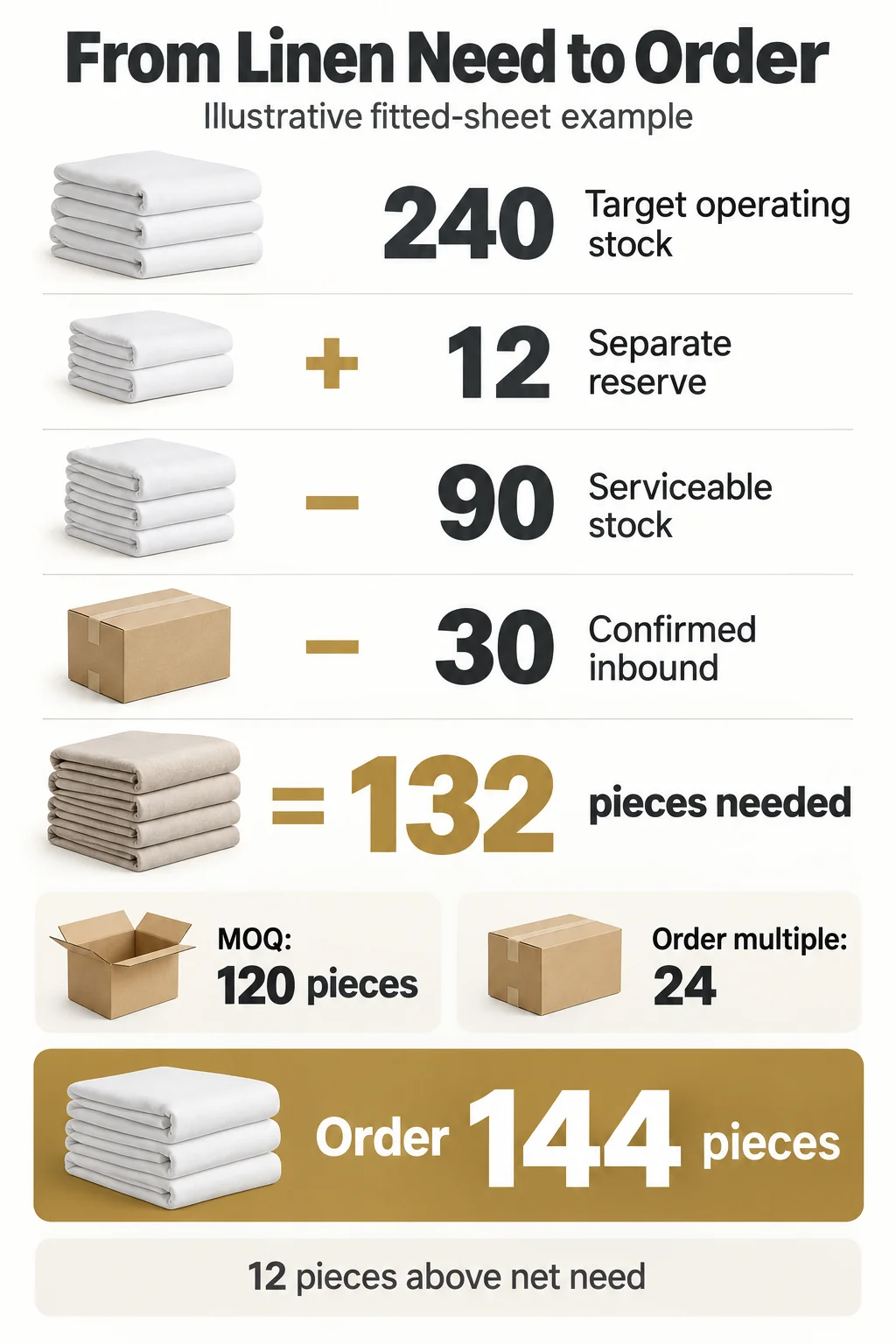
Use this planning relationship for each SKU: net requirement = target operating quantity + separately planned reserve − serviceable inventory − confirmed inbound stock allocated to this need. Avoid adding a reserve twice if it is already included in the target. Treat inbound stock as available only when its specification, allocation, and arrival date support the requirement.
For example, assume a property has 80 beds using one queen fitted sheet each. Management selects three par for this illustrative calculation, adds a separate reserve of 12 sheets, and confirms 90 serviceable sheets plus 30 inbound sheets that will arrive in time. The net requirement is 240 + 12 − 90 − 30 = 132 sheets. If the SKU minimum is 120 and the order multiple is 24, the order becomes 144 sheets. The extra 12 result from the ordering multiple, not a change in the operating requirement.
Distinguish stock, custom, and mixed orders
Ask whether the minimum applies to available stock or a new production run. For custom bedding, determine whether fabric, dyeing, labels, embroidery, or packaging creates a separate minimum. Confirm whether queen and king sizes can share a fabric minimum while retaining individual cutting or packing minimums. A combined order is useful only if the supplier accepts that combination in writing.
When the minimum substantially exceeds demand, request alternatives: an existing stocked specification, a smaller paid trial, staged releases, or a different pack configuration. Each alternative needs its own price and commitment terms. A staged delivery can reduce on-site storage while still obligating the buyer to purchase the full quantity. Confirm who holds the stock, storage charges, release deadlines, and what happens to unreleased inventory.
For the wider commercial background, see understanding minimum order quantities for wholesale hotel supplies. For bedding, the additional discipline is to apply those terms separately to every size and component that housekeeping must keep available.

Translate Pack Size Into Usable Quantity and Comparable Cost
Pack size determines how a valid requirement becomes a billable and receivable order. Require the quotation to state the sales unit, pieces per inner pack, inner packs per master carton, and any mandatory carton or pallet multiple. Keep the meaning of a set explicit, including each component and size. Two offers with the same price per pack may provide different numbers of usable pieces. Compare equivalent approved products using both total cash outlay and cost per accepted piece. Then examine the surplus created by rounding: a lower unit price can still produce an unnecessarily large purchase or an awkward mix of components.
Make the unit conversion visible
Write the conversion directly on each purchase order line. For example: “Pillowcase, specified size, 12 pieces per inner pack, 4 inner packs per carton, 10 cartons, 480 pieces total.” If a quote is per dozen, translate it to a per-piece amount before comparing it with a piece-priced offer. If the buyer needs complete bed sets, also show how many complete sets the component quantities can actually assemble.
Where one pack multiple applies, calculate the order quantity by rounding the greater of the net requirement and MOQ up to the next permitted multiple. If the supplier imposes several restrictions, verify the final quantity against all of them. Do not assume a permitted carton count also satisfies a custom production minimum.
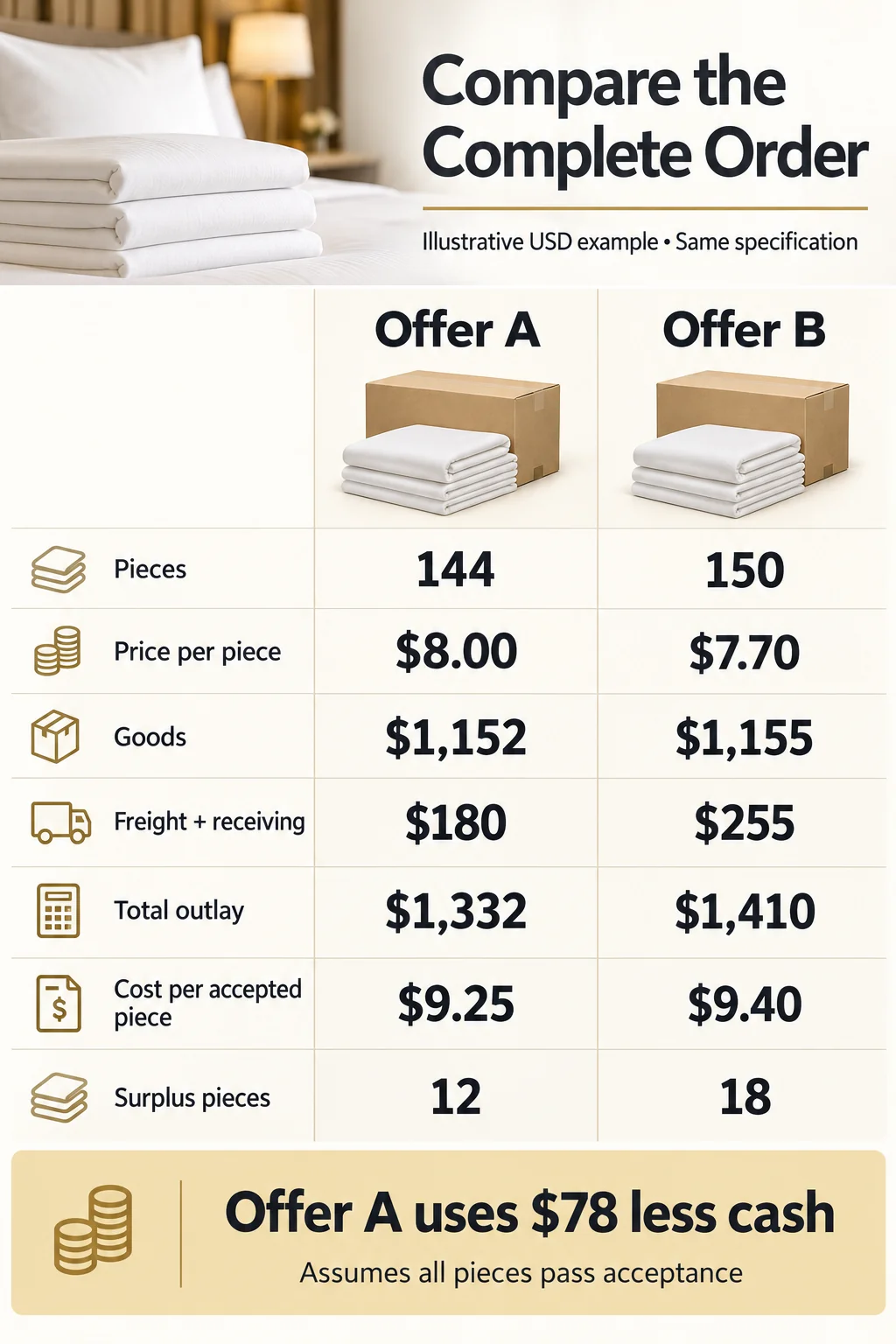
The table below compares hypothetical offers for the same approved fitted-sheet specification and a net requirement of 132 pieces. All figures are illustrative USD amounts. Freight and receiving are assumed to be the only additional acquisition charges in this example; real quotations may have other charges.
| Comparison item | Offer A | Offer B |
| SKU minimum | 120 pieces | 120 pieces |
| Mandatory order multiple | 24 pieces | 30 pieces |
| Rounded purchase quantity | 144 pieces | 150 pieces |
| Price per piece | $8.00 | $7.70 |
| Goods subtotal | $1,152.00 | $1,155.00 |
| Freight and receiving | $180.00 | $255.00 |
| Total acquisition outlay | $1,332.00 | $1,410.00 |
| Cost per accepted piece, assuming all pass | $9.25 | $9.40 |
| Pieces above current net requirement | 12 | 18 |
Offer B has a lower item price but requires $78 more cash and creates six additional surplus pieces. Offer A is preferable on these assumptions if both offers have equivalent quality, timing, and replacement terms. A different freight quote, useful future demand, or a substantial lead-time advantage could change the decision. The table demonstrates a comparison method; it does not predict actual market prices.
Include costs created by the order structure
Build the acquisition total from goods, customization, inspection, freight, cargo cover where purchased, brokerage, applicable nonrecoverable import charges, final delivery, and receiving costs. Keep currency and tax treatment consistent across offers. Separately assess storage, handling, and the risk that excess sizes will become obsolete. Obtain destination-specific import costs from the responsible broker or provider instead of applying a generic duty percentage to all bedding.
For imports, request packed carton dimensions, gross weight, carton count, and the palletized shipping footprint. A low textile weight does not guarantee low transport cost, especially for bulky inserts. Compare compression options only after confirming that the product recovers its required appearance and performance under the agreed unpacking process.
If the economics depend on spreading delivery across several dates, ask for a bedding sourcing quotation from KW Hospitality that separates the full purchase commitment from each shipment and release charge. Include the piece counts, packing requirements, destination, and required in-service date so the alternatives can be compared on the same basis.

Allocate Shipping Risk and Plan the Receiving Handoff
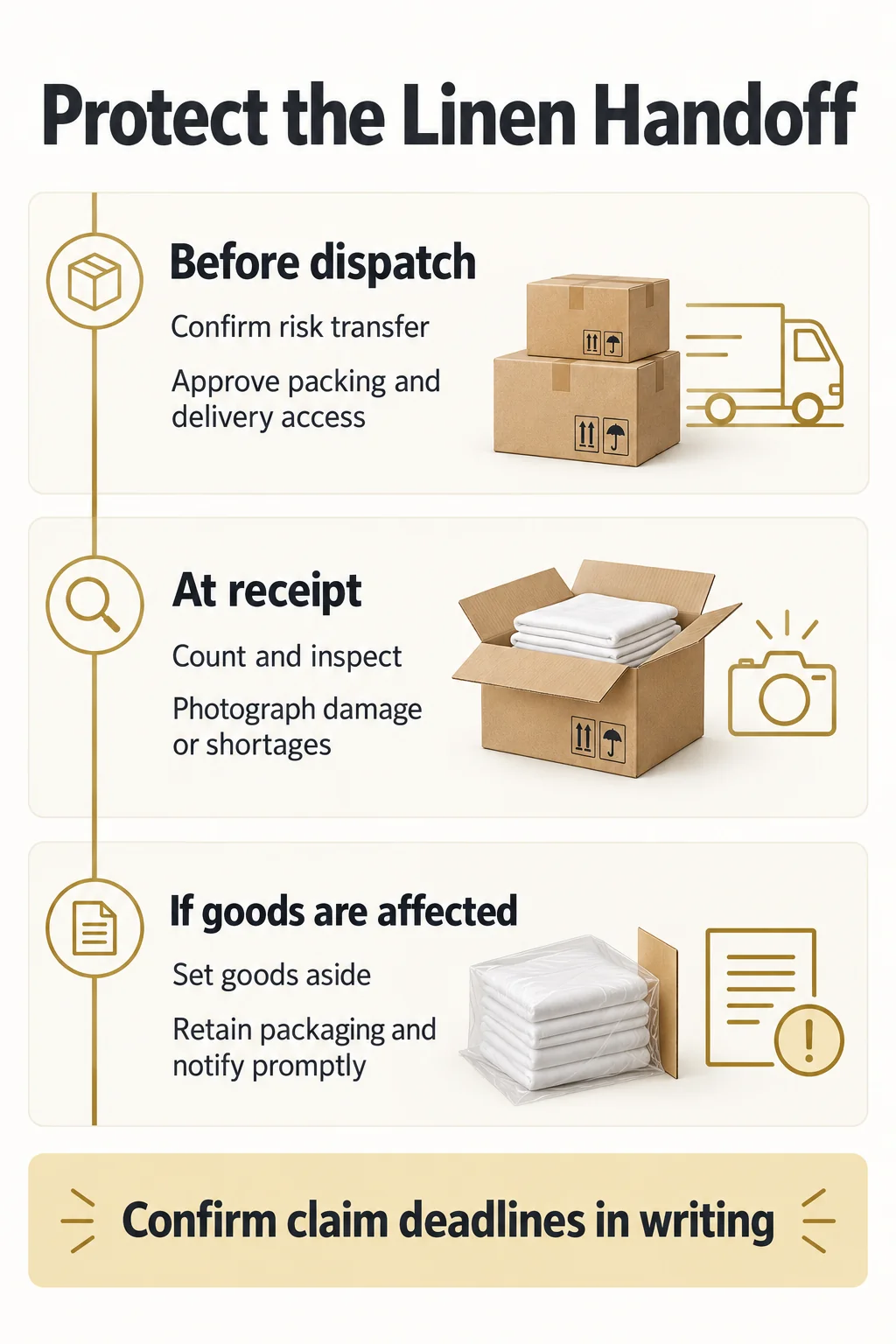
Shipping terms should identify who arranges each transport stage, who pays the associated charges, and when responsibility for loss or damage transfers. Those answers may differ, so a freight-inclusive quote is not enough. Record the named location and the applicable version of any agreed Incoterms rule, then confirm how the shipment will reach the actual receiving point. Bedding also needs a practical inspection and containment process: clean-looking cartons can contain wrong sizes, missing pieces, or moisture-affected goods. Arrange evidence collection and an escalation contact before dispatch so the team can act promptly when an exception appears.
Separate transport obligations from other sales terms
Incoterms allocate specified delivery tasks, costs, and risks. They do not settle all sales conditions, payment timing, title transfer, or remedies for nonconforming products and delays. Put those matters in the purchase agreement separately. Do not interpret “shipping included” as proof that the seller retains transit risk until the hotel accepts the goods.
Ask the logistics provider to explain the chosen rule for the actual transport mode and route. State the named place precisely and confirm unloading, delivery appointments, access restrictions, storage, and redelivery charges. Identify who files a cargo claim and what insurance, if any, applies. Confirm coverage limits and exclusions separately from a carrier’s liability terms.
Specify protection for the actual journey
Request a packaging proposal covering clean inner protection, carton strength, pallet stability, and protection from moisture and contamination. Ask for photographs of a packed production carton and a completed pallet before shipment. Product labels and packing lists should connect each carton to the SKU, size, quantity, and production lot. A photograph of a sample does not establish how the bulk order will be packed.
For consolidated shipments, confirm that bedding will be separated from liquids, sharp items, odors, and other incompatible cargo. Ask how the logistics team will keep cartons off wet surfaces and protect them during transfers. Where compression is used, agree on maximum storage duration in that condition and the recovery procedure recommended for the product. Do not introduce a compression method solely to reduce freight without testing the resulting bedding.
Work backward from the date the linens must be ready for guest use. Include sample approval, production, inspection, transport, clearance where applicable, receiving, initial laundering where required, and internal distribution. An estimated vessel arrival or warehouse dispatch date is not the same as an in-service date. Ask which milestones are estimates, which are commitments, and what happens if a critical milestone slips.
Preserve evidence without delaying operations
At receipt, reconcile the shipment identification and carton count with the packing list. Record visible damage or shortage specifically on the receiving documentation, take photographs, and follow the carrier’s instructions. Open a planned spread of cartons across sizes and lots to check identification, count, condition, and dimensions. Agree the inspection scope and acceptance criteria before shipping rather than inventing a pass rate at the dock.
Set questionable goods aside and retain packaging and supporting documents while the supplier or carrier investigates. Keep transit damage, manufacturing defects, and quantity discrepancies as distinct issues with named owners. Ask for the applicable notice and claim deadlines in writing; they vary by service and contract. A delivery-receipt notation is useful evidence but should not be treated as the entire claims process.
Clarify the remedy as well as the reporting procedure: replacement or credit, responsible party for replacement freight, treatment of inspection or sorting costs, and timing of the response. A future credit may have little operational value if the opening schedule requires immediate usable sheets.

Agree Reorder Terms Before the Opening Purchase
Reorder terms should make a smaller replacement purchase understandable before the larger first order is approved. Ask the supplier to state the repeat-order minimum, pack multiple, lead-time basis, price validity, and specification controls for each essential SKU. A product name or collection name alone is insufficient to ensure that later stock will fit and look consistent with the original delivery. Preserve an approved specification and sample reference, and require approval before substitutions. Build the replenishment decision from permanent depletion and the time needed to receive usable replacements; normal movement through the laundry cycle should not be counted as new consumption.
Preserve the specification and replacement route
Record fiber composition, fabric construction, dimensions and tolerances, fit after the agreed laundering process, color, seams, closure details, and labeling. For inserts, preserve the relevant fill and construction requirements as well. Keep an identified reference sample and a dated specification revision. Evaluate proposed repeat stock against these records, including compatibility with the property’s laundry process.
Ask how long the supplier expects to offer the item, how a change or discontinuation will be communicated, and whether a last-time order is possible. Treat an availability statement as limited to its written scope. Do not assume it guarantees unchanged production indefinitely. Where a replacement product is proposed, approve a sample before accepting it for the same guestroom presentation.
Buyers should also retain the ability to reorder individual components. If pillowcases wear out faster than duvet covers, a set-only minimum can make replacement inefficient. Ask whether component purchases, mixed-size repeat orders, or a small stocked reserve are available, and price each option explicitly.
Use a replenishment trigger tied to permanent depletion
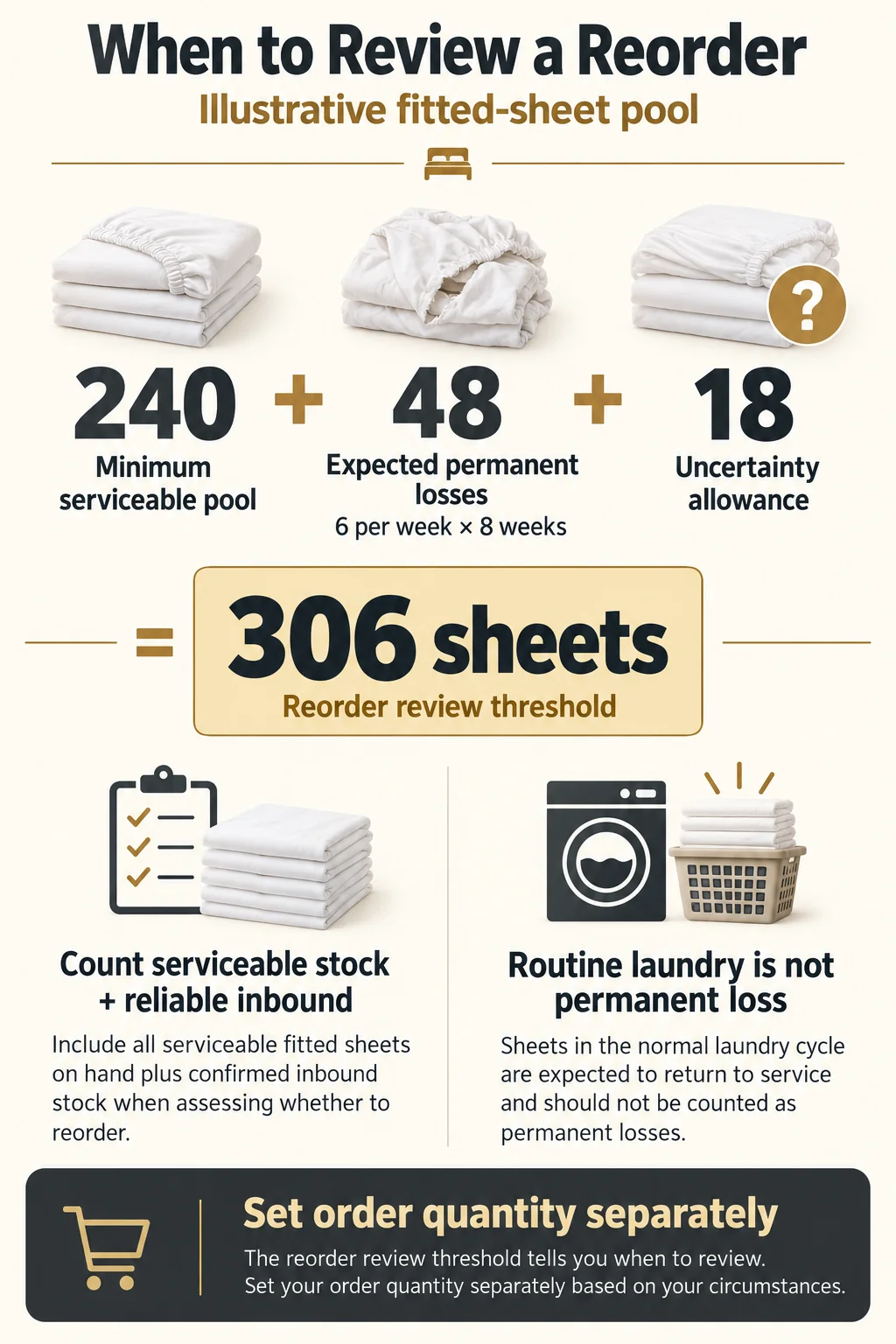
For an established linen pool, set a minimum serviceable pool that supports the chosen operating par. Then add expected permanent losses during replenishment lead time and an uncertainty allowance. Use the same unit of time for both the loss rate and lead time. Count confirmed inbound replacements once and avoid treating stock committed elsewhere as available.
For example, suppose the minimum pool is 240 fitted sheets, permanent retirements average 6 sheets per week, replenishment takes 8 weeks, and the buyer chooses an additional uncertainty allowance of 18 sheets. The illustrative trigger is 240 + (6 × 8) + 18 = 306 sheets. Review an order when the serviceable pool plus reliable inbound replacement stock reaches that threshold. Sheets temporarily in routine laundry remain in the serviceable pool if they are expected to return fit for use.
This trigger is not the purchase quantity. Set the order-up-to target separately, subtract the inventory position, and apply MOQ and pack rounding. Review the assumptions when room count, occupancy, retirement rate, laundry turnaround, or supplier lead time changes. A new property without loss history should use provisional assumptions and revise them as operating data becomes available.
Clarify price, releases, and payment milestones
Distinguish quote validity from any agreed price protection for later releases. Confirm currency, the basis for revised pricing, notice before a price change, and whether later orders are repriced at order entry or release. Record deposit requirements, balance-payment milestones, cancellation terms, and the treatment of supplier-held stock. These are negotiation points, not terms that should be inferred from the first invoice.
Before approval, bring the initial and replenishment requirements together in one request: approved product specifications, quantities by SKU, pack conversions, delivery destination, in-service date, shipping responsibility, inspection arrangement, and repeat-order expectations. Use the KW Hospitality contact form to discuss the proposed purchase and request written confirmation of the terms that remain open.

Conclusion
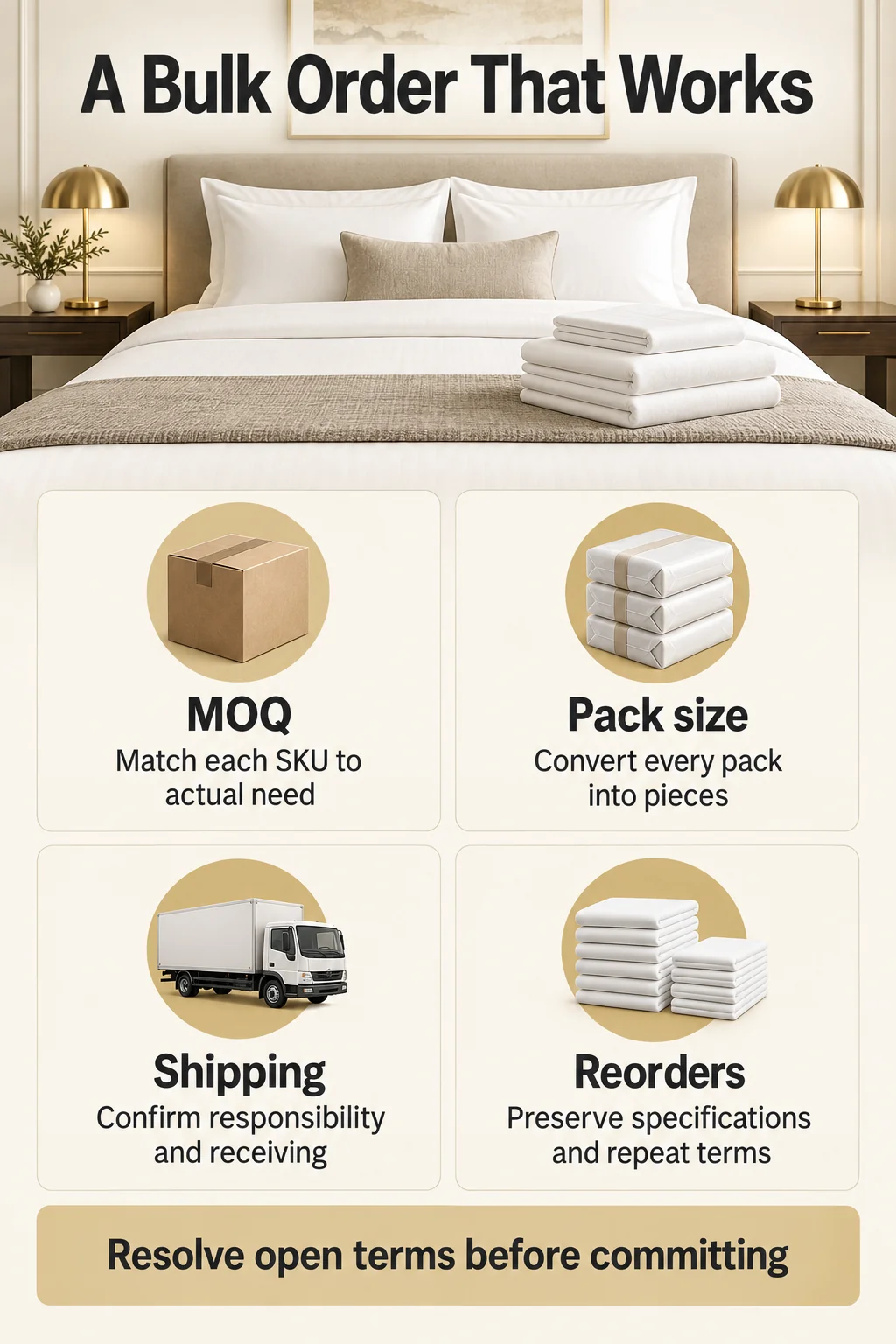
A workable bulk linen purchase connects the property’s actual requirement to an order it can receive, use, and replenish. Validate the MOQ at SKU level, convert every pack into pieces, and compare complete acquisition outlay alongside surplus stock. Resolve shipping responsibility and receiving procedures before dispatch, then preserve the specification and commercial terms needed for smaller repeat purchases. The most useful final approval question is whether housekeeping can keep the required beds supplied throughout the delivery and replacement cycle. If an answer still depends on an undefined pack, an assumed arrival date, or an unwritten substitution policy, resolve that point before committing the order.
The purchase should leave both parties with the same understanding of what will arrive, in what quantity, under which acceptance conditions, and how future needs will be handled. That clarity gives the quoted price practical meaning.
Frequently Asked Questions
Can several hotels combine their orders to meet one MOQ?
They can if the supplier accepts the combined quantities and the properties share compatible specifications. Confirm whether the minimum applies across the group or separately by size, color, delivery, or legal buyer. Also allocate freight, payment obligations, shortage handling, and surplus ownership. A shared order loses value if individual properties must accept stock they cannot use.
Should sample costs be deducted from the bulk invoice?
Only when that credit is explicitly agreed. Record the sample charge, shipping charge, credit amount, qualifying order conditions, and the invoice on which the credit will appear. Keep sample approval separate from the credit: a paid or credited sample still needs a specification reference and a clear relationship to the approved bulk production.
What if the first wash reveals a fit problem?
Set aside the affected lot and compare the results with the approved laundering procedure and dimensional criteria. Record before-and-after measurements, product identifiers, wash conditions, and the number of affected items. Notify the supplier within the agreed reporting period. Avoid washing the entire shipment before checking an initial batch unless that approach is part of the agreed acceptance plan.
Is an emergency local top-up compatible with a custom linen program?
It may be, but verify dimensions, fit, appearance, and laundry compatibility before mixing it into guest use. A visually similar sheet may behave differently after washing or fit a different mattress depth. Consider reserving the substitute for a defined room group while the approved stock is replenished, and keep its SKU separate so later ordering and retirement records remain accurate.
Does a supplier-held reserve eliminate inventory risk?
No. It can reduce on-site storage and shorten release time, but the agreement must define ownership, payment, insurance, storage conditions, allocation, release charges, and the final collection date. Confirm whether the stock is physically reserved for your property and what happens if the supplier cannot fulfill a release. Reserve stock also remains vulnerable to specification changes and declining demand.