
Preventing change orders in accessibility supplies starts with a documented comparison between the proposed equipment and the property where guests will use it. Before issuing a purchase order, verify the installed arrangement, structural support, utilities, room variations, delivery route, and responsibilities for installation and testing. Resolve any condition that could change the product, its location, its quantity, or the work needed to put it into service. A catalog description cannot establish that a particular installation will meet the project’s accessibility requirements.
This distinction matters because accessibility products interact with the building and with one another. A folding shower seat needs suitable support and a compatible shower layout. A grab bar must remain usable after dispensers and other accessories are installed. A portable notification device depends on its intended function, placement, power, and compatibility. Equipment may arrive exactly as ordered yet still require relocation, different fixings, additional work, or replacement because the original order relied on an unverified assumption.
This guide is for hospitality owners, procurement teams, operators, designers, and installers preparing openings, renovations, or targeted replacements. It focuses on site-dependent accessibility supplies, including bathing supports, guest communication equipment, and pool access equipment where included in the project. US accessibility examples provide context; the responsible project professionals must confirm the requirements and adopted codes for the actual jurisdiction. Canadian and other projects need their own applicable design basis.
The objective is to reduce avoidable changes while making unavoidable uncertainty visible. Concealed construction, revised design decisions, and authority requirements can still affect an order. A useful review therefore ends with evidence, a named decision owner, and a clear purchase restriction for every unresolved issue. The following approach connects those findings to room-specific requirements, supplier quotations, sample approval, and final release, so that the inspection changes what the team buys and how the work is priced.
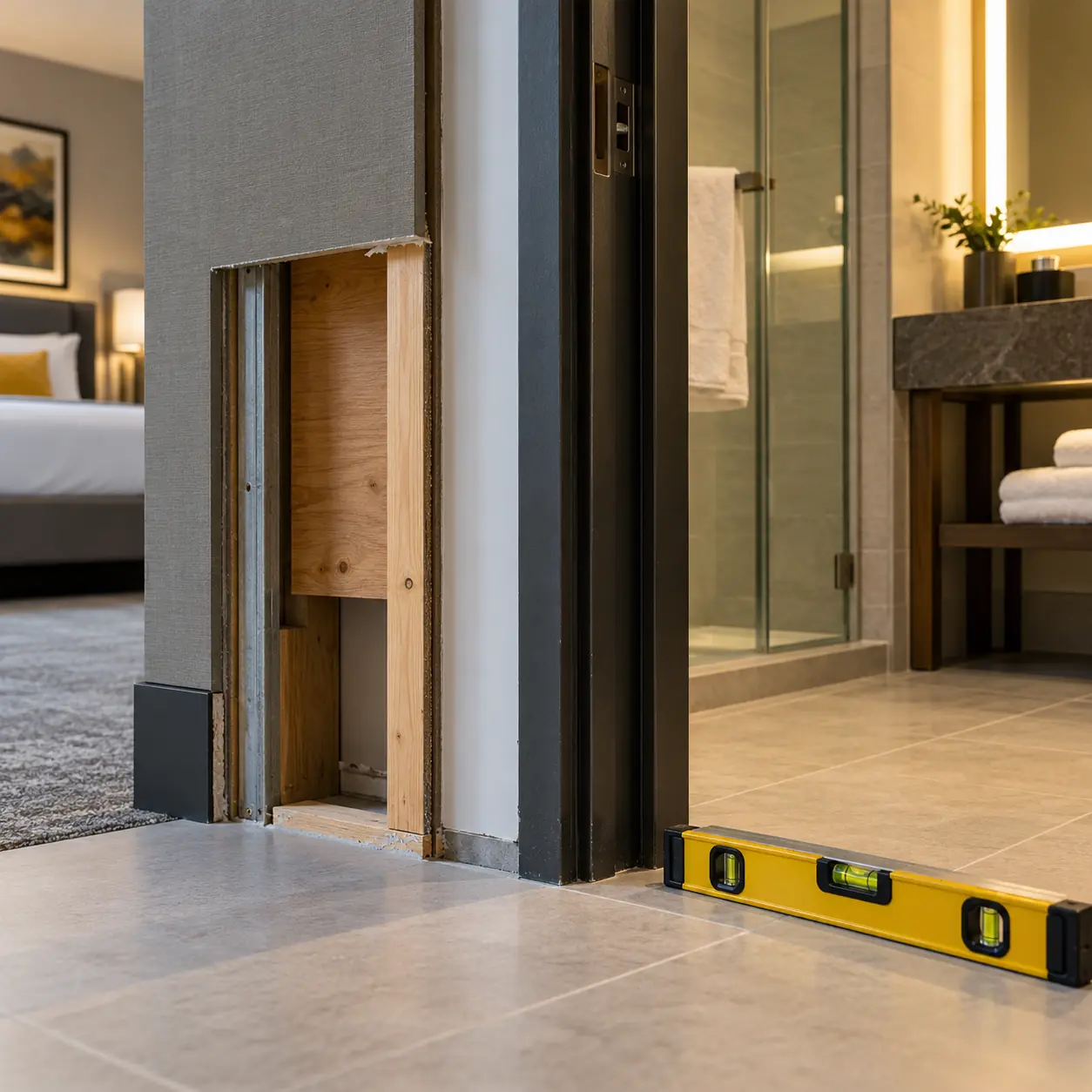
Establish the Site Conditions That Control the Purchase
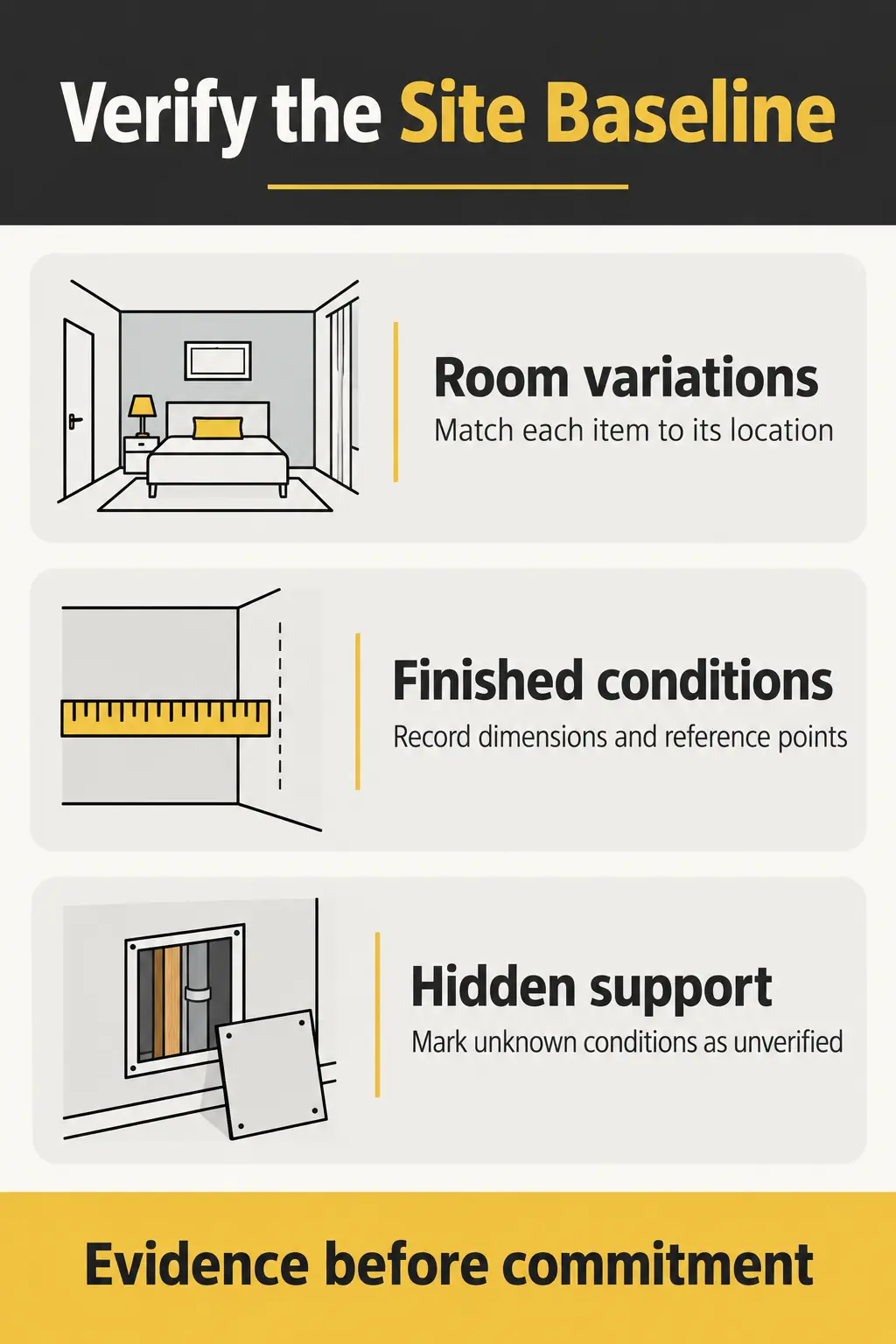
Start the review by establishing which conditions are verified, which will change before installation, and which remain unknown. The same model number can be appropriate in one accessible room and unsuitable in another because the shower arrangement, wall support, door movement, or utility location differs. Organize the review around these differences before counting units. Procurement should coordinate the record, while design, engineering, operations, and the installer confirm the matters within their responsibility. The purchasing baseline becomes reliable only when the room schedule and the evidence describe the same finished condition, with unresolved conditions clearly separated from approved requirements.
Define the design basis and the limits of the review
Identify the destination jurisdiction, project type, affected spaces, and applicable accessibility requirements before evaluating a proposed substitute. New construction, alterations, and work in an existing facility can raise different questions. Record who is responsible for interpreting the requirements and coordinating with the authority having jurisdiction. Do not allow a general claim such as ADA compliant to replace approval of the specific configuration, mounting details, and installed relationships.
Separate physical accessibility from communication features in the equipment schedule. They may involve different room assignments, systems, and review specialists. Confirm the underlying room requirements through the design team rather than estimating them from occupancy or buying an arbitrary number of portable kits. The site review verifies the purchase against the established design basis; it does not independently determine how many accessible rooms the hotel must provide.
Inspect variations that a model room can hide
Group rooms by the conditions relevant to the product: shower configuration, seat orientation, wall construction, door arrangement, communication infrastructure, and renovation phase. Include known exceptions such as repaired walls, relocated valves, unusual corners, and rooms with different finishes. Inspect a representative condition to evaluate the concept, then verify critical dimensions and support at each affected installation location before fabrication or drilling. A representative room is not proof that every location is identical.
Use consistent room identifiers and product item codes in measurements and photographs. Show both the overall arrangement and the particular contact or mounting point. State the units, reference points, date, drawing revision, and whether the measurement is to the finished surface. A tiled wall still awaiting another finish layer is a future condition, not a finished dimension. Where clearance is critical, record measurement uncertainty and have the responsible reviewer determine whether additional verification is needed.
Record concealed conditions honestly
A photograph of tile does not establish the backing behind it. Mark unsupported assumptions as unverified and identify how they will be resolved through reliable construction records, inspection access, approved investigation, or another suitable method. Any opening or destructive investigation needs coordination with the property and contractor, including restoration and waterproofing responsibilities. Do not turn an unknown substrate into an instruction to use whatever anchors are available.
For a wider room refresh, coordinate this equipment review with the guest room supplies site review. The shared room identifiers and delivery information can support both packages, while accessibility-specific approvals remain tied to the relevant product and installed arrangement.
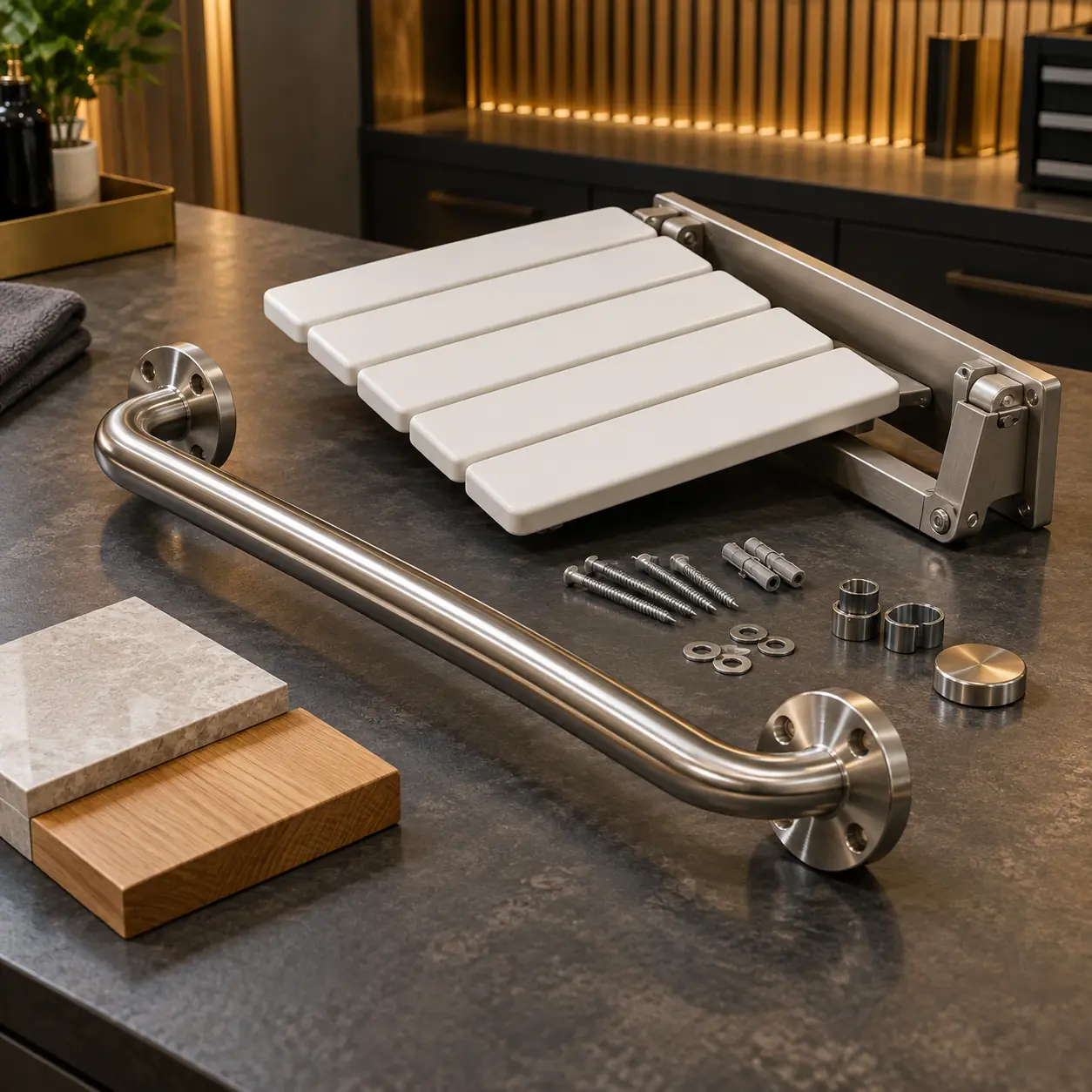
Resolve Accessibility Product and Building Interfaces
Evaluate each proposed item as part of a usable installation. Product dimensions, load information, and finish samples answer only some of the purchasing questions. The site review must also establish whether guests can approach and operate the equipment, whether the building can support it, and whether adjacent fittings interfere with its function. Test the intended arrangement with the correct model, installation instructions, and room information together. A mock-up can expose a mismatch, but it does not replace technical review, required testing, or approval of concealed construction. Record the precise condition that makes the proposed item acceptable at that location.
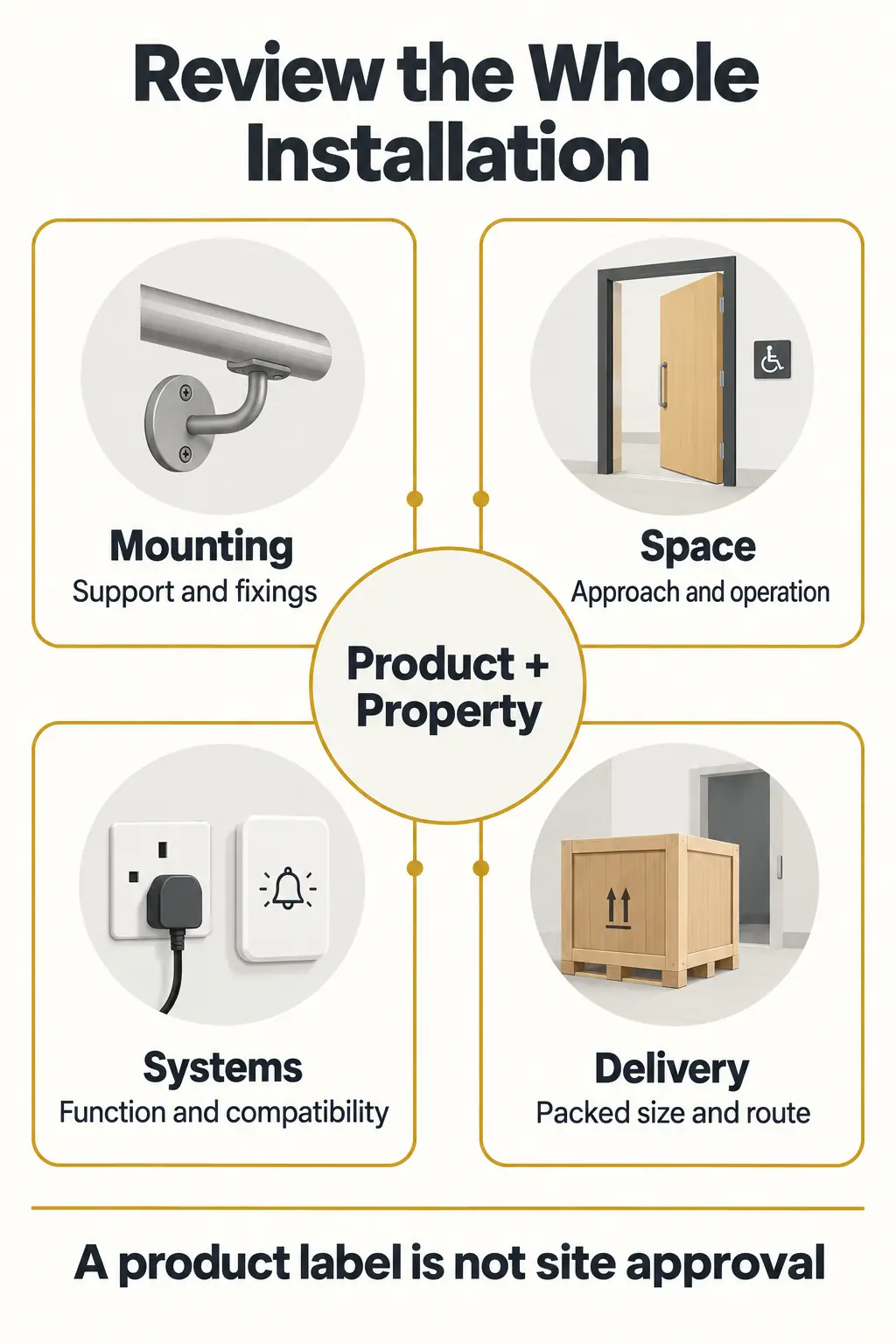
Bathing supports and the complete mounting assembly
For grab bars and wall-mounted shower seats, obtain the manufacturer’s current mounting requirements, dimensions, permitted substrates, and specified fasteners. Have the responsible installer or engineer reconcile those requirements with verified wall construction. Product load information must be evaluated with the fasteners, mounting devices, and supporting structure. A number on the seat label alone is not evidence that the installed assembly is adequate, and an accessibility structural requirement should not be interpreted as a universal guest weight rating.
Confirm the shower type and seat orientation before approving the room application. Evaluate the deployed seat, transfer space, grab bars, controls, hand shower, enclosure, and nearby accessories as a coordinated arrangement. Different shower configurations have different dimensional relationships; increasing one dimension or substituting a similar-looking seat is not automatically acceptable. Record the approved orientation in the item schedule so that mirrored rooms do not receive a single undifferentiated product allocation.
Check accessories in their operating positions. A dispenser can interfere with gripping space even if its fixing holes miss the grab bar. A folded seat may fit neatly while its deployed footprint conflicts with another fixture. Cleaning and refilling can also reveal problems that a static photograph misses. Do not resolve a conflict by moving required equipment informally; obtain an approved arrangement and update the affected drawing and product instructions.
Guest communication and notification equipment
Define the exact function before buying an alerting device: door notification, telephone notification, an auxiliary wake-up aid, or another stated use. Confirm how the proposed equipment interacts with the property’s telephone service, door devices, power supply, and any connected systems. Identify whether specialist installation or system-provider approval is needed. Portable guest aids must not be assumed to replace required building fire alarm notification or other mandated communication features.
Arrange a controlled demonstration in the intended environment with the responsible specialist. Document triggering, signal reception, device placement, reset, charging, battery replacement, and the agreed behavior during loss of power or connectivity. Keep life-safety system work and testing under qualified personnel and the property’s procedures. Operations should establish where supplemental devices are stored, how their readiness is checked, and how staff deliver and explain them without misrepresenting their capabilities.
Pool access equipment and delivery constraints
Where pool lifts are in scope, the selected model must be coordinated with the pool edge, water level, deck arrangement, approach space, anchoring requirements, operating characteristics, and servicing needs. Have the appropriate reviewer determine which accessibility provisions apply to that pool and project. A lift described as portable or accessible is not by itself proof that the proposed installation and operating plan satisfy those provisions. Confirm storage, charging, setup, maintenance, and availability as operational requirements.
Verify transport using the actual packed and assembled dimensions supplied for the approved model. Trace the delivery route through gates, service doors, elevators, turning points, and any temporary construction barriers. Confirm unloading equipment and whether disassembly is permitted by the manufacturer. The item may fit at the destination while its crate cannot reach it. Any special handling, assembly, or protection must appear in the scope and price before shipment.
Compare the failure mechanism with the required decision
| Observed mismatch | Potential purchasing consequence | Decision needed before release |
| Seat orientation differs between rooms | Wrong variant or mounting layout | Approve a room-to-variant allocation |
| Support behind the finish is unknown | Extra reinforcement and restoration | Verify support and approve the mounting detail |
| Accessory obstructs equipment in use | Relocation or different product | Approve the complete operating arrangement |
| Notification function is undefined | Incompatible or incomplete equipment | Define the function and verify compatibility |
| Shipping unit exceeds route limits | Special handling or repackaging | Agree an achievable delivery method |
These examples describe decision types, not a compliance certificate. The appropriate correction depends on the approved design, manufacturer’s instructions, local requirements, and actual site evidence. Use the consequence to identify the right reviewer and the affected quotation line, rather than treating every observation as a reason to change the product.

Turn Field Findings Into a Controlled Purchase Release
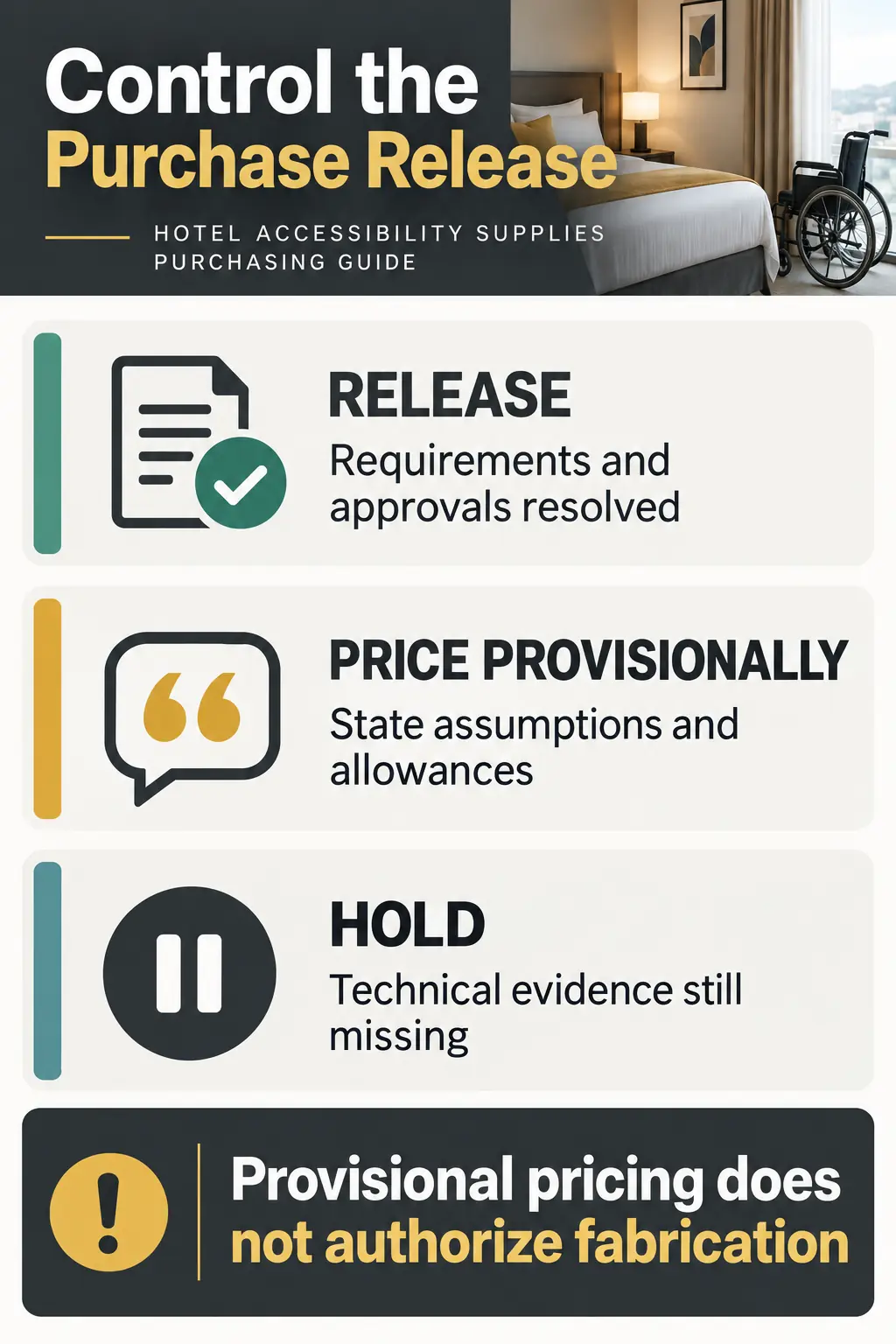
A site finding prevents a change order only when it changes the documents that authorize spending and production. Give every unresolved finding an item code, location, owner, required evidence, due date, and affected milestone. Then decide whether the item is ready for release, can be priced provisionally, or must remain on hold. Keep those states distinct. A supplier may be able to reserve capacity or quote an allowance while a technical issue remains open, but that does not authorize fabrication. The approved quotation, drawings, product schedule, and purchase order must ultimately refer to the same resolved requirements.
Assign work that a supply quotation may exclude
Identify who provides surveys, design details, reinforcement, anchors, electrical connections, drilling, waterproofing, making good, assembly, testing, staff instruction, and final acceptance. For each service, state whether it is included in the supplier’s price, included in another contractor’s scope, or awaiting a decision. Supply and installation is too broad if neither party has accepted responsibility for the underlying wall or system interface.
Request itemized pricing for known additional work and clearly described allowances for unresolved commercial quantities. State the assumed condition, what would cause the allowance to change, and how the final amount will be determined. An allowance can make cost uncertainty visible; it cannot make an unresolved structural or accessibility condition acceptable. Agree payment, cancellation, storage, and restocking consequences before using a reservation or partial order to protect the schedule.
Use separate gates for samples and production
Record what each approval actually covers. A finish sample may approve appearance without approving geometry. A functional sample may establish operation without proving compatibility in every room. A mock-up may confirm a room arrangement while the full production schedule still contains unchecked exceptions. Tie approval to the exact manufacturer, model, orientation, accessories, drawing revision, and intended room group. Document deviations instead of assuming that sample approved means every requirement has been satisfied.
Require proposed substitutions to return to the affected reviews. Compare mounting pattern, deployed envelope, controls, maintenance access, support requirements, accessories, certifications where applicable, and replacement availability. Similar size and finish are insufficient grounds for equivalence. State in the purchasing documents who may approve a substitute, which evidence is required, and whether the supplier must wait for written acceptance before changing production.
Example: one seat package, two site conditions
Consider a hypothetical renovation covering 24 shower-seat locations. Site verification finds 18 locations consistent with the reviewed mounting detail and six with a different wall assembly whose support remains unverified. The count alone suggests one bulk order. The evidence suggests two release groups. Provided all other approvals and dependencies are closed, the first group may be released under the approved detail. The second group remains blocked from fabrication or installation commitments that depend on the unresolved support.
The decision owner commissions the appropriate support review for the six exceptions. If reinforcement is required, the contractor prices the work, restoration, and schedule effect; the design team confirms the revised detail; procurement updates the affected purchase documents. If the review instead supports a different product, that variant undergoes the relevant technical and operational checks before approval. Either path makes the exception explicit before it becomes a field instruction after delivery.
Partial release is useful only when the groups can be separated commercially and operationally. Confirm minimum order constraints, finish consistency, split freight, packaging identification, later delivery dates, and the effect on room availability. The example illustrates a decision method, not a recommended sampling percentage or a savings estimate. No universal percentage of rooms or contingency allowance can replace verification of the conditions that determine the order.
Issue one final baseline and preserve the change record
Before release, reconcile approved quantities by room, product variants, accessories, revised drawings, scope inclusions, delivery conditions, and acceptance criteria. Have the supplier acknowledge the controlling revision and its exclusions. Keep superseded information accessible as history while clearly withdrawing it from current use. Any subsequent change should identify its reason, affected items, cost and schedule consequences, required approvals, and updated documents under the applicable contract process.
When the verified package is ready for pricing, contact KW Hospitality about your accessibility supplies requirements. Provide the room allocation, product requirements, approved interface details, quantities, destination, delivery target, and open commercial qualifications. Explicit inputs allow the sourcing discussion to address the actual property conditions without asking the supplier to make unassigned design decisions.
Conclusion
A pre-purchase site review reduces avoidable changes by connecting accessibility supplies to verified locations, approved installation details, and clearly assigned work. The most valuable result is a purchasing decision supported by evidence: release the resolved item, obtain a qualified price for a defined uncertainty, or hold the commitment that depends on an unanswered technical question. Keep room variations visible, test equipment in its intended operating arrangement, and ensure every approval has a stated scope. This approach supports clearer quotations and more orderly installation while recognizing that concealed conditions and legitimate project changes may still require controlled revisions.
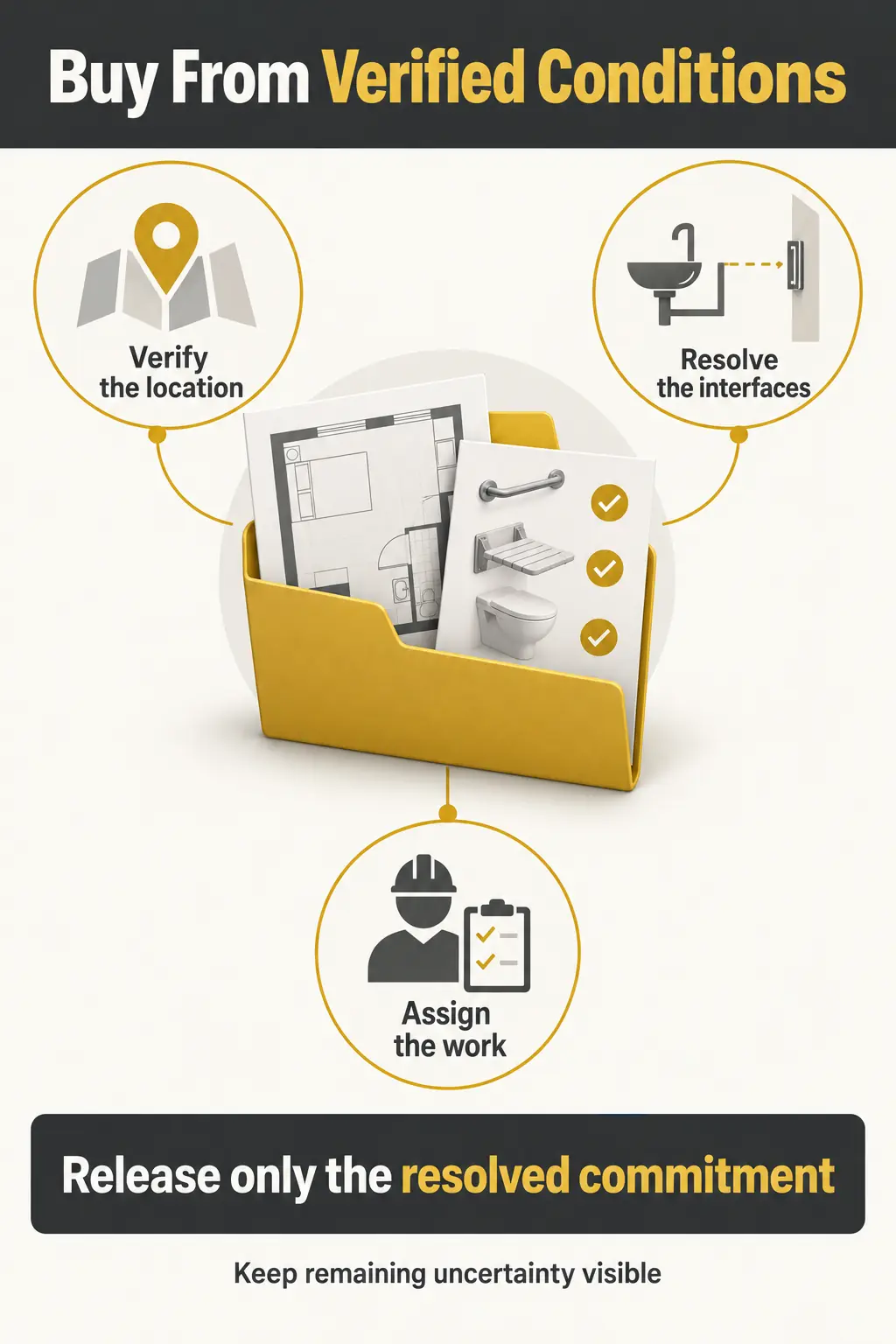
For the next procurement package, begin with the proposed item schedule and identify the building or system condition that controls acceptance of each site-dependent product. Close those dependencies before the corresponding purchase commitment. Use KW Hospitality’s contact form to begin a sourcing request with the verified package and clearly identified exceptions.
Frequently Asked Questions
Can a remote review replace a site visit?
A remote review can assess clear measurements, photographs, drawings, and product information when someone competent has verified the conditions on site. It cannot establish concealed support or resolve missing critical measurements from images alone. Use a targeted site visit or approved investigation where the purchasing decision depends on evidence the remote review cannot provide.
Does replacing an existing item with the same model eliminate the review?
No. Confirm the current model revision, mounting requirements, condition of the existing support, and suitability of the installed arrangement. A previous installation is evidence of what exists, not automatic proof of what is acceptable. Corrosion, repairs, changed finishes, or revised instructions can affect the replacement decision.
Should every unresolved observation stop the entire order?
Only the affected commitments and dependent items need to be held when they can be separated safely and commercially. An unresolved support condition should block the relevant installation or product decision. It need not automatically block an unrelated, fully approved item. Confirm that a partial release will not create incompatible variants, unmanageable freight, or an unusable installation sequence.
Who should approve a product advertised as ADA compliant?
The responsible project reviewers should evaluate the product data and the complete proposed installation against the applicable design basis. The supplier should provide accurate technical documentation and identify qualifications. Procurement records the approval and purchases the accepted configuration; a catalog statement does not transfer design responsibility or certify the finished room.
How should newly discovered conditions be handled after the order is placed?
Notify the designated decision owner promptly and stop the affected work or production commitment where appropriate. Document the condition, compare alternatives, obtain the required approvals, and agree the cost and schedule treatment through the contract process. Update the controlling documents before revised instructions are issued. Keeping a clear baseline makes the reason for the change easier to establish.