
Hotel bathrobe laundry cost per occupied room is the cost of processing guest-room bathrobes during a reporting period divided by occupied room-nights in that same period. For planning, multiply first-pass bathrobe washes per occupied room-night by processing cost per first-pass robe. Include rewash expense once, and report robe replacement and loss separately so the laundry figure remains useful.
That distinction matters when a purchasing team compares two robes with similar prices but different finished weights, drying behavior, or handling requirements. A lower purchase price can be offset by repeated processing expense. Conversely, a heavier robe does not automatically create a higher outsourced bill if the laundry charges the same amount per piece. The relevant cost depends on the property’s actual workflow and contract.
Start with three questions: How many occupied room-nights does the hotel serve? How many robes enter the laundry from those rooms? What does the hotel spend to return those robes ready for service? These quantities connect purchasing decisions to an operating result that housekeeping, finance, and the laundry team can all check. They also prevent a common mistake: treating two robes placed in every room as two robes washed every occupied night.
This guide develops a practical calculation for an on-premises laundry, explains how to adapt it to an outside processor, and shows how to evaluate a replacement robe. The worked example uses invented operating inputs in US dollars to demonstrate the method; it is not an industry benchmark, a supplier quotation, or a forecast for your hotel. Canadian properties can use the same formulas in CAD with local costs. An accompanying calculator lets you replace those assumptions, see the contribution of repeat processing, and keep the broader cost of the bathrobe program separate from the laundry-only result.
Define the Room-Night and Bathrobe Counts
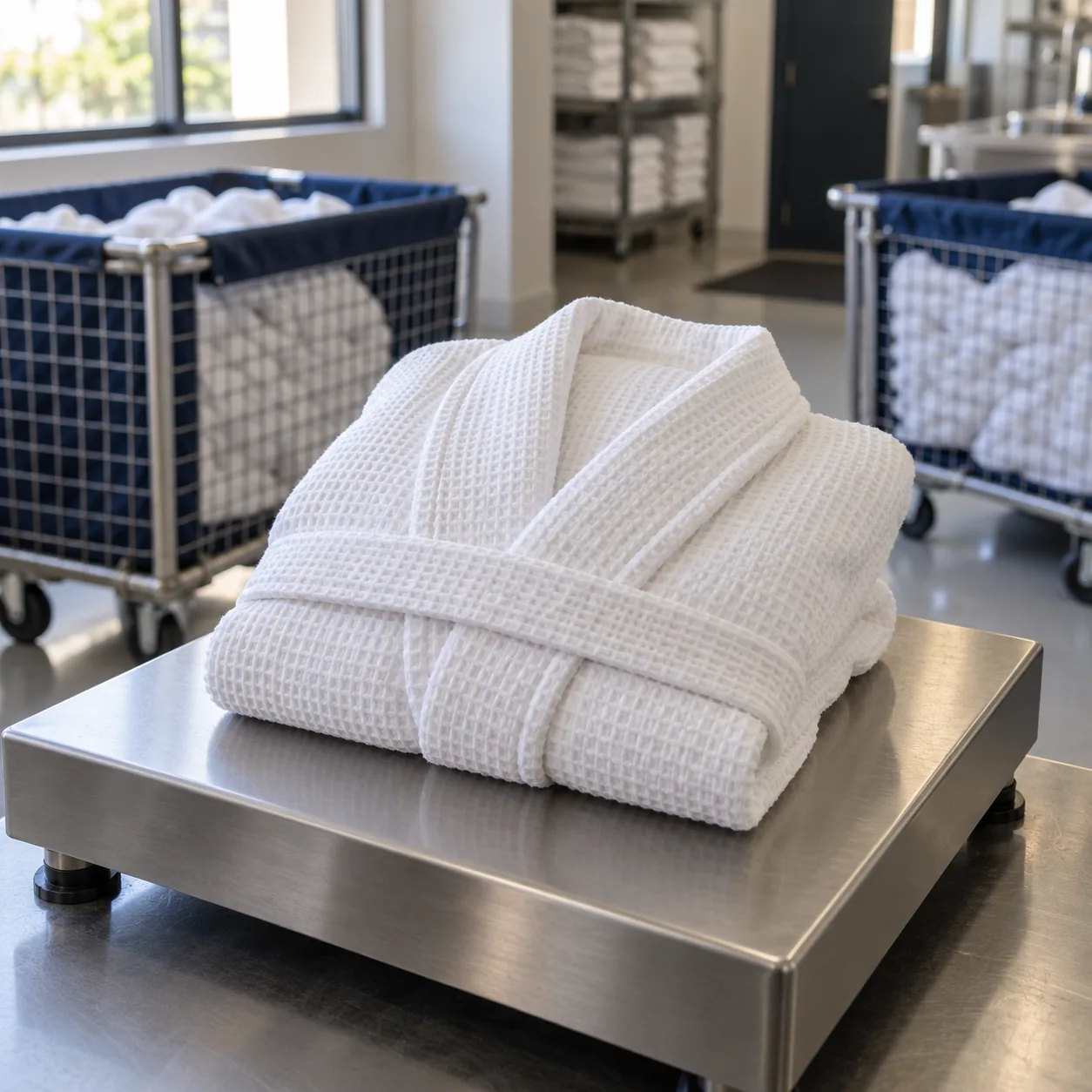
Use occupied room-nights as the denominator and first-pass bathrobe processing events as the volume measure. An occupied room-night means one occupied room for one night, regardless of guest count. A first-pass event means a robe entering the laundry from service; it is not a count of unique robes in inventory. The same physical robe can generate several events during the month. Keeping those definitions separate makes the model auditable and allows you to add repeat washing without counting it twice. Match the room-night, laundry-volume, and expense records to the same period before comparing properties or months.
Start with actual room-night records
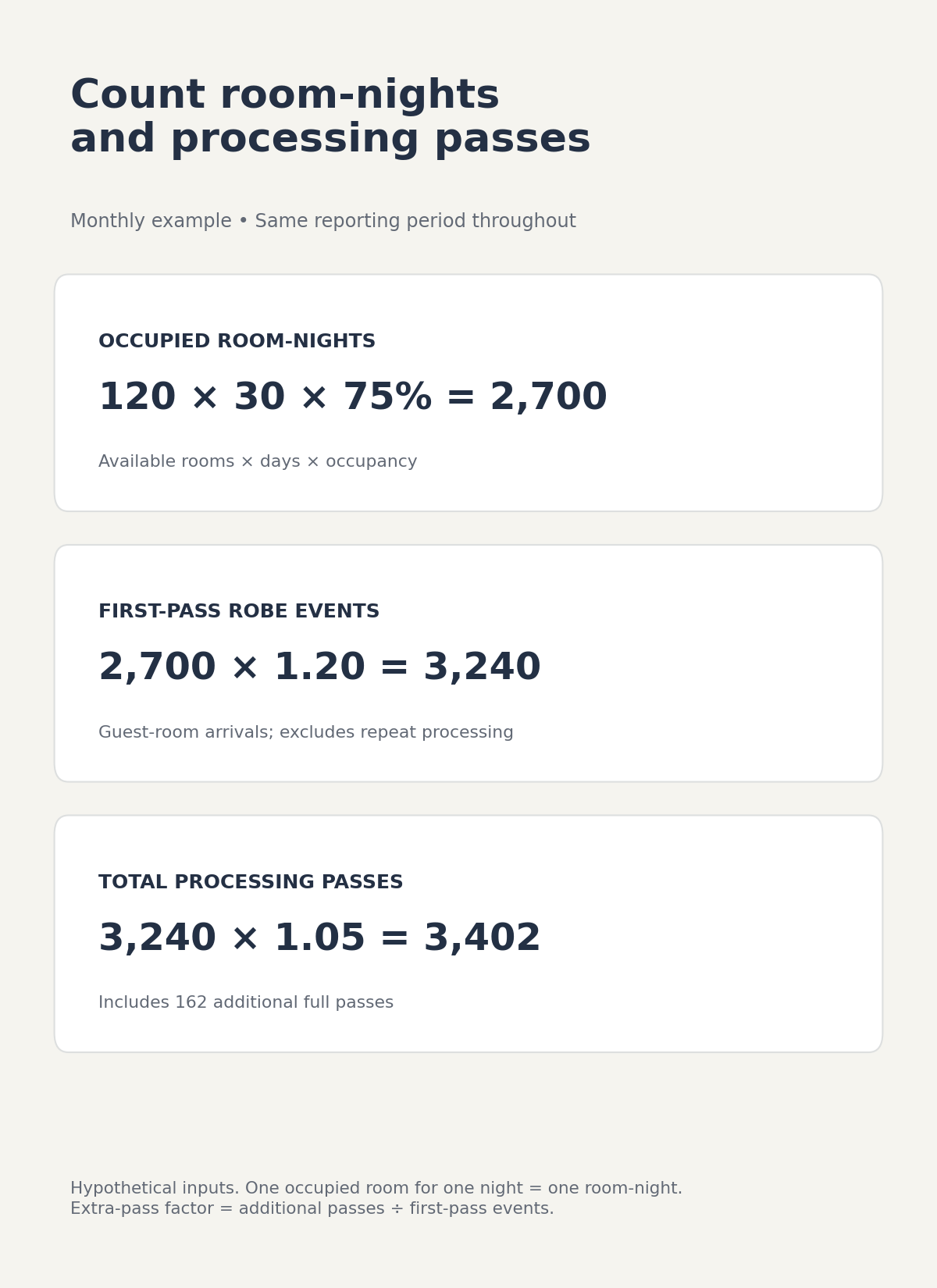
Use the occupied room-night total from your property management system. For a simple forecast with a constant available inventory, occupied room-nights equal available rooms multiplied by days multiplied by occupancy. A 120-room hotel at 75% occupancy over 30 days has 2,700 occupied room-nights. If rooms go out of service during the month, calculate from daily available room-nights rather than assuming the full inventory was available throughout.
Keep the denominator consistent with your finance reporting policy, including treatment of complimentary rooms. If only suites receive robes, calculate both a whole-hotel measure and an eligible-room measure. Divide the same suite robe expense by all occupied room-nights for the former, and by occupied suite room-nights for the latter. Label them clearly; the two numbers answer different questions.
Measure washing demand instead of assuming it
Define first-pass robes per occupied room-night as guest-room robe arrivals at the laundry divided by occupied room-nights. Include departure changes, stayover replacements, guest requests, and robes removed under the hotel’s room-reset procedure. Separate spa and pool robes unless their expense is deliberately allocated to the room program.
For forecasting, build volume from departure rooms times robes removed per departure, plus stayover rooms times robes changed per stayover, plus other recorded guest-room changes. These categories must be mutually exclusive. Longer stays can reduce departure-related washes per room-night without reducing occupied rooms, while extra guest requests can move demand in the opposite direction.
Do not infer a robe’s hygiene status from appearance or change cleaning standards to achieve a cost target. Follow the property’s approved handling, guest-change, and laundering procedures. Cost analysis should describe the service actually delivered.
Use one rewash convention
In this model, the rewash factor is additional full processing passes divided by first-pass events. If 3,240 first-pass events create 162 extra passes, the factor is 5%, and total passes are 3,402. Count every additional pass, including a third pass on the same robe.
Total passes = first-pass events × (1 + extra-pass factor).
A rewash percentage calculated against all passes has a different denominator and cannot be inserted directly into that formula. Also record redrying or spot treatment separately when these do not repeat the entire process. If your observed monthly laundry expense already includes repeat work, do not multiply that expense by another rewash allowance.
Build the Laundry Cost and Calculate a Worked Example
Build the laundry numerator from costs attributable to bathrobe processing, using measured consumption where possible and documented allocation where equipment or staff are shared. Separate the cost that grows with processing volume from monthly allocations that continue even when occupancy falls. This distinction lets you calculate a complete operating cost while avoiding exaggerated savings claims. A robe that requires less processing can release capacity, but an allocated lease or depreciation charge will not disappear automatically. The following example makes every input explicit and keeps replacement expense outside the laundry numerator until the broader program cost is calculated.
Decide what belongs in the numerator
| Cost component | Practical measurement or allocation | Double-counting risk |
| Labor | Paid bathrobe handling time, including sorting, loading, folding, inspection, and transfer within the chosen boundary, multiplied by loaded hourly labor cost | Charging a worker’s full shift and the same minutes again |
| Water and sewer | Metered volume for relevant loads multiplied by applicable volume charges | Adding a shared utility allocation to an already metered total |
| Energy | Wash-water heating, machine electricity, drying energy, and attributable finishing energy | Charging boiler input and the same delivered heat twice |
| Chemicals | Actual dose per load or per dry weight, multiplied by purchase cost | Adding chemicals again when included in a processor’s rate |
| Shared equipment and space | A disclosed allocation of maintenance, lease or depreciation, and relevant overhead | Treating all allocated cost as avoidable cash expense |
| Outside services | Bathrobe processing invoices plus attributable fees and retained hotel handling | Adding in-house washing expense that is already replaced by outsourcing |
Loaded labor cost includes the employer’s relevant payroll burden, not just the employee’s hourly wage. Machine cycle time is not automatically labor time: one attendant may supervise several machines. Keep the boundary consistent when comparing in-house and outsourced service, especially for collection, receiving, inspection, and restocking.
The EPA’s laundry equipment guidance recommends weighing loads and matching washing to soil levels. These are useful measurement practices, but the guide’s historical equipment figures should not substitute for current readings from your machines and utility bills.
Monthly example: 120 rooms and 75% occupancy
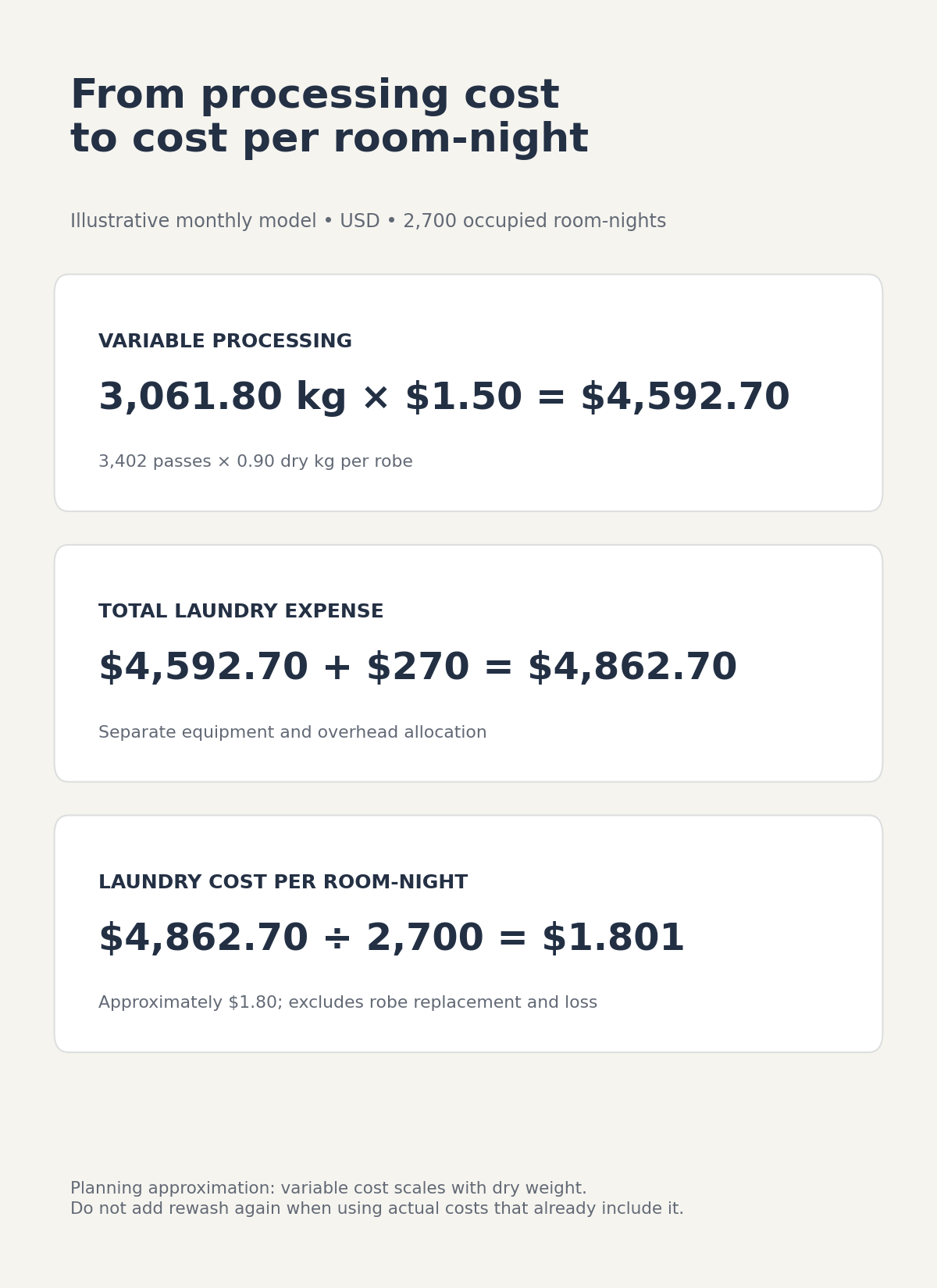
Assume 1.20 first-pass robe events per occupied room-night, an average finished dry robe weight of 0.90 kg, and an extra-pass factor of 5%. The variable processing rate is a hypothetical $1.50 per kg per full pass, including the modeled variable labor, utilities, and chemicals. Monthly bathrobe-allocated equipment and overhead cost is $270. No part of that $270 is included in the $1.50 rate.
| Calculation | Arithmetic | Result |
| Occupied room-nights | 120 × 30 × 75% | 2,700 |
| First-pass robe events | 2,700 × 1.20 | 3,240 |
| Additional full passes | 3,240 × 5% | 162 |
| Total processing passes | 3,240 + 162 | 3,402 |
| Dry-weight processing throughput | 3,402 × 0.90 kg | 3,061.80 kg |
| Variable processing expense | 3,061.80 kg × $1.50/kg | $4,592.70 |
| Total laundry expense | $4,592.70 + $270.00 | $4,862.70 |
| Laundry cost per occupied room-night | $4,862.70 ÷ 2,700 | $1.801 |
| Laundry cost per first-pass robe event | $4,862.70 ÷ 3,240 | $1.501 |
The room-night figure rounds to $1.80 for reporting. Retain unrounded values in the model. The throughput is a dry-weight equivalent accumulated over all passes; it is not the weight of the wet laundry cart, and it is not the amount of inventory owned.
Laundry cost per occupied room-night = [N × (1 + r) × w × c + F] ÷ O. Here N is first-pass robe events, r is additional full passes per first-pass event, w is dry kg per robe, c is variable cost per dry kg per pass, F is separately allocated monthly fixed cost, and O is occupied room-nights. This weight-based model is a planning approximation; piece handling and actual batch costs may not vary linearly with weight.
Download the calculator to change these assumptions and compare robe options. Its example currency is USD; use one currency consistently throughout all inputs.
Keep replacement and loss visible
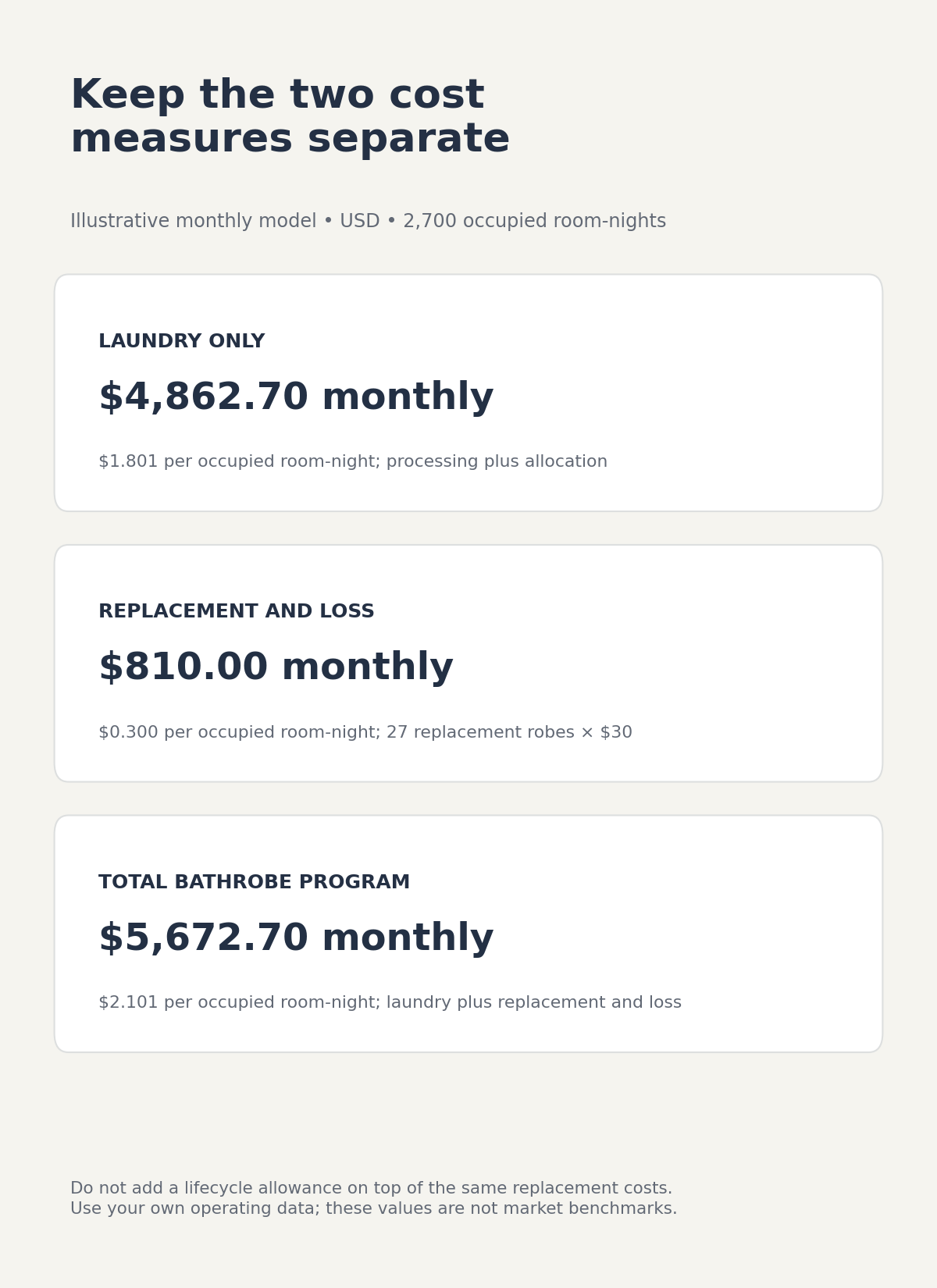
Suppose the same month includes 18 worn-out robes and nine missing robes, each with an assumed landed replacement cost of $30 and no salvage value. The separate replacement-and-loss expense is $810, or $0.30 per occupied room-night. The combined bathrobe program cost becomes $5,672.70 ÷ 2,700 = $2.101, approximately $2.10 per occupied room-night.
For this management view, count retirements and confirmed losses once. Do not also add a full purchase amortization allowance for the same robe consumption. Opening inventory, reserve stock, and purchases replacing future rather than current consumption need separate treatment agreed with finance. A reusable robe’s initial purchase price is not a new expense every time it is washed.
Read sensitivity results correctly
Under the example’s constant-rate assumptions, lowering first-pass demand from 1.20 to 1.00 robes per occupied room-night reduces laundry cost from $1.801 to $1.5175. Reducing the extra-pass factor from 5% to 2%, with demand unchanged, produces $1.7524. These are isolated scenarios, not promised savings or instructions to reduce necessary laundering.
If occupancy falls to 50% with the same robes-per-room-night demand and $270 monthly allocation, cost rises to $1.851 per occupied room-night because the fixed allocation is spread over fewer rooms. Review demand, rework, and capacity utilization before attributing a higher cost entirely to the robe itself.

Compare Robes and Laundry Contracts on the Same Basis
Compare candidates using the service they must provide and the process they will actually go through. Finished dry weight, size coverage, absorbency, softness, wash results, handling time, and useful life belong in the comparison alongside purchase price. For in-house service, measure batch performance instead of assuming that fabric weight determines every cost. For outside service, confirm the billing unit and all included tasks before translating a quote into a room-night figure. A consistent boundary makes the comparison useful and exposes whether a proposed saving comes from less resource use, a different accounting allocation, or a reduced service scope.
Finished weight is more useful than GSM alone
GSM measures fabric mass per square meter. It does not give the finished weight of a robe, which also depends on garment size, fabric area, collar, pockets, belt, and construction. Weigh clean, dry samples by size and use the expected size mix. Convert consistently: one kilogram is approximately 2.2046 pounds. A rate per pound must be paired with pounds, not kilograms.
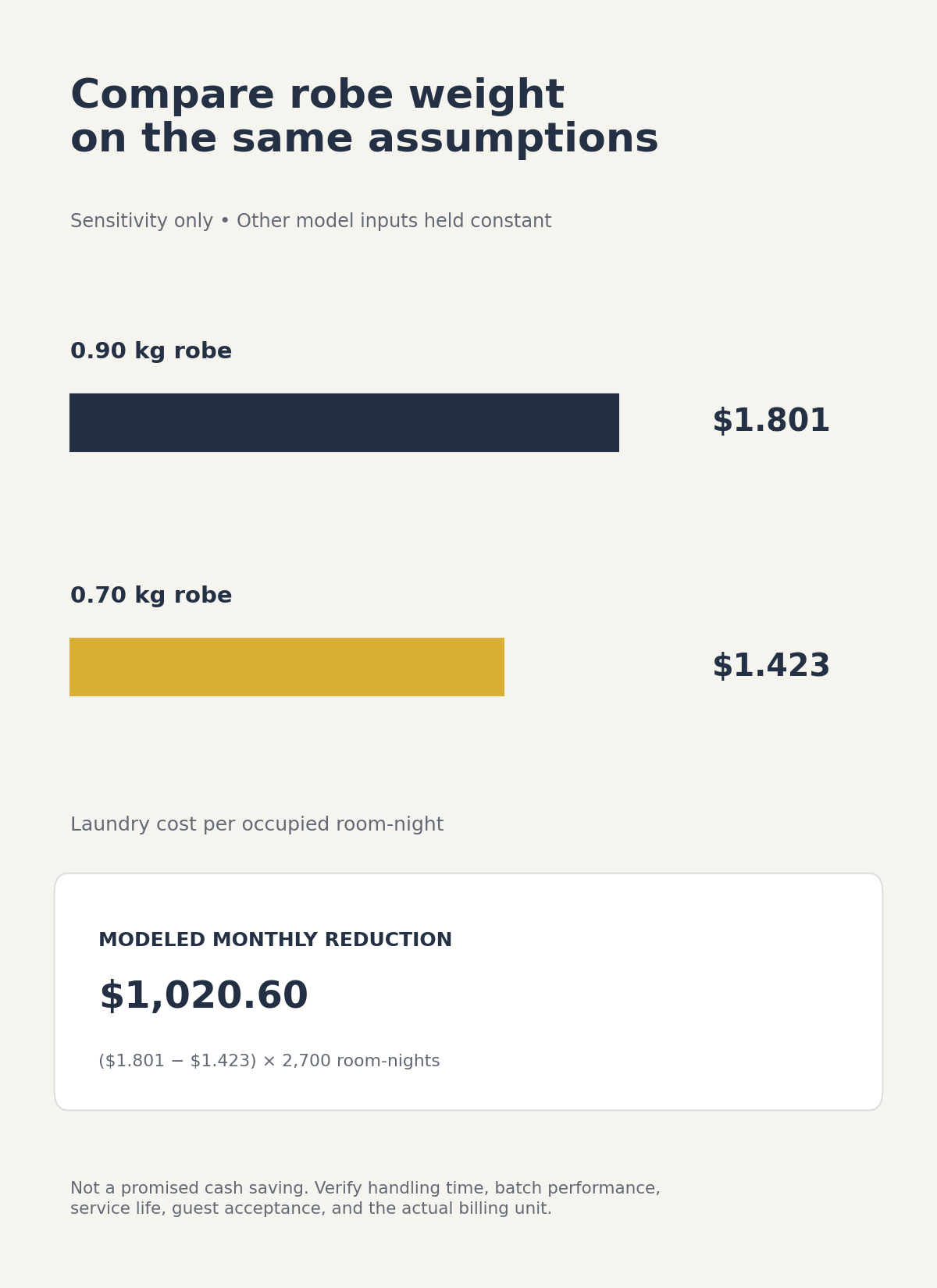
For example, changing the model’s weight from 0.90 kg to 0.70 kg, while holding the rate, demand, rewash factor, and monthly allocation constant, gives $1.423 per occupied room-night. The modeled difference is $0.378 per occupied room-night, or $1,020.60 over the example month. This calculation assumes all variable cost scales with weight. If folding labor is charged per piece or cycles remain unchanged, realized savings can be smaller.
When exploring hotel bath linens, request finished sample weights and care instructions for the actual proposed sizes and construction. A weight reduction is useful only if the robe still satisfies the property’s guest-experience and durability requirements.
Check drying and usable throughput in a trial
Compare candidates in the same approved wash process and record the clean dry load weight, weight after extraction, drying time to the same accepted finish, energy use where measurable, handling minutes, and quality rejects. Residual moisture on a dry-weight basis equals post-extraction weight minus dry weight, divided by dry weight. At 60% residual moisture, a 10 kg dry load contains 6 kg of retained water after extraction; at 45%, it contains 4.5 kg. That arithmetic does not establish an energy saving without a dryer measurement.
UniMac’s industrial tumbler information describes optional residual-moisture sensing. Such controls illustrate why drying endpoint matters, but availability and performance are model-specific. Follow the robe’s care instructions and the equipment manufacturer’s loading guidance. Do not exceed permitted loads or shorten a validated laundering process just to improve the cost number.
For a dedicated dryer window, usable dry-weight throughput is permitted dry load per cycle multiplied by completed cycles. Include loading, unloading, and cooling time in the scheduling estimate. Then account for downtime and competing linen demand. Do not assume rated washer capacity guarantees enough drying, folding, or clean-stock capacity before room-release deadlines.
Convert an outsourced quote without mixing units
If a processor bills per piece, use billed pieces times the piece rate. If it bills per weight, use the contract’s specified weight basis, which may differ from your internal dry-weight model. Add attributable delivery charges, minimums, surcharges, and retained hotel labor. Divide the comparable total by occupied room-nights.
For an independent hypothetical quote of $1.35 per first-pass robe, 3,240 billed robes cost $4,374. Add $180 for delivery and $216 for retained hotel handling, for a total of $4,770 or $1.7667 per occupied room-night. That example assumes no additional minimum charge and that rewash is included. It excludes robe ownership costs on both sides of the comparison.
The difference from the in-house $1.801 result is only $92.70 per month. It is not necessarily a cash saving: some of the in-house $270 allocation may remain after outsourcing. Check which payroll, maintenance, and equipment expenses actually disappear, and price any transition or additional reserve inventory separately. Confirm turnaround, reject handling, inventory reconciliation, loss liability, and whether the quote covers owned robes or a rental service.
Use measured life for a purchase decision
For a forecast, purchase cost divided by expected successful service uses provides a simple wear allowance when losses are modeled separately. A $30 robe lasting 150 service uses contributes $0.20 per use; a $24 robe lasting 90 contributes about $0.267. These are illustrative assumptions. A supplier’s wash-cycle claim is not automatically equivalent to successful guest uses, especially when rewashes consume cycles without delivering another service use.
Choose one replacement approach: actual retirements and losses for a reporting period, or a clearly defined lifecycle allowance for a forecast. If estimated useful life already includes loss and early retirement, do not add them a second time. Trial data should cover appearance, dimensional change, seams, belt retention, drying, and staff handling as well as guest comfort.
Conclusion
The useful bathrobe metric connects a clearly defined room-night denominator to the actual volume and cost of processing. Begin with first-pass events, count repeat work once, and use the same cost boundary every month. The example produces a laundry-only cost of about $1.80 per occupied room-night and a broader robe program cost of about $2.10 after separate replacement and loss. Those figures demonstrate the method; your result depends on service policy, robe construction, local rates, and laundry performance. Evaluate a proposed change with matched trials and distinguish an accounting reduction from expense that will actually leave the budget.
For a sourcing comparison, request a bathrobe quotation from KW Hospitality with quantities, size mix, fabric and finished-weight preferences, delivery destination, care requirements, and sample-testing needs. Use the same specification and laundry trial for each candidate before approving a bulk order.
Frequently Asked Questions
Can we use the hotel’s average laundry cost per pound for bathrobes?
Use it as an initial allocation only when you document what it includes. A blended rate for sheets, towels, and robes may hide different drying and finishing requirements. If the blended rate already includes rewash and overhead, adding separate allowances duplicates those costs. A robe-specific trial improves the estimate.
What happens when there are no occupied room-nights?
Cost per occupied room-night is undefined, not zero. Report the period’s expense and mark the ratio unavailable. The accompanying calculator displays a message for a zero denominator. Opening washes or storage-related rewashing should remain identifiable rather than being spread over nonexistent occupied rooms.
Do unused robes in a guest room count as laundry demand?
They count when the property’s procedures require their removal and processing. The number placed in a room is an inventory quantity, not proof of daily washing demand. Record actual removals and follow the hotel’s approved hygiene and reset policy.
How should spa robes be handled when hotel guests use the spa?
Track spa processing separately first. If finance allocates part of that service to guest rooms, use a documented allocation and apply it consistently. Otherwise a busy spa can make the guest-room robe program appear more expensive without any change in room use.
Does keeping more reserve stock increase laundry cost?
Extra stock increases cash tied up in inventory and may affect storage expense, but it does not automatically create more washes. Processing cost changes when that inventory enters the wash process. Set reserve stock around peak demand, turnaround, and disruption exposure instead of treating every owned robe as a daily wash.
Is a lighter robe always the cheaper option?
No. Its processing advantage may be limited by piece-based pricing, unchanged cycle counts, or similar folding time. Higher rejects, shorter useful life, or guest dissatisfaction can offset savings. Compare equivalent service quality and measured operating results.
References
US Environmental Protection Agency: WaterSense at Work, Section 3.6, Laundry Equipment. Official guidance for laundry loading, soil separation, water measurement, and operating practices. Published October 2012; used for general methods, not current prices or equipment benchmarks.
UniMac: UDR Series Industrial Tumblers. Manufacturer information describing optional residual-moisture sensing. Product availability and specifications vary by market and model.