
Before buying hotel sensor faucets, confirm that staff can replace the power source, clean the sensor window and outlet, and reach service components after the faucet is installed in the finished vanity. Ask for a demonstration using the proposed sink, backsplash, cabinet, and plumbing arrangement. A faucet that is easy to maintain on a supplier’s workbench can become difficult to service behind a deep basin or a fixed decorative panel.
The buying decision involves two different kinds of access. Engineering needs room for tools, battery removal, connectors, isolation valves, and replacement parts. Housekeeping needs room to wipe the faucet base, clean behind the spout, and clean the basin without repeatedly activating the water. Both teams need a reliable way to return the faucet to normal operation before releasing the room or reopening the restroom.
Battery access deserves particular attention because “battery powered” does not describe the service layout. The battery may sit inside the spout, in a separate holder, or in a power module below the counter. Cleaning access is equally specific: a smooth exterior does not tell you whether the outlet needs a proprietary key, whether an inlet filter is hidden behind plumbing, or whether the sensor can be temporarily disabled.
For hotel owners and purchasing teams, the useful comparison is therefore the complete installed arrangement. Guestroom vanities, accessible bathrooms, and busy lobby restrooms can require different solutions even when the visible faucets match. This guide explains how to compare those arrangements, interpret manufacturer instructions, and turn a sample evaluation into a purchasing decision. The cost example is illustrative, and the evaluation method is a proposed procurement approach—not a report of product testing. Always use the current instructions for the exact model and power configuration being quoted.
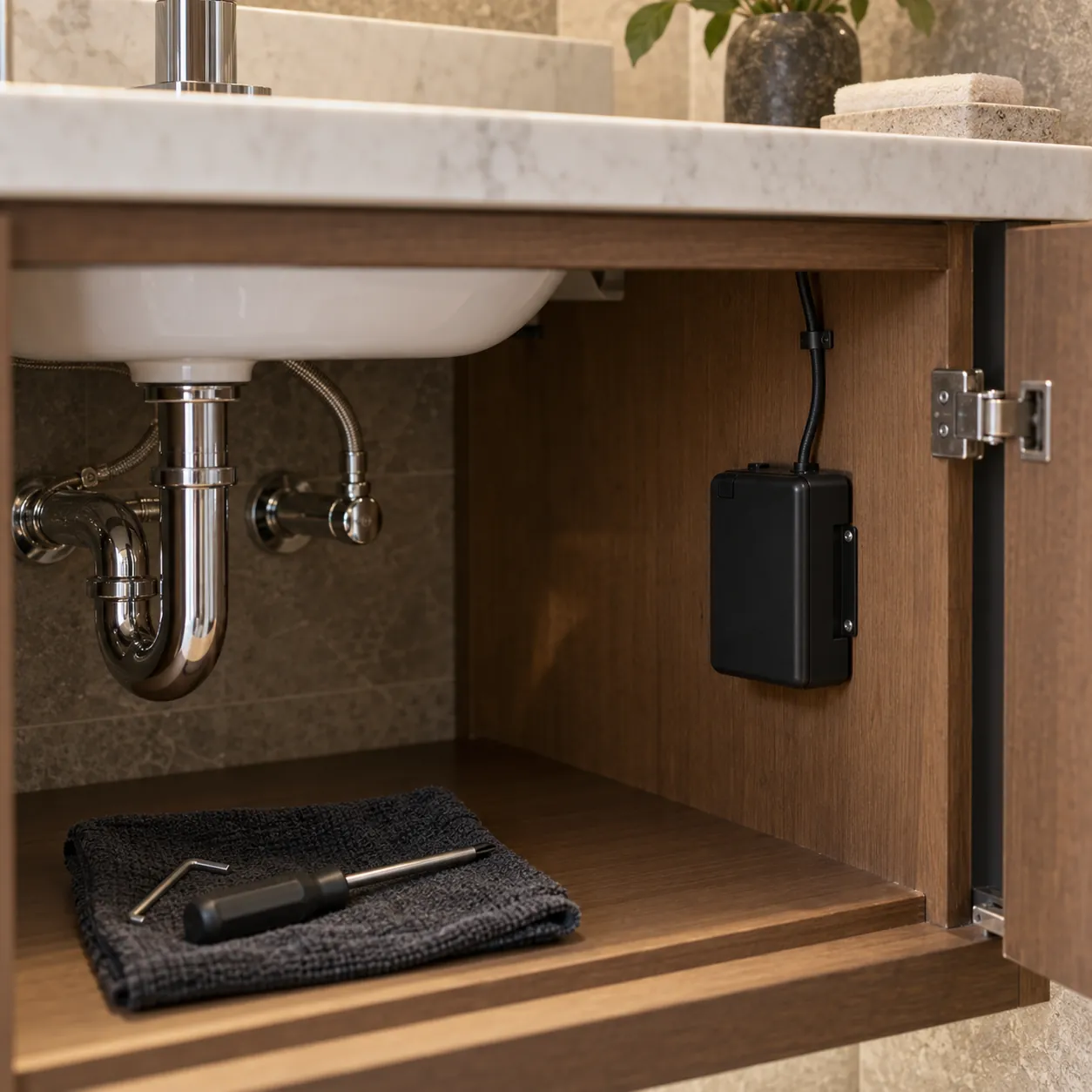
Battery Access Depends on the Installed Vanity
The best battery location is the one your maintenance team can reach safely and repeatedly without disturbing unrelated finishes or plumbing. Above-deck access may avoid work beneath the basin, but it still needs space to loosen a screw and withdraw a cover. An under-counter holder can work well when its lid faces the access opening and cables have appropriate slack. It becomes a liability when a trap, drawer, or decorative enclosure blocks removal. Evaluate the full service movement, from opening the compartment to reseating the seal and restoring operation, rather than accepting a photograph of an exposed battery as proof of maintainability.
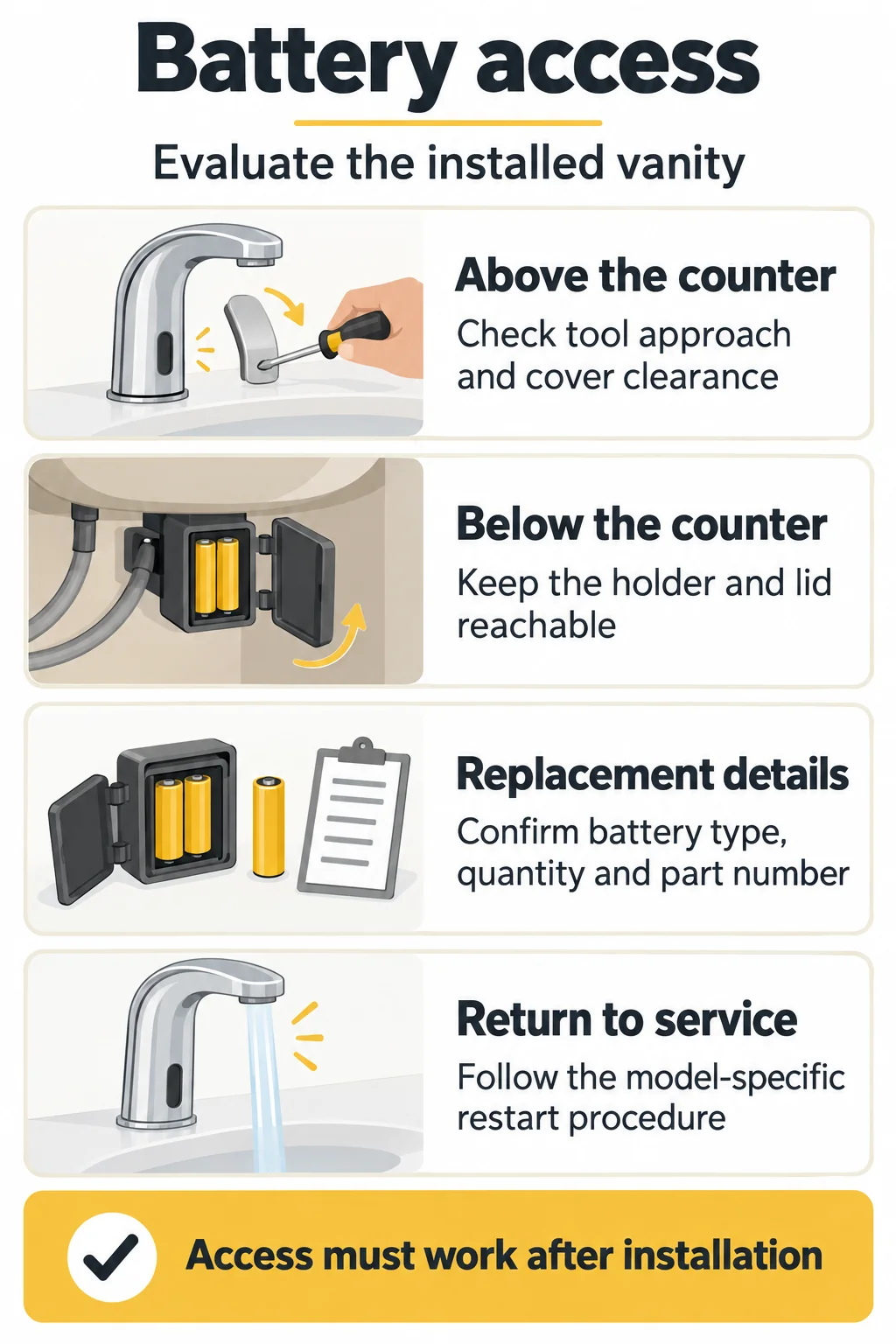
Compare the access route, not just the power label
The following comparison describes common arrangements, not a guarantee about every product in each category. Ask the supplier to identify the actual configuration on the quotation and installation drawing.
| Power arrangement | Potential operational advantage | Constraint to resolve before approval |
| Batteries inside the spout | Routine battery work may be possible above the counter | Cover withdrawal, tool approach, backsplash clearance, and protection of the finish |
| Separate battery holder below the counter | Battery compartment can sometimes be positioned near a service opening | Holder orientation, lid travel, cable reach, cabinet access, and exposure to leaks |
| Hardwired or plug-in supply | Reduces routine primary-battery replacement where no battery is used | Accessible transformer and connections, electrical installation scope, and outage behavior |
| Turbine or other assisted power system | May reduce dependence on frequent battery replacement | Exact storage or backup components, usage assumptions, and eventual service requirements |
A documented example helps explain why configuration matters. The Chicago Faucets E-Tronic 40 installation instructions show spout-cover access for battery servicing, while filter replacement requires access to the supply connection beneath the faucet. An accessible battery does not automatically mean every maintenance task can be performed above the deck.
For each finalist, have engineering open the actual compartment with the intended tools while the faucet is mounted. Observe whether the fastener can be reached straight on, whether the cover clears the backsplash, and whether the battery can be removed without pulling on wires. A lid that opens is not sufficient if the battery cannot pass through the remaining gap. Record the access dimensions on the approved installation drawing; there is no universal clearance that fits every faucet.
Make the battery specification usable for maintenance
Require the battery type, quantity, chemistry, voltage, holder or pack part number, and approved replacement instructions. Distinguish standard cells from a proprietary pack. Ask whether any proposed alternative, including rechargeable cells, is explicitly approved rather than assuming that physical fit proves compatibility.
Treat advertised battery life as a conditional claim. Ask for its test basis, including activation frequency and any enabled automatic functions. A quiet guestroom and a high-traffic lobby restroom should not share an unexamined replacement forecast. For example, the Sloan EBF-415 product information lists battery-strength reporting through its compatible app. That is a feature of the stated system, not evidence that all sensor faucets provide advance warning or remote monitoring.
Specify who will notice a low-power indication and where that observation is recorded. A warning that appears only during activation is less useful if nobody is assigned to check it. Obtain the manufacturer’s documented behavior at depleted power, the restart or calibration procedure, and any settings that must be checked afterward. Do not assume that removing power is an approved substitute for isolating water during wet-component servicing.
Protect access through installation and handover
Show the battery holder, service opening, shutoff valves, and cable routing on the vanity coordination drawing. Keep the holder within the manufacturer’s installation limits and clear of moving drawers. Do not improvise longer wiring or modify a sealed pack to compensate for poor placement. In an accessible bathroom, coordinate service access with the required clear space and pipe protection through the project’s design team.
At handover, retain the approved tools and record the installed model, power configuration, battery replacement date, and part numbers by room or fixture. This makes a later power fault easier to distinguish from a wrong replacement part or an undocumented installation change.
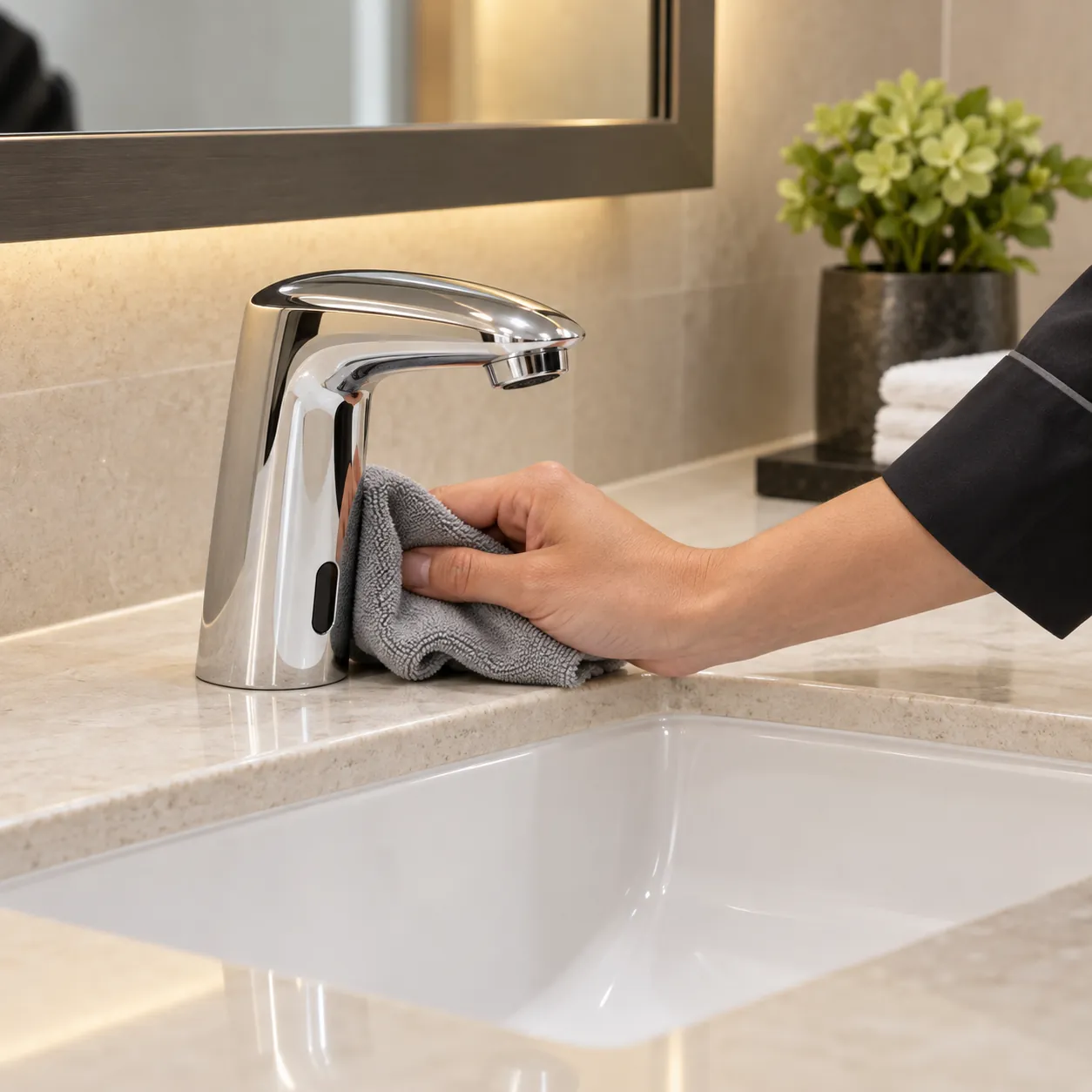
Cleaning Access Includes the Sensor, Outlet, and Hidden Filter
A hotel sensor faucet should support the housekeeping routine as well as periodic engineering maintenance. The daily task is to clean exposed surfaces and the sensor area using an approved method, then confirm normal operation. Periodic work may involve removing an outlet or accessing an inlet filter, with water isolation where the model requires it. These tasks use different tools, permissions, and access routes. Test them separately during sample approval. The purpose is to identify surfaces staff cannot reach and components they cannot remove before those limitations become part of every room’s cleaning routine.
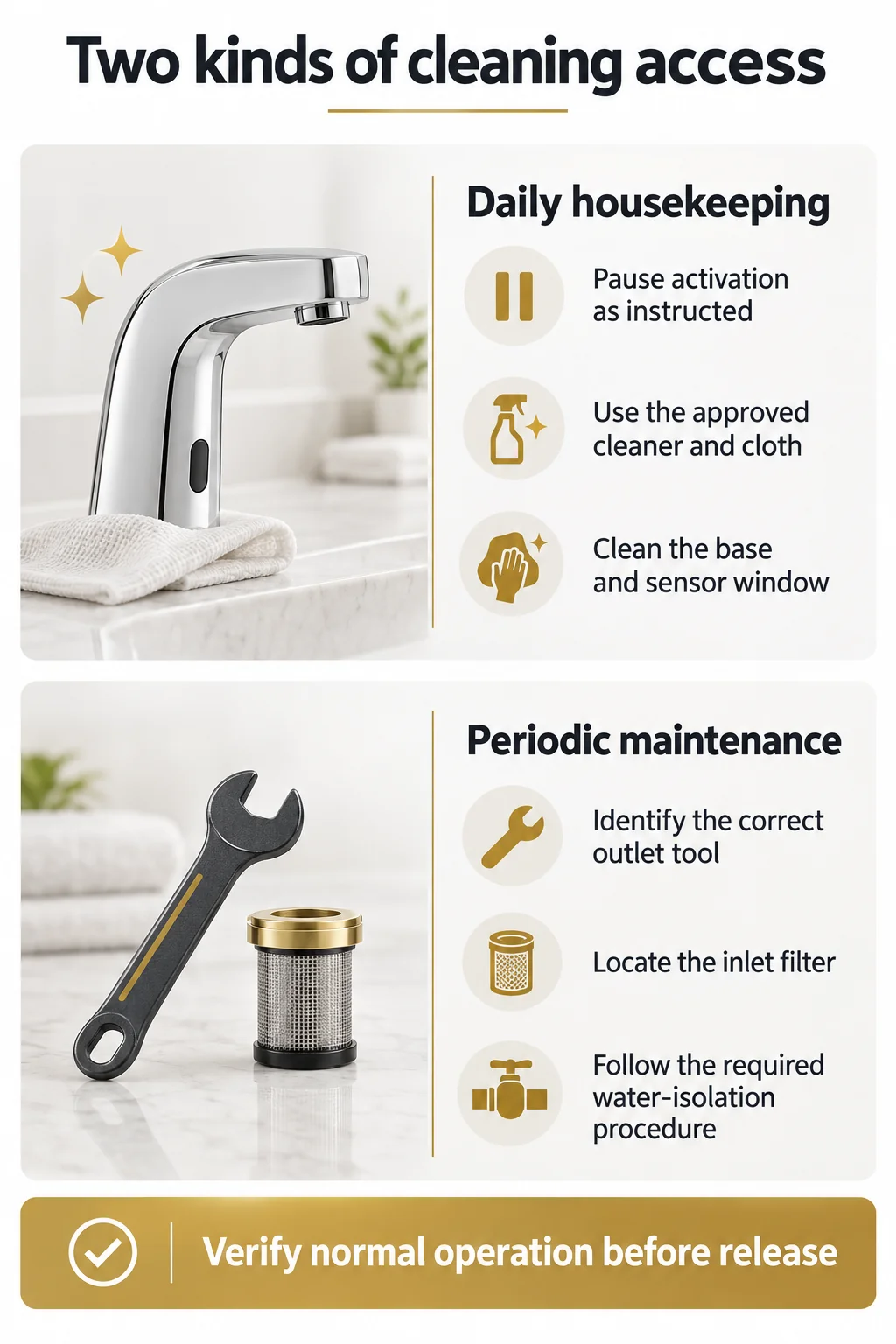
Give housekeeping a practical way to pause activation
Ask whether the exact model has a cleaning mode, how staff activate it, how long it lasts, and how operation resumes. If a phone, app, remote, or special key is needed, include that item in the workflow evaluation. Confirm that staff can identify the correct fixture and restore service without depending on one person’s personal phone.
Cleaning mode is not a universal feature with a universal procedure. Chicago Faucets’ CF Connect information includes Cleaning Mode among the operating options for compatible products. Obtain the instructions for the proposed faucet and software version before building a housekeeping procedure around that capability. A temporary pause in sensor activation is also different from isolating water for maintenance.
Use a sample cleaning cycle to observe the base, the rear of the spout, the underside of the outlet, and the joint between the faucet and countertop. Look for narrow gaps that a cloth cannot enter, obstructions from soap dispensers, and water that collects where the base meets the deck. Keep the evaluation realistic: place the amenities and dispensers in their intended positions rather than clearing the entire counter for the demonstration.
Match the finish to the actual cleaning products
Collect written care instructions for the exact finish and sensor window. Compare them with the hotel’s proposed cleaner, dilution, application method, and contact time. Product approval for the basin does not establish approval for the faucet. Request a written compatible procedure when the property’s disinfection requirements and the finish-care instructions appear to conflict.
The E-Tronic 40 manual cited above recommends mild soap and warm water for the finish and a smooth cloth for the infrared window; it also cautions against abrasive cleaners, chemicals, and solvents. Those instructions illustrate why a generic “commercial finish” description is inadequate. Do not turn a finish-care recommendation into a claim that a cleaning method meets every disinfection requirement.
Ask staff to demonstrate the approved procedure, then dry and inspect the faucet. If a sensor still behaves unexpectedly, follow the model’s troubleshooting instructions. Do not immediately change sensitivity settings to compensate for residue, misplaced objects, or a cleaning process that has not been completed.
Separate outlet cleaning from inlet-filter service
The outlet is the fitting at the end of the spout that shapes the stream. Depending on the product, it may be described as an aerator, spray insert, or flow outlet. The inlet filter or strainer catches debris upstream. These are separate components, and an easily removable outlet says little about access to the inlet filter.
For the outlet, obtain the approved replacement part and the tool required to remove it. Confirm there is room between the spout and basin to use the tool without scraping either surface. Ask for the permitted cleaning or descaling method; do not assume that soaking a complete electronic faucet is acceptable.
For the inlet filter, locate the component on the actual piping arrangement and establish the manufacturer’s isolation procedure. The E-Tronic 40 example requires closing the stop valves before disconnecting the supply connection for filter replacement. Other designs may differ. Include access to the valves themselves: a reachable filter behind an unreachable shutoff is an incomplete service arrangement.
Low flow should not automatically trigger a battery change. A blocked outlet, an obstructed filter, a supply problem, and a power fault require different investigations. The handover instructions should help staff identify the symptom and escalate it to the appropriate person without dismantling the faucet unnecessarily.
Use an Installed Sample to Compare Bids and Service Cost
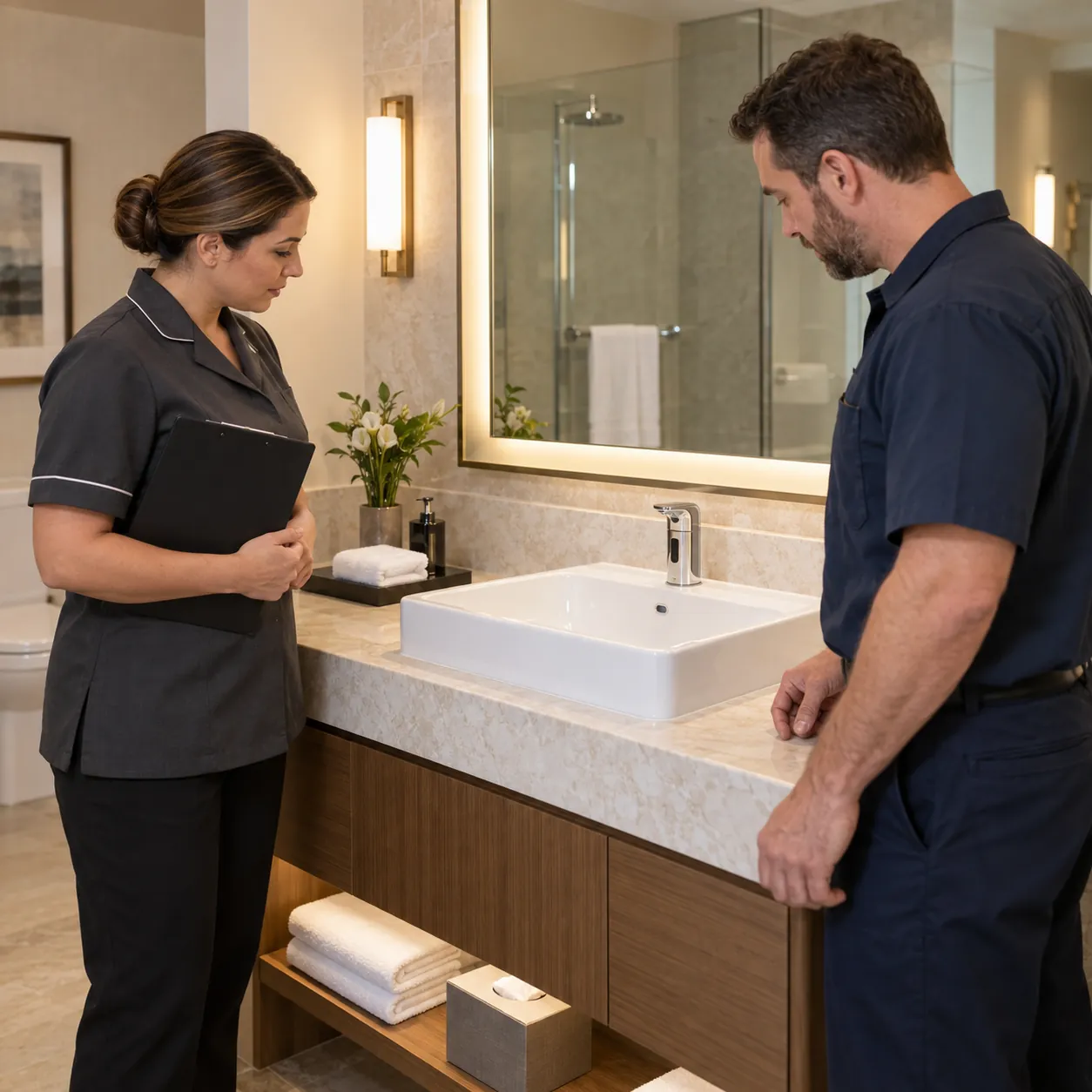
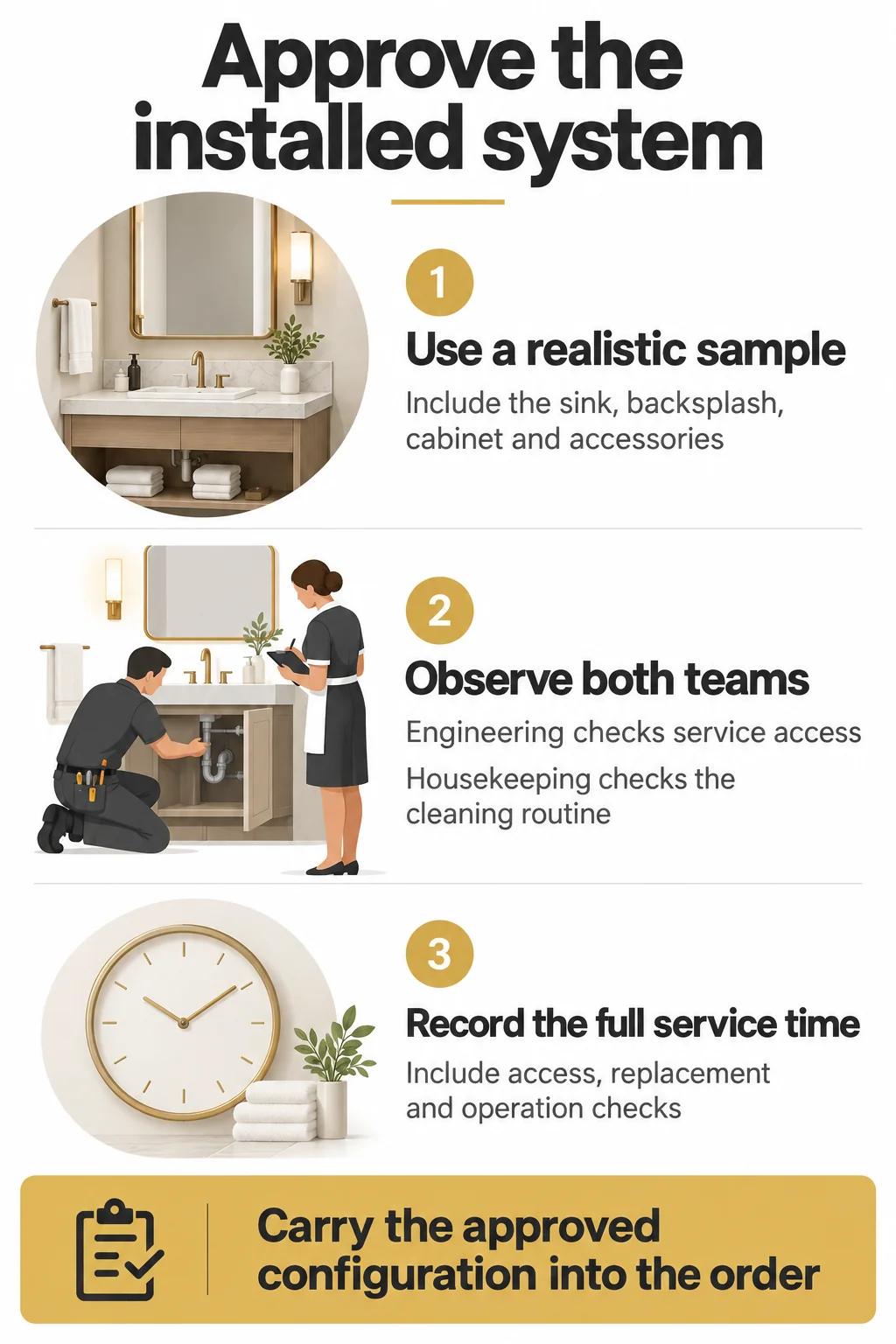
Approve the faucet only after a representative installation demonstrates both ordinary use and realistic maintenance. A sample on an open counter is useful for examining materials, but it does not prove access in a finished hotel bathroom. Include the basin, backsplash, cabinet, shutoff valves, and nearby accessories that will be present on site. Have engineering and housekeeping each perform their own tasks, then document the limitations. This produces evidence that purchasing can compare across suppliers and helps prevent a lower unit price from hiding additional labor, special tools, or recurring room-access problems.
Evaluate difficult layouts as well as the standard room
Choose sample locations by physical differences, not just room count. A shallow vanity, a deep vessel basin, a tight backsplash, and an enclosed accessible installation may expose different problems. Public restrooms also deserve a separate assessment because their usage and closure arrangements differ from guestrooms.
Observe normal handwashing with different users and hand positions. Check that the intended activation area is understandable, water lands appropriately in the basin, and normal use does not create troublesome splash. Try the arrangement with the planned soap dispenser and amenities in place. For guestrooms, consider everyday tasks such as rinsing a toothbrush; a faucet selected only for a public handwashing station may feel awkward in that setting.
Then time a complete battery service and an approved cleaning cycle. Start when staff begin gaining access and finish after covers or panels are restored and the faucet has passed an operation check. Record unfamiliarity separately from physical obstruction: training can improve a slow first attempt, but it cannot create space behind a fixed panel. A short pilot can reveal access and workflow problems; it cannot validate a multiyear battery-life claim or long-term finish durability.
Calculate the labor consequence of access
For a fleet of comparable faucets, a simple planning relationship is:
Annual battery-service labor cost = installed faucets × battery-service events per faucet per year × minutes per event ÷ 60 × loaded hourly labor rate.
Use observed service time and your own replacement forecast. Battery-service frequency is an assumption until supported by operating records. Include travel, room coordination, or administrative time consistently in both bids, or calculate those separately.
Consider an illustrative 120-faucet hotel, one battery-service event per faucet each year, and a loaded labor rate of US$35 per hour. Suppose the accessible arrangement takes 6 minutes per event while another takes 18 minutes because a vanity panel must be removed and refitted. Annual service labor is US$420 versus US$1,260—a US$840 difference. Over three years with the same assumptions and no discounting, that is US$2,520, or US$21 per installed faucet.
This is a labor comparison, not a product price recommendation or a complete ownership model. It excludes batteries, purchase premiums, installation differences, unplanned repairs, and any room downtime. If servicing occurs half as often, the modeled labor difference also halves. A pilot should supply the time inputs; a sales claim should not.
Put the accepted configuration into the order
Ask each bidder to identify the complete model code, finish, power option, outlet, mounting hardware, and any mixing components. Require the installation and maintenance instructions, replacement-part references, special tools, and confirmation of which items are included. Quote spare components separately so that a battery holder or electronic module does not disappear inside a generic “spares kit” description.
Define the service result you expect in plain language. For example, the approved installation might require routine battery replacement without removing the basin, disturbing sealed joints, or disconnecting supply piping. Make that a project-specific acceptance condition only after the selected sample has demonstrated it. The allowed access panel, tools, and installation dimensions should be recorded alongside it.
Request written answers about replacement availability, lead times, warranty coverage for electronics and finishes, and cleaning-related exclusions. Treat compatibility as model-specific. Similar-looking faucets or battery packs may not share service parts, and a product substitution should trigger another review of the relevant access tasks.
For a wider renovation, coordinate the faucet with the basin and other bathroom fixtures and accessories before finalizing the vanity. To request comparable sourcing options, send KW Hospitality a faucet RFQ with quantities, delivery location, vanity photographs or drawings, preferred finish, power preference, and the service conditions demonstrated by your sample. Include your target installation date so the quotation can address both supply and approval timing.
Conclusion
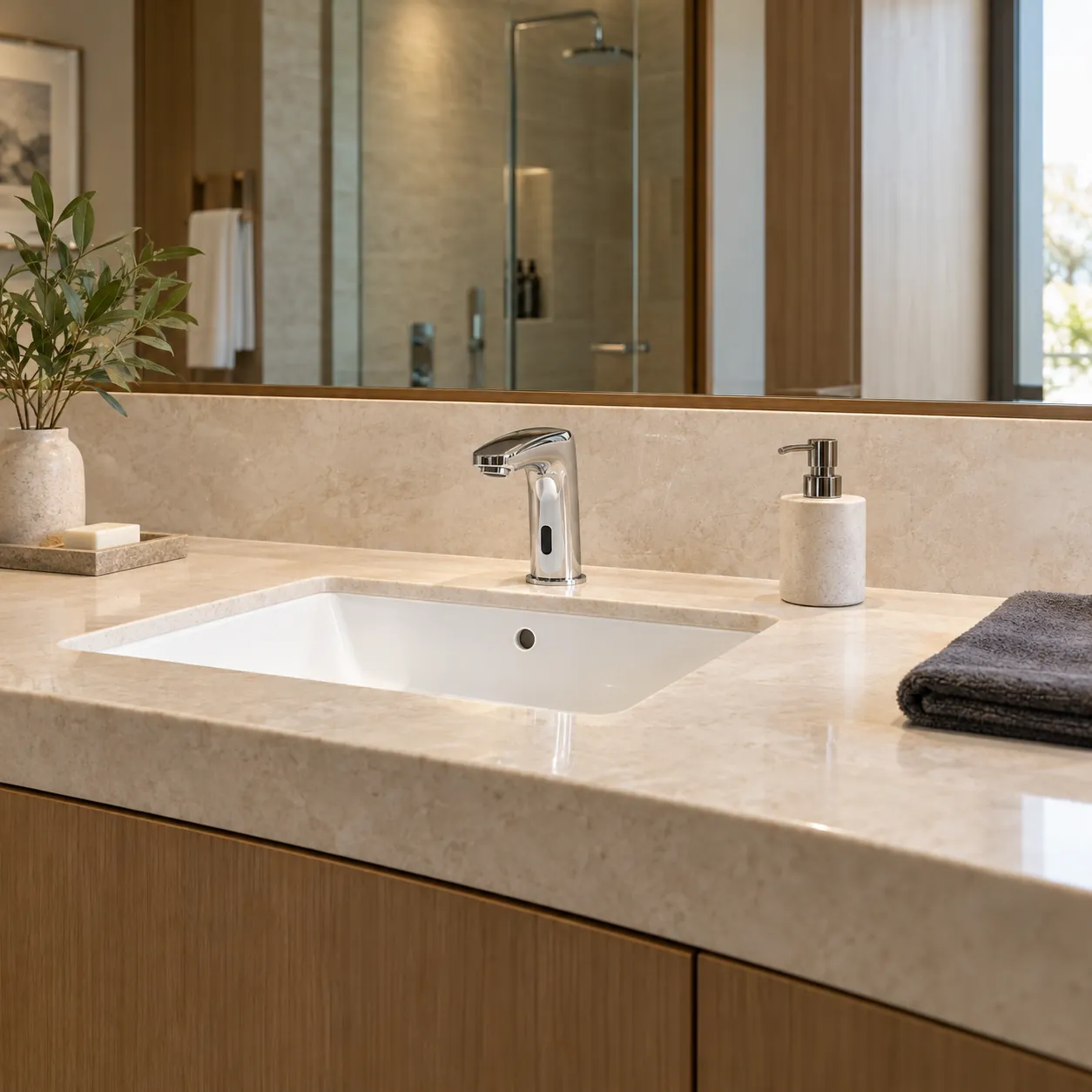
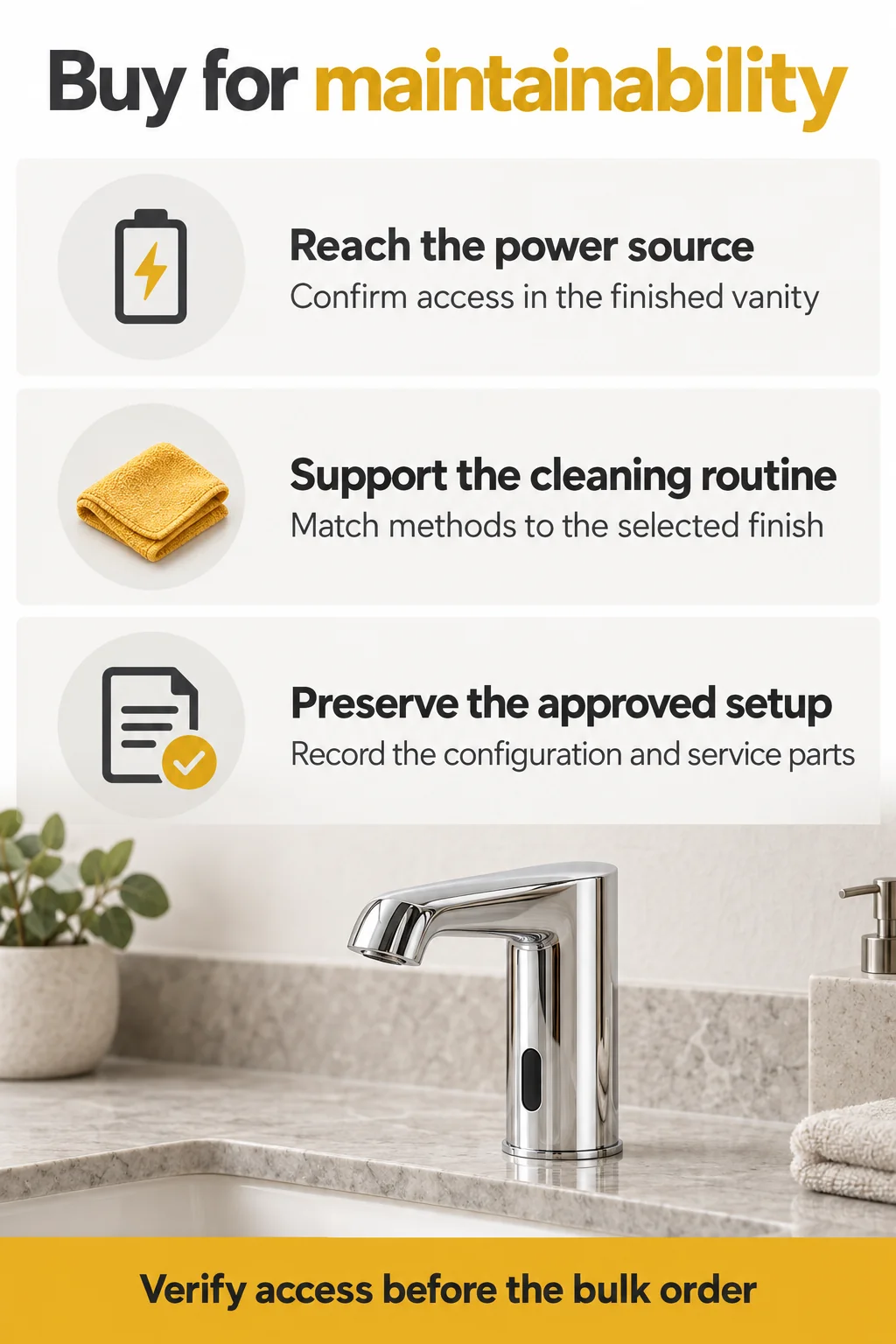
Hotel sensor faucets are easier to buy well when maintenance access is treated as part of the installation specification. Confirm the path to the battery, the surfaces housekeeping must clean, and the components engineering must remove. Verify the cleaning method for the selected finish and require a workable return-to-service procedure. An installed sample then connects those requirements to measurable labor and everyday usability. Choose the configuration that your team can maintain in the finished bathroom, and preserve that approved arrangement in the order, installation drawing, and handover records.
Frequently Asked Questions
Can every battery-powered sensor faucet be serviced from above the counter?
No. Battery placement varies by model and power configuration. Some designs provide access through the spout, while others use a separate holder below the counter. Even with an above-deck battery, filters or other components may require access beneath the basin. Review each service task separately.
Should housekeeping disconnect the batteries before cleaning?
Use the manufacturer’s approved cleaning procedure. A supported cleaning mode may provide a more practical routine than opening the battery compartment. If no such mode exists, obtain the specified alternative. Do not assume that disconnecting power isolates water or that reconnection requires no functional checks.
Does a sensor faucet eliminate the need to clean touch surfaces?
No. The faucet, basin, surrounding surfaces, and any temperature controls still need the property’s approved cleaning routine. Selecting touchless activation does not establish that a fixture is self-cleaning or that its internal water path has been disinfected.
Is a hardwired faucet always cheaper to maintain?
No. It can remove a routine primary-battery task, but the comparison must include electrical installation, access to the power supply, outage behavior, and repair requirements. Compare the complete installed systems using the same service assumptions rather than choosing from the power label alone.
How many spare batteries and service parts should a hotel order?
Base stock on the installed models, observed consumption or failure history, replenishment lead time, and the property’s tolerance for a fixture being unavailable. Use an initial planning allowance when history is absent, identify it as provisional, and revise it after operating data becomes available. There is no defensible universal percentage for every hotel.
Can the hotel test several years of battery life during sample approval?
No. A short sample trial can verify access, replacement steps, warning visibility, and restart behavior. Long-term endurance remains a separate claim that needs the supplier’s test conditions and subsequent operating records. Keep sample acceptance focused on what the trial actually demonstrates.
References
Official sources reviewed September 19, 2026. Product examples illustrate differences in configuration; they are not endorsements or confirmation that a model is suitable for every hotel installation.
Chicago Faucets: E-Tronic 40 Series Installation Instructions, document 957.079.00 — battery and filter access, cleaning instructions, and troubleshooting.
Chicago Faucets: CF Connect App — operating modes and compatible-faucet management features.
Sloan: Optima EBF-415 — power options and battery-strength reporting for the stated system.