
Lower-waste bedding and bed linens start with a practical purchasing rule: keep suitable textiles in service longer, replace only what has failed, and arrange a credible route for materials that can no longer meet the property’s needs. Recyclable packaging and supplier take-back can support that approach, but neither compensates for linens that shrink out of specification, need repeated washing, or arrive in quantities the hotel cannot use. The purchasing decision should connect product construction, daily laundry practices, replenishment availability, and the actual destination of discarded materials.
For hotel owners, procurement teams, and housekeeping managers, the useful question is how many acceptable uses a linen system delivers with manageable resource consumption. A lower purchase price can become expensive when replacement rates rise. A heavier fabric may survive handling but require more drying capacity. A lighter alternative may dry readily yet disappoint guests or fail early. These trade-offs need a small operational trial using the property’s equipment, water conditions, cleaning process, and room standards before a bulk commitment.
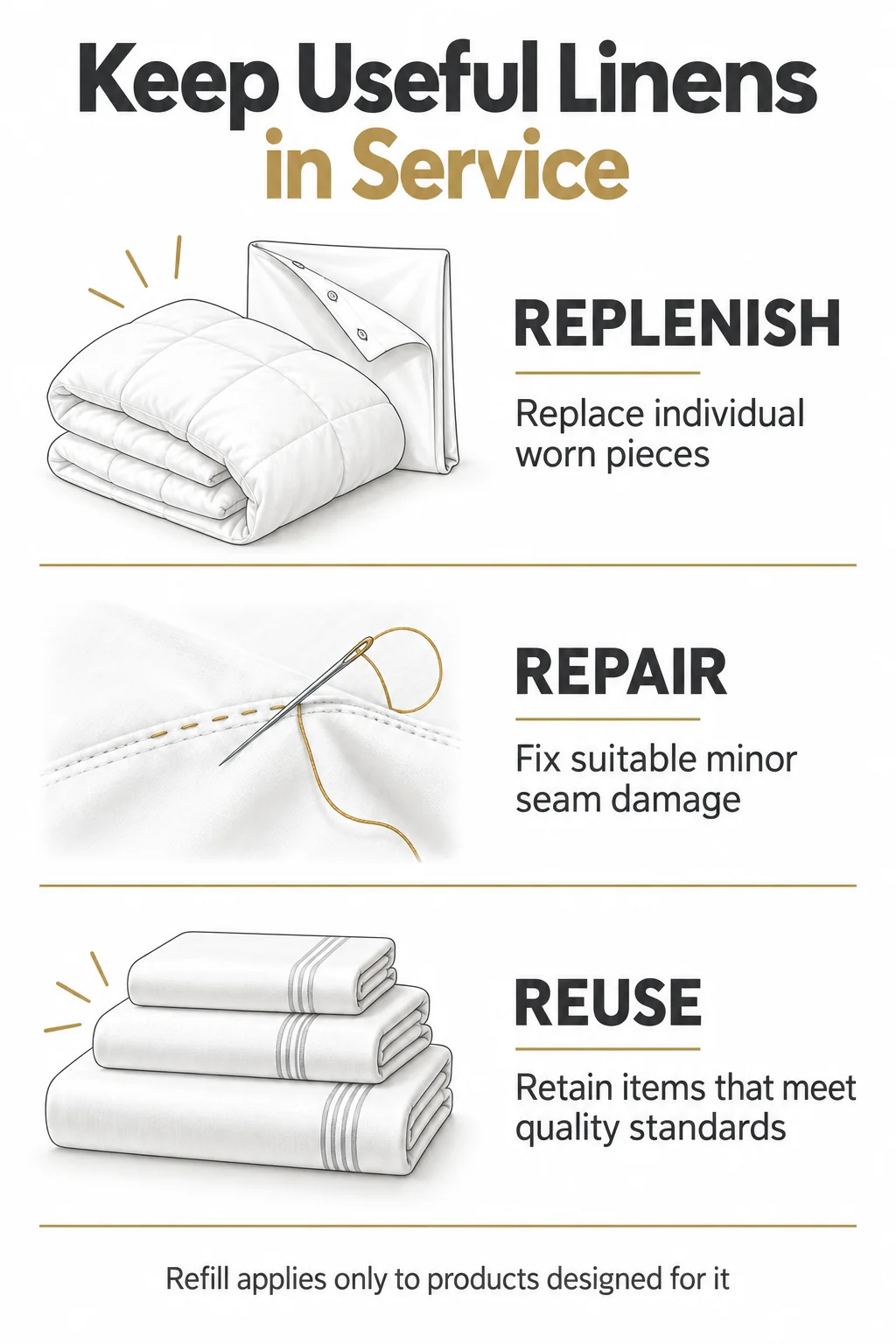
The word refill also needs care in this category. Ordinary sheets and pillowcases are replenished, not refilled. A duvet cover can be replaced independently of its insert, while a pillow should only be refilled if its design and manufacturer instructions expressly support that process. Refillable laundry chemical packaging is a separate operational opportunity, with its own dispensing and handling requirements. Keeping these distinctions clear makes supplier discussions more precise.
This guide explains how to combine reuse, efficient operation, packaging reduction, and verifiable recovery without weakening cleanliness or guest comfort. It also provides a cost-per-use example and measurement framework for comparing proposals. The framework supports properties in the United States and Canada, but acceptance by a recycler, commercial laundry, or take-back provider must be confirmed for the actual delivery location and material stream.

Design the Linen System for Replenishment and Reuse
The strongest opportunity for lower-waste bedding is often the ability to retain usable components while replacing individual items that no longer perform. Specify sheets, pillowcases, duvet covers, inserts, and protectors as identifiable products with compatible dimensions and clear reorder terms. Reuse should remain conditional on cleanliness, appearance, fit, and structural integrity; it is not a reason to keep unacceptable textiles in guest rooms. A useful specification therefore defines both what a new item must achieve and the conditions under which it will leave service. That combination helps purchasing and housekeeping make consistent decisions instead of replacing complete sets whenever one component fails.
Distinguish replenishment from genuine refill
For ordinary bed linens, request open-stock purchasing: the ability to order individual product types rather than complete retail sets. If pillowcases wear out faster than flat sheets, the property should be able to replenish pillowcases without accumulating unnecessary sheets. Confirm minimum quantities by size and item, packaging multiples, production lead times, and whether a reorder can reproduce the approved fabric, finish, and shade.
Separate washable covers from suitable inserts where the room specification permits it. This creates the possibility of replacing a damaged cover while retaining an acceptable insert. It does not make the insert permanently reusable or exempt it from its cleaning requirements. A zipper on a pillow or duvet component is not, by itself, proof that staff should add filling. Obtain a documented refill method, compatible filling specification, and post-service acceptance criteria before treating any filled product as refillable.
For laundry chemicals, a supplier-operated returnable container or approved bulk dispensing system may reduce small packaging purchases. Compare container recovery, delivery frequency, residual product, and dosing accuracy. Use the chemical supplier’s compatible equipment and handling instructions; improvised container reuse or mixing products can defeat both operational and safety objectives.
Buy compatibility that survives repeat orders
Record finished dimensions and acceptable dimensions after the agreed laundry trial. Include mattress depth, cover closure, fabric composition, construction, fabric mass where relevant, seam quality, appearance, and care requirements. Thread count alone does not establish service life. Keep an approved reference sample and a written procedure for accepting production changes. A supplier should identify substitutions before shipment, especially when a blend, finish, closure, or size change could disrupt the existing linen pool.
Standardization helps when it reduces unnecessary variants without compromising fit. Combining two nearly identical pillowcase specifications can simplify stock rotation; forcing one fitted-sheet depth across incompatible mattresses can increase tearing, poor presentation, and replacement. Standardize around the actual bed inventory, then retain the SKU-level records needed for selective replenishment.
Use condition-based decisions for repairs and secondary use
Minor seam damage on otherwise sound fabric may justify repair if the repaired item can still meet appearance and handling standards. Widespread thinning, persistent unacceptable staining, failed fit, or recurrent seam failure points toward retirement from guest use. Define rejection reasons and record them separately so an avoidable laundry problem is not mistaken for normal product aging.
Secondary use also needs a receiving purpose. A sound textile that no longer matches the room’s appearance standard may be acceptable to a willing reuse partner. Confirm that partner’s condition, cleaning, and delivery requirements before setting stock aside. Turning every rejected sheet into a cleaning cloth merely shifts inventory if housekeeping already has more cloths than it needs. Contaminated or otherwise unsuitable material should follow the appropriate handling route, not be passed on as a donation.
Reduce Waste Through Laundry and Inventory Control
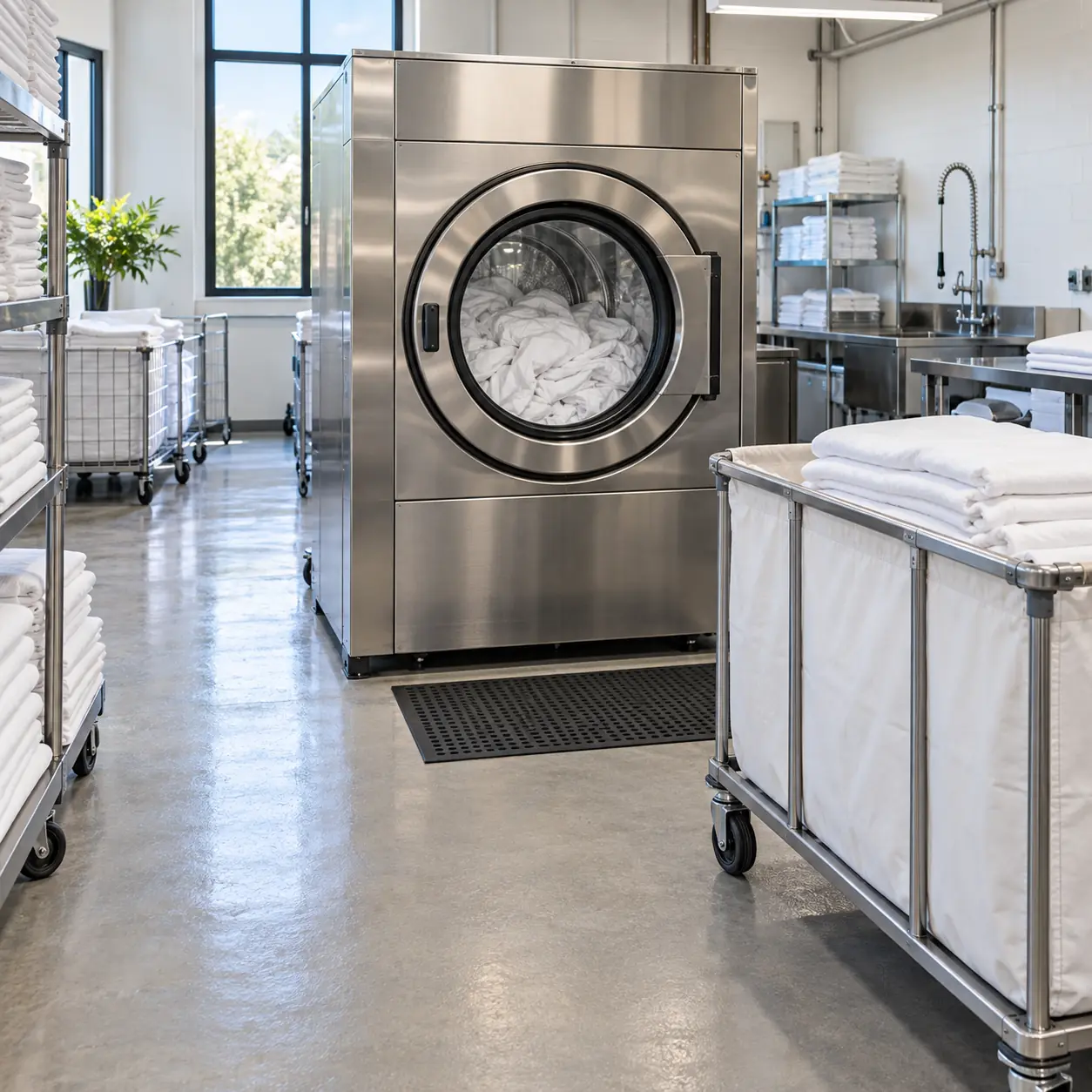
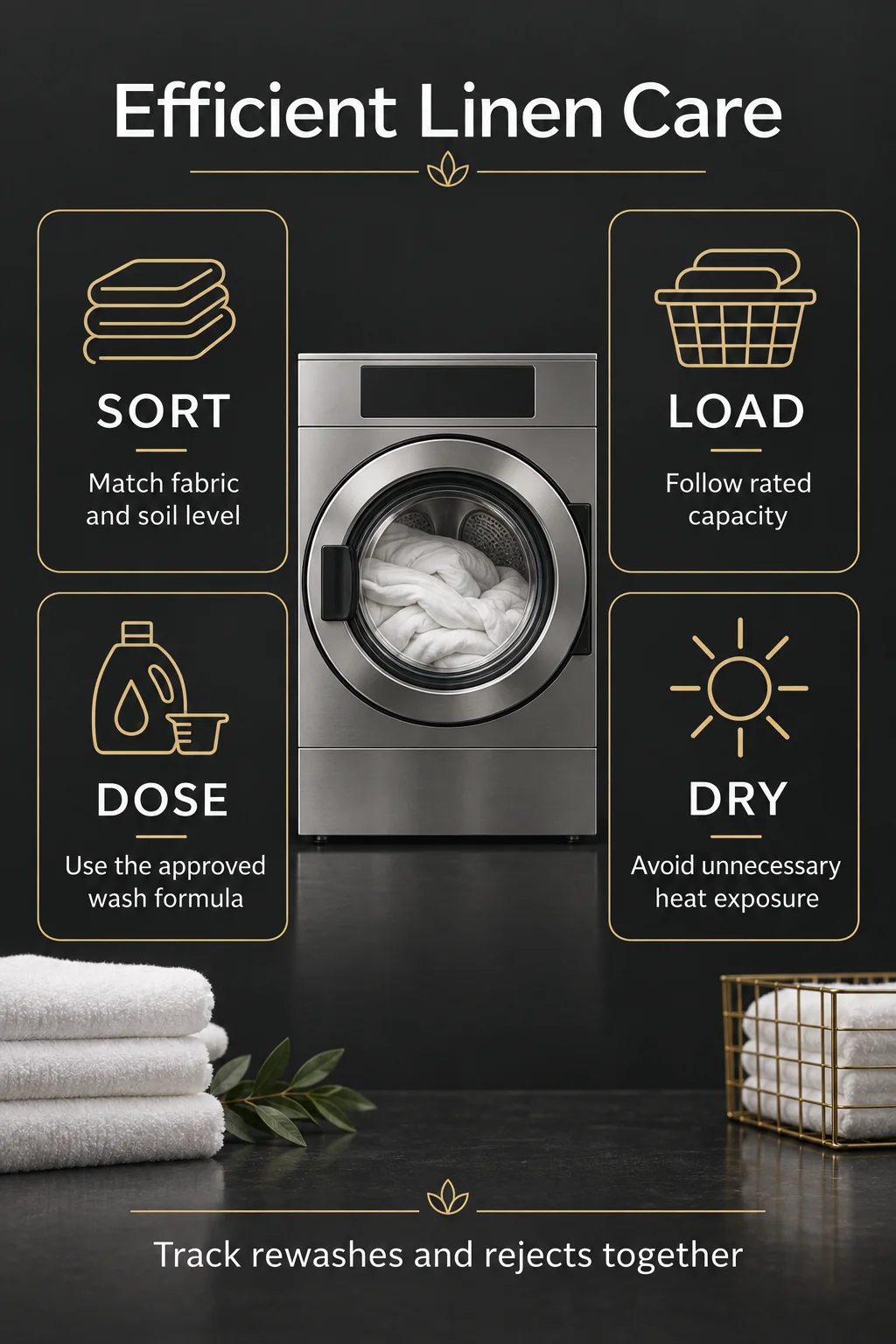
Efficient operation means delivering acceptable clean linens with fewer avoidable washes, rejects, and emergency purchases. Treat the textile, equipment, wash formula, loading practice, and handling process as one operating system. A temperature change or shorter cycle should be evaluated with the laundry provider and product instructions, because apparent savings disappear if cleanliness deteriorates or rewash rates climb. Measure output that meets the property’s standard, not simply the number of cycles completed. This approach also links housekeeping to procurement: the reasons items are rejected can reveal a mismatch in fabric, machine settings, stain treatment, storage, or the original purchase specification.
Control the process before changing the product
Sort by compatible fabric, color, and soil level. Load within the machine’s specified limits for the relevant textile and process; neither chronic underloading nor overloading is a reliable efficiency strategy. Use the approved dosing system, maintain it, and investigate residual chemicals, unexpected odor, poor rinsing, or repeated stain failures rather than adding more chemical by guesswork.
Manage drying and finishing to the requirements of the linen and equipment. Avoid leaving material exposed to unnecessary heat after the required condition has been reached, while ensuring it is adequately dry before storage. Separate clean and soiled flows, protect clean stock from dust and moisture, and identify rough surfaces or handling points that snag fabric. These are practical controls whose value should be demonstrated through fewer rejects and repeat cycles.
When evaluating new equipment, compare the actual eligible model, usable capacity, utility requirements, service access, and expected loads. An efficiency label on a particular washer category should not be treated as a performance guarantee for every industrial laundry system. For outsourced processing, request comparable reporting on rejects, rewashes, losses, turnaround, and responsibility for damaged stock before changing the contract.
Offer linen reuse without creating a service failure
A guest linen-reuse program can reduce unnecessary changes during an occupied stay when guests understand the choice and staff can honor it consistently. Keep a clear route for requesting fresh linens, and apply the property’s change, hygiene, and handling requirements whenever replacement is necessary. A sign alone is not an operational program: housekeeping assignments, room status, and guest requests must remain aligned.
Track actual linen changes rather than assuming every participating room avoids one complete wash. Laundry is processed in loads, and changed occupancy or guest mix can alter the result. Compare similar periods and record complaints and service exceptions alongside resource use. A program that saves laundry while making it difficult to obtain fresh bedding does not meet the intended service standard.
Hold enough stock without buying avoidable surplus
Set the linen pool from beds in service, change demand, processing turnaround, clean reserve, and expected losses. A universal par number cannot account for a remote property using an off-site laundry or a hotel with fast on-site processing. Model the busiest credible turnaround period and define when an exception triggers a reorder. Keep emergency stock visible so it does not become forgotten stock.
Record movement among guest rooms, laundry, storage, repairs, and retirement. Rotate stock consistently and distinguish consumption from disappearance. A rise in replacements may reflect losses, poor counts, or stock trapped at the laundry rather than textile failure. Resolve those causes before responding with a larger standing order.
Compare cost per acceptable use
Use the same product and service definition for both proposals. A simplified cost per acceptable use equals acquisition, allocated laundry, repair, handling, and end-of-use costs, less realized credits, divided by accepted uses delivered. Include the costs of failed processing and rejects in the numerator; do not count rejected output as an acceptable use. Keep uncertain future credits separate until the recovery terms support them.
Consider an illustrative sheet comparison, not a supplier quotation or a predicted lifespan. Sheet A costs $12 and delivers 100 accepted uses. Sheet B costs $16 and delivers 160. Acquisition cost per accepted use is $0.12 for A and $0.10 for B. If both incur $0.45 in allocated processing cost per accepted use, the simplified totals are $0.57 and $0.55. However, if B requires $0.03 more processing per use, its total becomes $0.58 and the ranking reverses. Actual trial results, loss rates, and processing allocations determine the decision.
Verify Packaging and Supplier Take-back Outcomes
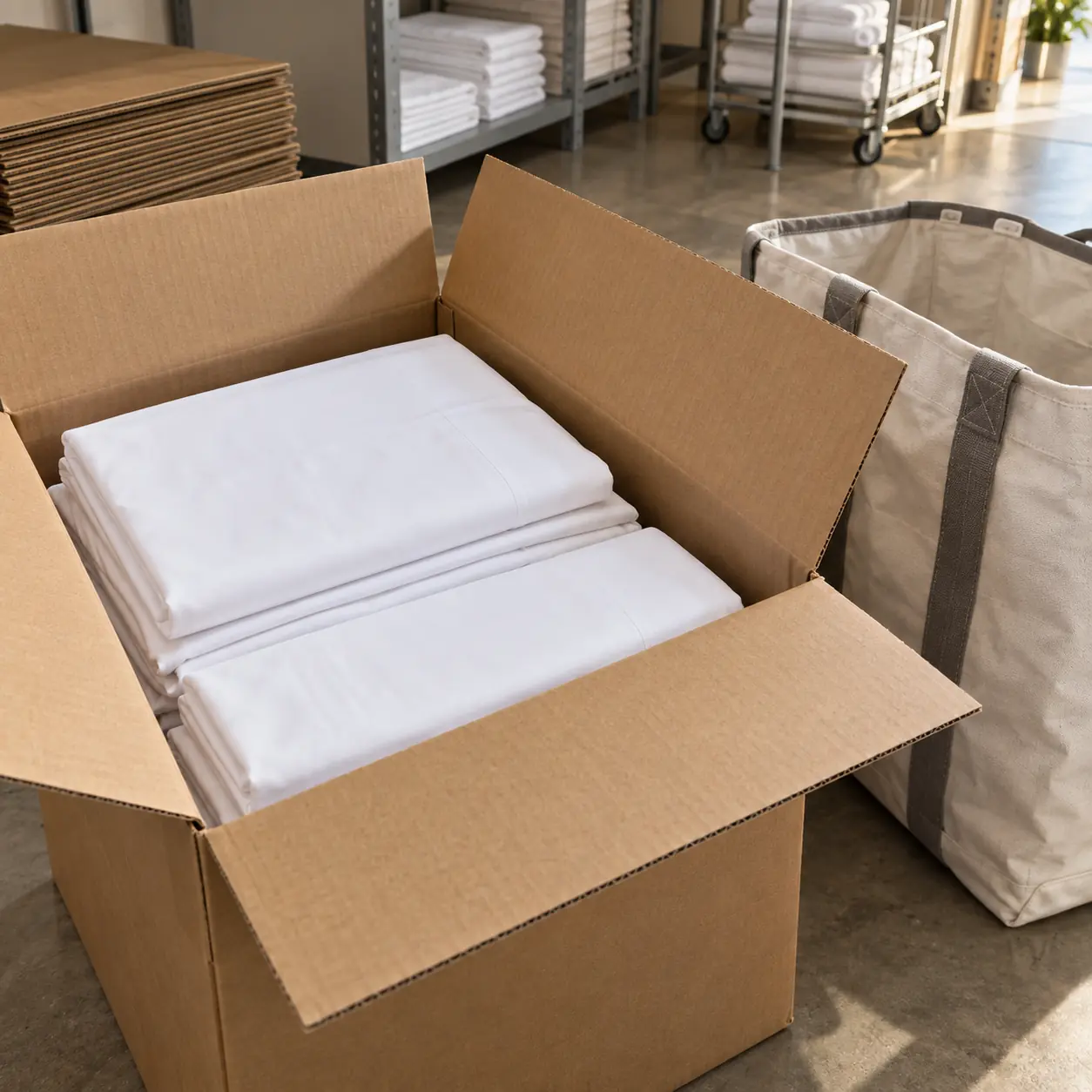
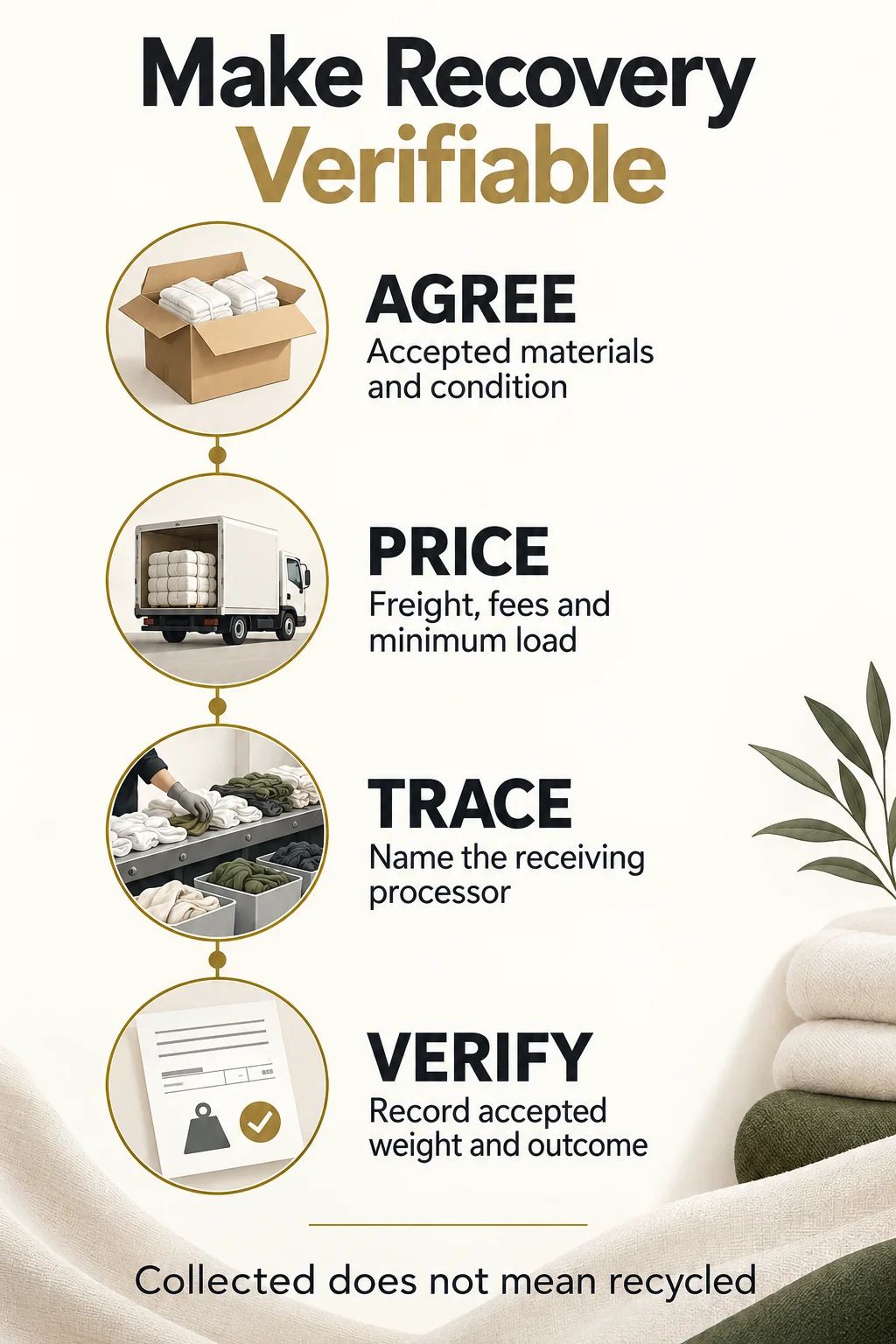
Packaging reduction and supplier take-back are useful only when they fit the shipping route and the receiving operation. Start by removing unnecessary material while preserving protection against moisture, contamination, and transit damage. Then verify what the property’s commercial collector or recovery partner will actually accept. A recyclable material is not automatically collected locally, and material collected by a supplier is not automatically recycled. Treat each claim as a defined service with a location, material specification, cost, and evidence requirement. That makes it possible to compare proposals fairly and report outcomes without overstating what happened after the linens left the hotel.
Reduce packaging without sacrificing delivery protection
Ask whether individual bags, decorative inserts, and redundant inner cartons can be removed for a commercial order. Compare a representative shipment with the existing pack before changing the full order. Bulk packing may work well for a protected domestic delivery but need different moisture protection during longer transport or temporary storage. The relevant result includes damaged or contaminated linen, not just grams of packaging removed.
Request packaging material and weight per shipment or per defined quantity of linens. Separate corrugated board, plastic film, strapping, and mixed-material components. Ask the receiving collector about each stream, including cleanliness and separation requirements. Do not infer acceptance from a recycling symbol, a resin code, or the fact that a material is accepted in household collection somewhere else.
Returnable totes and reusable sacks need their own operating arrangement. Specify ownership, cleaning, empty-container storage, return timing, losses, and charges. Their value depends on actual repeated trips. A heavy reusable container that disappears after one delivery may perform poorly compared with a lighter alternative. Consolidating returns with planned deliveries can be worth evaluating, but any claimed transport benefit needs route-specific evidence.
Put take-back terms into the quotation
Ask whether the proposed program accepts the actual linen construction, including fiber blends, finishes, closures, labels, and filling. Distinguish unused surplus, serviceable used goods, worn textiles, and excluded contamination. Establish whether competing brands are accepted and whether membership depends on buying replacement products from the same supplier.
The commercial terms should identify service geography, minimum pickup quantity, collection frequency, packaging or baling requirements, freight responsibility, sorting fees, rejected-load charges, and any credit calculation. A cross-border pickup should also have a clear logistics and documentation responsibility. Do not assume an international sourcing arrangement includes the return movement of used goods.
Require the receiving facility or downstream route to be identified, along with reporting deadlines. Separate direct reuse, conversion to another textile application, fiber recycling, energy recovery, disposal, and material still awaiting processing. These are different outcomes. A collection receipt establishes transfer; further documentation is needed to describe subsequent processing. If a provider cannot substantiate that later stage, report the collection honestly and leave the unverified outcome open.
Use a shared measurement framework
Track the same boundaries before and after a change. The following comparison framework separates material reduction, operational efficiency, and recovery so improvement in one area does not hide deterioration in another. Use consistent weight units and defined reporting periods; avoid mixing kilograms of packaging with counts of linens in a single diversion rate.
| Measure | Calculation or record | Interpretation |
| Linen retirement intensity | Retired linen weight / occupied room-nights × 1,000 | Compare similar service patterns and record retirement reasons. |
| Rewash share | Loads requiring rewash / total original loads × 100 | Define partial loads consistently and record causes. |
| Water intensity | Laundry water volume / dry textile weight processed | Keep outsourced and on-site boundaries explicit. |
| Energy intensity | Laundry energy / dry textile weight processed | Use consistent energy units and include the same equipment. |
| Packaging intensity | Packaging weight / accepted pieces received | Review alongside transit damage and contamination. |
| Take-back acceptance | Weight accepted / weight dispatched × 100 | Acceptance is not proof of recycling. |
| Confirmed recovery | Documented weight by outcome and destination | Keep pending processing and disposal separate. |
For example, a property dispatches 200 kilograms of retired textiles and the processor accepts 180 kilograms. Acceptance is 90%. If the processor subsequently documents 120 kilograms reused and 60 kilograms recycled, report those separate amounts. Account for the remaining 20 kilograms using its documented destination; do not automatically describe the original 200 kilograms as diverted. Avoid double-counting the same material at collection and processing stages.
Pilot the proposal and define the decision rule
Begin with a defined product group and a representative trial, with baseline measurements and agreed guest-quality standards. Set a short-term review for fit, processing problems, packing damage, and reorder accuracy, then continue observation long enough to assess wear. A short trial can reject an unsuitable product but cannot establish its full lifetime. Label projected service life as provisional and revisit it as accepted-use data accumulates.
Before expanding the program, reconcile observed cost per accepted use, laundry performance, guest feedback, packaging damage, and recovery evidence. Specify which material changes require fresh approval and what happens if the take-back route becomes unavailable. Keep an alternative local route or a documented disposal arrangement; an unfulfilled future promise should not leave the property holding unusable stock indefinitely.

Conclusion
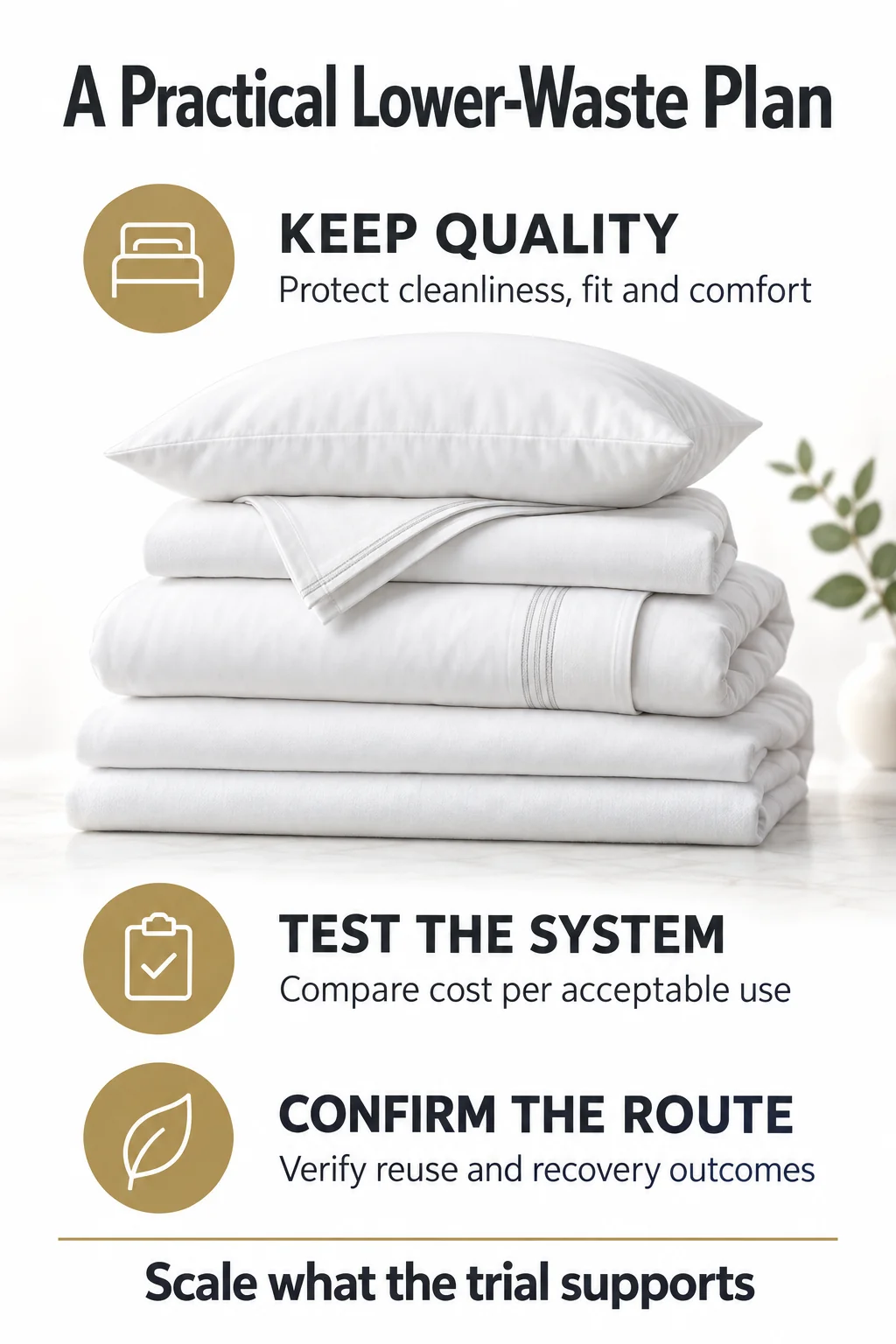
Lower-waste bedding and bed linens require purchasing and operations to support the same outcome: more acceptable service from the products already in circulation, followed by a documented route for items that must leave it. Prioritize compatible replacement pieces, sound reuse decisions, controlled laundry processes, and appropriate inventory before relying on packaging or take-back claims. Evaluate each change against guest quality, actual processing costs, and measurable material flows. A small, well-defined trial gives the property a defensible basis for scaling a proposal, while clear reorder and recovery terms reduce the risk that a promising first purchase becomes difficult to sustain.
For a sourcing discussion, prepare the bed inventory, approved linen specifications, trial requirements, forecast quantities, delivery location, and requested packaging and recovery terms. Use the KW Hospitality contact form to share your bedding sourcing requirements and ask which options can be quoted for the project. Confirm replenishment, packaging, and any take-back arrangement in the written proposal; availability should not be assumed.
Frequently Asked Questions
Is a cotton-polyester blend automatically a poor lower-waste choice?
No. Compare demonstrated durability, care requirements, guest acceptance, and the available recovery route. A blend may perform well in the property’s laundry while being unsuitable for a particular textile recycler. A single-fiber option may suit that recycler but still need operational testing. Neither composition alone establishes the better overall result.
Should usable linens be replaced immediately with recycled-content products?
Not solely because a new product contains recycled material. Retaining acceptable existing stock avoids an immediate replacement purchase. Evaluate recycled-content options when replenishment is needed, and verify the claimed content, performance, and suitability. A product attribute should inform the decision without becoming an automatic reason to discard usable linens.
Can a small hotel participate in supplier take-back?
Possibly, but minimum pickup quantities and transport charges may make infrequent collection more practical. Ask about shared collections, scheduled backhauls, and storage requirements. Confirm the provider’s local coverage and acceptance rules before accumulating textiles. A qualified local reuse or recovery partner may be a workable alternative when supplier collection is unavailable.
Does compostable packaging solve the disposal problem?
Only when the specific packaging is accepted by a processing route the property can use and staff can keep it in the required stream. The word compostable does not establish compatibility with ordinary recycling or guarantee local collection. Compare it with packaging elimination, accepted recyclable materials, and practical reusable transport options.
What if an outsourced laundry does not provide item-level data?
Start with records it can support consistently: weights processed, rejected quantities, deliveries, losses, and agreed service exceptions. Use marked trial stock or a separately managed batch if the provider can preserve its identity. Do not present an estimated cycle life as measured fact when items cannot be tracked through the process.
How should a hotel describe a lower-waste result publicly?
State the measured change, comparison period, product group, and reporting boundary. For example, describe a verified reduction in packaging weight for a defined delivery quantity rather than labeling the entire linen program environmentally friendly. Keep records supporting the result and distinguish material collected from material confirmed reused or recycled.