The accessibility supplies option that fits a hospitality operation is the one that meets the guest’s specific need, works in the actual room or amenity, and remains available throughout the stay. Fixed equipment, portable supplies, and a combination of both can each have a role. The purchasing decision should begin with required functionality and installation constraints, then compare daily usability, staff workload, maintenance, and cost. A low purchase price cannot compensate for a product that is unsuitable for its intended use.
For a hotel buyer, “accessibility supplies” is too broad to treat as one interchangeable product category. A shower seat supports a bathing task. A door-notification receiver supports awareness of a visitor. An assistive listening receiver supports access to spoken content in a compatible setting. Buying more of one does not resolve a shortage of another. Even products that appear similar can differ in mounting requirements, adjustment, cleaning instructions, power supply, and the replacement components needed to keep them working.
This comparison separates two decisions that procurement teams often combine: which product configuration performs the required task, and how the property will make that product available. A suitable portable item may still fail operationally if nobody can locate it at night. A permanently installed item may eliminate a delivery step but create a room-specific maintenance dependency. Neither outcome can be judged from a catalog photograph alone.
Use the framework below to compare equivalent offers, explain the tradeoffs to operations and engineering, and turn a shortlist into a clear purchasing decision. It is intended for hospitality procurement, with U.S. accessibility examples where relevant. It does not determine a property’s complete legal obligations or prescribe an individual guest’s transfer technique. Those questions require the applicable project requirements and, where necessary, qualified advice. The worked scoring example is illustrative, not a product test or an industry benchmark.
Compare Options Within the Same Guest Task
Compare accessibility supplies only after defining the task they must support and the setting in which they will operate. A fixed installation and a portable accessory are alternatives only when both are permitted and suitable for that particular requirement. Otherwise, they belong in different parts of the purchasing plan. Separate mandatory room or amenity features from supplementary items, then compare products within each function. This avoids a common procurement mistake: treating a flexible inventory model as evidence that the equipment itself can replace every installed feature. The comparison below identifies operational tradeoffs, while the project’s requirements determine which options are eligible.
Fixed, portable, and hybrid provision serve different purposes
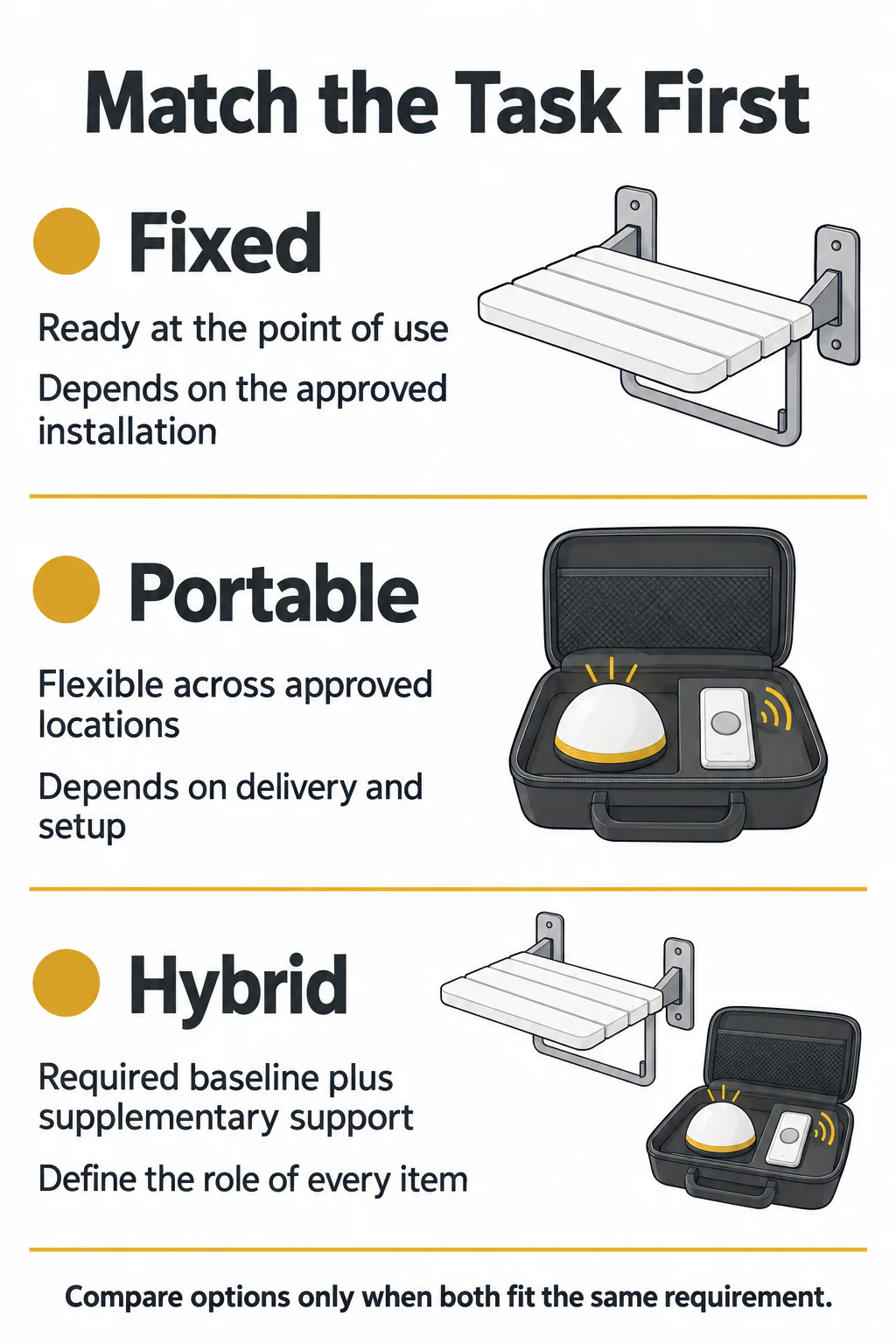
Fixed provision means equipment remains installed at its point of use. It can reduce retrieval and setup work, but the room, mounting system, and equipment become a connected maintenance responsibility. Wall structure, fasteners, clearances, finishes, and service access must be resolved together. A quoted seat price that excludes required installation work is not comparable with a fully installed offer.
Portable provision means suitable equipment can be moved between approved locations. It may help serve varied supplementary requests and simplify replacing a damaged unit. Its flexibility depends on a dependable process for assignment, cleaning, storage, delivery, setup, and return. Portable does not mean universally compatible, and a stockroom full of devices is not the same as usable availability.
Hybrid provision combines the required installed baseline with compatible supplementary inventory. It is often worth evaluating when a property has several room layouts or different guest requests. The benefit comes from assigning each item a clear role, not from purchasing a wider assortment without an operating plan.
| Option | Operational advantage | Main dependency | Potential fit |
| Fixed at point of use | Ready without retrieval | Approved installation and room-level repair | Required installed features or frequent use in a defined location |
| Portable, dedicated to a room | No shared-pool competition during assignment | Room compatibility and turnover inspection | Suitable supplementary items used repeatedly in one room |
| Portable, centrally pooled | Inventory can serve approved locations | Retrieval, setup, cleaning, and simultaneous demand | Variable supplementary requests with reliable delivery |
| Hybrid | Installed baseline plus adaptable support | Clear distinction between required and supplementary functions | Mixed room types and differentiated guest needs |
Bathing support: compare the complete installed or deployed condition
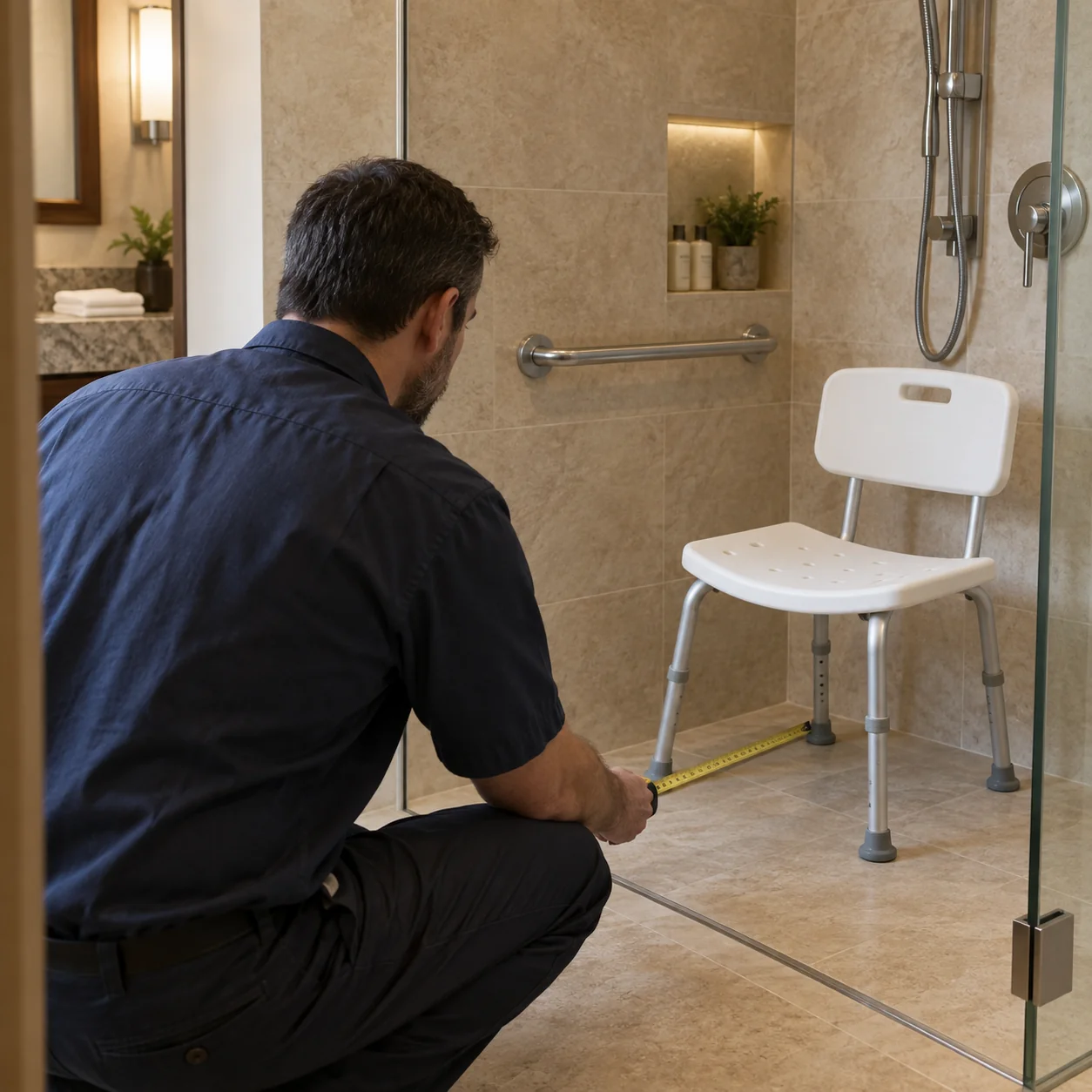
For a wall-mounted seat, assess the specified mounting arrangement and the actual supporting wall. For a freestanding shower chair, assess its intended environment, adjustment range, footprint, stability provisions, user rating, and compatibility with the room. Compare the usable space with the item in its operating position, not only its folded or packaged dimensions. Extra width may improve suitability for one user while obstructing a transfer area in a different room.
In U.S. transient lodging rooms with mobility features, the 2010 ADA Standards require folding seats in the roll-in showers covered by the relevant provision. A generic portable shower chair is not a substitute for that specified folding seat. The applicable requirements for a particular project depend on its scope and circumstances; resolve them before commercial scoring. Avoid improvised combinations, such as adding an accessory to a seat when the manufacturer has not approved that arrangement.
Communication support: match the device to the event
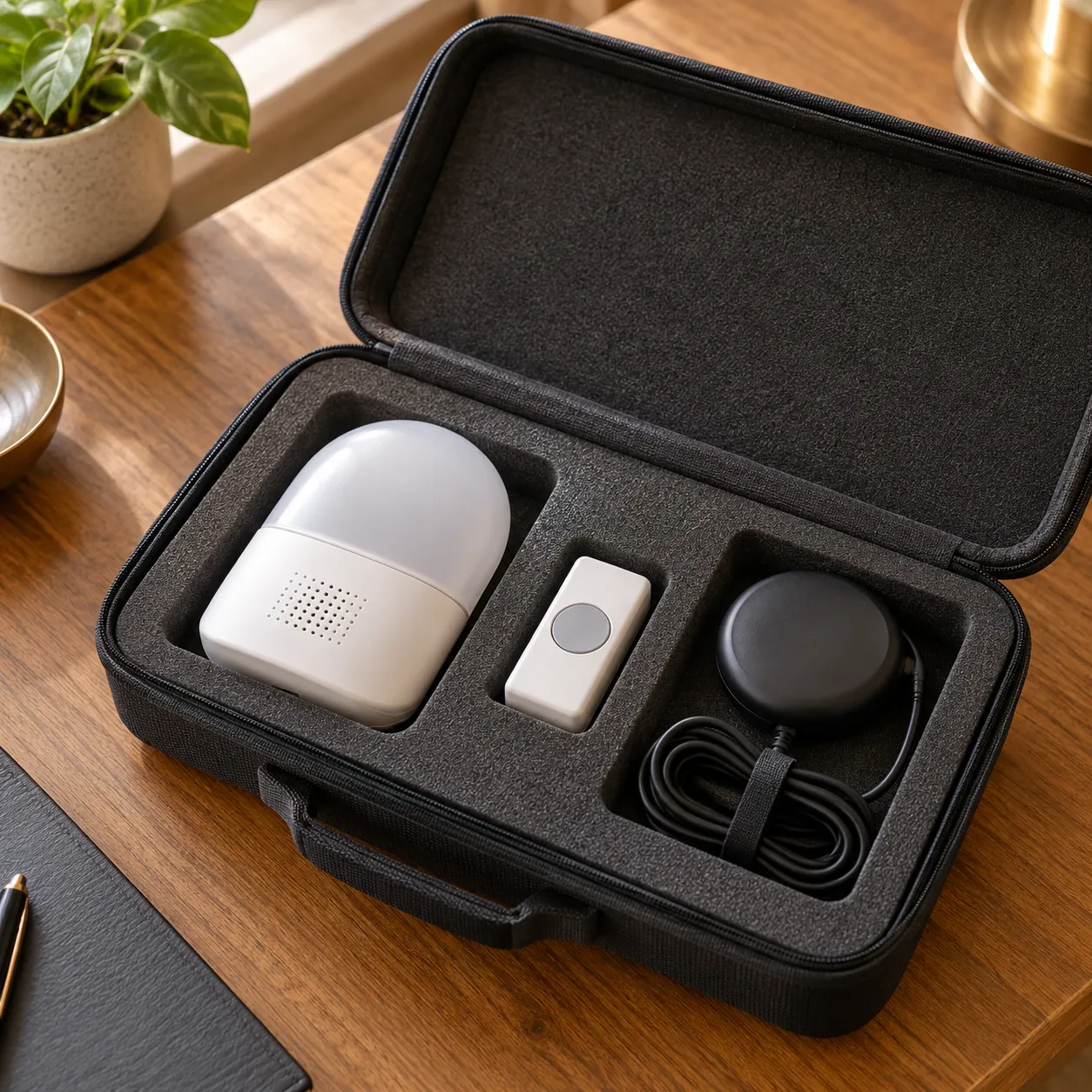
Compare a notification product against the event the guest needs to detect: a visitor at the door, an incoming telephone call, or another supported signal. Identify the transmitter, receiver, power arrangement, and any property-system interface. A standalone accessory and an integrated system are comparable only after their actual functions and compatibility are established.
For covered U.S. guest rooms with communication features, visible door and telephone notifications are distinct from visible fire-alarm appliances. Do not assume a consumer notification kit satisfies the building’s emergency-warning requirements. Have the responsible specialists review any life-safety interface. Where assistive listening equipment is being considered for a meeting space, evaluate the complete audio path and receiver compatibility rather than treating it as a general guest-room alert product.
Standardize around functions, then retain necessary variants
One standard model can simplify staff training and replacement stock, but forced uniformity can leave a known need unsupported. A better comparison asks whether a common base model covers the verified use cases and whether a limited number of approved alternatives covers meaningful exceptions. Record why each variant exists: room geometry, required functionality, user rating, or a supported communication method. Decorative finish alone should not create unnecessary operational variety.
Score Eligible Options Against the Operation
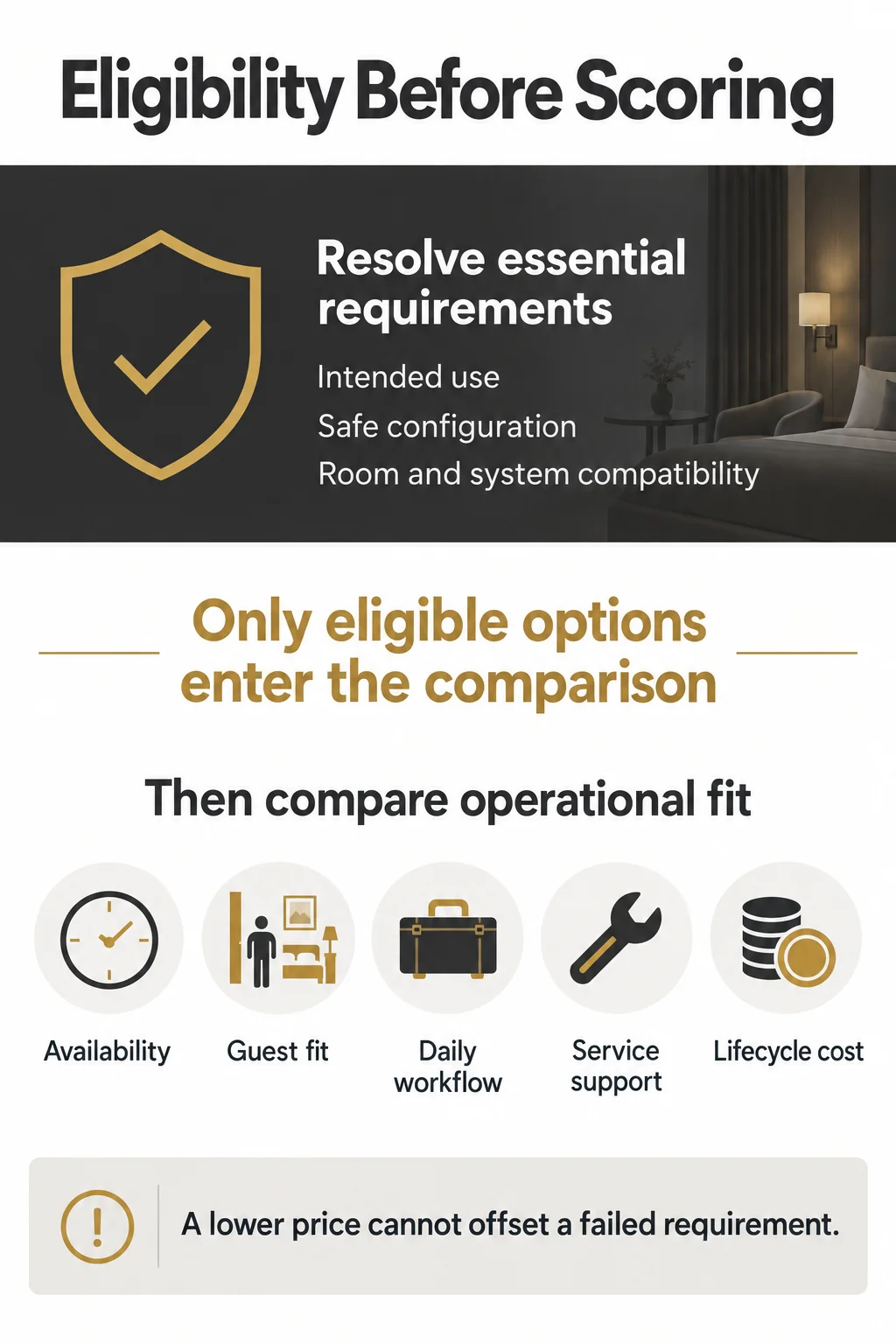
Use a two-stage comparison: first determine whether each offer satisfies the essential requirements, then score the eligible offers against operational priorities. Keep unresolved safety, installation, and compatibility questions outside the weighted score. A supplier’s attractive finish or favorable price must not offset failure on an essential condition. Once eligibility is established, weights can make the property’s preferences explicit and show why a particular configuration fits. Set those weights before reviewing commercial totals, use the same evidence rules for every supplier, and retain the underlying observations so a small numerical difference is not mistaken for certainty.
Treat essential requirements as pass, fail, or pending
An essential requirement can concern intended use, supported user rating, required dimensions, installation approval, cleaning compatibility, or a necessary system interface. Give each one a clear acceptance basis. A model-specific instruction manual or relevant test report is stronger evidence than an unsupported “commercial grade” statement. Confirm that documents describe the offered model and configuration; similar branding does not establish equivalence.
Mark an unanswered essential question pending, with the evidence needed and the responsible person. Do not quietly give it a middle score. Exclude failed options from the award decision, and resolve pending options before approval. An operational trial can establish room fit and workflow performance, but staff should not improvise structural overload tests or use guests to discover a product’s safety limits.
Choose weights that reflect the actual service model
The following weights are an illustrative starting point for comparing already eligible supplementary-equipment provision models. They are not regulatory thresholds or universal hospitality standards. Before scoring, operations and engineering should agree on the meaning of each criterion. Keep overlapping costs out of multiple categories: for example, use workflow to assess practical burden and error exposure, while including labor expense once in the cost calculation.
| Criterion | Weight | Evidence to compare |
| Availability and response | 25% | Trial delivery time, concurrent assignments, and backup coverage |
| Guest and room fit | 25% | Verified task coverage, room compatibility, reach, and usable controls |
| Daily workflow | 20% | Setup, cleaning, inspection, and handover observations |
| Service and replacement | 15% | Parts identification, support arrangements, and recovery process |
| Lifecycle cost | 15% | Comparable purchase, installation, labor, consumables, and replacement assumptions |
Score each criterion from 1 to 5 using agreed anchors: 1 means the option meets minimum eligibility but performs poorly operationally; 3 means it meets the property’s stated operating target; 5 means it materially exceeds that target with supporting evidence. Use 2 and 4 for intermediate performance. Missing evidence is not proof of average performance. Assign an evidence status beside every score and resolve material uncertainty before selecting a winner.
Calculate the total out of 100 as: sum of each criterion’s percentage weight multiplied by its score, divided by 5. For example, a score of 4 against a 25% weight contributes 20 points. Retain raw trial observations with the scoring record so another reviewer can understand how the judgment was reached.
Worked example: the highest score can change with the operating priority
Assume a hotel is comparing three ways to provide the same already approved supplementary notification equipment. Required installed communication features remain in place. Option A dedicates a unit to each selected room; Option B uses one central pool; Option C stages smaller pools near the rooms they serve. Assume all three can meet the required demand and minimum response target. The scores below are hypothetical and demonstrate the method only.
| Criterion | A: dedicated | B: central pool | C: nearby pools |
| Availability and response | 5 | 3 | 4 |
| Guest and room fit | 4 | 4 | 4 |
| Daily workflow | 4 | 3 | 4 |
| Service and replacement | 5 | 4 | 5 |
| Lifecycle cost | 2 | 5 | 4 |
| Weighted total / 100 | 82 | 74 | 83 |
Option C leads by only one point, which is too small to treat as a robust advantage without examining the evidence. If rapid response becomes more important, increase the availability weight from 25% to 35% and reduce lifecycle cost from 15% to 5%, leaving the other weights unchanged. A then scores 88, B scores 70, and C remains at 83. The preferred option changes because the operating priority changes, not because the equipment has improved.
Use this sensitivity test when reviewers disagree about priorities or scores are close. If an option wins only under one optimistic assumption, resolve that assumption through evidence or record the tradeoff explicitly. Never adjust weights after seeing prices solely to justify a preferred supplier.
Validate the Shortlist Before Committing to an Order
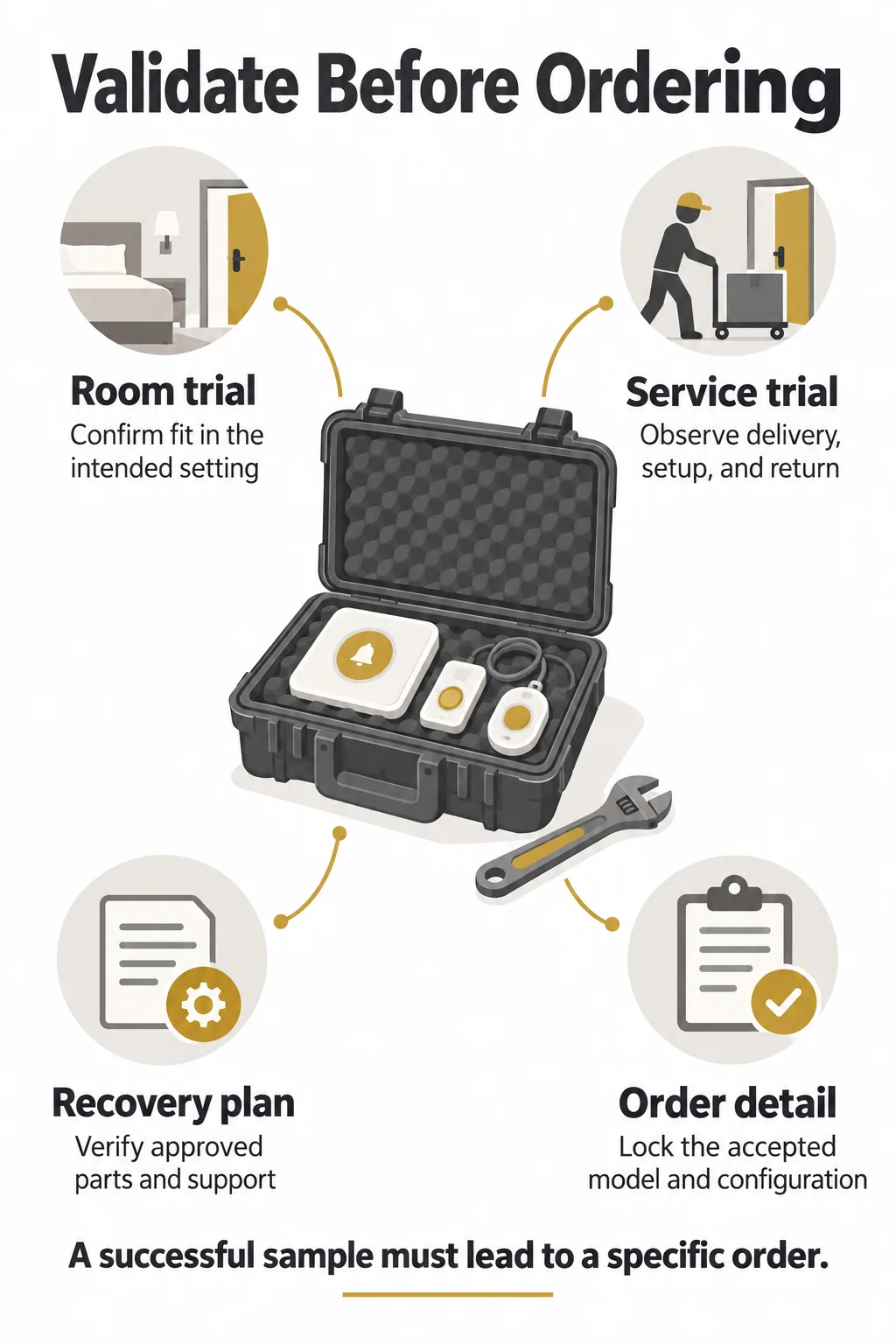
The shortlist should survive a trial in the property’s actual operating conditions before the order fixes the model, configuration, and service obligations. Product documents answer what an item is intended to do; a controlled trial shows how the approved item fits the room and the team’s routine. Keep the trial focused on the uncertainties that could change the purchasing decision. Record the configuration used, the people responsible for assessment, and the conditions observed. Then carry those findings into the purchase specification so a successful sample does not become an ambiguous bulk order.
Trial the service sequence as well as the product
For portable equipment, follow a request from receipt through location, delivery, setup, explanation, collection, cleaning, inspection, and return to ready stock. Include the shifts that will actually provide the service. A daytime demonstration by a supplier does not establish that an overnight team can locate every component and complete setup correctly. Distinguish active handling time from elapsed waiting time; both may affect the guest experience.
For fixed equipment, verify the proposed installed configuration with the responsible technical team and assess access for routine inspection and repair. Observe the equipment in its use and stowed positions where applicable. For electronic accessories, test the supported functions in the intended room, with the actual compatible interfaces and power arrangement. Follow manufacturer procedures; any alarm-system test needs the property’s authorized testing process.
Where appropriate, include compensated feedback from people with relevant lived experience in a safe, voluntary evaluation. Ask about the task, controls, reach, and instructions rather than expecting one person to represent every guest. Do not treat a favorable demonstration as certification of universal suitability. Guest feedback complements technical review and helps reveal usability issues that procurement measurements alone may miss.
Compare ownership cost on the same boundary
Use one time horizon and one operating-demand assumption for every offer. Include purchase and freight, required installation, compatible accessories, routine consumables, cleaning and inspection labor, servicing, and anticipated replacements. Identify taxes or disposal costs consistently if they are relevant. A warranty term is not a demonstrated product life, and a catalog lead time is not proof that a replacement will arrive during a busy weekend.
Do not add speculative lost-room revenue to one option while omitting the same exposure from another. Show uncertain downtime separately as a scenario, with its assumed duration and operational effect. For this selection exercise, the useful question is whether the apparent price advantage survives plausible support and workload assumptions. A detailed multiyear financial model can follow when the shortlist warrants it.
Evaluate recoverability, not just warranty length
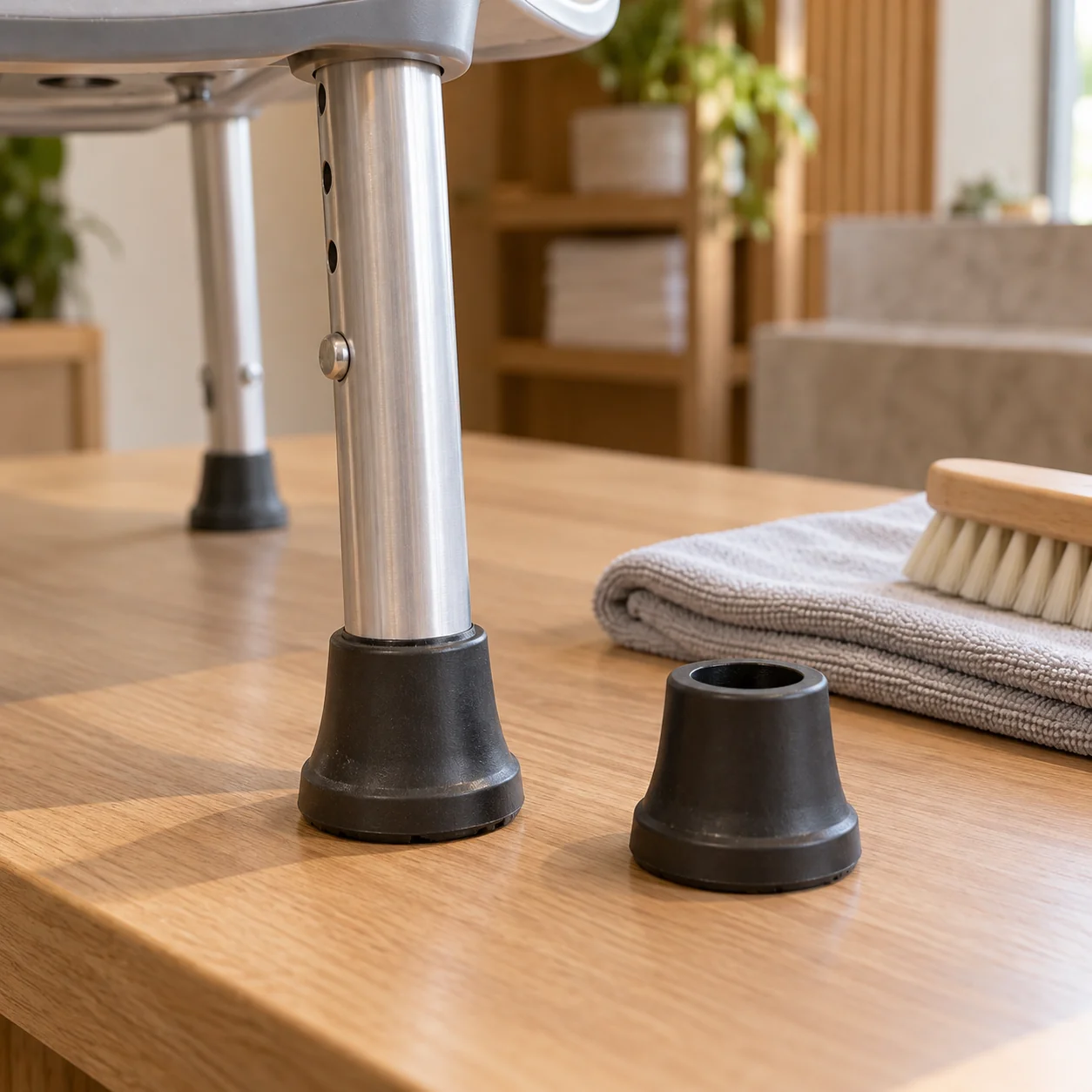
Ask how a failed item returns to service. The answer may involve a replacement foot, seat component, approved fastener set, battery, receiver, or entire assembly. Confirm the part identifier and compatibility, who supplies it, how a fault is reported, and whether the property can hold appropriate spares. Only use replacement parts and repair methods approved for the equipment. A readily available but incompatible component does not reduce operational risk.
Assess the supplier’s support commitments separately from the manufacturer’s product warranty. Document response arrangements, exclusions, shipping responsibility, and the process for discontinued or revised models. Prefer evidence of a workable recovery path over vague promises of lifetime support. If a critical component becomes unavailable, the procurement record should show which approved alternative or replacement assembly can restore service.
Make the quotation specific enough to compare
An RFQ should identify the guest task, room or amenity context, eligibility requirements, quantities, exact configuration, included accessories, finish, destination, and required delivery period. Ask the supplier to identify deviations explicitly and separate optional items from the base offer. Request the documents and sample conditions needed to resolve remaining uncertainties. This prevents a cheaper quotation from appearing equivalent when it omits mounting hardware, interfaces, or required service support.
When approaching KW Hospitality about sourcing, provide the operational brief and the shortlisted configurations so the discussion can focus on comparable offers. Include the intended market and ask which documentation and sample arrangements can be supplied for the proposed models. Confirm availability, service scope, and lead times for the actual request; no general comparison article can establish them in advance.
Conclusion
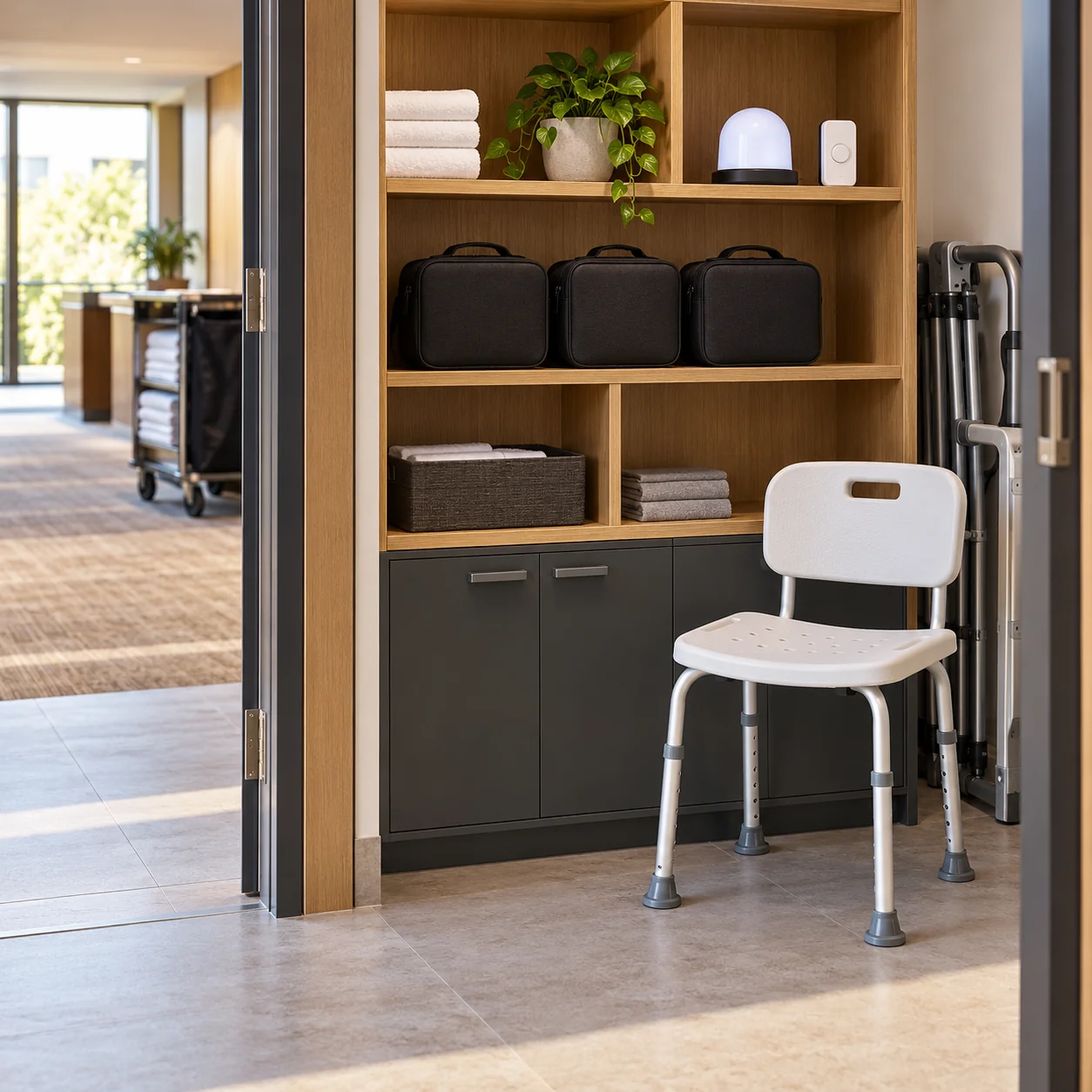
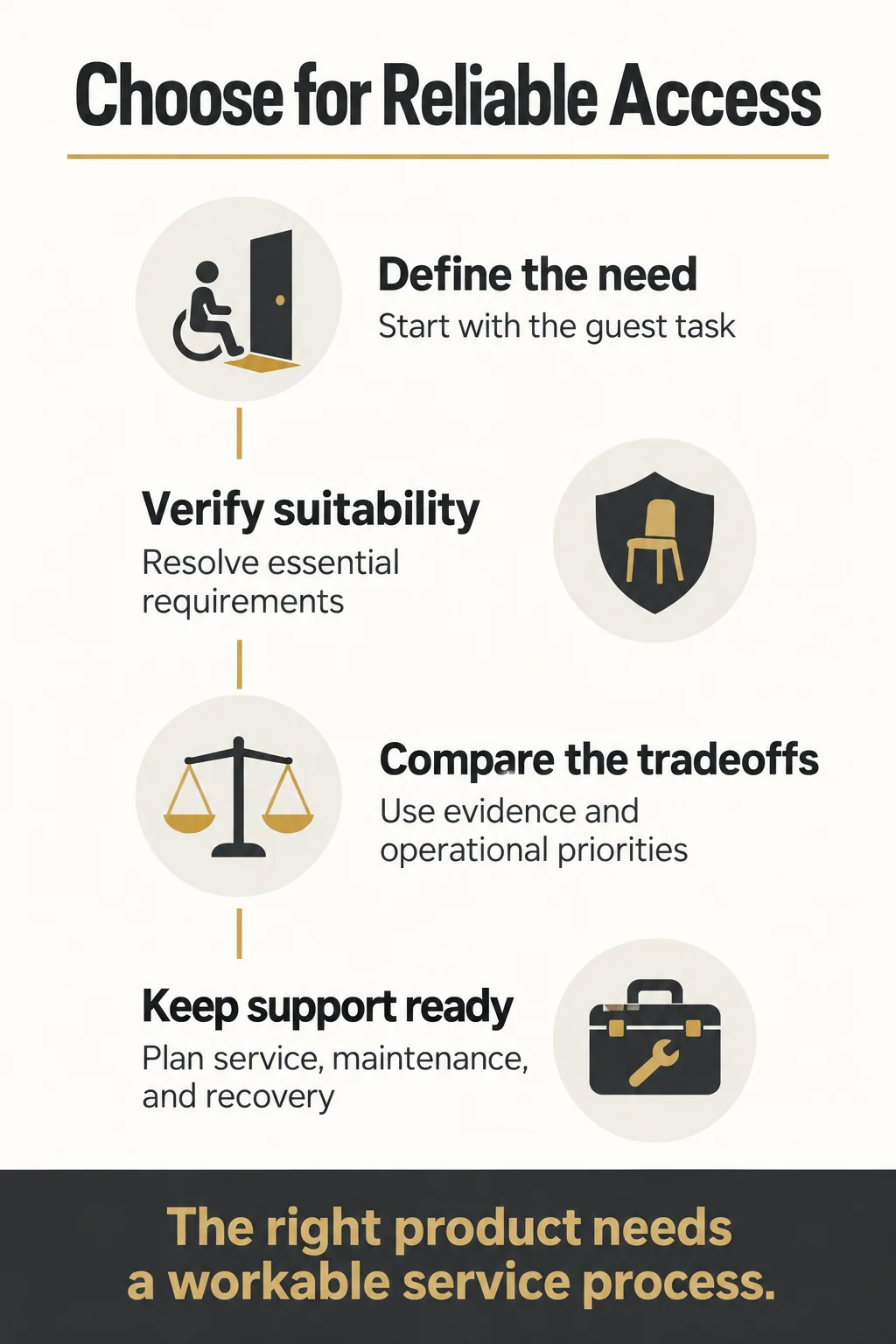
The best accessibility supplies option is the one that remains suitable and usable within the property’s real service conditions. Start with the guest task and the required installed baseline, compare only eligible alternatives, and make operational priorities explicit before ranking prices. Fixed, portable, and hybrid provision each introduce different responsibilities for room fit, response, cleaning, maintenance, and recovery. Use a controlled trial to resolve the uncertainties that could change the decision, then preserve the accepted configuration in the order. A defensible choice connects a specific need to verified equipment and a workable service process, with a clear plan for keeping that support available.
For the final sourcing discussion, send KW Hospitality the agreed requirements, model-specific questions, quantities, delivery destination, and remaining evidence requests. The goal is a quotation that can be evaluated against the same operating brief used to select the shortlist.
Frequently Asked Questions
Does a higher user weight rating automatically make a shower chair the better choice?
No. A suitable rating is one eligibility condition, but it does not establish room fit, adjustment suitability, intended use, or ease of operation. Compare the complete manufacturer-approved configuration and its dimensions with the intended setting. A larger model may need more space, so increased capacity should not be assumed to improve every application.
What if two eligible options have almost identical scores?
Treat the result as a close decision and review the observations behind the largest weighted differences. Test whether reasonable changes in weights or uncertain scores change the winner. If they do, collect evidence on those specific points or document why one tradeoff better matches the property’s priorities. A one-point lead is not a meaningful precision claim.
Can rented accessibility equipment cover an occasional supplementary request?
Rental may be worth comparing when the equipment is suitable and permitted for the intended role, and the provider can meet the required delivery, hygiene, condition, setup, and support needs. Verify those arrangements before relying on them. Rental availability should not be assumed to replace required permanent features or the property’s existing obligations.
Should low recorded usage justify reducing accessibility supplies?
Not by itself. Low usage may reflect limited demand, but it can also reflect poor information, a difficult request process, unavailable equipment, or an unsuitable product. Review unmet requests, delivery performance, guest feedback, and required provision before changing the inventory model. Keep required features and any applicable minimum provision outside a discretionary utilization decision.
What should happen if a supplier proposes a different model after sample approval?
Treat the substitution as a change requiring review before acceptance. Compare the new model’s function, dimensions, approved configuration, documentation, cleaning instructions, and support arrangements against the accepted specification. Repeat the affected parts of the trial where the change could alter suitability or workflow. Similar appearance and price are not enough to establish equivalence.