Hotel buffet trays and platters should be selected as operating equipment, not decorative accessories. The right pieces make a buffet easier to replenish, safer to handle, more consistent in appearance, and less expensive to maintain. The wrong pieces may be attractive in a showroom yet become awkward, unstable, difficult to clean, incompatible with existing risers, or too large for staff to exchange efficiently during service.
There is no single best material or universal platter size. Stainless steel is a dependable choice for demanding service and temperature-sensitive applications. Porcelain gives a refined presentation and can suit hot or cold food when the specific product is approved for the intended use. Melamine provides a lighter, break-resistant alternative for many high-volume displays, but it is generally unsuitable for ovens, microwaves, or direct heat. Glass can create an elegant, visually light display, while wood, bamboo, slate, acrylic, and high-pressure laminate can add character when their food-contact status, cleaning method, and temperature limits are clearly understood.
Size should follow the menu, equipment, replenishment system, and available buffet footprint. Modular Gastronorm pieces are especially useful when the hotel wants trays, pans, lids, risers, refrigerators, and service equipment to share a common dimensional system. Freestanding platters in the 10-to-22-inch range cover many appetizer, bakery, carving, seafood, dessert, and banquet applications, but nominal length alone is not enough. Usable surface area, rim width, depth, weight, handle design, stack height, and compatibility with covers matter just as much.
This guide explains how to build a practical assortment rather than simply buy an attractive collection.
Start With Function: Tray, Platter, Pan, Board, or Display Surface?
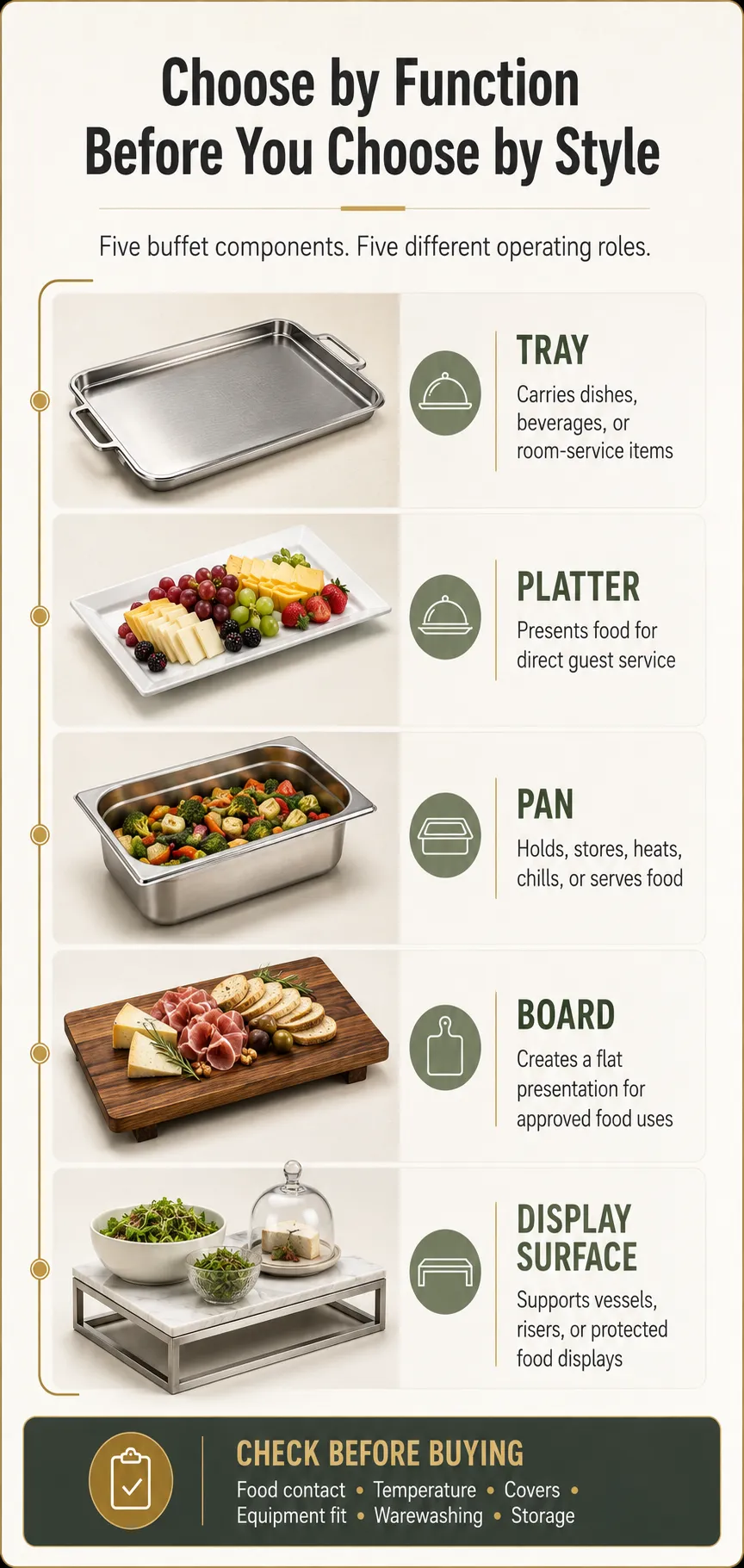
Hospitality catalogs often place several different product types under “trays and platters,” even though they perform different jobs. A clear purchasing specification begins by naming the function.
A service tray is primarily designed to carry items. It commonly has a raised rim, handles, a non-slip surface, or a shape that helps a server balance beverages, plated meals, or room-service components. It may never touch unpackaged food directly. A buffet platter is primarily a presentation surface from which food is served. It is usually shallower than a pan and may be rectangular, oval, round, square, asymmetrical, or paddle-shaped. A food pan is a deeper container used for preparation, storage, transport, hot holding, cold holding, or service. “Hotel pan” is common terminology in North America, while Gastronorm, abbreviated GN, refers to a modular metric system used widely in professional foodservice.
A board is a relatively flat presentation piece, often made from wood, bamboo, composite material, or melamine designed to imitate a natural surface. It may work well for bread, cheese, charcuterie, pastries, or individual presentation, but the buyer must confirm whether food can touch it directly and how it must be cleaned. A display surface may sit on a riser, frame, or cold display and may be made from tempered glass, acrylic, metal, stone-look laminate, or another engineered material. Some display surfaces are decorative platforms intended to hold bowls or packaged food rather than direct-contact serving pieces.
This distinction affects compliance, sanitation, and durability. A decorative wood-look shelf that is approved only as a nonfood-contact display surface should not automatically be specified as a direct-contact charcuterie board. Likewise, a fiberglass cafeteria tray may be excellent for carrying dishes but inappropriate as an uncovered food platter unless its manufacturer expressly approves that use.
Before comparing colors or prices, identify what each item must do:
- Hold unpackaged food directly, or support another vessel
- Carry food between kitchen and buffet, or remain stationary
- Enter an oven, heated well, induction unit, refrigerator, freezer, or blast chiller
- Sit under a heat lamp or over ice
- Accept a fitted lid, roll-top cover, dome, insert, or sneeze-guard arrangement
- Be exchanged as a complete loaded unit during replenishment
- Stack in a specific shelf, cart, rack, or storage bin
- Pass through a commercial warewashing system
Once these requirements are known, material and size decisions become much more objective.
Comparing the Main Materials for Hotel Buffet Service
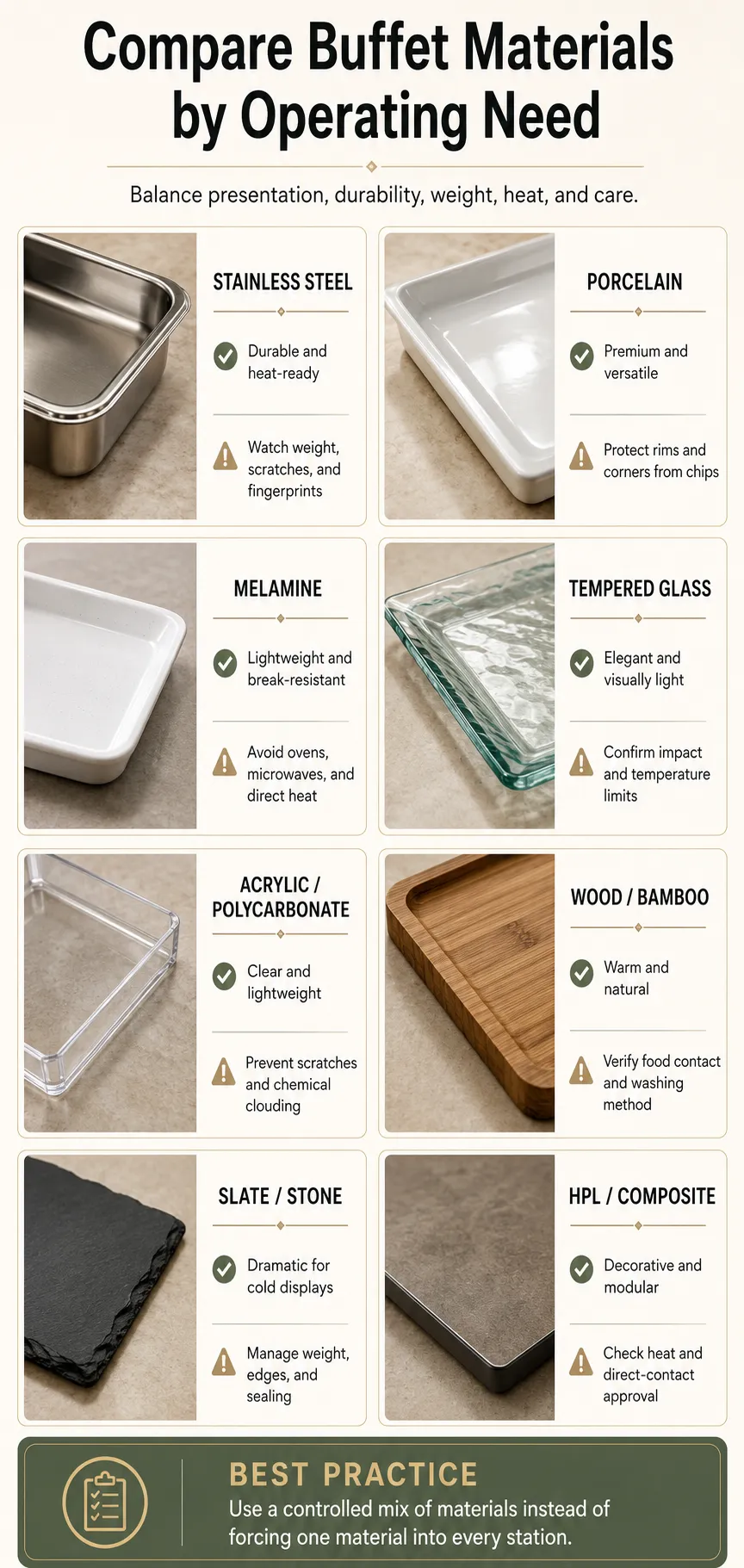
Every material creates a different balance of appearance, weight, breakage risk, thermal behavior, cleaning, and purchase cost. Hotels often achieve better results with a controlled mixed-material program than with one material used everywhere.
| Material | Operational strengths | Important limitations | Best-fit applications |
|---|---|---|---|
| Stainless steel | Durable, corrosion resistant when correctly specified, easy to clean, available in modular formats | Can scratch, show fingerprints, transfer heat, and feel industrial if poorly styled | Hot service, carving, seafood, banquets, high-volume stations |
| Porcelain or hotel-grade ceramic | Refined appearance, stable surface, useful for hot or cold presentation when approved | Heavier and breakable; rims and corners can chip | Premium breakfast, brunch, pastries, cold cuts, desserts |
| Melamine | Lightweight, break resistant, available in many colors and natural-look finishes | Usually not for ovens, microwaves, direct flame, or intense direct heat | Breakfast, salad, bakery, poolside, outdoor and high-volume displays |
| Tempered glass | Elegant, nonabsorbent surface and strong visual transparency | Heavy, breakable, shows marks, requires confirmed impact and temperature suitability | Desserts, cold displays, elevated presentation surfaces |
| Acrylic or polycarbonate | Light, clear, shapeable, useful for covers and cold-display components | Scratches; temperature and chemical compatibility vary | Chilled displays, bakery covers, riser surfaces, protected presentation |
| Wood or bamboo | Warm, natural appearance; useful for bakery and rustic concepts | Moisture, staining, warping, joints, and sanitation require careful control | Bread, pastries, packaged food, approved dry-food presentation |
| Slate or natural stone | Dramatic appearance and cold presentation potential | Heavy; edges may chip; surface and sealant require verification | Cheese, charcuterie, desserts, specialty cold displays |
| HPL or engineered composite | Decorative finishes, low visual weight, modular presentation options | Direct-food-contact approval and heat resistance are product-specific | Riser tops, display shelves, vessels-on-surface arrangements |
Stainless Steel
Stainless steel remains one of the most versatile commercial choices because a properly made piece can tolerate frequent handling and repeated washing while maintaining a sanitary, nonabsorbent surface. It is available as shallow platters, mirror-finished presentation trays, satin-finished display pieces, double-wall platters, and modular food pans. Rounded edges improve handling, while seamless or smoothly finished construction reduces areas in which food residue can collect.
Grade, thickness, finish, and fabrication deserve more attention than the generic phrase “stainless steel.” A heavy-gauge platter may resist denting better than a thin decorative tray. A satin interior can make wear less visible than a fully mirrored surface. A mirror finish can look more formal but may show fingerprints, water spotting, and scratches. Double-wall designs can slow temperature change and reduce condensation, although they do not replace validated hot- or cold-holding equipment.
Stainless steel is valuable for carving stations, chilled seafood, banquet service, and hot appetizers, but it conducts heat readily. Buyers should confirm whether the exact product is suitable for dishwashing, ovens, induction, heated shelves, acidic foods, or prolonged salt exposure. “Stainless” does not mean immune to every chemical or cleaning error.
Porcelain and Commercial Ceramic
White porcelain creates a neutral background that allows food color to dominate. Rectangular platters use space efficiently, while rounded or organic shapes soften a modular presentation. Commercial collections may include GN-format trays, bowls, and replacement pieces for visual consistency.
Porcelain is appropriate for premium breakfast service, cold cuts, fruit, pastries, hors d’oeuvres, desserts, and many hot-food presentations when the manufacturer approves the intended temperature cycle. It is nonabsorbent when properly manufactured and the glaze remains intact. It also has enough mass to feel substantial on a luxury buffet.
The tradeoff is handling weight and breakage. Large porcelain platters become much heavier after loading, increasing strain during rapid replenishment. Long rectangular pieces are vulnerable at corners and rims, particularly when crowded into racks not designed for them. Crazing, chips, cracks, or damaged glaze can make a piece unsuitable for continued service. Procurement should examine rim geometry, foot design, stack stability, rack fit, and replacement continuity rather than relying only on the face pattern.
Melamine
Commercial melamine can resemble porcelain, wood, stone, or ceramic while remaining lighter and more resistant to ordinary breakage. Modular full-, half-, third-, and quarter-size pieces can coordinate with buffet frames and covers.
Melamine works especially well for bakery displays, fruit, cold cuts, sandwiches, salads, desserts, terrace service, pool areas, and high-volume breakfast stations. Its reduced weight can improve replenishment ergonomics and lower the frequency of breakage-related replacement.
Its limitations must be written into operating procedures. Many commercial melamine products are dishwasher safe but are not microwave safe, oven safe, or suitable for direct flame or intense heat. Product temperature ranges differ, so a general material assumption is not sufficient. A platter that tolerates warm food is not necessarily approved for a heated shelf, heat lamp, or hot pan placed directly on it. Abrasive pads and harsh treatment can damage the surface. Deep scratches, cracks, swelling, chips, or loss of surface integrity are reasons to remove a piece from service.
Glass, Acrylic, and Clear Plastics
Clear surfaces make a buffet feel visually lighter and can work especially well with elevated displays. Tempered glass can provide a premium look, while smoked or colored glass adds contrast. Acrylic and polycarbonate can form shelves, trays, covers, bowls, and ice-display components with substantially less weight than glass.
Tempered glass, ordinary glass, acrylic, and polycarbonate do not share the same impact behavior or temperature tolerance. Confirm direct-contact status, load capacity, edge finish, support method, and permitted temperature changes. Long glass shelves require compatible support points.
Clear plastics are vulnerable to visible scratching and chemical damage. A product may become cloudy if exposed to the wrong detergent, sanitizer concentration, or cleaning tool. Hotels should test cleaning performance before standardizing a large collection and reserve pristine pieces for guest-facing use.
Wood, Bamboo, Slate, and Decorative Composites
Natural and natural-look surfaces add contrast to a buffet, but they require a disciplined distinction between a food-contact utensil and a decorative platform.
Wood and bamboo products vary in construction, adhesive, coating, grain, porosity, and washing instructions. Some are approved for limited direct contact, while others should hold only wrapped food or separate vessels. Soaking, high-temperature warewashing, and uncontrolled drying can lead to swelling, splitting, or warping. Slate and stone may chip at the edge, scratch adjacent surfaces, or require an approved finish. High-pressure laminate and engineered boards can be durable display surfaces, but their seams, cores, edges, heat limits, and direct-contact status must be verified.
For these materials, the purchase order should specify the intended food, cleaning method, temperature, and whether a liner or separate insert is required. “Natural finish” is an aesthetic description, not a sanitation specification.
Understanding Buffet Tray and Platter Sizes
Buffet sizing can follow three overlapping systems: Gastronorm dimensions, North American hotel-pan dimensions, and freestanding platter dimensions. Procurement teams should record actual external dimensions in both inches and millimeters even when a product carries a familiar size label.
Gastronorm Sizes
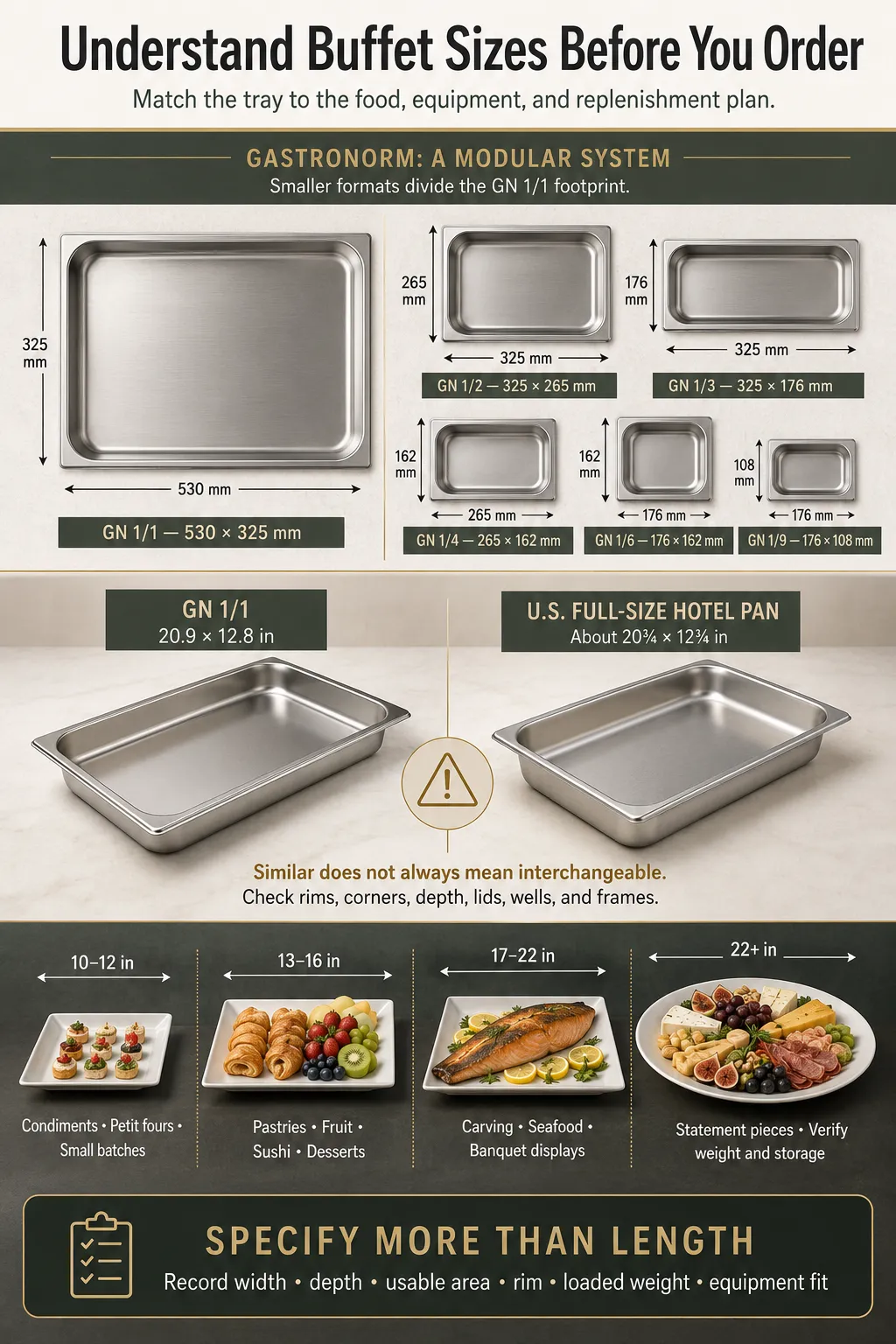
The GN system begins with GN 1/1 at 530 × 325 millimeters, approximately 20.9 × 12.8 inches. Other formats divide or multiply that module, enabling several smaller vessels to occupy the footprint of a larger one. This modularity is useful for buffet frames, refrigerators, carts, preparation counters, covers, and storage systems.
| GN size | Nominal dimensions | Typical buffet role |
|---|---|---|
| GN 2/1 | 650 × 530 mm | Very large banquet volume or compatible production equipment |
| GN 1/1 | 530 × 325 mm | Main display, large cold platter, full-size pan or tray |
| GN 2/3 | 354 × 325 mm | Medium display where a full size is too large |
| GN 2/4 | 530 × 162 mm | Long narrow presentation for sushi, pastries, cold cuts, or garnishes |
| GN 1/2 | 325 × 265 mm | Two-zone service, side dishes, fruit, salads, pastries |
| GN 1/3 | 325 × 176 mm | Smaller batches, toppings, appetizers, premium items |
| GN 1/4 | 265 × 162 mm | Condiments, garnishes, cheese, limited-volume items |
| GN 1/6 | 176 × 162 mm | Sauces, toppings, small accompaniments |
| GN 1/9 | 176 × 108 mm | Very small garnishes or condiment components |
Published dimensions sometimes differ by a millimeter because of rounding or catalog convention. Rim profiles also vary. A GN-designated platter may share the nominal footprint but still fit poorly in a particular frame, lid, or well if the corners, flange, underside, or depth are incompatible. Samples should be tested in the hotel’s actual equipment.
Depth is a separate specification. Common food-pan depths include approximately 20, 40, 65, 100, 150, and 200 millimeters, depending on size and manufacturer. A flat presentation platter may be only 10 to 30 millimeters high, while a full food pan may be much deeper. For buffet merchandising, deeper is not always better. A deep pan can hide a small quantity of food, encourage overfilling, and make serving awkward. Shallow vessels support smaller-batch replenishment and can make food appear fresher, provided the refill cycle can keep pace.
North American Hotel-Pan Sizes
In U.S. and Canadian catalogs, a full-size hotel pan is commonly listed near 20 3/4 × 12 3/4 inches. Half-, third-, quarter-, sixth-, and ninth-size pans are arranged as fractions of this footprint. Depths are often described in inches, including approximately 2 1/2, 4, 6, and 8 inches, with shallower variants also available.
These labels are not precision drawings. Rim dimensions, corner radii, stacking shoulders, and depth vary. North American fractional pans and GN pieces may look interchangeable yet fail to fit the same opening, adapter, lid, or transport system. State the required standard and exact measurements rather than asking only for “full size.”
Freestanding Platters
Freestanding platters are usually described by length, width, diameter, and height. A useful working assortment often includes:
- 10–12 inches: condiments, cheese, garnishes, petit fours, passed bites, or small replacement batches
- 13–16 inches: breakfast pastries, fruit, sandwiches, sushi, appetizers, desserts, and many table-service presentations
- 17–22 inches: large buffet displays, carved meats, seafood, cold cuts, banquet appetizers, and high-volume bakery presentation
- Above 22 inches: statement displays or specialty service that require careful assessment of weight, reach, support, washing, and storage
These are planning ranges, not universal rules. Shape and rim width change usable area, so buyers should request usable-well dimensions in addition to overall dimensions.
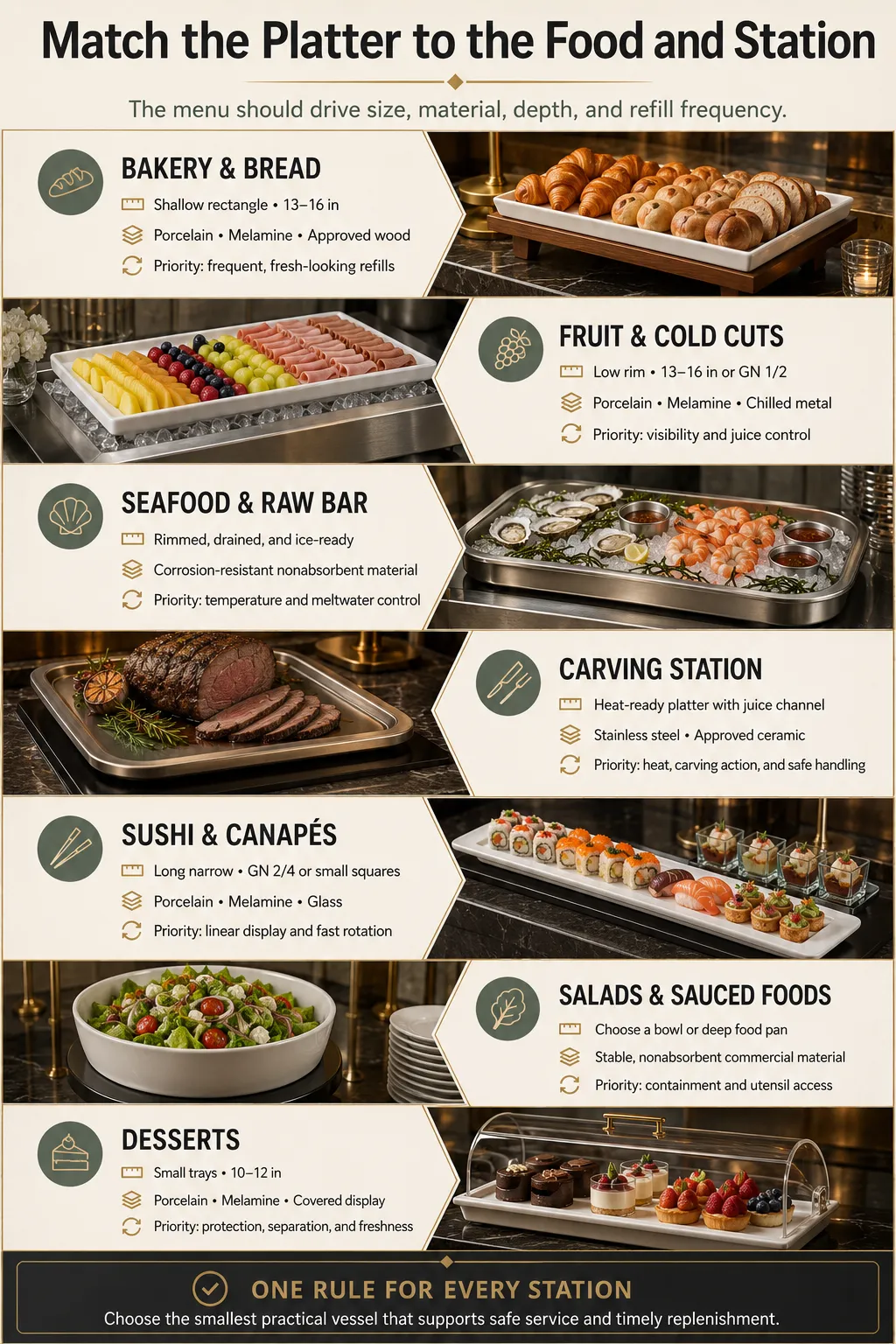
Match Size and Material to the Food and Station
The menu should drive the assortment. A hotel does not need every size in every material; it needs enough compatible formats to execute its recurring stations and special events.
For breakfast pastries and bread, shallow rectangular or long narrow platters create orderly rows. Melamine, porcelain, approved wood, or lined baskets may work. Smaller platters replenished frequently usually present better than one oversized tray late in service.
For fruit and cold cuts, low-rim platters improve visibility, while a modest rim contains juice. Porcelain and melamine are common; chilled metal or approved cold-display pieces work when temperature control is integrated. A platter does not replace required cold holding.
For seafood and raw bars, prioritize corrosion resistance, drainage, ice management, and cleanability. Approved nonabsorbent components are generally more practical than porous natural materials, and meltwater must be controlled.
For carving stations, choose heat-appropriate metal or approved ceramic components with enough rim or channel to manage juices. Confirm that the surface is designed for the heat source and carving action. Decorative melamine, acrylic, or laminate should not sit beneath intense heat unless the exact product is approved for that exposure.
For sushi, canapés, and petit fours, GN 2/4, narrow rectangular platters, paddles, and smaller square pieces support linear presentation and frequent replenishment. Matte black, white, glass, stone-look melamine, or natural finishes can create contrast, but the surface must remain easy to inspect and clean.
For salads, sauced foods, and loose side dishes, a platter may be the wrong form. Use a bowl or food pan with adequate depth, stable placement, and a utensil rest that keeps the handle above the food. Do not select a nearly flat platter simply because it matches the visual collection.
For desserts, small trays reduce replenishment damage and help keep separated products distinct. Covers may matter more than capacity for pastries that dry out or require protection.
For outdoor, poolside, and terrace service, lighter break-resistant materials can reduce risk. Consider wind, uneven surfaces, sunlight, ambient heat, and stability on risers.
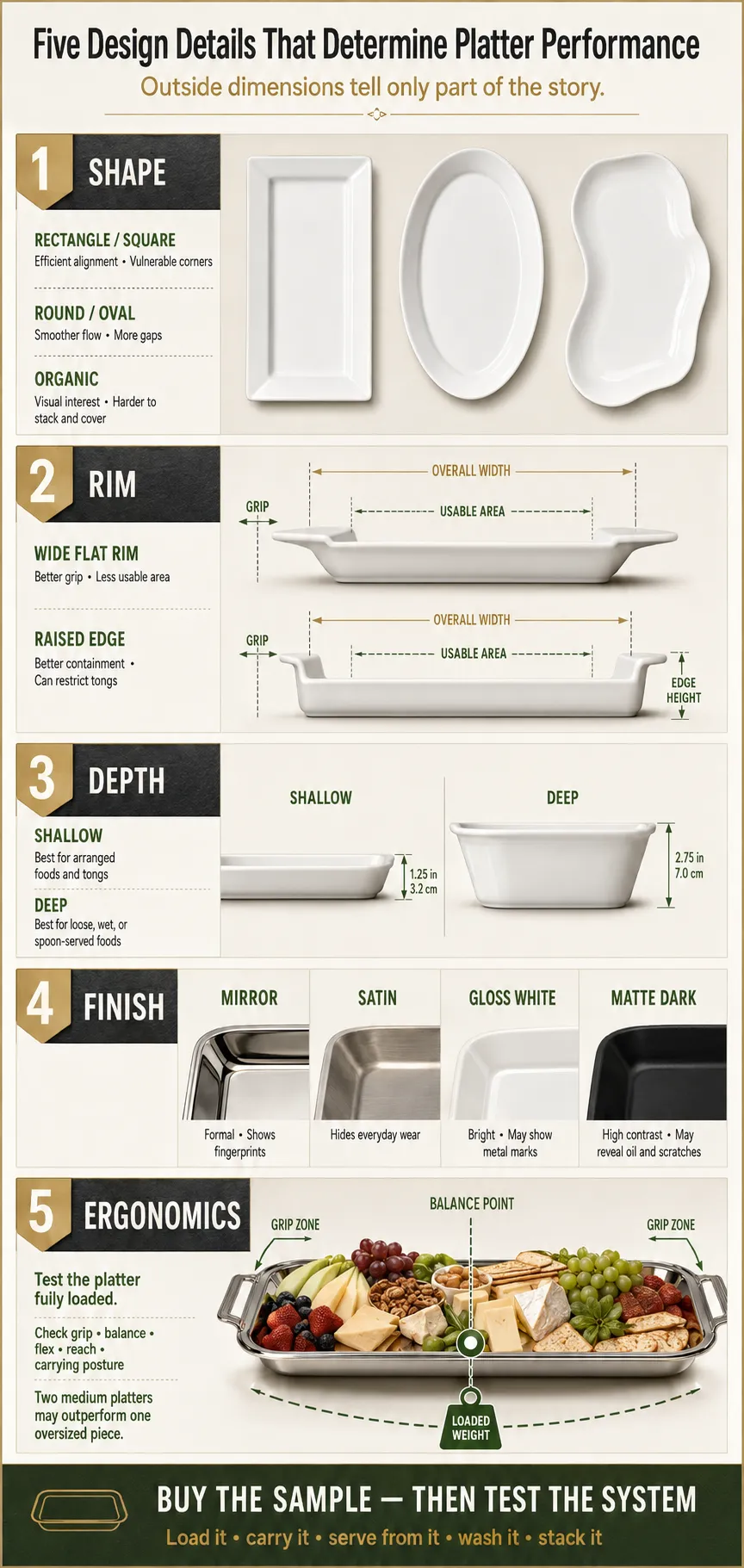
Shape, Rim, Depth, Finish, and Ergonomics
Material and outside dimensions describe only part of a platter. Small design details determine how well it performs during a busy service.
Rectangular and square pieces use linear space efficiently but are vulnerable at corners. Oval and round pieces soften the display and improve flow but leave gaps. Organic pieces add interest while complicating stacking, covers, and replacement matching.
A flat rim creates a visual frame and a gripping surface, but a very wide rim reduces capacity. A rolled or raised edge helps contain food and can improve grip. A rim that is too tall hides low-profile items and makes tongs awkward. Juice-bearing products need a lip or well, while dry pastries can use a nearly flat surface.
Depth influences both capacity and perceived freshness. A deep vessel is appropriate for food that moves, spills, or requires a serving spoon. A shallow platter is better for arranged items served with tongs. The utensil must be tested with the selected vessel: its handle should not fall into the food, and its bowl or gripping end should reach the bottom without forcing the guest’s hand against the rim.
Finish affects maintenance. Mirror metal shows fingerprints; satin hides some wear. Glossy white can show metal marks, while matte dark surfaces may reveal oil, dust, and scratches. Textures must remain cleanable.
Ergonomics should be assessed with a loaded sample. Record the empty weight, estimated loaded weight, grip points, balance, flex, and safe carrying posture. A platter that one employee can lift in a showroom may be unsafe when loaded with roast beef or wet fruit. In many operations, two medium platters rotated frequently are better than one oversized statement piece.
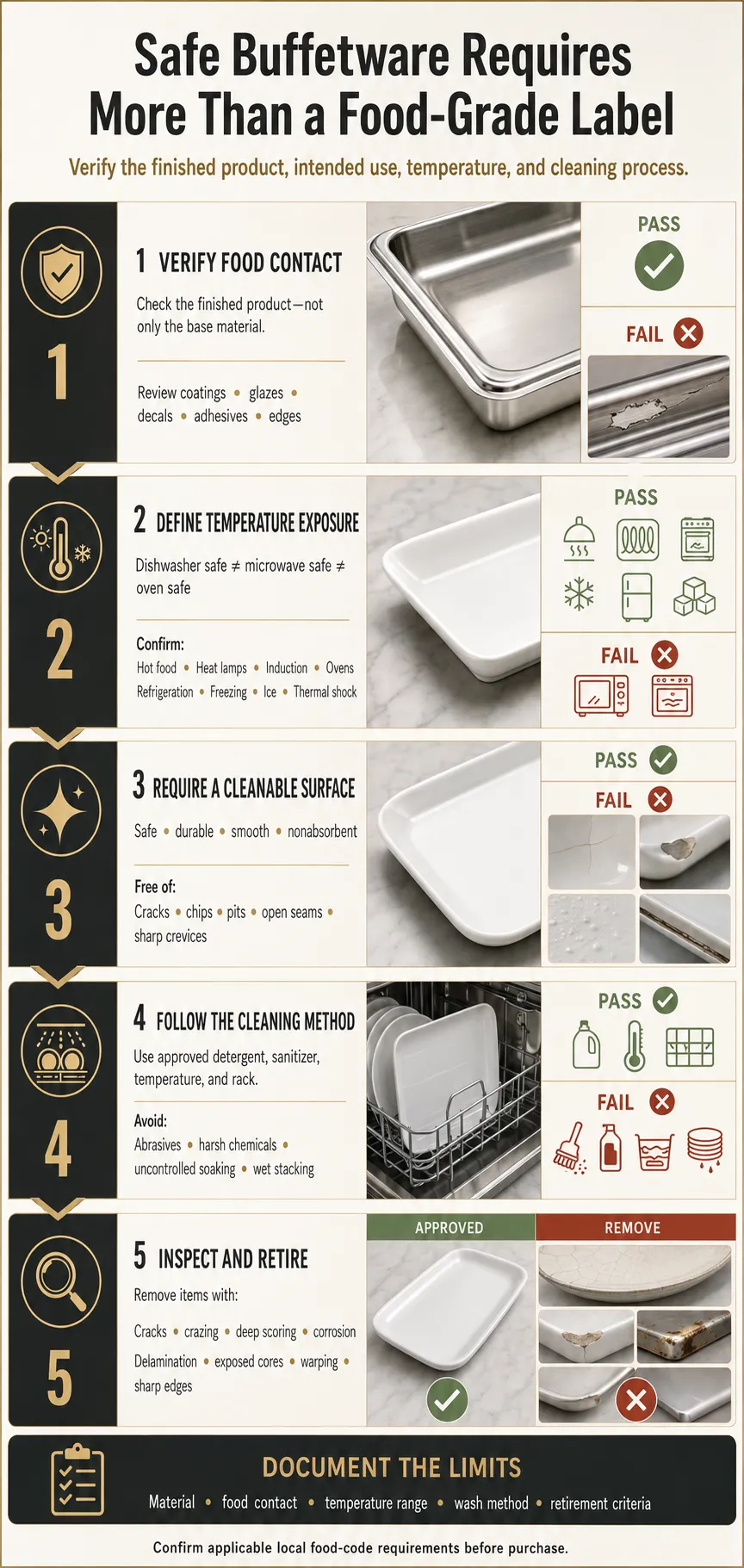
Food Safety, Temperature, and Cleaning Requirements
Any reusable surface that directly contacts food should be safe for its intended use, durable, nonabsorbent where required, corrosion resistant where relevant, smooth, and capable of withstanding the hotel’s cleaning and sanitizing process. It should remain free of cracks, chips, pits, open seams, sharp internal corners, and other damage that prevents effective cleaning.
Request documentation for the finished product, not merely the base material. A compliant resin does not prove that a printed platter, adhesive, coating, or edge band is suitable for the same use. Confirm applicable local rules.
Temperature language must be precise. “Heat resistant,” “hot-food safe,” “dishwasher safe,” and “oven safe” are different claims. The RFQ should state minimum and maximum operating temperatures, duration, whether heat is direct or indirect, and whether the piece will face rapid transitions. Ask separately about:
- Commercial dishwasher and sanitizing temperatures
- Microwave, oven, combi oven, salamander, and heat-lamp use
- Direct flame, chafing fuel, induction, and heated shelf exposure
- Refrigeration, freezing, blast chilling, and ice contact
- Rapid movement from cold storage to a warm buffet or from hot service to washing
Follow the exact cleaning instructions. Avoid improvised abrasives, unapproved chemicals, uncontrolled soaking, and wet stacking. Warewashing racks should support large platters without allowing corners to strike adjacent items.
Create objective retirement criteria. Remove pieces with cracks, chips, crazing, deep scoring, delamination, exposed cores, unstable feet, sharp edges, severe warping, corrosion, or surfaces that can no longer be cleaned effectively. A consistent inspection standard protects both guests and the appearance of the buffet.
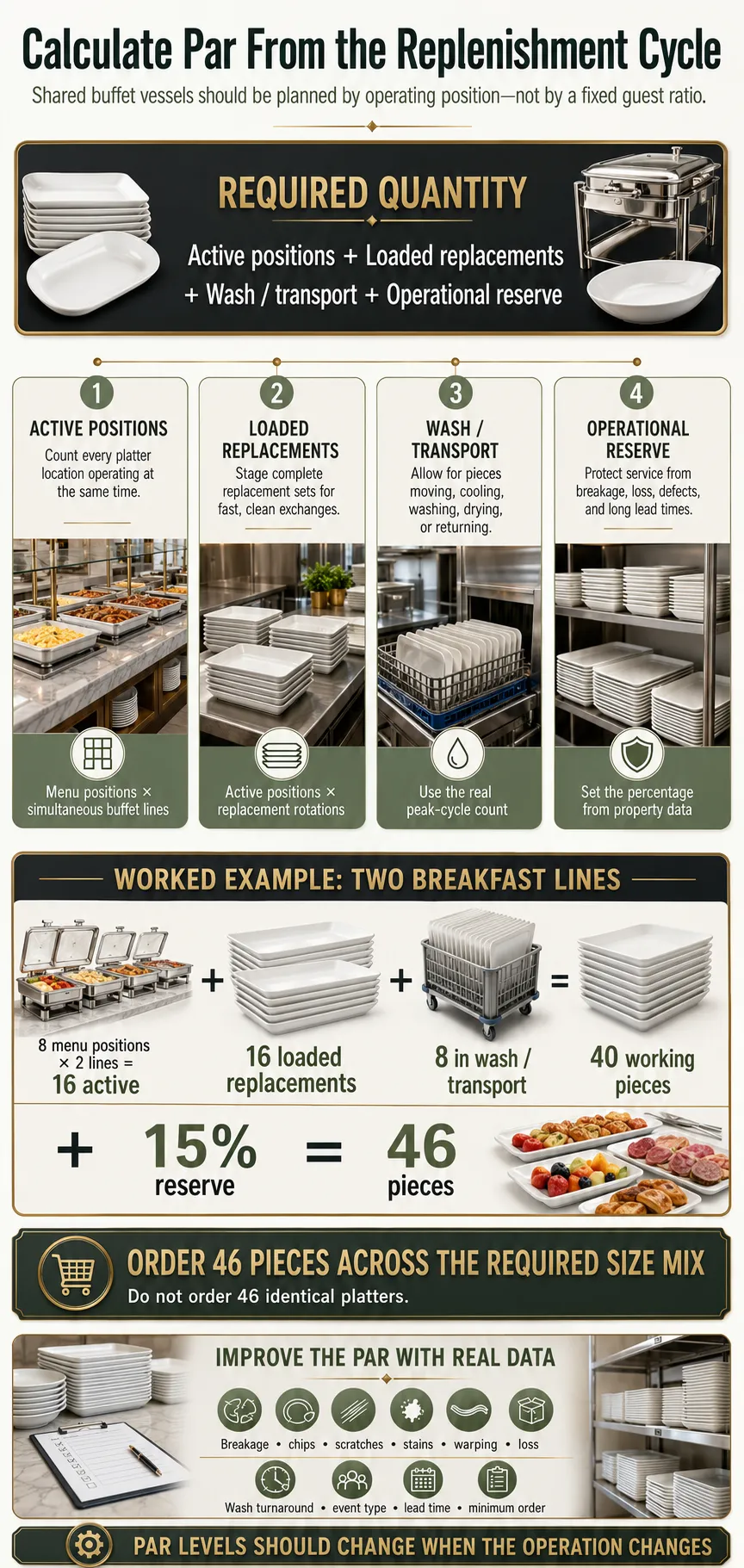
Calculate Quantities and Par Levels From the Replenishment Cycle
The correct quantity is not a fixed number per guest. Platters are shared service vessels, so their required par depends on the number of menu positions, simultaneous buffet lines, replenishment method, wash turnaround, event schedule, and breakage risk.
Use this planning formula for each menu position:
Required quantity = active positions + loaded replacement sets + pieces in wash/transport + operational reserve
Consider a breakfast buffet with two identical lines and eight platter-based menu positions on each line. That creates 16 active positions. If the kitchen stages one complete loaded replacement for every active position, another 16 pieces are needed. If eight pieces may be in washing, cooling, or transport at peak turnover, the working requirement reaches 40. Adding a 15% operational reserve and rounding up produces 46 pieces across the relevant sizes—not 46 identical platters, but a planned mix tied to the menu.
Set reserve percentages from property data. Porcelain in a convention hotel may need a different reserve from melamine in an executive lounge. Long replacement lead times also justify more protection.
Track the following after opening:
- Pieces placed in service by item code
- Breakage, chipping, scratching, staining, warping, and loss
- Menu position and event type associated with failure
- Wash cycles or months in service, where practical
- Replacement lead time and minimum order quantity
- Percentage of original stock still guest-presentable
This data turns the next purchase from an opinion into a forecast. It may show, for example, that a premium porcelain platter remains economical in a low-touch executive lounge but not at a pool buffet, or that a supposedly inexpensive melamine finish becomes unattractive too quickly under a particular cleaning process.
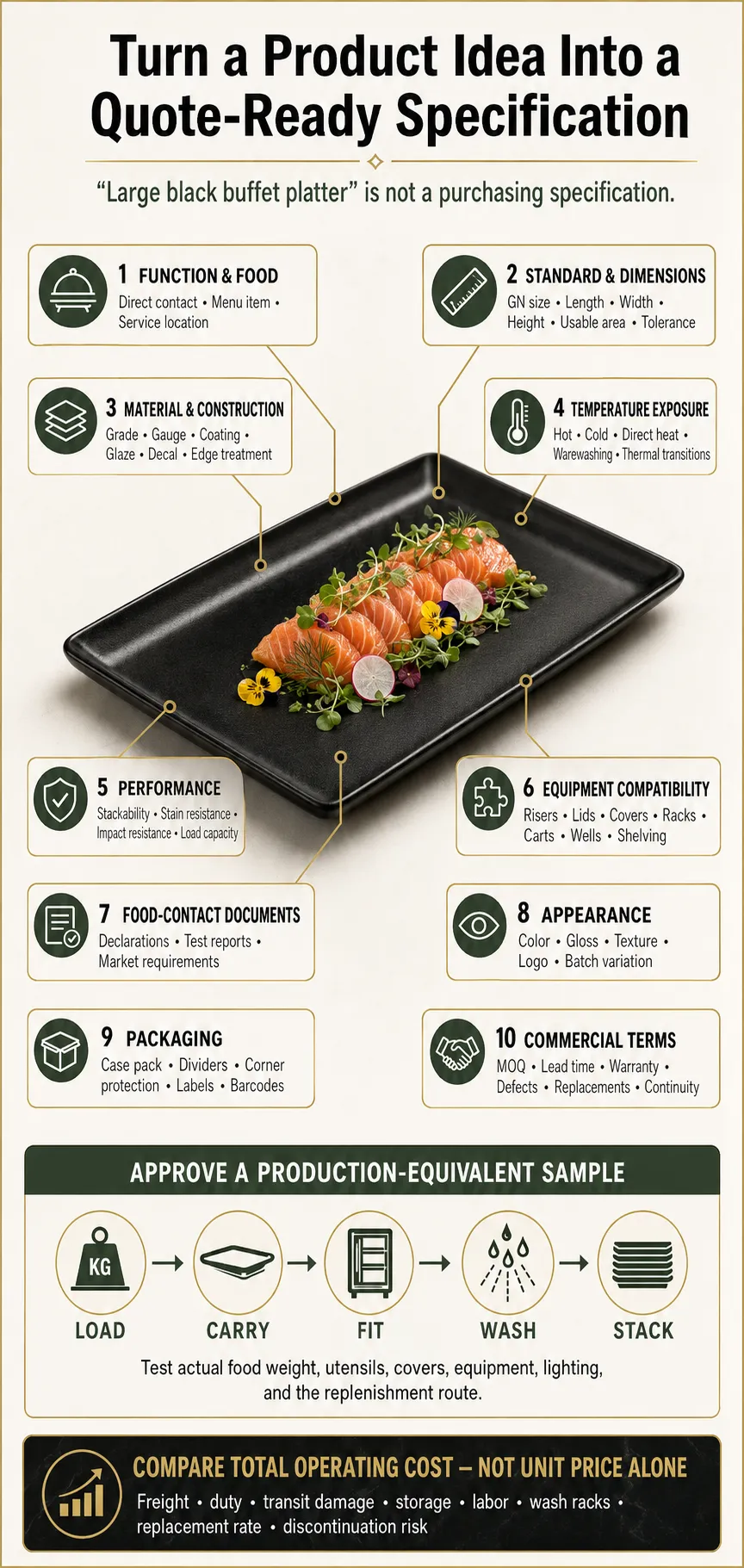
Write a Procurement Specification That Suppliers Can Quote Accurately
An effective RFQ should make comparable offers possible. “Large black buffet platter” is not a purchasing specification.
For each item, include:
- Function and food: Direct-contact platter for chilled sliced fruit, dry bakery tray, heated carving platter, or noncontact display shelf.
- Standard and dimensions: GN designation if required; overall length, width, height, usable area, rim width, and dimensional tolerance in inches and millimeters.
- Material: Finished-product material, grade where relevant, construction, wall thickness or gauge when important, coating, glaze, decal, adhesive, and edge treatment.
- Temperature exposure: Operating range, washing conditions, direct or indirect heat, cold use, and thermal transitions.
- Performance: Dishwasher safety, stain resistance, chip or impact resistance, stackability, non-slip features, load capacity, and expected commercial use.
- Compatibility: Riser opening, lid, cover, adapter, cart, rack, shelving, cold well, hot well, or induction equipment model.
- Food-contact documentation: Declarations, test reports, or certification applicable to the market and intended use.
- Appearance: Color standard, gloss level, texture, finish sample, logo location, and acceptable variation between production batches.
- Packaging: Case pack, dividers, corner protection, carton limits, barcode, spare-piece packing, and labeling.
- Commercial terms: Sample approval, production lead time, minimum order, warranty, replacement availability, defect process, and continuity of the collection.
Require a production-equivalent sample and test it in service. Load it with the actual food weight, place it on the intended riser, fit the cover, carry it through the replenishment route, wash it in the property’s machine, stack it on the assigned shelf, and ask employees to use the planned utensil. For decorated products, approve color and finish under the buffet’s real lighting.
When evaluating bids, compare landed and operating cost rather than unit price alone. Include freight, duty, packaging disposal, breakage in transit, storage volume, wash-rack changes, labor, expected replacement rate, and the risk that the collection will be discontinued.
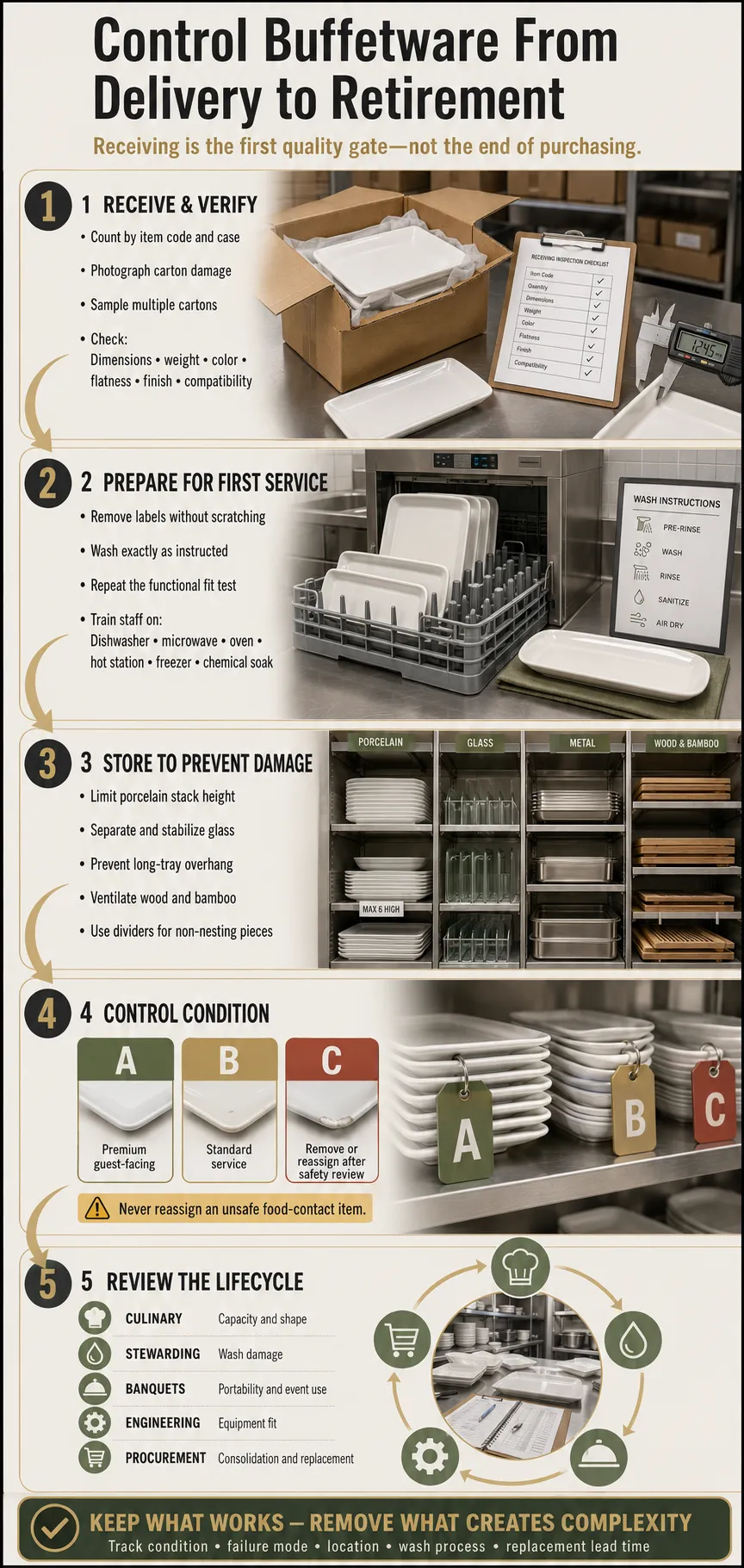
Receiving, Storage, Care, and Lifecycle Control
At receiving, count by item code, photograph damage, and sample different cartons. Confirm dimensions, weight, color, flatness, stack stability, rim condition, finish, and compatibility. Compare decorative batches side by side.
Before service, wash items as instructed and repeat the functional test. Give staff a handling guide that identifies what may enter the dishwasher, microwave, oven, hot station, freezer, or chemical soak.
Storage should prevent load damage. Limit porcelain stack height, separate and stabilize glass, prevent long trays from overhanging, ventilate wood and bamboo, and use dividers for statement pieces that do not nest.
Use a condition code such as A: premium guest-facing, B: standard service, and C: remove or reassign after safety review. This prevents a scratched or faded piece from appearing unexpectedly at a luxury event. Never reassign an unsafe food-contact item merely to avoid replacement.
Lifecycle reviews should connect purchasing, culinary, stewarding, banquets, and engineering. Culinary knows whether capacity and shape work. Stewarding sees wash damage. Banquets understands portability and event variation. Engineering can confirm equipment fit. Procurement can then consolidate successful items and eliminate sizes that create complexity without adding value.
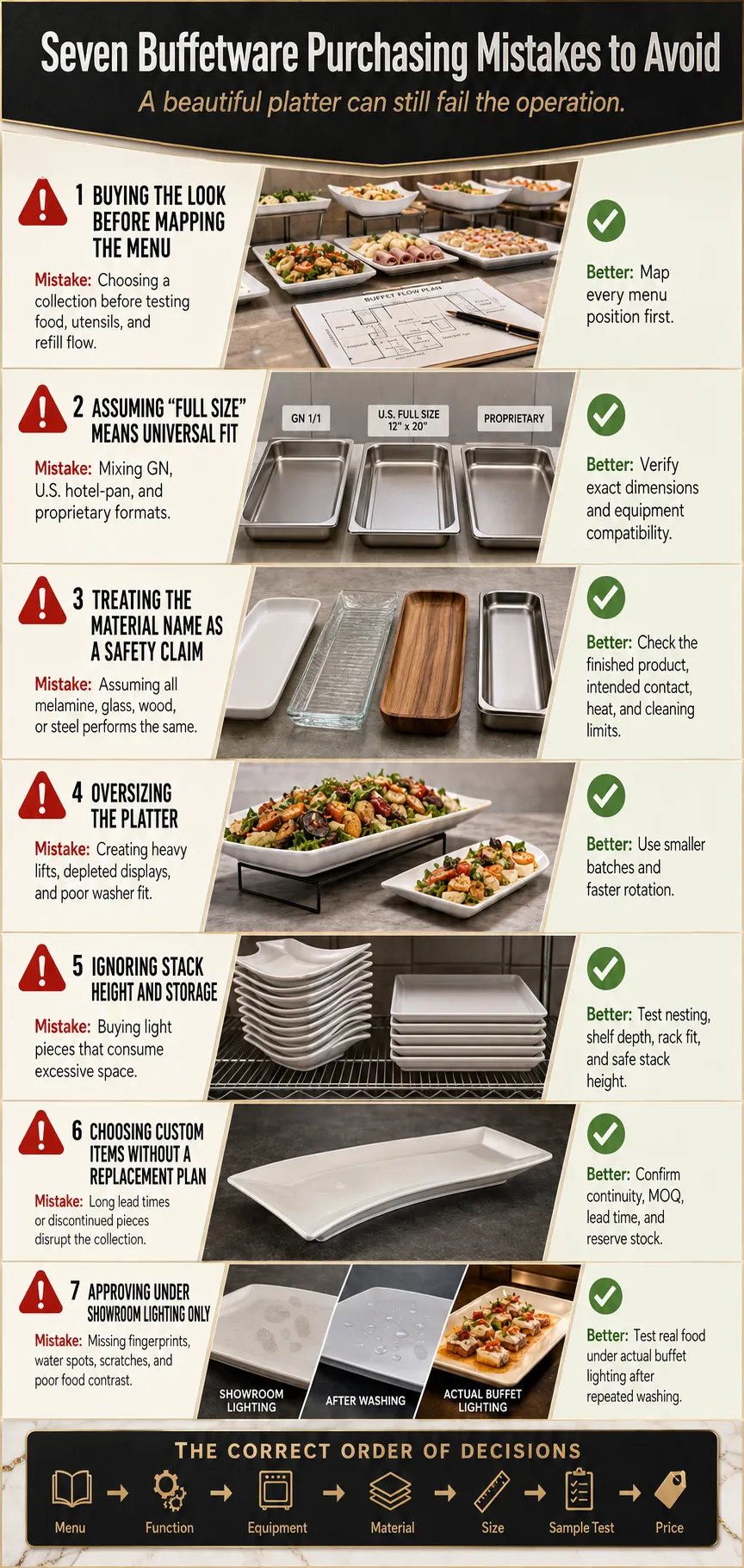
Common Purchasing Mistakes
The first mistake is buying a coordinated visual collection before mapping the menu. This creates beautiful pieces that do not fit the actual food, utensils, or refill system. The second is treating every “full-size” product as interchangeable. GN, U.S. hotel-pan, and proprietary buffet formats require dimensional verification.
Another error is treating a material name as a complete safety claim. Verify the finished product, intended contact, temperature, and cleaning conditions. Dishwasher-safe melamine is not automatically microwave-safe, and tempered glass is not approved for every thermal shock or unsupported span.
Oversizing is also common. A massive platter appears impressive when full but looks depleted quickly, becomes heavy to carry, requires more food to maintain abundance, and may not fit the washer or storage shelf. Small-batch rotation often improves both freshness and visual control.
Hotels also underestimate stack height and case-pack consequences. Non-nesting pieces consume storage, while custom shapes can create long replacement lead times. A low opening price becomes expensive if damaged pieces cannot be replaced.
Finally, appearance is sometimes evaluated only under showroom lighting. Gloss, texture, color, fingerprints, water spots, and food contrast can look different under warm buffet lights. Test actual food on the sample, photograph it from the guest’s viewing angle, and inspect it after repeated washing before approving a bulk order.
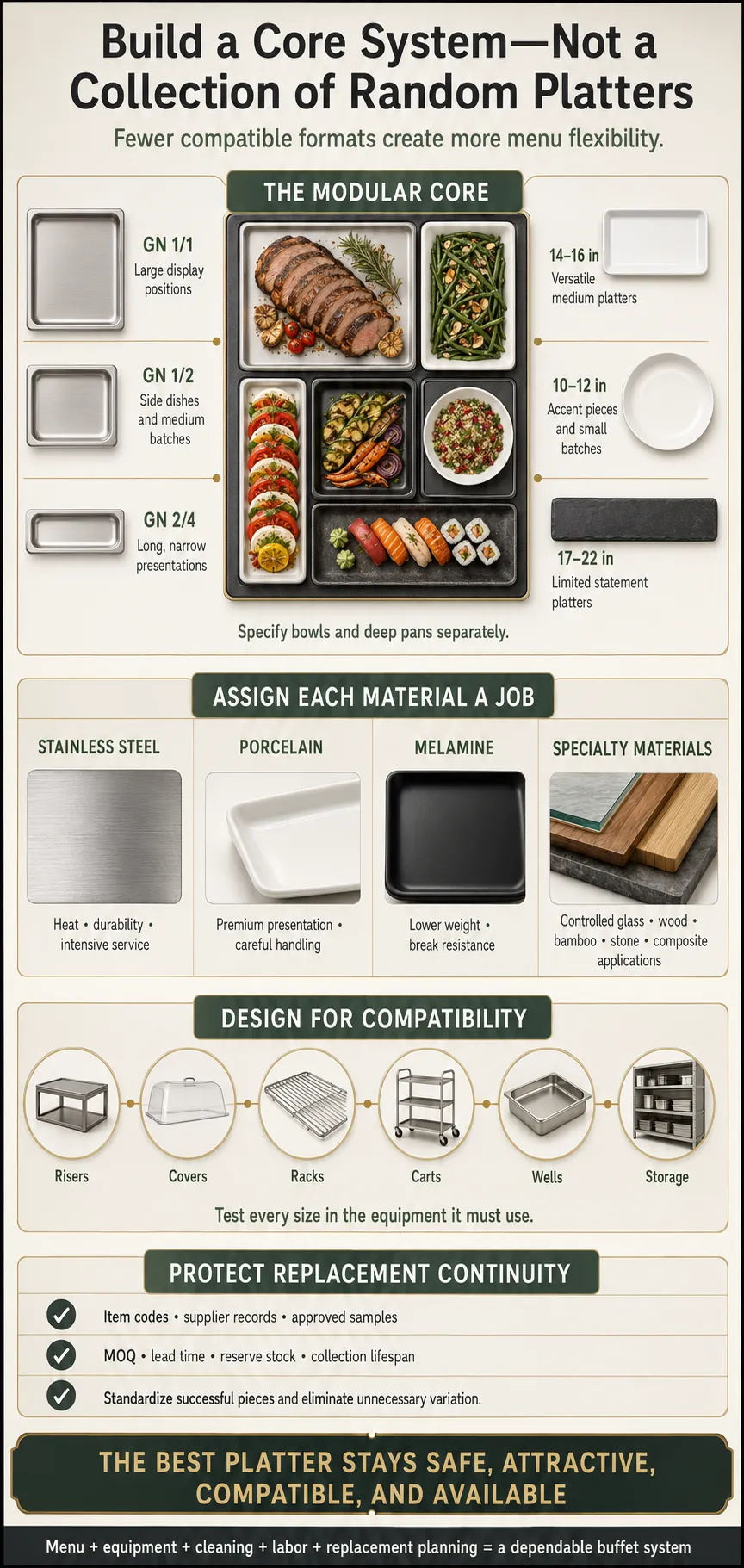
Build a Small, Modular, and Replaceable Buffet Platter System
A strong hotel buffet program needs a controlled family of pieces that covers the menu, fits the equipment, and can be replaced predictably. A practical core might include GN 1/1 and 1/2 rectangles, a long GN 2/4 or similar narrow platter, 14-to-16-inch ovals or rectangles, 10-to-12-inch accent pieces, and a few large statement platters. Specify bowls and pans separately for foods that need depth.
Use stainless steel where heat, durability, and intensive service dominate; porcelain where premium presentation justifies careful handling; melamine where lower weight and break resistance improve workflow; and glass, wood, bamboo, stone, or composites where a controlled specialty application supports the concept. No material should be assigned beyond its documented limits.
The best purchase is therefore not the cheapest tray or the most dramatic platter. It is the piece that remains safe, attractive, compatible, and available through repeated services. When material, dimensions, food, equipment, cleaning, labor, and replacement planning are specified together, buffet serveware becomes a dependable operating system rather than a recurring source of breakage and improvisation.
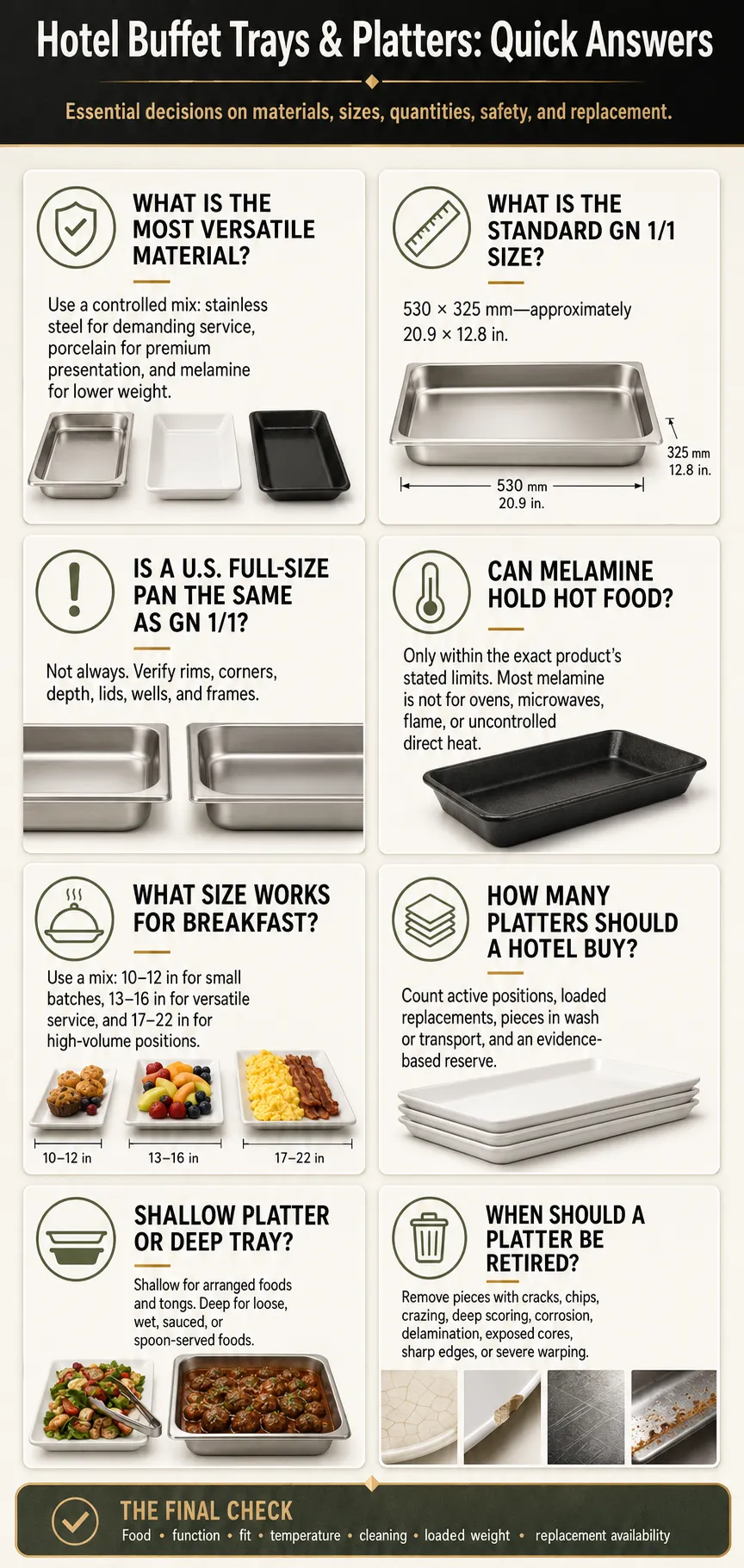
Frequently Asked Questions About Hotel Buffet Trays and Platters
What is the most versatile hotel buffet platter material?
There is no universal winner, but stainless steel, commercial porcelain, and commercial melamine form a versatile core. Stainless steel suits demanding and temperature-sensitive service, porcelain supports premium presentation, and melamine reduces weight and ordinary breakage in many cold or ambient displays.
What is the standard full-size Gastronorm tray dimension?
GN 1/1 measures 530 × 325 millimeters, approximately 20.9 × 12.8 inches. Confirm the exact rim, corner, height, and equipment fit before purchase because a nominal GN label does not guarantee compatibility with every proprietary frame or cover.
Is a U.S. full-size hotel pan the same as GN 1/1?
They are similar in overall footprint but should not be assumed to be identical. Catalog dimensions, rim geometry, corner radius, and depth may differ. Specify the required system and test samples in the actual well, frame, lid, and transport equipment.
Can melamine buffet trays hold hot food?
Some melamine products can hold warm or hot food within a stated temperature range, but most are not intended for ovens, microwaves, direct flame, or uncontrolled direct heat. Follow the limits for the exact finished product and describe the heat source in the RFQ.
Are wooden buffet boards safe for direct food contact?
Only when the finished board is approved for the intended food and use and can be maintained according to applicable requirements. Confirm the wood, adhesive, coating, seams, washing method, drying procedure, and retirement criteria. Otherwise, use it as a decorative support for separate vessels or protected food.
What platter size is best for a hotel breakfast buffet?
A mix works better than one size. Medium 13-to-16-inch pieces suit pastries, fruit, cold cuts, and many breakfast items; larger 17-to-22-inch pieces support high-volume positions; smaller 10-to-12-inch pieces help with premium items, late-service presentation, and frequent replenishment. GN modular formats are useful when buffet furniture follows the same system.
How many buffet platters should a hotel buy?
Calculate by active menu positions, simultaneous lines, staged replacement sets, items in washing or transport, and an evidence-based reserve. Do not use a fixed platter-per-guest ratio. Record actual loss and wash turnaround after opening, then adjust the par level by item.
Should a hotel choose shallow platters or deep trays?
Use shallow platters for arranged items served with tongs and deeper vessels for loose, wet, sauced, or spoon-served food. Smaller, shallower vessels also support frequent replenishment, while deep pans are more suitable when capacity and containment are essential.
Which shape uses buffet space most efficiently?
Rectangular and square platters generally align efficiently in a linear or modular buffet. Round and oval pieces improve flow and soften the presentation but leave more unused space between vessels. A mixed system can use rectangles for the operational core and a few curved shapes as accents.
What should be checked on a buffet-platter sample?
Check actual dimensions, usable area, empty and loaded weight, balance, rim grip, stack stability, cover and riser fit, utensil compatibility, dishwasher performance, surface marking, thermal limits, color consistency, packaging, and replacement availability. Test it through a real replenishment route rather than evaluating it only on a table.
When should a buffet tray or platter be discarded?
Remove it when cracks, chips, crazing, deep scoring, corrosion, delamination, exposed cores, sharp edges, severe warping, unstable feet, or other damage prevents safe use or effective cleaning. Establish written inspection criteria so every department makes the same decision.
Is a larger platter always better for high-volume service?
No. Very large platters are heavier, require more food to look abundant, may not fit washing or storage equipment, and can remain exposed longer. Two medium platters with a fast exchange cycle often provide better freshness, ergonomics, and visual consistency.