
The lowest quotation is easy to recognize, but it is rarely the easiest supplier decision to defend. Two hotel supply companies can price what appears to be the same item while making very different assumptions about materials, tolerances, packaging, freight, duties, installation, warranty, replacement stock, or delivery responsibility. If those differences remain hidden, the comparison rewards the bidder that omitted the most—not necessarily the company that offers the best value.
A better evaluation starts by making every offer comparable. Procurement teams should confirm that bidders are quoting the same specification, quantities, unit of measure, customization, delivery basis, and required services. They should then compare total delivered and lifecycle cost, validate product quality, test capacity and supply continuity, and examine how each company handles communication, defects, claims, and repeat orders. The objective is not to eliminate price from the decision. It is to place price inside a broader view of commercial value and operational risk.
This approach matters across hotel openings, renovations, brand conversions, and recurring replacement programs. A late shipment can disrupt installation. An inconsistent production run can create visible variation across guestrooms. A low-cost item that fails early can increase labor, downtime, and replacement expense. Conversely, a higher quote is not automatically better; every premium should be supported by a measurable improvement in specification, service, durability, or risk control.
The framework below gives hotel owners, operators, purchasing managers, designers, and project teams a repeatable way to compare hotel supply companies beyond the quoted price. It complements the broader process for choosing wholesale hotel supplies for a property by focusing specifically on supplier-level evaluation, bid normalization, evidence, weighting, and award validation.

Make Every Quote Comparable Before Scoring Suppliers
Supplier comparison begins with bid normalization: converting different offers into one common commercial and technical basis. A quotation is not comparable merely because it lists the same product name. Every bidder must respond to the same approved specification, quantity, unit of measure, packaging requirement, customization scope, delivery destination, required date, and service boundary. Procurement should also identify every exception, assumption, exclusion, and alternative. This first step prevents a low number from winning simply because freight, accessories, commissioning, sample approval, or another required component was omitted. It also creates a defensible record that finance, operations, design, and ownership can review without relying on informal explanations.
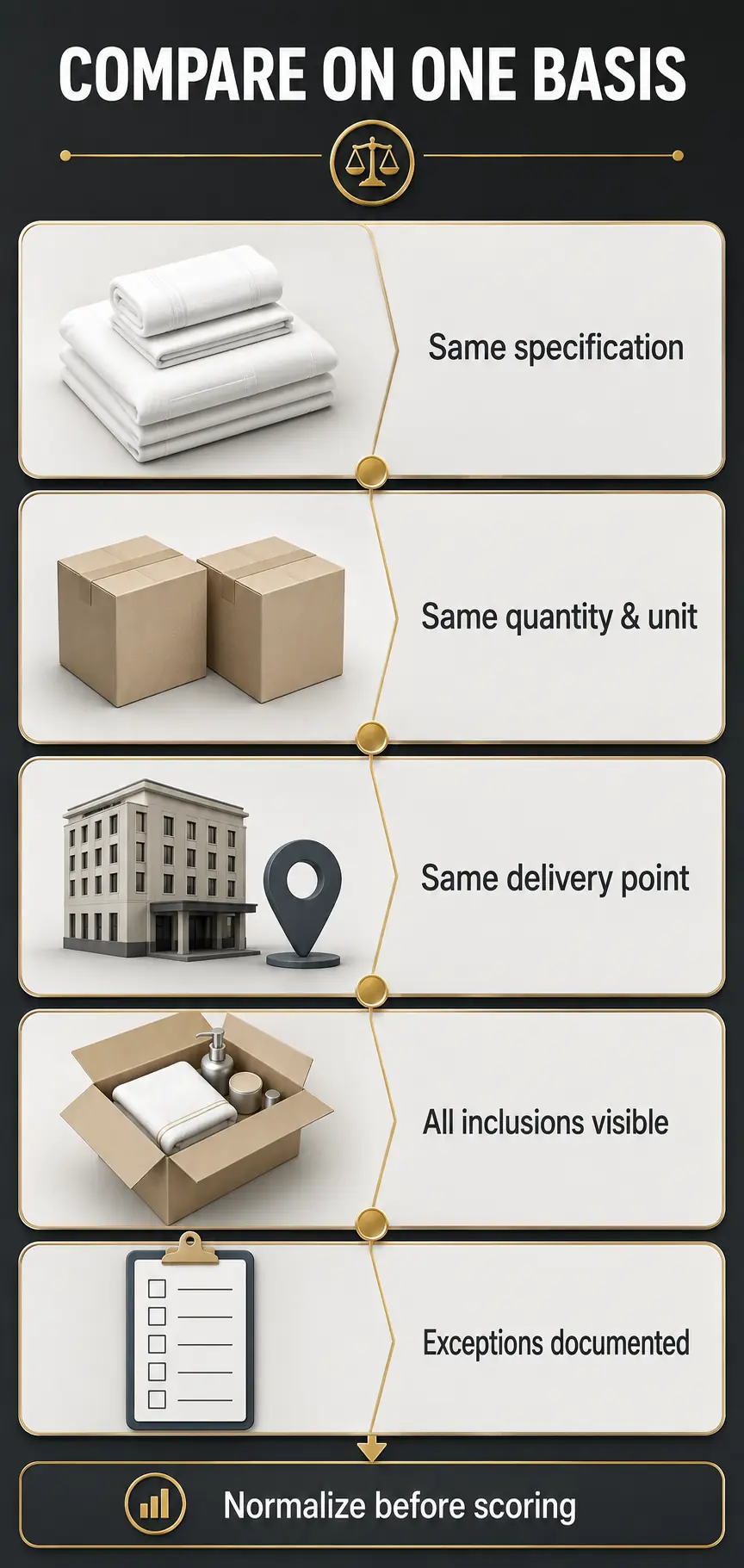
Start with one controlled request package
Issue the same procurement brief or RFQ to every company. Use identical item codes, product descriptions, drawings, finish references, quantities, required standards, delivery locations, and acceptance requirements. If an approved equivalent is allowed, define the performance requirements it must satisfy rather than accepting an unexplained substitute.
The practical guide on how to write an RFQ for hotel supplies explains how to structure supplier instructions, pricing schedules, capability questions, sample requirements, submission rules, and award conditions. A controlled RFQ makes omissions visible and reduces the time spent interpreting incompatible quotations.
Build a bid clarification log
Record questions and answers in one log rather than resolving material issues through scattered emails or calls. For each bidder, identify whether the quotation is compliant, compliant with a stated exception, or noncompliant. Require written confirmation when a supplier changes a price, specification, lead time, or commercial term. The final comparison should use the latest confirmed version of every offer.
At minimum, normalize the following fields:
Product specification, materials, dimensions, finish, performance, and approved sample.
Quantity, unit of measure, pack configuration, minimum order quantity, and overrun allowance.
Tooling, molds, artwork, logos, samples, setup, testing, inspection, and documentation.
Freight basis, delivery point, insurance, duties, taxes, unloading, assembly, installation, commissioning, and training.
Production lead time, shipment window, delivery milestones, quote validity, and permitted price adjustments.
Payment schedule, warranty, claims process, replacement obligations, and after-sales support.
Do not fill a blank field with a favorable assumption. Mark it as unresolved and request clarification. A blank line is a commercial risk until the supplier confirms whether the item is included, excluded, not applicable, or separately priced.

Compare Total Cost, Quality, and Lifecycle Value
After the scope is normalized, compare the cost of obtaining, using, maintaining, and replacing the product—not only the unit price printed on the quotation. For disposable or rapidly consumed items, the relevant measure may be delivered cost per usable unit. For furniture, equipment, linen, carts, fixtures, or customized goods, the analysis should extend to useful life, maintenance, energy or consumables, spare parts, repairability, downtime, and replacement continuity. Quality belongs in the same calculation because defects, breakage, rework, expedited replacements, and staff time are real costs. A lower quotation is valuable only when it continues to meet the hotel’s required performance and guest-facing standards.
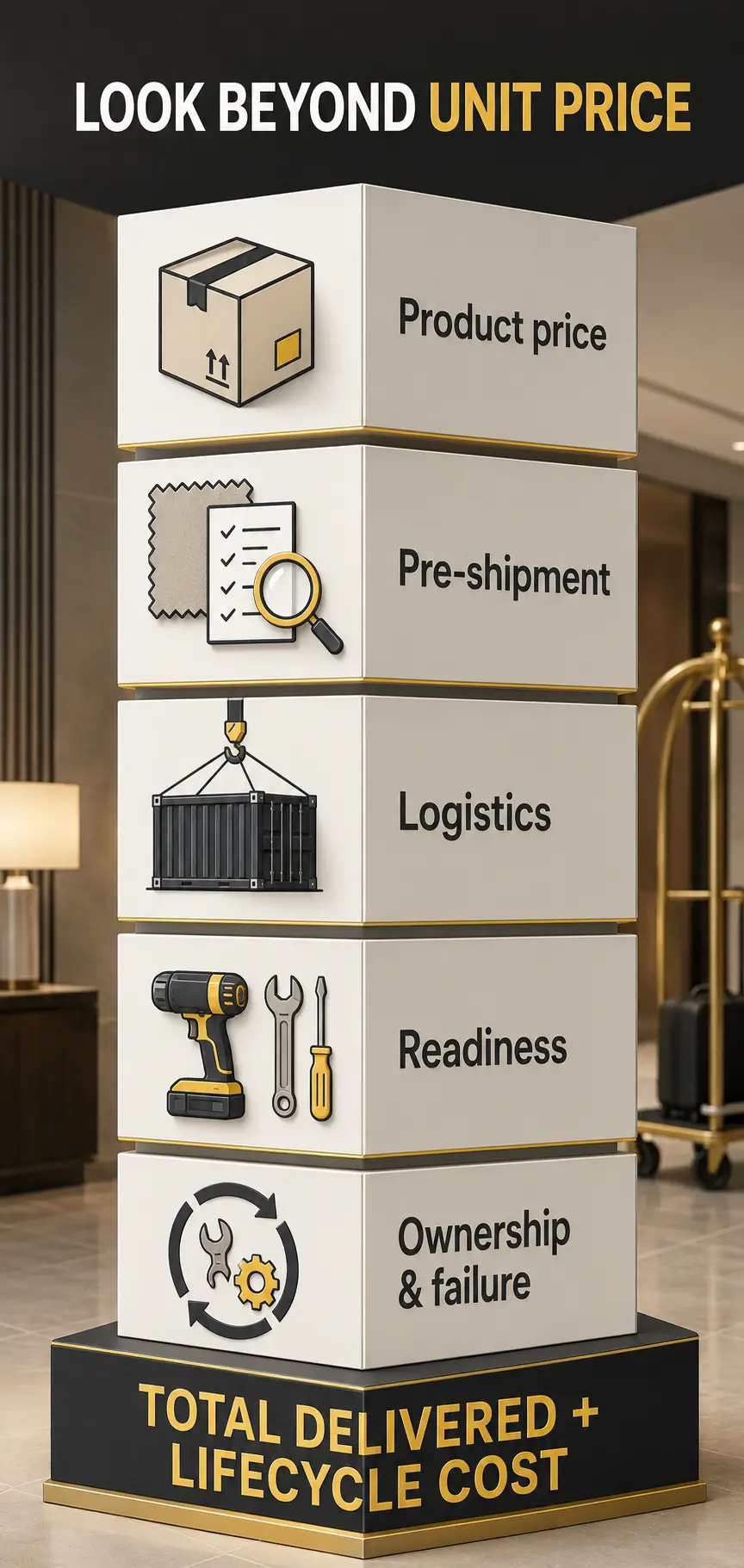
Separate price from total delivered cost
Create a cost bridge for every offer. Begin with the compliant product price and add all costs required to make the goods available for their intended use at the property. Depending on the category and delivery structure, this may include packaging, consolidation, inspection, freight, insurance, duties, brokerage, local transportation, storage, installation, commissioning, training, and expected breakage.
A practical comparison can use this structure:
| Cost layer | Questions to resolve |
| Product | Is the price based on the same specification, quantity, unit, and customization? |
| Pre-shipment | Are samples, tooling, testing, inspection, export packing, and documentation included? |
| Logistics | Who pays freight, insurance, duties, brokerage, delivery, unloading, and storage? |
| Readiness | Are assembly, installation, commissioning, calibration, and training required? |
| Ownership | What maintenance, consumables, energy, parts, labor, and replacement costs are expected? |
| Failure | What is the likely cost of defects, delays, rework, downtime, claims, and emergency purchases? |
Use the same time horizon and assumptions for every supplier. Do not assign a precise dollar value to risk merely to make the spreadsheet look complete. Where uncertainty is material but cannot be estimated responsibly, show it as a scenario, range, or documented risk rather than hiding it inside an arbitrary number.
Validate the product behind the price
Request samples or prototypes that represent the proposed material, finish, construction, and workmanship. Compare them with the written specification and record approval conditions. For custom products, define which sample becomes the control reference for production. For recurring goods, confirm whether repeat orders will use the same model, material, color, packaging, and quality level.
Evidence should match the risk of the category. Relevant evidence may include material declarations, test reports, technical data, care instructions, production tolerances, quality-control plans, traceability, warranties, and references from comparable hospitality projects. A document should not earn points merely because it looks official; verify that it applies to the proposed product, manufacturer, production site, and current specification.
Measure value in the hotel’s operating context
Durability is not an abstract premium. It matters when it reduces replacement frequency, staff handling, guest complaints, downtime, or visual inconsistency. Likewise, advanced features add value only if the property will use them. Compare each offer against the hotel’s cleaning processes, expected usage, storage, utilities, maintenance capability, brand requirements, and local service availability.

Evaluate Delivery Capacity and Supply Continuity
A promised lead time is not evidence that the supplier can meet it. The evaluation should test whether the company has the production capacity, material access, project controls, logistics plan, and backup options required for the order. The question is not simply, “How many days?” but “What activities, approvals, dependencies, and resources support that date?” This is especially important for opening-critical FF&E and OS&E, customized products, coordinated room packages, and goods with long international transport paths. A realistic schedule supported by capacity evidence may be safer than a shorter commitment that depends on unverified assumptions or leaves no recovery time.
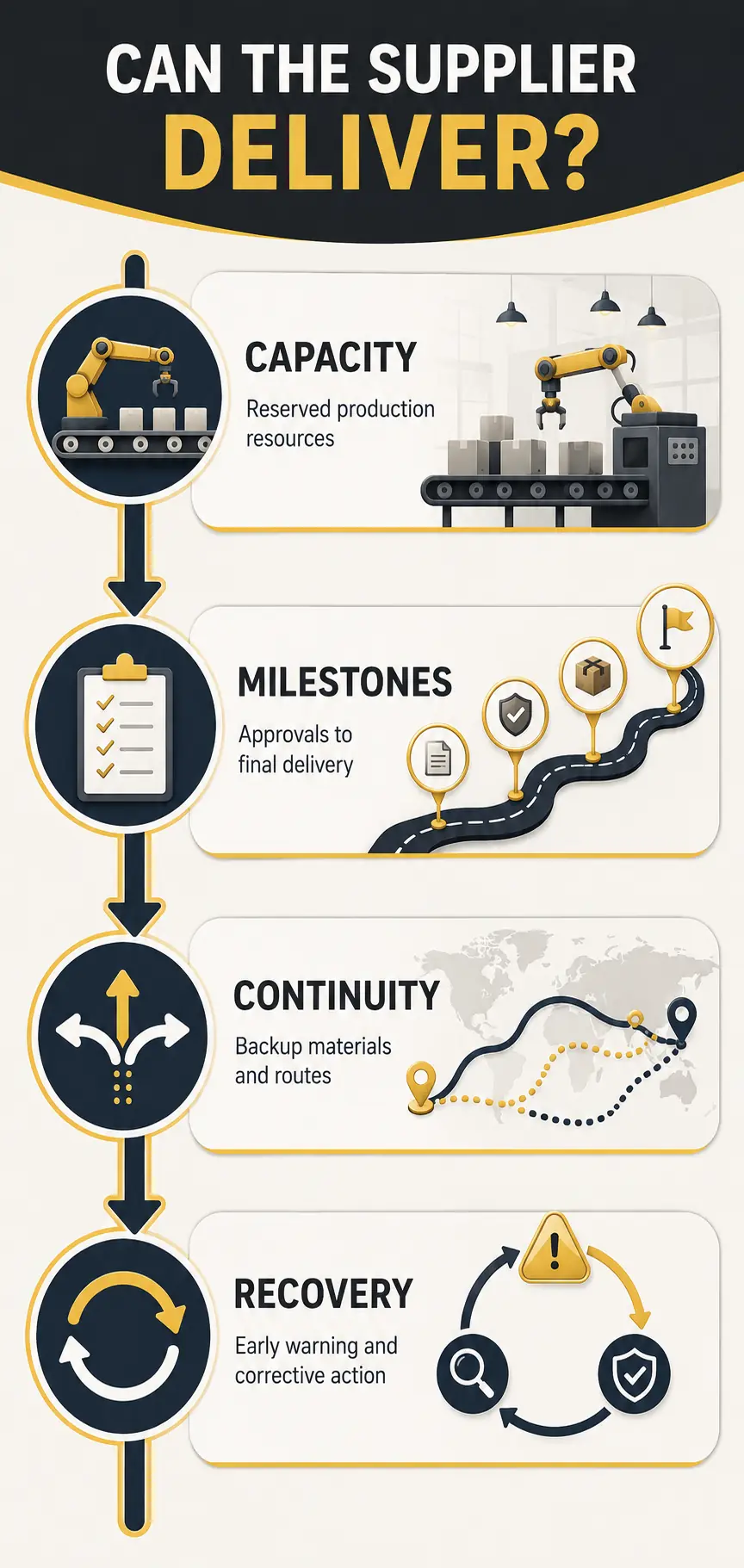
Ask for a milestone schedule, not one lead-time number
Require suppliers to separate design or specification confirmation, sample development, sample approval, material procurement, production, internal inspection, third-party inspection if applicable, packing, shipment, customs clearance, local delivery, installation, and rectification. Identify which milestones are controlled by the buyer and which are controlled by the supplier.
Review current workload, production location, subcontracted processes, equipment constraints, labor availability, and the supplier’s ability to reserve capacity. If the order is phased, confirm whether later batches have protected capacity or must re-enter the production queue.
Test the continuity plan
For critical or repeat-order products, ask where key materials and components come from, what alternatives are approved, and how the supplier manages discontinued models or finishes. Confirm whether replacement parts, spare components, or reserve stock can be provided. A hotel may accept a higher initial cost for a product that can be replenished consistently, while a seemingly cheaper proprietary item may create a costly replacement problem later.
Continuity questions should include:
Is there a qualified backup production line, material source, or logistics route?
Which processes are subcontracted, and how are those subcontractors controlled?
What notice is provided before a material, finish, model, or component is discontinued?
Can the supplier reproduce the approved specification for future expansion or replacement?
What stock, spare parts, or emergency alternatives are available near the delivery market?
How quickly will the supplier communicate a schedule risk, and what recovery options can it activate?
Compare the consequences of delay
Not every late item creates the same impact. A decorative accessory may tolerate a short delay, while beds, room locks, kitchen equipment, housekeeping carts, or opening linen can affect commissioning and revenue. Weight delivery reliability based on operational criticality, available float, substitute options, and the cost of delay. This keeps the scorecard focused on the risks that actually matter to the project.

Assess Service, Commercial Terms, and Risk Response
Supplier value becomes most visible when something changes or goes wrong. Before award, evaluate how each company communicates, documents decisions, resolves defects, supports replenishment, and responds to claims. Also compare payment milestones, warranty scope, liability boundaries, cancellation rules, quote validity, currency exposure, and permitted substitutions. Favorable terms should not compensate for a critical quality or delivery failure, but weak terms can materially increase risk even when the product is acceptable. The strongest supplier is usually the one that makes responsibilities clear, raises issues early, and provides a workable path from problem identification to corrective action.
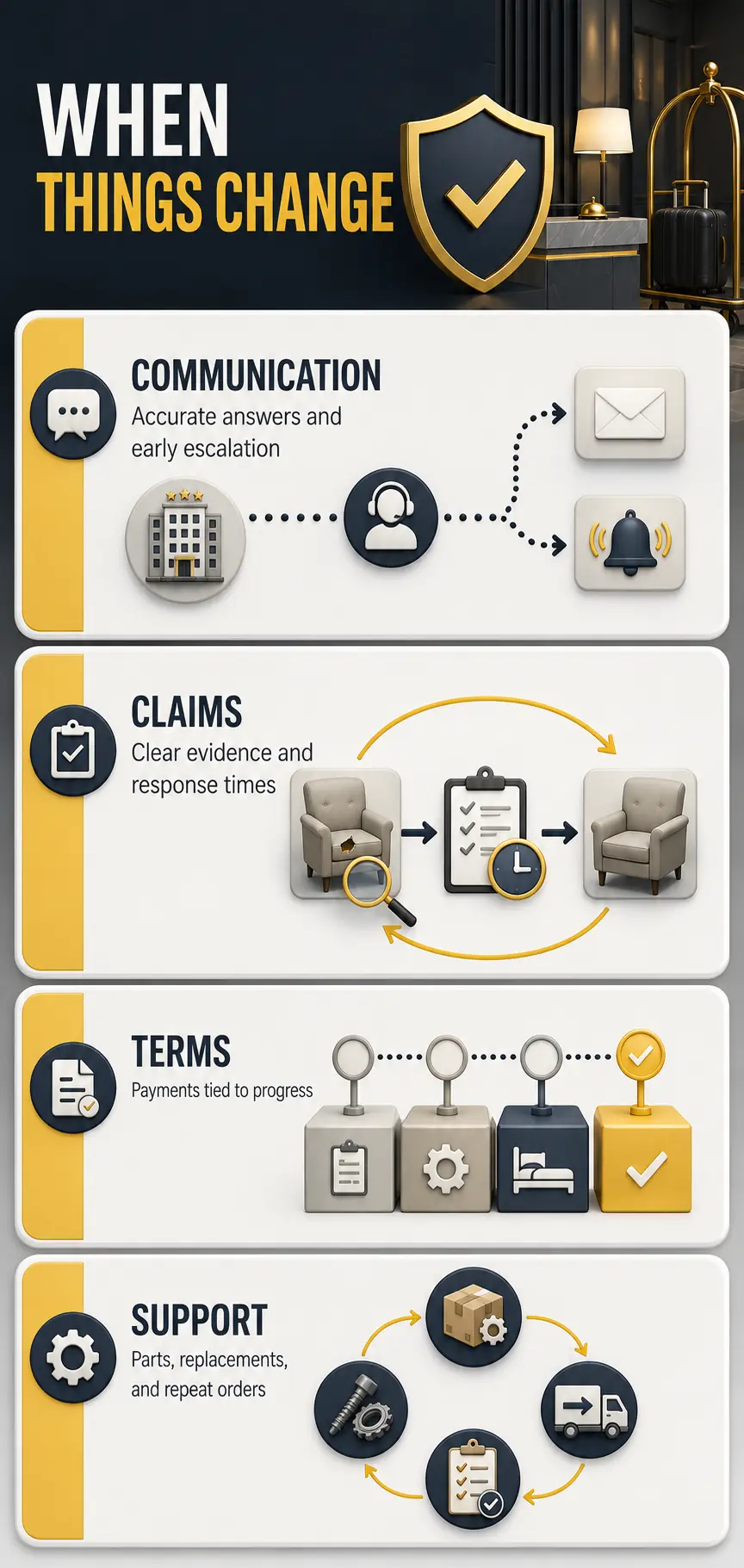
Evaluate communication as an operating capability
Response speed alone is not enough. Look for accurate answers, consistent documentation, clear ownership, and timely escalation. During the quotation stage, note whether the supplier identifies contradictions, asks relevant technical questions, and distinguishes confirmed facts from estimates. A company that agrees to every request without clarification may be less reliable than one that identifies a genuine constraint early.
The separate guide on finding a reliable hotel supply company in the USA provides additional qualification steps for buyers who need domestic availability, support coverage, or U.S.-market capability.
Read the claims process before you need it
Define how shortages, transit damage, manufacturing defects, finish variation, nonconforming dimensions, and installation problems will be documented and resolved. Compare notification periods, evidence requirements, response times, repair or replacement options, freight responsibility, and credit procedures. The warranty should state what is covered, when coverage begins, what is excluded, and who performs the corrective work.
Ask bidders to describe one comparable issue they handled, the corrective action taken, and how they prevented recurrence. This is more informative than a generic promise of “excellent service.” References should be asked about the same outcomes: on-time performance, sample-to-production consistency, responsiveness, claim resolution, and repeat-order support.
Compare payment terms by risk, not convenience alone
Payment schedules should follow objective progress: approved sample, verified material procurement when appropriate, completed production, passed inspection, shipment, delivery, installation, or acceptance. Large unsecured advances increase buyer exposure. Extremely delayed payment may increase supplier pricing or exclude capable companies. Compare the amount at risk at each stage and confirm what evidence releases the next payment.
Commercial review should also cover currency, tax treatment, price-adjustment rules, tooling ownership, intellectual property or artwork, confidentiality, insurance, termination, change control, governing documents, and order of precedence. Legal review may be appropriate for high-value, custom, or high-risk contracts.

Build and Validate a Weighted Supplier Scorecard
A scorecard converts the evaluation into a documented decision, but it must be designed before reviewers see the final prices. Start with category-specific criteria, critical pass/fail gates, measurable evidence, and weights that reflect the hotel’s operational priorities. Separate commercial attractiveness from technical acceptability so a very low price cannot offset failure of a mandatory requirement. Use a consistent scoring scale, record the reason for every material score, and run sensitivity checks to see whether modest changes in assumptions alter the result. The scorecard should support professional judgment, not hide it behind a single decimal number.
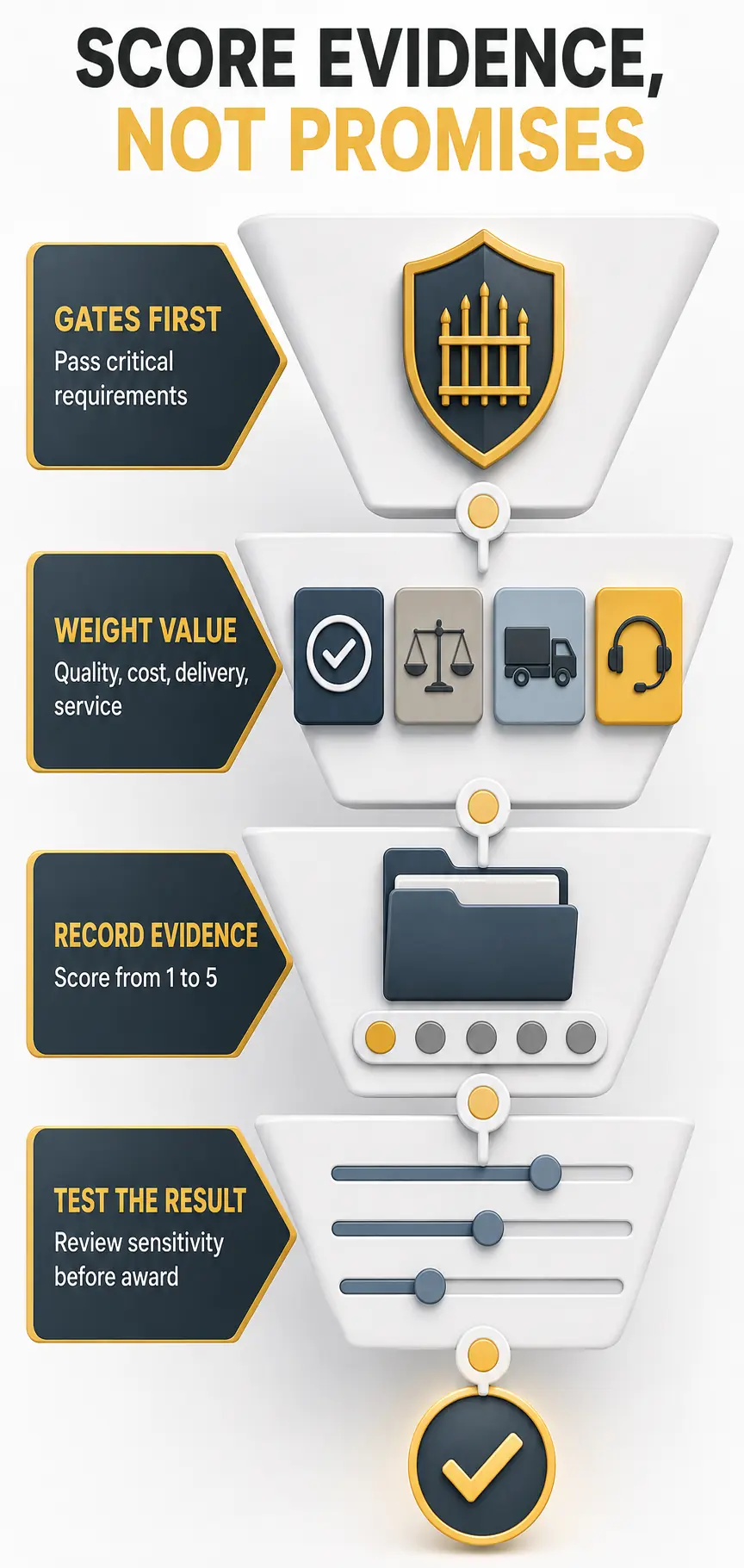
Use gates before weighted points
Critical requirements should be evaluated as pass, conditional pass, or fail. Examples may include compliance with the approved specification, required safety or technical documentation, acceptance of a control sample, capacity for the required date, and agreement to essential delivery or warranty obligations. A supplier that fails a non-negotiable gate should not win because it scored well on price or presentation.
For suppliers that pass the gates, apply weighted criteria. The exact percentages should change by category, but a balanced model may include the following:
| Criterion | Illustrative weight | Evidence |
| Specification and quality | 25% | Sample, test data, materials, tolerances, quality plan |
| Total delivered and lifecycle cost | 20% | Normalized cost model and assumptions |
| Delivery and capacity | 15% | Milestone plan, capacity evidence, current workload |
| Supply continuity and risk | 10% | Backup sources, discontinuation plan, alternatives |
| Service and claims response | 10% | Warranty, escalation, corrective-action process, references |
| Commercial terms | 10% | Payment, validity, change control, liability, tooling ownership |
| Replenishment and after-sales support | 5% | Parts, repeat-order terms, local support, stock strategy |
| Communication and transparency | 5% | Clarification quality, documentation, issue visibility |
Weights are not universal facts. Increase quality, continuity, or service weight when failure would affect guests or operations. Increase total cost weight for standardized, low-risk goods. For technical equipment, local support, commissioning, spare parts, and downtime may deserve more weight than unit price.
Score evidence, not confidence
Define the scale in advance. For example, a score of 1 may indicate a major gap or unsupported claim; 3 may indicate full compliance with adequate evidence; and 5 may indicate strong compliance with verified additional value. Do not award the highest score for persuasive language. Record the document, sample, reference, or clarification that supports the rating.
The downloadable scorecard below provides separate areas for gates, supplier scores, weights, evidence notes, total delivered cost, and an automatic weighted result.
Validate the result before award
Run three final checks. First, review scoring as a cross-functional team so operations, design, engineering, finance, and receiving risks are represented where relevant. Second, test sensitivity: if a small change in weight or one uncertain cost assumption changes the winner, the decision needs more evidence or negotiation. Third, conduct a pre-award clarification meeting and convert every accepted deviation into the final purchase order or contract.
For a project-specific quotation, buyers can submit the KW Hospitality RFQ form with product specifications, quantities, destination, required date, reference images, and relevant attachments. A structured submission helps the sourcing team evaluate scope and identify the information needed for a comparable offer.

Conclusion
The most defensible hotel supplier decision is not the lowest number or the highest score in isolation. It is the offer that meets every critical requirement and delivers the strongest expected value after cost, quality, schedule, continuity, service, and commercial risk are considered together. Begin with a common RFQ, normalize each proposal, verify the evidence behind every important claim, and make pass/fail gates visible before applying weights. Then test the result against operating realities and uncertain assumptions. This process may require more discipline before award, but it reduces ambiguity when the hotel is receiving, installing, using, replacing, or making a claim on the products.
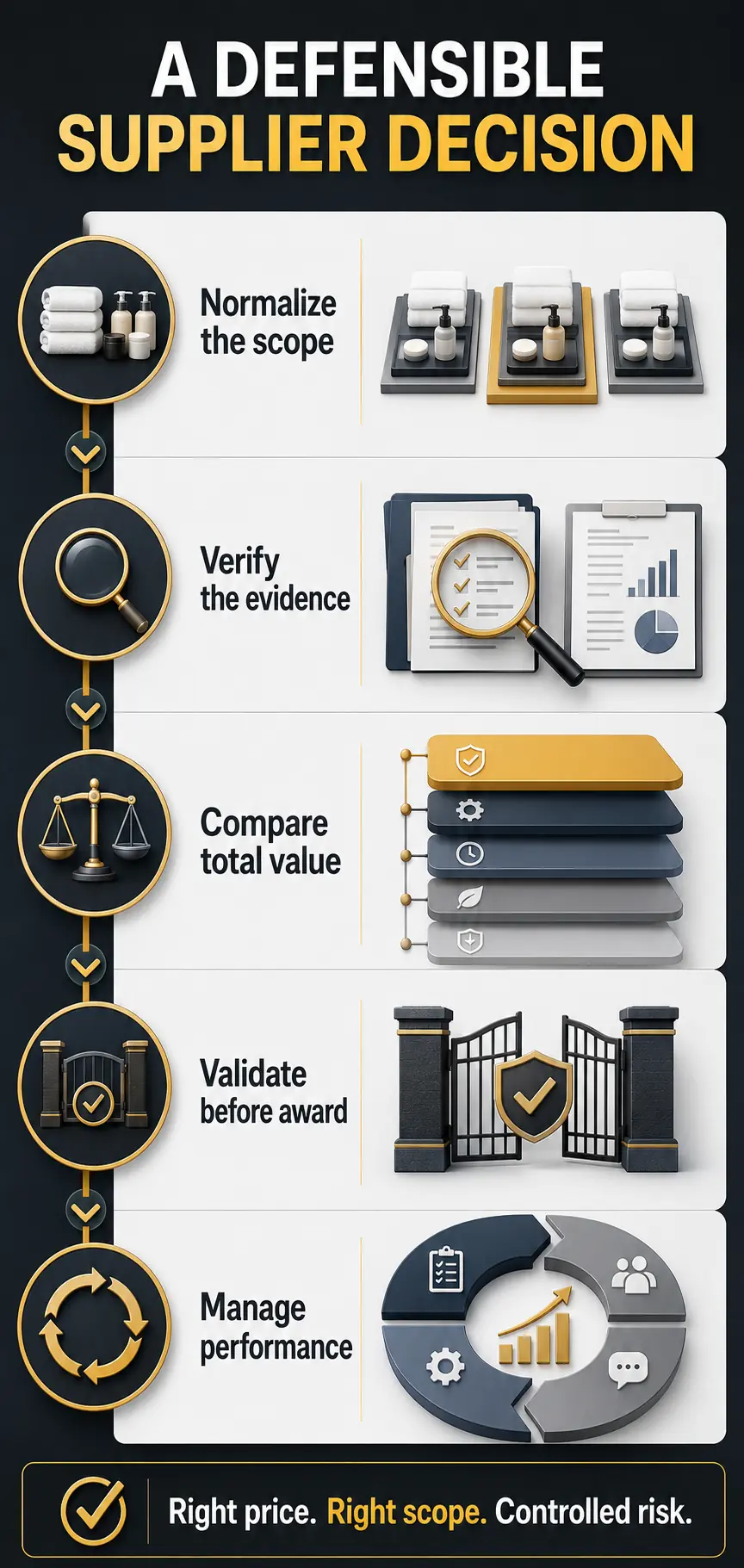
Treat the final score as a decision record, not a substitute for judgment. Keep the approved specification, sample, clarification log, scoring rationale, cost assumptions, schedule, warranty, and corrective-action obligations together with the contract. These records make it easier to manage performance after award and to improve the next sourcing cycle.
Price remains important. The key is to compare the right price for the right scope, supported by evidence that the supplier can deliver the required product, at the required time, with a workable response when conditions change.
Frequently Asked Questions
These questions address the practical issues procurement teams encounter when they move from quoted prices to a documented supplier decision.
What is the most important factor when comparing hotel supply companies?
No single factor is most important for every purchase. First confirm that the supplier meets all mandatory specifications, quality, compliance, and delivery requirements. Then compare total cost and weighted value based on the category’s operational risk. A critical kitchen equipment order may prioritize capacity, service, parts, and commissioning, while a standardized consumable may place more weight on delivered cost and replenishment reliability.
How can procurement compare quotes that use different freight terms?
Convert every offer to the same delivery point and responsibility basis. Identify which party pays for origin transport, export handling, main freight, insurance, duties, brokerage, local delivery, unloading, and storage. Use confirmed costs where available and clearly labeled estimates or scenarios where they are not. Do not compare unit prices until logistics responsibilities are aligned.
Should the lowest-priced supplier ever be selected?
Yes. The lowest-priced company may be the best choice when its offer is compliant, its total delivered cost remains lowest, and its quality, capacity, service, continuity, and commercial risks are acceptable. The point of the framework is not to reject low prices; it is to prevent incomplete or high-risk offers from appearing cheaper than they are.
How many suppliers should a hotel invite to quote?
The right number depends on category complexity, market availability, timing, and the cost of preparing and evaluating bids. Invite enough qualified suppliers to create meaningful competition, but not so many that evaluation becomes superficial. Prequalification can narrow the field before detailed samples, technical submissions, or custom development are requested.
How should supplier references be checked?
Contact references for projects that resemble the current purchase in product category, scale, customization, geography, or operational risk. Ask specific questions about delivery accuracy, sample-to-production consistency, defect rates, communication, claim resolution, and repeat-order support. General satisfaction ratings provide less useful evidence than examples of actual performance.
How often should hotel suppliers be re-evaluated?
Review strategic and high-risk suppliers at defined intervals and after significant orders, quality incidents, delivery failures, ownership changes, production moves, or major scope changes. Recurring suppliers should also be evaluated using actual performance data such as on-time delivery, defect and claim trends, response time, fill rate, and cost variance. The evaluation frequency should be proportionate to spend, criticality, and risk.