Before switching chemical suppliers, a hotel should verify the new product at the actual dispensing outlet, using the intended container and a test method approved for that formulation. Confirm the product-specific dilution target, commission the dispenser, test repeated fills, and document the results before releasing the new setup. The same metering tip does not prove the same dilution, and the correct mixing ratio does not by itself prove the required active-ingredient concentration.
A supplier change can look straightforward on a purchasing spreadsheet: replace one container with another, keep the wall unit, and compare the price per case. In practice, the hotel is changing part of a working system. The concentrate, connector, pickup tube, metering device, water supply, receiving bottle, and staff instructions all need to agree. A sample prepared at the supplier’s office cannot establish what every housekeeping closet will deliver during a busy shift.
The decision also involves different kinds of evidence. Equipment testing establishes how much concentrate enters the solution. A suitable chemical test measures a defined property of that solution. An operational trial shows whether the approved product and procedure work on the intended hotel surfaces. None of these should be replaced by judging fragrance, foam, or color, and none should be presented as a hotel-run proof of pathogen kill.
This guide focuses on surface-cleaning, sanitizing, and disinfecting dilution stations used to fill housekeeping bottles or buckets. Laundry injection systems and commercial dishmachine dosing require their own equipment-specific commissioning procedures. The regulatory examples below concern U.S. use; properties elsewhere need the product authorization and directions applicable to their location. The practical goal is a reviewable purchasing decision: retain a record of exactly what was tested, what passed, what still needs correction, and who authorized the change.
Define the Product and the Dilution Target
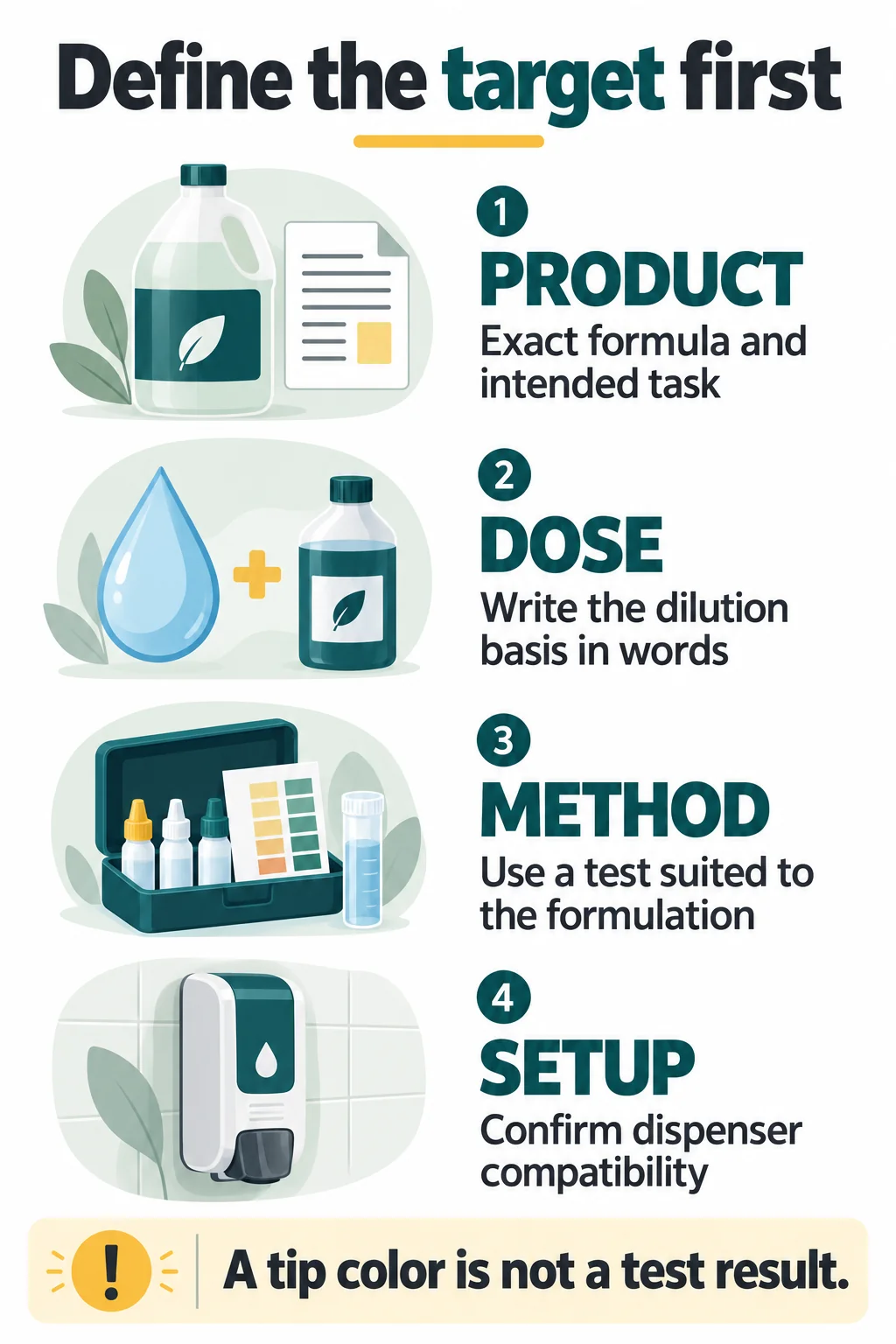
Start with the exact replacement product and its intended task, then work backward to the dispenser setting. A bathroom cleaner, a non-food-contact sanitizer, and a food-contact sanitizer should not inherit one shared concentration target merely because they fit the same cabinet. Ask the chemical manufacturer to identify the applicable directions, compatible dispensing configuration, and verification method. Record whether the target describes a product-to-water ratio, a product fraction in the final solution, or an active-ingredient concentration. This creates a common specification for purchasing, engineering, and housekeeping before anyone compares test results or promises savings.
Specify the use before the number
For a U.S. disinfectant, record the exact product name and EPA registration number, intended surface and use site, dilution directions, required wet contact time, and any precleaning or rinsing instructions. EPA’s Selected EPA-Registered Disinfectants guidance explains why the product identity and label directions matter. A reading within a chemical concentration range does not remove the need to follow those directions.
Keep the current label, technical instructions, and safety data sheet together. Ask for written clarification when the quotation, bottle label, and dispenser chart describe the dose differently. The hotel should not resolve a conflict by choosing the cheapest interpretation. For broader purchasing scope, KW Hospitality’s cleaning chemicals and dosing equipment categories help distinguish the concentrate from testing supplies, storage, and dispensing components.
Write ratios in words
Avoid an unexplained entry such as “1:64.” Write “one volume of concentrate plus 64 volumes of water” when that is what the manufacturer intends. That mixture contains 65 total volumes, so the concentrate fraction is 1/65, approximately 1.54%. “One volume of concentrate in 64 total volumes” instead means 1/64, approximately 1.56%. These are arithmetic examples, not recommended doses for a chemical.
Likewise, “fluid ounces per gallon of water” and “fluid ounces per gallon of finished solution” use different denominators. A U.S. gallon contains 128 U.S. fluid ounces; do not substitute an Imperial gallon or a weight ounce. Copy the manufacturer’s wording into the test record and have any ambiguous notation resolved before measuring.
Product concentration is not active-ingredient concentration. A ratio describes the whole formulation entering the water. A ppm result describes the particular substance or test response named by the method. Do not convert a label percentage into a field ppm acceptance value without confirming the percentage basis, formulation, density where relevant, and manufacturer-approved calculation.
Confirm that the existing dispenser can be reused
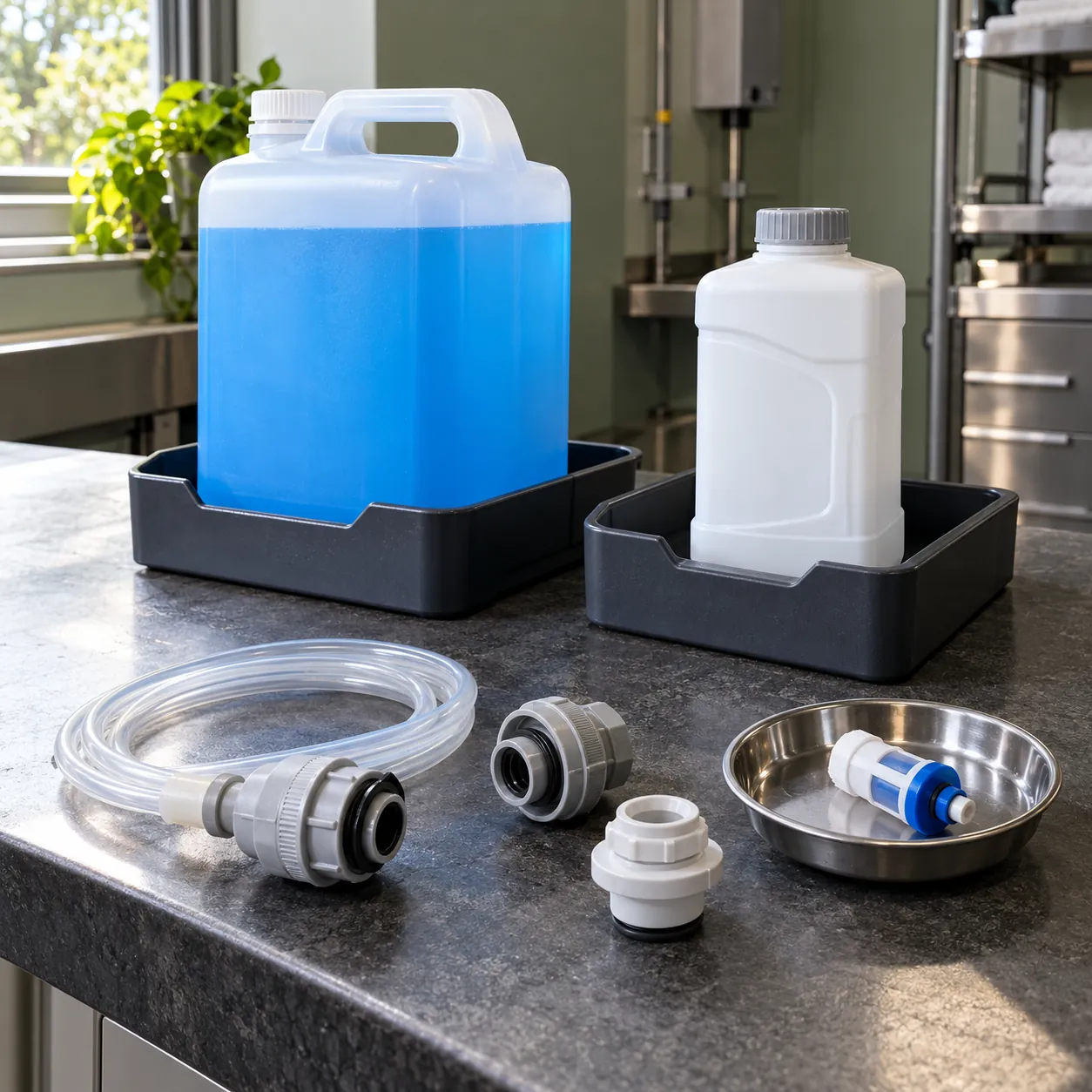
Obtain the model, outlet or button identification, flow configuration, connector type, and installed metering component. Ask both suppliers who owns the equipment and whether reuse is permitted. Written compatibility confirmation should cover the new container connection and the wetted parts; a connector that physically fits is not sufficient evidence.
Hydro Systems’ AccuMax user manual for E-Gap units explains that achieved dilution depends on the metering opening and product viscosity, with water conditions also relevant. Its tip chart distinguishes flow configurations. Therefore, a tip color or a ratio quoted for another outlet should be treated as a setup lead, not an acceptance result. Use the manual for the installed model; its limits cannot automatically be transferred to another dispenser.
Test Dilution at the Actual Hotel Outlet
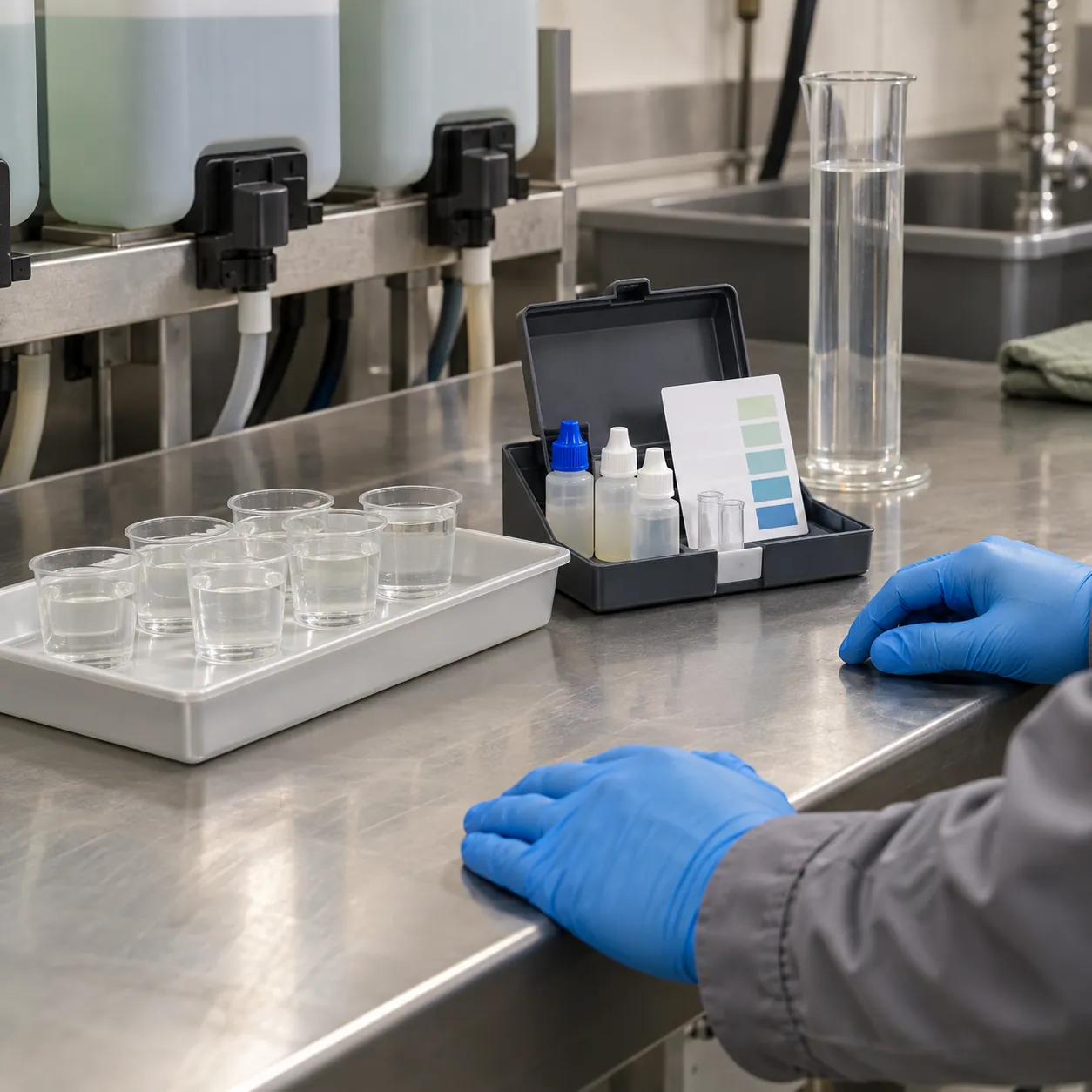
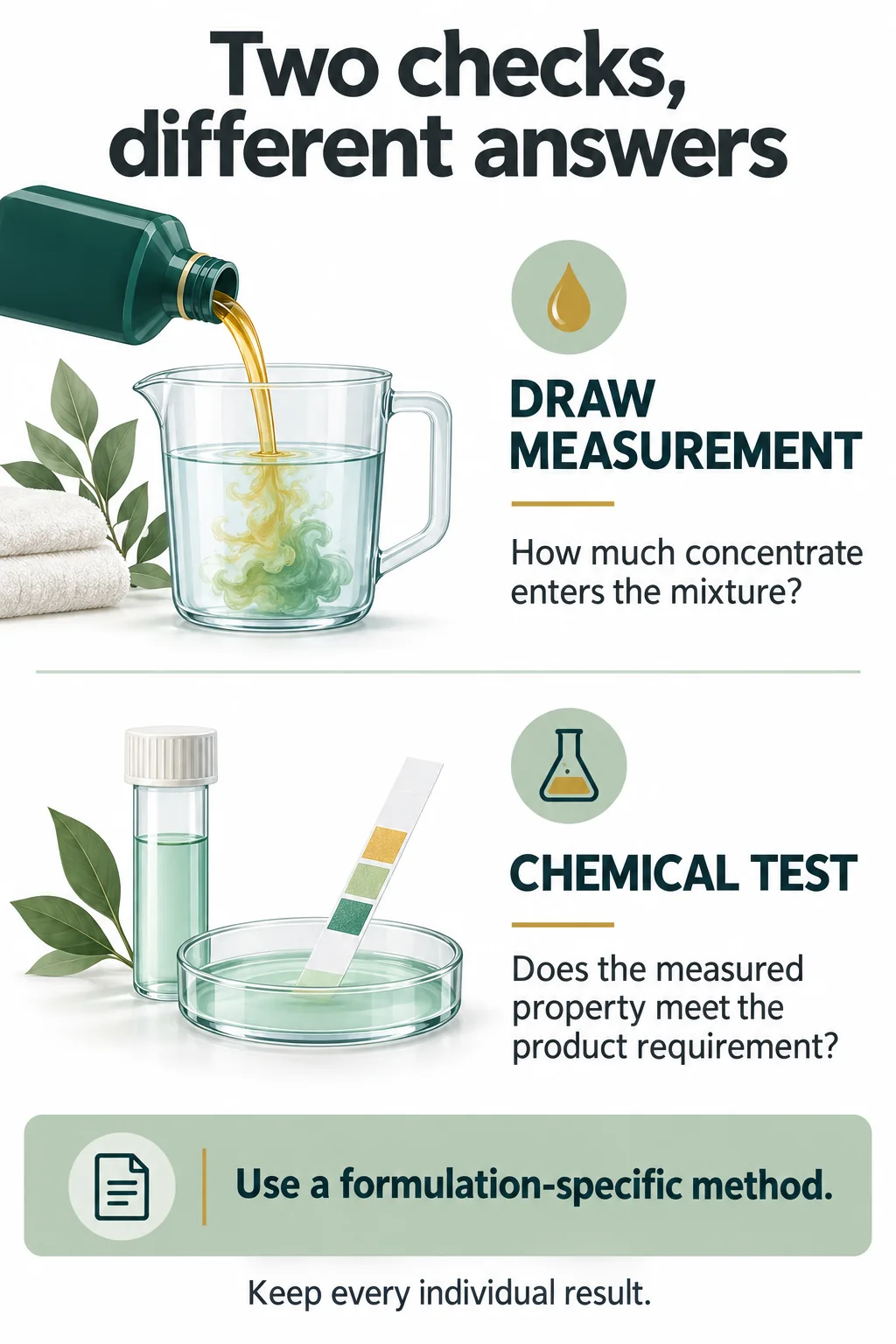
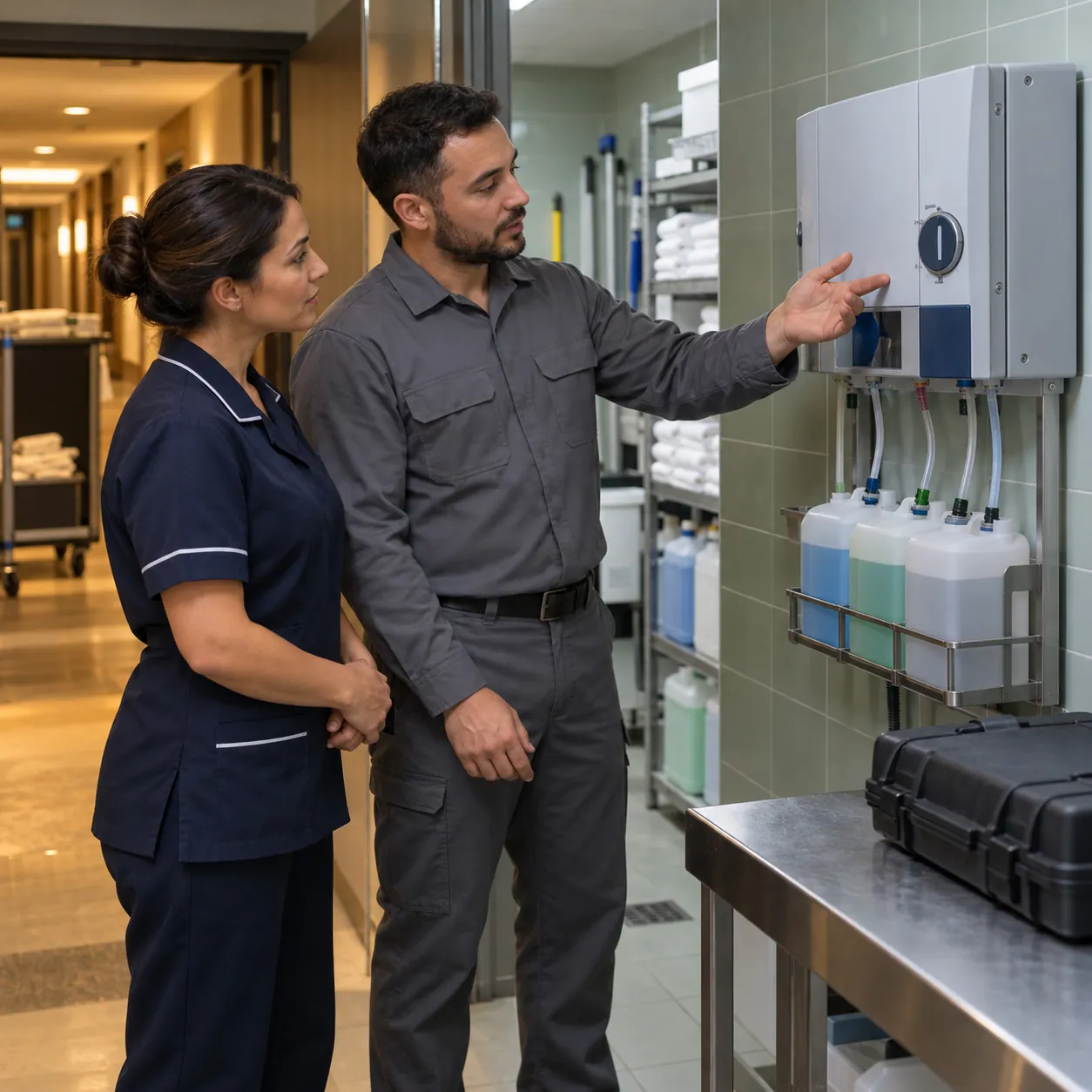
Use a controlled pilot at the property before committing every outlet to the replacement chemical. The pilot should preserve the intended operating conditions while making the observations traceable: identify the outlet, product, setup, receiving container, test method, and operator. Separate equipment draw measurement from chemical concentration testing so a disagreement can be investigated. The sampling approach below is a suggested purchasing and commissioning procedure, not a universal manufacturer tolerance or a regulatory test schedule. Adapt it with the chemical supplier and responsible technician, especially when a closed-loop system cannot be opened safely for a draw test.
Make the changeover safe and repeatable
Do not pour the replacement product into the old concentrate or use the new chemical to push an unknown residue through the line. Obtain the chemical and equipment manufacturers’ changeover instructions, including whether tubing, connectors, or other parts must be replaced. Follow the specified isolation, cleaning, priming, disposal, and personal protective equipment requirements. Do not improvise a flush chemistry or bypass a closed-loop connection to obtain a measurement.
The CDC’s facility cleaning and disinfection guidance advises against mixing products and calls for appropriate worker protection and training. Keep the trial outlet clearly identified and unavailable for routine filling until it has been released. Maintain an approved alternative supply so a failed test does not force staff to use an unverified mixture.
Record water conditions under actual dispensing, not only a static pressure reading. Where the equipment instructions require it, have the technician check flow, operating pressure, temperature, and the installation arrangement. Do not apply a pressure number from an unrelated model. Prime and collect samples according to the installed unit’s instructions. An unprimed line can make a draw test describe startup air rather than stable dosing.
Measure concentrate draw when the system permits it
Hydro Systems’ HydroChem 919 instruction sheet describes measuring concentrate consumed and total solution dispensed from a primed system. In the same volume units, the water-to-concentrate ratio is calculated as:
Water parts per one concentrate part = (finished solution volume − concentrate volume) ÷ concentrate volume.
For a worked example, suppose an authorized test collects 6,500 mL of finished solution while consuming 100 mL of concentrate. The calculation is (6,500 − 100) ÷ 100 = 64. The result is 64 parts water to one part concentrate, equivalent to approximately 1.54% concentrate by volume. This example illustrates arithmetic only; it does not establish any product’s permitted dilution.
Use measuring equipment that can resolve the expected draw. A tiny change read from a large jug is weak evidence. If a supplier authorizes weighing instead, record mass and use the appropriate density conversion; grams and milliliters are not interchangeable by assumption. Keep the collection procedure identical between repetitions and account for priming separately rather than including it in the measured sample.
Select a chemical test that can answer the question
Ask the chemical manufacturer to specify the test kit, measured substance, working range, sample preparation, timing, and acceptance criterion for the exact formulation. For illustration, LaMotte’s QAC Test Papers, code 2951, list color steps of 50, 100, 200, and 400 ppm. Those steps cannot reliably establish a small numerical difference between two nearby concentrations. The product is an example of measurement resolution, not a recommendation for every hotel disinfectant.
LaMotte’s QAC Test Kit, code 3043-DR-01, specifies a titration range of 0–500 ppm with 10 ppm sensitivity expressed as alkyl dimethyl benzyl ammonium chloride. That reporting basis matters: obtain confirmation that a method is appropriate for the replacement formulation. A quat method is not a universal test for chlorine, peroxide, or detergent strength.
Use in-date reagents or strips stored as directed, check instrument calibration where applicable, and follow the specified reading time. Record the actual result, including an out-of-range indication, rather than writing “OK.” Do not improvise sample dilution to bring a result onto a scale unless the method explicitly permits it and provides the calculation. Use pH, conductivity, or refractometer readings as concentration evidence only when the supplier has validated the product-specific relationship and relevant water conditions.
Repeat the conditions that could change the result
As a practical pilot, request three independent fills at each selected outlet and retain every result. Include the shortest normal bottle fill as well as the bucket-fill mode if both are used. Observe a first routine fill after idle separately from stabilized runs, following the manufacturer’s procedure. Select pilot locations that represent different water conditions, flow arrangements, and workloads rather than choosing only the easiest closet to access.
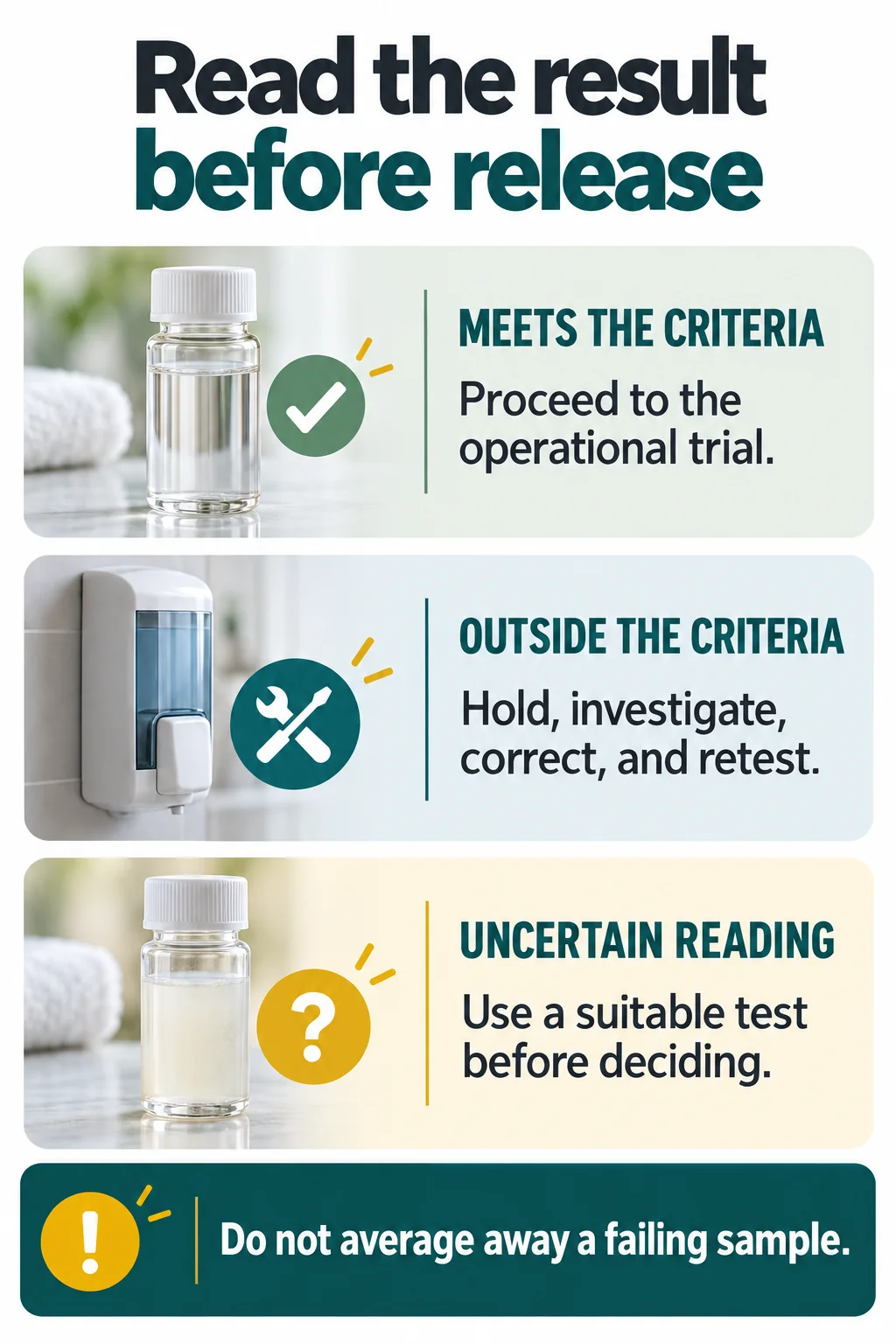
Three fills are a screening proposal, not statistical proof that the dispenser will always comply. Before release, verify every outlet being changed. If the test method is too coarse to distinguish compliance at the boundary, ask for a more suitable method. Do not average away a failing reading: a satisfactory mean can hide individual containers that are too weak or too strong.
Turn Test Results Into a Supplier-Switch Decision
Make the acceptance decision against a target and measurement method agreed before the trial. For an antimicrobial product, the decision must remain consistent with its applicable label directions; a supplier’s informal tolerance cannot override them. For other cleaners, obtain the manufacturer’s recommended working concentration and an agreed verification criterion. Evaluate the individual readings, their repeatability, and the method’s ability to resolve the boundary. The decision table below is an operational interpretation framework, not a new concentration standard. It helps buyers distinguish a failed setup from uncertain evidence and prevents an attractive quotation from becoming the acceptance criterion.
Interpret the evidence before adjusting the equipment
| Observed result | What it establishes | Purchasing or commissioning response |
| Ratio and suitable chemical test meet the agreed criteria on every required run | The tested configuration meets the defined dilution checks | Proceed to the operational trial and outlet-specific release record |
| Concentrate draw is inconsistent or outside the specified ratio | The dosing setup needs investigation | Hold release; have the technician check the system, correct it, and repeat testing |
| Draw ratio appears correct but the chemical result fails | The two measurements do not yet support acceptance | Confirm product identity, test method, sample handling, and chemical condition with the supplier |
| Test reading is at a boundary or outside the kit’s range | The measurement may be insufficient to classify the sample | Keep the result unresolved; obtain an appropriate method before accepting |
| Concentration passes but cleaning leaves residue or damages the trial surface | Correct dilution alone has not established operational suitability | Review product selection, application, rinsing, tools, and surface compatibility |
A competent technician should investigate the cause before changing a metering tip. Depending on the model, possible faults include an incorrect tip, a restricted pickup path, an air leak, a depleted container, or unsuitable water delivery. The manufacturer’s guidance on dispensing system use and maintenance also addresses filters, tubing, and metering components. Record the actual defect and correction; do not turn a troubleshooting possibility into a diagnosis without checking it.
Keep the operational trial separate from the dilution test
Once dilution is verified, evaluate the product on representative, compatible hotel surfaces using its specified procedure. Compare soil removal, residue, drying, odor acceptability, and material response under consistent conditions. Use the actual bottles, cloths, pads, or buckets that will be deployed. If those tools are also changing, specify them separately within the housekeeping and janitorial supply plan so the trial does not attribute every difference to the chemical.
For a disinfectant, a visual cleaning result or a field concentration reading is not a microbial efficacy test. Maintain the required application and contact-time conditions. Any label-defined restrictions on surfaces, preparation, storage, or solution life still apply after an outlet passes commissioning.
Compare cost per usable solution, then the total changeover cost
Compare suppliers at their own approved, verified working doses. A lower price per concentrate container can be offset by a higher amount required per finished gallon. Under the simplifying assumption that volumes add, concentrate costing $24 per U.S. gallon and mixed with 64 gallons of water yields 65 gallons of solution. The concentrate-only cost is approximately $0.37 per finished gallon. At 32 gallons of water per gallon of concentrate, that same price would produce 33 gallons and approximately $0.73 per finished gallon.
These are hypothetical calculations, not supplier prices or suggested adjustments. Never weaken the required dose to make a quotation look better. Add equipment charges or lease obligations, installation, compatible connectors, testing supplies, training, changeover waste, service visits, and expected rework to the commercial comparison. Separate recurring costs from one-time conversion costs and state the assumed consumption period.
Release the setup with ownership and a retest trigger
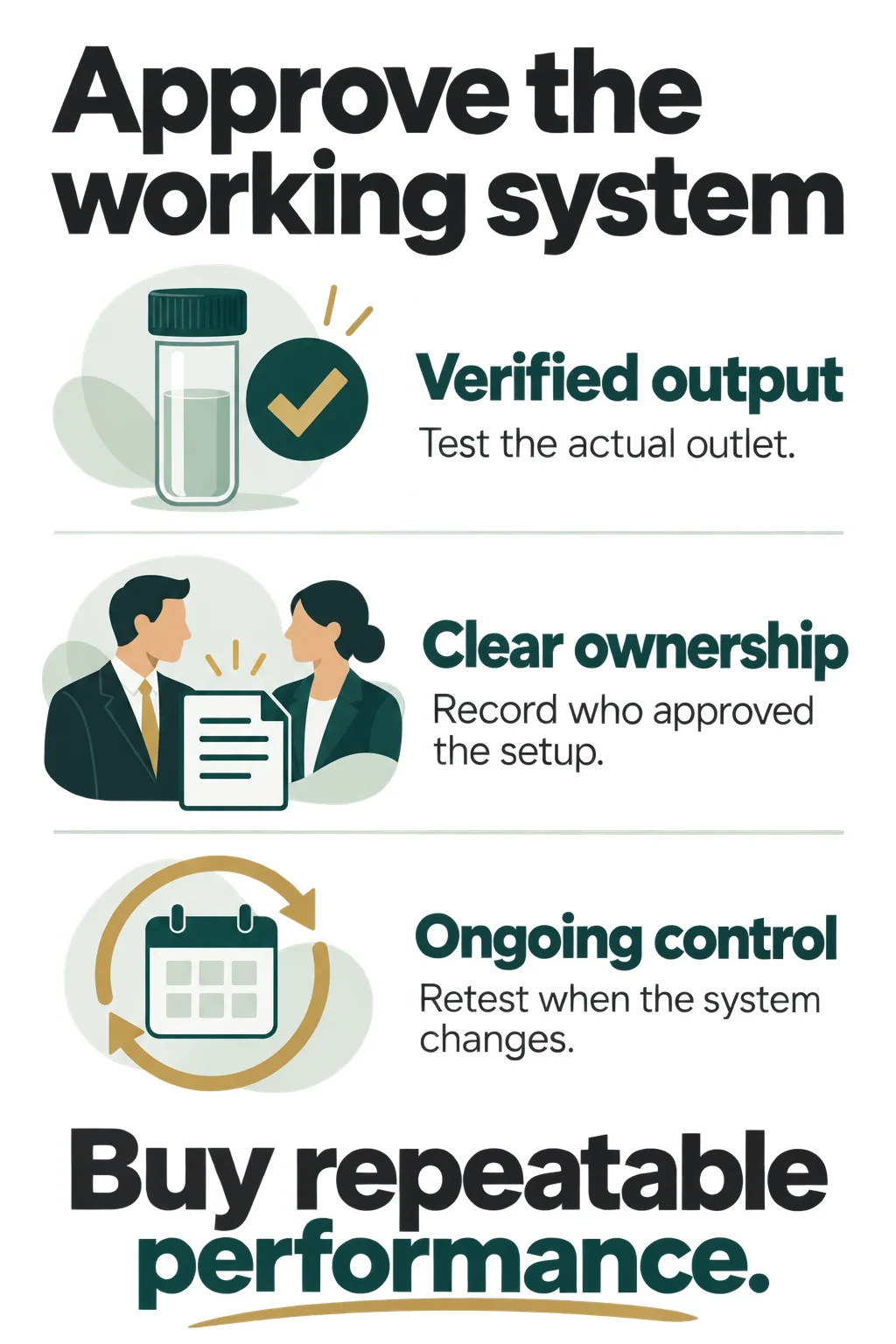
Retain a commissioning record identifying the product and lot, label revision, outlet and model, installed setting, water observations, container or fill mode, test method and expiry, individual readings, corrections, date, and responsible people. Ask engineering to confirm installation readiness, housekeeping to confirm operational usability, and purchasing to confirm that the approved configuration matches the order. Assign a named site owner for the record.
Update dispenser and secondary-container labels, remove obsolete instructions, and train staff before normal use. Agree a routine verification frequency with the supplier based on the equipment instructions and site conditions. Include retesting after relevant product or setup changes, maintenance affecting dosing, water-system changes, unexplained consumption changes, and complaints suggesting incorrect dilution. Do not treat an old passing result as approval for an altered configuration.
For a sourcing review, send the product documentation, installed dispenser details, intended applications, test results, required quantities, and delivery location through KW Hospitality’s specification-based RFQ form. State whether the request includes compatible dispensing hardware, test supplies, commissioning, or ongoing service so those responsibilities can be confirmed in the quotation.
Conclusion
A hotel chemical supplier switch is ready when the exact product, dispensing setup, measured output, and working procedure have been approved together. Establish the target before testing, verify the mixture at the real outlet, use a chemical method suited to the formulation, and keep individual results visible. Resolve uncertain or failing readings before release, then compare costs at the verified dose. The most useful purchasing evidence is an outlet-specific record that another employee can understand and repeat. Keep that record connected to the approved order, staff instructions, and future retesting whenever the system changes.
Frequently Asked Questions
Does a new supplier always require a new dispenser?
No. Reuse may be possible when ownership terms, chemical compatibility, connections, operating limits, and measured performance are confirmed. Replacement is appropriate when the existing unit cannot safely deliver or verify the required setup. Obtain a documented answer for the actual model rather than assuming that every concentrate is interchangeable.
Can we approve the change from a supplier’s demonstration sample?
A demonstration can support product selection, but it does not verify the hotel’s installed outlets. Treat it as preliminary evidence. The acceptance record should identify samples dispensed at the property under the conditions that will be used after the changeover.
What if the old and new products have the same EPA registration number?
Check the complete identifiers and labels. EPA explains that supplemental distributor products can share a primary registration while carrying a third number identifying the distributor. Product identity is useful evidence, but it does not verify the hotel’s connector, setting, or delivered dilution. Confirm the supplied formulation and repeat the relevant outlet checks.
Is a stronger mixture a safer fallback when a test fails?
No. An unapproved stronger mixture is not an acceptable substitute for the specified dose. Hold the affected outlet, investigate the failure, and use the property’s approved alternative until the setup passes. Do not ask housekeeping staff to compensate by adding concentrate manually.
Can one passing outlet approve the entire hotel?
No. A pilot can establish the method and expose likely problems, but each changed outlet needs its own release evidence. Two cabinets can have different settings, connections, flow configurations, or operating conditions even when their housings look identical.
Should a bottle tested later match a freshly dispensed sample?
Do not assume the results are directly comparable. Record the preparation time, container, storage conditions, and the product’s permitted in-use life. Follow the label and manufacturer’s storage and testing directions. A later-use check answers a different question from an immediate outlet commissioning test.
References
1. U.S. Environmental Protection Agency — Selected EPA-Registered Disinfectants
2. Hydro Systems — AccuMax 1, 2, & 3 button units with E-Gap eductors: user manual
3. Centers for Disease Control and Prevention — When and How to Clean and Disinfect a Facility
4. Hydro Systems — HydroChem 919: Multifunction Proportioning and Dispensing System
5. LaMotte — QAC Test Papers (2951)
6. LaMotte — QAC Test Kit (3043-DR-01)
7. Hydro Systems — Whitepaper: Ensuring Success with Dispensing Systems