
Hotel supply catalogs are useful discovery tools, but they are not neutral comparison documents. One catalog may list a towel by weight and fiber content, another may emphasize a marketing collection, and a third may show only dimensions, pack size, and a starting price. Similar-looking products can therefore differ materially in performance, maintenance needs, order quantity, warranty, lead time, and delivered cost. If a procurement team compares catalog pages at face value, it may shortlist products that are not equivalent—or reject a stronger option because the supplier presented information differently.
The practical solution is to move product information out of the catalog and into a buyer-controlled comparison structure. Start with the property’s use case and mandatory requirements, then normalize every candidate to the same unit of measure, specification fields, evidence requirements, cost basis, and delivery assumptions. Treat blanks as unresolved questions, not as proof that a feature is absent or included. Use samples and technical submittals to verify the attributes that matter most in real hotel operations. This also makes stakeholder review faster and supplier clarification more consistent across categories.
This guide explains how procurement teams should compare guest-room products, housekeeping supplies, tableware, linens, amenities, furniture, and selected equipment across hotel supply catalogs. It focuses on product-level decisions: defining a common baseline, translating inconsistent descriptions, evaluating performance by category, calculating total cost, checking minimum order quantities and replenishment risk, and recording a defensible selection. Teams building a broader category plan can also use KW Hospitality’s hospitality supplies directory to organize requirements by department before comparing individual catalog items.

Establish a Common Procurement Baseline Before Opening Any Catalog
A fair comparison begins with a statement of need, not with the first attractive product page. The team should define where the item will be used, who will handle it, what it must withstand, how it will be cleaned or maintained, and which constraints cannot be negotiated. This baseline becomes the control against which every catalog item is assessed. Without it, buyers tend to compare whichever attributes suppliers choose to highlight, allowing design language, product photography, or a low headline price to substitute for operational fit. The baseline also prevents a preferred product from quietly changing the requirement after stakeholders have already agreed on the project’s needs.
Translate the operational need into measurable requirements
Begin with the operating condition. A guest-room waste bin, banquet chair, bath towel, commercial kettle, and housekeeping cart face different loads, cleaning methods, moisture exposure, storage limits, and replacement patterns. Write requirements that can be checked: dimensions and tolerances, capacity, material or fiber composition, finish, load rating, power and utility needs, wash or care method, expected duty cycle, compatible accessories, and required documents.
Replace vague descriptions such as “premium,” “commercial grade,” or “luxury quality” with observable acceptance criteria. A finish may need to match an approved sample; a textile may require a specific construction and laundering performance; an electrical item may need to suit the destination voltage and plug configuration. Marketing terms can remain useful context, but they should not be scored unless they are converted into a measurable requirement.
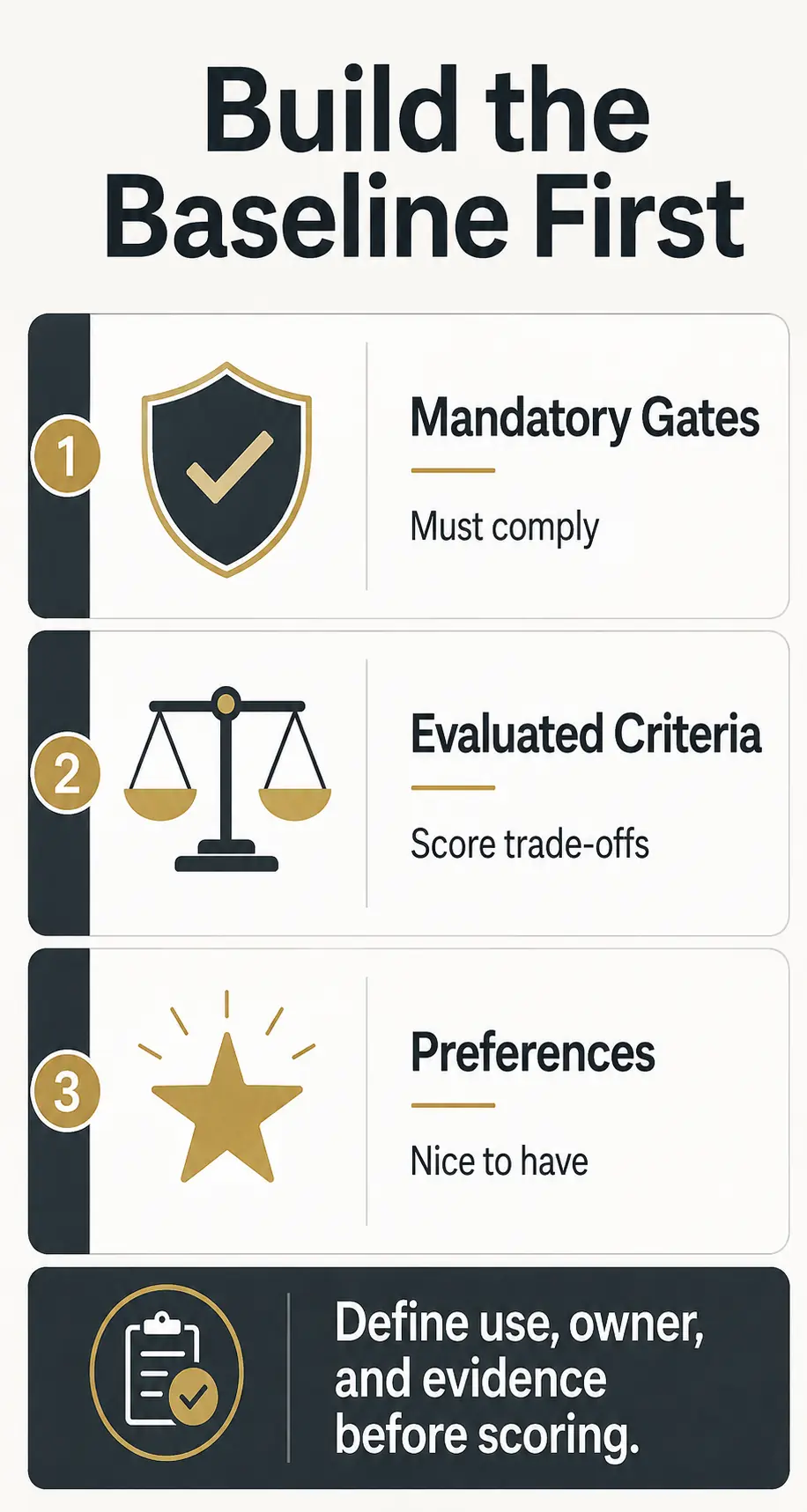
Separate gates from preferences
Divide requirements into three groups:
- Mandatory gates: failure means the product cannot proceed, regardless of price or appearance.
- Evaluated criteria: stronger performance earns a higher score, but trade-offs are permitted.
- Preferences: desirable features that should not outweigh essential operational needs.
This separation prevents a weighted score from hiding a critical failure. A product should not compensate for an incompatible voltage, unacceptable dimension, missing safety requirement, or prohibited material by earning extra points for color choice or unit price.
Assign ownership before comparison starts
The procurement team should identify who approves each type of requirement. Operations can assess workflow and cleanability; engineering can review utilities, access, and serviceability; design can control appearance and finish; finance can validate cost assumptions; receiving can confirm packaging and delivery constraints. One person should maintain the controlled comparison sheet so that changes, clarifications, and sample results are traceable.

Normalize Product Data Into a Comparable Specification Sheet
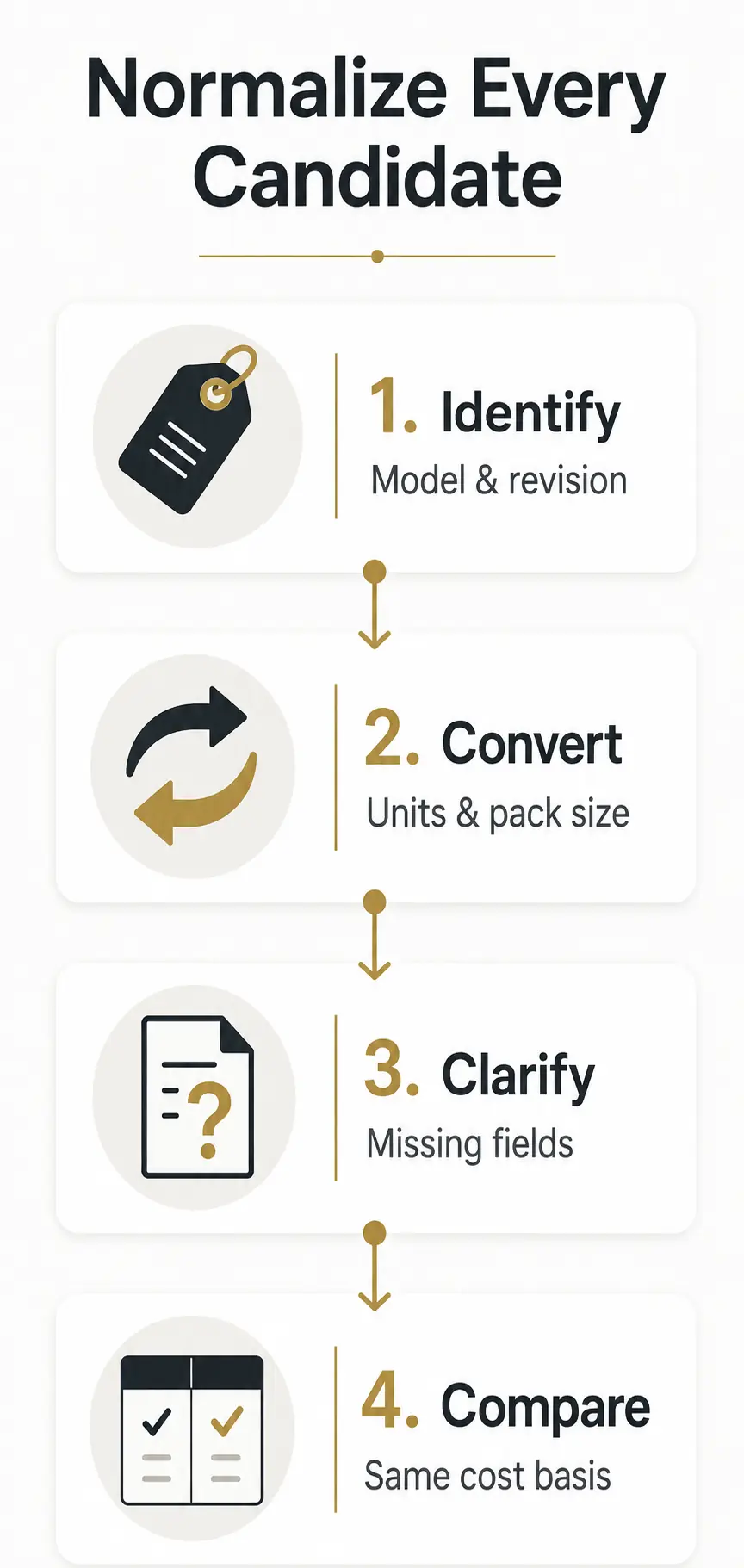
Catalogs rarely use the same labels, sequence, units, or level of detail. The buyer’s comparison sheet should therefore function as a translation layer. Give each candidate one row or one consistent record and map every catalog claim to the same field definitions. Preserve the supplier’s original model number and wording in a source column, but create normalized columns for decision-making. If a field is missing, mark it “not stated” or “clarification required”; do not enter “no,” zero, or a guessed value. This simple discipline distinguishes an actual product difference from a documentation difference and makes the questions sent to suppliers much more precise.
Use a minimum comparable product record
For most hotel supply categories, the record should include:
- supplier, catalog, product name, model or SKU, and revision or access date;
- intended application and approved property or department;
- dimensions, capacity, weight, material, construction, color, and finish;
- performance data relevant to the category;
- cleaning, maintenance, consumables, accessories, and spare parts;
- certifications, test reports, warranty, and exclusions;
- unit of measure, inner pack, case pack, pallet quantity, and minimum order quantity;
- unit price, currency, price basis, validity, taxes, duties, freight, and delivery scope;
- standard lead time, customization lead time, sample lead time, and reorder availability;
- country of origin or manufacturing location when it affects compliance, logistics, or brand policy;
- deviations, assumptions, questions, and evidence still required.
Record the date or revision of the catalog. Digital pages change, models are discontinued, and product specifications can be updated. A comparison that cannot identify which version was reviewed is difficult to defend later.
Convert units and packaging before comparing price
Normalize dimensions and weights to one unit system. Convert prices to the same usable unit: per piece, place setting, room set, liter, kilogram, meter, or another category-appropriate basis. A price per case is not comparable with a price per piece until the verified case pack and usable quantity are included. Also distinguish ordered quantity from required quantity. If the hotel needs 930 units but the item ships in cases of 48, the payable quantity may be 960 units before any spare allowance.
Keep “not stated,” “not applicable,” and “does not comply” separate
These three statuses have different meanings. “Not stated” requires clarification. “Not applicable” means the field does not matter for that product. “Does not comply” is a confirmed failure against the requirement. Using one blank cell for all three conditions creates false equivalence and makes later scoring unreliable.
When the comparison is ready to be issued to suppliers, use a controlled schedule rather than sending separate screenshots or catalog links. The hotel supply RFQ guide explains how to present common specifications, quantities, pricing fields, and submission rules so responses arrive on the same basis.

Compare Performance, Durability, and Operational Fit by Category
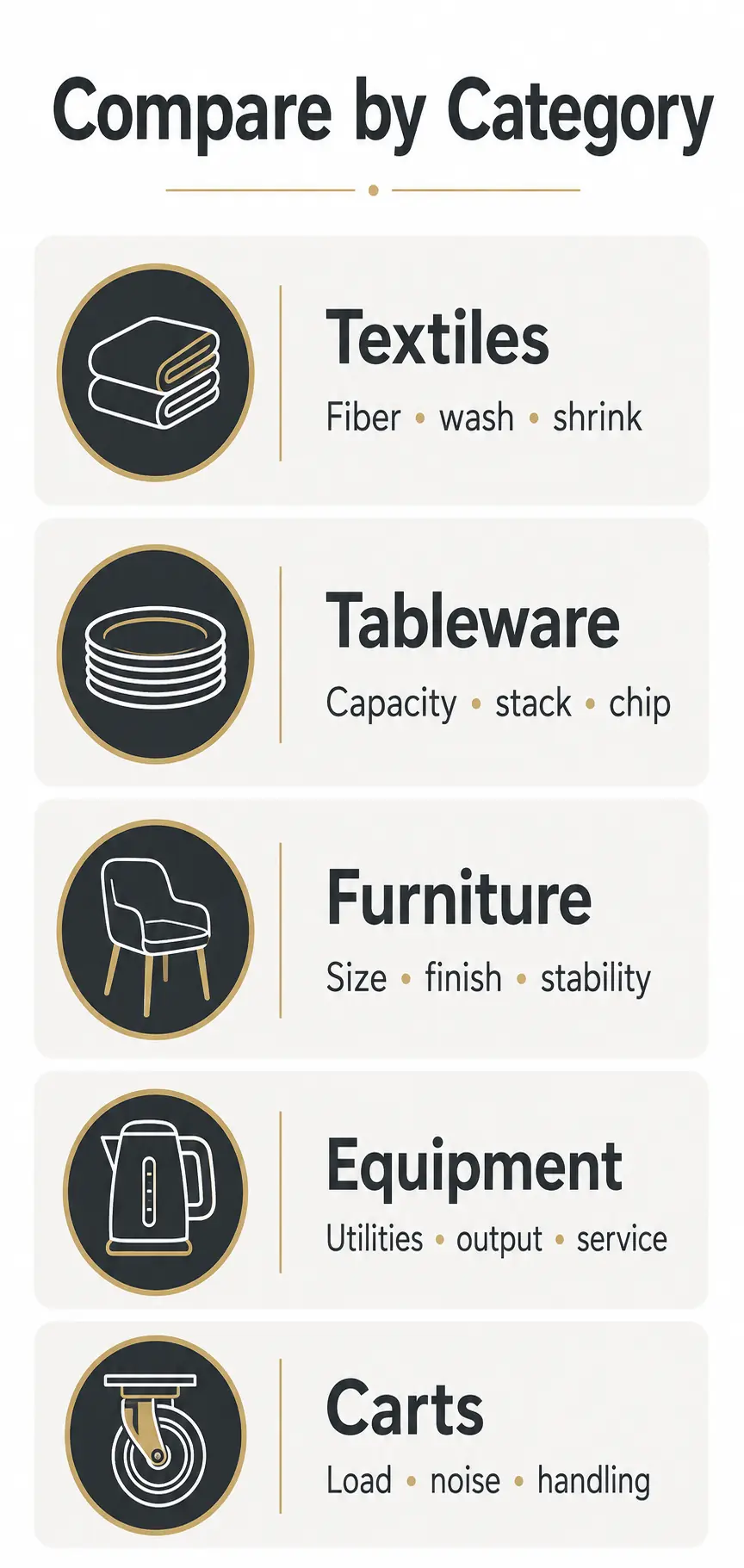
A universal comparison sheet needs category-specific modules. Dimensions, price, lead time, and warranty matter almost everywhere, but the evidence of quality for a textile is not the same as the evidence for tableware, furniture, or powered equipment. Procurement teams should build a shared core record and then add the fields that predict performance in the intended operating environment. The objective is not to collect every specification a catalog can provide. It is to identify the few product attributes that affect guest experience, staff effort, failure risk, safety, replacement frequency, and compatibility with the property.
Category comparison examples
| Category | High-value comparison fields | Operational questions to resolve |
| Linens and towels | fiber composition, construction, finished dimensions, weight basis, shrinkage, colorfastness, laundering instructions, seam and hem details | Will the item fit the laundry process, room standard, storage plan, and replacement cycle? |
| Guest amenities and dispensers | formulation or material, fill volume, dosing, tamper resistance, mounting, refill compatibility, packaging, shelf life | Is the system easy to refill, clean, audit, and replenish without creating waste or guest complaints? |
| Tableware and glassware | material, capacity, rim and edge construction, stackability, dishwasher compatibility, replacement continuity | Does it fit racks, storage, service style, portion standards, and high-volume handling? |
| Furniture and casegoods | dimensions and tolerances, structure, joinery, substrate, finish system, hardware, load and stability evidence, field assembly | Will it fit access routes, room layouts, maintenance capability, and the approved design sample? |
| Commercial equipment | capacity, throughput, utilities, efficiency, controls, clearances, installation, commissioning, service network, spares | Can the site install, operate, clean, maintain, and repair it under actual demand? |
| Housekeeping and material handling | load rating, wheel or caster design, maneuverability, noise, cleanability, storage footprint, replaceable parts | Can staff use it safely through elevators, corridors, thresholds, and service areas? |
Test catalog claims against the actual workflow
Catalog language often describes features without showing how they affect use. “Stackable” may not state the safe stack height or storage footprint. “Easy clean” may not identify compatible chemicals, removable parts, or crevices. “Heavy duty” may omit a load rating or duty cycle. Translate each important claim into a verification question and, when appropriate, a sample test.
For equipment with meaningful energy or water use, compare expected operating consumption as well as purchase price. For items with environmental claims, request specific evidence about the claimed attribute and its scope instead of scoring broad words such as “green” or “eco-friendly.” The same principle applies to antimicrobial, recycled-content, durability, fire-performance, and accessibility claims: the team should understand exactly what was tested, under which method or scope, and whether that evidence applies to the offered model.
Check interfaces, not just the product in isolation
Many catalog selection errors occur at the interfaces. Confirm that dimensions fit the room, millwork, elevator, dock, storage area, rack, cart, or machine. Confirm that power, water, drainage, ventilation, data, mounting, and consumables are compatible. Check whether accessories shown in the catalog are included, optional, or required for operation. A technically strong product can still be the wrong selection if it creates hidden work for installation, training, cleaning, inventory, or service.

Calculate Total Cost, Order Constraints, and Supply Continuity
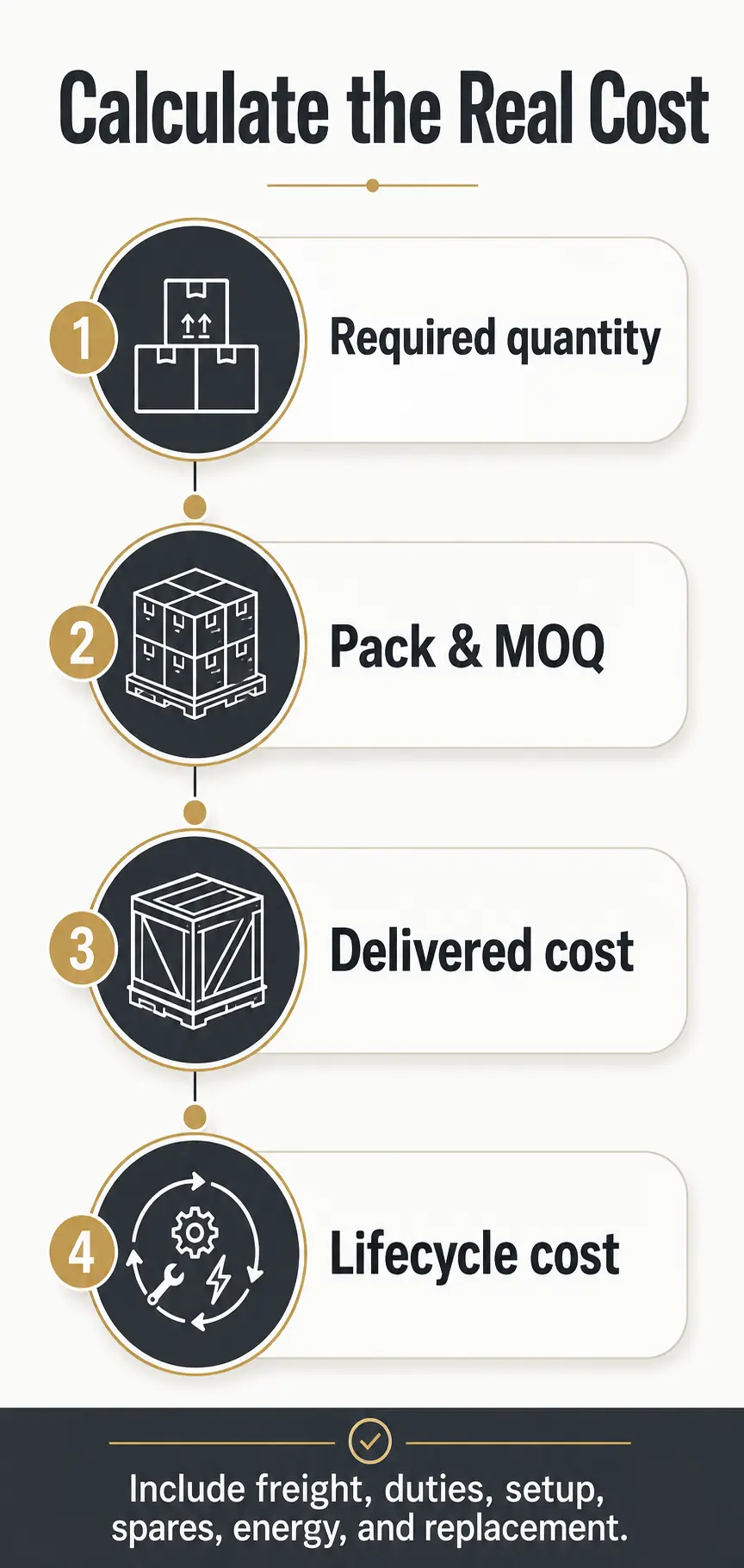
The lowest catalog price is rarely the lowest complete cost. A usable comparison must place every candidate on the same commercial and time basis, then examine what happens after delivery. Start with the quantity the property actually needs, apply pack sizes, minimum order quantities, spare stock, and expected waste, and then add the costs required to make the item available for use. For durable products, include operating, maintenance, repair, and replacement effects over a defined period. For frequently replenished products, examine reorder quantity, lead time, storage demand, and the risk that an approved model, pattern, color, refill, or spare part will no longer be available.
Build a normalized landed-cost view
At minimum, identify whether each offer includes or excludes:
- product cost at the required payable quantity;
- sample, artwork, mold, tooling, customization, or setup charges;
- export packing, labeling, palletization, and documentation;
- inland transport, international freight, insurance, duties, taxes, customs, and brokerage;
- delivery appointment, liftgate, unloading, inside delivery, assembly, installation, commissioning, or training;
- inspection, testing, reinspection, and corrective-action costs;
- expected spares, consumables, replacement parts, and disposal of packaging or retired equipment.
Do not hide uncertainty inside a single total. Show the assumptions and confidence level for freight, duty treatment, exchange rate, defect allowance, useful life, and other variable inputs. Test whether a reasonable change in those assumptions changes the preferred product.
Quantify the effect of MOQ and case packs
Use a clear calculation:
Payable quantity equals the higher of the minimum order quantity and the required quantity rounded up to the next full pack.
Then calculate the effective cost per required usable unit, not merely the quoted unit price. Excess units may be useful as opening spares, but they still consume budget and storage. For custom products, ask whether the same MOQ applies to reorders and whether future small replacements can match the original color, finish, mold, packaging, or branding.
Compare lifecycle cost where it can change the decision
Lifecycle analysis is most valuable when candidates differ in energy or water consumption, consumables, maintenance labor, repair frequency, useful life, or replacement price. Define the comparison period and apply the same assumptions to every product. Avoid false precision: a transparent range is better than a confident number based on unsupported failure rates.
The broader wholesale hotel supplies purchasing guide provides additional context for samples, commercial terms, quality control, logistics, receiving, and replenishment when the catalog comparison is part of a larger order.

Validate Claims With Evidence, Samples, and Controlled Scoring
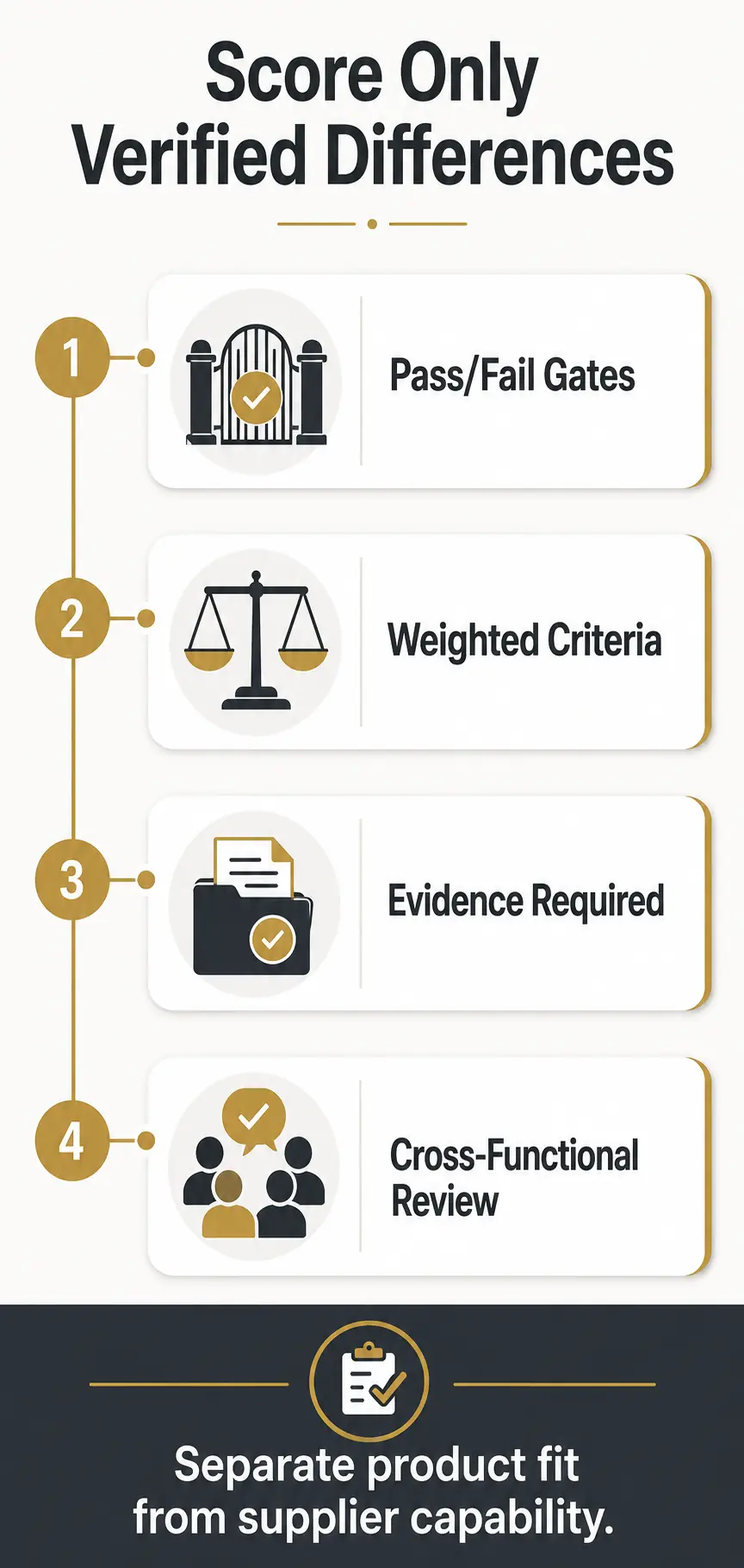
Scoring should summarize verified differences, not manufacture certainty from incomplete catalog pages. Apply mandatory gates first. Then score the remaining candidates using criteria, weights, and rating definitions agreed before the team sees final prices. Every important score should point to evidence: a technical data sheet, drawing, test report, warranty, completed supplier response, approved sample, trial result, or written clarification. If evidence is missing, assign a clearly defined pending status or a conservative score rather than rewarding an unsupported claim. Keep product scoring separate from supplier capability scoring so a strong product is not confused with a supplier’s ability to deliver it reliably.
Use a transparent scorecard
The following model is an example, not a universal weighting scheme:
| Evaluation area | Treatment | Example decision evidence |
| Mandatory specification and destination requirements | Pass/fail gate | completed compliance matrix, technical sheet, drawing, required documentation |
| Operational performance and durability | 25% | sample test, category-specific data, cleaning and maintenance review |
| Normalized landed and lifecycle cost | 25% | comparable pricing schedule, cost assumptions, sensitivity review |
| Quality evidence and consistency controls | 15% | sample approval, test evidence, inspection and corrective-action plan |
| Lead time, MOQ, packaging, and delivery fit | 15% | production plan, pack data, delivery scope, required-on-site alignment |
| Warranty, service, spares, and replenishment | 10% | warranty terms, service path, parts list, reorder and discontinuation response |
| Design, guest experience, and approved preferences | 10% | approved finish or prototype, design review, user feedback where appropriate |
Define what a rating of 1, 3, or 5 means for each criterion. Otherwise, different reviewers may use the same number for different judgments. Require comments for unusually high or low ratings and resolve major differences in a cross-functional review.
Approve samples against the written requirement
A sample is not a substitute for a specification, and a specification is not a substitute for a sample when appearance, workmanship, hand feel, noise, maneuverability, or usability matters. Use both. Label the sample with the product, revision, finish, date, and approval status. Record any conditions of approval and confirm whether the production product must match the sample, the written specification, or both.
For custom or technically sensitive items, the sequence may include a material swatch, finish chip, standard sample, customized prototype, mock-up, preproduction sample, or operational trial. The comparison record should show which stage has been completed and what remains open before award or production release.
Preserve the decision record and convert it into purchasing documents
Keep the baseline requirement, catalog extracts, clarification log, evidence, sample record, cost assumptions, scorecard, reviewer comments, and final approval together. Record the selected product’s exact model, revision, finish, accessories, deviations, and accepted conditions. Then transfer that controlled definition into the RFQ, quotation clarification, purchase order, or contract. Do not rely on a catalog link that may later change.
Product selection and supplier selection are related but distinct decisions. After the product shortlist is technically comparable, the team can use the framework for comparing hotel supply companies beyond quoted price to assess capacity, quality systems, delivery confidence, service, and commercial risk.
If your team has a multi-category hotel project, renovation, replacement program, or custom-product requirement, submit the normalized schedule through KW Hospitality’s sourcing RFQ form. Include quantities, destination, required date, specifications, acceptable alternatives, and any sample, branding, testing, packing, or delivery requirements so the quotation can be reviewed against a clear product baseline.

Conclusion
Hotel supply catalogs should help teams discover options, not dictate how options are judged. The procurement team needs its own comparison structure: one baseline, one set of field definitions, one unit and cost basis, category-specific performance criteria, explicit evidence requirements, and a controlled record of every clarification and approval. This approach exposes apparent bargains that depend on lower specifications, missing accessories, oversized case packs, uncertain freight, or unsupported claims. It also gives well-documented products a fair chance even when their catalog presentation is less polished.
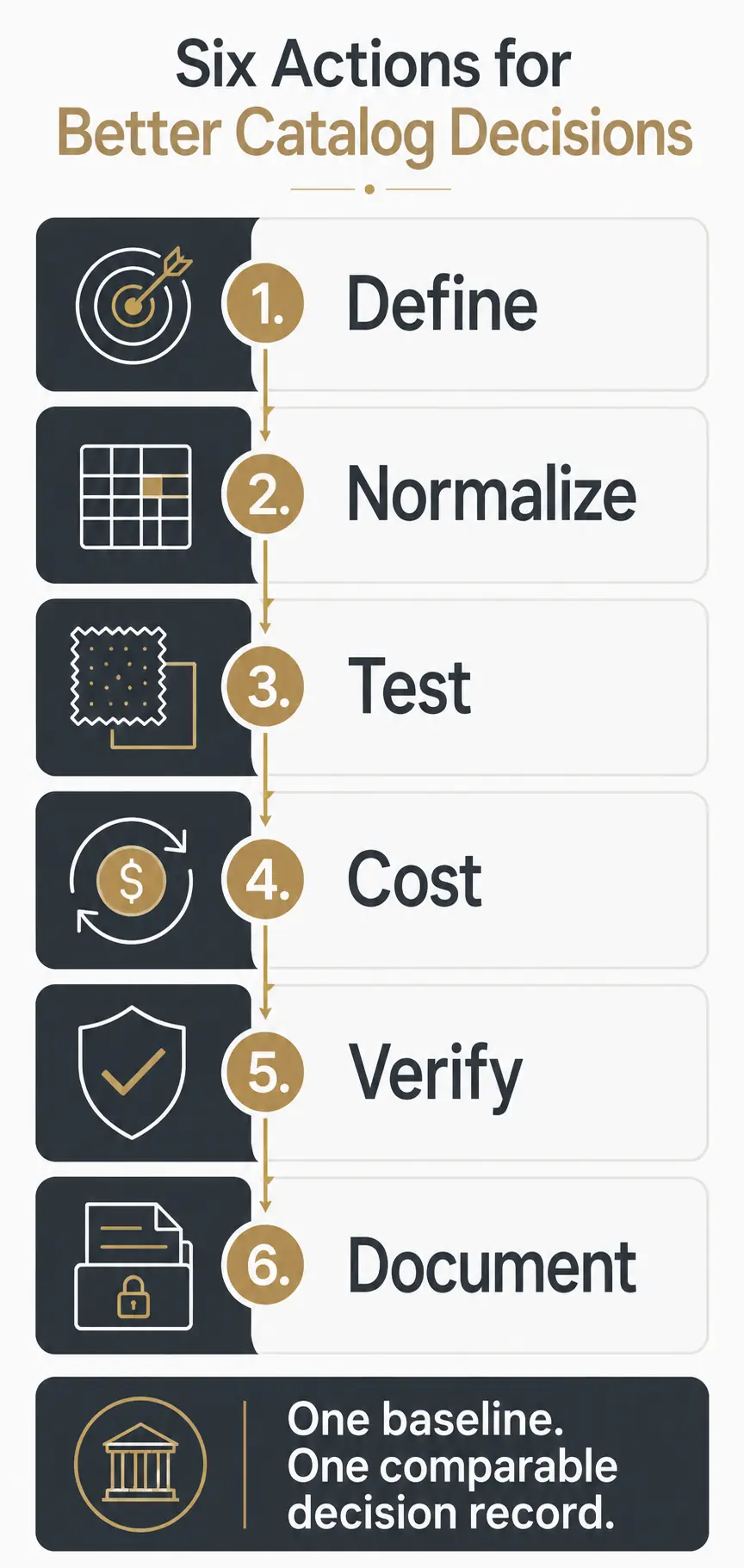
The process can be summarized in six actions: define the use case, normalize the data, test operational fit, compare total cost and continuity, verify evidence, and document the award. Apply mandatory gates before weighted scoring, and separate confirmed noncompliance from missing information. Use samples where physical experience matters, but bind the approved sample to a written specification and revision.
The final decision should be understandable to someone who did not attend the evaluation meeting. That person should be able to see what the hotel needed, which products were truly comparable, what assumptions were used, why one option was selected, what risks remain, and which documents control the order. When the comparison record can answer those questions, the catalog has been converted from a marketing source into a reliable procurement input.
Frequently Asked Questions
Catalog comparisons create recurring questions about scope, missing data, samples, custom items, and price. The answers below clarify how procurement teams can keep the process proportionate without weakening the decision record.
How many catalog products should a procurement team shortlist?
There is no fixed number. Shortlist enough credible options to test the market and compare meaningful alternatives, but remove products that fail mandatory gates before detailed scoring. For a straightforward replenishment item, two or three compliant candidates may be sufficient. A high-value, custom, or operationally critical item may justify a broader initial list followed by a staged reduction after technical review and samples.
What should buyers do when catalogs use different units or pack sizes?
Convert every candidate to the same usable unit and calculate the payable quantity after minimum order quantities and full-pack rounding. Keep the original catalog unit in a source field for traceability. Verify case packs in writing before award, especially when a listing mixes pieces, sets, cases, room packs, or cartons.
Can a catalog specification replace sample approval?
Not when appearance, workmanship, feel, fit, noise, maneuverability, or user interaction materially affects acceptance. The written specification defines measurable requirements; the sample helps verify physical qualities and execution. For important items, use both and record whether production must match the approved sample, the specification, or both.
How should custom or private-label products be compared?
Compare the standard product platform first, then add the custom variables: artwork method, dimensions, color and finish tolerance, mold or tooling, preproduction approval, packaging, labeling, MOQ, lead-time trigger, ownership of tooling, reorder conditions, and the method for controlling future production. Do not score a custom rendering as if it were a verified production sample.
Should the lowest-priced compliant product always win?
No. Price is one evaluated factor after mandatory compliance. A higher-priced product may provide lower delivered cost, longer useful life, lower operating expense, easier maintenance, stronger replacement continuity, or lower schedule risk. The preferred option should offer the strongest expected value under the team’s documented criteria and assumptions, not simply the lowest catalog number.