A hotel laundry water reuse system is worth buying only when it can deliver suitable water to an approved reuse point, consistently replace purchased freshwater, and produce acceptable linen at a defensible operating cost. The purchase decision should therefore begin with the hotel’s wash process and water balance—not a headline recovery percentage. A system may capture a large volume while saving much less after treatment losses, storage limitations, downtime, and the timing of washer demand are considered.
For an on-premises laundry, water reuse generally means collecting selected washer discharge, storing or treating it, and returning it to a specified part of a later wash process. This differs from encouraging guests to reuse towels, recovering heat from drain water, or supplying an entire building with reclaimed water. Those measures can complement one another, but their savings and approval requirements should be evaluated separately. Here, “recovered water” means water made available after the proposed treatment; “displaced freshwater” means recovered water actually delivered in place of a freshwater fill.
The practical questions cross several responsibilities. Laundry management knows the linen mix and production schedule. Engineering understands drainage, utilities, controls, and service access. The chemical supplier and washer manufacturer need to address process compatibility. Procurement must turn their answers into a scope that competing vendors can price consistently, while the property’s design professionals and relevant authorities resolve the permitted use and installation requirements.
This guide explains what those answers should contain, how to distinguish alternative recovery arrangements, and how to test a savings proposal. It also includes an editable calculator with a deliberately hypothetical example. The objective is a purchase decision supported by the hotel’s own conditions, with unresolved assumptions visible before equipment is ordered.
Which Water Will the System Recover and Where Will It Go?
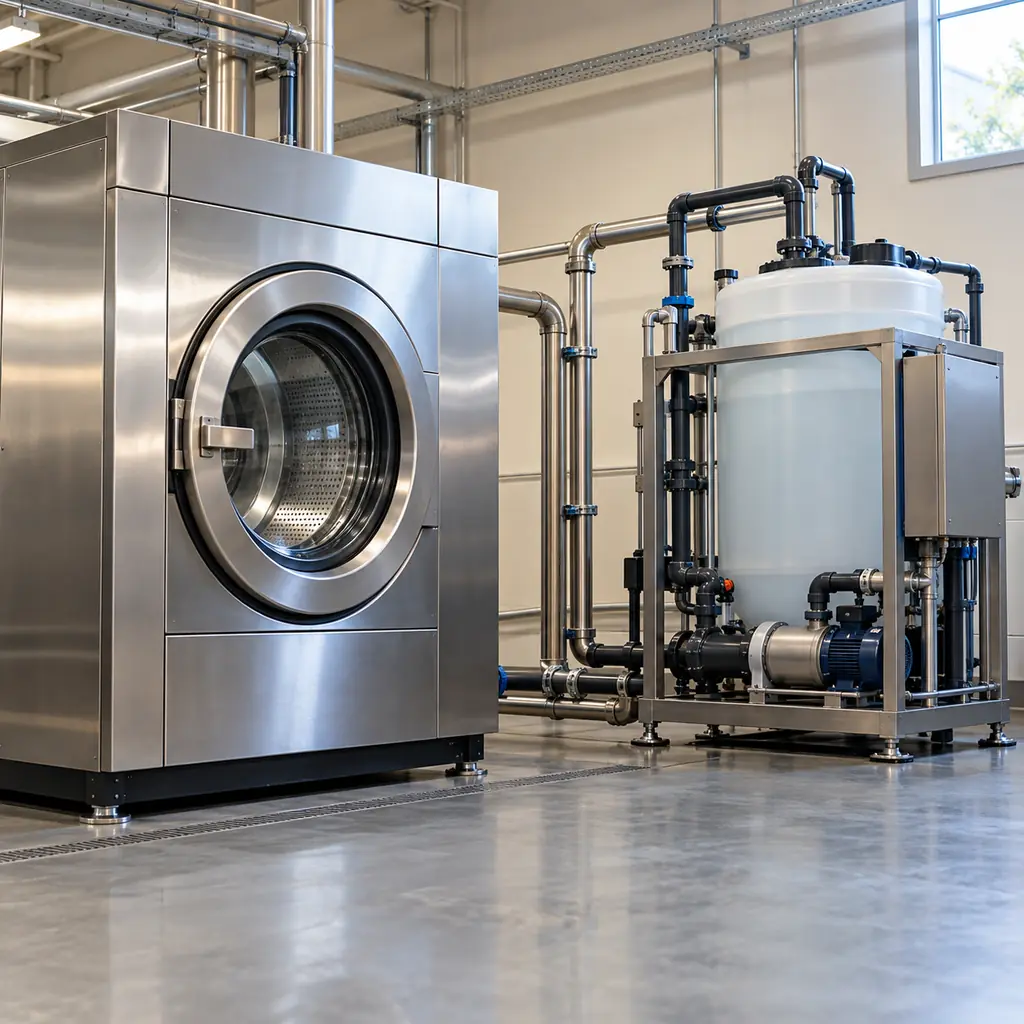
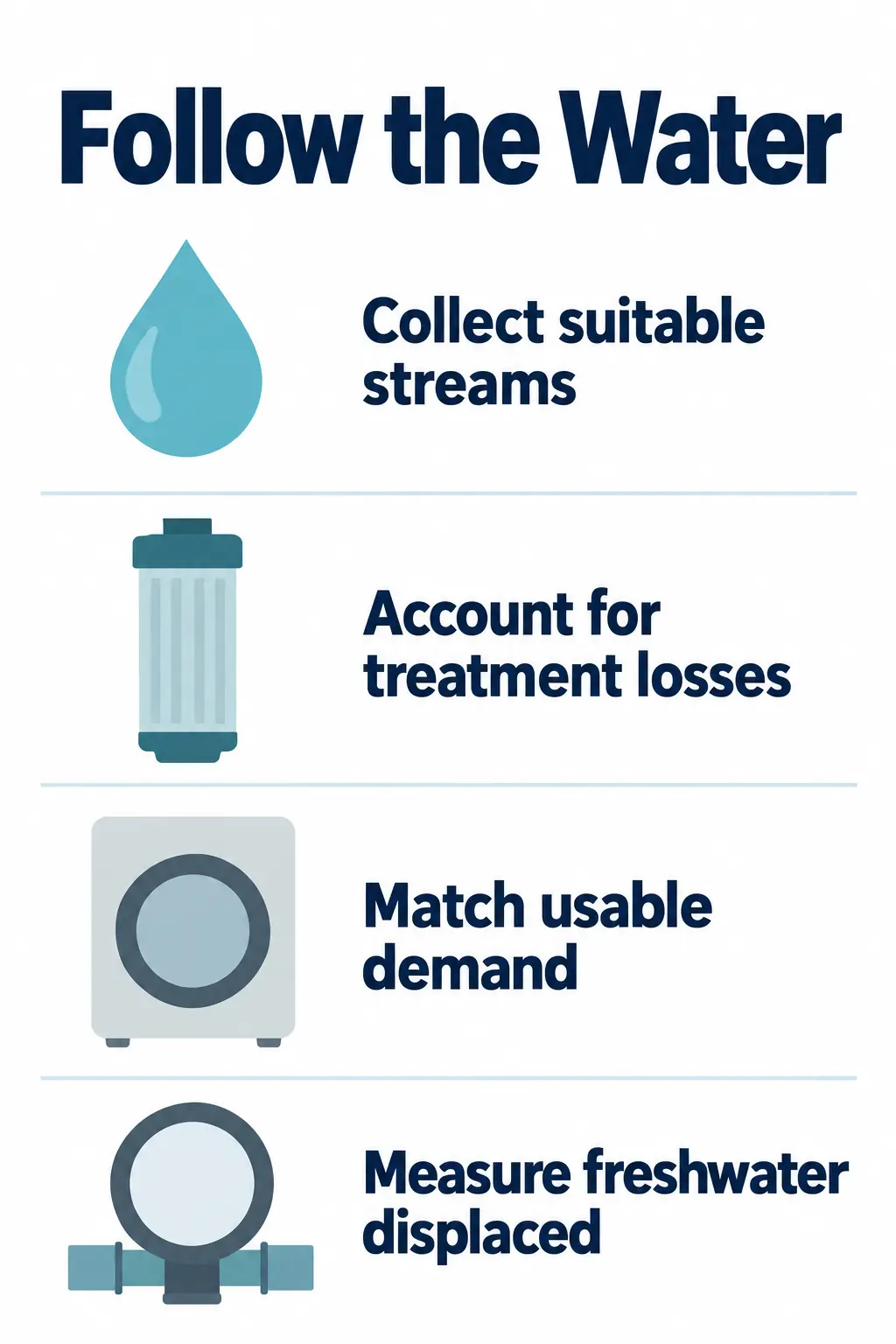
The first requirement is a defined water route: which washer discharges enter the system, what treatment and storage they pass through, and which future fills can receive the resulting water. “Laundry water recycling” alone does not describe that route. A proposal should distinguish eligible source water, collected water, treatment output, and freshwater actually displaced. It should also identify bypassed batches and every discharge leaving the recovery equipment. These distinctions make the proposed saving auditable and expose a common mismatch: enough recoverable water may exist over a day, yet be unavailable when a washer needs it.
Separate the recovery arrangements
EPA’s laundry equipment guidance distinguishes simpler rinse-water reuse from more extensive systems that treat wash and rinse discharge. That distinction matters because a suitable destination for one stream is not permission to return every stream to every wash stage.
| Arrangement | What returns to use | What the purchase scope must resolve |
| Selected rinse-water recovery | A defined rinse discharge for a specified later fill | Batch eligibility, destination, holding conditions, and any required treatment |
| Broader wastewater treatment and reuse | Treated output from a wider range of laundry discharges | Validated treatment performance, rejects, chemical carryover, and approved reuse points |
| Drain-water heat recovery | Heat transferred from wastewater; water may still leave for disposal | Heat-transfer performance and whether any separate water reuse occurs |
| Building-wide nonpotable reuse | Water supplied to approved building uses | Separate distribution, end-use quality, and applicable local approval requirements |
Request a process flow drawing tied to the actual washer models and programs. It should show collection valves, tanks, treatment equipment, fresh makeup, sampling points, return connections, overflows, and disposal routes. Keep wastewater from incompatible sources outside the defined collection boundary.
Size for the wash schedule as well as the daily volume
Build the baseline from dry linen weight, actual fill volumes, programmed cycles, and operating hours. Segregate towels, bedding, food-and-beverage linen, and unusual soil loads when their programs differ. Room count alone cannot describe the water available from those batches. The hotel’s linen mass also affects equipment demand; use the towel weight and dryer capacity guide when establishing a consistent dry-weight basis.
A storage tank does not automatically solve a timing problem. Larger storage can bridge some gaps, but it adds footprint, retained inventory, cleaning work, and a need to control holding conditions. The vendor’s calculation should account for concurrent washer fills, peak drain releases, minimum available tank volume, and the last recoverable batch before an overnight shutdown.
Treat recovery yield and utilization as different quantities. If treatment delivers 800 liters from 1,000 liters collected, its yield is 80%. If only 600 of those 800 liters replace freshwater, utilization is 75% and actual displacement is 600 liters. Neither 80% nor 75% is the percentage reduction in the hotel’s total laundry freshwater use; that requires the original freshwater baseline as the denominator.
What Water Quality Will Protect Linen and the Wash Process?
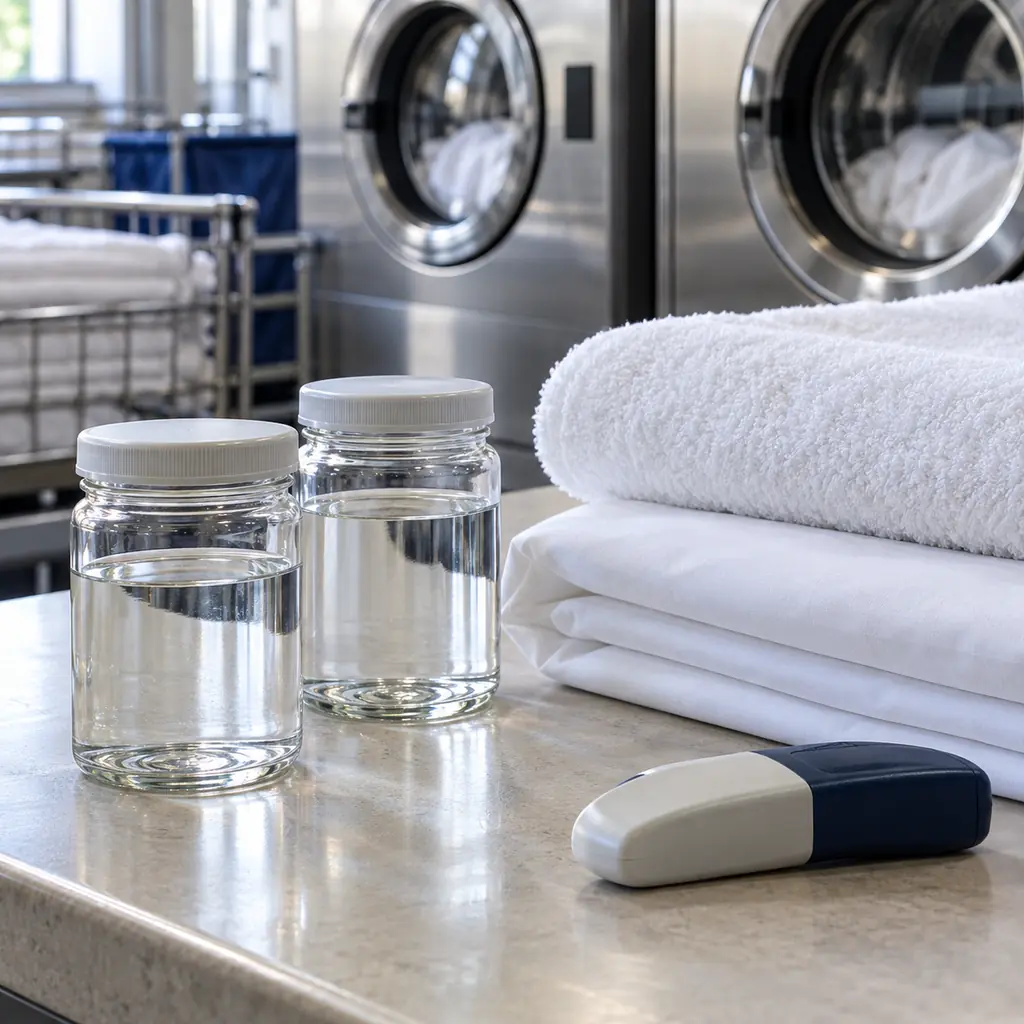
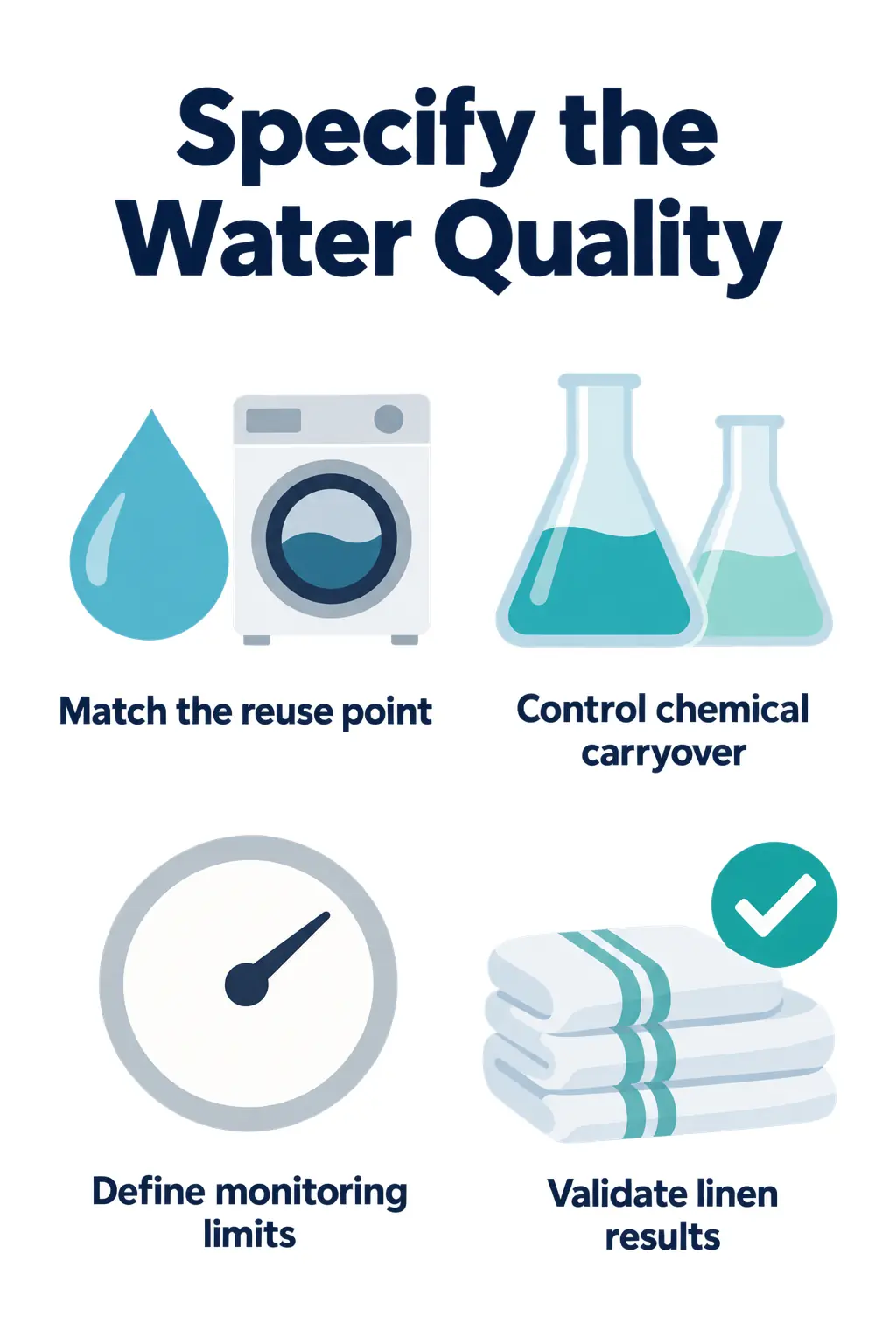
Water quality must be specified at the point where recovered water enters the wash process, with limits suited to that use. Clear appearance is insufficient evidence that water is suitable for contact with linen. A usable specification addresses physical contamination, chemical conditions, microbial requirements, and the consequences of storage and repeated reuse. It also states how compliance will be measured and what happens when a result falls outside the agreed range. The washer manufacturer, laundry chemical supplier, treatment designer, and relevant approval authority should resolve their respective requirements before the hotel accepts a treatment package.
Match treatment to the substances that need control
The Department of Energy’s alternative water sources guidance identifies detergents, dissolved and suspended material, and pathogens as potential constituents of graywater. For procurement, the implication is to require evidence for the actual incoming laundry stream and intended output, rather than treating the names of treatment technologies as interchangeable assurances.
| Treatment function | Performance question for the supplier | Important boundary |
| Screening or filtration | Which particles are removed, at what flow and loading? | Particle removal alone does not establish control of dissolved chemistry or microbial suitability |
| Membrane treatment | Which constituents are retained and what output is demonstrated? | “Membrane” is incomplete without membrane type, operating conditions, and reject volume |
| Disinfection | What validated process conditions and monitoring support the required result? | Disinfection does not by itself prove removal of salts, detergents, or all other contaminants |
| Storage and distribution | How is suitable output maintained until the reuse point? | A satisfactory result at treatment discharge does not describe every later holding condition |
Have the treatment supplier explain how performance changes at the hottest permitted inlet condition, the highest accepted soil load, and the minimum or maximum operating flow. Require the feedwater assumptions behind any guarantee to match the hotel’s sampling results.
Define process and linen acceptance separately
Relevant process measurements may include temperature, pH, conductivity, turbidity, hardness, selected detergent or disinfectant residuals, and the microbial parameters required for the proposed use. The purpose of each must be clear. Conductivity can help reveal a change in dissolved ionic content, for example, but it is not a direct test for every chemical or microorganism. Specify measurement location, units, method, frequency, limits, and the action associated with an unacceptable result.
Linen acceptance is a second decision. Compare otherwise equivalent loads for visible soil removal, whiteness or color change, odor, feel, absorbency where relevant, and rewash frequency. Evaluate the retained wash program and chemical dosing together; a visually acceptable demonstration load does not establish every hygiene requirement. Define who approves the results and which tests require a laboratory or specialist.
Chemical carryover also belongs in the purchase scope. Ask which constituents could persist through treatment, accumulate with repeated reuse, or interfere with the next batch’s chemistry. Require a defined control approach, such as limits on eligible streams, treatment, dilution, or discharge. Singapore’s PUB commercial laundry guide specifically discusses pH and dosing adjustments for rinse-water reuse; this is process guidance, not a North American approval standard. Do not assume detergent remaining in recovered water is an automatic chemical saving. Include laundry chemicals and dosing requirements in the same sourcing brief so that equipment and chemistry assumptions can be reviewed together.
Keep exceptional loads outside an unproven envelope
Identify heavily stained restaurant linen, unusual chemical treatments, and any contaminated loads that the proposed design has not covered. The answer may be to divert those discharges and run the affected washers on their established freshwater program. Expand collection only after the treatment supplier and process stakeholders have evaluated the additional conditions; the desire to improve a recovery percentage should not silently change the system’s accepted feedwater.
Can the Hotel Install, Operate, and Service the System?
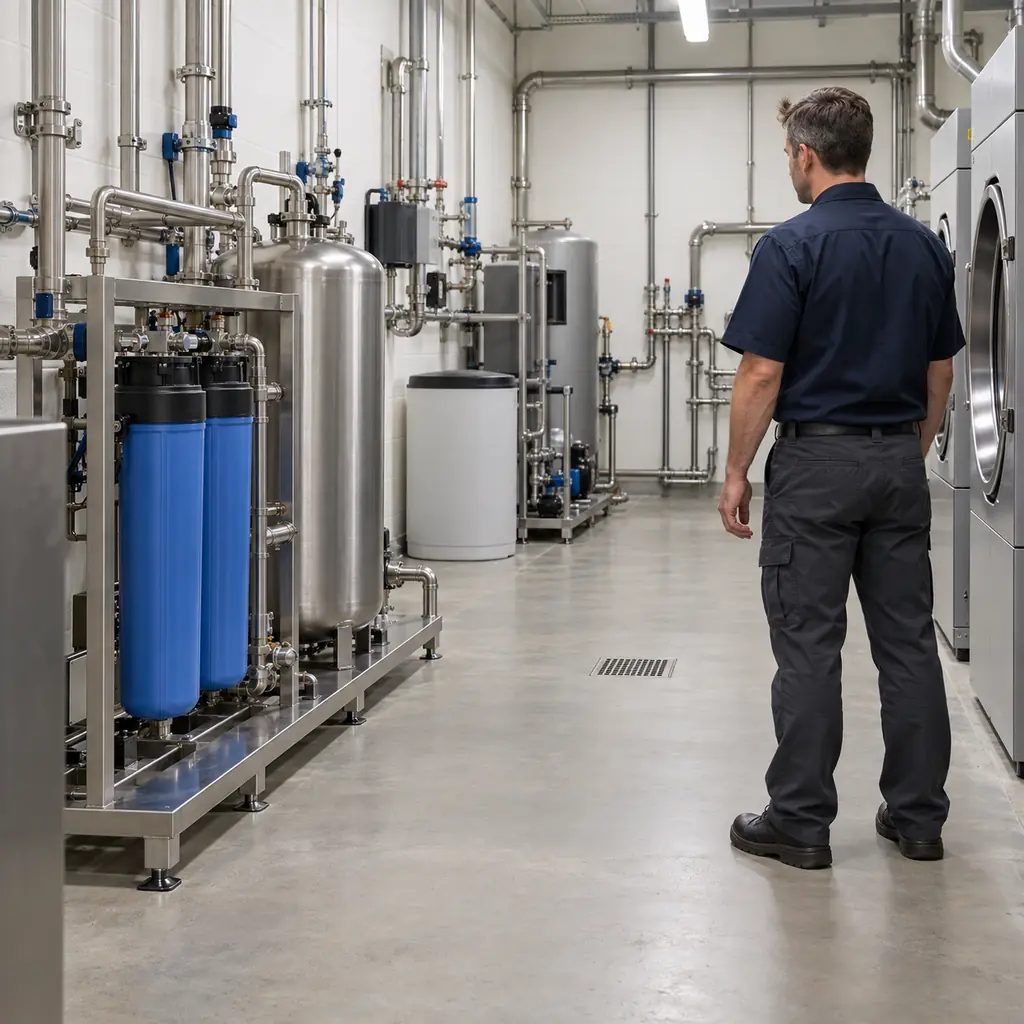
A viable retrofit must fit the building and the people who will run it. The installed scope extends beyond a treatment skid to collection and return piping, tanks, utility connections, drainage, controls, access, and the ability to maintain laundry production during faults or service. Approval requirements also depend on the property’s location and the exact water source and destination. Resolve those matters using an installation drawing and operating description specific to the hotel. A supplier’s general statement that its equipment is suitable for commercial laundries does not establish that the proposed installation is permitted or complete.
Resolve approval and potable-water protection early
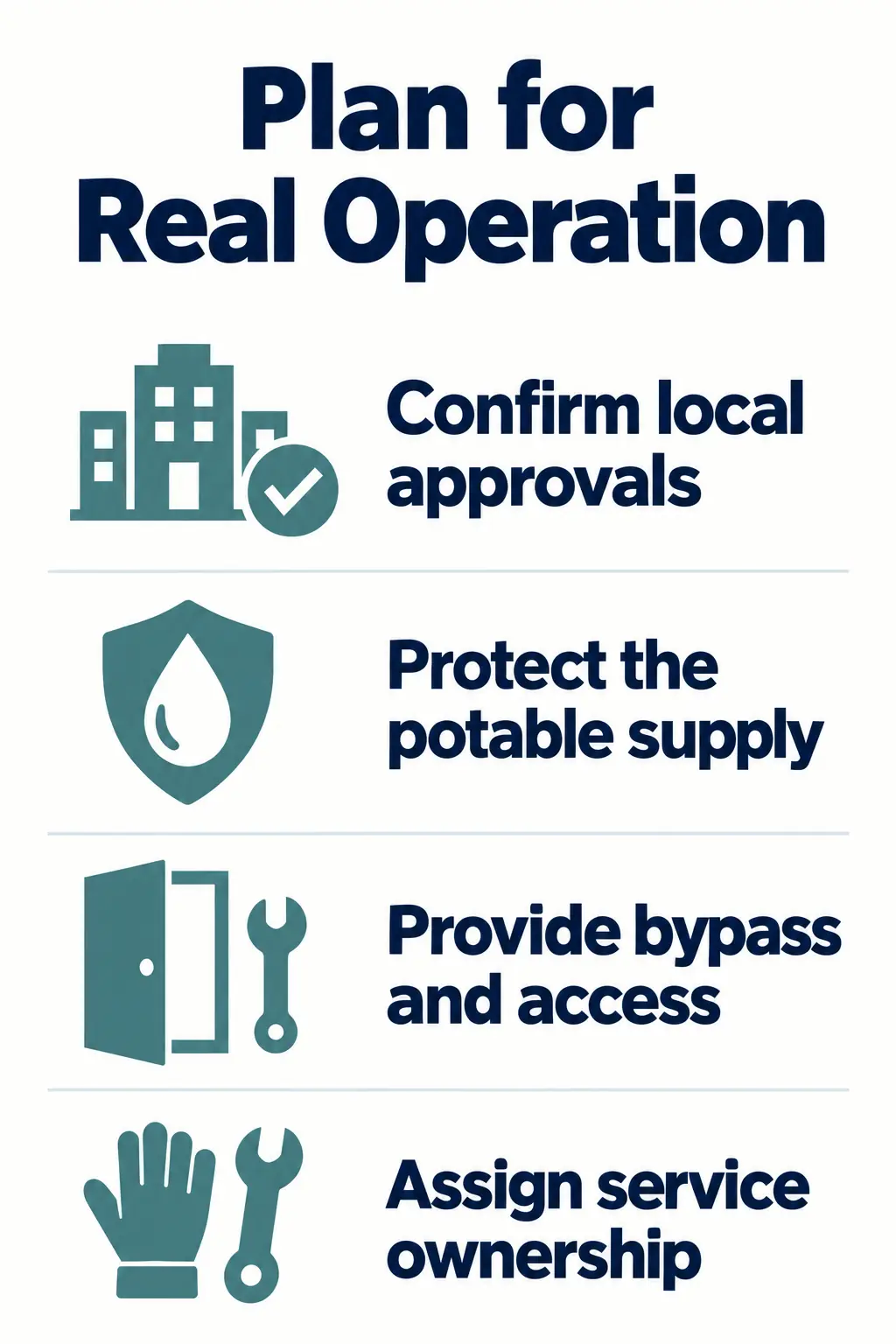
Identify the authority responsible for plumbing approval, the water utility’s cross-connection requirements, and the wastewater authority’s discharge conditions. Ask the project’s qualified designer to document the required protection between potable and nonpotable systems, identification of the reuse network, and the permitted freshwater makeup arrangement. Do not let an equipment quotation substitute for those project decisions.
For US projects, EPA’s REUSExplorer can help locate state guidance, but its summaries are nonbinding and direct users to current state information. For Canadian projects, Health Canada’s household reclaimed-water guidance describes a guideline scope limited to toilet and urinal flushing. It should not be presented as approval to supply recovered water to a commercial laundry.
If certification is claimed, inspect the exact model, capacity, classification, feedwater type, required components, and footnotes in the issuer’s listing. The NSF/ANSI 350 listings illustrate these distinctions. A listing’s “Laundry & Bathing” feedwater description does not by itself establish approval to reuse its output in every laundry stage.
Disposal remains part of the design. Establish the destination and characteristics of filter backwash, membrane concentrate if present, tank drains, cleaning waste, and rejected batches. Lower discharge volume does not automatically mean lower pollutant loading or lower sewer charges. Have the relevant utility confirm the billing and discharge implications for the proposed arrangement.
Confirm fit, connections, and production capacity
The Department of Energy’s water-intensive processes guidance specifically calls attention to treatment requirements and space when considering laundry rinse-water recycling. Translate that into dimensions and interfaces: equipment access routes, operating clearances, structural support for filled tanks, electrical requirements, water pressure and flow, drainage capacity, ventilation where needed, and safe access to service components.
Washer controls need equal attention. Establish whether the machines can select recovered or fresh water for the permitted fill, how collection valves identify the correct discharge, and how levels and pressures affect cycle time. Obtain written compatibility and warranty positions for any proposed modifications. A recovery arrangement that delays filling may reduce daily linen output even while saving water per load.
The changeover plan should account for laundry downtime, temporary piping or production arrangements, commissioning, and removal of existing equipment where applicable. Include those costs and responsibilities in the installed price.
Assign ownership of routine work and abnormal conditions
Name the person responsible for routine observations, cleaning, sampling, consumables, alarms, and records. Distinguish hotel tasks from specialist service visits. Request replacement intervals, expected work duration, access needs, spare-part lead times, and service response commitments. Obtain any remote-monitoring fees, software dependencies, and data-export terms before comparing lifecycle cost.
Specify what the system does after a failed quality check, treatment fault, pump failure, high tank level, or loss of power. The intended response should prevent unsuitable recovered water from entering the wash process and provide the agreed freshwater operating mode. The hotel’s capacity to continue washing during a recovery-system outage must be verified; a bypass shown on a schematic is not a production test.
Shutdown and restart deserve explicit operating instructions, including the management of retained water and any cleaning or verification required before reuse resumes. San Francisco’s onsite reuse commissioning guide provides a useful local example of calibration, controls testing, and simulated failures that prevent off-specification delivery. Its particular requirements do not automatically apply elsewhere. The project team should define appropriate witnessed tests and identify who investigates an adverse linen result and authorizes a return to service.
How Will Savings and Performance Be Proven?
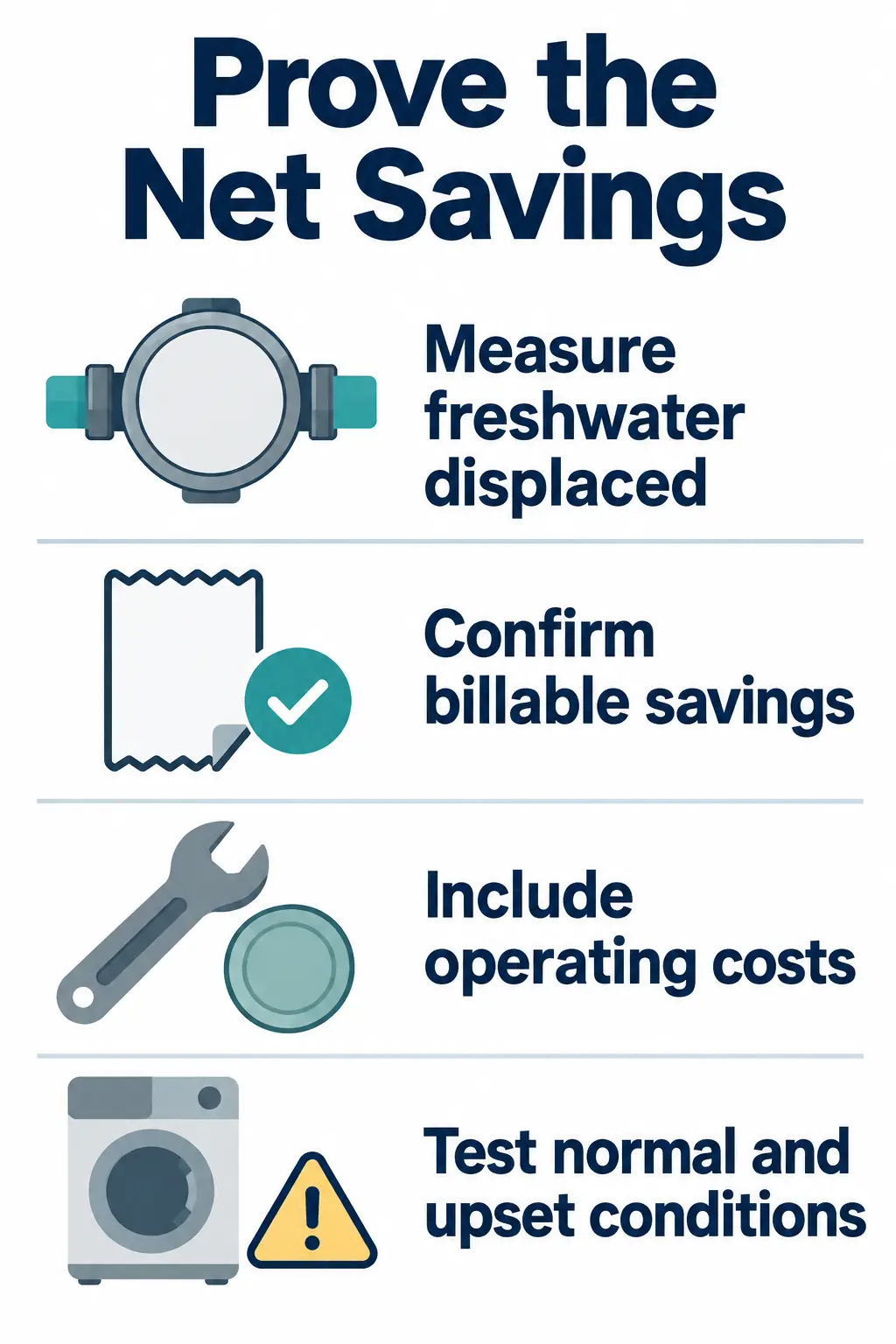
Evaluate savings at the same boundary used to define the purchase: net freshwater avoided, billable sewer savings where applicable, measured energy effects, and the additional cost of operating the system. Recovered volume alone is not an economic result. The comparison should also retain acceptable linen quality and production output, because extra rewashing or lost capacity can change the apparent benefit. Use a documented baseline and an agreed acceptance period covering representative operation. Forecasts remain estimates until the installed system’s meters, operating records, and linen results demonstrate the promised performance under the hotel’s conditions.
Calculate net displacement before assigning a financial value
For an initial screening estimate, start with annual dry linen throughput multiplied by baseline freshwater intensity. The collection fraction is eligible capturable discharge divided by baseline freshwater volume; treatment yield is usable output divided by collected feed. Utilization is the share of usable output replacing permitted fills while the system operates. Availability represents the share of annual recovery opportunity actually served, accounting for outage timing—not simply calendar uptime. Subtract additional freshwater needed to operate recovery. If measured utilization already includes downtime, do not deduct downtime again.
The following figures are hypothetical inputs, not typical hotel performance, market pricing, or a product guarantee. The example assumes unchanged wash programs, accepted linen output, and rewash, with matching tank inventories at the start and end of the period. One cubic meter equals 1,000 liters; use dry linen weight consistently.
| Calculation | Illustrative input or result |
| Annual linen throughput × baseline freshwater intensity | 300,000 kg × 12 L/kg = 3,600 m³/year |
| Eligible collection potential | 3,600 × 50% = 1,800 m³/year |
| Treatment output at full availability | 1,800 × 80% yield = 1,440 m³/year |
| Output matching permitted washer demand | 1,440 × 90% utilization = 1,296 m³/year |
| Actual freshwater displacement after availability | 1,296 × 95% = 1,231.2 m³/year |
| Net purchased freshwater avoided | 1,231.2 − 60 m³ additional freshwater = 1,171.2 m³/year |
The net reduction is approximately 32.53% of the 3,600 m³ baseline, or 3.904 liters per kilogram of dry linen. A model that reports the 80% treatment yield as the hotel’s water saving would substantially misstate this example.
The water management planning guidance recommends evaluating marginal water and sewer rates together with related energy and operating changes. Marginal means the amount the bill actually changes when consumption changes; fixed charges may remain payable.
Test the tariff assumption that can change the purchase decision
Assume, only for this example, a $4/m³ avoidable water rate, a possible $5/m³ sewer rate, $4,000 in additional annual operating costs, no heat credit, and a $40,000 installed cost. All amounts are illustrative US dollars. The $4,000 comprises electricity, consumables, service, labor, and disposal; actual testing and chemical costs must also be entered when applicable.
| Annual result | No sewer credit verified | Full sewer credit verified |
| Water bill saving | $4,684.80 | $4,684.80 |
| Sewer bill saving | $0 | $5,856.00 |
| Additional operating costs | $4,000.00 | $4,000.00 |
| Net annual benefit | $684.80 | $6,540.80 |
| Simple payback on $40,000 | 58.4 years | 6.1 years |
The second case is valid only if the utility’s billing method supports that credit. A flat fee, minimum charge, independently metered discharge, or different applicable rate can change the result. Confirm local tariffs, surcharges, and taxes that actually change with the project. Simple payback ignores financing, replacement cycles, discounting, and residual value; an apparent payback longer than the expected service life is not a viable repayment claim.
The downloadable workbook reproduces these calculations and allows the assumptions to be replaced. It is a screening tool, not a hydraulic design or water-quality approval.
Credit heat only once, then verify the complete result
Warm recovered water may reduce purchased heating energy, but the saving depends on the delivered temperature, required fill temperature, storage losses, heating-system efficiency, and changes elsewhere in the process. Do not apply a water-recovery percentage directly to the gas bill. If another heat-recovery measure already supplies that benefit, the same energy cannot be credited again. The example leaves the heat credit at zero until a defensible estimate or measurement is available.
Agree meter locations for laundry freshwater, recovered water delivered, recovery-system freshwater, and relevant energy before installation. Compare water intensity using consistent dry linen weights and account for linen mix, rewash, loading, and program changes. Track rewash separately so repeating a failed load does not appear to increase useful output. Use comparable tank inventories at the beginning and end of the measurement period. Record interruptions and rejected water as well as successful operating hours.
Put measurable acceptance terms in the purchase agreement: the operating conditions covered, volume and quality boundaries, acceptable linen outcomes, monitoring evidence, and the remedy if performance falls short. The hotel RFQ guide can help organize commercial scope, while the project’s technical reviewers should define the recovery-system acceptance criteria. Make meter access, usable operating data, commissioning, training, and the agreed retest process part of the deliverable.
For a broader hospitality procurement inquiry, submit an RFQ to KW Hospitality. Include the property location, equipment scope, quantities, available specifications, and project timing. Recovery-system design, local approval, and performance validation should remain explicit responsibilities in the final project agreement.
Conclusion
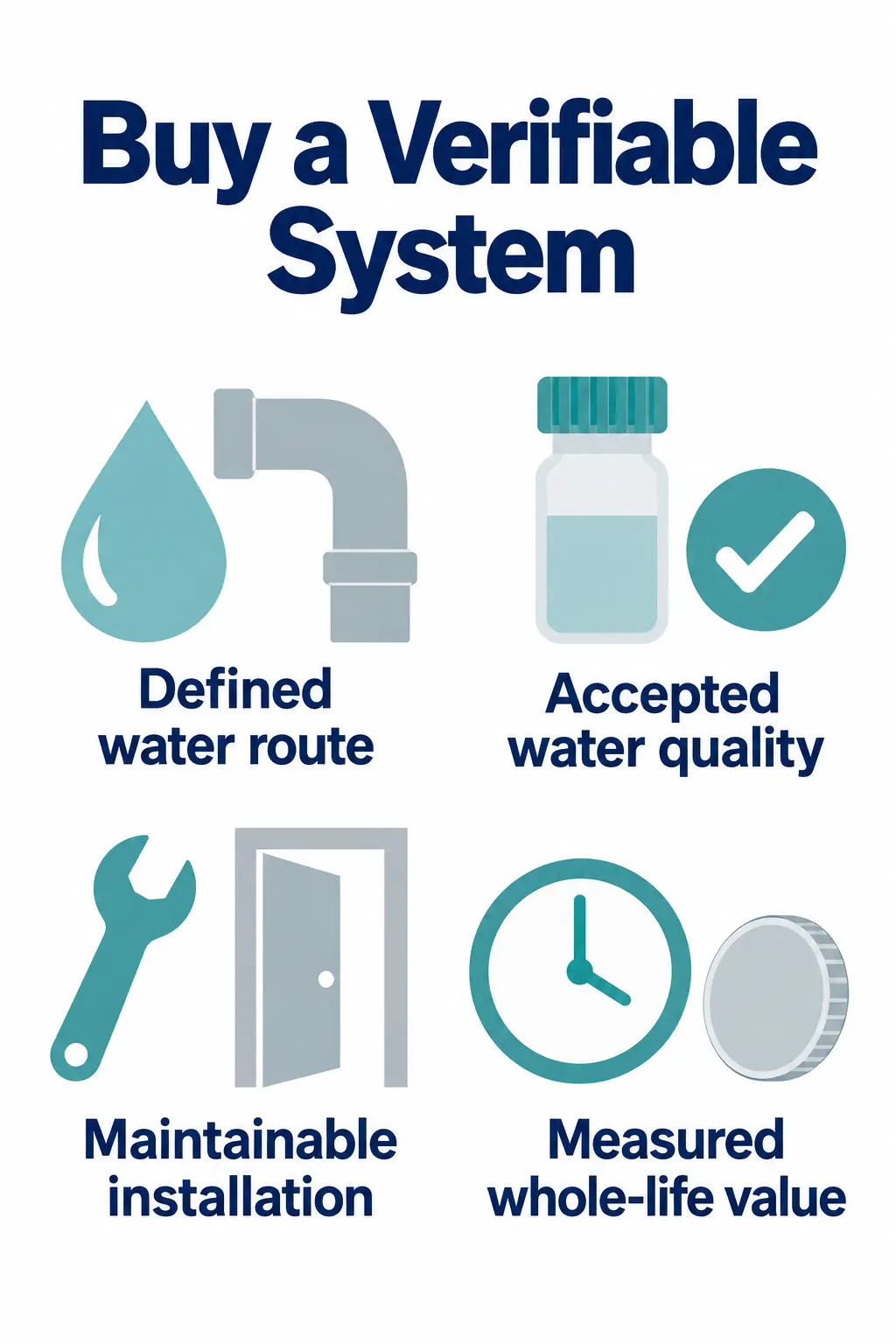
Buy a hotel laundry water recovery system against a defined water route, accepted quality requirements, an operable installation, and measured net value. A strong proposal explains both the useful output and the water that cannot be reused, identifies the people responsible for maintaining performance, and demonstrates how linen quality and laundry capacity will be preserved. If the financial case depends on sewer or heat savings, verify those assumptions before committing. The next useful step is a site-specific scope supported by wash records, incoming-water information, an installation layout, and vendor responses that can be compared on the same basis.
Frequently Asked Questions
Can the hotel claim the laundry has become a closed-loop system?
Only if that description accurately reflects the defined system. Fresh makeup, rejected batches, treatment waste, water leaving with linen, and other losses can prevent a completely closed loop. Describe the measured freshwater reduction and the system boundary instead of using “zero water” or “closed loop” as a substitute for a water balance.
Does a recovery system make the water drinkable?
No such conclusion follows from laundry reuse. Treatment is selected and verified for a specified use, and suitability for one wash stage does not demonstrate potable quality. Potable reuse involves a different set of treatment, monitoring, and regulatory decisions; do not connect laundry recovered water to drinking-water outlets.
Will a new washer reduce the benefit of a recovery retrofit?
It can. A washer or program that already uses less freshwater may leave less recoverable volume, and built-in reuse may overlap with the proposed retrofit. Rebuild the baseline around the planned equipment and program rather than adding separately advertised savings percentages. Also check whether the retrofit remains compatible with the replacement controls and connections.
Can one successful pilot justify connecting every washer?
Only when the evidence covers the additional conditions. A pilot using towels on one program may not represent restaurant linen, different chemicals, peak simultaneous demand, or seasonal shutdowns. Define the operating envelope demonstrated by the pilot and identify what still requires testing before expanding collection or reuse.
Is chemical saving guaranteed when detergent remains in recovered water?
No. Remaining chemistry may not be present in the right concentration, condition, or combination for the next load. Dose changes require the chemical supplier’s process assessment and validation of linen results. Enter zero chemical savings in the financial model until the hotel has a defensible basis for a different value.
When is postponing the purchase reasonable?
Postpone when the permitted reuse point, required quality, actual water demand, or installed responsibility is unresolved. It may also be sensible when conservative economics fail or the property cannot provide ongoing service. Improving the baseline, resolving approval questions, or assessing a simpler arrangement gives the next proposal a firmer basis.
References
- U.S. Environmental Protection Agency — WaterSense at Work: Sanitary Fixtures and Equipment, 3.5 Laundry Equipment
- U.S. Department of Energy — Best Management Practice #14: Alternative Water Sources
- PUB, Singapore’s National Water Agency — Best Practice Guide in Water Efficiency: Commercial Laundry Sector
- U.S. Environmental Protection Agency — Regulations and End-Use Specifications Explorer (REUSExplorer)
- Health Canada — Household Reclaimed Water
- NSF — NSF/ANSI 350 Onsite Residential and Commercial Water Reuse Treatment
- U.S. Department of Energy — Best Management Practice #13: Other Water-Intensive Processes
- San Francisco Public Utilities Commission — Guidebook for Commissioning an Onsite Water Reuse System in San Francisco
- U.S. Department of Energy — Best Management Practice #1: Water Management Planning