Writing an effective request for quotation (RFQ) for hotel supplies means giving every invited supplier the same clear, measurable set of requirements and a standardized way to respond. A strong RFQ identifies the exact products, quantities, quality standards, delivery conditions, commercial terms, and evaluation method before prices are requested. It turns competing quotations into comparable offers and helps a hotel avoid substitutions, incomplete pricing, hidden freight costs, poor-quality samples, late deliveries, and disputes after award.
This guide explains how to build that document for operating supplies and equipment (OS&E), selected furniture, fixtures, and equipment (FF&E), replenishment purchases, renovations, and pre-opening procurement.
A Strong Hotel Supply RFQ Starts Before the First Price Is Requested
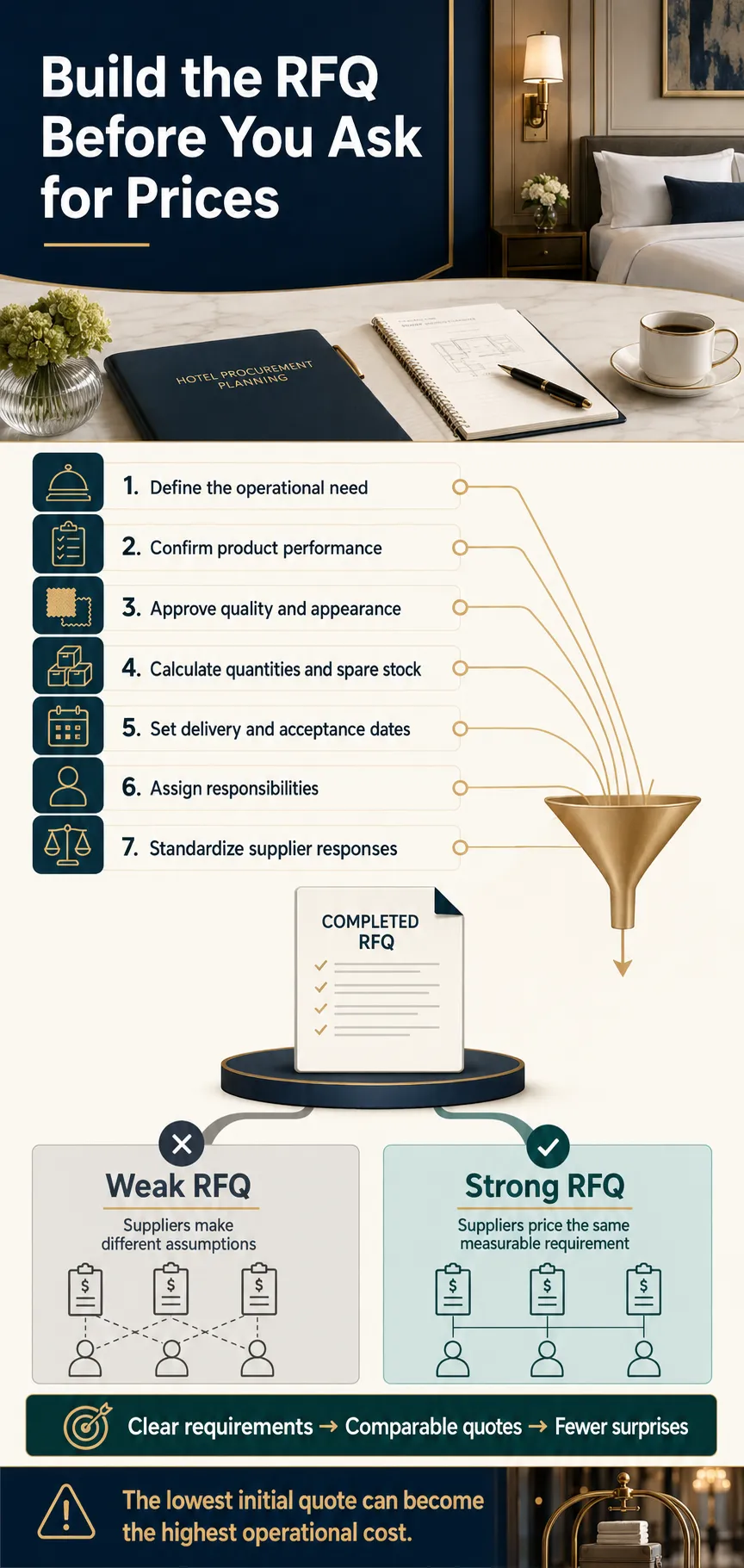
An RFQ is not simply a product list followed by the question, “What is your best price?” Its quality depends on the decisions made before it reaches suppliers. If the hotel has not agreed on product performance, approved appearance, realistic quantities, destination, required delivery date, and acceptance standards, suppliers must fill the gaps with assumptions. Each supplier may make different assumptions, so the resulting prices cannot be compared fairly.
The consequences appear later as change orders, sample rejections, unexpected minimum order quantities, split-shipment charges, customs costs, or products that look acceptable but fail under hotel operating conditions. The lowest initial quote can therefore produce the highest operational cost.
A procurement-ready RFQ creates one commercial baseline. It tells suppliers what is mandatory, where alternatives are permitted, which costs must be disclosed, and how the hotel will select the successful offer. It should be detailed enough to produce accurate quotations without becoming so complicated that qualified suppliers cannot respond efficiently.
RFQ, RFI, RFP, Tender, and Purchase Order: Choose the Right Document
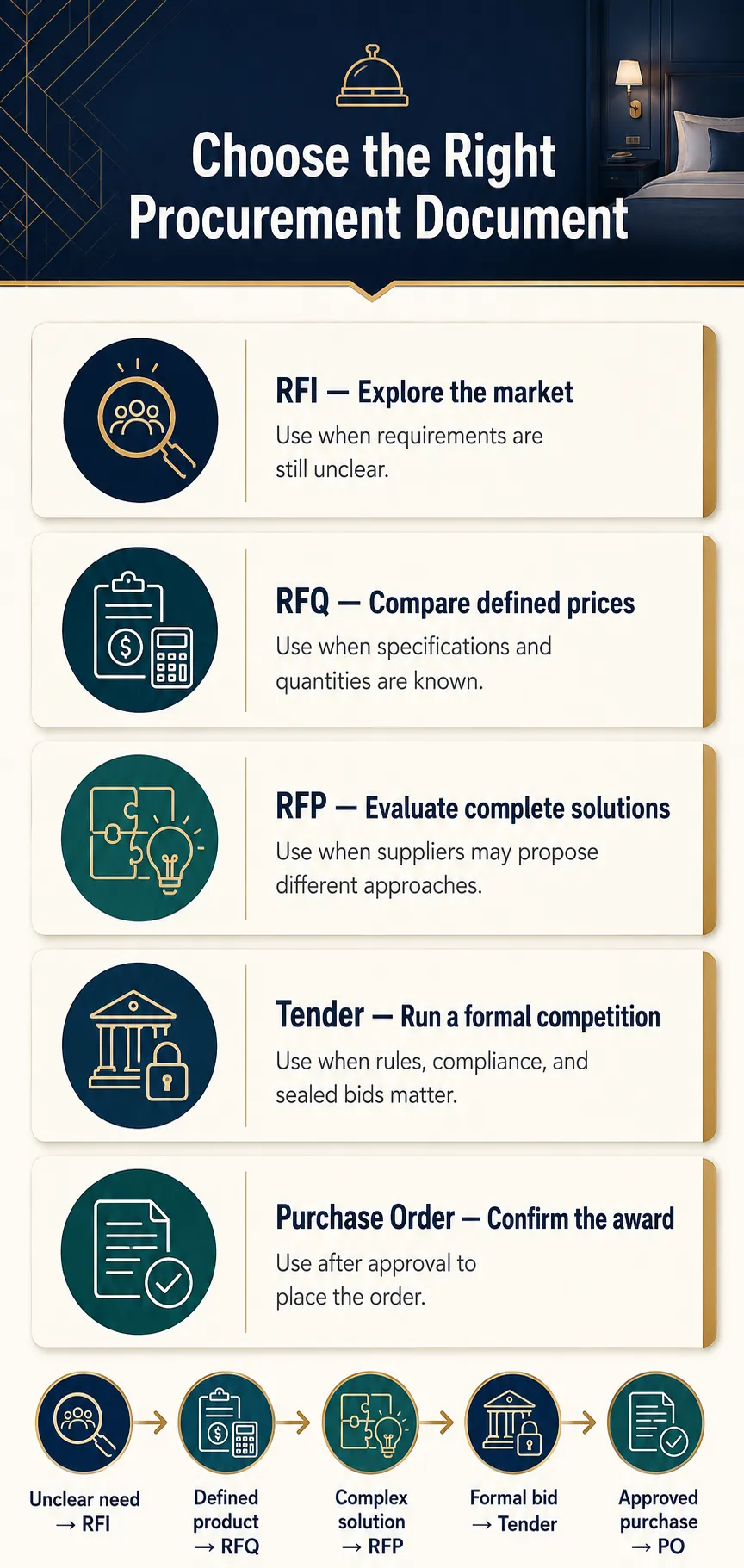
An RFQ works best when the hotel knows what it wants and needs suppliers to price a defined requirement. It may still evaluate quality, delivery, warranty, and supplier capability, but the requested product or performance outcome is substantially settled.
| Document | Best use in hotel procurement | Primary question |
|---|---|---|
| RFI | Early market research, unfamiliar products, or supplier discovery | What solutions and capabilities exist? |
| RFQ | Clearly specified goods with comparable commercial offers | What will you supply, when, and at what total cost? |
| RFP | Complex projects where suppliers may propose different methods or solutions | How would you solve this requirement? |
| Tender or bid invitation | Formal competition under established governance rules | Will you meet the stated conditions and price? |
| Purchase order | Placement of an approved order after selection | What has the hotel committed to buy? |
Do not force an uncertain requirement into an RFQ merely to obtain quick pricing. If the hotel is still deciding between bottled and dispenser-based amenities, comparing laundry technologies, or redesigning the guestroom sleep experience, an RFI or RFP may be more appropriate. A short market-sounding exercise can also precede the RFQ. Once the desired specification is stable, the hotel can invite prices on a common basis.
Define Requirements, Stakeholders, Budget, and Scope
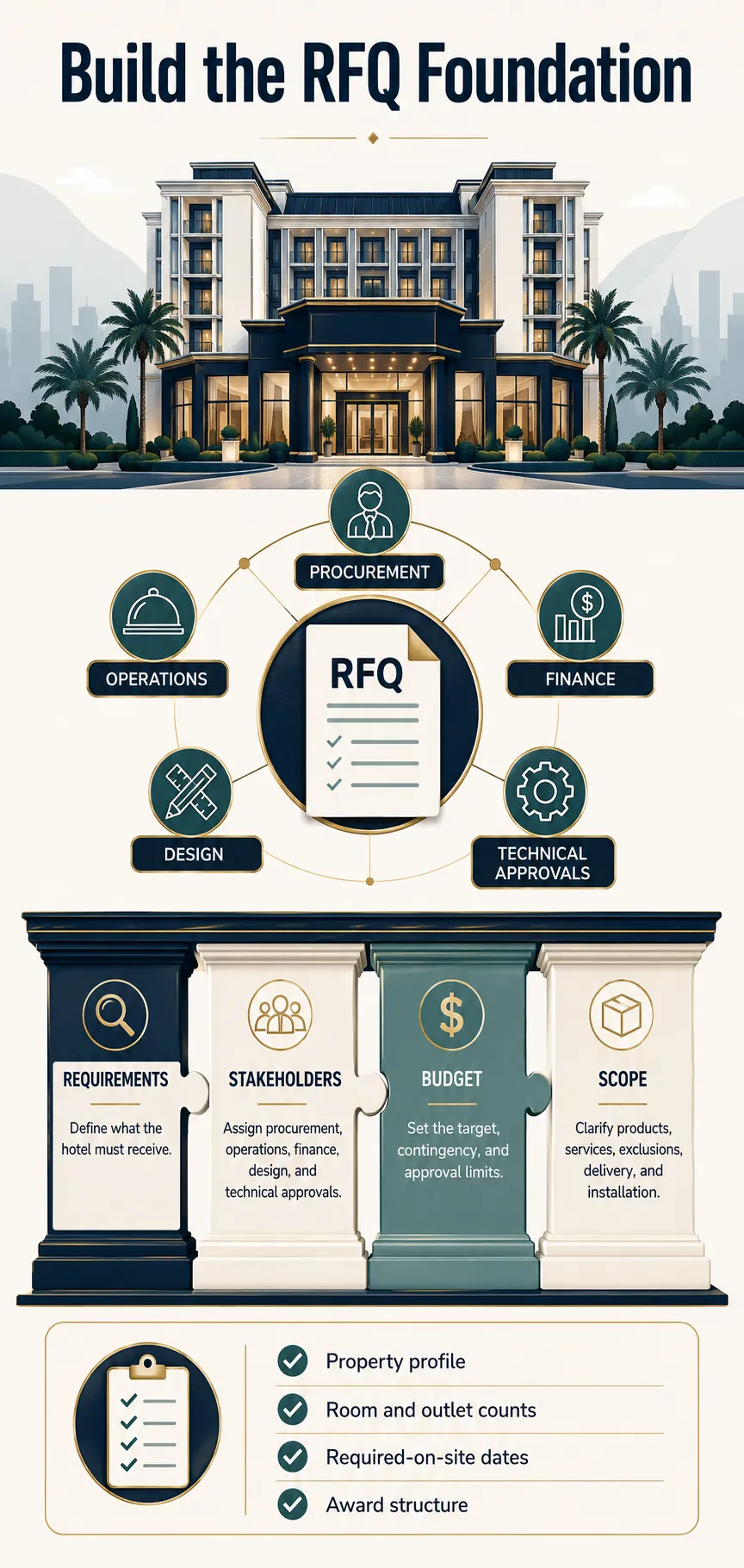
Start by writing a one-paragraph procurement objective. For example: “Supply opening stock and 10 percent operational spare stock for 180 guestrooms and three food-and-beverage outlets, delivered to the hotel’s receiving dock in two scheduled lots before operational testing.” That statement immediately clarifies the purchasing event, scale, location, and schedule.
Create a responsibility matrix. Procurement may own the RFQ, but operations should validate usability; housekeeping should approve linen and cleaning products; the executive chef should approve food-contact items; engineering should confirm utilities and maintainability; design should review finishes; finance should confirm budget and payment terms; risk or legal reviewers should check contract conditions. A brand representative may need to approve branded or standard-controlled items.
Define inclusions and exclusions. State whether the RFQ covers manufacturing, customization, samples, packaging, freight, customs documentation, unloading, assembly, installation, training, removal of packaging, spare parts, and warranty service. Identify the intended award structure as well: one supplier for all items, separate category awards, or the right to award individual line items. Suppliers price more accurately when they understand whether they are competing for an entire package or selected products.
Organize OS&E and FF&E Into a Clear Item Schedule
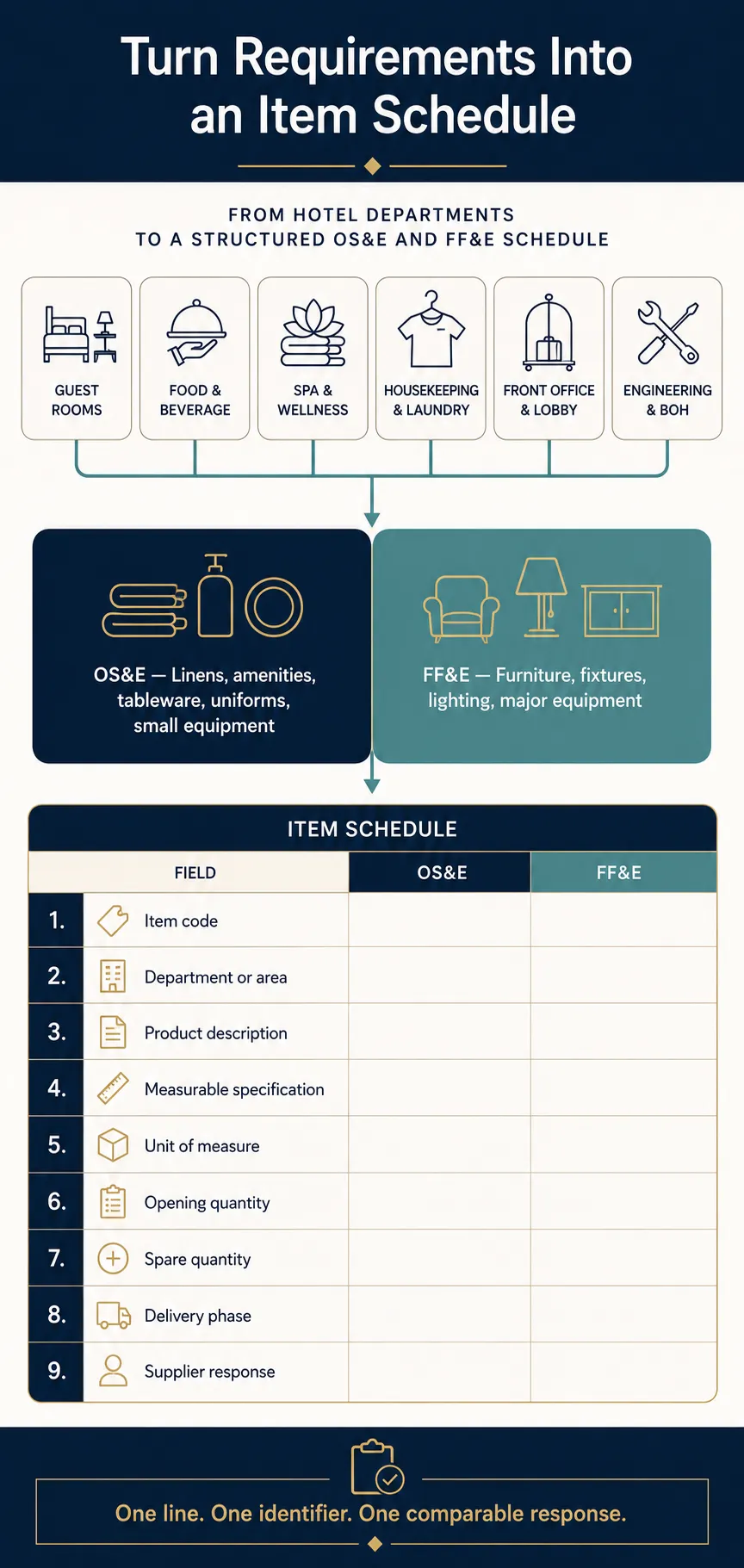
The item schedule is the commercial spine of the RFQ. Assign every product a unique line number and hotel item code. Group lines by department, outlet, room type, floor, or delivery phase without changing the unique identifier. Avoid relying on product names alone because descriptions such as “white bath towel” or “banquet chair” are not specific enough.
Useful fields include:
- RFQ line number and internal item code
- Department, area, or room type
- Item description and intended use
- Approved manufacturer and model, if applicable
- Performance specification
- Dimensions, capacity, material, color, and finish
- Unit of measure and units per case
- Required quantity and spare quantity
- Branding, embroidery, engraving, or packaging requirements
- Required certification or test evidence
- Sample or mock-up requirement
- Delivery phase and final destination
- Supplier response, exception, and alternative fields
Separate consumables from durable equipment when their pricing and delivery logic differ. A case of guest amenities may be quoted by unit, carton, pallet, and annual volume, while a housekeeping machine may require accessories, commissioning, training, and a multi-year warranty. The same spreadsheet can contain both categories, but the commercial fields must fit the product.
Version control is essential. Put the RFQ number, revision number, issue date, and page or tab identifier on every document. If quantities change, release a formal addendum and require bidders to acknowledge it. Do not quietly replace a spreadsheet attachment and assume everyone has noticed.
Write Product Specifications Suppliers Cannot Misinterpret
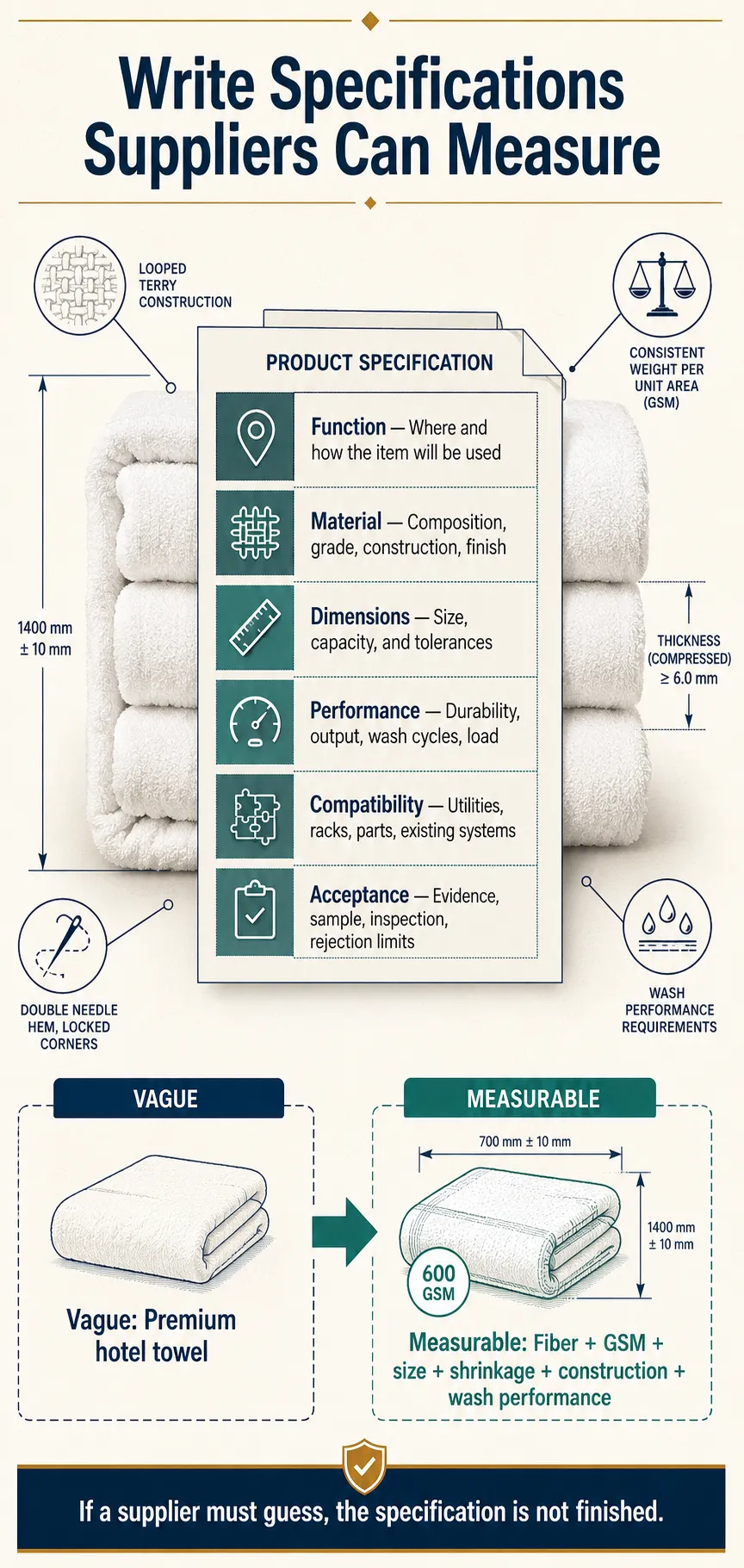
A specification should describe what the hotel needs to receive and verify. Use measurable language instead of subjective terms such as “premium,” “heavy-duty,” “luxury quality,” or “hotel grade” unless those terms are supported by defined performance criteria.
A complete line specification may include:
- Function: where and how the item will be used
- Material: composition, grade, construction, coating, or finish
- Dimensions: tolerances as well as nominal measurements
- Performance: capacity, durability, wash cycles, temperature range, load rating, or output
- Appearance: color reference, sheen, pattern, logo position, and finish sample
- Compatibility: utilities, replacement parts, dispensers, racks, storage systems, or existing equipment
- Compliance: applicable safety, sanitation, flammability, accessibility, or labeling requirements
- Evidence: test report, certification record, technical data sheet, safety data sheet, or warranty document
- Acceptance: inspection method and reasons for rejection
For example, “commercial white bath towel, 100 percent cotton, 700 GSM, 30 by 56 inches” is better than “luxury towel,” but it is still incomplete. The hotel may also need construction type, finished-size tolerance, weight tolerance, border design, shrinkage limit, colorfastness expectation, laundering compatibility, minimum wash-performance requirement, labeling, packing method, and an approved preproduction sample.
Use “brand or approved equivalent” carefully. Explain what makes an alternative equivalent and who decides. Otherwise, bidders may substitute an item that matches basic dimensions but not durability, finish, serviceability, or guest experience. Require alternatives to be identified separately rather than silently priced into the compliant offer.
Add Category-Specific Hotel Supply Requirements
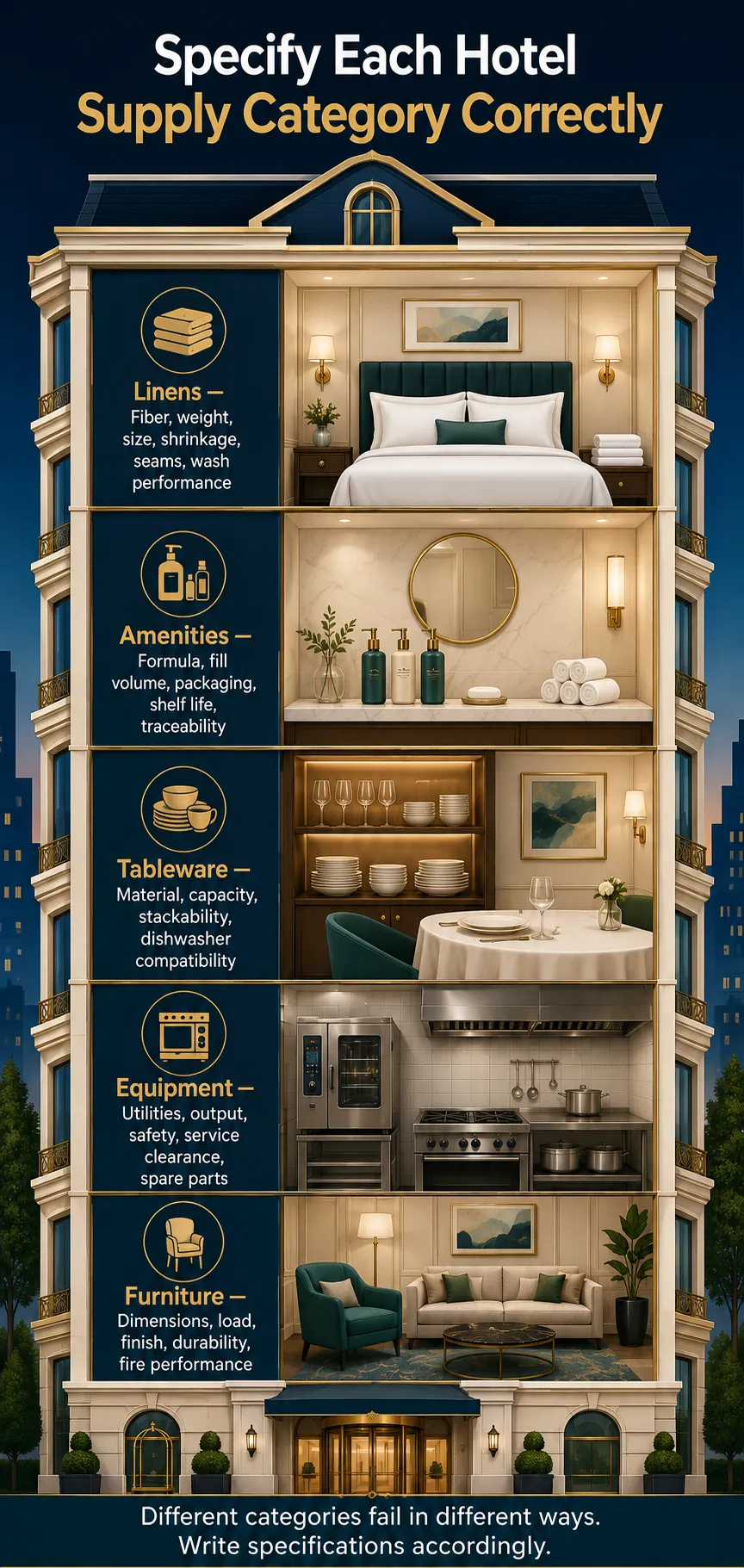
Different hotel categories fail in different ways, so a universal description field is not enough.
Linens, Towels, Bedding, and Uniforms
Specify fiber composition, yarn or weave construction, fabric weight, finished dimensions and tolerances, thread count where relevant, color standard, shrinkage, colorfastness, seam and hem construction, laundering conditions, labeling, and expected performance. For uniforms, include size distribution, fit samples, trims, replacement availability, personalization, and rules for discontinued fabrics.
Tableware, Glassware, Flatware, and Buffet Smallwares
State material composition, dimensions, capacity, weight, finish, edge or rim treatment, stackability, dishwasher and chemical compatibility, food-contact suitability, resistance requirements, and replacement continuity. Request rack compatibility for glassware and dishware. For patterns intended to remain in service for years, ask how long the supplier expects to support replacement orders.
Guest Amenities and Room Accessories
Define formulation or material expectations, fill volume, fragrance limitations, packaging, labeling language, dispenser compatibility, tamper evidence, shelf life, batch traceability, carton configuration, and sustainability claims requiring verification. For branded packaging, identify artwork ownership, color references, proofing stages, setup charges, excess-production rules, and disposal of obsolete stock.
Housekeeping Chemicals and Equipment
For chemicals, request technical and safety data, dilution ratios, intended surfaces, dispenser requirements, storage conditions, employee-safety information, and training. For equipment, specify capacity, power supply, noise level where relevant, battery and charger requirements, included accessories, consumables, spare parts, service coverage, and operator training.
Kitchen, Laundry, and Engineering Equipment
Confirm utility type, voltage, phase, frequency, water pressure, drainage, gas type, ventilation, heat output, connection points, external dimensions, service clearances, capacity, sanitation requirements, energy or water performance, installation responsibility, testing, commissioning, and preventive maintenance. A model number alone does not prove compatibility with the property.
Furniture and Guest-Facing Fixtures
Include drawings, dimensions, load ratings, materials, finishes, hardware, glides, fire-performance requirements, accessibility considerations, durability tests, packaging, assembly, installation, touch-up kits, and control samples. Clarify whether quoted dimensions are exact or whether site verification is required before production.
State Quantities, Units, Pack Sizes, and Spare Stock
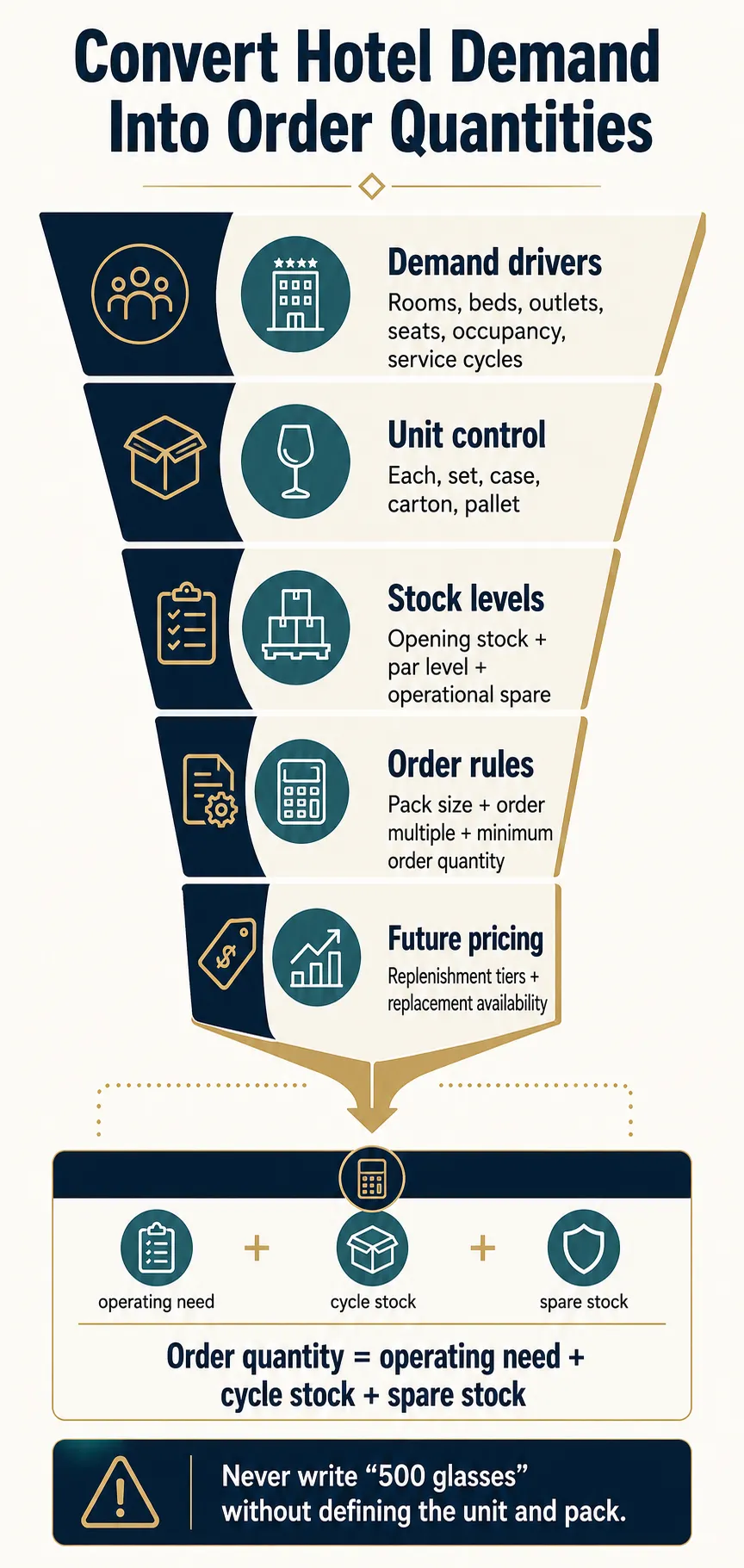
Quantity errors often begin with units of measure. “500 glasses” can mean 500 individual pieces, 500 sets, or 500 cases if the pricing sheet is poorly designed. Show the requested unit, supplier selling unit, units per case, number of cases, and total individual units. Require suppliers to disclose minimum order quantities and order multiples.
Build quantities from operational drivers: guestrooms by type, maximum occupancy, beds, bathroom count, restaurant seats, banquet capacity, meal periods, laundry turnaround, housekeeping cycles, delivery frequency, and expected breakage or loss. Separate opening quantity from operational spare stock so the contingency is visible rather than buried.
Ask for tiered pricing when future replenishment is likely. A pre-opening order may qualify for container or project pricing, but the hotel also needs to know the cost of replacing two cases six months later. Request prices at realistic order bands and ask how long the quoted price, tooling, pattern, dye lot, and custom artwork will remain available.
Control Samples, Mock-Ups, Testing, and Substitutions
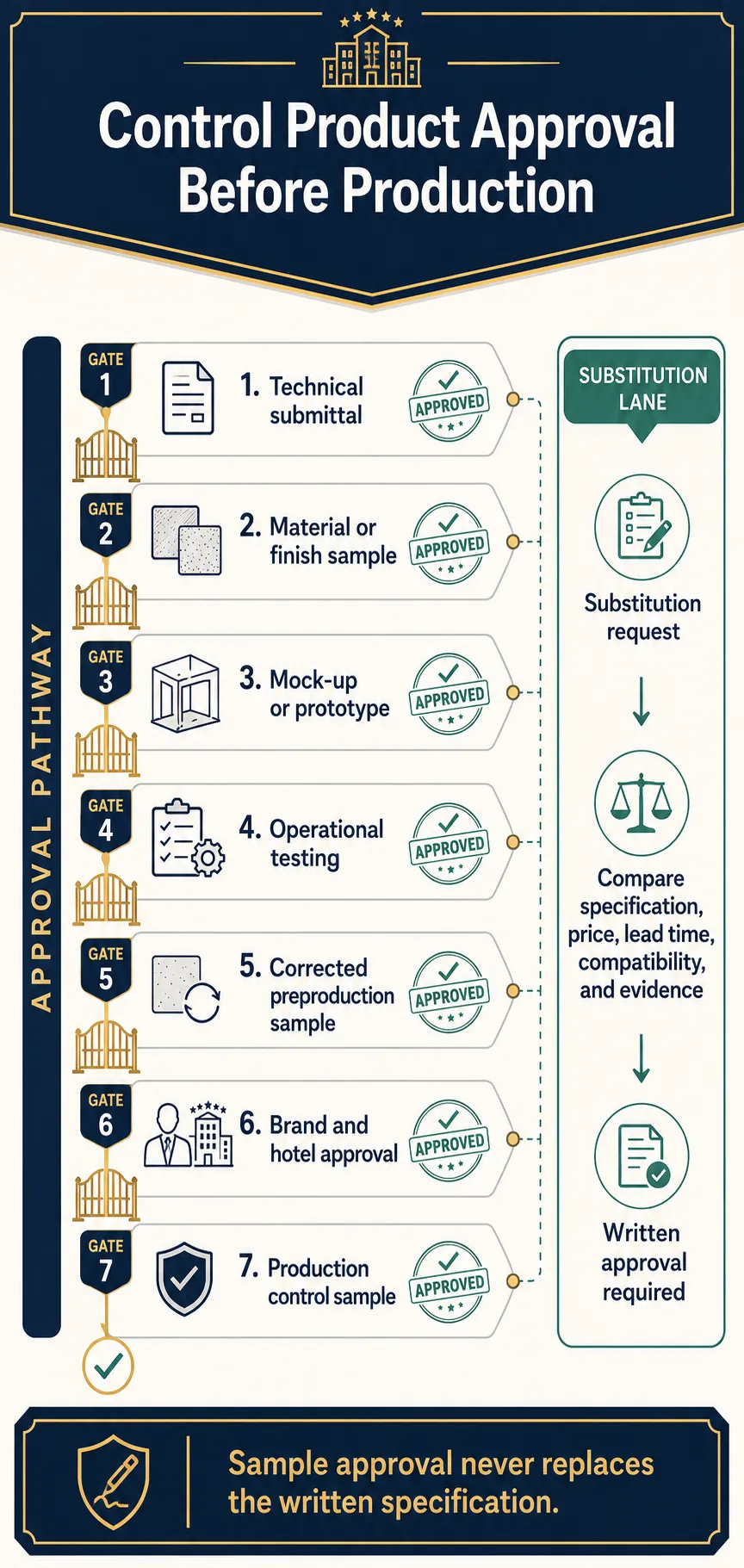
The RFQ should state which products require a catalog cut sheet, physical sample, finish sample, room mock-up, operational trial, or preproduction approval. Identify who pays for samples, whether samples are returnable, where they must be sent, and whether an approved sample becomes the control sample for production.
A sample approval should not be interpreted as permission to change materials or manufacturing methods later. Require production goods to match the approved control sample and the written specification. For custom items, use staged approvals: digital artwork, material or color sample, prototype, corrected prototype if necessary, and preproduction sample.
Require bidders to list every exception and substitution in a dedicated schedule. “No exceptions stated” should mean full compliance. Alternatives can be valuable when they reduce cost or lead time, but they should appear as a separate option with a comparison against the requested specification. This protects the compliant base bid and prevents an attractive price from concealing a lower standard.
Build a Standardized Pricing Schedule
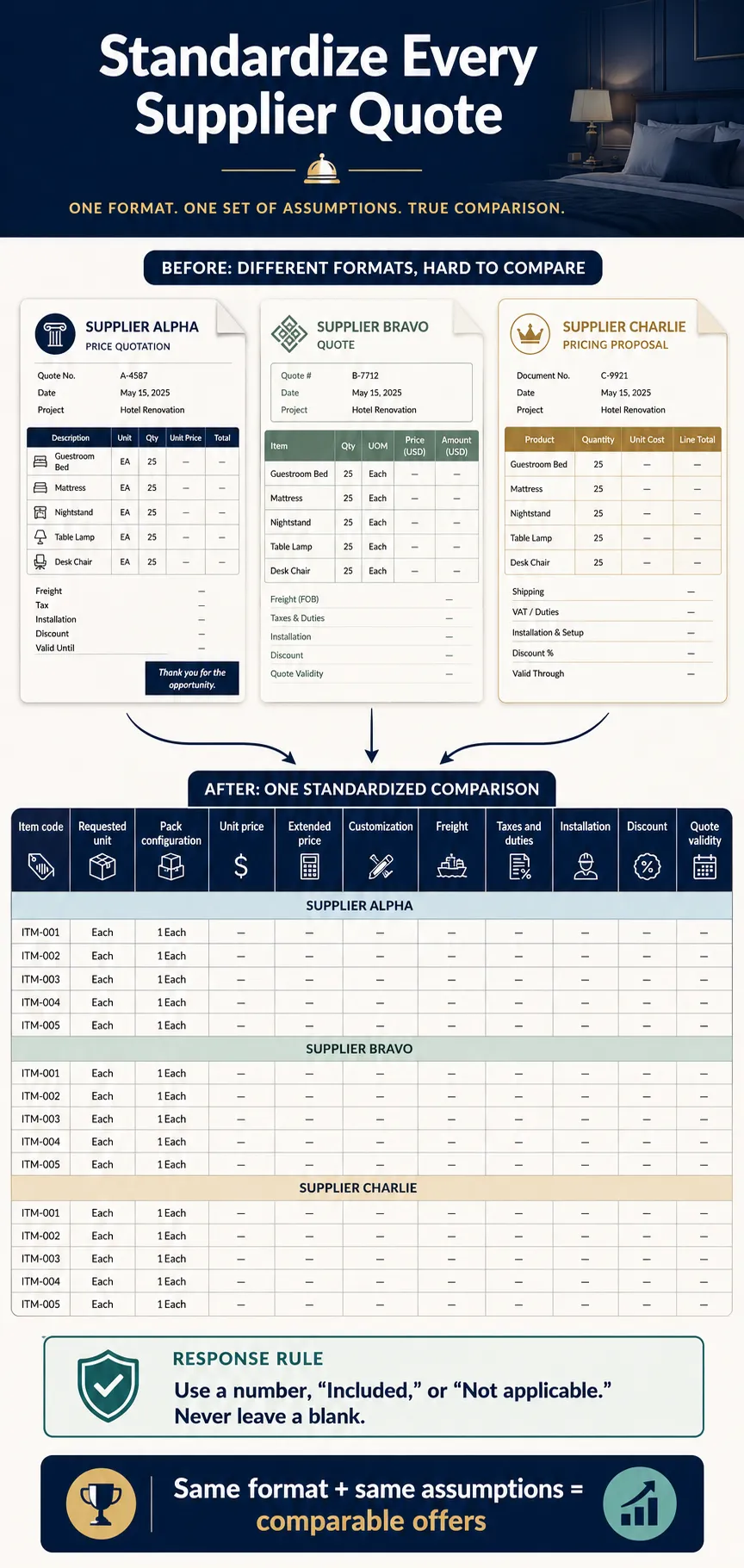
Never allow each supplier to invent a quotation format for a multi-item RFQ. Provide a locked or clearly structured response workbook with one row per item and defined commercial columns. Suppliers should not be able to hide major charges in a general note or omit them entirely.
| Pricing field | Information required |
|---|---|
| Unit price | Price per hotel-requested unit of measure |
| Pack configuration | Pieces per inner pack, case, and pallet |
| Extended price | Unit price multiplied by compliant quantity |
| Customization | Logo, embroidery, tooling, mold, artwork, or setup charges |
| Samples | Sample price, shipping, and credit policy after award |
| Freight | Origin freight, international freight, local delivery, or included amount |
| Taxes and duties | Included, excluded, estimated, or payable by buyer |
| Installation | Assembly, installation, commissioning, and training charges |
| Discounts | Volume, package, early-payment, or promotional discount |
| Quote validity | Date through which pricing and terms remain valid |
Require suppliers to enter “included,” “not applicable,” or a numeric amount rather than leaving cells blank. Clarify currency and rounding rules. State whether prices are fixed or adjustable and how any permitted adjustment would be calculated. Ask for payment milestones tied to objective events such as approved samples, production completion, shipment, delivery, installation, and acceptance—not merely calendar dates.
Capture Total Landed Cost and Logistics Responsibilities
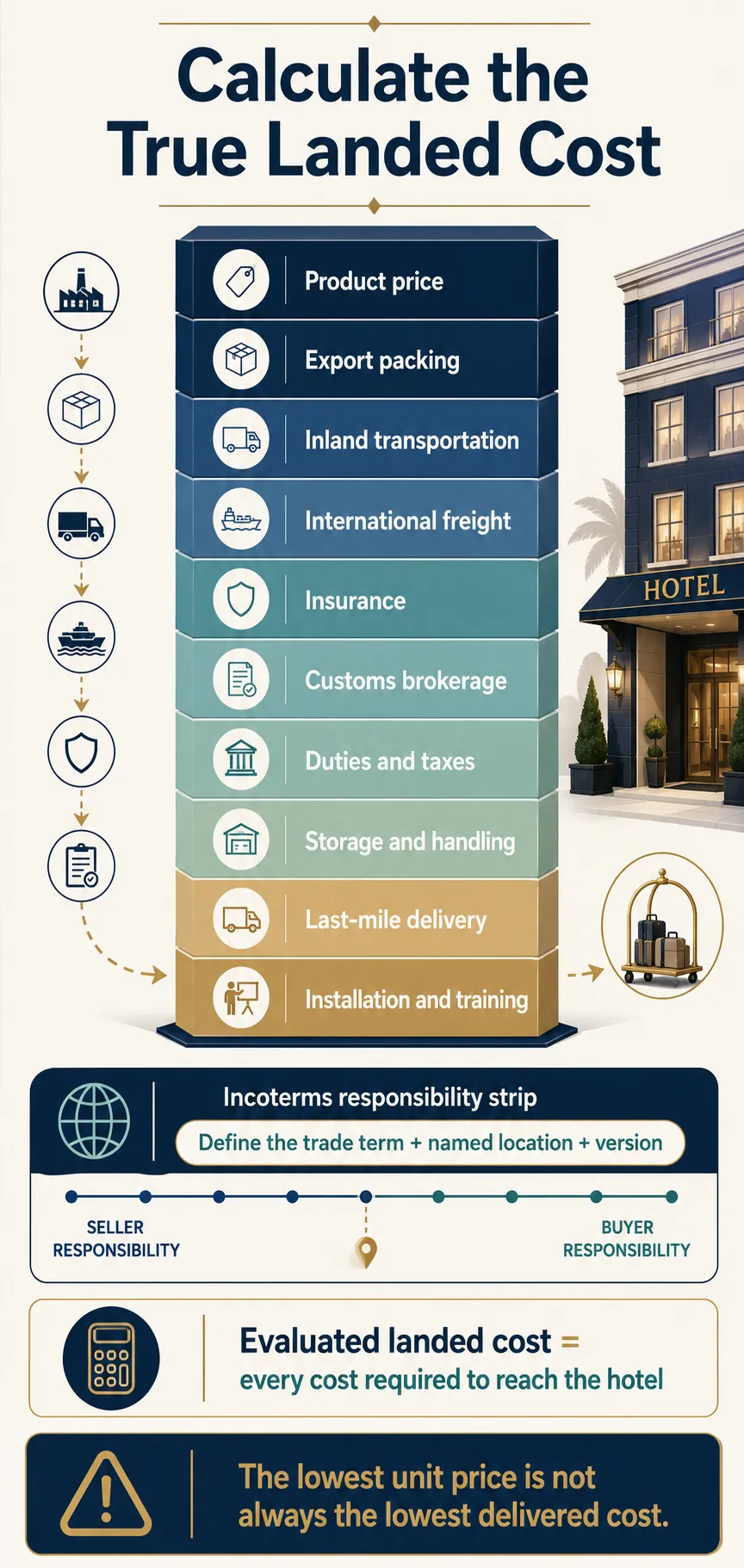
Unit price is only one component of cost. Depending on the sourcing route, the hotel may also pay for export packing, inland transportation, freight, insurance, terminal handling, customs brokerage, duties, taxes, inspection, storage, demurrage, last-mile delivery, unloading, assembly, installation, and removal of packaging.
State the named delivery location and the applicable trade term with its version and location. A trade term without a named port, terminal, warehouse, or hotel address is incomplete. Require the supplier to explain which party handles export clearance, main carriage, insurance, import clearance, duties, and delivery risk.
For each bid, calculate an evaluated landed cost using the same assumptions. If some charges remain estimates, label them and use a consistent estimating method. Also consider total cost of ownership for durable equipment: energy, water, chemicals, consumables, maintenance, software, required accessories, service travel, downtime, and expected replacement life. A more expensive machine may be the better commercial choice if its operating and service costs are materially lower.
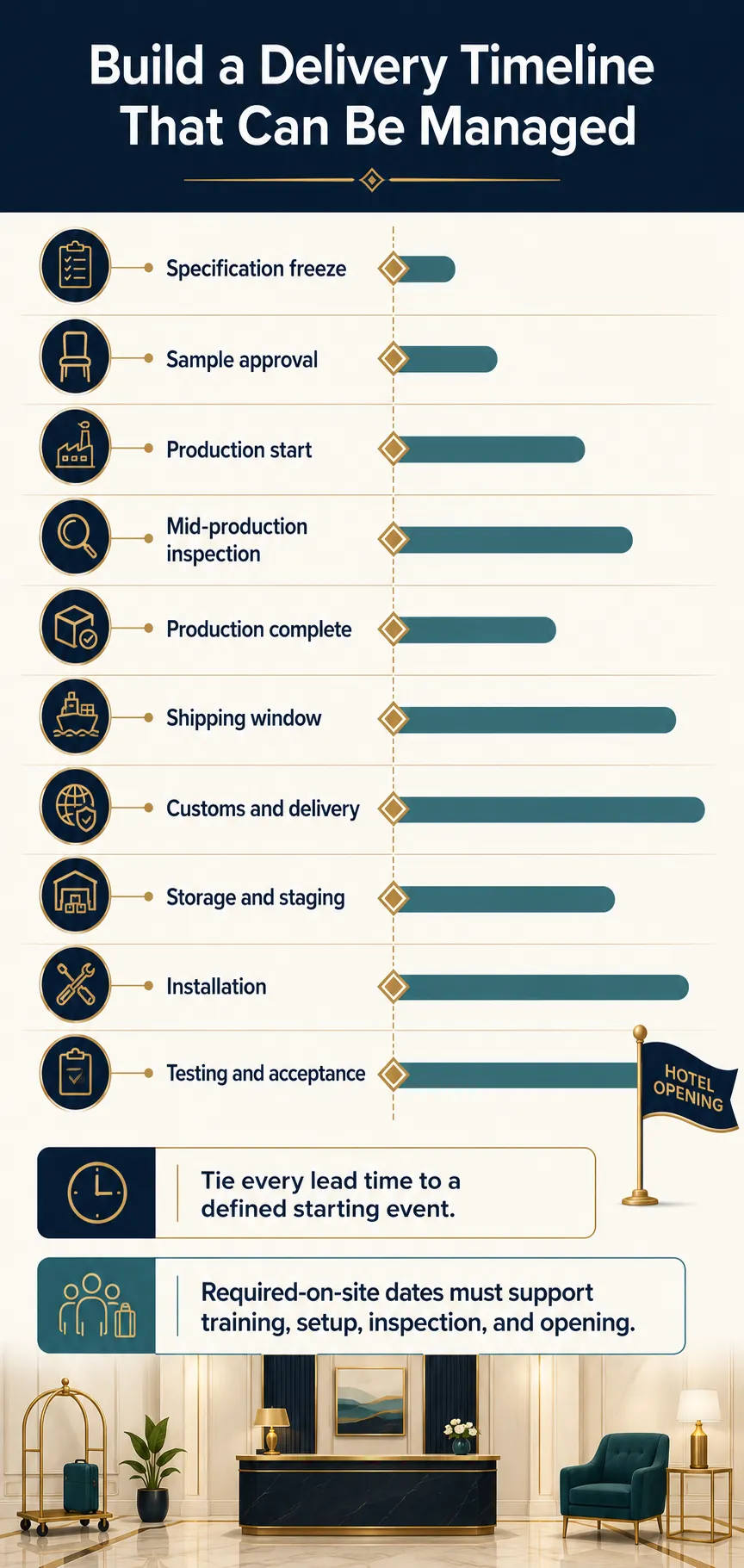
Specify Lead Times, Delivery Windows, and Site Conditions
Ask suppliers to separate sample lead time, production lead time after approval, transit time, customs allowance, delivery time, and installation duration. “Eight-week lead time” is ambiguous unless the starting event and included activities are defined.
Provide a delivery schedule with required-on-site dates, not only the hotel opening date. Supplies must often arrive before staff training, room setup, kitchen testing, photography, soft opening, or brand inspection. Identify partial-delivery rules and whether early delivery is permitted.
Describe receiving constraints: dock dimensions, vehicle restrictions, delivery hours, appointment process, elevator capacity, floor protection, staging areas, pallet requirements, maximum carton weight, and floor-by-floor distribution. State who unloads, counts, assembles, installs, removes waste, and signs the delivery receipt. If the hotel is not ready, define storage responsibilities and rates in advance rather than negotiating them during a delay.
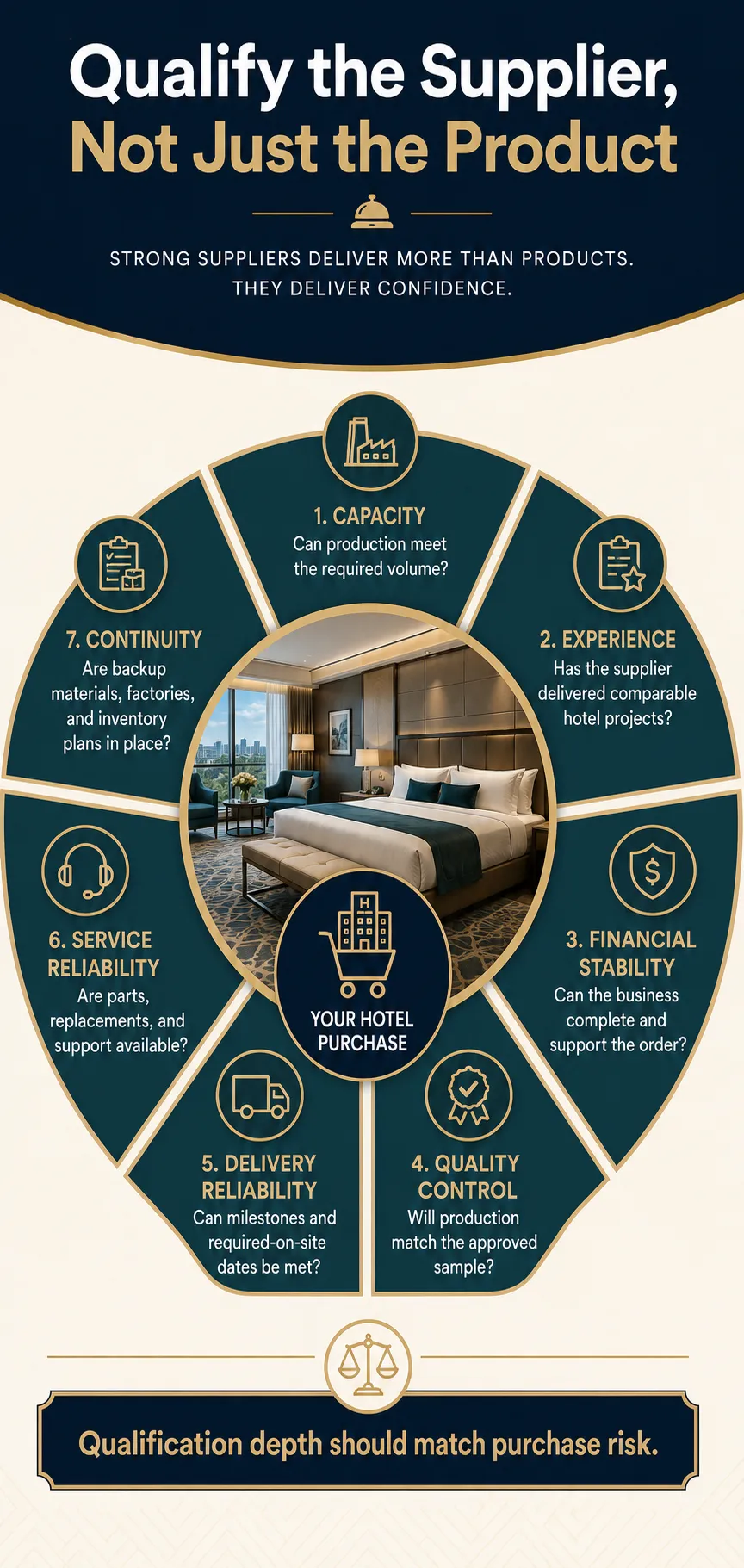
Qualify Suppliers Beyond the Quoted Price
Supplier qualification should be proportionate to the risk of the purchase. A routine order from an approved local distributor needs less investigation than custom furniture for 300 guestrooms or imported operating equipment required before opening.
Request the supplier’s legal name, ownership and contact details, years in business, relevant hotel experience, similar projects, production locations, quality-management process, financial information appropriate to the risk, insurance, production capacity, current workload, subcontractors, and service network. Ask for references from comparable properties and verify the specific performance that matters: delivery reliability, consistency between sample and production, defect response, and replenishment support.
For critical products, examine supply continuity. Where are key materials sourced? Is there a backup production line? What happens if a model or fabric is discontinued? Can replacement parts be delivered locally? What inventory is normally stocked? The goal is not to collect impressive documents; it is to test whether the supplier can fulfill this particular order under the required conditions.
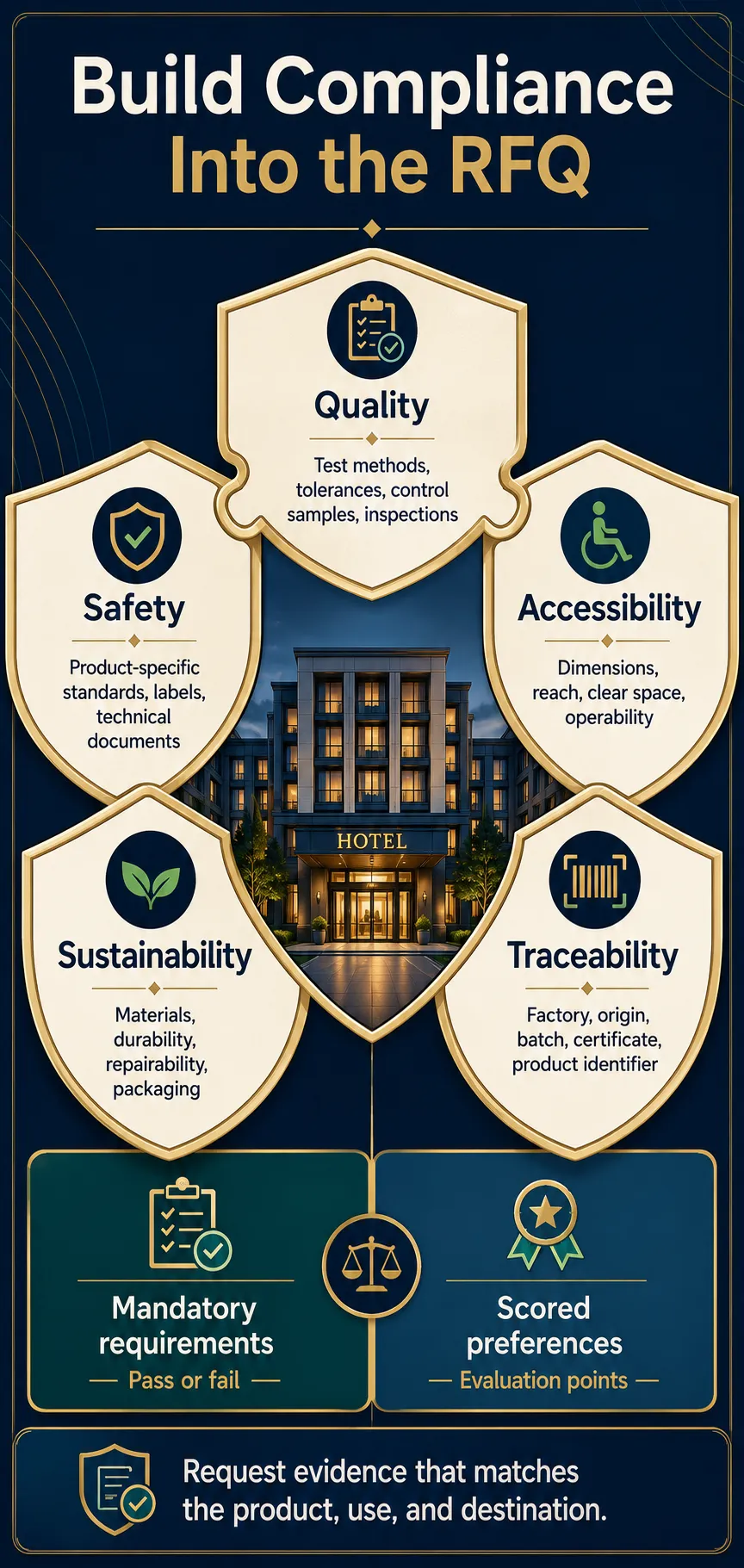
Add Quality, Safety, Accessibility, and Sustainability Requirements
Write compliance requirements at the item level and match them to the destination market and intended use. Do not copy a generic list of certifications into every line. Food-service equipment, mattresses, upholstered furniture, textiles, cleaning chemicals, electrical appliances, food-contact items, and accessible-room products may each require different evidence.
Require bidders to identify applicable standards, provide current supporting documents, and confirm that offered products are legal and suitable for the destination. For chemicals, obtain safety documentation and handling requirements. For electrical or gas equipment, confirm the relevant listing, local code acceptance, utilities, and installation conditions. For furniture and bedding, address applicable fire-performance and labeling requirements. Accessibility should be checked in the complete room or operating environment; buying an “accessible” item does not help if its dimensions or placement obstruct required clear space or reach ranges.
Sustainability requirements should also be measurable. Instead of asking whether the supplier is “eco-friendly,” request specific information such as material origin, recycled or certified content, restricted substances, energy and water performance, product durability, repairability, replaceable components, packaging weight, elimination of unnecessary single-use materials, take-back options, labor standards, factory transparency, and evidence supporting environmental claims.
Distinguish mandatory compliance from scored preferences. A mandatory safety requirement is pass or fail. Reduced packaging or a stronger take-back program may earn evaluation points. This prevents a supplier from compensating for a legal or safety failure with an attractive sustainability narrative.
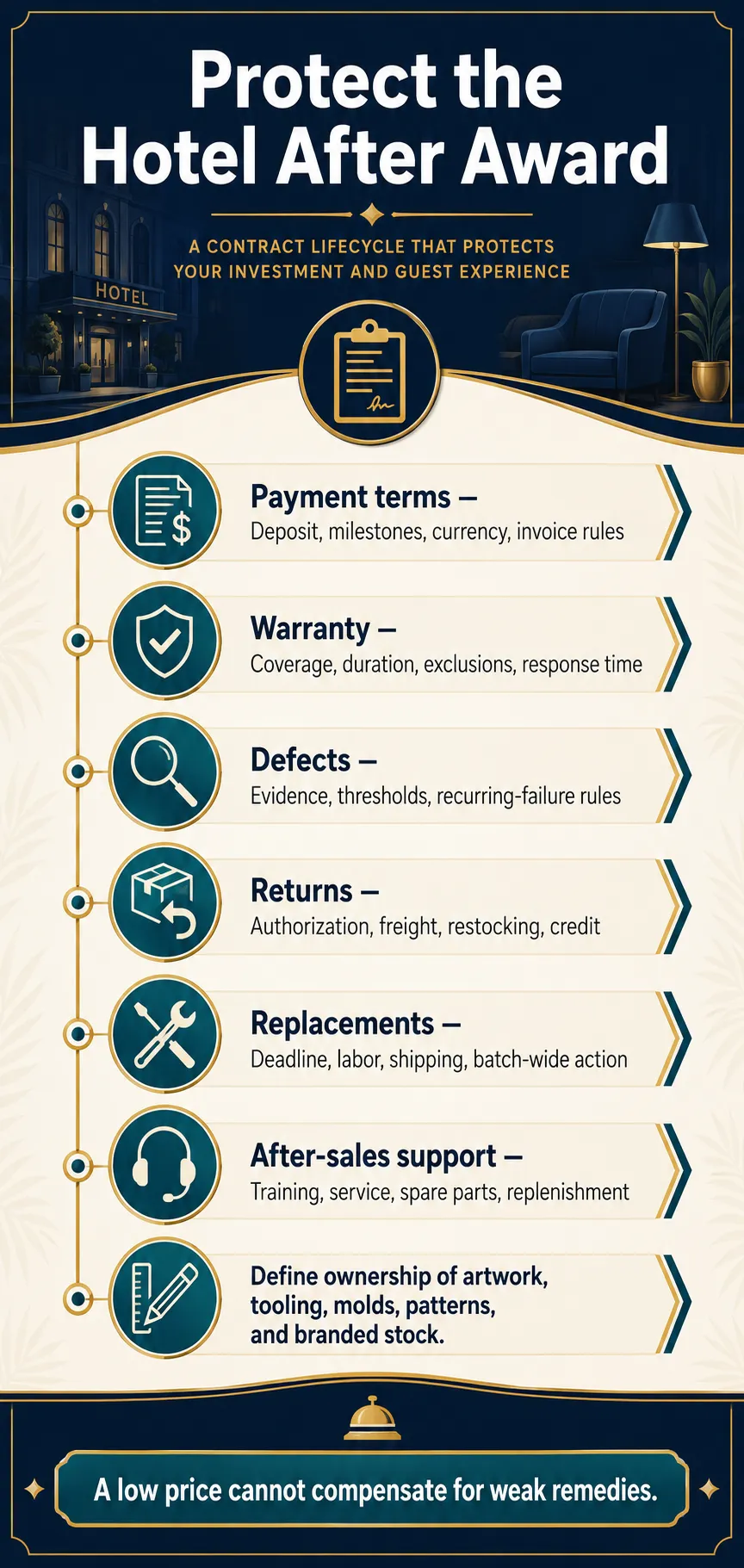
Define Commercial Terms Before Suppliers Quote
Attach proposed purchase terms or a commercial requirements schedule to the RFQ. Address payment currency, deposits, milestone payments, taxes, invoice requirements, bank fees, title and risk transfer, inspection rights, rejection, warranty, service response, spare parts, returns, cancellation, delay, confidentiality, intellectual property, insurance, indemnity, dispute resolution, and governing law as appropriate.
For custom products, explain ownership of artwork, tooling, molds, patterns, digital files, and unused branded packaging. State whether the supplier may produce overruns and what happens to obsolete inventory. Require written approval before subcontracting critical production or changing an approved factory, material, component, or country of origin.
Define defects operationally. Include the reporting period, evidence required, response time, repair or replacement deadline, responsibility for freight and labor, and treatment of recurring or batch-wide failures. A warranty promising “replacement at supplier discretion” may be inadequate if the hotel must close rooms, rent substitute equipment, or pay international freight to resolve the defect.
The RFQ should state that an invitation to quote does not guarantee an award and that the hotel may accept, reject, clarify, negotiate, split, or cancel the requirement according to its stated process. Legal language should be reviewed for the hotel’s jurisdiction and organizational policy.
Set Submission Instructions and a Fair RFQ Calendar
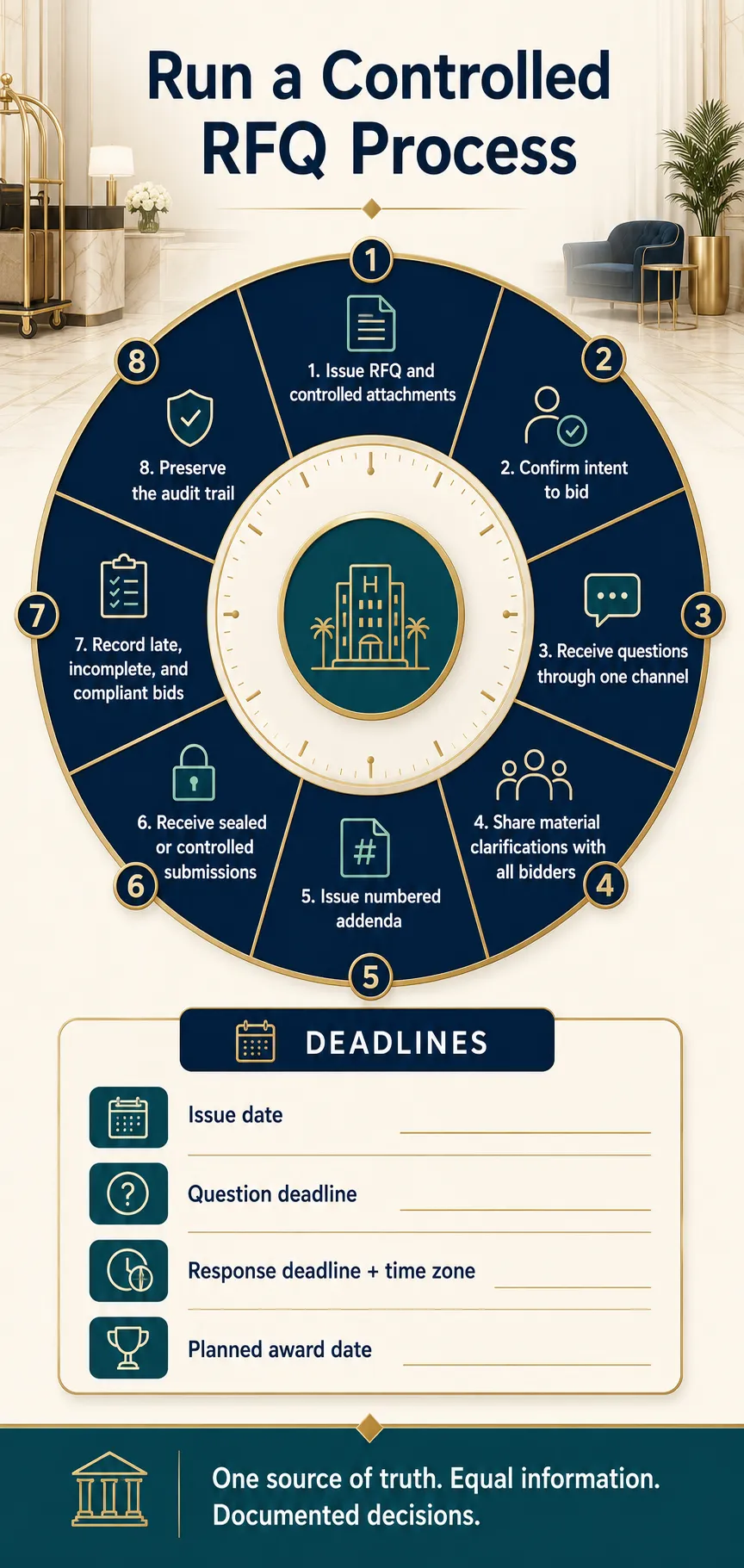
Give suppliers a single source of truth. The RFQ cover page should identify the buyer, RFQ number, issue date, contact person, intent-to-bid deadline, question deadline, response date and time with time zone, submission method, required file format, and planned award date.
Use one controlled question process. Share material clarifications with all bidders without revealing confidential supplier information. If an answer changes the requirement, issue a numbered addendum and consider extending the deadline. Avoid giving one supplier private guidance that improves its bid.
List every required response document: signed cover letter, pricing workbook, compliance schedule, exception register, technical data, samples, delivery plan, supplier questionnaire, references, and acceptance of terms. Establish filename conventions and maximum file sizes. Late, incomplete, or improperly submitted quotations should be handled according to rules stated in advance, not improvised after prices are visible.
Create a Weighted Evaluation Model and Level Every Bid
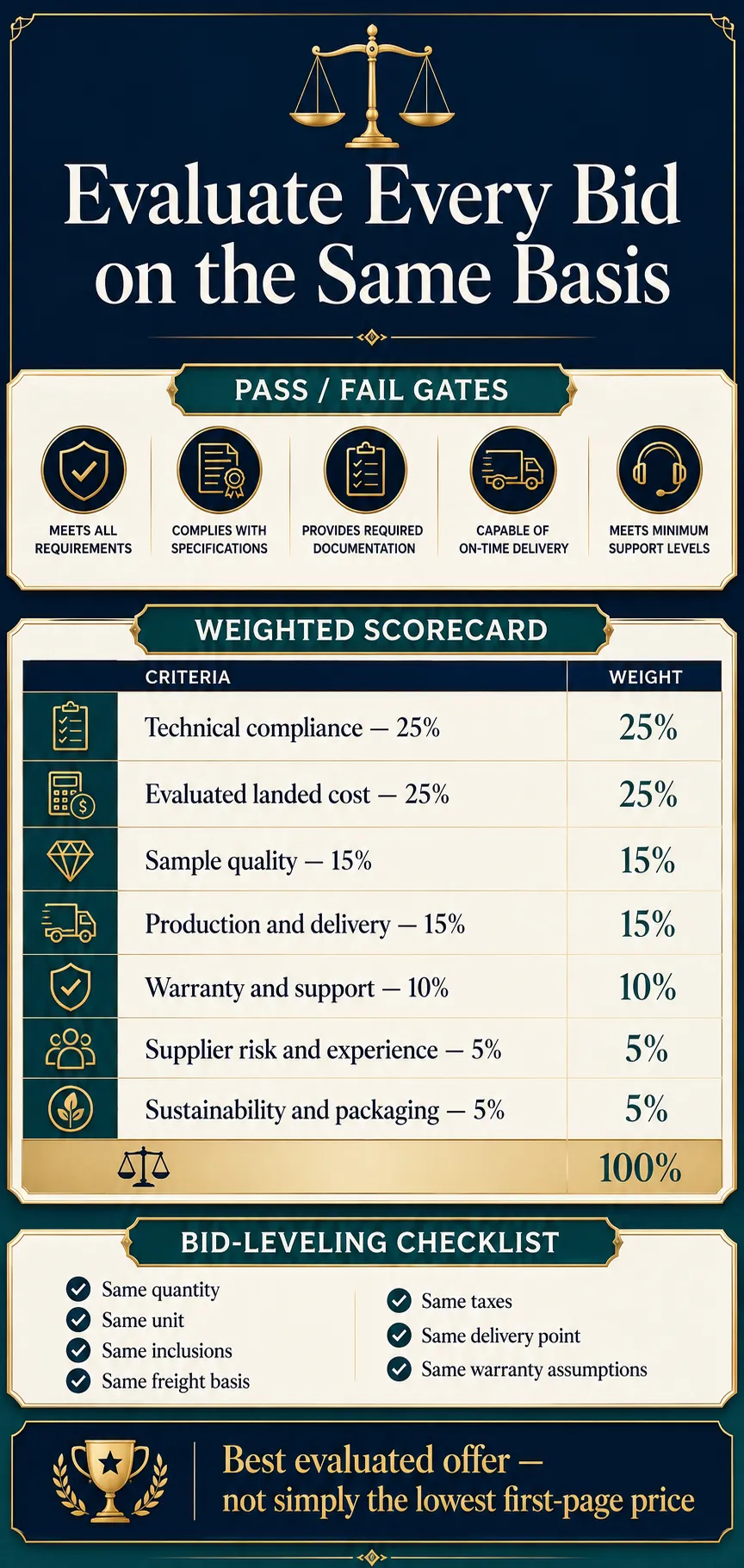
Design the evaluation before issuing the RFQ. The model should reflect the purchase risk and be disclosed at an appropriate level so suppliers understand what matters. A replenishment order for a fixed approved product may be highly price-weighted. A custom pre-opening package should give more weight to technical compliance, capacity, quality assurance, and delivery certainty.
An illustrative model might be:
| Criterion | Weight |
|---|---|
| Technical and specification compliance | 25% |
| Evaluated landed cost | 25% |
| Sample quality and operational suitability | 15% |
| Production and delivery capability | 15% |
| Warranty, service, and replenishment support | 10% |
| Supplier risk and relevant experience | 5% |
| Sustainability and packaging performance | 5% |
First apply mandatory pass-or-fail requirements. Then score compliant offers. Bid leveling means adjusting the comparison so every offer reflects the same quantity, unit, inclusions, freight basis, taxes, delivery location, warranty expectation, and commercial assumptions. Flag omissions rather than treating blank cells as zero cost.
Document evaluators, conflicts of interest, scores, clarifications, adjustments, and the reason for selection. If the hotel negotiates with shortlisted suppliers, give them a consistent commercial framework and a clear best-and-final-offer deadline. The winning bid should be the best evaluated offer under the published method, not simply the lowest number on the first quotation page.
Complete Hotel Supplies RFQ Template
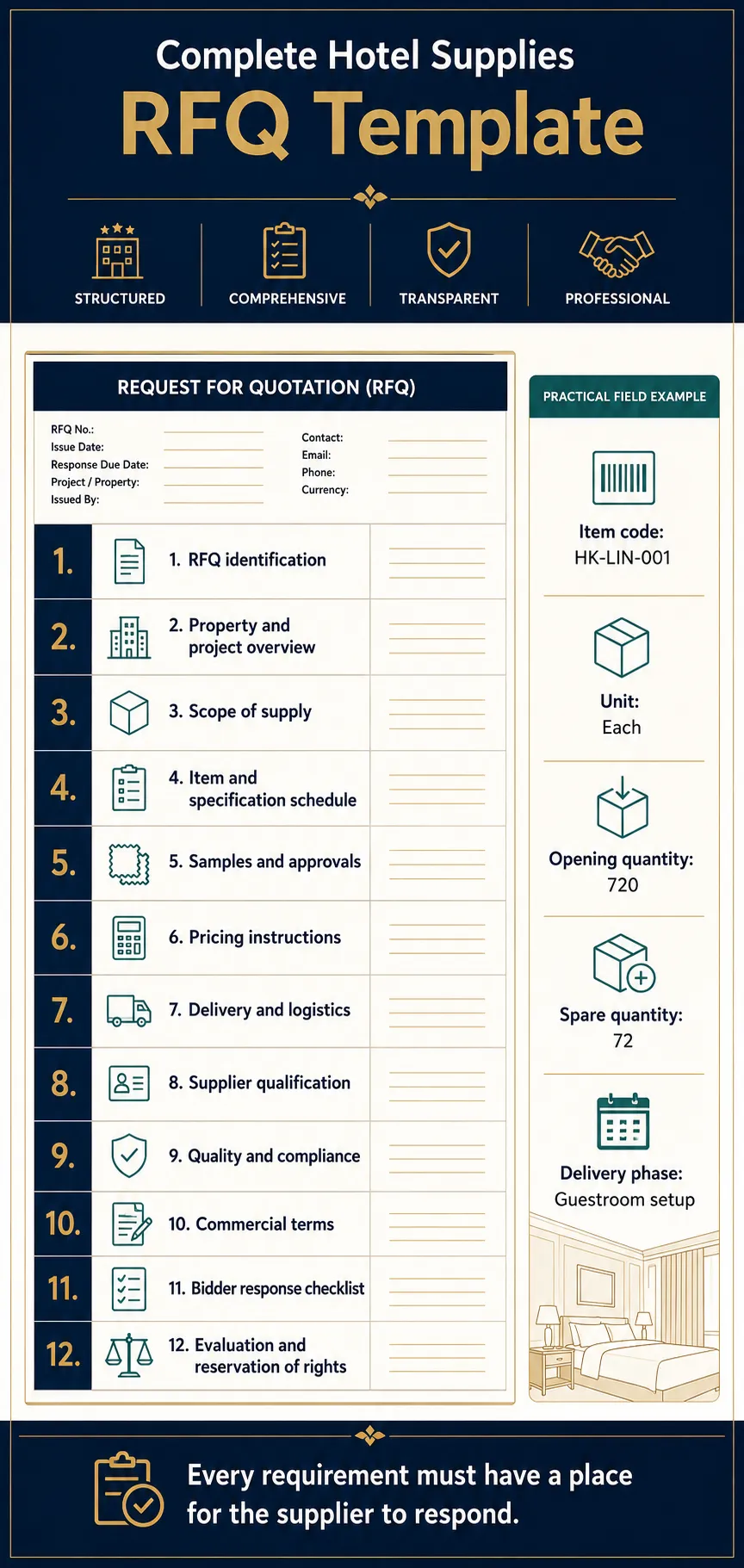
The following structure can be copied into a hotel RFQ and adjusted to the category and jurisdiction.
1. RFQ Identification
- Hotel or project name
- RFQ title and reference number
- Issue date and revision number
- Procurement contact
- Quote deadline, time zone, and submission method
- Confidentiality classification, if applicable
2. Property and Project Overview
Briefly describe the hotel type, room count, outlets, project stage, location, target opening or operational date, and purpose of the purchase. Include only information suppliers need to prepare an accurate offer.
3. Scope of Supply
State the included product categories and required services. Identify exclusions, award structure, delivery phases, and whether alternatives are permitted.
4. Item and Specification Schedule
Attach a controlled spreadsheet containing line number, item code, description, performance specification, quantity, unit, spare quantity, destination, delivery date, and required evidence. Add supplier fields for make, model, country of origin, compliance, exception, lead time, pack size, unit price, and extended price.
5. Samples and Approvals
List sample requirements, delivery address, deadline, labeling method, cost responsibility, approval stages, and control-sample rules. State that approval does not waive compliance with the written specification.
6. Pricing Instructions
Define currency, tax treatment, price basis, trade term and named location, freight treatment, quote validity, discounts, tooling, samples, customization, installation, training, and every required cost field. Prohibit undisclosed mandatory charges.
7. Delivery and Logistics
Provide required-on-site dates, receiving constraints, packaging and labeling rules, pallet and carton requirements, documentation, unloading, assembly, installation, waste removal, storage, and rules for early, late, partial, or damaged deliveries.
8. Supplier Qualification
Request relevant project history, references, manufacturing and service locations, quality process, production capacity, financial and insurance information proportionate to risk, subcontractors, and continuity arrangements.
9. Quality and Compliance
Specify required inspections, tests, certifications, technical documents, safety information, traceability, accessibility, sustainability evidence, pre-shipment inspection, delivery inspection, acceptance process, and defect thresholds.
10. Commercial Terms
Include payment milestones, invoicing, warranty, spare parts, service response, rejection and replacement, delay consequences, ownership of custom assets, confidentiality, insurance, dispute provisions, and the hotel’s proposed purchase terms.
11. Bidder Response Checklist
Require a signed offer, completed pricing sheet, compliance schedule, exception register, technical submissions, delivery plan, qualification documents, references, sample record, and acknowledgement of every addendum.
12. Evaluation and Reservation of Rights
Explain mandatory requirements, evaluated criteria, intended award basis, clarification process, and the hotel’s right to reject, negotiate, split, amend, or cancel the procurement in accordance with applicable policy.
Common RFQ Mistakes That Create Cost and Delay
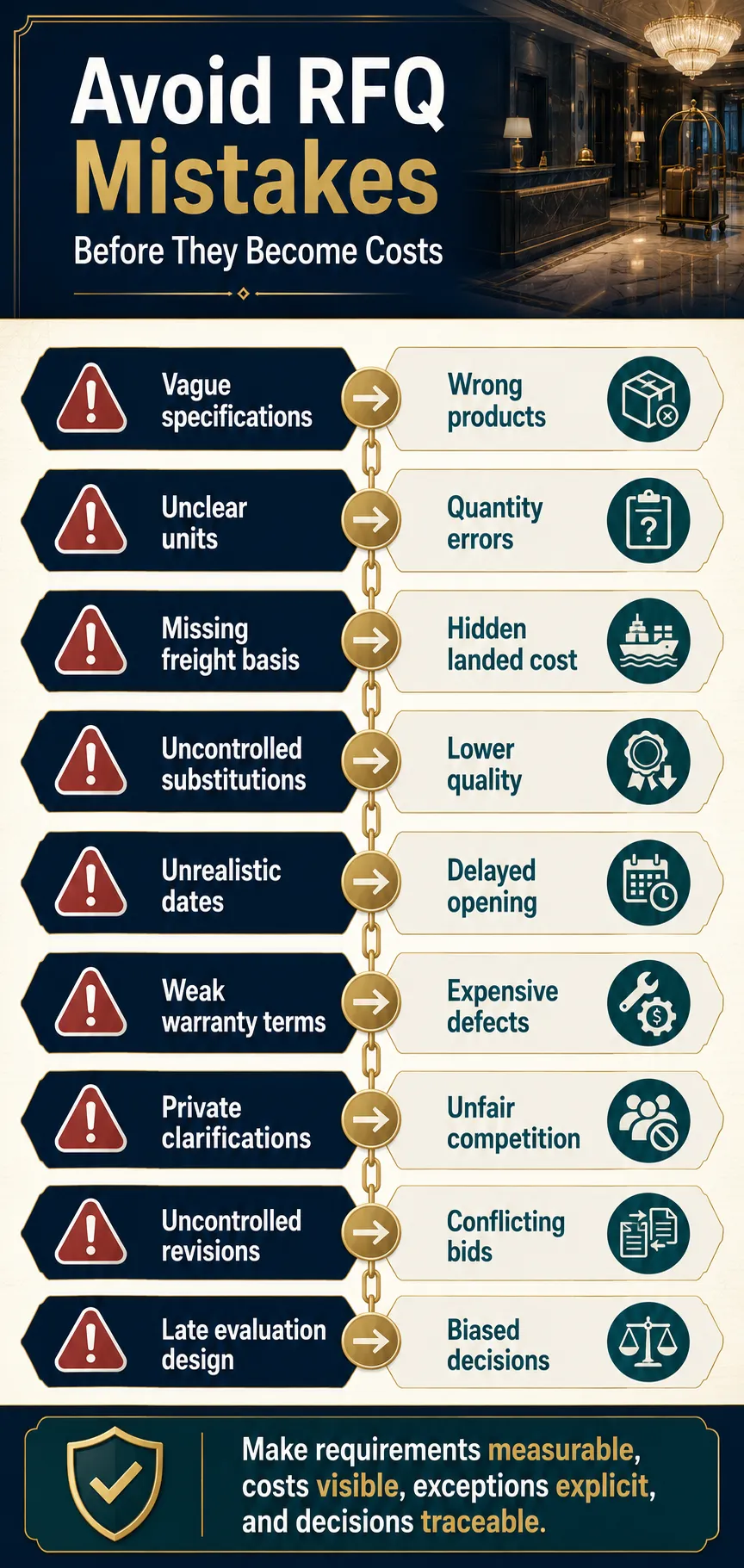
The most damaging mistake is issuing the RFQ before the requirement is stable. Other recurring failures include vague quality descriptions, inconsistent units, quantities without pack information, model numbers without performance criteria, missing delivery destinations, unrealistic dates, and no procedure for alternatives.
Hotels also create false savings by comparing unit prices while ignoring freight, duties, installation, consumables, service, and energy use. They may approve a beautiful sample without defining production tolerances, or accept a substitution without checking compatibility. Some RFQs request dozens of generic certificates but omit the one document needed for the actual product and jurisdiction.
Commercially, blank pricing cells, undefined taxes, uncertain trade terms, weak warranty language, excessive deposits, and missing quote-validity dates create avoidable exposure. Procedurally, private clarifications, uncontrolled spreadsheet versions, evaluation criteria written after bids arrive, and undocumented negotiations undermine fairness and decision quality.
The cure is straightforward: make every requirement measurable, every cost visible, every exception explicit, and every evaluation decision traceable.
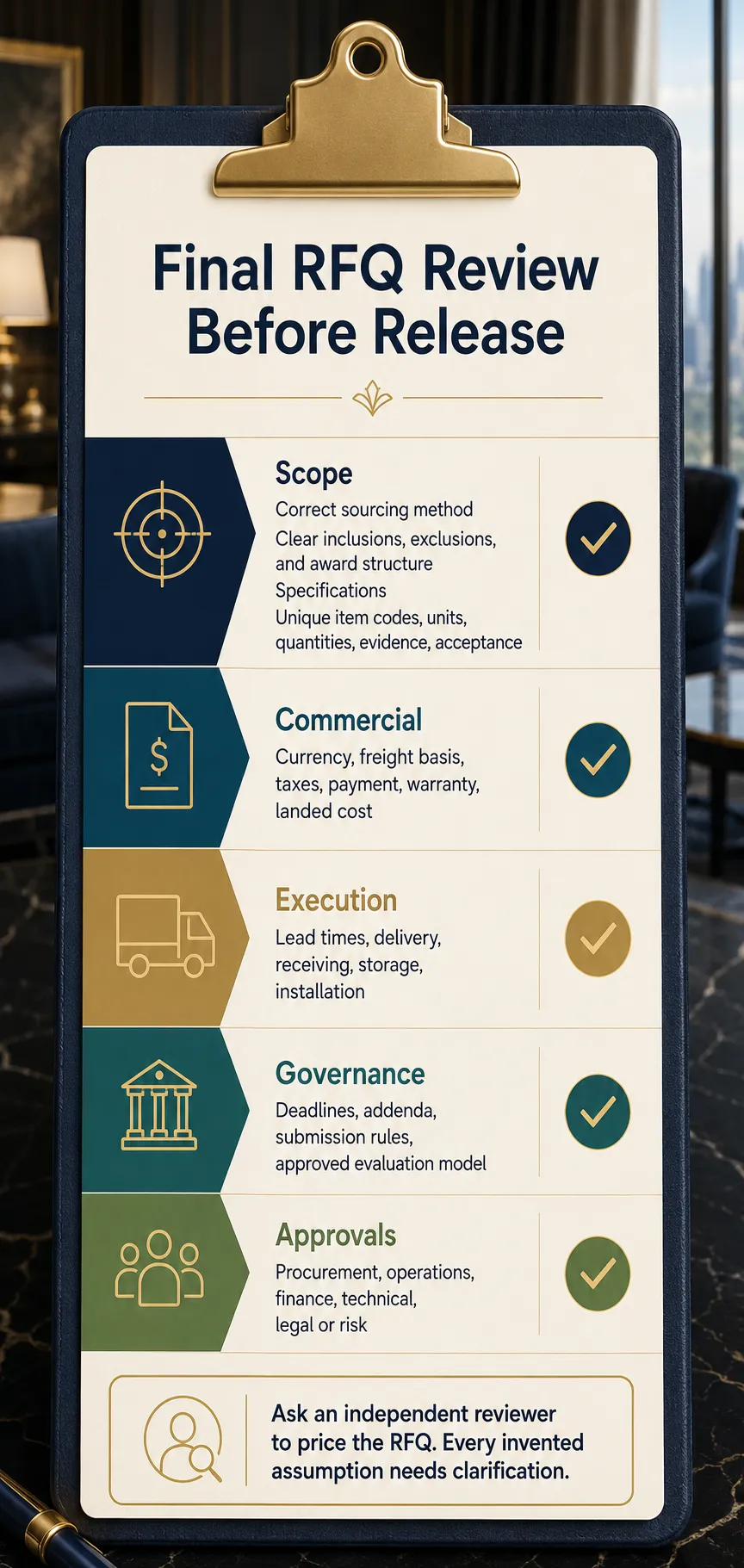
Final Review Checklist Before Release
Before inviting suppliers, confirm that:
- The RFQ is the correct sourcing method for a defined requirement.
- Scope, responsibilities, award structure, and exclusions are clear.
- Every line has a unique identifier, unit, quantity, specification, and destination.
- Hotel departments have approved operational and design requirements.
- Utilities, dimensions, interfaces, and site constraints have been checked.
- Mandatory compliance evidence is relevant to the product and destination.
- Samples, alternatives, substitutions, and production approvals are controlled.
- The pricing workbook captures all required costs and prohibits unexplained blanks.
- Currency, taxes, freight basis, trade term, and named delivery point are defined.
- Lead times are tied to specific approval and production events.
- Delivery, receiving, storage, installation, and acceptance responsibilities are assigned.
- Supplier qualification is proportionate to value and operational risk.
- Payment, warranty, defect, return, and service terms are included.
- Questions, addenda, deadlines, and submission rules create equal treatment.
- Evaluation criteria and mandatory thresholds are approved before issue.
- All attachments carry the correct RFQ and revision numbers.
- Finance, operations, procurement, and legal or risk reviewers have completed their checks.
A short internal red-team review is valuable: ask someone who did not draft the RFQ to price it as if they were a supplier. Every assumption they must invent is a candidate for clarification.
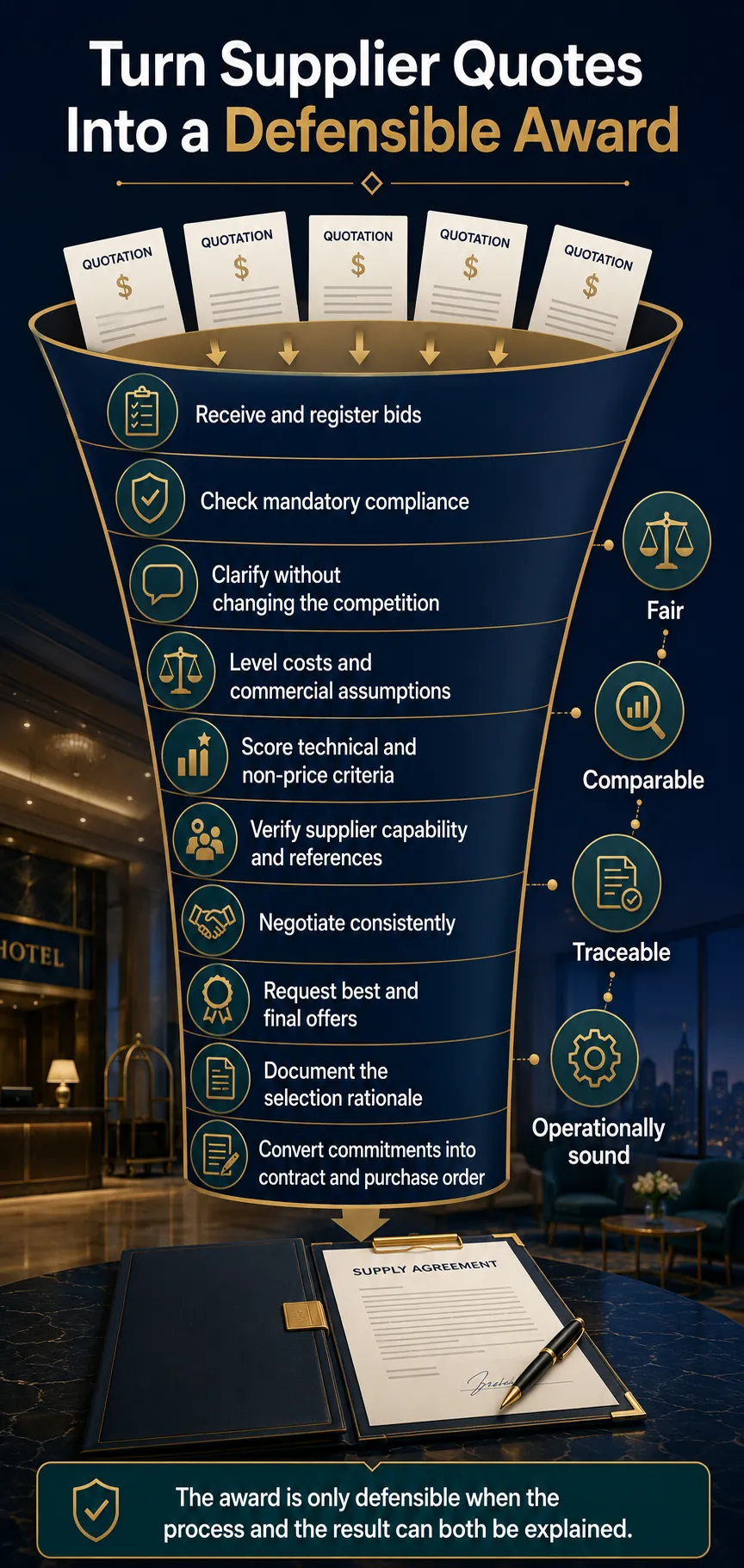
From Supplier Quotes to an Operationally Sound Award
A professional RFQ does more than generate competitive prices. It creates a shared definition of quality, cost, responsibility, and timing. That definition follows the procurement team from supplier invitation through clarification, evaluation, negotiation, purchase order, inspection, delivery, and warranty management.
The most effective hotel RFQs are specific without being needlessly restrictive, commercially complete without becoming unreadable, and rigorous about the issues that affect guests and operations. When specifications are measurable, quotations follow one format, landed costs are leveled, and supplier capability is tested, the hotel can award with confidence—and receive what it believed it was buying.
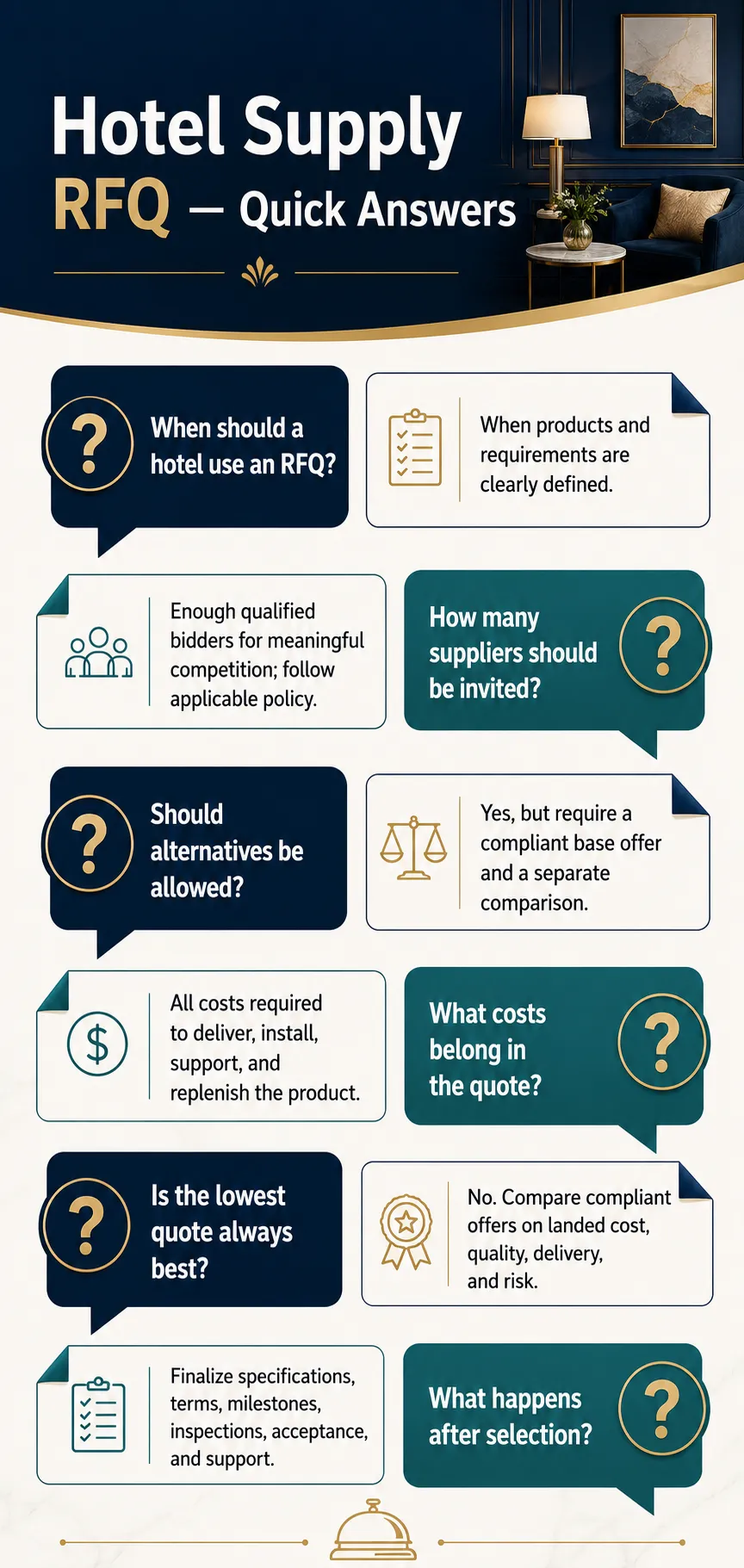
Frequently Asked Questions About Hotel Supply RFQs
What Is an RFQ for Hotel Supplies?
It is a structured request inviting selected suppliers to quote defined hotel products under stated technical, quality, delivery, and commercial conditions. It is most suitable when the hotel substantially knows what it needs and wants comparable offers.
When Should a Hotel Use an RFQ Instead of an RFP?
Use an RFQ when the requirement can be specified clearly and suppliers are pricing substantially equivalent goods. Use an RFP when the hotel needs suppliers to recommend different solutions, methods, designs, or service approaches and will evaluate the quality of those proposals as well as price.
How Many Suppliers Should Receive an RFQ?
There is no universal number for private hotel procurement. Invite enough qualified suppliers to create meaningful competition without overwhelming the evaluation team. Three capable bidders are often more useful than ten poorly matched vendors. Follow corporate, ownership, brand, lender, or public-procurement rules when they prescribe a minimum.
Should the Hotel Disclose Its Budget?
It depends on the objective. A budget can prevent unrealistic offers and help suppliers propose suitable alternatives, but it can also influence pricing. For a tightly specified RFQ, disclosure may be unnecessary. For a constrained project with selectable options, a budget range can improve relevance. Apply the same disclosure to all bidders.
Can a Hotel Name a Preferred Brand in an RFQ?
Yes, when compatibility, brand standards, approved design, existing inventory, or service considerations justify it. If equivalents are permitted, define the attributes an alternative must match and require it to be quoted separately. Avoid using a brand name as a substitute for a complete specification.
Should Suppliers Be Allowed to Propose Alternatives?
Usually yes, provided they first submit a fully compliant base offer or clearly state that they cannot. Alternatives should include a side-by-side technical comparison, price effect, lead-time effect, evidence, sample, and explanation of any operational consequence. The hotel should retain sole approval authority.
What Costs Should a Hotel Request Besides Unit Price?
Request packaging, customization, tooling, samples, inland transportation, freight, insurance, brokerage, duties, taxes, delivery, unloading, storage, assembly, installation, commissioning, training, consumables, spare parts, service, and any recurring fee relevant to the product. The goal is to compare evaluated landed cost and, for durable products, total cost of ownership.
How Long Should an RFQ Remain Open?
The response period should reflect the number of items, customization, sample requirements, site visits, international sourcing, and internal approvals suppliers need. A simple replenishment quote may require only several business days; a multi-category pre-opening package may require weeks. Include a separate question period and extend the deadline when a material addendum changes the work.
Is the Lowest Quotation Always the Best Choice?
No. The lowest price may omit required costs, fail technical requirements, rely on an unacceptable substitution, or carry delivery and service risk. Evaluate only technically acceptable offers and compare them on the same landed-cost and commercial basis. The award should follow the RFQ’s stated evaluation method.
What Should Happen After Supplier Selection?
Complete due diligence, resolve exceptions, confirm samples and final specifications, document the award, and convert the accepted terms into a purchase order or contract. Establish production milestones, reporting, inspections, shipping documentation, receiving procedures, acceptance criteria, warranty contacts, and supplier-performance measures. The final contract should not leave critical RFQ promises behind.