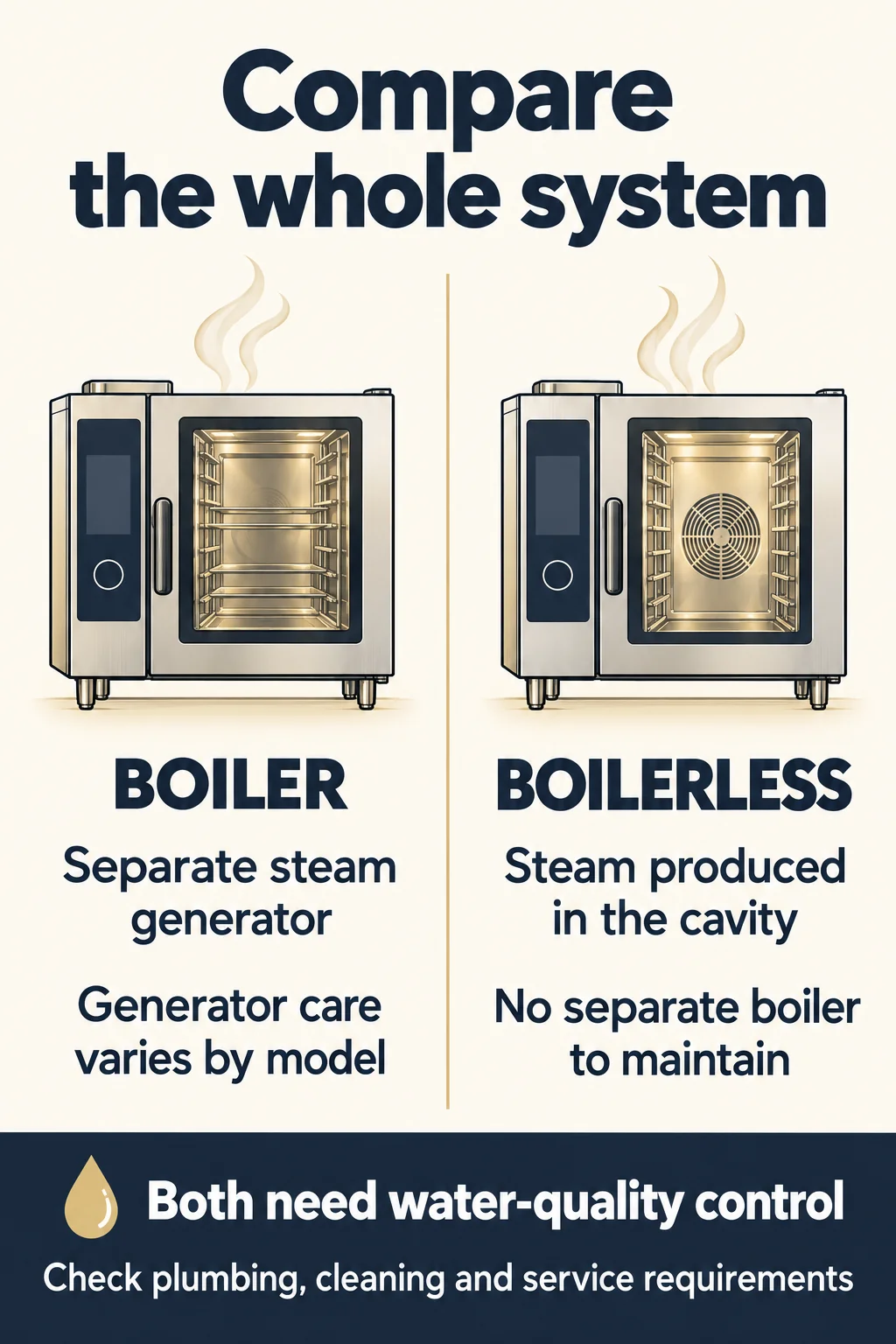
A boiler combi oven produces steam in a separate generator; a boilerless combi produces it within the cooking system without a separate boiler. That difference changes which components need attention, but it does not establish which oven will use less water or cost less to maintain in your hotel. Compare exact models across a complete operating day, using the same food output and quality requirements. Include cleaning, idle operation, any drain cooling, and water-treatment losses in the comparison.
A combi oven brings steam, convection, and combined cooking into one appliance. For a hotel, that versatility must work across uneven demand: breakfast preparation, restaurant service, room service, and tightly timed banquet production. An oven that performs well on one demonstration tray may behave differently when repeatedly loaded during a large event. The purchasing decision therefore belongs jointly to the chef, engineering team, and procurement team.
Water requirements also extend beyond the number of gallons used. The installation must supply suitable water at the required pressure and flow while other kitchen equipment operates. Treatment must match the manufacturer’s chemistry limits. Cleaning must fit the available shutdown window, and service technicians must be able to reach the parts that need inspection or replacement. A lower equipment price is only useful if those requirements can be met.
This guide explains how to distinguish the two steam systems, map their water demand, separate cleaning from scale control, and compare ownership costs. The examples illustrate evaluation methods rather than performance promises for any brand. For a wider equipment schedule, place the combi alongside the property’s other commercial cooking equipment so that capacity, utilities, and service access are considered together. Keep the final selection tied to the current documentation for the exact model and configuration being purchased.
How Boiler and Boilerless Combi Ovens Differ
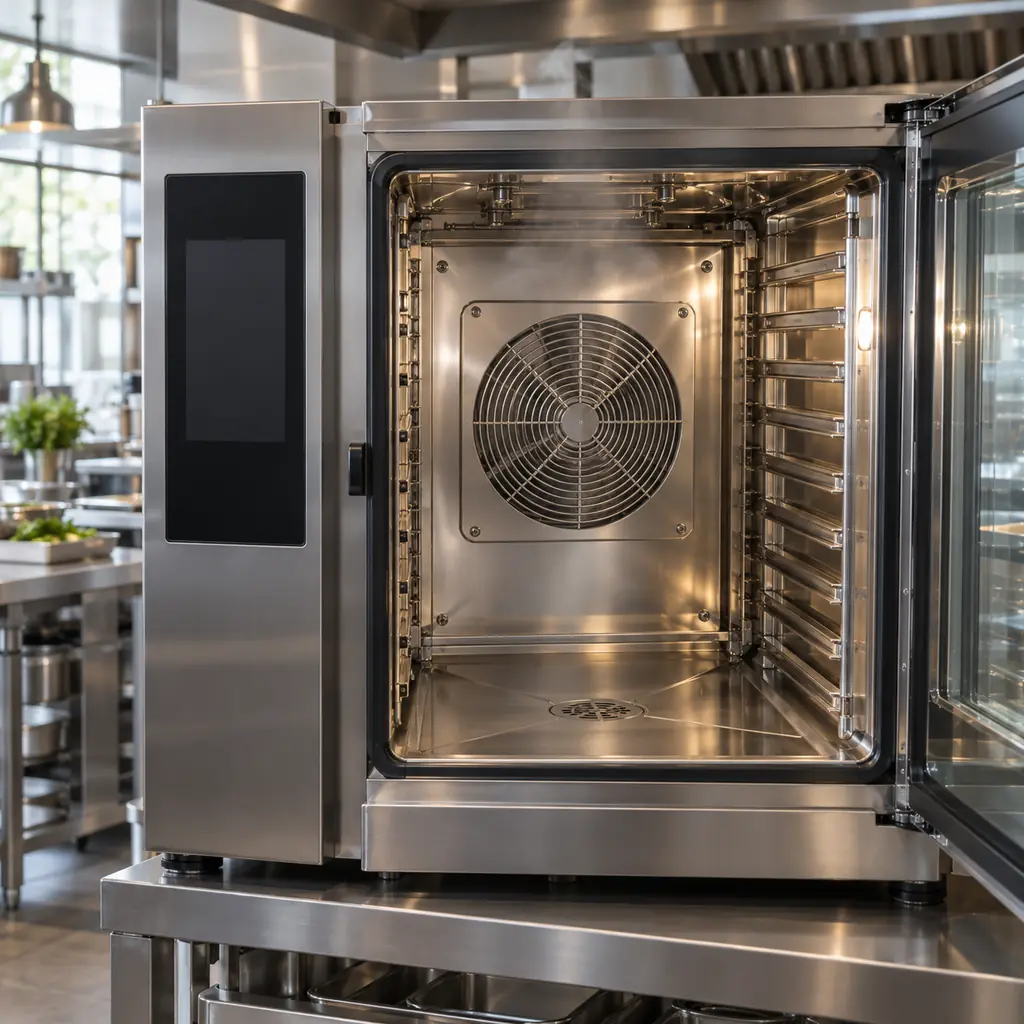
The useful distinction is where steam is produced and which associated components the hotel must support. A boiler-based combi has a separate steam generator supplying the cooking chamber. A boilerless design creates steam without that separate generator, commonly by introducing water onto a heated surface within the cooking system. Removing the boiler removes its particular service tasks, but other water-contact components remain. Neither label tells you the number of water connections, the drainage arrangement, or the achievable production rate. Treat the label as the beginning of the equipment comparison, then examine the installation drawing, operating manual, and a representative cooking demonstration.
Understand the mechanism without assuming the plumbing
In this context, “boiler” generally refers to the oven’s steam generator. It does not automatically mean that the appliance connects to the hotel’s central steam plant. Ask the supplier to identify the actual steam source. Gas versus electric is a separate choice from boiler versus boilerless, and the comparison must retain the correct fuel, voltage, phase, and model suffix.
Alto-Shaam’s description of its boilerless design illustrates one approach: water contacts a heated surface and the fan distributes the resulting steam. That explanation describes the mechanism; it does not prove a fixed water-saving percentage for a different hotel, menu, or competing oven.
Boilerless does not mean connectionless. The Vulcan ABC7 installation and operation manual specifies a treated-water supply for steam and the spray hose, a separate supply for drain tempering, and a drain connection. This is a concrete counterexample to the assumption that every boilerless combi needs only one water line or no drain. Obtain the manual revision applicable to the offered unit; that linked manual is Form 47110, Rev. C, April 2018.
| Comparison point | Boiler-based design | Boilerless design | What the hotel should establish |
| Steam production | Separate steam generator | Steam production without a separate boiler | Actual mechanism and supplied configuration |
| Generator-specific work | Generator care must be understood | No separate boiler to maintain | Automatic versus manual tasks in the model’s manual |
| Water connections | Depend on the complete design | Also depend on the complete design | Every inlet, treatment branch, drain, and required flow |
| Cleaning workload | Depends on cleaning system and cooking soil | Depends on cleaning system and cooking soil | Staff time, cycle duration, chemicals, and access |
| Peak output | Must be demonstrated | Must be demonstrated | Accepted food delivered within the service window |
| Daily consumption | Must be measured or credibly modeled | Must be measured or credibly modeled | Equivalent load, schedule, and measurement boundary |
Match the model to the hotel’s production pattern
A banquet kitchen may prioritize repeated full loads and recovery between batches. A small hotel may prioritize smaller batches, predictable cleaning, and rapid readiness after idle periods. Neither pattern establishes an automatic winner. Test both candidate models against the actual menu rather than assigning all heavy production to boilers and all light production to boilerless equipment.
Specify usable pan size and spacing, not just advertised rack count. A tall food item, required airflow clearance, or different pan orientation can change useful loading. Define the service deadline, acceptable texture and yield, and the number of consecutive batches. If an oven meets the water target only by extending production beyond the banquet deadline, it has not met the requirement.
Map Water Demand and Specify the Right Water Quality
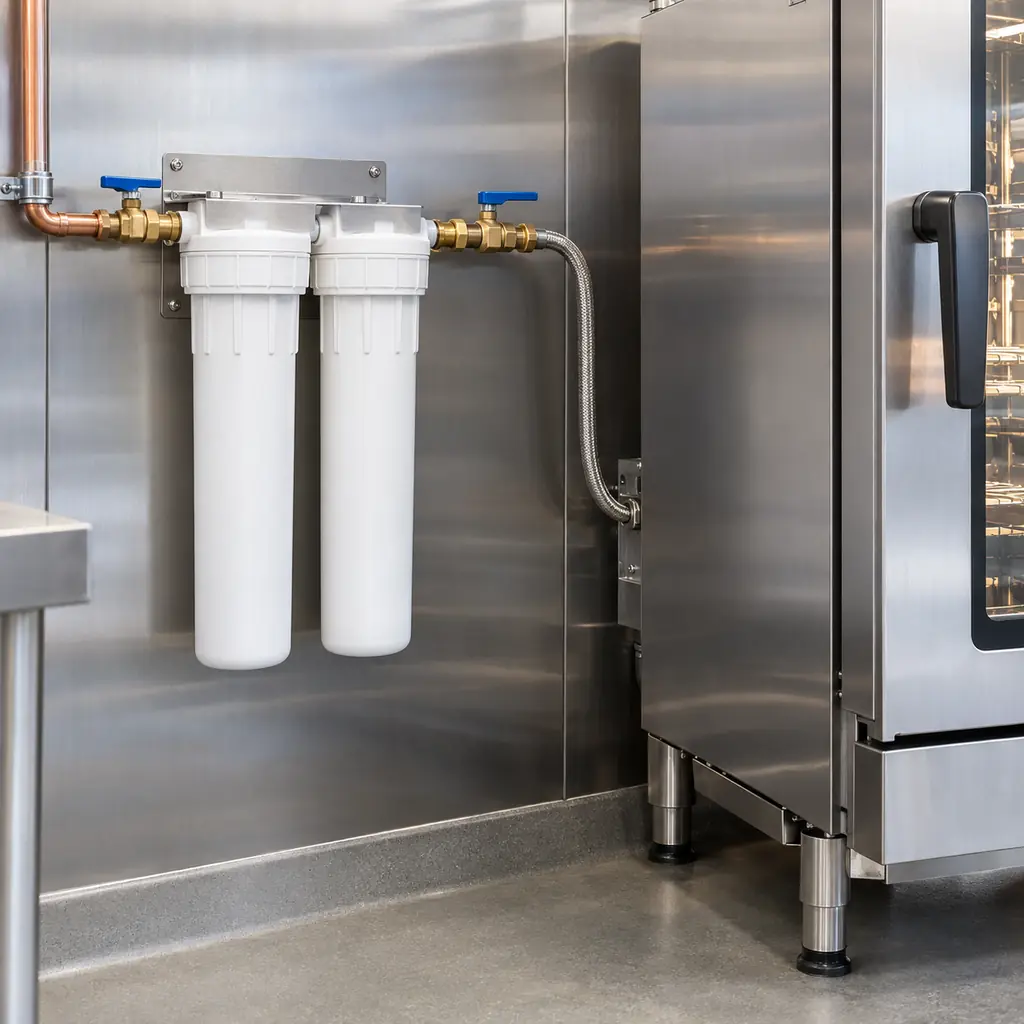
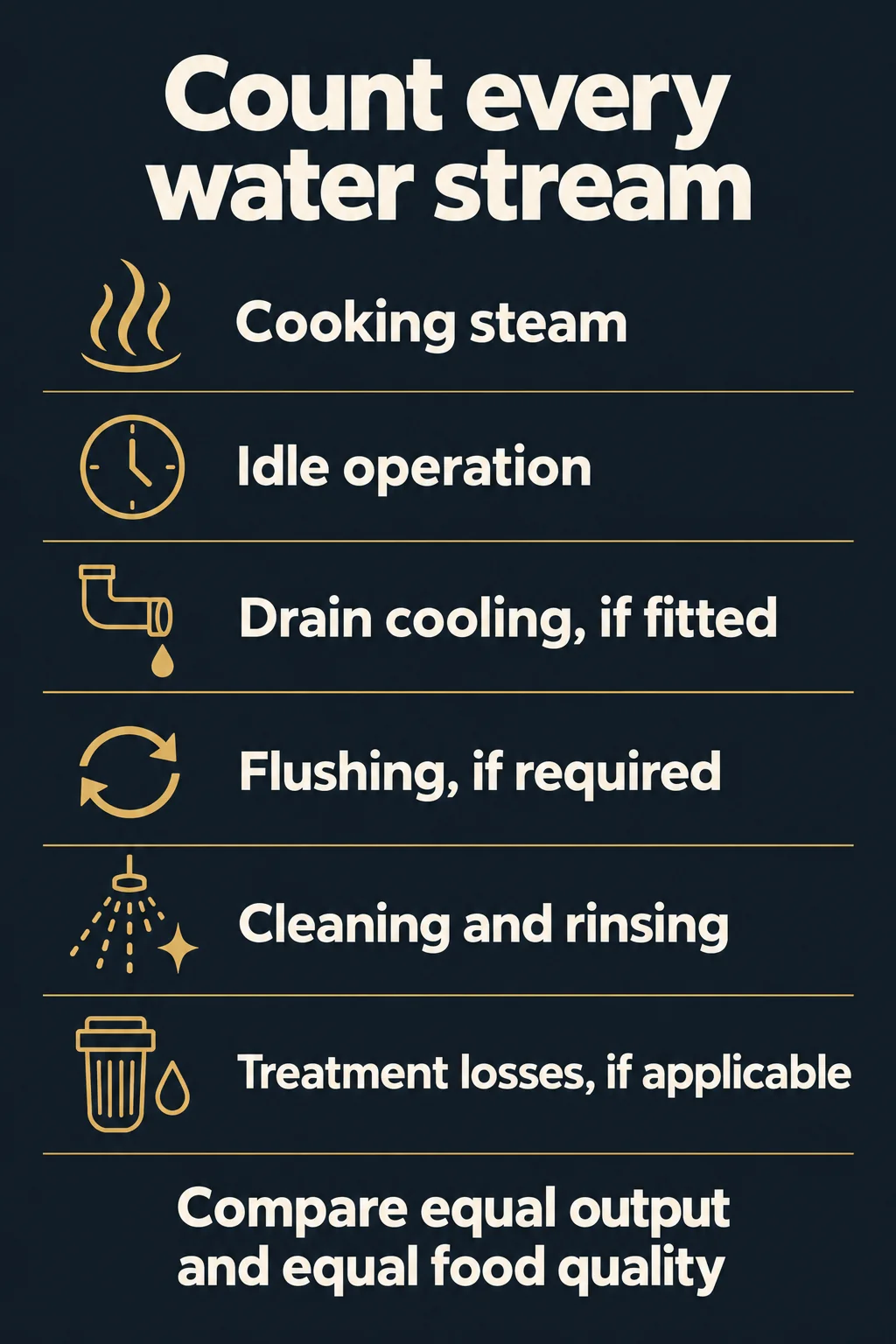
A useful water comparison follows every supply branch serving the oven and its treatment equipment, then relates that total to acceptable food output. Cooking steam is only one part of the balance. Depending on the model and installation, water may also serve idle operation, cooling, flushing, cleaning, and rinsing. Separately, suitable pressure and chemistry determine whether the installation can operate reliably. Keep these questions distinct: daily volume describes consumption, peak flow describes connection capacity, and the water analysis describes treatment needs. A favorable result in one category does not compensate for a failure in another.
Draw the measurement boundary before comparing figures
The following table is a water-accounting map. The streams are possibilities to verify, not a statement that every oven uses all of them.
| Possible water stream | How to capture it | Main comparison risk |
| Cooking steam | Measure each representative recipe and batch | Comparing different loads or food endpoints |
| Idle operation | Record ready-state duration and water use | Ignoring long gaps between meal periods |
| Generator filling or flushing | Log the relevant events, if fitted | Leaving intermittent events outside the trial |
| Drain tempering or condensate cooling | Include the relevant supply branch | Metering only the treated steam-water line |
| Automatic cleaning and hand rinsing | Include a complete normal cleaning routine | Comparing production-only readings |
| Treatment reject, regeneration, or backwash | Measure or allocate the applicable upstream use | Omitting treatment losses or counting them twice |
If a meter upstream of a dedicated treatment system already captures feed water and reject losses, do not add those losses again. If treatment is shared, record the allocation method and its uncertainty. An oven-only meter and a whole-system meter answer different questions; label them clearly.
Readings should cover a representative light service and a demanding event day. Record batch size, recipe, cooking mode, idle time, cleaning program, and accepted portions or food weight. Mark unusual events such as a second cleaning cycle or a supply interruption. Keep a repeatable record rather than treating one favorable demonstration as an annual average.
Use efficiency ratings within their stated limits
The ENERGY STAR Version 3.0 specification sets combination-oven cooking-water limits below 0.5 US gallon per pan in steam mode and below 0.4 US gallon per pan in convection mode. It requires idle-water reporting, without a numerical idle-water ceiling in that table. Applicable condensate-cooling water is included in its water metrics.
These are standardized test results, not daily consumption forecasts. Check the exact certified model, pan basis, fuel, test mode, and reported units. Cooking gallons per pan cannot be compared directly with idle gallons per hour per pan. Certification is useful screening evidence; a hotel-specific operating trial still supplies the missing schedule, menu, and cleaning context.
Peak inlet flow is a different issue. Have the installer verify available pressure, flow, and inlet-water temperature at the oven after treatment, while other relevant equipment draws water. Confirm the drain arrangement, drain-temperature limits, backflow provisions, and local approval requirements against the model’s installation instructions. Do not select pipework or alter drain cooling from an average daily water figure.
Choose treatment from a water report and model limits
Drinking-water suitability alone does not establish equipment suitability. Request a water analysis at the proposed connection and compare it with the manufacturer’s stated limits for the parameters it requires, such as hardness, chloride, chlorine, conductivity, or pH. Retest downstream of the selected treatment before commissioning. Chlorine and chloride are different measurements; do not substitute one result for the other.
The RATIONAL iCombi Pro/iCombi Classic installation manual, V11.1, April 2026, shows why blanket treatment advice is unreliable. For the covered units used as instructed, it describes automatic scale removal and says upstream softening for scale is unnecessary. Other water characteristics can still require treatment, and minimum conductivity matters. Those instructions are specific to the covered models, not a general rule for every combi.
Have the supplier identify what each proposed treatment stage changes, the resulting outlet-water specification, flow capacity, replacement basis, consumables, and any wastewater. “Filter included” is not an adequate specification. An existing filter can only be reused after its performance and remaining capacity have been assessed against the replacement oven’s requirements.
Plan Cleaning, Descaling, and Preventive Service
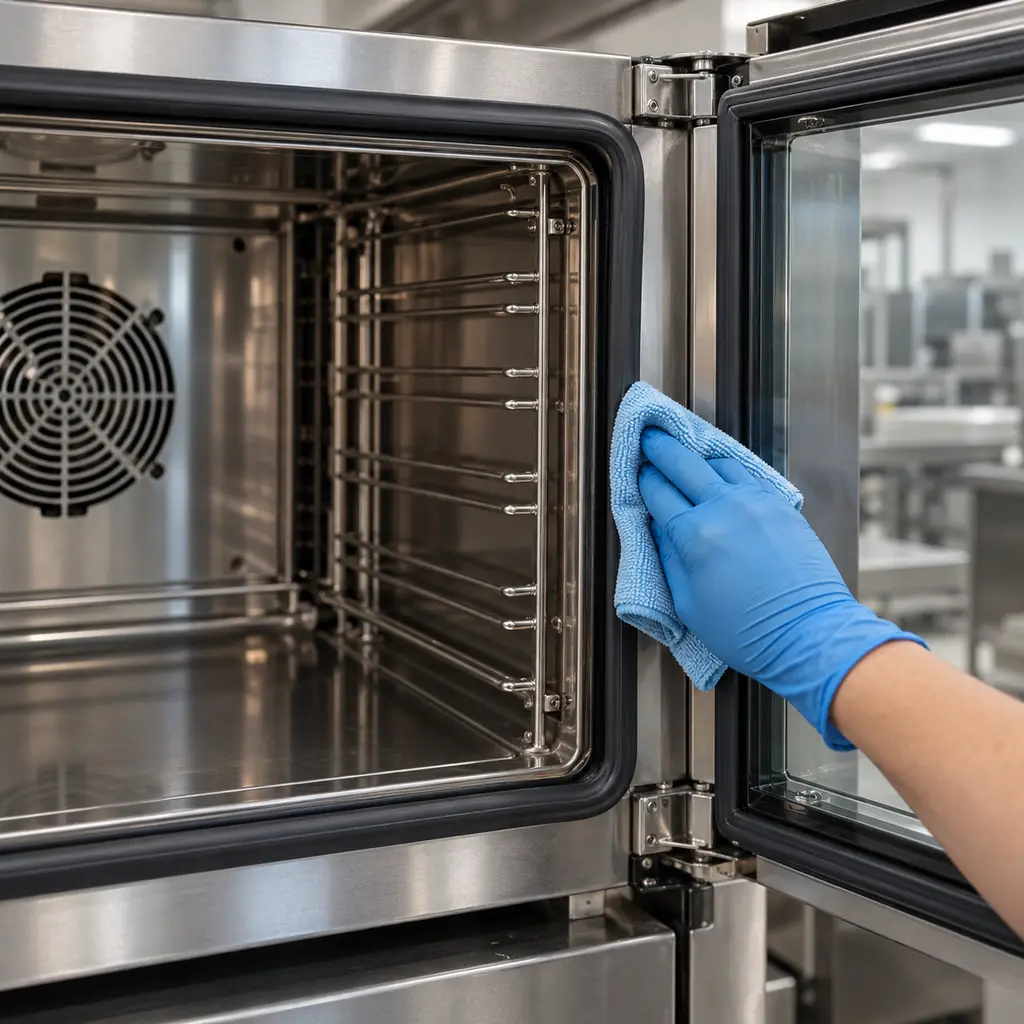
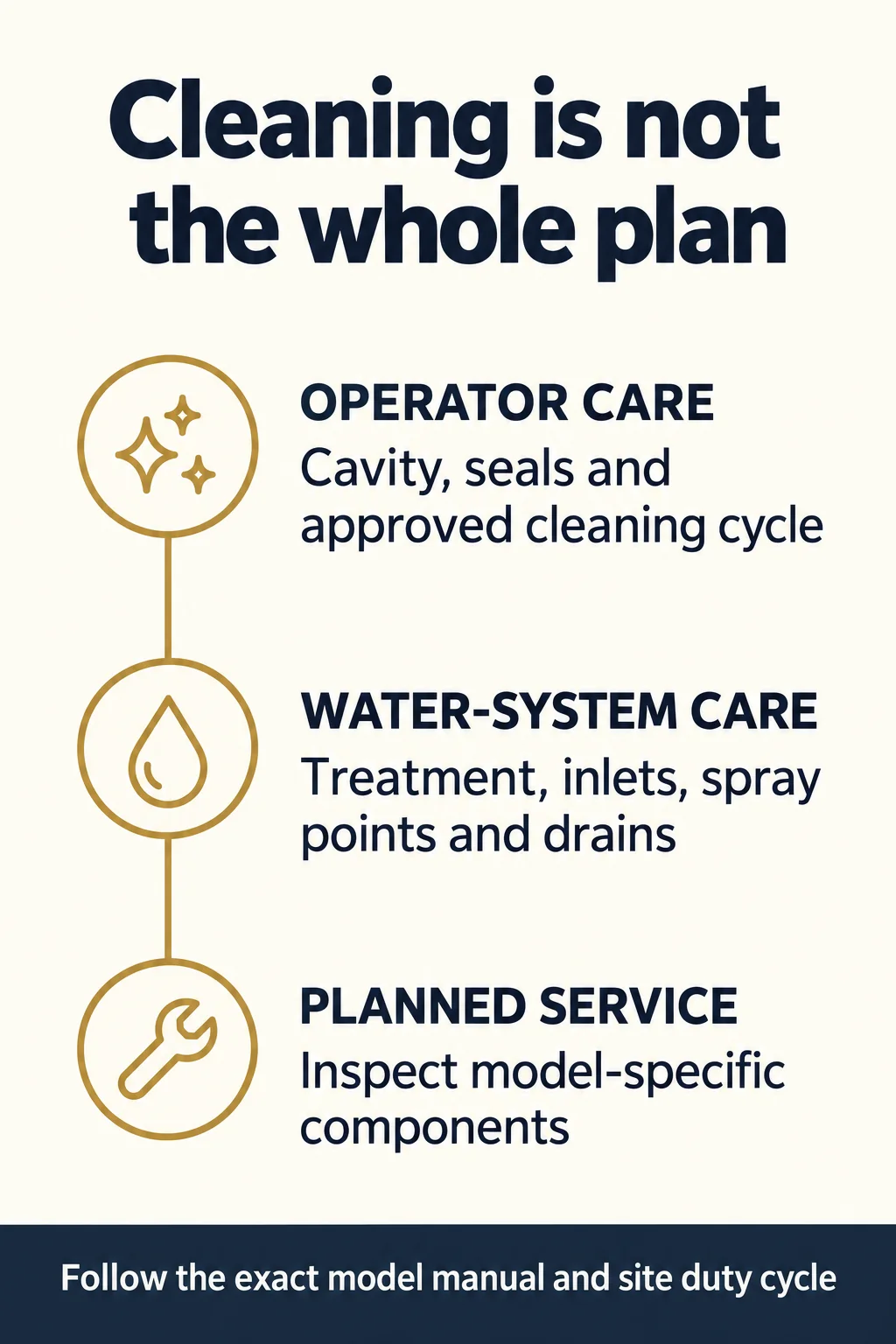
Cleaning removes cooking residues, scale control addresses mineral deposits, and preventive service checks the equipment’s condition and operation. These are related activities, but they are not interchangeable. A hotel needs a written plan showing what the automatic system performs, what operators must do, and what requires a qualified technician. The plan should match the exact appliance, water conditions, workload, and available cleaning window. Comparing maintenance therefore means comparing tasks, labor, consumables, access, and expected interruption—not simply counting boilers. A system that staff can execute consistently has more practical value than an attractive maintenance claim without defined responsibilities.
Establish what the cleaning cycle actually covers
Ask the supplier to demonstrate the normal cycle after a representative cooking load. Record operator preparation, detergent or tablet quantity, rinse requirements, cycle duration, and the point at which the oven is ready for food production again. Identify surfaces or accessories requiring separate attention. A cycle’s elapsed time and the operator’s hands-on time belong in different columns of the cost model.
Do not assume an automatic wash also descales the steam generator or every water-contact surface. Obtain the model-specific explanation of scale management, required chemistry, prompts, and manual interventions. Use the approved products and procedures; an improvised chemical substitution makes both the result and the operating cost uncertain.
For example, the Vulcan ABC7 manual includes daily washing and rinsing, filter care, and routine cavity deliming. Its boilerless architecture does not eliminate those tasks. RATIONAL’s preventive maintenance document covers water distribution, valves, pumps, steam-generator components, drains, and seals, and varies recommended service frequency with use intensity. Its regional schedule is an example of workload-based planning, not a universal interval for other brands.
Assign work to people and available service windows
The chef or kitchen supervisor should own completion of the approved operator routine. Engineering should own water-system records and coordinate faults or changing supply conditions. The qualified service provider should define its inspection scope and access requirements. Procurement should preserve the quoted consumables, warranty conditions, and service commitments so they remain available after installation.
Ask how the plan changes during peak season. A property with back-to-back events may need cleaning to finish between dinner and early breakfast preparation. A maintenance visit may require isolation, cooling, moving the oven, or access behind it. Establish the duration and staffing in advance, and identify alternative cooking capacity for that period.
Stock planning should follow the actual model: approved cleaning products, treatment consumables, and agreed service parts. Confirm who supplies them, the expected replenishment time, and which items require technician installation. Do not assume a locally sold oven automatically comes with a local service response commitment.
Investigate changes instead of normalizing them
A sudden increase in metered water, repeated cleaning interruptions, visible deposits, leaks, or slower recovery deserves investigation. Compare the event log with recent menu, treatment, and utility changes before attributing everything to the steam architecture. Record alarms and operating conditions for the service provider; operators should not bypass interlocks or dismantle pressurized or energized equipment.
EPA’s WaterSense guidance for combination ovens supports managing idle periods, avoiding unnecessary oversizing, maintaining effective door seals, and monitoring scale. Apply operational changes within the recipe and food-safety requirements. Turning off steam that the product needs, postponing required cleaning, or disabling drain cooling does not create a valid efficiency improvement.
For an equipment replacement with difficult access or shared utilities, discuss the project requirements with KW Hospitality before comparing quotations. Include the water report, equipment location, service clearances, and production schedule so the sourcing brief describes the installation the hotel actually needs.
Compare Costs and Prove Performance Before Acceptance
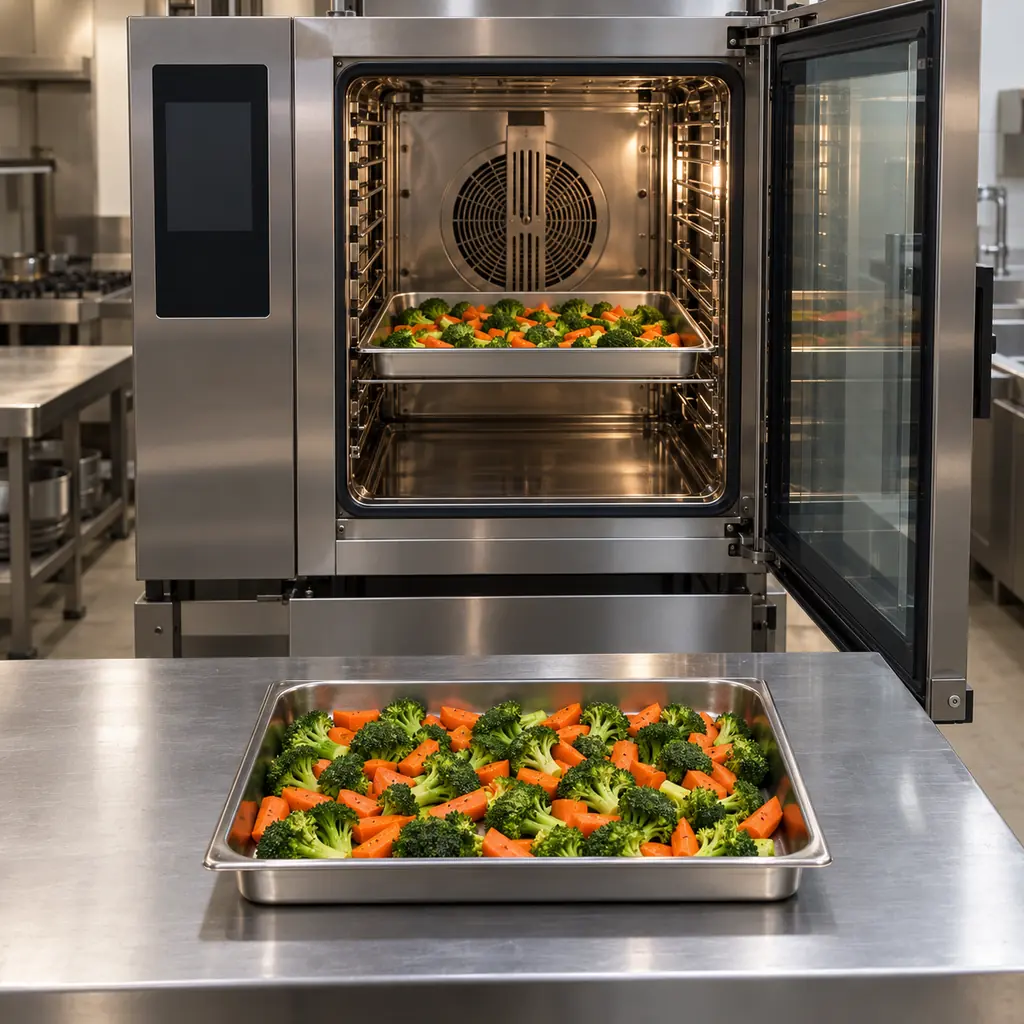
The preferred oven is the candidate that meets production, infrastructure, and maintenance requirements at the lowest credible ownership cost. Begin with pass-or-fail conditions such as food quality, service timing, suitable water, safe installation, and service availability. Only compare savings after both candidates pass those conditions. Separate measured values from supplier estimates and unresolved allowances. This makes the decision auditable and prevents a low water figure from concealing longer cooking time, greater labor, or an installation upgrade. Use the same evaluation period and currency for every quote, then test how uncertain inputs could change the result.
Build a complete cost comparison
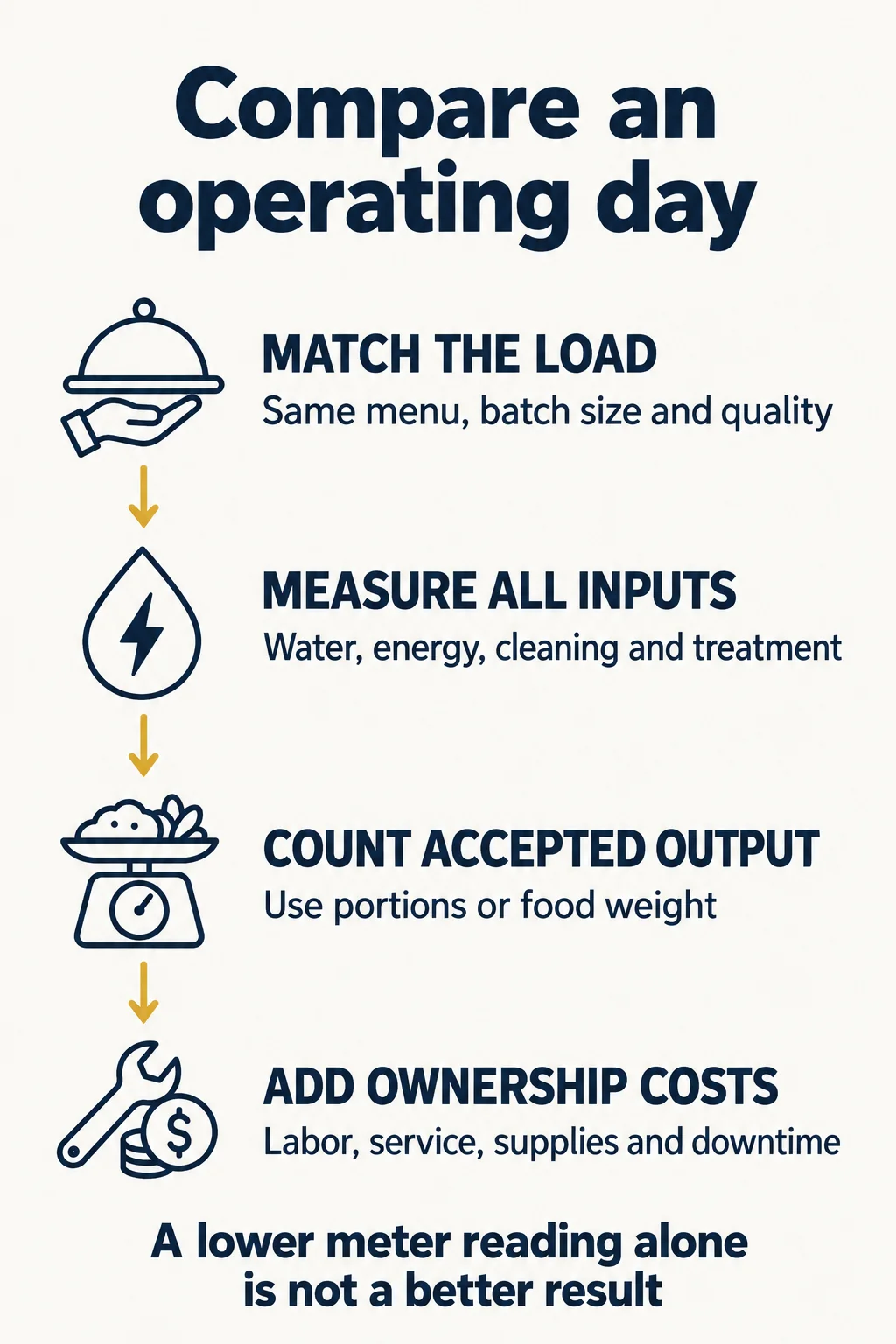
Installed cost includes the oven, stand or stacking arrangement, delivery access, utility work, treatment, commissioning, and training that the project actually requires. Confirm what each quote includes rather than assigning the same allowance to physically different installations. Identify applicable certifications and the party responsible for installation approval at the destination.
Recurring cost combines water and sewer charges, energy, cleaning chemicals, treatment consumables, operator labor, scheduled service, and a separately identified allowance for interruptions. Model electricity and fuel with the hotel’s tariff structure. Keep assumptions about failures or downtime visible rather than presenting an uncertain estimate as a guaranteed annual saving.
Two calculations are particularly useful:
Daily water intensity = total water within the defined boundary ÷ accepted food output.
Annual operating cost = annual utilities + consumables + operator labor + planned service + stated interruption allowance.
Choose accepted portions for a stable menu or accepted food weight for a suitably controlled batch comparison. Never combine different portion sizes without adjustment. Track rejected or reworked food separately; exclude it from accepted output while keeping its resource use in the numerator.
A hypothetical water comparison
Suppose two qualified candidates both produce 600 accepted portions per operating day. Under the same measurement boundary, Candidate A uses 180 liters and Candidate B uses 240 liters, including normal cleaning and any applicable treatment losses. These are invented inputs for illustration, not measured results or expected performance by architecture.
Candidate A uses 0.30 liter per accepted portion; Candidate B uses 0.40. The difference is 60 liters a day. At 300 equivalent operating days, that becomes 18,000 liters, or 18 cubic meters, annually. If the assumed combined variable water and sewer charge is US$6 per cubic meter, the calculated water-related difference is US$108 per year.
The result matters because it keeps the decision proportional. A US$108 water difference cannot justify an unspecified purchase premium on its own. Add credible energy and labor differences, then subtract any extra chemical, treatment, or service cost. If the candidates serve a changing mix of banquet and quiet days, calculate each day type separately and weight it by the expected number of days; do not multiply a single peak day by 365.
Convert the evaluation into a purchase specification
The RFQ should identify the exact model and options, usable pan configuration, recipe and peak-output requirements, utilities, water analysis, treatment proposal, cleaning system, service access, and destination. Request the corresponding installation, operation, maintenance, and warranty documents. Ask suppliers to label measured performance, certified results, calculated estimates, and untested claims separately.
Before final acceptance, demonstrate the agreed menu and loading pattern under realistic utility demand. Observe consecutive batches and the relevant recovery interval, not only a single successful load. Meter the agreed water boundary and include a complete cleaning routine. Confirm that the installed treatment settings and downstream water results meet the approved model specification. Record exceptions and assign their resolution rather than accepting undocumented assurances.
The handover should leave the hotel with an identified model and serial number, final utility and treatment arrangements, training records, cleaning instructions, service contacts, and an agreed baseline. A future replacement filter, software change affecting operating programs, or altered water source should trigger a review of the relevant baseline rather than an assumption that the original result still applies.
Conclusion
Choose between boiler and boilerless combi ovens by evaluating the complete installed system. Steam-generation design explains some maintenance differences, but the hotel’s menu, water conditions, cleaning routine, utilities, and service arrangements determine whether a particular model is a good fit. Compare equivalent output, count all relevant water streams, and verify the claimed performance before acceptance. Keep the operating assumptions visible so the comparison can be updated when demand changes. When those requirements are defined, submit a combi oven sourcing RFQ with the model requirements, water report, production schedule, and destination for a documented quotation comparison.
Frequently Asked Questions
Can two stacked combi ovens share one treatment system?
Possibly, but only if the proposed system meets both ovens’ water-quality and simultaneous-flow requirements and the manufacturers accept the arrangement. Include pressure loss, peak demand, consumable capacity, any separate untreated branches, and service isolation in the design. Sharing a treatment system is an installation decision, not an automatic consequence of stacking the ovens.
Does a boilerless combi oven still need a drain?
It can. Boilerless describes steam production, not drainage. Some models require drain connections and separate cooling-water supplies. Use the exact installation drawing to determine the connections, drain arrangement, and required provisions; do not purchase on the assumption that boilerless means connectionless.
Can the existing water filter stay when the oven is replaced?
Only after verification. Compare the replacement oven’s required water parameters and flow with the existing treatment’s documented outlet performance, remaining capacity, and maintenance history. A filter that was appropriate for the old appliance may not be appropriate for the new one. Test the treated water and document the commissioning result.
What if the water source changes after installation?
Review the water analysis and treatment selection. A different source, blending arrangement, or treatment change can invalidate the assumptions used at commissioning. Check the parameters required by the oven manufacturer and confirm the downstream results. Retain the updated report with the maintenance record so later service decisions use current information.
Is a gas combi necessarily more economical than an electric one?
No. Fuel choice and steam-generation design are separate comparisons. Evaluate the exact models using local utility tariffs, installation requirements, cooking performance, idle behavior, and maintenance costs. Compare the same workload and required outcome. A favorable fuel price alone does not establish the lowest total ownership cost.
Can the hotel accept the oven before water treatment is commissioned?
Delivery inspection can be recorded separately, but operational acceptance should wait until the required water conditions and installation provisions have been verified. Otherwise, the hotel cannot confirm that the agreed performance was demonstrated under the intended operating conditions. Define staged acceptance and unresolved work explicitly in the purchase agreement.
References
1. Alto-Shaam — Boilerless Design with PROpower Technology
2. Vulcan — ABC7 Combi Oven Installation & Operation Manual, Form 47110, Rev. C, April 2018
3. ENERGY STAR — Product Specification for Commercial Ovens: Eligibility Criteria, Version 3.0
4. RATIONAL — iCombi Pro / iCombi Classic Installation Manual, 80.06.083, V11.1, April 2026, en-US
5. RATIONAL — Preventive Maintenance Check List iCombi Pro / iCombi Classic, 80.52.195, V07.1, March 2026, en-GB
6. U.S. Environmental Protection Agency — WaterSense at Work, Section 4.3: Combination Ovens, May 2023