
Hotel laundry leak detection should start with the water boundary serving the laundry, then add monitoring where a failure can remain hidden or cause serious damage. For many properties, the useful starting combination is a laundry supply submeter, water sensors at vulnerable connections, and access to washer cycle or fault information. Individual machine meters and valve feedback become worthwhile when they help the team locate a problem faster or isolate a smaller area. There is no universal requirement to put a sensor on every valve.
The buying decision becomes clearer when the hotel separates three problems. A burst hose releases water into the room. A leaking washer inlet or drain valve can waste water through the machine without making the floor wet. A failed isolation valve can leave water flowing after a shutdown command. Each problem needs different evidence, and a single device may not provide all of it. A meter measures water movement; a floor sensor detects water at its location; a valve position signal reports an actuator state. None alone establishes the complete cause.
This guide is for hotel engineers, laundry managers, and purchasing teams planning an on-premises laundry retrofit or equipment replacement. It explains which water paths deserve attention, how to select useful measurement points, and what to require from an alarm and shutoff system. The focus is water monitoring around laundry equipment. Steam, gas, fire protection, and building water-quality controls require their own approved operating arrangements.
Begin with a drawing of the actual piping and a description of normal laundry operation. Record where hot, cold, tempered, softened, and recovered water enter the process, which users share each branch, and who can respond when the room is unattended. The best monitoring scope is the one that connects a credible failure to a detectable signal and a practical response. Buying hardware before defining those connections often creates more notifications than useful protection.
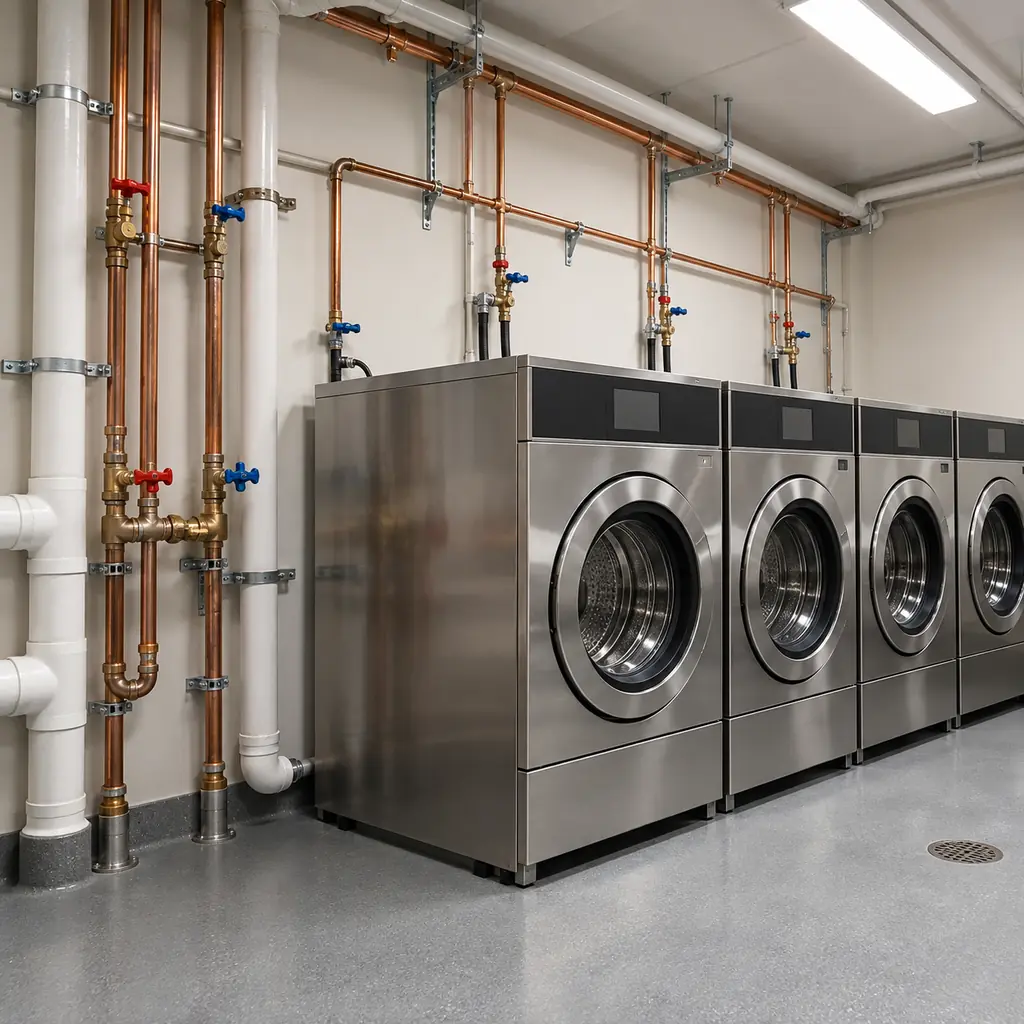
Choose the Water Boundary Before Choosing Devices
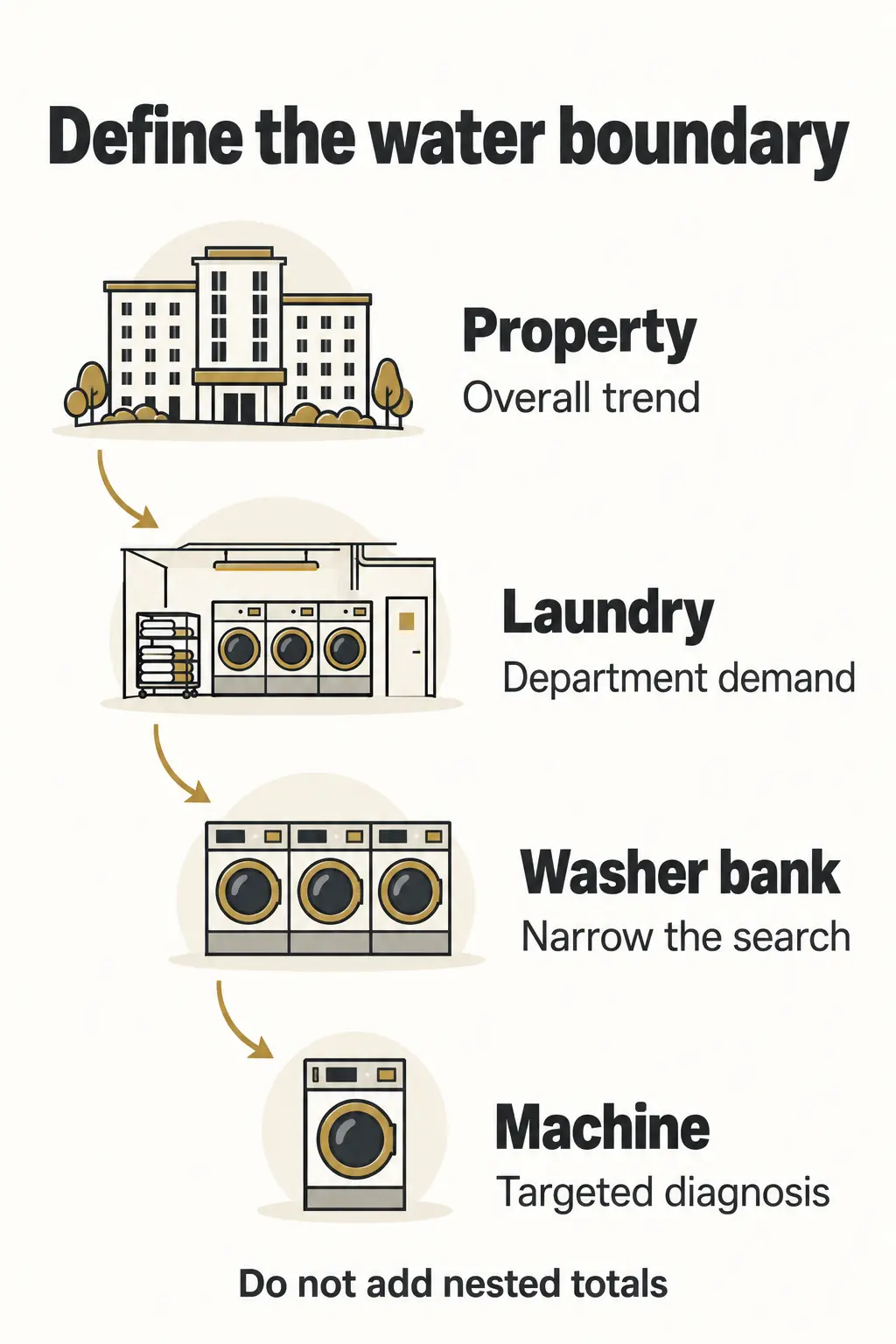
A laundry meter is useful only when the team knows exactly what passes through it. Define the boundary around the process you want to investigate: the entire laundry, one washer bank, or one troublesome machine. Then identify every supply crossing that boundary and any unrelated users included in the reading. The EPA’s metering and submetering guidance supports measuring specific end uses to identify equipment problems and follow water consumption. For a hotel, the practical design question is whether a reading can distinguish laundry demand from guest rooms, kitchens, cleaning, and other building loads. A whole-property trend is useful context, but it seldom identifies a particular washer.
Trace the supply paths and avoid double counting
If separate hot and cold branches serve the laundry, measure both when the objective is total incoming water. A cold meter alone will miss water arriving from the central hot-water system. If a dedicated heater is inside the selected boundary and all of its makeup water already crosses the cold meter, adding its hot outlet volume to that same total would count some water twice. Label each meter as a boundary total, a nested diagnostic point, or a separate source before building the dashboard.
Hot-water circulation also needs care. Caleffi’s explanation of single-loop recirculation describes circulation without a hot-water draw. Water passing around a supply-and-return loop is therefore not necessarily fresh water consumed by the laundry. A meter on a circulation leg should not be presented as laundry consumption. Where appropriate, locate the consumption measurement on a draw-off branch outside the circulation loop. If a supply-minus-return method is proposed, require an engineer to demonstrate synchronized readings and uncertainty at the small net flow being measured; subtracting two large, imperfect readings can obscure a small loss.
Recovered water introduces another boundary. Track incoming fresh water separately from recovered water delivered to washers. A decrease in fresh-water use can coexist with a leaking recovery-system makeup valve or an overflowing tank. Likewise, a reuse pump’s discharge volume does not equal water purchased from the utility. Agree on these definitions before comparing equipment or evaluating savings.
Choose the smallest useful monitoring level
| Monitoring level | Question it can help answer | Main limitation |
| Whole-property meter | Has the hotel’s overall water pattern changed? | Many simultaneous users obscure the cause. |
| Laundry supply boundary | Is the laundry drawing unexpected water? | Shared washdown or treatment loads need context. |
| Washer bank or dedicated branch | Which group contains the abnormal demand? | More than one machine can still contribute. |
| Individual machine supply | Does this washer draw water at the wrong time? | All relevant feeds and machine state must be included. |
These levels are alternatives for diagnosis, not volumes to add together. A machine meter is normally nested inside its bank and laundry totals.
Start with boundary monitoring when several washers share a clear supply and staff can investigate promptly. Add bank or machine meters when repeated faults, concealed drains, critical production, or slow fault isolation justify them. A temporary compatible flow logger can help test that decision before a permanent installation, provided its limitations at the actual pipe and flow conditions are understood. A small accessible laundry may gain more from dependable zone monitoring and a tested response than from a large number of poorly maintained instruments.
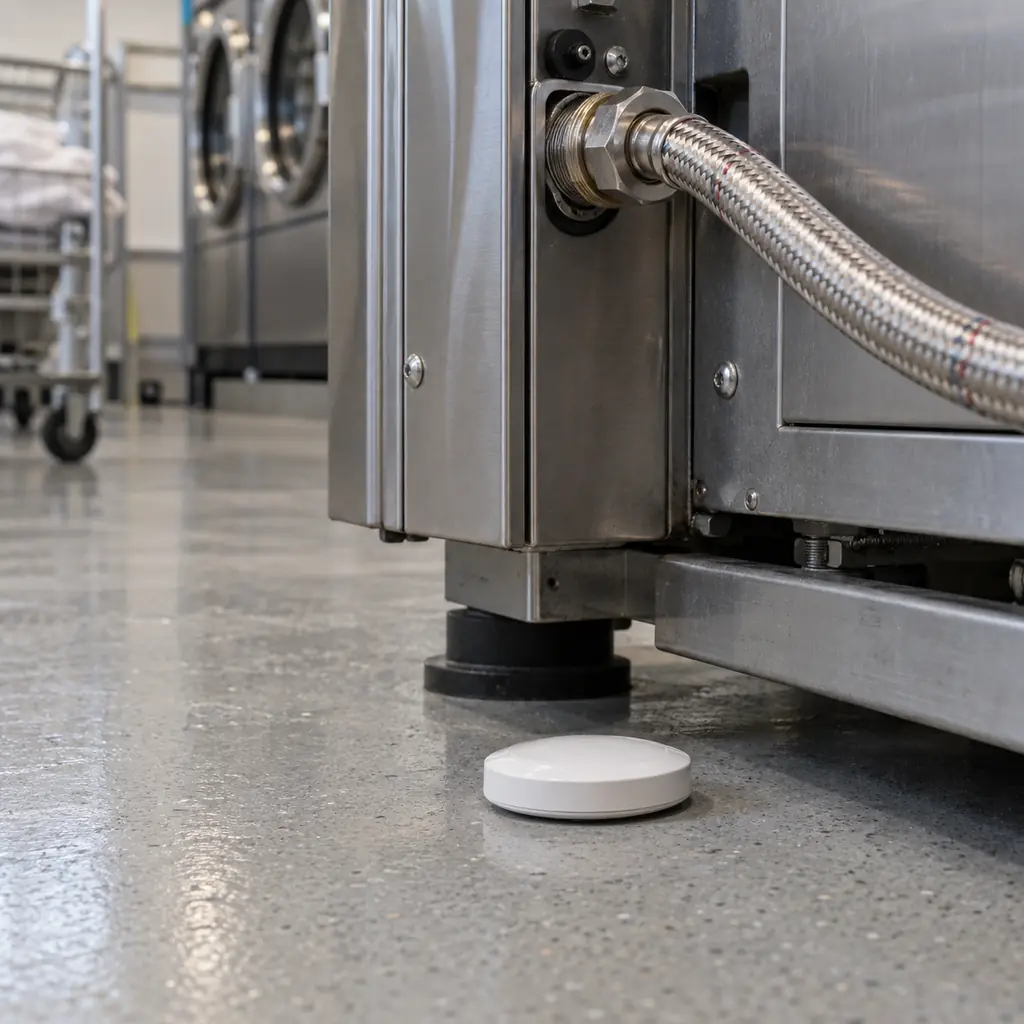
Match Each Valve and Meter to a Failure Mode
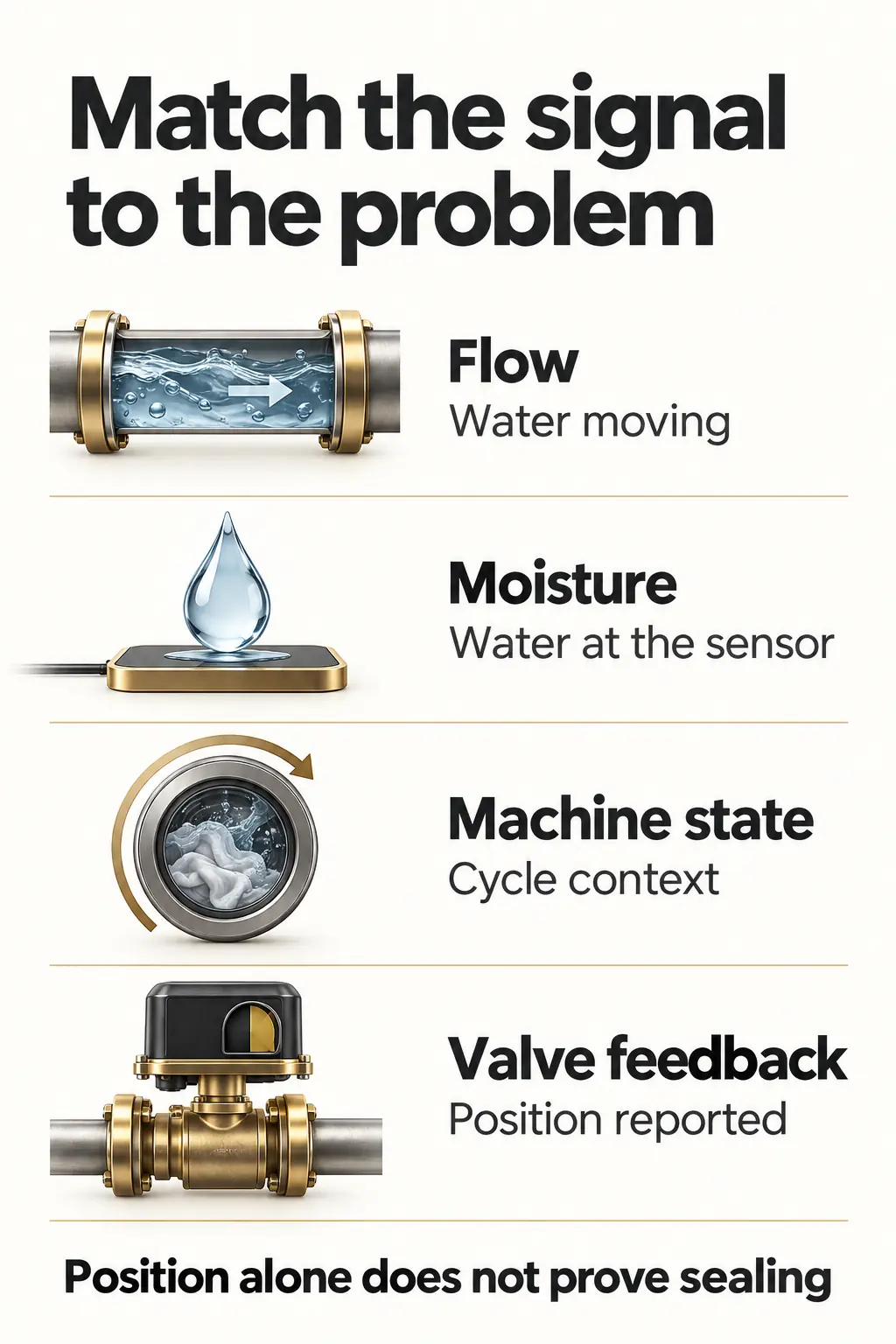
Prioritize points where failure is difficult to see, costly to leave unattended, or hard to isolate. Include washer inlet valves and hoses, drain valves that must retain water during the wash, the laundry’s isolation valves, and any tank makeup or recovery paths inside the selected boundary. The matrix below is a starting design aid, not a claim that every property needs every instrument. Choose the signal that answers the failure question, then decide whether continuous monitoring, existing controller data, or scheduled inspection is proportionate. Monitoring a valve’s electrical command alone does not demonstrate that water has stopped passing through it.
| Point or component | Evidence worth obtaining | What the evidence does not prove |
| Hot and cold laundry feeds | Incoming volume and flow with time stamps | Which downstream component failed |
| Washer inlet valve | Flow when no fill is requested; unexpected level rise | Whether the valve, controller, or another inlet caused it |
| Supply hose and coupling | Water presence along a credible leak path | Hidden discharge going directly to a drain |
| Washer drain valve | Level loss or repeat fills during a phase expected to retain water | That every drain flow during a cycle is abnormal |
| Motorized zone shutoff | Command, position feedback, and downstream flow response | That an indicated closed position is leak-tight |
| Manual isolation valve | Accessible identification and serviceability; position sensing only where the response requires it | Manual handle position does not prove the valve seals |
| Recovery tank makeup or overflow | Makeup volume, level trend, and overflow indication | The quality or suitability of recovered water |
| Softener or filter branch | Regeneration or backwash state with flow duration | That scheduled treatment flow is a leak |
| Bypass around monitored equipment | Known valve state and the actual alternate route | That closing the main path removes every supply |
Hidden valve leakage needs process evidence
A leaking inlet valve may allow water into an idle washer. Depending on the machine and drain state, water may accumulate or leave through the drain. A drain valve that does not seal can allow loss during a phase intended to retain wash liquor, prompting additional filling or a fault. The Dexter washer troubleshooting guide lists an open drain valve among the possible causes when incoming water does not raise the level, along with other fill-related checks. Its troubleshooting instructions apply to the equipment covered by that guide; use the exact service documentation for the installed model.
A high fill total is a reason to investigate, not a diagnosis by itself. Changed recipes, additional rinses, load mix, low inlet pressure, restricted strainers, or level-sensing problems can also change the observed behavior. Correlate meter data with a machine’s cycle phase, level, and fault history where the manufacturer provides those signals. Do not infer a failed drain merely because discharge occurs: draining is normal at particular stages of a wash program.
Water sensors complement flow measurement
Place spot sensors where water from vulnerable connections will actually collect, or use compatible sensing cable along a likely travel path. Consider floor slope, curbs, drip trays, drains, washdown, and access for cleaning. A sensor beside a washer can remain dry while water runs behind the machine into a floor drain. One sensor in the middle of a large laundry is not equivalent to room-wide coverage.
The EPA guide to leak detection and flow monitoring devices distinguishes moisture sensing from flow monitoring. Written primarily for homes, it is useful for understanding those detection principles; commercial laundry suitability still depends on the selected device, temperature, flow range, environment, and control design. Pressure or temperature signals may add diagnostic context, but they should not be described as proof of a particular leak without corroborating evidence.
Specify measurement performance at both ends of the range
Ask for the smallest flow the proposed meter can measure with stated accuracy, its starting or detection flow, its maximum operating flow, and pressure loss at the expected peak. These are different specifications. An instrument may show that movement has started below the range in which its volume accuracy is guaranteed. Select a hot-water-rated meter where needed, and verify water quality, pipe material, installation orientation, straight-run requirements, service access, and compatibility with the manufacturer’s instructions.
Low-flow visibility can also be lost in the reporting chain. PNNL’s Water Metering Best Practices documents how coarse pulse increments can obscure small uses. Consider an illustrative meter output of one pulse per 10 US gallons. At a steady 0.10 gallon per minute, accumulating a full pulse takes 100 minutes. The first pulse may arrive sooner depending on the starting counter position, but a short period without a pulse cannot establish zero flow. Polling the logger every minute does not improve that underlying resolution. Ask the supplier to demonstrate the complete meter, output, logger, and alarm performance at the smallest leak the hotel wants to detect.
Set Alarms Around Real Laundry Operation
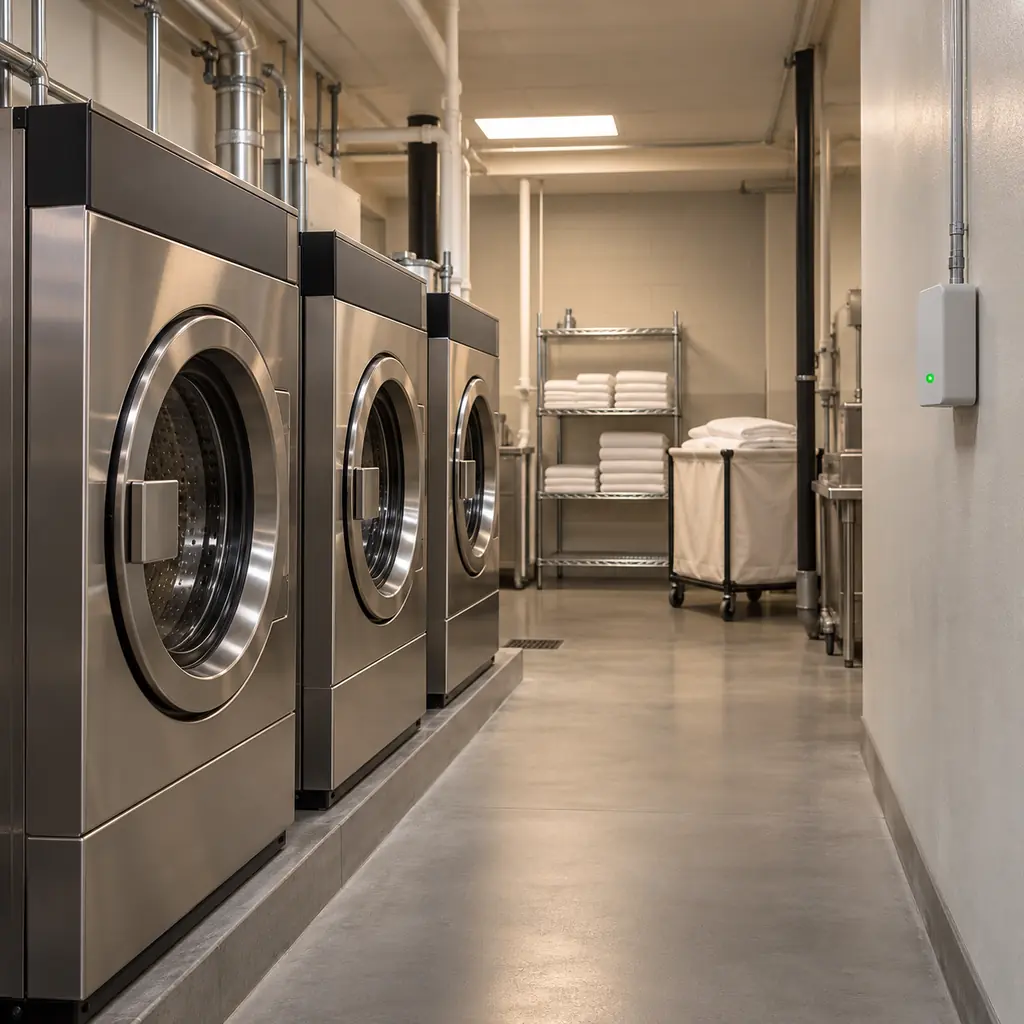
Useful alarms compare water behavior with an operating state, not just the time of day. A hotel may wash linen overnight, while a closed laundry may still have scheduled softener regeneration, tank replenishment, or cleaning. Establish representative normal patterns before setting persistence times and limits. Record washer programs, overlapping fills, service activities, and known background demand. The EPA’s leak detection and repair guidance recommends monitoring unexpected use and investigating it. The alarm examples here translate that principle into laundry decisions; they are proposed design logic, not universal settings or manufacturer-approved control sequences.
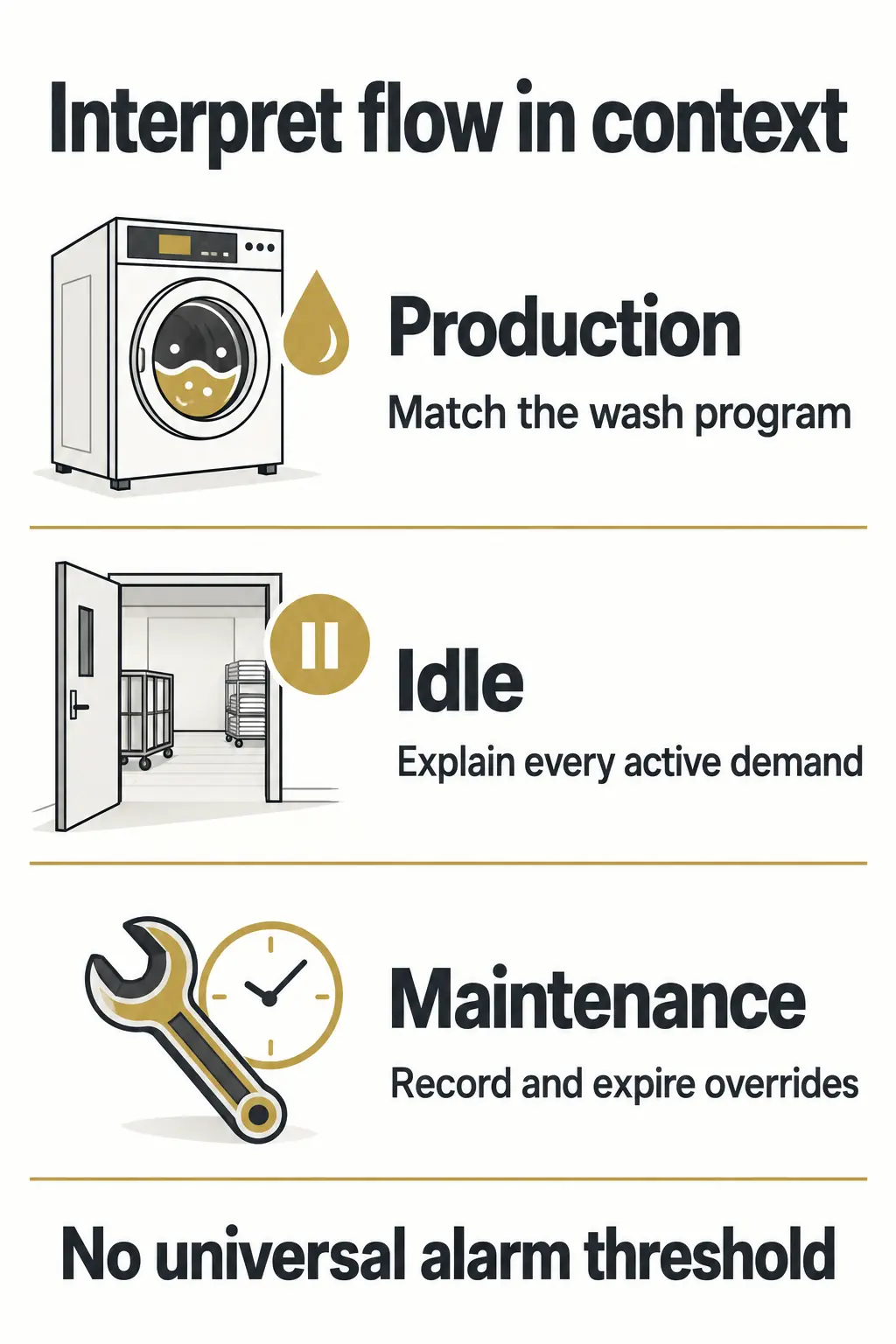
Separate operating, idle, and maintenance states
During production, compare a washer’s demand with the phase that should permit filling and the expected volume range for that program and load category. At a bank meter, allow for multiple simultaneous fills. A threshold below normal combined demand will create avoidable alarms, while a threshold set only for peak demand may miss a small continuous loss.
During a verified idle period, investigate sustained flow that cannot be explained by authorized users inside the boundary. A useful idle rule might combine no machine fill requests, no approved treatment cycle, and measured flow persisting beyond a commissioned interval. The interval must account for resolution, delayed signals, and normal transitions. Do not label all nighttime flow at the main hotel meter as leakage.
Maintenance mode should have an owner, an expiry time, and a visible record. An indefinite alarm bypass can erase the protection the hotel purchased. Continue recording available data while notifications or automatic actions are temporarily suppressed, and make the return to normal monitoring explicit.
Assign a response to each alarm class
A persistent consumption anomaly usually calls for investigation and targeted maintenance. Water detected where flooding could spread may need urgent notification and an approved local isolation action. A shutdown command followed by continuing downstream flow needs escalation because the valve, bypass, alternate feed, or measurement may not be behaving as expected. Treat missing data, a low sensor battery, or a stale time stamp as a monitoring fault. A silent or disconnected device is not evidence that the laundry is dry.
The message should identify the location, measured condition, time, affected equipment, and required next action. Route it to the person covering that shift, with a second route if it is not acknowledged. The team should be able to distinguish “someone saw the notification,” “water was isolated,” and “the underlying cause was repaired.” Those are separate outcomes.
Use a transparent loss estimate to prioritize investigation
For a suspected steady loss, estimated volume equals measured excess flow multiplied by the time it persists. Suppose an investigation confirms an additional 0.20 US gallon per minute for 12 idle hours each day. That equals 144 gallons per day. If it continued every day for a year, it would total 52,560 gallons. At an illustrative combined variable water and sewer rate of $14 per 1,000 gallons, the annual variable charge would be $735.84.
This example is arithmetic, not a typical hotel leak or a savings promise. Replace every input with the property’s measured duration, rate schedule, and billing basis. Hot-water losses may also waste heating energy, but calculate that separately from the actual temperature rise and plant performance. Avoid counting fixed charges as avoidable savings. Damage exposure, interrupted linen production, and response time may justify monitoring even where the water-bill calculation alone is modest.
For ongoing comparisons, relate laundry water use to the same defined linen workload and program mix. A heavier production day is not automatically a leak. If using water per accepted dry pound, define accepted output consistently and treat rewash separately so an operating change does not masquerade as a valve fault.
Specify and Commission a System Staff Can Act On
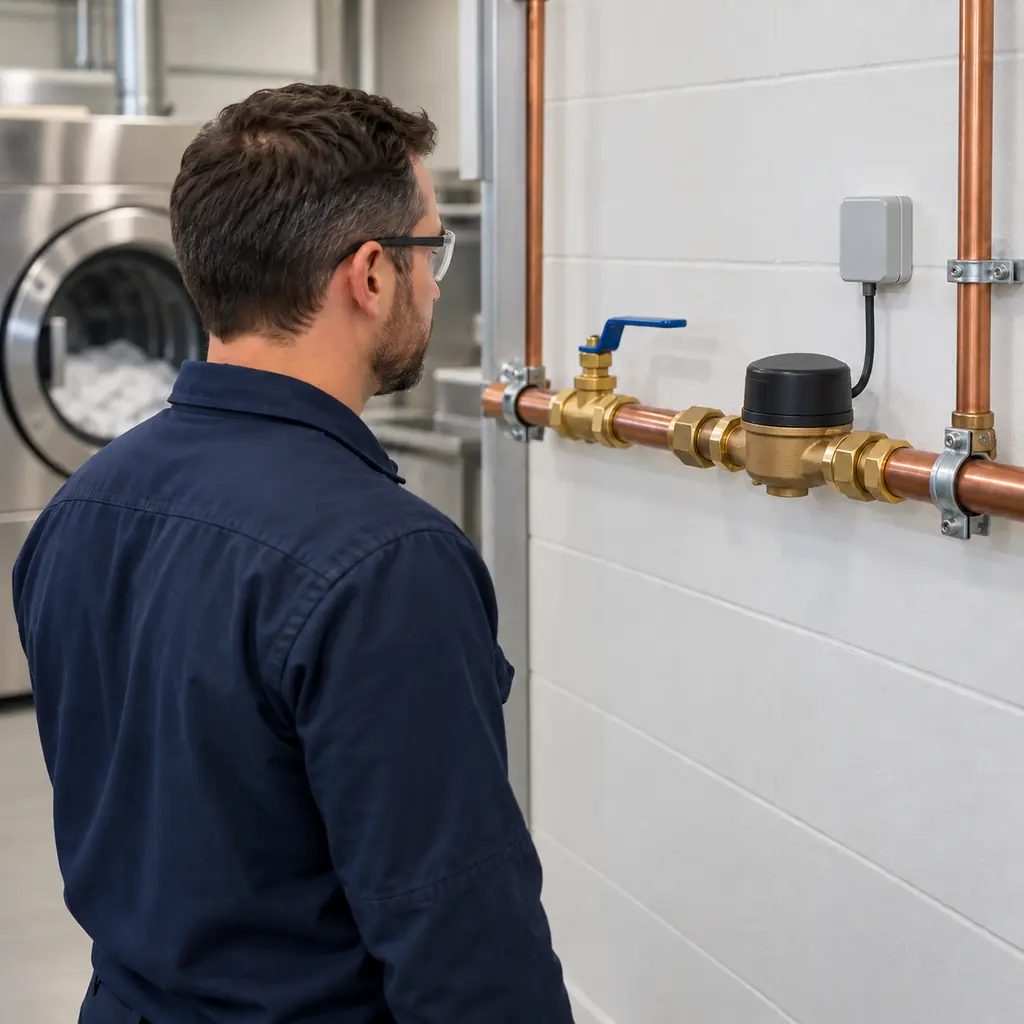
Buy an operating arrangement that includes detection, interpretation, notification, and a proven response. The supplier’s scope should identify which water paths are monitored, the failures each point is intended to reveal, and what happens when a signal or power source is lost. Automatic isolation deserves a separate engineering review because a laundry can have multiple feeds and equipment that cannot simply resume an interrupted process. Decide the safe shutdown boundary and restart authority before ordering actuators. A proposal that lists meters and sensors without an alarm owner, acceptance test, or service plan leaves the most consequential parts of the project unresolved.
Choose an appropriate isolation boundary
Where feasible, a dedicated washer or bank isolation arrangement can contain an event while preserving unaffected production. Confirm that it addresses all feeds to that area, including hot water and any alternate supply. A closed cold-water valve does not isolate a washer that still has an open hot-water connection. Account for trapped water, storage tanks, and the time required for residual flow to cease; isolation does not remove water already released.
Have the responsible designer and equipment service provider establish valve ratings, pressure loss, actuation time, water-hammer implications, manual access, and the required state after power loss. Fail-open and fail-closed designs have different consequences; neither is universally correct. Automatic laundry controls must not inadvertently interrupt fire protection, shared critical plant, or other services outside their approved scope. Do not cap a relief discharge or defeat a safety device to eliminate an alarm.
Use manufacturer-supported interfaces for machine interlocks. An external signal should not bypass the washer’s own level, door, or other safety controls. The restart procedure should address interrupted wash formulas and linen disposition, not only reopening a valve. The Alliance washer-extractor programming manual illustrates why controller-specific behavior matters: fill and drain diagnostics depend on the covered machine and control system. Before ordering additional instruments, ask the service provider which built-in leak tests the installed model supports, whether they are enabled, and how their results can inform the monitoring plan. The cited manual is a model-specific example, not a generic authorization to modify another washer.
Make the quotation testable
Give suppliers a marked piping layout, washer make and model, water temperatures and pressures, likely minimum and peak flows, existing meter outputs, communication requirements, and the hours during which staff can respond. State whether the intended outcome is early warning, automatic isolation, water accounting, or a combination. Include the shortest useful detection time and the smallest target loss, and ask suppliers to explain how their entire signal chain can meet both.
Require a point schedule that distinguishes measured flow, cumulative volume, valve command, position feedback, water presence, and device health. Specify units explicitly, particularly US gallons versus Imperial gallons, and agree on time stamps, retained history, downloadable records, and who owns the data. For building management system integration, ask for the actual supported interface and point mapping. A statement that equipment is “smart” or “BMS compatible” is insufficient.
Compare installed scope and recurring costs: pipework changes, power, gateways, connectivity, subscriptions, battery replacement, calibration or verification, spare parts, training, and service access. Confirm performance during a network outage. Local detection, local valve control, remote alerts, and cloud history may have different dependencies, so require a demonstration of each function that is part of the purchase.
Witness the complete response before acceptance
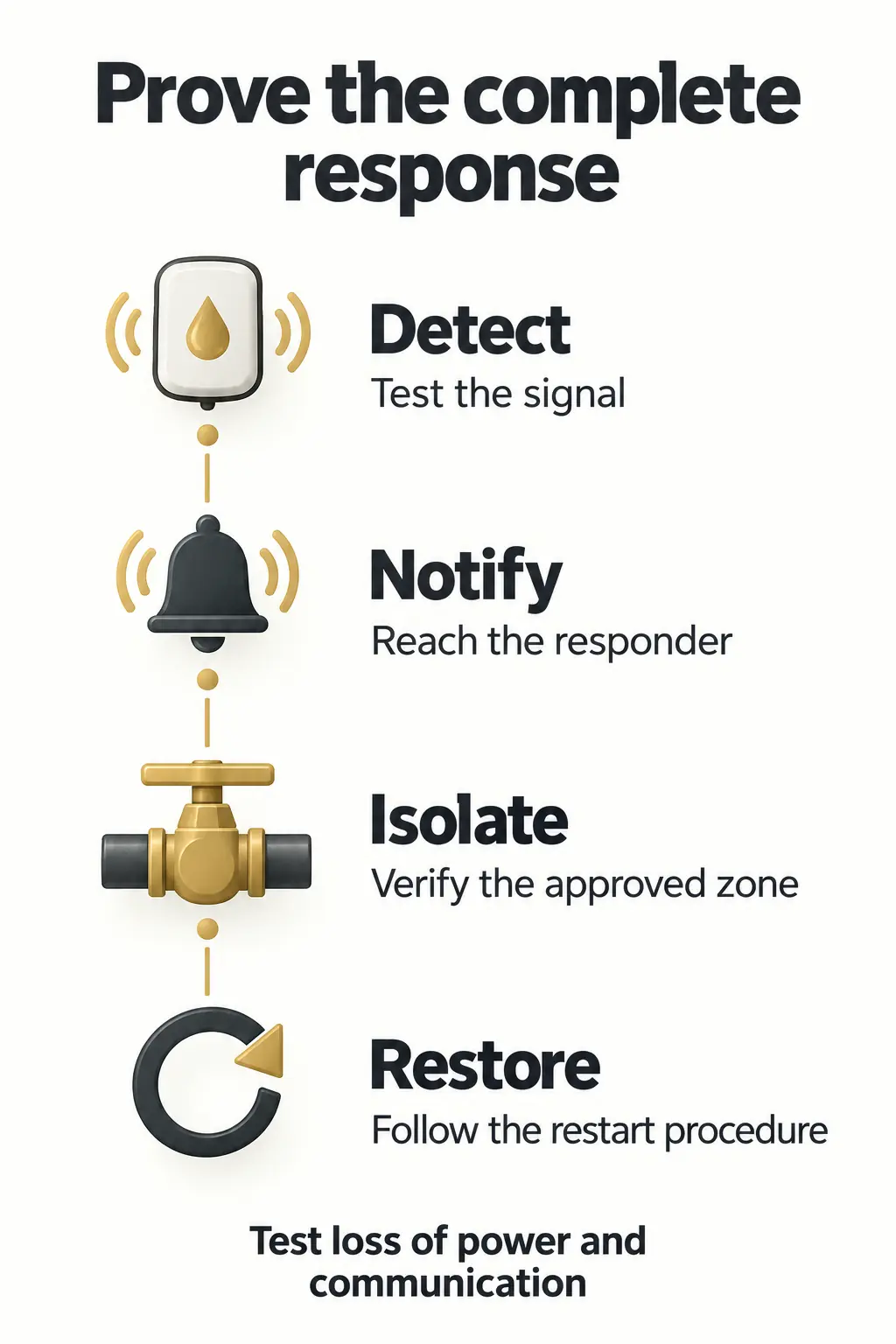
Commission with authorized personnel using safe, controlled tests. Confirm that a known volume is recorded in the correct units and that both small and representative production flows are visible. Prove the water-sensor path using the manufacturer’s prescribed test method. Verify that the notification reaches the on-duty recipient and escalates as agreed. Where automatic closure is included, witness the correct valve actuation and downstream response without interrupting unrelated services.
Also test a disconnected sensor or lost communication and verify the monitoring-fault notification. Document power-loss behavior, the manual override, and the controlled restart. Do not create a real hose rupture or release uncontrolled water to demonstrate the system. Retain the results, approved settings, device locations, and service responsibilities so later maintenance staff can reproduce the checks.
After a repair, compare a matched operating condition and repeat the relevant isolation or detection test. Reset baselines after legitimate equipment or program changes, with the reason recorded. Keep laundry response equipment coordinated with the property’s housekeeping and janitorial supply program, including suitable spill response tools and clear access to service points.

Conclusion
Prioritize the laundry water boundary, concealed loss paths through washers, vulnerable connections, and valves responsible for isolation. Add monitoring when its signal will change a decision: locate a fault, shorten response time, verify closure, or explain consumption. Combine flow data with machine state and water-presence sensing where the failure demands it, and prove the response under realistic operating conditions. The result should be a defined scope with known limitations and named responsibilities. For a sourcing discussion, send KW Hospitality a laundry equipment RFQ with the piping layout, machine list, operating schedule, required signals, and intended alarm or isolation outcome so supplier proposals can be compared on the same basis.
Frequently Asked Questions
Can an existing utility meter replace a laundry submeter?
Sometimes it can reveal a large change or support initial investigation, especially if interval data are available. It usually cannot isolate laundry demand from the hotel’s other water users. Check what the utility actually measures and when the hotel receives the data. Use a laundry submeter when attribution or response timing requires more detail than the utility service provides.
Does every washer need its own water meter?
No. Dedicated machine meters are most useful where a shared reading cannot locate recurring losses, machines have hidden drain paths, or identifying the affected washer quickly has high operational value. A bank meter plus controller data may provide enough information. Include every relevant feed and assess installation and maintenance costs before choosing the measurement level.
Is a zero reading proof that the inlet valve is sound?
No. Flow may be below the meter’s detection range, the output may be too coarse for the observation period, or the data may be stale. Water may also enter through an unmetered feed. Verify the instrument and boundary first, then use the installed machine’s approved diagnostic method to evaluate the valve.
Should every leak alarm close the water automatically?
No. A consumption anomaly may warrant investigation, while a confirmed water release in a vulnerable location may justify an engineered automatic response. The decision depends on consequences, false-alarm risk, affected services, equipment requirements, and staffing. The selected closure and restart sequence must be approved for that installation and tested before use.
Can a clamp-on flow meter be used without cutting the pipe?
Some ultrasonic meters support external installation, which can be useful for a survey or retrofit. Suitability still depends on the model, pipe material and size, fluid conditions, available installation position, and the required low-flow performance. A convenient installation does not guarantee detection of the smallest target leak. Ask for evidence under the site’s conditions.
How often should sensors and shutoff valves be tested?
Follow the device and equipment manufacturers’ requirements and the property’s maintenance and risk plan. Establish documented functional checks at commissioning, repeat affected checks after repairs or configuration changes, and set a recurring interval appropriate to the environment and consequences of failure. There is no single interval that can be applied responsibly to every hotel laundry.
References
1. U.S. Environmental Protection Agency — WaterSense at Work Section 2.1: Metering and Submetering
2. Caleffi — 2. SINGLE-LOOP RECIRCULATION SYSTEMS
3. Dexter Laundry — Common Washer Troubleshooting Solutions
4. U.S. Environmental Protection Agency — Know Your Flow and Curb Water Waste: A WaterSense Guide to Leak Detection and Flow Monitoring Devices
5. Pacific Northwest National Laboratory — Water Metering Best Practices
6. U.S. Environmental Protection Agency — WaterSense at Work Section 2.2: Leak Detection and Repair
7. Alliance Laundry Systems — Washer-Extractor: Programming (F8208501ENR10)