
A compressor minibar is usually the stronger starting point when a hotel needs efficient cooling and dependable recovery after restocking. An absorption minibar deserves consideration when eliminating compressor noise is the overriding requirement. Neither choice should be approved from the technology label alone. The useful comparison is between complete models operating inside the furniture, room temperature, and service routine your property will actually use.
A refrigerator that performs well on an open showroom floor may struggle inside a poorly ventilated cabinet. A quiet compressor can become noticeable when a loose furniture panel vibrates. An absorption unit can avoid compressor cycling yet still miss the hotel’s beverage temperature target if heat cannot escape. These are purchasing and installation issues as much as equipment issues, which is why the mock-up room matters before a large order is released.
Start by defining the service: a stocked beverage minibar, a guest-use refrigerator, or a mixture of both. Then state the intended contents, usable bottle capacity, restocking schedule, permitted temperature range, and likely room conditions. Do not assume that a beverage minibar is suitable for fresh food or temperature-sensitive medicine. Those uses require a model explicitly intended for them and an appropriate operating procedure.
This guide compares the noise, energy, and cooling questions that hotel purchasing teams need to resolve. It also explains how to assess competing samples and turn the results into an RFQ. The evaluation method is a proposed procurement approach, not a report of product testing performed by KW Hospitality. Any cost example is illustrative. Use current data for the exact regional model and repeat the comparison under the same conditions before treating one offer as the better long-term choice.
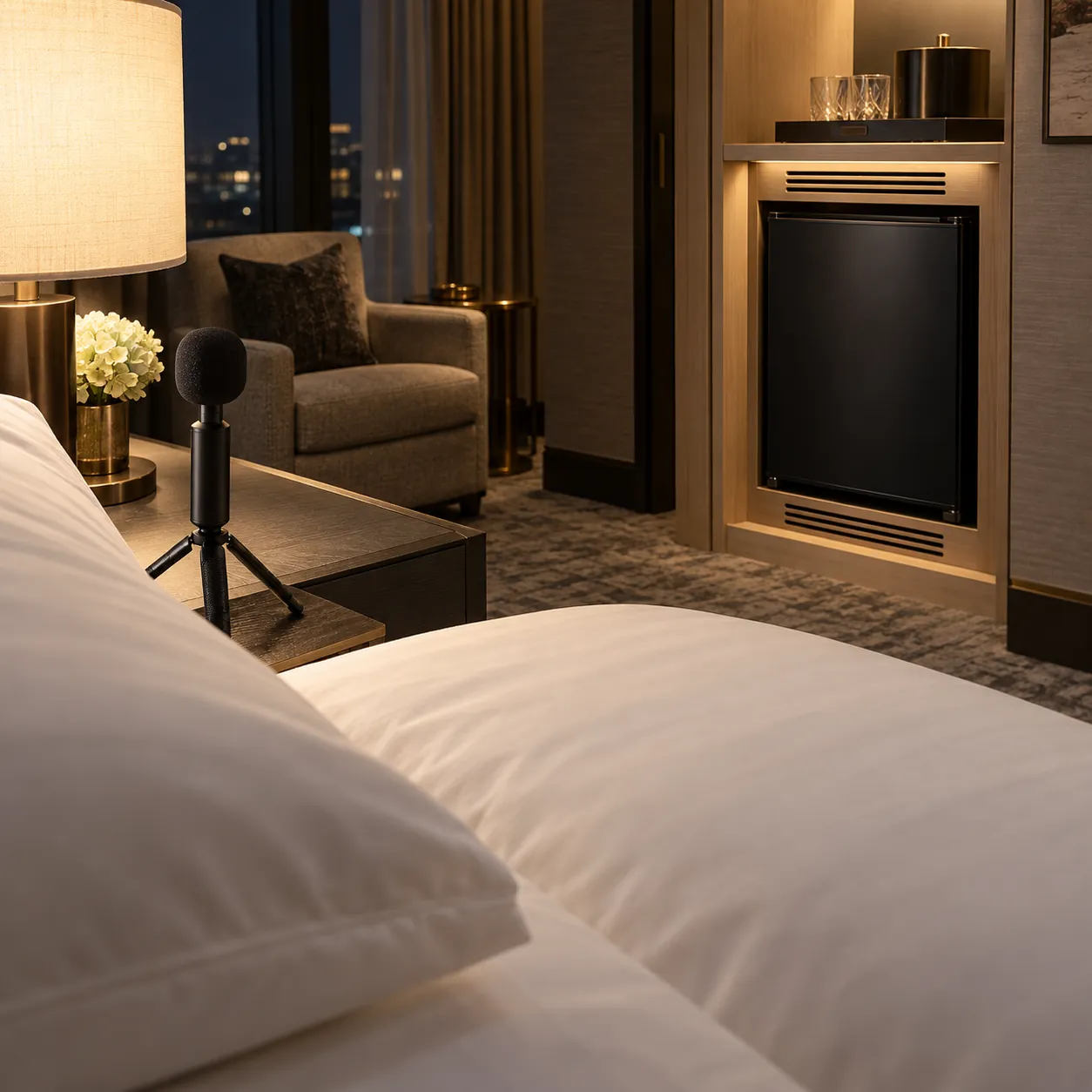
Compare the Cooling Systems and the Noise Guests Hear
Absorption cooling removes the mechanical compressor from the refrigeration process, which gives it a clear advantage when compressor cycling would disturb sleep. Compressor cooling uses a motor-driven refrigerant circuit and can introduce hum, vibration, or startup sounds, although the amount varies substantially by model. The decision is therefore not simply silent versus noisy. It is whether the complete installed appliance meets the room’s acoustic expectations throughout its operating cycle. A specification measured under laboratory conditions cannot describe every sound a guest may notice from a pillow beside a resonant cabinet.
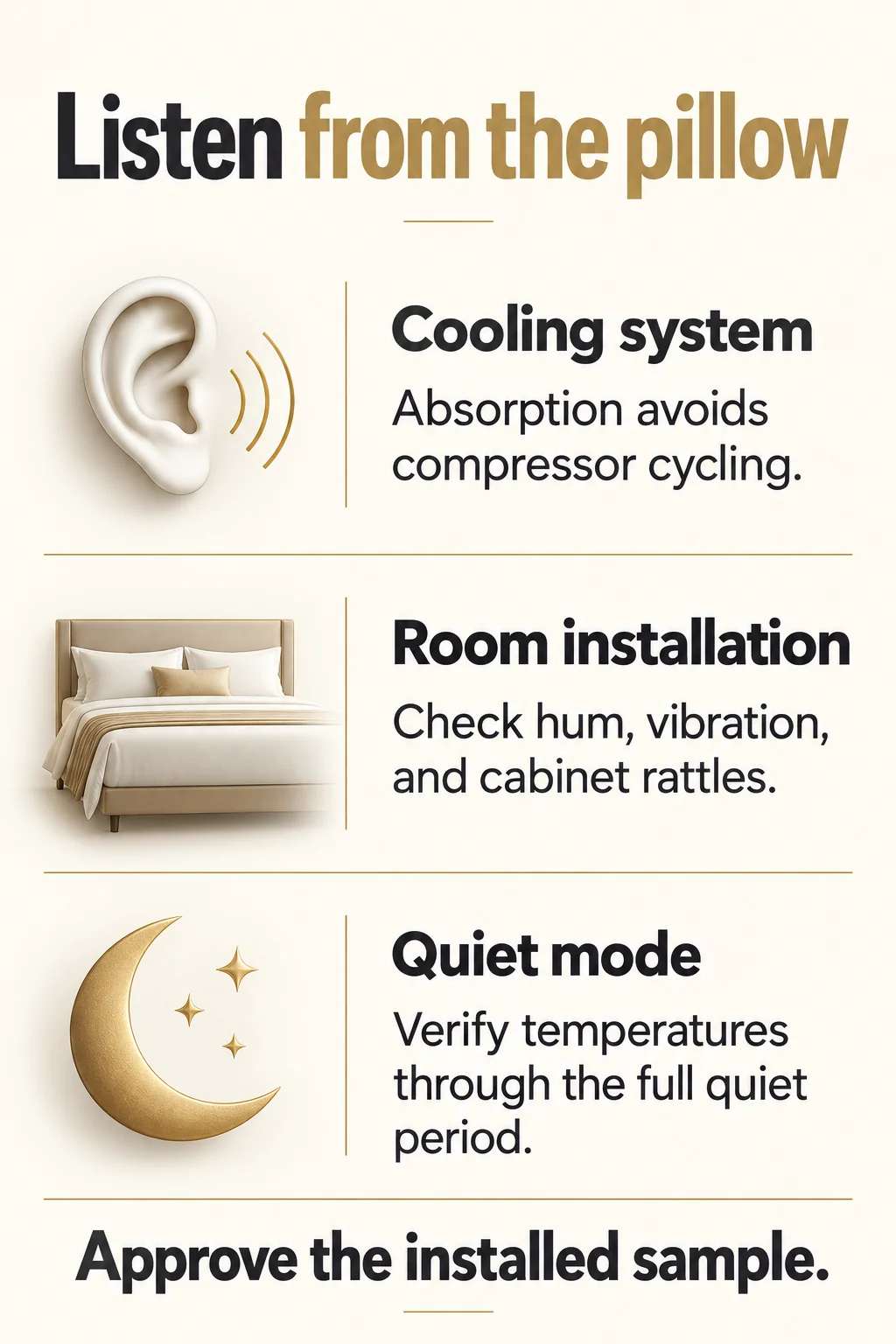
What changes inside the minibar
An electrically heated absorption system circulates a working fluid without a mechanical compressor. Many hotel absorption designs are effectively silent in normal operation. Confirm whether the proposed appliance includes a fan or other audible components; the cooling principle alone does not describe every part of the finished product.
A compressor system pumps refrigerant around a circuit to transfer heat out of the storage compartment. Efficient modern designs can operate quietly, but they should not automatically be described as silent while cooling. Thermoelectric minibars are a separate technology and should be identified separately in quotations, even when suppliers group all three under the same room-appliance category. Indel B’s hospitality technology overview distinguishes these three systems and describes the acoustic and efficiency priorities of its ranges.
| Decision factor | Compressor minibar | Absorption minibar |
| Primary acoustic concern | Operating hum, cycling, fans if fitted, and transmitted vibration | Check the whole appliance; no compressor cycle |
| Energy comparison | Often a strong candidate for lower consumption | May require more electricity for comparable service |
| Restocking demand | Often attractive where recovery demand is high | Validate recovery against the actual refill schedule |
| Installation dependency | Needs the specified heat-rejection path | Needs the specified heat-rejection path and leveling |
| Approval basis | Installed sample performance | Installed sample performance |
Compare acoustic measurements on the same basis
Ask what a quoted dB(A) value represents. Sound power and sound pressure describe different quantities: the former characterizes the source; the latter describes a measurement at a position and depends on distance and room conditions. These values are not interchangeable. Request the measurement standard, operating mode, and test arrangement before comparing two numbers. Do not interpret a published zero-noise claim as a guarantee that an occupied hotel room will have zero ambient sound.
For sample assessment, install the unit with its intended shelves, bottles, furniture door, and mounting arrangement. Listen from the nearest pillow position during a quiet period with the room systems in their normal overnight state. Observe startup, steady operation, shutdown, and any defrost or fan activity. A brief inspection while the compressor is off misses the relevant event.
If measurement is needed, use a suitable calibrated meter and record background sound with the minibar off as well as the operating condition. At very low levels, the instrument’s noise floor and the room background can dominate. A phone app can help document a noticeable rattle but is not a reliable way to certify a very low noise specification. Record audible tonal or intermittent disturbances alongside the measured level.
Treat silent mode as an operating schedule
Some compressor models offer a scheduled quiet period that suspends compressor operation; others use different control strategies. Ask what the specific mode actually does, how long it lasts, and what happens after a power interruption. If cooling pauses overnight, validate temperatures through that entire period and the following recovery. Cold-storage features, where fitted, do not remove the need to test the actual load. For example, Indel B’s description of Fridom’s Timer and Smart modes explains scheduled compressor operation and occupancy-based control; these features should not be assumed for every compressor minibar.
Absorption is worth shortlisting for exceptionally quiet bedrooms where compressor events remain unacceptable after proper installation. Compressor models deserve a fair trial where furniture isolation, room layout, and the tested operating sound meet the property’s standard. Avoid solving a noise complaint by adding unapproved insulation around a refrigerator; that can obstruct heat rejection.
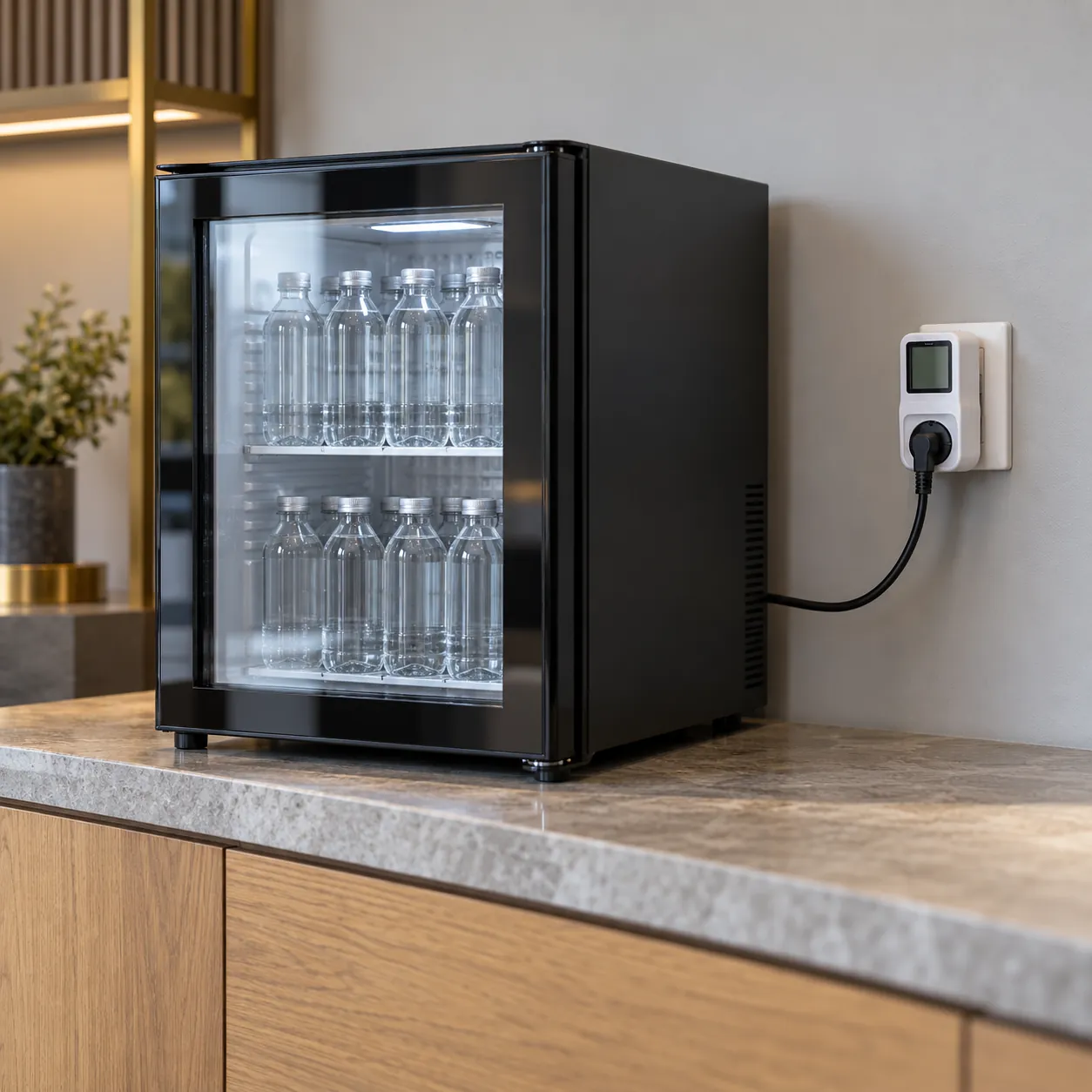
Compare Energy Consumption and the Cost per Room
Compare energy in kilowatt-hours over time, not just the wattage printed on a nameplate. Rated input power does not tell you how long a compressor will run, how a heater is controlled, or how the appliance responds to warm drinks and a closed cabinet. Compressor minibars often have an efficiency advantage, but a fixed percentage saving is not a dependable rule across different capacities, doors, climates, and settings. Use comparable declared data to shortlist models, then measure the finalists while they deliver the same useful cooling service.

Normalize the two offers first
Match usable capacity, door construction, intended temperature, climate suitability, voltage, and installation type. A glass-door display model and a solid-door unit are different offers even if both are sold as the same nominal liter class. Also distinguish gross cabinet volume from usable space for the hotel’s actual bottle and can mix. A larger shelf count does not establish equivalent capacity.
Request annual kWh or kWh per 24 hours with the applicable test conditions and the exact model identifier. Energy-label classes from different schemes or different generations should not be treated as directly equivalent. For a Canadian or US project, confirm that the documentation belongs to the supplied regional version rather than a similarly named export model. The U.S. Department of Energy’s test-procedure overview explains why specified measurement protocols underpin declared energy use and estimated operating costs.
Translate a daily difference into a property budget
Annual direct electricity cost equals daily consumption multiplied by energized days, the number of minibars, and the electricity rate. Use the portion of the tariff that actually changes with consumption. Fixed charges do not disappear when minibar consumption falls, and demand charges require a separate assessment.
| Illustrative input or result | Option A | Option B |
| Assumed daily energy | 0.25 kWh | 0.65 kWh |
| Energized units and days | 100 units × 365 days | 100 units × 365 days |
| Assumed energy rate | $0.15 per kWh | $0.15 per kWh |
| Annual direct electricity | 9,125 kWh | 23,725 kWh |
| Annual direct electricity cost | $1,368.75 | $3,558.75 |
These are invented comparison inputs, not measured results or claims about a particular compressor or absorption model. The difference is 14,600 kWh and $2,190 per year for the property, or $21.90 per room. Keep all amounts in one currency. If Option A costs $100 more per room installed, the simple electricity-only payback is about 4.6 years: $100 divided by $21.90. Maintenance, financing, replacement, and residual value are outside that calculation.
Measure after stabilization and under a repeatable load
For a practical procurement trial, allow each unit to complete the manufacturer’s prescribed stabilization period, then log energy over several representative days with a suitably rated meter. Keep the starting beverage load, refill quantity, door-opening pattern, room conditions, and temperature objective the same. Include a full scheduled quiet-mode cycle if it will be used. Report initial pull-down separately from routine operation so an empty-cabinet startup does not distort the comparison.
Log storage temperatures at the same time. A unit that uses less electricity while allowing drinks to remain warmer is not providing equivalent service. Record measured days and conditions rather than presenting a short trial as a guaranteed annual result. If the property operates markedly different summer and winter room conditions, model those periods separately.
Most electrical energy used by a minibar ultimately becomes heat in the surrounding space. That heat can affect room cooling demand, but the HVAC effect depends on season, controls, and system efficiency. Keep it separate from direct appliance savings unless the engineering team has modeled it. Likewise, use energized days rather than occupancy alone: an empty room’s minibar may still be running.
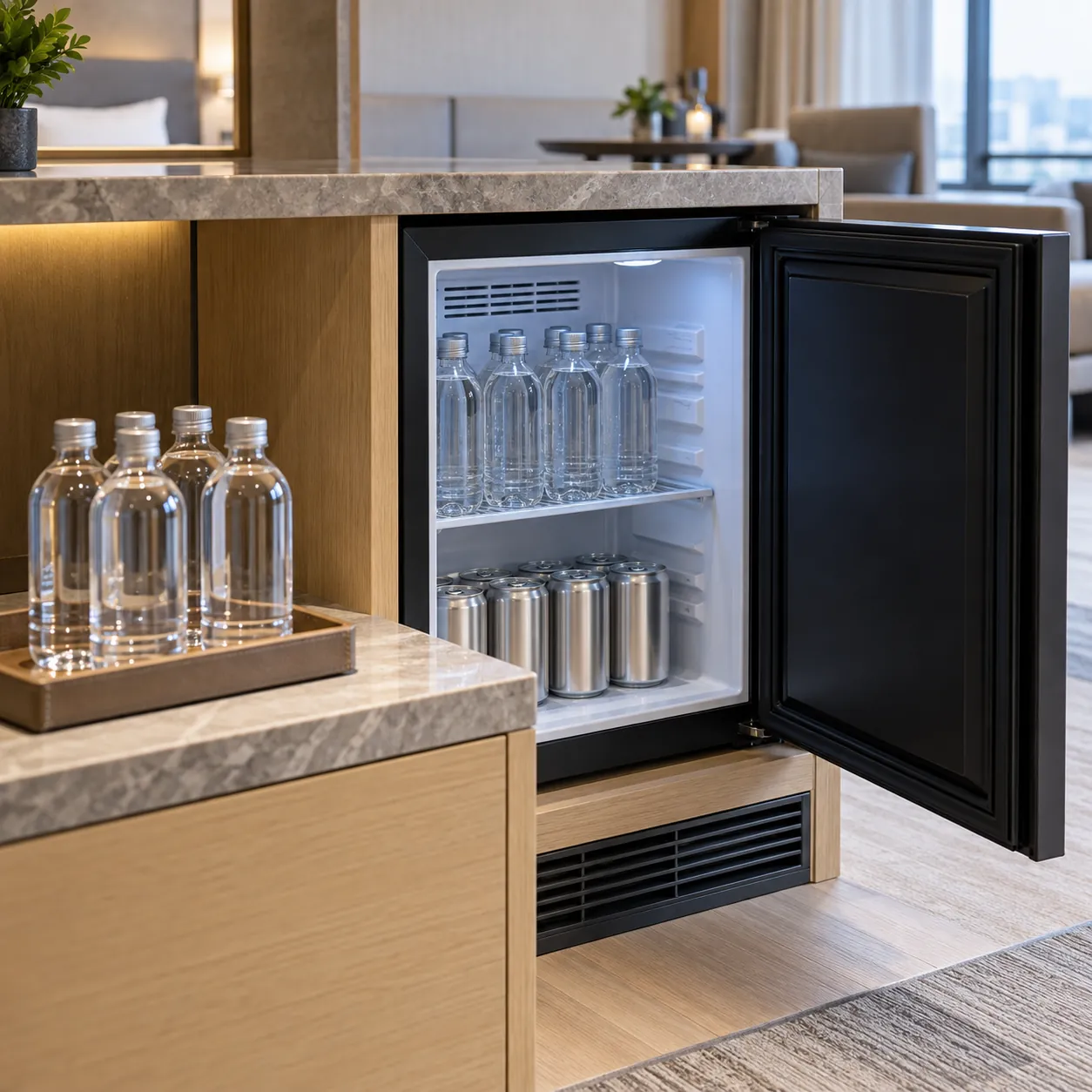
Match Cooling Performance to the Cabinet and Service Routine
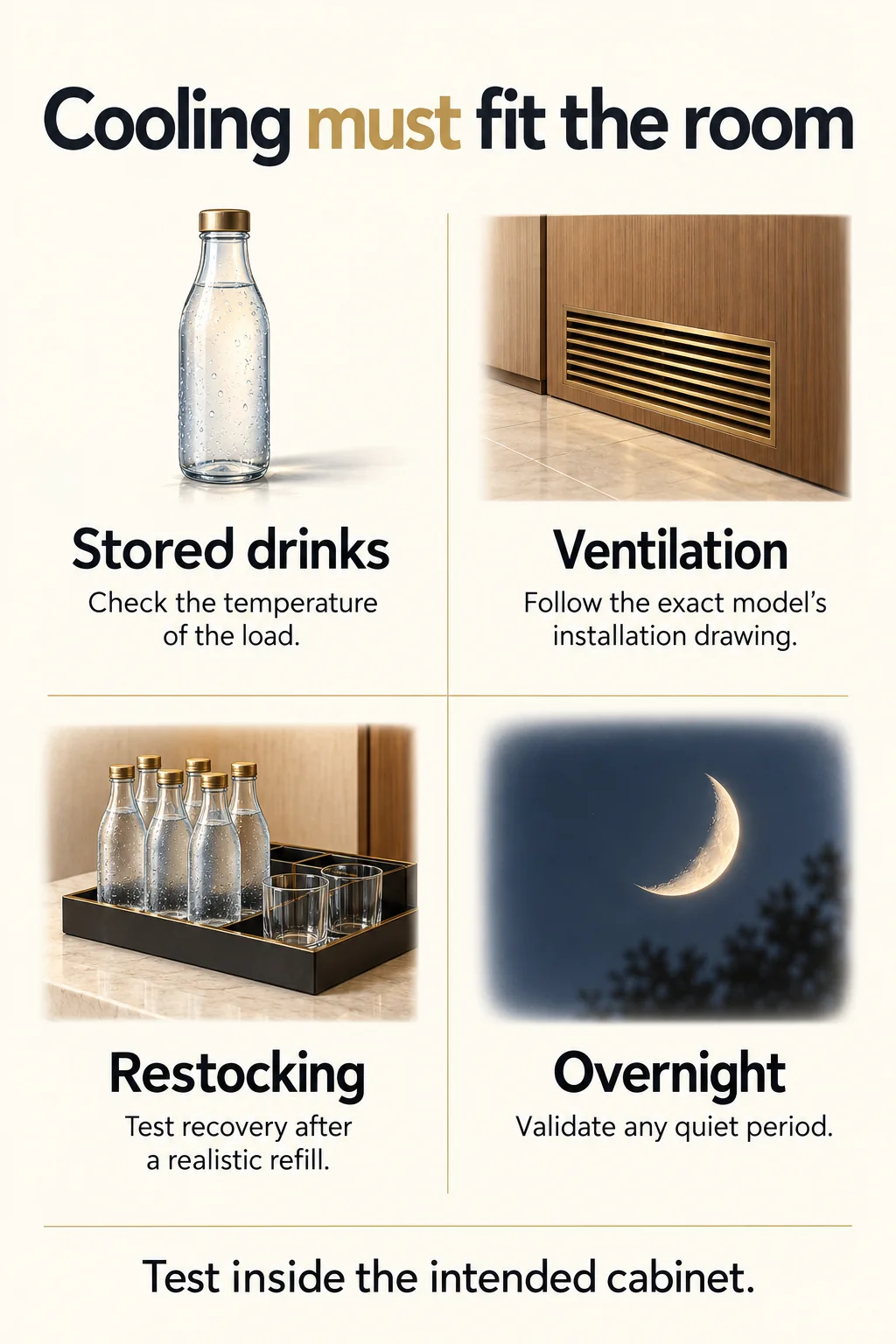
Approve cooling performance with the minibar installed as it will be used and loaded with the intended beverage assortment. The relevant question is whether it can reach and hold the agreed temperature, recover after routine refills, and remain acceptable through the hottest expected room conditions and any quiet period. Compressor models are often good candidates for demanding recovery schedules, while absorption models can serve beverage programs well when their capacity and installation suit the task. Neither technology compensates for blocked ventilation, an unsuitable ambient rating, or a service routine beyond the model’s capability.
Specify the contents and the acceptance target
Define the desired beverage temperature and the maximum acceptable recovery time before samples arrive. Distinguish a cool can already in storage from a room-temperature bottle added shortly before check-in. An appliance can maintain a settled load successfully yet recover too slowly after a large warm refill. A cold air reading beside the cooling surface does not establish that the warmest drink is ready to serve.
For a repeatable comparison, use identical sealed water containers as test loads and an appropriate calibrated temperature-logging arrangement. Position measurement points across representative storage locations without blocking circulation or compromising the door seal. Record liquid-temperature behavior or a suitable buffered measurement as well as room conditions. A single spot reading from the display is insufficient to describe the full storage cycle.
Keep acceptance criteria tied to the intended service. A beverage refreshment target is not automatically a safe storage specification for perishable food. If the property promises a guest refrigerator for groceries, choose a model explicitly suitable for that use and apply the relevant storage requirements. Do not market a general minibar as medication storage merely because it feels cold. For example, Dometic’s HiPro3000/4000/4000Vision/6000 manual excludes fresh-food and medicine storage for those models; check the intended-use section for the model being purchased.
Approve the ventilation drawing before the furniture order
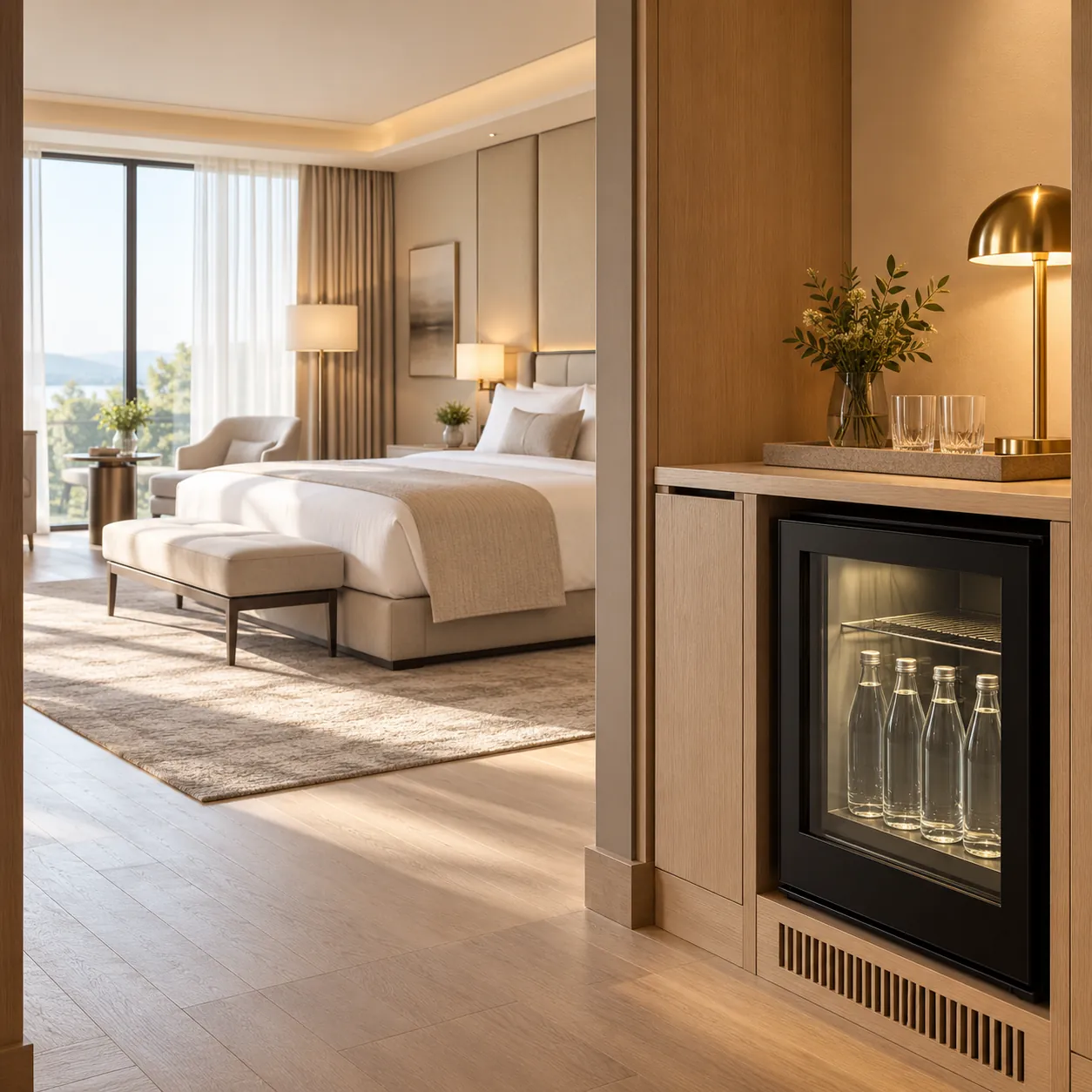
Obtain the installation drawing for the exact model. It should define the required intake, exhaust, clearances, and permissible cabinet arrangement. Vent openings need a continuous air path to the room; a gap that terminates inside a sealed furniture cavity is not an effective exhaust. Grille dimensions also differ from net free area because slats and screens restrict the opening. The installation section of the same Dometic HiPro manual illustrates a model-specific airflow route and clearances; its dimensions are not a universal minibar specification.
Do not copy a universal clearance from another minibar. One model’s rear gap or ventilation area may be inadequate for another. Keep heat sources away from the intake and prevent discharged warm air from repeatedly returning to it. Level and support the unit as instructed, allow the door to seal fully, and provide service access without dismantling the whole room.
Coordinate the appliance envelope and airflow route with the hotel’s hospitality FF&E specifications. The cabinet supplier and appliance supplier should approve the same drawing. Door swing, sliding hinges, handles, electrical access, and a furniture panel that can rattle are all worth resolving before replication across hundreds of rooms.
Use a trial that resembles a real guest day
Run each finalist in the same mock-up arrangement. Begin with a stabilized load, reproduce a realistic housekeeping refill, and record how long the agreed drink locations take to recover. Continue through the overnight operating schedule. Repeat under the warmest expected conditions that remain within the model’s permitted ambient range. These are proposed trial stages, not a standardized certification test.
| Observed result | Interpretation to investigate |
| Good cooling in the open; weak cooling in furniture | Heat-rejection path or cabinet conditions may be limiting performance |
| Air cools quickly; refilled bottles stay warm | Product recovery is the limiting requirement |
| Rattle appears only after installation | Mounting, panel resonance, or contact may transmit vibration |
| Temperatures drift during quiet mode | Off-period, load, or storage strategy may not suit the service |
| Energy falls while stored drinks become warmer | The two tests are not delivering equivalent cooling |
Retain the raw logs, conditions, configuration, and sample identification. Where feasible, test more than one unit of a finalist so approval does not depend entirely on one sample. A marginal result should trigger a specific change and repeat evaluation, such as correcting the cabinet exhaust path; it should not be averaged away by good results in an easier room.
Turn the result into an orderable specification
The final RFQ should identify room quantities, destination, required delivery date, exact supply voltage and frequency, contents, usable capacity, cabinet drawings, and the accepted operating targets. Request the relevant product documentation, installation instructions, warranty scope, service arrangement, and replaceable-parts availability. Confirm who pays for removal and reinstallation if a built-in unit needs service.
Record the approved regional model and any agreed control settings. Treat a supplier’s replacement model as a change requiring review, even when its exterior looks identical. Include cleaning access, door seals, shelves, and fan or condenser maintenance where applicable; a claimed low-maintenance cooling system does not make the complete minibar maintenance-free.
For a coordinated purchase, request a minibar sourcing quote from KW Hospitality with the room count, cabinet drawing, acoustic expectations, cooling targets, and destination. This gives the sourcing team a defined basis for comparing available options and arranging sample review. Resolve the appliance together with the surrounding guest room supplies so the finished room works as a complete service environment.
Conclusion
Choose a compressor minibar when the tested model meets the hotel’s acoustic standard and its energy use and recovery performance support the service plan. Choose absorption when eliminating compressor noise is decisive and the installed sample still meets the required temperature and operating-cost limits. The strongest purchase decision combines supplier documentation with a repeatable room trial and an approved cabinet drawing. Keep the exact model, operating settings, and acceptance conditions attached to the order so a successful sample becomes the standard for delivery rather than an isolated demonstration.
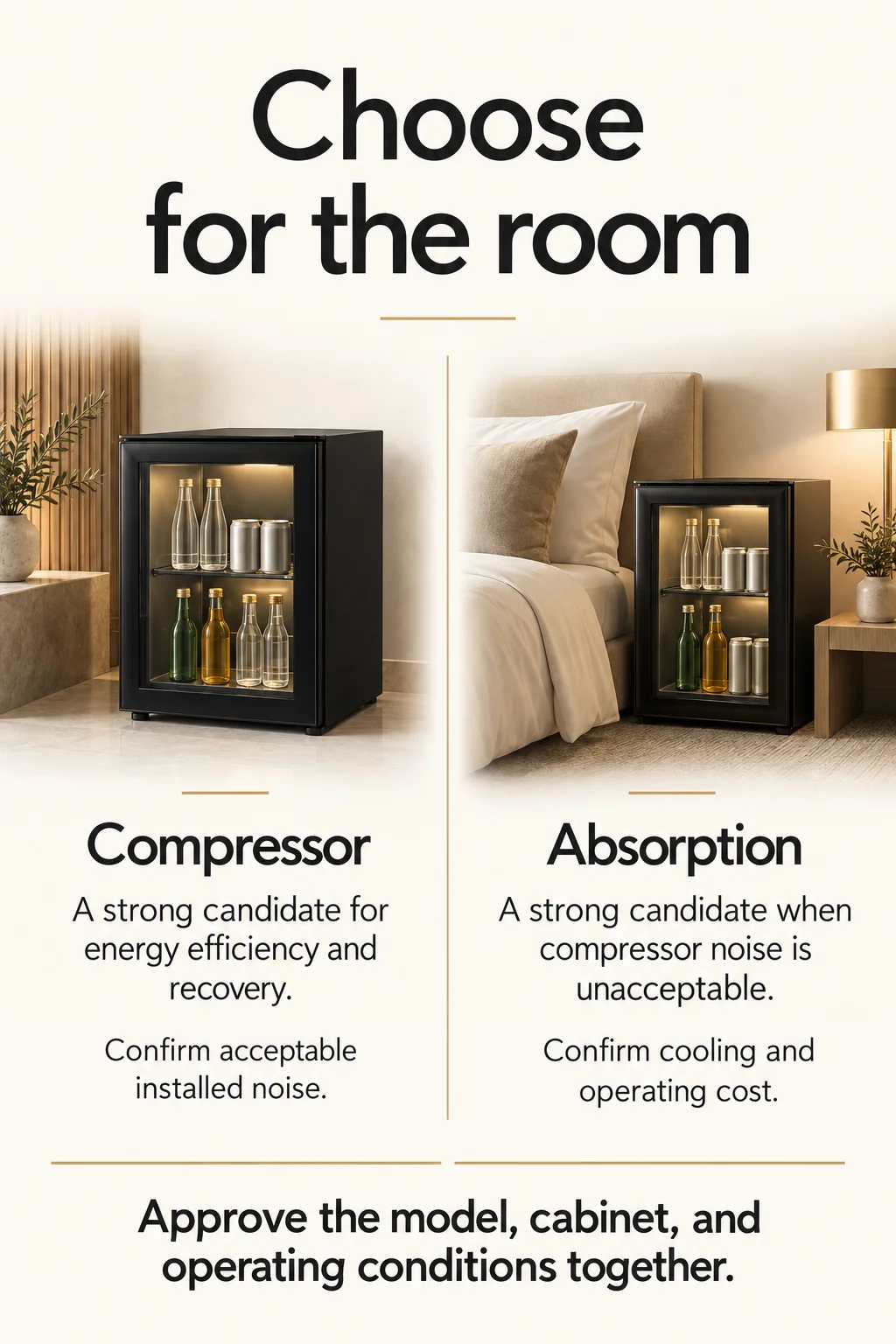
A low purchase price, a silence claim, or an energy label alone cannot settle the choice. Ask whether guests receive the intended cooling service, whether they can sleep comfortably beside the installation, and what that service costs over time. Those answers give the property a defensible reason to choose one technology or to use different models in different room types.
Frequently Asked Questions
Can a minibar be switched off by the room key-card system?
Only if that arrangement is compatible with the model and the hotel’s storage plan. A switched socket can leave beverages warm before arrival and interrupt quiet-mode schedules or other controls. Confirm the supply arrangement with the engineering team and test behavior after power returns. Use a continuously energized circuit when the approved service requires continuous refrigeration.
Does an absorption minibar need a gas connection?
An electric hotel absorption minibar does not need a gas connection; its absorption cycle can be driven by an electric heater. Do not confuse it with a gas-capable leisure-vehicle refrigerator. Confirm the power supply and installation requirements of the actual hotel model.
Will a glass door consume more energy?
It can change the thermal performance, but the size of the difference depends on the complete door and cabinet design. Compare declared energy and trial results for the specific glass-door and solid-door options at the same cooling target. Include display lighting and the intended operating schedule in that comparison.
Can staff fix a noisy compressor minibar by putting foam around it?
Do not enclose the appliance in improvised foam or block its vents. First investigate leveling, loose panels, contact with the furniture, and installation requirements. Use only mounting or isolation measures compatible with the manufacturer’s instructions, then repeat both the noise and temperature assessment.
Is replacing absorption with compressor always a direct swap?
No. Similar external dimensions do not establish matching ventilation, door swing, hinges, electrical requirements, or service access. Review the replacement model’s drawing and test it in the existing cabinet before ordering a property-wide conversion. Include cabinet modifications in the installed cost.
Should every room use the same cooling technology?
Not necessarily. A very quiet suite close to the minibar and an extended-stay layout with frequent warm refills can have different priorities. Standardize within a clearly defined room type where possible, then document the approved model and spare-parts plan for each variation. Avoid creating unnecessary model diversity without an operational reason.
References
Indel B — Hospitality
Brüel & Kjær — Introduction to Noise Measurements on Business Machines
Indel B — Fridom beyond the UTOPIA | SIA 2023
U.S. Department of Energy — Test Procedure Development and Revision
Dometic — HiPro3000, HiPro4000, HiPro4000Vision, HiPro6000: Minibar — Installation and Operating Manual