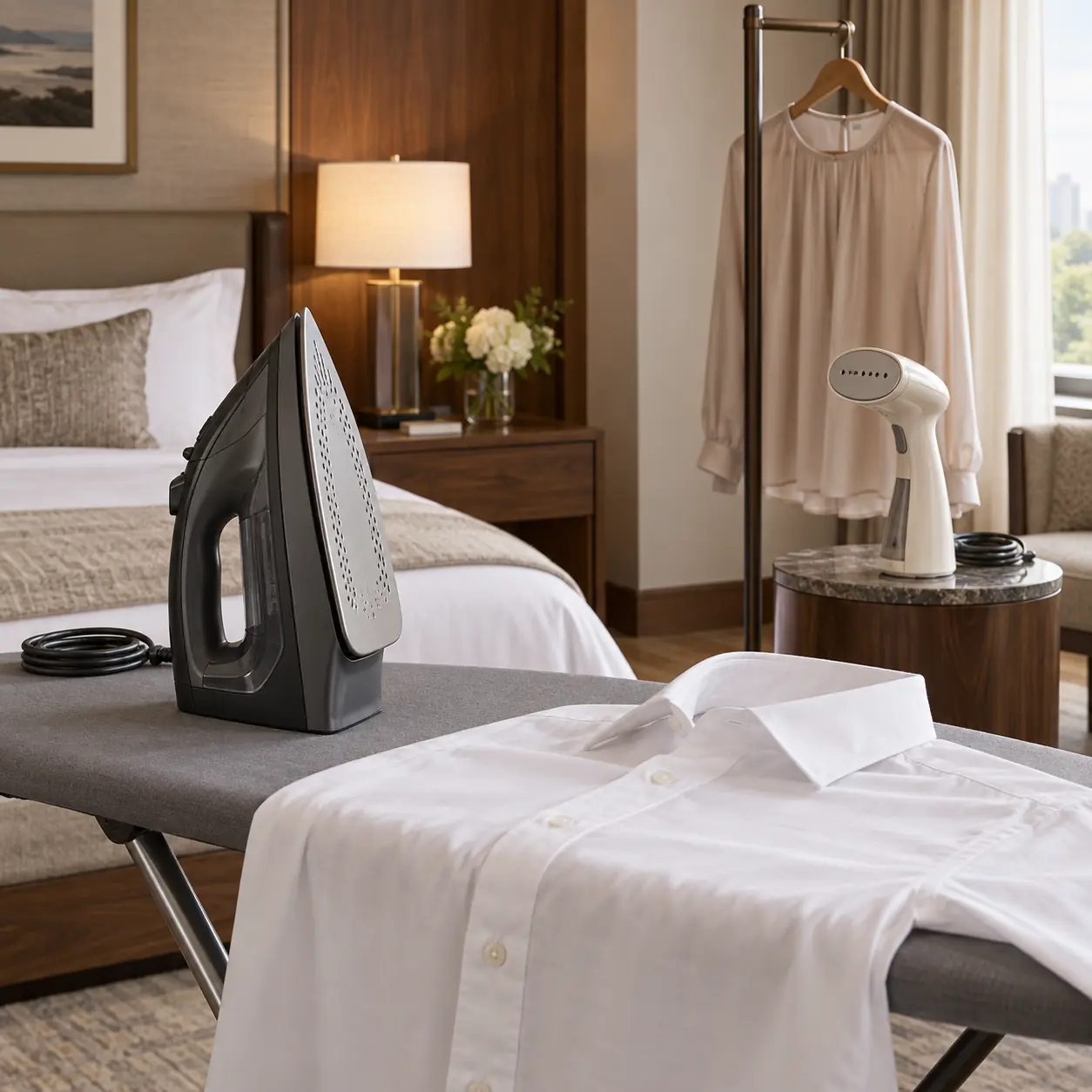
Choose an iron when guests need pressed collars, cuffs, or trouser creases and the room can accommodate an ironing board. Choose a handheld garment steamer when the main requirement is smoothing suitable hanging garments and the room has an appropriate place to hang them. In either case, approve the appliance together with its storage arrangement, operating space, and housekeeping routine. The smallest appliance is not automatically the easiest one to provide.
For hotel buyers, the comparison often begins with a shelf or drawer measurement. That is only part of the decision. An iron may fit neatly in a holder while its folded board obstructs the wardrobe. A steamer may occupy less shelf space but leave guests searching for a usable hanger, an outlet, or a safe place to put the hot appliance down. These problems emerge after installation, when replacing cabinetry or changing room standards becomes inconvenient.
Evaluate garment care as a complete room provision. Include the appliance, cord, plug, holder or pouch, any attachments, and the supporting board or hanging arrangement. Then consider the transition from storage to use and back again. An appliance that passes a static fit test can still fail when a guest tries to lift it past a shelf, route its cord, or return it before it has cooled.
This guide focuses on hotel guestrooms and the practical differences between irons and handheld steamers. Full-size standing steamers are treated as a separate service option because their base, pole, and hose change the storage requirement substantially. The comparison below helps purchasing, housekeeping, and engineering agree on a room-specific specification before ordering replacement stock or equipping a new property. Any dimensions in the worked example are illustrative planning assumptions, not universal clearances or specifications for a particular product.
Match the Garment Task to the Complete Room Kit
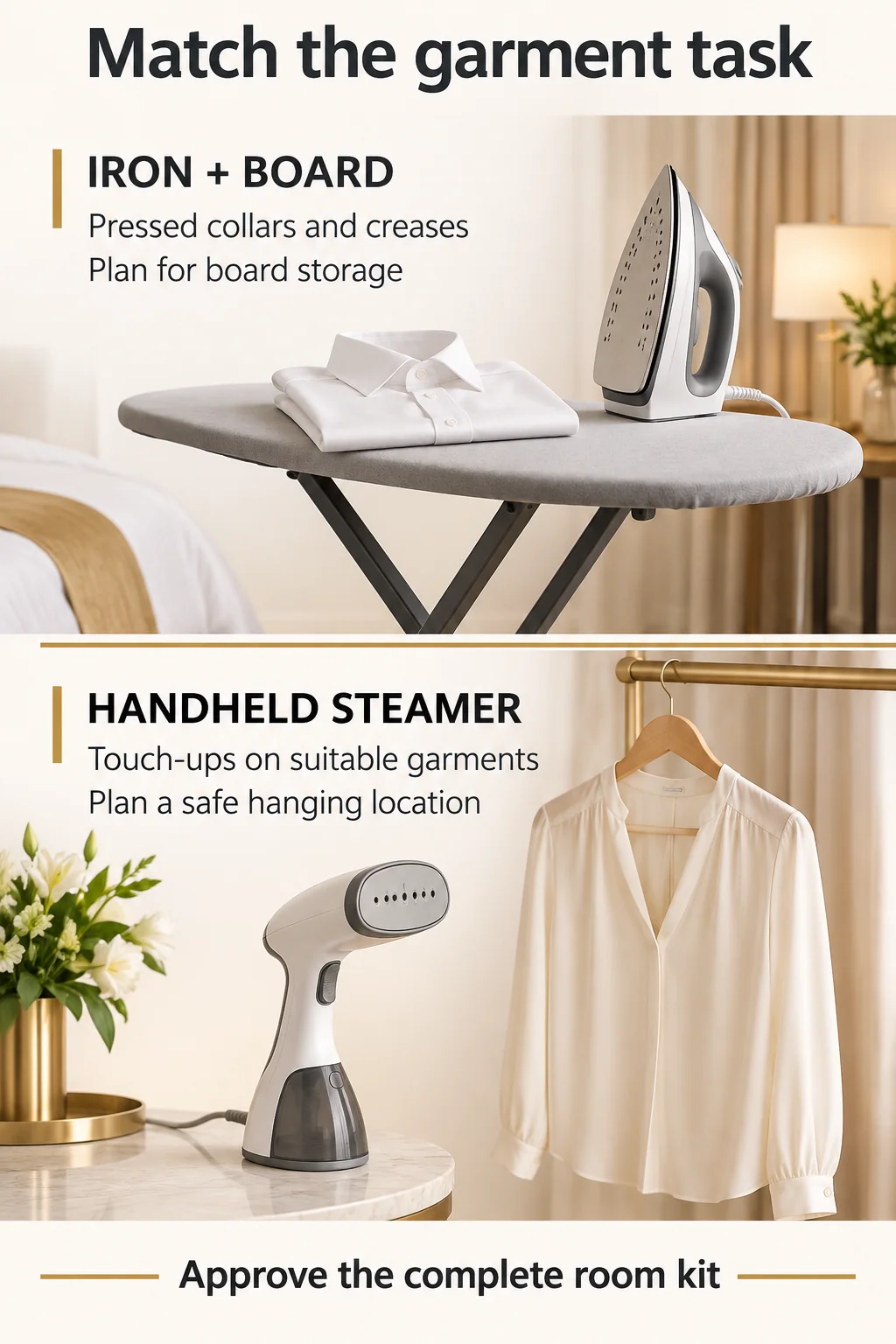
An iron and a handheld steamer overlap in wrinkle removal, but they do not deliver the same finish or require the same supporting equipment. An iron uses a heated soleplate and pressure against a suitable ironing surface, making it the more direct choice for crisp details. A handheld steamer supports quick touch-ups on compatible hanging garments without setting up a conventional board. The purchasing decision should therefore start with the finish guests expect, then account for everything the room must provide to achieve it. Treating either appliance as a stand-alone object hides the space and operating requirements that determine whether it works well in practice.
Compare the whole provision
| Decision factor | Iron with a suitable board | Handheld garment steamer |
| Main garment task | Pressing flat areas and defined details, subject to fabric care instructions | Relaxing wrinkles on suitable hanging garments; not an equivalent promise of sharp creases |
| Supporting equipment | Stable ironing board, compatible cover, and suitable iron rest | Secure garment support, usable hanger, and an approved place to rest the appliance |
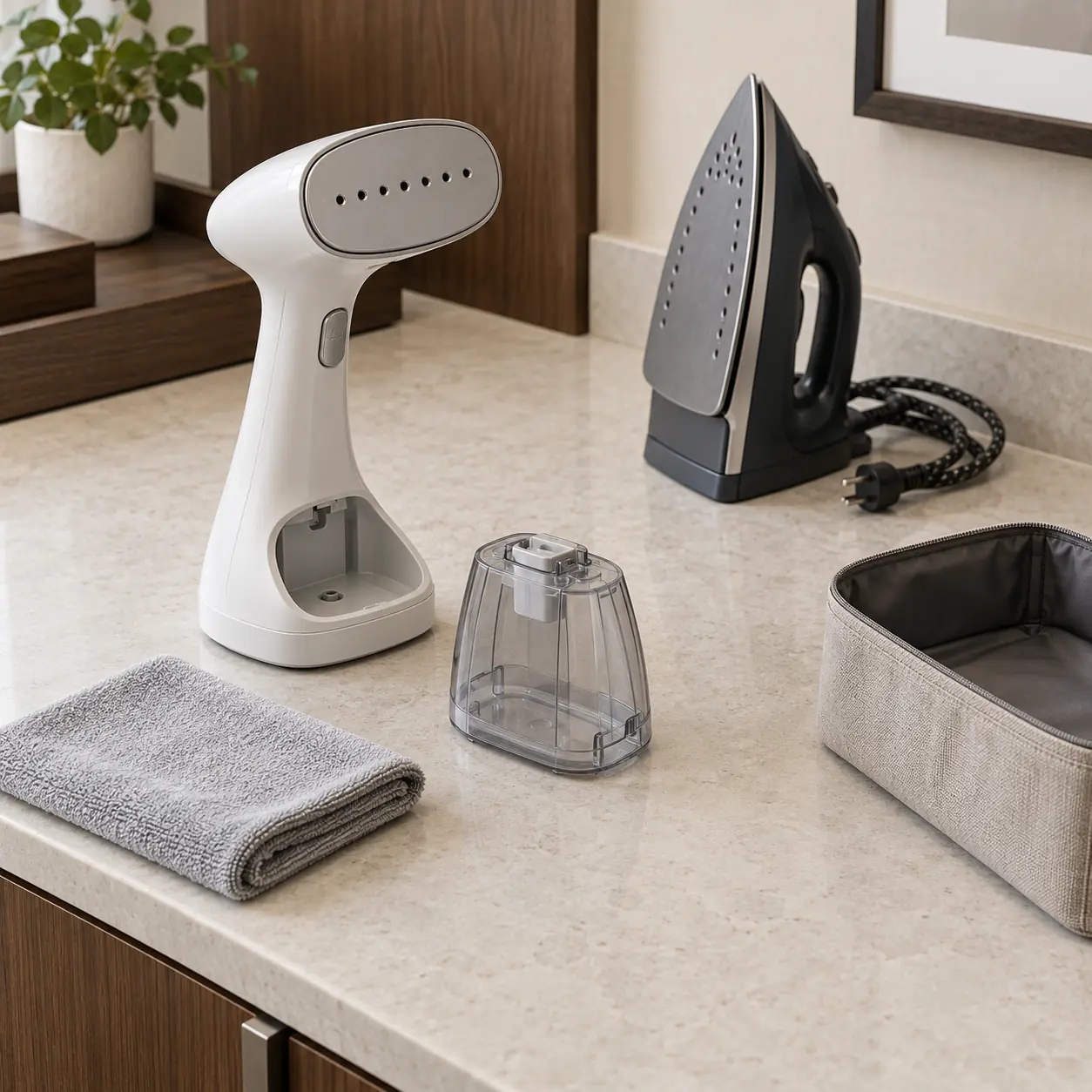
| Stored space | Iron, holder, cord, plug, and folded board | Body, tank, cord, plug, and any supplied accessories or pouch |
| Space during use | Open board, standing position, and a clear cord route | Hanging garment, working reach, and separation from surfaces vulnerable to heat or moisture |
| Housekeeping burden | Soleplate condition, board cover, frame, holder, and cord | Steam head, reservoir, tank closure, accessories, and cord |
| Important limitation | A compact board can save storage space while reducing the useful pressing area | Removing the board does not remove the need for a suitable operating location |
The table describes typical arrangements. A hybrid steamer/iron or an iron with vertical steam may cross these categories, so the actual instructions and garment results must decide its role. A product name alone does not establish how it can be used or stored.
Choose by guest expectation and room type
A room marketed to business travelers may need a reliable pressing option even when a handheld steamer is easier to store. Event guests may value steaming for suitable dresses or jackets, while still requesting an iron for a shirt. Use actual guest requests and the property’s service standard to determine the balance; do not assume that one guest segment has only one garment-care need.
Providing one device in the room and the alternative on request can work when the service is staffed and dependable. The decision moves part of the space requirement into a service cupboard and adds delivery, collection, inspection, and cooling time. A standing steamer may suit a managed garment-care service, but its larger equipment set should not be treated as interchangeable with a handheld model.
Coordinate appliance selection with the wider closet and garment care specification. Hangers, wardrobe layout, laundry bags, and ironing equipment compete for the same usable space. A complete sample arrangement exposes conflicts that separate product approvals can miss.
Measure Storage, Retrieval, and Operating Space Separately
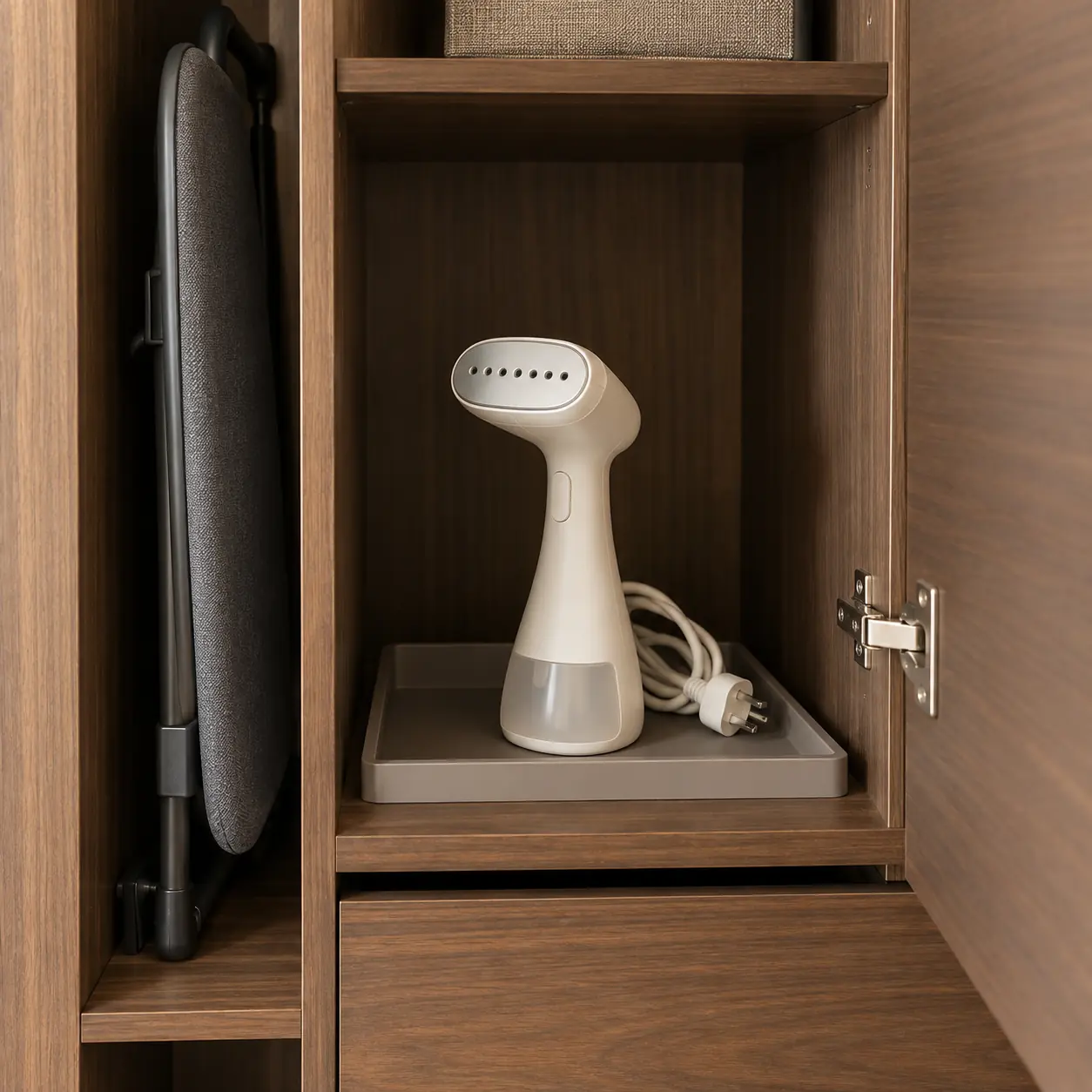
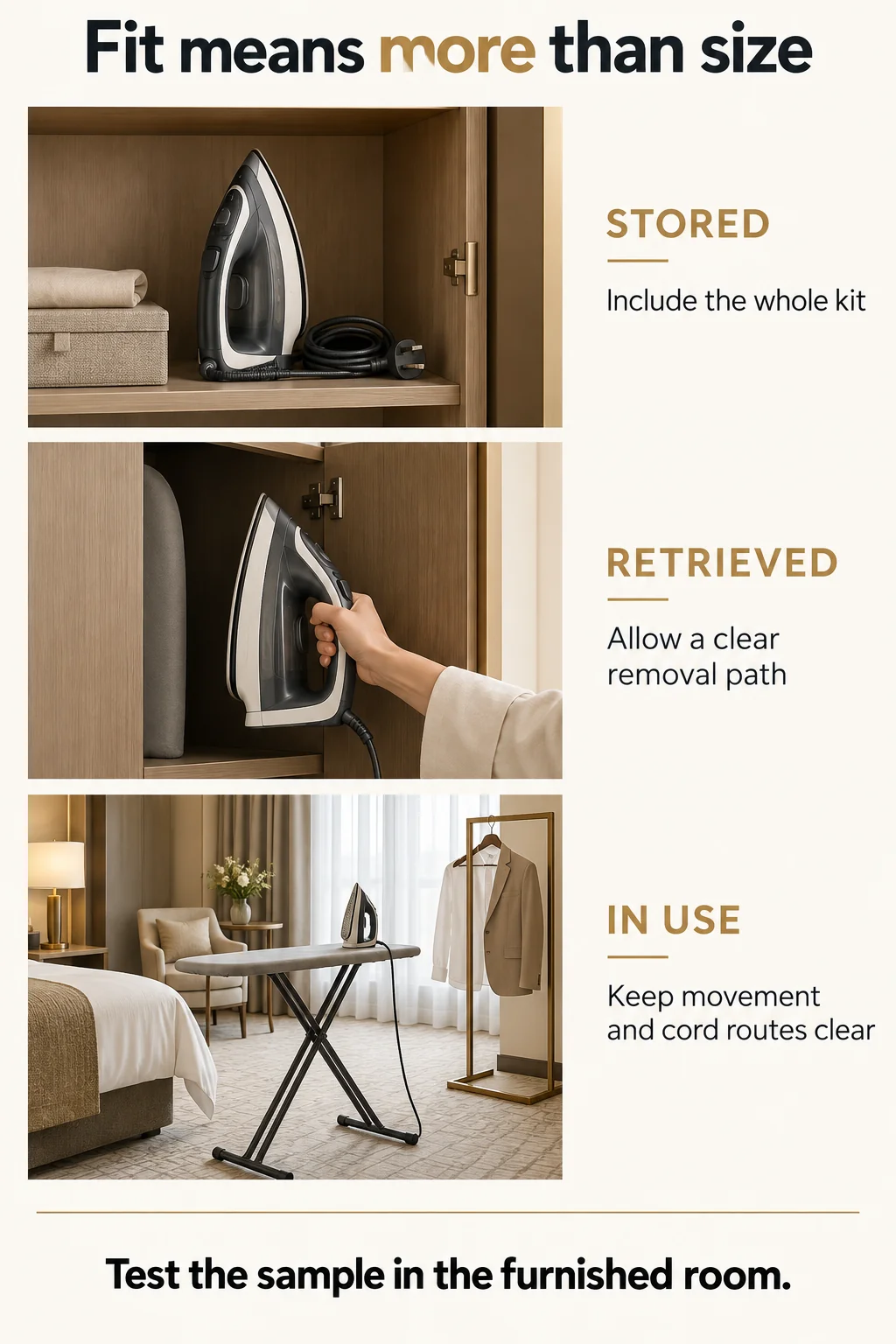
Guestroom storage should pass three different fit tests: the complete kit fits when put away, the guest can remove and replace it comfortably, and the room supports its intended use. These tests require different measurements. Product dimensions describe the appliance body, but a holder, folded cord, plug, or protruding handle may increase the installed space. Access can be tighter than the compartment behind it because of hinges, drawer fronts, door tracks, or adjacent items. Finally, the operating location may be somewhere else in the room. Approve those three conditions separately so a satisfactory shelf measurement does not conceal an unusable guest setup.
Measure the assembled storage arrangement
Record the compartment’s clear internal width, depth, and height, followed by the dimensions of the opening through which the appliance must pass. Measure with the actual door, shelf, drawer runner, holder, and neighboring room items in place. Photograph the proposed arrangement so the quotation refers to a specific room condition.
Ask for dimensions in the intended stored orientation, including the cord and plug. A height measured with an iron resting on its soleplate is not necessarily the height when it stands on its heel. Likewise, a folding handle may reduce a steamer’s height while leaving its head or tank as the widest part. Do not infer those dimensions from a product photograph or shipping carton.
For an iron, include the folded board’s legs, hooks, and any mounted holder. Check whether the board can be removed without unloading the wardrobe. For a steamer, account for the supplied brush or attachment and the storage position permitted by the instructions. A cloth bag is useful for presentation only if the appliance can be cooled and prepared for storage before being enclosed.
A worked example of a misleading fit
Assume a proposed shelf has a clear opening 12 inches wide, 8 inches deep, and 12 inches high. A sample steamer measures 6 inches wide, 5 inches deep, and 11 inches high in its intended stored position. Comparing those numbers alone suggests that the unit fits, with 1 inch of unused height.
During a physical trial, suppose the buyer measures 1.5 inches of additional lift needed to clear the front lip of its holder. The withdrawal movement now requires 12.5 inches of vertical space. The 12-inch opening fails that particular arrangement even though the appliance body fits inside the compartment. A different holder or storage position might solve the problem, but only if it is suitable for that device.
The example is a geometric illustration, not a recommended clearance. It also shows why total compartment volume is a poor selection rule: excess width cannot compensate for a blocked removal path. Measure the actual movement needed, including how a guest grips the handle, and test it with the proposed sample.
Confirm the place where guests will use it
Open the ironing board in the furnished room. Look at circulation past the bed, the room entrance, the bathroom door, and any accessible route. A board that stores well but can only be used by blocking movement needs a different arrangement. Avoid assuming that a desk, bed, or luggage bench is a suitable ironing surface.
For a steamer, identify a secure garment support in a suitable operating location. Check whether the supplied hanger can be removed from an anti-theft rail or used where needed. Do not make steaming against a wardrobe panel or door the default solution: the support, surrounding finish, clearance, and appliance instructions must suit the task. Guests also need a stable place to set the appliance down as directed.
Locate the usable outlet and test the real cord route. A longer cord can help reach but adds storage bulk and may create a trip or snag hazard. Review the exact voltage, frequency, plug, power rating, and room electrical arrangement with engineering when coordinating in-room appliances and electronics. Do not solve an unsuitable appliance specification with an improvised adapter or extension arrangement.
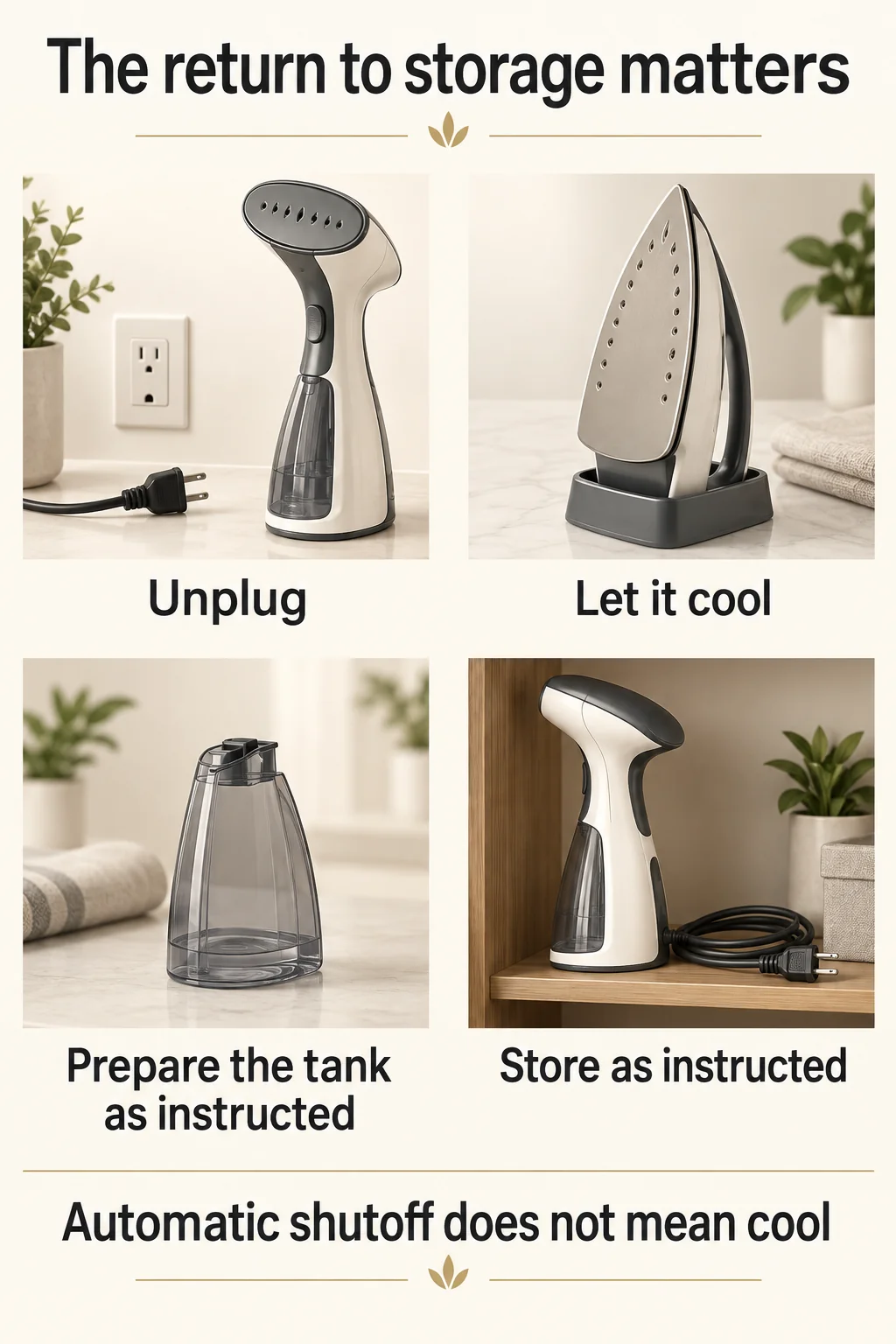
Test the Return to Storage Before Approving the Order
A successful sample trial must follow the appliance through the entire guest and housekeeping cycle, including its return to storage. Demonstrating wrinkle removal alone does not reveal whether the tank is awkward to empty, the cord catches in the holder, or the room lacks an appropriate cooling location. Test representative room types with the proposed accessories and instructions, then document the exact configuration that works. This turns the sample into a purchasing reference rather than a showroom impression. It also helps separate product limitations from room-layout problems before the same unresolved issue is repeated across the property.
Follow the appliance instructions through the full cycle
Use the sample on representative garments whose care labels permit the intended treatment. Observe setup, filling where applicable, grip, controls, garment result, resting position, shutdown, and the return to storage. Do not steam or iron clothing while someone is wearing it. A steamer’s hot surfaces and steam still require care even when it has no conventional iron-shaped soleplate.
For water-using appliances, base filling, emptying, water type, descaling, and storage on the exact model’s instructions. Do not prescribe distilled water, vinegar, or another cleaning mixture universally: model requirements differ. Test whether housekeeping can perform the specified care routine with the hotel’s available facilities and supplies.
Switch off and unplug as instructed, allow the appliance to cool, and follow the required tank preparation before storage. Do not assume that automatic shutoff means the unit is cool enough to place in a bag or against cabinetry. A holder advertised as heat resistant must be approved for the actual appliance and mounting conditions; an ordinary storage pouch should not be treated as a hot-appliance enclosure.
An illuminated power indicator is also not evidence of automatic shutoff. Ask what triggers shutoff, how it resets, and whether the function applies in each relevant position. Treat the feature as an additional safeguard, not a substitute for a safe resting place, unplugging, and the required cooling routine.
Compare operating effort as well as purchase price
Observe the time housekeeping spends inspecting and resetting each trial kit. Record hands-on work separately from elapsed cooling time because a unit can be unavailable even when no employee is actively handling it. A shared loan appliance may also need delivery and collection, whereas an in-room unit occupies space continuously.
An illustrative comparison makes the distinction concrete. Suppose one approved arrangement requires 20 seconds more hands-on reset time per reset than another. At 40 resets per day, that difference is 800 seconds, or 13 minutes 20 seconds daily. Across 365 operating days, it is approximately 81.1 labor hours. At an assumed loaded labor rate of $25 per hour, the difference is about $2,028 per year. These are hypothetical inputs, not measured hotel performance or a prediction that steamers cost more to maintain.
Use the property’s observed reset frequency rather than multiplying automatically by every occupied room. Then compare that effort with equipment price, board or holder cost, spare parts, service availability, failures, and any delivery workload. A cheaper appliance can be a more expensive room provision if it creates repeated handling problems.
Make the approved sample enforceable in the purchase order
Identify the exact model and revision, room allocation, stored orientation, overall stored dimensions, holder, board where required, and included accessories. Retain photographs of the approved configuration and make substitutions subject to another fit trial. A revised tank, plug, cord exit, or holder can invalidate a previous approval without noticeably changing the product’s appearance.
For US or Canadian deployment, have engineering confirm the electrical safety approval or certification evidence appropriate to the installation jurisdiction and the exact supplied model. Obtain written confirmation of the permitted hotel use, warranty terms, cleaning instructions, spare-part availability, and support route. A consumer product demonstration does not establish commercial-use warranty coverage.
When requesting quotations, distinguish appliance-only pricing from the complete room kit. State whether delivery, holders, mounting hardware, board covers, instructions, and spare units are included. This makes it possible to compare a steamer proposal with an iron proposal without overlooking the equipment each needs to function in the room.

Conclusion
Select the appliance that delivers the required garment finish within a room arrangement guests can use and housekeeping can maintain. An iron earns its place when pressing quality matters and the complete board-and-iron provision works. A handheld steamer can simplify some room layouts when its hanging location, electrical connection, resting position, and storage routine have been resolved. Approve the whole kit through a realistic sample trial, including removal, use, cooling, and return. Keep the accepted dimensions and accessories tied to the purchase order so the delivered equipment matches the arrangement that was actually tested.
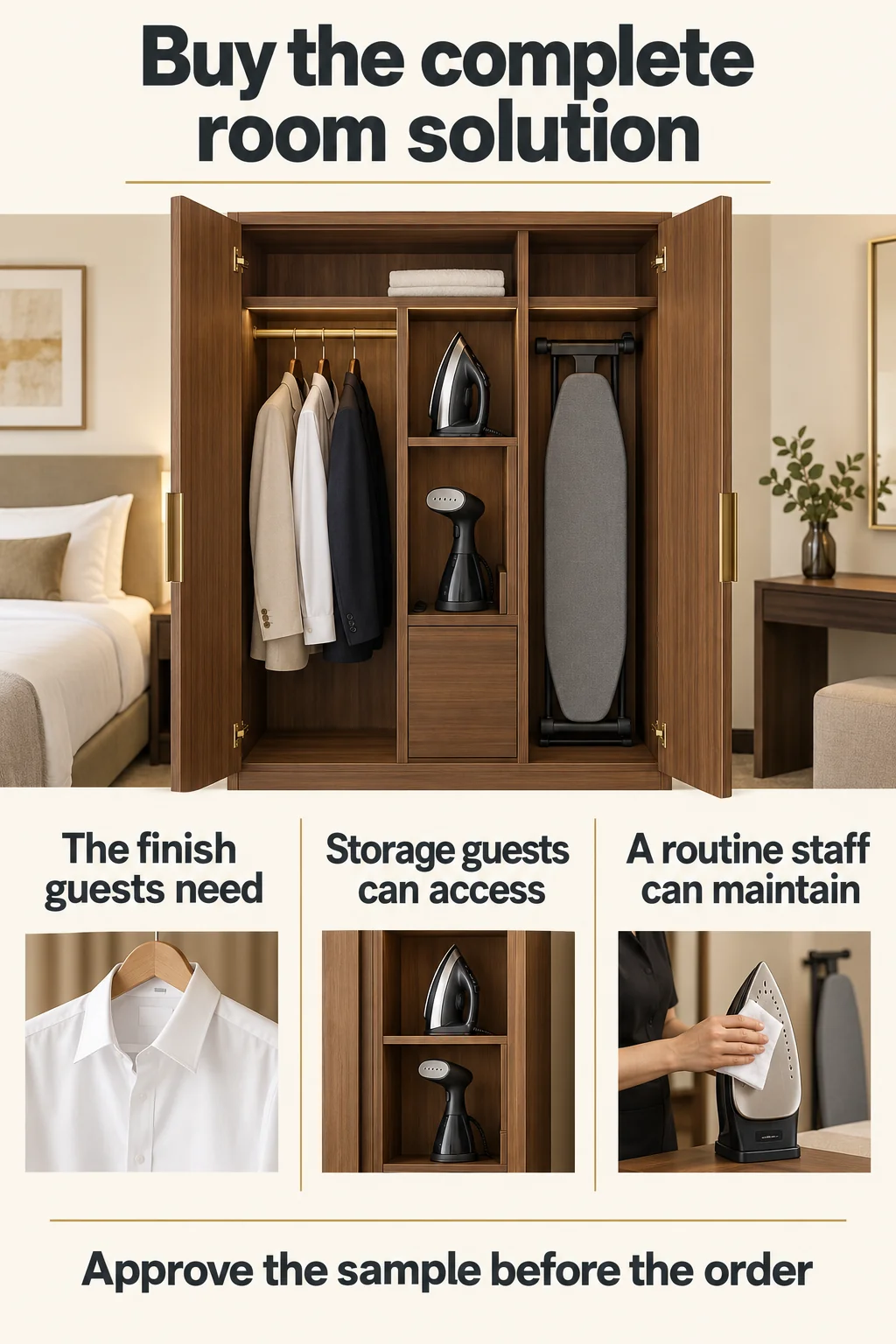
To compare suitable sourcing options, request a garment care quote with your room quantities, clear storage dimensions, photographs, required garment tasks, electrical requirements, and preferred in-room or on-request service model.
Frequently Asked Questions
Can a handheld steamer replace the ironing board in every room?
Only if its garment results and complete operating arrangement meet the property’s service standard. Guests who need pressed collars or defined trouser creases may still require an iron and suitable board. If those are supplied on request, specify how guests obtain them and how the equipment is returned, inspected, and made ready for the next request.
Does a compact or travel model automatically suit a shallow drawer?
No. The drawer must accommodate the complete stored kit in a permitted orientation, and the opening must allow retrieval. A folding handle does not necessarily reduce the depth of the tank, head, plug, or cord bundle. Confirm actual dimensions and try the sample in the finished drawer before approving it.
Should hotels keep a steamer tank filled for the next guest?
Do not make prefilled storage the default. Establish the routine from the exact model’s instructions and the property’s housekeeping procedure, including any requirement to empty the tank after use. The next guest should receive clear filling instructions and an appliance inspected for leaks, residue, and damage.
Can the same holder be reused when the iron model changes?
Only after compatibility is verified. Body width, heel shape, cord exit, balance, and hot-surface position can all change. Recheck retention, removal, mounting suitability, and thermal compatibility with the replacement model. Similar external dimensions alone do not establish that an existing holder remains appropriate.
Is a steamer a substitute for laundering or professional garment care?
No. Wrinkle removal does not establish that a garment has been cleaned or disinfected. Follow the garment care label and the appliance instructions, and avoid making hygiene claims for the room amenity unless they are specifically substantiated for the exact device and conditions of use. Provide a separate laundry or professional-care option where appropriate.
How many spare or loan units should a hotel order?
There is no useful universal percentage. Size the pool from observed simultaneous demand, delivery and return times, cooling and inspection time, maintenance downtime, and replenishment lead time. Keep in-room replacement stock distinct from the loan pool so a busy event does not consume the units needed to replace a failed room appliance.