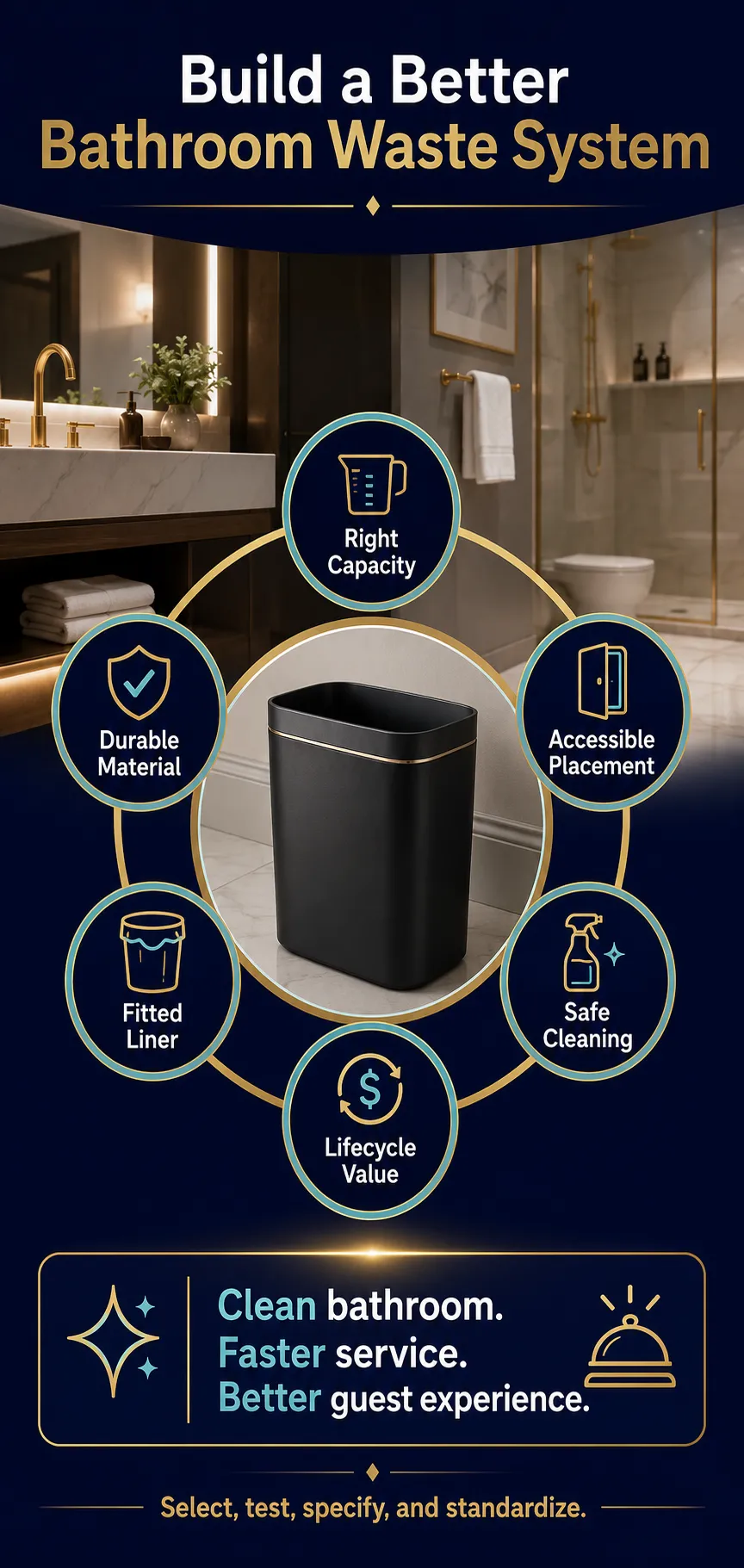
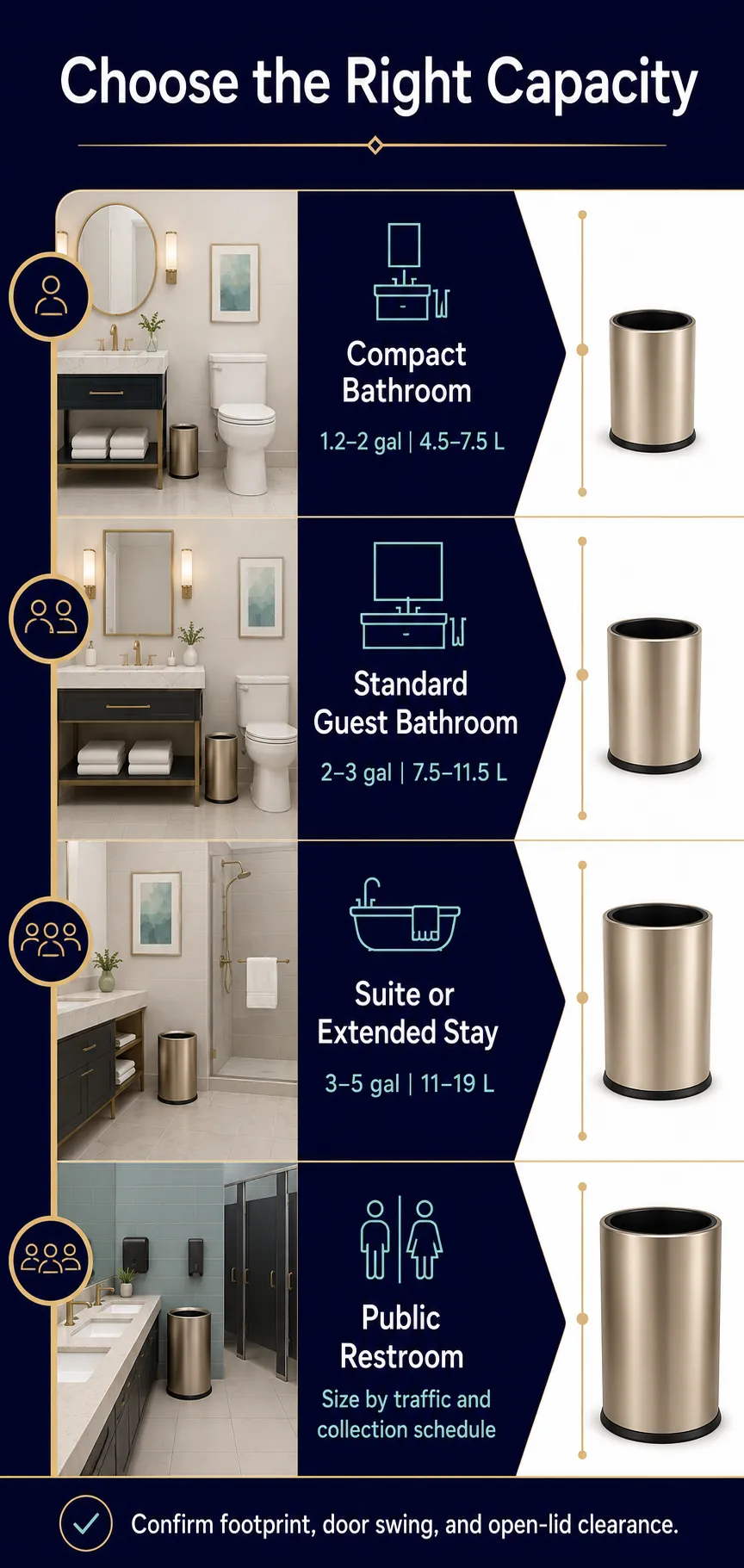
A hotel bathroom trash can should be compact enough to fit discreetly beside the vanity or toilet, large enough to hold waste between housekeeping visits, and simple enough to clean without slowing room attendants. For most standard guest bathrooms, a 2- to 3-gallon capacity is a practical starting point. Smaller 1.2- to 2-gallon models may suit compact rooms, while suites and extended-stay accommodations may require 3 to 5 gallons.
Capacity alone is not enough. Hotels should also evaluate the exterior dimensions, liner fit, material, lid mechanism, moisture resistance, cleaning compatibility, placement, replacement parts, and total lifecycle cost. The best model is the smallest receptacle that consistently prevents overflow while remaining easy for guests to use and efficient for housekeeping to service.
Why Hotel Bathroom Trash Cans Matter More Than Their Size Suggests
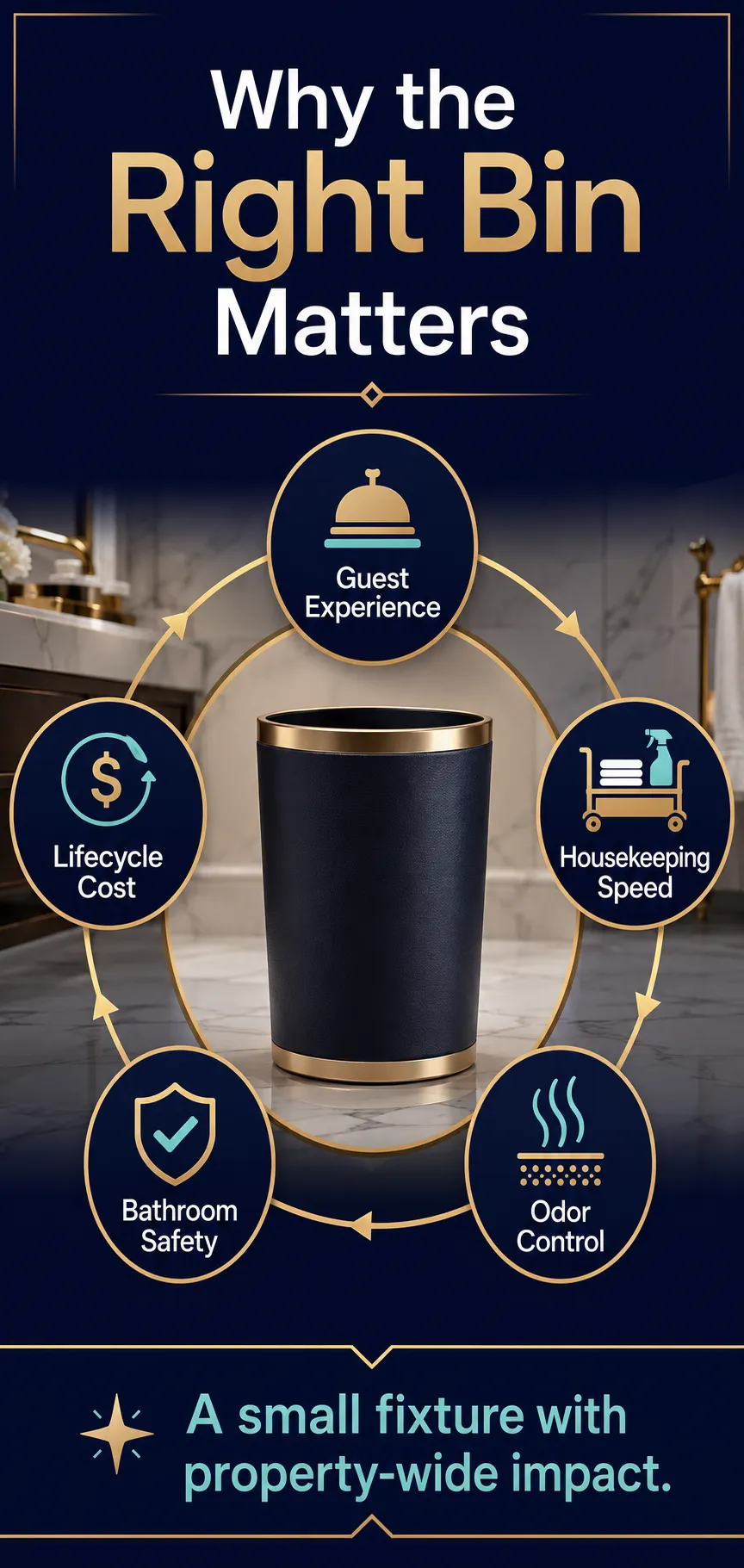
A bathroom wastebasket is a relatively inexpensive hotel accessory, but it affects several parts of the guest and housekeeping experience.
An undersized trash can may overflow with tissues, amenity packaging, disposable cups, personal-care products, and other bathroom waste. An oversized model takes up valuable floor space, looks institutional, consumes unnecessarily large liners, and may encourage guests to place food or bulky refuse in the bathroom.
Poorly selected materials create additional problems. Decorative bins with unsealed seams can absorb moisture. Low-grade metal may stain or corrode when exposed to humidity and incompatible cleaning products. Complex lids can collect residue, while lightweight receptacles may slide, tip, or become caught in the bathroom door swing.
The ideal hotel bathroom trash can supports five operational goals:
- It gives guests an obvious and convenient place to discard ordinary bathroom waste.
- It remains visually discreet when partially filled.
- It can be emptied without attendants touching or compressing the contents.
- Its interior and exterior can be cleaned quickly.
- It maintains its finish through repeated exposure to moisture, liners, cleaning chemicals, and housekeeping equipment.
Hotels should therefore purchase bathroom trash cans as part of a coordinated waste-handling system rather than as isolated decorative accessories.
Determine the Right Trash Can Size for Each Hotel Bathroom
For most properties, capacity should be selected according to room type and service frequency—not hotel star rating alone. A luxury hotel with compact urban bathrooms may require a smaller footprint than a select-service property with spacious guest rooms.
The following ranges are useful procurement starting points rather than universal standards:
| Hotel bathroom application | Suggested starting capacity | Operational considerations |
|---|---|---|
| Compact guest bathroom | 1.2–2 gallons, or 4.5–7.5 liters | Best where floor space is limited and rooms receive frequent service |
| Standard guest bathroom | 2–3 gallons, or 7.5–11.5 liters | Suitable for many single- and double-occupancy rooms |
| Suite or family accommodation | 3–5 gallons, or 11–19 liters | Consider occupancy, length of stay, and whether another bin is provided in the living area |
| Extended-stay bathroom | 3–5 gallons, or 11–19 liters | May require additional capacity if service is less frequent |
| Accessible guest bathroom | Based on room demand, usually 2–3 gallons | Prioritize an unobstructed location, stable base, and easily usable opening |
| Public hotel restroom | Determined by traffic and collection schedule | Guest-room wastebaskets are usually too small for public-restroom demand |
The stated capacity is only one dimension of fit. Procurement teams should record the product’s width, depth, height, opening size, and height with the lid fully raised. A nominally compact step can may require more usable space than an open-top model because of its pedal, hinge, and lid movement.
Shape also matters. Rectangular or slim-profile bins generally sit more efficiently against a vanity or wall. Round receptacles can complement softer interior designs but may create unused space around the base. Tapered wastebaskets are easy to nest for shipping and storage, although excessive taper can reduce usable capacity near the bottom.
Before approving a model, place a physical sample in the smallest bathroom configuration included in the procurement package. Verify that it does not interfere with the door, toilet, vanity, towels, housekeeping access, or required maneuvering space.
Match Capacity to Room Type, Occupancy, and Collection Frequency
Catalog descriptions cannot determine the correct capacity for every hotel. The most reliable method is a short operational waste audit.
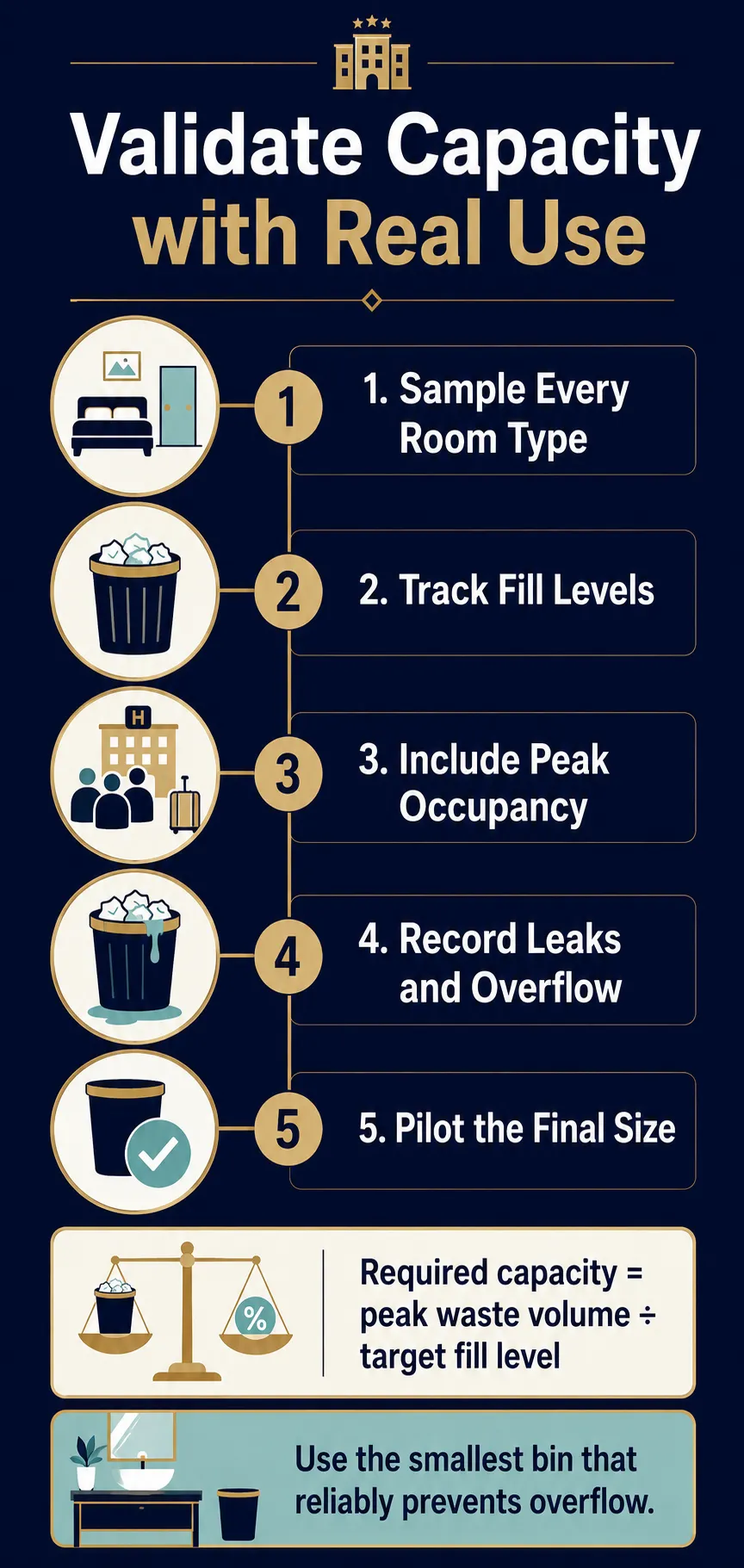
Select a representative sample of standard rooms, accessible rooms, suites, connecting rooms, and extended-stay units. Over several weeks, record the approximate fill level when each bathroom trash can is serviced. Include high-occupancy periods, weekends, family stays, group business, and longer stays where possible.
The audit should capture:
- Room type and maximum occupancy
- Number of occupied room-nights
- Housekeeping service frequency
- Approximate fill level at collection
- Frequency of overflow or waste placed beside the bin
- Common bulky or wet items
- Liner leaks, tears, or slippage
- Guest complaints or housekeeping observations
Hotels can establish an internal target fill level—for example, servicing the bin before it regularly exceeds approximately three-quarters of its usable volume. This is an operational planning threshold, not an industry rule. It leaves room to close the liner safely and reduces the chance of contents touching the lid.
If the highest recurring waste volume is approximately 7 liters and the hotel uses a 75% target fill level, the nominal requirement would be:
Required capacity = 7 liters ÷ 0.75 = 9.3 liters
The procurement team could then test a commercially available 10- to 12-liter model. If that model occupies too much space, the better solution may be a more frequent service schedule or a second dry-waste bin in the bedroom rather than a larger bathroom receptacle.
Capacity decisions should also account for room layout. A hotel providing one bin in the bathroom and another near the desk can use a smaller bathroom receptacle because guests have a separate place for food packaging and general refuse. A room with only one wastebasket may need more capacity, but placing the sole receptacle inside the bathroom may be inconvenient for guests.
Compare the Best Materials for Hotel Bathroom Trash Cans
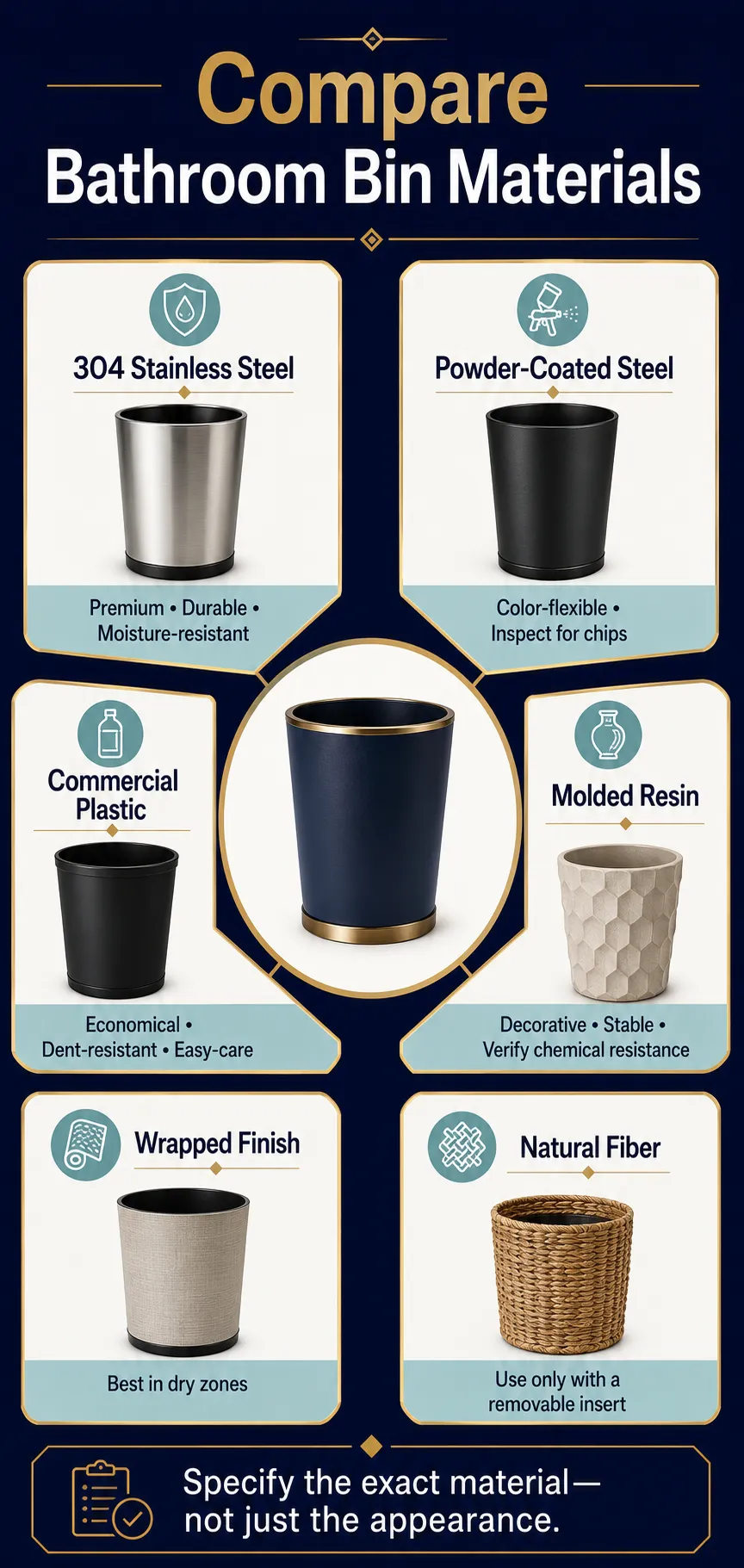
Bathroom conditions favor nonporous materials with smooth surfaces and limited seams. Each material offers a different balance of appearance, durability, cleaning time, and price.
| Material | Advantages | Limitations | Best applications |
|---|---|---|---|
| Type 304 stainless steel | Premium appearance, strong, moisture-resistant, widely available in commercial finishes | Shows water spots and fingerprints; incompatible chemicals can damage the finish | Upscale, luxury, and high-turnover hotels |
| Powder-coated steel | Broad color selection, durable appearance, coordinates with hardware | Chips or scratches can expose the base metal; coating quality varies | Branded interiors and midscale-to-upscale rooms |
| Polypropylene or polyethylene | Lightweight, dent-resistant, economical, nonporous, easy to replace | May scratch, fade, or look less premium | Select-service hotels, staff areas, and operation-focused guestrooms |
| Molded resin or composite | Decorative stone-like appearance, stable weight, broad design options | May chip or discolor; chemical resistance must be verified | Boutique, resort, and design-led bathrooms |
| Vinyl- or leatherette-wrapped construction | Warm residential appearance and strong brand coordination | Seams and backing may trap moisture; difficult to disinfect thoroughly | Dry vanity zones rather than splash-prone locations |
| Natural fiber or woven material | Distinctive decorative character | Difficult to clean, vulnerable to moisture, and dependent on an inner liner | Low-turnover decorative settings with a removable insert |
Stainless steel
Stainless steel is often the strongest all-around choice for upscale hotel bathrooms, but the specification should name the grade rather than simply stating “stainless steel.” Type 304 is a common commercial choice because it provides a useful balance of corrosion resistance, formability, and appearance.
A satin or brushed finish generally conceals small scratches and fingerprints better than a mirror-polished surface. If a property operates in a coastal environment or uses unusually aggressive chemicals, the supplier should assess whether a more corrosion-resistant grade is justified. Upgrading the alloy cannot compensate for poor chemical handling or failure to rinse residues.
Powder-coated metal
Powder-coated steel allows the trash can to match black, bronze, white, or custom-colored bathroom hardware. The coating must cover edges, seams, and the underside adequately. Procurement samples should be inspected for thin coverage around rolled edges and welds.
Once the coating is chipped, water and cleaning solution may reach the metal underneath. Replacement criteria should therefore include exposed metal, bubbling, flaking, or corrosion—not only structural failure.
Plastic
Commercial-grade polypropylene and polyethylene receptacles are practical where durability and replacement cost matter more than a metallic appearance. Plastic does not dent like thin steel and can tolerate routine handling well. However, textured surfaces, decorative ribs, and deep molded recesses increase cleaning time.
Specify a smooth interior, rounded corners, color-through construction, and documented compatibility with the hotel’s approved cleaning products.
Decorative materials
Resin, composite, wrapped, and woven bins should be treated as decorative housings unless their complete construction can tolerate wet cleaning. A removable plastic or metal insert can protect the outer shell, simplify liner changes, and reduce exposure to leaks.
Do not assume an “antimicrobial” coating eliminates routine cleaning. Any such claim should be supported by specific supplier documentation and evaluated for its actual scope, durability, and maintenance requirements.
Choose Between Open-Top, Lidded, Pedal, and Swing-Top Designs
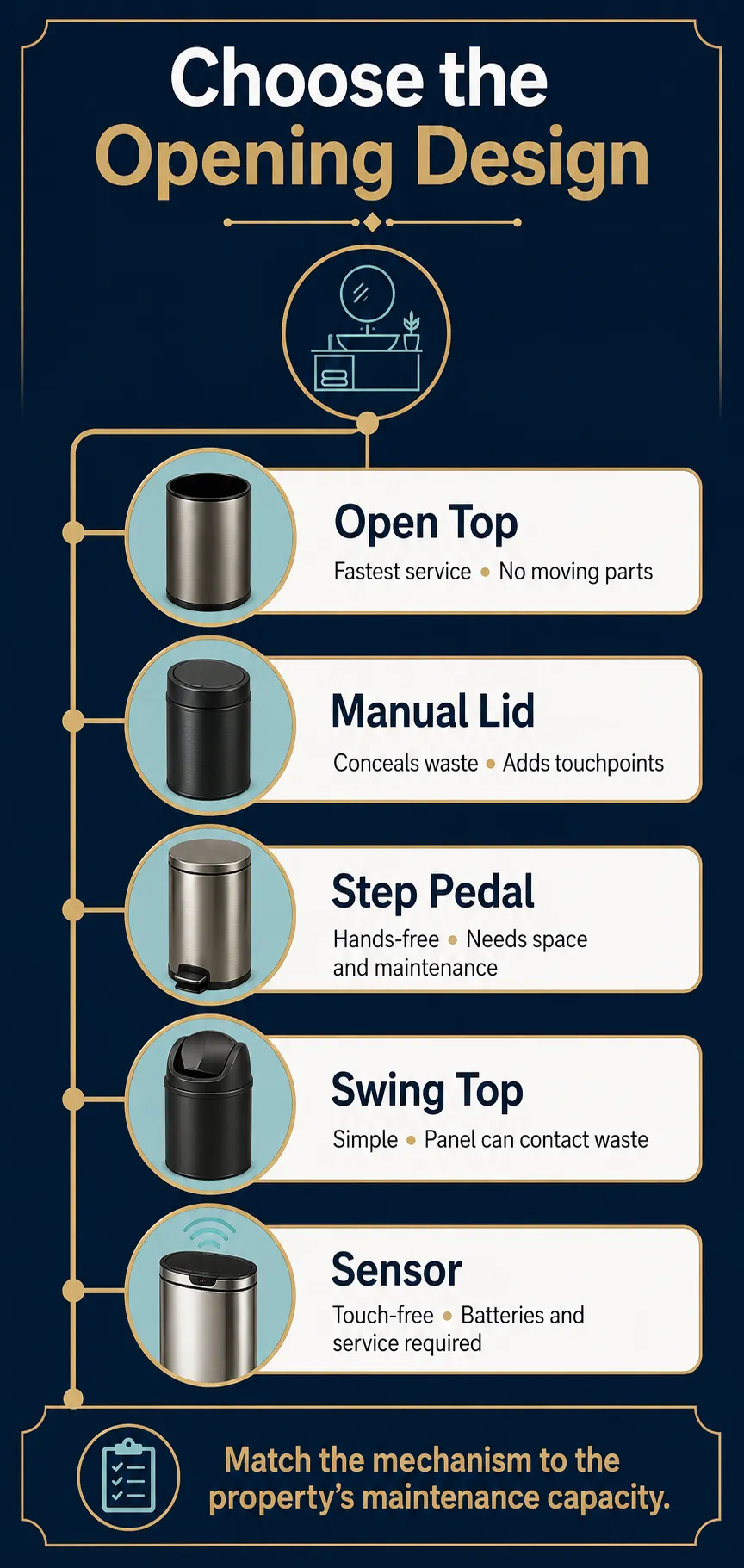
The opening mechanism affects guest convenience, odor control, cleaning time, and maintenance.
Open-top wastebaskets
Open-top designs are simple, quiet, and easy to use. They contain no hinges, pedals, batteries, or moving parts. Housekeeping can inspect and empty them quickly, and guests do not need to touch a lid.
Their main disadvantage is visibility. Waste and liner edges may be noticeable, especially in a luxury bathroom. A deep body, recessed opening, removable collar, or liner-concealing ring can improve presentation without introducing a full lid.
Open-top designs are often the best operational choice when the property already provides daily service and bathroom waste is primarily dry.
Manual lidded cans
A removable or lift-top lid conceals contents and helps contain mild odors. However, guests may need to touch the lid, and attendants must clean the underside and surrounding rim.
Loose lids can be dropped, misplaced, or positioned incorrectly during room turnover. If a hotel selects this design, the lid should align easily and remain secure during normal movement.
Pedal-operated cans
A step can offers hands-free opening and a more residential or premium appearance. It can be useful where guests frequently discard personal-care waste.
The mechanism adds several procurement concerns:
- The pedal increases the overall footprint.
- The lid requires vertical and rear clearance.
- Hinges, dampers, and pedals can fail.
- The underside of the lid requires detailed cleaning.
- A lightweight can may slide when the pedal is pressed.
- Pedal operation may not be convenient for every guest.
Specify a stable non-slip base, replaceable mechanism, soft-close operation, and a removable inner bucket. Test the pedal while the can is empty and while it contains a partially filled liner.
Swing-top cans
Swing-top lids conceal part of the contents and require no pedal, but the swinging panel may contact the waste. Moist tissues or personal-care products can soil the panel quickly. This design is generally better suited to low-moisture waste or public areas where the opening can be cleaned frequently.
Sensor-operated cans
Automatic cans minimize direct contact when working correctly. In guest bathrooms, however, batteries, sensors, motors, moisture, and false activations create additional maintenance. A sensor can should be selected only when the property has a clear operational reason and can stock batteries and replacement components.
For many guestrooms, a well-designed open-top or mechanical step can provides a better balance of reliability and convenience.
Evaluate Liners, Handles, Bases, and Other Operational Features
The liner and receptacle should be procured together. A high-quality bin can still perform poorly if the bag slips inside, hangs visibly over the rim, blocks the lid, or tears during removal.
Ask suppliers to provide production samples of both the receptacle and proposed liner. Conduct a fit test using realistic bathroom waste rather than approving the combination from catalog dimensions.
A suitable liner should:
- Open easily during room servicing
- Reach the bottom without excessive stretching
- Fold securely over the rim or engage with the retainer
- Remain hidden when the design includes a liner collar
- Allow the lid to close without catching
- Resist punctures from typical guest waste
- Lift out without vacuum locking or tearing
- Leave enough material for safe closure
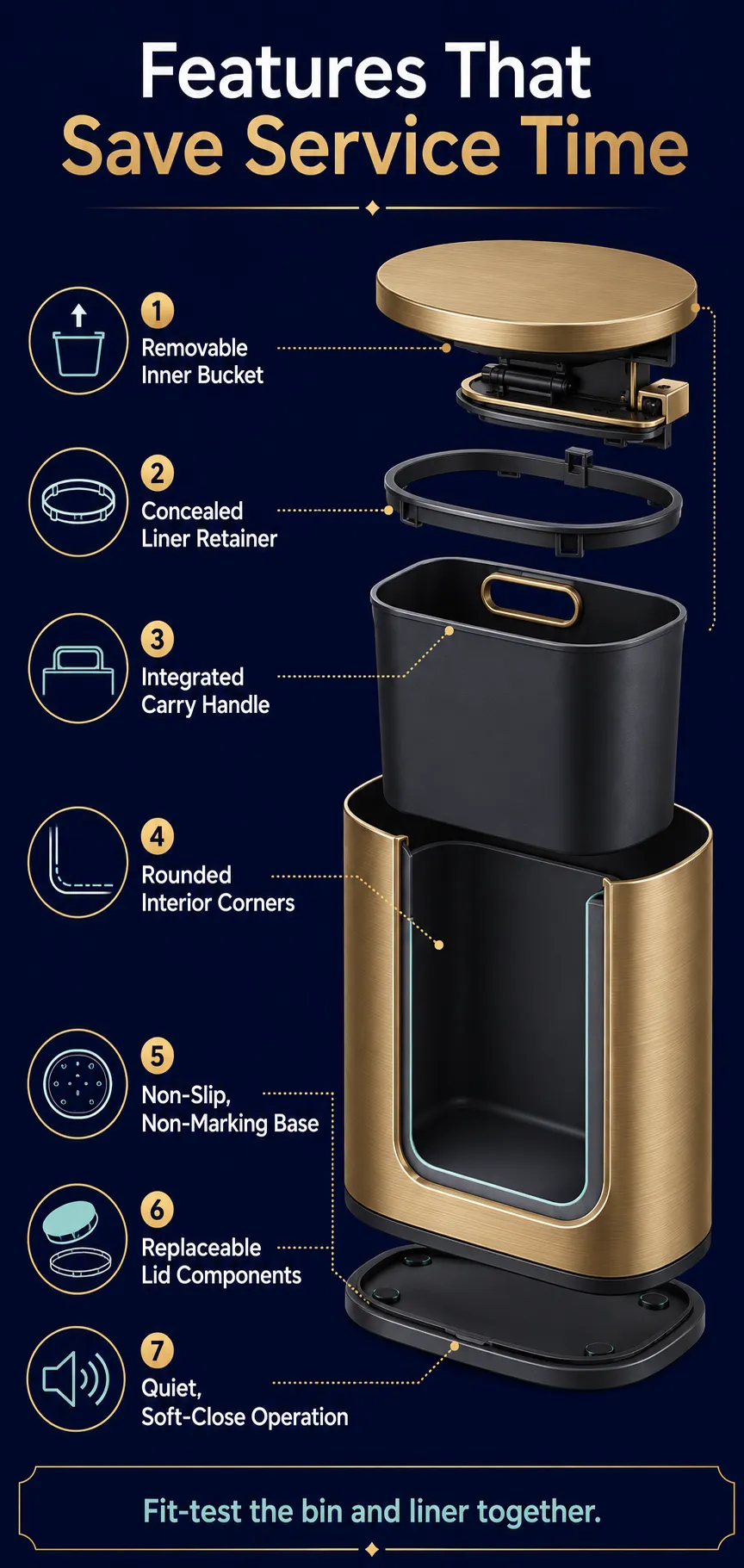
Useful receptacle features include a removable inner bucket, concealed liner retainer, integrated carry handle, non-slip base, rounded interior corners, hemmed metal edges, and replaceable lid components.
A removable inner bucket is particularly valuable. It allows attendants to clean the part most likely to contact leaked waste without carrying the decorative outer shell to a utility area. The insert should lift out without requiring attendants to reach deeply into the receptacle.
Avoid complex interior clips that require excessive finger force or slow every liner change. A feature that adds only five seconds per room can create substantial annual labor when multiplied across hundreds of rooms and thousands of service events.
Noise should also be evaluated. Metal lids that close sharply may disturb guests in adjoining rooms, while loose inner buckets can rattle during movement. Soft-close mechanisms, fitted inserts, and elastomer base rings can improve both operation and perceived quality.
Select the Right Finish for Moisture, Corrosion, and Hotel Décor
The finish should coordinate with the bathroom without becoming a maintenance burden.
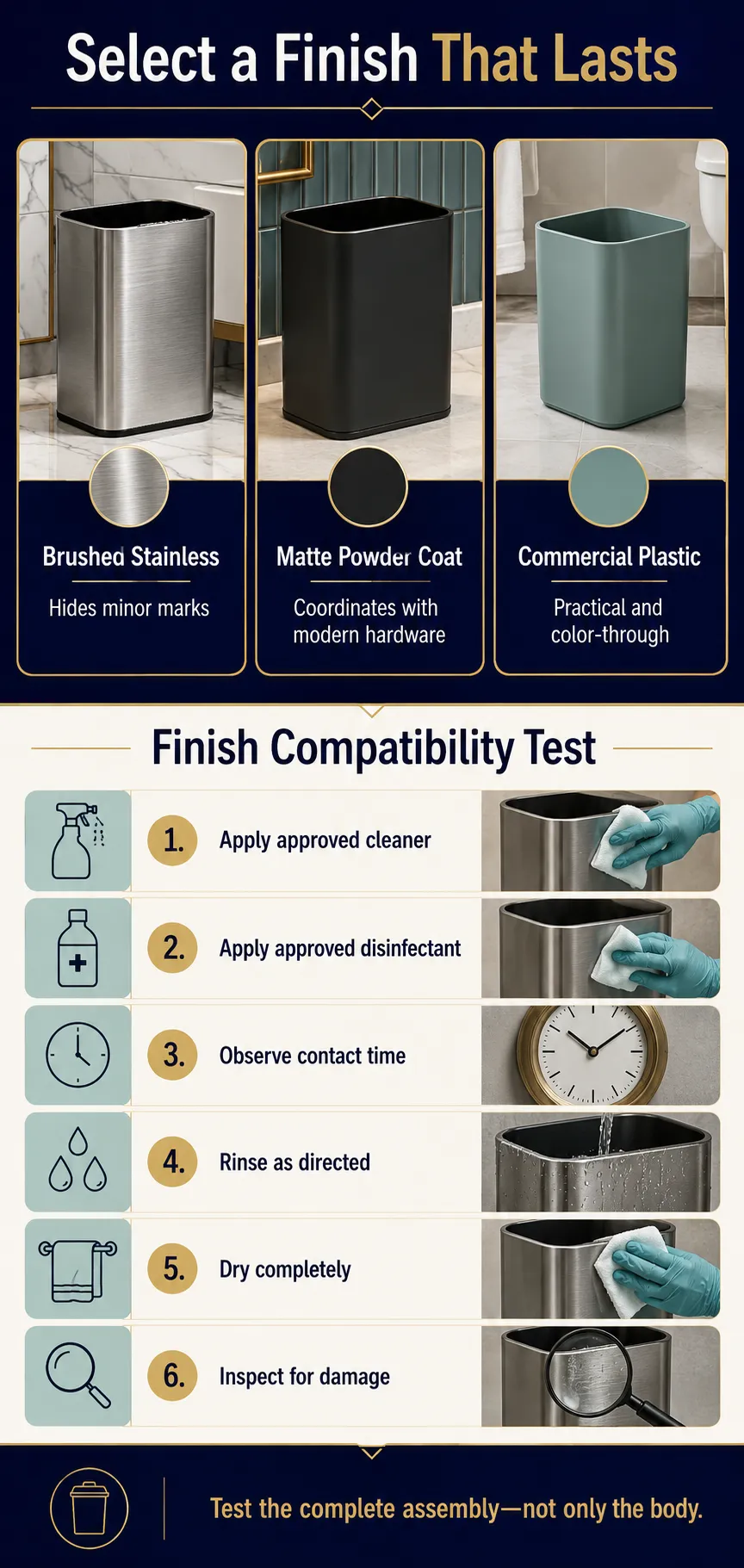
Brushed stainless steel works well with satin nickel and stainless fixtures. Matte black or bronze powder coating can coordinate with contemporary hardware but may reveal soap residue or mineral spots. White and light-colored plastic can look clean and understated, although staining and yellowing should be considered during sample testing.
Evaluate finish samples under actual bathroom lighting. Warm lighting, cool LED lighting, and daylight can make the same metal or painted surface appear noticeably different.
A procurement finish test should include:
- Exposure to the property’s approved neutral cleaner.
- Exposure to the approved disinfectant for its labeled contact time.
- Clean-water rinsing where required.
- Repeated wiping with the approved cloth.
- Air-drying and manual drying.
- Inspection for haze, streaks, color transfer, swelling, softening, or corrosion.
For routine stainless-steel care, mild detergent and warm water followed by a clean-water rinse and drying are generally appropriate. Chloride-containing solutions and prolonged bleach contact can cause staining or pitting, so the product manufacturer’s instructions and chemical compatibility must be checked before approval. Carbon-steel wool and chloride-based cleaning solutions should also be avoided on stainless surfaces.
Decorative trash cans with mixed materials require extra attention. A metal body may tolerate a product that damages its rubber base, adhesive, painted logo, plastic insert, or soft-close mechanism. Chemical compatibility should cover the complete assembly.
Position Bathroom Trash Cans for Convenience, Safety, and Discretion
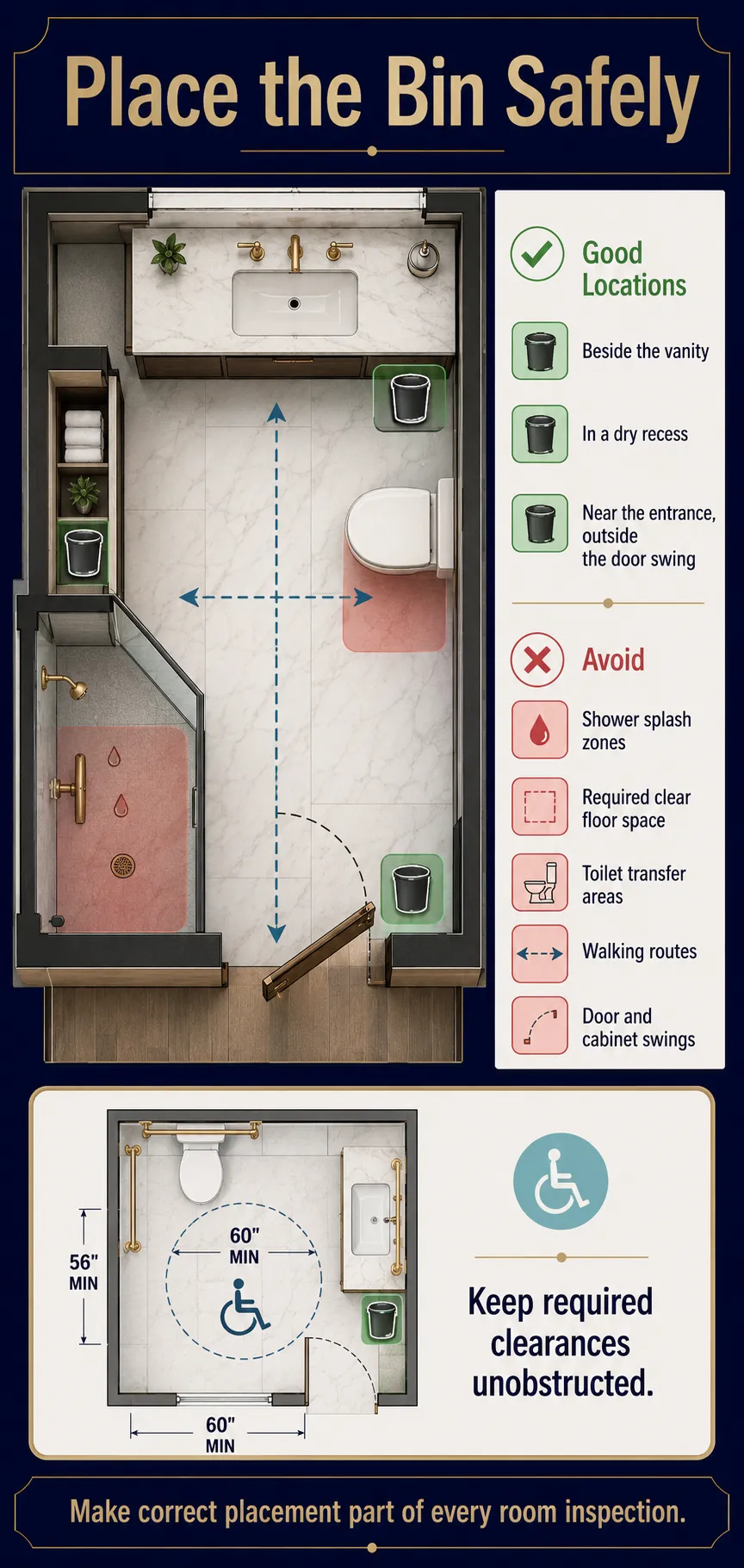
A guest should be able to find and use the trash can without moving it. At the same time, it should not dominate the room or sit directly in a splash zone.
Common locations include:
- Beside the vanity
- Between the vanity and toilet, where space allows
- Beneath an open vanity outside required knee clearance
- Near the bathroom entrance without interfering with the door
- In a dry recess designed for the receptacle
Avoid placing the bin where it:
- Prevents the bathroom door from opening fully
- Sits inside the shower or bathtub splash zone
- Interferes with towels or bathrobes
- Requires guests to reach behind the toilet
- Blocks access to the toilet, sink, controls, or emergency equipment
- Narrows the walking route
- Creates a trip hazard in low light
- Obstructs housekeeping tools or routine floor cleaning
Accessible rooms require layout-specific verification. In applicable accessible layouts, required clear floor space is generally at least 30 by 48 inches, and it must connect to an accessible route. A movable trash can can still become an obstruction if housekeeping repeatedly returns it to a required clear area. Placement should therefore be included in the room inspection standard, not left to individual judgment. Federal, state, local, brand, and project-specific accessibility requirements should all be reviewed before the location is approved.
A pedal should not be the only practical way to use the waste receptacle in a mobility-accessible room. An open-top design, motion-activated option, or easily operated lid may be more usable, depending on the guest-room configuration. Test the complete setup with an accessibility professional rather than treating the trash can as an isolated product.
Wall-mounted models can free floor space and simplify floor cleaning, but their projection, mounting height, capacity, and installation must be coordinated with the accessible route and surrounding fixtures.
Establish an Effective Cleaning and Disinfection Procedure
Cleaning removes soil and residue; disinfection uses an appropriate product to kill specified microorganisms that remain after cleaning. These are related but distinct processes.
Routine cleaning is sufficient in many ordinary situations, while additional disinfection may be appropriate after visible illness, contamination, outbreaks, or according to the property’s risk-based protocol. When disinfection is required, the surface should be cleaned first and the disinfectant must remain wet for the complete contact time stated on its label.
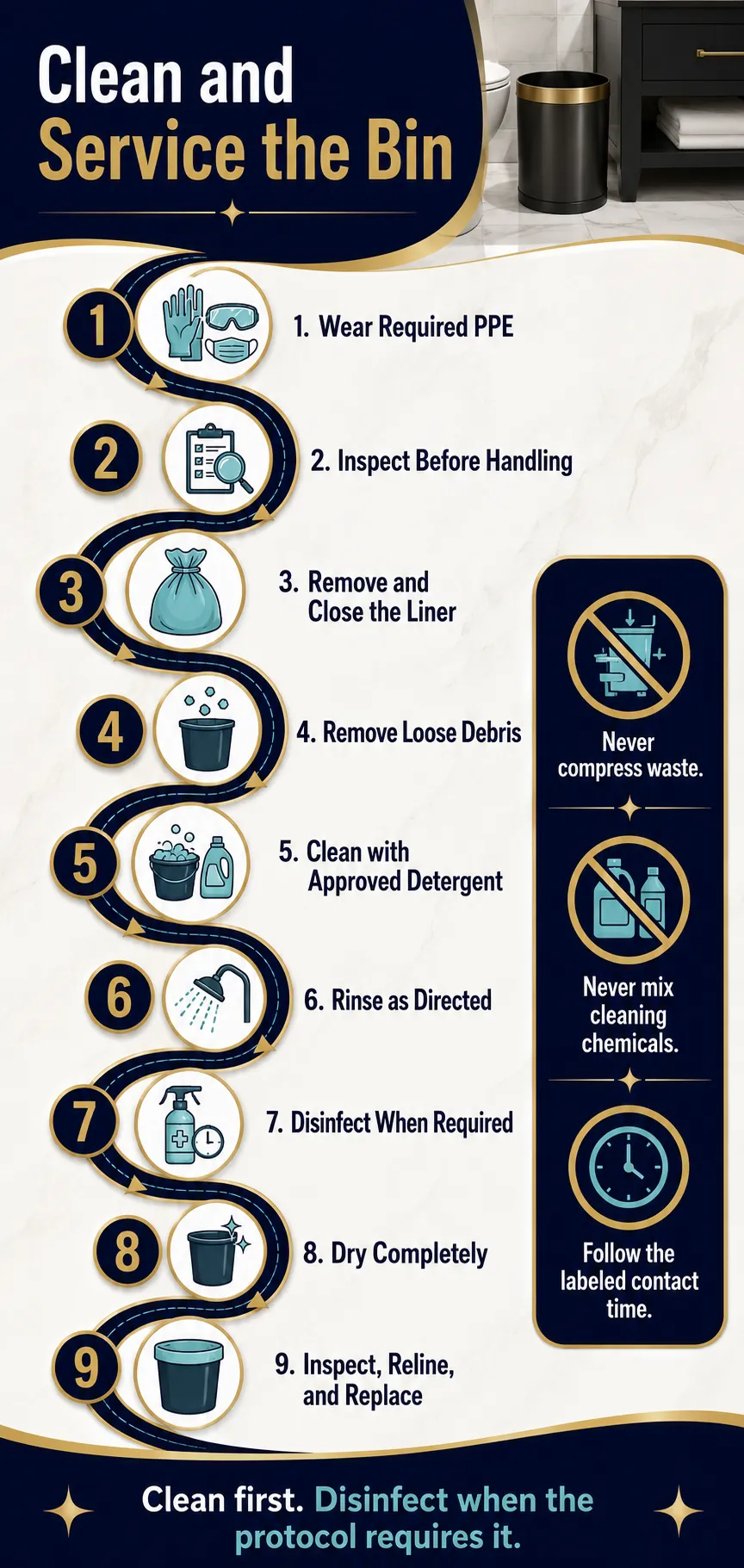
A practical hotel procedure should include the following steps.
1. Prepare safely
Wear the gloves and any additional protective equipment specified by the product label, Safety Data Sheet, and hotel policy. Ensure adequate ventilation. Never combine cleaning or disinfecting chemicals.
Employers should maintain accessible Safety Data Sheets for hazardous cleaning products and train employees in dilution, storage, labeling, personal protective equipment, and spill procedures.
2. Inspect before handling
Look for liquids, broken glass, exposed sharp objects, visible blood, or other unusual waste. Do not press down on the contents or place a hand inside the liner.
The hotel should have an escalation procedure for sharps and potentially infectious material. Management should evaluate which jobs or tasks involve reasonably anticipated occupational exposure and provide the necessary protections. Designated, trained employees should handle tasks involving unusual or potentially hazardous waste.
3. Remove the liner
Gather the liner from the upper edges, close it according to property procedure, and transfer it to the designated collection container. Do not carry an open liner against the body or overfill the housekeeping cart.
If a liner leaks, isolate the affected surfaces and follow the hotel’s spill-response procedure.
4. Remove loose debris
Take out the inner bucket when present. Remove dry debris without scratching the interior. Receptacles with seams, pedals, or liner-retaining rings may require a small dedicated detailing brush.
5. Clean the surface
Use the approved detergent or cleaner at the correct dilution. Wipe the interior, rim, exterior, base, underside of the lid, pedal, hinge, handle, and insert. Pay particular attention to liner-contact points and recessed areas.
6. Rinse when required
Remove cleaner residue according to the product and receptacle instructions. Residue can make the surface sticky, attract soil, discolor finishes, or interfere with a subsequent disinfectant.
7. Disinfect when indicated
Apply a surface-compatible disinfectant according to its label. Maintain visible wetness for the full contact time and reapply if the product dries too soon. Do not assume every disinfectant is suitable for stainless steel, coated metal, resin, plastic, rubber, or adhesive.
8. Dry completely
Allow the surface to dry as directed, then manually dry remaining water where appropriate. Moisture trapped under the liner can cause odor, staining, coating failure, or corrosion.
9. Inspect and reline
Check for cracks, sharp edges, loose components, corrosion, damaged coating, odor, and unstable feet. Install the liner smoothly, conceal excess material, and return the receptacle to its approved location.
A useful frequency schedule is:
| Service event | Recommended tasks |
|---|---|
| Routine occupied-room service | Inspect, empty as required, remove visible soil, clean contact points, replace liner when needed, and confirm correct placement |
| Checkout service | Empty, clean the interior and exterior, inspect the base and lid components, dry, and install a fresh liner |
| Scheduled detail cleaning | Clean seams, hinges, pedals, liner retainers, inserts, and the underside of the base |
| Spill, illness, or visible contamination | Isolate as necessary and follow the property’s approved cleaning, disinfection, exposure-control, and waste procedures |
| Quality inspection | Check odor, appearance, liner presentation, placement, finish damage, stability, and mechanism operation |
The property should set exact frequencies from usage, contamination history, product instructions, brand standards, and local requirements.
Prevent Odors, Stains, Rust, Leaks, and Premature Wear
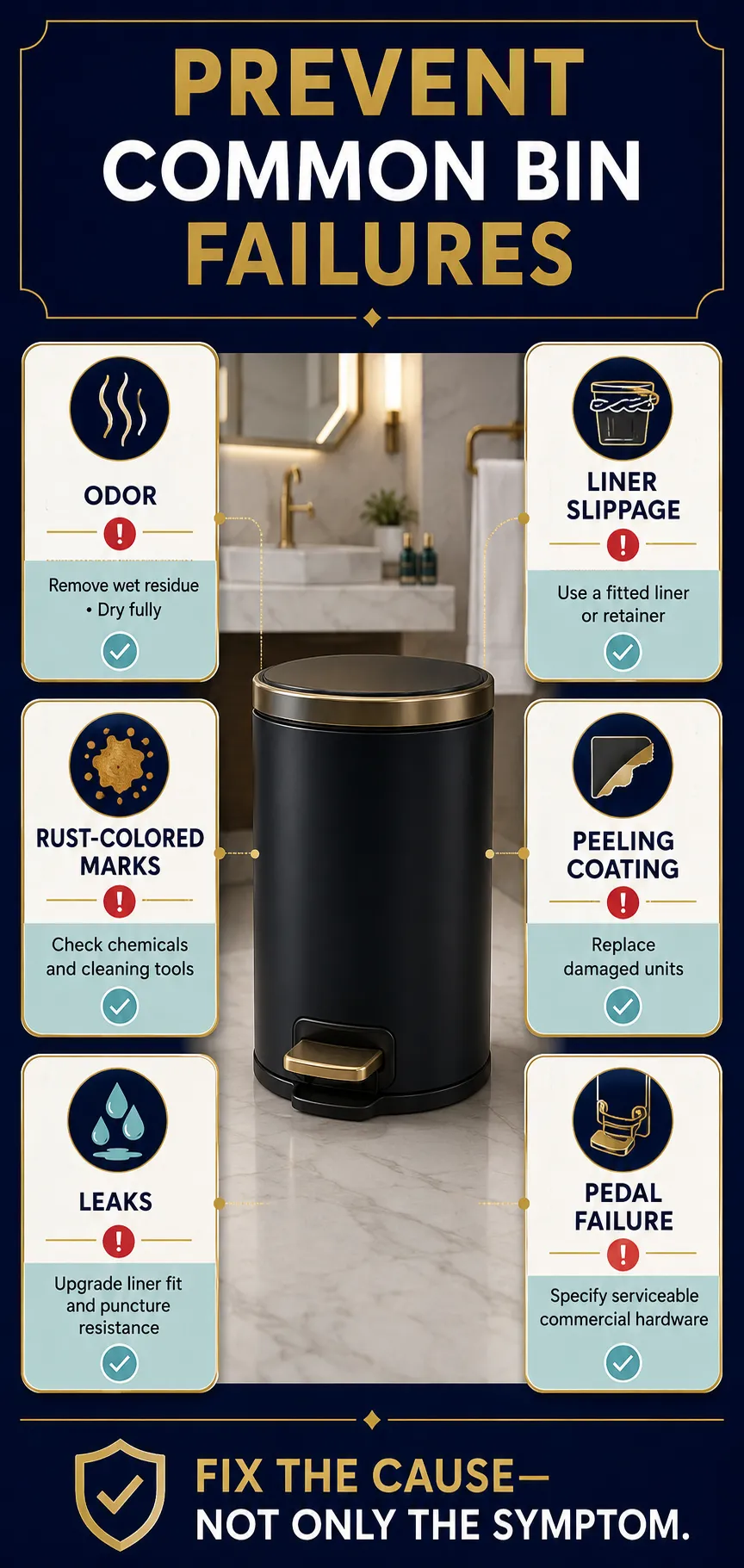
Odor is usually a systems problem rather than a reason to mask the bin with fragrance. Common causes include wet waste, an oversized collection interval, liquid beneath the liner, a dirty lid, residue trapped in seams, or a liner that has slipped below the rim.
| Problem | Likely causes | Corrective action |
|---|---|---|
| Persistent odor | Wet residue, delayed collection, contaminated insert, inaccessible seams | Deep-clean and dry the complete assembly; reassess capacity and collection frequency |
| Liner falls inside | Bag is too small, rim is too smooth, retainer is ineffective | Select a fitted liner or specify an integrated liner-retaining system |
| Liner shows above rim | Bag is oversized or no concealment system is provided | Fit-test smaller liners or add a compatible liner collar |
| Rust-colored marks | Base-metal exposure, chloride damage, carbon-steel contamination, or residue | Identify the source; use compatible tools and chemicals; replace damaged units |
| Peeling coating | Impact damage, weak edge coverage, or chemical incompatibility | Improve specifications and replace units with exposed substrate |
| Liquid under liner | Bag puncture, condensation, or poor fit | Use a stronger fitted liner, inspect common waste, and dry the insert |
| Pedal or lid failure | Low-duty mechanism, corrosion, impact, or unavailable parts | Specify tested commercial hardware and stocked replacement components |
| Scratched floor | Missing or hardened base ring, debris trapped underneath | Clean the base and install non-marking, replaceable floor protection |
| Trash can tips or slides | Narrow base, lightweight construction, forceful pedal | Select a wider or weighted base with non-slip feet |
Do not use steel wool on stainless steel. Do not attempt to conceal corrosion with polish before identifying its cause. If the protective coating has failed or the surface can no longer be cleaned to the property standard, replacement is usually more defensible than repeated cosmetic treatment.
Fragrance blocks and odor-control cartridges should be used cautiously. They add inventory, may conflict with fragrance-reduction policies, and do not correct contaminated surfaces. If the hotel uses them, they should be inaccessible to children, compatible with the receptacle, and included in the replacement schedule.
Calculate Quantities, Replacement Stock, and Lifecycle Cost
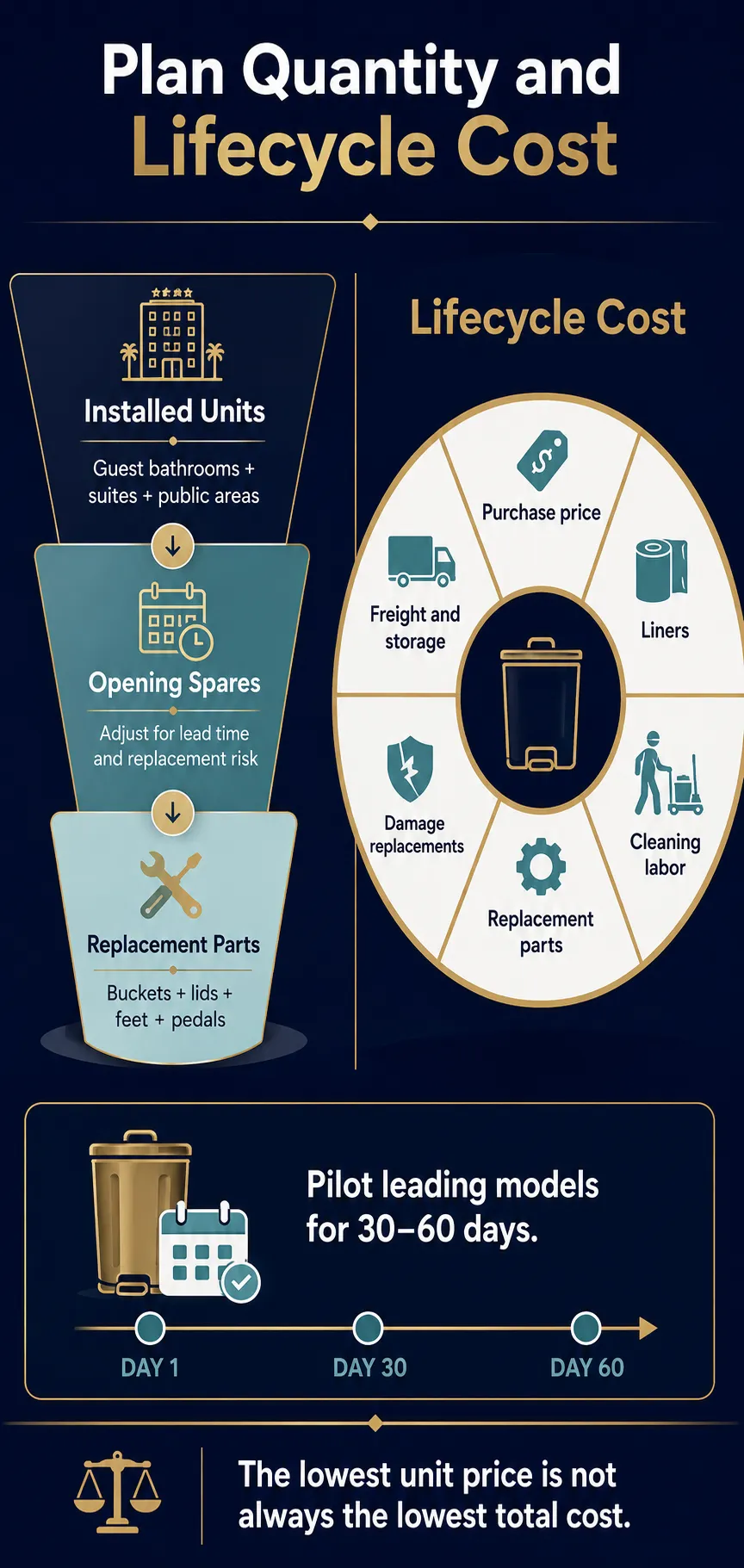
The opening order should cover installed units, spares, model samples, and replacement components.
Begin with a location schedule:
- One bathroom trash can for every applicable guest bathroom
- Additional units for multi-bathroom suites
- Public-restroom receptacles sized separately
- Staff, spa, fitness, pool, and back-of-house bathrooms
- Model-specific spares
- Inner buckets, lids, dampers, pedals, feet, and liner-retaining parts
A preliminary spare allowance of approximately 3% to 5% may be sufficient for a standardized, domestically available model with short lead times. Custom finishes, imported products, seasonal resorts, or models with long replacement lead times may justify 5% to 10%. These are planning ranges, not fixed industry requirements; adjust them using supplier lead time, warranty performance, room downtime risk, and storage capacity.
For example, a property purchasing 180 guest-bathroom units and eight additional bathroom units would require 188 installed receptacles. A 5% opening spare allowance would add approximately ten units, creating an initial order of 198.
Purchase price should not be the only financial measure. Compare total cost using:
Lifecycle cost per unit = purchase price + liners + cleaning labor + replacement parts + damage replacements + freight and storage − residual value
A cheaper receptacle may cost more if it requires a proprietary liner, takes longer to clean, damages easily, or cannot be repaired. Conversely, a premium sensor can may fail to justify its cost if its batteries, mechanisms, and service calls add complexity without improving guest satisfaction.
Before a property-wide purchase, pilot the leading models in representative rooms. A 30- to 60-day pilot can evaluate:
- Guest use and placement
- Average fill level
- Liner consumption
- Cleaning time
- Water spotting and fingerprints
- Mechanism reliability
- Floor movement
- Finish damage
- Room-attendant feedback
- Replacement-part availability
Keep the evaluation form consistent across models so appearance does not outweigh operational performance.
Write Procurement-Ready Specifications for Suppliers
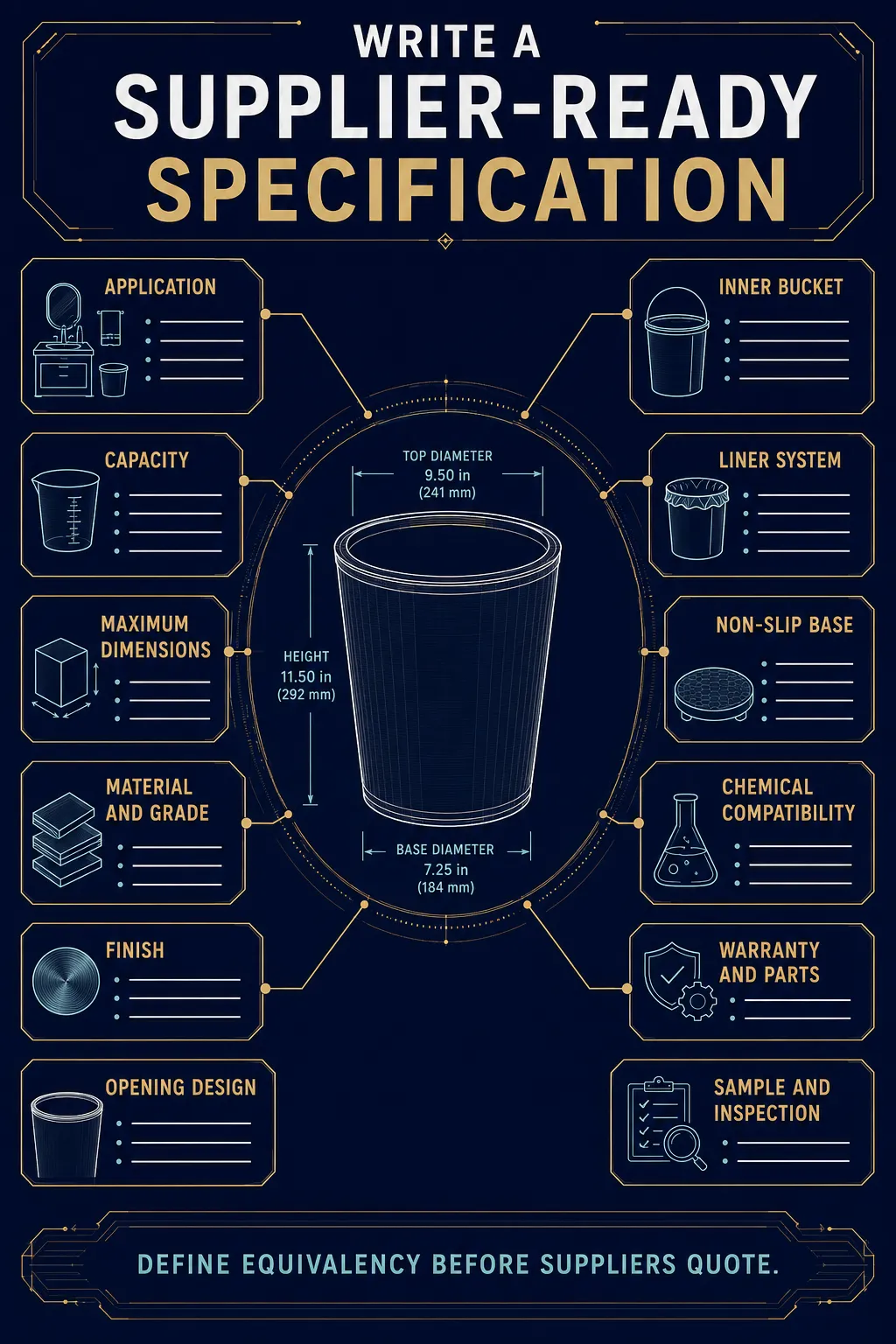
A procurement specification should enable competing suppliers to quote comparable products. Avoid vague requirements such as “luxury stainless bathroom bin” or “high-quality hotel wastebasket.”
A supplier-ready specification should include:
- Application: Hotel guest bathroom, room categories, and expected service environment
- Quantity: Installed units, spares, samples, and replacement components
- Nominal capacity: Gallons and liters
- Maximum dimensions: Width, depth, body height, and open-lid height
- Shape: Rectangular, slim, round, tapered, or property-approved equivalent
- Body material: Polymer type, metal grade, coating system, resin, or approved construction
- Material thickness: Where relevant to durability and quotation comparison
- Finish: Color, texture, gloss level, brushing direction, and approved sample
- Opening: Open top, lift lid, step pedal, swing top, or sensor
- Inner bucket: Required material, handle, leak resistance, and removability
- Liner system: Standard liner size, retainer type, concealment, and approved sample
- Base: Non-slip, non-marking, moisture-resistant, and replaceable where possible
- Safety: Rounded or hemmed edges and no accessible sharp projections
- Cleanability: Smooth surfaces, limited seams, removable components, and acceptable cleaning method
- Chemical compatibility: Written compatibility with property-approved cleaner and disinfectant
- Mechanism performance: Soft-close operation, pedal stability, and replaceable components
- Noise: No rattling insert or uncontrolled lid closure
- Quality sample: Preproduction or control sample required before mass production
- Submittals: Dimensions, materials, cleaning instructions, warranty, parts list, packaging, and country of origin
- Inspection: Acceptance criteria for finish consistency, stability, operation, damage, and quantity
- Packaging: Protection against scratches, dents, moisture, and finish transfer
- Warranty: Duration, exclusions, claim process, and response time
- Replacement availability: Guaranteed or stated period for inserts, lids, feet, pedals, and other service parts
The specification should also state whether alternative products are permitted and which characteristics suppliers may not change. Approving “or equivalent” without defining equivalency makes bid comparison unreliable.
Need supplier-ready specifications for multiple room types? KW Hospitality can prepare a property-specific bathroom waste-receptacle package based on your room count, layouts, finish schedule, service frequency, and opening date.
Send Us Your RFQ ( Request for Quote )
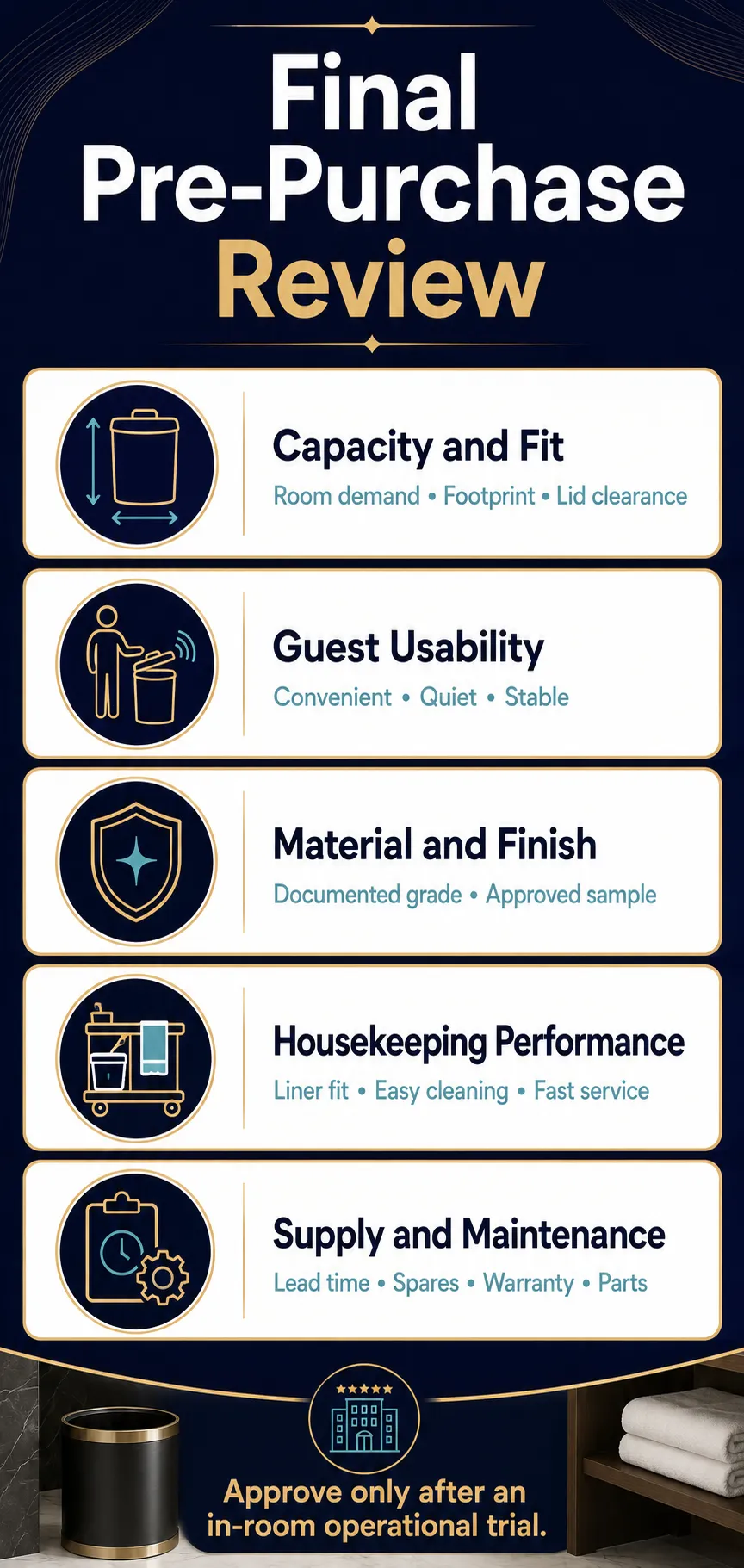
Final Purchasing Checklist for Hotel Bathroom Trash Cans
Before approving the purchase, verify the following.
Capacity and fit
- Capacity has been matched to room type, occupancy, and service frequency.
- The sample fits the smallest applicable bathroom.
- The door, toilet, vanity, and housekeeping route remain unobstructed.
- Lid and pedal movement have been tested in the installed position.
- The receptacle does not occupy required accessible clearances.
- Public-restroom demand has been calculated separately.
Guest usability
- The bin is visible enough to find but visually discreet.
- Guests can use the opening without awkward bending or reaching.
- The lid does not close sharply or create excessive noise.
- The base remains stable during normal use.
- Accessible-room operation has been reviewed separately.
Material and finish
- The exact body material or stainless-steel grade is documented.
- Color, texture, and gloss match the approved control sample.
- Coating coverage is consistent around edges and seams.
- The material has been tested with approved cleaning products.
- Water spots, fingerprints, and minor scratches remain acceptable under room lighting.
Housekeeping performance
- The liner can be changed quickly without reaching into the bin.
- Excess liner material can be concealed.
- The inner bucket is removable where required.
- Interior corners and lid components are accessible for cleaning.
- The complete unit dries without trapping water.
- Attendants can lift and transport it safely.
- The model passed an operational room trial.
Safety and maintenance
- Edges are rounded or hemmed.
- The base does not mark or scratch the floor.
- Attendants have procedures for leaks, sharps, blood, and unusual waste.
- Cleaning-product labels and Safety Data Sheets are available.
- Mechanisms and replaceable parts have been identified.
- Replacement criteria are included in inspection standards.
Commercial and supply requirements
- Unit pricing includes freight, packaging, duties, and required accessories.
- Liner cost and availability have been calculated.
- Lead time supports the project schedule.
- Spare quantities reflect replacement risk and replenishment lead time.
- Warranty terms and exclusions are documented.
- Final acceptance criteria are included in the purchase order.
- The supplier cannot substitute materials or finishes without written approval.

Final Purchasing Checklist for Hotel Bathroom Trash Cans
Frequently Asked Questions About Hotel Bathroom Trash Cans
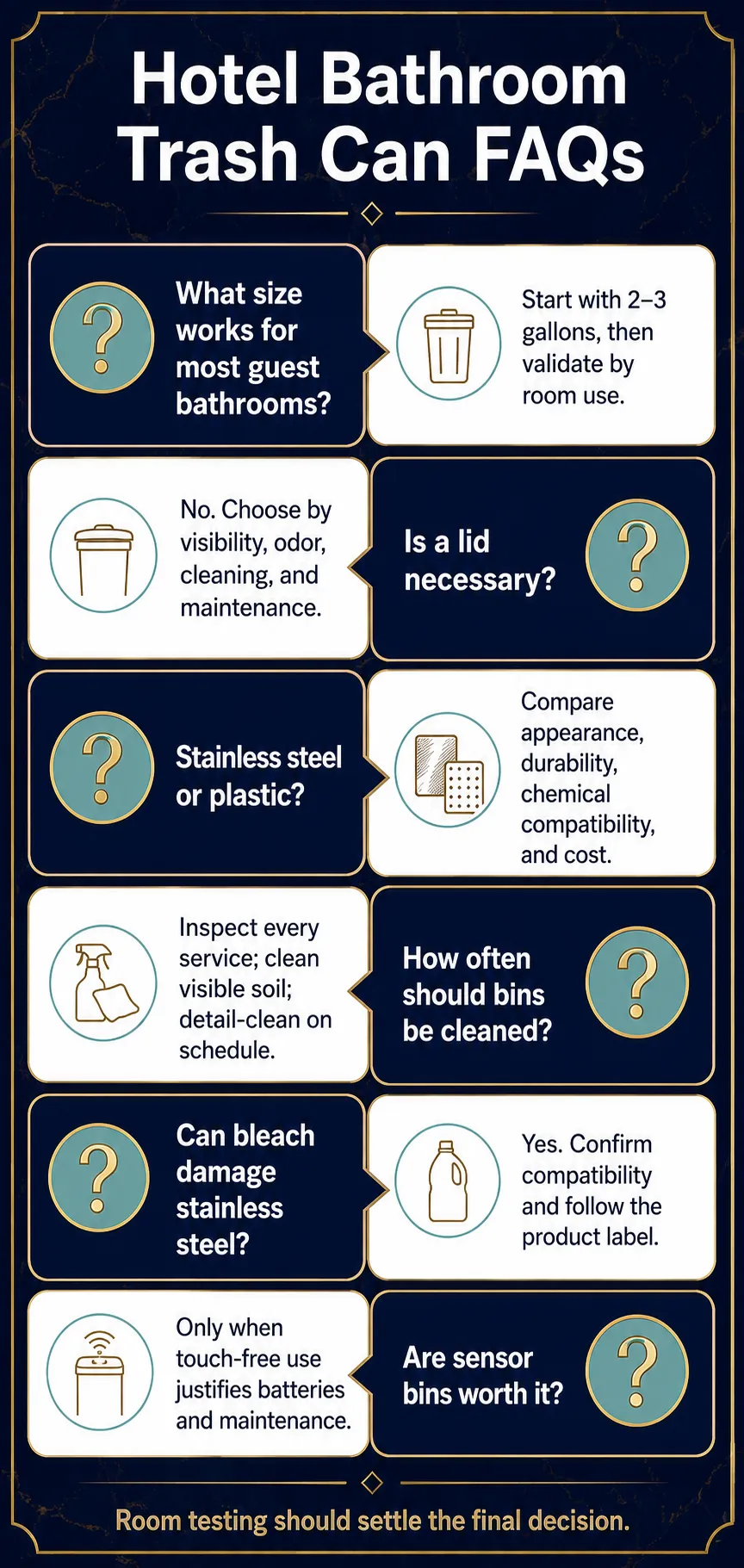
What size trash can is best for a hotel bathroom?
A 2- to 3-gallon model is a practical starting point for many standard hotel bathrooms. Compact rooms may require 1.2 to 2 gallons, while suites or extended-stay accommodations may require 3 to 5 gallons. The final choice should be validated using room layout, occupancy, waste volume, and housekeeping frequency.
Should a hotel bathroom trash can have a lid?
A lid conceals waste and may reduce mild odors, but it adds surfaces and mechanisms that require cleaning. Open-top bins are faster to service and easier to operate. Step cans are useful when concealed, hands-free disposal is important. The best option depends on guest expectations and the property’s maintenance capacity.
Is stainless steel better than plastic?
Neither material is universally better. Type 304 stainless steel offers a premium appearance and good durability when maintained correctly. Commercial plastic is economical, dent-resistant, lightweight, and easy to replace. Hotels should compare cleaning compatibility, appearance, labor, and lifecycle cost.
How often should hotel bathroom trash cans be cleaned?
They should be inspected during every applicable room service. Visible soil and spills require prompt cleaning. Checkout service should include cleaning the interior and exterior, while hinges, bases, seams, and liner retainers should be included in a scheduled detail-cleaning rotation. Disinfection should follow the property’s risk-based protocol and product-label directions.
Can bleach be used on stainless-steel trash cans?
Only if the receptacle manufacturer and chemical label permit it. Chloride-containing products and prolonged bleach contact can stain or pit stainless steel. Use the approved dilution and contact time, rinse when required, and never leave concentrated bleach on a decorative stainless surface.
Do hotel bathroom trash cans need liners?
A liner is strongly advisable in most guestrooms because it reduces direct contact with wet or personal-care waste and simplifies servicing. The liner must fit correctly, resist typical punctures, and remain concealed where appearance matters.
Why do stainless-steel bathroom bins develop rust-colored spots?
Possible causes include chloride exposure, contaminated cleaning pads, carbon-steel particles, damage to mixed-material components, or base-metal exposure on a lower-grade product. Identify the source before polishing the surface or replacing the unit.
Are sensor trash cans a good choice for hotel bathrooms?
They can provide touch-free operation, but batteries, sensors, motors, moisture, and replacement parts increase maintenance. Most guestrooms can be served more reliably by a well-designed open-top or mechanical step can.
Where should the trash can be placed in an accessible hotel bathroom?
Place it within convenient reach but outside the accessible route, required clear floor space, transfer area, door swing, and fixture access zones. The exact position should be verified against the room plan, applicable accessibility requirements, and an on-site inspection.
Should hotels use compostable trash bags?
Only when the bag is compatible with the actual waste stream and the receiving composting program accepts it. A compostable liner placed in ordinary landfill waste may not provide the expected environmental outcome. Environmental claims should be specific, accurate, and supported rather than misleading or overly broad.
Choose a Bathroom Waste System That Supports Cleanliness and Guest Satisfaction
The best hotel bathroom trash can is not necessarily the largest, most decorative, or most expensive model. It is the receptacle that fits the room, handles expected waste without overflow, supports accessible placement, works with a readily available liner, tolerates approved cleaning products, and can be serviced efficiently throughout its useful life.
Begin with a 2- to 3-gallon model for a standard guest bathroom, then validate that assumption through layout testing and an operational pilot. Specify the exact material and finish, test chemical compatibility, include replacement components, and train housekeeping employees to inspect, clean, dry, and reline the unit consistently.
For a supplier-ready hotel bathroom trash-can package, send KW Hospitality your property type, room count, bathroom layouts, finish requirements, service model, target opening date, and required delivery location.
Send Us Your RFQ ( Request for Quote )