
Approve a hotel showerhead retrofit only when the replacement delivers an acceptable spray at the property’s actual operating pressures, works with the existing shower valve, and reduces water use under realistic showering conditions. A lower gallons-per-minute rating is useful evidence, but it cannot establish those outcomes by itself. The purchasing decision needs both documented product performance and a controlled room trial.
That distinction matters when a hotel replaces hundreds of fixtures at once. A sample that feels comfortable in a demonstration bathroom may behave differently in an upper-floor room during the morning rush. A broad spray may look impressive while leaving the guest moving around to rinse. An otherwise suitable head may perform poorly behind an old diverter or through a restrictive hose. Buying before separating those effects can turn a simple replacement into repeated maintenance visits.
The useful question is therefore specific: which complete shower assembly gives this hotel a comfortable, consistent rinse at an acceptable water consumption? Answer it by recording the existing condition, comparing candidates under similar conditions, and setting acceptance requirements before ordering. Keep flow, flowing pressure, temperature behavior, and user feedback together in the same room record. An isolated measurement is much harder to interpret later.
This guide is for hotel owners, purchasing teams, and engineering managers planning fixture replacement in the United States or Canada. It explains how to read supplier data, organize an operational pilot, diagnose common failures, and estimate savings without presenting assumptions as measured results. Installation requirements remain specific to the property and the selected products. The examples below are illustrative procurement scenarios, not laboratory certification tests or reports from KW Hospitality installations.
Read flow, pressure, and spray as separate measures
Flow, pressure, and spray describe different parts of the shower experience, so the procurement specification should keep them separate. Flow tells you how much water arrives each minute. Flowing pressure describes the supply condition while that water is moving. Spray performance describes how the outlet distributes water and how it feels at the intended bathing position. Two heads can have the same flow rating and deliver noticeably different experiences. Likewise, one head can behave differently in two rooms. Start by matching the supplier’s test conditions to the conditions your engineering team can actually document, then assess the complete installed result.
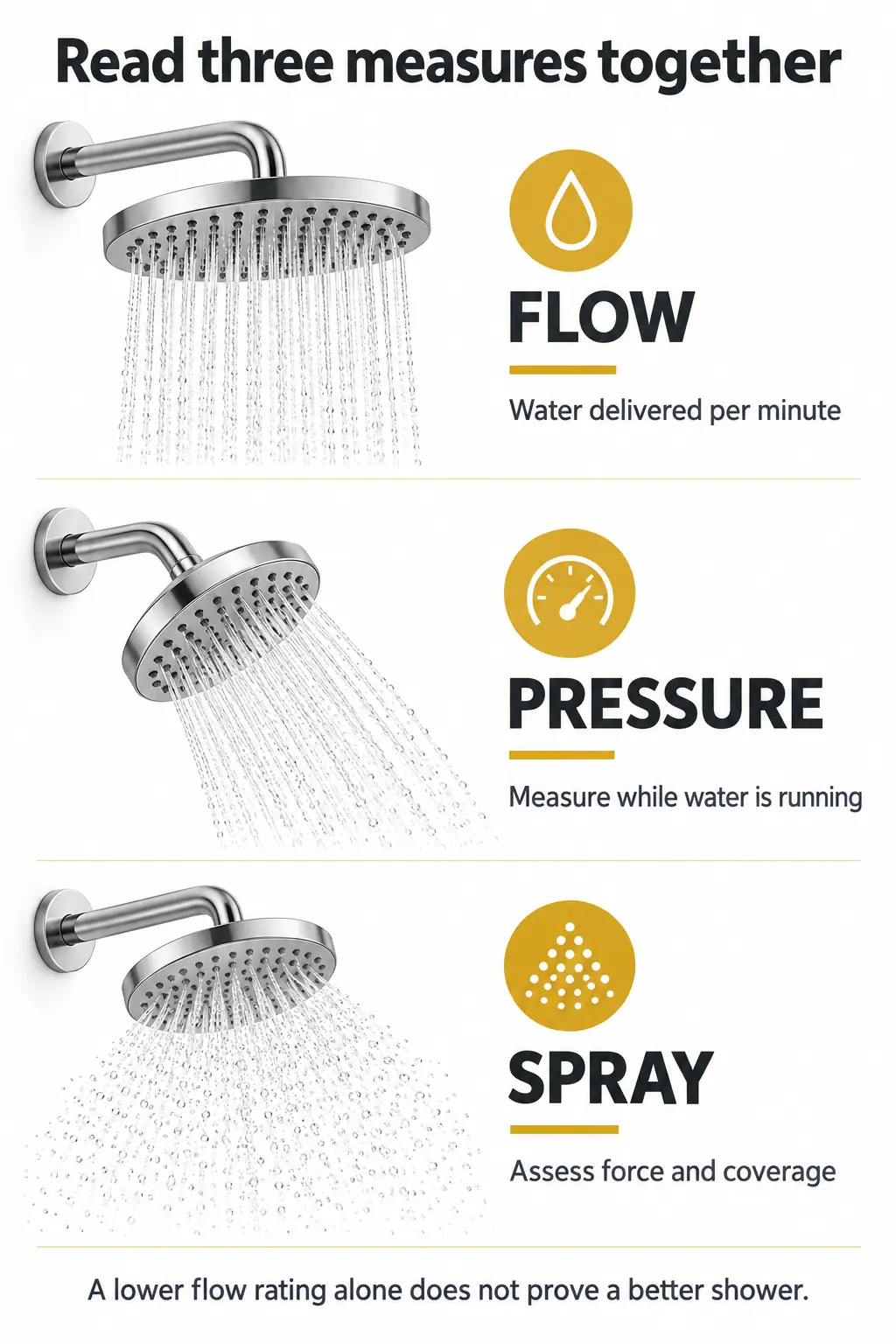
What the flow rating tells you
Flow is expressed in US gallons per minute, abbreviated gpm, or liters per minute, L/min. One US gallon is approximately 3.785 liters. A nominal 1.8 gpm rating therefore corresponds to approximately 6.8 L/min. Always confirm the rating’s test pressure and the exact model and flow variant; visually identical fixtures may have different internal flow controls.
The EPA WaterSense showerhead overview describes independently certified products that combine water efficiency with performance criteria. Its listed specification sets a maximum rated flow of 2.0 gpm. Treat that as a voluntary product-program criterion, not a universal legal allowance for every installation. Have the project team establish the applicable local requirements before issuing the order.
Why a static pressure reading is insufficient
Static pressure is measured when the relevant outlet is not flowing. It does not show what pressure remains when guests use water. Ask a qualified plumbing professional to measure flowing pressure at the showerhead inlet, with the candidate operating and with the measurement location recorded. A reading at a basement supply or a different fixture is not interchangeable with this value.
A gauge that blocks the shower outlet measures a different condition from a gauge on a suitable tee that allows the shower to run. Test hardware must be correctly rated and must not introduce a restriction that invalidates the comparison. Keep the head, hose, and valve configuration documented whenever measurements are taken.
What WaterSense testing adds
The WaterSense Specification for Showerheads, Version 1.1 evaluates flow at 20, 45, and 80 psi flowing pressure. It requires minimum flow relative to the rated maximum: 60% at 20 psi and 75% at 45 and 80 psi. These are certification criteria, not a guarantee of constant flow or satisfactory operation below the tested pressure range.
For example, the 60% criterion for a 1.8 gpm model corresponds to 1.08 gpm at 20 psi. That arithmetic explains the standard’s minimum-flow requirement; it does not predict a particular product’s actual output. Request the model’s flow-versus-pressure data and confirm the certification applies to the exact item offered.
Judge the spray at the bathing position
Spray force and coverage deserve independent attention. A narrow jet can feel strong while covering too little area; a very broad spray can distribute water beyond the useful rinsing zone. EPA’s explanation of showerhead performance testing describes separate laboratory methods for these characteristics, including a different arrangement for overhead rain showers.
In the hotel trial, evaluate shoulder coverage, rinsing effort, comfortable impact, overspray, and adjustment range at the actual mounting height. Use staff feedback as an operational comparison, not as a claim that the hotel has reproduced a certified laboratory test. A large faceplate, many nozzles, or a supplier’s “high pressure” description does not replace measured performance data.
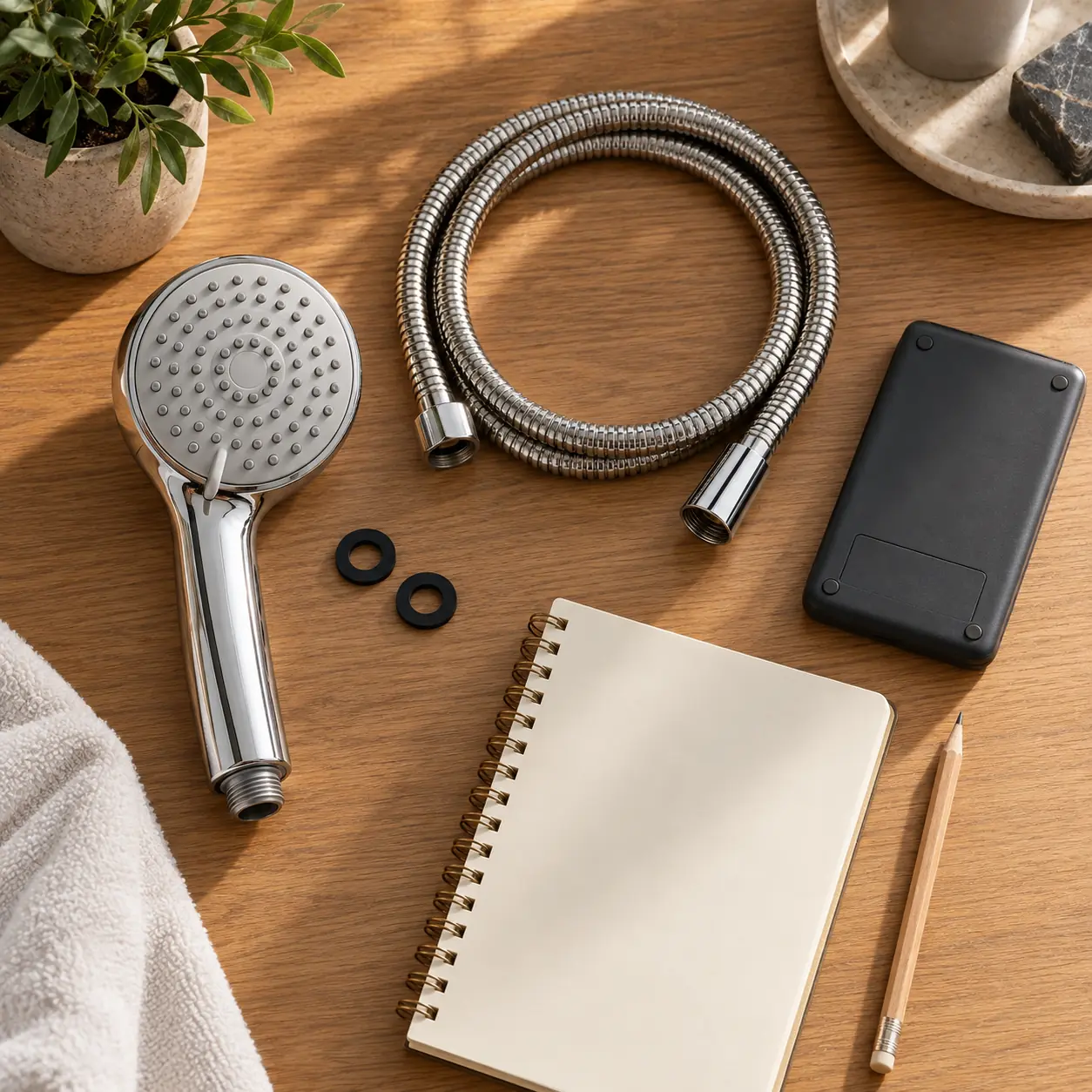
When shortlisting bathroom fixtures and accessories, compare the complete configuration that will be installed. A handheld model with a hose and diverter needs its own assessment even when its head resembles a fixed model already approved elsewhere.
Run a room pilot that reveals the cause of weak performance
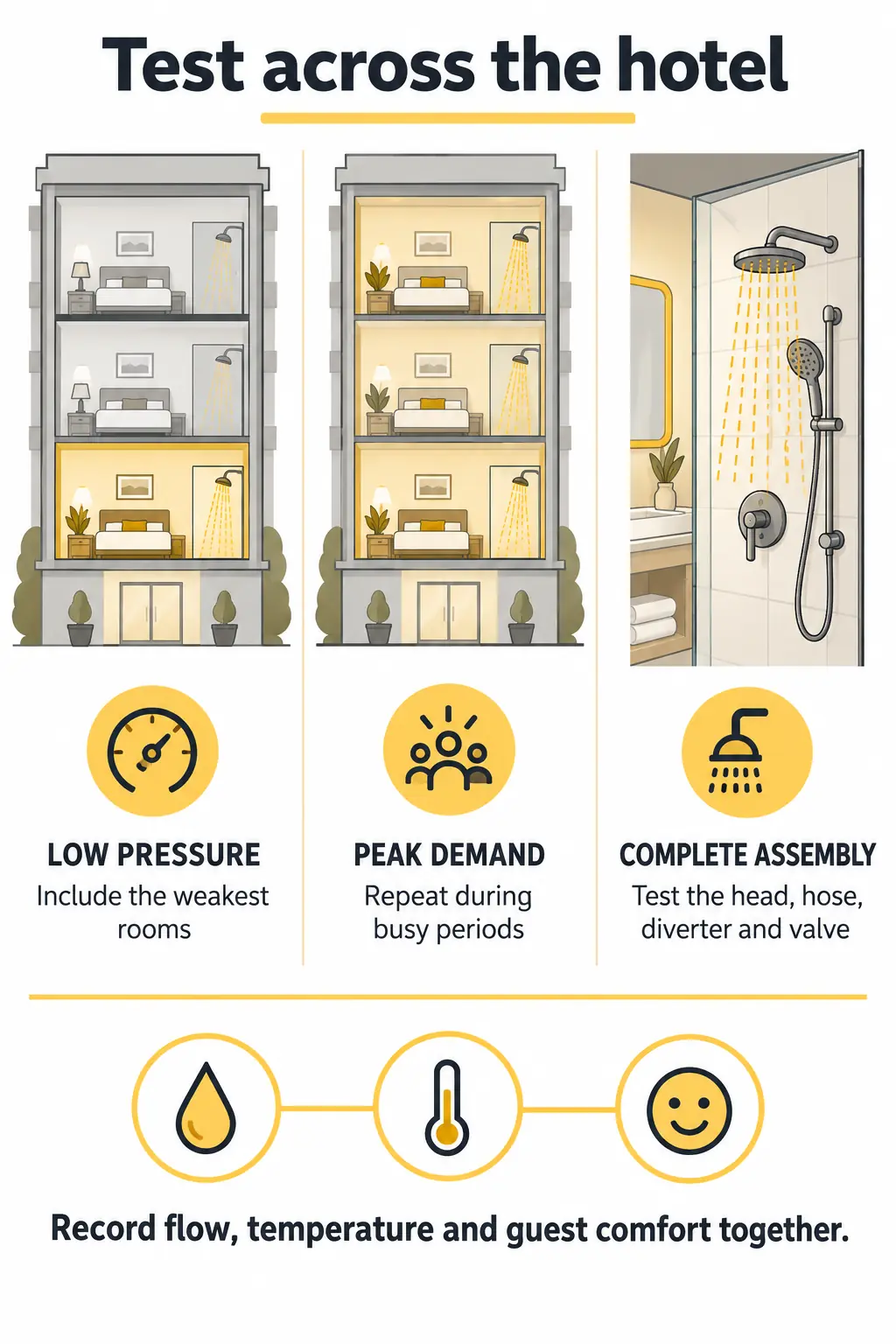
A useful pilot includes the conditions most likely to expose a problem, as well as ordinary rooms that represent most of the property. Select rooms across pressure zones, floors, risers, and valve types using the engineering team’s knowledge of the building. Include known complaint rooms and repeat comparisons during meaningful demand periods. The proposed procedure here is an operational purchasing method, not a prescribed sample size or code inspection. Its purpose is to distinguish a poor candidate from a supply, installation, or maintenance problem before a whole-property order turns that uncertainty into a costly commitment.
Establish the existing condition before changing parts
Record room identity, pressure zone, fixture and valve models where known, head position, hose arrangement, and visible condition. Measure the existing assembly as found. Then document any maintenance and retest it separately. This preserves the difference between improvement from cleaning a neglected fixture and improvement from purchasing a new design.
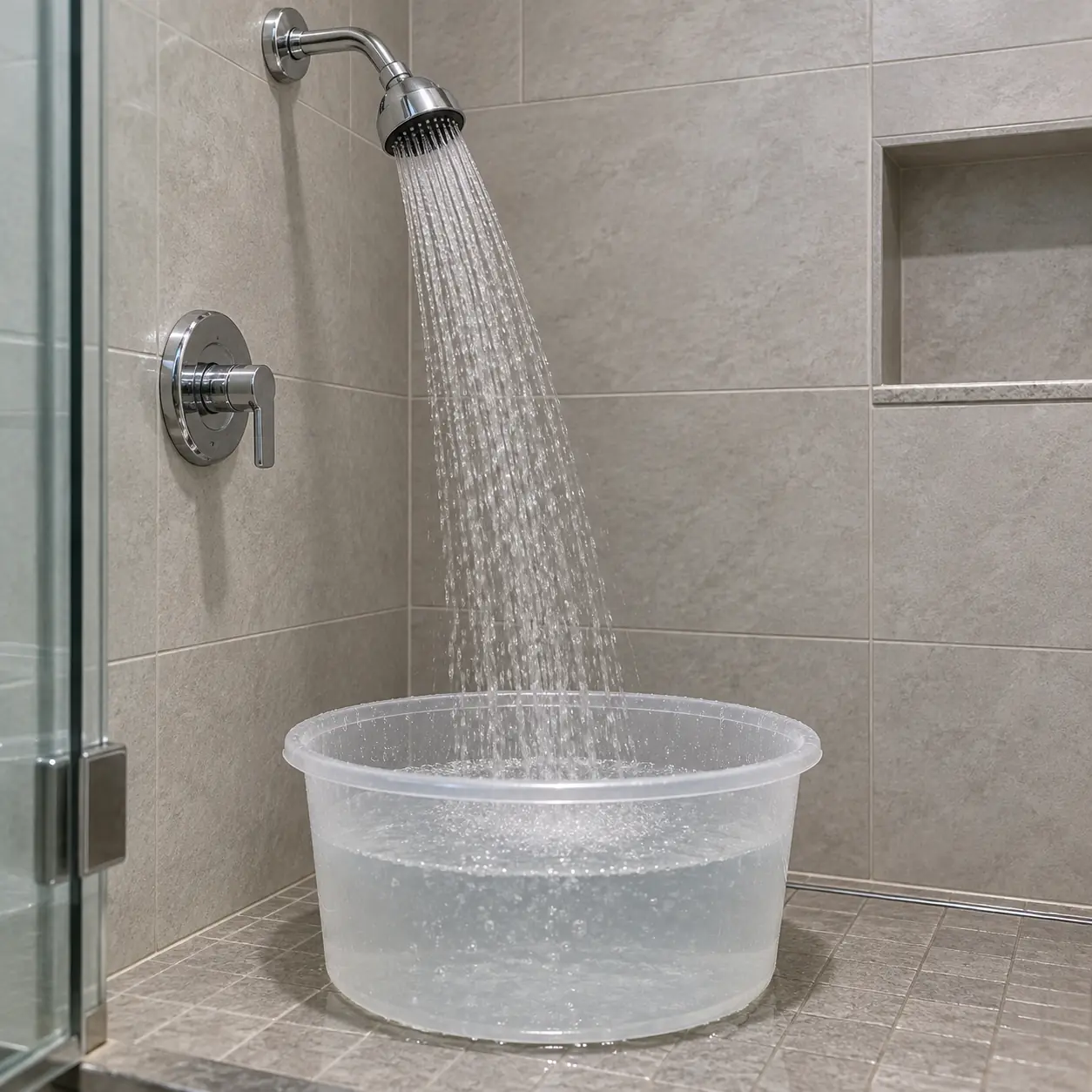
The EPA commercial showerhead guidance recommends checking scale, diverter leakage, and compatibility between the showerhead’s flow and the valve’s temperature-control performance. It also describes using a timer and a container of known volume to check flow. Those observations are a practical starting point for the hotel’s baseline.
For a timed collection, capture the entire spray without sealing or obstructing the outlet. After flow has stabilized, measure the collected volume and elapsed time. Flow in L/min = collected liters × 60 ÷ elapsed seconds. A collection of 3.4 liters over 30 seconds gives 6.8 L/min. Repeat the collection; inconsistent readings call for investigation rather than selective use of the best number. Use the same method for the existing and proposed fixtures.
Keep temperature, active spray mode, time of day, nearby demand, and flowing pressure with each result. Record tub-spout leakage separately where present. A collection from the showerhead alone does not capture water escaping through the tub spout.
Compare candidates without changing the whole experiment
Test the existing head and each candidate in the same rooms when practical. Keep the mounting arrangement and chosen operating condition comparable. A useful trial order alternates candidates rather than always testing one first, which helps reduce preference and timing effects. Include more than one sample of the proposed model so a single unusually good or defective specimen does not determine the purchase.
Have engineering approve the safe test arrangement before staff assess comfort. Use a consistent feedback scale, such as unacceptable, acceptable, or preferred, with a separate comment on rinse effort. Note whether the user had to change position, adjust the spray repeatedly, or extend rinsing. A favorable overall comment should not erase a specific temperature or leak concern.
The trial record should identify each observation with a room, candidate, operating mode, and date. “Good pressure” without those details is too vague to support a supplier acceptance discussion.
Diagnose the symptom before rejecting the product
The following table is a troubleshooting aid. Each cause is a possibility to investigate, not a diagnosis established by the symptom alone.
| Observed result | Possible explanation | Comparison that helps isolate it |
| Several heads weaken in the same rooms during busy periods | A supply or pressure-zone limitation | Repeat inlet flowing-pressure measurements across rooms and demand periods |
| One candidate is weak while the reference head is acceptable | Candidate characteristics, sample condition, or assembly restriction | Compare documented flow and pressure with a second sample in the same arrangement |
| Flow remains similar but rinsing feels worse | Spray distribution or impact does not suit the bathing position | Compare coverage, angle, mounting height, and user rinse feedback |
| Spray becomes uneven after service | Scale or debris may affect outlets or strainers | Inspect and service according to the manufacturer’s instructions, then retest |
| Water continues from the tub spout while showering | Diverter leakage adds water use outside the measured spray | Measure the spout loss separately and have the diverter assessed |
| Temperature changes unacceptably with demand | Valve compatibility, supply imbalance, or another system fault | Stop the comfort trial and have qualified engineering investigate the complete assembly |
Keep temperature control and physical fit as approval gates
A lower-flow head should not be approved simply because it fits the existing thread. Obtain the valve manufacturer’s minimum operating-flow information and confirm that temperature-control performance applies to the proposed operating range. EPA’s commercial guidance specifically calls for a compatible valve evaluated at the showerhead flow rate. A comfortable steady-state temperature alone does not establish performance when supply conditions change.
Also verify thread type, sealing method, arm projection, adjustment clearance, hose routing, bracket retention, and service access. Nominal connection size alone is not sufficient evidence that imported and existing fittings are compatible. Accessible-room requirements need a separate review of the applicable arrangement and controls; a standard-room trial cannot approve every room type.
Do not remove the integral flow regulator to rescue a failing sample. That changes the product being assessed and invalidates the relationship between its documentation and the tested assembly. If a candidate cannot meet the hotel’s approved conditions as supplied, resolve the cause or choose another model.
Turn measured performance into savings and a purchase specification
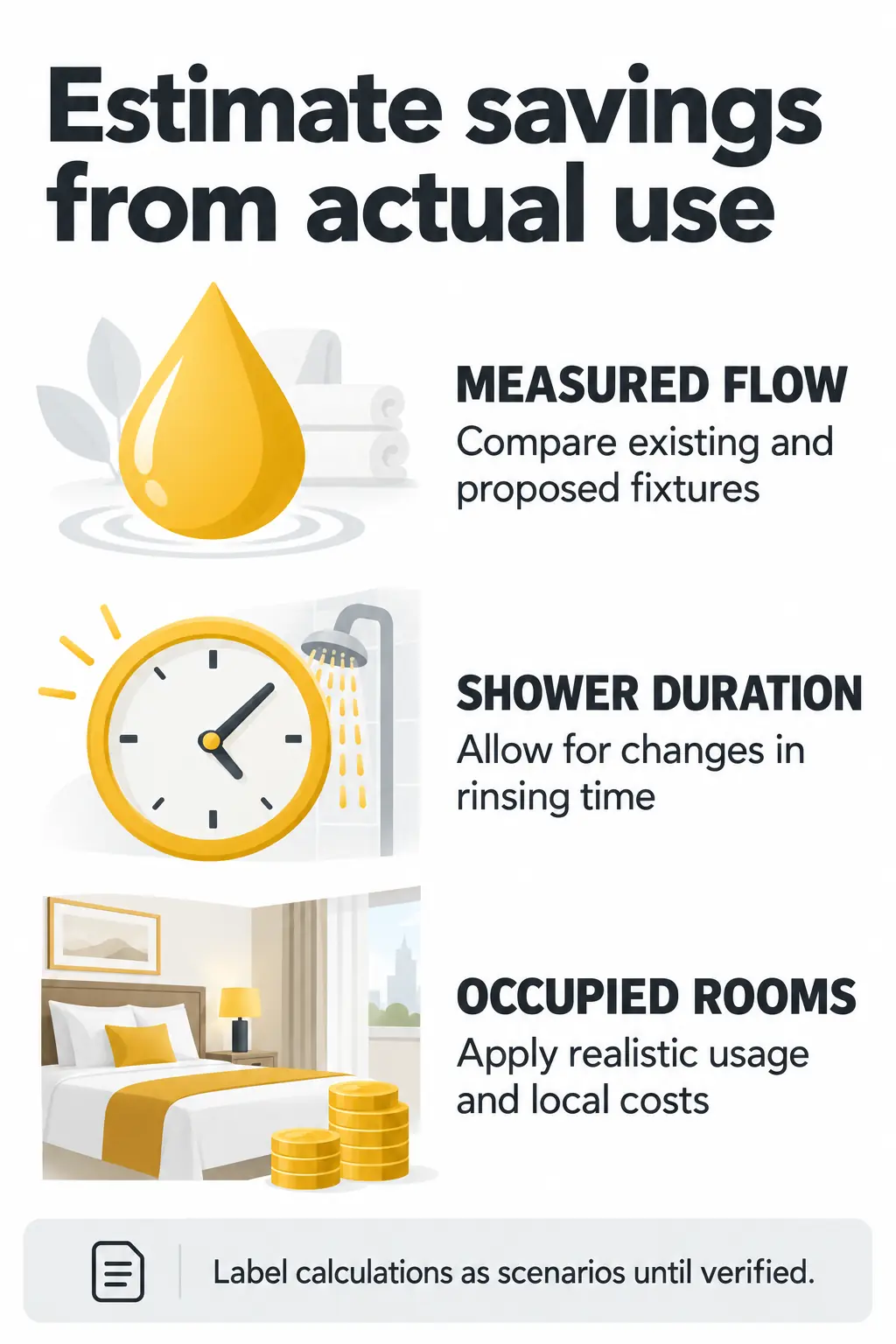
The business case should use the flow the hotel expects to obtain, the number of showers actually taken, and a realistic duration for each shower. Rated flow alone cannot establish annual savings because occupancy, guest behavior, fixture condition, and installation details all influence consumption. Treat supplier savings estimates as scenarios until their inputs match the property. Once a candidate passes the room trial, translate its identity and tested configuration into the purchase specification. This connects the financial estimate to the product delivered and gives purchasing, engineering, and housekeeping a shared basis for accepting or questioning the order.
Calculate water use per shower before annualizing it
For a simplified scenario with approximately steady flow, water per shower equals flow multiplied by duration. Annual shower-water savings equal annual shower count multiplied by the difference between existing and proposed water use per shower. If the guest changes spray modes, use measured total volume or an appropriate time-weighted flow rather than one mode’s rating.
Consider an illustrative 150-room hotel at 70% average occupancy, with an assumed 1.2 showers per occupied room-night. These assumptions produce 45,990 showers per year: 150 × 0.70 × 365 × 1.2. They are not hotel-industry benchmarks. The example assumes no change in warm-up waste or diverter leakage and uses the following measured-flow assumptions.
| Scenario | Flow | Duration | Water per shower | Annual reduction versus baseline |
| Existing assembly | 2.2 gpm | 8 minutes | 17.6 US gallons | Baseline |
| Candidate with unchanged duration | 1.8 gpm | 8 minutes | 14.4 US gallons | 147,168 US gallons |
| Candidate with longer duration | 1.8 gpm | 9 minutes | 16.2 US gallons | 64,386 US gallons |
At eight minutes, the modeled reduction is about 18.2%. At nine minutes, it falls to about 8.0%. The break-even duration is 17.6 ÷ 1.8, or approximately 9.78 minutes: beyond that point, the candidate uses more water per shower than this baseline. This does not predict that guests will shower longer. It shows why rinsing performance belongs in the financial decision.
For rooms with different usage or pressure conditions, calculate separate groups and add them. Do not multiply the most favorable trial-room saving by every room in the hotel. If only part of the property is retrofitted, include only the shower use associated with that part.
Separate water charges, heating energy, and installation costs
Water and sewer savings should use the marginal charges that actually vary with consumption. Fixed fees generally remain. For an explicitly assumed combined variable rate of $12 per 1,000 US gallons, the unchanged-duration scenario gives approximately $1,766 per year; the longer-duration scenario gives approximately $773. These are arithmetic examples, not current local utility rates or supplier quotations.
Heating savings require another calculation using the hot-water share, temperature rise, and plant performance. Do not treat every gallon of mixed shower water as a gallon of fully heated supply water. Do not assume a reduction in shower demand produces the same percentage reduction in the entire water-heating bill, since storage and distribution losses may remain.
Compare benefits with the installed project cost: fixtures, freight, applicable duties and taxes, labor, any required valve work, replacement parts, and room disruption. Simple payback is installed cost divided by estimated annual net operating savings. State the assumptions and exclude benefits you cannot reasonably quantify. A low unit price is of little help if unresolved compatibility requires reopening rooms.
Specify the tested assembly and control substitutions
The supplier brief should identify the exact model, rated-flow variant, finish, included hose or arm, and any diverter or bracket. Request dimensional drawings, applicable compliance documentation, model-specific certification where required, flow-versus-pressure data, installation instructions, and cleaning guidance. Record the approved sample’s identity so the delivered order can be compared with it.
Set acceptance requirements around the hotel’s approved trial conditions. Keep safety and compatibility as pass-or-fail gates, then compare comfort, maintenance effort, and cost among candidates that pass. A weighted score should never allow a cheaper fixture to compensate for an unresolved temperature-control fault.
Require written approval for changes to the flow-control insert, hose, nozzle assembly, or other performance-relevant component. Agree on spare-part availability, warranty procedure, and how batch identification will appear on packaging. Housekeeping should review the manufacturer’s cleaning method before approval; maintenance effort and finish compatibility are part of the operating decision.
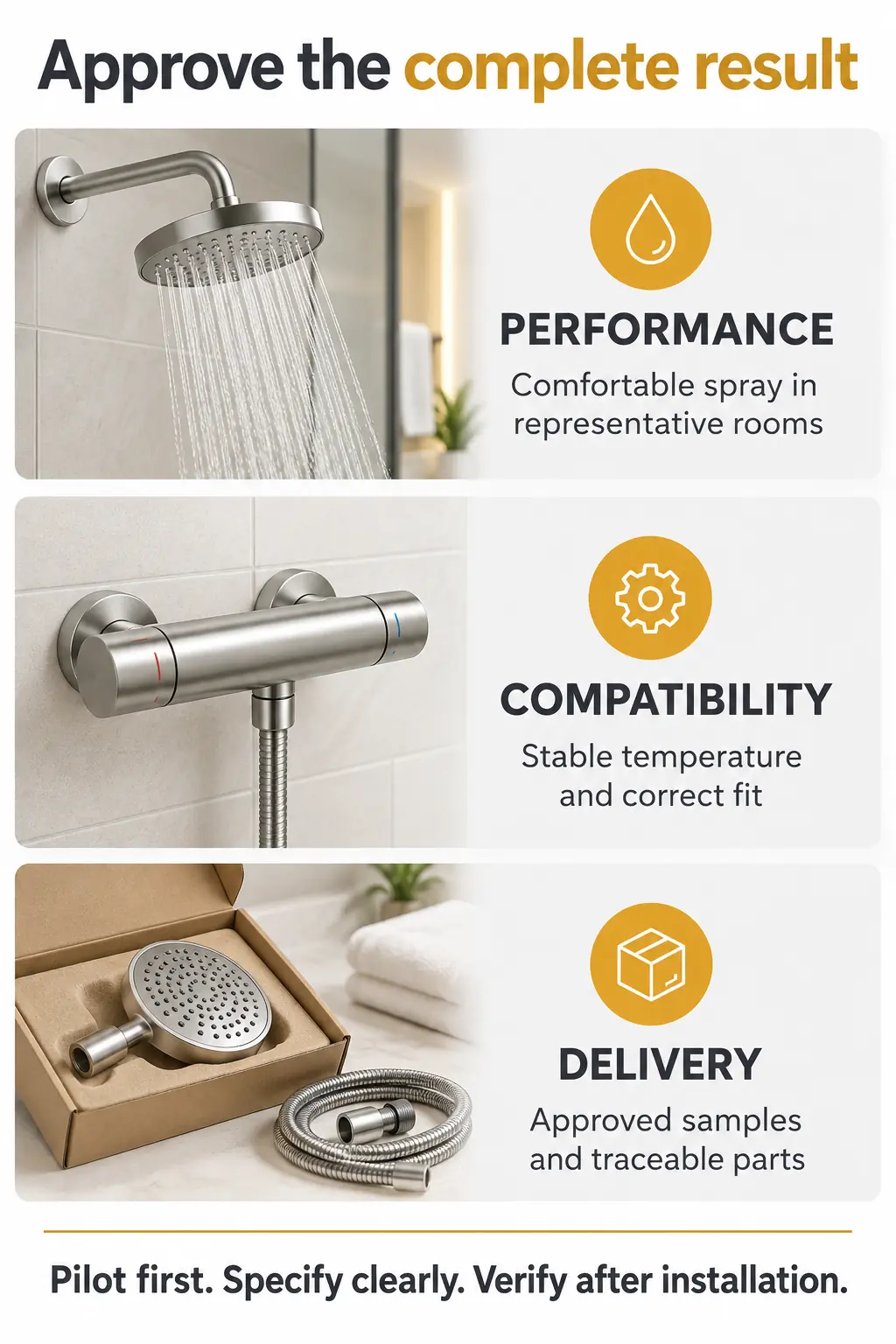
After installation, sample rooms across the completed work and compare them with the approved trial. Investigate differences in flow, leaks, temperature behavior, or user feedback before releasing the next phase. Procurement is complete when the delivered assembly reproduces the approved result, not merely when the cartons arrive.
Conclusion
A sound showerhead retrofit starts with the room conditions the hotel actually has and ends with a clearly identified assembly that performs acceptably in those conditions. Read flow, flowing pressure, and spray separately, then evaluate them together with temperature stability and physical compatibility. Use the pilot to resolve causes of poor performance before ordering at scale. Build the savings estimate from realistic shower use, and preserve the tested configuration in the supplier specification. This gives the hotel a defensible purchase decision while keeping guest comfort, maintenance requirements, and operating costs visible throughout the project.
For a project-specific sourcing discussion, send KW Hospitality a showerhead RFQ with the property location, room quantity, existing fixture details, required documentation, measured operating conditions, and target installation schedule. Include the approved sample or pilot findings when available so quotations can be compared against the same brief.
Frequently Asked Questions
Can a new showerhead fix genuinely low supply pressure?
It may deliver a more satisfactory spray using the available supply, but a passive showerhead does not create additional building supply pressure. If several candidates weaken in the same rooms or at the same demand periods, investigate the supply conditions before treating the head as the sole cause.
Is 1.5 gpm or 1.8 gpm automatically the better hotel choice?
Neither rating establishes the better choice on its own. Compare compliant candidates in the hotel’s operating conditions, including rinse comfort and valve compatibility. Use the measured water per shower and installed cost to compare the candidates that pass. Do not assume a lower rating guarantees lower consumption if duration changes.
Does a WaterSense label guarantee guest satisfaction in every room?
No. It establishes that the certified model meets the program’s applicable efficiency and performance criteria. The installation still introduces room pressure, valve behavior, mounting geometry, and other variables. Verify the exact model and perform a representative hotel trial.
How many rooms should a retrofit pilot include?
There is no single room count established by this guide. Cover the meaningful combinations of pressure zone, valve type, installation arrangement, and known problem conditions. A small uniform property may need fewer combinations than a tower with multiple systems. Engineering should define coverage and expand it when results vary unexpectedly.
Should the flow through a handheld shower be tested with its hose attached?
Yes, assess the configuration guests will use, including the specified hose and diverter. Document pressure measurement locations so readings can be interpreted correctly. If multiple outlets can operate together, measure total consumption in that mode as well as individual outlet behavior; one head’s rating does not describe the entire system.
Can the hotel claim the calculated annual saving immediately after installation?
Describe it as an estimate until verified. Track actual operating conditions and compare consumption over a suitable period while accounting for occupancy and other water uses. Separate observed results from the assumptions used to explain them. Whole-building meter changes alone may not isolate the showerhead project’s effect.
References
Official sources reviewed for this article on September 19, 2026:
US EPA — Showerheads: WaterSense efficiency and performance overview.
US EPA — WaterSense Specification for Showerheads, Version 1.1.
US EPA — Explanation of Performance Testing Under the WaterSense Specification for Showerheads.
US EPA — WaterSense at Work, Section 3.4: Showerheads and Bath and Shower Diverters.