
Before ordering hotel faucet aerators, match the existing aerator family, thread gender, nominal diameter, thread pitch, and sealing arrangement. Then approve a sample on the actual faucet. A replacement that looks similar, measures approximately the same width, or starts to screw into the spout is not enough evidence for a bulk purchase. The complete assembly must fit correctly and deliver the intended water stream.
For a hotel, the difficult part is rarely the price of one aerator. It is knowing which replacement belongs in which room. A property may have original guest-room faucets, renovated suites, accessible bathrooms, public-restroom fixtures, and individual repairs made with different models. Even faucets with similar chrome finishes can require different parts. Buying one carton for the entire building can leave maintenance with unusable stock and delay room release while the right components are sourced.
The word aerator also hides several purchasing decisions. You might need a complete metal housing with an insert and washer, only an insert for a reusable housing, or a concealed cartridge that threads directly into the spout. These are different order descriptions. A flow rating adds another distinction: two mechanically compatible parts can produce different flow rates or stream patterns. Neoperl’s identification guide treats size, construction, flow, and additional functions as separate selection factors.
The practical approach is to identify fixture groups first, resolve uncertain parts with physical samples, and create a purchasing record for each approved replacement. This guide focuses on hotel basin faucets. It explains how to read thread descriptions, where measurement can mislead, how to evaluate a trial installation, and how to translate the result into replacement stock. Kitchen spray heads, tub fillers, and proprietary designer outlets need their own model-specific identification rather than automatic inclusion in the same order.
Identify the Aerator Family and Full Thread Specification
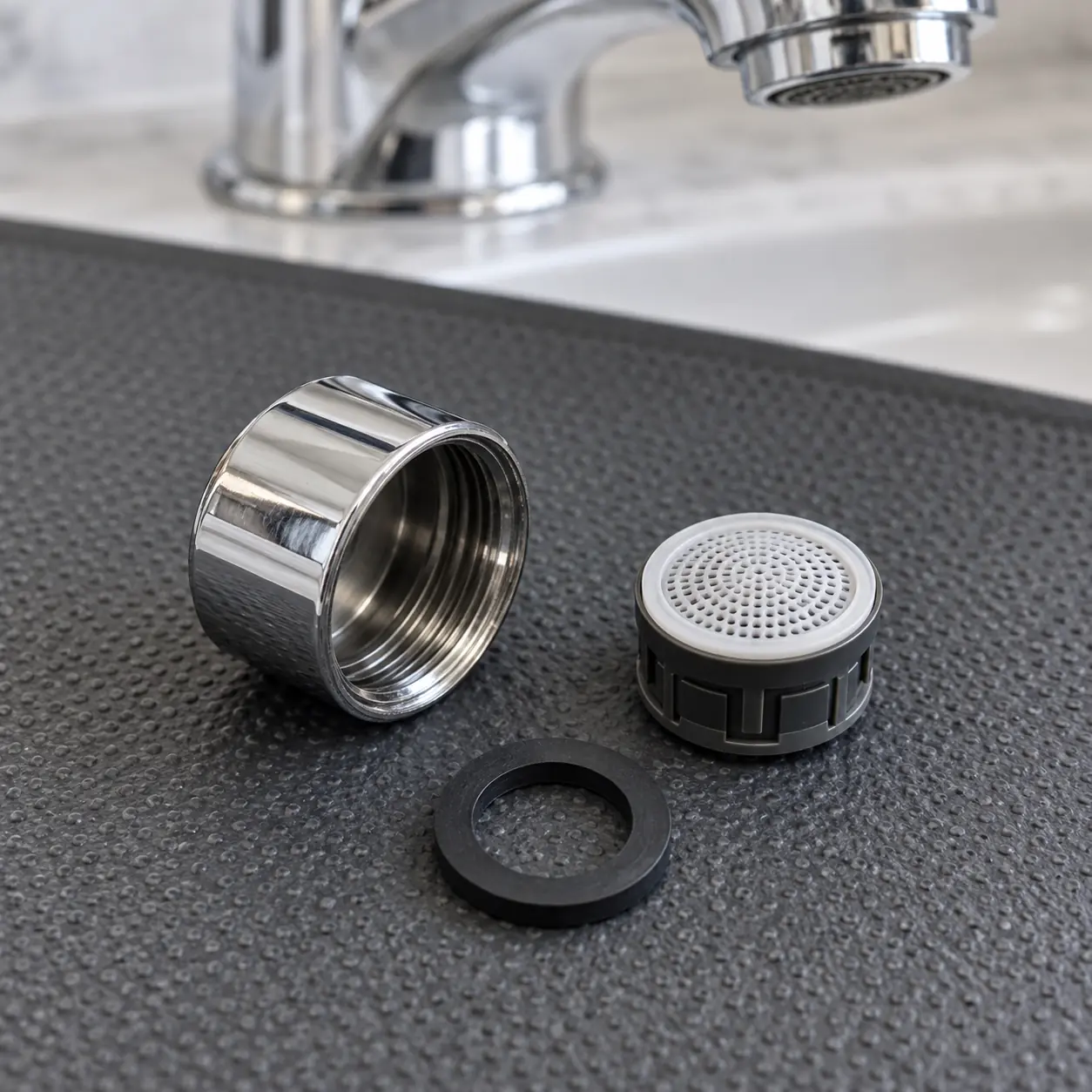
Start by identifying what actually attaches to the faucet, because the exposed finish ring and the working insert are not always the same component. A conventional aerator can have a removable metal housing containing an insert and a washer. A concealed threaded cartridge screws directly into a compatible spout. An insert removed from a metal housing may have no attachment thread at all. Photograph the outlet before removal, then photograph the removed assembly from the side and both ends. Keep the parts together with the room or fixture-group reference so that a measurement cannot become separated from the faucet it describes.
Describe gender from the replacement part’s perspective
A male aerator housing has threads on its outside and screws into an internally threaded spout. A female aerator housing has threads inside and screws over externally threaded spout threads. A note reading “male faucet” can therefore describe the opposite gender from the replacement aerator required. Put “aerator housing: female,” for example, in the purchase record instead of leaving the reference ambiguous. Aerator.com’s construction guide illustrates this distinction.
Identify whether the purchase includes the complete assembly or only the insert. Reusing an undamaged housing can preserve an existing finish, but insert diameter, height, seating, and washer compatibility still need confirmation. Neoperl lists conventional housings, inserts, and washers as separate parts in its housing and insert guide. A “standard insert” description is insufficient without the relevant product family.
Read diameter and pitch together
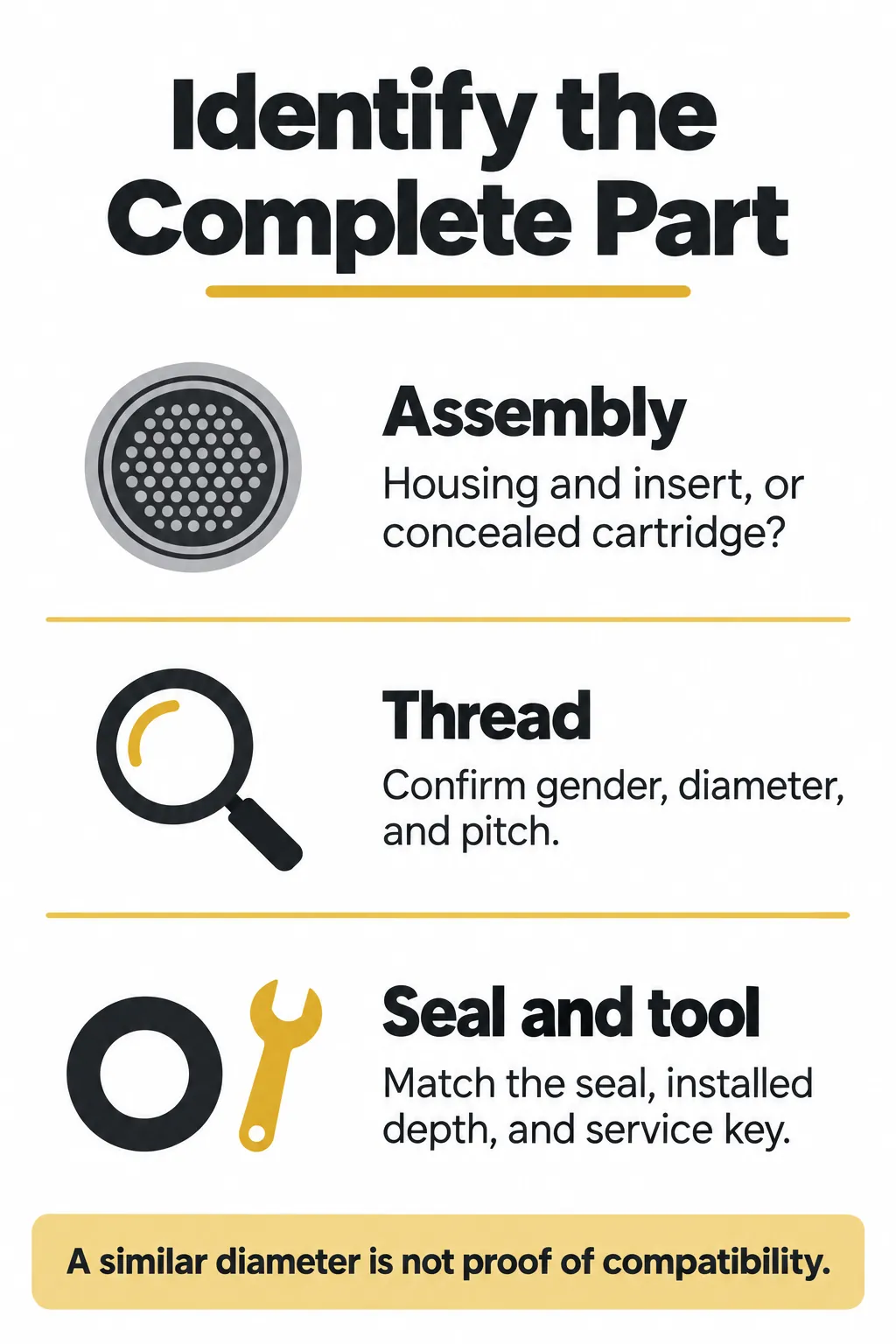
In a metric designation such as M22×1, 22 is the nominal thread diameter in millimeters and 1 is the pitch: the axial distance between adjacent thread crests. Measure an accessible external thread across its crests with a caliper, rather than across the decorative shell. For an internal thread, a simple opening measurement does not directly establish its nominal diameter; use the manufacturer’s drawing, a suitable thread gauge, or a positively identified mating sample.
Keep US inch-thread descriptions exactly as specified by the manufacturer, including threads per inch. Do not round an inch dimension to a nearby metric size and declare a match. Similarly, matching diameter without checking pitch leaves the identification incomplete. If the original is damaged or heavily scaled, obtain a second sample from the same verified fixture group before relying on its dimensions.
| Replacement family | Example thread designation | What the buyer must distinguish |
| Conventional female housing | M22×1 | Threads inside the housing; separate insert and washer |
| Conventional male housing | M24×1 | Threads outside the housing; separate insert and washer |
| CACHÉ Tom Thumb (TT) | M16.5×1 | Concealed cartridge family; matching bore and service key |
| CACHÉ Tiny Junior (TJ) | M18.5×1 | Different size from TT; verify the complete cartridge |
| CACHÉ Junior (JR) | M21.5×1 | Do not round to M22 when specifying the replacement |
| CACHÉ Standard (STD) | M24×1 | Same nominal designation as some housed models, but a different assembly |
These are identification examples, not a compatibility guarantee or a complete list of aerator threads. The CACHÉ names and sizes appear in Neoperl’s printable size reference. Print that reference at actual size and check its scale before using it. A screen image or a printout fitted to the page can mislead.
Treat concealed outlets as complete systems
A CACHÉ STD M24×1 cartridge should not be substituted for a conventional M24×1 metal housing simply because the thread notation matches. CACHÉ requires a suitable spout bore and seals differently. Its cartridge geometry, seal position, installed depth, and removal tool matter together. Neoperl’s CACHÉ guidance specifies replacement within the same size and the appropriate service key.
For a rectangular outlet, unusual thread, or missing original part, obtain the faucet model and replacement drawing. An empty spout photograph alone is weak evidence. If the exact model is unknown, send the supplier the original assembly and faucet photographs, and hold the volume order until the identification is resolved.

Approve Fit and Water Performance on the Actual Faucet
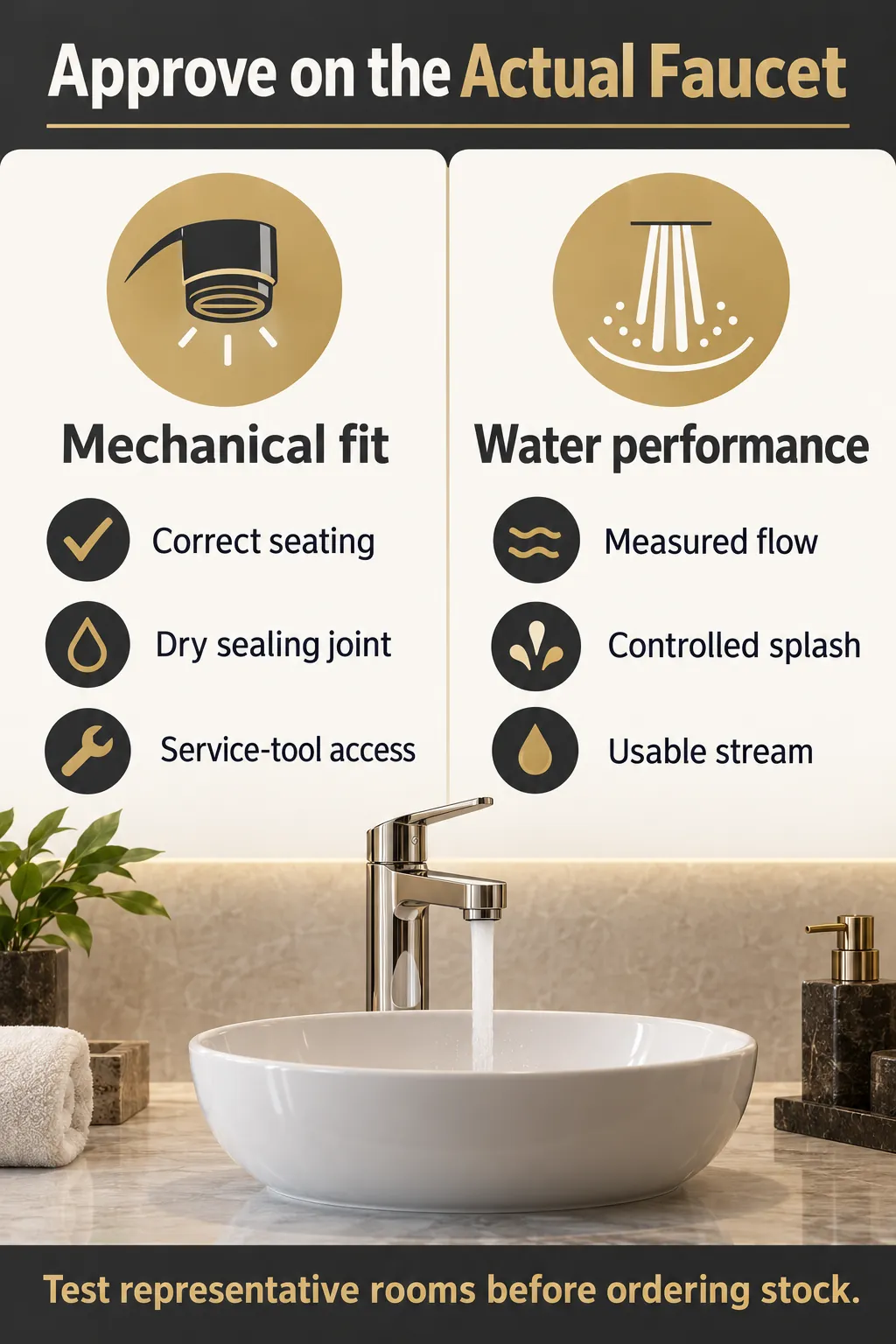
A correctly identified thread is the entry condition for a trial installation, not the final acceptance decision. Evaluate the replacement on an actual faucet from every distinct fixture group before approving stock. Choose additional trial locations where operating conditions differ, such as an upper floor, a remote branch, or a bathroom with a different basin. These locations reveal issues that a loose sample on a purchasing desk cannot: poor sealing, an unsuitable stream angle, restricted flow, difficult servicing, or an outlet that projects farther than intended. Record the part number and test location so approval applies to a defined combination rather than to an untraceable sample.
Confirm seating without forcing the connection
Protect the basin drain against lost parts and use the specified removal tool. Inspect for a washer left inside the spout, damaged threads, deposits, or a distorted sealing surface. Fit the specified replacement seal in its intended position. Do not add washers or thread tape to make an uncertain part appear compatible; neither establishes the correct thread or sealing geometry.
Start the replacement squarely and gently. Stop if it binds, tilts, or requires force immediately. Tightening requirements depend on the design, so follow its installation instructions rather than a universal number of turns. For CACHÉ, Neoperl instructs installers to stop at the specified flush position and avoid driving the cartridge fully inward. Its replacement instructions also identify displaced seals and damaged plastic threads as potential causes of leakage.
After installation, run the faucet and inspect the joint. Water escaping around the housing calls for an installation and seal check; it should not be accepted because the outlet also produces a stream. Confirm that the service tool can remove and reinstall the sample without damaging it. Maintenance access is part of compatibility.
Separate flow rate, stream pattern, and pressure
A flow rating states volume per unit time, usually gallons per minute (gpm) or liters per minute (L/min). It does not identify the thread. Ask for the rated flow, the pressure at which it is specified, and whether the model restricts flow or regulates it over a stated pressure range. A pressure-compensating model can help maintain a more consistent flow within its operating range; it cannot create missing supply pressure. Neoperl’s flow-regulator overview distinguishes this regulating function.
Test the installed stream in the actual basin. Check handwashing space, splash onto the counter, stream direction, noise, and the time needed to obtain usable warm water. Repeat under representative building demand if pressure varies. Aerated, laminar, and spray outlets create different experiences; the same nominal gpm does not make them operationally identical. Neoperl’s stream-pattern guide describes those alternatives.
For a simple field measurement, collect the whole stream for a measured interval: L/min = collected liters × 60 ÷ seconds. For example, 0.75 liters collected in 10 seconds equals 4.5 L/min. This is an illustrative calculation, not a target flow or a certification test. Repeat the measurement and record operating conditions; a partial catch underestimates flow.
Keep guest-room and public-restroom requirements separate
EPA includes hotel guest-room bathroom faucets within the private-lavatory scope of WaterSense. Its current published guidance describes a maximum of 1.5 gpm for labeled bathroom faucets and accessories, while public lavatories have a different use case and efficiency guidance. Do not transfer a public-restroom flow selection automatically into guest rooms. Confirm the applicable local requirements and the exact accessory’s certification before purchasing. See EPA’s bathroom-faucet guidance.
A low-pressure faucet serving a non-pressurized water heater is another exception. It may require a special low-resistance stream shaper rather than a conventional restrictive aerator. Identify that system before any substitution; Neoperl explains this limitation in its consumer guidance.
Turn Approved Samples into Reliable Replacement Stock
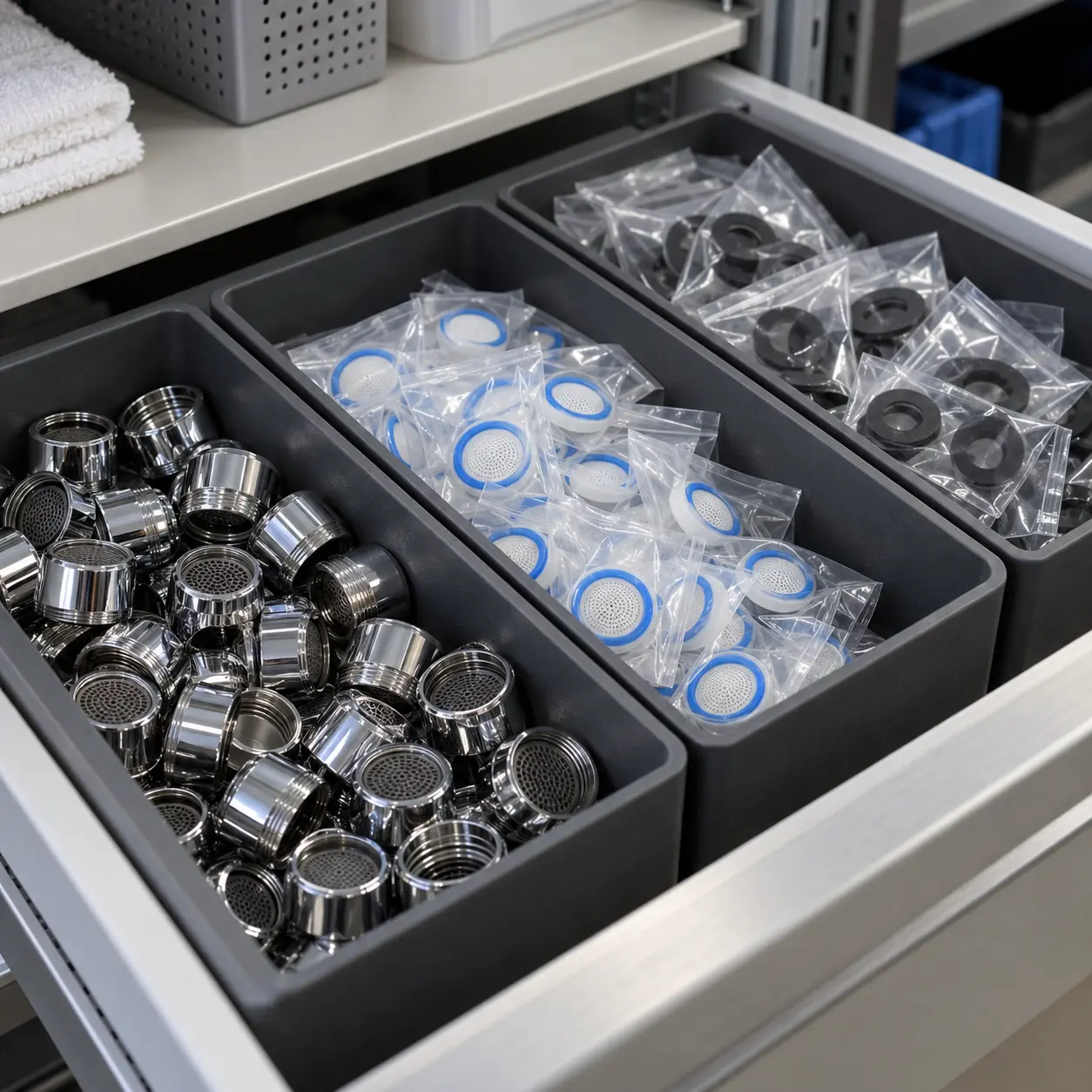
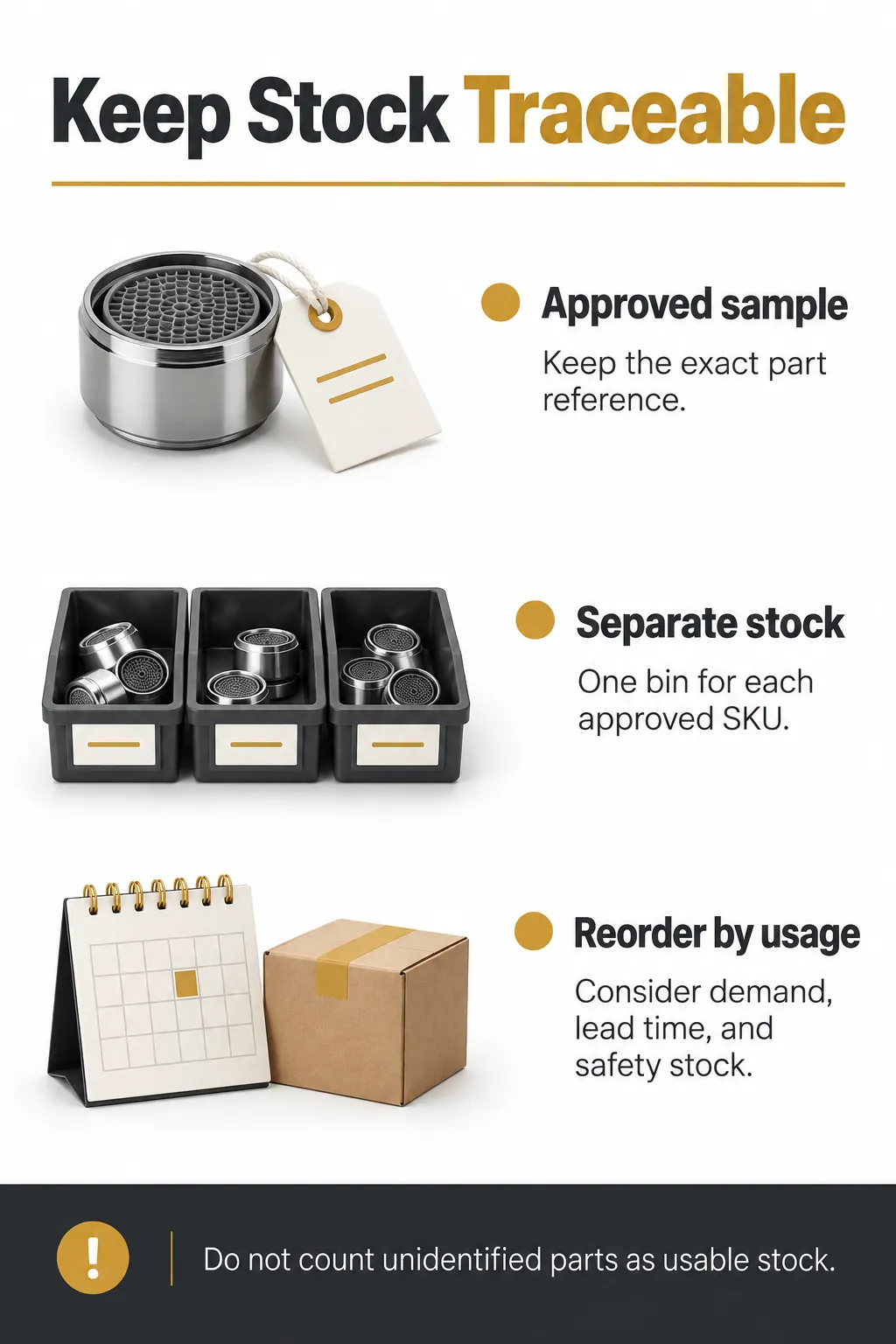
Create a separate stock identity for each approved combination of fit, performance, and service requirements. Combining parts under a label such as “chrome aerator” transfers unresolved decisions from purchasing to the maintenance cart. The useful stock record connects an exact supplier part number to the relevant fixture group, accepted thread specification, assembly type, flow rating, and included seals or tools. Keep one approved reference sample with that record. When a supplier proposes an alternative, treat it as a new sample requiring confirmation instead of assuming that a similar description carries the original approval forward.
Write an order description that survives substitution
An effective purchasing description identifies the faucet make and model where known, room or renovation group, aerator family, complete thread designation, and whether the item is a full housing assembly or an insert. Add the approved finish, rated flow and test pressure, stream pattern, seal arrangement, installation tool, packaging unit, and the exact accepted supplier SKU. Attach the approved drawing and sample reference.
Separate required characteristics from preferences. For example, the correct thread and sealing arrangement are acceptance conditions; a proposed carton size is a commercial variable. Ask the supplier to identify deviations before shipment and obtain confirmation that repeat orders will retain the approved part specification. Request the relevant drinking-water-contact and product certification documentation for the exact part, rather than accepting a generic certificate covering an unrelated product range.
This process also helps distinguish an aerator replacement from a wider fixture upgrade. If the work involves damaged spouts, finish changes, or replacement faucets, organize it alongside the property’s bathroom fixtures and accessories requirements so the spare-part decision stays connected to the installed bathroom standard.
Calculate stock by SKU, not by total room count
Separate planned replacements from routine replenishment. A scheduled renovation may justify buying one approved part for each affected fixture, plus a justified installation reserve. Ongoing maintenance stock should instead reflect consumption, replenishment time, and uncertainty for that specific SKU. Room count alone does not tell you how often a part needs replacement, particularly when cleaning can return some units to service.
A useful starting rule is: reorder point = expected demand during replenishment lead time + safety stock. Use consistent units and a lead time that includes delivery and receiving. Review the rule whenever usage, supplier reliability, or the installed fixture population changes.
For an illustrative SKU using four units per week, with a six-week replenishment lead time and eight units of safety stock, the reorder point is 32 units: 4 × 6 + 8. Compare that threshold with inventory position: usable on-hand stock plus confirmed incoming stock, minus committed demand. If 20 usable units are on hand, 16 are incoming, and six are committed, inventory position is 30, so the reorder threshold has been reached. The order quantity is a separate decision based on the desired coverage, pack size, and planned work. These numbers illustrate the method; they are not a recommended hotel stocking allowance.
A pooled building-wide total can conceal a shortage. Fifty unused cartridges for renovated suites cannot cover ten missing housings for original guest rooms. Keep unavailable, unapproved, damaged, and unidentified parts out of the usable quantity. Record cleaning and replacement separately so the consumption history measures actual stock use.
Preserve the approval through receiving and storage
Check incoming packages against the approved SKU, specification, included seals, finish, and quantities. Inspect samples from the delivery for consistency with the reference part before releasing the carton to general stock. Keep different thread families in separate labeled bins, and store clean replacements in protective packaging. A bin label should identify the approved fixture group and part number; color alone is not a durable identification system.
For a hotel sourcing request, send the faucet and aerator photographs, full thread description, proposed quantities by fixture group, required performance, and delivery location. Use KW Hospitality’s request for a sourcing quote to submit the requirements, with sample approval specified before release of the replacement-stock order.

Conclusion
Reliable aerator stock starts with a verified connection between the installed faucet and an approved replacement. Identify the assembly before measuring it, preserve the full thread designation, and confirm the seal and service tool as well as the diameter. Then test the replacement where it will actually be used, including its water stream and maintenance access. Once the sample passes, carry that exact identity into purchasing, receiving, bin labels, and reorder calculations. This gives hotel engineering and procurement a shared basis for replacement decisions and reduces the chance that apparently interchangeable parts reach the wrong bathroom.
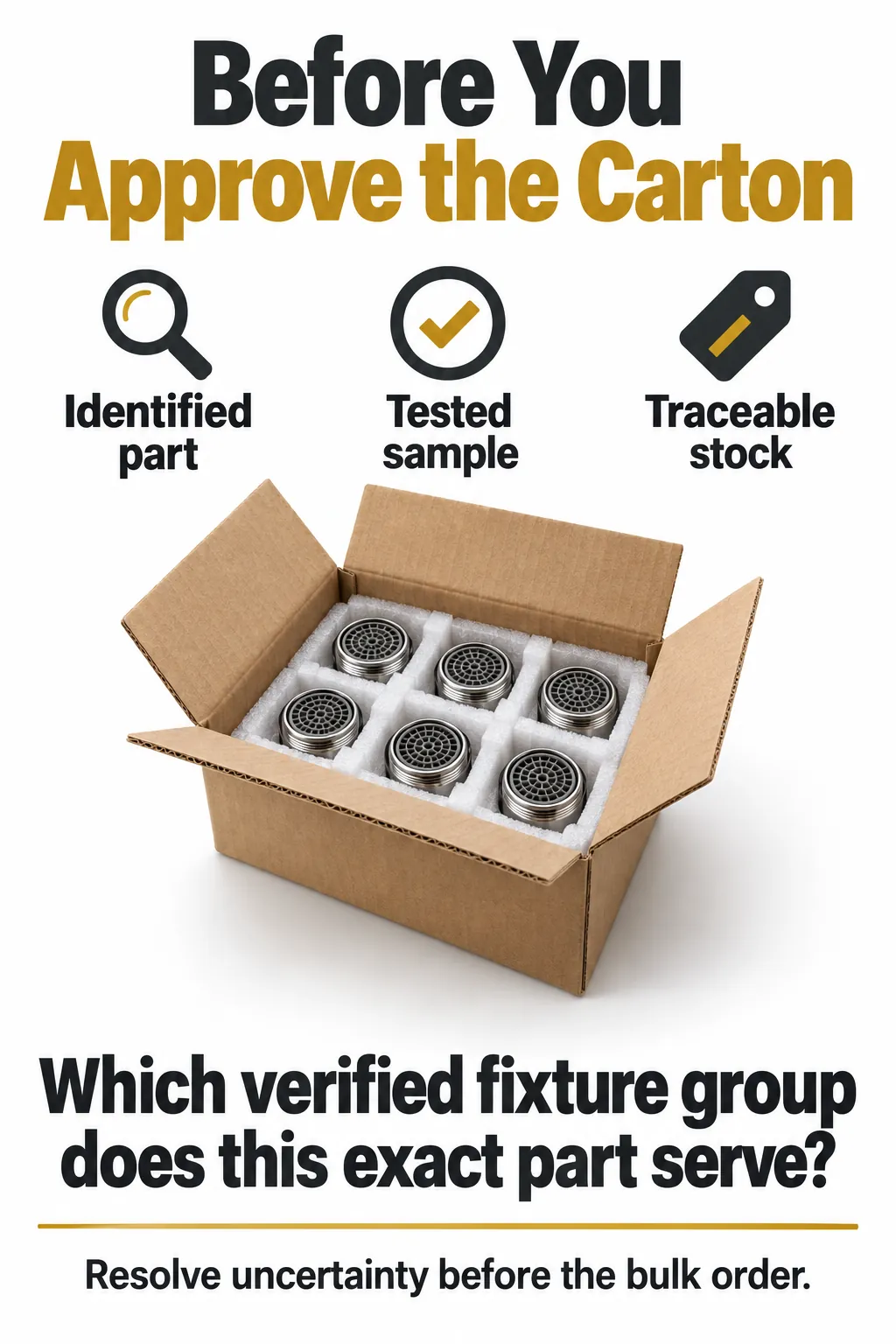
The most useful question before approving the carton is: Which verified fixture group does this exact part serve? If the answer depends on guesswork, finish the identification and trial installation first.
Frequently Asked Questions
Can I replace only the insert and keep the original metal housing?
Yes, when the housing is undamaged and the replacement insert and washer are confirmed for it. Check seating and height, not just the visible insert diameter. Replace the full assembly if the housing thread, seal seat, or finish is no longer serviceable. An insert for a separate housing is not automatically a substitute for a threaded concealed cartridge.
What if the replacement starts threading but becomes tight almost immediately?
Stop and remove it gently. Early resistance can indicate a mismatch, cross-threading, deposits, or damage. Starting one turn does not prove compatibility. Recheck the original specification and sealing geometry before trying again; a wrench should not be used to resolve uncertainty about the part.
Can an adapter let us keep only one aerator SKU?
An adapter may connect specific thread combinations, but it creates a new assembly to approve. It can change outlet projection, appearance, sealing interfaces, and service access. Confirm both adapter connections and test the complete arrangement on the basin before adopting it. Count the adapter as a required stocked component rather than treating the result as one universal part.
How often should hotel aerators be replaced?
There is no single interval that suits every property. Base inspection, cleaning, and replacement on the manufacturer’s instructions, local water conditions, observed deposits, stream deterioration, damage, and the hotel’s maintenance program. Track the reasons for replacement so stocking decisions reflect actual consumption rather than an assumed calendar life.
Does a WaterSense label prove that an aerator fits our faucet?
No. WaterSense addresses defined efficiency and performance criteria within its product scope; it does not identify your installed thread, housing, or cartridge bore. Confirm mechanical compatibility separately, then verify that the exact labeled accessory is appropriate for the application. A low-flow claim alone is also not evidence of WaterSense certification.
What should we do when identical-looking rooms contain different aerators?
Split them into separate fixture groups until the differences are resolved. Renovation dates, replacement work, or visually similar faucet models can explain the variation. Retain photographs and a sample reference for each group. Consolidate stock only after a replacement has been verified across all the groups it is intended to serve.
References
Neoperl: How to identify the aerator installed in a faucet.
Neoperl: Aerators with housing and matching insert sizes.
Neoperl: Faucet aerator size overview, printable PDF.
Neoperl: CACHÉ identification and service-key guidance.
Neoperl: Replacing a faucet aerator.
Neoperl: Aerator functions and stream patterns.
Neoperl: Product overview, including flow regulators.
Neoperl: Consumer guidance and non-pressurized water-heater limitations.
Aerator.com, a division of Neoperl: Aerator construction and housing gender.
US EPA: Bathroom faucets, WaterSense scope, and performance guidance.