
Buying hotel luggage carts wholesale requires more than comparing unit prices and choosing an attractive frame finish. A luggage cart is a frequently used piece of commercial operating equipment. It must carry irregular loads, move quietly through public areas, fit elevators and doorways, protect floors and walls, remain controllable under load, and support the hotel’s service standards for years.
The wrong carts can create recurring problems: damaged elevator panels, noisy lobby traffic, difficult steering, unavailable replacement wheels, insufficient storage space, premature corrosion, staff injuries, and guest complaints. These issues are often traced back to incomplete specifications or purchasing decisions based only on catalog photographs.
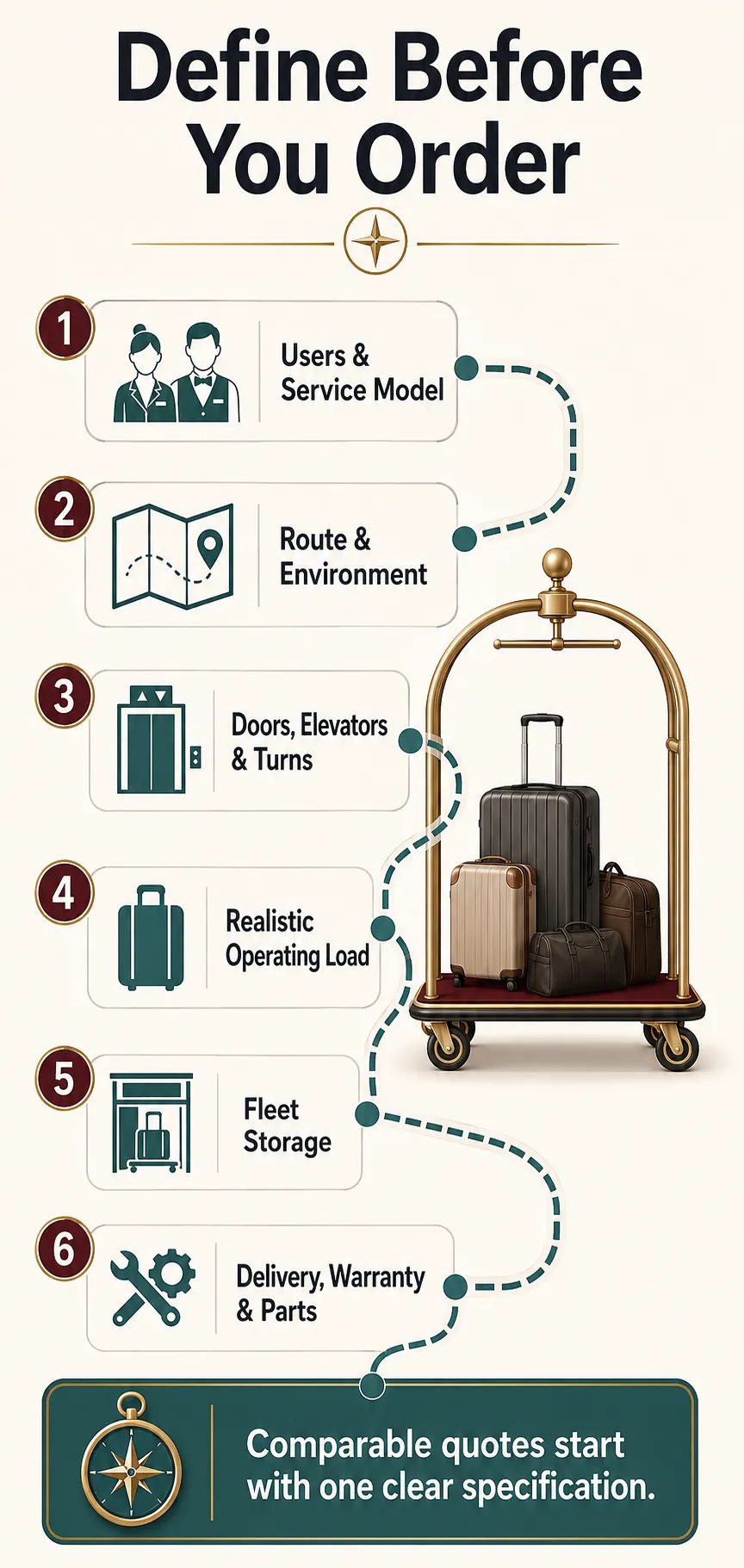
A successful wholesale purchase begins with the property’s actual operating conditions. Buyers should document the travel route, expected luggage volume, floor surfaces, elevator dimensions, storage limitations, environmental exposure, staffing model, maintenance resources, and delivery requirements before requesting quotations.
What Buyers Should Define Before Ordering
“Hotel luggage cart” can refer to several different products, ranging from ornate bellman carts to compact guest-operated trolleys. These products may look similar online while differing substantially in size, construction, maneuverability, durability, and intended use.
Before contacting suppliers, define the operational requirement in writing:
- Who will use the carts: guests, bell staff, valet staff, front-desk employees, or multiple departments
- Where the carts will travel
- Whether they will be used indoors, outdoors, or in both environments
- The narrowest doorway and elevator entrance on the route
- The smallest elevator car that must accommodate the cart
- The tightest corridor turn
- The steepest permitted slope or ramp
- The flooring and transitions the cart must cross
- The heaviest realistic operating load
- The available cart-storage area
- The hotel’s required appearance and finish
- The expected delivery date
- The preferred assembly condition
- The availability of local maintenance support
- The required warranty and replacement-parts program
Buyers should also separate structural capacity from operational capacity. A cart may be physically capable of holding a heavy load while becoming difficult to start, turn, stop, or control. The hotel’s internal operating limit may therefore need to be lower than the manufacturer’s maximum rating.
Wholesale quotations are useful only when suppliers price the same requirements. If one supplier includes brakes, commercial casters, protective packaging, spare parts, assembly, and delivery while another quotes only an unassembled basic cart, the two prices are not directly comparable.
Need Help Specifying the Right Hotel Luggage Carts ?
Share your property type, required quantity, route dimensions, preferred frame finish, destination, and delivery schedule. KW Hospitality can help prepare a property-specific luggage-cart package for wholesale purchasing.
Request a Wholesale Cart Quote
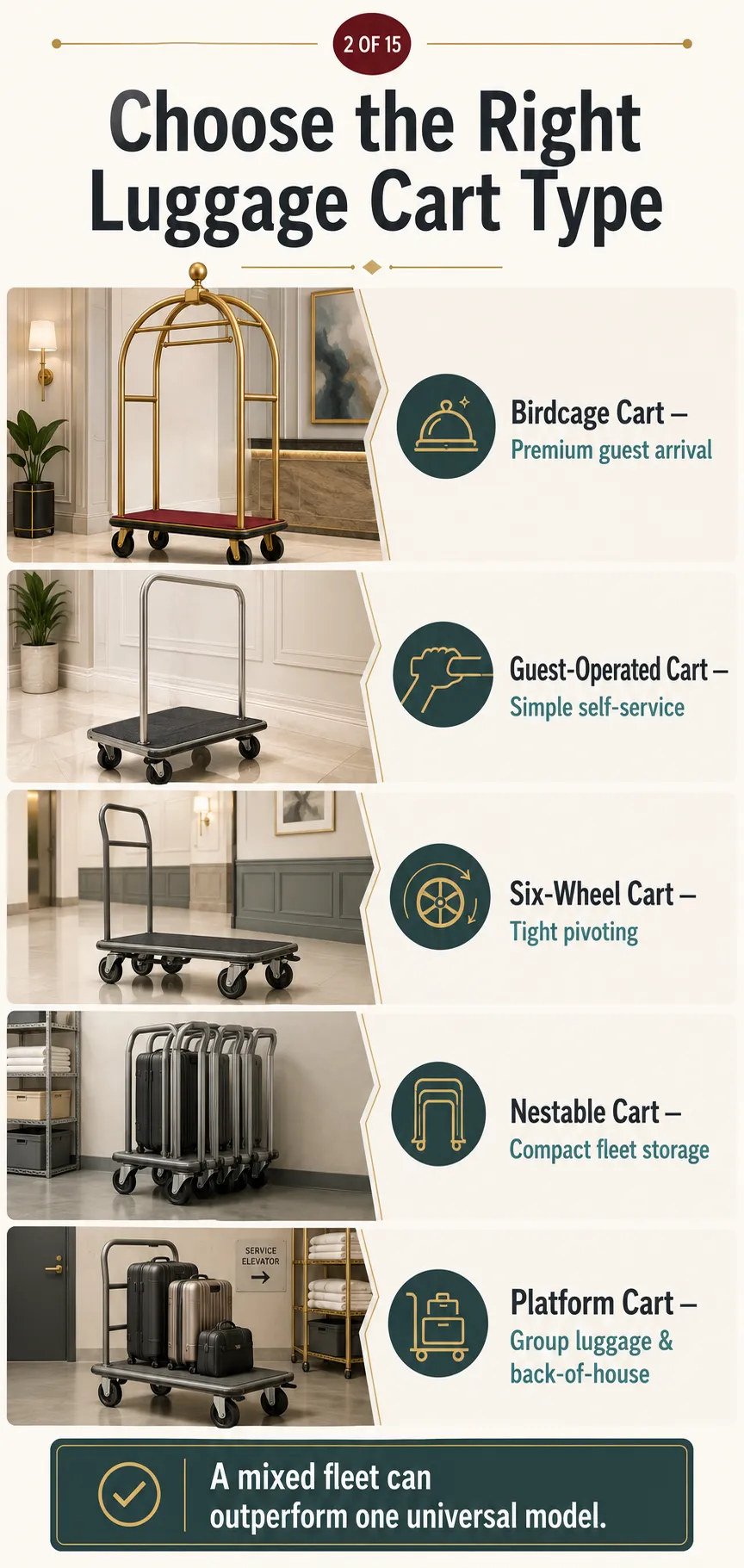
Main Types of Hotel Luggage Carts
The correct cart type depends on the hotel’s service level, traffic patterns, guest profile, storage space, and interior design.
| Cart type | Typical application | Main purchasing considerations |
|---|---|---|
| Birdcage bellman cart | Full-service, upscale, and luxury hotels | Premium appearance, large deck, garment bar, substantial height, and storage footprint |
| Compact bellman cart | Boutique, urban, and historic hotels | Smaller elevators, narrow corridors, limited storage, and lower empty weight |
| Guest-operated luggage cart | Select-service and extended-stay hotels | Simple operation, stability, visible instructions, durable bumpers, and resistance to misuse |
| Six-wheel luggage cart | Convention hotels, resorts, and group arrivals | Tight pivoting, load distribution, threshold performance, and operator control |
| Four-wheel luggage cart | General hotel operations | Straight tracking, familiar handling, and caster-layout selection |
| Nestable luggage cart | Hotels with limited storage | Fleet storage efficiency, nesting clearance, deck movement, and frame contact |
| Platform cart | Group luggage, parcels, event materials, and back-of-house transport | High usable deck area, lower loading height, and less formal appearance |
| Enclosed luggage cart | Secure or concealed baggage movement | Added weight, locking hardware, visibility, ventilation, and turning space |
| Specialty cart | Ski, golf, beach, airport, and destination properties | Compatibility with unusual equipment and specific environmental conditions |
Many properties benefit from a mixed fleet. A luxury hotel might use birdcage carts for guest arrivals, compact carts for smaller elevators, and platform carts for group luggage or packages. Selecting one model for every task may simplify ordering, but it can reduce operational efficiency.
Birdcage bellman carts
Traditional birdcage carts offer strong visual presence and generous hanging space for garments. Their polished frames and carpeted decks complement formal lobbies, but their height and turning envelope can create problems in small elevators or low storage areas.
Buyers should measure the complete height, including arches, finials, and decorative elements. The widest point may be the bumper or caster assembly rather than the upper frame.
Guest-operated carts
Self-service carts should be intuitive, stable, and difficult to misuse. Guests may not understand load distribution, braking, or safe turning techniques, so the design should minimize unnecessary complexity.
The handle should be easy to identify and comfortable for users of different heights. Instructions such as load limits, brake operation, and prohibitions against riding should be visible without making the cart look industrial.
Six-wheel carts
A well-designed six-wheel chassis can rotate in a relatively small area, which may be valuable in crowded lobbies and elevator vestibules. However, performance depends on wheel placement, deck length, load distribution, and floor conditions.
Some six-wheel carts pivot smoothly on level tile but become unstable or difficult to control over elevator tracks, thick entrance mats, or uneven transitions. Testing with representative luggage is essential.
Nestable carts
Nestable carts reduce the storage footprint of a fleet by allowing multiple units to overlap. Buyers should request the footprint of the first cart and the additional depth created by every cart added to the row.
The nesting system should be inspected for pinch points, frame contact, deck movement, and damage to finishes. Employees should be able to separate nested carts without excessive force.
Match the Cart to the Property and Service Model
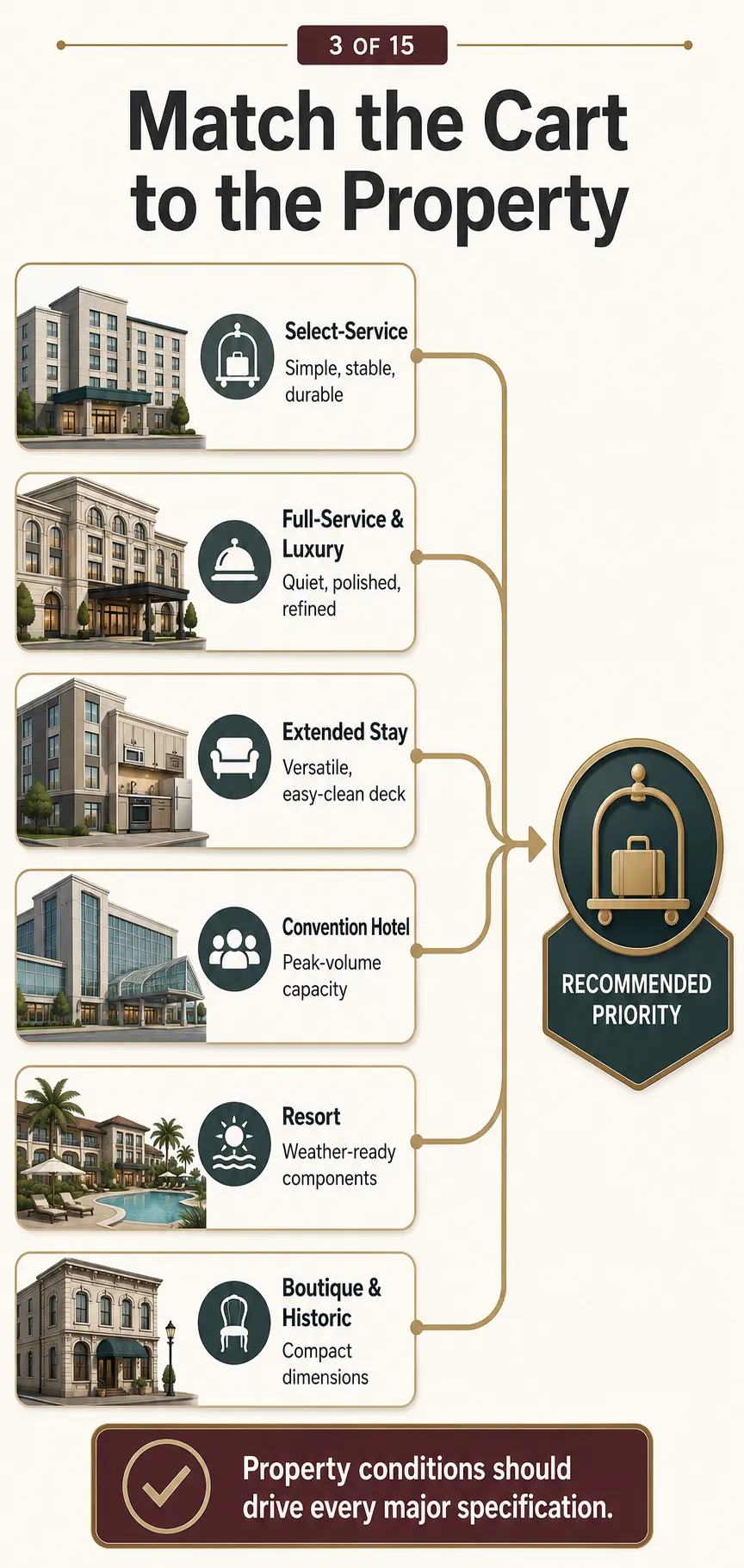
A cart that performs well in a convention resort may be unsuitable for a small historic hotel. Property type should shape every major purchasing decision.
Select-service hotels
In select-service properties, guests frequently move their own luggage. Priorities usually include:
- Simple steering
- Stable loading
- Easy-to-operate brakes
- Durable deck surfaces
- Full perimeter bumpers
- Non-marking wheels
- Clear operating instructions
- Compact storage
- Resistance to repeated guest misuse
A highly decorative finish may be less valuable than a practical surface that tolerates scratches, cleaning, and frequent contact.
Full-service and luxury hotels
Full-service hotels often expect bell staff to control cart movement. Appearance becomes part of the arrival experience, but presentation should not be separated from performance.
Important details include:
- Quiet casters
- Smooth frame joints
- Uniform finish color
- Concealed or coordinated fasteners
- Clean carpet edges
- Stable garment bars
- Replaceable bumpers
- Polished welds
- Minimal frame vibration
- Coordination with lobby finishes
A visually impressive cart that rattles across stone flooring or requires excessive force to turn can undermine the service experience it was intended to enhance.
Extended-stay properties
Extended-stay guests may carry groceries, kitchen supplies, storage containers, pet equipment, and larger quantities of personal belongings. The cart should accommodate diverse loads without encouraging unsafe stacking.
A durable, easy-to-clean deck and a practical handle configuration may be more important than a traditional bellman-cart appearance.
Convention and group-oriented hotels
Group arrivals create short periods of concentrated demand. Larger carts can reduce the number of trips, but they also consume more elevator capacity and become harder to control when overloaded.
These properties may benefit from a combination of guest-facing bellman carts and high-capacity platform carts managed by trained staff.
Resorts and outdoor properties
Outdoor routes introduce rain, humidity, salt air, pool chemicals, temperature changes, rough paving, and long travel distances. Buyers should evaluate the entire cart rather than focusing only on the visible frame.
Outdoor suitability depends on:
- The chassis material
- Surface preparation and coating
- Weld protection
- Fastener composition
- Caster forks and bearings
- Brake components
- Deck substrate
- Carpet or vinyl adhesives
- Edge sealing
- Drainage
- Storage conditions
The phrase “outdoor use” should be translated into measurable environmental and maintenance requirements in the purchase specification.
Boutique and historic hotels
Older buildings frequently have narrow doors, tight corridor turns, compact elevators, uneven thresholds, and limited back-of-house space. In these properties, a smaller, lighter cart may provide more value than maximum capacity.
Every critical dimension should be verified on-site. Building plans may not show trim, handrails, protective panels, floor mats, or later alterations that reduce usable clearance.
Capacity, Dimensions, Elevators, and Storage
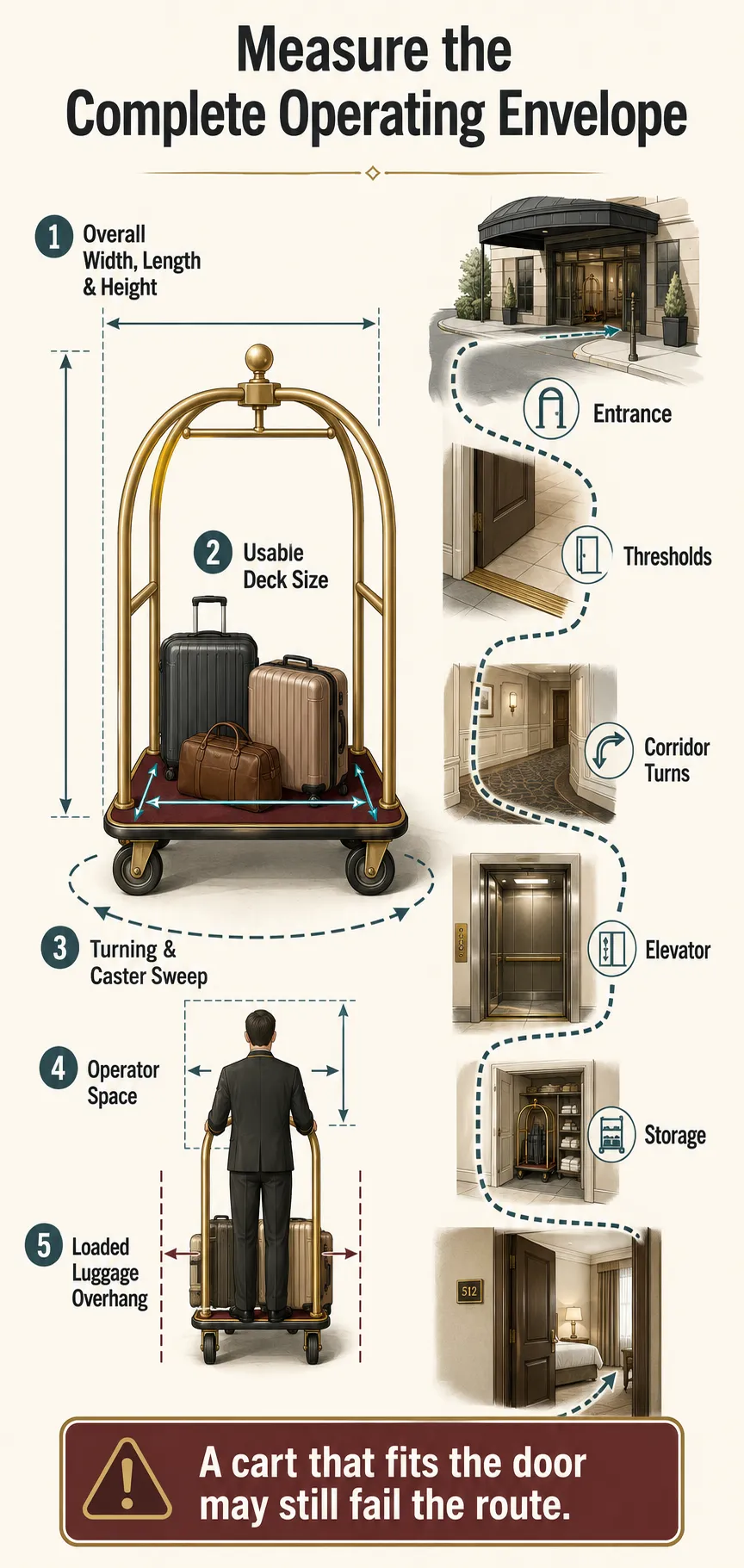
Catalog dimensions do not always describe the cart’s complete operating envelope. Luggage can extend beyond the deck, bumpers may increase width, and swivel casters can sweep outside the frame during turns.
Measure the following:
- Overall width at the widest point
- Overall length
- Overall height
- Usable deck width and length
- Deck height
- Empty cart weight
- Rated load capacity
- Expected operating load
- Caster diameter and tread width
- Ground clearance
- Handle projection
- Turning radius or swept path
- Bumper projection
- Space required behind the cart for the operator
Survey the complete travel route
Walk the route from the arrival point to guest rooms, luggage storage, and other destinations. Include:
- Vehicle unloading areas
- Revolving or automatic doors
- Entrance mats
- Vestibules
- Security gates
- Lobby furniture
- Queue barriers
- Corridor turns
- Service doors
- Elevator entrances
- Elevator tracks
- Elevator handrails
- Guest-floor corridors
- Room-entry thresholds
- Ramps and outdoor paving
Measure clear openings rather than nominal door sizes. Door hardware, trim, protective guards, and partially opening doors may reduce usable width.
Test elevator compatibility
A cart fitting through the elevator door does not prove it will work inside the elevator. The loaded cart must be able to approach, enter, align, and exit without trapping the employee or blocking other occupants.
Confirm that the cart can:
- Approach the entrance from the actual corridor angle.
- Cross the elevator sill without caster binding.
- Enter within the normal door-open period.
- Fit inside with representative luggage.
- Leave adequate standing space for the operator.
- Avoid contact with controls, mirrors, rails, and door panels.
- Exit safely on every floor served.
A taped floor outline can identify obvious dimensional conflicts. For a large or customized order, an actual sample provides much stronger evidence.
Protect accessible and emergency routes
Cart storage and staging must not obstruct routes used by guests, employees, or emergency responders. A cart that technically fits a corridor may still interfere with maneuvering space, elevator access, doors, fire equipment, or guests using mobility devices.
Accessibility and life-safety requirements vary by jurisdiction and building configuration. Verify the final operating and storage plan against the property’s applicable requirements rather than using general cart dimensions as evidence of compliance.
Plan storage for the entire fleet
Storage should be calculated for the complete order, not a single unit. Include maneuvering space needed to park, retrieve, inspect, and clean the carts.
Ask whether stored carts will:
- Block staff movement
- Contact walls or doors
- Interfere with luggage-room operations
- Require protective floor strips
- Need locking or access control
- Be exposed to moisture or temperature extremes
- Remain visible to guests
- Require covers
- Fit through the storage-room entrance
If carts are expected to remain in the lobby, appearance and positioning become part of the interior design plan.
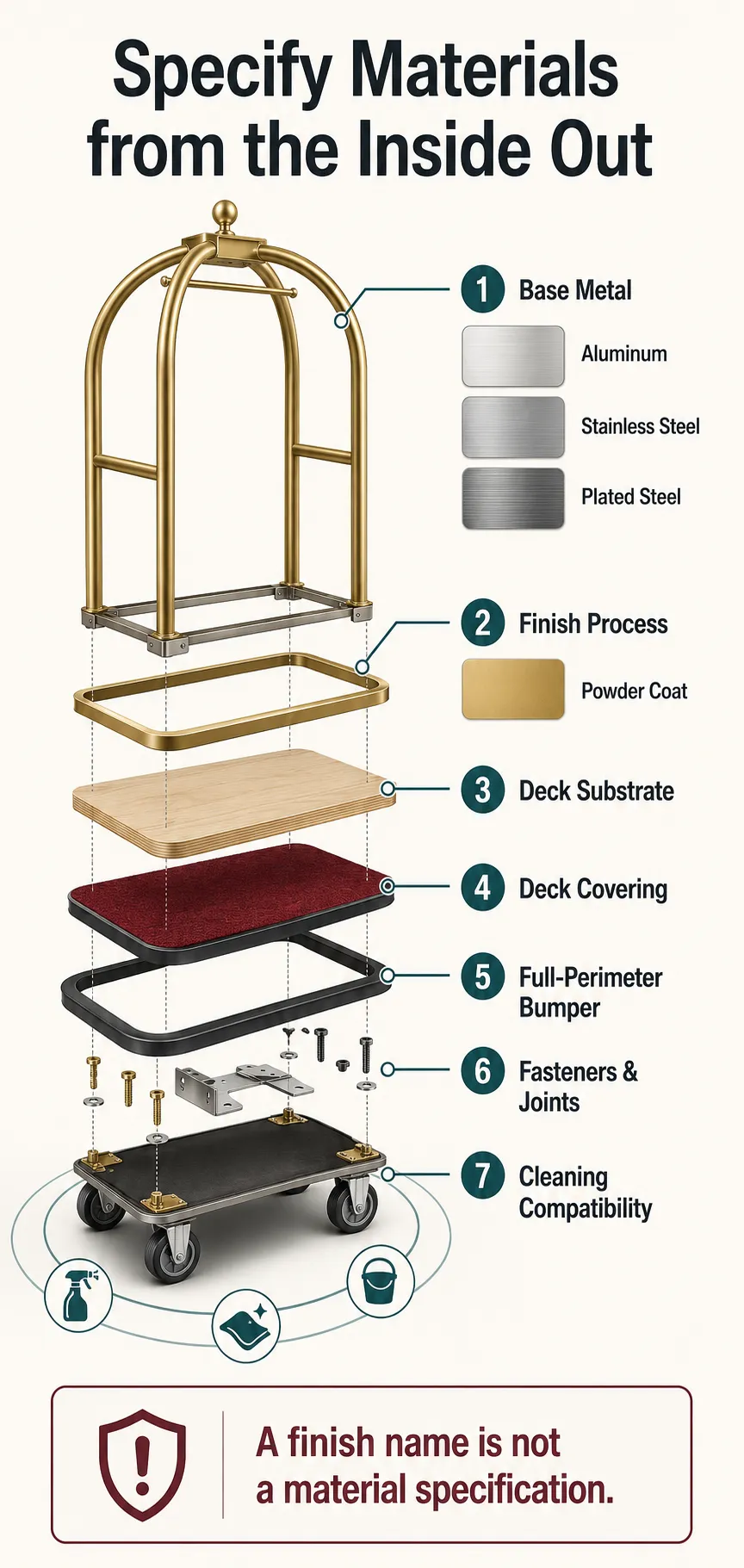
Frame Materials, Decks, Finishes, and Bumpers
Frame construction influences weight, corrosion resistance, appearance, repairability, and long-term cost.
Aluminum
Aluminum can reduce empty cart weight and offer useful corrosion resistance. It is available in anodized, satin, polished, powder-coated, and decorative finishes.
Buyers should confirm which components are aluminum. A cart may have an aluminum upper frame but use a different metal for its chassis, fasteners, caster mounts, or decorative parts.
Stainless steel
Stainless steel provides a clean commercial appearance and is commonly offered in brushed or polished finishes. Brushed surfaces may conceal minor scratches and fingerprints more effectively than highly reflective finishes.
Where moisture, salt, or chemicals are present, specify the required material grade and confirm the composition of welds, hardware, and caster forks. The words “stainless finish” should not be accepted as proof that the underlying material is stainless steel.
Plated steel
Steel with chrome, brass-colored, or other decorative plating can provide an upscale appearance at a competitive initial price. Durability depends on substrate preparation, plating quality, edge coverage, protective coatings, and resistance to impact.
Once the decorative layer is deeply scratched, exposed steel may become vulnerable to corrosion. The property should understand the approved cleaning and touch-up procedure before purchase.
Brass and brass-look finishes
“Brass” may refer to solid brass, brass plating, a brass-colored coating, or a protected decorative finish over another metal. These options differ in cost, weight, maintenance, aging, and repairability.
The quotation should identify:
- Base metal
- Finish process
- Protective topcoat
- Expected color variation
- Approved cleaning products
- Repair method
- Replacement-part finish matching
Physical finish samples are more reliable than photographs for approving color, gloss, and reflectivity.
Powder-coated frames
Powder coating supports a wide range of colors and can provide durable coverage when surface preparation and curing are properly controlled. Buyers should approve a physical sample and define acceptable differences between batches.
High-contact areas, sharp edges, welds, and concealed surfaces deserve special attention because coating failure often begins where preparation or coverage is weakest.
Deck construction
The deck must support expected loads without excessive flexing, permanent deformation, sharp edges, or loose covering materials.
Request details about:
- Deck substrate
- Structural thickness
- Support points
- Covering material
- Attachment method
- Moisture resistance
- Edge sealing
- Slip behavior
- Cleaning restrictions
- Field replacement
- Replacement-part availability
Carpeted decks provide a traditional appearance, cushion luggage, and reduce movement. However, they require vacuuming, spot cleaning, stain control, and occasional deep cleaning.
Vinyl or rubberized decks are generally easier to wipe down and may suit wet or mixed-use environments. Their texture should prevent luggage from sliding without making heavy bags difficult to reposition.
Metal or textured composite decks may offer durability but should be evaluated for noise, drainage, luggage damage, and slip behavior.
Bumpers and protective features
A full perimeter bumper helps protect walls, doors, elevator panels, furniture, and the cart itself. Buyers should verify its material, height, projection, attachment, and replacement method.
Bumper location matters. A bumper mounted below the surfaces most likely to be struck will provide limited protection. Upper-frame contact and luggage overhang should also be considered.
Corner guards, padded handles, concealed fasteners, protected finials, and rounded edges can further reduce property damage and guest contact hazards.
Casters, Brakes, Noise, and Maneuverability
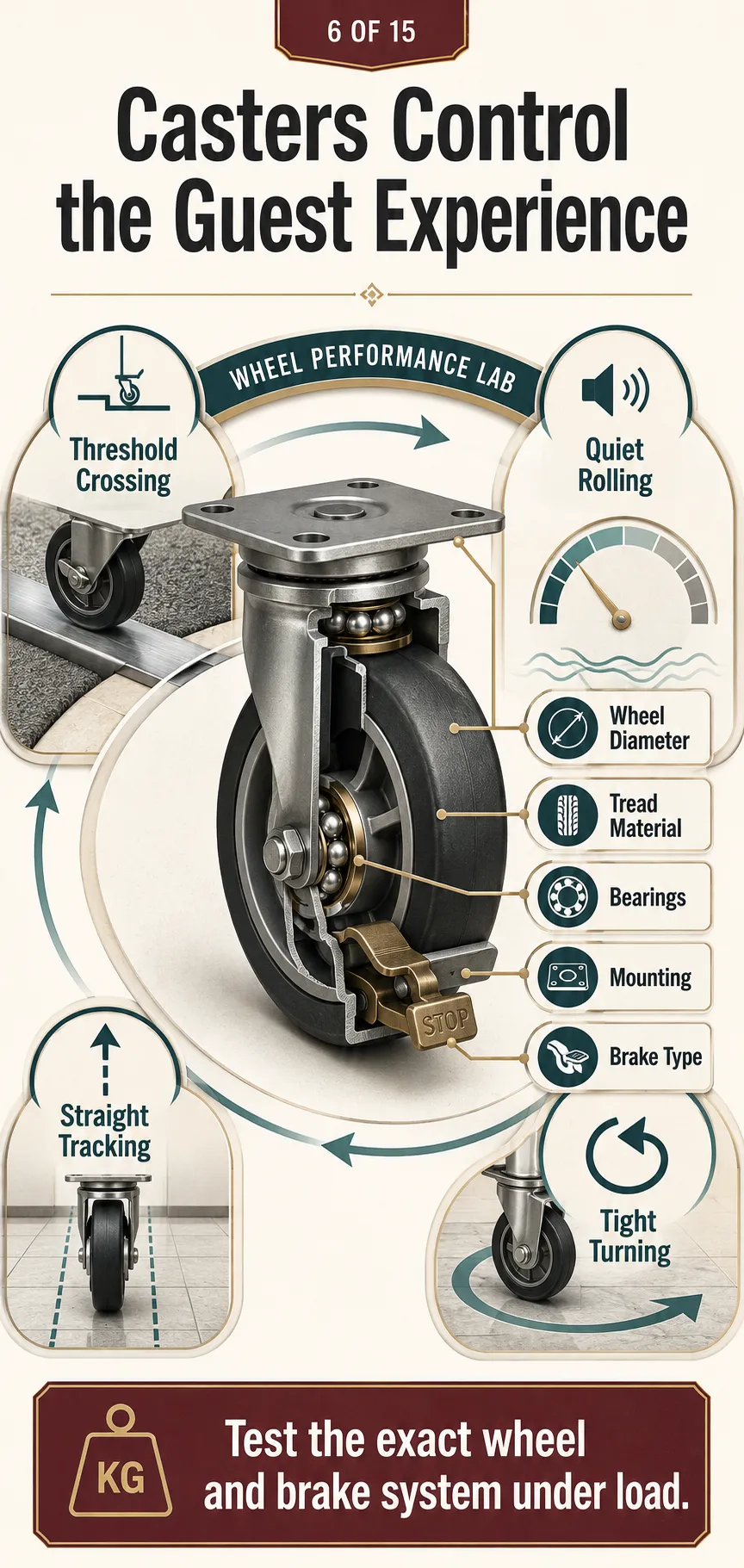
Caster selection has a major effect on employee effort, steering, vibration, noise, and floor protection.
Wheel diameter
Larger wheels generally cross thresholds and small surface irregularities more easily. They can also add height, weight, cost, and storage requirements.
Small wheels may perform acceptably on smooth indoor floors but struggle on entrance mats, elevator tracks, rough paving, and damaged transitions. The correct diameter should be selected through route testing.
Tread material
Common tread options include rubber, thermoplastic rubber, polyurethane, and other commercial compounds. Each creates a different balance among rolling resistance, noise, durability, floor protection, and load capacity.
A softer tread may reduce sound and vibration but require more effort under certain loads. A harder tread may roll efficiently while transmitting more vibration and creating noticeable noise on hard surfaces.
“Non-marking” should be treated as a required characteristic, not a guarantee of compatibility with every floor finish. Test the production-equivalent wheel on important flooring when discoloration or surface damage would be costly.
Bearings and caster construction
Wheel material alone does not determine performance. Bearings, axle quality, fork construction, swivel race design, seals, mounting plates, and fasteners also affect reliability.
Ask whether caster assemblies can be replaced using standard tools. Proprietary mounting systems may create long periods of downtime if parts are unavailable.
Four-wheel configurations
A four-wheel cart may use:
- Two fixed and two swivel casters
- Four swivel casters
- Swivel casters with directional locks
- A combination of swivel and braking functions
Two fixed wheels can improve straight tracking over long routes. Four swivel wheels can improve movement in tight spaces but may allow the cart to wander or rotate unexpectedly, particularly on slopes.
Six-wheel configurations
Many six-wheel carts use larger center wheels and smaller swivel casters at the ends. This arrangement can allow tight pivoting when the load is balanced properly.
Performance should be tested with light, typical, and heavy loads. Uneven loading may change which wheels maintain contact and affect steering or braking.
Brake selection
Brake requirements should reflect the actual route. Options may include:
- Wheel brakes
- Total-lock casters
- Directional locks
- Central brake systems
- Foot-operated mechanisms
- Brakes accessible from both ends
- Parking controls intended for level staging areas
A brake should be tested under a representative load and on the steepest approved surface. It should never be treated as permission to leave a heavily loaded cart unattended on a slope.
Noise testing
An empty showroom cart may sound quiet but behave differently after loading. Test for:
- Bearing chatter
- Wheel vibration
- Tread slap
- Loose frame joints
- Rattling garment bars
- Moving finials
- Brake contact
- Deck vibration
- Noise over elevator tracks and thresholds
Quiet operation is especially important in luxury lobbies, near guest rooms, and during overnight hours.
Safety, Ergonomics, and Damage Prevention
Luggage carts reduce the need to carry heavy bags, but they do not remove all manual-handling risk. Starting, pushing, turning, stopping, and positioning a loaded cart can strain employees or create collision hazards.
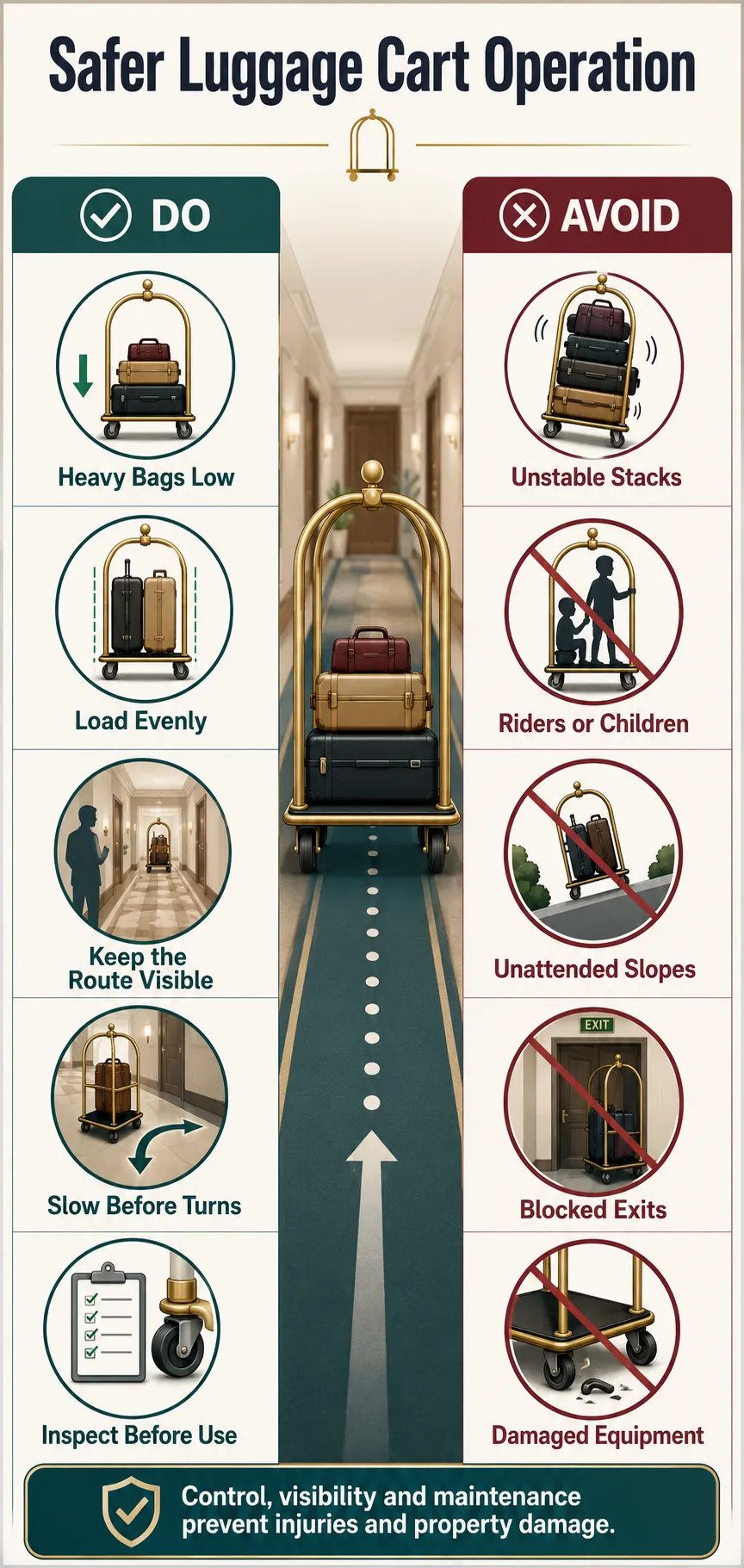
A safe operating program should include the following practices:
- Keep loads within approved operating limits.
- Place heavy bags low and near the center of the deck.
- Distribute weight evenly.
- Avoid unstable stacks.
- Maintain a clear view of the travel path.
- Push the cart where practical instead of pulling it over long distances.
- Slow down before turns, thresholds, and elevator entrances.
- Use two employees when the load or route cannot be controlled safely by one person.
- Do not permit passengers or children to ride on the cart.
- Keep hands and feet away from caster and nesting pinch points.
- Remove damaged carts from service immediately.
- Store carts only in approved areas.
Handle height and shape should support a comfortable pushing posture. Handles that are too high, too low, too narrow, or positioned behind projecting luggage may increase fatigue and reduce control.
The required pushing force depends on more than load capacity. Wheel condition, flooring, slopes, thresholds, bearings, speed, cart weight, and load distribution all affect effort. Hotels should not assume that a high-capacity label means the cart will remain easy to control at that load.
Guest-operated carts require additional safeguards. Instructions should be clear, brakes should be intuitive, and the design should discourage climbing or riding. Employees should assist guests who cannot safely manage the equipment.
Damage prevention also deserves formal attention. Common problems include:
- Frames striking elevator panels
- Bags extending beyond bumpers
- Dirty wheels marking floors
- Loose hardware scratching walls
- Wet carts entering carpeted areas
- Overloaded decks bending or flexing
- Finials striking door closers
- Carts parked against decorative surfaces
Incident reports can reveal recurring route or equipment problems. If collisions repeatedly occur at the same doorway or turn, the solution may involve changing the route, adding wall protection, reducing load size, or selecting a different cart.
How Many Luggage Carts Does a Hotel Need?
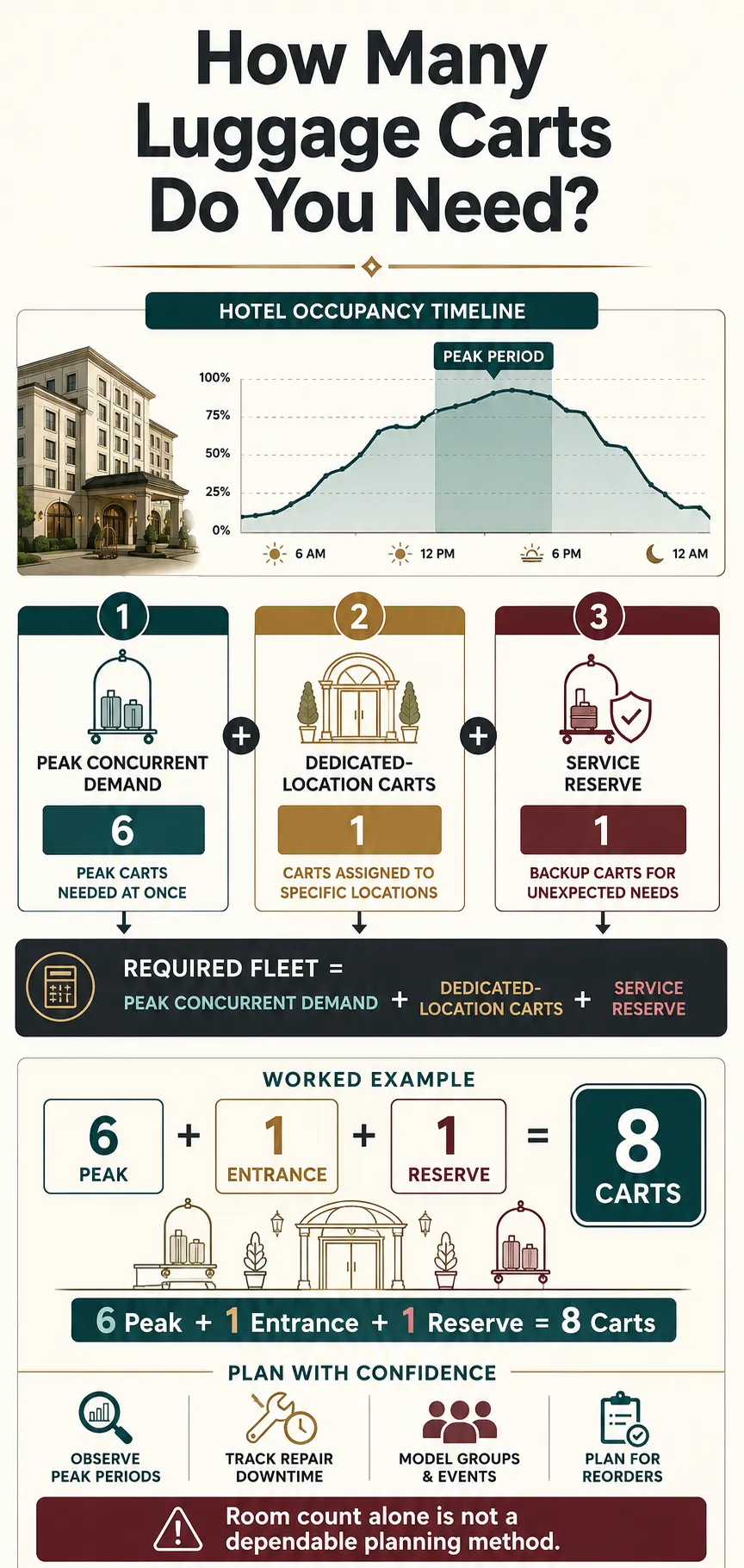
There is no dependable universal room-to-cart ratio. Demand depends on the service model, guest behavior, parking layout, elevator speed, property size, group business, seasonality, staffing, and average length of stay.
A 100-room extended-stay hotel may experience more self-service cart demand than a larger full-service hotel where bell staff manage each movement efficiently.
Use operational demand data
For an existing property:
- Record how many carts are simultaneously in use during arrival and departure periods.
- Include weekdays, weekends, events, group movements, and seasonal peaks.
- Record how long carts remain away from storage.
- Track carts unavailable because of cleaning or repair.
- Identify carts assigned to separate entrances, towers, or buildings.
- Note guest complaints about cart availability.
- Use a high-demand period rather than a daily average as the planning baseline.
- Add a service reserve.
A practical planning formula is:
Required fleet = peak concurrent demand + dedicated-location carts + service reserve
Suppose a hotel observes a peak concurrent demand of six carts, needs one permanently staged near a separate entrance, and wants one reserve unit. The initial planning quantity would be eight carts.
The reserve should reflect fleet size and replacement-part lead times. A small hotel may need one complete spare even if that represents a large percentage of its total fleet. A large fleet may use a percentage-based reserve supported by on-site spare parts.
Estimate demand for a new hotel
A preopening property can model several operating scenarios:
- Normal weekday arrivals
- Sold-out weekend checkout
- Tour-group arrival
- Airport-shuttle arrival
- Conference check-in
- Wedding or event departure
- Severe weather
- Delayed room readiness
- Temporary elevator outage
- Multiple arrivals at separate entrances
When uncertainty is high, consider purchasing a controlled opening quantity with a documented reorder option. Confirm that future units can match the original finish, carpet, branding, and caster specification.
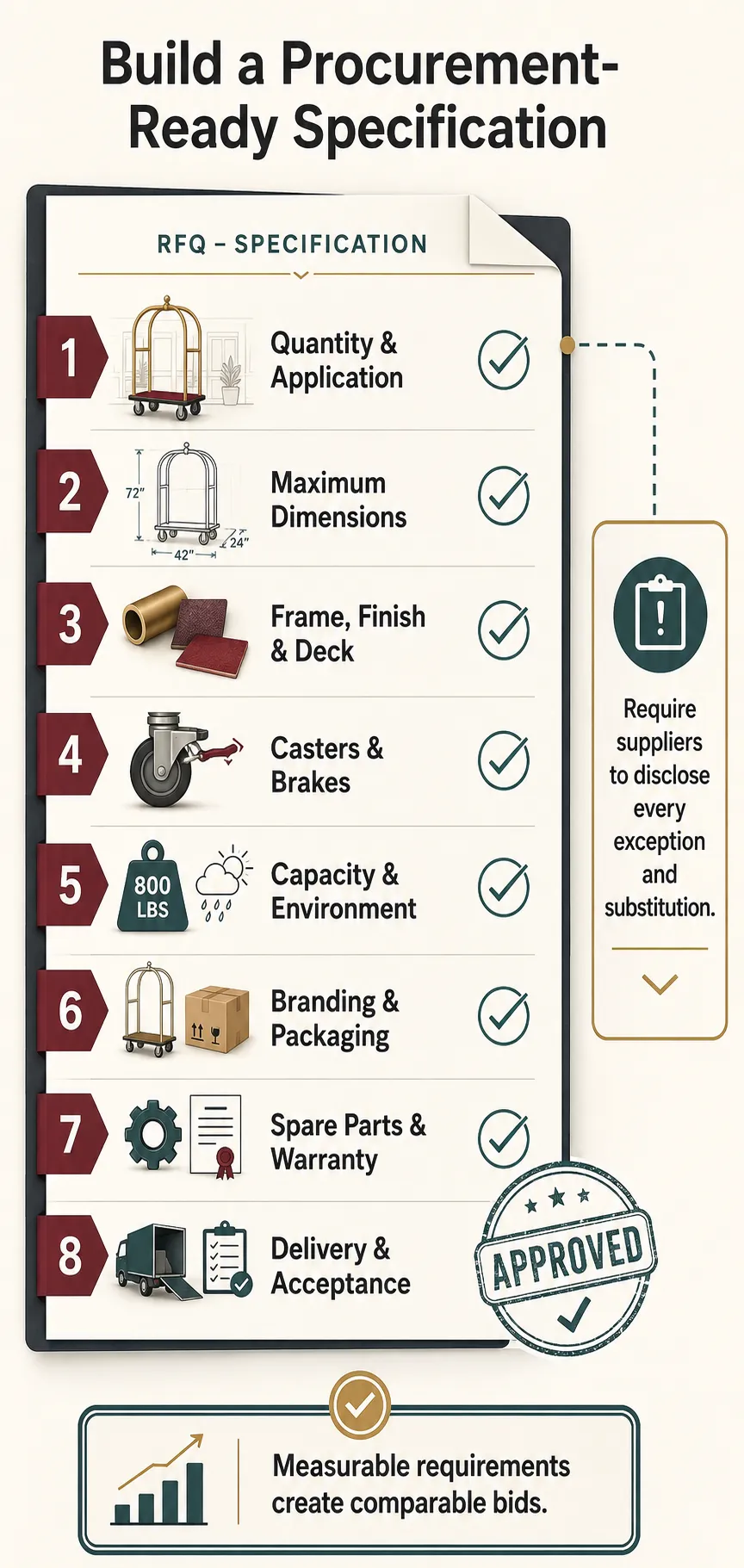
How to Write a Procurement-Ready Specification
A professional request for quotation should describe measurable requirements. Phrases such as “heavy duty,” “premium quality,” “luxury finish,” and “quiet wheels” are too subjective on their own.
| Specification field | Information to provide |
|---|---|
| Quantity | Initial order, optional quantity, and future phases |
| Application | Staff-operated, guest self-service, group luggage, outdoor transfer, or mixed use |
| Maximum dimensions | Width, length, height, and turning limitations |
| Deck | Usable dimensions, substrate, covering, color, edges, and replacement method |
| Capacity | Required manufacturer rating and intended hotel operating load |
| Frame | Base metal, major structural details, joining method, and finish |
| Finish | Process, color, gloss, sample approval, and care limitations |
| Bumper | Material, color, coverage, height, and replacement method |
| Casters | Quantity, configuration, diameter, tread, bearings, and mounting |
| Brakes | Type, operating method, location, and loaded performance |
| Environment | Indoor, outdoor, moisture, salt air, chemicals, and temperature exposure |
| Noise | Surfaces and route conditions used for acceptance testing |
| Branding | Artwork, dimensions, placement, color, and approval process |
| Assembly | Fully assembled or knocked down, required tools, and labor responsibility |
| Packaging | Carton or crate protection, palletization, labels, and stacking restrictions |
| Spare parts | Initial quantities of casters, brakes, bumpers, hardware, and deck materials |
| Documentation | Drawings, instructions, parts list, maintenance guide, and warranty |
| Delivery | Destination, unloading conditions, appointment needs, and deadline |
| Acceptance | Inspection method, tolerances, route test, and defect remedies |
Require each supplier to identify exceptions and substitutions explicitly. Silence in a quotation should not automatically be interpreted as compliance.
For a substantial customized order, use staged approvals:
- Technical data review
- Dimensioned drawing approval
- Material and finish samples
- Branding proof
- Production-equivalent sample
- Written acceptance criteria
- Production inspection
- Shipping release
Record every approval. Verbal confirmation is difficult to enforce when production colors, wheel specifications, or dimensions do not match expectations.
Comparing Wholesale Suppliers and Samples
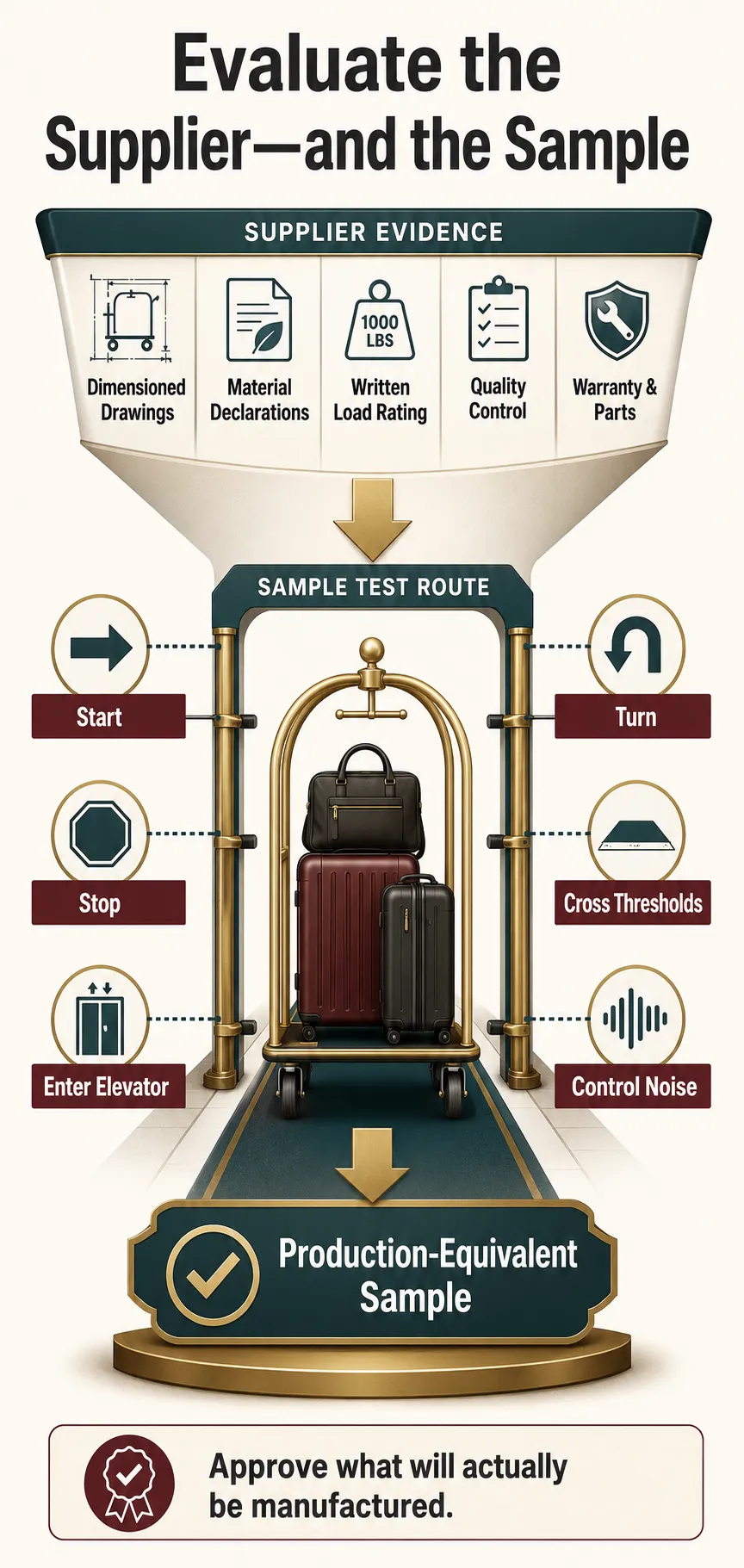
Supplier evaluation should include technical capability, quality control, after-sales support, and commercial reliability—not only price.
Ask each supplier to provide:
- Legal business identity
- Manufacturing or distribution role
- Product model and revision
- Dimensioned drawings
- Material declarations
- Written load rating
- Production lead time
- Sample availability
- Quality-control procedures
- Packaging details
- Warranty document
- Replacement-parts list
- Current spare-parts pricing
- Parts lead times
- Installation or assembly instructions
- Maintenance guidance
- References for comparable hospitality projects
Clarify whether the company providing the quotation will also handle technical support, warranty claims, freight damage, and replacement parts.
Evaluate a production-equivalent sample
A sample should match the proposed production model in frame material, finish, wheel system, deck, brakes, bumpers, and hardware. An upgraded showroom sample is not a reliable basis for approving a lower-specification order.
Test the sample with representative luggage along the property’s actual route. Evaluate:
- Starting force
- Straight tracking
- Turning
- Stopping
- Threshold crossing
- Elevator entry
- Ramp control
- Noise
- Frame stability
- Brake operation
- Bumper effectiveness
- Staff visibility
- Deck deflection
- Finish durability
- Storage compatibility
Ask several employees to test the cart. Differences in height, strength, experience, and pushing technique may reveal issues missed by a single evaluator.
Examine the warranty carefully
Warranty duration alone does not establish value. Review:
- Covered components
- Excluded wear items
- Finish exclusions
- Commercial-use limitations
- Claim documentation
- Warranty start date
- Replacement labor
- Diagnostic costs
- Freight responsibility
- International claim procedures
- Availability of equivalent parts
- Remedies for discontinued components
A shorter, practical warranty with accessible parts may provide more operational value than a longer warranty with broad exclusions.
MOQ, Customization, Freight, and Landed Cost
Minimum order quantities can vary according to model, finish, branding, packaging, manufacturing method, and production origin. Standard domestic products may be available in small quantities, while custom colors, frames, or carpet logos may require a larger run.
Customization options can include:
- Frame finish
- Powder-coat color
- Carpet or vinyl color
- Carpet logo
- Branded side panel
- Custom finial
- Bumper color
- Wheel color
- Garment bar
- Deck dimensions
- Containment rails
- Brake configuration
- Protective cover
- Asset labels
- Custom packaging
Every custom feature should have a signed specification or approved sample. Digital images can help confirm layout, but they may not accurately represent color, texture, reflectivity, or material quality.
Assembled versus knocked-down shipping
Fully assembled carts reduce on-site labor and assembly risk. However, they occupy more freight volume and may be vulnerable to impact damage during transportation.
Knocked-down carts can reduce shipping volume but create additional responsibilities:
- Confirming all components are present
- Protecting finishes during assembly
- Using correct tools
- Following torque requirements
- Aligning frames and casters
- Conducting post-assembly inspections
- Training installation personnel
- Disposing of additional packaging
The cheapest shipping format is not always the lowest-cost operational option.
Calculate total landed cost
The cart’s quoted unit price represents only part of the purchase.
Use the following calculation:
Landed cost per accepted cart = total acquisition and delivery cost ÷ number of accepted carts
Include:
- Product price
- Customization
- Samples
- Tooling
- Packaging
- Origin handling
- Freight
- Cargo insurance
- Customs processing
- Duties and taxes
- Port or terminal charges
- Domestic transportation
- Delivery appointments
- Liftgate service
- Inside delivery
- Unloading
- Assembly
- Receiving inspection
- Initial spare parts
- Replacement of rejected units
- Disposal of damaged packaging
- Temporary storage
For international orders, the contract should state which party is responsible for transportation, insurance, customs documents, duties, unloading, and risk at each stage. A shipping term does not replace detailed product, inspection, payment, and warranty requirements.
Consider lifecycle cost
A more durable cart may justify a higher initial price if it reduces repairs, floor damage, downtime, and premature replacement.
A lifecycle comparison can include:
- Initial landed cost
- Scheduled maintenance
- Replacement casters
- Brake components
- Bumper replacement
- Carpet or deck replacement
- Finish restoration
- Staff labor
- Downtime
- Damage to hotel surfaces
- Expected service life
- End-of-life disposal
Avoid assigning a precise service-life figure unless the operating environment and maintenance plan support it.

Receiving, Assembly, Training, and Maintenance
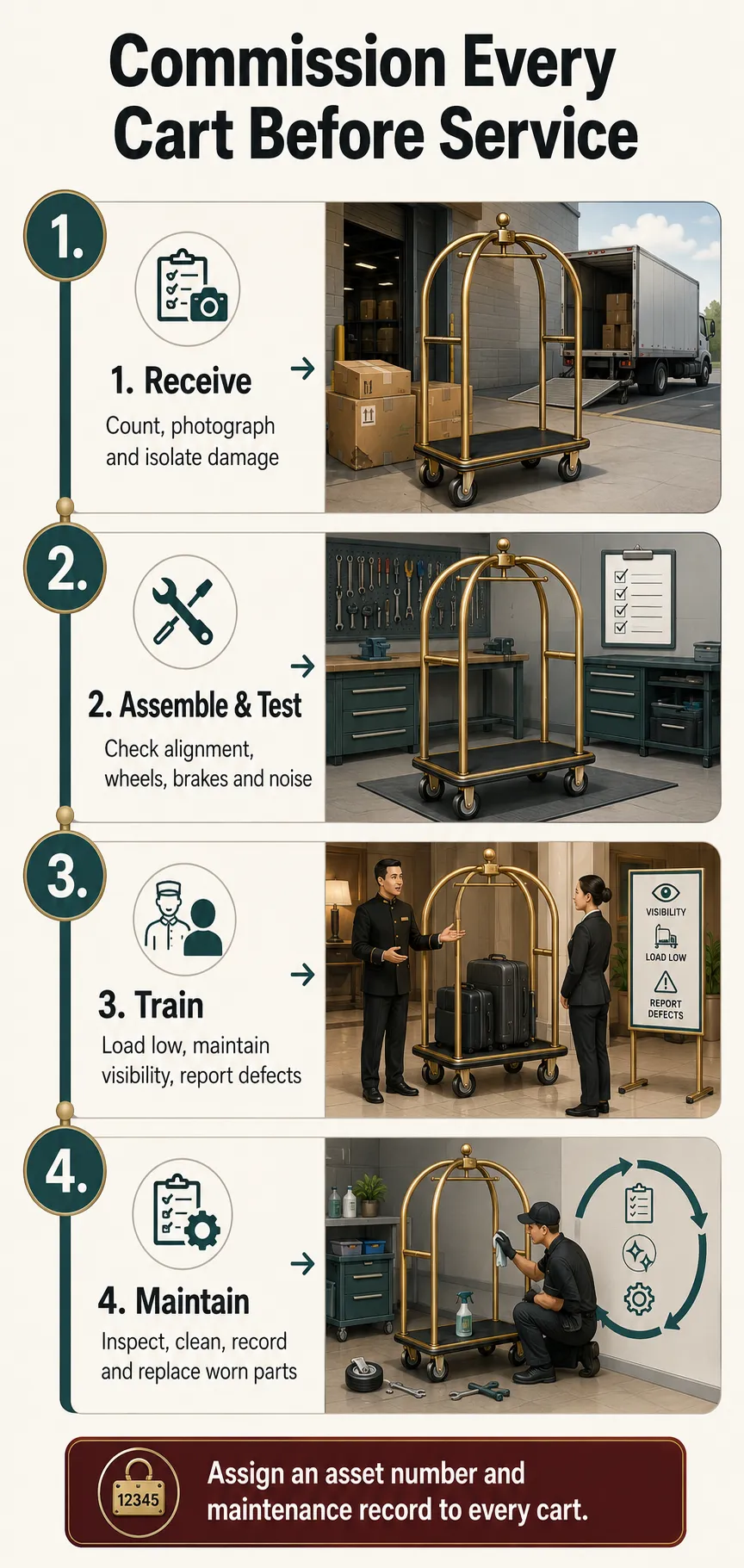
The purchase is not complete when the shipment reaches the hotel. Receiving and commissioning determine whether defective or incorrect carts enter service.
Receiving inspection
Before unpacking:
- Compare the shipment with the purchase order and packing list.
- Count pallets, cartons, and loose components.
- Photograph packaging condition.
- Record visible freight damage through the required carrier process.
- Identify wet, crushed, punctured, or unstable packages.
- Move questionable units into a controlled inspection area.
After unpacking:
- Verify model numbers.
- Confirm quantity.
- Check frame material and finish.
- Measure critical dimensions.
- Inspect welds and joints.
- Check carpet and deck edges.
- Inspect bumpers.
- Confirm caster type and diameter.
- Test brakes.
- Check branding placement.
- Identify scratches, dents, discoloration, and exposed substrate.
- Confirm assembly hardware and instructions.
- Count spare parts.
- Verify maintenance and warranty documents.
Do not inspect only the easiest cartons to reach. Use the agreed inspection plan, and isolate nonconforming units until responsibility and corrective action are established.
Assembly and acceptance testing
Follow the supplier’s assembly sequence and fastener requirements. Protect finished surfaces during installation.
After assembly, test each cart for:
- Frame alignment
- Structural stability
- Wheel rotation
- Swivel movement
- Brake operation
- Loose components
- Ground clearance
- Bumper attachment
- Garment-bar stability
- Unusual noise
Selected units should then complete the hotel’s approved route under a representative load. Record failures consistently so the supplier receives clear evidence.
Staff training
Employees should know how to:
- Perform a brief pre-use inspection
- Load heavy items low
- Distribute luggage evenly
- Maintain forward visibility
- Approach thresholds slowly
- Enter elevators safely
- Use brakes correctly
- Avoid riding or transporting passengers
- Identify unsafe conditions
- Remove defective carts from service
- Report collisions
- Return carts to approved storage locations
Guest self-service properties should also decide when staff assistance is required and how abandoned carts will be retrieved.
Preventive maintenance
Assign an asset number to each cart and record its inspection and repair history.
A maintenance program may include:
- Daily visual checks
- Regular brake testing
- Removal of hair and thread from wheels
- Fastener inspection
- Caster and bearing checks
- Bumper inspection
- Carpet vacuuming
- Deck cleaning
- Finish inspection
- Frame-joint inspection
- Replacement of worn components
- Periodic loaded route testing
Cleaning chemicals, lubricants, polishes, and disinfectants should be compatible with the cart’s finish, deck, bumpers, bearings, and brake components. Applying an unsuitable product can damage coatings, soften adhesives, discolor carpet, or reduce brake performance.
Final Wholesale Purchasing Checklist
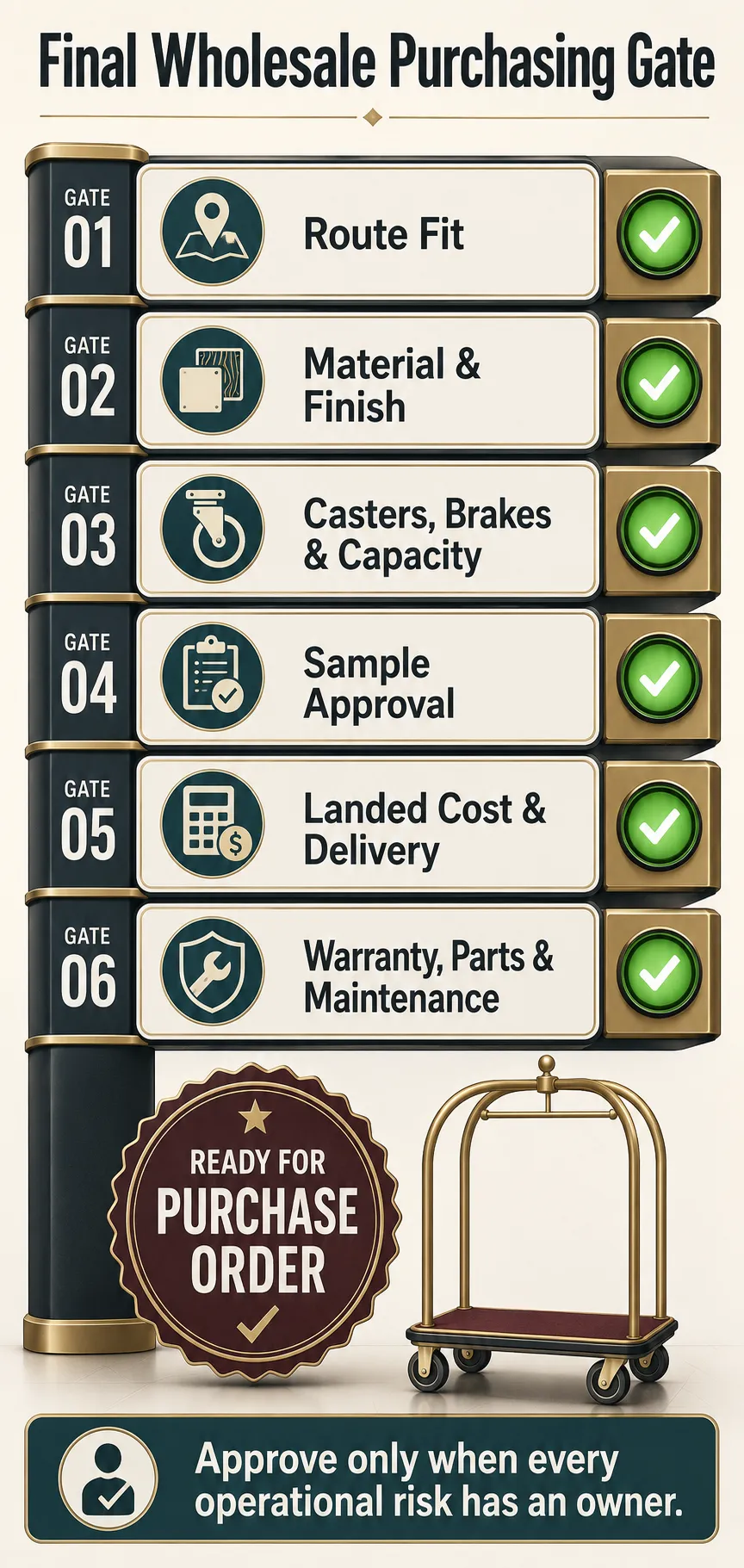
Before issuing the purchase order, confirm that:
- The hotel’s service model is documented.
- The intended cart operators are identified.
- The complete travel route has been surveyed.
- Doors, elevators, thresholds, ramps, and turns have been measured.
- The loaded cart fits the operating route.
- Adequate fleet storage is available.
- Cart staging will not obstruct accessible or emergency routes.
- The required cart type has been selected.
- The frame’s base material is documented.
- The finish process and approved sample are recorded.
- Deck construction and cleaning requirements are acceptable.
- Bumper location protects relevant hotel surfaces.
- Caster diameter, tread, bearings, and configuration are specified.
- Brake type matches route conditions.
- Capacity is supported by written technical information.
- The hotel’s lower operational limit is defined if needed.
- A production-equivalent sample has been tested.
- Custom colors and branding have been approved.
- Supplier exceptions are documented.
- Warranty coverage is understood.
- Replacement parts have part numbers and prices.
- Parts lead times are acceptable.
- Packaging requirements are included.
- Assembly responsibility is clear.
- Freight and delivery responsibilities are documented.
- Total landed cost has been calculated.
- Receiving and acceptance criteria are part of the order.
- Initial spare parts are included.
- Staff training and maintenance procedures are prepared.
- Delivery allows sufficient time for inspection before opening or peak occupancy.
Frequently Asked Questions About Wholesale Hotel Luggage Carts
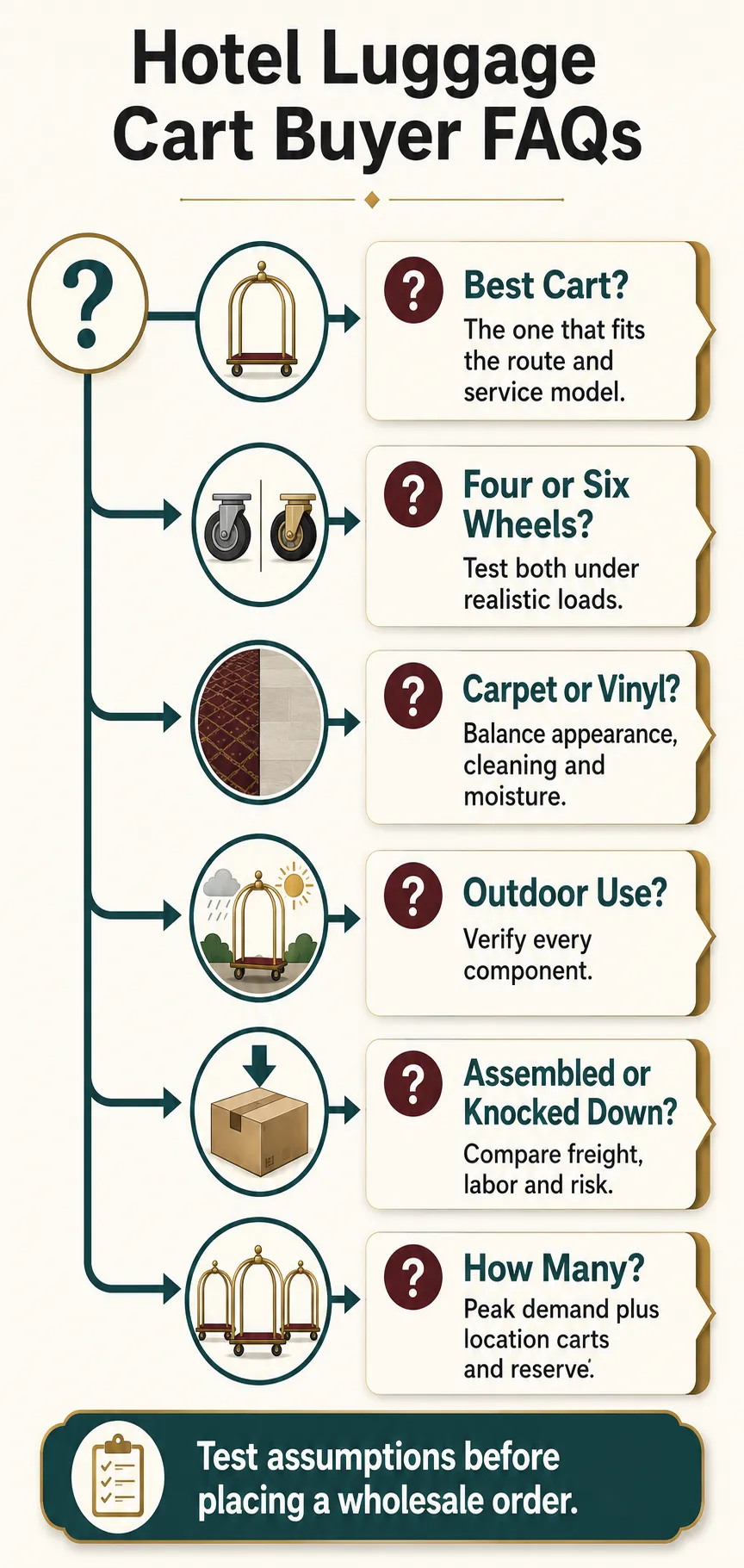
What is the best type of luggage cart for a hotel?
There is no single best model. Full-service hotels commonly favor birdcage bellman carts, while select-service properties may prefer durable guest-operated trolleys. Compact and nestable carts can help properties with small elevators or limited storage. The best cart is the model that passes the hotel’s route, load, storage, maintenance, and presentation requirements.
Should a hotel buy four-wheel or six-wheel carts?
Four-wheel carts can offer predictable tracking, while properly designed six-wheel carts can pivot in a smaller area. Performance depends on caster placement, deck length, load distribution, flooring, and thresholds. Both configurations should be tested under realistic conditions before a large order.
How much weight should a luggage cart hold?
The required capacity should reflect the hotel’s realistic luggage patterns. A high structural rating does not guarantee that the cart will remain easy to push, turn, or stop. Buyers should define both the required manufacturer rating and the hotel’s practical operating limit.
Are larger wheels always better?
Larger wheels usually cross thresholds and surface irregularities more effectively, but they can increase cart height, weight, cost, and storage needs. Tread material, bearings, caster design, and route conditions are equally important.
Is carpet or vinyl better for the deck?
Carpet offers a traditional upscale appearance and helps cushion luggage. Vinyl or rubberized surfaces are generally easier to wipe down and may be better for wet or mixed indoor-outdoor use. The decision should consider appearance, cleaning, replacement, moisture exposure, and guest expectations.
Can hotel luggage carts be used outdoors?
Only if the entire cart is suitable for the expected conditions. The frame, chassis, fasteners, bearings, brakes, deck, adhesive, and covering materials must tolerate moisture and environmental exposure. Outdoor carts also require appropriate storage and maintenance.
Should luggage carts arrive assembled?
Assembled carts reduce installation labor but can cost more to transport and may be exposed to freight damage. Knocked-down carts reduce shipping volume but require competent assembly, correct tools, complete hardware, and final inspection.
Can a hotel add its logo to the carts?
Many wholesale programs offer carpet logos, branded panels, custom colors, and decorative components. Buyers should approve artwork, dimensions, placement, color, production samples, and replacement availability before manufacturing begins.
Which spare parts should be ordered initially?
Common priorities include caster assemblies, brake components, bumper sections, bearings, fasteners, and replaceable deck materials. The correct quantity depends on fleet size, usage intensity, component lead time, and whether the parts are proprietary.
How often should luggage carts be inspected?
Employees should conduct a brief visual and functional check before use. More detailed inspections should follow a property-defined schedule based on usage, load, route conditions, manufacturer instructions, and repair history.
How many carts should a hotel order?
Use peak concurrent demand, carts dedicated to separate locations, and a service reserve. Room count alone is not a sufficient planning method. New hotels should model transient, group, event, sold-out, and severe-weather scenarios.
What should buyers compare besides unit price?
Compare dimensions, materials, deck construction, caster system, brakes, finish, packaging, freight, assembly, warranty, replacement parts, sample quality, delivery time, and total landed cost. The lowest unit price may not produce the lowest lifecycle cost.
Build a Luggage Cart Program for Long-Term Operations
The strongest wholesale purchase is not automatically the cart with the lowest price, the most decorative finish, or the highest claimed capacity. It is the cart program that fits the property, supports employees, protects guests and interior finishes, remains maintainable, and performs reliably during peak demand.
Measure the route before selecting the model. Define realistic loads before specifying capacity. Test the exact caster and brake configuration before approving production. Compare quotations on a common specification, calculate the complete landed cost, and secure replacement parts before the order ships.
When these decisions are made systematically, hotel luggage carts become reliable operating assets instead of recurring maintenance problems.
Send Us Your RFQ ( Request for Quote )