
Opening a hotel requires much more than filling guestrooms with beds, towels, and toiletries. A property is ready only when every department has the products, tools, replacement stock, safety items, systems, storage, and replenishment process needed to deliver the promised guest experience. The most reliable way to reach that point is to treat hotel opening supplies as a dedicated project workstream: define the operating model, build a department-level master list, calculate quantities from real demand, order backward from the launch date, control specifications and costs, inspect deliveries, and test every item in live operating scenarios.
This guide explains how owners, developers, general managers, purchasing teams, and department heads can build that process from the ground up. It applies to independent and branded hotels, from limited-service properties to full-service resorts. The exact quantities and lead times will vary, but the planning logic remains the same.
Start With the Hotel You Intend to Operate
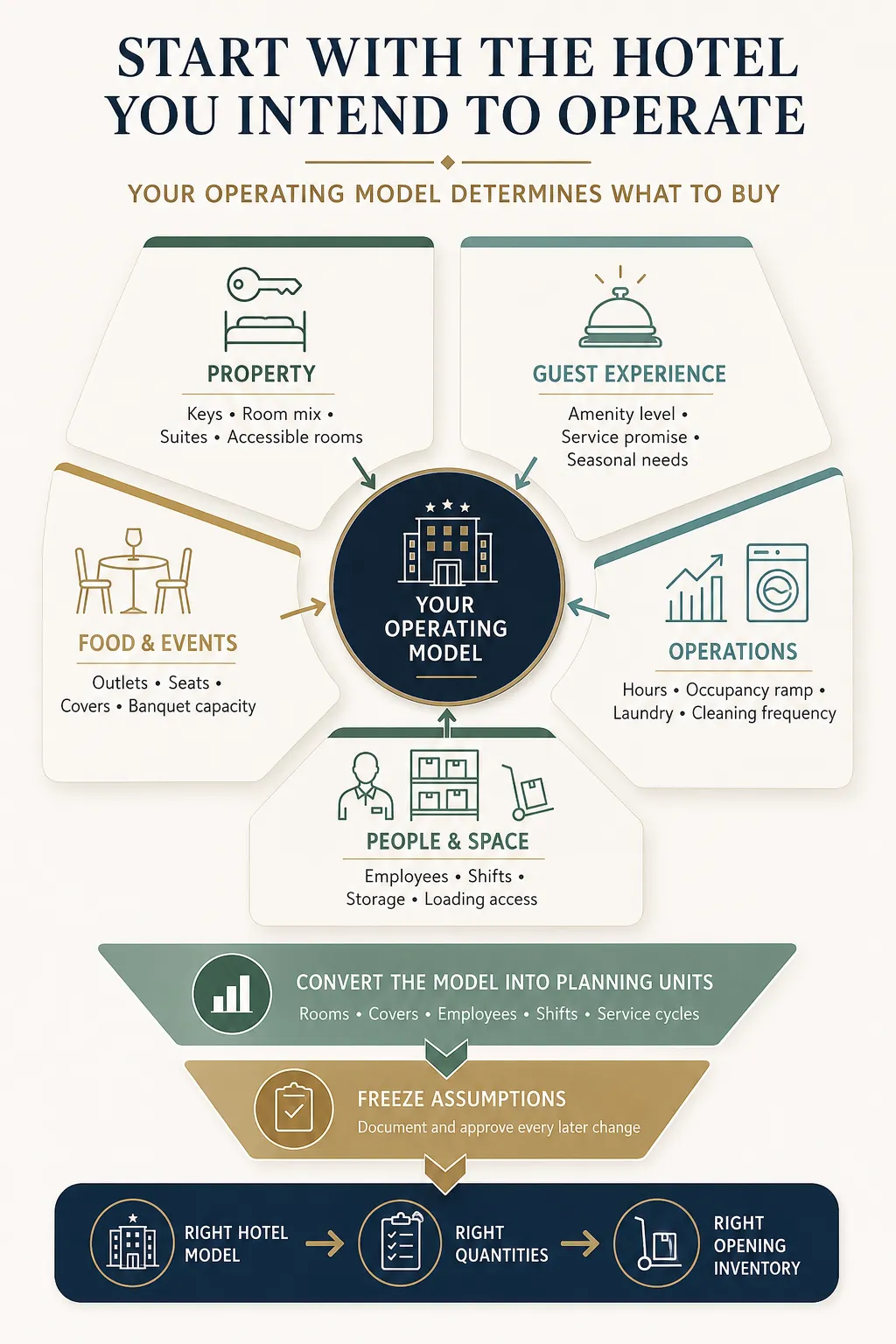
The first procurement mistake usually happens before anyone requests a quote: the team starts with a generic supply checklist instead of a defined operating model. Two hotels with the same number of rooms may require completely different opening inventories. A select-service airport hotel with outsourced laundry, a breakfast room, and no banquet business does not need the same equipment as an urban lifestyle hotel with two restaurants, a rooftop bar, valet parking, meeting rooms, and 24-hour room service.
Before building the supply list, document the assumptions that drive demand. Record the number and mix of guestrooms, accessible rooms, suites, connecting rooms, food-and-beverage outlets, seats, banquet covers, meeting rooms, kitchens, bars, pools, treatment rooms, fitness areas, offices, storage rooms, housekeeping pantries, and loading areas. Add the planned occupancy ramp, hours of operation, service style, laundry method, cleaning frequency, staffing model, guest amenity standard, pet policy, family offerings, and any seasonal services.
This operating brief should also define the brand promise. A luxury hotel may require multiple pillow options, premium bath textiles, turndown supplies, elaborate tabletop collections, in-room dining equipment, and more generous backup inventory. A limited-service property may favor fewer product variants, durable finishes, simplified room setups, and faster replenishment. The goal is not to buy the most items; it is to buy the right items for the service model guests will actually experience.
Translate the brief into measurable planning units. Guestroom products are often driven by keys and room type. Restaurant items may be driven by seats, covers per meal period, table turns, and menu design. Banquet stock may be driven by the largest event the property intends to serve without rental support. Uniforms depend on positions, employees, shifts, laundering cycles, and replacement needs. Housekeeping tools depend on room assignments, floor layout, and the number of attendants working at peak occupancy. These units become the foundation for defensible quantities.
Finally, freeze the assumptions at an agreed project milestone. If the restaurant concept, room count, or laundry strategy changes later, procurement must receive a formal change notice. Without this discipline, buyers continue working from old quantities while operators assume the new concept has already been incorporated.
Separate FF&E, OS&E, Consumables, Technology, and Opening Expenses
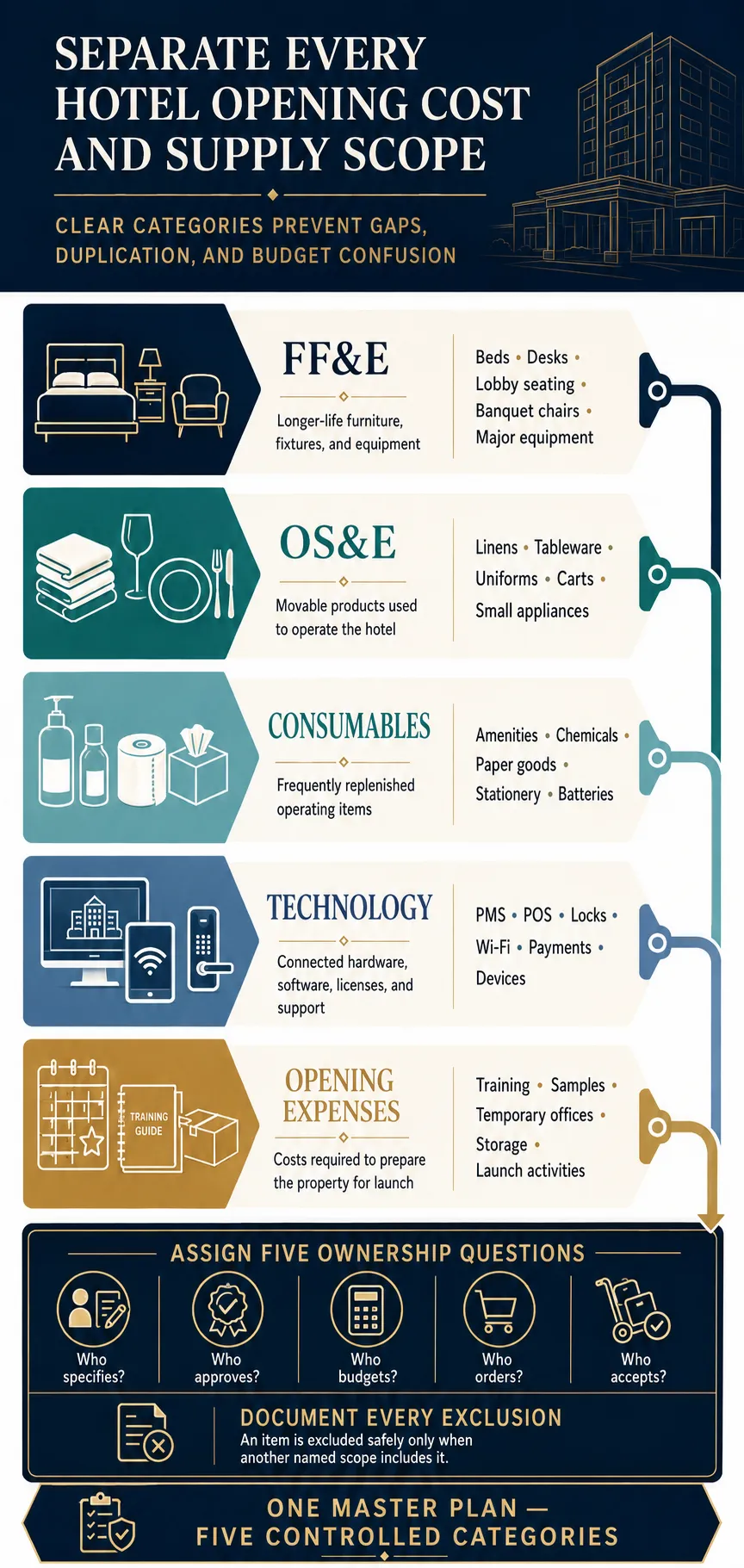
A complete opening plan needs clear boundaries. Furniture, fixtures, and equipment generally include longer-life assets such as guestroom furniture, decorative lighting, lobby seating, restaurant tables, banquet chairs, fitness machines, kitchen equipment, and office furniture. Operating supplies and equipment include the movable products used to run the hotel, such as linens, tableware, cookware, housekeeping carts, uniforms, small appliances, guestroom accessories, and maintenance tools. Consumables include amenities, chemicals, paper products, food packaging, stationery, batteries, and other frequently replenished items.
Create a responsibility matrix that assigns every category to one accountable owner. The matrix should answer five questions: Who writes the requirement? Who approves the specification? Who controls the budget? Who places the order? Who accepts the delivered item? Design may select the look of a wastebasket, operations may validate capacity and cleanability, finance may approve the cost, procurement may contract the supplier, and housekeeping may accept the final delivery. Those roles can be different, but they cannot be undefined.
Also document exclusions. For example, decorative lighting may be purchased by the construction contractor while replacement lamps are purchased by engineering. Built-in kitchen equipment may sit in the construction package while utensils and mobile racks sit in OS&E. Guestroom televisions may be in the FF&E budget, but remotes, batteries, casting devices, and spare units may be elsewhere. An exclusion is safe only when another named scope includes it.
Build the Master Supply List Around Departments and the Guest Journey
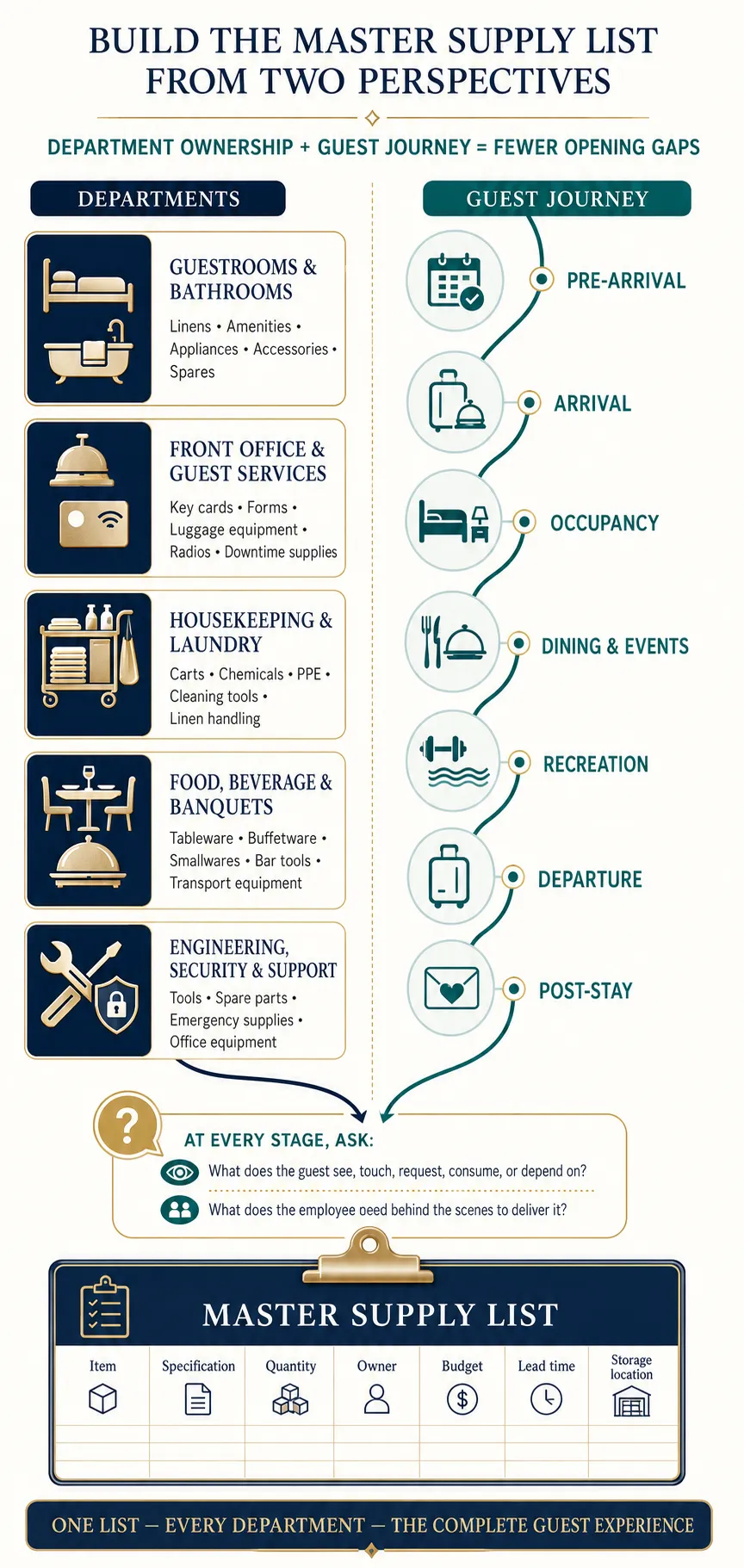
A reliable master list is both department-based and journey-based. Department ownership helps teams buy and store products. The guest journey helps them notice gaps that departmental lists often miss. Walk through pre-arrival, arrival, occupancy, dining, meetings, recreation, departure, and post-stay service. At each stage, ask what the guest sees, touches, requests, consumes, or depends on—and what employees need behind the scenes to deliver it.
Guestrooms and Bathrooms
List every room type separately. Include bedding, protectors, pillows, towels, bath mats, robes where applicable, hangers, wastebaskets, luggage racks, glassware, beverage supplies, ice buckets, trays, irons, boards, hair dryers, laundry bags, door hangers, stationery, amenity dispensers or individual amenities, tissue, toilet paper, sanitary bags, and accessibility-related products. Include operational spares for frequently damaged or misplaced items, not just one complete setup per room.
Build a room setup sheet with a photo or diagram showing the exact placement of each item. A written list may say “two glasses,” but the visual standard should identify the model, location, orientation, and whether they are wrapped, capped, or placed on a tray. This sheet becomes useful for receiving, room staging, training, inspections, and later quality audits.
Front Office, Lobby, and Guest Services
Plan key cards, card holders, registration materials, receipt paper, payment-terminal supplies, pens, luggage tags, baggage carts, queue equipment, umbrellas, wheelchairs if offered, parcel-handling materials, lost-and-found supplies, cash-handling tools, radios, chargers, signage, concierge materials, and secure storage. Include backup procedures for network or power interruptions, such as manual forms, emergency keys, flashlights, and printed contact lists.
Housekeeping, Laundry, and Public-Area Cleaning
Include room-attendant carts, caddies, vacuums, floor machines, microfiber systems, brushes, mops, buckets, dusters, ladders, warning signs, trash liners, gloves, protective eyewear where required, chemical dispensers, labeled bottles, spill supplies, laundry bags, linen carts, shelving, garment racks, sewing supplies, scales, and lost-and-found containers. If laundry is on-site, add washers, dryers, finishing equipment, folding tables, dosing systems, nets, sorting bins, and maintenance spares. If laundry is outsourced, plan transport carts, collection schedules, counting controls, reject procedures, and emergency backup.
Cleaning chemicals must be selected as part of a complete safety system. Confirm correct surfaces, dilution method, ventilation needs, compatible equipment, labeled secondary containers, safety information, storage segregation, personal protective equipment, spill response, and staff training. Never allow last-minute purchasing to introduce unknown chemicals that employees have not been trained to use.
Food, Beverage, Banquets, and Kitchens
Start with the approved concepts, menus, recipes, seat counts, operating hours, and maximum event capacities. Plan china, glassware, flatware, serving pieces, trays, buffetware, cookware, utensils, knives, cutting boards, storage containers, thermometers, scales, bar tools, coffee equipment, ice handling, dish racks, sanitation items, banquet linen, table numbers, menu covers, check presenters, and transport equipment. Separate restaurant, bar, banquet, room-service, pool, club-lounge, and staff-cafeteria requirements so one outlet does not accidentally consume another outlet’s opening stock.
Food-service equipment and smallwares must match the food-safety plan and the requirements adopted in the hotel’s jurisdiction. Verify materials, cleanability, temperature control, warewashing, handwashing, storage separation, labeling, allergen procedures, and measurement tools. A kitchen is not ready because the ovens turn on; it is ready when employees can receive, store, prepare, cook, hold, serve, cool, clean, and document food safely under realistic volume.
Engineering, Security, Offices, Wellness, and Other Areas
Engineering needs tools, meters, filters, lamps, fasteners, lubricants, lockout supplies, spare parts, maintenance carts, keys, labels, storage, and documentation. Security may need radios, chargers, incident forms, flashlights, first-aid supplies, barriers, reflective vests, key-control equipment, and emergency resources. Offices require computers, printers, secure filing, stationery, shredding, safes, storage, and meeting supplies.
Pools, spas, fitness centers, kids’ clubs, retail areas, valet operations, parking, outdoor spaces, business centers, and employee areas each require a separate functional checklist.
Calculate Opening Quantities With Par Levels and Demand Drivers
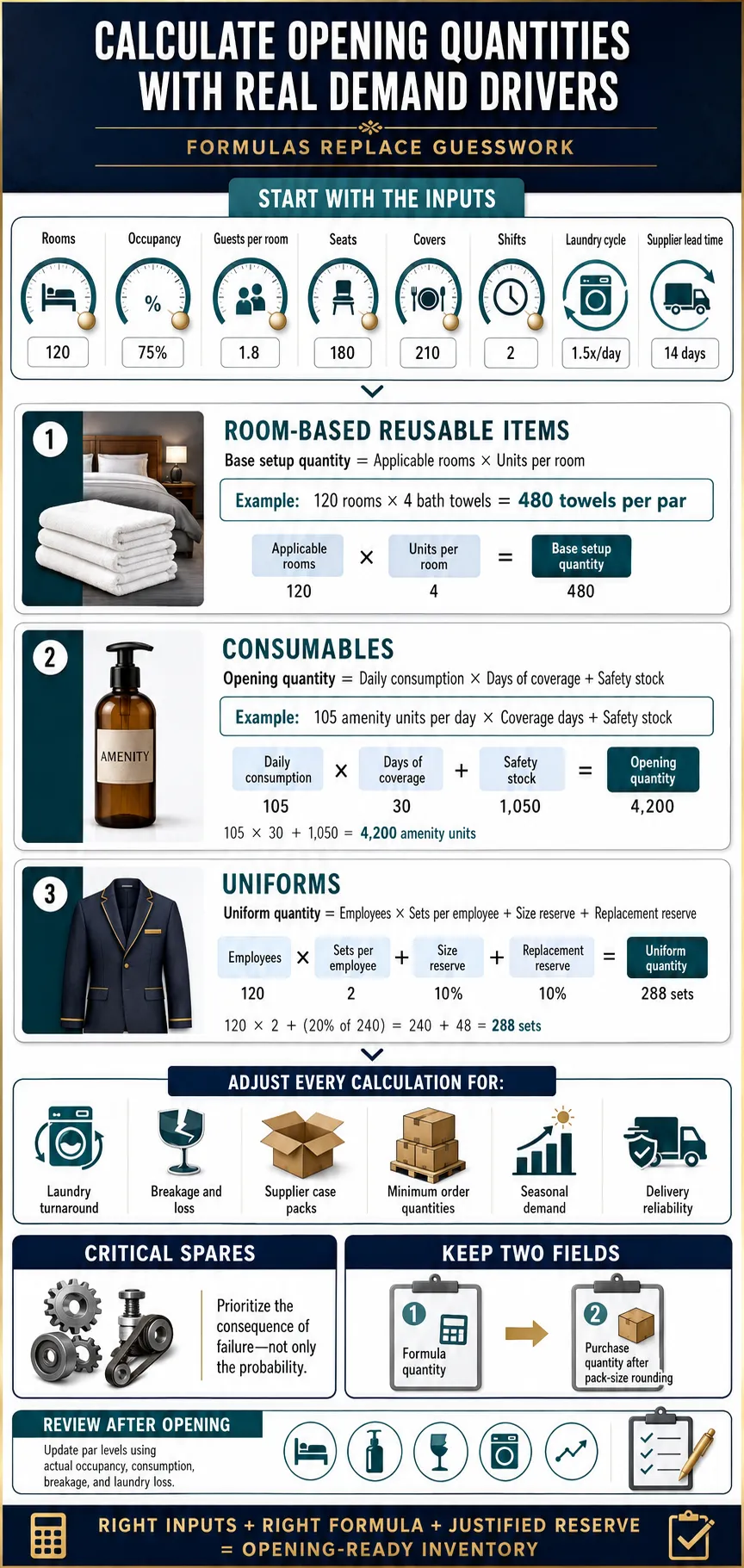
Quantities should come from formulas, not intuition. For each line item, record the setup quantity, operating par, replacement reserve, expected consumption, supplier lead time, order multiple, and opening quantity. The calculation method will vary by product.
For room-based reusable items, begin with:
Base setup quantity = Number of applicable rooms × Units per room
If 120 standard rooms each require four bath towels, the base setup is 480 towels. A linen “par” commonly represents one complete setup for all applicable rooms. However, the appropriate total par depends on the laundry cycle, occupancy, turnaround time, losses, storage, delivery reliability, and service standard. One set may be in use, another in laundry, and another in storage, but that simplified model should be tested against the property’s actual process rather than accepted automatically.
For consumables, use:
Opening quantity = Daily consumption at planned demand × Days of coverage + Safety stock
Daily consumption should reflect occupancy, guest behavior, outlet volumes, employee use, and waste. Suppose a 150-room hotel expects 70% occupancy during its first month, averages 1.6 occupied guests per room, and uses one amenity unit per occupied room-night. Estimated use is 105 units per day before safety stock. If the supplier delivers weekly but a disruption could add another week, the property may choose coverage that protects both the normal cycle and the identified risk.
For restaurants, calculate tabletop quantities by seats, pieces per cover, table turns, warewashing duration, breakage, and outlet sharing rules. For banquets, define the maximum simultaneous function the hotel will serve from owned inventory. If the ballroom holds 400 guests but the opening sales strategy caps events at 250 until staffing stabilizes, decide whether to procure for physical capacity or the controlled launch capacity—and document who approved that decision.
For uniforms, calculate by employee rather than job title alone:
Uniform quantity = Employees in position × Sets per employee + Size reserve + Replacement reserve
Account for recruitment not yet completed, turnover, seasonal staff, laundering frequency, gender-neutral options, maternity needs, extreme sizes, and altered garments. Do not guess the size curve from a generic workforce; collect measurements as early as practical and maintain a controlled exchange process.
For critical spare parts, estimate the consequence of failure as well as likelihood. A low-cost component that can shut down the only glasswasher deserves more protection than a decorative accessory available locally. Classify items as opening-critical, service-critical, compliance-critical, or noncritical. This classification also guides expediting decisions when the budget or schedule comes under pressure.
Round quantities carefully. Supplier case packs and minimum order quantities can create hidden overstock. Conversely, rounding down may leave incomplete room sets or table settings. Keep the formula quantity and purchase quantity in separate fields so the team can see the effect of pack sizes. After opening, review actual consumption frequently and adjust par levels as real occupancy, breakage, theft, laundry loss, and service patterns become visible.
Work Backward From the Opening Date
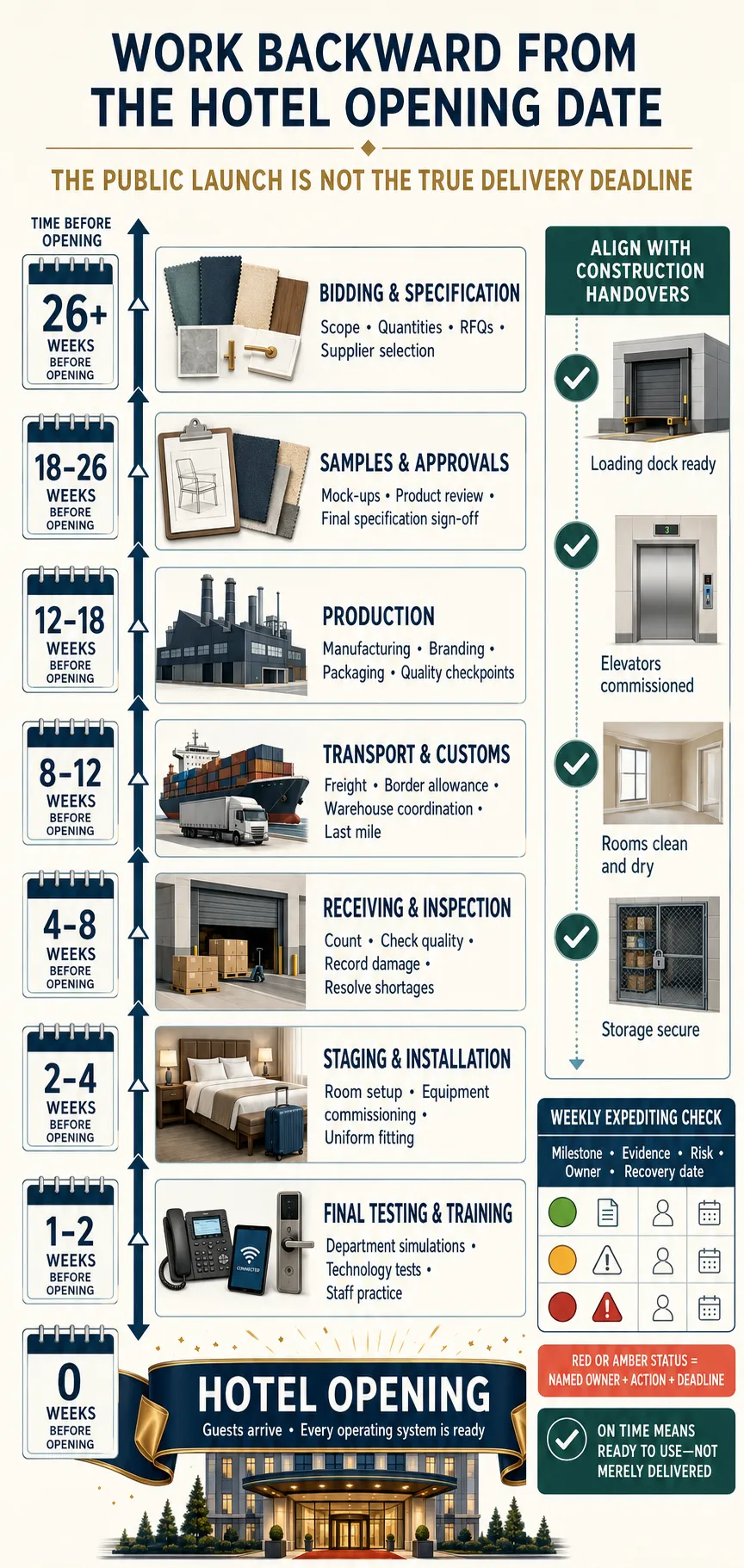
Do not organize procurement around the day a purchase order is issued. Organize it around the date each product must be installed, staged, trained on, or available for inspection. The grand opening is not the true delivery deadline. Linens may need washing before use; uniforms need fitting and alterations; kitchen equipment needs installation, commissioning, and training; guestroom items need floor-by-floor distribution; technology needs configuration and integration testing.
Create a backward schedule for every item using these components: required-on-site date, receiving and inspection time, installation or room-staging time, transport time, customs and border allowance if relevant, production time, sample and approval time, bidding and negotiation time, and specification-development time. Add a risk allowance based on product complexity and supply route.
As a planning framework, major custom FF&E and complex equipment usually need attention far earlier than routine consumables. Customized furniture, decorative products, commercial kitchen equipment, branded amenities, printed materials, uniforms, and technology hardware all have different critical paths. Never apply one blanket “order by” date to the entire OS&E package.
Tie the procurement schedule to construction handovers. A delivery may be on time according to the purchase order but still create a project problem if the loading dock is unavailable, elevators are not commissioned, guestrooms are dusty, storage rooms are unfinished, or security is not in place. Identify when each floor and back-of-house area becomes clean, dry, secure, accessible, and ready to receive goods.
Establish weekly expediting reviews once orders are placed. Track approved specification, purchase-order date, deposit, production status, inspection date, booking, departure, arrival, customs status, warehouse receipt, hotel delivery, shortage, damage, installation, and final acceptance. Every red or amber line needs an owner, action, and recovery date. “Supplier says on schedule” is not a meaningful status without a completed milestone and supporting evidence.
Build a Landed-Cost Budget With Controlled Contingency
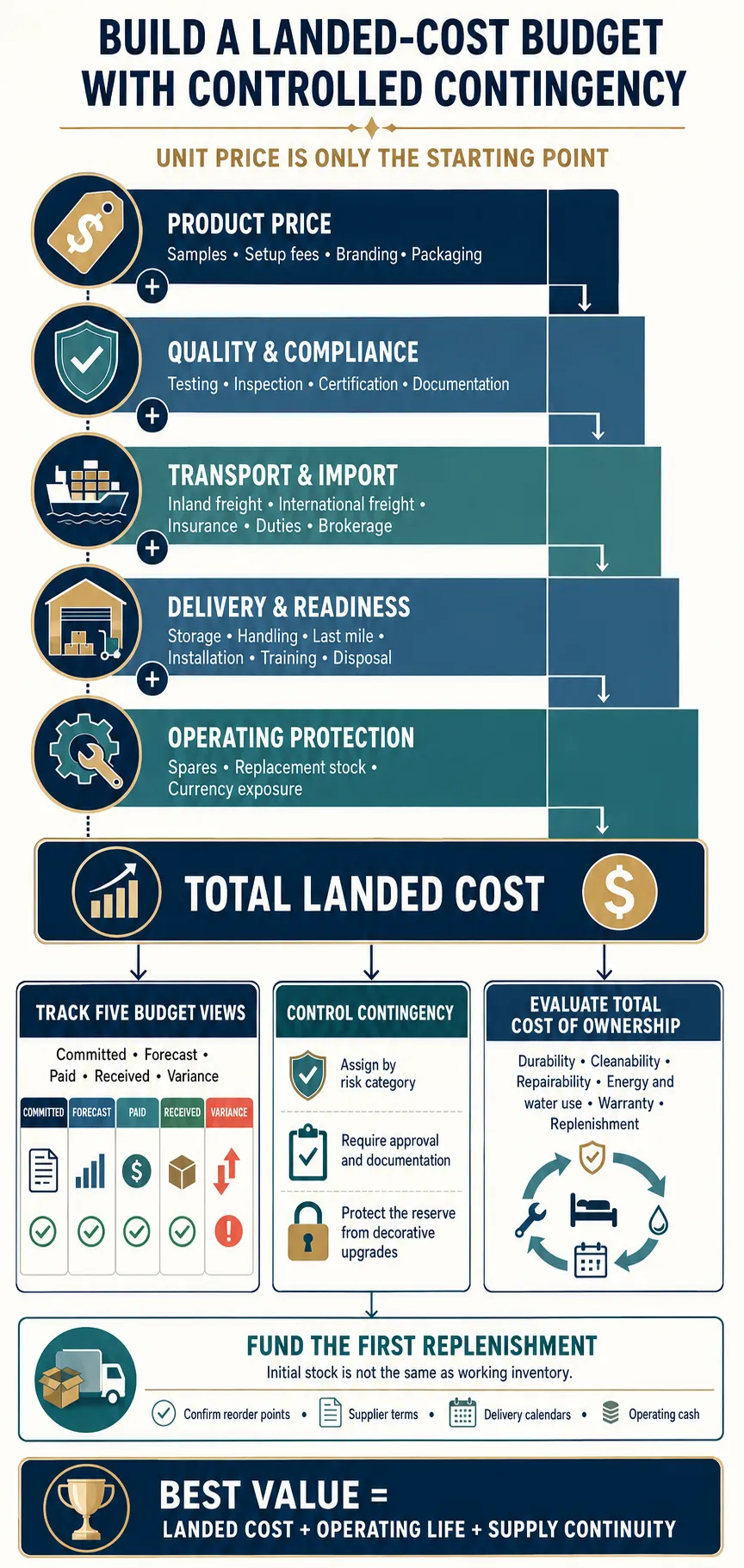
Unit price is only one component of opening cost. The budget should capture samples, molds or setup fees, branding, packaging, testing, inspection, inland transport, international freight, insurance, duties, brokerage, taxes, port charges, storage, handling, last-mile delivery, installation, assembly, calibration, training, disposal, spares, and replacement stock. Currency exposure and payment timing matter when purchasing internationally.
Structure the budget by department and category, then maintain committed, forecast, paid, received, and variance values. A purchase order may be committed while freight remains only a forecast. Finance needs both views to manage cash and prevent a false impression that an apparently unspent balance is available for new scope.
Create contingency rules rather than one vague reserve. Long-lead custom products, uncertain construction interfaces, freight-sensitive categories, and compliance-critical equipment may justify different risk allowances. Define who can authorize contingency and what documentation is required. This protects the reserve from being consumed by decorative upgrades while genuine opening risks remain unresolved.
Evaluate value through total cost of ownership. A lower-priced item may cost more if it breaks frequently, requires special chemicals, uses excessive energy or water, lacks replaceable parts, creates inconsistent room setups, or cannot be replenished in small quantities. Review durability, cleanability, repairability, warranty, availability, storage density, employee handling, guest comfort, and replenishment continuity.
Budget for the first replenishment before opening. Initial stock is not the same as working inventory. Some consumables will need to be reordered before the hotel has stable cash flow or reliable usage history. Confirm supplier credit terms, reorder points, delivery calendars, and funds for the first operating cycles. A property that looks fully stocked on opening day can still face shortages two weeks later.
Convert Brand Intent Into Procurement-Ready Specifications
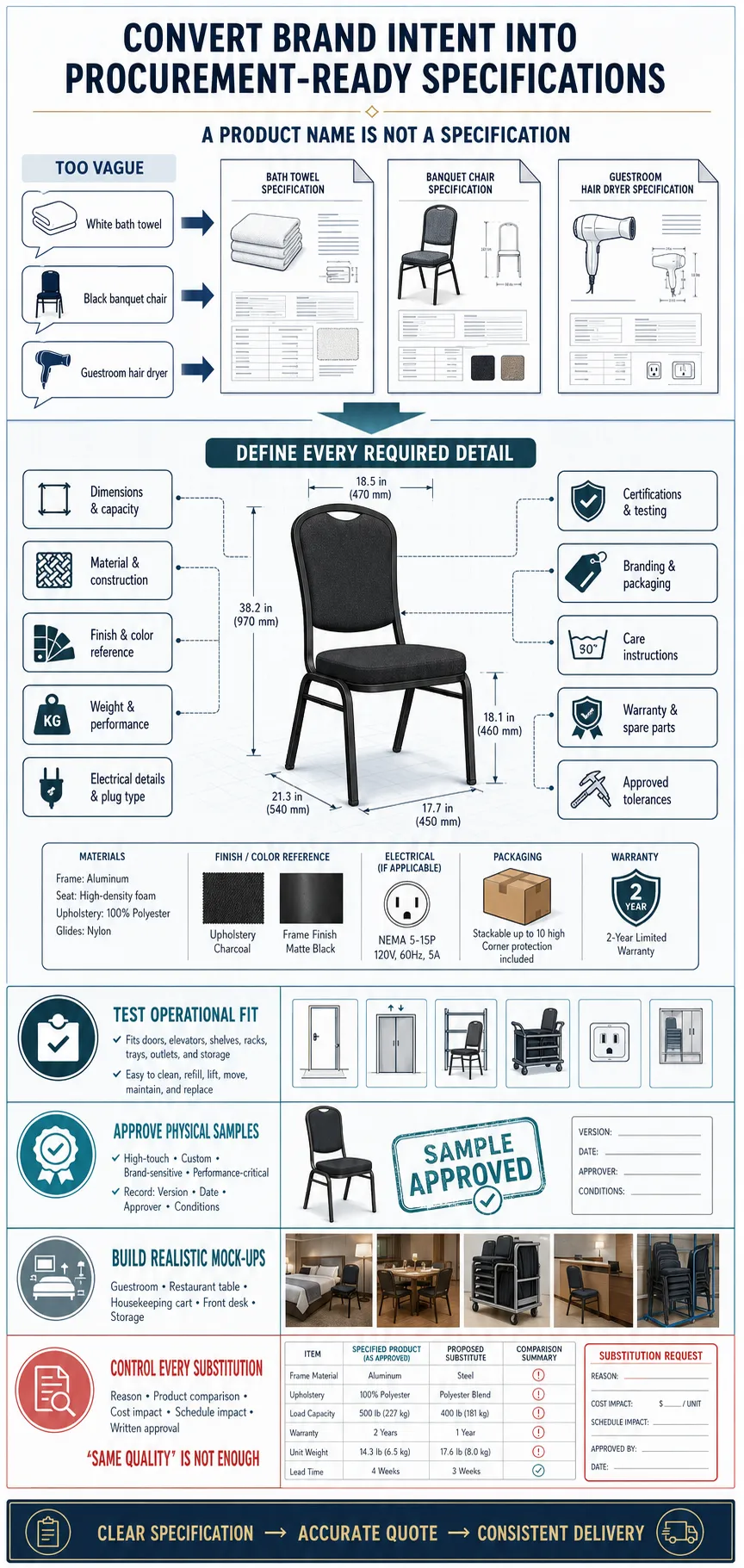
A product name is not a specification. “White bath towel,” “black banquet chair,” or “guestroom hair dryer” leaves too much room for interpretation. Each specification should include dimensions, capacity, material, finish, color reference, weight or performance requirements, electrical details, plug type, applicable certifications, packaging, branding, care instructions, warranty, spare parts, approved sample, acceptable tolerances, and delivery destination where relevant.
Operations must review products for use, not just appearance. Test whether a cart fits through service doors and elevators, whether shelves match storage bins, whether glassware fits dish racks, whether plates fit hot boxes, whether dispensers can be refilled efficiently, whether housekeeping can clean the surface, and whether employees can lift and move the item safely. Confirm that guestroom appliances fit available outlets and electrical capacity.
Use physical samples for high-touch, custom, brand-sensitive, or performance-critical items. Keep one signed control sample or a clearly documented equivalent. Record approvals with date, version, approver, and conditions. Photographs are helpful but may not accurately represent color, texture, balance, weight, finish, or construction.
Create a mock guestroom and, where practical, mock operating stations for restaurant tables, housekeeping carts, front desk drawers, banquet setups, and back-of-house storage. A mock-up reveals conflicts that spreadsheets cannot: crowded vanity trays, inaccessible outlets, unstable tabletop combinations, insufficient drawer depth, poor cart organization, or impractical packaging.
After specification freeze, substitutions should follow formal change control. The request must explain why the original product is unavailable, compare the proposed alternative, state cost and schedule impacts, and obtain the required approvals. A verbal “same quality” claim is not enough. Even a small dimensional change can affect trays, shelves, room layouts, replacement compatibility, or brand consistency.
Select Suppliers for Delivery Performance, Not Just Quoted Price
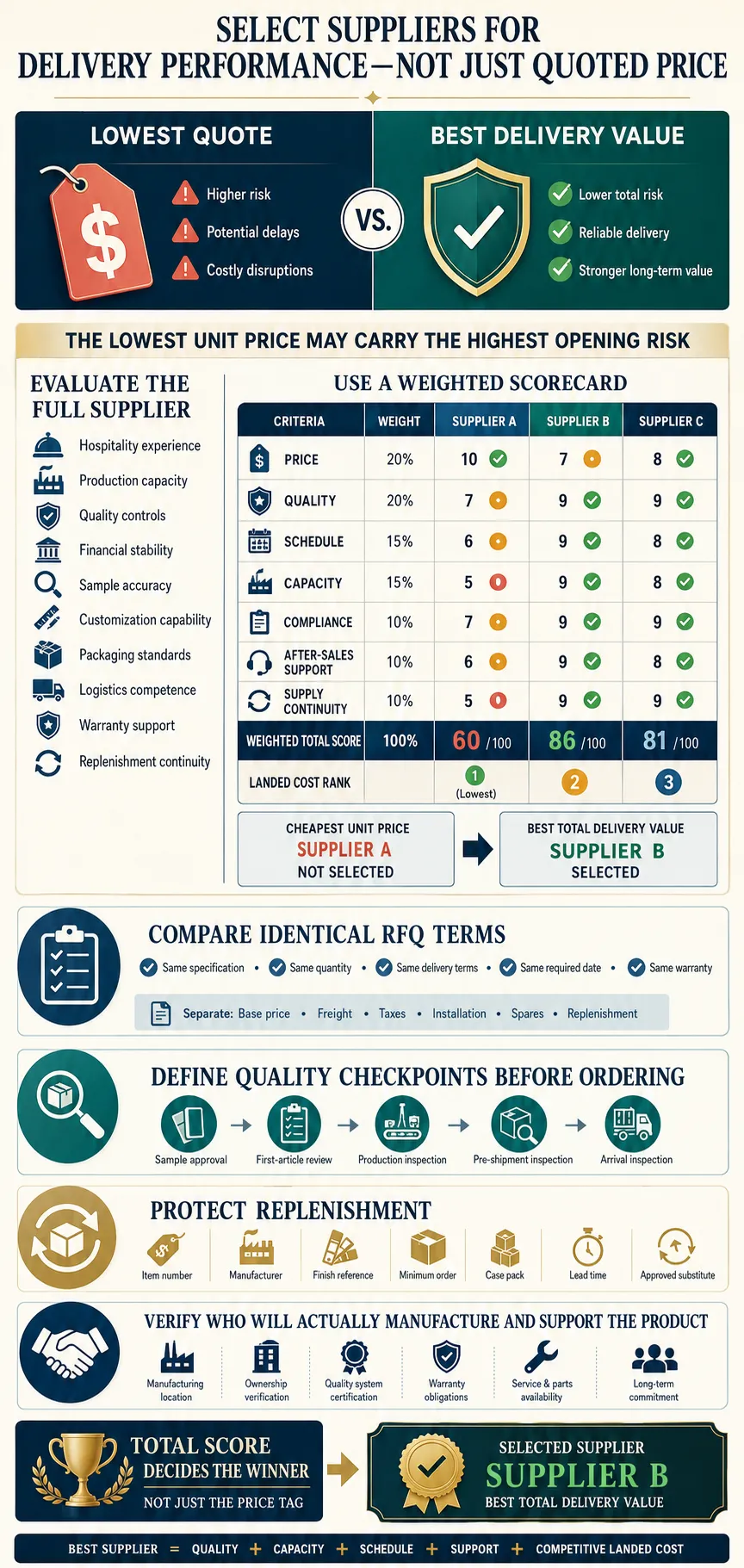
Supplier evaluation should match the risk of the category. Review hospitality experience, production capacity, quality controls, financial stability, reference projects, certifications, warranty support, response time, sample accuracy, customization capability, replenishment availability, packaging standards, and logistics competence. For critical orders, verify the actual manufacturing source and clarify whether the bidder is the factory, distributor, importer, or trading company.
Issue quote requests with identical specifications, quantities, delivery terms, required dates, packaging, warranty, sample expectations, and commercial conditions. Otherwise, comparison tables create the illusion of competition while suppliers have priced different scopes. Separate base price from optional items, freight, taxes, installation, spares, and recurring replenishment.
Use a weighted evaluation that reflects operational value. Price may be important, but so are compliance, quality, schedule, capacity, after-sales support, and supply continuity. Weighting should change by category: replacement availability may dominate for daily-use tabletop; technical service may dominate for kitchen equipment; color consistency and workmanship may dominate for custom furniture.
Define quality checkpoints before issuing the order. These may include sample approval, raw-material verification, first-article review, production inspection, pre-shipment inspection, functional testing, packaging review, and arrival inspection. State what happens when goods fail: rework, replacement, credit, rejected shipment, or approved concession. Inspection does not transfer responsibility away from the supplier; it provides earlier visibility.
Protect replenishment from the beginning. Record item numbers, manufacturer details, color and finish references, minimum orders, standard lead times, case packs, account contacts, and approved substitutes. Ask whether the exact item will remain available and whether smaller replacement orders are possible. A beautiful custom product becomes an operational burden if the hotel cannot replace 20 units after opening.
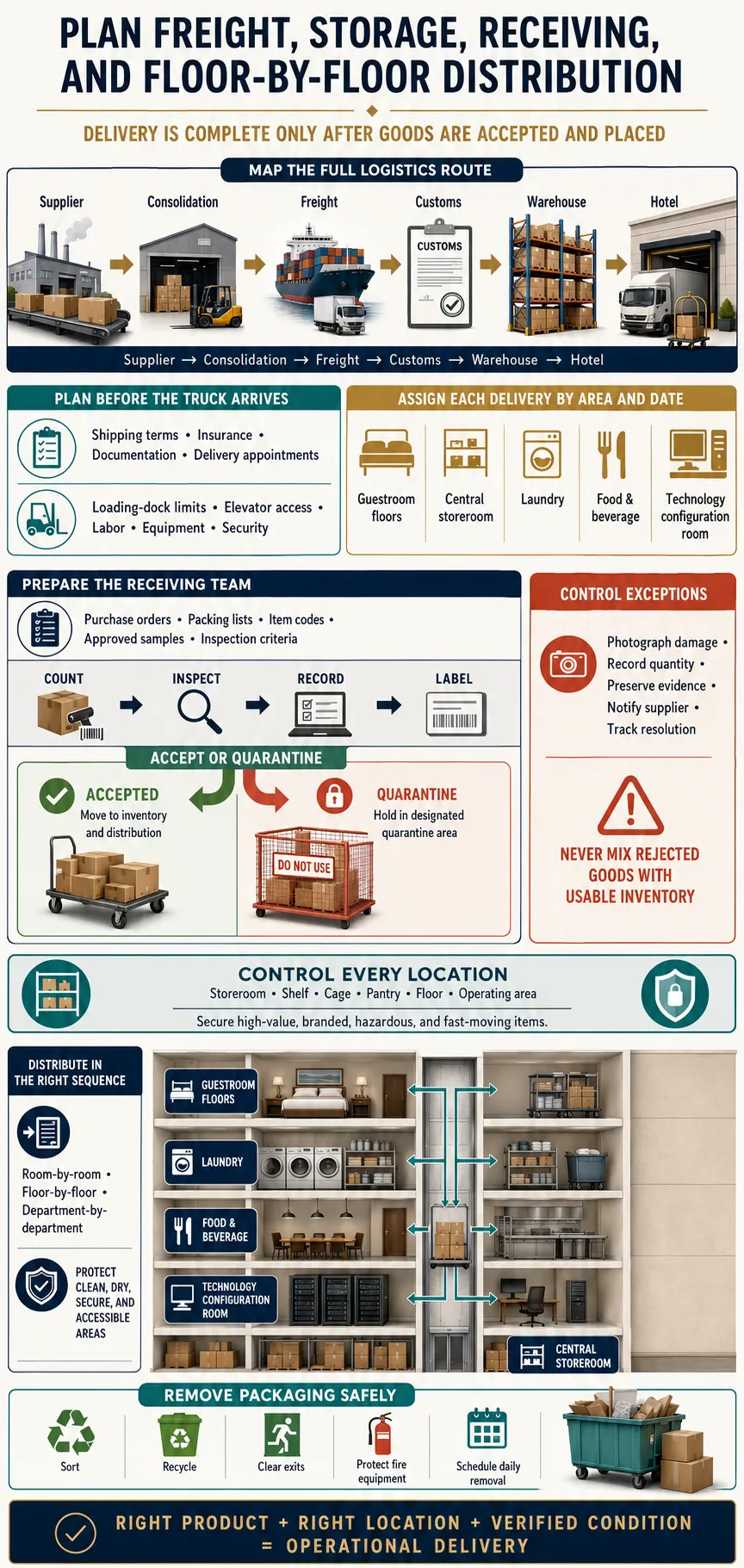
Plan Freight, Storage, Receiving, and Floor-by-Floor Distribution
Goods are not “delivered” when a truck reaches the property. They must be counted, inspected, recorded, stored, distributed, installed, and accepted. Build a logistics plan that identifies shipping terms, consolidation points, freight responsibility, insurance, customs documentation, warehouse needs, appointment rules, loading-dock dimensions, vehicle restrictions, elevator access, labor, equipment, packaging disposal, security, and temporary storage.
Create a delivery matrix by area and date. Large FF&E may need room-by-room or floor-by-floor delivery; tabletop may go to a secured central storeroom; linens may go directly to laundry for initial processing; technology may need a controlled configuration room. Sequence deliveries so products do not block construction or become exposed to dust, moisture, theft, and trade damage.
Prepare a receiving team before the first shipment. They need purchase orders, packing lists, item codes, quantities, approved samples or images, inspection criteria, cameras, labels, discrepancy forms, and a defined escalation path. Count sealed cartons strategically, open enough packages to assess quality, and inspect high-risk items more deeply. Record visible damage on carrier documents before signing when applicable.
Quarantine damaged, incorrect, or unapproved goods. Do not allow them to blend into usable inventory while a claim is pending. Photograph the product, packaging, labels, and shipment condition; record the affected quantity; preserve evidence; and notify the responsible parties within contractual deadlines. Track shortages and damage to closure rather than assuming a supplier’s acknowledgment equals resolution.
Use location labels and inventory controls from the first receipt. Each product should have an assigned storeroom, shelf, cage, pantry, floor, or operating area. Control access to high-value, branded, hazardous, and easily consumed items. Poor pre-opening inventory control can make purchased goods effectively disappear before the first guest arrives.
Plan packaging removal and waste. Openings generate large volumes of cardboard, plastic wrap, pallets, foam, and crates, often while the building’s normal waste systems are not fully operating. Coordinate sorting, recycling, dumpsters, removal labor, fire-exit protection, and daily housekeeping. Packaging must never obstruct egress routes, fire equipment, or work areas.
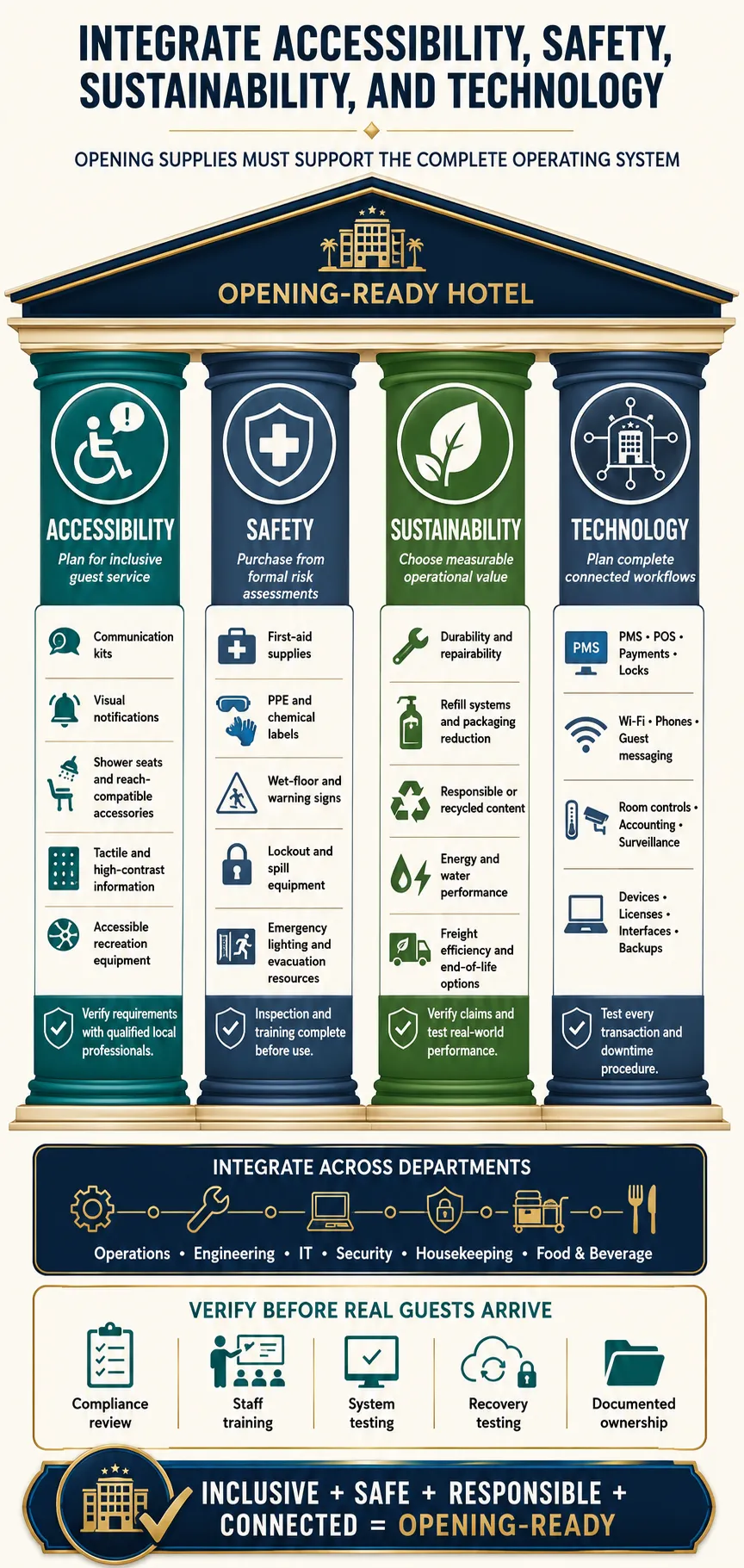
Integrate Accessibility, Safety, Sustainability, and Technology
Opening supplies must support legal obligations and inclusive service. Review the requirements that apply to the property’s location, building, services, and room mix with qualified local professionals. Procurement implications may include accessible communication kits, visual notification devices, shower seats, reach-compatible accessories, tactile or high-contrast information, accessible pool equipment, and service tools for guests with vision, hearing, mobility, or dexterity needs. Do not assume that a generic accessibility kit makes a room or service compliant.
Safety-related purchasing should flow from formal risk assessments and operating procedures. Examples include first-aid supplies, protective equipment, chemical labels and storage, wet-floor signs, lockout equipment, fire-safety items, emergency lighting, flashlights, radios, spill kits, temperature-measurement tools, and evacuation resources. Local authorities and qualified specialists must confirm the exact requirements; an online checklist is not a substitute for inspection and approval.
Sustainable purchasing should be specific and verifiable. Consider product durability, refill systems, packaging reduction, recycled or responsibly sourced content, repairability, energy and water performance, chemical profile, freight efficiency, and end-of-life options. Avoid vague “green” claims. Request documentation, test operational fit, and calculate the full life-cycle effect. A product that reduces packaging but leaks, frustrates guests, or cannot be refilled reliably may create more waste and service failures.
Technology supplies must be planned as complete workflows. For the property-management system, point of sale, booking engine, channel connections, payments, locks, phones, Wi-Fi, accounting, guest messaging, room controls, and surveillance, document every device, license, cable, accessory, interface, user role, support contact, and backup process. Test transactions from reservation through checkout, including deposits, refunds, taxes, room moves, no-shows, split folios, outlet charges, night audit, key failures, network outages, and emergency access.
Cybersecurity and privacy should be addressed before real guest data enters the systems. Change default credentials, control administrative access, separate networks appropriately, patch devices, secure payment processes, configure backups, test recovery, and train employees against common attacks. Confirm who owns configuration, monitoring, incident response, and vendor access after launch.
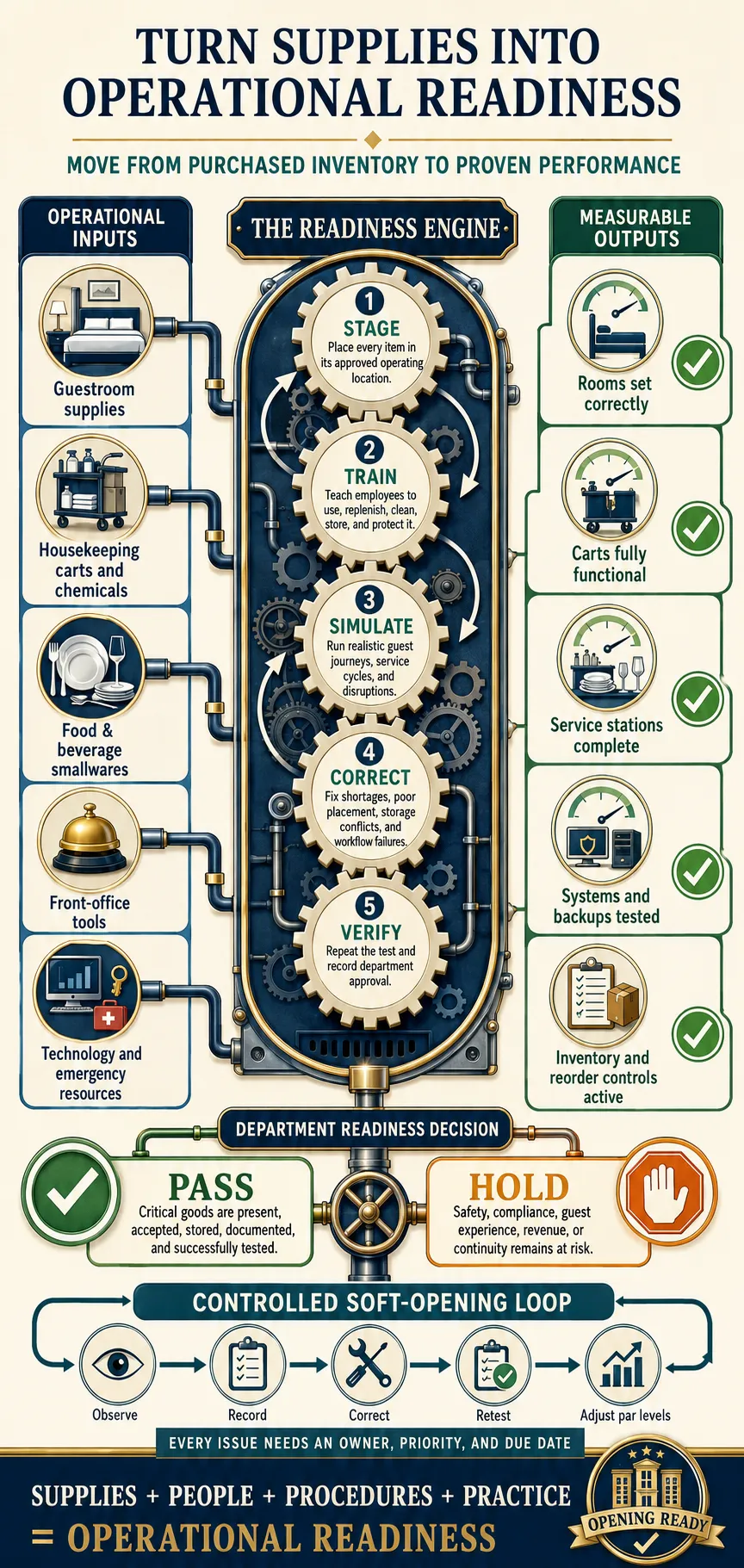
Turn Supplies Into Operational Readiness
The final phase is not a visual inspection; it is rehearsal. Stage guestrooms according to approved setup sheets and inspect every room. Run housekeeping cycles with full carts. Receive a mock food delivery. Prepare, serve, clear, and wash a representative meal. Set a banquet, move equipment through service routes, process a guest complaint, issue replacement keys, handle luggage, complete a night audit, and respond to simulated system outages.
These exercises reveal whether quantities, placement, storage, training, and procedures work together. A hotel may own 30 housekeeping caddies but have no practical place to refill them. A restaurant may have enough plates but too few racks to move them through dishwashing. A front desk may have emergency forms but no trained process for reconciling manual transactions when systems return.
Create readiness gates for each department. A department passes only when critical goods are present, inspected, stored, entered into inventory, incorporated into procedures, and used successfully in a simulation. Open issues should be ranked by their effect on safety, compliance, guest experience, revenue, and operating continuity. Assign an owner and due date to each issue.
Use a soft opening to test controlled demand, not to excuse unfinished fundamentals. Limit inventory exposure and service complexity if necessary, but do not open occupied rooms without required safety, accessibility, cleanliness, security, and core operating capabilities. Capture guest and employee feedback daily, investigate recurring requests, and adjust pars or layouts based on evidence.
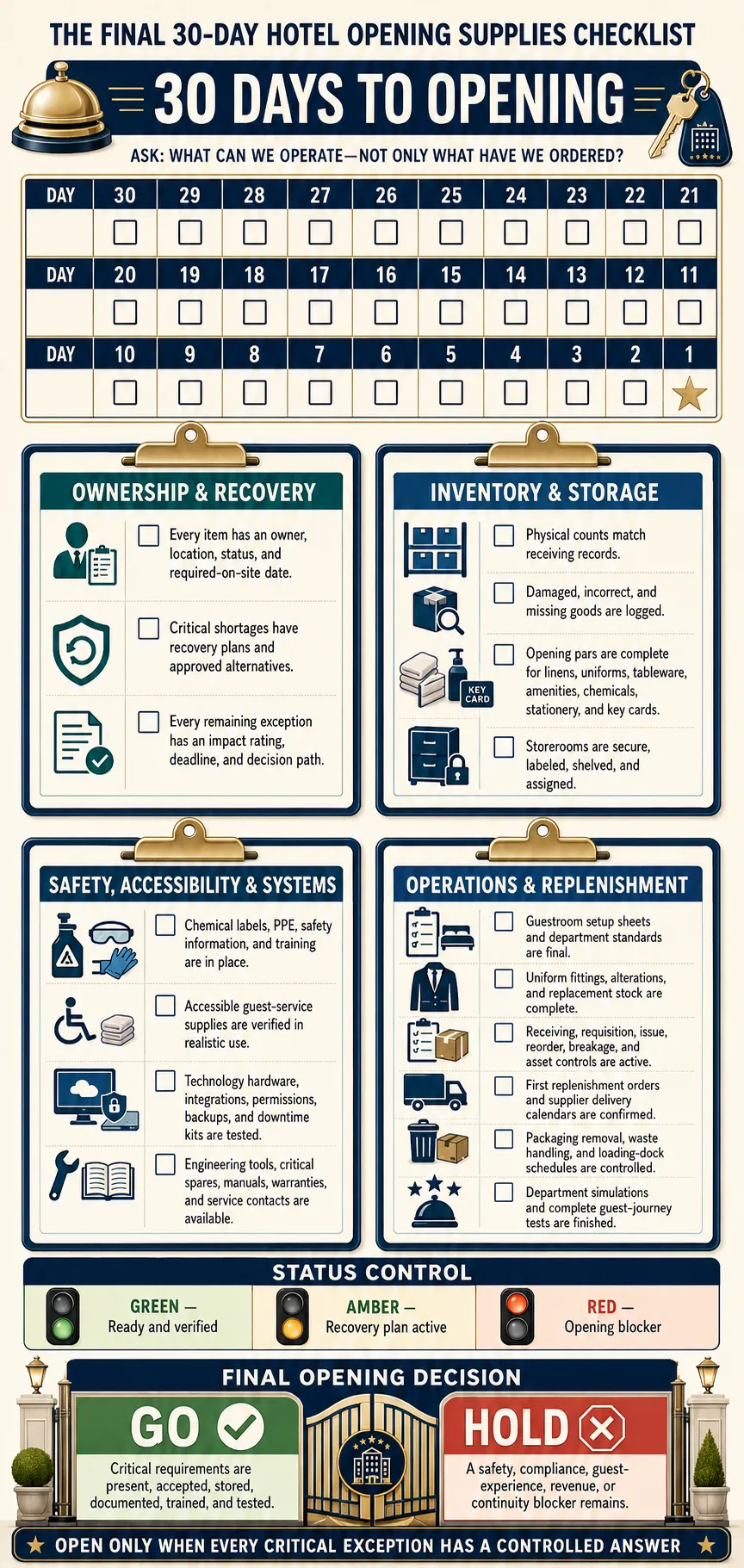
The Final 30-Day Hotel Opening Supplies Checklist
Thirty days before launch, the procurement conversation should move from “What have we ordered?” to “What can we operate?” Confirm the following:
- Every item has an accountable owner, location, status, and required-on-site date.
- Opening-critical shortages have documented recovery plans and approved alternatives.
- Guestroom setup sheets and department operating standards are final.
- Physical counts match receiving records for critical categories.
- Damaged, incorrect, and missing goods are logged and being resolved.
- Linen, uniforms, tableware, glassware, amenities, chemicals, stationery, and key cards meet approved opening pars.
- Uniform fittings, alterations, issue records, and replacement stock are complete.
- Storerooms are secure, labeled, shelved, and assigned to responsible employees.
- Cleaning chemicals, safety information, protective equipment, labels, and training are in place.
- Food-service smallwares and measurement tools support approved menus and safety procedures.
- Accessible guest-service supplies have been verified in realistic use.
- Technology hardware, accessories, integrations, permissions, backups, and downtime kits have been tested.
- Engineering tools, critical spares, manuals, warranties, and service contacts are available.
- Receiving, requisition, issue, reorder, breakage, and asset-control procedures are active.
- First replenishment orders and supplier delivery calendars are confirmed.
- Packaging removal, waste handling, and loading-dock schedules are controlled.
- Department simulations and cross-department guest-journey tests have been completed.
- Every remaining exception has an owner, deadline, impact rating, and decision path.
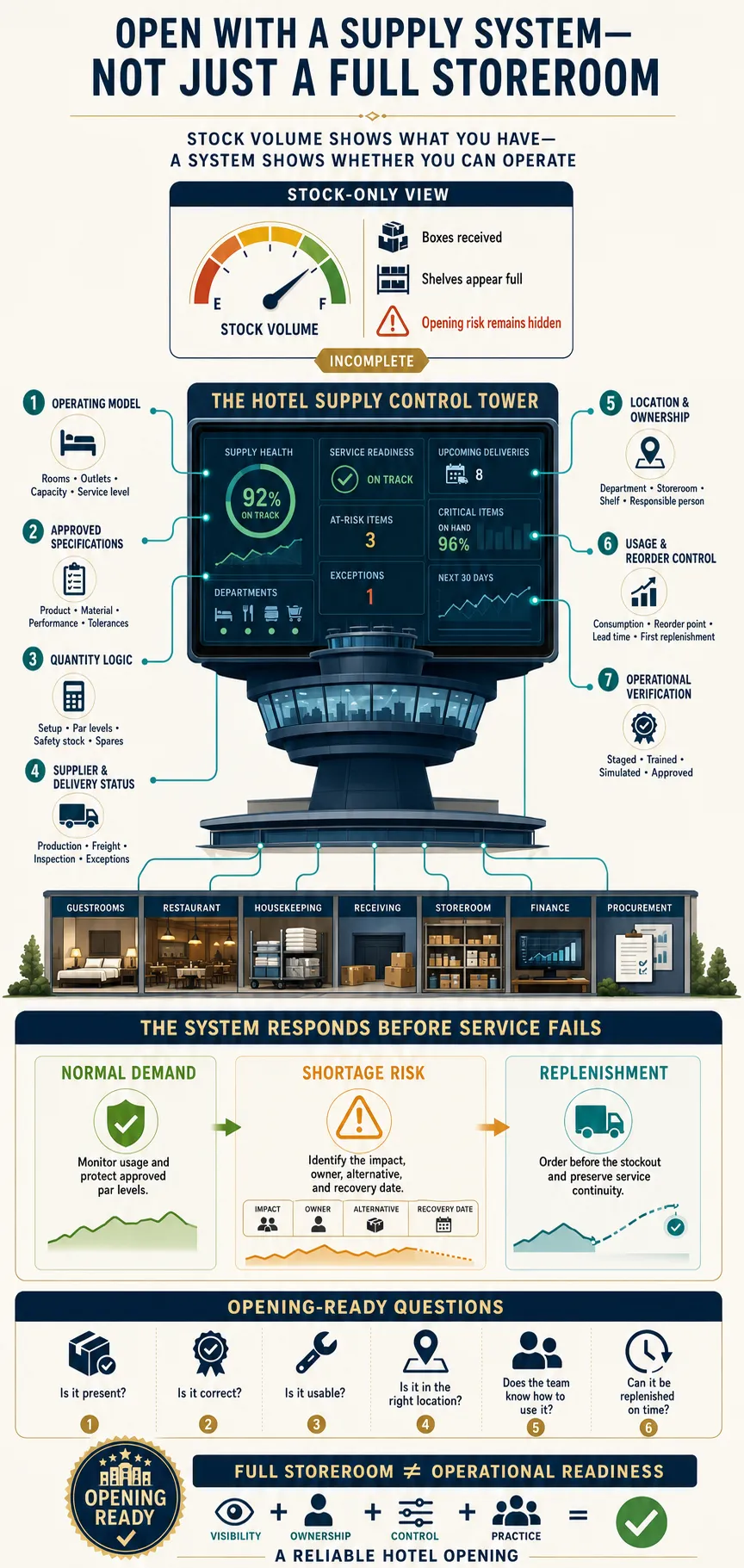
Open With a Supply System, Not Just a Full Storeroom
Successful hotel-opening procurement connects design intent, operating demand, budget control, supplier performance, logistics, compliance, training, and replenishment. The master list matters, but the management system behind it matters more. When assumptions are clear, quantities are formula-based, specifications are controlled, deliveries are inspected, and departments rehearse with the actual products, opening day becomes the result of disciplined preparation rather than last-minute rescue.
KW Hospitality helps hotel owners, developers, operators, and purchasing teams source coordinated FF&E and OS&E packages directly from qualified manufacturing partners. From custom guestroom and food-and-beverage products to amenities, furniture, and recurring operational supplies, our Montreal-based team supports specifications, supplier coordination, quality control, and door-to-door delivery for projects across Canada and the United States. Send your project scope or RFQ to info@kwhospitality.com to begin planning your opening supply package.
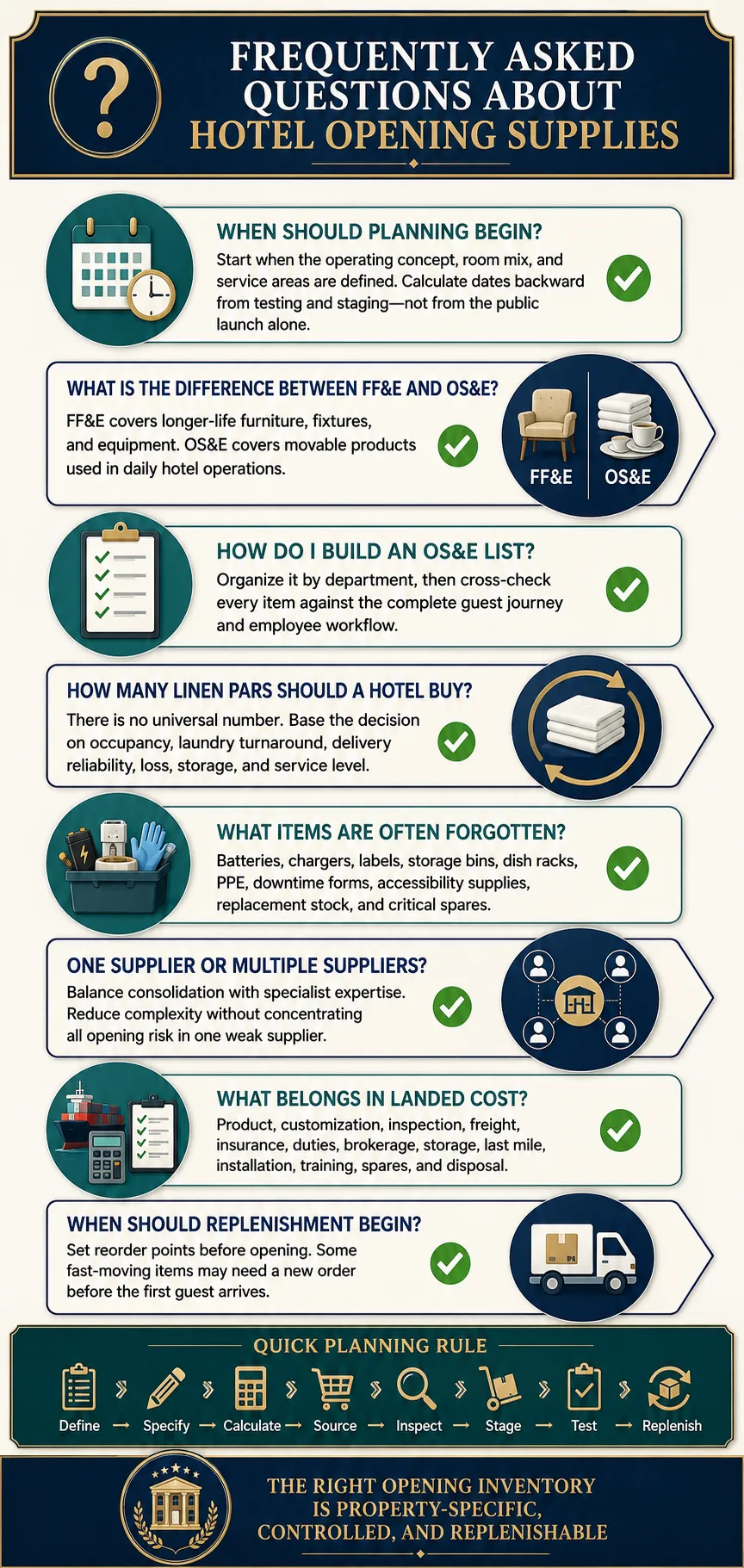
Frequently Asked Questions About Hotel Opening Supplies
How early should hotel opening supplies be planned?
Begin as soon as the operating concept, room mix, and major service areas are defined. Long-lead custom furniture, equipment, technology, branded products, and imported goods may require many months for specification, samples, production, transport, and installation. Routine consumables can be ordered later, but their quantities and storage still need early planning. The correct date is calculated backward from when the item must be tested or staged—not simply from the public opening date.
What is the difference between FF&E and OS&E in a hotel opening?
FF&E generally refers to longer-life furniture, fixtures, and equipment, such as beds, desks, chairs, decorative lighting, restaurant furniture, and major equipment. OS&E generally refers to movable operating supplies and equipment used in daily service, including linens, tableware, uniforms, smallwares, housekeeping equipment, and guestroom accessories. The boundary can vary by contract and accounting policy, so each project should define ownership and exclusions explicitly.
How do I create a hotel OS&E list?
Start with the operating model, then build separate lists for guestrooms, bathrooms, front office, housekeeping, laundry, restaurants, bars, banquets, kitchens, engineering, security, offices, wellness areas, employee facilities, and other services. Cross-check the list against the complete guest journey and employee workflows. For every item, add a specification, quantity formula, budget, lead time, supplier, delivery date, storage location, and responsible approver.
How many sets of hotel linen should be purchased?
There is no universal number that fits every hotel. The required par depends on room count, occupancy, on-site or outsourced laundry, processing time, delivery schedule, reject rate, loss, storage, and service standard. Model one complete room setup, map where each set is during the laundry cycle, add a justified reserve, and test the calculation under peak occupancy and a realistic disruption.
What supplies are most often forgotten before opening?
Common gaps include replacement batteries, chargers, adapters, labels, storage bins, dish racks, glass racks, cleaning accessories, chemical dispensers, protective equipment, spare remotes, employee-area supplies, manual downtime forms, accessible communication devices, first replenishment stock, packaging-removal resources, and critical equipment spares. These items are often missed because they sit between departmental scopes or support a process rather than a visible guest area.
Should a hotel use one supplier or multiple suppliers?
The right approach balances consolidation and specialization. Fewer suppliers can simplify invoices, shipping, communication, and consistency. Specialized suppliers may provide better expertise, quality, or replenishment for certain categories. Group compatible products where consolidation creates value, but maintain alternatives for critical items and avoid concentrating the entire opening risk with a supplier that lacks capacity across all categories.
What should be included in the landed cost of hotel supplies?
Include the product price plus samples, customization, packaging, testing, inspection, inland transport, freight, insurance, duties, brokerage, taxes, port or terminal fees, storage, handling, last-mile delivery, installation, assembly, calibration, training, spares, and disposal where applicable. Also consider currency movement, payment timing, warranty limitations, and the cost of urgent replacement if a shipment fails.
How should hotel supplies be inspected before launch?
Use approved specifications and samples to inspect identity, quantity, dimensions, material, color, workmanship, function, branding, packaging, and damage. Apply deeper checks to critical and high-risk items. Record discrepancies with photographs and item codes, quarantine nonconforming goods, notify suppliers within the required period, and track corrective action through final replacement, repair, credit, or approved acceptance.
What is a hotel opening critical-items list?
It is a shorter list of products whose absence could prevent safe, legal, or commercially viable operation. It may include guestroom linen, keys, cleaning equipment, essential amenities, payment devices, food-safety tools, required accessibility items, protective equipment, emergency supplies, core kitchen smallwares, and critical engineering parts. Classify these items early so the team knows what deserves priority, contingency stock, alternate suppliers, or expedited recovery.
When should a hotel place its first replenishment order?
Set reorder points before opening using forecast consumption, stock on hand, supplier lead time, delivery frequency, minimum order, and safety stock. Fast-moving products may need a replenishment order placed before the first guest arrives, especially when the initial delivery was intentionally limited or supplier lead times are long. Review actual use daily or weekly during ramp-up and adjust assumptions quickly.