
Section 1: The Silent Luxury: Why Cutlery Defines the 5-Star Hotel Dining Experience
Luxury Is Often Felt Before It Is Understood
In the world of five-star hospitality, true luxury rarely announces itself loudly. It does not rely on excess, nor does it beg for attention. Instead, it operates quietly, through details that guests may never consciously analyze but will always feel. Luxury hotel cutlery belongs to this rare category of silent luxury—an element so fundamental, so frequently touched, that its quality becomes inseparable from the guest’s overall perception of refinement, care, and excellence. The moment a guest lifts a fork or knife at a luxury hotel restaurant, banquet, or in-room dining experience, a subtle but powerful dialogue begins between the object and the guest’s senses. Weight, balance, temperature, surface finish, and even sound—all communicate something deeper than design. They communicate intent.
In five-star hotels, cutlery is not a background object. It is a tactile ambassador of the brand. A heavy, perfectly balanced fork signals confidence, permanence, and investment. A flawlessly polished knife edge reflects not only light but discipline—discipline in procurement, operations, and standards. Guests may not leave a restaurant saying, “The cutlery was exceptional,” but they will leave feeling that everything was right. And in luxury hospitality, that feeling is everything.
Cutlery as a Psychological Anchor in Guest Experience
Unlike décor elements that are admired from a distance, cutlery is held, used, and experienced intimately. It remains in a guest’s hand throughout the meal, influencing comfort, confidence, and enjoyment at every bite. Research in hospitality psychology consistently shows that tactile experiences shape perceived quality far more than visual ones alone. When a guest feels a flimsy fork or an unbalanced knife, the subconscious reaction is immediate: doubt. Doubt about food quality, service standards, and even the credibility of the hotel’s five-star positioning.
Luxury stainless steel cutlery, especially heavy-weight 18/10 flatware, creates the opposite effect. It anchors the dining experience, providing a sense of solidity and assurance that elevates everything else on the table—from the chef’s plating to the wine selection. In premium hotels, cutlery acts as a stabilizing force, ensuring that no matter how creative or minimalist the cuisine becomes, the guest always feels grounded in quality.
This is why leading luxury hotel groups invest heavily in flatware programs that are not only beautiful but consistent, durable, and deliberately selected to align with brand philosophy. Cutlery is not an afterthought; it is infrastructure for guest satisfaction.
Why 5-Star Hotels Treat Cutlery as a Strategic Asset
For five-star hotels, cutlery is not simply a dining tool—it is an operational asset with long-term implications. Premium hotel cutlery must withstand thousands of wash cycles, resist corrosion, maintain polish, and retain its weight and form over years of continuous use. But beyond durability, it must do something more difficult: remain timeless.
Trends in cuisine evolve rapidly, but luxury hotels cannot afford to redesign their flatware every two years. The right cutlery selection must transcend trends while remaining contemporary, adaptable, and visually relevant across multiple outlets—fine dining restaurants, all-day dining, banquets, lounges, and in-room service. This requires a procurement mindset that balances aesthetics, engineering, lifecycle cost, and brand continuity.
This is where experienced hospitality cutlery suppliers differentiate themselves from general wholesalers. Luxury hotel cutlery sourcing demands an understanding of hotel operations, replacement planning, loss ratios, and future availability. A fork is never just a fork when it must match future replenishment orders five or ten years down the line.
The Unspoken Language of Weight, Balance, and Finish
One of the most overlooked aspects of luxury cutlery is weight. Guests rarely articulate it, yet they instinctively recognize it. Heavy-weight flatware communicates seriousness and value. It slows the dining experience just enough to encourage mindfulness and enjoyment, aligning perfectly with fine dining and premium hospitality environments.
Balance is equally critical. Poorly balanced cutlery disrupts rhythm, creating discomfort that guests may misattribute to food or service. Premium hotel cutlery sets are engineered so that the center of gravity feels natural in the hand, regardless of whether the guest is left- or right-handed. This level of refinement is invisible—but unmistakable.
Finish completes the conversation. Mirror polish conveys classic luxury and ceremony, while satin or brushed finishes express modern restraint and understated elegance. In five-star environments, these finishes are chosen not for trendiness, but for how they interact with lighting, tableware, and the overall atmosphere of the space.
Luxury Cutlery and the Expectation of Consistency
Luxury hospitality is built on trust. Guests return to five-star hotels because they trust the experience will meet—or exceed—their expectations every time. Cutlery plays a quiet but critical role in maintaining that trust. A mismatch in weight, design, or finish between outlets—or worse, between visits—can subtly erode confidence.
This is why premium hotel groups centralize flatware standards and insist on long-term supplier relationships. Consistency across properties, regions, and service formats is not accidental; it is the result of disciplined sourcing and long-term planning. Luxury hotel cutlery suppliers must be able to guarantee not only today’s delivery but tomorrow’s continuity.
Where Procurement Meets Guest Emotion
At its highest level, luxury hospitality procurement is not about products—it is about emotion. The emotional response a guest has to a meal, a service interaction, or a space is shaped by dozens of invisible choices made long before arrival. Cutlery is one of those choices.
When procurement teams select premium stainless steel cutlery wholesale for a five-star hotel, they are not merely buying flatware. They are investing in comfort, confidence, and subconscious satisfaction. They are protecting the brand’s promise at the most intimate point of guest interaction: the table.
This philosophy is central to how KW Hospitality approaches luxury hotel cutlery sourcing—treating each program as a long-term partnership between design intent, operational reality, and guest expectation.
Looking Ahead: From Philosophy to Precision
In this opening section, we explored why cutlery matters so profoundly in five-star hospitality—not as an accessory, but as a silent architect of guest experience. In the next section, we move from philosophy to identity.
In next section We will explore how luxury hotels use cutlery design to express brand DNA, cultural identity, and culinary philosophy—transforming stainless steel into a powerful storytelling tool.
Continue reading to discover how your cutlery can speak your brand’s language—without saying a word.

Section 2: Cutlery as a Brand Signature: When Stainless Steel Becomes Storytelling
From Utility to Identity: The Moment Cutlery Stops Being Generic
In five-star hospitality, nothing exists in isolation. Every object placed in front of a guest—every surface, texture, and tool—either reinforces or weakens the hotel’s identity. Cutlery, though often treated as a commodity in mid-scale operations, becomes a powerful storytelling medium in luxury hotels. The moment flatware shifts from being merely functional to intentionally selected, it begins to express brand values with remarkable subtlety. A fork’s silhouette, the curvature of a knife handle, the softness of a spoon’s bowl—each becomes a visual and tactile sentence in a much larger narrative about who the hotel is and what it stands for.
Luxury hotels do not “choose cutlery”; they define a language. That language must remain consistent whether the guest is dining in a Michelin-aspiring fine-dining restaurant, attending a black-tie banquet, or enjoying breakfast overlooking a city skyline. When executed correctly, cutlery becomes as recognizable as a logo—yet far more intimate, because it is held, not merely seen.
Brand DNA at the Table: Translating Philosophy into Form
Every luxury hotel brand carries a philosophy, whether it is rooted in heritage, modern minimalism, cultural storytelling, or experiential indulgence. The challenge lies in translating that abstract philosophy into physical form without appearing forced or theatrical. Cutlery does this exceptionally well because it operates quietly. A heritage luxury hotel may choose classic European flatware profiles with subtle ornamentation, reflecting history, craftsmanship, and permanence. A contemporary urban luxury property, by contrast, may select sleek, linear designs with satin finishes and architectural proportions that mirror the building itself.
What distinguishes five-star hotel cutlery programs from restaurant-only selections is scale and foresight. The cutlery must express identity not just once, but thousands of times per day, across years of service. This requires restraint. True luxury branding through cutlery is never loud; it is confident enough to be subtle. Guests may not consciously recognize the design logic, but they will feel its coherence—and that feeling translates directly into trust.
Design Consistency Across Outlets: One Brand, Many Experiences
One of the most complex challenges in luxury hospitality is maintaining brand consistency across diverse dining environments. A five-star hotel may operate multiple outlets under one roof: fine dining, all-day dining, lounge, banquet halls, poolside service, and in-room dining. Each has its own atmosphere, yet all must feel unmistakably part of the same brand universe.
Cutlery plays a central role in solving this puzzle. Rather than selecting entirely different flatware sets for each outlet, leading luxury hotels develop a core design language that can be subtly adapted. For example, the same handle profile may be used across all outlets, while weight, finish, or piece selection varies depending on formality. This approach preserves visual unity while allowing operational flexibility.
From a procurement standpoint, this strategy is also intelligent. It simplifies inventory management, replacement planning, and long-term sourcing while protecting the brand’s aesthetic integrity. Experienced hospitality cutlery suppliers understand how to engineer these programs so that elegance and efficiency coexist seamlessly.
The Emotional Intelligence of Cutlery Design
Luxury hospitality operates on emotional intelligence as much as operational excellence. Cutlery contributes to this emotional layer by shaping how guests feel during a meal. Rounded edges convey warmth and comfort. Sharper lines suggest precision and modernity. A heavier handle can evoke generosity and indulgence, while a slimmer profile may suggest refinement and restraint.
These emotional cues must align with the hotel’s positioning. A resort-style luxury property focused on relaxation and abundance may favor softer, more generous forms. A business-oriented luxury hotel catering to executives may prefer structured, disciplined designs that communicate efficiency and confidence. In both cases, the cutlery is doing more than serving food—it is guiding emotional perception.
This is why luxury hotel cutlery sourcing cannot be reduced to catalog selection. It requires dialogue, understanding, and intentional design decisions that align with brand psychology.
Customization Without Excess: The Art of Discreet Branding
In the luxury segment, branding must be present—but never intrusive. Custom engraved cutlery for hotels is a perfect example of this delicate balance. When done poorly, engraving can feel promotional or cheap. When done correctly, it becomes a quiet mark of ownership and pride.
Five-star hotels often opt for micro-engraving, laser etching on the back of handles, or discreet monograms placed where they are felt rather than seen. The goal is not to announce the brand, but to reinforce authenticity and belonging. Guests may notice it subconsciously, registering that the cutlery is custom, not off-the-shelf—and that realization subtly elevates the perceived value of the entire dining experience.
From a procurement perspective, customization also strengthens asset control, discourages loss, and ensures long-term consistency. A trusted luxury hotel cutlery supplier understands how to implement branding techniques that enhance rather than dilute prestige.
Global Guests, Universal Language
Luxury hotels welcome guests from all over the world, each bringing cultural expectations around dining etiquette and tableware. Cutlery design must therefore strike a balance between universal usability and brand specificity. A fork must feel intuitive to a guest from New York, London, Dubai, or Tokyo. Proportions, weight, and ergonomics must respect global dining norms while still expressing a distinct identity.
This universality is one of the reasons why premium stainless steel cutlery wholesale programs for hotels prioritize proven, well-engineered designs over experimental forms. Innovation in luxury hospitality is not about novelty for its own sake; it is about refinement that works everywhere, every time.
Procurement Intelligence: Protecting the Brand Long-Term
Brand storytelling through cutlery does not end with the initial purchase. True luxury procurement looks forward—sometimes a decade ahead. Will this design still be available? Can additional quantities be produced with identical specifications? Will future renovations or expansions require seamless integration?
Hotels that fail to consider these questions risk fragmenting their brand over time. Those that partner with experienced hospitality cutlery suppliers build programs that are future-proof, scalable, and resilient. This is where procurement intelligence becomes brand protection.
At KW Hospitality, luxury cutlery programs are approached as long-term brand assets, not seasonal purchases. Design continuity, production control, and replacement planning are treated as integral to storytelling—not separate from it.
From Storytelling to Structure
In this section, we explored how luxury hotel cutlery evolves from a functional tool into a powerful expression of brand identity—quietly reinforcing philosophy, emotion, and consistency across every guest interaction. But storytelling alone is not enough. Behind every elegant fork lies a complex structure of engineering, materials, and precision.
In next section We will dissect the physical and technical components that separate true five-star cutlery from ordinary flatware—examining balance, geometry, metallurgy, and tactile performance in uncompromising detail.
Continue reading to uncover what luxury cutlery is truly made of—inside and out.

Section 3: Anatomy of 5-Star Hotel Cutlery: Beyond Forks, Knives, and Spoons
Luxury Begins Where Geometry, Weight, and Engineering Intersect
At first glance, cutlery appears deceptively simple. A fork has tines, a knife has an edge, a spoon has a bowl. Yet in five-star hospitality, this simplicity is an illusion. True luxury cutlery is the result of dozens of microscopic decisions—each one influencing how the piece feels, performs, and endures under relentless commercial use. When procurement teams for luxury hotels evaluate premium stainless steel cutlery, they are not merely choosing shapes; they are selecting a system of engineering that must perform flawlessly thousands of times per day while maintaining elegance, consistency, and tactile pleasure.
The anatomy of five-star hotel cutlery begins with proportion. Length-to-width ratios determine visual harmony on the table. Handle thickness dictates comfort and balance. The transition points between handle and functional end—the neck of a fork, the shoulder of a knife, the stem of a spoon—are engineered to distribute weight evenly, ensuring that the cutlery rests naturally in the hand. Guests may never consciously analyze these details, but their hands do. Luxury is felt through absence of discomfort.
Balance as a Non-Negotiable Standard
In premium hotel cutlery, balance is not accidental; it is calculated. A well-balanced fork should feel stable whether resting on a plate or lifted mid-bite. A knife should not tip forward aggressively nor pull backward into the palm. This equilibrium is achieved through precise control of metal distribution during forging or stamping, followed by meticulous finishing.
Heavy-weight flatware hospitality programs prioritize balance even more than mass. While weight signals quality, imbalance destroys it. Five-star cutlery sets are engineered so that their center of gravity aligns with natural hand movement, reducing fatigue during long meals and enhancing overall comfort. This becomes especially important in banquet settings and tasting menus, where guests interact with cutlery repeatedly over extended periods.
The Fork: Precision in Every Tine
The fork is arguably the most frequently used piece of cutlery, making its design critical. In luxury hotel cutlery, tine length, spacing, and taper are optimized for versatility—capable of handling everything from delicate seafood to dense proteins. Tines must be thin enough to appear refined, yet strong enough to resist bending under pressure.
The underside polish of fork tines is another subtle marker of quality. Inferior flatware often neglects this area, leading to rough edges and food retention. Premium stainless steel cutlery wholesale programs ensure full polishing on all surfaces, not just those visible at rest. This enhances hygiene, ease of cleaning, and long-term appearance.
The Knife: Where Engineering Meets Performance
Luxury hotel knives are the most technically complex pieces in a flatware set. They must cut effortlessly while remaining safe, durable, and dishwasher-resistant. Five-star hotels typically choose hollow-handle or solid-handle knives depending on concept, but in both cases, blade alignment and edge geometry are paramount.
The cutting edge of commercial flatware for hotels is designed to retain sharpness without becoming aggressive. Unlike household knives, hotel cutlery must balance performance with safety, ensuring smooth cutting of food without risking guest discomfort. Blade serration, if used, is micro-engineered to remain discreet while maintaining longevity.
Knife handles deserve equal attention. Seamless construction prevents water ingress during dishwashing, protecting internal structure and preventing corrosion. This is one of the defining differences between luxury hotel cutlery and lower-grade alternatives.
The Spoon: Comfort, Curvature, and Control
Spoons are often underestimated, yet they reveal cutlery quality instantly. The curvature of the bowl determines how comfortably it rests on the lips, while bowl depth influences portion control and fluid retention. In five-star hotel cutlery sets, spoon bowls are refined through multiple polishing stages to achieve smoothness without thinning the metal excessively.
Handle curvature also matters. A spoon should guide itself naturally toward the mouth without forcing wrist rotation. This ergonomic refinement is subtle but essential, particularly in fine dining and breakfast service where spoons are used frequently.
Edge Finishing and Surface Integrity
One of the clearest indicators of luxury cutlery is edge finishing. Every edge—visible or hidden—must be smooth, rounded, and consistent. Sharp transitions not only feel unpleasant but also increase wear on linens and increase the risk of chipping or deformation.
Surface integrity goes hand in hand with finishing. Premium hotel cutlery undergoes multiple polishing stages to eliminate micro-imperfections that can trap moisture or food particles. This enhances both hygiene excellence and corrosion resistance, especially critical in high-volume hotel operations.
Material Thickness and Structural Longevity
Five-star hotel cutlery is designed to last years, not seasons. Material thickness plays a crucial role in this longevity. Thicker gauge stainless steel resists bending, maintains shape, and feels substantial in the hand. However, thickness must be paired with intelligent shaping; excessive bulk without refinement feels clumsy rather than luxurious.
This balance is why leading luxury hotel cutlery suppliers focus on forged or precision-stamped processes combined with controlled finishing. The result is flatware that feels confident, performs reliably, and ages gracefully.
Anatomy as a Reflection of Standards
The anatomy of luxury hotel cutlery reflects the standards of the hotel itself. Precision, restraint, durability, and comfort are not optional—they are expectations. Each fork, knife, and spoon must perform flawlessly in isolation and in harmony with the rest of the tabletop environment.
For procurement teams, understanding this anatomy transforms sourcing from guesswork into strategy. It becomes clear why not all stainless steel cutlery is equal, and why five-star hotels insist on detailed specifications rather than generic descriptions.
At KW Hospitality, cutlery programs are evaluated piece by piece, dimension by dimension, ensuring that every anatomical detail aligns with both guest experience and operational reality.
From Anatomy to Material Excellence
Now that we have explored the physical and structural anatomy of five-star hotel cutlery, the next step is understanding the material that makes this precision possible.
In next section We will examine why 18/10 stainless steel dominates luxury hospitality, how it performs under commercial conditions, and what procurement teams must verify before approving bulk production.
Continue reading to discover why the right steel makes all the difference.
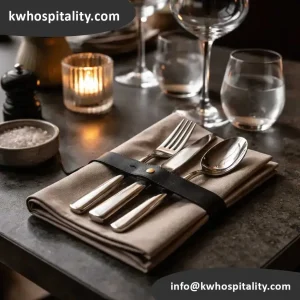
Section 4: 18/10 Stainless Steel Explained: The Gold Standard for Luxury Hotels
Why Material Choice Is the Foundation of Luxury Cutlery
In five-star hospitality, material selection is never a technical footnote—it is the foundation upon which durability, elegance, hygiene, and brand credibility are built. Among all available alloys, 18/10 stainless steel has emerged as the undisputed benchmark for luxury hotel cutlery worldwide. This is not a trend, nor a marketing label. It is the result of decades of operational testing across high-volume hotels, fine-dining restaurants, and banquet environments where flatware must perform flawlessly under constant stress while maintaining its visual and tactile integrity.
The designation “18/10” refers to the alloy composition: 18% chromium and 10% nickel, blended into high-grade steel. Chromium provides corrosion resistance, while nickel enhances shine, smoothness, and long-term structural stability. Together, they create a material that is not only beautiful on day one, but resilient enough to withstand years of aggressive commercial dishwashing, handling, stacking, and storage—conditions that quickly expose inferior materials.
For luxury hotels, 18/10 stainless steel is not a luxury add-on; it is a baseline requirement.
The Role of Chromium: Corrosion Resistance Under Pressure
Chromium is the silent protector within stainless steel. At 18%, it forms a passive oxide layer on the surface of the cutlery, shielding it from moisture, acids, detergents, and oxygen. This layer is self-repairing—meaning that minor surface abrasions do not compromise corrosion resistance. In a hotel environment where cutlery may pass through industrial dishwashers multiple times per day, this property is essential.
Lower-grade cutlery alloys, such as 18/0 or 13/0 stainless steel, lack sufficient chromium and nickel to maintain this protective layer under stress. Over time, they develop discoloration, pitting, and surface roughness that not only degrade appearance but also raise hygiene concerns. Five-star hotels cannot afford these compromises—not visually, not operationally, and certainly not reputationally.
Nickel’s Influence on Shine, Smoothness, and Tactile Luxury
If chromium is protection, nickel is refinement. The 10% nickel content in 18/10 stainless steel is responsible for the luminous polish and smooth surface that guests instinctively associate with luxury. Nickel improves malleability, allowing manufacturers to achieve finer detailing, softer curves, and more refined transitions without sacrificing strength.
From a guest perspective, nickel contributes directly to comfort. It creates a smoother mouthfeel when spoons touch the lips and reduces friction when cutlery is handled repeatedly. From an operational perspective, nickel enhances resistance to heat deformation and stress cracking, ensuring that cutlery maintains its form even after thousands of wash cycles.
This combination of beauty and resilience is why premium stainless steel cutlery wholesale programs for luxury hotels overwhelmingly specify 18/10 steel—and why procurement teams insist on verified material composition rather than supplier claims alone.
18/10 vs 18/8 vs 18/0: Understanding the Differences That Matter
Not all “stainless steel” is equal, and understanding the differences is critical for hotel buyers. While 18/8 stainless steel (18% chromium, 8% nickel) is sometimes marketed as a cost-effective alternative, it offers reduced corrosion resistance and slightly diminished polish retention over time. In moderate-use environments, this may be acceptable—but five-star hotels operate under far more demanding conditions.
18/0 stainless steel, which contains no nickel, is significantly less resistant to corrosion and lacks the depth of shine expected in luxury hospitality. While it may appear adequate initially, its limitations become evident within months of commercial use. For luxury hotels, these materials represent false economy—lower upfront cost followed by higher replacement, maintenance, and brand-risk expenses.
True luxury procurement focuses on lifecycle value, not unit price.
Commercial Performance: Designed for Relentless Use
Luxury hotel cutlery must endure conditions far harsher than residential or boutique restaurant settings. Industrial dishwashers expose flatware to high temperatures, aggressive detergents, and mechanical friction. Storage systems stack and compress pieces repeatedly. Staff handle cutlery quickly, often under pressure, increasing the likelihood of impact and abrasion.
18/10 stainless steel excels in this environment. Its structural stability resists warping, while its corrosion resistance prevents staining even when dishwashing protocols are imperfect—an inevitable reality in high-volume operations. This resilience ensures that cutlery remains presentable, hygienic, and consistent across outlets and service periods.
For banquet operations in particular, where hundreds or thousands of place settings may be deployed simultaneously, the reliability of 18/10 cutlery becomes operationally critical. Any deviation in performance multiplies quickly at scale.
Hygiene Excellence and Food Safety Compliance
In the post-pandemic hospitality landscape, hygiene is no longer assumed—it is scrutinized. Luxury hotels must demonstrate uncompromising standards not only through visible cleanliness, but through material choices that support sanitation at a microscopic level.
The smooth, non-porous surface of 18/10 stainless steel minimizes bacterial adhesion and facilitates thorough cleaning. Unlike plated or coated materials, it does not degrade over time, eliminating the risk of flaking or micro-cracking where contaminants can accumulate. This makes it fully compliant with stringent food safety standards in both the United States and Canada.
From a procurement standpoint, specifying 18/10 stainless steel supports both operational hygiene protocols and regulatory compliance—reducing risk while reinforcing guest confidence.
Sustainability Through Longevity
Sustainability in luxury hospitality is not about novelty—it is about responsibility. 18/10 stainless steel supports sustainability goals by extending product lifespan, reducing replacement frequency, and remaining fully recyclable at end-of-life. A single high-quality flatware set may serve a hotel for a decade or more, significantly lowering material waste compared to lower-grade alternatives that require frequent replacement.
This aligns with the sustainability strategies of leading luxury hotel groups, which increasingly prioritize durability and lifecycle impact over short-term cost savings. Choosing premium materials is both an environmental and economic decision.
Procurement Verification: Trust, but Verify
One of the most important lessons in luxury cutlery sourcing is this: not every supplier who claims 18/10 delivers true 18/10. Reputable hospitality cutlery suppliers provide material certifications, production transparency, and sample testing to verify alloy composition and performance.
Luxury hotels working with experienced partners like KW Hospitality benefit from rigorous quality control, ensuring that what is specified is exactly what is delivered—today and years into the future. This verification protects the brand, the operation, and the guest experience.
From Material Science to Sensory Experience
18/10 stainless steel is more than a technical specification; it is the material expression of luxury hospitality values—durability, elegance, hygiene, and trust. It enables the precise anatomy, refined balance, and enduring beauty explored in earlier sections, transforming engineering into experience.
In next section We will explore why weight matters so profoundly in five-star dining, how it influences guest perception, and how hotels select the right balance between substance and elegance.
Continue reading to feel the weight of true luxury—quite literally.

Section 5: Heavy-Weight Flatware: The Unspoken Language of Luxury
Why Weight Is Felt Before It Is Seen
In five-star hospitality, guests may admire design with their eyes, but they judge luxury with their hands. Long before a dish is tasted, the moment a guest lifts a fork or knife becomes a decisive sensory checkpoint. Weight—subtle, intentional, and perfectly calibrated—is one of the most powerful yet least discussed indicators of quality in luxury hotel cutlery. Heavy-weight flatware does not announce itself; it reassures. It communicates investment, permanence, and seriousness of intent without a single word being spoken.
Luxury hotels understand that lightweight cutlery creates an immediate psychological disconnect. Even when visually attractive, insufficient weight undermines credibility. It introduces a sense of fragility, of cost-cutting, of impermanence—qualities fundamentally incompatible with five-star positioning. Heavy-weight stainless steel cutlery, by contrast, anchors the dining experience. It slows gestures slightly, encourages mindfulness, and reinforces the perception that everything placed before the guest has been deliberately chosen.
The Psychology of Heaviness in Fine Dining
Human perception associates weight with value. This principle is well documented in behavioral psychology and retail studies, and it applies directly to hospitality tableware. When an object has substance, the brain interprets it as higher quality, more durable, and more valuable. In a luxury dining context, this perception elevates not only the cutlery itself, but also the food, the service, and the brand as a whole.
In five-star hotels, heavy-weight flatware works quietly in the background, supporting the chef’s craftsmanship and the service team’s precision. A perfectly plated dish feels more important when paired with substantial cutlery. Wine tastes more deliberate. Even silence at the table feels more intentional. These effects are subtle, but cumulative—and they are precisely what distinguish luxury hospitality from competent hospitality.
Defining “Heavy-Weight” in Commercial Hotel Cutlery
In professional procurement terms, heavy-weight flatware is not defined by marketing language but by material gauge, mass distribution, and balance. Luxury hotel cutlery sets typically use thicker stainless steel blanks combined with refined shaping to ensure that weight feels natural rather than excessive. The goal is not heaviness for its own sake, but controlled substance.
True heavy-weight cutlery maintains elegance. It does not feel bulky, awkward, or tiring. Instead, it delivers a sense of calm assurance. This is achieved by distributing mass along the handle rather than concentrating it at the head, allowing the cutlery to rest comfortably in the hand while maintaining visual refinement on the table.
Balance vs Bulk: Where Many Hotels Make Mistakes
One of the most common procurement errors is confusing weight with quality. Some suppliers add thickness indiscriminately, resulting in cutlery that feels clumsy and inelegant. Five-star hotels cannot afford this mistake. Luxury flatware must be balanced, not merely heavy.
Balance determines how cutlery moves with the hand. A knife that pulls forward feels aggressive. A fork that drags backward feels awkward. Heavy-weight cutlery must achieve equilibrium, allowing the guest to focus on the dining experience rather than unconsciously adjusting grip or posture.
This is why leading hospitality cutlery suppliers emphasize engineering and testing rather than catalog weight specifications alone. Samples are handled, lifted, and used—not just viewed. Procurement teams that skip this step risk compromising guest comfort at scale.
Heavy-Weight Cutlery Across Different Hotel Outlets
Not all hotel outlets require the same level of weight, and luxury hotels understand how to modulate substance without breaking brand consistency. Fine-dining restaurants often feature the heaviest flatware, reinforcing ceremony and indulgence. All-day dining outlets may use slightly lighter—but still premium—pieces to accommodate volume and speed. Banquet and event cutlery must balance weight with stackability and staff ergonomics.
The key is cohesion. Guests should never feel a dramatic shift in quality between outlets. Weight variations must be subtle, intentional, and aligned with function. This level of nuance requires a supplier who understands hospitality operations—not just manufacturing.
Operational Advantages of Heavy-Weight Flatware
Beyond guest perception, heavy-weight flatware offers tangible operational benefits. Thicker stainless steel resists bending, warping, and edge deformation, extending lifespan and reducing replacement costs. It tolerates the realities of hotel operations—rapid handling, stacking, accidental drops—far better than lighter alternatives.
For procurement teams focused on lifecycle value, this durability is critical. While heavy-weight cutlery carries a higher upfront cost, it often delivers a lower total cost of ownership over time. Fewer replacements, less visible wear, and greater consistency across years of service protect both budgets and brand standards.
The Sound of Quality
One rarely discussed but deeply influential aspect of heavy-weight cutlery is sound. The way a knife rests on a plate, the subtle resonance of a fork touching porcelain—these acoustic cues shape perception more than guests realize. Lightweight cutlery produces sharp, hollow sounds that feel abrupt and cheap. Heavy-weight flatware produces muted, controlled tones that reinforce calm and refinement.
In luxury hospitality, silence is curated. Even sound becomes part of the experience. Heavy-weight cutlery contributes to this orchestration, supporting an atmosphere of composed elegance.
Heavy-Weight Flatware as a Brand Commitment
When a five-star hotel invests in heavy-weight cutlery, it sends a message—to guests, to staff, and to partners. It signals that shortcuts are unacceptable, that details matter, and that quality is non-negotiable. This commitment shapes culture internally as much as perception externally. Staff handle premium tools differently. They move with more care. Standards rise organically.
At KW Hospitality, heavy-weight flatware is never positioned as an upgrade—it is treated as the natural choice for hotels that take their brand seriously. Weight is not a luxury add-on; it is a baseline expression of excellence.
From Weight to Surface Expression
Weight defines substance, but surface defines personality. Once mass and balance are perfected, finish becomes the next critical decision—shaping how light, texture, and maintenance interact in real hotel environments.
In next section We will explore how surface finish influences perception, maintenance, hygiene, and design coherence—and how luxury hotels choose finishes that age gracefully under commercial use.
Continue reading to see how surface treatment completes the language of luxury.

Section 6: Mirror Polish vs Satin Finish: Choosing the Right Surface for Your Concept
Surface Finish as a Visual and Emotional Decision
Once weight, balance, and material integrity have been perfected, the surface finish of luxury hotel cutlery becomes the defining layer of expression. Finish is where cutlery stops being purely tactile and begins to interact actively with space, light, and atmosphere. In five-star hospitality, the decision between mirror polish and satin (brushed) finish is never superficial. It is a strategic choice that affects guest perception, operational performance, maintenance routines, and long-term brand consistency.
Surface finish is one of the first things a guest notices—often subconsciously—when seated at a table. The way cutlery reflects ambient lighting, contrasts with porcelain, and complements glassware shapes the overall mood of the dining experience. In luxury hotels, finish is selected not for trend alignment, but for how it supports the hotel’s identity and endures under relentless commercial use.
Mirror Polish: Ceremony, Brilliance, and Timeless Prestige
Mirror-polished cutlery is the traditional emblem of classic luxury. Its high-gloss surface reflects light cleanly and dramatically, amplifying the sense of formality and occasion. In heritage hotels, grand dining rooms, and fine-dining restaurants with a ceremonial character, mirror polish reinforces expectations of refinement and tradition.
From a guest perspective, mirror-polished cutlery feels celebratory. It elevates the table visually, particularly under warm lighting, chandeliers, or candlelight. The reflection of surroundings creates a sense of depth and richness that aligns beautifully with white tablecloth service, crystal glassware, and formal plating.
However, mirror polish demands discipline. Scratches, water spots, and fingerprints are more visible, meaning that operational standards must be equally high. Luxury hotels that choose mirror polish are making a statement not only about aesthetics, but about their commitment to meticulous handling, polishing protocols, and staff training.
Satin Finish: Understated Modernity and Contemporary Confidence
Satin or brushed finishes represent a more contemporary interpretation of luxury. Rather than reflecting light sharply, satin finishes diffuse it softly, creating a calm, restrained visual presence. This makes them particularly popular in modern luxury hotels, urban properties, and design-forward concepts where minimalism and subtlety are valued.
From a practical standpoint, satin finishes offer operational advantages. Fine scratches and fingerprints are less visible, allowing cutlery to maintain a pristine appearance longer between polishing cycles. This makes satin-finish cutlery especially attractive for high-volume outlets, all-day dining, and luxury banqueting where consistency and efficiency must coexist with elegance.
Guests often describe satin-finish cutlery as “soft” or “comfortable” without consciously identifying why. This emotional response aligns well with contemporary luxury philosophies that emphasize ease, approachability, and relaxed sophistication.
Hygiene and Maintenance Implications
Both mirror and satin finishes can meet the highest hygiene standards when executed properly, but they behave differently under commercial conditions. Mirror-polished surfaces are extremely smooth, minimizing micro-crevices where bacteria could adhere. Satin finishes, when produced by reputable manufacturers, are engineered with controlled brushing that preserves surface integrity without introducing hygienic risk.
The key distinction lies in maintenance routines. Mirror polish requires more frequent visual inspection and polishing to maintain its brilliance. Satin finishes are more forgiving, allowing hotels to maintain a consistently elegant appearance with slightly reduced labor intensity. Procurement teams must evaluate these realities honestly, aligning finish choice with staffing models and operational flow.
Finish as Part of a Cohesive Tabletop Language
Cutlery does not exist alone. Its finish must harmonize with tableware, glassware, linens, and even interior materials. Mirror-polished cutlery pairs naturally with glossy porcelain, crystal glassware, and formal linen programs. Satin finishes complement matte ceramics, stoneware, textured linens, and contemporary interior palettes.
Five-star hotels often select finishes based on how they interact with lighting design. Bright, dramatic spaces benefit from controlled reflection, while softer environments call for muted surfaces. This level of integration transforms cutlery from a standalone item into an essential component of spatial storytelling.
Mixed Finishes and Hybrid Approaches
Some luxury hotels adopt hybrid strategies, using mirror-polished cutlery in fine-dining outlets and satin finishes in casual or high-volume spaces. When executed thoughtfully, this approach preserves brand coherence while optimizing performance for each environment. The challenge lies in maintaining consistency in form, weight, and proportion so that guests still recognize a unified brand identity across outlets.
This is where experienced hospitality cutlery suppliers provide critical guidance—ensuring that variations feel intentional rather than fragmented.
Procurement Perspective: Finish Longevity and Replacement Planning
From a procurement standpoint, finish selection impacts long-term consistency. Mirror-polished cutlery may require more frequent refinishing or selective replacement over time, while satin finishes often age more gracefully. Hotels planning multi-year programs must consider how finishes will look not just in the first six months, but after five or ten years of service.
At KW Hospitality, finish selection is evaluated alongside lifecycle planning, replacement ratios, and future availability—ensuring that today’s aesthetic decision does not become tomorrow’s operational challenge.
From Surface to Style
Surface finish defines how cutlery interacts with light and space—but style defines how it speaks visually. Once finish is chosen, design language becomes the next critical layer in shaping the guest’s perception of luxury.
In next section We will explore the dominant design styles in luxury hospitality flatware and how hotels choose silhouettes that remain relevant across evolving culinary and interior trends.
Continue reading to discover how style transforms steel into identity.
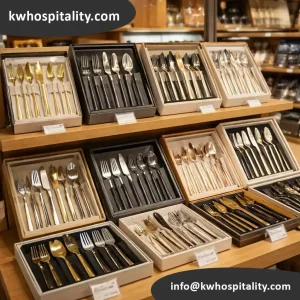
Section 7: Modern, Classic, or Transitional: Cutlery Design Styles for 5-Star Hotels
Design Style as a Strategic Hospitality Decision
In five-star hospitality, design style is never a matter of taste alone—it is a strategic decision that influences guest perception, operational longevity, and brand resilience over time. Luxury hotel cutlery sits at the intersection of aesthetics and endurance, meaning that its design must remain relevant long after décor trends, menu concepts, or culinary fashions evolve. For this reason, leading hotels approach cutlery style not as decoration, but as infrastructure for identity.
The three dominant design languages in luxury hotel cutlery—classic, modern, and transitional—each carry distinct visual, emotional, and operational implications. Selecting the right style is less about following trends and more about aligning form with brand philosophy, guest demographics, and long-term procurement strategy.
Classic Cutlery: Heritage, Ceremony, and Timeless Authority
Classic cutlery designs draw from European dining traditions that have defined luxury hospitality for centuries. Characterized by gentle curves, balanced proportions, and restrained detailing, classic flatware communicates permanence and authority. It reassures guests that the hotel understands tradition and respects the rituals of fine dining.
In heritage hotels, landmark properties, and luxury destinations with a strong sense of place, classic cutlery reinforces continuity. It pairs naturally with formal table settings, white tablecloth service, crystal glassware, and refined plating. Guests encountering classic cutlery instinctively slow down, perceiving the meal as an occasion rather than a transaction.
From a procurement standpoint, classic designs offer exceptional longevity. Their visual language transcends trends, reducing the risk of aesthetic obsolescence. This makes classic 5-star hotel cutlery sets particularly attractive for properties seeking stability and consistency across decades of service.
Modern Cutlery: Precision, Minimalism, and Contemporary Confidence
Modern cutlery reflects the evolution of luxury itself—away from ornamentation and toward precision, clarity, and restraint. Clean lines, geometric profiles, and simplified silhouettes define this style, often paired with satin finishes and heavier gauges to balance minimalism with substance.
Modern luxury hotels favor this approach because it aligns with contemporary architecture, open kitchens, and experiential dining concepts. Modern flatware places emphasis on form and function, allowing food to take center stage while reinforcing a sense of intentional design. Guests perceive modern cutlery as confident and deliberate, signaling that the hotel is current, progressive, and thoughtfully curated.
Operationally, modern designs often integrate seamlessly across multiple outlets, from fine dining to casual lounges. Their simplicity makes them adaptable, but it also demands precision—any inconsistency in finish, balance, or weight becomes immediately noticeable. This is why modern luxury cutlery sourcing requires rigorous quality control and reliable manufacturing partners.
Transitional Cutlery: The Art of Balance
Transitional cutlery occupies the space between classic and modern, blending the warmth of tradition with the clarity of contemporary design. Subtle curves coexist with clean lines, creating a versatile aesthetic that appeals to a broad range of guests. For many five-star hotels, transitional designs offer the best of both worlds—timeless enough to endure, yet current enough to feel relevant.
This style is particularly effective for hotels serving diverse demographics or operating multiple dining concepts under one roof. Transitional cutlery adapts easily, maintaining elegance in formal settings while remaining approachable in relaxed environments. It is a favorite choice for luxury hotel groups seeking brand consistency across properties with varying personalities.
From a procurement perspective, transitional designs are highly strategic. They reduce the risk of future redesigns and support long-term replacement planning, making them a prudent investment for large-scale hospitality operations.
Matching Cutlery Style to Brand Identity
Selecting a cutlery style without reference to brand identity is one of the most common—and costly—mistakes hotels make. Cutlery must reflect the hotel’s story. A heritage luxury brand loses credibility with overly minimal flatware, just as a cutting-edge urban hotel feels constrained by overly traditional designs.
Five-star hotels that excel in this area treat cutlery selection as an extension of brand development. Design teams, culinary leadership, and procurement specialists collaborate to ensure that flatware aligns with architecture, interior design, service philosophy, and guest expectations.
Global Guests, Local Sensibilities
Luxury hotels operate in a global marketplace, welcoming guests from diverse cultural backgrounds. Cutlery design must therefore strike a balance between brand expression and universal usability. Overly stylized designs may confuse or discomfort some guests, while overly generic designs dilute brand impact.
This is where refined design language matters. Successful luxury hotel cutlery communicates identity without imposing unfamiliar forms. It feels intuitive, comfortable, and respectful—qualities that resonate universally, regardless of cultural context.
Design Longevity and Replacement Continuity
Design style also affects future procurement. Hotels must consider whether additional quantities can be sourced years later, whether molds and specifications will remain available, and whether future batches will match original programs seamlessly. Classic and transitional designs generally offer greater continuity, while highly distinctive modern designs require stronger supplier partnerships to ensure long-term consistency.
At KW Hospitality, cutlery style selection is always evaluated alongside lifecycle planning, ensuring that design decisions support both immediate impact and long-term operational stability.
From Style to Application
Style defines the visual language of cutlery—but application defines how that language is used across different dining environments within the hotel.
In next section We will explore how fine-dining cutlery differs from all-day dining, banquets, and in-room service—and how five-star hotels design cohesive yet flexible flatware programs.
Continue reading to see how design adapts to function without losing identity.
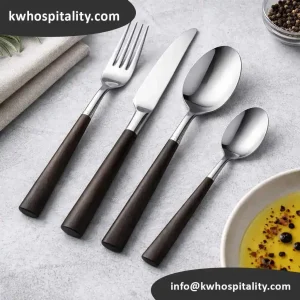
Section 8: Luxury Restaurant Cutlery Sets vs Hotel-Wide Programs
Why a Five-Star Hotel Can Never Think in “One Set Only”
In luxury hospitality, a hotel is not a single dining environment—it is a constellation of experiences operating under one brand promise. Fine-dining restaurants, all-day dining venues, lounges, banquet halls, executive floors, poolside service, and in-room dining each serve different purposes, move at different rhythms, and cater to different guest expectations. Expecting one cutlery set to perform perfectly across all of these environments is not only unrealistic—it is strategically unsound.
Five-star hotels therefore distinguish clearly between luxury restaurant cutlery sets and hotel-wide flatware programs. The difference is not merely aesthetic; it is operational, psychological, and financial. Understanding this distinction is essential for procurement teams seeking to protect both guest experience and long-term brand consistency.
Fine-Dining Cutlery: Precision, Ceremony, and Emotional Elevation
Luxury restaurant cutlery sets—particularly those used in signature or Michelin-aspiring outlets—are designed to heighten the sense of occasion. These pieces often feature heavier weight, more refined detailing, and sometimes unique silhouettes that reflect the culinary philosophy of the restaurant. Every interaction is deliberate. Guests linger longer, observe more closely, and form stronger emotional impressions.
In these environments, cutlery becomes part of the storytelling. The knife must glide effortlessly through proteins. The fork must feel perfectly balanced during slow, intentional bites. The spoon must deliver comfort and control in tasting menus and desserts. Any compromise in quality becomes immediately noticeable, breaking the illusion of perfection that fine dining demands.
For this reason, luxury restaurants within hotels often justify higher-specification cutlery—sometimes even exclusive designs—while accepting higher handling discipline and replacement costs as part of the experience.
Hotel-Wide Cutlery Programs: Consistency at Scale
Hotel-wide cutlery programs, by contrast, prioritize consistency, versatility, and operational resilience. These sets must perform across multiple outlets, withstand higher turnover, and remain visually coherent even when used in different contexts. The design must be elegant but forgiving. The weight must feel premium but manageable for staff during high-volume service.
This does not mean compromising luxury. On the contrary, hotel-wide cutlery programs are often the most strategically designed, because they represent the brand most frequently. Breakfast service, banquets, room service—these are touchpoints that define daily guest experience. The cutlery used here must reinforce five-star standards without demanding excessive maintenance or specialized handling.
The Risk of Over-Specialization
One common mistake hotels make is over-specializing cutlery for individual outlets without a unifying framework. This can lead to fragmented guest perception, inconsistent quality signals, and procurement inefficiencies. Guests may subconsciously notice that cutlery quality varies from one outlet to another, raising questions about standards and priorities.
Luxury hotels that excel avoid this trap by developing tiered flatware programs. A core design language—consistent in form, finish, and material—runs through all outlets, while specific pieces are upgraded or adapted for fine dining. This approach preserves brand cohesion while allowing each environment to express its unique character.
Operational Reality: Staff, Speed, and Durability
From an operational perspective, the demands placed on cutlery vary dramatically across hotel outlets. Fine-dining service is slower, more controlled, and supported by highly trained staff. Banquets and breakfast service, on the other hand, are fast-paced and high-volume. Cutlery must survive stacking, rapid clearing, and industrial dishwashing without visible degradation.
Procurement teams must therefore evaluate cutlery not only by appearance, but by how it behaves under stress. Luxury hotel cutlery suppliers with hospitality experience understand these realities and guide hotels toward solutions that balance elegance with endurance.
Cost Allocation and ROI Across Programs
Another critical distinction lies in cost allocation. Luxury restaurant cutlery sets may justify higher per-piece investment because they serve as brand flagships. Hotel-wide programs, while still premium, are optimized for lifecycle value—delivering consistent quality over years of heavy use.
This strategic allocation ensures that investment aligns with impact. Guests remember fine dining experiences vividly, but they interact with hotel-wide cutlery more frequently. Both matter—but in different ways. Effective procurement recognizes this nuance.
Procurement Intelligence: Designing for Replacement and Expansion
Hotel-wide programs must also consider future needs. Additional rooms, new outlets, renovations, or brand expansions all require seamless integration of flatware. Choosing designs that can be reproduced consistently over time is essential. Luxury hotels often regret selecting overly unique pieces that cannot be matched years later.
At KW Hospitality, hotel-wide cutlery programs are designed with future availability and consistency in mind—ensuring that replacement orders feel indistinguishable from original installations, even years down the line.
From Program Structure to Performance Engineering
Understanding how cutlery programs differ across hotel environments sets the stage for a deeper discussion about performance—how flatware is engineered to survive relentless commercial use without losing its luxury appeal.
In next section We will explore how luxury hotel cutlery is engineered for durability, dishwasher resistance, and structural integrity—revealing why commercial performance is inseparable from five-star elegance.
Continue reading to see how true luxury is engineered, not assumed.

Section 9: Commercial Flatware Engineering: Built for 10,000 Wash Cycles
Luxury That Survives Reality, Not Just the First Impression
In five-star hospitality, elegance that cannot survive reality is not luxury—it is liability. While guests experience cutlery in moments of calm refinement, behind the scenes luxury hotel flatware is subjected to one of the most punishing operational environments imaginable. Industrial dishwashers operating at extreme temperatures, aggressive detergents designed for rapid sanitation, constant stacking and unstacking, hurried handling during peak service hours, and long storage periods in compact spaces all exert relentless stress on every piece of cutlery. For a luxury hotel, the true test of quality is not how cutlery looks on opening night, but how it performs after thousands—often tens of thousands—of wash cycles.
Commercial flatware engineering exists precisely to bridge this gap between beauty and brutality. Five-star hotels do not buy cutlery; they invest in engineered systems designed to endure operational intensity while preserving visual and tactile excellence. This is where luxury hospitality separates itself decisively from retail-grade or restaurant-only flatware.
Dishwasher Resistance: The Unseen Battlefield
The industrial dishwasher is the single most aggressive force acting on hotel cutlery. High heat, caustic detergents, mineral-rich water, and mechanical abrasion combine to attack metal surfaces repeatedly, day after day. Inferior cutlery may survive a few months before signs of distress appear—clouding, pitting, discoloration, or micro-corrosion that permanently compromises appearance and hygiene.
Luxury hotel cutlery engineered for commercial use is designed with this environment in mind. Alloy composition, surface finishing, and edge sealing are optimized to resist chemical attack and thermal shock. Handles are constructed to prevent water ingress, eliminating internal corrosion that often goes unnoticed until structural failure occurs. The result is flatware that emerges from the dishwasher cycle after cycle with its integrity intact—both visually and structurally.
Forging vs Stamping: Engineering Choices That Matter
One of the most critical engineering decisions in luxury hotel cutlery is the manufacturing process itself. Forged flatware, produced by shaping heated steel under pressure, offers superior density and structural consistency. This process enhances durability, improves balance, and contributes to the reassuring heft expected in five-star environments.
Stamped flatware, when executed to luxury specifications, can also perform exceptionally well—provided that material thickness, finishing, and quality control are uncompromising. The key is not the method alone, but how it is applied. Five-star hotels work with suppliers who understand these distinctions and select manufacturing techniques based on intended use, outlet type, and lifecycle expectations.
Edge Retention and Structural Integrity
Commercial flatware must maintain its shape and function over time. Fork tines must resist spreading or bending. Knife blades must retain cutting effectiveness without becoming dangerously sharp or dull. Spoon bowls must remain smooth and symmetrical, preserving comfort and hygiene.
Luxury hotel cutlery engineering addresses these demands through controlled metal hardness and precise finishing. Steel that is too soft deforms easily; steel that is too hard becomes brittle. The ideal balance ensures resilience without fragility—a balance achieved only through experience, testing, and refinement.
Seamless Construction: Eliminating Failure Points
One of the most common failure points in lower-grade cutlery is the junction between handle and functional end, particularly in knives. Poor sealing allows water and detergent to infiltrate, leading to internal corrosion that eventually causes swelling, cracking, or separation.
Five-star hotel cutlery avoids these risks through seamless construction techniques. Handles are fully sealed, transitions are smooth, and joints are engineered to withstand both mechanical stress and chemical exposure. This attention to invisible details is a hallmark of luxury hospitality engineering.
Stacking, Storage, and Mechanical Stress
Cutlery in hotels is not gently laid down after each use. It is stacked, sorted, transported, and stored repeatedly, often under time pressure. Engineering must account for friction between pieces, pressure points in storage bins, and the cumulative effect of minor impacts.
Luxury hotel flatware is designed with reinforced edges and consistent thickness to prevent warping and surface damage during these processes. This ensures that cutlery looks uniform on the table—even when drawn from large, high-turnover inventories.
Consistency Across Large Quantities
Engineering excellence must be repeatable. Five-star hotels require hundreds or thousands of identical pieces that behave exactly the same way. Any variation in weight, finish, or performance becomes immediately noticeable when cutlery is set en masse.
This is why luxury hotel cutlery suppliers invest heavily in quality control, batch testing, and production consistency. Procurement teams depend on this reliability to maintain standards across outlets, shifts, and years of service.
At KW Hospitality, commercial flatware engineering is evaluated not just by specification sheets, but through real-world performance testing—ensuring that cutlery survives the realities of hotel operations without compromise.
Engineering as Brand Protection
Ultimately, commercial flatware engineering is not about metal—it is about protecting the brand. A single visibly degraded fork on a table undermines years of brand building. A knife that feels flimsy or performs poorly erodes trust instantly. Engineering excellence ensures that every guest interaction reinforces confidence rather than raising doubt.
Luxury hotels understand this intuitively. That is why they treat cutlery as engineered equipment, not decorative accessories.
From Durability to Hygiene Excellence
Engineering ensures survival—but hygiene ensures trust. As guest expectations around cleanliness continue to rise, material performance alone is no longer enough.
In next section We will examine how luxury hotels ensure food safety, sanitation, and guest confidence through material science, surface finishing, and operational protocols—without sacrificing elegance.
Continue reading to see how hygiene becomes part of luxury, not a trade-off.
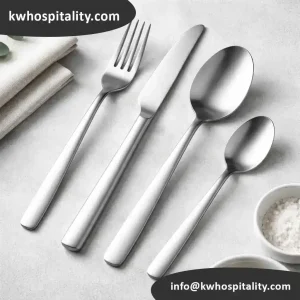
Section 10: Hygiene Excellence in Luxury Cutlery: Safety Without Compromise
In Five-Star Hospitality, Clean Is Not Enough—It Must Feel Immaculate
In luxury hotels, hygiene is no longer an invisible operational standard; it is an emotional contract with the guest. Five-star hospitality operates in a space where cleanliness must be unquestionable, intuitive, and silently reassuring. Guests may never inspect cutlery under a microscope, yet their trust is shaped by what they sense: smoothness against the lips, absence of residue, uniform brilliance, and the subconscious certainty that what they are touching is impeccably clean. Luxury hotel cutlery plays a central role in this trust equation, because it is the most intimate object on the table—placed directly in the guest’s hand and mouth.
Hygiene excellence in cutlery is not achieved through washing alone. It is engineered into the material, the finish, the construction, and the operational protocols that surround it. Five-star hotels understand that safety and luxury are not opposing forces; they are mutually reinforcing. True luxury removes doubt completely.
Material Integrity as the First Line of Hygiene Defense
The foundation of hygienic performance in luxury cutlery begins with material integrity. High-grade 18/10 stainless steel is not only chosen for beauty and durability, but for its non-porous, corrosion-resistant properties. Unlike plated metals or coated finishes, solid stainless steel does not degrade over time, does not flake, and does not develop micro-cracks that harbor bacteria.
In commercial hotel environments, where cutlery is exposed to heat, moisture, and chemicals repeatedly, inferior materials begin to fail invisibly long before failure becomes obvious. Microscopic pitting creates retention points for food particles and bacteria, undermining sanitation even when visual cleanliness appears acceptable. Five-star hotels eliminate this risk by specifying premium alloys that maintain surface integrity over years of use.
Surface Smoothness and Micro-Hygiene
One of the most overlooked aspects of cutlery hygiene is surface smoothness at the microscopic level. Luxury hotel cutlery undergoes extensive polishing not merely for appearance, but to eliminate micro-roughness where contaminants can adhere. Every curve, edge, and transition is refined to ensure continuous, uninterrupted surfaces.
This refinement is especially critical for areas that guests do not see but do touch—such as the underside of fork tines, the back of spoon bowls, and the junctions between handle and head. Inferior flatware often neglects these areas, creating hygiene blind spots. Five-star cutlery leaves nothing untreated, because hygiene excellence cannot rely on visibility alone.
Dishwasher Sanitation and Thermal Stability
Industrial dishwashers are designed to sanitize at high temperatures, but sanitation is only effective if the cutlery material can withstand thermal shock without degrading. Luxury hotel cutlery is engineered to maintain structural and surface stability under repeated exposure to extreme heat, ensuring that sanitation cycles remain effective over time.
Thermal stability also prevents warping and micro-fracturing, which can compromise both performance and hygiene. Cutlery that deforms slightly may still appear usable, but its altered geometry can trap residue or interfere with proper cleaning. Five-star hotels eliminate these risks through rigorous material and engineering standards.
Knife Construction and Hidden Hygiene Risks
Knives represent a unique hygiene challenge in hospitality cutlery. Hollow handles, seams, and poorly sealed joints can trap moisture and organic matter internally—creating invisible contamination risks. Over time, this can lead not only to hygiene issues but also to structural failure.
Luxury hotel cutlery avoids these pitfalls through seamless knife construction and fully sealed handles. Water ingress is prevented entirely, ensuring that internal spaces remain sterile. This level of engineering is invisible to guests but essential to maintaining hygiene integrity at scale.
Operational Protocols That Protect the Investment
Even the best-engineered cutlery requires disciplined operational handling to maintain hygiene excellence. Five-star hotels implement strict protocols for sorting, washing, drying, and storage. Cutlery is handled in a way that minimizes cross-contamination, avoids contact with unsanitary surfaces, and ensures complete drying before storage.
Storage systems are designed to prevent moisture accumulation and friction damage, preserving both cleanliness and appearance. Staff training emphasizes not just speed, but precision—recognizing that hygiene lapses at any stage undermine the entire guest experience.
Luxury hotels understand that hygiene is cultural as much as technical. When staff are given premium tools, they tend to treat them with greater respect, reinforcing standards organically.
Guest Perception and the Psychology of Cleanliness
Hygiene excellence must be felt as much as verified. Guests subconsciously evaluate cleanliness through tactile cues: smoothness, temperature, absence of odor, and visual uniformity. A single water spot, fingerprint, or residue mark can introduce doubt—no matter how clean the cutlery actually is.
Five-star hotels therefore design hygiene into presentation. Cutlery is polished, aligned, and presented with care, reinforcing the perception of control and attention to detail. This is not about theatrics; it is about removing uncertainty entirely.
Compliance, Audits, and Brand Protection
Luxury hotels operate under strict food safety regulations in both the United States and Canada. Premium cutlery programs support compliance by using materials and constructions that meet or exceed regulatory requirements. This reduces audit risk and simplifies documentation, allowing hotels to demonstrate due diligence with confidence.
From a brand perspective, hygiene excellence protects reputation. In an era of instant online reviews and heightened sensitivity to cleanliness, even a single perceived lapse can have disproportionate consequences. Luxury hotels mitigate this risk by eliminating weak points—starting with the tools guests touch most.
At KW Hospitality, hygiene performance is treated as a core procurement criterion, not an afterthought. Cutlery is evaluated not only for aesthetics and durability, but for how it supports uncompromising sanitation standards over time.
From Hygiene to Responsibility
Hygiene protects the guest—but responsibility extends beyond the table. As luxury hospitality evolves, sustainability becomes inseparable from excellence.
In next section We will explore how five-star hotels align environmental responsibility with durability, material choice, ethical manufacturing, and long-term value—without compromising luxury standards.
Continue reading to discover how responsible sourcing becomes a new form of prestige.
Section 11: Sustainability in Luxury Cutlery Procurement: Responsibility as the New Prestige
Why Sustainability Has Become a Core Luxury Expectation
In modern five-star hospitality, sustainability is no longer positioned as an ethical bonus or a marketing add-on—it has become a defining dimension of true luxury. Today’s high-net-worth travelers, corporate decision-makers, and discerning leisure guests increasingly associate prestige with responsibility. They expect luxury hotels not only to deliver comfort and beauty, but also to demonstrate awareness, restraint, and long-term thinking. Within this context, luxury hotel cutlery procurement plays a far more meaningful role than it may appear at first glance.
Cutlery is a high-volume, long-life product that touches every guest, every day. Unlike decorative elements that may be replaced during renovations, flatware remains in continuous circulation for years. This makes it one of the most powerful—and often underestimated—levers for sustainable impact in hospitality operations. Choosing the right materials, suppliers, and lifecycle strategies transforms cutlery from a consumable into a statement of values.
Durability as the First and Most Important Sustainability Metric
In luxury hospitality, the most sustainable product is rarely the newest or most experimental—it is the one that lasts. High-quality 18/10 stainless steel cutlery exemplifies this principle perfectly. Designed to withstand tens of thousands of wash cycles, resist corrosion, and maintain structural integrity for a decade or more, premium flatware dramatically reduces replacement frequency, transportation emissions, and material waste.
Hotels that opt for lower-grade cutlery under the guise of “cost efficiency” often find themselves replacing entire programs every few years. This cycle generates unnecessary waste, increases carbon footprint, and ultimately costs more—financially and reputationally. Five-star hotels that prioritize longevity understand that durability is sustainability in its most practical form.
Stainless Steel and Circular Responsibility
One of the most compelling sustainability advantages of luxury stainless steel cutlery is its full recyclability. At the end of its service life, stainless steel can be recycled indefinitely without loss of quality. This positions premium hotel cutlery within a circular material economy—an increasingly important consideration for hotel groups with ESG commitments and environmental reporting obligations.
Unlike plated or composite materials, solid stainless steel does not introduce contamination into recycling streams. This makes it a responsible choice not only during use, but also at end-of-life. Luxury hotels that track material recovery increasingly favor stainless steel programs that support transparent, measurable sustainability outcomes.
Ethical Manufacturing and Supply Chain Transparency
Sustainability extends beyond materials into the ethics of production. Luxury hotel procurement teams are increasingly scrutinizing how and where cutlery is manufactured. Responsible factories demonstrate compliance with labor standards, environmental regulations, and energy efficiency practices. They invest in waste reduction, water treatment, and safe working conditions—not as marketing claims, but as operational realities.
Partnering with experienced hospitality cutlery suppliers who maintain transparent supply chains allows hotels to align procurement with corporate responsibility goals. This is particularly important for international hotel groups operating across multiple jurisdictions, where supply chain integrity must withstand external audits and public scrutiny.
At KW Hospitality, supplier selection prioritizes factories that combine advanced manufacturing capabilities with ethical production standards—ensuring that luxury is never built at the expense of responsibility.
Reducing Waste Through Smart Procurement Planning
Sustainable cutlery procurement is as much about planning as it is about product choice. Over-ordering, poor forecasting, and lack of replacement strategy lead to unnecessary waste and storage inefficiencies. Five-star hotels that adopt intelligent procurement models analyze usage patterns, loss rates, and replacement cycles to order precisely what is needed—no more, no less.
By standardizing designs across outlets and planning for long-term availability, hotels reduce the need for emergency purchases or mismatched replacements. This strategic discipline minimizes waste while preserving aesthetic consistency.
Sustainability Without Sacrificing Luxury
One of the persistent myths in hospitality is that sustainability requires compromise. In reality, the opposite is often true. Premium stainless steel cutlery that is heavier, better finished, and more durable not only performs better—it aligns naturally with sustainability goals. Luxury hotels do not need to choose between elegance and responsibility; the right procurement strategy delivers both.
Guests increasingly recognize and appreciate this alignment. Subtle cues—such as understated design, timeless aesthetics, and visible quality—signal a thoughtful approach to consumption. Luxury becomes quieter, more intentional, and more credible.
Sustainability as Brand Integrity
Ultimately, sustainability in luxury cutlery procurement is about integrity. It reflects how a hotel thinks about time, resources, and its role in the world. Guests may not ask about alloy composition or recycling rates, but they sense coherence. They feel when a brand’s values are consistent across visible and invisible details.
Luxury hotels that integrate sustainability into foundational elements like cutlery demonstrate leadership rather than compliance. They show that excellence is not only about what the guest sees today, but about what the brand protects for tomorrow.
From Responsibility to Scale
Sustainability becomes even more complex—and more impactful—when luxury hotels purchase at scale. Bulk sourcing introduces new challenges and opportunities.
In next section We will explore how five-star hotels buy luxury cutlery in large volumes while preserving design integrity, quality consistency, and brand exclusivity.
Continue reading to discover how scale and sophistication can coexist seamlessly.

Section 12: Bulk Hotel Cutlery Sourcing: Scale Without Sacrificing Prestige
Why Volume Purchasing Is a Luxury Discipline, Not a Cost Exercise
In five-star hospitality, buying in bulk is not a signal of commoditization—it is a test of discipline. Luxury hotels do not source cutlery in large volumes because they want cheaper products; they do so because operational reality demands consistency at scale. Hundreds of rooms, multiple dining outlets, banquets, events, and room service programs require thousands—sometimes tens of thousands—of identical pieces that must look, feel, and perform exactly the same. The challenge lies not in buying more, but in ensuring that nothing is diluted when quantity increases.
True luxury bulk sourcing is a controlled process. It preserves prestige through specification, verification, and long-term planning. When executed properly, bulk procurement becomes a force multiplier for brand integrity rather than a compromise.
The Myth of “Bulk Equals Generic” in Luxury Hospitality
One of the most persistent misconceptions in hotel procurement is that bulk purchasing inevitably leads to generic results. This belief stems from experiences with consumer-grade suppliers who prioritize unit price over specification discipline. Five-star hotels operate under a fundamentally different logic. For them, bulk sourcing is an opportunity to lock in excellence—to standardize premium materials, refined finishes, and engineered performance across the entire operation.
Luxury hotel cutlery suppliers who understand hospitality dynamics structure bulk programs around fixed specifications, controlled tolerances, and documented quality benchmarks. Every fork, knife, and spoon produced must match approved samples precisely, regardless of quantity. This is how prestige survives scale.
Specification Control: The Backbone of Bulk Luxury Programs
At the heart of successful bulk cutlery sourcing lies specification control. Five-star hotels define exact parameters—material grade (typically 18/10 stainless steel), weight range, thickness, finish type, edge treatment, balance point, and branding details. These specifications are documented, approved, and frozen before production begins.
This discipline eliminates ambiguity and protects the hotel from variability between production runs. It also enables reliable replenishment years later, ensuring that replacement orders integrate seamlessly with existing inventory. Bulk sourcing without strict specifications is not sourcing—it is gambling.
Sampling, Prototyping, and Pre-Production Validation
Luxury hotels never approve bulk production based on catalog images or descriptions alone. Physical samples are handled, tested, washed, and evaluated under real operational conditions. Some hotels conduct pilot runs, introducing a limited batch into service to observe performance over time before committing to full-scale production.
This validation phase is critical. It allows procurement teams to identify subtle issues—balance discomfort, finish sensitivity, handling challenges—that may not appear in short-term testing. Only once samples pass both aesthetic and operational scrutiny does bulk production move forward.
At KW Hospitality, this stage is treated as non-negotiable. Scale is earned through proof, not promises.
Consistency Across Production Batches
Bulk sourcing often involves staggered production—initial orders followed by replenishments months or years later. Maintaining consistency across these batches is one of the most technically demanding aspects of luxury cutlery procurement. Tooling, molds, finishing processes, and material sources must remain unchanged or tightly controlled.
Experienced hospitality cutlery suppliers maintain production records and retain tooling specifically for long-term hotel programs. This ensures that future orders match original specifications exactly, preserving visual and tactile uniformity across the hotel’s lifecycle.
Inventory Planning and Loss Management
Bulk sourcing also enables smarter inventory strategies. Five-star hotels analyze usage patterns, loss rates, and outlet-specific demand to determine optimal order quantities. Rather than over-ordering “just in case,” disciplined procurement aligns inventory with actual operational needs.
Some hotels intentionally order a strategic surplus at the outset, securing future replacements at original pricing and specifications. Others plan phased orders with guaranteed continuity. In both cases, bulk sourcing becomes a tool for cost control without compromising luxury standards.
Custom Branding at Scale
Bulk sourcing allows luxury hotels to implement discreet customization—such as laser engraving or monograms—across large inventories without visual inconsistency. When branding is applied uniformly at scale, it reinforces ownership, reduces loss, and enhances perceived exclusivity.
Crucially, customization must remain subtle. Five-star hotels avoid overt logos, opting instead for refined marks that guests may notice subconsciously rather than consciously. Bulk sourcing ensures that this branding remains consistent across all pieces, reinforcing identity quietly and effectively.
Logistics, Storage, and Global Distribution
Large-volume cutlery sourcing introduces logistical complexity, particularly for hotel groups operating across regions. Packaging, palletization, moisture protection, and storage conditions must be planned carefully to prevent damage before deployment.
Luxury suppliers coordinate logistics to ensure that cutlery arrives ready for service—clean, protected, and organized by outlet or program. This operational foresight prevents costly delays and ensures that prestige is preserved from factory to table.
Bulk Sourcing as Brand Protection
When luxury hotels source cutlery in bulk with precision and foresight, they achieve something powerful: control. Control over quality, consistency, cost, and future availability. This control protects the brand from erosion and ensures that every guest interaction—whether today or years from now—reflects the same uncompromising standards.
At KW Hospitality, bulk hotel cutlery sourcing is approached as a long-term partnership, aligning manufacturing discipline with hospitality excellence.
From Scale to Personalization
Once scale is mastered, luxury hotels can explore personalization without losing consistency—adding another layer of distinction to their cutlery programs.
In next section We will examine how five-star hotels incorporate logos, monograms, and subtle identifiers into cutlery—enhancing brand presence while preserving elegance.
Continue reading to see how personalization becomes invisible luxury.

Section 13: Custom Engraved Cutlery for Hotels: Branding with Restraint
Why True Luxury Branding Is Whispered, Not Announced
In five-star hospitality, branding succeeds only when it feels inevitable—never imposed. Guests should sense identity without being confronted by it, recognize ownership without feeling marketed to. Nowhere is this balance more delicate than in custom engraved hotel cutlery. When executed with restraint and intelligence, engraving transforms flatware into a quiet signature of authenticity. When handled poorly, it instantly devalues the experience, turning luxury into advertisement.
Luxury hotels understand that cutlery branding is not about visibility—it is about belonging. The goal is not for the guest to notice the logo, but for them to intuitively feel that the object in their hand was created specifically for this place, this brand, this experience. This is the essence of branding with restraint.
The Psychological Impact of Discreet Customization
Custom engraving operates primarily at the subconscious level. A guest may never actively register a monogram on the back of a fork handle, yet the presence of customization communicates something powerful: intention. It signals that the hotel invests in details beyond what is necessary, that it does not rely on generic solutions, and that ownership extends even to the smallest tools of service.
This subtle psychological reinforcement elevates trust. Guests feel that they are in a controlled, curated environment where nothing has been left to chance. In luxury hospitality, this feeling is often more important than overt visual statements.
Placement Matters More Than the Mark Itself
One of the most critical decisions in custom engraved cutlery is where branding is placed. Five-star hotels almost universally avoid engraving on the front-facing surfaces of cutlery. Logos on the handle face, blade, or bowl disrupt visual harmony and feel intrusive.
Instead, luxury properties favor discreet placements:
The reverse side of the handle
Near the base of the stem
On the inner curve of the handle where it is felt more than seen
These placements ensure that branding remains private, almost intimate—shared only between the object and the guest holding it. This approach aligns perfectly with luxury hospitality’s preference for understatement.
Laser Engraving vs Stamping: Choosing the Right Technique
Not all engraving methods are equal, and the choice of technique has significant implications for longevity, hygiene, and appearance. Laser engraving is the preferred method for luxury hotel cutlery. It allows for precise, shallow markings that do not compromise surface integrity or create crevices where residue can accumulate. The result is clean, permanent, and hygienically sound.
Traditional stamping, while sometimes used, introduces deeper impressions that may affect balance, collect debris, or distort the metal over time. For five-star hotels focused on hygiene excellence and longevity, laser engraving offers superior control and refinement.
Typography, Scale, and the Language of Luxury
Luxury branding is as much about typography as it is about logos. When engraving cutlery, font selection must align with the hotel’s broader visual identity. Overly decorative fonts feel theatrical; overly modern fonts may feel cold. The most successful luxury cutlery engravings use restrained, timeless typography—often custom-designed or subtly modified to ensure perfect proportion at small scale.
Scale is equally important. Engraving should be readable upon inspection but invisible at a glance. If a guest notices the engraving immediately upon sitting down, it is likely too large. Five-star hotels err on the side of discretion, trusting that subtlety communicates confidence.
Operational Benefits Beyond Aesthetics
While branding with restraint is primarily about guest perception, custom engraved cutlery also delivers tangible operational benefits. Branded flatware discourages loss, simplifies inventory control, and reduces the likelihood of pieces leaving the property unintentionally—particularly in banquet and room service operations.
Importantly, this functional advantage does not conflict with luxury positioning when engraving is done discreetly. Instead, it supports operational discipline without sacrificing elegance.
Consistency at Scale: The Hidden Challenge
Custom engraving introduces an additional layer of complexity to bulk sourcing. Every engraved piece must be identical in placement, depth, and finish—across thousands of units and multiple production runs. Inconsistent engraving immediately undermines the sense of control that luxury branding depends on.
This is why experienced hospitality cutlery suppliers treat engraving as part of the core manufacturing process, not an afterthought. Tooling, laser calibration, and quality control protocols must be locked in from the first approved sample to ensure continuity over time.
At KW Hospitality, engraved cutlery programs are engineered to remain consistent not just across initial orders, but across years of replenishment—protecting brand integrity long term.
When Not to Engrave
Perhaps the most sophisticated decision a luxury hotel can make is choosing not to engrave at all. Some brands rely entirely on form, weight, and finish to express identity, believing that true confidence requires no signature. This choice can be just as powerful—provided the cutlery selection is distinctive enough to feel proprietary.
Luxury procurement is not about adding features indiscriminately; it is about knowing when restraint serves the brand better than embellishment.
From Branding to Geography
Once branding decisions are resolved, another layer of complexity emerges—where the cutlery is made, and how global manufacturing aligns with local luxury expectations.
In next section We will explore how luxury hotels balance global production excellence with North American quality standards, cultural expectations, and regulatory requirements.
Continue reading to understand how origin, oversight, and expectations intersect in five-star cutlery sourcing.

Section 14: Global Manufacturing vs Local Expectations
Where Luxury Is Made vs Where Luxury Is Experienced
In five-star hospitality, guests rarely ask where their cutlery was manufactured—but they instinctively know whether it meets their expectations. This distinction is critical. Luxury today is not defined by geography alone; it is defined by outcomes. Precision, consistency, hygiene, durability, and tactile excellence matter far more than country-of-origin labels. Yet for procurement teams in the United States and Canada, balancing global manufacturing capability with local luxury expectations remains one of the most nuanced challenges in hotel cutlery sourcing.
Global manufacturing—particularly in specialized stainless steel production hubs—offers scale, technical mastery, and cost efficiency that few domestic producers can match. At the same time, North American luxury hotels operate under strict regulatory frameworks, cultural expectations, and brand standards that cannot be compromised. The role of intelligent procurement is to bridge these worlds seamlessly, ensuring that global production delivers locally acceptable—and locally admired—results.
Why Global Manufacturing Dominates Luxury Cutlery Production
High-quality stainless steel cutlery manufacturing requires a convergence of metallurgy expertise, tooling investment, polishing craftsmanship, and quality control infrastructure. Over decades, certain regions have developed deep specialization in these areas, allowing them to produce premium 18/10 stainless steel cutlery at scale with remarkable consistency.
For luxury hotels, this global manufacturing capability enables:
Access to advanced forging and stamping technologies
Consistent alloy quality and polishing standards
Scalable production for large hotel-wide programs
Competitive pricing without sacrificing specifications
These advantages make global manufacturing not a compromise, but a strategic choice—provided oversight and standards are uncompromising.
North American Expectations: The Non-Negotiables
Hotels operating in the USA and Canada face a distinct set of expectations that shape procurement decisions. These include food safety regulations, labor and sustainability scrutiny, and heightened guest sensitivity to hygiene and quality. Cutlery must comply with applicable standards while feeling appropriate to North American luxury sensibilities.
North American guests often expect:
Substantial weight and solid hand-feel
Flawless surface finish with no visible defects
Absolute consistency across pieces and outlets
Materials that feel safe, clean, and trustworthy
Global manufacturing must be calibrated precisely to meet these expectations—not approximately, not eventually, but from the first delivery.
Quality Control as the Bridge Between Global and Local
The true differentiator in global cutlery sourcing is not the factory—it is the quality control system that surrounds it. Five-star hotels and experienced hospitality suppliers implement multi-layered QC processes that include:
Pre-production sample approval
In-process inspections during forging, polishing, and finishing
Final inspection against approved master samples
Random batch testing for weight, balance, and finish
This rigor ensures that cutlery produced thousands of miles away feels as if it were crafted specifically for the hotel’s dining room.
At KW Hospitality, quality control is not outsourced or assumed. It is actively managed, documented, and enforced—because luxury cannot rely on trust alone.
Cultural Sensitivity and Design Adaptation
Global manufacturing does not mean global sameness. Cutlery designs often require subtle adaptation to align with regional dining habits and cultural preferences. North American luxury dining tends to favor slightly heavier flatware, generous proportions, and understated elegance. Designs that feel appropriate in one region may feel insubstantial or overly ornate in another.
Sophisticated suppliers understand these nuances and adjust specifications accordingly—modifying weight, length, or finish to ensure cultural alignment without altering the core design language. This sensitivity is essential for hotels welcoming international guests while maintaining local credibility.
Compliance, Documentation, and Transparency
Luxury hotels increasingly require documentation that goes beyond basic product descriptions. Material certifications, compliance statements, and sustainability disclosures are becoming standard procurement requirements. Global manufacturing partners must be able to provide this transparency reliably.
This documentation supports regulatory compliance, internal audits, and ESG reporting—protecting hotels from reputational and operational risk. Suppliers who cannot provide clear, verifiable information simply do not meet five-star procurement standards.
Managing Perception Without Compromising Reality
Some luxury brands remain cautious about openly discussing offshore manufacturing, concerned about perception. The most successful hotels manage this by focusing on quality outcomes rather than origins. When cutlery performs flawlessly, feels luxurious, and aligns with sustainability values, perception follows performance.
Luxury is ultimately experiential. Guests judge with their senses, not supply chain maps.
From Origin to Integration
Understanding where cutlery is made is only part of the equation. The next challenge is integrating flatware intelligently into the broader hotel procurement ecosystem.
In next section We will explore how luxury hotels classify, manage, and optimize cutlery as an Operating Supply & Equipment asset—balancing aesthetics with inventory control and lifecycle planning.
Continue reading to see how cutlery becomes a strategic operational asset, not just a dining accessory.

Section 15: Cutlery as OS&E: Integrating Flatware into Luxury Hotel Procurement Strategy
Why Five-Star Hotels Treat Cutlery as an Asset, Not an Accessory
In luxury hospitality, the difference between a well-run operation and an exceptional one often lies in how seemingly ordinary items are classified, managed, and protected. Cutlery, despite its daily visibility, is frequently misunderstood in less disciplined organizations as a consumable rather than a strategic asset. Five-star hotels do not make this mistake. They treat luxury cutlery firmly within the OS&E (Operating Supplies & Equipment) framework—recognizing it as a long-term investment that directly influences guest satisfaction, operational efficiency, and brand integrity.
Classifying cutlery as OS&E changes everything. It shifts the conversation from short-term purchasing to lifecycle planning, from unit price to total cost of ownership, and from reactive replacement to proactive asset management. This mindset is one of the quiet but decisive advantages of mature luxury hotel procurement teams.
OS&E Classification: More Than an Accounting Decision
Within the OS&E category, cutlery occupies a unique position. Unlike back-of-house equipment, it is constantly visible to guests. Unlike linens, it does not wear out quickly when properly specified. And unlike decorative elements, it must perform under extreme operational stress. This hybrid nature makes cutlery one of the most sensitive OS&E assets in a luxury hotel.
When procurement teams correctly classify flatware as OS&E, they gain the authority—and the responsibility—to specify premium materials, control replacement cycles, and enforce consistency across outlets. Cutlery stops being purchased ad hoc and starts being managed intentionally, with clear standards and documentation.
Lifecycle Planning: Designing for Years, Not Months
Luxury hotels think in timelines measured in years, sometimes decades. Cutlery programs are therefore designed with lifecycle planning at their core. Procurement teams estimate usage frequency, loss rates, and wear patterns across different outlets—fine dining, banquets, breakfast service, room service—and build these realities into initial order quantities and replenishment strategies.
Rather than reacting to shortages or visible degradation, five-star hotels anticipate them. They plan buffer inventory, secure long-term production continuity, and align replacement schedules with operational rhythms. This foresight ensures that guest experience remains uninterrupted and visually consistent, even as individual pieces cycle out of service.
Inventory Control Without Diluting Luxury
Inventory management in luxury hospitality must balance precision with discretion. Cutlery cannot feel over-controlled or utilitarian, yet loss and inconsistency pose real financial and operational risks. Five-star hotels address this through intelligent OS&E systems that track quantities, locations, and usage patterns without interfering with service flow.
Standardized designs across outlets simplify inventory pooling and redistribution. Subtle engraving or marking—implemented with restraint—supports asset control without compromising elegance. Storage solutions are designed to protect finish and alignment, ensuring that cutlery remains presentation-ready at all times.
Replacement Ratios and Visual Consistency
One of the greatest risks in cutlery management is visual fragmentation. Mixing older, worn pieces with newer replacements erodes the sense of cohesion that defines luxury. OS&E-driven procurement strategies avoid this by defining acceptable wear thresholds and replacing cutlery in controlled batches rather than piecemeal.
This approach preserves uniformity on the table and prevents guests from subconsciously noticing variation. It also simplifies budgeting, allowing hotels to forecast replacement costs accurately rather than absorbing unpredictable expenses.
Cross-Department Alignment
Treating cutlery as OS&E encourages collaboration across departments. Culinary teams, service leadership, housekeeping, and procurement work together to define standards that support both performance and presentation. Feedback loops ensure that operational realities inform procurement decisions, while procurement discipline supports service excellence.
This alignment is particularly important in luxury hotels, where siloed decision-making often leads to inconsistency and inefficiency. OS&E integration creates a shared language around quality, responsibility, and brand protection.
Procurement Intelligence as Brand Safeguard
When cutlery is integrated into OS&E strategy, procurement becomes a form of brand stewardship. Decisions are documented, specifications are preserved, and supplier relationships are managed with continuity in mind. This protects the hotel from the erosion that occurs when standards drift over time or when emergency purchases introduce inferior substitutes.
At KW Hospitality, luxury cutlery programs are developed within this OS&E framework—ensuring that flatware supports not just dining operations, but the hotel’s long-term identity and financial discipline.
From Strategy to Harmony
Once cutlery is fully integrated into OS&E strategy, the next challenge is aesthetic harmony—ensuring that flatware works in concert with every other element on the table.
In next section We will explore how five-star hotels create cohesive tabletop compositions where cutlery, porcelain, glass, and textile speak the same visual language.
Continue reading to see how luxury is composed—not assembled.

Section 16: Matching Cutlery with Tableware, Glassware, and Linen
Luxury Is Never Isolated—It Is Composed
In five-star hospitality, no object is ever judged on its own. Guests do not experience cutlery, porcelain, glassware, or linen independently; they experience a composition. The table is read as a single visual and tactile landscape, where harmony—or the lack of it—is perceived instantly and instinctively. A perfectly designed fork can lose its impact when paired with incompatible plates. Exquisite porcelain can feel diminished when matched with cutlery of the wrong weight or finish. True luxury emerges only when every element on the table speaks the same language.
For luxury hotels, matching cutlery with tableware, glassware, and linen is not an aesthetic afterthought—it is a strategic design discipline that directly influences guest perception, brand coherence, and dining satisfaction.
Cutlery as the Structural Anchor of the Tabletop
Among all tabletop elements, cutlery occupies a unique role. Plates and glasses may change with menus or seasons, but cutlery remains constant, framing every meal from beginning to end. This makes flatware the structural anchor of the tabletop composition. Its weight, finish, and form must therefore be versatile enough to support a wide range of tableware styles without ever feeling out of place.
Luxury hotels often select cutlery first, then build tableware and linen programs around it. This approach ensures that the most tactile and durable element sets the tone, allowing more flexible components to adapt without disrupting harmony.
Finish Coordination: Reflective vs Muted Surfaces
One of the most critical alignment decisions involves surface finishes. Mirror-polished cutlery pairs naturally with glossy porcelain, fine bone china, and crystal glassware, reinforcing formality and ceremony. Satin or brushed cutlery complements matte ceramics, stoneware, and textured glass, creating a softer, contemporary atmosphere.
Mismatch in finish creates visual tension. Highly reflective cutlery next to matte plates can feel discordant, while brushed flatware beside ornate porcelain may appear underwhelming. Five-star hotels avoid these conflicts through intentional finish coordination, ensuring that light behaves consistently across the table.
Weight Harmony and Perceived Quality
Weight must also be considered holistically. Heavy-weight flatware demands tableware with sufficient presence to balance it visually and physically. Delicate plates paired with substantial cutlery can feel fragile by comparison, while lightweight cutlery alongside robust stoneware feels inadequate.
Luxury hotels test these combinations physically—placing full settings on tables, lifting pieces together, and evaluating how the ensemble feels in use. This tactile testing reveals imbalances that no catalog image can predict.
Color, Texture, and Emotional Tone
Cutlery color—typically silver-toned stainless steel—interacts subtly with linens and ceramics. Crisp white linens amplify brightness and formality, while warmer textiles soften the visual impact of steel. Neutral or earth-toned tableware can either ground or clash with cutlery depending on finish and shape.
Texture adds another layer. Smooth cutlery against textured linens creates contrast that feels intentional and refined. Too many competing textures, however, overwhelm the senses. Luxury hospitality favors restraint, allowing one or two elements to lead while others support quietly.
Consistency Across Outlets, Flexibility Across Experiences
Five-star hotels often operate multiple dining environments, each with its own personality. The challenge is maintaining brand cohesion while allowing variation. This is achieved by keeping cutlery consistent while varying plates, glassware, and linens to suit each outlet.
By anchoring the tabletop with a single cutlery language, hotels create a subconscious throughline that guests recognize even as settings change. This strategy simplifies procurement, inventory, and training while strengthening brand identity.
Operational Practicality Meets Design Intent
Harmony must survive real-world operations. Cutlery must stack safely with chosen plates, avoid scratching glassware, and coexist with linen care routines. Designers and procurement teams collaborate to ensure that aesthetic decisions do not introduce operational friction.
Luxury hotels that ignore these practicalities often face hidden costs—damaged finishes, increased replacement rates, or staff frustration. Thoughtful integration prevents these issues before they arise.
The Role of Procurement as Curator
In luxury hospitality, procurement is not merely purchasing—it is curation. Selecting cutlery that harmonizes with tableware, glassware, and linen requires taste, experience, and cross-functional collaboration. Procurement teams act as guardians of coherence, ensuring that every supplier contributes to a unified vision.
At KW Hospitality, tabletop harmony is approached as a system, not a collection of products. Cutlery programs are designed to integrate effortlessly with existing or planned tabletop elements, protecting both aesthetic intent and operational efficiency.
From Harmony to High Volume
Once harmony is achieved in intimate dining settings, the next challenge is translating it to scale—where hundreds or thousands of place settings must perform flawlessly.
In next section We will explore how five-star hotels adapt cutlery programs for large-scale banquets and events, balancing visual consistency, durability, and staff efficiency without sacrificing elegance.
Continue reading to see how luxury holds its form—even at grand scale.
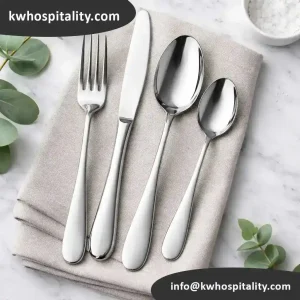
Section 17: Banquet & Event Cutlery for Luxury Hotels
When Luxury Must Perform at Grand Scale
Banquets and large-scale events represent one of the most demanding environments in five-star hospitality. Unlike intimate restaurant settings, banquets test luxury under pressure: hundreds or thousands of guests served simultaneously, rapid table turns, compressed timelines, and intense back-of-house coordination. In this context, cutlery must do something extraordinary—it must preserve elegance while operating at industrial scale. For luxury hotels, banquet cutlery is where procurement discipline, engineering, and brand integrity are most visibly tested.
Guests attending weddings, galas, conferences, and diplomatic events may not consciously analyze flatware, but they are acutely sensitive to inconsistencies. A single flimsy fork or mismatched knife can undermine the perceived caliber of an entire event. This is why five-star hotels treat banquet cutlery as a specialized subset of their flatware program, not a downgraded version of restaurant service.
Visual Uniformity Across Hundreds of Place Settings
In banqueting, visual impact is collective. Guests absorb the room as a whole before focusing on individual details. Uniformity of cutlery—identical weight, finish, alignment, and placement—creates a sense of order and professionalism that elevates the entire experience. Luxury banquet cutlery must therefore be engineered and procured with tighter tolerances than almost any other flatware category.
Hotels that attempt to mix older stock, mismatched replacements, or secondary-grade cutlery quickly lose visual coherence. Five-star operations avoid this by dedicating specific cutlery programs to banquets, ensuring that every piece deployed in large events matches perfectly, even under intense usage.
Durability Without Visual Compromise
Banquet cutlery faces extreme mechanical stress. Pieces are stacked tightly, transported in bulk, and handled rapidly by large service teams. Yet despite this intensity, banquet flatware must emerge looking immaculate. Heavy-weight stainless steel becomes especially critical here, resisting bending and surface damage that would be unacceptable in luxury environments.
Engineering choices—such as reinforced edges, balanced mass distribution, and resilient finishes—ensure that banquet cutlery maintains its form and appearance even after repeated large-scale deployments. This durability protects not only the cutlery itself, but also the hotel’s reputation during its most visible events.
Staff Ergonomics and Service Efficiency
Luxury banquets are as much about choreography as cuisine. Service teams must move efficiently, often carrying multiple place settings at once. Cutlery that is excessively heavy or poorly balanced increases fatigue and slows service, introducing risk at scale.
Five-star hotels therefore select banquet cutlery that balances substance with ergonomics. The goal is a reassuring weight that still allows staff to work confidently and efficiently. This consideration reflects a deeper understanding of luxury operations: guest experience cannot be separated from staff experience.
Storage, Transport, and Loss Control
Banquet cutlery programs must also account for storage and transport realities. Specialized trays, racks, and storage systems protect finish and alignment while enabling rapid deployment. Subtle branding or marking—applied with restraint—helps hotels manage inventory and reduce loss without drawing attention.
These systems are invisible to guests but essential to maintaining luxury standards at scale. Hotels that neglect them often find that banquet cutlery degrades faster than expected, undermining both aesthetics and budgets.
Banquets as Brand Showcases
Large events often attract first-time guests, VIPs, and media attention. For many attendees, a banquet may be their only interaction with the hotel brand. In these moments, cutlery becomes a silent ambassador, reinforcing perceptions of competence, elegance, and attention to detail.
Luxury hotels understand that banquets are not secondary experiences—they are brand showcases. Cutlery used in these settings must therefore meet the same standards as fine dining, adapted intelligently for scale.
At KW Hospitality, banquet cutlery programs are designed with this dual purpose in mind: uncompromising appearance and industrial-grade performance, aligned seamlessly with the hotel’s broader flatware identity.
From the Ballroom to the Guest Room
After mastering elegance at scale, luxury hospitality turns inward—toward the most private dining environment of all.
In next section We will explore how five-star hotels adapt cutlery for in-room dining, balancing compact presentation, durability, hygiene, and the psychology of private luxury.
Continue reading to see how refinement follows the guest—right to their door.

Section 18: Room Service & In-Room Dining Cutlery
Luxury in Its Most Intimate Form
If banquet service is the grand stage of hospitality, in-room dining is its most intimate expression. Here, luxury is no longer shared or observed—it is personal, private, and uninterrupted. Guests are alone with the experience, free from social cues, service choreography, or ambient distractions. In this setting, every detail is amplified, and cutlery becomes one of the most revealing indicators of a hotel’s true standards. There is no room for distraction, no visual noise to hide imperfections. What remains is the object in the guest’s hand—and the feeling it creates.
Five-star hotels understand that in-room dining cutlery must meet the same quality thresholds as restaurant flatware, while adapting intelligently to the unique realities of private service. This is where luxury either proves itself—or quietly collapses.
Compact Presentation Without Compromising Substance
In-room dining trays, carts, and packaging impose spatial constraints that restaurant tables do not. Cutlery must fit elegantly within limited space, align cleanly with plateware, and remain secure during transport through corridors, elevators, and guest rooms. Yet compact presentation must never translate into lighter weight or reduced quality. Guests do not forgive “room service cutlery” that feels secondary or simplified.
Luxury hotels therefore specify in-room dining cutlery that mirrors their core flatware design language—same material, same finish, same tactile confidence—sometimes with subtle dimensional adjustments to improve tray compatibility. The goal is continuity. A guest who dines in the restaurant one evening and orders room service the next should feel no drop in quality, no shift in philosophy.
Psychology of Private Dining
In-room dining carries a unique psychological weight. Guests often choose it when they seek comfort, privacy, recovery, or indulgence without performance. In these moments, cutlery becomes part of a personal ritual. A well-balanced fork or a reassuringly solid spoon can contribute to a sense of care and calm that far exceeds its functional role.
Conversely, lightweight or poorly finished cutlery in a guest room feels disproportionately disappointing. Without the context of a dining room or attentive service staff, such shortcomings are interpreted not as oversight, but as indifference. Five-star hotels eliminate this risk by ensuring that in-room dining cutlery communicates the same respect as any other touchpoint.
Hygiene and Sealed Confidence
In-room dining introduces heightened expectations around hygiene. Guests often assume that what enters their private space should meet even stricter cleanliness standards than public areas. Cutlery presentation therefore becomes critical. Whether wrapped in linen, housed in protective sleeves, or placed within covered serviceware, the cutlery must look—and feel—untouched, pristine, and intentional.
Material choice again plays a decisive role. Premium stainless steel with flawless finishing reassures guests instantly. Any residue, spotting, or imperfection becomes magnified in the quiet of the room. Luxury hotels mitigate this by pairing high-grade cutlery with disciplined handling and presentation protocols that reinforce trust.
Durability in Transit and Reuse
Room service cutlery faces a different kind of stress than restaurant flatware. It is transported over distance, often stacked on trays, subject to movement, vibration, and temperature variation. Pieces must resist scratching, bending, and misalignment despite frequent handling and return cycles.
Five-star hotels specify in-room dining cutlery with durability equal to—or greater than—restaurant programs, precisely because replacement visibility is so high. A guest encountering a bent fork or dulled knife in their room will associate the flaw directly with the brand, without contextual forgiveness.
Consistency Across Service Moments
In-room dining often intersects with other private service formats: executive lounge offerings, late-night snacks, VIP amenities, or extended-stay service. Consistency across these moments is essential. Cutlery should feel familiar, reinforcing the sense that every aspect of the hotel is governed by the same standards.
This consistency simplifies operations while strengthening brand coherence. Guests experience the hotel not as a collection of departments, but as a single, unified expression of quality.
Operational Intelligence Behind the Scenes
From an OS&E perspective, in-room dining cutlery must integrate seamlessly into inventory systems. Hotels track circulation carefully, balancing par levels with turnaround times to ensure availability without overstocking. Subtle branding or identification—applied discreetly—helps prevent loss without compromising elegance.
At KW Hospitality, in-room dining cutlery programs are designed as extensions of the hotel’s core flatware strategy, not exceptions. Specifications, finishes, and sourcing are aligned deliberately, ensuring that private luxury never feels like a compromise.
From Private Space to Global Perspective
Once cutlery performs flawlessly in the most intimate setting, the next challenge is ensuring it satisfies the expectations of a truly global audience.
In next section We will explore how five-star hotels accommodate diverse dining cultures, etiquette norms, and global guest preferences through thoughtful cutlery design and selection.
Continue reading to see how luxury speaks fluently across cultures—without saying a word.
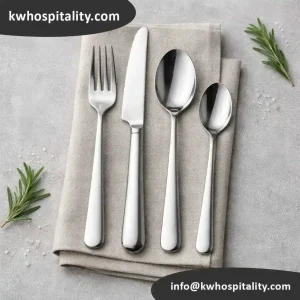
Section 19: International Guest Expectations: Cultural Sensitivity in Cutlery Selection
Luxury That Speaks Every Language Without Translation
Five-star hotels are, by definition, global stages. On any given day, a single dining room may host guests from North America, Europe, the Middle East, and Asia—each carrying deeply ingrained dining habits, etiquette expectations, and sensory benchmarks shaped by culture. In this context, luxury hotel cutlery must perform a delicate balancing act: it must express a clear brand identity while remaining universally intuitive, respectful, and comfortable. Cultural insensitivity in cutlery design is rarely loud, but it is always felt—and it quietly erodes the sense of belonging that luxury hospitality promises.
The most successful luxury hotels do not attempt to customize cutlery for every culture. Instead, they select designs that are culturally fluent—pieces that feel natural in the hand regardless of background, avoiding extremes while signaling refinement through balance, proportion, and restraint.
Western Dining Norms: Familiarity as Comfort
For guests from North America and much of Europe, expectations around cutlery are well defined. Balanced weight, moderate handle thickness, and familiar proportions create immediate comfort. Knives are expected to cut cleanly without effort, forks to feel stable and slightly substantial, spoons to rest comfortably on the lips without sharp edges or exaggerated curvature.
Luxury hotels serving these guests understand that deviation from these norms—even in the name of design innovation—can create discomfort. Five-star cutlery programs therefore prioritize ergonomic familiarity, allowing guests to focus on the cuisine and service rather than adapting to unfamiliar tools.
Asian Guest Expectations: Precision and Refinement
Guests from East Asian cultures often bring heightened sensitivity to utensil balance, surface smoothness, and mouthfeel. While chopsticks may dominate certain dining contexts, when Western cutlery is used, expectations for refinement are particularly high. Rough finishes, sharp edges, or awkward proportions are noticed immediately.
Luxury hotels that cater to Asian guests emphasize flawless polishing, gentle transitions, and impeccable hygiene. Spoon bowls, in particular, receive careful attention, as they are frequently used and closely associated with comfort. Even when Western cutlery is employed, its execution must feel precise and respectful.
Middle Eastern and Global Hybrid Dining
Middle Eastern guests often engage in dining experiences that blend Western and traditional elements. In these contexts, cutlery must coexist comfortably with shared plates, varied textures, and flexible dining rhythms. Robustness becomes important—forks must handle dense foods, knives must perform without aggression, and spoons must feel generous rather than delicate.
Luxury hotels serving international guests in these regions select cutlery that communicates generosity and substance without heaviness. This balance reinforces hospitality and abundance—core cultural values—while maintaining five-star elegance.
Avoiding Cultural Extremes in Design
One of the most common mistakes in luxury cutlery selection is over-stylization. Designs that are too thin, too angular, or too experimental may photograph well but fail in real-world, multicultural use. Guests should never feel that cutlery demands adaptation.
Five-star hotels therefore favor timeless silhouettes with subtle personality rather than radical form. This approach ensures that cutlery feels inclusive rather than exclusive—welcoming rather than challenging.
Universal Ergonomics as a Luxury Standard
True luxury cutlery feels “right” immediately. This universality is achieved through careful attention to ergonomics: neutral balance points, moderate handle contours, and intuitive orientation. Guests should not need to think about how to hold or use the cutlery—it should disappear into the experience.
This universality is not accidental. It is the result of testing across diverse user groups and dining scenarios. Luxury hotel cutlery suppliers with global experience understand these dynamics and guide hotels toward designs that transcend regional bias.
Cultural Sensitivity Without Fragmentation
Importantly, cultural sensitivity does not mean fragmentation. Five-star hotels avoid offering different cutlery sets for different guest groups, which would undermine brand cohesion and operational efficiency. Instead, they select globally elegant designs that feel respectful everywhere.
This approach reinforces the hotel’s identity as an international destination—rooted, confident, and inclusive.
From Cultural Comfort to Financial Intelligence
Once cutlery meets global guest expectations, procurement teams must address another critical dimension: value. Luxury is not about excess—it is about intelligent investment.
In next section We will explore why premium cutlery delivers superior long-term returns, how to evaluate lifecycle cost accurately, and why cheaper options often prove far more expensive over time.
Continue reading to discover how luxury cutlery earns its place on the balance sheet—not just the table.

Section 20: Cost vs Value: Understanding True ROI in Luxury Cutlery
Why the Cheapest Cutlery Is Almost Always the Most Expensive Decision
In five-star hospitality, cost is a number—but value is a strategy. Nowhere is this distinction more misunderstood than in cutlery procurement. On paper, the difference between premium stainless steel cutlery and lower-grade alternatives may appear marginal, even tempting when multiplied across thousands of pieces. In reality, luxury cutlery decisions reverberate across years of operations, touching guest perception, staff efficiency, replacement cycles, sustainability goals, and brand credibility. Hotels that evaluate cutlery purely on unit price inevitably pay far more—just not always on the same invoice.
True ROI in luxury cutlery is not measured at purchase. It is measured in years of consistent performance, absence of guest complaints, reduced replacement frequency, and preserved brand equity. Five-star hotels that understand this treat cutlery as capital discipline, not expense management.
Lifecycle Cost vs Unit Price: The Only Comparison That Matters
The most critical mistake in flatware procurement is comparing unit prices without accounting for lifecycle cost. Lower-grade cutlery often enters service at an attractive price point, only to degrade rapidly under commercial conditions. Warping, corrosion, surface dulling, and hygiene concerns appear gradually—forcing hotels into piecemeal replacements, emergency purchases, and visual inconsistency.
Premium 18/10 stainless steel cutlery, by contrast, is engineered for longevity. Its higher upfront cost is amortized over years—often a decade or more—of continuous service. When replacement frequency, labor, logistics, and brand risk are factored in, luxury cutlery almost always delivers a lower total cost of ownership.
Hidden Operational Costs of Inferior Cutlery
Inferior cutlery creates costs that rarely appear on procurement spreadsheets but are felt daily on the floor. Bent forks slow service. Dull knives frustrate guests and staff. Inconsistent pieces disrupt table settings and increase setup time. Frequent replacements consume management attention and storage space.
These friction points compound quietly, eroding efficiency and morale. Luxury hotels operate on precision; anything that introduces variability becomes expensive over time. Premium cutlery removes these frictions by performing predictably, consistently, and quietly—allowing operations to flow without interruption.
Guest Perception as a Financial Variable
In luxury hospitality, guest perception is not abstract—it is monetizable. It influences repeat bookings, average daily rate, reviews, and brand advocacy. Cutlery, though subtle, contributes directly to this perception. Guests may not articulate dissatisfaction with flatware, but they feel it. And in an environment where expectations are high, even minor discomfort can color the entire experience.
A single negative impression may not generate a complaint—but it can reduce enthusiasm, shorten stays, or discourage return visits. Conversely, consistent tactile quality reinforces trust and satisfaction, supporting long-term revenue in ways that are difficult to quantify but impossible to ignore.
Replacement Strategy and Budget Predictability
Luxury cutlery delivers financial value by stabilizing budgets. When flatware lasts longer and degrades more slowly, replacement cycles become predictable. Procurement teams can plan replenishments in controlled batches rather than reacting to crises. This predictability supports accurate forecasting and protects margins.
Hotels relying on cheaper cutlery often face the opposite reality—unexpected shortages, mismatched replacements, and urgent purchases at unfavorable pricing. Over time, this volatility undermines financial discipline.
ROI Through Sustainability Alignment
Sustainability is increasingly tied to financial performance through corporate reporting, brand positioning, and guest preference. Premium cutlery supports sustainability goals by reducing waste, transportation frequency, and material turnover. This alignment enhances brand value and can influence partnerships, corporate contracts, and investor perception.
Luxury hotels that invest in durable, recyclable cutlery demonstrate long-term thinking—a quality that resonates with modern luxury consumers and stakeholders alike.
Value Protection Through Supplier Partnership
True ROI also depends on supplier reliability. Luxury cutlery programs require continuity—identical specifications, consistent quality, and long-term availability. Hotels that partner with experienced hospitality suppliers protect their investment by ensuring that future orders integrate seamlessly with existing programs.
At KW Hospitality, ROI is approached holistically. Cutlery sourcing considers not only cost and aesthetics, but lifecycle performance, operational harmony, and brand protection—ensuring that value compounds over time rather than eroding quietly.
From Financial Logic to Practical Action
Understanding ROI conceptually is essential—but luxury procurement ultimately demands practical tools and clear criteria to guide decisions.
In next section We will translate strategy into action, presenting a buyer-focused checklist that luxury hotels use to evaluate suppliers, specifications, samples, and long-term programs with confidence.
Continue reading to turn insight into intelligent procurement decisions.

Section 21: Procurement Checklists for 5-Star Hotel Cutlery Buyers
From Intuition to Intelligence: Why Luxury Procurement Needs Structure
In five-star hospitality, instinct and taste are essential—but they are never sufficient on their own. Luxury cutlery procurement sits at the intersection of aesthetics, engineering, operations, finance, and brand stewardship. Without a structured evaluation framework, even experienced buyers risk being influenced by surface impressions, persuasive sales language, or short-term pricing incentives. The role of a procurement checklist is not to constrain creativity, but to protect it—ensuring that every decision aligns with five-star standards long after the excitement of selection has passed.
Elite hotels use procurement checklists not as bureaucratic tools, but as guardrails for excellence. These frameworks translate luxury intent into measurable criteria, allowing teams to evaluate suppliers and products consistently, objectively, and defensibly. In an environment where mistakes surface months or years later—on the dining room floor rather than in the showroom—structure is a form of foresight.
Material & Specification Verification Checklist
At the foundation of every luxury cutlery program lies material integrity. Five-star buyers never rely on verbal assurances or catalog descriptions alone. They verify.
Key verification points include:
Confirmed 18/10 stainless steel composition with documentation
Material thickness and gauge consistency across pieces
Weight range tolerance (not just average weight)
Corrosion resistance performance under commercial dishwashing
Non-plated, solid stainless construction
This stage separates hospitality-grade suppliers from consumer-grade vendors. If documentation is vague or inconsistent, the supplier is not prepared for five-star scrutiny.
Design & Ergonomic Evaluation Checklist
Luxury cutlery must perform intuitively across cultures, service styles, and guest demographics. Buyers therefore evaluate design not only visually, but physically and emotionally.
Evaluation criteria include:
Balance point when held naturally
Comfort during extended use
Edge smoothness on all contact surfaces
Fork tine strength and alignment
Knife cutting performance without aggression
Spoon bowl comfort against lips
This evaluation is never rushed. Five-star procurement teams handle samples repeatedly, simulate service scenarios, and gather feedback from culinary and service leadership before approval.
Finish & Aesthetic Consistency Checklist
Finish quality is where many suppliers fail under scale. Luxury buyers examine finish not only on one sample, but across multiple pieces to detect variation.
Key checks include:
Uniformity of polish or satin texture
Absence of micro-scratches or swirl marks
Finish stability after repeated washing tests
Compatibility with existing tableware and glassware
Aging behavior over time, not just initial appearance
Consistency here is non-negotiable. A finish that varies subtly from piece to piece becomes obvious when set across hundreds of place settings.
Operational Performance Checklist
Luxury cutlery must survive real hotel conditions. Procurement teams therefore evaluate operational performance with equal seriousness.
Key considerations include:
Resistance to bending and warping
Stackability without surface damage
Dishwasher compatibility with hotel detergents
Storage and transport durability
Staff handling ergonomics
Hotels that skip this stage often discover problems only after deployment—when correction becomes expensive and disruptive.
Bulk Production & Continuity Checklist
Five-star hotels think beyond the first order. They evaluate whether a supplier can support continuity across years.
Critical questions include:
Can this design be reproduced identically in the future?
Are tooling and molds retained for long-term programs?
Is batch-to-batch consistency documented?
Are minimum reorder quantities reasonable?
Is lead time predictable and reliable?
Without clear answers, luxury continuity is at risk.
Customization & Branding Checklist
If engraving or branding is required, buyers evaluate restraint and execution with precision.
Checklist items include:
Placement discreetness and consistency
Laser engraving quality and hygiene impact
Typography alignment with brand identity
Depth control and finish integrity
Repeatability across future orders
Customization should elevate ownership—not visibility.
Supplier Capability & Partnership Checklist
Ultimately, luxury procurement is relational. Buyers assess not only the product, but the partner.
Key evaluation points include:
Hospitality-specific experience
Quality control processes and documentation
Transparency in manufacturing and sourcing
Responsiveness and communication discipline
Willingness to support sampling, testing, and long-term planning
Suppliers who resist scrutiny rarely meet five-star expectations.
At KW Hospitality, this checklist-driven approach is embedded into every luxury cutlery program—ensuring that procurement decisions are defensible, repeatable, and aligned with brand excellence.
From Evaluation to Validation
Once procurement criteria are defined and suppliers shortlisted, the next critical step is validation—ensuring that what is approved performs exactly as expected before full deployment.
In next section We will explore how five-star hotels test, approve, and validate cutlery samples—turning specifications into certainty before committing to bulk production.
Continue reading to see how luxury decisions are proven, not assumed.
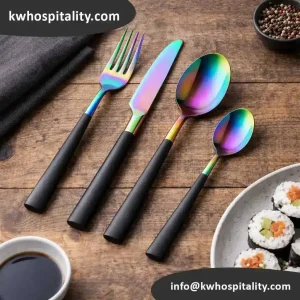
Section 22: Quality Control & Sample Approval Process
Why Five-Star Hotels Never Trust Specifications Alone
In luxury hospitality procurement, specifications are promises—but samples are proof. Five-star hotels understand that even the most detailed specification sheet cannot fully predict how cutlery will feel, perform, and endure in real-world conditions. Quality control and sample approval are therefore not procedural formalities; they are decisive safeguards that protect brand standards, operational stability, and long-term value. This stage is where intent becomes reality, and where luxury procurement proves its seriousness.
Elite hotels do not rush sample approval. They treat it as a multi-stage validation process designed to expose weaknesses early—before thousands of pieces enter service. This discipline separates mature luxury operations from those that learn lessons only after guests have already noticed.
Pre-Sample Alignment: Eliminating Ambiguity Before Production
Before samples are even produced, five-star procurement teams align internally on non-negotiables. Material grade, weight range, finish type, balance expectations, and branding parameters are confirmed in writing. This alignment prevents subjective debate later and ensures that samples are evaluated against agreed standards rather than shifting preferences.
At this stage, experienced suppliers clarify tolerances—what can vary microscopically and what cannot. Luxury hotels insist on tight tolerances, knowing that minor deviations become visible when scaled across hundreds of place settings.
First Article Samples: Evaluating the Essence
Initial samples—often referred to as first articles—are evaluated holistically. Procurement, culinary leadership, and service management all participate, each bringing a different perspective. The focus is not only on appearance, but on feel, behavior, and intuition.
These samples are lifted, balanced, set on tables, and used during actual meals. Teams assess whether the cutlery disappears naturally into the dining experience or demands attention through discomfort or awkwardness. Luxury is confirmed when nothing feels wrong.
Operational Stress Testing
True validation requires stress. Five-star hotels subject samples to repeated industrial dishwashing, stacking, and handling simulations. They observe how finishes react to detergents, whether water spots appear, and how pieces interact when stored in bulk.
This testing reveals truths that showroom evaluations cannot. A finish that looks flawless initially may cloud over time. A knife that feels balanced in isolation may behave poorly after repeated washing. Luxury procurement exposes these risks before approval, not after rollout.
Comparative Benchmarking
Many luxury hotels benchmark samples against existing programs or known high-performing cutlery. This comparative approach provides context, helping teams articulate preferences and identify subtle differences. It also prevents regression—ensuring that new programs meet or exceed established standards.
Benchmarking reinforces continuity, especially for hotel groups managing multiple properties or phased renovations.
Final Sample Lock-In and Master Reference Creation
Once samples pass all evaluations, one set is designated as the master reference. This reference becomes the definitive standard against which all future production is measured. Dimensions, weight, finish, engraving placement, and overall feel are documented meticulously.
Five-star hotels insist that suppliers retain this reference and use it for quality control in every production run. This practice is essential for maintaining consistency across years of replenishment.
Quality Control During Bulk Production
Sample approval does not end scrutiny—it intensifies it. Luxury hotels expect ongoing quality control throughout bulk production. Random inspections, batch testing, and final pre-shipment checks ensure that approved standards are upheld consistently.
Suppliers who welcome this oversight demonstrate readiness for luxury partnership. Those who resist it reveal misalignment.
At KW Hospitality, quality control is integrated end-to-end—from sample development through bulk delivery—ensuring that what is approved is exactly what arrives on the table.
From Validation to Daily Discipline
Once cutlery enters service, quality responsibility shifts from factory to hotel operations. Proper handling, storage, and staff training become essential to preserving approved standards.
In next section We will explore how five-star hotels protect their cutlery investment through disciplined storage systems, handling protocols, and service culture—ensuring that luxury endures long after delivery.
Continue reading to see how daily discipline sustains five-star standards.

Section 23: Storage, Handling, and Staff Training for Luxury Flatware
Luxury Is Preserved in the Back of House
In five-star hospitality, what the guest sees is only the final expression of a much larger discipline. Luxury cutlery does not remain pristine by accident; it survives because of systems, training, and culture that protect it every hour of every day. Storage, handling, and staff training form the invisible framework that sustains excellence long after procurement decisions are made. Without this framework, even the finest 18/10 stainless steel cutlery will degrade prematurely, undermining both guest experience and return on investment.
Elite hotels understand that cutlery must be treated not as a disposable tool, but as a shared asset that represents the brand. This philosophy must be embedded deeply into daily operations, from the dishwashing area to the dining room floor.
Storage Systems Designed for Protection, Not Convenience Alone
Proper storage is the first line of defense in preserving luxury flatware. Cutlery should never be stored loosely in deep bins where friction, weight, and misalignment cause micro-damage over time. Five-star hotels invest in dedicated storage solutions—partitioned trays, soft-lined compartments, and vertical holders—that protect finish and shape while allowing efficient access.
These systems are designed to prevent metal-on-metal contact, moisture retention, and uneven pressure. Even small design details, such as rounded compartment edges or breathable liners, contribute to extending the life of cutlery. Storage areas are kept dry, clean, and well-organized, reinforcing the message that flatware is a valued asset, not an afterthought.
Handling Protocols That Respect Craftsmanship
How cutlery is handled between uses matters as much as how it is stored. In luxury operations, staff are trained to handle flatware with care—not out of fragility, but out of respect. Throwing cutlery into bins, stacking it carelessly, or dragging it across hard surfaces introduces cumulative damage that eventually becomes visible on the table.
Five-star hotels implement clear handling protocols: cutlery is placed, not dropped; sorted carefully after service; and aligned during setup to avoid unnecessary contact. These practices may seem subtle, but they have a profound impact on longevity and appearance.
Dishwashing Discipline and Finish Preservation
Dishwashing is both a sanitation process and a preservation challenge. Luxury hotels calibrate dishwasher settings, detergent types, and loading methods specifically for premium flatware. Overly aggressive detergents, improper water hardness, or overcrowded racks can dull finishes and accelerate wear.
Staff are trained to load cutlery so that pieces do not rub excessively against each other during wash cycles. Post-wash drying protocols ensure that moisture does not linger, preventing spotting and corrosion. This level of discipline ensures that cutlery emerges from each cycle ready for presentation, not remediation.
Staff Training as a Cultural Investment
Training is not a one-time instruction—it is an ongoing cultural reinforcement. Five-star hotels integrate cutlery care into onboarding programs, refresher training, and service standards documentation. Staff are taught why flatware matters, not just how to handle it. When employees understand that cutlery influences guest perception and brand credibility, compliance becomes intuitive rather than enforced.
Supervisors model correct behavior, and excellence is recognized. This cultural alignment transforms cutlery care from a task into a shared responsibility.
Cross-Department Coordination
Cutlery moves across departments—culinary, service, housekeeping, banquets, room service. Luxury hotels ensure that handling standards are consistent across all touchpoints. Misalignment between departments often leads to accelerated wear and confusion over accountability.
Clear ownership structures and communication protocols prevent this. Everyone understands that protecting cutlery is part of protecting the brand.
Preservation as Financial Intelligence
Proper storage and handling extend the lifespan of luxury flatware significantly. This translates directly into financial value—reducing replacement frequency, preserving visual consistency, and stabilizing OS&E budgets. What appears as operational discipline is, in reality, financial intelligence.
At KW Hospitality, we emphasize that procurement excellence must be matched by operational stewardship. Luxury cutlery programs succeed only when both are aligned.
From Daily Care to Long-Term Consistency
Once storage, handling, and training are embedded into daily operations, luxury hotels can focus on the long view—ensuring that cutlery programs remain consistent across years of service and future expansions.
In next section We will explore how five-star hotels manage replenishment, maintain visual continuity, and protect design integrity over time—without disrupting guest experience.
Continue reading to see how luxury endures beyond the first year.

Section 24: Replacement Planning & Long-Term Consistency
Luxury That Endures Is Designed for the Future
In five-star hospitality, consistency over time is one of the most difficult—and most valuable—achievements. Guests may not remember every meal, but they remember how a place felt. That feeling depends on continuity: the same reassuring weight of a fork, the same balanced knife, the same quiet confidence conveyed year after year. Replacement planning is therefore not a logistical exercise; it is an act of brand preservation. Luxury hotels that fail to plan for the future allow inconsistency to creep in slowly, piece by piece, until the dining experience subtly erodes.
Elite hotels approach cutlery replacement with the same foresight they apply to architecture, interior design, and brand standards. They recognize that flatware programs must survive staff turnover, renovations, supplier changes, and market shifts—without losing their identity.
Why Ad-Hoc Replacement Is the Enemy of Luxury
One of the most common threats to long-term consistency is reactive replacement. When a hotel replaces cutlery only when shortages arise, it invites variation. Emergency purchases introduce mismatched weight, finish, or proportions that may not be immediately obvious—but become painfully visible when placed alongside original pieces.
Luxury hotels avoid this scenario by planning replacement in controlled cycles. Rather than replacing individual pieces as they disappear, they replenish in batches, maintaining uniformity across place settings. This approach protects visual harmony and reinforces the sense of deliberate control that defines five-star operations.
Design Freeze and Specification Preservation
Long-term consistency begins with a design freeze. Once a luxury cutlery program is approved and deployed, its specifications are documented and locked. Material composition, dimensions, weight, finish, engraving placement, and tolerances are preserved as reference standards.
These specifications are not treated as flexible guidelines—they are treated as architectural drawings. Any future production must match them exactly. This discipline allows hotels to reorder confidently years later, knowing that replacements will integrate seamlessly into existing inventory.
Supplier Continuity and Tooling Retention
Replacement planning depends heavily on supplier partnership. Luxury hotels work with suppliers who commit to retaining tooling, molds, and finishing processes for long-term programs. This commitment ensures that future batches remain indistinguishable from original deliveries.
Hotels that switch suppliers without careful planning often discover that “similar” cutlery is never truly the same. Even minor deviations in curvature, thickness, or polish disrupt tactile and visual consistency. Long-term supplier relationships protect against this erosion.
At KW Hospitality, continuity is treated as a contractual and operational priority—not an assumption.
Phased Replacement Strategies
Five-star hotels often implement phased replacement strategies aligned with operational rhythms. For example, banquet cutlery may be replenished on a different schedule than fine-dining flatware, reflecting different usage patterns and wear rates. These strategies are planned in advance, reducing disruption and ensuring that replacements appear intentional rather than reactive.
Phased replacement also supports budgeting discipline, spreading costs predictably rather than absorbing sudden expenses.
Managing Aging Gracefully
Even the finest cutlery ages. Luxury hotels define acceptable aging thresholds—recognizing that slight patina may be acceptable in certain contexts, while visible wear is not. When pieces cross these thresholds, they are retired systematically rather than left in circulation indefinitely.
This approach prevents visual fragmentation and ensures that guests never encounter a mix of pristine and tired pieces on the same table.
Consistency Across Renovations and Expansions
Hotels evolve. New outlets open, spaces are renovated, brands refresh their expression. Replacement planning ensures that cutlery remains consistent through these changes—or evolves deliberately, not accidentally. When updates are required, they are implemented comprehensively, not incrementally, preserving coherence.
This discipline ensures that guests experience evolution as refinement, not inconsistency.
Long-Term Consistency as Brand Trust
Ultimately, replacement planning is about trust. Guests trust that a five-star hotel will deliver the same standard today as it did years ago. Cutlery—quiet, constant, and intimate—plays a significant role in maintaining that trust.
At KW Hospitality, long-term consistency is built into every luxury cutlery program from the outset, ensuring that excellence is not a moment—but a legacy.
From Time to Territory
Once consistency is secured over time, luxury hotels must also ensure alignment across geography—meeting regional expectations while preserving brand standards.
In next section We will explore regulatory requirements, buyer expectations, and market-specific preferences that shape luxury hotel cutlery sourcing in the United States and Canada.
Continue reading to understand how luxury adapts locally without losing its identity.

Section 25: North American Market Standards (USA & Canada)
Luxury Through the Lens of North American Expectations
Luxury hospitality in North America operates under a unique convergence of regulation, cultural expectation, and operational rigor. While five-star hotels in the United States and Canada share many global luxury principles, the North American market places particular emphasis on consistency, safety, substance, and accountability. Guests expect excellence to be not only visible, but verifiable. Procurement teams, in turn, are held to high standards of compliance, documentation, and performance justification. Luxury hotel cutlery sourcing in this region must therefore satisfy a dual mandate: elevate guest experience while meeting stringent regulatory and operational benchmarks.
For luxury hotels operating in the USA and Canada, cutlery is not merely a design choice—it is a compliance-sensitive asset that must align with food safety expectations, brand liability considerations, and long-term operational transparency.
Regulatory Awareness and Food Safety Confidence
North American hospitality environments operate under strict food safety frameworks enforced at federal, state, provincial, and municipal levels. While cutlery is rarely regulated in isolation, its materials and hygiene performance are implicitly scrutinized during inspections, audits, and incident reviews. Five-star hotels therefore favor solid stainless steel cutlery with proven sanitation performance, corrosion resistance, and material stability.
18/10 stainless steel aligns naturally with these expectations. Its non-porous surface, resistance to chemical degradation, and durability under high-temperature dishwashing support compliance with sanitation protocols in both the U.S. and Canada. Luxury hotels value this reliability, not only for inspection readiness, but for peace of mind in daily operations.
Guest Sensibilities: Substance, Comfort, and Trust
North American luxury guests often associate quality with substance. Heavier flatware, balanced proportions, and tactile confidence resonate strongly in this market. Cutlery that feels insubstantial or overly delicate can undermine perception, even if visually attractive. Five-star hotels respond by selecting heavy-weight, well-balanced flatware that communicates durability and value immediately upon touch.
Comfort is equally important. Ergonomics must feel intuitive across diverse age groups and dining styles. North American guests expect cutlery to perform effortlessly—without requiring adaptation or explanation. Luxury is defined by ease.
Operational Transparency and Documentation
Procurement teams in North America are increasingly accountable to internal audits, ownership groups, and brand standards committees. Documentation matters. Suppliers are expected to provide clear specifications, material declarations, and quality assurances that withstand scrutiny. Vague claims or undocumented processes do not align with five-star procurement culture in this region.
Luxury hotels therefore gravitate toward hospitality-focused suppliers who understand North American expectations for transparency, responsiveness, and long-term support. The supplier relationship is viewed as a professional partnership, not a transactional exchange.
Consistency Across Properties and Brands
Many luxury hotels in the USA and Canada operate as part of multi-property portfolios or global brands. Consistency across locations is critical. Guests expect the same standard in New York as in Toronto, in Los Angeles as in Vancouver. Cutlery programs must therefore be scalable, repeatable, and controllable across geography.
This requirement reinforces the importance of standardized specifications, retained tooling, and supplier continuity. North American luxury hotels prioritize partners who can deliver identical results across multiple deliveries and locations without drift.
Sustainability and Corporate Responsibility
Sustainability expectations are particularly pronounced in North America, where corporate responsibility increasingly influences brand perception and purchasing decisions. Luxury hotels are under pressure—from guests, investors, and partners—to demonstrate responsible sourcing and long-term thinking.
Durable stainless steel cutlery supports these goals by reducing waste, minimizing replacement cycles, and aligning with circular material principles. North American buyers view sustainability not as a trend, but as an extension of professionalism and foresight.
Risk Management and Brand Protection
In a highly litigious environment, risk management is a practical concern. Cutlery failures—whether related to hygiene, breakage, or guest injury—carry reputational and legal consequences. Five-star hotels mitigate these risks by selecting cutlery engineered for commercial use, supported by documented quality control and reliable supply chains.
This cautious, evidence-based approach reflects the broader North American mindset: luxury must be defensible, not just impressive.
From Regional Standards to Supplier Selection
Once North American expectations are clearly defined, the next step is choosing partners capable of meeting them consistently.
In next section We will explore what truly distinguishes a hospitality-focused cutlery supplier from a generic wholesaler—and how five-star hotels identify partners who protect their brand over the long term.
Continue reading to learn how the right supplier becomes an extension of your standards.

Section 26: Working with a Luxury Hotel Cutlery Supplier
Why Five-Star Hotels Do Not “Buy Products” — They Choose Partners
In luxury hospitality, suppliers are not interchangeable. A five-star hotel does not simply purchase cutlery; it entrusts a partner with one of the most intimate and frequently used guest touchpoints. This distinction is critical. Generic wholesalers sell objects. Luxury hotel cutlery suppliers safeguard standards. They understand that every fork, knife, and spoon placed on a table is a physical extension of the hotel’s promise—and that a single failure, repeated hundreds of times, becomes a brand liability.
The difference between a supplier and a partner lies in mindset. A true luxury hospitality supplier thinks beyond the shipment. They think in years, in replenishment cycles, in brand audits, in guest psychology, and in operational realities that never appear on a purchase order. Five-star hotels gravitate toward these partners instinctively, because they recognize that long-term consistency cannot be bought cheaply or managed casually.
Hospitality Expertise vs Commodity Distribution
One of the most dangerous misconceptions in procurement is assuming that any cutlery wholesaler can serve a luxury hotel. Commodity distributors focus on price, volume, and availability. Hospitality-focused suppliers focus on application, endurance, and consequence. They understand how cutlery behaves in banquet rushes, how finishes degrade under industrial dishwashing, how staff handle flatware during peak service, and how guests interpret tactile cues subconsciously.
Luxury hotel cutlery suppliers speak the language of OS&E, not retail. They ask questions about outlet mix, service rhythm, replacement planning, and future expansion. They challenge assumptions when specifications are unclear. This consultative posture is not salesmanship—it is risk management.
Specification Discipline as a Core Competency
A defining characteristic of a luxury supplier is respect for specification discipline. Five-star hotels rely on suppliers who can execute exact requirements repeatedly, without drift. Material composition, weight tolerance, finish consistency, engraving placement—none of these are negotiable once approved.
A capable supplier documents these specifications meticulously, retains master samples, and integrates them into production control systems. They do not substitute “similar” products when conditions change. They communicate proactively if constraints arise. This discipline is what allows luxury hotels to reorder years later with confidence.
Transparency, Documentation, and Accountability
Luxury procurement thrives on transparency. Suppliers serving five-star hotels must be comfortable with scrutiny—providing material certifications, quality control documentation, and clear explanations of manufacturing processes. Evasion or vagueness is incompatible with luxury standards.
This transparency protects both parties. It enables hotels to satisfy internal audits, brand standards reviews, and regulatory expectations. It also ensures that suppliers are evaluated fairly on objective criteria rather than assumptions.
Sampling, Testing, and Collaborative Validation
Luxury suppliers do not resist sampling—they encourage it. They understand that approval is earned through proof, not persuasion. They support multiple sample iterations, operational testing, and comparative evaluation because they recognize that long-term success depends on getting it right the first time.
This collaborative validation builds trust. When a supplier participates actively in testing and refinement, they become invested in the program’s success rather than merely its delivery.
Long-Term Availability and Future-Proofing
One of the most overlooked supplier responsibilities is future availability. Luxury hotels need assurance that approved designs can be reproduced identically years later. This requires retained tooling, stable manufacturing relationships, and production continuity planning.
Suppliers who cannot commit to future reproduction place hotels at risk of fragmentation. Five-star hotels therefore prioritize partners who think beyond the initial contract—partners who understand that luxury is cumulative, not transactional.
At KW Hospitality, this philosophy defines every supplier relationship. Cutlery programs are built not for the next shipment, but for the next decade—ensuring that partners remain aligned with brand evolution, expansion, and consistency.
Communication and Responsiveness as Luxury Standards
In luxury hospitality, silence is rarely golden. Delays, changes, or issues must be communicated early and clearly. Suppliers who disappear after delivery or respond slowly during replenishment cycles erode trust quickly.
Five-star hotels value partners who are responsive, proactive, and candid—especially when challenges arise. Reliability in communication is as important as reliability in manufacturing.
From Partnership to Pitfalls
Understanding what to expect from a luxury supplier also clarifies what to avoid. Many procurement failures stem not from bad intentions, but from predictable mistakes.
In next section We will identify the most frequent errors luxury hotels encounter when sourcing flatware—and how to avoid decisions that quietly undermine five-star standards over time.
Continue reading to learn how excellence is protected by avoiding what compromises it.

Section 27: Common Procurement Mistakes Hotels Make with Cutlery
How Luxury Quietly Erodes When Small Decisions Go Unquestioned
In five-star hospitality, failures rarely arrive dramatically. They appear slowly, disguised as reasonable compromises, budget adjustments, or “temporary” solutions that quietly become permanent. Cutlery procurement is especially vulnerable to this erosion because flatware is familiar, deceptively simple, and often assumed to be interchangeable. Yet many of the most visible breakdowns in luxury dining experience trace back to early procurement missteps that were never corrected.
Understanding these mistakes is not about assigning blame—it is about recognizing patterns. Five-star hotels that maintain excellence over decades are not those that never err, but those that identify risks early and institutionalize safeguards against them.
Mistake 1: Treating Cutlery as a Commodity
The most fundamental error is treating cutlery as a generic product rather than a brand asset. When procurement teams focus primarily on unit price, availability, or catalog appeal, they strip flatware of its strategic importance. Commodity thinking leads to inconsistent weight, inferior materials, and designs that photograph well but fail under real service conditions.
Luxury hotels that fall into this trap often discover the consequences months later—through accelerated wear, guest discomfort, or visual inconsistency. By then, replacement becomes costly and disruptive. Five-star procurement avoids this by elevating cutlery decisions to the same level of scrutiny as furniture, fixtures, and signature amenities.
Mistake 2: Skipping Operational Testing
Another common error is approving cutlery based solely on showroom samples or short-term evaluation. A fork that feels acceptable in a quiet office may behave very differently after hundreds of dishwasher cycles or during a high-volume banquet. Hotels that skip operational testing invite surprises they cannot afford.
Luxury procurement demands stress testing—washing, stacking, handling, and repeated use—before approval. This discipline exposes weaknesses early, when they can still be corrected.
Mistake 3: Over-Designing in the Name of Differentiation
In the pursuit of uniqueness, some hotels select overly stylized cutlery that prioritizes novelty over usability. Extreme shapes, sharp edges, or unconventional proportions may impress initially but often alienate guests over time. What feels distinctive on opening night can feel awkward or dated within a year.
Five-star hotels recognize that differentiation comes from restraint, not exaggeration. Timeless design with subtle character outperforms bold experimentation in long-term luxury environments.
Mistake 4: Ignoring Replacement and Continuity Planning
Many procurement failures stem from short-term thinking. Hotels approve cutlery without considering future availability, tooling retention, or batch-to-batch consistency. When replacements are needed, the original design is unavailable or altered—forcing mismatched substitutes into service.
This fragmentation is immediately visible to discerning guests. Luxury hotels prevent it by locking specifications, retaining master samples, and partnering with suppliers who commit to long-term continuity.
Mistake 5: Allowing Inconsistent Standards Across Outlets
Another subtle but damaging error is allowing different outlets to operate under different quality thresholds. When banquet cutlery feels inferior to restaurant flatware, or room service cutlery feels secondary, guests perceive a hierarchy of care that undermines brand integrity.
Five-star hotels design tiered programs thoughtfully—never downgrading quality, only adapting specifications intelligently for function. Consistency of philosophy matters more than uniformity of form.
Mistake 6: Underestimating Staff Impact
Even the best cutlery fails when staff are not trained to handle it properly. Hotels that neglect training and storage protocols accelerate wear and shorten lifespan unnecessarily. The result is not only financial loss, but visible decline in presentation.
Luxury hotels embed cutlery care into service culture, recognizing that staff behavior preserves—or destroys—investment daily.
Mistake 7: Choosing the Wrong Supplier Relationship
Finally, many mistakes originate in supplier selection. Hotels that prioritize speed, convenience, or lowest bid often sacrifice expertise, transparency, and long-term support. When issues arise, these suppliers lack the hospitality understanding needed to resolve them effectively.
Five-star hotels choose partners, not vendors—suppliers who share responsibility for outcomes rather than merely fulfilling orders.
From Avoiding Mistakes to Shaping the Future
Recognizing what undermines luxury is essential—but excellence also requires vision. The final step is understanding where luxury cutlery is headed next.
In next section We will explore emerging trends in design, sustainability, tactile experience, and guest psychology—and how forward-thinking hotels prepare today for tomorrow’s expectations.
Continue reading to see how luxury evolves without losing its soul.
Section 28: The Future of Luxury Hotel Cutlery
Where Tradition Meets Tomorrow
Luxury hospitality has always evolved quietly. Unlike mass markets that chase trends aggressively, five-star hotels adopt change selectively, integrating innovation only when it enhances—not disrupts—the guest experience. The future of luxury hotel cutlery follows this same philosophy. It is not about radical reinvention, but about refinement, responsibility, and sensory intelligence. Tomorrow’s cutlery will look familiar, feel better, last longer, and communicate values more clearly than ever before.
Forward-thinking hotels already understand that the future of flatware is not driven by fashion cycles, but by deeper shifts in guest psychology, sustainability expectations, operational precision, and global brand accountability.
Tactile Luxury as the New Differentiator
As visual luxury becomes increasingly standardized across high-end hotels, tactile experience is emerging as a primary differentiator. Guests may scroll past beautiful images online, but they remember how things felt. The future of luxury cutlery places even greater emphasis on hand-feel, balance calibration, micro-edge finishing, and ergonomic neutrality.
Expect to see:
Even tighter balance tolerances
Softer edge transitions
More nuanced weight distribution
Surfaces engineered to feel warmer and smoother
These changes are subtle, but they respond directly to how modern guests process comfort and quality—instinctively, not analytically.
Timeless Design Over Trend-Driven Aesthetics
While design trends will continue to emerge, luxury hotels are moving decisively away from trend-dependent cutlery. The future favors timeless silhouettes that age gracefully and remain relevant across decades of service. This is not conservatism—it is strategic restraint.
Hotels are increasingly asking: Will this still feel right in ten years?
If the answer is uncertain, the design is rejected.
This shift reinforces long-term consistency, protects brand identity, and reduces the environmental and financial cost of redesign cycles.
Sustainability Integrated, Not Advertised
Sustainability in luxury cutlery is evolving from a talking point into an assumption. Guests no longer need to be told that materials are responsible—they expect it. The future focuses on:
Ultra-durable programs with extended lifecycles
Fully recyclable, mono-material construction
Reduced packaging and optimized logistics
Transparent, ethical manufacturing partnerships
Luxury hotels will communicate sustainability through behavior, not messaging. Cutlery that lasts longer, performs better, and requires fewer replacements becomes a silent sustainability statement—more powerful than any label.
Data-Driven Procurement and Predictive Replacement
The future of luxury cutlery procurement is increasingly data-informed. Hotels are beginning to track usage, loss, and wear patterns more precisely, enabling predictive replacement planning rather than reactive purchasing.
This intelligence allows procurement teams to:
Optimize order quantities
Reduce emergency replacements
Preserve visual consistency
Improve budget predictability
Cutlery becomes part of a smarter OS&E ecosystem—managed with the same sophistication as other high-value assets.
Customization Becomes Invisible
Branding will not disappear—but it will become even more discreet. The future of custom cutlery lies in near-invisible ownership cues: micro-engraving, proprietary proportions, or unique balance profiles that are felt rather than seen.
This approach aligns perfectly with modern luxury values—confidence without display, identity without intrusion.
Global Consistency with Local Sensitivity
As luxury hotel brands expand globally, cutlery programs will increasingly be designed for global deployment with local comfort. One core design language will serve multiple regions, with subtle specification adjustments to meet cultural preferences—without fragmenting brand identity.
This balance allows hotels to scale without dilution, maintaining a recognizable tactile signature worldwide.
Technology Supports, Craft Leads
While manufacturing technology will continue to advance—improving precision, consistency, and efficiency—the future of luxury cutlery will remain grounded in craftsmanship. Technology supports excellence, but it does not replace judgment, testing, and experience.
Hotels that succeed will be those that combine advanced manufacturing with human discernment—never allowing automation to override sensibility.
Preparing for the Future Starts Now
The future of luxury hotel cutlery is already taking shape in the procurement decisions made today. Hotels that invest in timeless design, durable materials, intelligent sourcing, and disciplined partnerships position themselves ahead of change—not reacting to it.
At KW Hospitality, future-readiness is built into every luxury cutlery program. Decisions are made with tomorrow in mind, ensuring that today’s choices remain relevant, responsible, and refined for years to come.
From Vision to Consolidation
After exploring the future, the final step is to bring everything together—distilling philosophy, strategy, and practice into a clear, actionable perspective.
In next section We will examine how top luxury hotel groups protect consistency, leverage scale, and reinforce brand integrity by centralizing flatware sourcing across properties and regions.
Continue reading to see how strategic control becomes the ultimate luxury.

Section 29: Why Leading Hotels Centralize Cutlery Sourcing
Control Is the Quiet Engine Behind Consistent Luxury
In the world of five-star hospitality, consistency is not accidental—it is engineered. As luxury hotel brands expand across cities, regions, and continents, the complexity of maintaining uniform standards increases exponentially. What once could be managed through individual property decisions now demands centralized strategy. Cutlery sourcing, in particular, has emerged as a critical area where centralization is not about cost control, but about brand control.
Leading luxury hotel groups centralize cutlery sourcing because flatware is one of the few guest touchpoints that appears in every property, every outlet, and every meal. Allowing this element to vary independently at the property level invites fragmentation that no amount of marketing can correct. Centralization, when done intelligently, becomes a safeguard—ensuring that the brand speaks with one tactile voice everywhere it operates.
Brand Integrity Across Geography
A luxury brand is only as strong as its weakest inconsistency. Guests traveling between properties within the same brand expect continuity—not sameness of décor, but sameness of quality. The weight of the fork in New York should feel familiar in Toronto. The balance of the knife in Los Angeles should reassure in Vancouver. These details matter precisely because they are subtle.
Centralized cutlery sourcing ensures that core specifications—material, weight, finish, balance, and design language—remain consistent across all locations. This does not prevent local expression; it anchors it. Properties retain flexibility in tableware, menus, and ambiance, while cutlery provides a constant undercurrent of brand identity.
Specification Discipline at Scale
When sourcing is decentralized, specifications inevitably drift. Different suppliers interpret requirements differently. Minor substitutions creep in. Over time, “almost the same” becomes visibly different. Centralization eliminates this risk by establishing one master specification—approved, documented, and enforced across all properties.
This discipline simplifies procurement, replacement planning, and quality control. It also enables reliable replenishment, ensuring that future orders integrate seamlessly with existing inventory. In luxury hospitality, predictability is not boring—it is reassuring.
Operational Efficiency Without Compromise
Centralized sourcing improves operational efficiency without diluting standards. Bulk purchasing under a unified program allows hotel groups to secure consistent quality, predictable lead times, and stable pricing—while avoiding the compromises often associated with cost-driven consolidation.
Importantly, centralized programs are not about choosing the cheapest option. They are about choosing the right option once, then executing it flawlessly everywhere. This reduces administrative overhead, minimizes emergency purchases, and allows procurement teams to focus on strategic oversight rather than constant troubleshooting.
Risk Management and Accountability
From a risk perspective, centralization creates clarity. One program, one supplier ecosystem, one set of quality controls. This clarity supports internal audits, brand standards enforcement, and regulatory compliance. When issues arise, accountability is clear and corrective action is swift.
Decentralized sourcing diffuses responsibility. Centralization concentrates it—making excellence easier to protect and failures easier to prevent.
Supplier Partnerships That Scale With the Brand
Luxury hotel groups that centralize cutlery sourcing develop deeper, more strategic supplier relationships. These partners understand the brand holistically, anticipate future needs, and invest in long-term continuity. Tooling retention, specification preservation, and innovation alignment become shared priorities rather than afterthoughts.
At KW Hospitality, centralized sourcing programs are designed to scale with the brand—supporting new openings, renovations, and regional expansions without compromising identity or quality.
Flexibility Within a Controlled Framework
Centralization does not mean rigidity. Leading hotel groups design centralized cutlery programs with controlled flexibility—allowing for outlet-specific adaptations, regional adjustments, or special concepts without breaking the core standard. This balance ensures relevance without fragmentation.
Luxury thrives when freedom operates within structure.
From Centralization to Philosophy
Centralizing cutlery sourcing is not merely a logistical decision—it is a philosophical one. It reflects how a brand views control, responsibility, and the guest experience. Hotels that centralize intelligently signal that nothing is left to chance, even the smallest details.
With this understanding, we arrive at the final articulation of approach.
In next section We will consolidate everything explored so far into a clear, refined philosophy—showing how KW Hospitality partners with five-star hotels in Canada and the USA to deliver cutlery programs that are elegant, durable, consistent, and future-ready.
Continue reading to see how philosophy becomes practice.

Section 30: The KW Hospitality Approach to Luxury 5-Star Hotel Cutlery
Luxury, Engineered With Discipline
At the highest level of hospitality, luxury is never accidental. It is designed, tested, protected, and renewed continuously. Throughout this guide, one truth has emerged repeatedly: cutlery is not a minor detail. It is one of the most frequently touched, most emotionally interpreted, and most operationally stressed elements in a five-star hotel. Treating it casually undermines everything else. Treating it strategically elevates the entire brand.
The KW Hospitality approach to luxury hotel cutlery is built on this understanding. It is not driven by catalogs, trends, or short-term pricing. It is driven by procurement intelligence, operational reality, and brand stewardship—three pillars that ensure cutlery programs perform flawlessly today and remain relevant for years to come.
From Product Sourcing to Program Architecture
KW Hospitality does not “sell cutlery.” We design cutlery programs.
A program is more than a collection of forks, knives, and spoons. It is a carefully engineered system that accounts for:
Guest experience and tactile perception
Brand identity and design language
Operational stress and durability
Hygiene excellence and compliance
Sustainability and lifecycle value
Replacement planning and long-term consistency
Every recommendation begins with context. We study the hotel’s positioning, outlet mix, service style, guest demographics, and growth plans before proposing a solution. This ensures that cutlery is not just beautiful—but appropriate, resilient, and future-proof.
Specification First, Always
At KW Hospitality, luxury begins with specification discipline. Material grade, weight range, finish, balance, geometry, and tolerances are defined precisely and documented rigorously. We work exclusively with hospitality-grade manufacturing partners capable of executing these specifications consistently at scale.
This discipline eliminates ambiguity, protects continuity, and ensures that every piece placed on the table meets the same uncompromising standard—whether it is the first delivery or a replenishment five years later.
Hospitality-Centric Quality Control
Our quality control process is designed specifically for hotel operations—not retail or restaurant-only environments. Samples are validated under real conditions: industrial dishwashing, banquet handling, high-volume service, and long-term use simulations.
Only cutlery that performs flawlessly in these environments is approved. This protects hotels from surprises, inconsistencies, and reputational risk.
Bulk Sourcing Without Dilution
KW Hospitality specializes in bulk luxury cutlery sourcing for five-star hotels in Canada and the USA. Our programs are structured to deliver scale without compromise—preserving weight, finish, balance, and aesthetic integrity across thousands of units.
Through retained tooling, locked specifications, and controlled production, we ensure that scale strengthens consistency rather than eroding it.
Subtle Customization, Never Overbranding
When branding is required, we advocate restraint. Discreet laser engraving, thoughtful placement, and refined typography reinforce ownership without intruding on the guest experience. When branding is unnecessary, we support that decision equally.
Luxury, in our philosophy, does not need to announce itself.
Sustainability as a Practical Standard
Our approach to sustainability is grounded in durability and responsibility, not slogans. By prioritizing long-life 18/10 stainless steel cutlery, recyclable materials, and ethical manufacturing partners, we help hotels meet sustainability goals naturally—through better products, not louder claims.
Longevity is the most honest form of sustainability.
Long-Term Partnership Over Transaction
Perhaps most importantly, KW Hospitality views every cutlery program as a long-term partnership. We support hotels through:
Initial program design
Sample testing and approval
Bulk production and logistics
Replacement planning and continuity
Expansion and renovation phases
This continuity ensures that luxury does not degrade quietly over time.
A Final Thought: Where Luxury Is Truly Felt
Guests may forget what they ate, but they remember how the experience made them feel. Cutlery—silent, constant, and intimate—plays a decisive role in shaping that feeling. When it is right, it disappears into comfort and confidence. When it is wrong, nothing else fully compensates.
The KW Hospitality approach exists to ensure it is always right.
If you are sourcing or reviewing luxury 5-star hotel cutlery—whether for a new opening, renovation, or program upgrade—KW Hospitality is ready to support you with clarity, discipline, and hospitality-first expertise.
Luxury deserves nothing less than precision.
Luxury 5-Star Hotel Cutlery Procurement Checklist
1. Material & Construction
☐ Cutlery is manufactured from 18/10 stainless steel (verified alloy composition)
☐ Material certification or declaration provided by supplier
☐ Solid stainless steel construction (no plating, no coating)
☐ Consistent thickness and gauge across all pieces
☐ No hollow handles or water-trap constructions (especially knives)
☐ Corrosion resistance suitable for industrial dishwashing environments
2. Weight & Tactile Quality
☐ Heavy-weight flatware appropriate for five-star hospitality
☐ Weight distribution feels balanced and natural in hand
☐ No forward-tipping or handle-heavy imbalance
☐ Cutlery conveys substance and durability upon first touch
☐ Consistent weight tolerance across production batches
3. Design & Ergonomics
☐ Ergonomic handle shape suitable for extended dining use
☐ Smooth edges with no sharp transitions
☐ Fork tines are aligned, strong, and resistant to bending
☐ Spoon bowl shape provides comfortable mouthfeel
☐ Knife geometry allows clean cutting without excessive sharpness
☐ Design is timeless (not trend-driven) and suitable for long-term use
4. Finish & Aesthetic Consistency
☐ Finish type confirmed (mirror / satin / brushed)
☐ Finish is uniform across all pieces and batches
☐ No swirl marks, micro-scratches, or polishing defects
☐ Finish remains stable after repeated industrial wash cycles
☐ Finish aligns visually with existing tableware and glassware
5. Hygiene & Food Safety
☐ Cutlery is non-porous and easy to sanitize
☐ Suitable for high-temperature commercial dishwashers
☐ Resistant to staining, spotting, and residue buildup
☐ Engraving (if any) does not create hygiene risks
☐ No flaking, peeling, or surface degradation over time
6. Operational Performance
☐ Cutlery stacks safely without damaging finish
☐ Resistant to bending during banquet and high-volume service
☐ Suitable for fine dining, banquets, room service, and all-day dining
☐ Comfortable for service staff to handle during peak operations
☐ Performs reliably under real hotel service conditions
7. Bulk Sourcing & Supply Readiness
☐ Minimum order quantity (MOQ) aligns with hotel rollout needs
☐ Supplier can support bulk volumes without quality dilution
☐ Lead times are documented and reliable
☐ Packaging protects cutlery during transit and storage
☐ Logistics support available for USA & Canada deliveries
8. Replacement Continuity & Lifecycle Planning
☐ Specifications are locked and documented
☐ Tooling and molds retained for future reorders
☐ Batch-to-batch consistency guaranteed
☐ Reorders can be placed years later with identical results
☐ Replacement strategy defined (batch replacement vs piecemeal)
9. Branding & Customization (If Required)
☐ Laser engraving available (preferred method)
☐ Engraving placement is discreet and brand-appropriate
☐ Font, scale, and depth approved
☐ Engraving does not affect balance or hygiene
☐ Branding can be replicated identically in future orders
10. Sustainability & ESG Alignment
☐ Stainless steel is fully recyclable
☐ Product lifecycle supports long-term use (reduced waste)
☐ Supplier demonstrates responsible manufacturing practices
☐ Bulk sourcing reduces transport and packaging impact
☐ Sustainability achieved through durability, not short-term claims
11. Supplier Capability & Partnership
☐ Supplier has proven experience with luxury hotels / resorts
☐ Hospitality OS&E knowledge demonstrated
☐ Transparent quality control processes
☐ Clear documentation and communication standards
☐ Willingness to support sampling, testing, and long-term planning
12. Internal Validation & Approval
☐ Samples tested under real service conditions
☐ Culinary team approval
☐ Service leadership approval
☐ Procurement approval
☐ Ownership / asset manager sign-off (if required)
Final Procurement Decision
☐ Supplier meets five-star luxury standards
☐ Long-term consistency and replacement risk mitigated
☐ Total lifecycle value justified (not just unit price)
☐ Cutlery program approved for deployment
Download free Luxury 5-Star Hotel Cutlery Procurement Checklist
Source Luxury Cutlery Built for Five-Star Hospitality
Luxury hotel cutlery is not a decorative detail; it is a core OS&E asset that directly shapes guest perception, operational efficiency, hygiene confidence, and long-term brand consistency. Throughout this guide, one principle remains constant: in five-star hospitality, cutlery must be engineered, not chosen, and managed, not replaced reactively.
From material science (18/10 stainless steel), heavy-weight balance, and finish discipline to banquet durability, room-service intimacy, cultural sensitivity, sustainability, and centralized sourcing, luxury cutlery programs succeed only when procurement decisions are made with lifecycle intelligence. Hotels that focus solely on unit price compromise tactile luxury, increase replacement costs, and risk brand erosion over time.
KW Hospitality’s role is to bridge luxury design and hospitality operations—delivering cutlery programs that are:
Engineered for 10,000+ wash cycles
Consistent across all outlets and properties
Scalable for bulk sourcing without dilution
Aligned with North American standards (USA & Canada)
Designed for long-term replacement continuity
Sustainable through durability, not marketing claims
Luxury is not what shines on day one.
Luxury is what still feels perfect five years later.
Why luxury hotels work with KW Hospitality for cutlery sourcing:
Hospitality-grade manufacturing partners (not commodity wholesalers)
Locked specifications + retained tooling for long-term continuity
Heavy-weight, balanced, premium stainless steel programs
Discreet customization (laser engraving, restrained branding)
Bulk sourcing expertise for hotels, resorts, and banquet operations
Canada & USA procurement intelligence with global manufacturing control
Contact KW Hospitality
📧 Email: info@kwhospitality.com
🌐 Website: kwhospitality.com
📍 Serving: Canada & United States (North America)
Request a consultation or cutlery program review to discuss specifications, quantities, timelines, and long-term sourcing strategy.
Frequently Asked Questions ( FAQs )
General Luxury Hotel Cutlery Procurement
What defines true luxury cutlery for a 5-star hotel?
True luxury hotel cutlery is defined by a combination of material integrity, weight balance, finish quality, and long-term performance under commercial conditions. It is typically made from 18/10 stainless steel, engineered for durability, and designed to feel substantial and comfortable in the guest’s hand. Beyond appearance, luxury cutlery must withstand thousands of industrial wash cycles, maintain hygiene standards, and remain visually consistent across years of service. In five-star hospitality, luxury is measured by how cutlery performs over time, not how it looks on day one.
Why is cutlery considered an OS&E asset in luxury hotels?
In five-star hotels, cutlery is classified as OS&E because it is a long-term operational asset rather than a disposable supply. It directly impacts guest experience, brand perception, service efficiency, and hygiene compliance. Treating cutlery as OS&E allows hotels to plan lifecycle costs, control replacement consistency, and protect design integrity across multiple outlets and years of operation.
What is the difference between hotel-grade and restaurant-grade cutlery?
Hotel-grade cutlery is engineered for higher volume, broader usage scenarios, and longer lifecycle demands than restaurant-grade cutlery. Hotels require flatware that performs across fine dining, banquets, room service, and all-day dining, often under extreme operational pressure. Restaurant-grade cutlery may perform well in controlled environments but often lacks the durability, consistency, and replacement continuity required for luxury hotel operations.
Why do luxury hotels avoid lightweight cutlery?
Lightweight cutlery undermines perceived quality, guest comfort, and brand credibility in luxury environments. Guests associate weight with value and durability. Lightweight flatware often bends, deforms, and wears faster under commercial use, leading to inconsistent presentation and higher replacement costs. Five-star hotels therefore prioritize heavy-weight flatware that communicates substance and confidence immediately upon touch.
How does cutlery influence guest perception subconsciously?
Cutlery affects guest perception through tactile feedback, balance, temperature, and sound. Even when guests do not consciously notice cutlery, their brain registers comfort or discomfort instantly. Poorly balanced or flimsy cutlery introduces subconscious doubt about quality, while well-engineered flatware reinforces trust, calm, and refinement throughout the dining experience.
Is 18/10 stainless steel mandatory for luxury hotels?
While not legally mandatory, 18/10 stainless steel is considered the gold standard for luxury hospitality due to its corrosion resistance, shine retention, hygiene performance, and durability. Lower grades such as 18/0 or 18/8 may reduce upfront cost but typically fail to meet long-term performance and visual standards expected in five-star hotels.
Why do luxury hotels standardize cutlery across outlets?
Standardizing cutlery across outlets ensures brand consistency, simplifies inventory management, reduces procurement complexity, and protects guest perception. While specific outlets may require functional adaptations, the core design language, weight, and quality level remain consistent to avoid creating a hierarchy of care within the property.
What are the risks of sourcing cutlery based only on price?
Price-driven sourcing often leads to inferior materials, inconsistent batches, higher replacement rates, operational inefficiencies, and eventual brand erosion. The true cost appears later through frequent reorders, guest dissatisfaction, and loss of visual cohesion. Luxury hotels evaluate cutlery based on lifecycle value, not unit cost.
How long should luxury hotel cutlery last under normal operation?
Properly specified and maintained luxury cutlery should last many years—often a decade or more—depending on usage intensity. Heavy-weight 18/10 stainless steel flatware with correct handling and storage can withstand tens of thousands of wash cycles while maintaining performance and appearance.
Why is cutlery balance more important than appearance?
Balance determines how cutlery feels in the hand during use. Poor balance causes fatigue, awkward grip, and discomfort that guests may subconsciously associate with food or service quality. Luxury cutlery must feel natural and intuitive, disappearing into the dining experience rather than demanding adjustment.
Should banquet cutlery be different from restaurant cutlery?
Banquet cutlery often requires reinforced durability and optimized ergonomics due to high-volume handling, but it should never feel inferior. Five-star hotels design banquet programs that match the visual and tactile quality of restaurant cutlery while adapting intelligently for scale and staff efficiency.
Why is cutlery consistency critical for brand trust?
Guests expect the same level of quality every time they visit a luxury hotel. Inconsistent cutlery—varying weight, finish, or design—creates subconscious doubt and breaks trust. Consistency reinforces professionalism, control, and attention to detail, all core pillars of five-star branding.
Can luxury cutlery be both durable and elegant?
Yes. In luxury hospitality, durability and elegance are not opposing forces. Proper engineering, material selection, and finishing allow cutlery to feel refined while performing under extreme conditions. True luxury is resilient, not fragile.
How does cutlery impact operational efficiency?
Well-engineered cutlery reduces bending, breakage, sorting issues, and replacement frequency. It stacks better, washes more consistently, and handles predictably. These efficiencies save labor time, reduce stress during service, and stabilize OS&E budgets.
Why do luxury hotels work with specialized hospitality cutlery suppliers?
Hospitality-focused suppliers understand real hotel operations, long-term continuity, and brand risk. They provide specification discipline, quality control, and future availability that generic wholesalers cannot guarantee. Luxury hotels choose partners who protect standards, not just deliver products.
Bulk Sourcing, MOQ, Pricing & Supplier Selection
What does “bulk cutlery sourcing” mean for luxury hotels?
Bulk cutlery sourcing in luxury hospitality refers to procuring large volumes of identical flatware under locked specifications to ensure consistency, durability, and long-term availability. Unlike mass-market bulk purchasing, luxury bulk sourcing prioritizes quality control, retained tooling, and batch-to-batch uniformity rather than lowest unit price.
What is a typical minimum order quantity (MOQ) for luxury hotel cutlery?
MOQ varies by design and customization level, but luxury hotel cutlery programs often start in the low thousands of pieces per item type (forks, knives, spoons). Custom designs, engraving, or exclusive molds may require higher MOQs to justify tooling and quality control processes. Experienced suppliers help optimize MOQ based on outlet mix and lifecycle planning.
Why do luxury hotels order more cutlery than immediate needs?
Hotels intentionally order surplus inventory to secure future replacements at identical specifications. This strategy protects visual consistency, avoids emergency purchases, and locks pricing and availability before designs are discontinued or altered by manufacturers.
How does bulk pricing work for premium stainless steel cutlery?
Bulk pricing reflects material cost, weight, finish complexity, production volume, and customization. While unit price decreases with volume, luxury hotels focus on total lifecycle cost rather than marginal per-piece savings. A slightly higher unit cost often delivers significantly lower replacement and operational costs over time.
Is it possible to buy luxury cutlery in bulk without sacrificing quality?
Yes, provided specifications are locked, quality control is enforced, and production is managed by hospitality-grade suppliers. Quality erosion occurs when bulk sourcing prioritizes speed or price over process discipline.
How do hotels compare suppliers during bulk sourcing?
Luxury hotels compare suppliers based on material documentation, sample performance, batch consistency, quality control systems, long-term availability, hospitality experience, and responsiveness—not just pricing. Supplier capability is evaluated holistically.
Why do some suppliers refuse small-volume luxury orders?
Luxury-grade production requires tooling setup, polishing processes, and quality controls that are inefficient at very low volumes. Reputable suppliers may decline small orders because they cannot deliver luxury standards profitably without scale.
Should luxury hotels work directly with manufacturers or through sourcing partners?
Most luxury hotels benefit from working with hospitality sourcing partners who manage factory oversight, quality control, logistics, and continuity. Direct factory sourcing without hospitality expertise often exposes hotels to quality drift and operational risk.
How do bulk orders affect lead times for hotel cutlery?
Lead times depend on customization, volume, and production scheduling. Standard luxury flatware programs may require several weeks, while custom or engraved programs can take longer. Reliable suppliers provide realistic timelines and proactive communication.
What payment terms are common in luxury cutlery sourcing?
Payment terms vary but often include deposits for production and balance before shipment. Established partnerships may allow negotiated terms. Luxury procurement values predictability and transparency over aggressive short-term terms.
Can bulk sourcing support phased hotel openings or renovations?
Yes. Bulk programs are often structured in phases to align with construction schedules, outlet openings, or renovation timelines. This approach ensures consistency while supporting operational rollout.
Why is supplier transparency critical in bulk cutlery sourcing?
Transparency ensures hotels understand material composition, manufacturing processes, and quality controls. It protects against substitutions, undocumented changes, and future inconsistencies that compromise luxury standards.
How do luxury hotels protect against batch inconsistency?
They lock specifications, retain master samples, require documented quality controls, and work with suppliers who maintain tooling and production records. Random batch inspections are often included.
Is custom engraving possible in bulk orders?
Yes, luxury hotels frequently engrave cutlery discreetly in bulk. Laser engraving is preferred for precision, hygiene, and consistency. Placement and scale are carefully controlled.
What role does sourcing geography play in bulk pricing?
Geography affects labor, tooling expertise, and scale efficiency, but luxury hotels focus on outcome quality rather than origin. Proper oversight matters more than location.
Materials, Stainless Steel Grades & Durability
Why is 18/10 stainless steel preferred for luxury hotel cutlery?
18/10 stainless steel contains approximately 18% chromium and 10% nickel, which gives it superior corrosion resistance, long-lasting shine, and excellent structural stability. In luxury hotel environments where cutlery is exposed to industrial dishwashing, high heat, and chemical detergents daily, this composition ensures durability, hygiene safety, and consistent appearance over many years of service.
What is the difference between 18/10, 18/8, and 18/0 stainless steel?
The difference lies in nickel content. 18/10 has the highest nickel level, offering the best corrosion resistance and polish retention. 18/8 is slightly less resistant but still acceptable for mid-to-upper hospitality. 18/0 contains no nickel, making it more prone to corrosion, staining, and dulling, and is generally unsuitable for five-star hotel use.
Can guests tell the difference between stainless steel grades?
Guests may not identify grades explicitly, but they feel the difference through weight, smoothness, shine stability, and mouthfeel. Lower-grade steel often feels colder, lighter, and less refined, and degrades visibly faster—subconsciously signaling lower quality.
How does stainless steel grade affect hygiene?
Higher-grade stainless steel is less porous and more resistant to pitting and micro-corrosion, reducing areas where bacteria or residue can accumulate. This makes 18/10 stainless steel significantly safer and easier to sanitize in high-volume hospitality operations.
Does heavier cutlery always mean better quality?
Not automatically, but weight is a strong indicator of material thickness and durability. Luxury cutlery balances weight with ergonomics—feeling substantial without being tiring. Excessively heavy cutlery without proper balance can reduce comfort, while lightweight cutlery often lacks durability.
How does cutlery thickness impact durability?
Thicker cutlery resists bending, warping, and edge damage under commercial use. Thin flatware may look elegant initially but deforms quickly in hotel environments, increasing replacement frequency and visual inconsistency.
Why do some luxury cutlery programs still fail prematurely?
Failures often result from poor alloy quality, inconsistent heat treatment, inferior polishing, or weak quality control rather than design alone. Even visually attractive cutlery can degrade quickly if manufacturing discipline is lacking.
How many wash cycles should luxury cutlery withstand?
High-quality luxury hotel cutlery should withstand tens of thousands of industrial wash cycles without corrosion, dulling, or deformation when handled and stored correctly. This longevity is a key factor in lifecycle ROI.
Does mirror polish affect durability?
A high-quality mirror polish does not reduce durability when properly executed. In fact, smoother surfaces resist residue buildup and corrosion better than poorly finished matte surfaces. The key is polishing quality, not polish type.
Are satin or brushed finishes less durable than mirror polish?
Not inherently. Satin and brushed finishes can perform well if properly sealed and engineered. However, they require more disciplined handling to avoid visible scratching. Finish choice should align with operational realities.
Can stainless steel cutlery rust in hotels?
True rust is rare with 18/10 stainless steel, but surface discoloration can occur if cutlery is exposed to harsh chemicals, improper drying, or prolonged moisture. Proper handling and material quality prevent this.
How does water quality affect cutlery lifespan?
Hard water, mineral buildup, and improper detergent balance can cause spotting and dulling. Luxury hotels calibrate dishwashing systems to protect cutlery finishes and maintain hygiene excellence.
Are plated or coated cutlery suitable for luxury hotels?
Plated or coated cutlery is generally unsuitable for five-star hotels due to wear, flaking, hygiene risk, and short lifespan. Solid stainless steel is preferred for durability and sanitation integrity.
How does cutlery material affect sound and dining feel?
Material density influences the sound cutlery makes when contacting plates or tables. Luxury cutlery produces a muted, reassuring tone rather than a sharp or hollow sound, contributing subtly to perceived quality.
Is recycled stainless steel acceptable for luxury cutlery?
Yes, when processed correctly. Many high-quality stainless steel alloys include recycled content without compromising performance. What matters is alloy control, purity, and quality assurance—not whether material is virgin or recycled.
Design, Weight, Ergonomics & Guest Comfort
Why is ergonomic design critical for luxury hotel cutlery?
Ergonomics determine how cutlery feels during actual use, not how it looks in a display. In luxury hotels, guests may hold cutlery for extended periods during multi-course meals. Poor ergonomics cause subtle discomfort, fatigue, or awkward grip, which subconsciously affects the dining experience. Luxury cutlery must feel natural, intuitive, and effortless from the first touch.
How do luxury hotels evaluate cutlery balance?
Balance is evaluated by holding cutlery naturally, not by measuring alone. Well-balanced cutlery rests comfortably between fingers without tipping forward or backward. Hotels test balance during real meals, not just tabletop inspection, because balance perception changes when cutting, scooping, or lifting food.
Is heavier cutlery always more comfortable for guests?
Comfort comes from balance, not weight alone. Heavy cutlery that is poorly balanced can feel tiring or awkward, while moderately heavy cutlery with excellent balance feels luxurious and reassuring. Five-star hotels seek the point where weight communicates quality without causing strain.
How does handle shape affect guest comfort?
Handle contours influence grip stability and pressure distribution. Luxury cutlery avoids sharp edges, overly thin handles, or exaggerated curves. Smooth transitions and neutral geometry ensure comfort across different hand sizes and dining styles.
Why do luxury hotels avoid overly thin or minimalist cutlery designs?
Extremely thin designs often compromise strength, balance, and comfort. While visually striking, they can feel fragile, bend easily, and perform poorly under commercial use. Luxury hotels prioritize timeless comfort over visual novelty.
Do guests from different cultures prefer different cutlery designs?
Yes, but luxury hotels select designs that feel globally intuitive rather than culturally extreme. Neutral proportions, balanced weight, and smooth finishes accommodate diverse guest expectations without fragmenting brand identity.
How does spoon bowl shape influence guest experience?
Spoon bowl depth, curvature, and edge softness affect mouthfeel and comfort. Luxury spoons are designed to feel smooth against the lips, avoid sharp edges, and deliver food naturally without awkward angles.
Why is knife performance important beyond sharpness?
Luxury knives must cut cleanly without aggression. Overly sharp knives can feel unsafe, while dull knives frustrate guests. Balance, blade thickness, and edge geometry all contribute to controlled, confident cutting.
How does cutlery design impact service staff efficiency?
Well-designed cutlery stacks better, handles predictably, and reduces fatigue for service staff. Poor design increases setup time, handling errors, and breakage—indirectly affecting guest experience.
Should luxury cutlery designs follow trends?
Luxury hotels generally avoid trend-driven designs in cutlery. Trends date quickly and complicate replacement continuity. Timeless silhouettes protect long-term consistency and brand integrity.
Can cutlery design affect perceived food quality?
Yes. Guests subconsciously associate tactile quality with food quality. Comfortable, balanced cutlery enhances enjoyment, while awkward flatware can diminish perception of even excellent cuisine.
Why do luxury hotels test cutlery during real meals?
Real-use testing reveals ergonomic issues that static inspection cannot. How cutlery behaves when cutting steak, eating soup, or handling delicate foods matters more than appearance alone.
Is symmetry important in cutlery design?
Symmetry contributes to visual order and tactile predictability. Asymmetrical designs often feel unstable or confusing in use, especially for international guests.
How does cutlery thickness affect mouthfeel?
Thin edges can feel sharp or uncomfortable, while overly thick edges feel clumsy. Luxury cutlery balances refinement with comfort, ensuring smooth, pleasant contact.
Why is “invisible comfort” the goal of luxury cutlery design?
The best luxury cutlery disappears into the experience. Guests should never think about the tool—they should simply enjoy the meal. This invisibility is achieved through perfect ergonomics.
Custom Engraving, Branding & Exclusivity
Why do luxury hotels engrave cutlery?
Luxury hotels engrave cutlery to reinforce ownership, discourage loss, support inventory control, and subtly express brand identity. When executed with restraint, engraving enhances exclusivity without intruding on guest experience.
Where should engraving be placed on luxury hotel cutlery?
Engraving is typically placed on the reverse side of the handle, near the base or inner curve. This placement keeps branding discreet and tactile rather than visual, aligning with luxury standards.
What engraving method is best for hotel cutlery?
Laser engraving is preferred for luxury hospitality because it offers precision, consistency, hygiene safety, and durability. It does not compromise surface integrity or create crevices that trap residue.
Is stamped engraving acceptable for five-star hotels?
Stamped engraving is generally avoided in luxury hotels because it can distort metal, create deep impressions, and affect balance or hygiene. Laser engraving provides superior control.
Can engraving weaken cutlery over time?
Proper laser engraving does not weaken cutlery when executed correctly. Problems arise only with excessive depth or poor process control, which reputable hospitality suppliers avoid.
Should hotel logos be visible to guests?
In most luxury environments, logos should not be immediately visible. Branding should be subtle enough to be noticed only upon inspection. Overt logos can feel commercial and reduce perceived elegance.
Does custom engraving increase cost significantly?
Engraving adds marginal cost relative to the total lifecycle value of luxury cutlery. When ordered in bulk, the per-piece impact is minimal and often offset by reduced loss and improved inventory control.
Can engraving be standardized across future replacement orders?
Yes, when specifications, placement, and laser settings are documented and retained. This ensures identical reproduction across years of replenishment.
Is custom-designed cutlery better than engraved standard designs?
Custom-designed cutlery offers maximum exclusivity but requires higher investment and MOQ. Engraved standard luxury designs often provide the best balance between identity, cost, and continuity.
How does engraving affect sustainability?
Engraving supports sustainability indirectly by reducing loss and discouraging off-property removal, extending the usable life of cutlery.
Can engraving be used selectively (banquets vs restaurants)?
Yes, some hotels engrave banquet cutlery for control while leaving fine-dining cutlery unbranded. This approach balances elegance and operational needs.
Does engraving complicate dishwashing or hygiene?
Laser engraving does not complicate dishwashing when executed correctly. Poorly done stamping can introduce hygiene challenges.
Is engraving necessary for every luxury hotel?
No. Some luxury brands prefer unbranded cutlery, relying on design and quality alone to express identity. Both approaches are valid when executed intentionally.
How do hotels ensure engraving remains subtle?
By controlling font choice, scale, depth, and placement. Luxury engraving is almost invisible unless intentionally observed.
Can engraving help prevent cutlery theft?
Yes. Discreet branding reduces resale value and deters casual removal without making guests feel monitored.
Hygiene, Safety & Compliance
Why is hygiene a critical factor in luxury hotel cutlery selection?
In five-star hospitality, hygiene is not only a regulatory requirement but a trust signal. Guests may not consciously evaluate sanitation, but they instinctively sense cleanliness through visual clarity, smoothness, and tactile confidence. Cutlery that appears dull, spotted, or poorly finished undermines this trust immediately.
How does cutlery material affect hygiene performance?
High-grade stainless steel, particularly 18/10, is non-porous and resistant to micro-corrosion, which prevents bacteria and residue from accumulating. Lower-grade alloys can develop pitting over time, creating hidden hygiene risks even when cutlery appears clean.
Is stainless steel safer than plated cutlery for hotels?
Yes. Solid stainless steel is significantly safer than plated cutlery because it does not flake, peel, or degrade under repeated washing. Plated finishes can wear off, exposing base metals and creating hygiene and safety concerns.
Do luxury hotels need food-safety certifications for cutlery?
While cutlery is not always regulated individually, luxury hotels often require material declarations, compliance statements, and manufacturing documentation to support food safety audits, brand standards, and internal risk management.
How does industrial dishwashing affect cutlery hygiene?
Industrial dishwashers sanitize at high temperatures using strong detergents. Luxury cutlery must withstand these conditions without degrading. Inferior cutlery may discolor, warp, or develop micro-defects that compromise hygiene over time.
Can engraving create hygiene risks?
Laser engraving does not create hygiene risks when executed correctly because it is shallow and smooth. Deep stamping or poorly finished engraving can trap residue and should be avoided in luxury hospitality.
Why is surface smoothness important for hygiene?
Smooth surfaces reduce the likelihood of residue adherence and make cleaning more effective. Micro-roughness, even if invisible to the eye, can harbor contaminants and reduce sanitation reliability.
How do luxury hotels prevent water spotting and residue on cutlery?
Hotels manage water hardness, detergent balance, drying protocols, and storage conditions carefully. Proper material selection also plays a role—higher-grade stainless steel resists spotting more effectively.
Is cutlery inspection part of hygiene protocols?
Yes. Luxury hotels routinely inspect cutlery for spots, residue, or damage before service. Pieces that fail visual or tactile inspection are removed from circulation immediately.
Does cutlery hygiene affect guest reviews?
Absolutely. Even subtle hygiene concerns can trigger negative perceptions and reviews. Guests may not mention cutlery directly, but dissatisfaction often appears as comments about “cleanliness” or “attention to detail.”
How often should cutlery be replaced for hygiene reasons?
Replacement is driven by condition rather than time. Well-maintained luxury cutlery can remain hygienically safe for many years. Pieces showing pitting, corrosion, or surface damage should be retired promptly.
Are there North American hygiene expectations hotels must consider?
Yes. Hotels in the USA and Canada operate under strict sanitation expectations. Using hospitality-grade stainless steel cutlery simplifies compliance and inspection readiness.
Does heavier cutlery improve hygiene perception?
Heavier, well-finished cutlery often feels more trustworthy and substantial, reinforcing guest confidence in cleanliness and quality.
How does cutlery storage impact hygiene?
Improper storage traps moisture and encourages contamination. Luxury hotels use ventilated, organized storage systems to ensure cutlery dries fully and remains protected.
Why is hygiene considered part of luxury branding?
Because trust is foundational to luxury. Guests equate cleanliness with professionalism, care, and respect. Cutlery plays a direct role in reinforcing that trust.
Replacement, Loss Control & Lifecycle Management
Why do luxury hotels plan cutlery replacement in advance?
Luxury hotels plan replacement in advance to preserve visual consistency, protect brand standards, and avoid emergency purchasing. Reactive replacement often introduces mismatched pieces that dilute the dining experience. Planned replenishment ensures continuity and budget predictability.
What causes cutlery loss in hotel operations?
Loss typically occurs through banquet events, room service, off-site catering, staff handling errors, or accidental disposal. High-volume environments increase risk, which is why luxury hotels design loss-control strategies into their cutlery programs.
How do hotels reduce cutlery loss without compromising luxury?
Loss is reduced through discreet engraving, disciplined inventory tracking, staff training, and standardized storage—never through visible security measures that would detract from guest experience.
Should hotels replace cutlery piece by piece or in batches?
Batch replacement is preferred. Replacing individual pieces introduces visual inconsistency. Batch replenishment preserves uniformity across place settings and maintains a cohesive aesthetic.
How do hotels decide when cutlery should be retired?
Retirement decisions are based on condition thresholds such as bending, surface damage, corrosion, or visible wear. Luxury hotels remove pieces before guests notice deterioration.
Does replacing cutlery too late affect brand perception?
Yes. Guests may not articulate the issue, but worn or inconsistent cutlery erodes trust and perceived quality. Luxury depends on proactive replacement, not delayed correction.
How does lifecycle planning reduce long-term cost?
Lifecycle planning minimizes emergency purchases, reduces waste, stabilizes budgets, and ensures that replacements integrate seamlessly with existing inventory—lowering total cost of ownership.
Why do luxury hotels keep reserve cutlery stock?
Reserve stock allows hotels to respond to unexpected loss or peak demand without compromising consistency or quality. It also protects against supplier changes or discontinuation.
Can old cutlery be repurposed within the hotel?
Yes. Retired fine-dining cutlery may be reassigned to staff dining or training environments, extending value without exposing guests to degraded pieces.
How does centralized sourcing support lifecycle management?
Centralized sourcing locks specifications, simplifies replenishment, and ensures that future orders match original programs exactly—critical for long-term consistency.
What role does engraving play in lifecycle management?
Engraving reduces loss, supports tracking, and discourages resale, extending usable life and protecting inventory integrity.
Is it normal for luxury hotels to refresh cutlery during renovations?
Yes, but refreshes are planned comprehensively. Partial updates risk inconsistency. Luxury hotels align cutlery refreshes with broader brand or design changes.
How do hotels manage cutlery across multiple outlets?
Through standardized programs with outlet-specific allocations, supported by inventory tracking and cross-department coordination.
What happens if original cutlery is discontinued?
This risk is mitigated through supplier continuity, retained tooling, and advance planning. Hotels that skip this step face forced redesigns.
Why is lifecycle thinking considered a luxury discipline?
Because it reflects foresight, control, and respect for detail—core attributes of five-star hospitality.
Sustainability, ESG & Responsible Sourcing
Why is sustainability important in luxury hotel cutlery sourcing?
In five-star hospitality, sustainability is no longer a marketing statement—it is an operational expectation. Guests, corporate clients, and ownership groups increasingly evaluate hotels on responsible sourcing practices. Cutlery plays a meaningful role because it is high-volume, long-life, and directly tied to daily operations. Sustainable cutlery programs demonstrate foresight, discipline, and respect for resources.
Is durable cutlery more sustainable than eco-labeled alternatives?
Yes. In luxury hospitality, durability is the most impactful sustainability factor. Cutlery that lasts 10–15 years reduces material consumption, shipping emissions, and waste far more effectively than short-lived “eco” alternatives that require frequent replacement.
How does stainless steel support sustainability goals?
Stainless steel is fully recyclable, highly durable, and resistant to degradation. Premium 18/10 stainless steel supports circular economy principles because it can be recycled indefinitely without losing performance characteristics.
Does recycled stainless steel compromise quality?
No, when processed correctly. High-quality stainless steel alloys often contain recycled content while maintaining strict alloy control. What matters is metallurgical discipline, not whether material is virgin or recycled.
How do luxury hotels evaluate ethical manufacturing practices?
Hotels assess supplier transparency, labor standards, environmental controls, and factory certifications. Ethical manufacturing protects brand reputation and aligns procurement with ESG commitments.
Is offshore manufacturing incompatible with sustainability?
Not inherently. Offshore manufacturing can be sustainable when factories operate efficiently, follow ethical labor practices, and produce durable goods that reduce long-term waste. Oversight and accountability matter more than geography.
How does bulk sourcing improve sustainability outcomes?
Bulk sourcing reduces shipping frequency, packaging waste, and emergency orders. Consolidated production and logistics lower overall environmental impact while improving consistency.
Does custom engraving affect sustainability?
Engraving can improve sustainability indirectly by reducing loss and extending product life. Proper laser engraving does not interfere with recyclability.
Should hotels request sustainability documentation from suppliers?
Yes. Material declarations, recycling statements, and factory compliance documentation support ESG reporting and internal audits.
Can sustainable cutlery still meet luxury expectations?
Absolutely. Sustainability and luxury align naturally when quality, durability, and responsibility are prioritized. The most sustainable cutlery programs are often the most luxurious.
How do sustainability goals influence replacement planning?
Sustainability encourages longer replacement cycles, proactive maintenance, and disciplined lifecycle management—reducing waste and cost simultaneously.
Are guests aware of sustainable cutlery choices?
Guests may not ask directly, but they increasingly expect responsible practices. Sustainability expressed through performance and longevity feels authentic, not promotional.
Does sustainability affect procurement cost?
Sustainable luxury cutlery may have higher upfront cost but delivers lower total cost of ownership due to reduced replacement and operational efficiency.
How does sustainability strengthen luxury brand identity?
It signals maturity, responsibility, and long-term thinking—values increasingly associated with modern luxury.
Why is sustainability considered a procurement intelligence issue?
Because it requires evaluating lifecycle impact, not just product features. Intelligent procurement integrates sustainability naturally into decision-making.
USA & Canada Market Expectations, Logistics & Compliance
What distinguishes the USA & Canada market for luxury hotel cutlery?
The North American luxury hospitality market places strong emphasis on consistency, compliance, accountability, and tactile quality. Buyers expect documented specifications, reliable supply chains, and products that perform under intense operational conditions. Luxury cutlery must satisfy both guest expectations and internal audit requirements.
Are there specific regulations hotels in the USA and Canada must consider for cutlery?
While cutlery itself is not always regulated as a standalone product, hotels operate under strict food safety, sanitation, and liability frameworks. Using hospitality-grade stainless steel cutlery with documented material integrity simplifies compliance and inspection readiness.
Why do North American guests prefer heavier cutlery?
Heavier cutlery is subconsciously associated with value, durability, and quality in North America. Guests expect a substantial feel that reinforces confidence and comfort, particularly in five-star dining environments.
How important is documentation for North American hotel procurement teams?
Documentation is critical. Procurement teams often report to ownership groups, brands, or asset managers who require clear justification for purchasing decisions. Material specifications, quality assurances, and supplier transparency support this accountability.
How do logistics affect luxury cutlery sourcing in North America?
Logistics influence lead times, inventory planning, and replacement continuity. Reliable suppliers coordinate packaging, palletization, and shipping methods that protect finish and alignment during transit.
What lead times should hotels expect for bulk cutlery orders in North America?
Lead times vary by customization and volume, but luxury hotels typically plan several weeks to a few months ahead. Advance planning prevents service disruption and emergency purchasing.
How do hotels manage cutlery sourcing for multiple North American properties?
Through centralized sourcing programs that lock specifications and leverage scale. This ensures consistency across locations while simplifying procurement and replenishment.
Is domestic manufacturing required for North American luxury hotels?
No. Outcome quality, compliance, and reliability matter more than origin. Global manufacturing paired with strong oversight can meet or exceed North American expectations.
How do hotels handle customs and import considerations?
Experienced sourcing partners manage customs documentation, tariff classification, and logistics coordination, reducing risk and administrative burden for hotels.
Does North American hospitality favor classic or modern cutlery designs?
The market generally favors timeless, well-balanced designs over extreme modernity. Subtle modern cues are welcome, but comfort and familiarity remain priorities.
How does insurance and liability factor into cutlery sourcing?
Cutlery failures can pose safety risks. Luxury hotels mitigate liability by sourcing durable, well-engineered flatware supported by quality documentation and supplier accountability.
Are sustainability expectations different in North America?
Yes. ESG reporting, corporate responsibility, and guest awareness are particularly prominent. Durable, recyclable cutlery aligns naturally with these expectations.
Why do North American buyers avoid frequent supplier changes?
Supplier changes introduce inconsistency, risk, and administrative burden. Long-term partnerships protect continuity and simplify lifecycle management.
How does North American procurement culture view price negotiation?
Price matters, but value and predictability matter more. Buyers prioritize total cost of ownership over aggressive short-term savings.
What role does trust play in North American supplier relationships?
Trust is foundational. Suppliers are expected to be transparent, responsive, and consistent. Once established, trust enables smoother operations and long-term collaboration.
Final Buyer Questions, Decision Triggers & Supplier Selection
When is the right time for a luxury hotel to review or change its cutlery program?
The right time is during new openings, major renovations, brand repositioning, outlet redesigns, or when inconsistency, excessive replacement, or guest feedback begins to appear. Proactive review prevents visible decline and protects brand standards.
What are the main signs that a hotel’s current cutlery is underperforming?
Frequent bending, dull knives, visible wear, inconsistent appearance, rising replacement costs, staff complaints, or subtle guest dissatisfaction are all indicators that the cutlery program is no longer aligned with five-star standards.
Should cutlery selection involve culinary and service teams?
Yes. Procurement decisions are strongest when culinary leadership and service management participate in testing and evaluation. Their operational insight ensures that cutlery performs well in real service conditions.
How many samples should a hotel test before approving a program?
Luxury hotels typically test multiple samples across different suppliers and sometimes multiple variations from the same supplier. Comparing samples side by side reveals differences that are not obvious in isolation.
What questions should buyers ask a luxury cutlery supplier first?
Buyers should ask about hospitality experience, material specifications, quality control processes, batch consistency, future availability, and replacement planning—not just pricing and lead time.
Why is supplier hospitality experience more important than factory size?
Large factories do not guarantee hospitality suitability. Suppliers with hotel-specific experience understand operational stress, brand risk, and lifecycle expectations that generic manufacturers often overlook.
How do hotels avoid being locked into poor supplier relationships?
By locking specifications rather than suppliers, documenting standards, retaining master samples, and maintaining transparency. Strong programs protect the hotel even if suppliers change.
Can a hotel upgrade cutlery without disrupting operations?
Yes, when upgrades are phased and planned. Luxury hotels introduce new cutlery systematically, often outlet by outlet, ensuring uninterrupted service and consistent presentation.
How does cutlery impact guest loyalty and repeat business?
Cutlery contributes to the overall sense of comfort, quality, and professionalism that guests associate with a brand. While subtle, these impressions influence return decisions and brand trust.
Is luxury cutlery selection a one-time decision?
No. It is a long-term program that requires periodic review, replacement planning, and alignment with evolving brand standards—without chasing trends.
Why do some luxury hotels regret changing cutlery programs?
Regret often stems from short-term cost decisions, poor testing, or supplier inconsistency. Once guests and staff notice decline, reversal is costly and disruptive.
How important is replacement continuity when selecting a supplier?
It is critical. Without guaranteed continuity, hotels risk fragmentation and forced redesigns. Continuity protects investment and brand integrity.
What role does centralized sourcing play in decision confidence?
Centralized sourcing consolidates standards, reduces variability, and strengthens negotiating power—while preserving luxury through specification discipline.
Should luxury hotels prioritize aesthetics or performance?
Performance always comes first. Aesthetic appeal must survive real use. Luxury that fails operationally is not luxury.
How do buyers justify premium cutlery investment internally?
By presenting lifecycle ROI, reduced replacement costs, brand protection, guest experience impact, and sustainability alignment rather than unit price alone.
What is the biggest long-term risk in luxury cutlery procurement?
Inconsistency. Once standards erode, rebuilding trust is far more expensive than protecting it from the beginning.
How does the right cutlery program support brand audits and standards reviews?
Documented specifications, consistent appearance, and durable performance simplify audits and demonstrate disciplined brand stewardship.
Why do luxury hotels value predictability over novelty in cutlery?
Predictability ensures comfort, continuity, and operational stability. Novelty fades; consistency builds trust.
What ultimately separates average hotels from five-star hotels in cutlery decisions?
Five-star hotels think in years, not purchases. They treat cutlery as a strategic asset, not a commodity.
Why do leading hotels partner with KW Hospitality for cutlery sourcing?
Because KW Hospitality approaches cutlery as a long-term hospitality program—combining luxury standards, procurement intelligence, bulk sourcing discipline, and North American market expertise.
How does KW Hospitality support hotels beyond initial delivery?
Through replacement planning, continuity management, future sourcing, and advisory support—ensuring luxury standards endure over time.
What should a hotel do before requesting a quote for luxury cutlery?
Clarify outlet mix, service style, quantity needs, branding preferences, and long-term plans. This allows suppliers to design solutions rather than guess.
What is the final decision trigger for luxury buyers?
Confidence. Confidence that the cutlery will perform flawlessly today, remain consistent tomorrow, and protect the brand for years to come.
What is the most important takeaway for luxury hotel buyers?
Luxury cutlery is not about forks and knives—it is about trust, consistency, and discipline. When done right, guests never notice it. And that is exactly the point.


