Reusable microfiber cloths are a practical choice when a hotel can consistently collect, launder, inspect, and return clean cloths to service. Disposable microfiber cloths can simplify that return process, but they introduce recurring purchasing, storage, and waste-handling work. The better option is the system that meets the property’s cleaning requirements at a sustainable total cost per accepted room. A lower purchase price or a faster wiping time alone does not settle the decision.
For an executive housekeeper, the question begins at the cart and ends when supplies are ready for the next shift. A reusable cloth that performs well but remains in the laundry creates a stock problem. A disposable cloth that dispenses poorly or needs frequent replacement may consume more time and material than expected. Both systems depend on correct task separation, compatible chemicals, and enough clean stock to avoid shortcuts during a busy departure period.
This article provides a practical workflow trial for comparing specific products under hotel operating conditions. It is a proposed method, not a report of testing performed by KW Hospitality. All cost figures in the worked example are illustrative assumptions, not market prices, supplier quotations, or measured hotel results. Replace them with your own observations before making a purchasing decision.
Start with a defined set of routine guestroom surfaces and keep stayover service separate from checkout cleaning. Compare similar rooms, train attendants in both systems, and count preparation, handling, laundry, waste, and rework alongside room-level performance. Unusual contamination incidents belong under the property’s dedicated response procedure rather than this routine purchasing trial. The outcome may be one cloth system for most work or a clearly defined combination. Either way, the useful result is a repeatable operating specification that housekeeping, laundry, and purchasing can all maintain.
Choose Comparable Cloth Systems
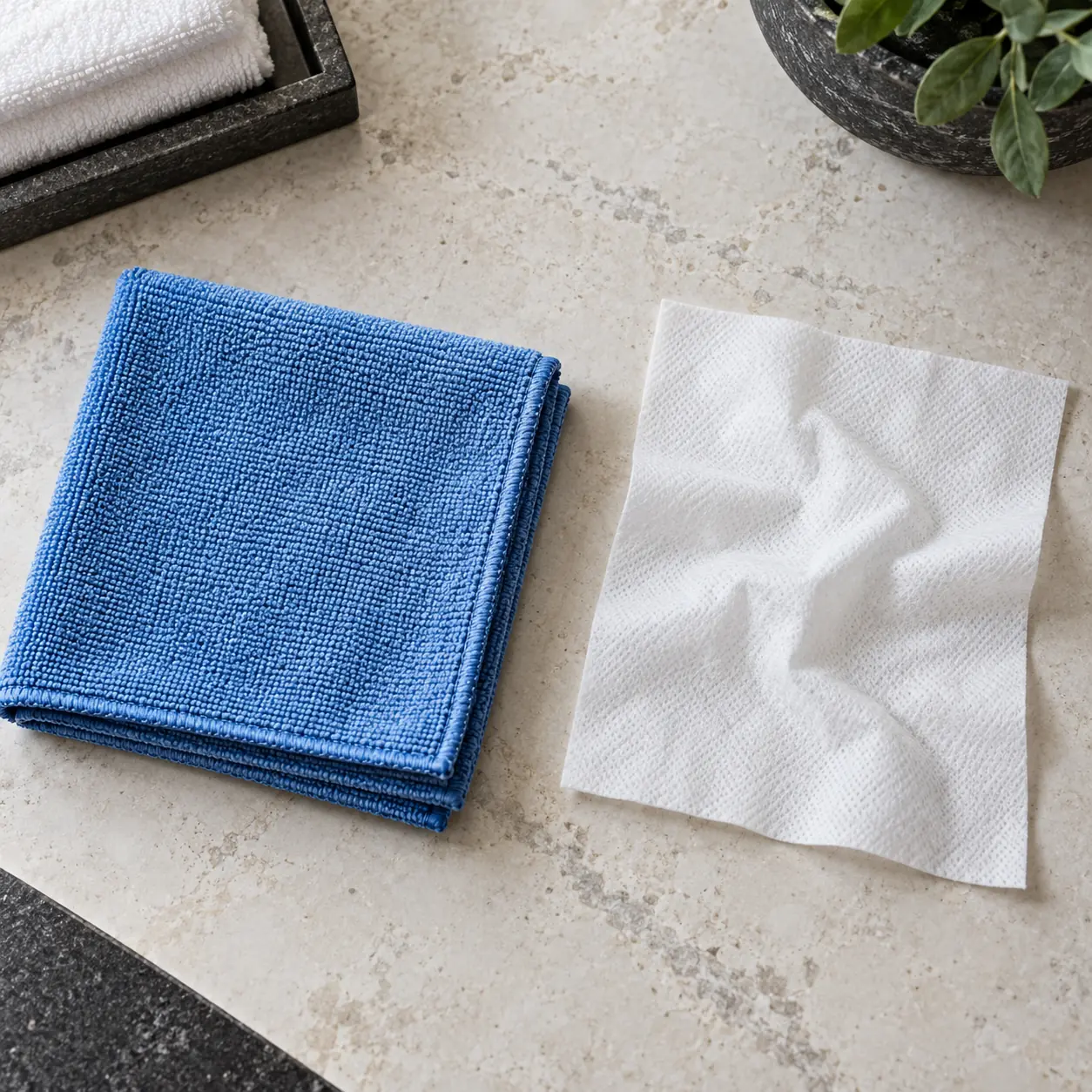
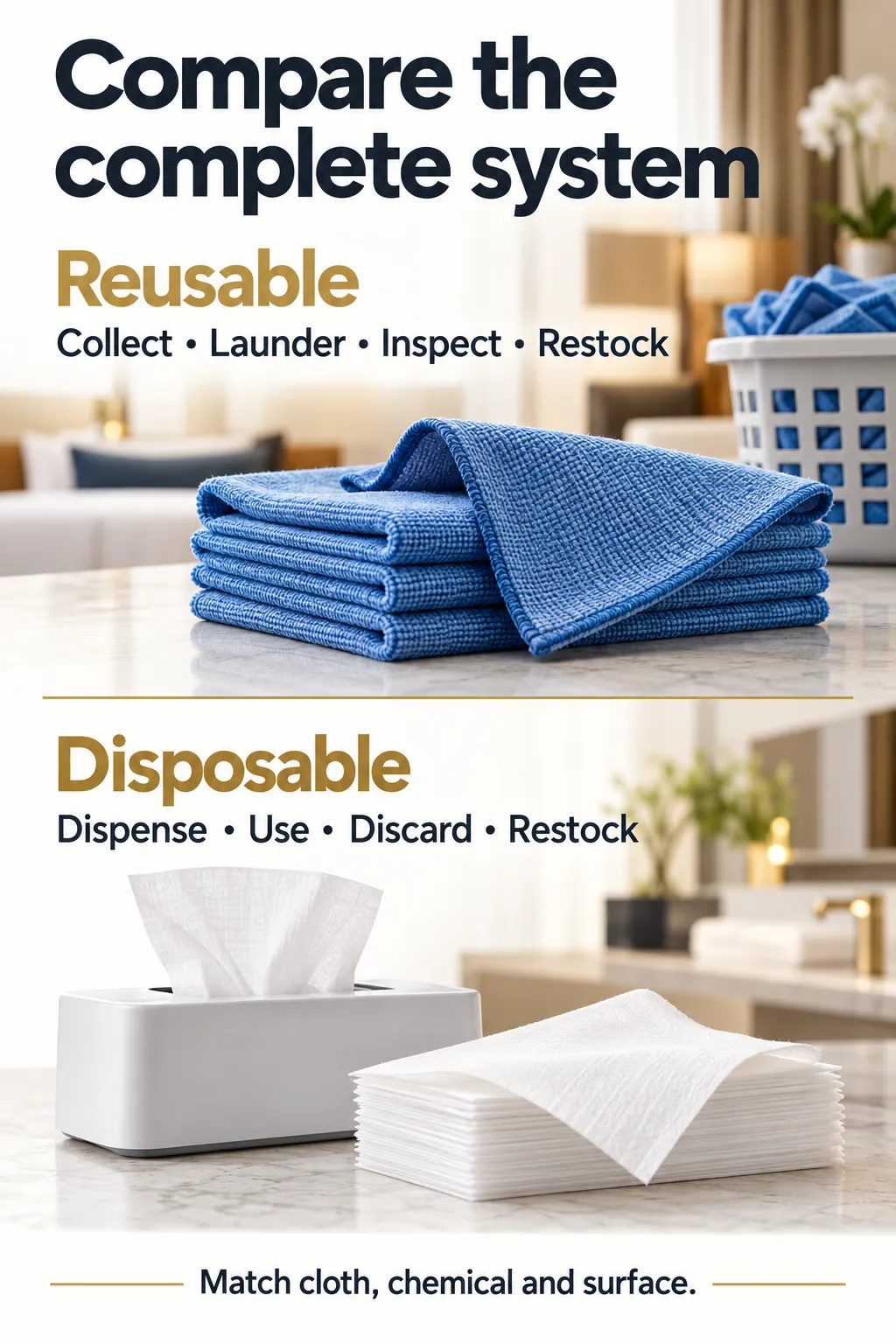
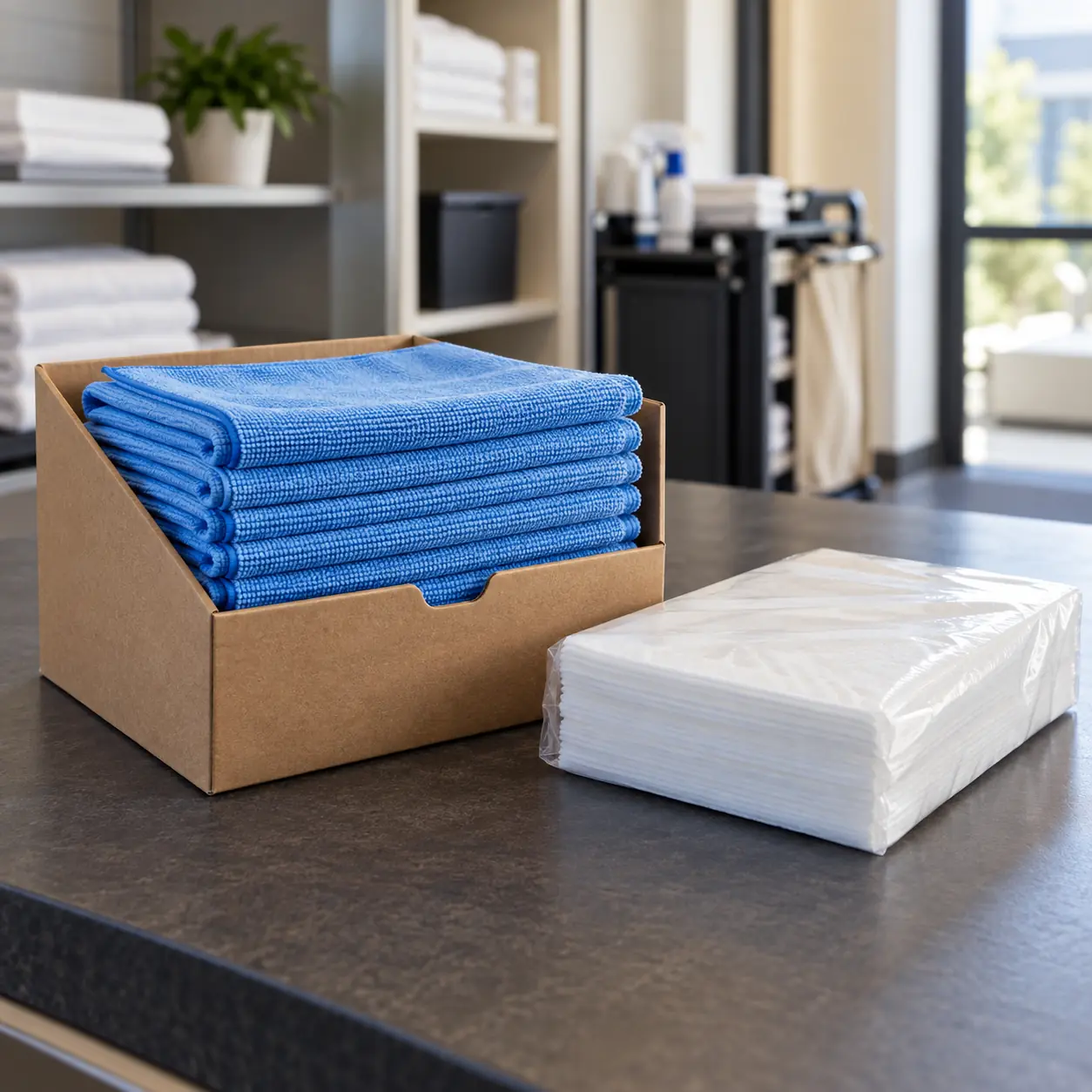
Compare two complete, specified cleaning systems rather than two products that happen to carry the word microfiber. Reusable cloths are intended for repeated use after the required reprocessing; disposable microfiber cloths are intended for the single-use scope stated by their manufacturer. That scope does not automatically mean one cloth can clean an entire room. Record the intended surfaces, product dimensions, construction, chemical compatibility, and change rules before the trial. A glass-polishing cloth and a general-purpose cleaning cloth may serve different jobs, so their results should not be treated as interchangeable. The comparison becomes useful when each candidate is suited to the same task and judged against the same finished-surface requirement.
Separate the cloth from the cleaning chemistry
A dry disposable microfiber cloth is not automatically a premoistened disinfecting wipe. Confirm whether the candidate arrives dry, is prepared with an approved solution on site, or is supplied as a finished wet product. If the two options require different chemicals or application methods, describe the project as a comparison of complete systems. You cannot attribute the resulting difference to the cloth alone.
Cleaning removes soil; disinfection is a separate performance claim tied to the approved product and its directions. The U.S. Environmental Protection Agency explains this distinction in its guide to cleaning, sanitizing, and disinfecting surfaces. Where disinfection is required, follow the relevant label for surface suitability, dilution, application, and wet contact time. For U.S. properties using EPA-registered disinfectants, EPA’s directions-for-use guidance explains that the surface must remain visibly wet throughout the labeled contact time. A cloth’s laboratory removal claim does not establish that a hotel surface has been disinfected.
Ask for written compatibility information for the exact cloth, chemical, concentration, and preparation method. For example, Rubbermaid Commercial Products lists compatibility with quaternary ammonium compounds, chlorine bleach, and hydrogen peroxide for its HYGEN r-100 disposable cloth. That is a specification for this product, not evidence that every microfiber cloth works with every disinfectant. Confirm the actual pairing before the trial. KW Hospitality’s cleaning chemicals supply guide can help organize the wider product specification.
| Decision point | Reusable system | Disposable system |
| Return to clean stock | Collection, washing, drying, inspection, folding | Replenishment from protected new stock |
| Repeated expense | Processing, handling, replacement and losses | New cloths, dispensing, storage and disposal |
| Product evidence | Care instructions and performance after use cycles | Intended single-use scope and wet-use strength |
| Operational vulnerability | Delayed laundry or cloths returned in poor condition | Stockouts, excessive dispensing or waste capacity |
| Common controls | Task separation, correct chemistry, surface inspection | Task separation, correct chemistry, surface inspection |
Establish change rules before measuring consumption
Assign cloths to defined tasks or zones and keep used items separate from clean supplies. A property might use different colors for bathroom fixtures and guestroom furniture, but color assignments are an internal operating convention, not a universal standard. Specify a fresh cloth when moving to a new room or incompatible task, and replace it sooner when soiled, damaged, or no longer delivering the required result. Never move a toilet-area cloth to a bedside surface.
If folding is part of the approved method, train staff to expose a clean face without touching it with a soiled glove. Extra folds do not override a required cloth change. Keep cloth preparation containers and storage clean, and do not return a used cloth to shared clean solution. CDC’s Environmental Cleaning Procedures supports this no-double-dipping practice. That document addresses healthcare facilities with limited resources; the cloth-handling principle is useful here, but its clinical schedules and patient-zone rules are not hotel requirements. Use the chemical instructions and property procedure for protective equipment and hand hygiene.
Agree on the laundry method for the actual product
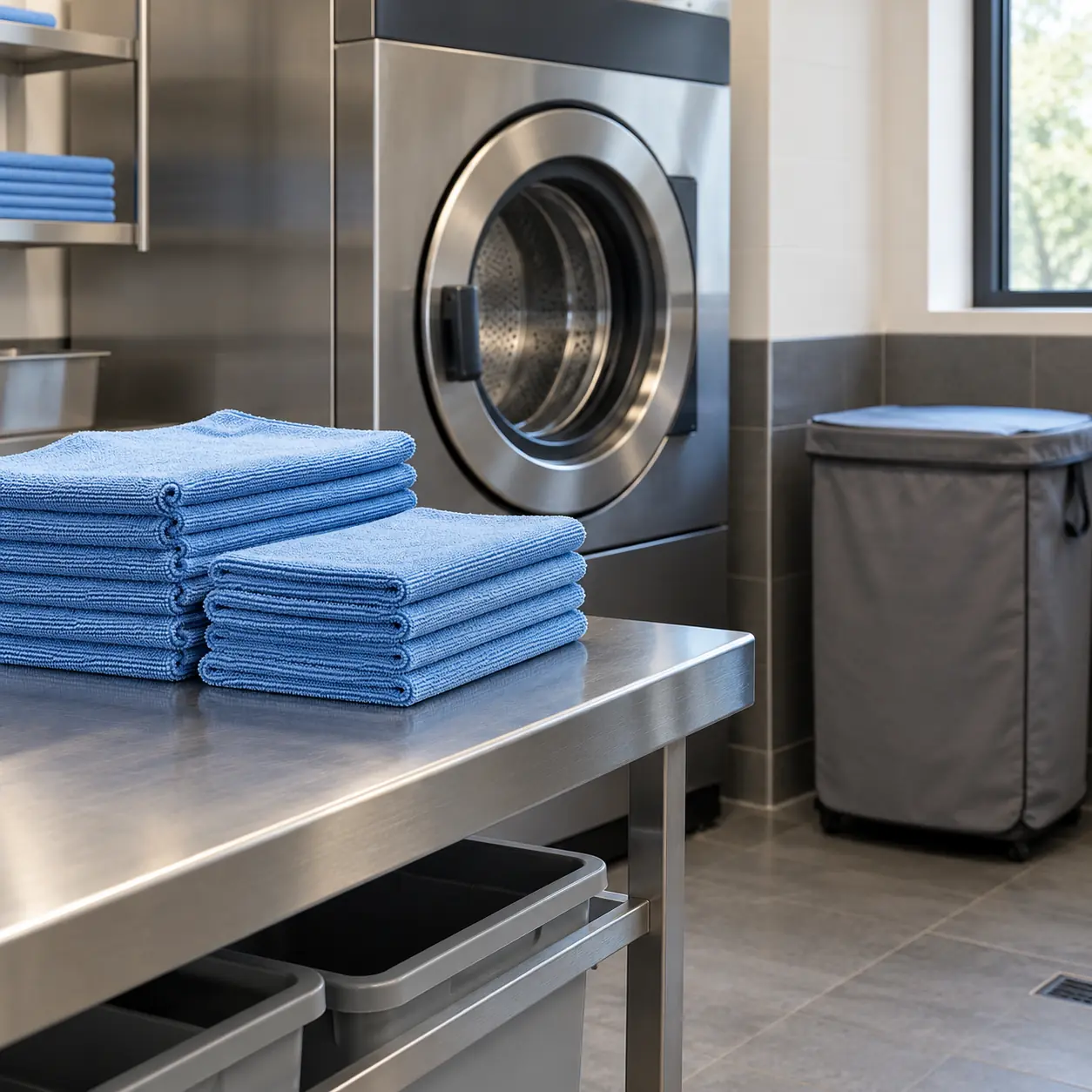
Do not set one wash temperature, bleach policy, or dryer setting for every microfiber cloth. Obtain the supplier’s care instructions and confirm that the laundry can run that process consistently. Separate microfiber from lint-shedding cotton loads; avoid fabric softener where the care instructions prohibit it. For example, Rubbermaid Commercial Products’ HYGEN Laundry Guide directs users to separate its microfiber from other textiles and avoid fabric softener and dryer sheets. Apply the instructions for the product you actually buy rather than extending that guide’s wash and drying settings to all microfiber.
Document detergent, load size, approved wash program, drying conditions, and inspection criteria. Bleach tolerance and claimed wash life vary by product and conditions. Use actual serviceable life in the cost model rather than assuming that a maximum advertised wash count will be achieved.
Run a Matched Room Trial
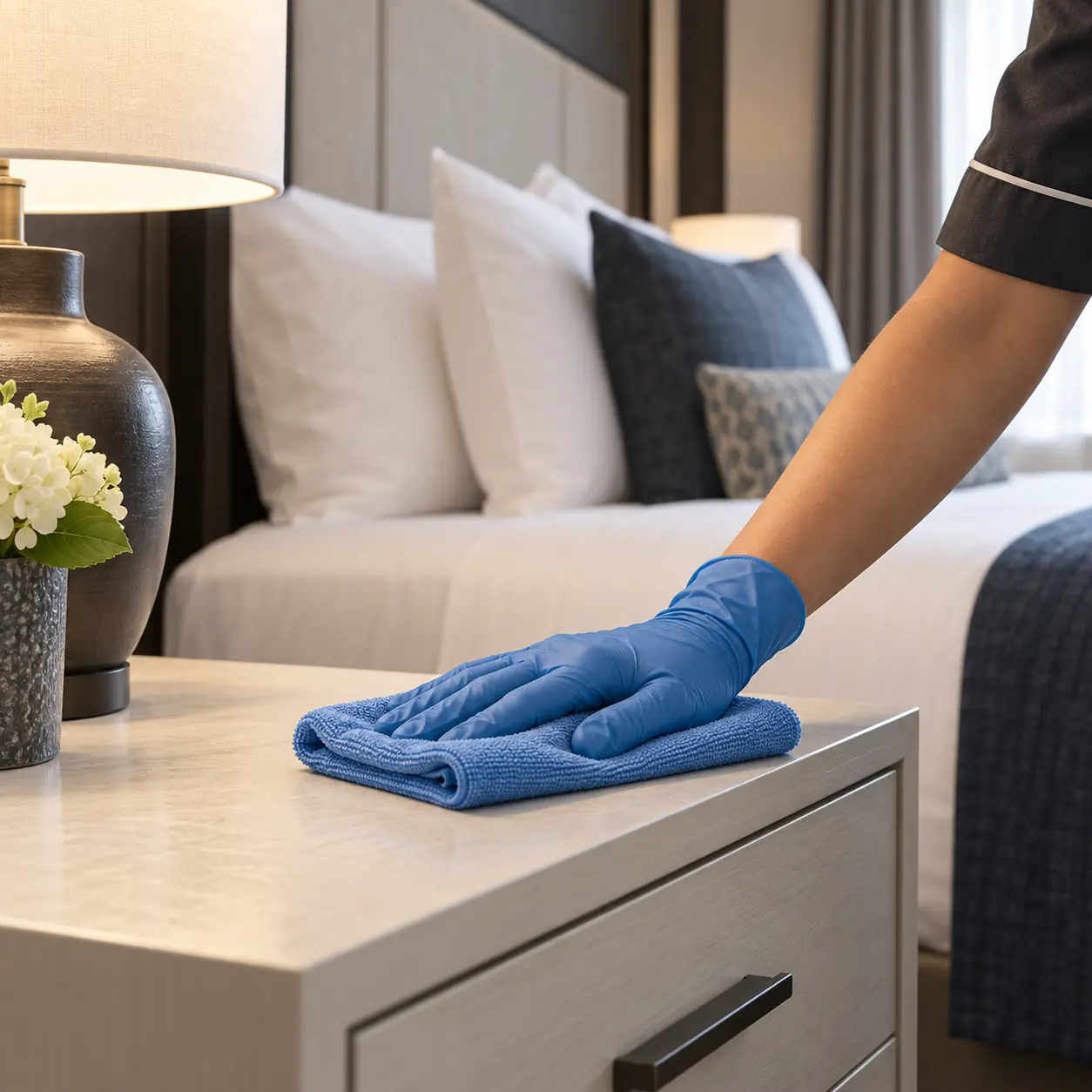
A fair trial gives both systems comparable rooms, trained users, and the same inspection standard. Begin with a short practice period so unfamiliar dispensing or folding does not determine the result. Then allocate similar room assignments to each system and rotate attendants between them. Record room type, service type, starting soil level, shift, and unusual interruptions. Keep the selected surfaces and required finish constant. The aim is to learn whether the system works reliably in your hotel, including its busy periods and laundry turnaround, rather than to produce a headline about every reusable or disposable cloth on the market.
Define the comparison before the first scored room
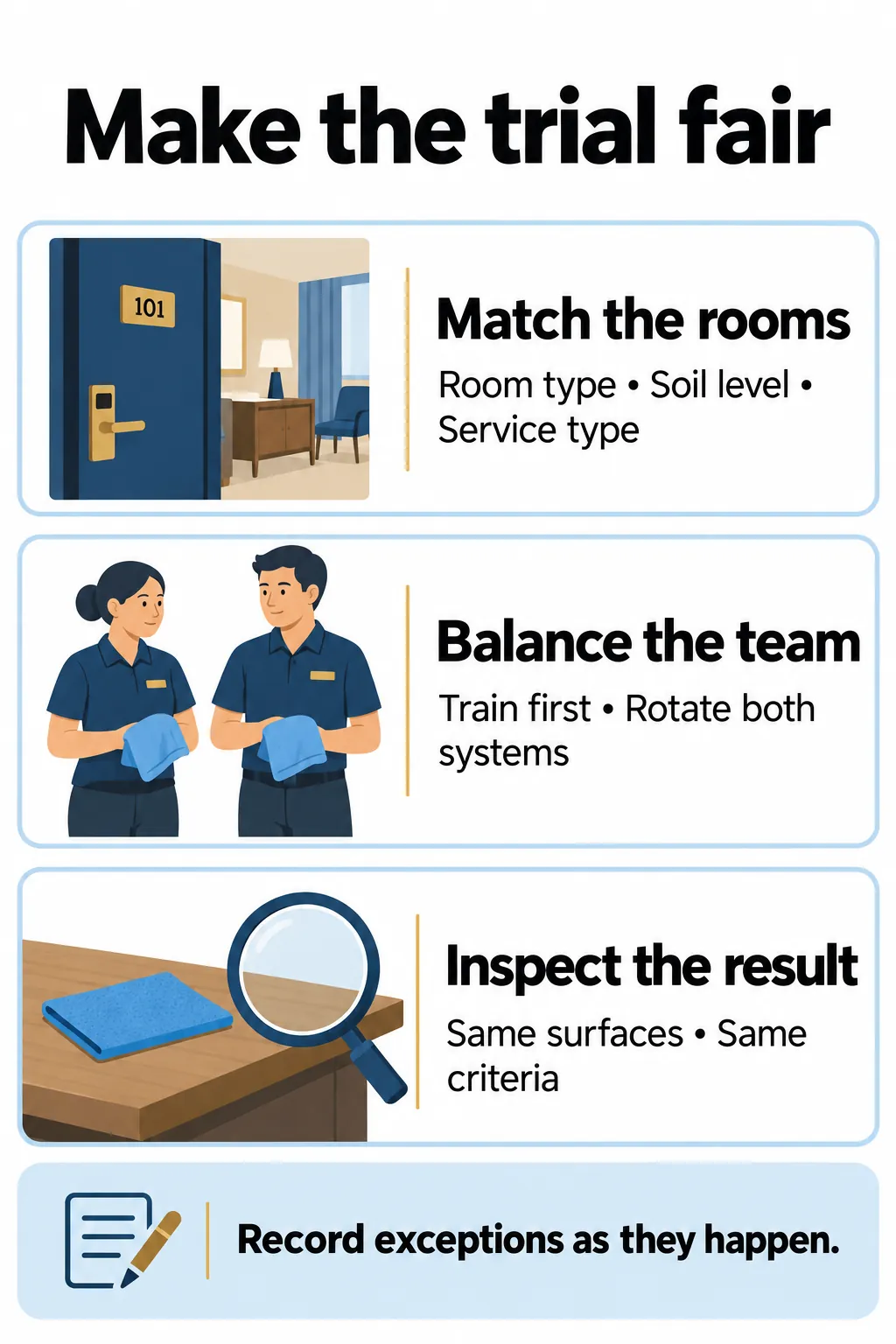
Choose a manageable scope, such as the approved routine wiping tasks on guestroom furniture and bathroom fixtures, with separate cloths for each zone. Keep glass polishing, floor cleaning, food-contact items, and specialist surfaces outside that scope unless they receive their own defined method. Identify the finish required on each included surface: no visible soil, unacceptable streaking, lint, tacky residue, or surface damage under a consistent inspection method.
A practical starting design could include several trained attendants and roughly 30 to 50 comparable room services per system, spread across multiple shifts. This is a planning example, not a statistically validated sample size or a guarantee of a conclusive result. Extend the trial when room mix is unbalanced, results vary substantially, or the difference is too small to distinguish from normal operational variation. A brief trial also cannot prove long-term cloth life.
Within similar room groups, vary which system is used first. For example, two attendants can begin with opposite systems and switch for comparable assignments on the next day. Avoid assigning all heavily soiled checkout rooms to one option and light stayovers to the other. Run both options within the same general period so occupancy and staffing changes are less likely to distort the comparison.
Inspect quality before rewarding speed
Record first-pass acceptance before touch-ups. After any rework, record whether the room passes final inspection. Keep rework time and additional cloths in that room’s totals, even when the room eventually passes. A room service is one observation; wiping the same room twice does not create two successful rooms. An independent supervisor should use the same target surfaces and inspection procedure for both systems, ideally without knowing which candidate was used when that is practical.
Visual inspection evaluates presentation and visible cleaning outcomes; it does not prove pathogen elimination. If the property already uses additional monitoring, keep its established interpretation and sampling method. Do not turn a surface reading into an unsupported universal safety threshold or a claim that one cloth system prevents infections.
Capture the return route as well as the room
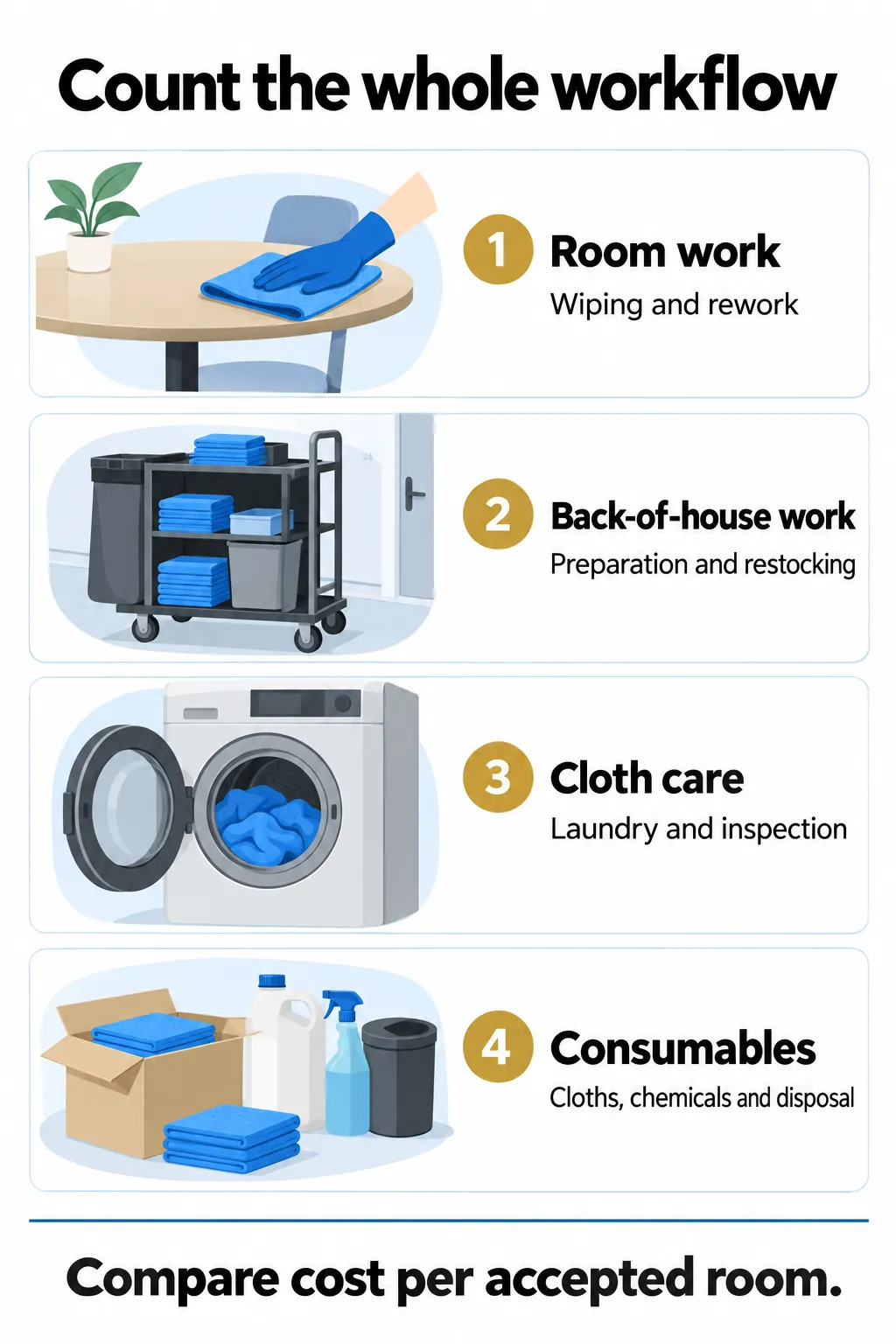
Measure hands-on time for preparation, dispensing, cloth changes, collection, sorting, inspection, folding, restocking, and waste handling. Allocate shared batch work across the rooms served by that batch. Record unattended washer and dryer time separately from labor: it affects turnaround and stock availability, but it is not all paid hands-on work. Do not add a full machine cycle to every individual room.
Note stockouts, double dispensing, torn cloths, rejected laundered items, unexpected trips, and departures from the approved method. Keep interruptions caused by maintenance or guest requests visible instead of silently deleting inconvenient observations. Stop use of a candidate when it damages a finish, cannot support the required chemical application, or repeatedly causes handling errors. Correct the process before continuing the comparison.
Measure the Whole Workflow and Cost
Use cost per accepted room as the main purchasing measure, supported by first-pass quality, labor time, cloth consumption, and supply reliability. Define an accepted room as one that passes the trial’s final inspection for the included tasks. Keep the costs of failed attempts and rework in the numerator. This prevents a cheap but unreliable process from looking attractive simply because its unsuccessful work disappeared from the calculation. Evaluate results separately for comparable room and service types before combining them. The worked example below shows how to calculate the comparison; it does not predict which option will win at your property.
Use consistent units and avoid counting costs twice
The general calculation is: cost per accepted room = total included workflow cost ÷ rooms passing final inspection. Total included cost covers cloth consumption or allocated reusable acquisition cost, laundry, hands-on labor, cleaning chemicals, waste, and other directly relevant operating expenses. Compare the same task scope, currency, and tax treatment for both systems. Keep common room work, such as changing bed linen, outside a cloth-only comparison unless the cloth choice changes that work.
For a reusable product, allocate its landed purchase price over its realized serviceable uses. If a cloth costs $1.80 and delivers 60 serviceable uses, acquisition cost is $0.03 per use. Count early retirement and loss when estimating that average. Do not add a second loss allowance if losses are already reflected in the shortened service life. If your laundry cost includes handling labor, exclude that same labor from the separate time charge.
| Illustrative input or result | Reusable | Disposable |
| Cloths used per serviced room | 3 | 3 |
| Landed price per cloth, USD | $1.80 | $0.16 |
| Serviceable uses per cloth | 60 | 1 |
| Laundry cost per cloth-use, excluding handling labor | $0.06 | $0.00 |
| Included hands-on minutes per serviced room | 1.40 | 1.00 |
| Loaded labor cost per hour | $24.00 | $24.00 |
| Chemicals per serviced room | $0.05 | $0.05 |
| Waste and other included cost per serviced room | $0.01 | $0.03 |
| Final acceptance rate | 100% | 100% |
| Calculated cost per accepted room | $0.89 | $0.96 |
These are invented inputs for a narrow cloth-related workflow, not the total time or cost to clean a hotel room. Reusable cost is 3 × ($1.80 ÷ 60 + $0.06), plus 1.40 × ($24 ÷ 60), plus $0.05 and $0.01. Disposable cost is 3 × $0.16, plus 1.00 × ($24 ÷ 60), plus $0.05 and $0.03. The illustrative difference is $0.07 per accepted room. Different consumption, life, labor, or laundry conditions can reverse it.
Test the assumptions that could change the decision
In this example, reducing reusable serviceable life from 60 uses to 30 raises its cost to $0.98 per accepted room. The disposable assumption remains $0.96. With every other input unchanged, reusable life must exceed 33.75 uses on average to cost less. This threshold belongs only to this example. It is not a recommended replacement schedule or a general microfiber break-even point.
Repeat the model with observed low and high cloth consumption, realistic laundry charges, slower busy-shift handling, and actual first-pass performance. The final acceptance rate also matters: when some room attempts remain unaccepted, spread all included costs over the smaller number that passed. Never improve the rate by excluding difficult rooms after seeing their results.
The companion workbook includes an editable cost comparison and a blank room-level trial log. Its prefilled calculator uses the illustrative assumptions above. Record observations in the log, summarize comparable groups, and enter the resulting averages into the calculator. The log does not automatically decide which rooms are comparable or transfer their values into the cost inputs.
Track resources without inventing a sustainability winner
Count disposable cloths and packaging, reusable cloth retirements, laundry loads, water and energy where metered, and waste-handling requirements. Compare these per accepted room under the same task scope. Less solid waste alone does not establish a lower overall environmental impact; lower laundry use alone does not establish it either. Manufacturing, transport, realized reuse, washing, and end-of-life treatment all affect a broader assessment. Treat recycled-content claims and local disposal options as product-specific information requiring confirmation. Do not assume that a used synthetic microfiber cloth is compostable, recyclable locally, or suitable for flushing.
Turn Results into a Purchasing Specification
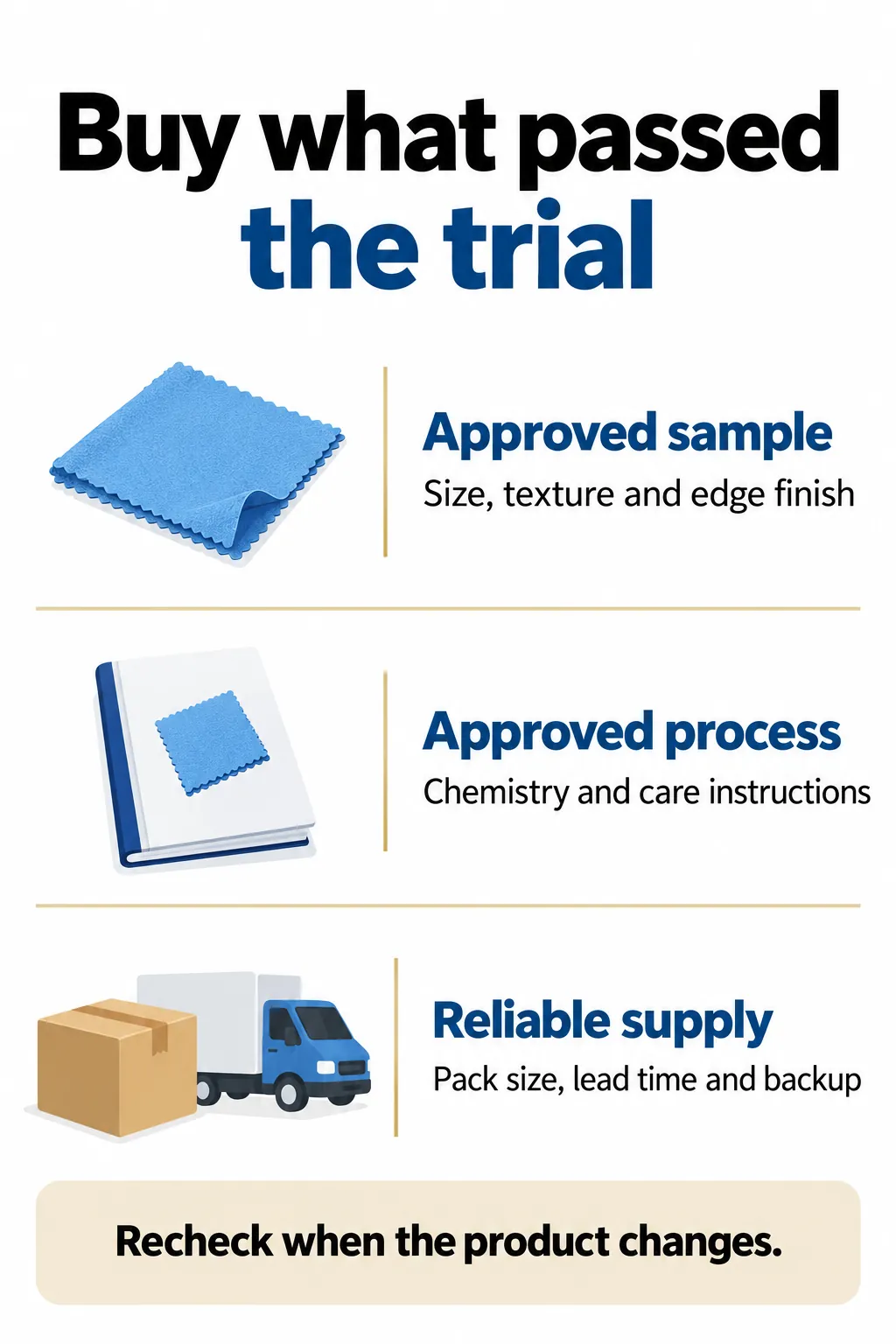
Buy the product and process that passed the trial, with enough detail to reproduce the outcome when the next shipment arrives. A generic purchase order for microfiber cloths leaves room for changes in size, texture, fiber construction, seams, packaging, or dispensing behavior. Record the approved sample and the conditions under which it worked. The housekeeping manager should own the task method, laundry should confirm reprocessing capacity where relevant, and purchasing should secure a consistent supply specification. If results are close, reliability and staff usability may be more valuable than a small modeled saving that disappears during a busy shift.
Translate observations into approval conditions
Record the supplier reference and product revision, dimensions, construction, edge finish, intended task, color assignment, pack quantity, and approved chemicals. For reusable cloths, include the agreed care process and reject criteria. For disposable cloths, specify the single-use boundary, dispensing arrangement, prepared-solution limits if applicable, and disposal route. Keep a retained sample for comparing incoming batches; require review before accepting substitutions.
| Trial finding | Purchasing or operating response |
| Reusable cloths pass, but clean stock runs out | Increase the justified circulating stock or correct laundry turnaround before rollout |
| Disposable cloths tear or dispense in multiples | Trial another construction or dispenser and recalculate consumption |
| Both pass with similar total cost | Weigh supply continuity, handling effort and staff feedback |
| One option leaves lint or damages a finish | Reject it for that surface or test a suitable alternative |
| Different tasks favor different products | Publish a clear task-to-product assignment and train both workflows |
Size stock around the actual return cycle
Reusable circulating stock must cover items in use, awaiting processing, in the laundry, rejected pending replacement, and held as clean reserve. As a simplified planning example, 80 serviced rooms a day using three reusable cloths each require 240 cloth-uses daily. If replenishment takes two full days and the operating plan requires one additional day of clean reserve, a starting estimate is 720 serviceable cloths. Verify that estimate against collection timing, zone-specific colors, peaks, losses, and supplier lead time before ordering.
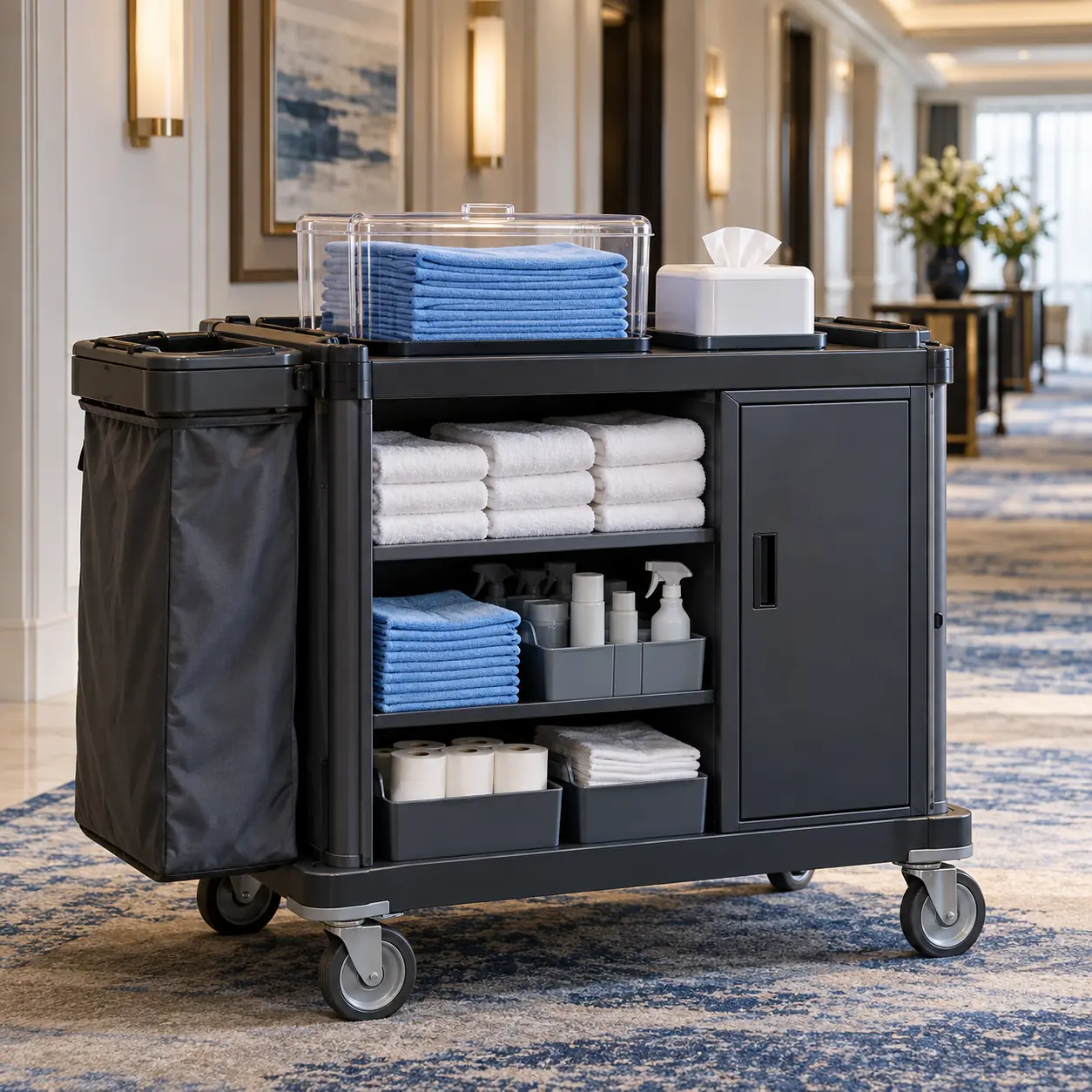
For disposable stock, use measured daily consumption multiplied by replenishment lead time, then add a justified buffer. Preserve enough storage and cart capacity for the resulting packs. Connect both stock models to the property’s housekeeping cart restocking standard so the selected cloth is available when needed, in the correct zone and condition.
Plan a controlled rollout and review changes
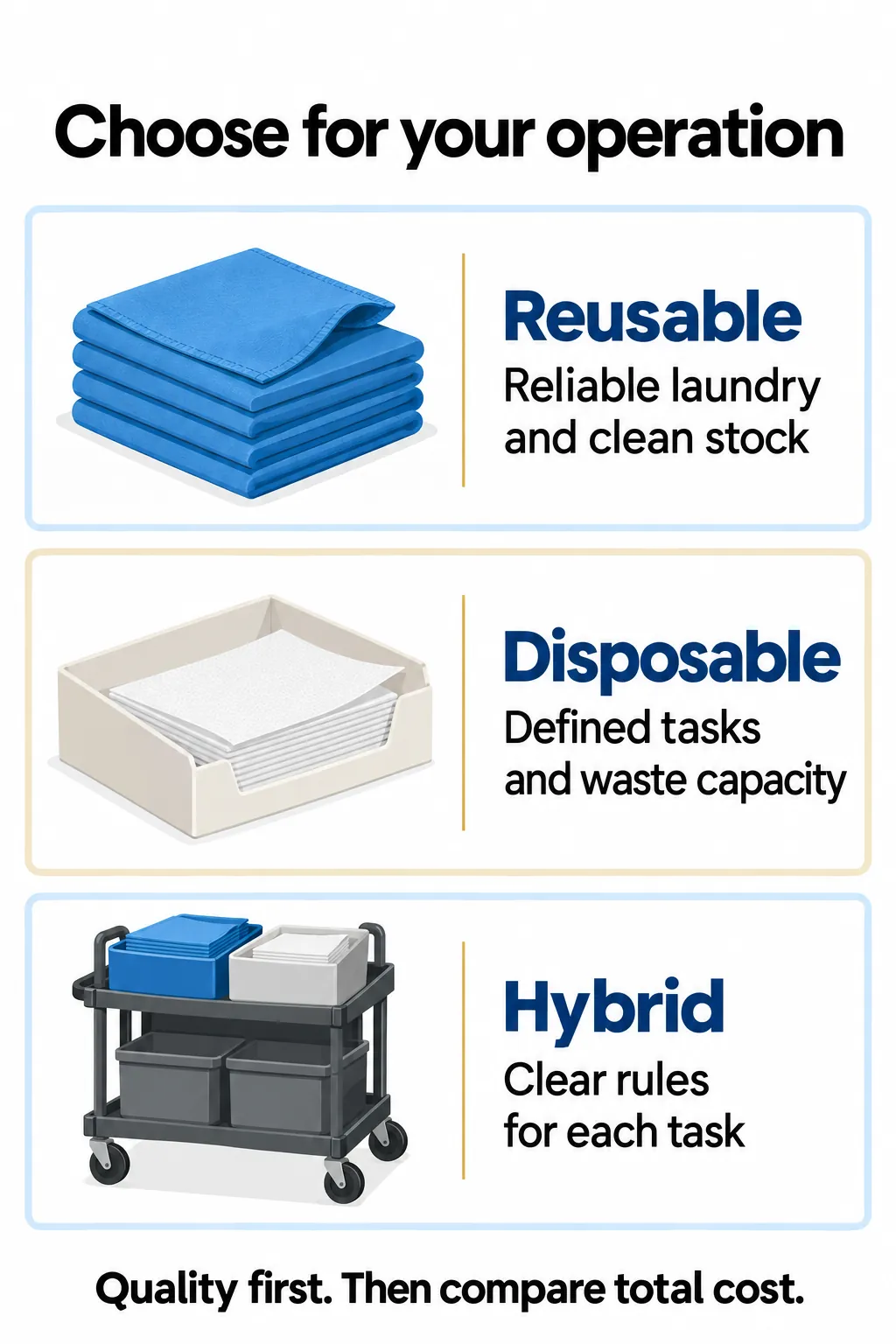
Roll out to a manageable group of rooms first, review first-pass acceptance and stock availability, and check that handling time remains close to the trial. Continue recording reusable retirements long enough to replace provisional life assumptions with observed experience. Revisit the decision after a cloth substitution, chemical change, laundry-process change, major shift in occupancy, or persistent shortage. A hybrid system needs explicit task boundaries; leaving the choice to individual preference makes consumption and quality harder to control.
Conclusion
Reusable and disposable microfiber cloths can each support a workable hotel housekeeping system when the product, chemistry, task rules, and supply process fit the property. Start with quality and safe handling, then compare the entire workflow using cost per accepted room. Keep the trial balanced, include rework and back-of-house effort, and test whether realistic changes in cloth life or consumption would reverse the decision. The most useful purchasing outcome is an approved sample supported by clear operating instructions and reliable replenishment. Keep evaluating the system after rollout so the decision continues to reflect actual hotel conditions rather than the assumptions used at purchase.
If your property is comparing cloth programs, contact KW Hospitality about samples and sourcing with the intended tasks, cloth specification, estimated quantities, approved chemistry, laundry conditions, delivery location, and target date. Ask the team to confirm suitable sample options and commercial terms before a bulk order.
Frequently Asked Questions
Does disposable microfiber mean one cloth per room?
No. The manufacturer’s intended use and the property’s task-separation rules define the boundary. One room may require multiple cloths, particularly when moving between bathroom and guestroom tasks. Replace a cloth earlier if it becomes soiled, damaged, or ineffective. Do not reuse a single-use product in another room to reduce the recorded consumption.
Can a reusable microfiber cloth be rinsed and used again immediately?
Rinsing alone should not be treated as the agreed laundering and reprocessing procedure. Return used cloths through the property’s approved process before reissue. Clean-looking fabric can still carry soil, chemical residue, or contamination that a quick rinse has not adequately addressed.
Should microfiber cloths be washed with hotel towels?
Keep microfiber separate from lint-shedding cotton towels and other incompatible loads. Follow the actual cloth’s care instructions and the approved laundry process. The relevant question is whether the laundry can consistently return serviceable cloths, not whether the machine has spare capacity in an unrelated towel load.
Can a two-week trial establish reusable cloth life?
It can reveal early problems and workflow constraints, but it usually cannot establish a long replacement life. Track a known cohort through actual use and laundering, recording losses and reject reasons. Keep the life assumption provisional and show how shorter life changes the cost result until sufficient observations are available.
What if reusable cloths are cheaper but attendants prefer disposable ones?
Find out why. Preferences may reveal a real issue with folding, wetness, hand comfort, dispensing, weight, or access to clean stock. Measure the associated time and quality effects. A small modeled saving is weak justification for a process that staff cannot use consistently; a change in cart setup or training may also solve the problem.
Which system should be used after an unusual contamination incident?
Follow the property’s dedicated incident procedure and the applicable product directions. The routine workflow trial described here does not establish an incident-response method. Product choice, protective equipment, cleaning chemistry, handling, and disposal may need controls beyond those used for ordinary guestroom cleaning.
References
U.S. Environmental Protection Agency — What’s the difference between products that disinfect, sanitize, and clean surfaces?
U.S. Environmental Protection Agency — Selected EPA-Registered Disinfectants
Rubbermaid Commercial Products — HYGEN™ r-100 Disposable Microfiber Cloth, 12″ x 12″, 480-Count
Centers for Disease Control and Prevention — Environmental Cleaning Procedures
Rubbermaid Commercial Products — Laundry Guide