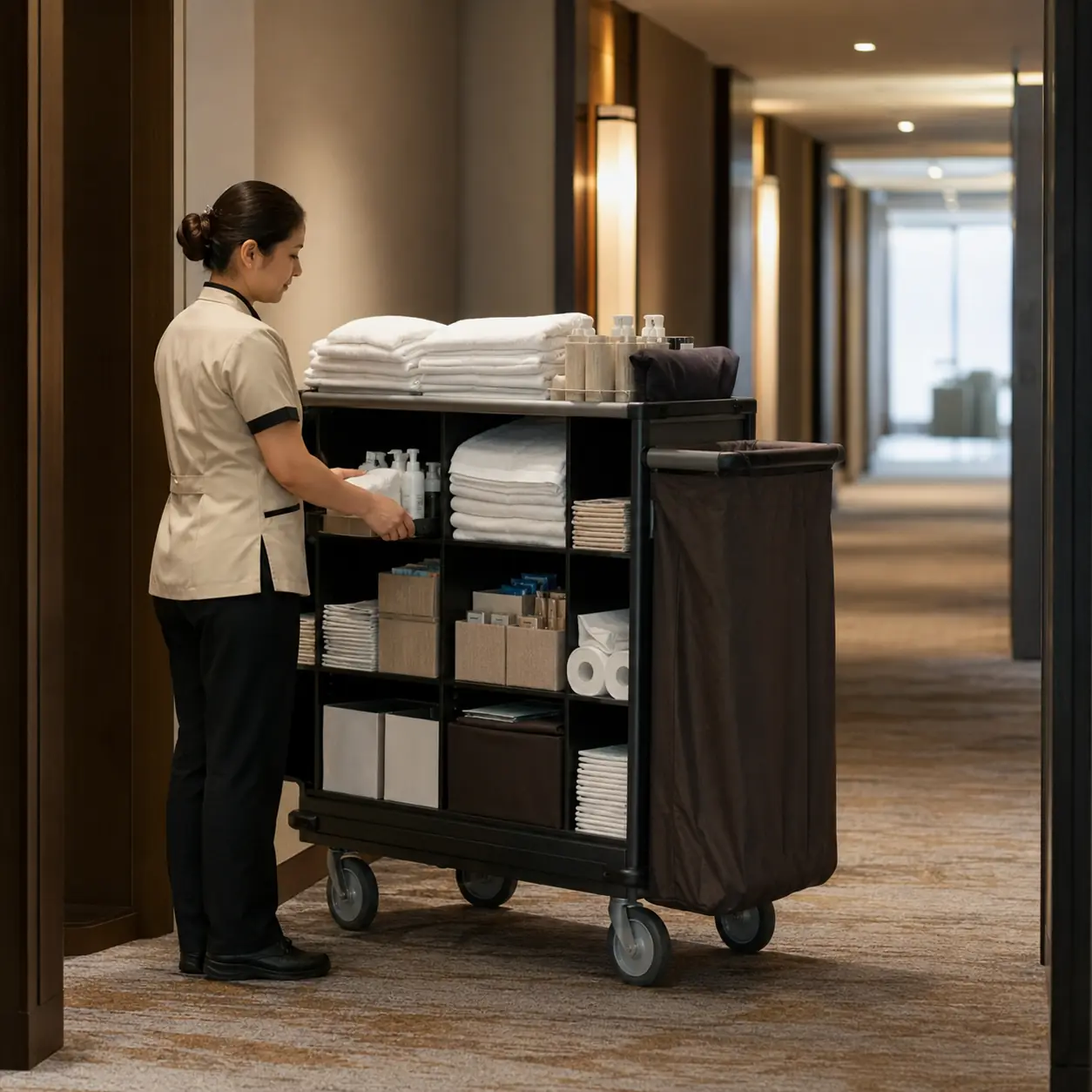
A housekeeping cart is a mobile work station, but its real value depends on what is loaded, where each item is placed, and whether the quantity matches the route. A cart that looks full can still be operationally incomplete: it may carry too many towels but not enough pillowcases, several amenity types but no replacement tissue, or cleaning products without the tools and protective equipment needed to use them safely. These gaps create return trips, interrupt room flow, and make service quality depend too heavily on individual memory.
This hotel housekeeping cart restocking checklist gives supervisors and room attendants a repeatable way to prepare carts for daily assignments. It covers guestroom linen, towels, paper products, amenities, cleaning tools, chemicals, personal protective equipment, and operational forms. It also explains how to set route-specific par levels, arrange clean and soiled zones, complete an end-of-shift handoff, and turn shortage records into better reorder decisions. The checklist is intentionally property-neutral: brand standards, room types, occupancy patterns, stayover policies, and local safety requirements should determine the final quantities and approved products.
Use the checklist as a controlled baseline, not a reason to overload the cart. The correct cart is the lightest, safest configuration that lets an attendant complete the assigned rooms without predictable stockouts. Hotels planning a new opening or a department reset can connect the cart standard to their wider hotel opening supplies plan so cart capacity, linen pars, guest amenities, housekeeping chemicals, storeroom inventory, and replenishment responsibilities are designed as one operating system. The downloadable Word, Excel, and PDF versions below make the checklist easier to edit, track, print, and deploy across shifts.
Why a Standardized Restocking System Matters
Standardized restocking reduces avoidable variation before a room attendant reaches the first guestroom. It gives every shift the same starting condition, makes missing items visible during handoff, and separates a true consumption problem from a one-off loading mistake. The goal is not to make every cart identical regardless of assignment; it is to use one controlled method for translating the day’s room mix into a safe, complete cart. When attendants know the expected zones, item groups, quantities, and sign-off steps, supervisors can coach against a clear standard and purchasing teams can see which shortages are caused by demand, storage, or supplier inconsistency.
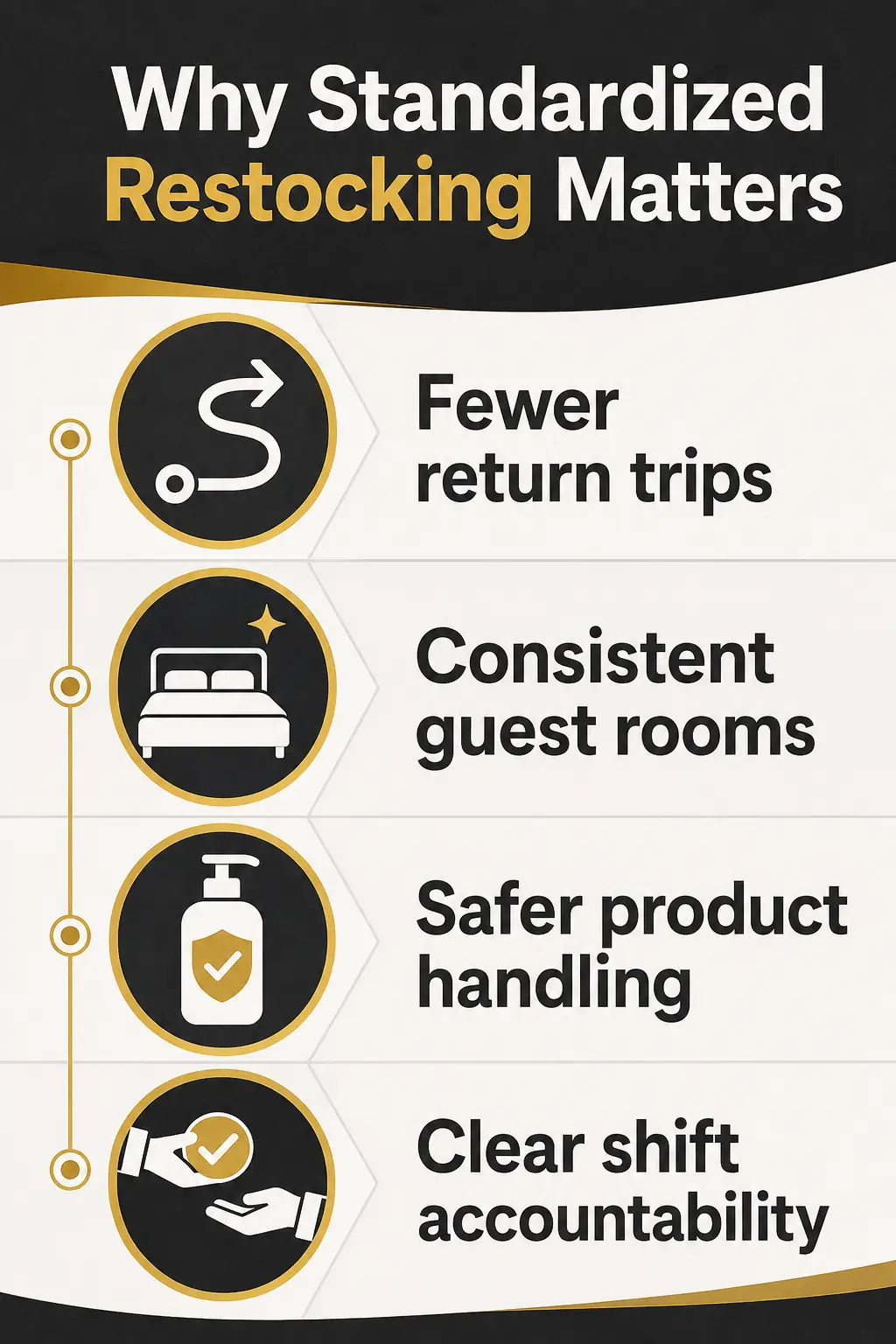
The four operational outcomes
First, a complete cart reduces return trips to the pantry or linen room. That protects productive cleaning time without encouraging rushed work. Second, standardized item selection supports more consistent guest rooms because the same approved linen, amenities, paper goods, and cleaning tools are available to every attendant. Third, a defined chemical zone and separate clean/soiled flow improve handling discipline. Finally, a documented shift handoff creates accountability: the next team can distinguish what was consumed, what was returned, and what remains unavailable.
Fewer interruptions caused by predictable stockouts
More consistent room presentation and amenity placement
Clearer separation of clean supplies, chemicals, waste, and used textiles
Better shortage data for supervisors, storeroom teams, and purchasing
A cart standard should also reflect the wider OS&E plan. Housekeeping carts, linen, cloths, chemicals, paper goods, and guest supplies are operating items that must work together; KW Hospitality’s guide to hotel FF&E and OS&E provides useful context for separating these recurring operating needs from longer-life assets. The cart checklist then becomes a daily control within that larger inventory system.
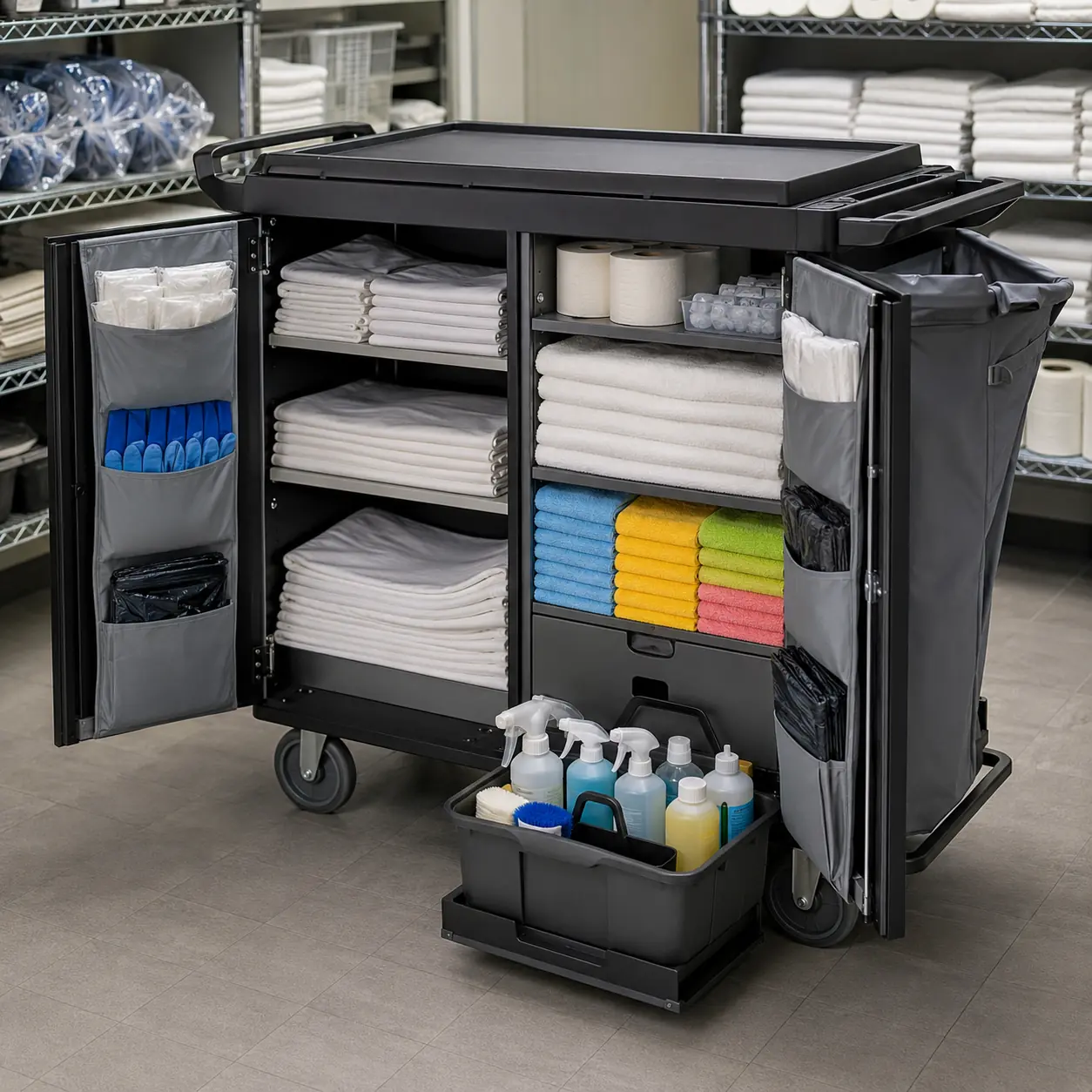
Hotel Housekeeping Cart Restocking Checklist
The checklist below is a master item matrix for a typical full-service hotel. It is deliberately more detailed than a simple “linens, amenities, and chemicals” list because omissions often occur at the subcategory level. A property should remove items it does not issue, add brand-specific products, and assign a route par for each room type. Products intended only for request delivery, deep cleaning, supervisors, or public areas should not automatically occupy cart space. The same rule applies to chemical concentrates and bulk containers: keep them in the approved dispensing or storage area unless the property’s safety procedure specifically authorizes cart transport.
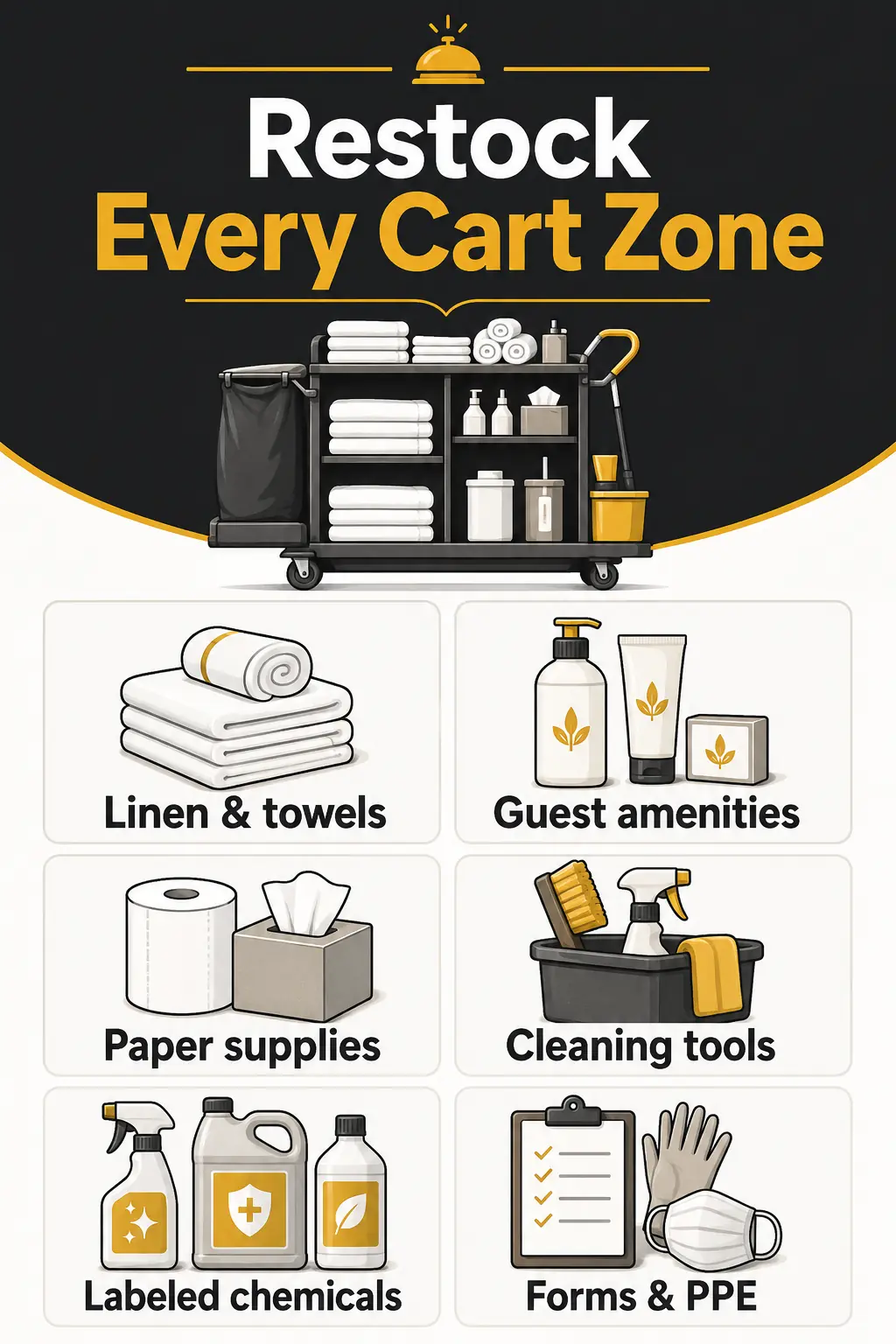
| Category | Item | Restocking standard | Cart zone | Verification |
| Linen and towels | Bed sheets by approved size | Load route par by room type; keep clean, dry, and covered | Lower enclosed shelf | Correct size, no stains, tears, dampness, or mixed reject linen |
| Linen and towels | Duvet covers or top sheets | Load only the approved bed presentation item for assigned rooms | Lower enclosed shelf | Correct size and finish; fold consistently |
| Linen and towels | Pillowcases | Calculate by pillow count plus a small item-specific buffer | Upper linen shelf | Correct size; no mixed fabric or shade |
| Linen and towels | Bath towels | Load by room standard and expected occupancy | Lower centered shelf | Dry, matched, clean edges, no rejects |
| Linen and towels | Hand towels | Load by room standard and assigned room count | Upper linen shelf | Correct fold and quantity |
| Linen and towels | Washcloths or face towels | Load by room standard and service type | Upper linen shelf | Correct type and quantity |
| Linen and towels | Bath mats | Load for turnover rooms and replacements allowed by policy | Separate linen stack | Keep separate from floor-cleaning textiles |
| Linen and towels | Bathrobes and slippers if standard | Carry only for rooms or tiers that require them | Protected amenity zone | Size, pair, packaging, and presentation correct |
| Paper supplies | Toilet tissue | Load full replacement rolls plus route buffer | Dry paper compartment | Wrap intact; no crushed or damp rolls |
| Paper supplies | Facial tissue refills or boxes | Load by turnover plan and replacement threshold | Dry paper compartment | Package clean and undamaged |
| Paper supplies | Sanitary disposal bags | Load to room standard; keep sealed | Small amenity drawer | Correct color and packaging |
| Paper supplies | Laundry bags and forms | Load according to room standard | Flat dry compartment | Bag and form present; no creases or moisture |
| Paper supplies | Guestroom waste-bin liners | Load correct sizes for all assigned bin types | Liner holder | Correct gauge and size; bags dispense cleanly |
| Guest amenities | Shampoo or approved hair-care unit | Load sealed units or approved refill-ready stock | Amenity drawer | Seal intact; correct product and batch rotation |
| Guest amenities | Conditioner | Load only where included in the brand standard | Amenity drawer | Seal intact; no leakage |
| Guest amenities | Body wash or shower gel | Load sealed units or approved refill-ready stock | Amenity drawer | Correct product; cap and container sound |
| Guest amenities | Body lotion | Load by room standard and route par | Amenity drawer | Seal intact; no expired or damaged stock |
| Guest amenities | Hand soap or bar soap | Load by sink and bath standard | Amenity drawer | Packaging clean and dry |
| Guest amenities | Shower caps and vanity kits | Load core standard or keep request-only items in pantry | Small-item organizer | Correct kit contents and packaging |
| Guest amenities | Dental, shaving, or sewing kits | Carry only if standard; otherwise stage for request delivery | Request-item compartment | Correct kit; packaging intact |
| Cleaning tools | Color-coded microfiber cloths | Load enough clean cloths for route policy; never mix with used cloths | Clean cloth compartment | Correct color assignment; clean and dry |
| Cleaning tools | Nonabrasive pads and sponges | Load approved types for designated surfaces | Tool caddy | No excessive wear; color or type correct |
| Cleaning tools | Duster heads and detail brushes | Load clean serviceable tools only | Vertical tool holder | Clean, dry, attached securely |
| Cleaning tools | Toilet brush and holder | Use dedicated covered tool according to property procedure | Isolated lower holder | Clean holder, no leakage, isolated from clean supplies |
| Cleaning tools | Mop heads or compact floor tools | Carry only clean heads required for the route | Lower tool zone | Clean and dry; handle secured |
| Approved chemicals | All-purpose cleaner | Carry approved closed working container only | Removable chemical caddy | Label legible; cap, trigger, and bottle intact |
| Approved chemicals | Glass cleaner | Carry approved product for specified surfaces | Removable chemical caddy | Label legible; no leakage |
| Approved chemicals | Bathroom and toilet cleaner | Keep upright and separated as required by chemical procedure | Removable chemical caddy | Correct product; never mixed or decanted into unapproved bottle |
| Approved chemicals | Disinfectant | Load approved product with label directions available | Removable chemical caddy | Correct product, dilution, label, and contact-time instructions |
| Approved chemicals | Floor cleaner or spot product | Carry only when required for assigned surfaces | Removable chemical caddy | Approved for surface; container sound |
| Safety and PPE | Disposable or reusable gloves | Load correct type and sizes required by the task | Clean PPE compartment | Clean, dry, undamaged, and accessible |
| Safety and PPE | Eye protection or additional PPE if required | Carry when specified by label or property risk assessment | Clean PPE compartment | Clean, undamaged, correct fit |
| Safety and PPE | Wet-floor signs | Carry the property-required quantity without blocking access | External secured holder | Clean, stable, and legible |
| Operational controls | Room assignment device or list | Issue current assignment without exposing guest data | Secure top compartment | Current, protected, returned or signed out |
| Operational controls | Maintenance and defect reporting method | Provide approved paper form or secure digital workflow | Secure admin compartment | Available and working; no guest data left visible |
| Operational controls | Lost-and-found bags and tags | Load approved tamper-evident or controlled supplies | Secure admin compartment | Correct packaging and chain-of-custody method |
| Operational controls | Cart bags for waste and soiled linen | Fit clean bags before release; keep streams separate | Side bag frames | Bags secure, not torn, not overloaded, lids or covers functional |
| Operational controls | Final cart condition check | Inspect frame, shelves, doors, handles, bumpers, wheels, and brakes | Whole cart | Cart clean, dry, stable, maneuverable, and released by assigned owner |
Use the editable Word version for local SOP changes, the Excel tracker for shift-by-shift quantities and shortages, the PDF for printing, or the complete package for all three formats.
How to adapt the master checklist
Map every line to the property’s room standard, approved chemical list, and actual cart compartments. A limited-service hotel may carry fewer linen types and amenities, while a resort may need multiple towel sizes, robes, slippers, turndown items, or outlet-specific supplies. Keep request-only amenities in a labeled pantry location rather than filling every cart with low-use items. If a product is replaced, update the cart standard, storeroom bin, chemical documentation, and training at the same time.
The cart itself should support the checklist. Shelf spacing, doors, drawers, removable caddies, liner holders, bag capacity, bumper design, and wheel quality affect what can be carried safely and how quickly the cart can be cleaned. Hotels reviewing carts or other housekeeping products can use KW Hospitality’s hospitality supplies overview to frame the equipment and consumables as one sourcing package rather than unrelated purchases.
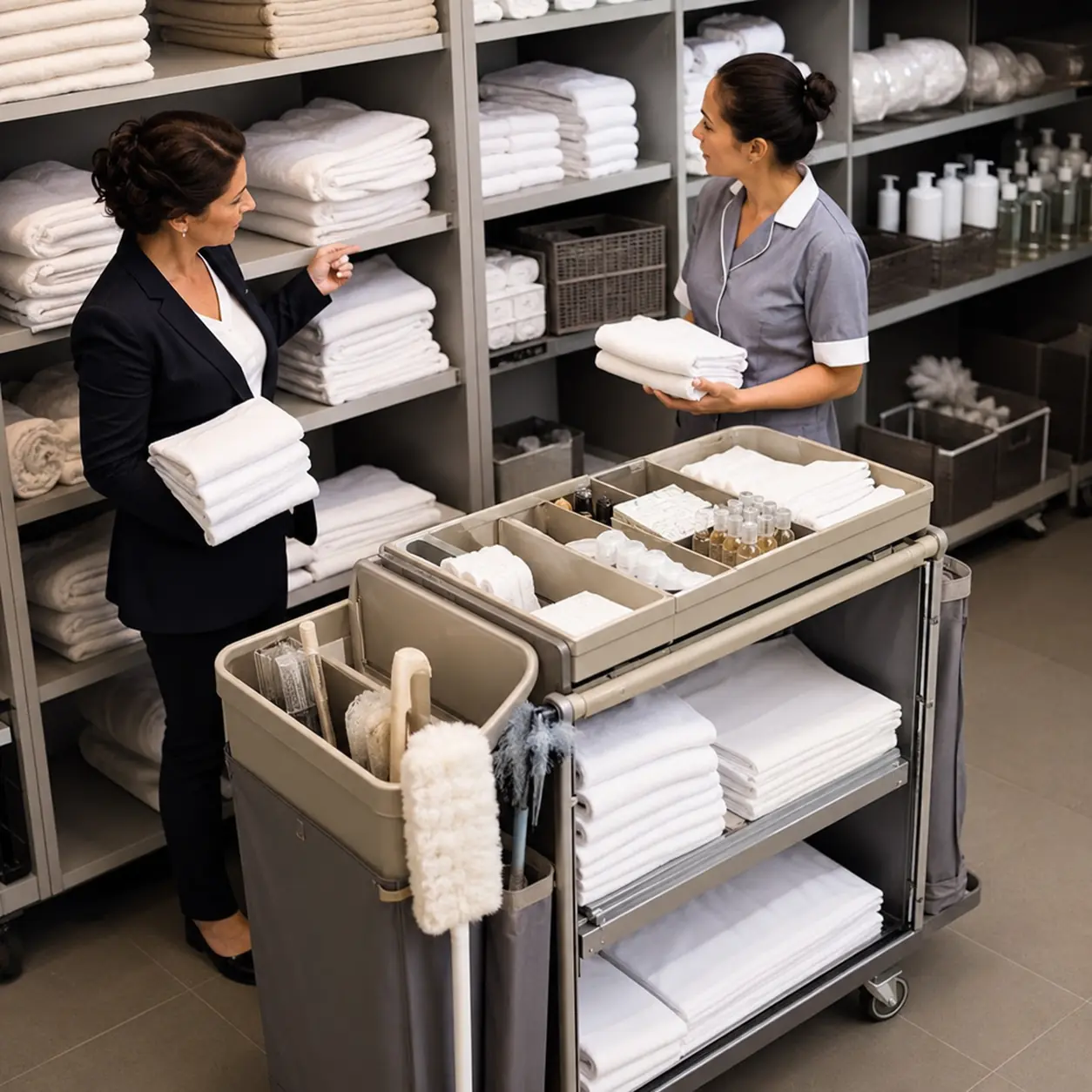
Set Par Levels and Arrange the Cart for the Route
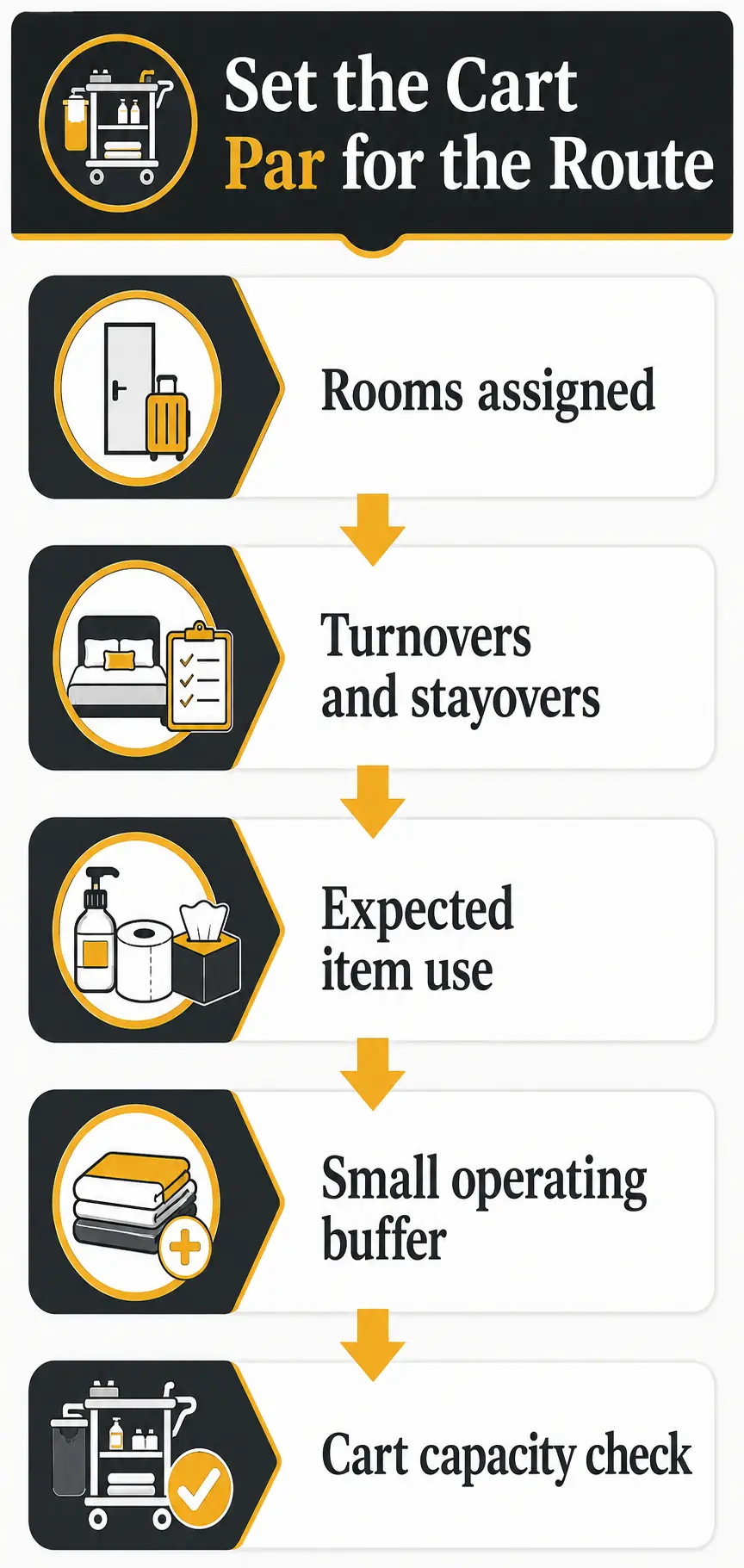
A master checklist tells the team what belongs on the cart; a route par tells them how much to load today. The par should start with assigned rooms, then adjust for turnover rooms, stayovers, suites, extra beds, family occupancy, turndown service, known VIP setups, and the property’s actual replacement policy. Add a small operating buffer for predictable variation, but do not treat the buffer as permission to fill every shelf. Excess weight makes the cart harder to maneuver, increases linen handling, hides shortages, and can lead attendants to place items in unstable or contaminated locations when the designed compartments are full.
A practical route-par method
Count the assigned rooms by room type and service type.
Apply the property standard for each item used in a turnover, stayover, or special setup.
Adjust for known exceptions such as extra beds, family rooms, suites, turndown, or approved green-stay programs.
Add a modest buffer based on actual variance, not an arbitrary percentage copied across all items.
Compare the result with cart weight, shelf capacity, chemical segregation, and clear lines of sight.
Record any item that must be staged at a floor pantry or delivered on request rather than carried.
For example, towels and pillowcases may justify a larger buffer because usage varies by occupancy, while slow-moving vanity kits may be better supplied on request. Bulk refill containers should usually remain at the controlled refill point; the cart should carry only approved working containers or sealed amenity units. When occupancy or service mix changes materially, recalculate the route par instead of relying on the previous day’s cart.
Arrange by frequency, weight, and contamination risk
Place frequently used, lightweight supplies within easy reach. Keep heavy linen low and centered, protect clean textiles behind doors or covers where possible, and secure bottles upright in a removable caddy. Paper goods and amenities should stay dry and separate from chemicals. Used cloths, waste, and soiled linen need their own closed or clearly isolated return zones. The final arrangement should allow the attendant to identify shortages at a glance without opening multiple bags or moving heavy stacks.
Restock Safely and Complete the Shift Handoff
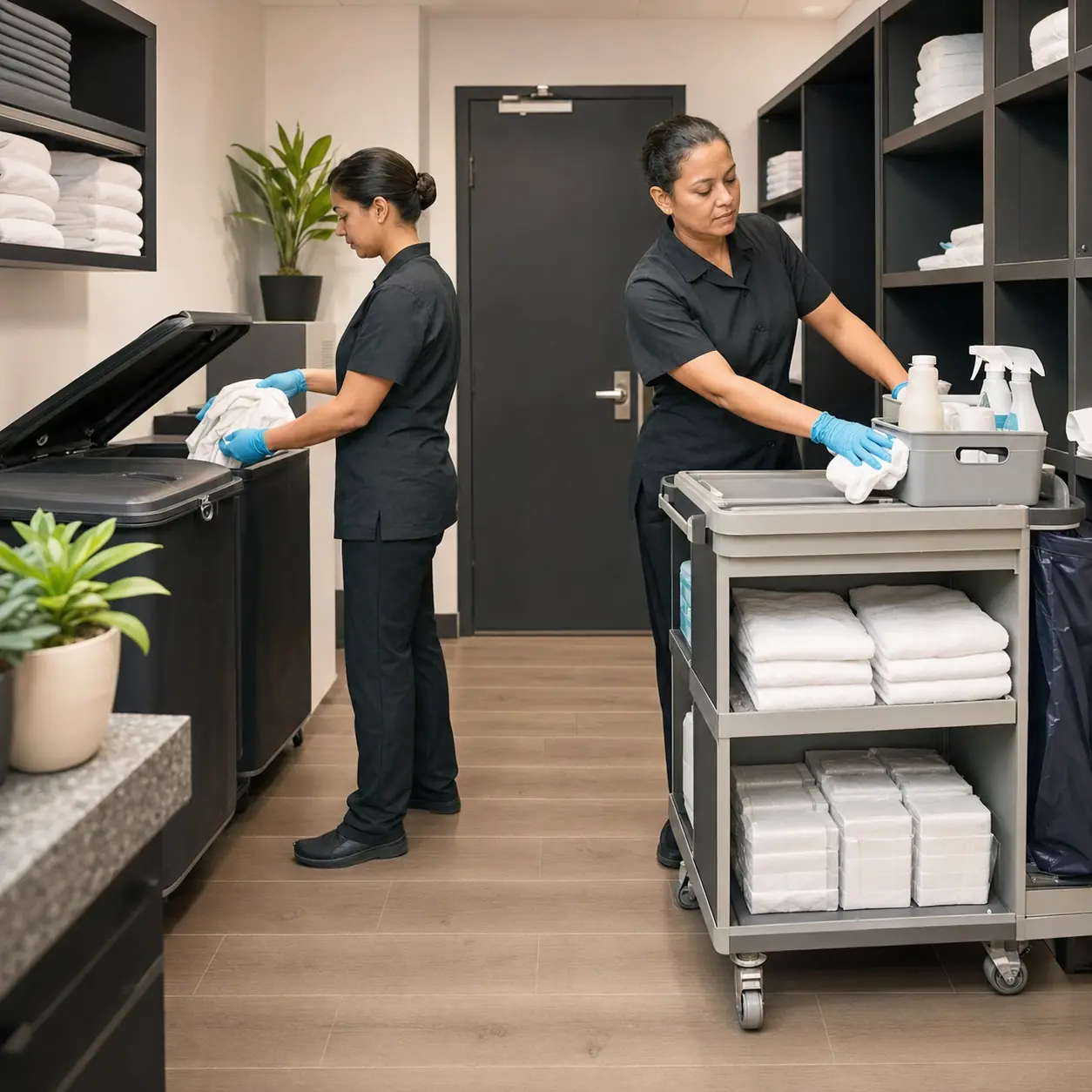
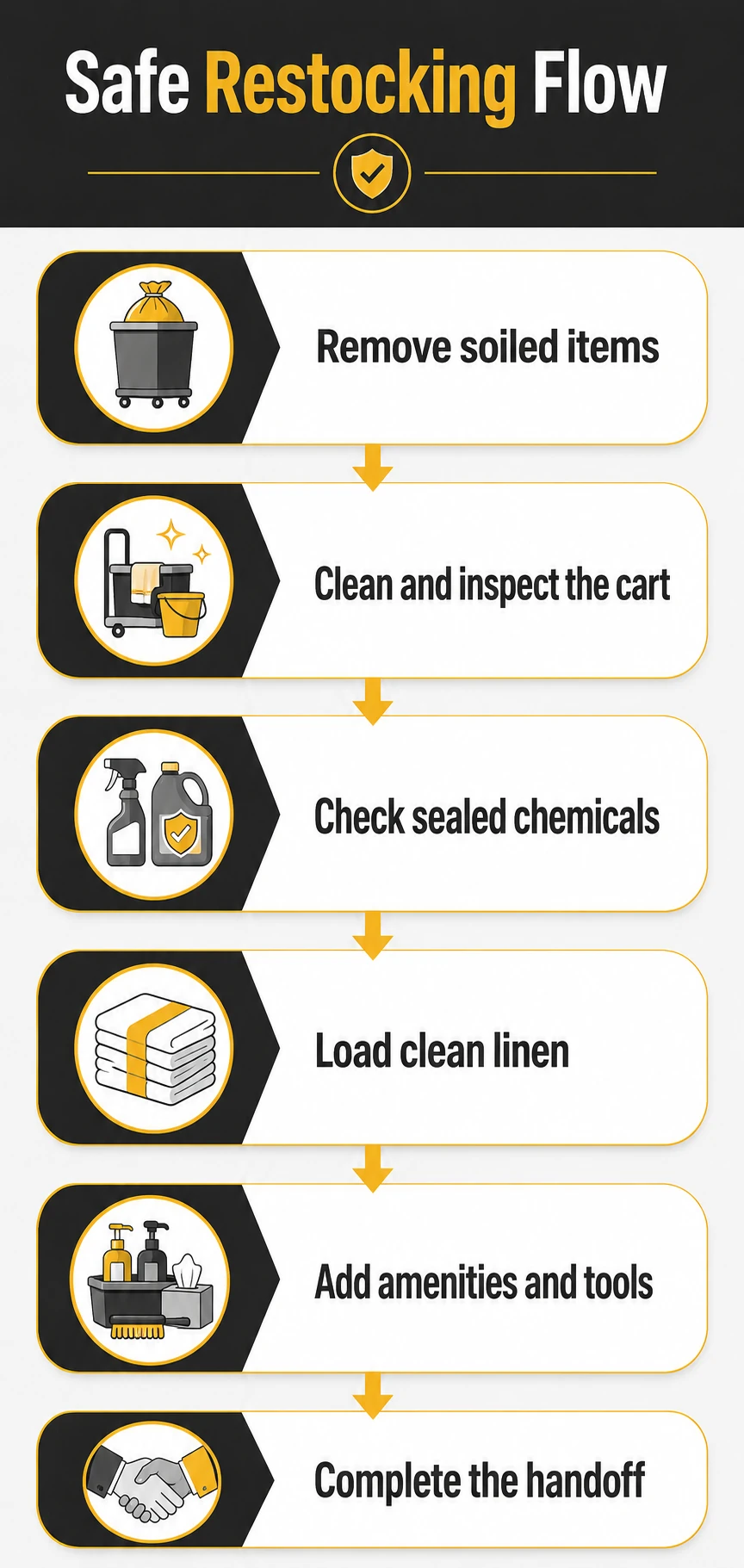
The safest restocking sequence begins by removing returns and contamination before clean products are loaded. A cart arriving from the floor should not be topped up around used cloths, waste, leaking bottles, or damp linen. The team should empty the designated return zones, clean and inspect cart surfaces, check wheels and handles, and confirm that chemical containers are closed, labeled, and in good condition. Only then should clean linen, paper goods, amenities, tools, and protective equipment be replenished. A short sign-off or digital handoff records unresolved shortages and prevents the next shift from assuming the cart is complete.
End-of-shift versus start-of-shift checks
End-of-shift restocking is usually more reliable because the attendant who used the cart can report unusual consumption, damaged equipment, or missing supplies. The cart can then be left clean and substantially ready. A start-of-shift check remains necessary to confirm the room assignment, add route-specific quantities, verify that time-sensitive products are ready, and document stockouts that occurred overnight. Dividing responsibility this way avoids a rushed full reload during morning deployment while preserving a final check against the current room list.
Chemical and hygiene controls
Follow the product label, the hotel’s chemical program, and applicable local requirements. OSHA’s guidance for workers who use cleaning chemicals emphasizes training on hazards, handling, storage, dilution, spill procedures, and required PPE; it also warns that a “green” label does not automatically make a product safe. Keep current safety data accessible, never mix chemicals, and do not transfer products into unapproved or unlabeled containers. The OSHA cleaning chemical safety guide is a useful US reference, but each property must apply the rules that govern its location.
For disinfectants, use only approved products for the intended surface and follow the label’s dilution, application, and contact-time directions. The US EPA disinfectant guidance explains that efficacy depends on using the product according to its label. Keep clean cloths separate from used cloths and return used materials for the property’s laundering or disposal process. CDC environmental-cleaning guidance for healthcare settings also stresses carrying enough clean cloths and maintaining separation between clean and soiled materials; hotels can apply that separation principle while following their own risk profile and procedures.
| Supervisor sign-off: Do not release a cart with an unidentified chemical, a leaking bottle, blocked wheels, an unsecured bag, visibly soiled clean-supply zone, or an unresolved critical shortage. |
Audit Consumption, Reorder Early, and Standardize Procurement
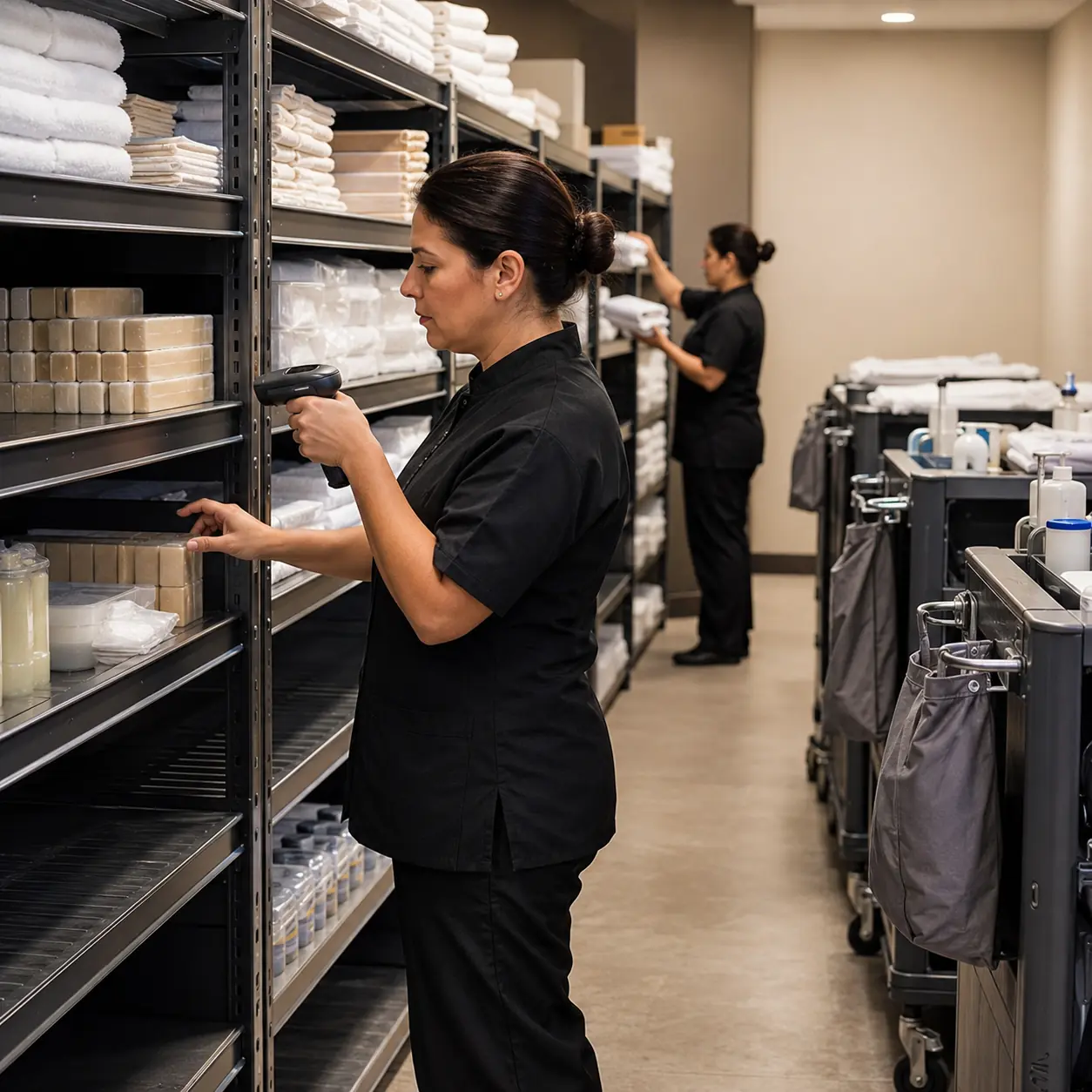
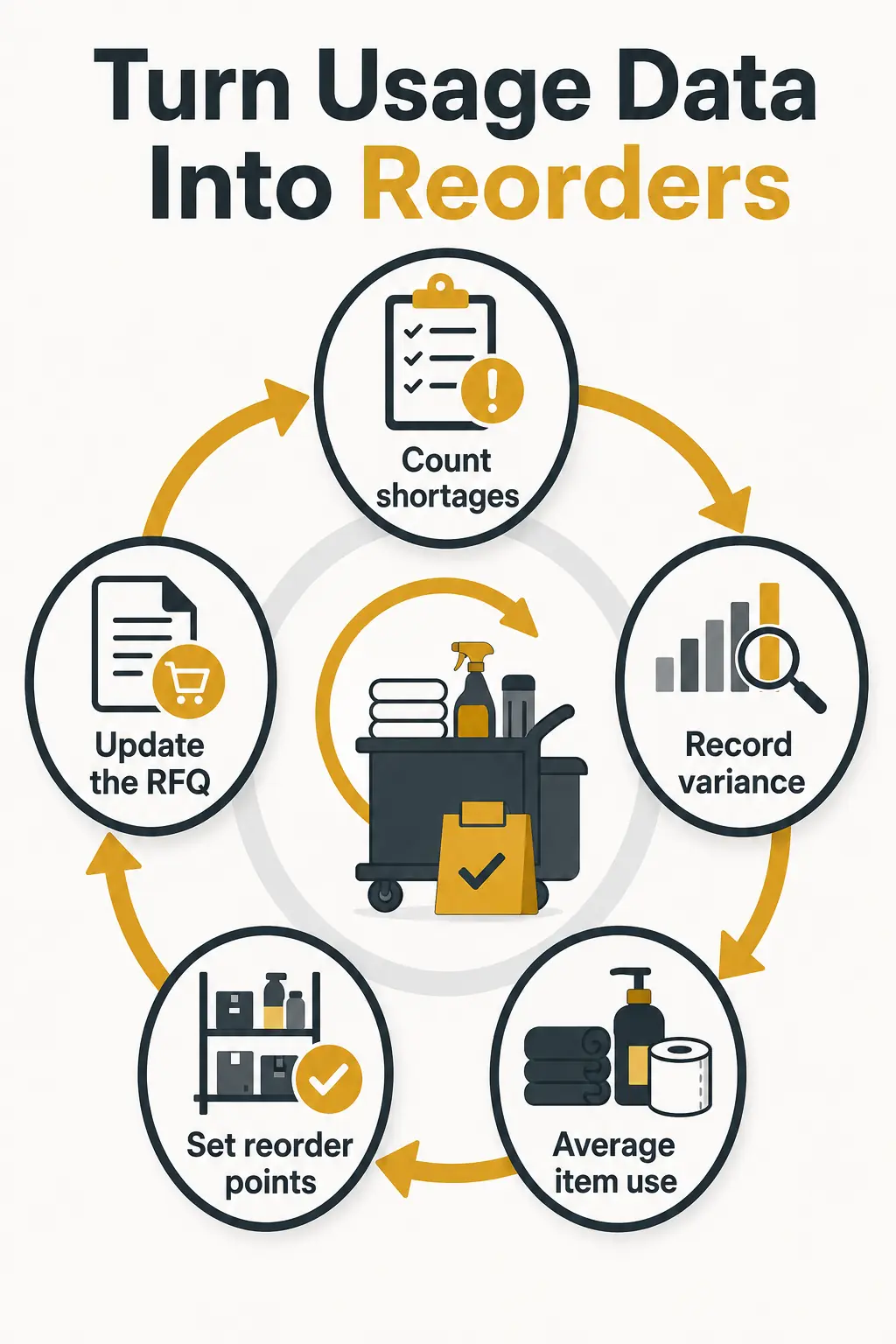
A restocking checklist becomes a management tool when the hotel records variance instead of simply filling the cart again. Track which items repeatedly fall short, which return unused, and which create substitution or quality problems. Compare usage by occupancy, room type, service type, floor, and shift where the data volume supports it. This reveals whether the issue is an incorrect par, uneven storeroom replenishment, an unsuitable pack size, waste, theft, supplier inconsistency, or a cart design that hides inventory. The objective is not to monitor individuals through isolated counts; it is to improve the operating standard with enough evidence to make responsible changes.
Create simple reorder signals
Use average daily consumption, supplier lead time, delivery frequency, storage capacity, minimum order quantity, and an agreed safety stock to set a reorder point for each important item. High-use linen, tissue, liners, core amenities, and approved chemicals usually need stronger controls than request-only items. Review damaged or rejected goods separately from normal consumption so quality failures do not disappear inside usage figures. The Excel checklist in this package includes fields for required quantity, opening quantity, additions, final quantity, shortage, status, owner, and notes so the same operational record can support purchasing decisions.
Turn the standard into a quote-ready specification
When it is time to source carts or recurring supplies, describe the operating requirement rather than sending a generic product name. For carts, specify overall dimensions, shelf and drawer configuration, bag capacity, door requirements, wheel material and diameter, bumpers, finish, cleanability, replacement parts, sample approval, and packaging. For consumables, specify material, dimensions or fill volume, color, performance standard, packaging unit, labeling, compatibility, approved samples, expected consumption, delivery destination, and required documentation. KW Hospitality’s guide on how to write an RFQ for hotel supplies shows how consistent specifications make supplier responses easier to compare.
If your property is standardizing housekeeping carts, linen, guest amenities, janitorial supplies, or a multi-category opening package, submit the item list, route requirements, quantities, project location, target delivery date, reference images, and any required customization through the KW Hospitality RFQ form. The sourcing review can then be built around the property’s operating standard rather than a disconnected catalog list.
Frequently asked questions
Should every housekeeping cart carry exactly the same quantity? No. Every cart should use the same item standard and layout logic, but quantities should reflect the assigned route, room types, turnovers, stayovers, special setups, and cart capacity.
When should a housekeeping cart be restocked? Complete the main cleaning and replenishment at the end of the shift, then perform a short route-specific verification before deployment. Properties with multiple handoffs may add a mid-shift control for high-use items.
Should bulk chemicals be stored on the cart? Usually no. Keep concentrates and bulk containers in the approved storage or dispensing area unless the property’s documented procedure specifically authorizes cart transport. Carry only approved, closed, correctly labeled working containers.
How large should the cart buffer be? Use a small, item-specific buffer based on observed variance. Avoid one blanket percentage for every item, and do not exceed safe cart weight or compartment capacity.
Who owns the final cart sign-off? The property should assign responsibility explicitly. Common models use the outgoing attendant for condition and usage reporting, the storeroom or runner for replenishment, and a supervisor for exceptions and release.