Luxury hotel bathroom amenities should make everyday tasks comfortable and effortless: washing with clearly identified products, drying off with an absorbent towel, using a dependable hair dryer, and finding useful items without searching. A successful amenity program combines product performance, thoughtful presentation, and a housekeeping routine the hotel can repeat. An expensive fragrance or a crowded tray cannot compensate for an empty dispenser, a rough towel, or a tool that is awkward to use.
For hotel owners, purchasing managers, and housekeeping teams, the buying decision therefore starts with the guest experience and continues through cleaning, replenishment, storage, and replacement. Shampoo, conditioner, body wash, hand soap, towels, and grooming equipment need different evaluation methods. They also interact: a larger dispenser can reduce counter space, heavier textiles can affect laundry throughput, and an unfamiliar mounting system can complicate a seemingly simple brand change. Evaluate the collection as an operating system, with clear responsibility for each part.
This guide focuses on selecting and maintaining bathroom amenities for hotels in Canada and the United States. It covers consumable toiletries, towels and robes, grooming tools, small accessories, and the way those products are presented. Plumbing, ventilation, and permanent electrical work belong to the wider bathroom project and need their own technical review. Where brand requirements or local rules apply, confirm them before approving the product assortment; there is no universal shopping list that establishes a hotel’s luxury status.
The practical approach is to protect the essentials first, select a few meaningful upgrades, and compare the full cost of keeping everything ready for the next guest. The sections below provide an assortment framework, a dispenser comparison, and a worked cost example. Use them to turn attractive samples into clear purchase specifications and a manageable supply plan, without assuming that the highest price or the longest product list produces the best result.
Choose a Focused Amenity Set
Start with the tasks guests need to complete and the service promise attached to each room category. Build a dependable everyday assortment, then decide which additions belong in selected rooms and which can be supplied on request. This approach protects the budget for frequently used products while keeping the bathroom easy to navigate and clean. It also makes differences between room categories deliberate: an upgraded robe or a better grooming tool can have a clear purpose, whereas several rarely used packets may simply consume space. The right selection depends on guest needs, brand standards, available storage, and the team’s ability to deliver each item consistently.
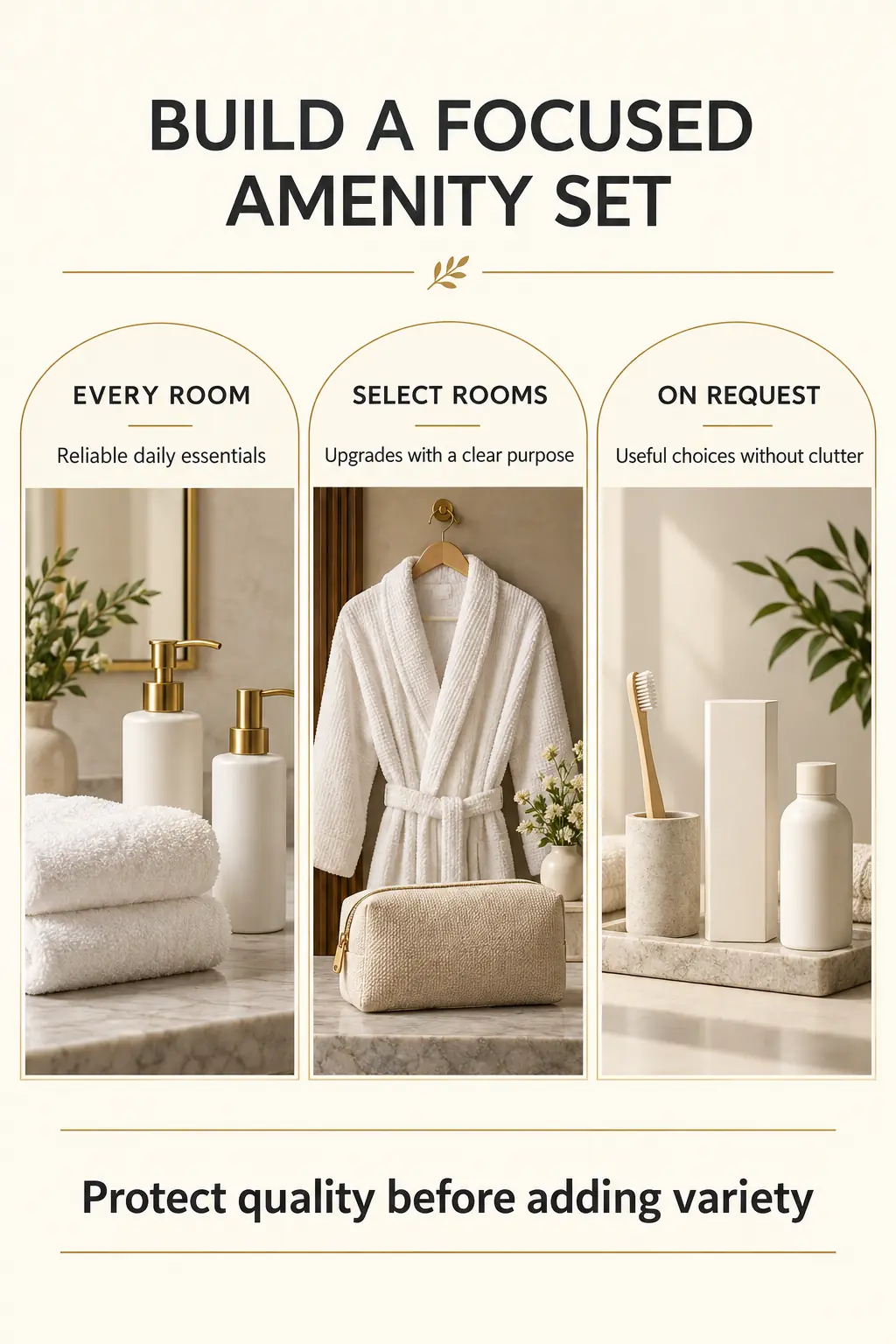
Separate essentials, selective upgrades, and request items
The following is a planning framework, not a star-rating standard. Adjust it to the property’s positioning and confirmed guest requirements.
| Amenity group | Suitable starting role | Buying decision that matters |
| Shampoo, conditioner, body wash, and hand soap | Core washing products in the room | Distinct identification, usable dispensing, acceptable formula, and reliable replenishment. |
| Bath towels, hand towels, washcloths, and bath mat | Core textile assortment defined by the room standard | Finished size, absorbency, condition after laundering, and replacement availability. |
| Hair dryer and useful mirror lighting | Everyday grooming provision | Ease of use, storage, cleaning access, and suitability for the destination market. |
| Body lotion, robe, and slippers | Standard or selective upgrade, depending on the property | Actual use, fit, comfort, laundering or disposal, and the full cost of provision. |
| Dental, shaving, vanity, and shower-cap kits | In-room or on-request service | Guest demand, intact packaging, accessible information, and dependable delivery. |
| Fragrance-free alternatives and additional sizes | A clearly communicated request option | Exact product information, availability, and a process staff can explain accurately. |
An on-request item only works when the request is easy to make and staff can fulfill it. A late-night arrival who needs a toothbrush should not have to discover that the service is unavailable until morning. Decide how the option appears in the guest directory, where stock is held, and who responds during each shift.
Spend on the weak point guests actually encounter
Use existing complaints, replacement requests, housekeeping observations, and sample feedback to identify the first upgrade. If dispensers run empty, correct stock visibility and servicing before buying a more elaborate bottle. If towels feel rough, investigate the product and laundry process together before automatically increasing fabric weight.
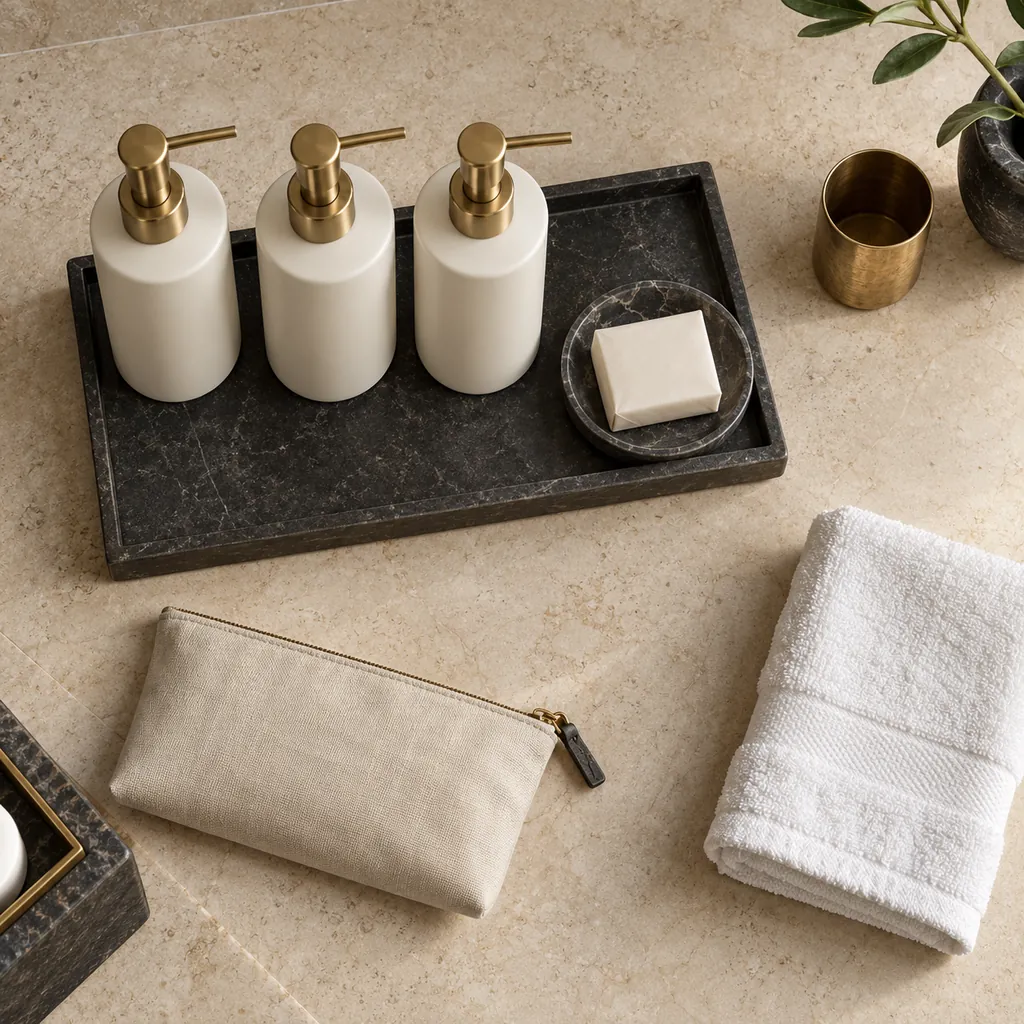
Keep the display coherent but useful. Leave room for guests’ own belongings, choose trays that can be lifted and cleaned, and avoid finishes that become visibly damaged under the hotel’s cleaning method. Decorative glass containers need a breakage assessment, especially near wet areas. More objects also mean more surfaces to inspect, move, and reset.
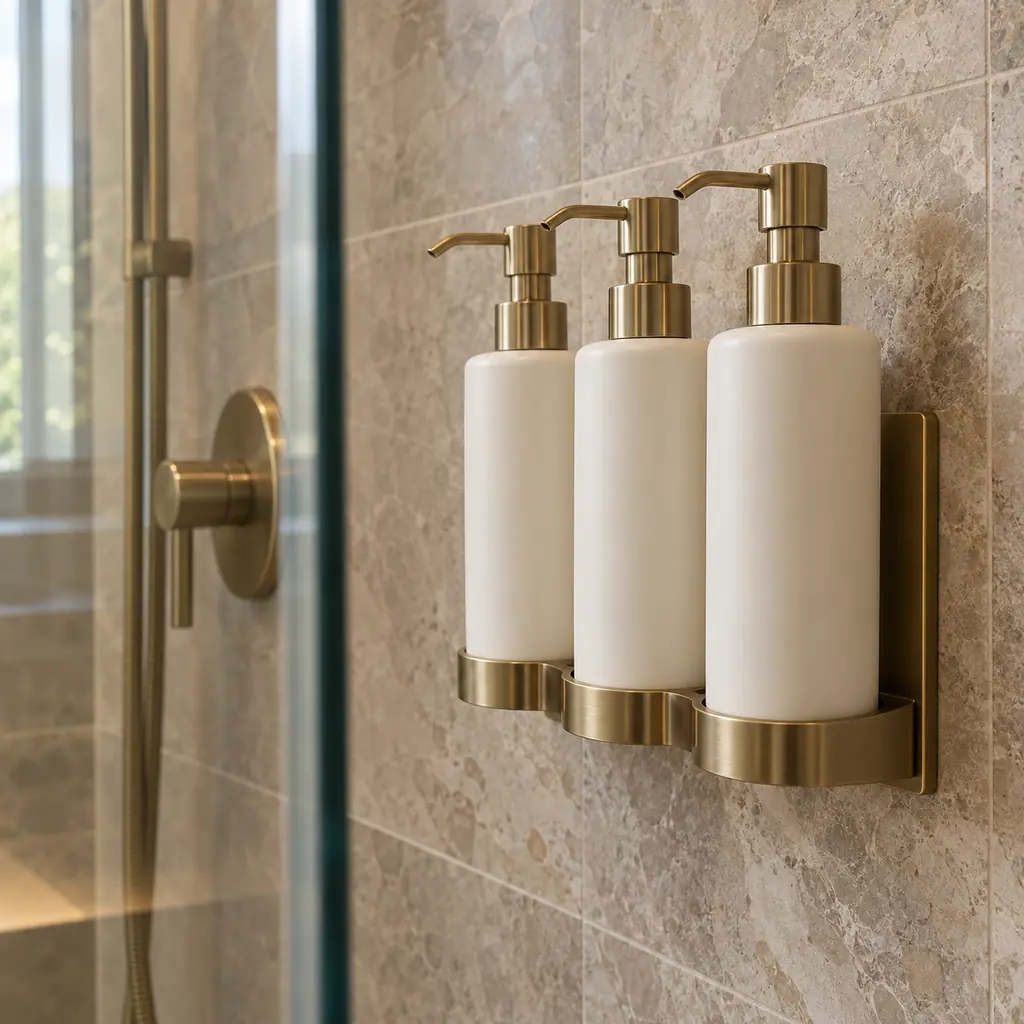
Evaluate Toiletries and Dispensers as One System
Choose the liquid, its packaging, and the dispensing hardware together. A formula that feels good in a sample sachet may dispense poorly through the proposed pump, while an elegant bottle may be difficult to identify or replace in the shower. Compare the complete combination using the hotel’s water, room layout, and normal servicing routine. Housekeeping should be able to recognize the product, assess whether it needs attention, clean the surrounding area, and restore the setup consistently. Guest-facing appearance matters, but it should be supported by clear product information, controlled handling, and a replenishment arrangement that remains practical after the opening order.
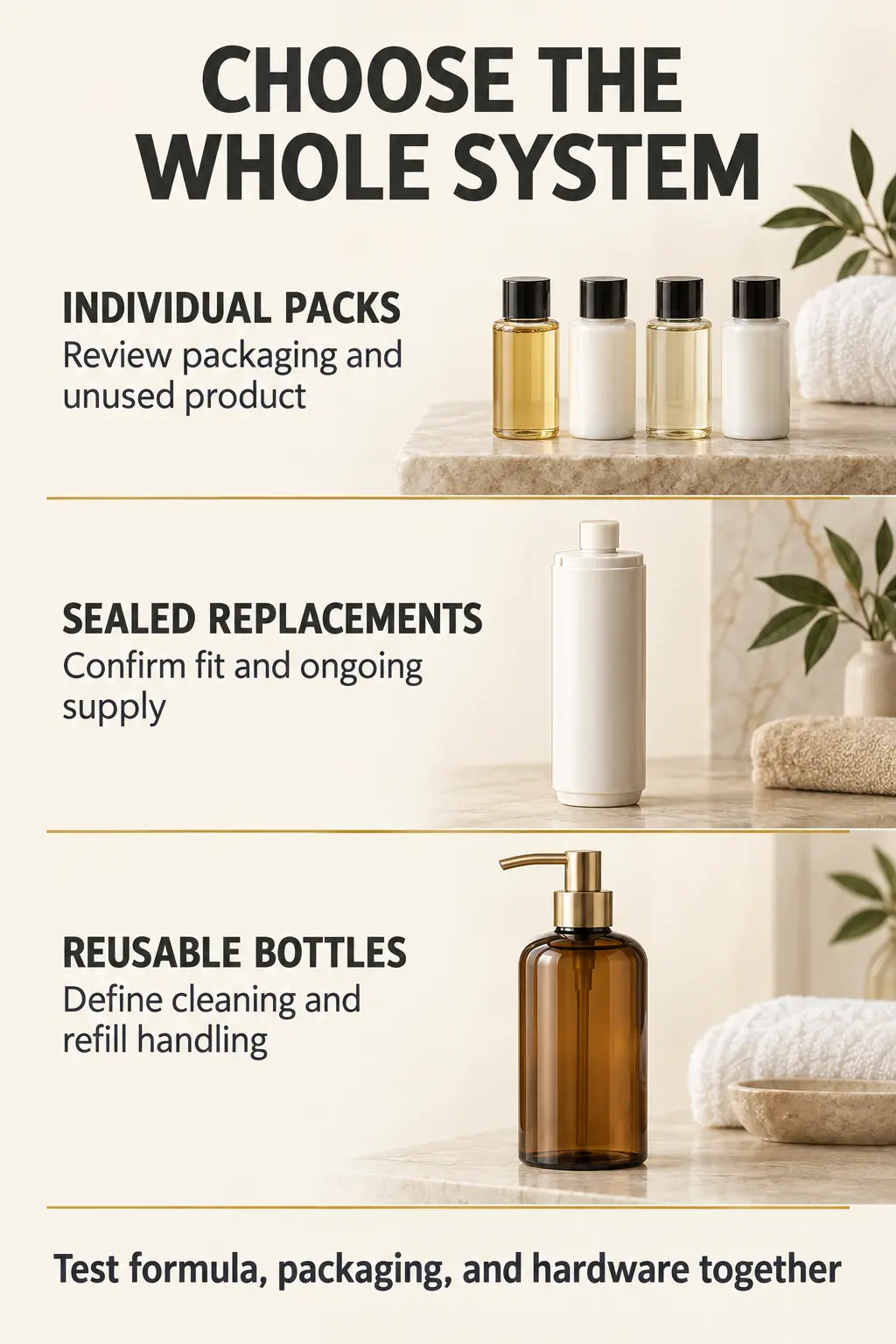
Evaluate the formula without relying on marketing terms
Assess shampoo, conditioner, body wash, and lotion separately. Record observations about dispensing, spread, rinsing, residue, fragrance intensity, and the amount used under comparable conditions. Gather feedback from people with different preferences; a small hotel trial helps compare usability but does not establish medical safety or prove that a product suits everyone.
Ask for the current ingredient list, product identification, batch traceability, storage instructions, usable life, and relevant supplier documentation for the intended market. Keep that information accessible when a guest asks about an ingredient. Do not assume that “natural,” “botanical,” or “hypoallergenic” means a product cannot cause a reaction. In the United States, “hypoallergenic” has no federal definition that guarantees a particular performance standard.
Keep fragrance restrained enough that it does not dominate the bathroom. If fragrance-free alternatives are offered, verify the exact formulation and description rather than treating “unscented” as an automatic equivalent. Staff should provide factual product information and avoid assuring a guest that an item is allergy-safe.
Compare packaging by how it is actually serviced
| Format | Potential operational advantage | Trade-off to resolve |
| Individually packaged toiletries | Straightforward identification and replacement; useful for selected service models | Packaging volume, unused product, storage, and any restrictions applying at the property location. |
| Sealed replacement cartridges or bottles | Defined changeover with less open handling during replacement | Proprietary fit, residual product, replacement price, and continuity of supply. |
| Reusable bottles filled from bulk product | Flexibility where the supplier supports the complete system | Documented emptying, cleaning, drying, refill handling, labor, and product compatibility. |
Do not assume that every large bottle is refillable or that every cartridge replaces its pump. Obtain the instructions for the exact system. Do not dilute products, mix formulas, or add fresh hand soap to partially empty soap containers. For reusable dispensers, follow the manufacturer’s validated cleaning and refill procedure; a hotel’s visual inspection alone cannot verify microbiological quality.
The choice is easier when procurement compares sealed cartridges and refillable dispensers as different housekeeping workflows. For a brand change, separately review bottle and mounting compatibility before assuming existing brackets can stay.
Make identification and access part of the sample review
Use readable, durable product names and distinguish shampoo from conditioner without relying only on color. Have the project team evaluate pump operation, reach, and placement in the actual room, including accessible layouts. A successful test in one standard bathroom does not establish accessibility compliance throughout the property.
Inspect leakage, drips, label durability, release-key access, and the space needed to change a bottle. Secure access can discourage casual tampering, but it is not a guarantee against contamination. Request a product sample from KW Hospitality with the intended formula, bottle, pump, and holder identified, so the review concerns the combination that would actually be ordered.
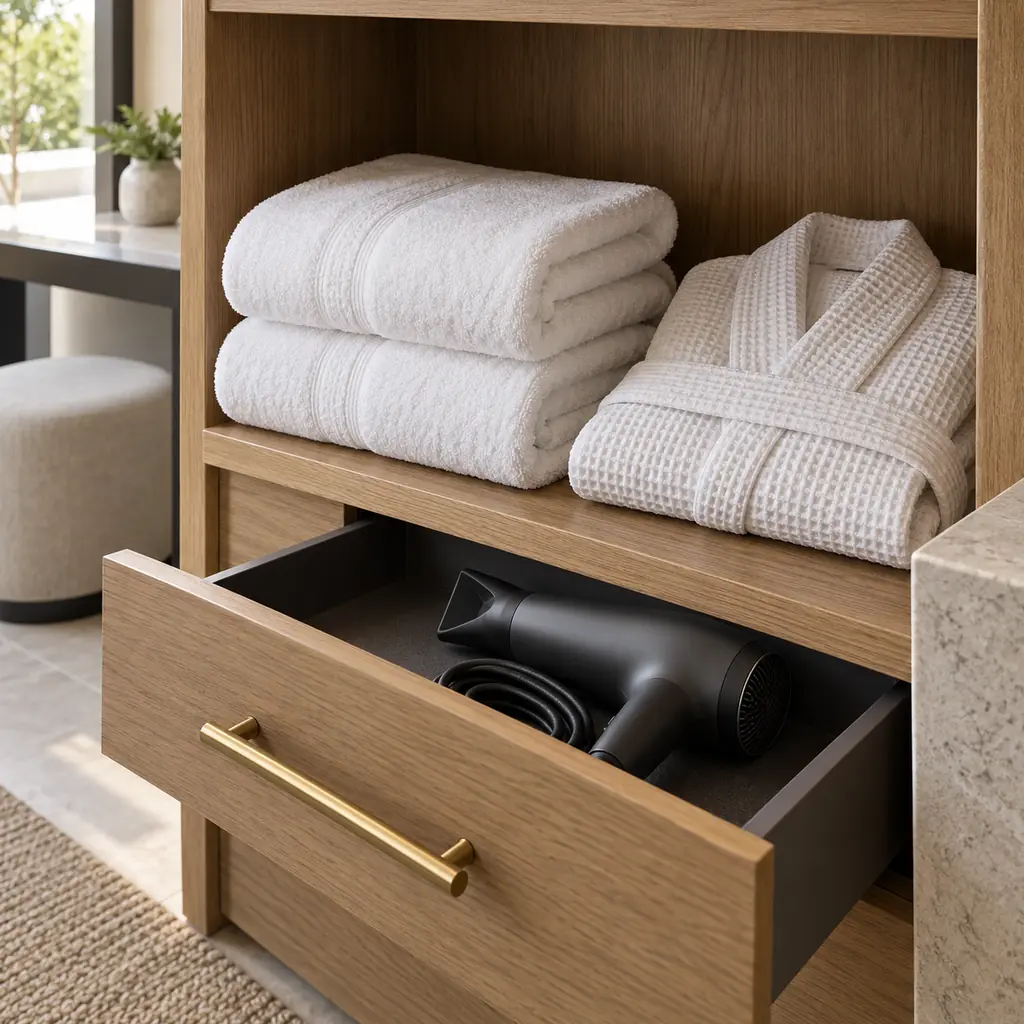
Match Textiles and Grooming Tools to Daily Use
Evaluate bathroom textiles and grooming equipment after use and servicing, not only when they are newly unpacked. A towel has to remain absorbent and presentable through the hotel’s laundry process; a robe has to fit comfortably and return to service on time; a hair dryer has to be convenient to handle, clean, and store. These products have different replacement cycles, so a matching visual style does not justify buying them as an untested set. Compare samples in representative rooms and ask housekeeping, laundry, and engineering to review the details that affect their work before a preferred appearance becomes a bulk purchase.
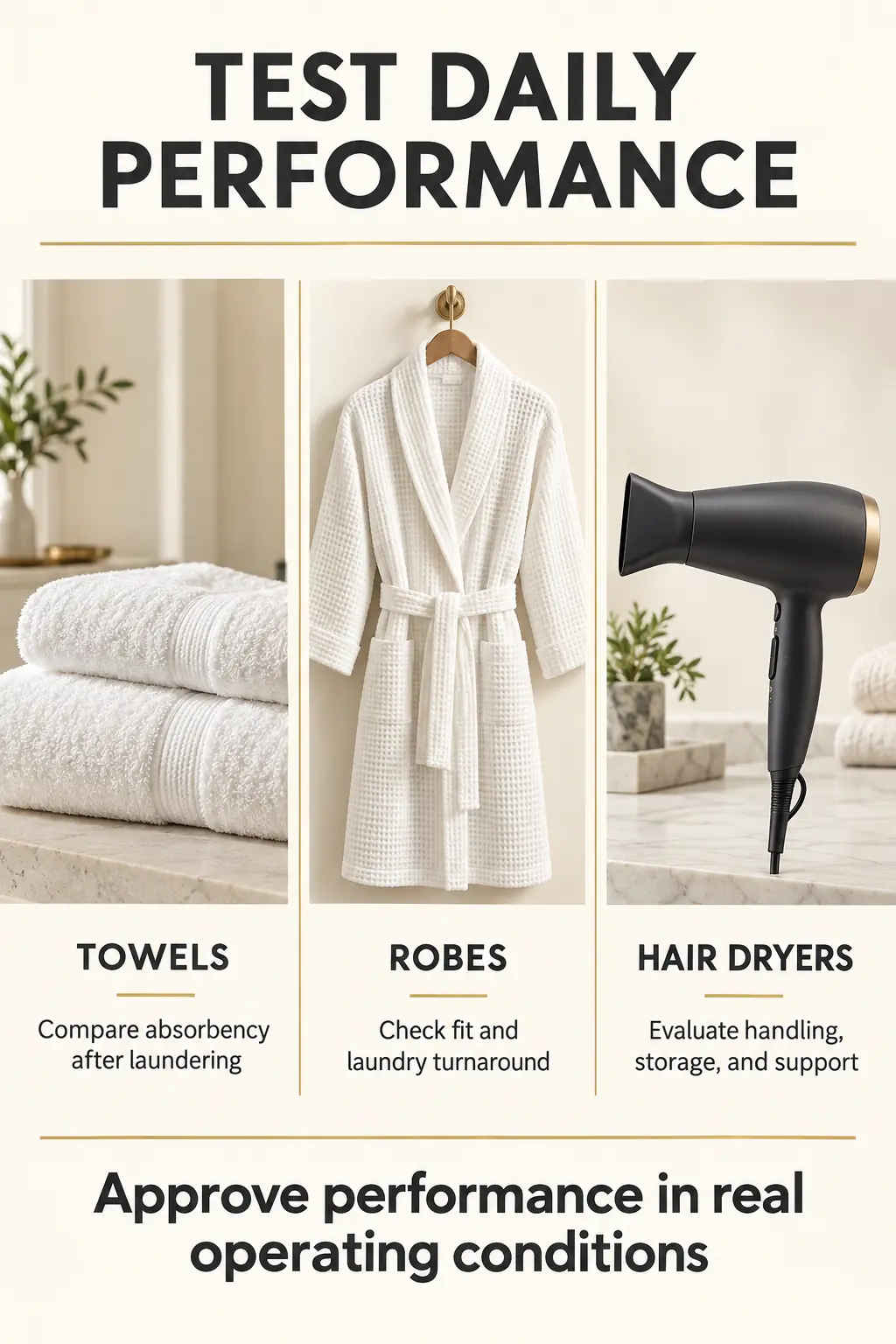
Towels and robes: compare finished performance
Grams per square meter, usually shortened to GSM, describes fabric mass per area. It does not independently measure softness, absorbency, durability, or overall quality. Towels with the same GSM can differ in size, yarn, construction, finishing, and condition after washing. A larger towel can also add laundry mass even when its GSM is unchanged.
Evaluate finished dimensions, edge stitching, absorbency, lint, drying time, and appearance after the hotel’s intended wash and dry process. Agree the trial conditions and acceptance criteria before testing. Retain an approved reference sample and record changes, rather than describing the result only as “premium quality.” A trial provides evidence for that product and process; it cannot establish an unlimited service life.
For a heavier textile range, review towel weight and dryer capacity together. For robes, include size availability, coverage, belt attachment, pocket construction, and the laundry load created by the hotel’s replacement policy. A garment that looks generous on a hanger may still fit a guest poorly.
Hair dryers: compare use, storage, and support
Wattage alone cannot tell a buyer how fast, quiet, or comfortable a dryer will be. Compare drying performance under consistent conditions, handling weight, control placement, heat options, filter access, and the cord’s usable reach. Check whether attachments are useful for the intended guests and how they will be stored and replaced.
Have engineering verify electrical ratings, protection features, documentation, and suitability for the destination market and installation. A compatible-looking plug is not sufficient evidence. Confirm that the warranty covers the proposed hotel use, and ask about replacement units and parts. Avoid promising a percentage reduction in drying time or a fixed lifespan unless the specific claim is supported by an applicable test or warranty.
Store the appliance in a suitable dry location and follow its instructions for operation, cooling, and cleaning. Do not improvise power arrangements or place equipment where its cord creates an obstruction or exposes it to water.
Small accessories should remove friction
Look at the room from the guest’s position: is there a dry place for a toiletry bag, useful light at the mirror, and an accessible tissue or waste bin? Assess slipper fit and sole behavior for the intended setting; do not infer slip resistance from appearance. Keep grooming kits sealed until use and decide how opened or damaged items will be handled.
Coordinate movable accessories with the room’s accessibility review. A tray, bin, or enlarged dispenser can create a new obstruction even when the original bathroom layout was approved. Choose decorative consistency after usability has been confirmed.
Price the Program and Approve a Working Sample
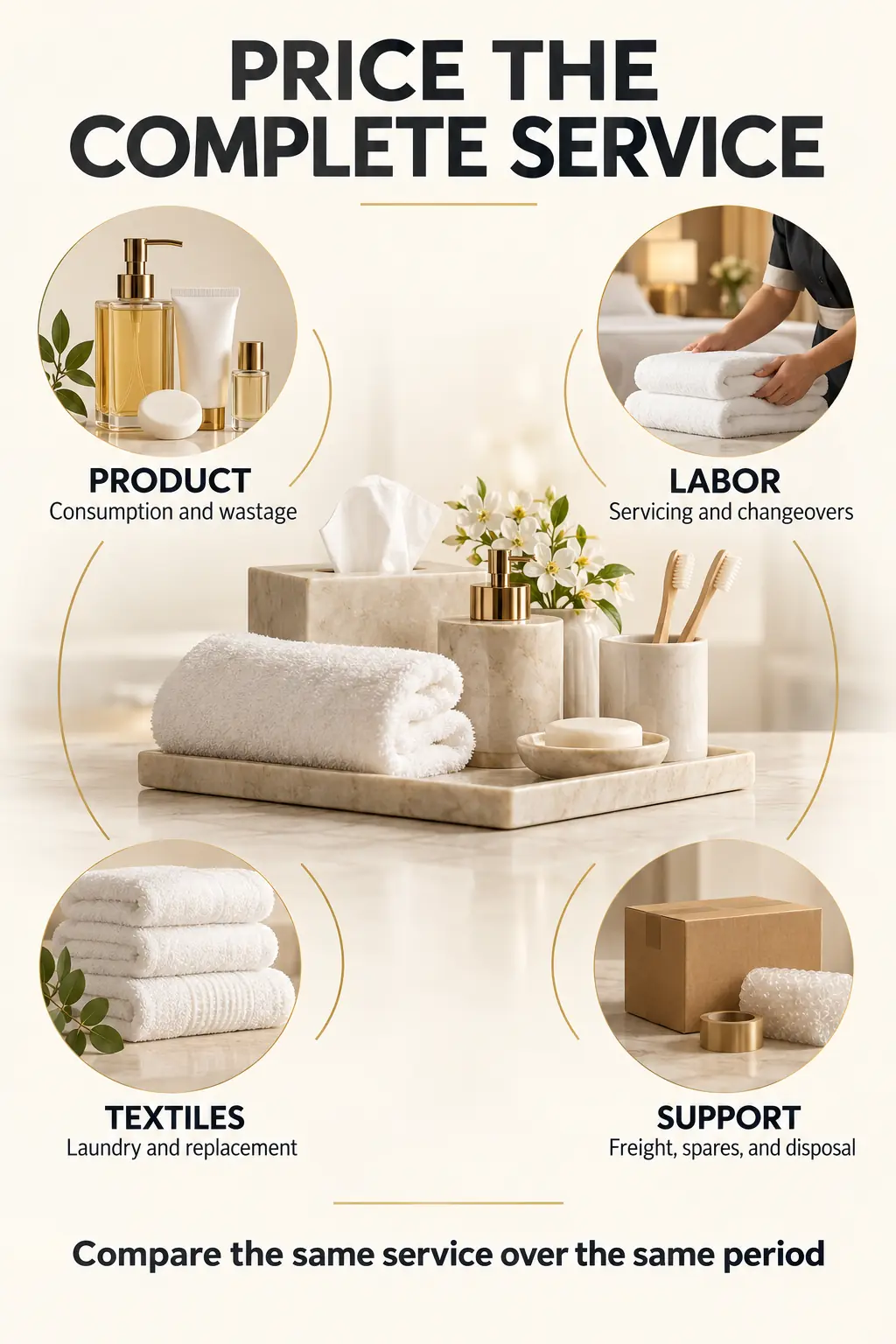
Compare amenity programs using the cost of delivering the same guest service over the same period. Unit prices are useful, but they leave out differences in product consumption, servicing time, laundry, breakage, and replacement. Start with the full purchase and installation cost, then estimate recurring cost per occupied room night using explicit assumptions. Update those assumptions with measured pilot results and supplier quotations. This gives procurement a defensible comparison while making the trade-offs visible to operations: a cheaper refill can require more handling, and a more expensive towel can change both replacement spending and the laundry workload.
Use occupied room nights as a consistent denominator
One occupied room night means one room occupied for one night, regardless of how many guests share it. Keep occupancy, guest mix, stay length, and housekeeping frequency visible because they affect consumption differently. Do not compare one supplier’s cost per stay with another supplier’s cost per occupied room night.
For illustration only, consider a 120-room hotel at 75% occupancy during a 30-day month: 120 × 0.75 × 30 = 2,700 occupied room nights. The following CAD amounts are hypothetical budgeting inputs, not supplier prices or industry benchmarks.
| Cost component | Illustrative monthly allocation | Cost per occupied room night |
| Toiletries and small consumables | CAD 1,674 | CAD 0.62 |
| Amenity servicing labor | CAD 900 | CAD 0.33, rounded |
| Bathroom textile laundry and replacement allocation | CAD 1,485 | CAD 0.55 |
| Grooming equipment and accessory replacement allocation | CAD 540 | CAD 0.20 |
| Allocated freight, damage, and disposal | CAD 270 | CAD 0.10 |
| Total | CAD 4,869 | CAD 1.80, rounded |
The calculation is total attributable cost divided by occupied room nights. This example excludes the initial installation project, financing, and recoverable taxes. It is a planning allocation, not an accounting depreciation schedule. Keep categories mutually exclusive so freight or damaged stock is not counted twice. Allocate any one-time conversion cost separately over a stated planning horizon when comparing options.
Consumption matters as much as the purchase rate. At an assumed CAD 12 per liter, 25 mL of product costs CAD 0.30; at 35 mL, it costs CAD 0.42. That difference is CAD 324 over 2,700 occupied room nights. These are illustrative inputs for one product, not recommended usage levels. Measure actual drawdown, residual product, and wastage before forecasting savings.
Approve a sample that represents the delivered product
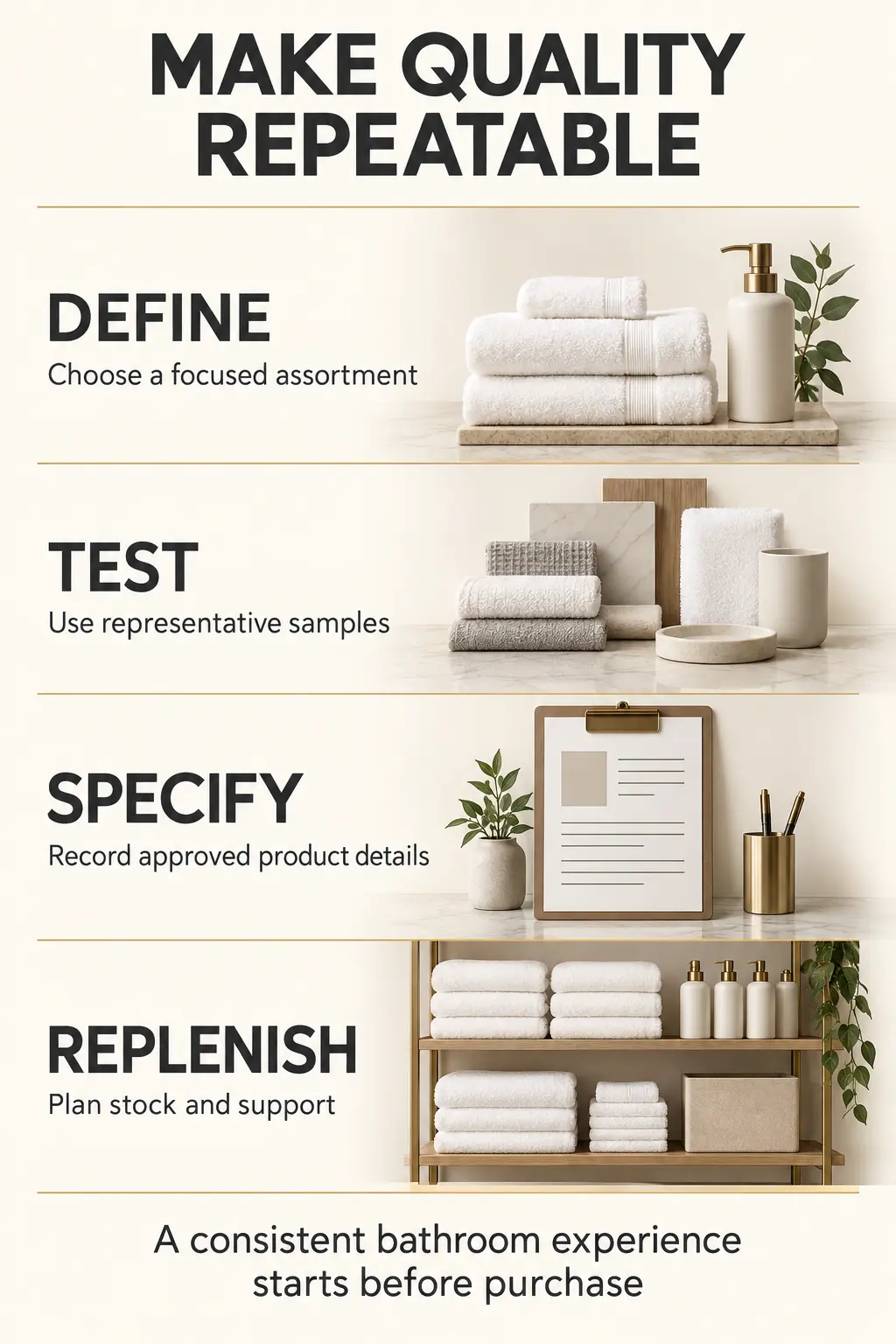
Agree which rooms, servicing cycles, and operating conditions the pilot must cover. Housekeeping should perform normal changeovers; laundry should process the proposed textiles; engineering should review hardware and appliances. Record leakage, product identification errors, servicing time, damaged finishes, textile condition, and guest feedback where available. Resolve recurring failures before expanding the order.
Identify the approved formula, pack size, pump or cartridge, holder, textile dimensions, materials, finish, and packaging in the purchase specification. Keep photographs and a physical reference where practical. State which substitutions need written approval. A fragrance name or a catalog photograph alone does not define the product sufficiently.
Ask for minimum order quantities by item and customization, sample and production lead times, delivery terms, spare-part availability, remaining usable life on receipt, and notification before product changes. Set replenishment around actual consumption, replenishment lead time, and an explicit safety-stock allowance. Opening quantities and ongoing reorder quantities serve different purposes.
Measure environmental improvements in concrete terms
Compare the packaging discarded, product left unused, handling process, and replacement demand under each option. A large dispenser is not automatically “zero waste,” and a material described as recyclable still needs a suitable local collection route. Use specific statements supported by the product and the hotel’s actual disposal arrangement. Verify location-specific restrictions before selecting single-use toiletry packs for a Canadian or US property.

Conclusion
The strongest luxury bathroom amenity program is a focused collection that performs reliably and is easy to keep ready for guests. Protect the everyday essentials, evaluate toiletries with their dispensing system, and test textiles and grooming tools under actual operating conditions. Compare the full service cost using clear assumptions, then turn the approved sample into a precise purchasing specification. Attractive presentation should support identification, access, and cleanliness. A consistent experience comes from the products, the replenishment plan, and the people maintaining the room, so each needs attention before the order is placed.
To discuss sourcing with KW Hospitality, request a bathroom amenity quotation and include room count, product quantities, preferred formats, branding requirements, delivery city and postal code, and required delivery date. Add existing dispenser details when compatibility matters. Ask for sample availability, applicable charges, and a quotation based on the approved specification before committing to a bulk order.
Frequently Asked Questions
Does a luxury hotel need a famous toiletry brand?
No single brand is necessary for every luxury property. Recognition may be valuable to a hotel’s positioning, but it does not replace testing the formula, dispensing system, replenishment terms, and guest fit. If a management agreement or brand standard specifies a collection, resolve that requirement first. Otherwise, compare recognizable brands and private-label options against the same written criteria.
Should conditioner be separate from shampoo?
A separate conditioner gives guests a distinct choice and allows the hotel to evaluate both products on their own merits. It also adds a stock item and a dispensing position. Decide from the property’s service promise and guest needs, then test the proposed formulas. Do not assume that a combined product delivers the same experience simply because it reduces the number of bottles.
Can an existing holder be reused when the cosmetic brand changes?
Only after the exact new bottle or cartridge is confirmed compatible with the holder and servicing method. Similar size and appearance do not prove that the retaining mechanism, pump clearance, or release tool will work. Obtain a representative sample and written compatibility confirmation. Include wall repair and replacement hardware in the comparison when reuse cannot be established.
How many spare towels and robes should a hotel buy?
There is no universal quantity for every property. Calculate the items placed in rooms, those moving through laundry, clean reserve stock, and a justified allowance for loss or damage. Include occupancy peaks and laundry turnaround. A hotel’s own issue and replacement records provide a better basis than adopting another property’s stock multiple without understanding its operation.
Are bamboo or refillable amenities automatically sustainable?
No. Material names and refill formats describe only part of a product’s impact. Compare usable life, packaging, product waste, cleaning requirements, transport, and the actual local disposal route. Ask suppliers to substantiate specific claims and avoid broad promises such as “plastic-free” when a product still contains plastic components or packaging.
What should staff do if a guest reports a reaction to a toiletry?
Stop offering the implicated item to that guest, provide the product and ingredient information, and follow the hotel’s incident procedure. Preserve the product identity and batch details for investigation and notify the responsible manager and supplier. Staff should not diagnose the reaction or promise that another product is safe. If symptoms are severe or urgent, follow the property’s emergency-response procedure and seek medical assistance.