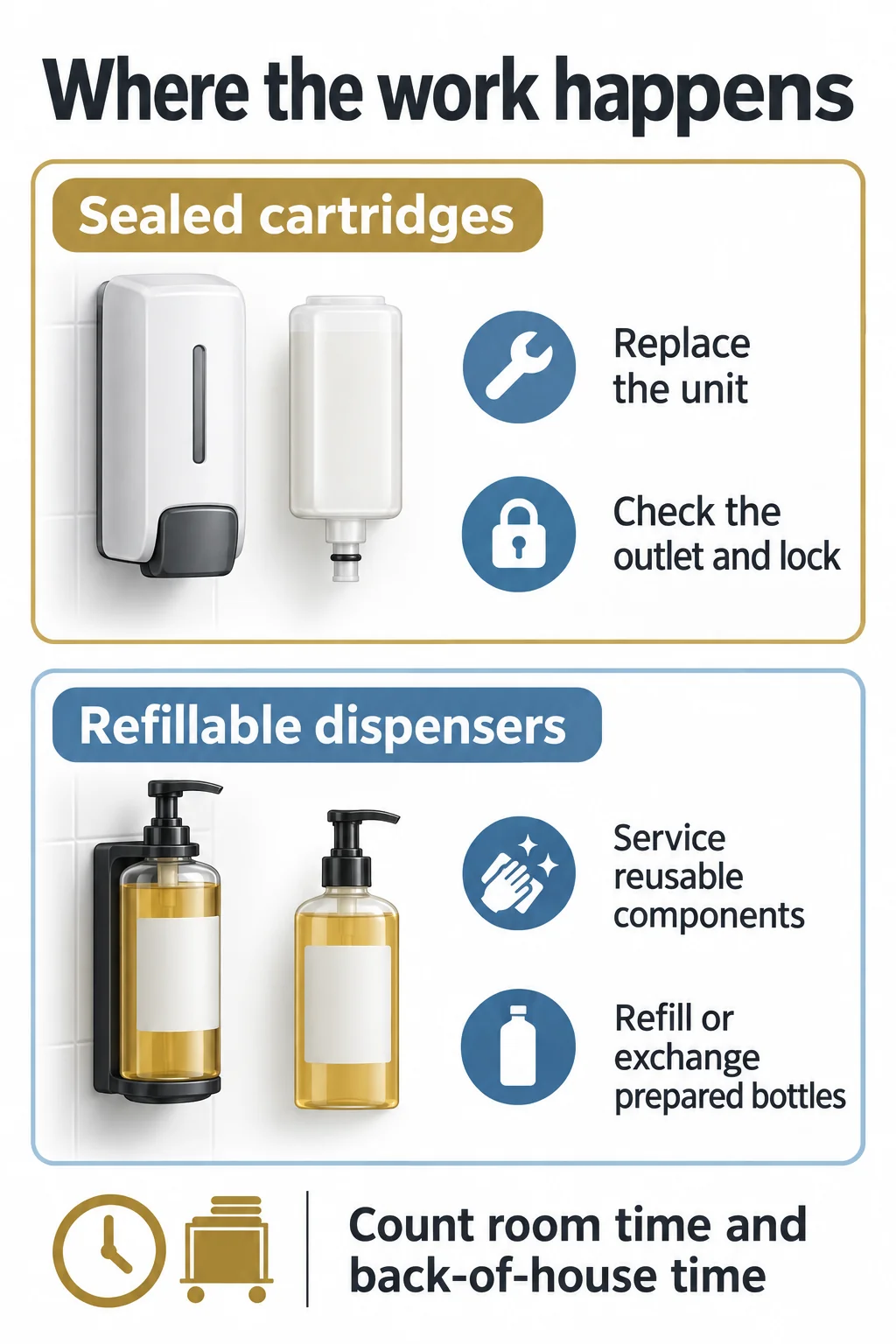
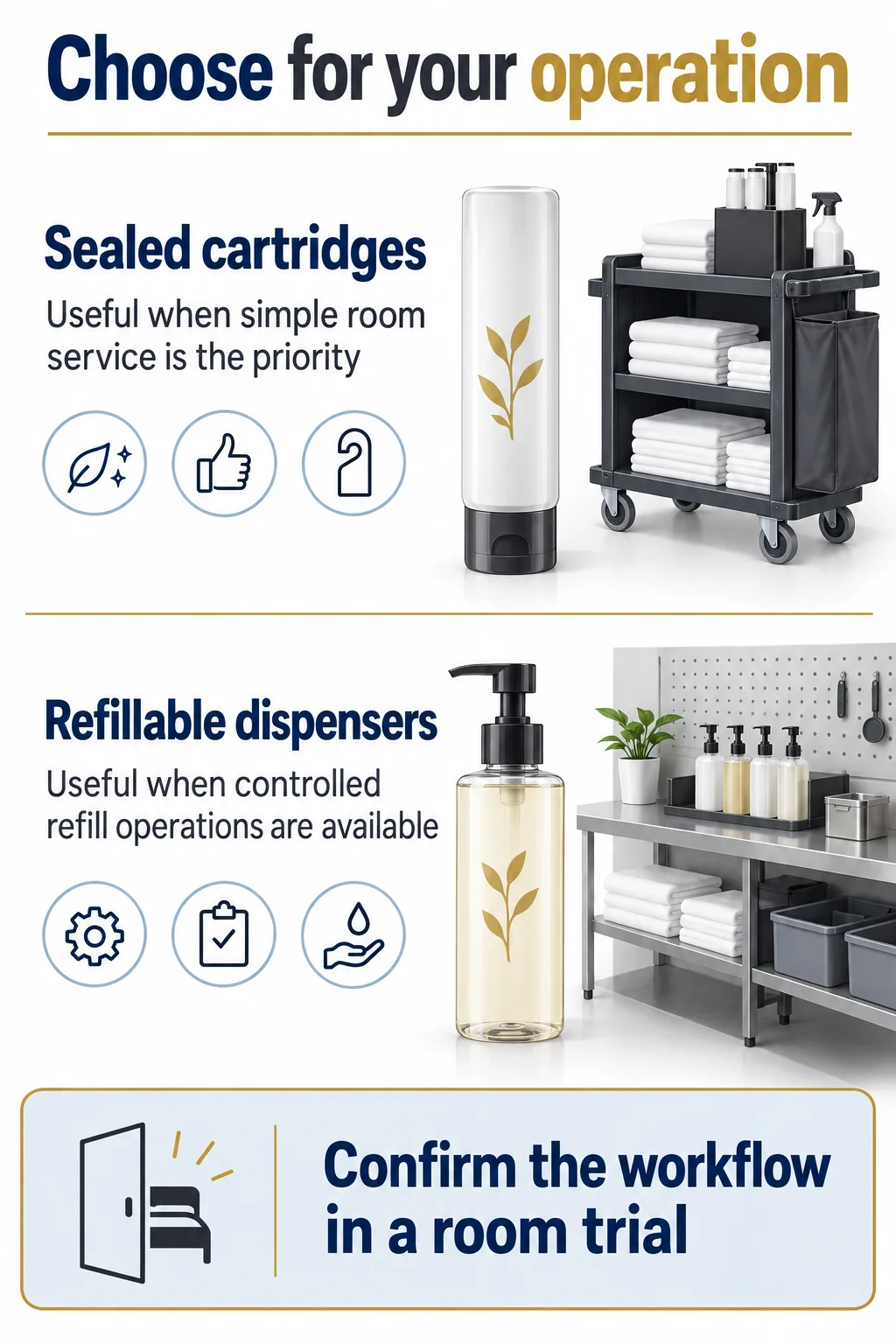
Sealed cartridges usually simplify replenishment because housekeeping replaces a prepared unit without pouring liquid. Refillable dispensers can support reuse and flexible purchasing, but they require a controlled process for the bottle, pump, refill equipment, and product records. The better hotel toiletry system is the one your team can operate consistently at an acceptable total cost, including work outside the guest room.
That distinction matters during a busy departure morning. A dispenser that looks inexpensive on a purchasing spreadsheet may add handling steps, spills, or repeat visits. A cartridge that appears faster in a demonstration may have a difficult lock, an unreliable level indicator, or a supply arrangement that makes replacement stock hard to obtain. Neither the container size nor the price per liter captures those effects.
This comparison covers shampoo, conditioner, body wash, and similar guest toiletries in hotel bathrooms. A sealed cartridge means a factory-filled replacement pack that staff use without opening it for bulk pouring. A refillable dispenser means a reusable bottle or reservoir replenished with an approved product. Some systems combine reusable outer hardware with a disposable internal pack; others use a controlled refill station. These distinctions need to be resolved before suppliers’ claims can be compared fairly.
For an executive housekeeper, the central question is where each task happens and who owns it. For a purchasing manager, it is whether savings survive the cost of labor, unused product, replacement parts, storage, and service failures. For the guest, the test is simpler: the correct product must be available, identifiable, and easy to dispense.
Use the workflow comparison below to define the system, establish handling requirements, and run a property-level cost comparison. Keep that operational decision connected to your broader hotel guest amenities specification, including formulation, fragrance, presentation, and guest expectations.
Compare the complete housekeeping workflow
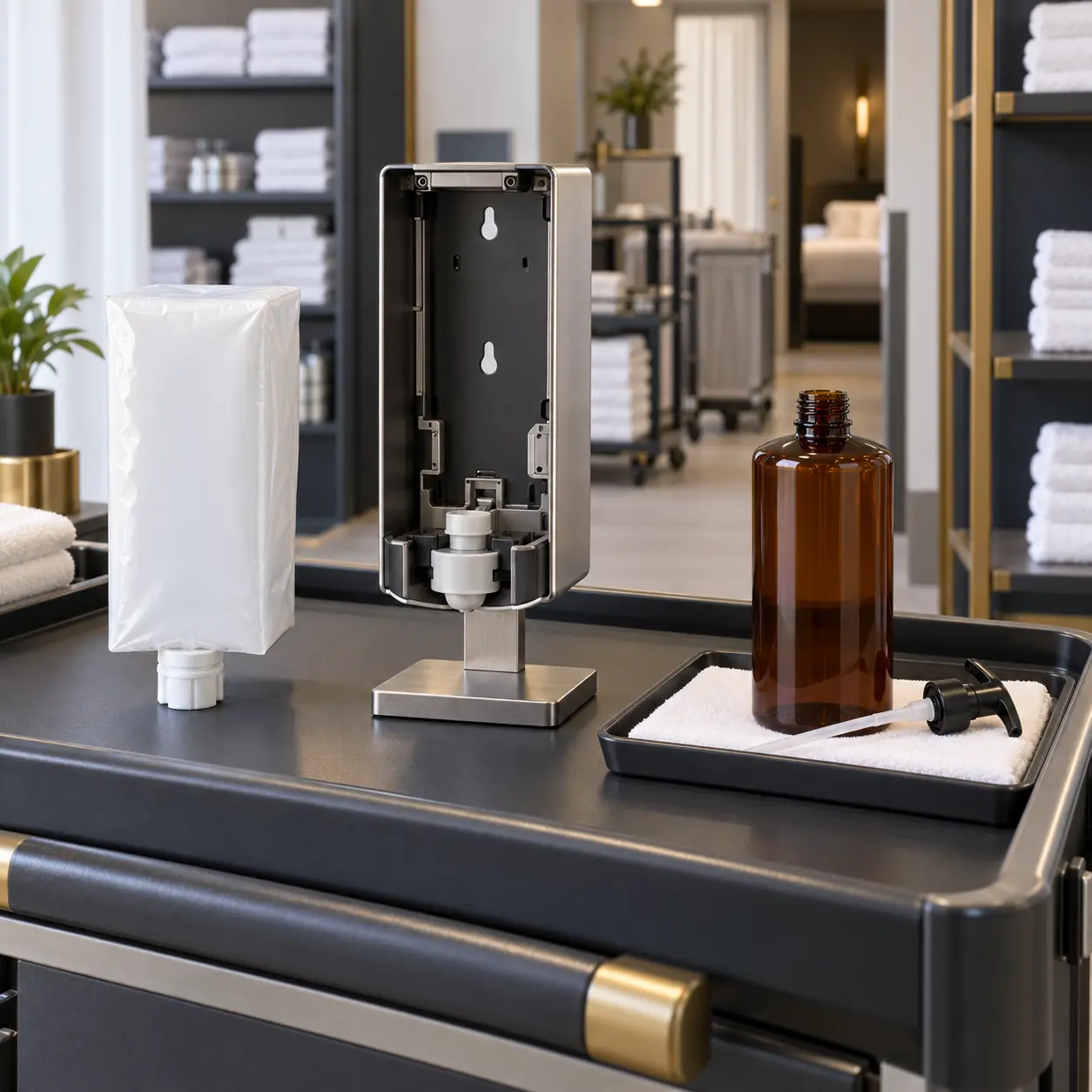
The most useful comparison follows a unit from the storeroom to the bathroom and back to waste handling or servicing. A sealed cartridge removes the pouring task, but it does not remove inspection, exterior cleaning, stock rotation, or replacement logistics. A refillable system adds reusable components whose condition must be managed; however, exchanging a prepared bottle can keep that work outside the room. Treat these as different operating models. Ask each supplier to demonstrate the actual hardware, including the lock, product outlet, and low-level check. Then document which steps remain with the room attendant and which move to another employee or work area.
Identify what is replaced and what stays in service
Do not accept “sealed,” “refill,” or “tamper-resistant” as a complete specification. A replacement cartridge may include a new outlet, connect to a reusable pump, or use another dispensing mechanism. Those designs have different maintenance requirements. Likewise, a locked bracket may prevent casual bottle removal without sealing the bottle’s contents against contamination.
For example, ADA Cosmetics’ SmartCare system describes a membrane and safe-lock design, while its SHAPE system describes a pump designed to prevent back contamination. These are product-specific manufacturer descriptions, not evidence that every sealed dispenser provides the same protection or service time. Request the instructions for the exact model being quoted.
| Work stage | Sealed cartridge system | Refillable bottle or reservoir |
| Storeroom preparation | Pick compatible replacement packs and rotate stock by product and lot. | Pick approved bulk product and prepared bottles or refill equipment; track opened stock. |
| Routine room check | Check identity, usable level, outlet condition, housing, and lock. | Check identity, usable level, pump, bottle condition, and closure. |
| Replenishment | Remove the depleted unit, install the replacement, and activate as instructed. | Refill through the approved process or exchange a prepared bottle; service removed components separately. |
| Product-contact components | Determine which outlet or pump components are replaced with the pack. | Follow the specified cleaning, drying, inspection, and replacement requirements. |
| Return from the floor | Sort empty packs and isolate damaged or suspect units. | Keep used components separate from clean, prepared stock and route them for servicing. |
| Supply interruption | Replacement availability depends on the compatible cartridge and hardware. | Alternatives still require verified formula, viscosity, pump, and material compatibility. |
This table is a workflow comparison, not a cleaning procedure. The supplier’s instructions must determine the approved method and schedule for each system.
Separate a room check from a replenishment event
A room attendant may inspect three dispensers but replace only one. Time these activities separately. Applying a full refill time to every occupied room exaggerates labor; recording only the seconds needed to attach a cartridge understates it.
With sealed packs, the relevant event includes retrieving the correct pack, accessing the holder, checking the connection, testing delivery where required, securing the unit, and handling the empty pack. A difficult key or bracket can erase part of the apparent advantage.
For a manual refill system, the event may include retrieving the approved liquid, opening the unit, following the required preparation, controlling the fill, closing it, and cleaning up. For a bottle-exchange system, the in-room task can be shorter, but washing, drying, refilling, labeling, and moving bottles still consume resources elsewhere. Record them rather than treating them as free work.
Avoid replacing usable product just to simplify the round
An early replacement policy creates a trade-off between avoiding guest stockouts and discarding residual product. Define a minimum usable level using expected demand until the next planned service opportunity, with an allowance for uncertainty. For a stayover room, that opportunity may differ from the next calendar day.
Do not recover residual liquid by opening a nonrefillable cartridge or combining leftovers. Track early replacements as a separate loss. With reusable bottles, any decision to retain, refill, or discard remaining product must follow the approved procedure; an attractive full bottle is not a reason to improvise.
Build hygiene and traceability into the process
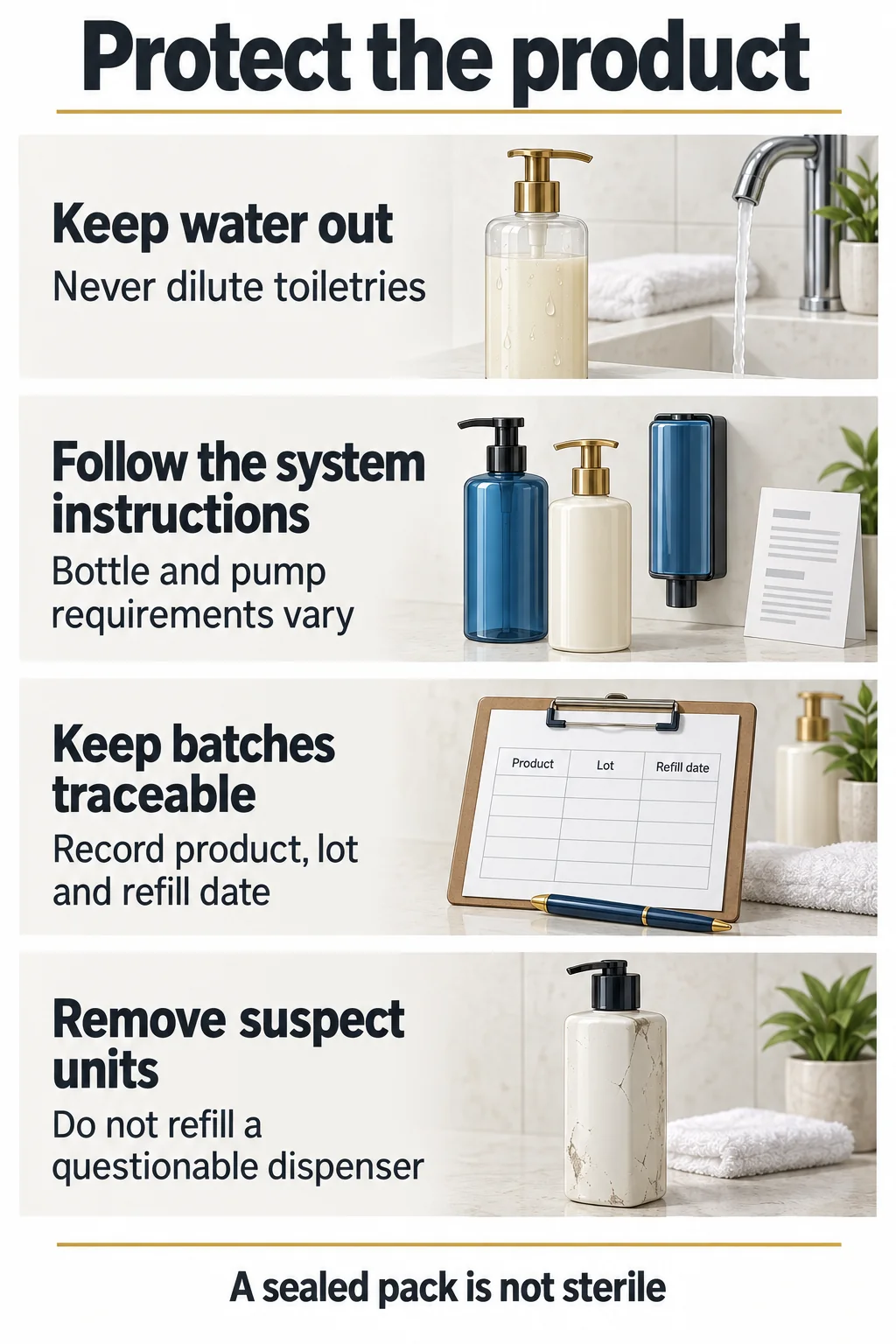
Hygiene depends on the entire product path: bulk container or cartridge, transfer equipment, bottle, pump, outlet, storage, and staff handling. A factory seal reduces handling before installation, but “sealed” does not mean sterile or maintenance-free. A reusable bottle also needs more than a clean exterior. Before choosing either model, obtain written instructions covering compatible products, reusable components, cleaning methods, drying, storage, and service intervals. The procurement decision should establish who carries out those tasks and how supervisors verify them. If the instructions do not explain how a proposed refill process remains controlled, resolve that gap before a hotel-wide rollout.
Keep formulation and handling requirements together
The FDA’s guidance on microbiological safety and cosmetics identifies contamination routes that include water, packaging, storage conditions, and use. It also advises against adding water to cosmetics because that can introduce microorganisms and weaken preservatives. For hotel operations, keep toiletries undiluted, store them as directed, and protect openings from unintended contact.
There is no universal cleaning chemical, concentration, contact time, or drying period that can be prescribed for every toiletry dispenser. Obtain the supplier’s instructions for the bottle and pump as well as the cosmetic product. Do not assume a bathroom surface disinfectant is appropriate inside a product-contact component.
For manually refillable units, do not make routine topping off an undocumented practice. Require a written procedure that explicitly covers residual product, cleaning, drying, refill frequency, and product compatibility. If no suitable procedure exists, select a different system instead of inventing one on the housekeeping floor.
Give bottle exchange a real back-of-house operation
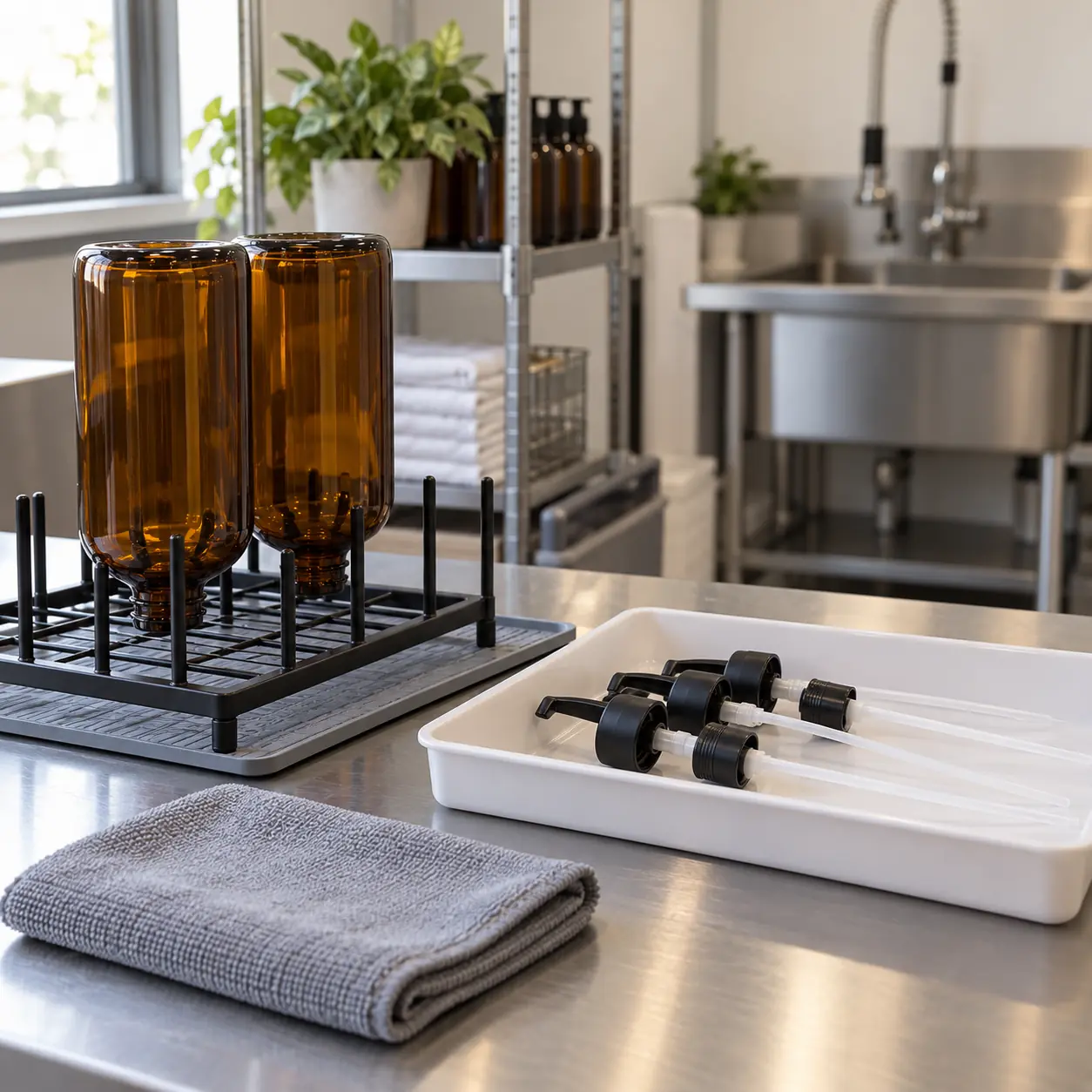
A bottle-exchange model needs sufficient clean spare bottles, a designated servicing area, separation between used and prepared units, and a person accountable for releasing bottles back into circulation. Drying or other required holding time may create a capacity constraint even when it does not require continuous labor.
A controlled refill station is a distinct option. ADA Cosmetics’ Refillution system describes automated filling and batch tracing. Its existence illustrates why “refillable” should not automatically mean manual pouring beside a guest shower. Evaluate the specific station’s capital cost, servicing, training, consumables, and throughput; manufacturer claims for one system should not be applied to ordinary open reservoirs.
Keep a usable product history
For sealed packs, retain product identity and lot information and establish a practical way to identify affected rooms if a recall or quality issue arises. For reusable bottles, link the bulk lot to the refill date and the bottle or destination room. A filling log without any connection to where bottles were installed may not support an effective withdrawal.
Avoid mixing different formulas or creating an undocumented mixture of batches. Keep original supplier labels and records available, even when guest-facing packaging uses the hotel’s branding. Staff should be able to distinguish shampoo, conditioner, and body wash without relying only on liquid color.
If a unit shows an unexplained change in odor, color, texture, closure integrity, or dispensing behavior, remove it from guest use and follow the property’s escalation procedure. Retain identifying information for investigation. A normal appearance alone does not establish microbiological safety, so visual inspection cannot replace the supplier’s controls.
Compare total cost with a room trial
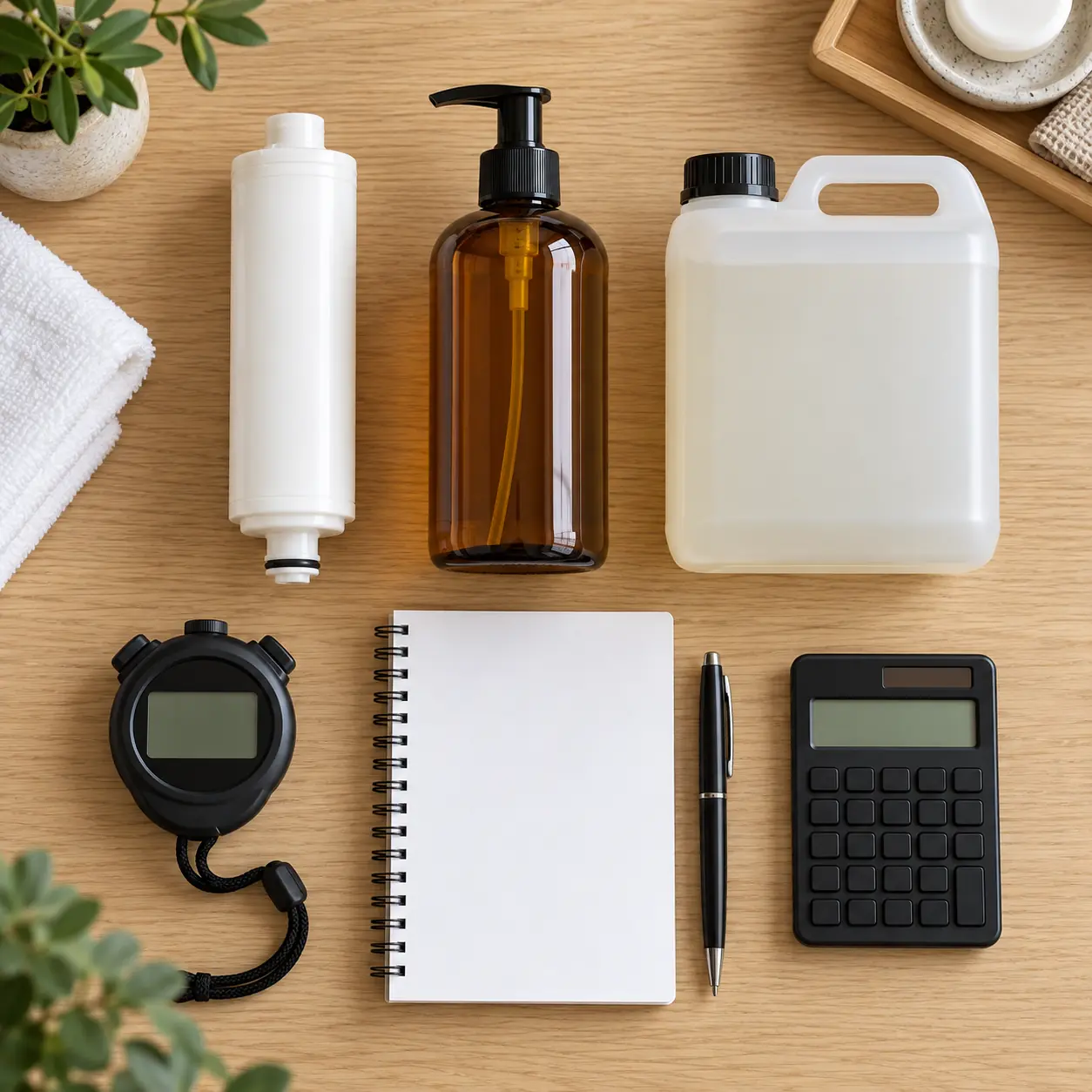
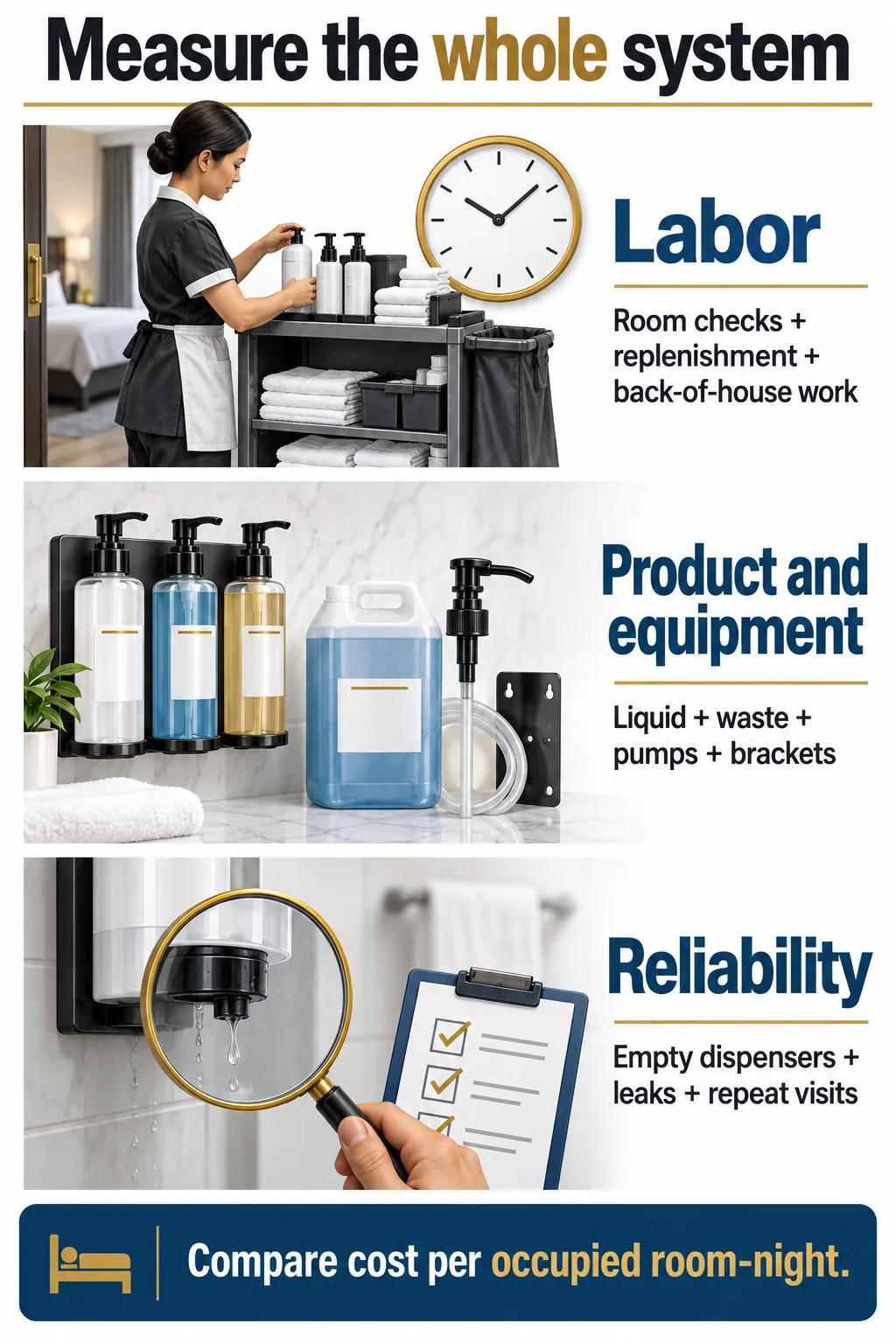
Compare systems per occupied room-night over the same period, using equivalent guest products and service expectations. Separate liquid cost, labor, equipment, and avoidable losses so that a change in one category remains visible. The quickest bottle swap is not necessarily the least expensive operating system, and the cheapest bulk liquid is not necessarily the best purchase. A room trial should establish both average workload and operational reliability. Include ordinary room checks, replenishment events, back-of-house servicing, and repeat visits. Count empty dispensers, leaks, identification errors, and guest complaints alongside time, because a low-cost process that fails in use is not an acceptable result.
Calculate the labor actually consumed
Use this daily labor model for a defined room group:
Daily labor minutes = routine inspection minutes + replenishment-event minutes + back-of-house servicing minutes + exception minutes.
Routine inspection minutes equal the number of service visits multiplied by average toiletry inspection minutes per visit. Replenishment-event minutes equal the number of individual units replenished multiplied by average event time. Back-of-house time includes preparation, component servicing, stock handling, and records. Exception time captures extra trips, leaks, unavailable keys, wrong-product corrections, and related rework. Keep categories separate to avoid counting the same work twice.
The following example is hypothetical. It is not a supplier quotation, industry benchmark, or claim about measured hotel performance. All dollar values are illustrative USD.
| Daily input or result | Sealed cartridges | Refillable system |
| Occupied room-nights | 120 | 120 |
| Rooms receiving service | 120 | 120 |
| Routine check time per serviced room | 0.15 minute | 0.15 minute |
| Individual units replenished | 36 | 36 |
| Average time per replenishment event | 0.50 minute | 1.50 minutes |
| Back-of-house and exception time | 8 minutes | 20 minutes |
| Total daily toiletry labor | 44 minutes | 92 minutes |
| Labor cost at $24 per hour | $17.60 | $36.80 |
| Labor cost per occupied room-night | $0.147 | $0.307 |
Under these assumptions, cartridges use 48 fewer labor minutes per day, worth $19.20, or $0.16 per occupied room-night. A $0.10 reduction in liquid cost per occupied room-night would save $12 daily and would not offset that labor difference. A $0.20 reduction would save $24 daily, leaving $4.80 before other cost differences. Replace every input with trial data before making a purchase decision.
Saved minutes represent labor capacity. They become a payroll reduction only if schedules, overtime, or staffing requirements actually change. They may instead help the team absorb departures, reduce delays, or complete other required work.
Normalize product and equipment costs
Calculate total system cost as liquid consumed or lost, plus paid labor, allocated equipment costs, cleaning supplies, replacement parts, freight, and waste handling. Divide by occupied room-nights for the same period. Allocate brackets, installation, spare bottles, and refill-station costs over a stated useful life and expected occupancy; use one currency consistently.
For liquid, reconcile opening stock plus receipts minus closing stock, including usable product still in room dispensers and opened bulk containers. Treat supplier returns and transfers consistently. Record spills, discarded residuals, and expired stock separately where possible. Invoice purchases alone can overstate consumption during an opening stock build or understate it during a drawdown.
Compare usable delivered product, not nominal bottle capacity alone. Dose per pump stroke, viscosity, and dispensing performance can affect consumption. Include pump failures and spare-part availability. Verify case quantities and lead times separately for shampoo, conditioner, and body wash; one fast-moving item can run out while the other two remain overstocked.
Run a fair trial and set the decision rule first
Use comparable room types and record occupancy, departure versus stayover service, and guest count where available. Train staff before timing routine work and record training time separately. Where practical, have the same attendants work with both systems in a balanced sequence. This reduces the chance that one unusually fast employee or easy room group determines the result.
Continue long enough to observe actual replenishment and any scheduled component servicing. A short trial may need to be supplemented with documented long-term maintenance costs if pumps do not yet require attention. Report typical time and slower events, including the reason for delays, rather than relying on one demonstration.
Decide in advance what would make a system unacceptable: repeated leaks, insufficient guest supply, unresolved handling instructions, or inability to trace product. Among systems that pass those requirements, compare cost and workload. Review packaging waste per occupied room-night separately; a refillable bottle or recyclable cartridge does not by itself establish a lower environmental impact or local recyclability.
For a sourcing comparison, use the same requirements across suppliers: dispenser architecture, included pump or outlet, capacity, dosing, mounting, cleaning instructions, refill or cartridge availability, and delivery terms. KW Hospitality’s hospitality supplies directory can help coordinate the amenity system with the related bathroom and housekeeping items in the purchasing scope.
Conclusion
Sealed cartridges are a strong option when a hotel needs a simple replenishment routine and dependable compatible stock is available. Refillable dispensers can suit properties able to manage approved products, reusable components, controlled servicing, and traceable refills. The decision should follow the actual workflow rather than the packaging label. Compare the tasks that stay in the room, the tasks transferred to a service area, and the cost of failures. Then select the system that meets the hotel’s handling and guest-service requirements at a sustainable workload and a defensible cost per occupied room-night.
To compare sourcing options, send KW Hospitality a toiletry dispenser RFQ with room count, expected occupancy, service schedule, products required, preferred dispenser design, destination, and the procedures your housekeeping team can support. Request comparable hardware and consumable specifications, samples, and written maintenance instructions before committing to the full quantity.
Frequently Asked Questions
Can a sealed cartridge be opened and refilled to reduce waste?
Only if the manufacturer explicitly designs and approves that unit for refilling. Opening a nonrefillable pack changes the intended product path and may bypass its closure or dispensing safeguards. Ask about an approved reusable alternative rather than adapting a disposable cartridge yourself.
Must hotel toiletries be replaced after every guest?
Guest departure alone does not determine the replacement interval for every dispenser system. Follow the product and hardware instructions, the hotel’s service requirements, and any applicable local rules. Check identity, condition, closure, dispensing, and sufficient usable product before releasing the room; treat a damaged or suspect unit separately.
Can the same dispenser be used for shampoo and conditioner?
Not automatically. A pump that works with one formula may dispense a thicker product poorly, and material compatibility also matters. Obtain written compatibility confirmation for each product. Do not switch formulas in an existing bottle without following the approved changeover and identification procedure.
What happens if housekeeping does not enter a stayover room daily?
Set the replenishment threshold for the interval until the next expected service opportunity, taking guest count and observed consumption into account. Provide a clear way to request replacements and include those trips in trial costs. Daily occupancy is not the same as daily access to every dispenser.
How much spare stock should the hotel keep?
For each product, estimate average daily replacement demand multiplied by replenishment lead time, then add safety stock reflecting demand variation and delivery uncertainty. Include both usable back-room stock and units already committed to carts. A reusable bottle-exchange system also needs enough spare bottles to cover its servicing and drying cycle.
Is a locked dispenser the same as a sealed dispensing system?
No. A lock controls access to a holder or bottle; a sealed product path concerns how liquid is enclosed and dispensed. A refillable bottle can sit inside a locked bracket. Evaluate the closure, outlet, reusable components, and access control independently instead of assuming the lock resolves every handling issue.
References
FDA — Microbiological Safety and Cosmetics. Official guidance on contamination routes, storage, and avoiding dilution.
ADA Cosmetics — SmartCare. Manufacturer description of its membrane dispensing design and replacement hardware.
ADA Cosmetics — SHAPE. Manufacturer description of a specific pump and bottle-exchange system.
ADA Cosmetics — Refillution. Manufacturer description of automated refilling and batch tracing. Product-specific claims are not universal hotel performance benchmarks.