Choose accessibility supplies by first defining the task a guest needs to complete, then confirming that the equipment is suitable for the property, supported by appropriate evidence, and practical to keep in service. Compare price, finish, and operating cost only after those conditions are met. A product that looks suitable in a catalog can still fail at the point of use because it does not fit the room, connect to an existing system, or arrive with the instructions staff need.
For hotel owners, procurement managers, and operations teams, this makes accessibility purchasing a shared decision. A shower seat involves the guest, housekeeping, engineering, and sometimes a qualified installer. A communication aid involves reservations, front desk staff, the guest’s preferred way of communicating, and the systems already operating at the property. The purchase is successful when those relationships work together throughout the equipment’s service life.
This framework addresses the selection decision for hospitality accessibility supplies, including bathing aids, communication devices, and equipment that supports participation in shared amenities. It does not determine how many accessible rooms a property must provide or replace a project-specific accessibility assessment. Local requirements, existing conditions, and the distinction between new construction, alterations, and ongoing operations need separate attention. A supplier’s general claim of accessibility does not resolve those questions.
The approach below uses three connected decisions: define the need, qualify and compare the options, and verify that the selected equipment actually supports guest access after deployment. It also distinguishes low demand from poor availability. An item used infrequently may still be essential; another item may be underused because guests cannot discover it or staff cannot prepare it promptly. Treat utilization as evidence to investigate, while keeping safety and applicable access requirements outside any commercial trade-off.
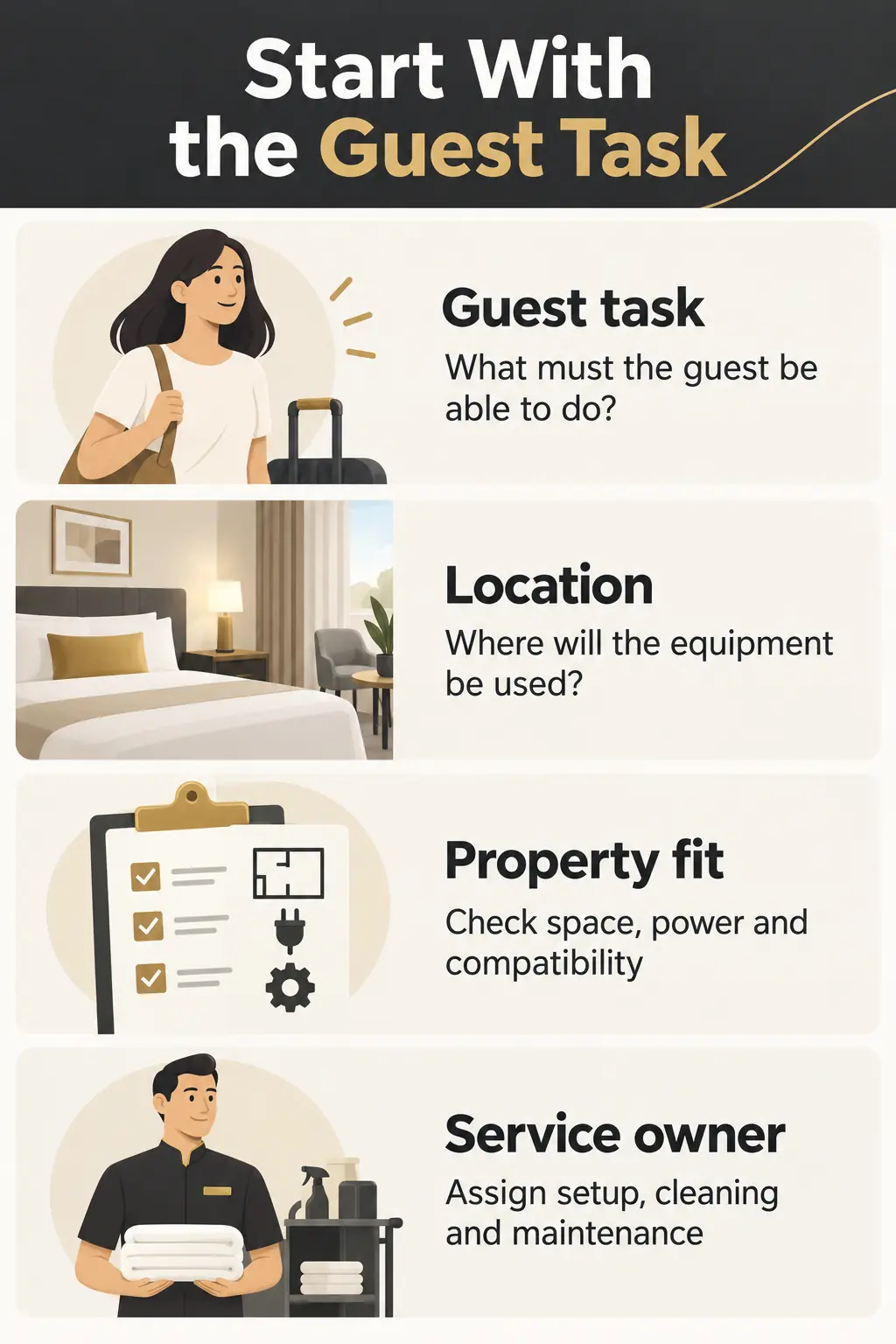
Define the Guest Task and Property Constraints
Start with the guest’s intended activity and the conditions in which it happens. “Provide a bathing aid” is too broad to specify a product; “support seated showering in this identified room configuration” gives the team a task to investigate. Record the location, relevant equipment already present, physical constraints, and who will prepare and maintain the item. Include guest feedback about barriers without assuming that every person with the same disability wants the same solution. This creates a purchasing brief that connects the guest task, location, property fit, and service owner before a catalog or quotation starts shaping the decision.
Separate equipment from the surrounding access problem
A portable product cannot be assumed to correct an inaccessible route, unsuitable bathroom layout, or missing building feature. Identify which problems concern the building, which concern equipment, and which concern service procedures. A bathing aid might be appropriate for a particular use, while the room still needs a separate review of maneuvering space and fixtures. A freestanding shower chair should not automatically replace a required installed seat.
For U.S. projects, physical access and effective communication are related but distinct obligations. Requirements depend on the applicable rules and circumstances. Have the responsible accessibility professional establish the project’s baseline before procurement treats any product as an acceptable substitute. Outside the United States, confirm the relevant jurisdiction rather than carrying over U.S. terminology as a universal specification.
Describe functions instead of making assumptions about guests
Ask what assistance or equipment would help the guest use the service. Keep the discussion focused on the requested function, such as hearing a presentation, receiving a door notification, or using a bathing facility. Communication methods differ: a device suitable for one guest may be ineffective for another. A general conversation aid also serves a different purpose from an emergency notification system.
Do not make a guest’s possession of a particular smartphone, application, or personal accessory an unexamined prerequisite for access. If a proposed device depends on one, document that limitation and determine how the property will meet requests from guests who cannot use it. Staff should be able to explain features accurately and consult the guest about suitability without promising that one kit meets every need.
Translate the setting into a purchasing brief
Use the following mapping to focus discussions across departments. These are examples of selection questions, not installation instructions or a list of universally required products.
| Guest activity | Candidate supply category | Property-specific question | Responsible participants |
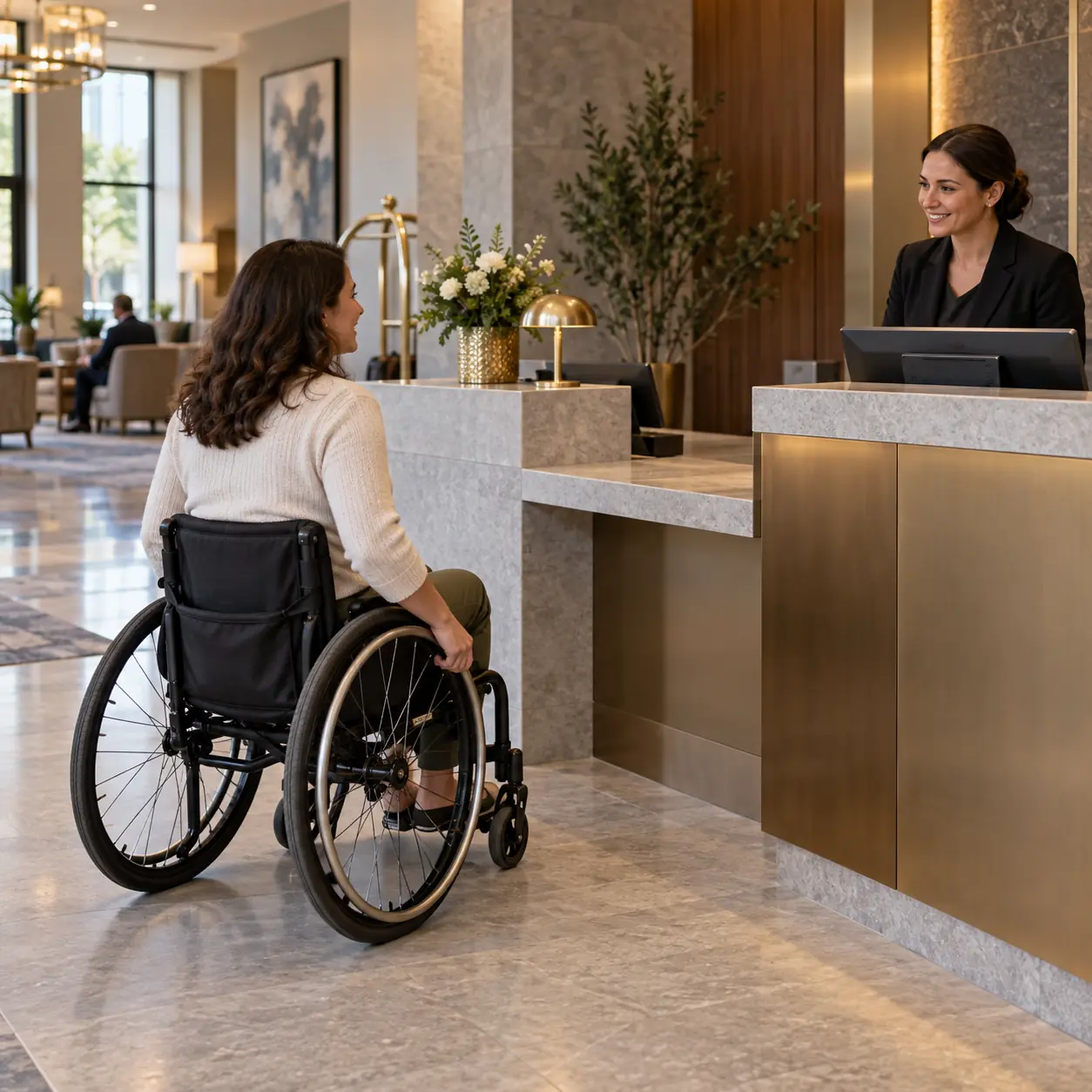
| Communicate at reception | Communication aid or accessible information | Does it support the guest’s communication method? | Front desk and operations |
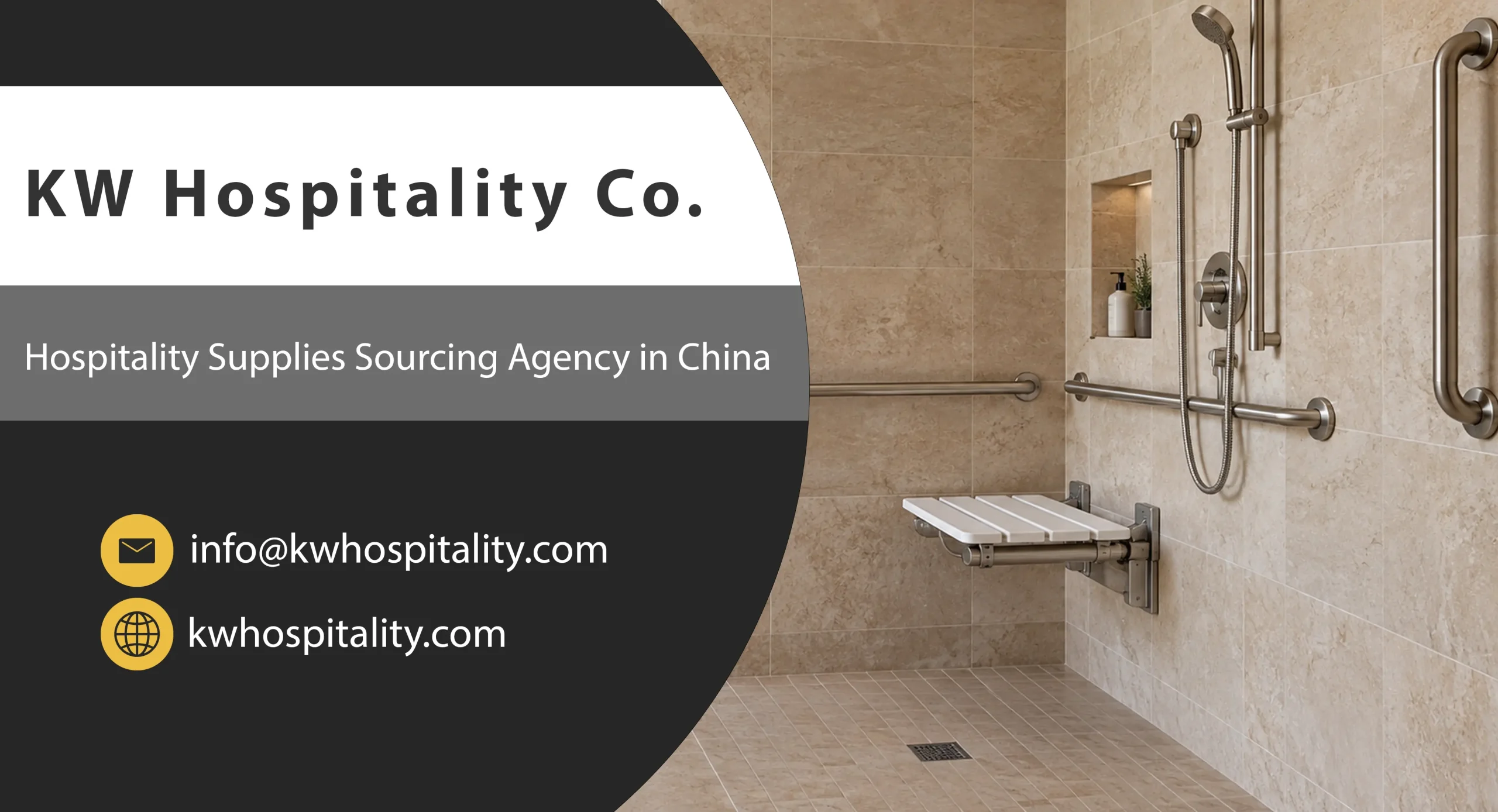
| Use a bathing facility | Suitable seat or bathing aid | Does the exact model suit the room and intended use? | Engineering, housekeeping, accessibility reviewer |
| Participate in a meeting | Assistive listening equipment | Does it work with the venue’s audio system and user accessories? | Events team and audiovisual specialist |
| Receive a room notification | Compatible signaling equipment | Which event does it signal, and how is operation verified? | Engineering and front desk |
Record physical dimensions, storage location, required power or batteries, environmental exposure, cleaning products, and any integration dependencies. For mounted equipment, the relevant substrate and installation method matter alongside the item itself. For portable equipment, include transport, setup, and return-to-service conditions. Assign one decision owner who can resolve gaps between departments before an order is approved.
Qualify Products Before Comparing Commercial Value
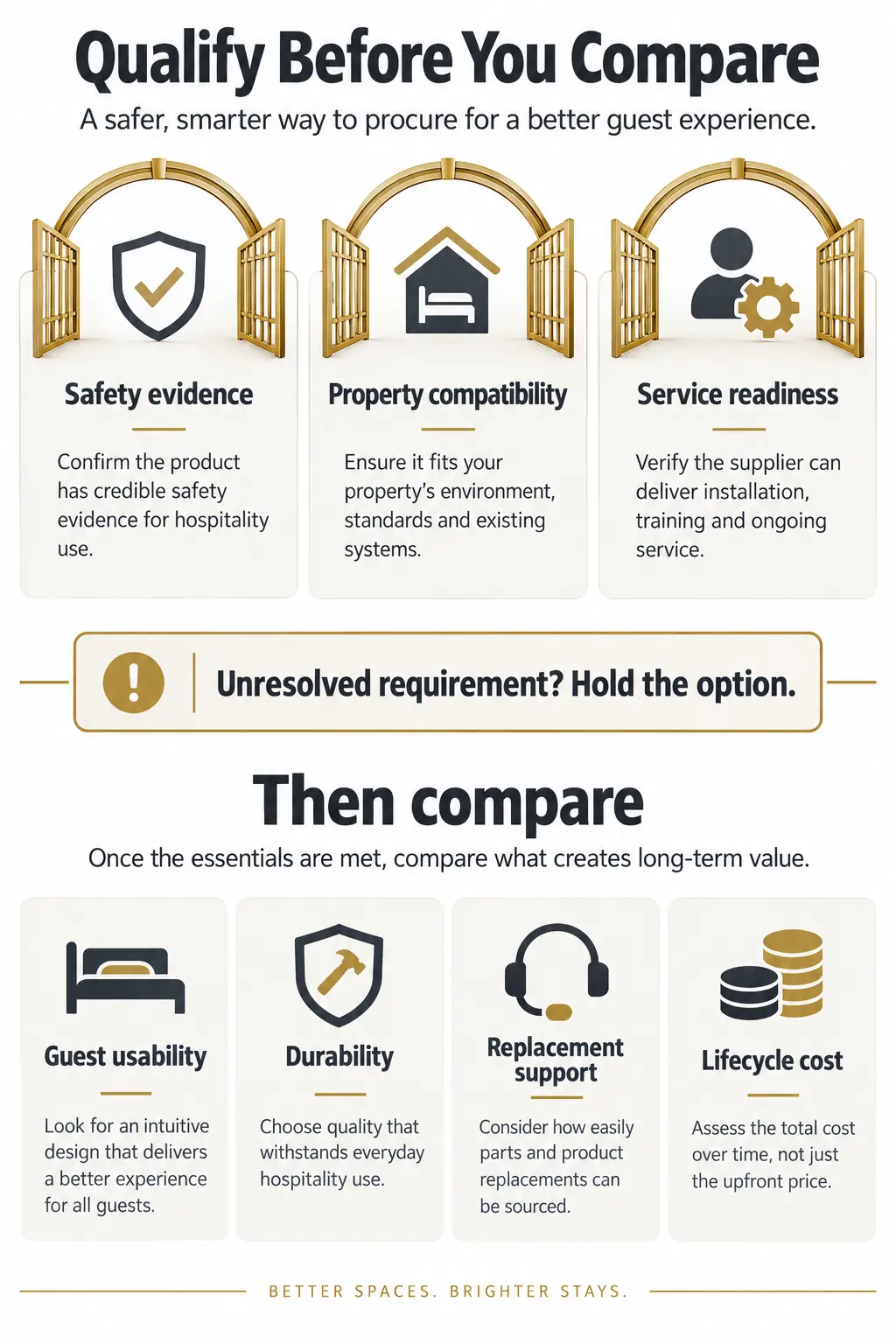
Use a qualification stage before a weighted comparison. Safety evidence, property compatibility, and service readiness are entry conditions, not benefits that a low price can offset. Mark each condition as demonstrated, unresolved, or failed for the exact model and proposed use. An unresolved condition keeps the option on hold; a failed condition removes it from that application unless the underlying problem is corrected and reviewed. Only qualified options move into a comparison of guest usability, durability, replacement support, and lifecycle cost. This prevents attractive finishes or purchasing discounts from disguising a product that cannot reliably deliver the intended service.
Require evidence that matches the supplied model
Ask for the model identifier, intended-use statement, operating limitations, instructions, warranty terms, and relevant test or certification documentation. Where a certification is claimed, verify its scope and connection to the supplied model. A logo on a brochure, a report for another product, or a factory quality-system certificate is not equivalent to evidence for the performance claim being evaluated.
For load-bearing products, engineering should review the manufacturer’s rated capacity, installation conditions, and applicable evidence rather than inferring strength from material thickness or appearance. Do not conduct improvised overload tests with staff or guests. For electrical and signaling equipment, involve the appropriate specialist to review power, environmental suitability, compatibility, and intended signaling function. A convenient door-alert accessory is not a substitute for a required fire or emergency system.
Require the supplier to identify who provides installation, training, and ongoing service, even when those responsibilities sit with a local contractor rather than the supplier. Service readiness means the arrangements are workable, documented, and available to the property. It does not require every vendor to deliver every service directly.
Examine samples under representative operating conditions
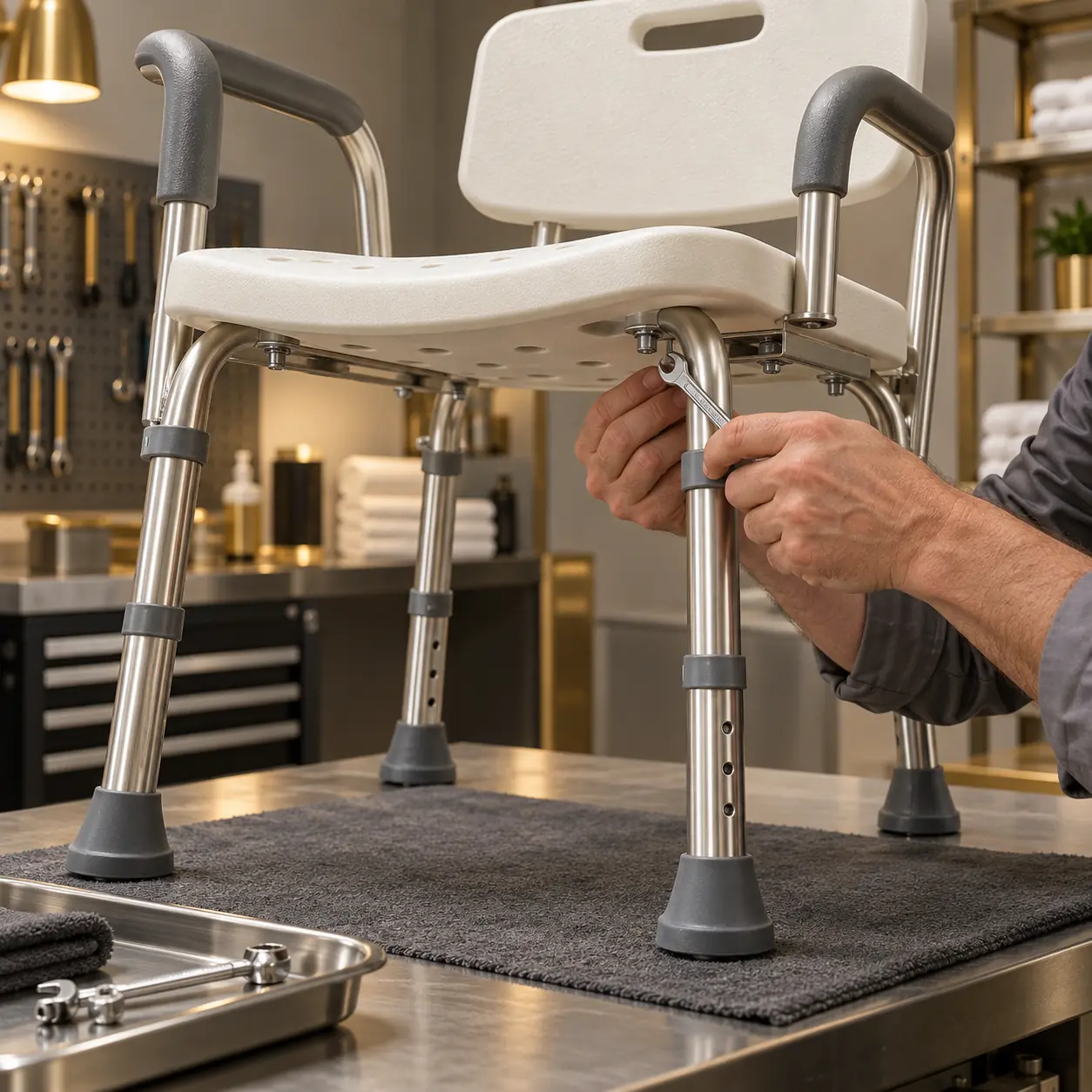
Use the sample to investigate the actual guest task and operating process. Observe control visibility, grip, adjustment, setup effort, stability under intended use, and access for cleaning. Have appropriately qualified staff manage any activity involving installation or safety-critical operation. Where feasible, invite people with relevant lived experience to assess usability voluntarily, with suitable safeguards and compensation for their contribution.
Run repeated setup, cleaning, drying, and storage cycles using the manufacturer’s instructions and the property’s intended products. Record what was done and what changed: surface marking, loosened fittings, difficult adjustments, trapped moisture, or confusing connections. A short trial can reveal problems; it cannot establish a guaranteed service life. Keep the approved sample and acceptance criteria tied to the final model, material, finish, and accessories so later substitutions do not silently invalidate the review.
Apply a transparent comparison to qualified options
The example below is an editorial decision model, not an industry benchmark. Set the weights before comparing bids and adapt them to the property. Score each criterion from 1 to 5 using documented observations: 1 represents weak performance among otherwise qualified options, 3 acceptable performance, and 5 strong demonstrated performance. Missing evidence stays unresolved rather than receiving a convenient middle score.
| Comparison criterion | Illustrative weight | What supports the score |
| Guest usability | 35% | Observed task completion and understandable operation |
| Durability and cleanability | 25% | Trial observations and relevant product evidence |
| Replacement and service support | 25% | Identified parts, lead times, and service arrangements |
| Lifecycle cost | 15% | Comparable purchase, setup, upkeep, and replacement assumptions |
Calculate the total by multiplying each score by its weight and adding the results. For example, an option scoring 4, 4, 3, and 3 receives 3.60 out of 5. Another scoring 3, 4, 5, and 4 receives 3.90. The second ranks higher under these illustrative weights because its support advantage outweighs its lower usability score. Both must already meet the essential guest task; the calculation cannot authorize a product that excludes the intended user.
If a small change in reasonable weights reverses the ranking, examine the trade-off explicitly. Consider a targeted additional trial or separate products for distinct needs. Avoid presenting a small score difference as proof of superiority when the observations behind it are uncertain.
Write the selected configuration into the order
Specify the exact model, finish, dimensions, accessories, power arrangement, instructions, spare parts, and evidence required with delivery. State that proposed substitutions need review before shipment. Include inspection and acceptance responsibilities, discrepancy handling, and the scope of warranty support. For imported equipment, make the destination market and required documentation explicit before production.
Compare lifecycle cost over the same planning period and level of service. Include acquisition, freight and applicable import costs, installation, staff preparation, cleaning labor, consumables, maintenance, replacement parts, and expected replacement purchases. Keep downtime assumptions visible rather than inventing a monetary value for guest harm. If future costs are discounted, use a consistent method and rate across options. The objective is a fair comparison, not a precise-looking forecast built on unsupported lifespan claims.
Prepare the Service and Measure Actual Access
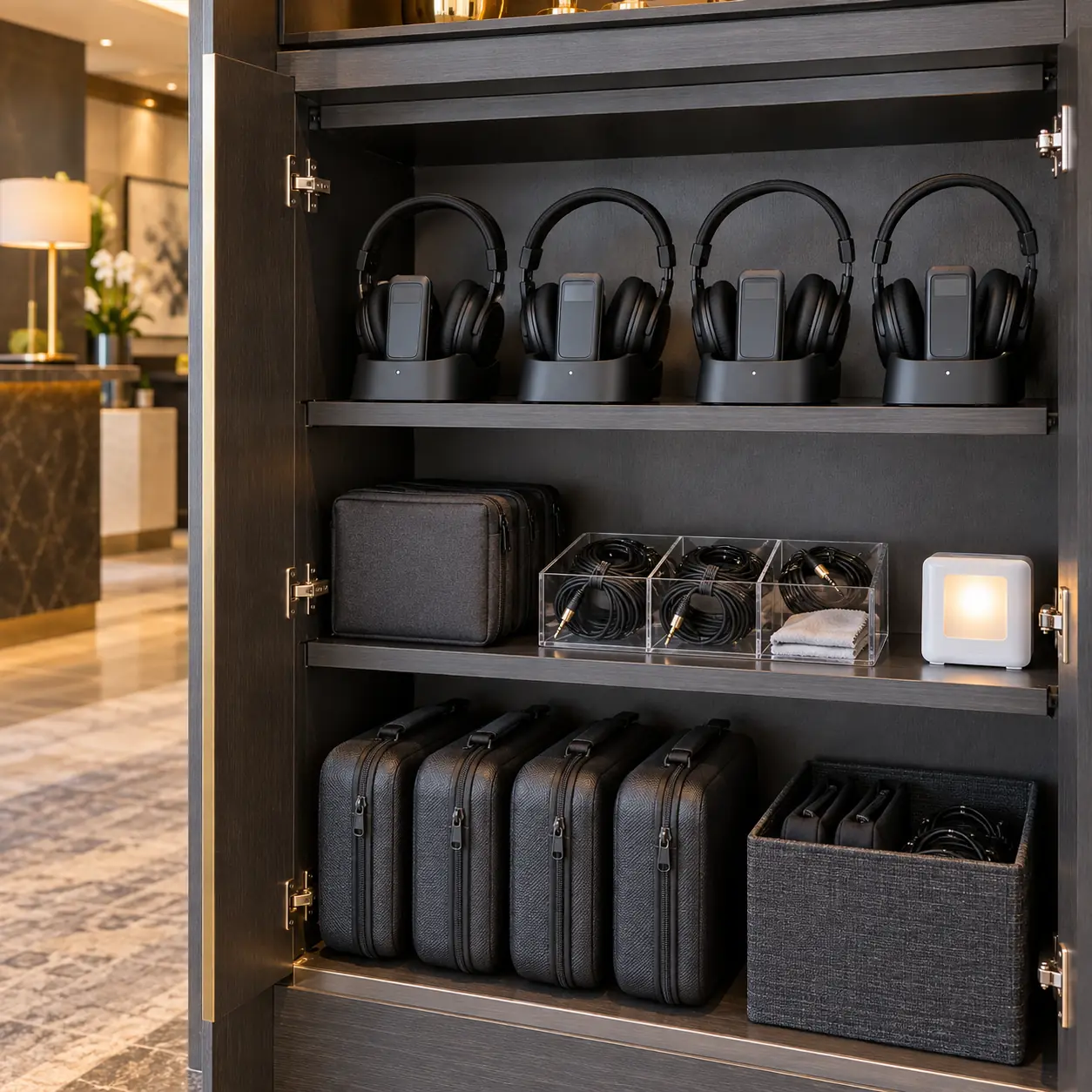
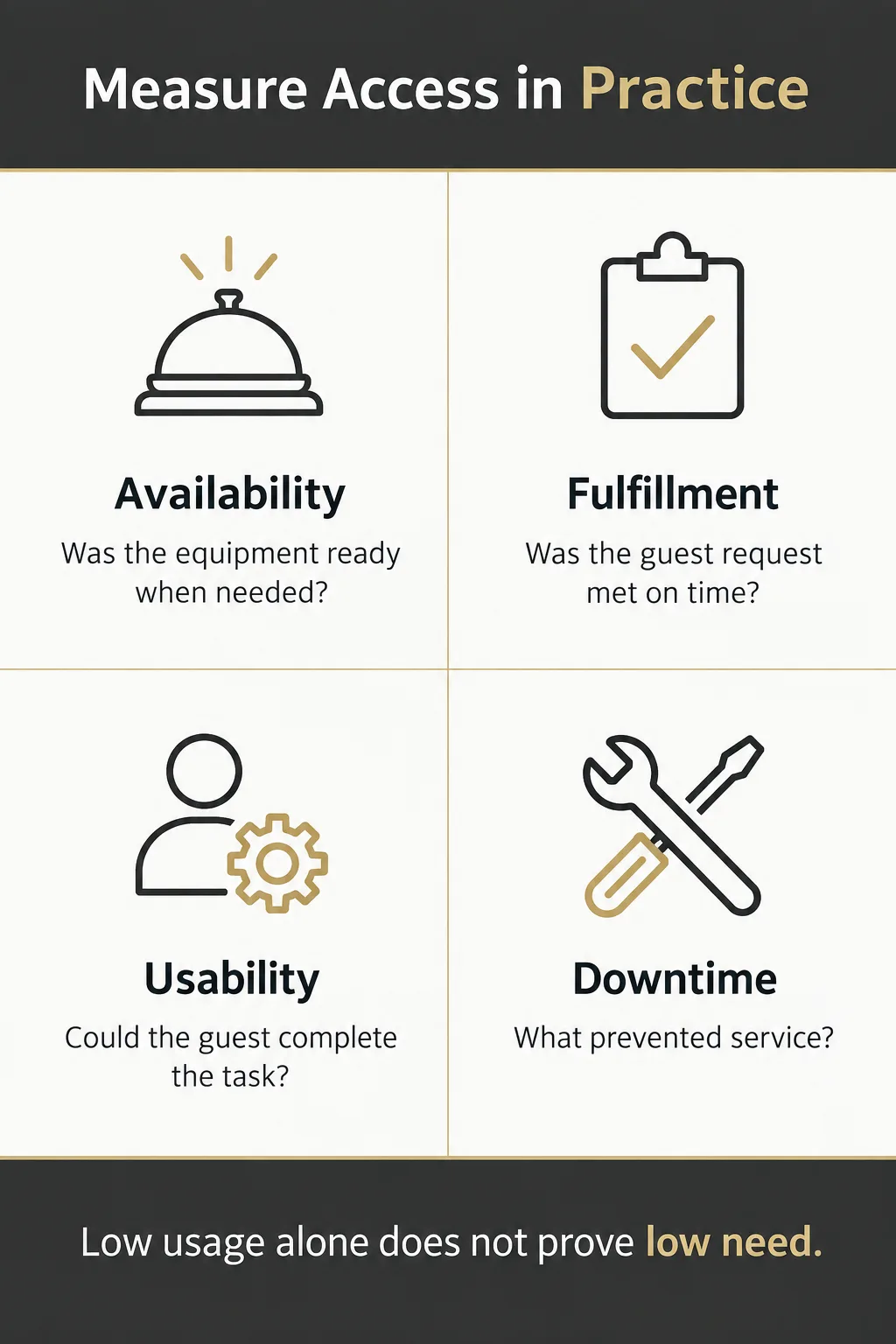
Selection is incomplete until staff can make the equipment available, explain its use, and return it to service after each deployment. Establish the operating process before announcing the amenity. Test a request from initial inquiry through delivery, setup, use, collection, cleaning, inspection, and storage. Include evenings or weekends if the service operates then. Measure availability, fulfillment, usability, and downtime together; a count of issued items alone cannot show whether guests obtained effective access. Keep reporting proportionate and focused on service performance, collecting only information needed to understand the request and resolve operational problems.
Give each handoff an owner
Reservations and front desk teams need accurate descriptions of what is available and where it can be used. Housekeeping needs the cleaning and inspection process. Engineering needs maintenance responsibilities, compatible spares, and removal-from-service criteria. The manager on duty needs a response when an item is unavailable or unsuitable. Record those responsibilities in the operating procedure and practice the handoffs with the actual equipment.
Use clear readiness states such as available, deployed, cleaning, and out of service. Keep defective equipment physically separated from ready stock and prevent it from being issued accidentally. Staff should follow the manufacturer’s inspection and maintenance instructions, with additional checks based on use and the property’s assessed risks. A spare only counts as available when it is complete, serviceable, and ready for the intended task.
Distinguish utilization from service success
Choose a unit of measurement that fits the equipment. A portable receiver can be counted in deployment sessions; a loan item used over multiple nights may suit item-days; an installed amenity needs an availability measure over its operating hours. Do not combine unlike units into a single percentage. For operational diagnosis, track these measures separately:
| Measure | Working definition | Interpretation |
| Request fulfillment | Requests met appropriately and on time divided by relevant requests | Shows whether requests were served |
| Service availability | Ready service hours divided by planned service hours | Reveals loss of usable access |
| Portable stock utilization | Deployed item-days divided by available item-days | Describes use of serviceable stock |
| Unmet requests | Count and reason for requests not fulfilled | Identifies shortages or suitability gaps |
For illustration, suppose six portable items are serviceable throughout a 30-day period. That provides 180 available item-days. If guests use them for 54 item-days, stock utilization is 30%. Suppose separately that 20 relevant requests were recorded, with 18 met appropriately and on time. Fulfillment is 90%, while two unmet requests still require investigation. Those requests might have overlapped at a peak time or involved a need the stocked model could not serve.
If equipment is out of service, track the resulting loss of availability separately and define the utilization denominator consistently. Otherwise, removing broken items from the denominator can make utilization look better while guest access worsens. Record requests with zero demand as not applicable for fulfillment reporting rather than assigning an artificial success rate.
Investigate low use before reducing provision
Low recorded use may reflect limited awareness, inaccurate booking information, inaccessible instructions, slow setup, unsuitable equipment, or guests deciding not to ask. Review those explanations alongside actual demand. Do not infer disability prevalence from bookings or assume that guests must disclose personal information for management to improve its service.
Observe the distribution of requests, not just the average. Two simultaneous needs can expose a shortage even when monthly utilization is low. Use peak overlap, cleaning turnaround, repair lead time, and an appropriate reserve to inform quantity decisions. Applicable access requirements remain separate from discretionary stock optimization; a low-use report is not permission to remove required provision.
Reopen the selection when conditions change
Review the decision after a model change, repeated failure, loss of spare-part support, room renovation, system replacement, or credible guest report of difficulty. A change in cleaning chemistry may also justify a compatibility review. Keep incident response separate from routine purchasing: remove suspected unsafe equipment from use, preserve relevant information, and escalate through the property’s established process before considering a replacement order.
Use an initial post-launch review to establish a baseline, then set a review interval appropriate to the equipment and operating pattern. Do not wait for a calendar date when a safety concern or material service failure arises. The purpose of measurement is to improve access and readiness, not to pressure guests to use equipment so a utilization target looks better.
Conclusion
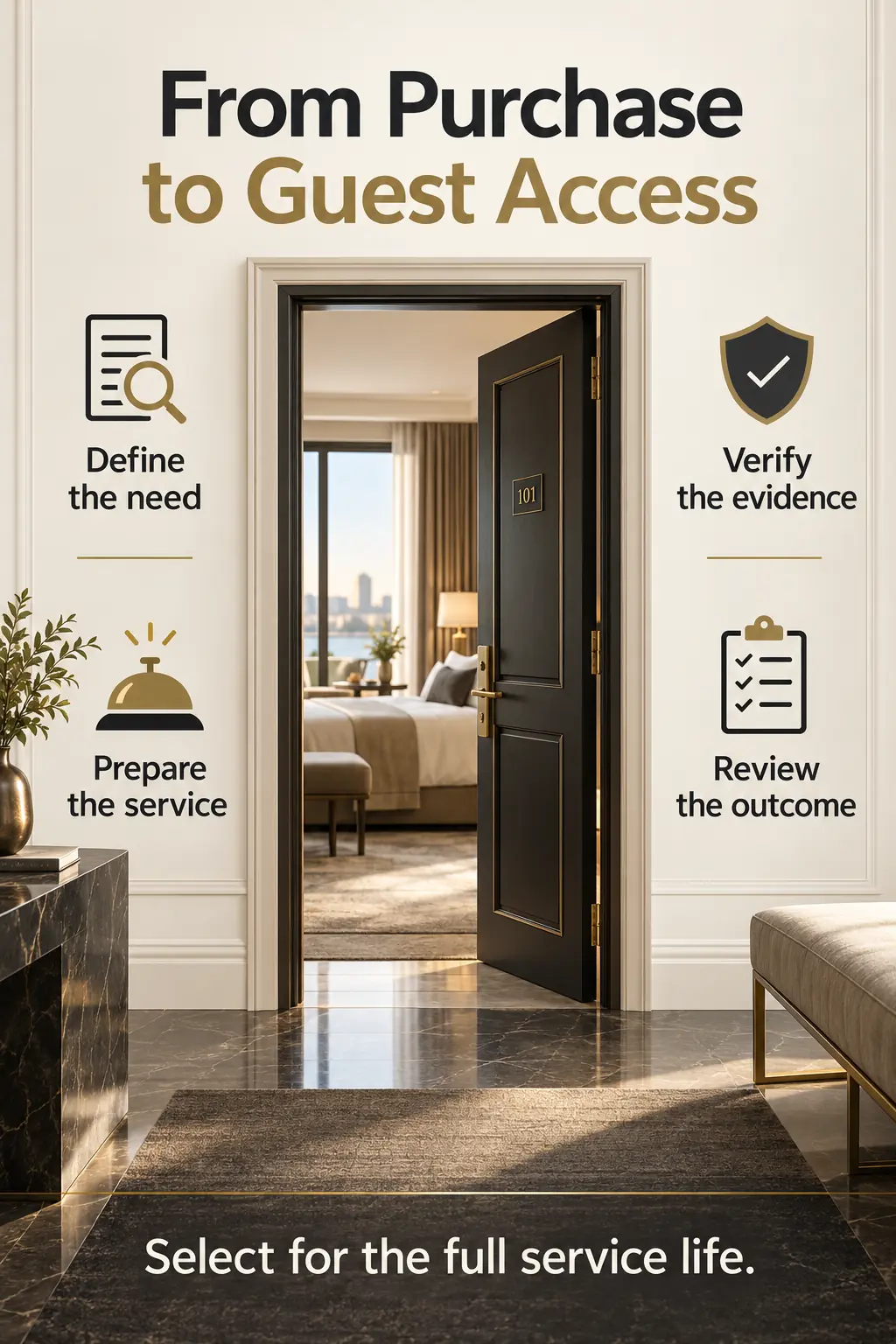
A reliable accessibility supplies selection framework connects the guest task to the product, the property, and the people who keep it usable. Define the need before reviewing catalogs, require suitable evidence before comparing value, and make service readiness part of acceptance. After deployment, review whether guests can obtain and use the equipment when they need it. This approach helps purchasing teams explain their decisions without treating appearance, unit price, or a utilization percentage as a complete measure of success. The result to pursue is sustained, appropriate access across the equipment’s full service life.
For an accessibility supplies sourcing inquiry with KW Hospitality, prepare a brief covering the guest task, destination market, room or amenity conditions, expected deployment pattern, required documentation, sample evaluation criteria, and replacement support. Ask suppliers to quote against that same brief and identify every exception. A clear requirement makes comparisons more useful and gives the property a stronger basis for reviewing samples, accepting deliveries, and planning support.
Frequently Asked Questions
Does an accessibility label prove that a product is suitable for my hotel?
No. Review the exact model, intended use, supporting evidence, and the conditions at your property. Suitability also depends on installation, the surrounding space or system, and how the equipment will be operated. A general marketing description does not establish project-specific compliance or demonstrate that a particular guest can use the item effectively.
Can one accessibility kit serve every guest request?
No single kit should be assumed to cover every mobility, hearing, vision, or communication need. Define the functions of each component and explain them accurately. Consult the guest about the requested service, verify compatibility, and have a process for needs that the standard stock cannot meet.
Should we always choose the option with the highest comparison score?
Only after confirming that it meets every essential condition and that the scoring evidence is credible. The total helps organize trade-offs; it does not replace judgment. If options serve different guest needs, a combination may be more appropriate than selecting a single winner. Revisit close rankings when uncertain assumptions drive the result.
How should we respond when a supplier changes the approved model?
Treat the change as a new review of the affected requirements. Ask which materials, components, dimensions, functions, and supporting documents changed. Compare the replacement against the purchasing brief and approved sample before accepting it. Similar appearance or a shared product name is not enough to establish equivalence.
Is low equipment utilization a reason to reduce stock?
It is a reason to investigate, not an automatic instruction to reduce provision. Examine readiness, discoverability, suitability, unmet requests, peak overlap, and repair turnaround. Preserve applicable required provision. Adjust discretionary quantities only after the evidence shows that service can remain appropriate and available.
What should happen when equipment is unavailable during a guest request?
Explain the situation accurately, ask what would meet the guest’s need, and escalate promptly to the responsible manager. Explore appropriate available alternatives without promising equivalence before it is verified. Record the service gap and its cause so the property can address the equipment, staffing, or process issue that produced it.