
Hotel supplies purchasing is not a search for a vendor with a long catalog. It is a controlled process for translating a property’s operating model into approved products that arrive in the correct quantity, at the required quality, within budget, and early enough to be inspected and placed into service. Procurement managers must connect design, operations, finance, engineering, housekeeping, food and beverage, logistics, and ownership. When those groups work from different assumptions, quotations become difficult to compare and the lowest-looking offer can create the highest project cost.
A reliable purchasing system starts with one property-specific scope. It separates furniture, fixtures and equipment from operating supplies and equipment where the project requires that distinction; assigns an owner and approval path to each item; records measurable specifications; calculates quantities from rooms, seats, outlets, operating par and reserve; and plans backward from the required-on-site date. It then qualifies suppliers before price evaluation, levels bids on the same commercial basis, locks approved samples, manages production and delivery milestones, and documents receiving and acceptance.
This guide provides that end-to-end framework for new openings, renovations, replacement programs and multi-property standardization. It is designed for procurement managers who need decisions that can be audited and handed from one team to another without losing the reasoning behind them. Use the hotel supplies category directory as a coverage check, but build the actual schedule around your hotel’s rooms, departments, guest journey, service standards and local requirements. The objective is not to buy more. It is to buy the right specification, in the right quantity, under terms that protect operational readiness.

Start With Procurement Governance and a Property-Specific Scope
Procurement becomes manageable when the project first agrees on what is being bought, who can approve it, where the money sits, and when each item must be usable on site. Define the operating concept, property type, room mix, outlets, back-of-house functions, service level, opening or renovation phases, and any brand standards. Then map decision rights: who authors the specification, who validates operations, who controls design, who approves budget, and who accepts the final product. Record unresolved assumptions rather than allowing suppliers to solve them silently. This governance layer prevents duplicated orders, uncontrolled substitutions, late changes, and disputes over whether an item belongs to the contractor, operator, owner, designer or procurement scope.
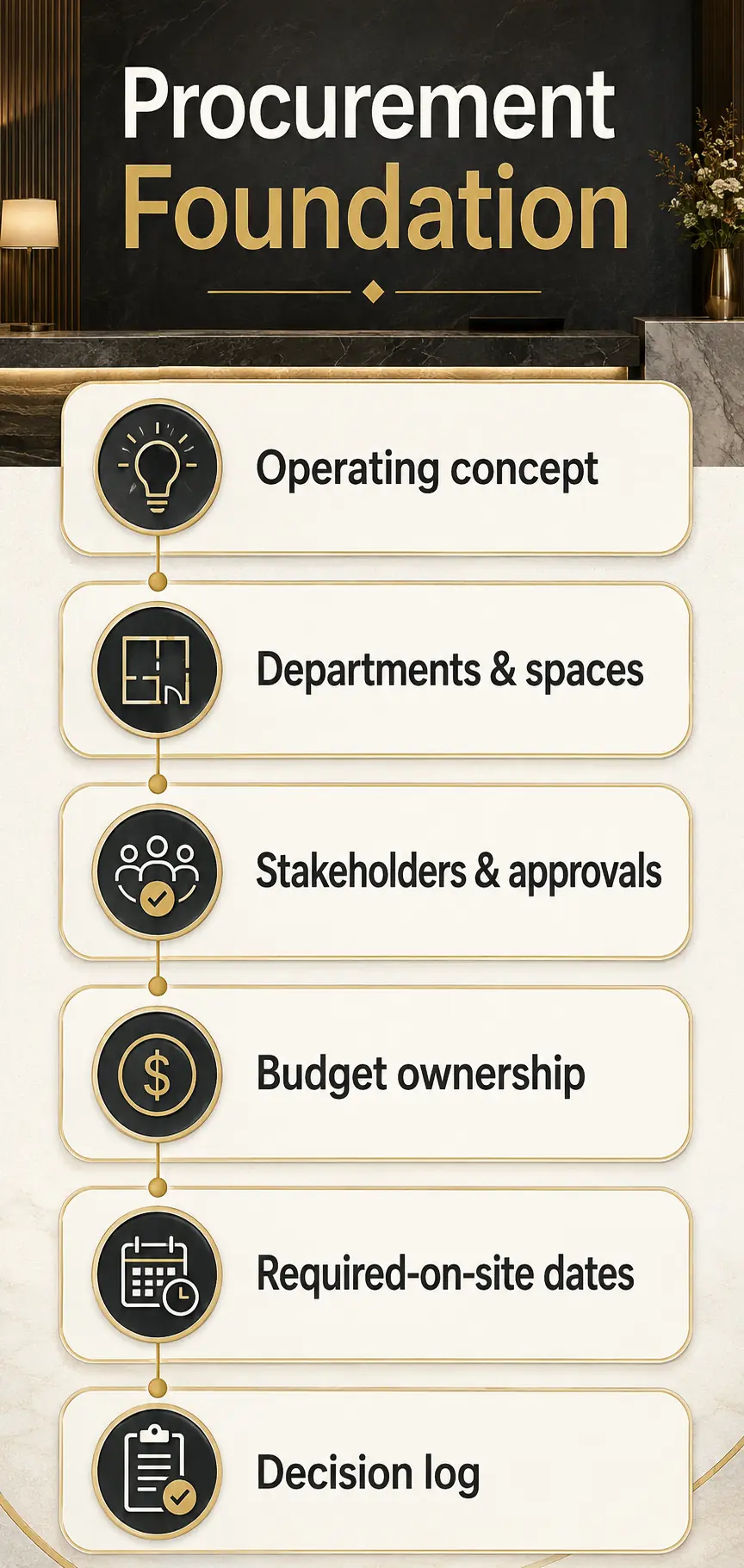
A practical scope is organized by physical area and operational responsibility. Guest rooms, bathrooms, corridors, lobby, front office, housekeeping, laundry, kitchen, restaurants, bars, banquets, wellness, engineering, security, offices and employee areas each need a named owner. For every area, capture installed items, movable equipment, operating supplies, consumables, spare parts, initial stock and any service needed for assembly, installation, commissioning or training.
Create a short procurement charter before building the item list. It should define:
The business objective and success criteria for the purchase.
The scope boundaries, exclusions and interfaces with construction or operator contracts.
The approval matrix for specifications, samples, commercial awards and changes.
The budget owner, currency, tax treatment and contingency rules.
The required-on-site dates, receiving constraints and opening-critical priorities.
The document that serves as the controlled source of truth and the person who maintains it.
Use a decision log for exceptions. A dated record of the question, options, decision, approver and effect on cost or schedule is more valuable than a chain of disconnected messages. It also protects continuity when team members or consultants change during a long project.

Build the Master FF&E and OS&E Schedule
The master schedule is the operational backbone of the purchase. Give every line a unique item code and connect it to a department, room type, area, category and procurement package. At minimum, capture the description, specification reference, unit of measure, quantity, budget, selected supplier, approval status, lead time, required-on-site date and receiving destination. Keep one row per distinct item and configuration; do not hide several products in a single narrative cell. The schedule should show both what has been decided and what is still unknown. A useful schedule is not merely a list of products—it is a controlled dataset that supports quotation, approvals, purchase orders, logistics, receiving, inventory and later replenishment.
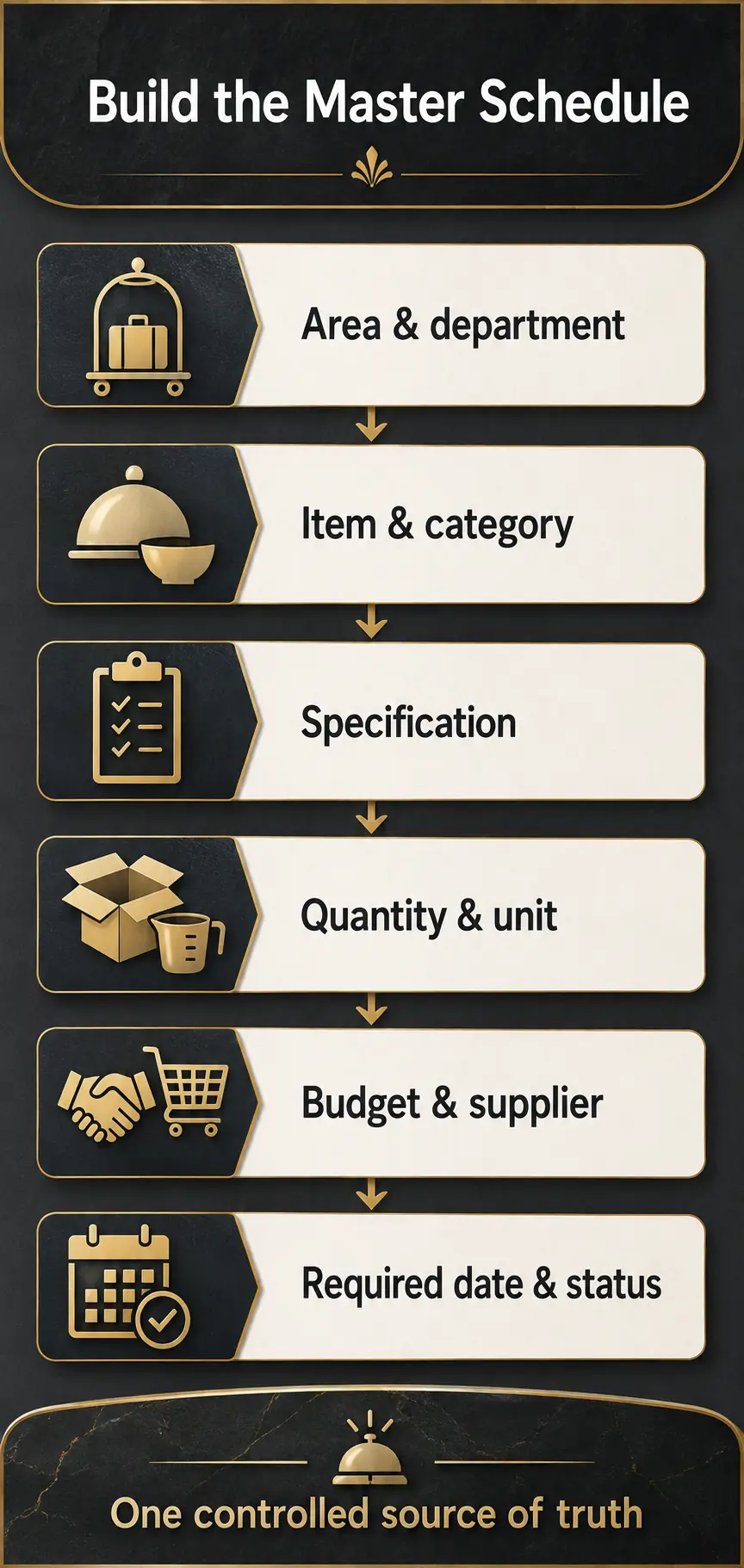
Classification matters because it affects budgeting, timing, ownership and replacement planning. Use the FF&E and OS&E guide for purchasing managers to align terminology, then define the project’s own boundaries in writing. Accounting treatment and contract scope can vary, so a generic label should never override the approved project definition.
| Schedule field | Purpose | Control question |
| Item code | Creates a stable reference across documents | Is the code unique across all packages? |
| Area / department | Assigns operational ownership | Who uses and accepts the item? |
| Specification revision | Prevents obsolete requirements | Which approved version governs? |
| Unit and pack | Makes quantities and prices comparable | Piece, set, case, carton or pallet? |
| Required-on-site date | Connects purchasing to operations | When must the item be inspected and usable? |
| Status and approver | Makes exceptions visible | What is pending and who must act? |
Control revisions rather than saving multiple uncontrolled copies. A change to material, finish, dimension, quantity, pack size or delivery phase can affect pricing, freight, storage and compatibility. Each revision should carry a date, owner, reason and approval. Freeze the baseline before inviting bids, then distinguish approved changes from supplier clarifications.

Turn Operational Needs Into Measurable Specifications and Quantities
Suppliers can only quote and manufacture what the procurement package defines. Replace adjectives such as “premium,” “durable” or “hotel quality” with measurable requirements tied to use. State dimensions and tolerances, material grade, construction, finish, color reference, performance, capacity, cleaning method, compatibility, packaging, labeling, warranty, documentation and applicable market requirements. For design-sensitive items, identify the controlled drawing, finish sample or approved physical sample. For alternatives, require a side-by-side deviation schedule and written approval before substitution. Quantity must be equally explicit: identify the purchasing unit, pack configuration, base requirement, operating par, reserve, breakage allowance, phased delivery and any opening stock that will be consumed before normal replenishment begins.
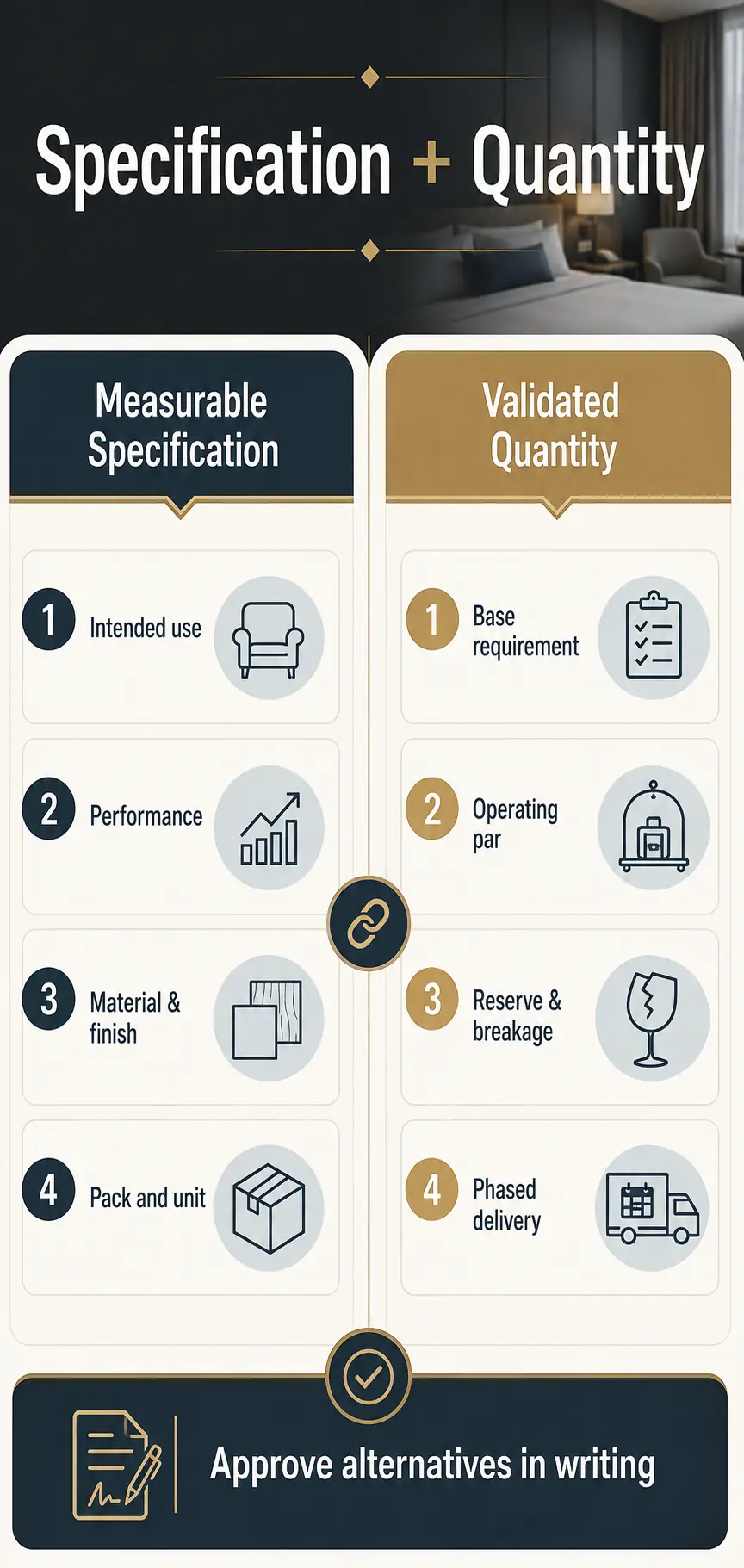
Build quantity logic from an operational driver rather than copying a generic hotel list. The formula changes by category:
| Category | Base driver | Quantity logic |
| Guest-room item | Room type and installed locations | Rooms × units per room + approved reserve |
| Linen | Rooms, occupancy and laundry cycle | Full setup × operating par + opening and reject reserve |
| Restaurant tableware | Seats, turns and service style | Covers per peak period × pieces per cover × par |
| Housekeeping equipment | Floors, zones and staffing | Simultaneous teams + charging/repair reserve |
| Consumables | Daily use and replenishment interval | Average use × days of cover + safety stock |
Validate formulas with the people who will operate the property. Housekeeping may know the real cart cycle; food and beverage may know how banquet peaks differ from restaurant averages; engineering may identify connection, voltage, clearance or maintenance constraints; finance may define whether an allowance belongs in capital or operating budgets. Record the formula and assumptions beside the result so the number can be recalculated when room count, seating, occupancy, service style or delivery frequency changes.
Do not mix pieces, sets, cartons and cases. Ask suppliers to confirm pieces per inner pack, inner packs per carton, cartons per pallet, minimum order quantity and order multiple. The commercial total should reconcile to the individual units the hotel will actually receive.

Prequalify Suppliers Before Requesting Prices
A competitive quotation is useful only when the invited suppliers are capable of fulfilling the requirement. Prequalification should test category experience, manufacturing or sourcing capability, capacity during the required window, quality systems, compliance evidence, financial and commercial stability, communication discipline, after-sales support and continuity for replacement orders. Match the depth of review to the purchase risk. A standard stocked amenity may need basic commercial checks; custom furniture, foodservice equipment, branded products or large multi-category packages require stronger technical, quality and delivery evidence. Ask for proof that relates to the proposed product and facility, not a generic company presentation. Resolve qualification gaps before price scoring so commercial pressure does not normalize an unacceptable risk.
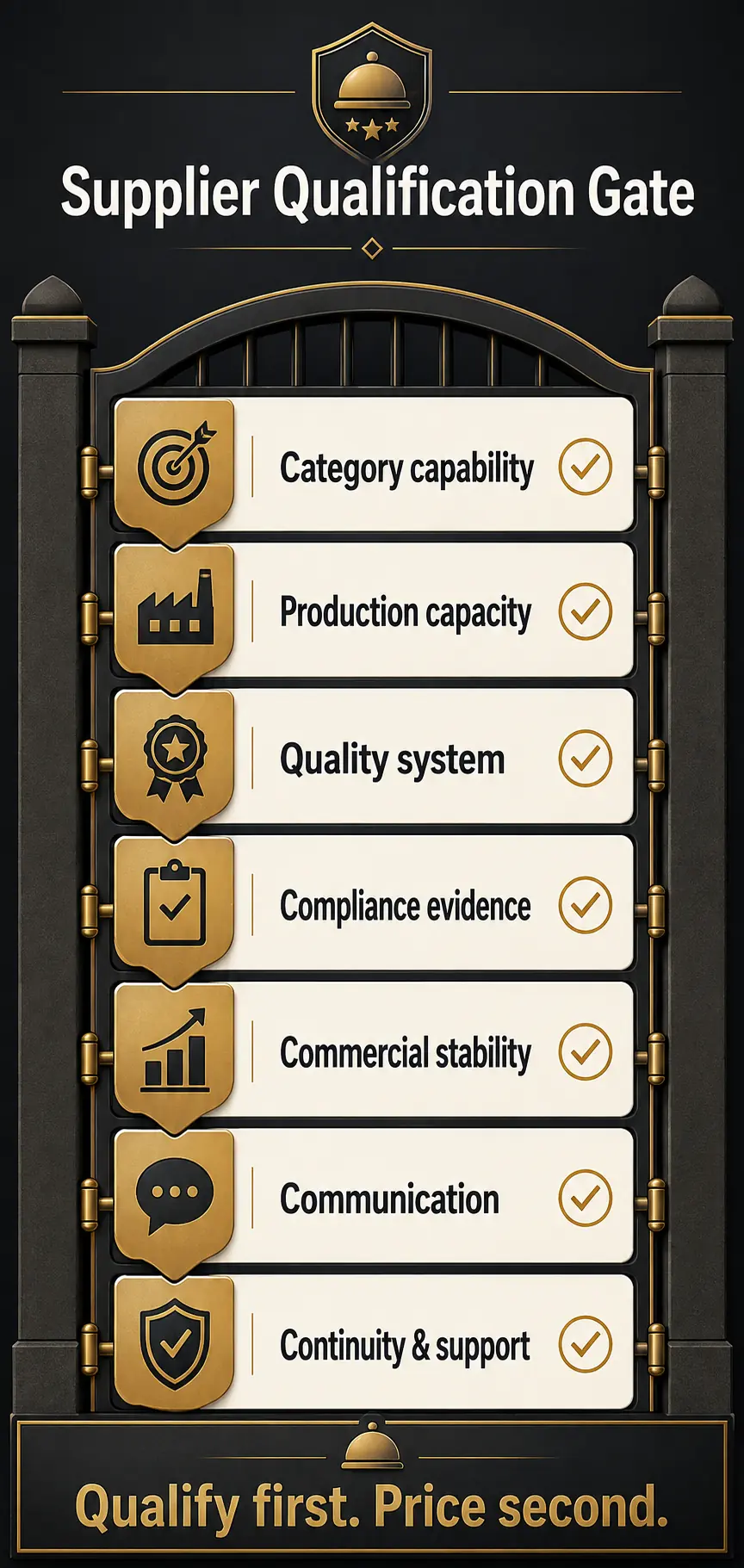
Use a gated approach. A supplier that fails a mandatory safety, legal, technical or capacity requirement should not recover through a low price. Separate mandatory pass/fail criteria from weighted preferences. Suggested gates include:
Ability to meet the exact product category, customization and documentation requirements.
Evidence of relevant projects, references or repeat-order capability.
Factory or supply-chain capacity aligned with the required production window.
A defined quality-control process and responsibility for nonconforming goods.
Market-specific compliance documents for the actual product and destination.
Clear ownership of samples, changes, claims, warranty and spare parts.
Commercial terms that the buyer can verify and administer.
Where the risk warrants it, review the production site, audit the process or commission an independent assessment. Confirm which legal entity will contract and invoice, which facility will make the goods, and whether subcontracting is permitted. A supplier’s willingness to answer precise questions, acknowledge limitations and document deviations is itself a useful indicator of execution quality.

Compare Bids on Total Landed Cost and Best Value
Bid comparison should place every offer on the same technical and commercial basis. Begin with compliance: identify omissions, deviations, substitutions and assumptions line by line. Then normalize units, pack sizes, currencies, quote validity, quantities, delivery terms and included services. Evaluate the complete cost that the project is expected to bear—not only the unit price. Depending on the purchase, this can include tooling, artwork, samples, packaging, inspection, freight, insurance, duties, taxes, customs-related charges, storage, installation, commissioning, training, maintenance, energy or water use, consumables, spare parts, downtime, expected service life and disposal. Keep the formula transparent, use common assumptions for all bids, and show where cost remains estimated or excluded.
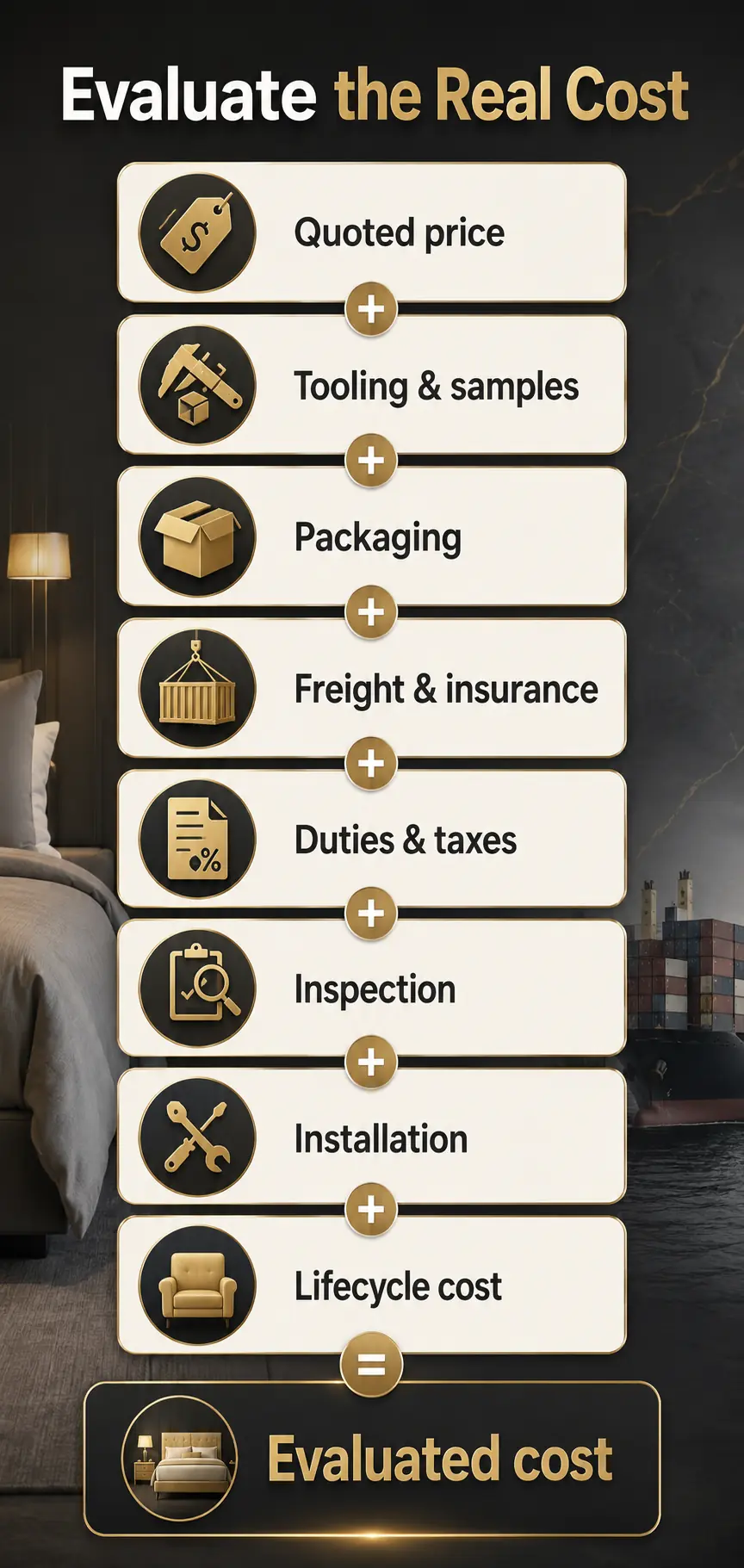
A best-value model combines cost with the factors that determine operational success. Define criteria and weights before opening final commercial offers where the process allows. Use a consistent scale with written scoring anchors. For example, a score of five should describe evidence of full compliance and low execution risk; a score of three should describe an acceptable but qualified response; a score of one should describe a material gap.
| Evaluation area | Example evidence | Typical treatment |
| Mandatory compliance | Specification, safety, destination and contract gates | Pass / fail |
| Evaluated cost | Normalized landed and lifecycle cost | Weighted score |
| Quality and durability | Samples, tests, controls and warranty | Weighted score |
| Delivery confidence | Capacity, milestone plan and logistics response | Weighted score |
| Service and continuity | Claims response, spares and reorder support | Weighted score |
Use the hotel supplies RFQ guide to structure comparable supplier responses. The workbook below converts the framework into editable schedules for item planning, supplier scoring, landed-cost comparison, sample control, delivery tracking and risk review.
Review sensitivity before awarding. A supplier can rank first under one freight assumption and second under another. Test the most uncertain variables—freight, currency, duty treatment, defect allowance, useful life and required spare stock—and document the approval rationale. The award memo should show why the selected offer is the strongest compliant value, including any risks the contract must control.

Control Samples, Quality, Contracts, and Change
Quality control begins before production, not at receiving. Define the sample path for each risk level: material swatch, finish sample, standard unit, customized prototype, mock-up, preproduction sample or operational trial. Record what was reviewed, against which specification revision, by whom, on what date, and with what conditions. Retain an approved control sample when appearance or workmanship matters. The purchase order or contract should identify that sample and the written specification as the production reference, define inspection stages and acceptance criteria, and state how nonconforming goods, corrective work, reinspection, delay and replacement will be handled. No verbal change should alter cost, schedule, quality or scope without a documented approval.
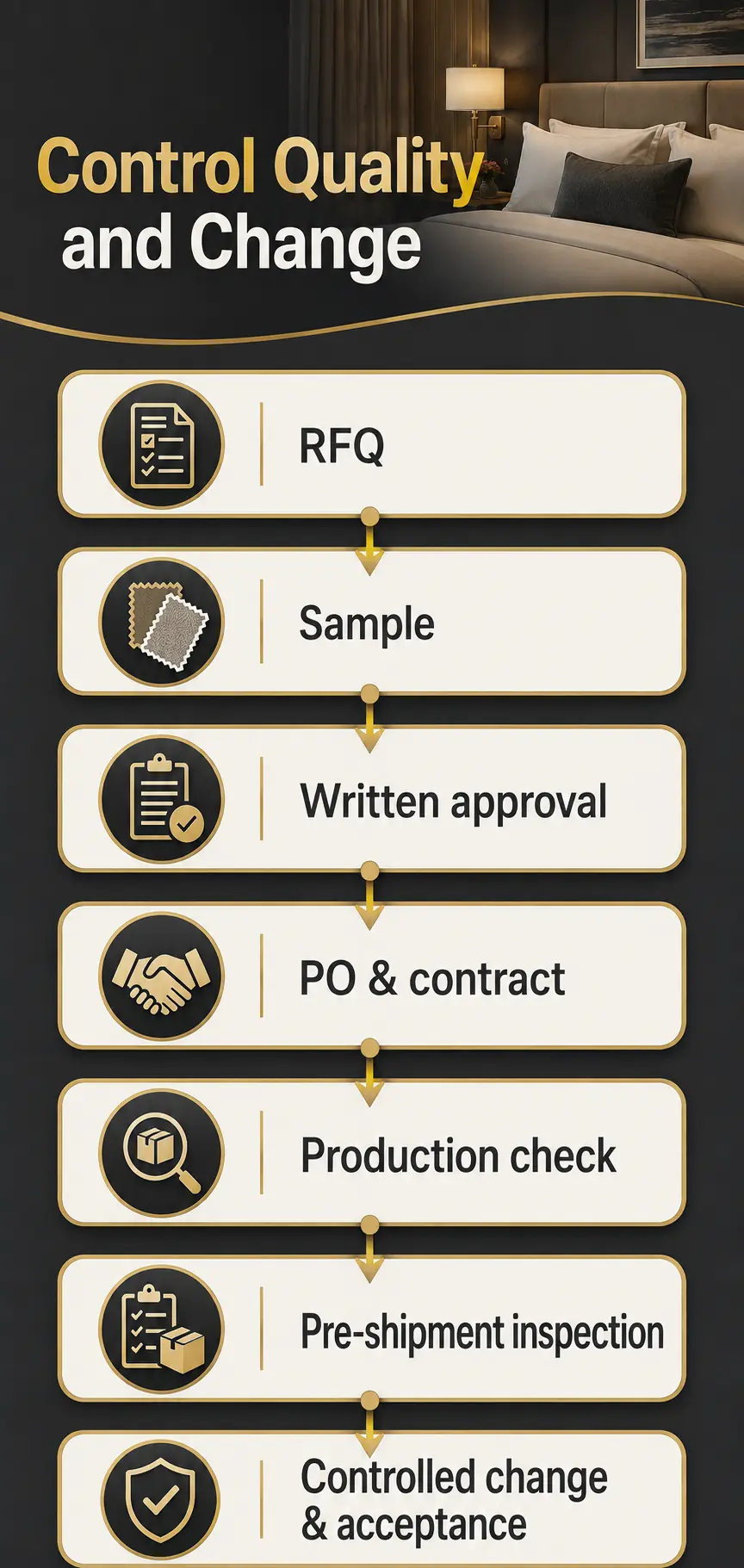
Match inspections to risk and production stage. Raw-material or first-article checks can prevent a defect from spreading through an entire order. In-line checks test whether the approved process is being followed. Pre-shipment inspection confirms quantity, workmanship, dimensions, finish, function, branding, packaging and documentation before the goods leave the supplier. Receiving inspection then verifies the delivered condition and reconciles shipment records.
The commercial document should state at least the following:
The exact product, quantity, unit, approved specification and revision.
Price basis, currency, validity, taxes, delivery term and named place where relevant.
Sample, artwork, drawing and control-sample approval requirements.
Production, inspection, shipping and required-on-site milestones.
Packaging, labeling, carton marking and destination documentation.
Warranty, spare parts, training, installation and after-sales obligations.
Change-control, delay, rejection, corrective-action and claim procedures.
Keep a change log that links every approved change to the affected item codes, documents, cost, quantity and milestone. Reissue the relevant schedule or drawing with a new revision. If a supplier proposes an alternative because of availability, lead time, minimum order quantity or cost, require a comparison of material, dimensions, capacity, finish, compliance, warranty and delivery before approval.

Plan Logistics, Receiving, and Post-Award Performance
Plan backward from the date each item must be available for inspection, assembly, installation, washing, staff training or room staging. The public opening date is usually too late as a planning anchor. Break the timeline into approvals, sample production, material procurement, manufacturing, inspection, export preparation, transit, customs, final delivery, unloading and internal distribution. Confirm destination details early: address, receiving hours, appointment rules, dock and vehicle limits, unloading equipment, elevator access, floor distribution, storage conditions and site contacts. For phased or multi-property deliveries, separate quantities, labels, dates and destinations. The supplier’s “lead time” should never remain one unexplained number; define the event that starts it and the milestones that prove progress.
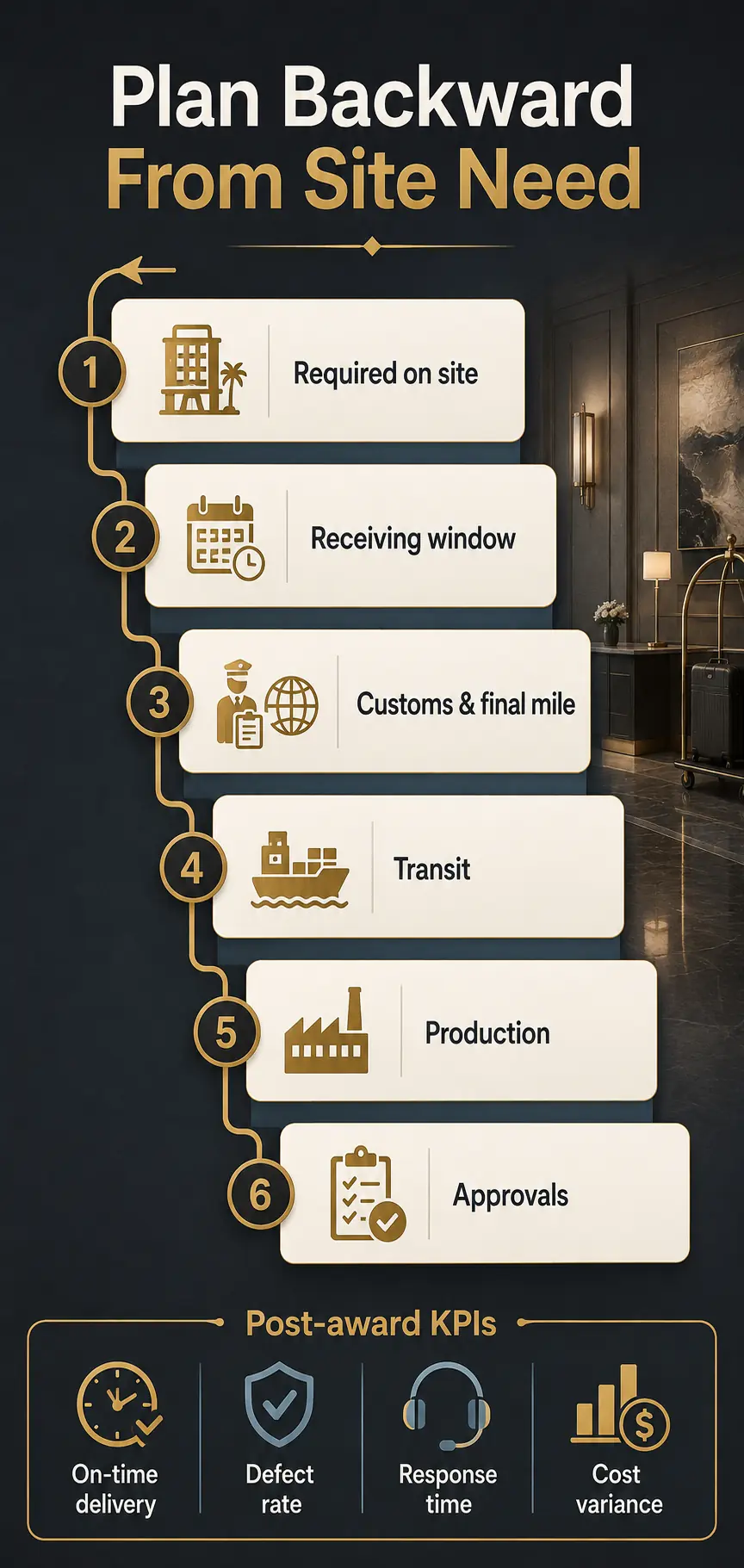
The hotel opening supplies planning guide explains how required-on-site dates connect procurement to commissioning and operational readiness. Use an exception report for milestones that are late, unconfirmed or dependent on unresolved approvals. A risk should name its owner, trigger, response and decision date rather than remain a generic warning.
Prepare receiving before the truck arrives. The receiving team needs the purchase order, packing list, item schedule, expected cartons or pallets, inspection plan, storage location and escalation route. Photograph external damage before unloading where appropriate, segregate suspect goods, count at the correct unit level, test critical items, and record shortages or nonconformities against the item code. Acceptance should be explicit; silence or movement into storage should not automatically close a claim.
After award, monitor a small set of actionable supplier indicators: milestone adherence, on-time and in-full delivery, defect and rejection rates, response time, corrective-action closure, cost variance, document accuracy and reorder continuity. The objective is not to create a decorative dashboard. It is to identify where intervention is needed and to provide evidence for future sourcing decisions.
If you are preparing a multi-item hotel package, organize your item schedule, specifications, quantities, destination and required dates, then submit a sourcing RFQ. KW Hospitality can review standard, customized and project-specific hospitality supply requirements and coordinate quotation, samples, quality control and delivery support.

Conclusion
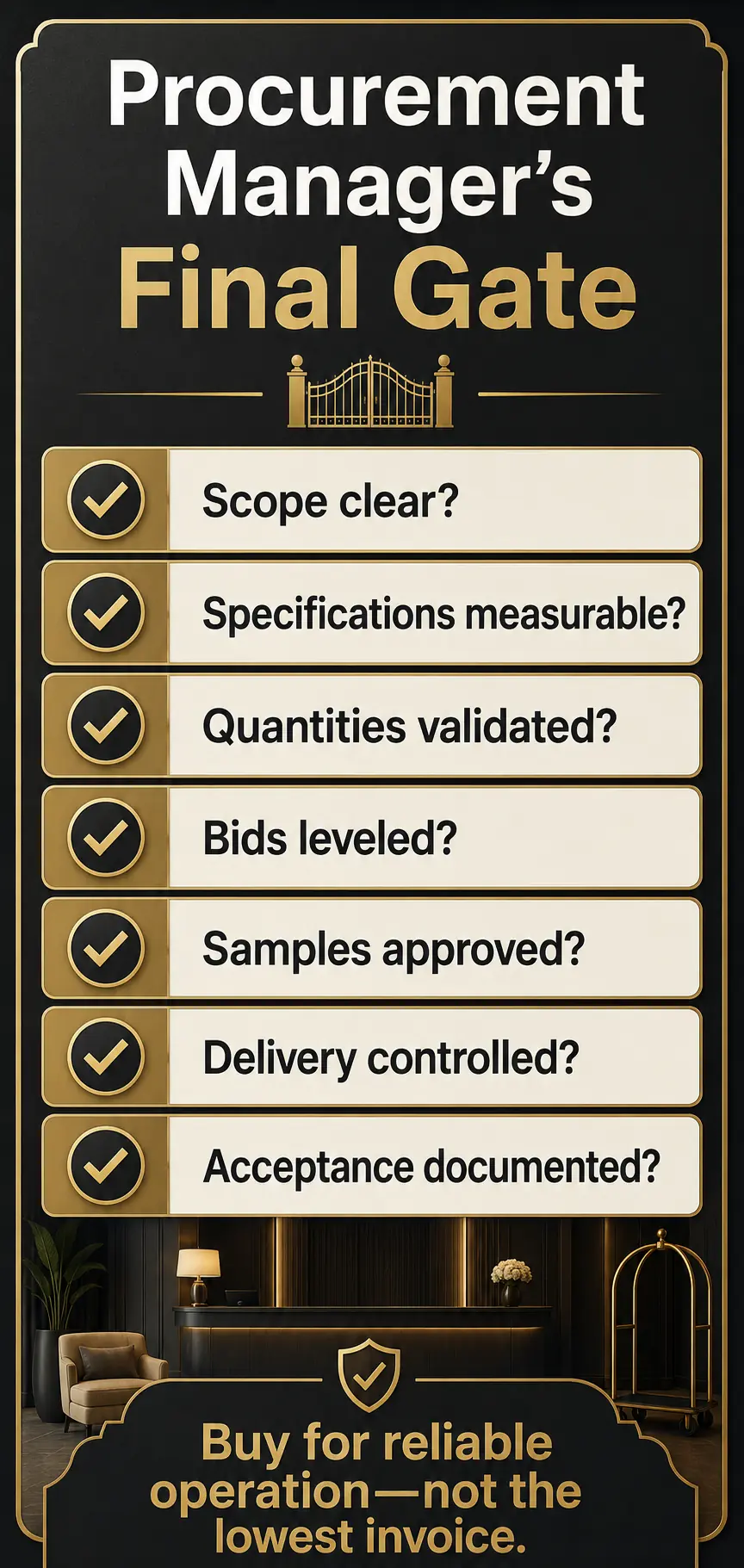
Effective hotel supplies purchasing is a chain of controlled decisions. A property-specific scope defines the need; a master schedule gives every item a stable identity; measurable specifications and formulas make quotations comparable; prequalification limits supplier risk; landed-cost and best-value evaluation make the award defensible; sample and change controls protect quality; and backward logistics planning turns a purchase order into operational readiness. The procurement manager’s final check is therefore broader than price: Is the scope clear, the specification measurable, the quantity validated, the bid leveled, the sample approved, the delivery controlled and acceptance documented? When every answer has an owner and evidence, the hotel can buy with confidence and preserve the reasoning for future replenishment, renovation and multi-property standards.
Use the process as a living management system rather than a one-time tender exercise. Update assumptions, measure actual supplier performance, capture receiving lessons and revise standards when operating data proves that a product, quantity or service level should change. The strongest procurement program is the one that becomes easier to audit, repeat and improve with every purchase.
Frequently Asked Questions
The questions below address the decisions that most often affect hotel supply cost, comparability, quality and timing.
What should a hotel procurement manager prepare before requesting quotations?
Prepare a property-specific item schedule, measurable specifications, validated quantities and units, destination information, required-on-site dates, sample and compliance requirements, pricing format, commercial terms, submission instructions and evaluation method. Identify unresolved assumptions and tell suppliers how to disclose deviations or alternatives. The more consistently every bidder receives and answers the same requirement, the more reliable the comparison becomes.
How should hotel suppliers be compared when their quotations use different formats?
First confirm technical compliance, then normalize item descriptions, quantities, units, pack sizes, currencies, quote validity, delivery terms, included services and exclusions. Calculate total landed or evaluated cost using the same assumptions for every offer. Score nonprice factors with predefined criteria and written anchors. Do not reward an apparently low offer that omits freight, inspection, required accessories, documentation or other scope.
What is the difference between unit price, landed cost, and total cost of ownership?
Unit price is the price assigned to the stated purchasing unit. Landed cost adds the costs required to bring the goods to the defined destination, which may include packaging, freight, insurance, duties, taxes and customs-related charges depending on the agreed basis. Total cost of ownership goes further by considering relevant costs over use, such as installation, maintenance, consumables, energy, downtime, service life and disposal. The applicable model depends on the category and decision.
When should hotel product samples be approved?
Approve the relevant sample before mass production whenever material, finish, dimensions, branding, workmanship, fit, performance or guest-facing appearance is important. The required stage may be a swatch, standard sample, prototype, mock-up, preproduction sample or trial unit. Record the approved specification revision, reviewer, date and conditions, and identify whether a physical control sample will be retained for production comparison.
How far in advance should hotel supplies be purchased?
There is no universal lead time. Plan backward from the required-on-site date and include specification finalization, supplier qualification, quotation, sample approval, production, inspection, transport, customs, final delivery, installation, washing, testing, training and staging. Long-lead, customized, imported, technical and opening-critical items usually require earlier action than standard replenishment supplies. Confirm the event that starts each supplier’s quoted lead time.
What supplier performance indicators are most useful after award?
Track indicators that support action: milestone adherence, on-time and in-full delivery, defect or rejection rate, response time, corrective-action closure, cost variance, document accuracy, warranty performance and continuity for repeat orders. Define how each measure is calculated and who reviews it. A short, consistent scorecard is more useful than a large dashboard that no one uses to manage exceptions.