
Choosing wholesale hotel supplies is not a catalog-shopping exercise. The right products must fit the property’s positioning, operating model, room count, guest expectations, staffing, utilities, cleaning processes, storage limits, opening schedule, and replacement strategy. A luxury resort may need custom finishes and high-touch amenities, while an extended-stay property may place greater weight on wash durability, modular replacement, and dependable replenishment. Even two hotels with the same room count can require very different specifications.
A disciplined purchasing process starts by translating those operating realities into measurable requirements. It then matches each product category with the right type of supplier, compares quotes on a common commercial basis, validates samples and compliance evidence, and plans quality control and delivery before a purchase order is released. The objective is not simply to obtain the lowest unit price. It is to secure the best total value: products that perform as expected, arrive when needed, remain consistent across the order, and can be supported after opening.
This guide provides a practical decision framework for owners, purchasing managers, operators, designers, and project teams buying wholesale hotel supplies. It explains what to define, which supplier models to consider, how to compare total landed and lifecycle cost, what to verify before mass production, and how to score suppliers without allowing a strong price to hide a critical risk. Use it for new openings, renovations, brand conversions, and recurring replacement procurement. It also helps teams document assumptions, compare exceptions openly, and create a decision record that operations, finance, design, ownership, and receiving staff can use after the order is placed.

Translate Your Property Requirements into a Procurement Brief
The first purchasing decision is not which supplier to call; it is what the property actually needs. A useful procurement brief converts design intent and operating assumptions into quantities, performance requirements, acceptance criteria, commercial boundaries, and delivery milestones. It should be detailed enough that different suppliers quote the same scope, yet flexible enough to allow equivalent solutions where a brand standard does not prescribe one product. Without this common baseline, low quotes often reflect missing components, lighter specifications, incomplete packing, or different delivery assumptions rather than genuine value.
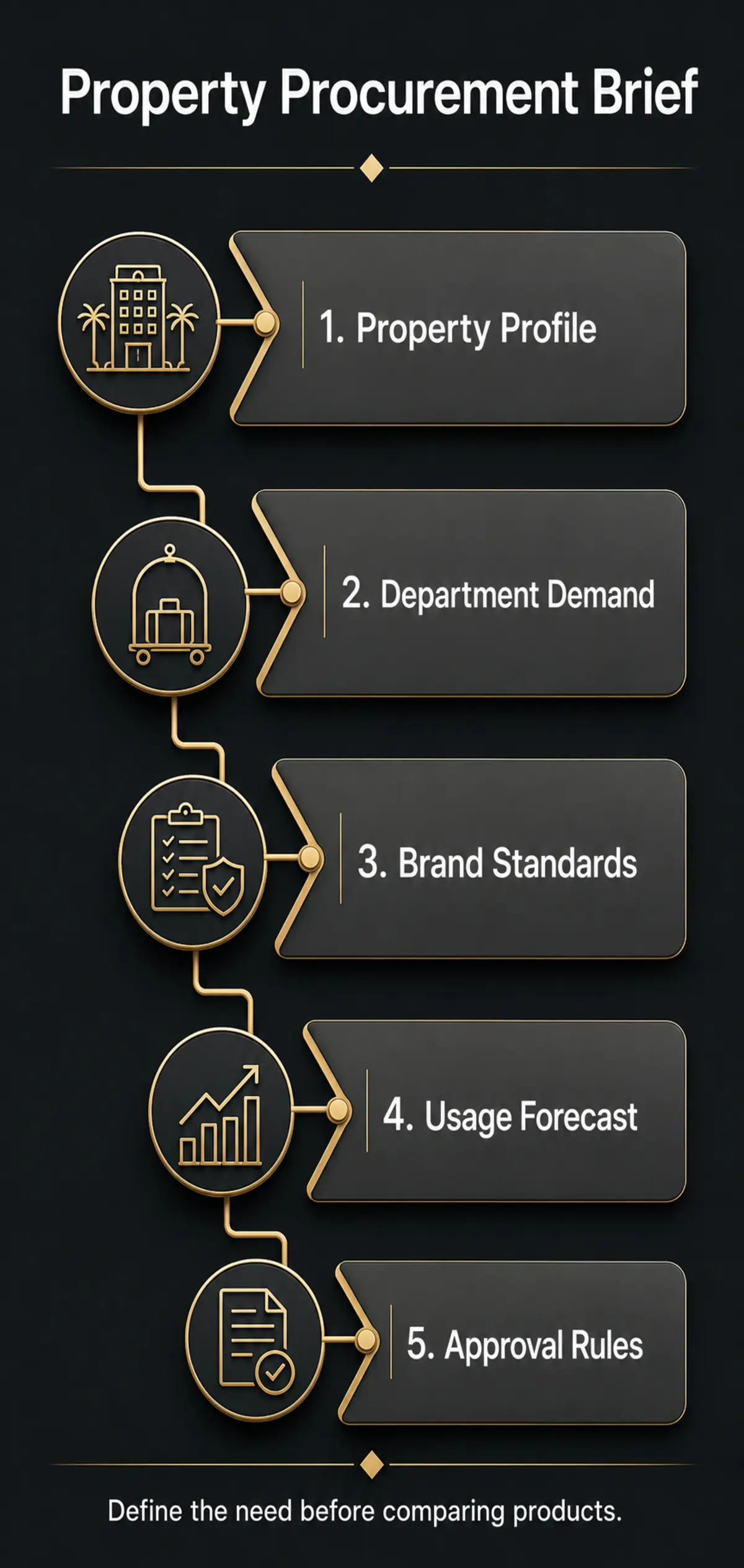
Start with the property profile
Document the property type, location, market level, room count, suite mix, outlets, banquet capacity, spa or pool areas, back-of-house functions, accessibility needs, and whether the building is new, renovated, or already operating. Include guest and operating realities that change product performance: expected occupancy, laundry method, cleaning chemicals, floor surfaces, storage space, cart routes, elevator dimensions, electrical standards, water conditions, and local service availability.
Build a room-by-room and department-by-department scope
KW Hospitality’s hospitality supplies directory organizes guest-room essentials, foodservice equipment, operating supplies, FF&E, and project-ready categories. Use a category directory as a coverage check, then create the actual schedule around the property rather than copying a generic list.
| Requirement Area | Questions to Resolve | Procurement Output |
| Property and brand | Positioning, design standards, guest promise, owner priorities | Approved product tier and finish direction |
| Operations | Users, frequency, cleaning, storage, handling, maintenance | Performance and service requirements |
| Quantity | Installed units, operating par, reserve stock, breakage, growth | Order quantity by phase |
| Technical | Dimensions, materials, power, utilities, interfaces, tolerances | Comparable specification sheet |
| Acceptance | Sample, testing, inspection, packaging, defect thresholds | Approval and quality-control plan |
| Commercial | Budget basis, currency, Incoterm, payment, warranty, claims | Comparable quote instructions |
| Schedule | Approval, production, inspection, shipment, delivery, installation | Required milestone plan |
Quantity should distinguish installed quantity, daily operating par, opening reserve, replacement stock, and future expansion. A single total hides how items will be deployed and can cause either stockouts or unnecessary storage. For recurring supplies, include consumption assumptions and reorder frequency; for durable equipment, include spares, accessories, consumables, and replacement parts.

Use the Right Supplier Model for Each Product Category
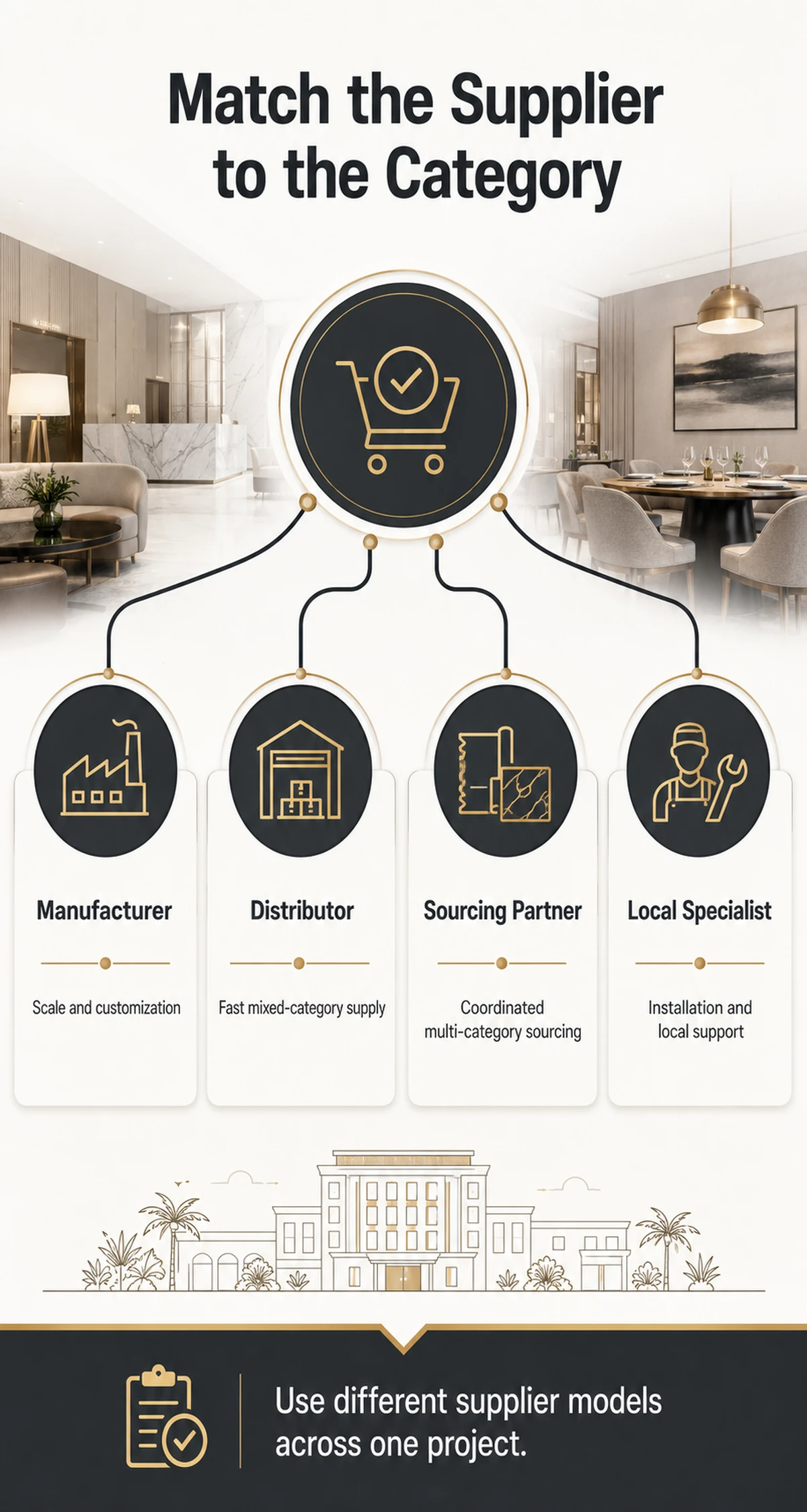
No single supplier model is best for every hotel product. Direct manufacturers can offer competitive production pricing, customization, and control at scale, but may require higher minimums and more buyer-side coordination. Distributors can consolidate ready-made products and support smaller or mixed orders. Sourcing partners can coordinate multiple factories, specifications, samples, inspections, and shipments across categories. Local specialists may be essential where installation, commissioning, code coordination, rapid service, or stocked replacement parts matter. The practical strategy is often a category-by-category mix rather than one universal source.
Separate FF&E, OS&E, consumables, and technical equipment
Before selecting vendors, clarify whether each item belongs to FF&E, OS&E, consumables, or a technical package. The article Hotel FF&E vs. OS&E: What Purchasing Managers Must Know explains why ownership, budgeting, installation, and replacement treatment differ. That distinction also changes the supplier profile you need.
| Supplier Model | Best Fit | Watch For |
| Direct manufacturer | High volumes, controlled specifications, custom branding or finishes | MOQ, tooling, export readiness, production oversight |
| Distributor / wholesaler | Mixed ready-stock items, fast replenishment, lower quantities | Brand consistency, substituted models, margin transparency |
| Sourcing partner | Multi-category projects needing one coordination path | Scope clarity, supplier disclosure, inspection and claims process |
| Local specialist | Installation, commissioning, code interfaces, urgent support | Geographic coverage, labor exclusions, parts availability |
Verify capability at the category level
A supplier can be experienced in hospitality and still be weak in the specific category you are buying. Ask for comparable projects, production locations, current capacity, quality controls, export markets, service coverage, and references relevant to the product. For custom goods, examine design development, tooling ownership, color and material control, approved-sample retention, and repeat-order consistency. For replacement purchases, prioritize model continuity, parts, and reorder minimums.

Compare Total Landed Cost, Lifecycle Value, and Commercial Terms
Wholesale quotations become comparable only after every supplier prices the same specification, quantity, packaging level, delivery basis, and service scope. A low unit price can be offset by higher freight, poor container utilization, inspection expense, duty, storage, installation, breakage, energy use, maintenance, or early replacement. Conversely, a premium product is not automatically better value if its additional features do not improve the guest experience or operation. Compare the full economic effect over a realistic service period, and record which costs are included, estimated, excluded, or buyer-supplied.

Normalize every quotation
Confirm the exact product, model, material, dimensions, finish, accessories, and packing configuration.
State currency, quotation validity, tax treatment, Incoterm, shipment method, delivery point, and insurance responsibility.
Separate one-time costs such as tooling, molds, artwork, samples, testing, and setup.
Identify exclusions: installation, commissioning, unloading, storage, local permits, training, or disposal.
Record MOQ, price breaks, mixed-container rules, payment schedule, warranty, claim window, and spare-part pricing.
Calculate value per useful service cycle
A practical lifecycle comparison can be expressed as: total acquisition and operating cost minus expected residual value, divided by the useful service units delivered. The service unit may be a room-night, wash cycle, meal served, operating hour, or year in service. The calculation does not need false precision; its value comes from making assumptions visible. Test a base case and at least one downside case for shorter life, higher freight, delayed delivery, or greater breakage.
| Cost Layer | Examples | Evidence |
| Acquisition | Unit price, tooling, sample, testing, packaging | Itemized supplier quote |
| Landed | Inspection, freight, insurance, duty, tax, delivery | Forwarder and destination estimates |
| Deployment | Storage, handling, installation, commissioning, training | Project logistics and labor plan |
| Operation | Energy, water, consumables, cleaning, maintenance | Technical data and operating assumptions |
| Risk and replacement | Breakage, defects, downtime, spares, early replacement | Sample tests, history, warranty, sensitivity case |

Validate Samples, Compliance, and Production Quality
A sample is useful only when it represents a controlled specification and remains traceable to mass production. Approve materials, construction, dimensions, color, finish, function, branding, packaging, and workmanship in writing; retain a master sample or an equivalent digital control record. Then define what will be checked before production, during production, and before shipment. Compliance evidence must be product- and destination-specific. A generic certificate, expired report, or document for a different model does not prove that the ordered item meets the applicable requirement.
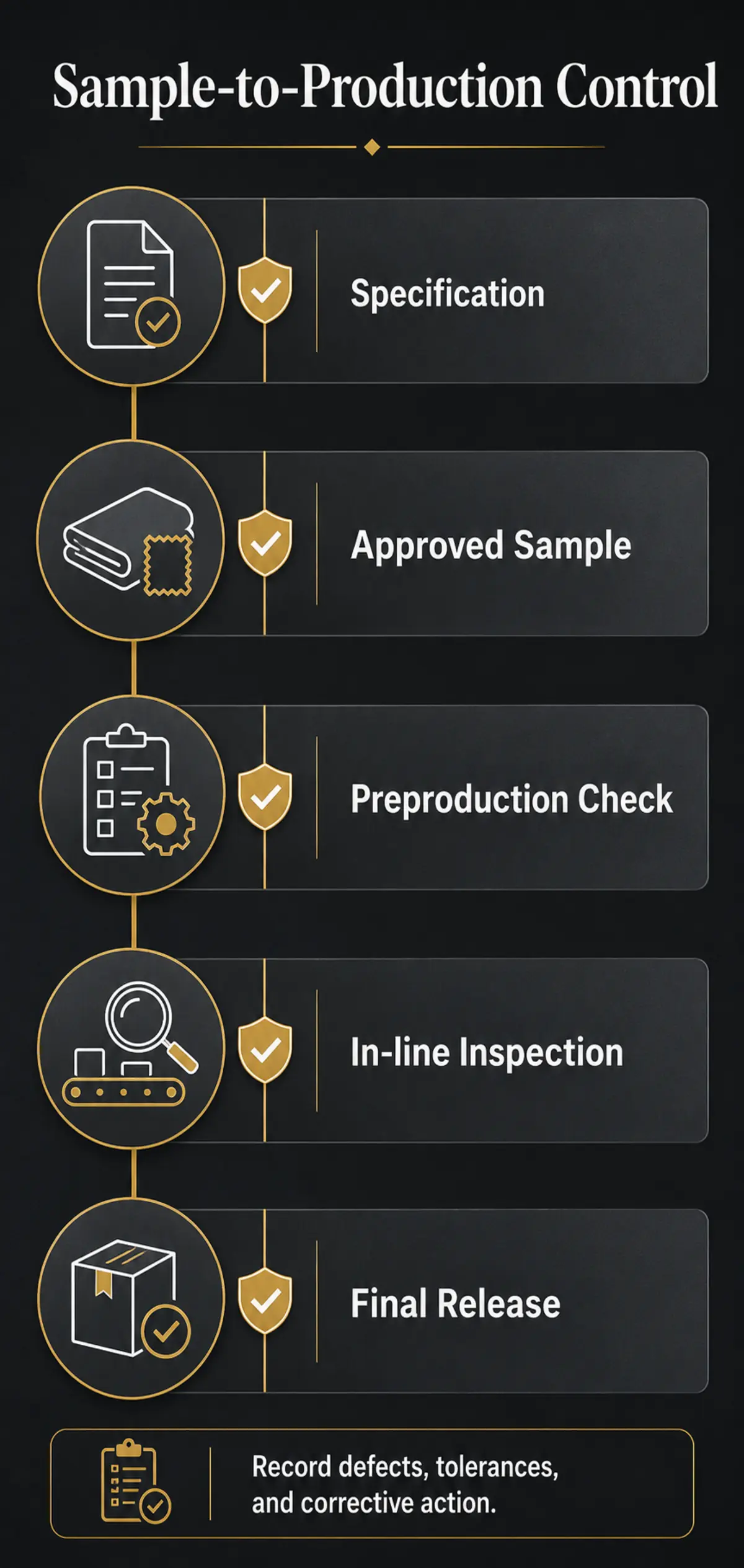
Use a sample approval record
Record the sample identifier, date, supplier, product revision, material and finish references, measured results, deviations, approvers, photographs, and conditions of approval. If approval is conditional, list the exact change and require confirmation before production. For color-sensitive or tactile products, store the master sample in conditions that reduce fading, contamination, or damage.
Plan inspections around risk
Inspection depth should reflect product criticality, order value, supplier history, process capability, and the consequences of failure. Preproduction checks confirm materials and setup; in-line checks can catch process drift while correction is still possible; final inspection verifies completed quantity, workmanship, function, assortment, labeling, and packaging before release. ISO 2859-1:2026 defines acceptance sampling systems for inspection by attributes, but the buyer still must select an appropriate plan and defect definitions for the order.
Confirm category-specific requirements
Requirements change by country and product. In the United States, for example, mattresses are subject to federal flammability requirements under 16 CFR Parts 1632 and 1633, while eligible commercial foodservice equipment can be compared through current ENERGY STAR product specifications. Treat these as examples of category-specific verification, not a universal compliance list. Confirm the destination market, intended use, current standard edition, test scope, model identity, labeling, recordkeeping, and any local authority requirements before award.
Define critical, major, and minor defects with visual examples where possible.
Require corrective action for repeated or systemic findings, not only sorting of visible defects.
Link release to approved evidence: inspection result, compliance documents, packing list, and shipping marks.
State the process for reinspection, rework, replacement, credit, and freight responsibility when goods fail.

Score Suppliers, Plan Delivery, and Issue a Clear RFQ
The award decision should combine weighted value with non-negotiable gates. A scorecard makes tradeoffs visible, but it should never allow a low price or strong presentation to compensate for an unresolved safety, compliance, sample, capacity, or delivery failure. Use the same evidence window and scoring definitions for every supplier. Then convert the preferred proposal into a controlled award package: final specification, quantity schedule, approved samples, milestones, inspection plan, commercial terms, packing requirements, document list, claims process, and responsibilities through delivery and installation.
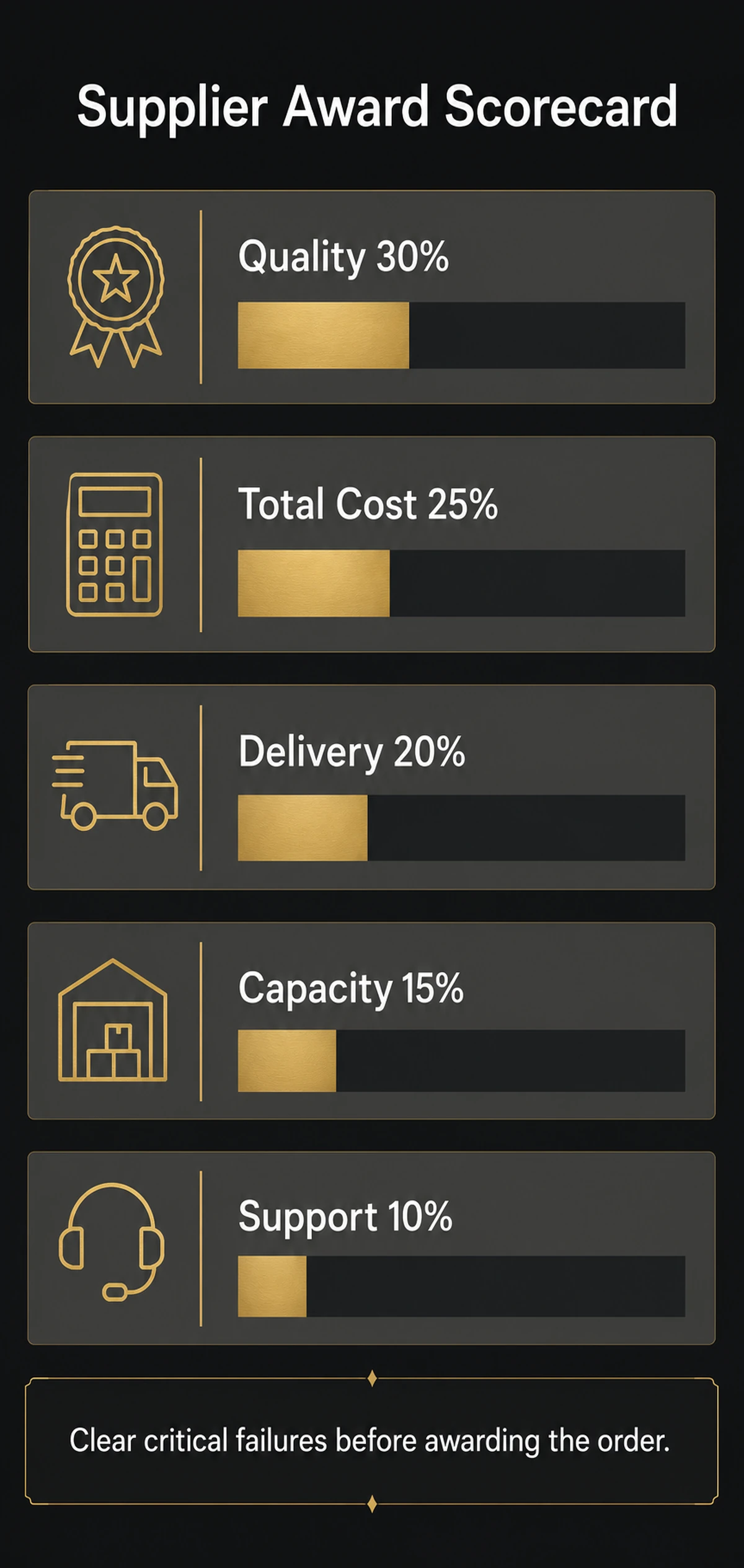
Use weighted criteria and critical gates
| Criterion | Suggested Weight | Evidence to Review | Critical Gate? |
| Product quality and specification match | 20% | Sample, test results, tolerances, workmanship | Yes |
| Compliance and documentation | 10% | Applicable reports, certificates, labels, traceability | Yes |
| Total landed cost | 15% | Normalized commercial comparison | No |
| Lifecycle value | 10% | Service life, maintenance, spares, replacement sensitivity | No |
| Delivery reliability | 15% | Capacity-supported lead time and logistics plan | Yes |
| Production capacity | 10% | Capacity, current load, backup plan, subcontractor control | Yes |
| MOQ and commercial terms | 5% | MOQ, payment, warranty, claims, quote validity | No |
| After-sales and replenishment | 10% | Parts, repeat-order terms, continuity, local support | No |
| Communication and issue response | 5% | Clarity, speed, escalation, corrective action | No |
Build a delivery and replenishment plan
Work backward from the required-on-site date through unloading, customs clearance, transport, shipment booking, final inspection, production, preproduction approval, and sample approval. Add decision buffers for custom finishes, holidays, port congestion, and corrective action. Phase deliveries around available storage and installation sequence; early delivery can be as disruptive as late delivery when a hotel lacks secure staging space.
For operating properties, define reorder triggers, reserve stock, approved alternates, replacement parts, discontinued-model handling, and emergency supply options. For opening projects, identify which items are opening-critical and which can arrive later without preventing staff training, inspections, soft opening, or guest service.
Send one clear RFQ package
A structured RFQ gives suppliers the same scope and makes omissions visible. Use the step-by-step guide How to Write an RFQ for Hotel Supplies to prepare supplier instructions, pricing schedules, capability questions, quality requirements, and submission rules.
Before award, resolve every deviation in a written clarification log and incorporate the accepted result into the purchase order or contract. The final agreement should identify the governing specification and sample, change-control method, acceptance process, document requirements, warranty and claims procedure, and ownership of tooling or artwork where relevant.
If you are sourcing multiple hospitality categories for a new opening, renovation, or replacement program, submit a project-specific sourcing RFQ to KW Hospitality. Include the property location, product categories, quantities, specifications or reference images, target delivery date, and any branding, sample, testing, or packing requirements so the quotation can be structured around the actual project.
The right wholesale hotel supplies are therefore the products that satisfy the property’s real operating requirements at an acceptable total cost and risk—not merely the items with the lowest price. A clear brief, category-specific supplier strategy, normalized cost model, controlled samples, risk-based quality plan, weighted scorecard, and realistic delivery schedule turn a broad purchasing exercise into an auditable decision.