
A useful safety and accessibility review ends with a purchase decision supported by evidence: approve the exact product and installation, hold the order until a missing requirement is resolved, or reject an unsuitable option. A catalog label such as ‘accessible’ cannot establish whether a shower seat fits the room, a support rail has adequate anchorage, or a communication device works with the property’s systems. For hospitality buyers, the review must connect the product, its location, and the way staff keep it available to guests.
This 2026 buyer checklist is written for U.S. hotels and similar hospitality properties purchasing accessibility supplies for guest rooms, bathrooms, pools, and shared spaces. The year identifies the review cycle; it does not imply that a new blanket ‘2026 ADA certification’ exists. Federal accessibility obligations, applicable state and local requirements, the project’s construction or alteration scope, and manufacturer instructions need to be considered together. Canadian projects require their own jurisdiction-specific review rather than a direct transfer of U.S. criteria.
The practical goal is to resolve consequential questions before a deposit, production release, or guest-use handover. Purchasing should collect model-specific evidence; the designer and installer should verify the setting and attachment method; operations should confirm that cleaning, charging, storage, and staff procedures preserve access. Each group has a different responsibility, and none should silently inherit an unresolved decision from the others.
The checklist below provides a reusable evidence register and a clear release rule. It concentrates on support equipment, usable controls, communication aids, and operating readiness rather than calculating room counts or comparing prices. Use it for initial sourcing, proposed substitutions, and final acceptance. For the broader placement of furnishings and amenities, the companion guest room safety and accessibility checklist covers the surrounding procurement context.
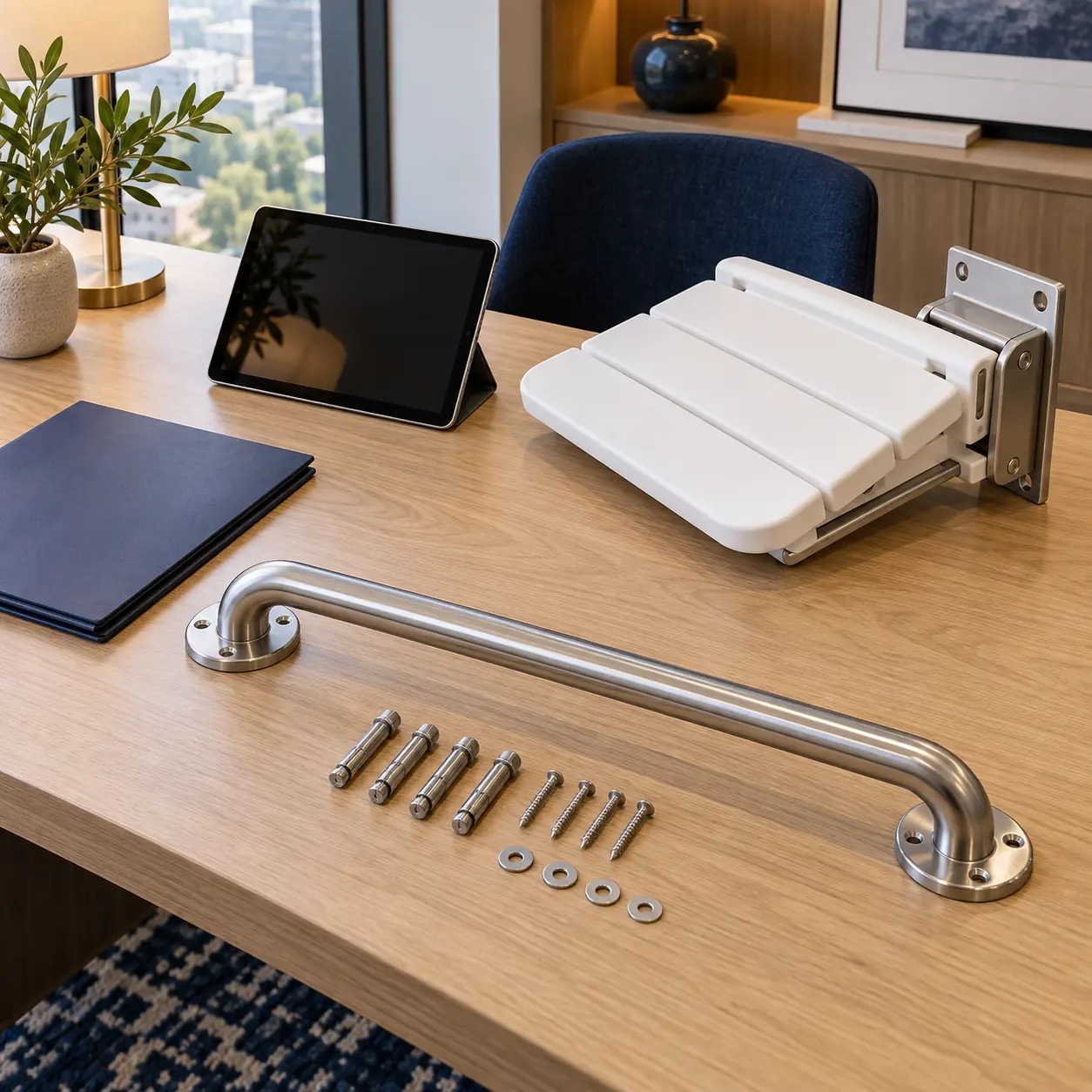
Define the Review Scope and Required Evidence
Start by identifying what the product must enable a guest to do and which room or facility will use it. A wall-mounted support, a portable bathing aid, and a hearing assistance device do not share one universal approval route. The review should specify the intended function, applicable project requirements, exact model, installation conditions, and evidence owner before suppliers quote. This prevents a broad marketing claim from becoming the purchasing specification. Keep statutory requirements, manufacturer limitations, and the property’s additional operating preferences in separate fields so a commercial preference cannot conceal a safety failure.
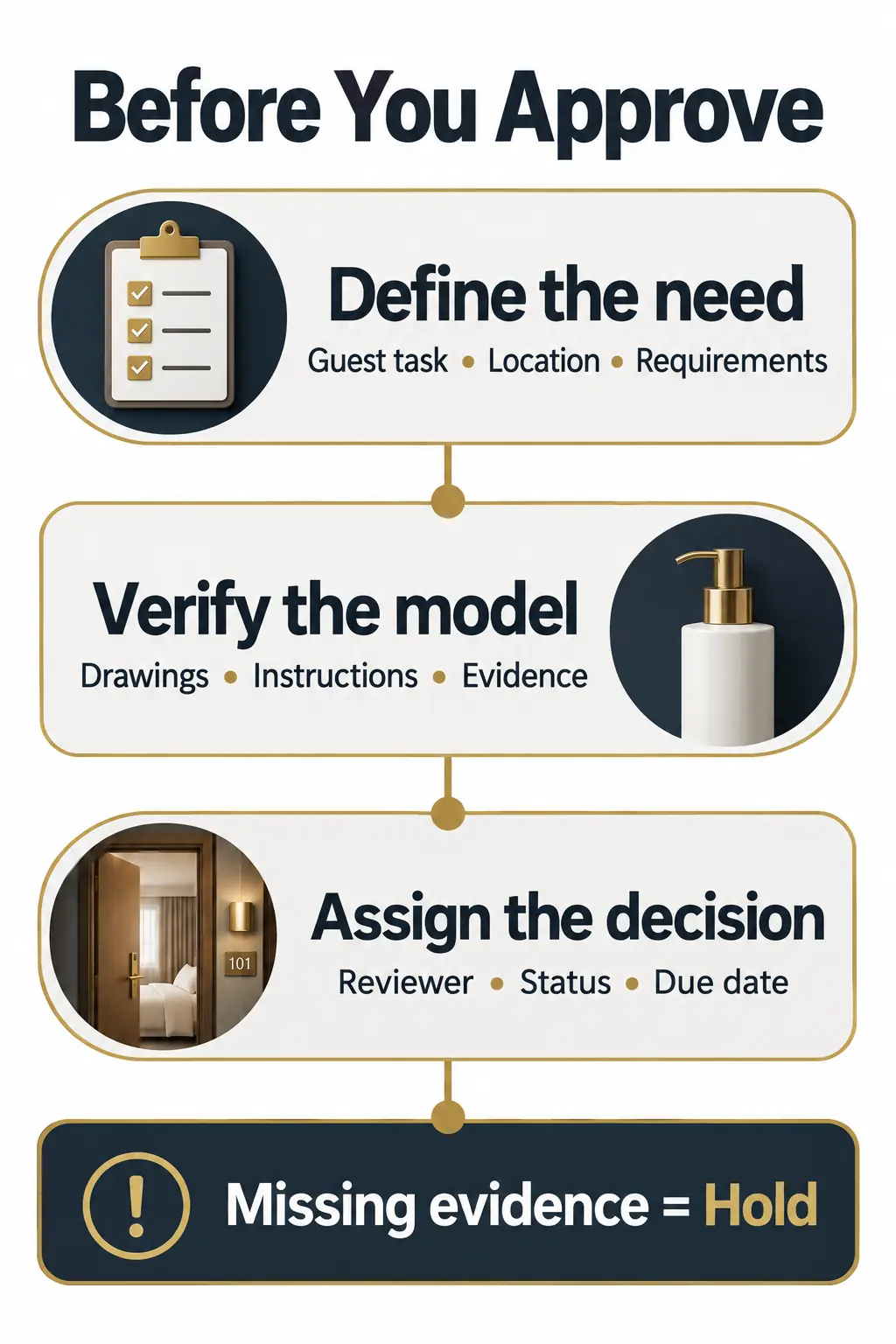
Establish the jurisdiction and project conditions
For a U.S. property, ask the project’s qualified accessibility reviewer to identify the governing requirements and how they apply to new work, alterations, and existing facilities. The 2010 ADA Standards remain the federal design reference for covered construction and alterations; an existing property may have additional ongoing obligations. A purchasing checklist does not resolve technical infeasibility, equivalent facilitation, or other legal exceptions. Record those determinations with the responsible professional rather than accepting a supplier’s interpretation.
Define the boundary of each review. A replacement shower seat may affect the wall reinforcement, transfer space, shower controls, and housekeeping setup even when the purchase order lists only one item. Likewise, a portable communication kit can be useful without fulfilling every requirement that applies to a guest room with communication features. Describe the required function before selecting the product category.
Require evidence for the supplied configuration
Request a dated specification sheet, dimensioned drawing, installation manual, use and maintenance instructions, rated capacity where applicable, and details of the supplied attachments and accessories. Identify the manufacturer, model, revision, finish, and configuration. When a test report or listing is relevant, check that its product description and scope cover what will actually arrive. A report for a different mounting arrangement, material, or product family leaves a gap that the reviewer must resolve.
Separate demonstrated facts from promises. ‘Compatible with the hotel system’ should lead to an identified interface and an acceptance test. ‘Heavy duty’ should lead to documented limits and the intended commercial use. ‘Replacement parts available’ should lead to part numbers, a supply route, and quoted lead times. These are recommended procurement controls, not universal legal documentation formats.
Use a decision gate before commercial approval
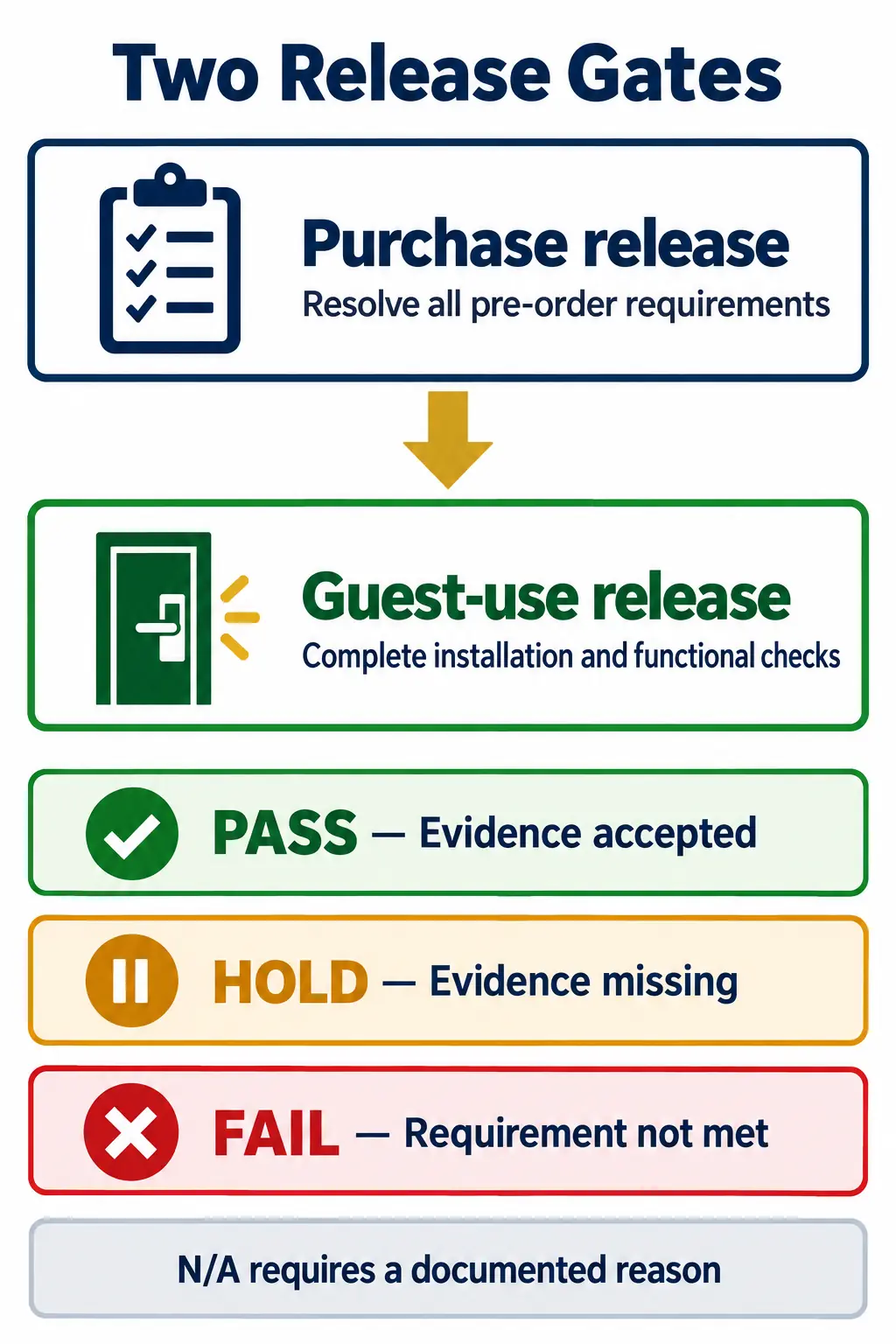
Give every requirement a named owner and one status: Pass, Hold, Fail, or N/A with a written reason. Pass means that evidence has been reviewed against the stated criterion. Hold means a drawing, measurement, answer, or test remains unresolved. Fail means the offered configuration conflicts with the requirement. No response means Hold. Do not let a high overall score offset one unresolved safety-critical issue.
If you are preparing a multi-item inquiry, contact KW Hospitality about the sourcing scope with the destination, quantities, room types, preliminary specifications, and required delivery date. Include the unresolved technical questions so quotations can identify dependencies. Final installation and accessibility acceptance should remain with the professionals responsible for the property.
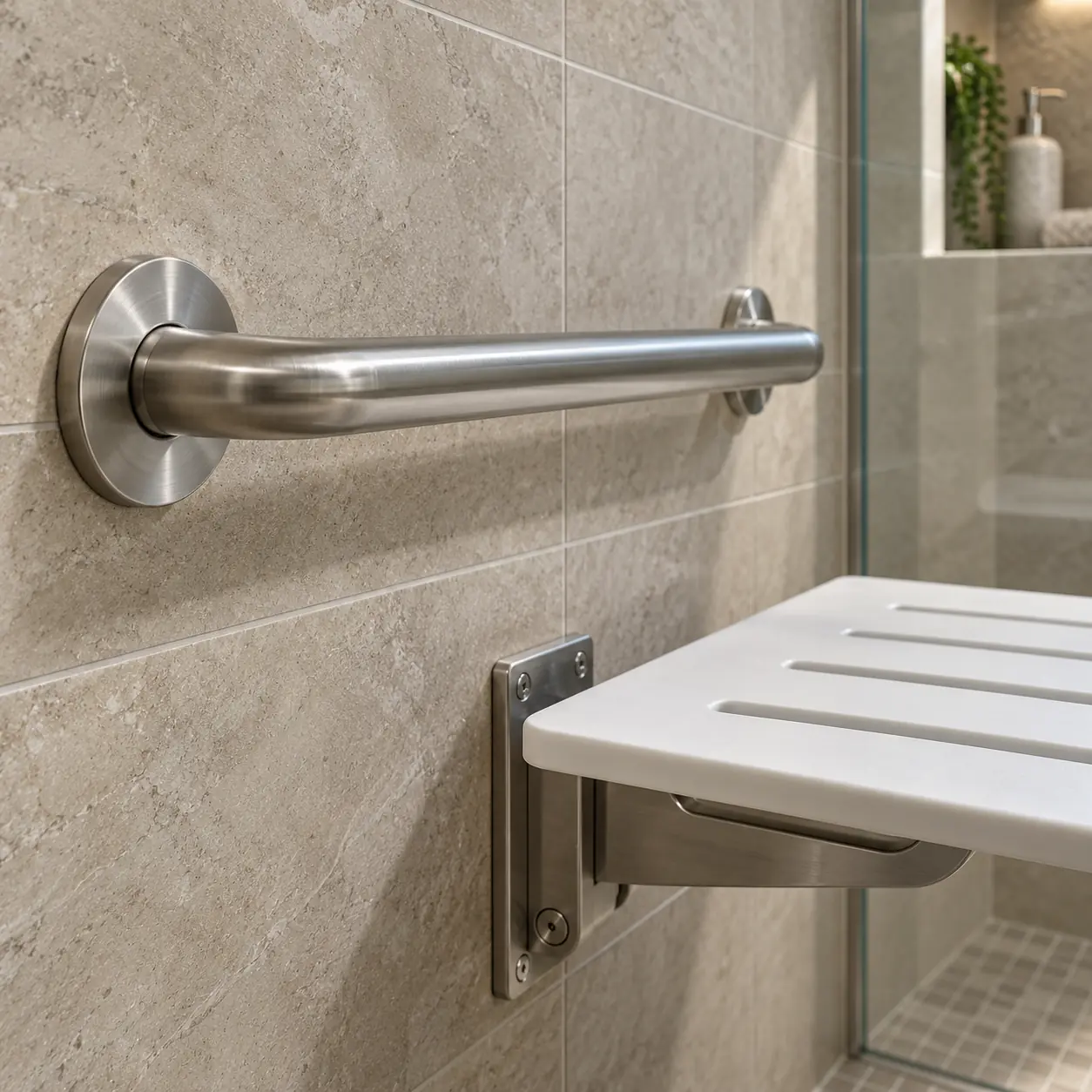
Verify Support, Reach, and Communication in the Actual Setting
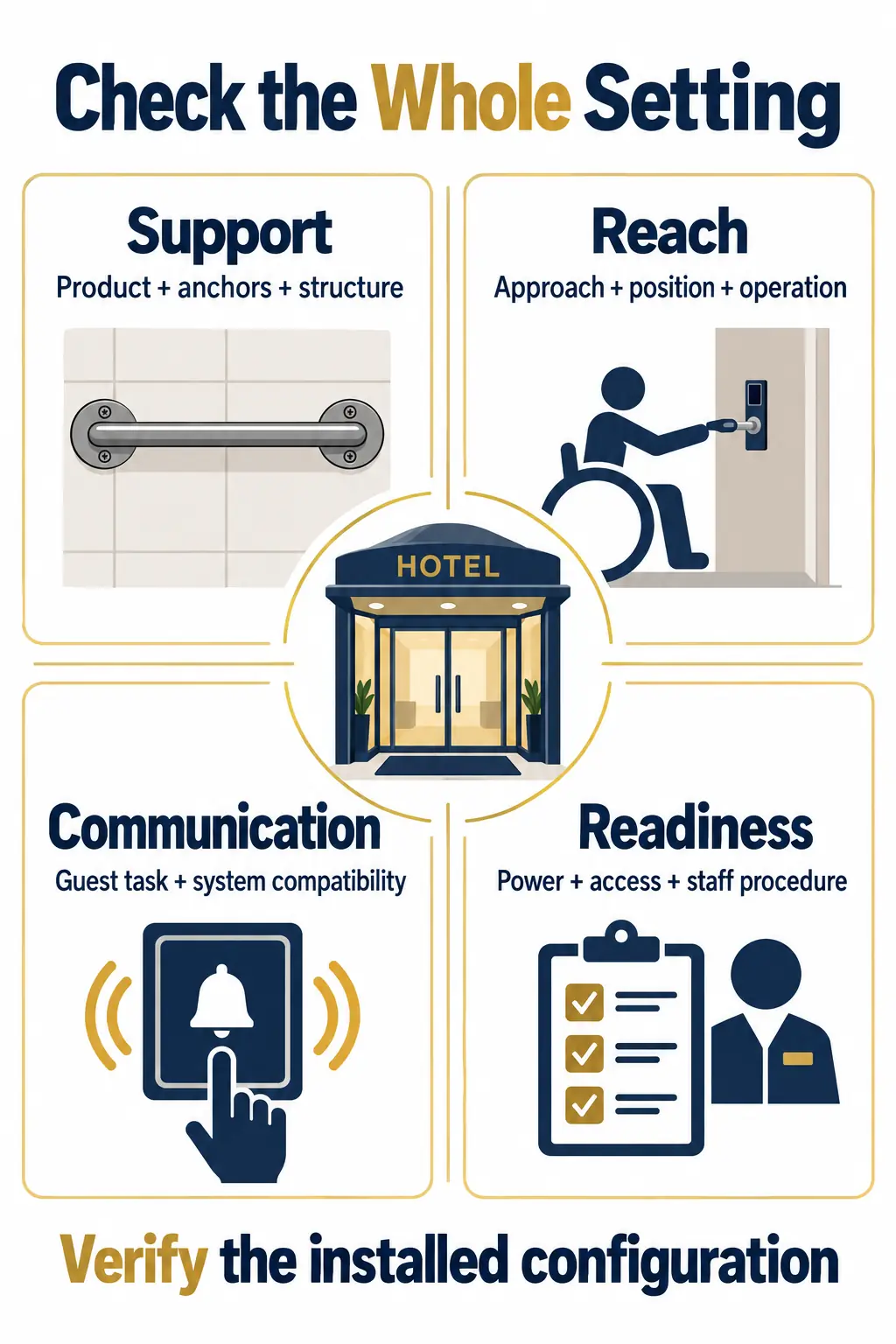
Assess accessibility supplies as part of the installed environment, not as isolated objects on a sample table. A strong support can be unsafe on an unsuitable wall, an easy-to-use control can be unreachable behind furniture, and a functioning alert can be ineffective in the wrong configuration. The checks in this section identify common acceptance issues for hospitality purchasing; they are not a complete design specification. Have the responsible reviewer select the relevant technical provisions, then connect each requirement to a drawing, manufacturer document, site measurement, or witnessed functional test.
Grab bars and bathing seats: review the whole load path
For grab bars and shower seats covered by the applicable ADA provisions, the structural-strength criterion addresses a 250-pound vertical or horizontal force at any point on the component, fastener, mounting device, or supporting structure. That is a structural criterion, not a universal maximum guest body weight or a substitute for the manufacturer’s user-capacity rating. A component report alone does not prove that the proposed wall, backing, and anchors will perform as required.
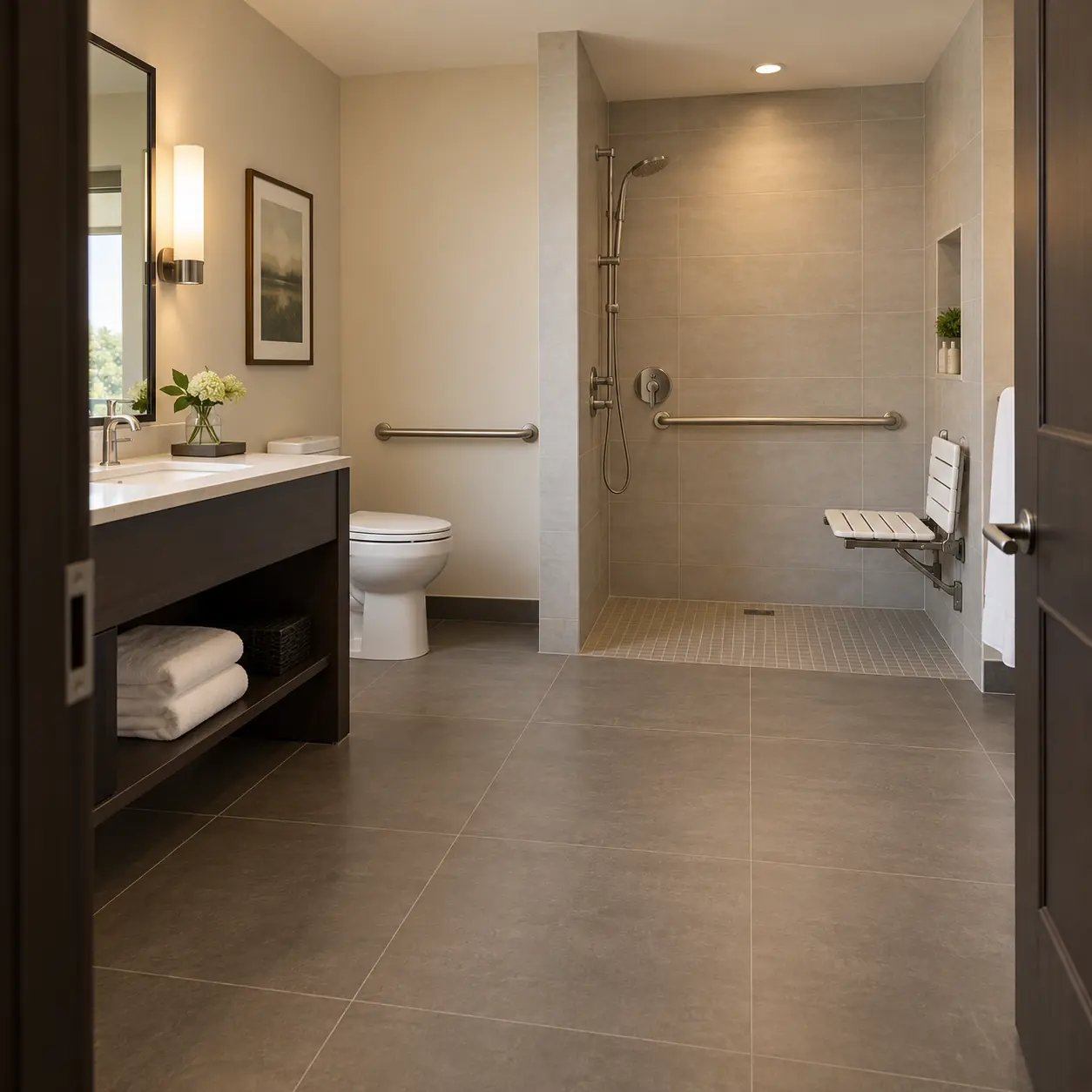
Check the specified bar geometry, clearances, mounting position, and resistance to rotation. Shower-seat selection also depends on the compartment type and seat arrangement; a freestanding chair should not be assumed to replace a required folding seat. The installer needs verified substrate and reinforcement information, not just a tile photograph. Do not improvise a proof test with staff or guests; any testing must follow a competent, approved procedure.
Inspect samples for sharp edges, exposed fasteners, unstable hinges, pinch points, and surfaces that retain soil or water. Record the approved materials and finish, then ask the manufacturer which cleaning products and application methods are suitable. Do not assume that all stainless steel, coatings, rubber feet, or adhesive components tolerate the same disinfectant or poolside environment.
Controls and accessories: preserve the usable approach
Where the general ADA operable-parts provisions apply, controls must be usable with one hand without tight grasping, pinching, or twisting the wrist, and operating force is limited to 5 pounds. The general unobstructed adult reach range is 15 to 48 inches above the finished floor. Obstructions, approach direction, and element-specific provisions can change the applicable geometry, so those figures should not become a universal mounting instruction.
Measure with the room in its intended operating condition. Place waste bins, linen carts, trays, cords, and movable furniture where staff actually use them. Check whether the guest can approach the device, position a mobility aid, reach the control, and complete the action without the accessory consuming required clear space. A drawing should show the device’s operating envelope, including a folding seat or arm in its deployed position.
Pool lifts: test the complete operating arrangement
Where a pool lift is the required accessible entry, review its selected location, seat and deck geometry, anchorage, and controls. Applicable ADA lift provisions require unassisted operation from both the deck and water, a minimum 300-pound single-person capacity, and capacity to sustain a static load of at least 1.5 times its rating. These checks do not settle pool-entry scoping or every installation requirement. Obtain a site-specific review before choosing or relocating a lift.
During commissioning, verify the manufacturer’s operating sequence, charging arrangements, accessible controls, and recovery procedure. Keep the access path and transfer area clear. A device sitting in storage or waiting for a charged battery does not provide the same service as a ready-to-use installation. Set inspection frequency from the manual, exposure, and use pattern; do not invent a universal replacement interval.
Communication aids: verify the guest task and system interface
Identify the communication need before choosing receivers, neckloops, visual alerts, or other aids. Effective communication depends on the interaction and the person’s needs, so one generic kit should not be treated as a complete solution for every guest. Confirm compatibility with the property’s audio, telephone, or notification systems and test the actual end-to-end function. Involve the relevant system specialist where the interface affects building systems.
Treat life-safety notification as a separate engineering matter. A portable vibrating alarm or door-knock alert should not be represented as a substitute for a required building fire-alarm feature. Keep charging, cleaning, issue instructions, return checks, and staff familiarity in the operating plan. Ask for feedback on usability without requiring a guest to demonstrate or prove a disability as part of the purchasing review.

Use the Buyer Checklist to Control Purchase and Handover
Use one checklist row for each acceptance requirement and repeat the register for each model and installation type. The table below is a practical procurement framework, with evidence and suggested ownership attached to each check. It combines design review, product verification, and operational preparation without treating them as interchangeable approvals. The downloadable versions include room for status, evidence references, corrective actions, and reviewer details. The register supports a decision; it does not certify the property. Keep unresolved items visible through order release, receiving, installation, and the final decision to make equipment available to guests.
| ID | Check | Acceptance evidence | Suggested owner |
| 01 | Jurisdiction and scope | Applicable requirements and project conditions recorded; reviewer assigned. | Design / accessibility reviewer |
| 02 | Exact product identity | Manufacturer, model, revision, finish and accessories match the approved schedule. | Purchasing |
| 03 | Intended function and capacity | Documented use and rated limits meet the specified application. | Reviewer / supplier |
| 04 | Dimensions and operating space | Drawings and measurements confirm fit, approach and deployed clearance. | Design / installer |
| 05 | Supports and anchorage | Product evidence, substrate, backing and attachment design are accepted. | Structural reviewer / installer |
| 06 | Controls and reach | Applicable reach, operation and placement criteria are verified. | Accessibility reviewer |
| 07 | Mechanical condition | Edges, hinges, stability and moving parts pass the approved inspection. | Receiving / installer |
| 08 | Cleaning and exposure | Manufacturer confirms cleaning method and suitability for the environment. | Housekeeping / engineering |
| 09 | Power and interfaces | Required power, charging and system compatibility are documented and tested. | Engineering / system specialist |
| 10 | Communication function | Intended interaction works end to end; life-safety responsibilities are separated. | Operations / system specialist |
| 11 | Pool entry, if applicable | Site-specific lift or entry review and commissioning are accepted. | Pool / accessibility reviewer |
| 12 | Delivery and substitutions | Received model and components match approval; changes are re-reviewed. | Purchasing / receiving |
| 13 | Installation and commissioning | As-built checks and prescribed functional tests are complete. | Installer / engineering |
| 14 | Staff and availability | Issue, storage, charging, cleaning and fault procedures have named owners. | Operations |
| 15 | Service and traceability | Parts, manuals, warranty terms and fault records are linked to the item ID. | Engineering / purchasing |
| 16 | Final release | Evidence is accepted; applicable items Pass; N/A reasons and release are signed. | Authorized property reviewer |
Apply the release rule at two different moments
At purchase release, all requirements due before ordering should Pass or have an accepted N/A rationale. Clearly identify installation and commissioning checks that are not yet due, and carry them forward as Hold with an owner and due date. Do not record them as Pass because the supplier expects the product to work. If a critical mounting or system-compatibility question could invalidate the order, settle it before committing to that configuration.
At guest-use release, every applicable requirement must Pass and every N/A decision must have its rationale accepted. Any Fail, unresolved Hold, blank status, or missing required evidence keeps the affected item out of service. A partial delivery can be accepted commercially without being released for guest use; keep those decisions separate. The property’s authorized reviewer should sign the release, with installer and operations confirmations attached.
Make substitutions and defects traceable
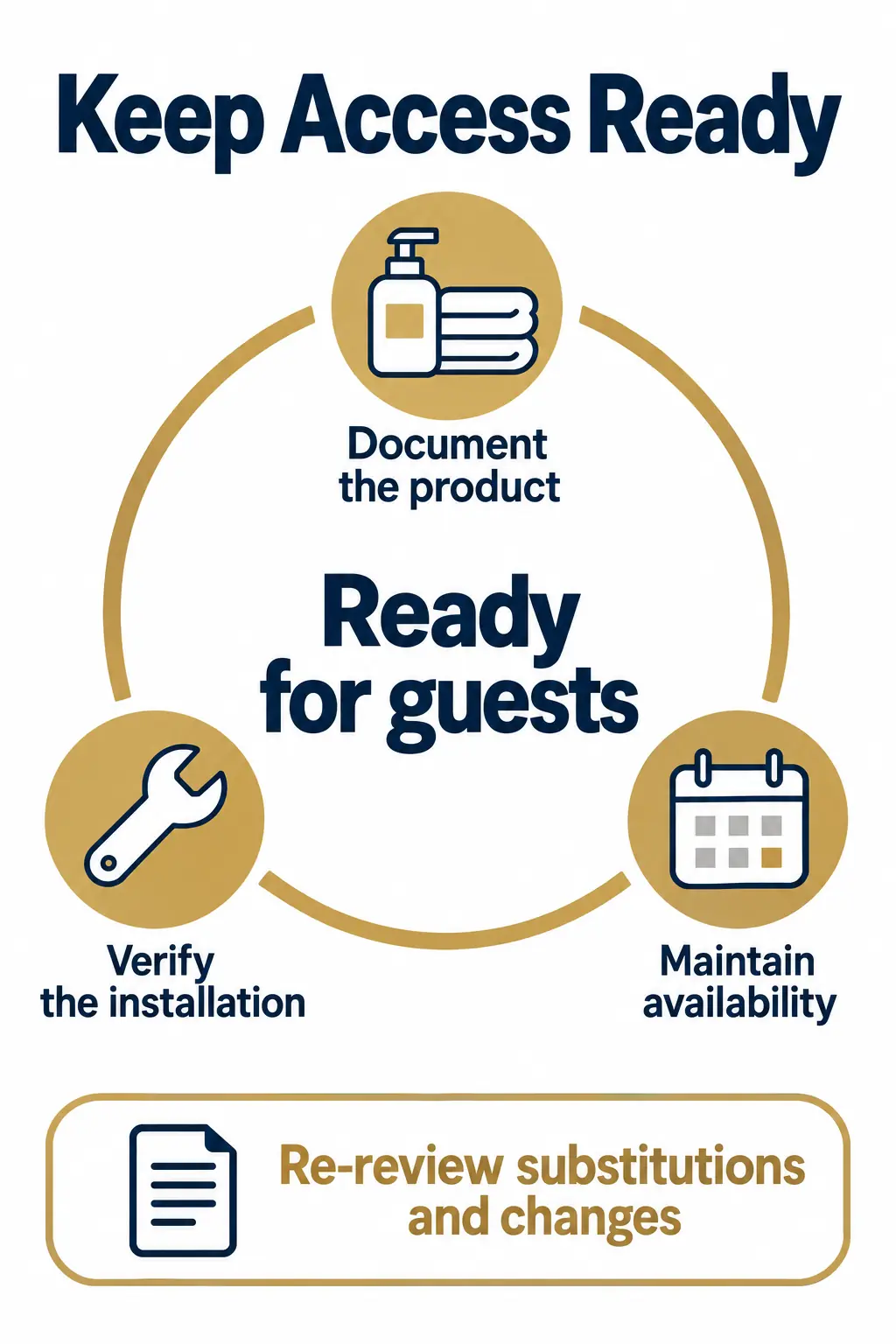
Tie the purchase order to the approved model and revision. Require written review of proposed changes to dimensions, materials, load ratings, anchors, controls, electronics, or accessories before shipment. At receiving, compare labels and supplied parts with the approved schedule. A visually similar substitute may introduce a different mounting pattern or operating limitation, so appearance is not sufficient acceptance evidence.
For a defect, record the item ID, affected location, symptom, evidence, assigned owner, action, and target date. Isolate unsafe equipment and coordinate restoration of the affected accessible service. Recheck after correction, photograph the completed condition when useful, and retain the release record. For required accessible features, ongoing operability matters; brief maintenance interruptions should not become an unexamined long-term arrangement.
Example: a folding-seat order that should remain on Hold
Consider an illustrative renovation in which a folding shower seat has an acceptable product report but the wall construction is undocumented. Purchasing has evidence for the seat, yet the attachment requirement remains unresolved. The next action is to obtain the backing and anchor design from the responsible professional and installer. A discount, a delivery deadline, or a supplier’s verbal assurance does not close that gap. After installation, the reviewer still needs the specified as-built checks before guest-use release.
This example shows why the checklist should track requirements instead of averaging ratings. The missing evidence has a direct path to the purchasing decision, an owner who can resolve it, and a second gate that verifies the installed result. Use the same logic for an alert device with untested compatibility or a lift without an agreed charging and availability procedure.
Conclusion
The strongest purchasing decision connects documented product capability, a verified installation, and a workable operating routine. Use the checklist to expose missing evidence early, assign ownership, and prevent commercial approval from being mistaken for guest-use acceptance. Review the exact model and configuration again when a supplier proposes a substitution or when the room, anchorage, or connected system changes. For a 2026 review, confirm current requirements at the project’s location and preserve the reasoning behind each decision. A complete file should explain what was accepted, who accepted it, and how access will remain available after handover.
When your schedule is ready, send KW Hospitality your accessibility supplies inquiry with product specifications, quantities, destination, target dates, relevant site drawings, and the evidence required with each quotation. Identify sample approval, installation responsibilities, and unresolved checklist items explicitly. This gives the sourcing discussion a clear starting point while keeping technical acceptance with the property’s designated reviewers.
Frequently Asked Questions
Does an ADA-compliant product label prove that the hotel installation complies?
No. The label does not establish the room’s layout, attachment strength, reach conditions, required quantities, or operating availability. Request the technical basis for the claim and have the exact installed configuration reviewed against the applicable requirements.
Can we replace a required shower seat with a portable bathing chair?
Do not assume so. Requirements depend on the shower type and applicable provisions. A portable chair can serve a particular guest need, but that does not establish equivalence to a required built-in or folding seat. Resolve the specific proposal with the project’s accessibility reviewer before purchasing.
Is the 250-pound structural criterion a guest weight limit?
No. It describes a specified applied force for covered supports and seats, including their attachments and supporting structure. The manufacturer’s user-capacity rating is a separate consideration. Both need to be suitable for the selected product and intended use.
Can one checklist cover several identical guest rooms?
You can reuse the same product evidence, but verify that the rooms truly share the relevant geometry, backing, anchors, and connected systems. Give every installation a location ID and record deviations. An approved sample room does not automatically establish that later rooms were installed identically.
What should happen when an accessibility aid fails after opening?
Remove unsafe equipment from use, notify the responsible team, and address the affected accessible service promptly. Record the fault, arrange repair or an appropriate alternative, and verify performance before release. Track recurring failures so the property can correct the underlying issue rather than repeatedly resetting the device.
Does this checklist apply unchanged to a Canadian hotel?
No. It is framed around U.S. hospitality purchasing and selected U.S. accessibility criteria. A Canadian project needs a review of the requirements applicable to its province or territory, municipality, building type, and scope of work. The evidence and ownership method can still be reused.