
Hotel mattresses and box springs perform different jobs. The mattress provides the sleep surface, while a box spring or another approved base supports it from below. A hotel therefore does not choose a mattress instead of a box spring. It chooses a compatible bed system: mattress, supporting base, frame or platform, and the bedding that guests actually use. Getting that distinction right prevents a low quoted price from becoming an uncomfortable, unstable, or impractical room installation.
Terminology makes the decision harder. Some suppliers use ‘box spring’ for almost any upholstered support unit, including rigid foundations with no springs inside. Meanwhile, a platform bed may already provide the support that a separate foundation would otherwise supply. Before comparing offers, identify what each component contains, what it supports, and whether the mattress manufacturer approves the proposed arrangement. A familiar product name is not enough to establish compatibility.
For hotel owners, procurement managers, designers, and operations teams, the important questions extend beyond initial comfort. Can guests sit securely at the edge? Does the finished bed height suit the intended room and its users? Can housekeeping fit protectors, make the bed, inspect the base, and move components safely? Will replacement units match the approved configuration? These questions connect guest expectations with the daily work and future cost of keeping rooms available.
This guide compares the roles of mattresses, true box springs, rigid foundations, and platforms, then explains how to evaluate them together. It provides a practical decision matrix, a finished-height calculation, and a method for comparing complete installed costs. The aim is to help a property select and specify a bed system that performs consistently in its own rooms, without assuming that the thickest mattress, tallest base, or longest advertised warranty automatically represents the strongest purchase.
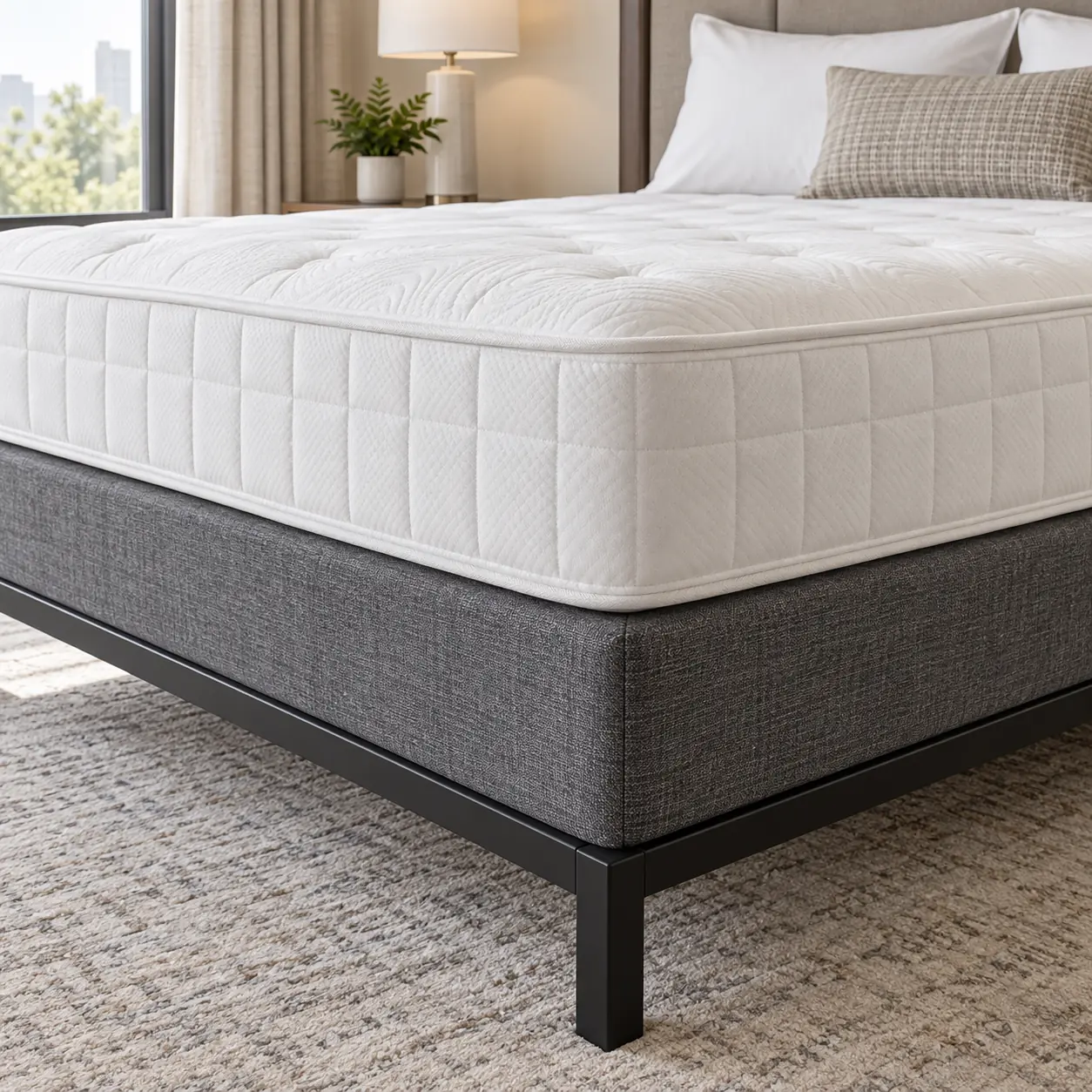
Understand the Mattress and Its Supporting Base
Start by separating the sleep surface from the structure beneath it. A mattress contains the comfort and support materials that interact directly with the sleeper. A true box spring is a covered support unit with springs; a rigid foundation provides support with much less intended movement. A platform can combine the frame and mattress support into one structure. These products may look similar once dressed, but their internal construction changes compatibility and behavior. Ask suppliers to identify the actual design and approved mattress pairing before comparing height, appearance, or price. The right comparison is between complete configurations that can meet the same room requirement.
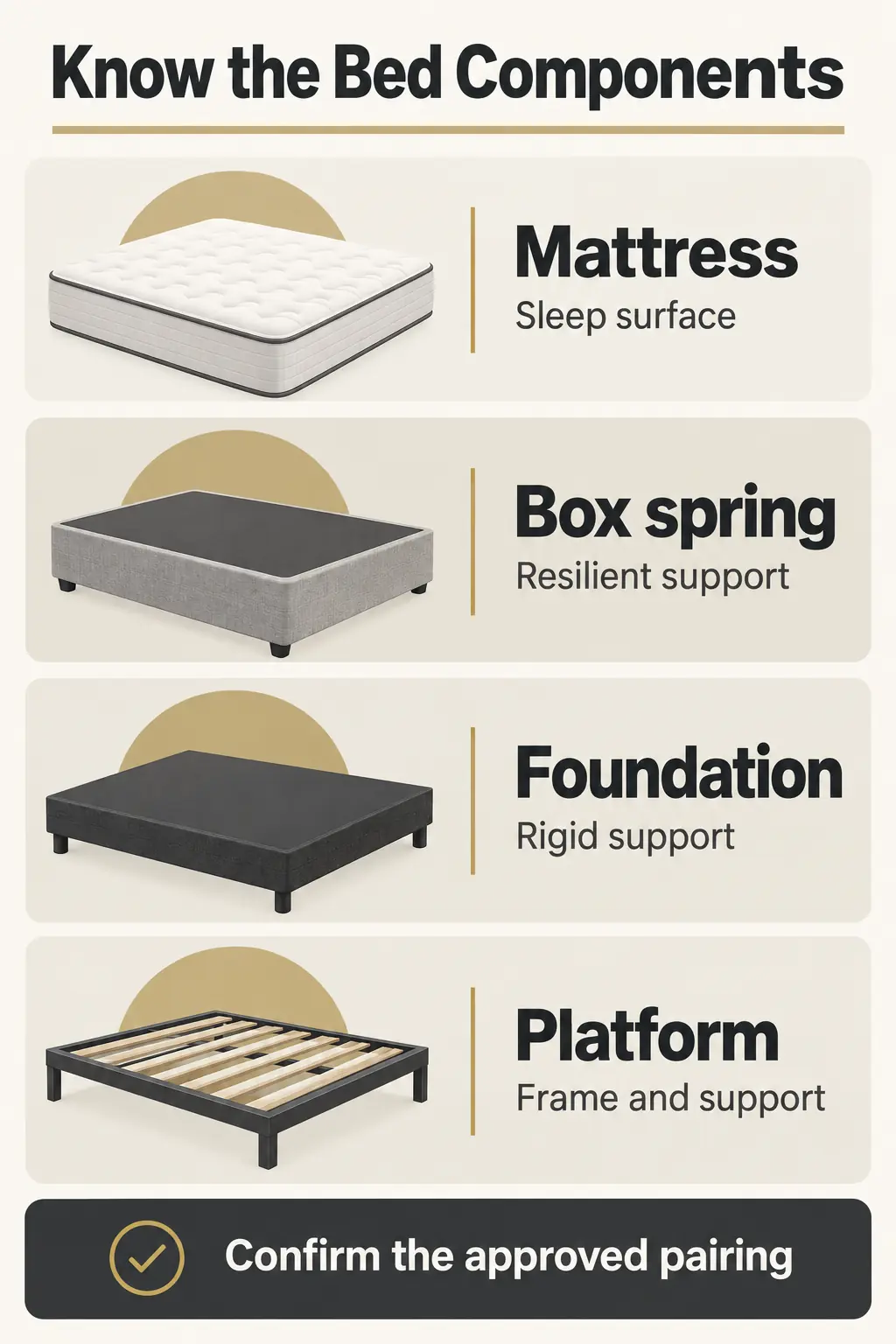
| Component | Primary role | What the buyer must establish |
| Mattress | Sleep surface and body support | Exact model, construction, dimensions, feel, and approved base |
| True box spring | Resilient support beneath a compatible mattress | Spring construction and written approval for the intended pairing |
| Rigid foundation | Stable support beneath the mattress | Support surface, structural design, and frame requirements |
| Platform bed | Integrated frame and mattress support | Deck or slat design, center support, and mattress compatibility |
Treat compatibility as a requirement
Do not infer base compatibility from ‘hybrid,’ ‘foam,’ or ‘innerspring’ alone. These categories describe broad mattress constructions, not the installation instructions for every model. Obtain the manufacturer’s requirements for the exact mattress: permitted base types, support spacing where applicable, center support, and any restrictions on flexible bases. If a supplier offers a substitute foundation, require written confirmation that the substitute remains suitable for the mattress and intended commercial use.
A platform may remove the need for a separate foundation when its support surface meets those requirements. Adding another base can then introduce unnecessary height and cost. Conversely, a decorative frame with only perimeter rails may still need an approved foundation or a designed support system. The appearance of a complete bed frame does not establish that it can support a mattress directly.
Separate structural support from firmness
A firm mattress can still perform poorly on an uneven or damaged base. A softer surface can remain structurally well supported when paired correctly. Avoid using ‘firm’ as shorthand for durable, or ‘plush’ as shorthand for unsuitable. Surface feel, edge behavior, internal construction, and base stability are separate attributes that should be reviewed separately. When an existing bed sags or squeaks, inspect the frame, fasteners, and support unit before assuming the mattress is the only cause.

Translate Guest Expectations into a Room Trial
Guest expectations should become observations that the team can compare in a finished room. Comfort varies with the sleeper and with the layers above and below the mattress, so a brief showroom impression is a weak purchasing basis. Evaluate shortlisted mattresses on their proposed bases with the property’s actual protector, pad or topper, sheets, and duvet. Include different body sizes and sleeping preferences in the review, and record individual responses before discussing a group result. The useful outcome is a clearly described room experience that can be reproduced, rather than an unsupported claim that one firmness level will satisfy every guest.
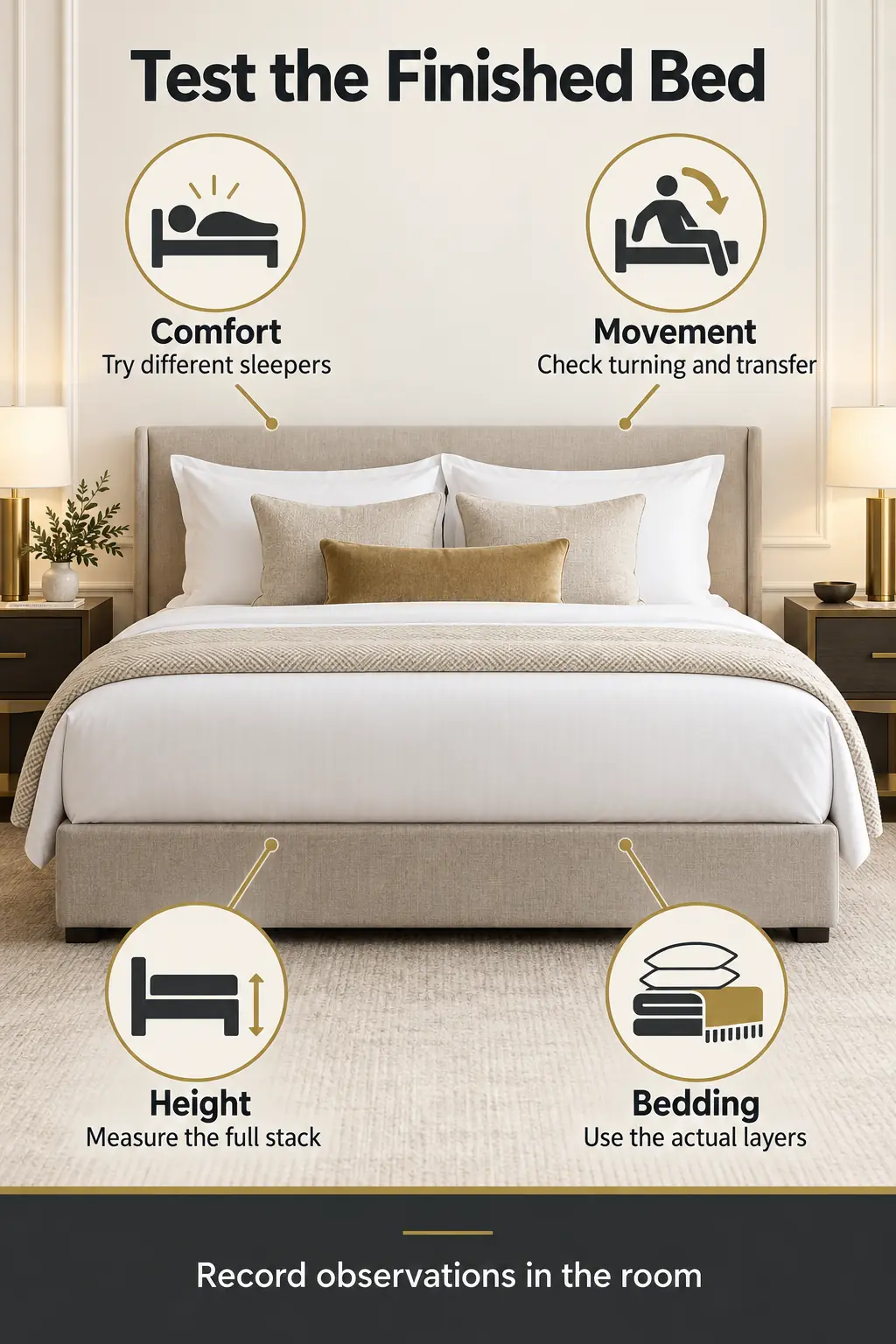
Assess more than the first impression
Review pressure comfort, ease of turning, movement felt from another sleeper, and edge stability during sitting and entry. Look for persistent noise, a sense of rolling toward the edge, or difficulty getting out of a deeply compressing surface. Use the same trial conditions across candidates. Subjective ratings are useful when tied to a described observation; they should not be presented as laboratory proof or a guarantee of guest satisfaction.
Check the full bedding combination before accepting temperature-related marketing claims. A protector, thick topper, or tightly fitted sheet can change the experience of the same mattress. Ask what a claimed cooling benefit measures and whether it applies to the final room configuration. A material label alone cannot establish how the completed bed will feel throughout a guest’s stay.
Calculate finished height before ordering
For a conventional frame-and-foundation arrangement, estimate the finished sleep-surface height as the floor-to-foundation-bearing-plane height plus foundation thickness, mattress thickness, and the effective thickness of added comfort layers. Do not count a frame rail and a foundation bearing height twice. A platform configuration uses its mattress-support surface height instead of a separate frame-and-foundation stack.
For illustration, a 7-inch bearing height, 5-inch foundation, 12-inch mattress, and 1-inch topper produce an approximate 25-inch surface height before loading. Replacing only the foundation with a 9-inch model raises the estimate to 29 inches. These are arithmetic examples, not recommended heights or accessibility limits. Measure the assembled bed, including how its edge compresses when occupied, and review entry, exit, bedside reach, and applicable accessibility requirements for the property.
Match the test to the guest promise
An extended-stay property may place particular value on repeatable comfort and ease of daily use; a luxury room may place additional emphasis on surface feel and presentation. Neither priority removes the need for stable support or manageable height. Define the room promise first, then evaluate whether each candidate delivers it without creating operating problems. Keep the approved model and bedding combination together in the room standard.
The same discipline applies to the broader supplier sample review: identify the unit tested and record how it differs, if at all, from the configuration offered for production.

Choose a Configuration That Works for Room Operations
A bed system must fit the building and the housekeeping routine as well as the room design. Base depth, mattress weight, clearance, and component size affect installation, inspection, cleaning, and future replacement. A configuration that looks efficient in a catalog can become costly when it will not pass through a service elevator or makes a routine bed change awkward. Review a representative room and the complete delivery route before standardizing. Where the property has different room layouts, test the relevant variants rather than assuming one successful installation proves every room will work. Operational suitability depends on the whole arrangement, not a single component.
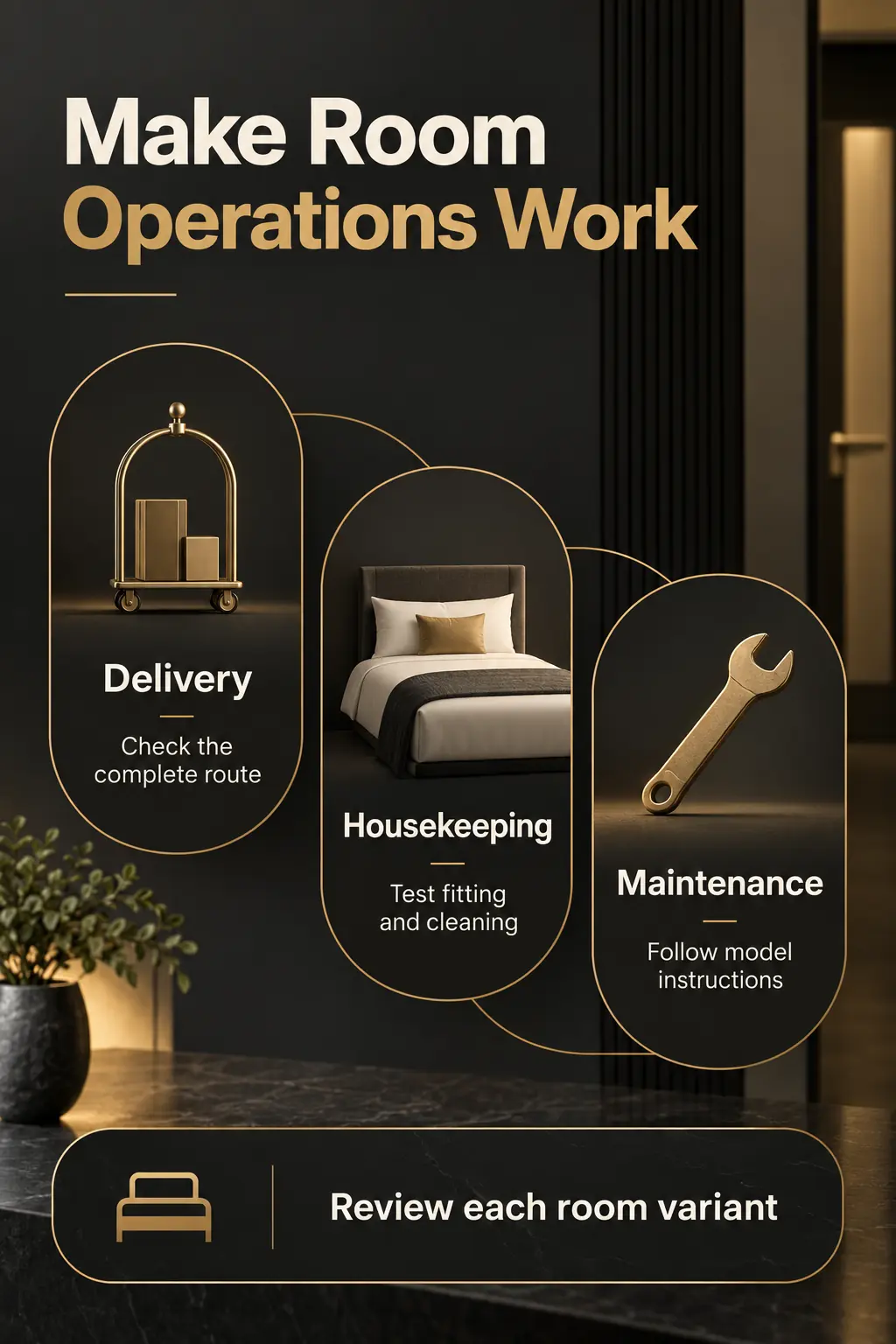
| Room situation | Configuration worth evaluating | Condition that controls the decision |
| Existing platform in good condition | Mattress on the existing platform | Written compatibility plus verified support and finished height |
| Conventional frame with no mattress deck | Mattress with an approved foundation or box spring | The complete frame-base-mattress combination is suitable |
| Thick mattress makes the bed too tall | Approved low-profile foundation or revised platform | Retained support, workable entry, and design approval |
| Restricted stairs or elevator access | Approved split foundation | Both halves fit the route and receive the required support |
| Repeated sagging or noise complaints | Inspect the entire existing system before replacement | Identify the failed component and any compatibility problem |
Test the housekeeping cycle
Have the housekeeping team fit the actual protector and sheets, tuck the corners, inspect the edges, and clean accessible areas around and below the bed. Observe reach and handling demands without asking staff to lift beyond their safe working procedure. A thicker mattress can require different sheet pockets; an extra topper adds another item to fit, inspect, store, and replace. Confirm these consequences before treating an upgrade as a mattress-only cost.
Clearance is a deliberate design choice. An open base can provide access underneath when tools and staff can reach the area; a closed plinth changes the cleaning and inspection method. Neither arrangement is automatically cleaner. Evaluate joints, fabric undersides, removable parts, and the ability to inspect around the bed. Keep pest inspection and treatment procedures aligned with the property’s trained service provider rather than relying on a product’s appearance or a marketing claim.
Plan movement and maintenance
Compare packaged dimensions with doors, tight turns, stairwells, elevators, and staging space. A split foundation can solve an access problem but needs a compatible frame that supports both pieces correctly. Do not assume that a full-size mattress can be folded simply because the base comes in halves. Obtain the handling and packaging instructions, including any permitted compression period and room-ready expansion time for products supplied compressed.
Use the manufacturer’s care instructions to decide whether a mattress may be rotated, flipped, or neither. One-sided construction should not be treated as double-sided. Retain component identification and installation details so engineering can diagnose recurring complaints and housekeeping can maintain a consistent routine. Replacement timing should respond to condition, performance, hygiene requirements, and the property’s standards rather than an assumed universal service life.
Once room dimensions and the intended support arrangement are recorded, ask KW Hospitality to review the sourcing requirements with the quantities, room variants, access constraints, destination, and target installation date. This gives proposed options a common operating basis.

Compare Complete Costs and Lock the Approved Specification
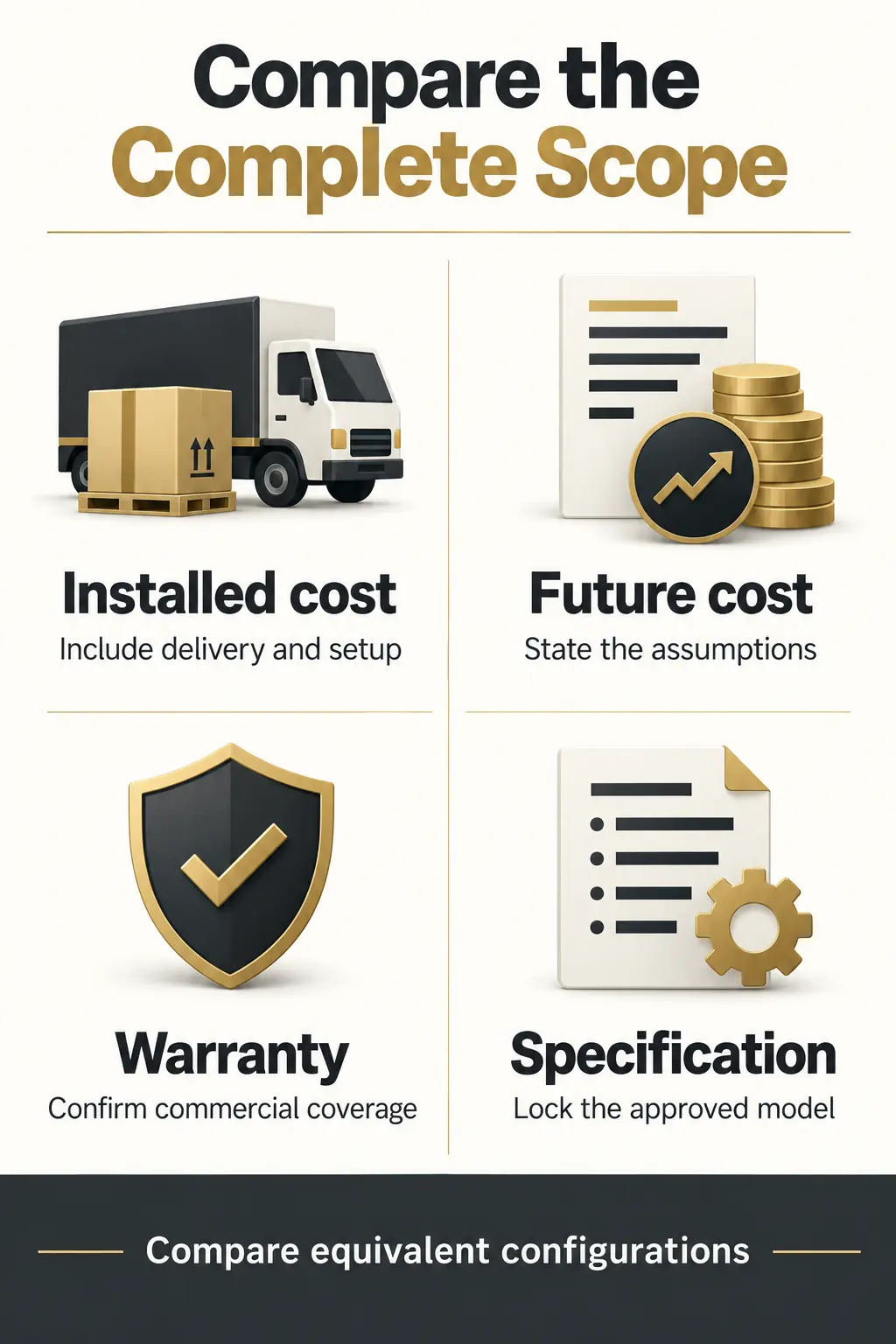
Compare the cost of delivering a usable bed system to the room, not the price of an isolated mattress or foundation. Two quotations can look competitive while including different bases, assembly work, freight services, or replacement responsibilities. Normalize the scope first, then examine maintenance and replacement assumptions over the same planning period. Keep uncertain future costs visible as scenarios rather than presenting them as established savings. The final purchase specification should connect the model tested, the support arrangement approved, and the commercial terms accepted. This reduces the chance that the room receives a different system from the one the team evaluated.
Normalize the installed scope
Include the mattress, required base and frame components, protectors or changed linen sizes, packing, freight, unloading, movement to rooms, assembly, removal of old units, and disposal where applicable. Specify the currency and treatment of duties and taxes. Identify which party carries each activity, especially when ‘delivery’ means curbside, loading dock, or room placement in different offers. The guest room supplies bid comparison guide provides a wider method for aligning these commercial differences.
A simple planning model is initial installed cost plus expected maintenance, replacement, and downtime costs over a stated period, less any supported recovery value. Use the same period and room count for each option. For example, an additional $120 per room across 100 rooms adds $12,000 at purchase. It is justified economically only if the value of the preferred experience or the expected operating benefits is sufficient for the property; a longer warranty by itself does not prove that the extra cost will be recovered.
Avoid counting a room as lost revenue if the hotel could still accommodate the booking elsewhere. Where a replacement actually displaces a sale, use a clearly stated contribution-loss assumption and explain its basis. Model replacement rates and lead times as ranges when records are limited. For a more detailed budgeting structure, use the five-year total cost of ownership framework.
Read the commercial warranty for the actual order
Obtain written confirmation that the warranty covers hotel or commercial use and applies in the delivery market. Identify the responsible seller or manufacturer, defect definitions, exclusions, claim evidence, freight costs, labor, and whether remedies are prorated. A consumer warranty or retail trial policy should not be assumed to apply to a bulk hospitality order. Normal softening, a change in comfort preference, and a covered manufacturing defect may be treated differently.
Retaining an existing base can be reasonable if it is sound, compatible, and accepted under the new mattress terms. Replacing everything can be reasonable when the support is damaged, identity is unknown, or the new pairing requires another design. Compare the evidence for each room group. A blanket rule to keep every old base or replace every base can conceal the actual condition and compatibility issues.
Carry sample approval into the order
Specify the mattress model and revision, dimensions and tolerances, base construction and height, approved support details, bedding interfaces, packaging, room quantities, and the accepted sample reference. Identify allowable substitutions and require approval before a change is made. Separate a preference, such as a particular surface feel, from a measurable dimension or mandatory market requirement so each can be verified by the right method.
For U.S. projects, the mattress and foundation configuration matters to applicable flammability labeling and documentation. Request evidence for the configuration actually being supplied, including whether the mattress is intended for use with a foundation or without one. Do not accept ‘hotel grade’ as proof of compliance. For other destinations, verify their own requirements rather than treating U.S. documentation as automatically sufficient. Product compliance and comfort approval remain separate decisions.
At receiving, reconcile the delivered model identities and quantities with the approved documents before room installation. Record damage and exceptions promptly under the agreed claims process. Preserve purchase records and product labels needed for future support. A representative room trial reduces purchasing uncertainty, but it does not replace production controls or establish the service life of every delivered unit.

Conclusion
Hotel mattress purchasing works best when the mattress, supporting base, frame, and bedding are evaluated as one room system. The mattress supplies the sleep surface; the base must provide the support the model requires. Guest comfort then has to coexist with appropriate finished height, practical housekeeping, feasible delivery, and clear replacement terms. Select the configuration that meets those requirements in a representative room, and carry the approved details into the order. An attractive unit price becomes meaningful only after competing offers describe the same usable scope and the property understands the costs and uncertainties that remain.
For an opening, renovation, or phased replacement, request a specification-based quote from KW Hospitality. Include the room mix, bed sizes, quantities, existing frame or platform details, desired finished height, approved comfort reference, destination, and required delivery date. Use the contact form to begin the review and arrange how detailed specifications will be shared.
Frequently Asked Questions
Can a topper fix an uncomfortable hotel mattress?
A topper can alter surface feel, but it cannot repair a failed mattress core, a sagging foundation, or an unstable frame. Diagnose the complaint first. If the structure is sound and the issue is surface preference, test the topper with the actual protector and sheets, then account for height, cleaning, handling, and replacement needs before adopting it.
Does a split foundation mean the hotel needs two mattresses?
No. Two compatible foundation sections may support a single mattress when the manufacturer approves the arrangement and the frame supports both sections correctly. A split foundation is different from a split mattress configuration. State each component’s dimensions and quantity explicitly so a king bed is not quoted or delivered as the wrong combination.
Can the same mattress be used in every room category?
Possibly, if the proposed bases, finished heights, room layouts, and brand requirements all work with that model. Standardization can simplify purchasing and replacements, but it should follow the review of room variants. Accessible rooms or unusual layouts may need a different support arrangement without necessarily needing a different sleep surface.
How long should a hotel trial a sample bed?
There is no single trial duration that proves long-term suitability. Define the period around the questions being tested: installation fit can be reviewed immediately, while repeated housekeeping cycles and feedback need more use. Agree the trial scope and acceptance method in advance. A short successful trial does not establish years of durability or replace the commercial warranty.
Is a thicker mattress necessarily a better hotel mattress?
No. Thickness does not establish comfort, durability, or suitability for a particular support system. Compare the actual construction, observed room performance, approved base, and service terms. A thicker model may also change bed height, sheet fit, handling, and the appearance of the headboard, so assess those interfaces before approving it.