
Before replacing a hotel cleaner in bulk, confirm that the proposed product is permitted for the exact surface and finish, then test it using the intended dilution, contact time, cloth or pad, rinsing method, and cleaning frequency. Compare the result with an untreated reference and the current approved method. Approve the combination of product, surface, and method, rather than approving one bottle for every room. A successful spot test reduces uncertainty; it does not establish long-term durability, disinfection efficacy, or warranty coverage.
The purchasing risk is easy to underestimate. A substitute can remove bathroom soil effectively while leaving a haze on a polished vanity, changing the appearance of a decorative fitting, or requiring an extra rinse that housekeeping cannot fit into the room-turn schedule. Similar fragrance, color, pH, or ingredient descriptions do not establish equivalent performance. The useful question is whether the new cleaning process works on the materials the hotel actually owns, under conditions staff can reproduce.
This guide is for hotel purchasing, housekeeping, and engineering teams evaluating a proposed change before committing to a large order. It covers routine hard-surface cleaning and the compatibility portion of a disinfectant review. Upholstery, electronics, specialty coatings, food-contact sanitation, and floor slip performance may require separate instructions or specialist assessment. Product labels and the surface manufacturer’s current care requirements remain the starting point; a local trial cannot override a prohibited use.
The method below combines document screening, a controlled comparison, and a limited operational pilot. It also explains how to record a conditional approval when a replacement works in one application but fails in another. Use it alongside the property’s broader cleaning chemical procurement program, so that a lower purchase price is considered together with labor, surface condition, dispensing requirements, and the cost of maintaining exceptions.
Identify the surface and the cleaning task
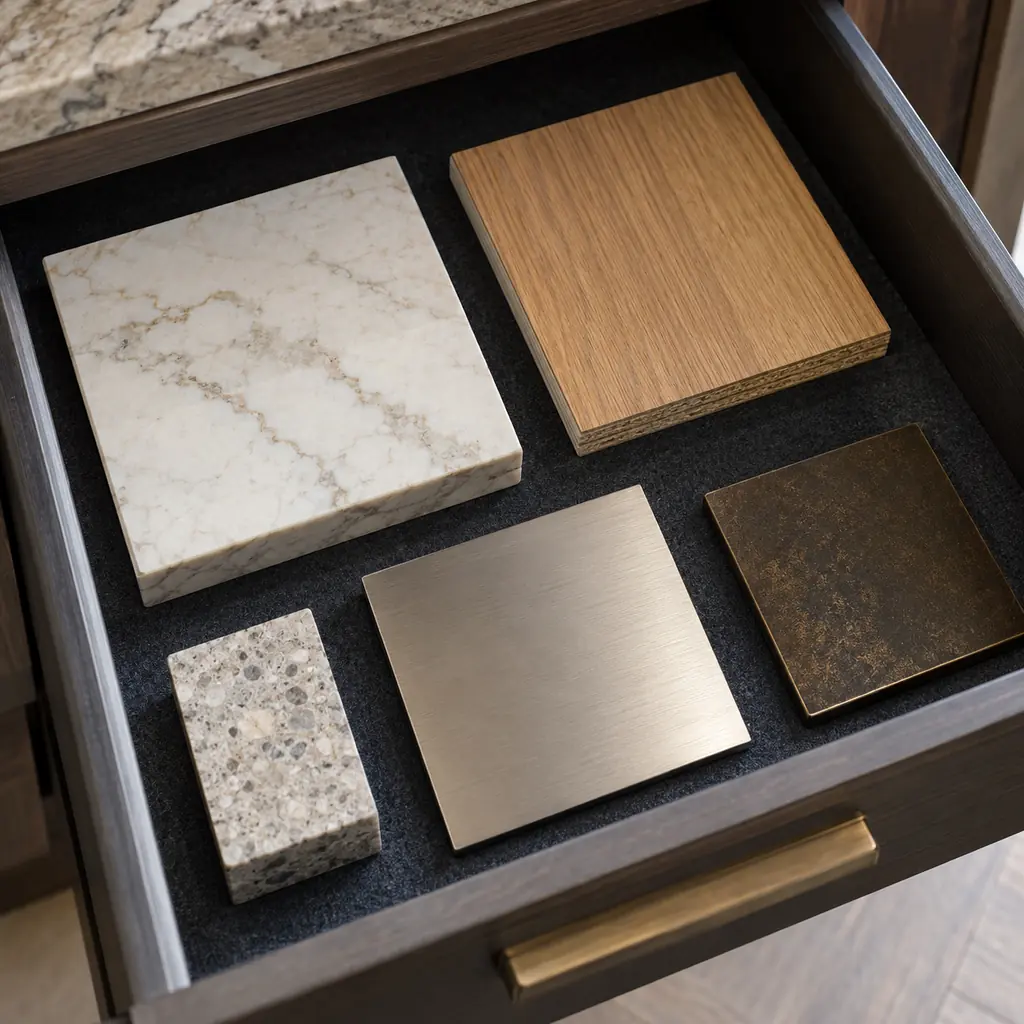
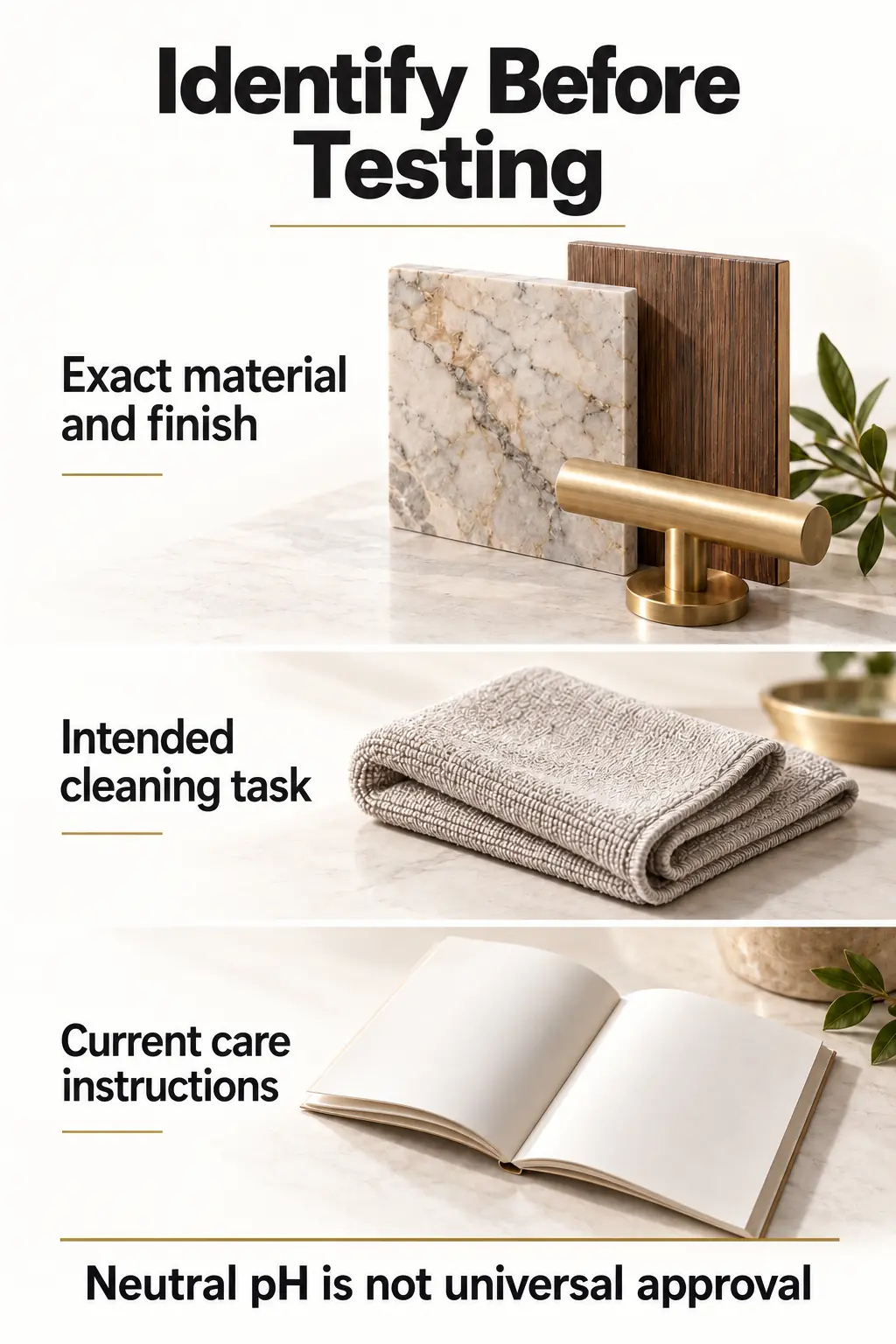
Start with the material that the cleaner will touch, including any coating, sealer, joint, or decorative finish. A description such as stone, metal, or wood is too broad to support a substitution. The same bathroom may contain a natural-stone top, a resin-based surface, coated hardware, and sealant, each with different care limits. Match the cleaning task as carefully as the material: routine soil removal, occasional descaling, and disinfection expose surfaces differently. If the surface identity or the permitted method is unresolved, hold that application out of the trial until engineering or the manufacturer can clarify it.
Separate the job from the marketing category
State what needs to be removed and what outcome is required. A daily cleaner that removes fingerprints is not automatically a substitute for a descaler, and a cleaner without the appropriate authorized claims is not a replacement for a disinfectant. A product that leaves no visible soil may still leave unacceptable residue or change a finish.
For Canadian properties, consult the exact product’s authorized label. Health Canada’s biocide labeling guidance treats dilution, application, contact time, and relevant rinsing instructions as elements of directions for use. If disinfection is required, the trial must accommodate the applicable labeled wet-contact time. Shortening that time to protect a surface does not establish a usable disinfectant substitution.
Read three different kinds of evidence
Obtain the exact product label, technical instructions, and current safety data sheet, or SDS. Pair them with the surface or fixture manufacturer’s care document for the installed product. The label establishes permitted use; technical information can clarify application and compatibility claims; the surface document identifies finish-specific limits.
The CCOHS explanation of safety data sheets describes their role in communicating hazards and precautions. An SDS is essential for handling review, but it is not a finished-surface compatibility certificate. Absence of a warning about a particular coating does not demonstrate that repeated use will preserve that coating. Ask the supplier to identify the exact tested surface, concentration, exposure, and evaluation method behind a compatibility statement.
Use material names to find the right restrictions
The examples below illustrate why approval must remain specific. They are screening pointers, not a universal chemical-resistance chart.
| Surface example | Relevant official guidance | Implication for the proposed substitution |
| Calcareous natural stone | The Natural Stone Institute describes sensitivity to acidic solutions and warns that acidic products can dull or etch these stones. | Identify the stone and any treatment; exclude prohibited chemistry before testing. |
| Caesarstone quartz surfaces | Caesarstone warns about strong chemicals, solvents, and certain aggressive agents, including risks that pH alone does not describe. | Follow the current care guidance for the exact product; do not treat neutral pH as blanket approval. |
| Wilsonart laminate | Wilsonart cautions against acidic or abrasive cleaners and warns that prolonged bleach exposure can discolor laminate. | Distinguish a restricted stain-removal procedure from repeated daily cleaning. |
| Decorative faucet finishes | Fixture care requirements can depend on the finish and model. | Obtain the exact care document; approval for the surrounding countertop does not cover the faucet. |
Use the Natural Stone Institute’s care guidance, Caesarstone’s care and maintenance guidance, and Wilsonart’s laminate care document as product-specific examples. None proves suitability for a different manufacturer’s material. Include older, repaired, or worn surfaces in the review; a new sample may not represent a finish that has already deteriorated in service.
Test the replacement under controlled conditions
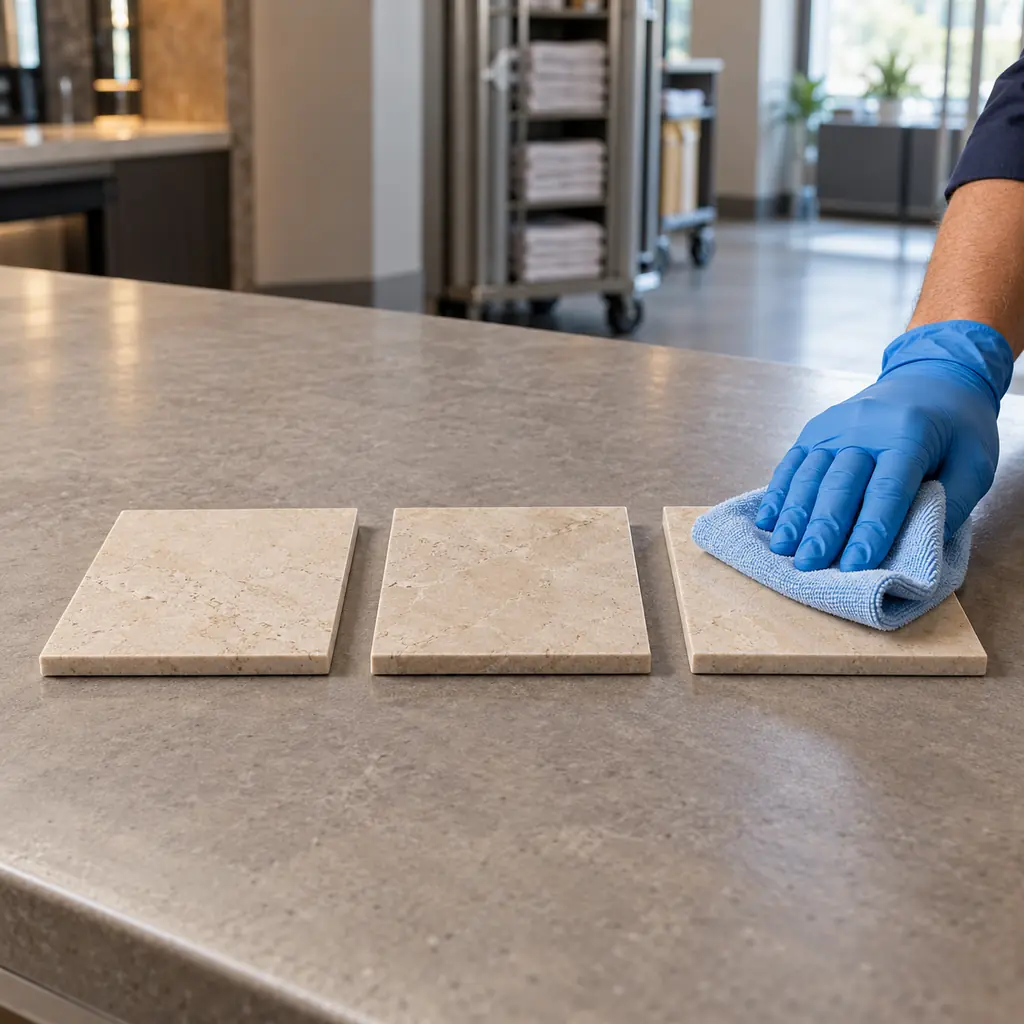
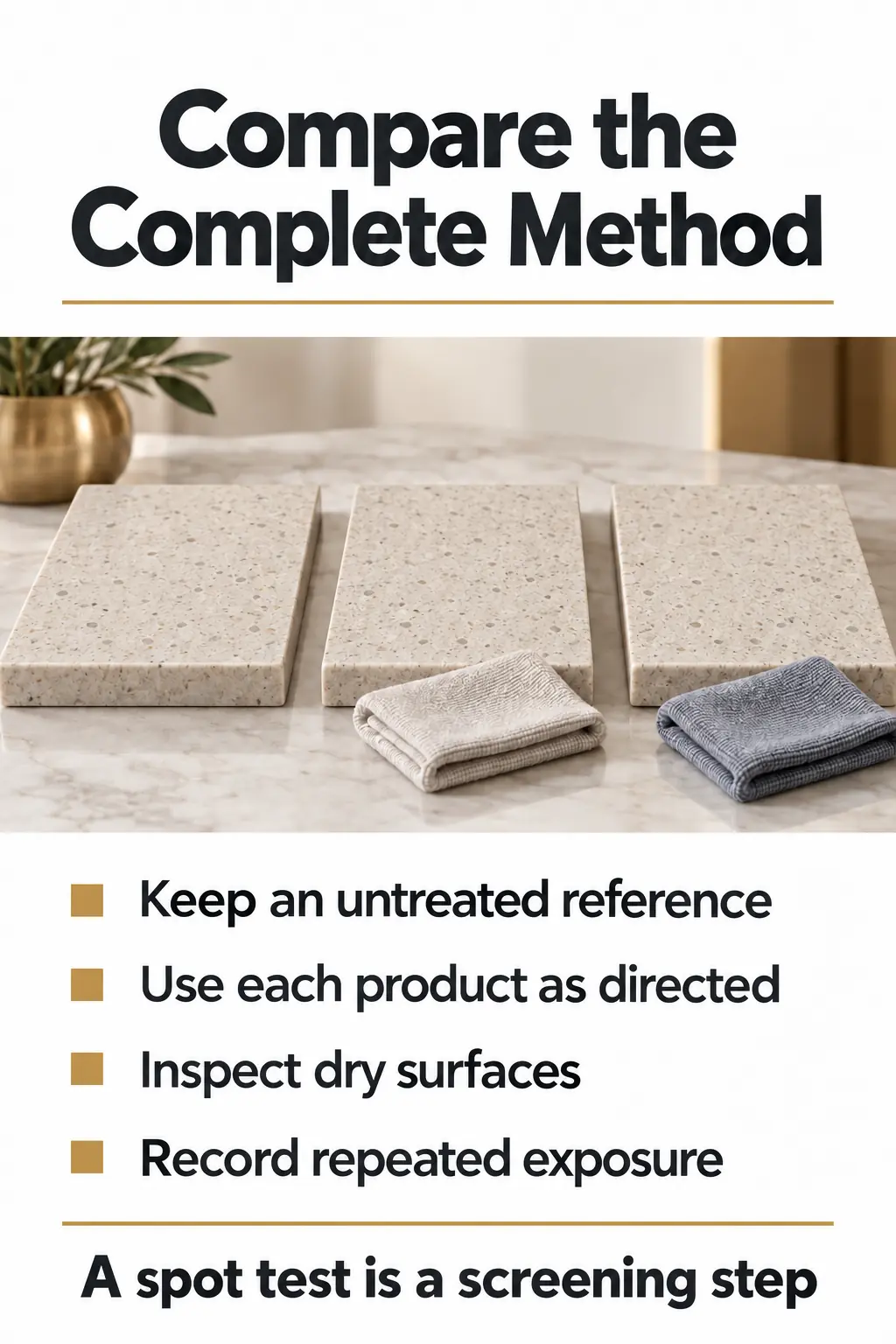
Use a documented comparison that changes the cleaner while keeping other relevant conditions consistent. Begin with representative spare pieces or an approved concealed location, not an entire guestroom. Keep an untreated reference and a comparison cleaned with the current approved method. Record existing defects before applying anything. Follow the proposed product’s label and the surface care requirements throughout the test, including preparation and drying. This is a practical screening method for purchasing decisions, not a standardized durability certification. Where the proposed use conflicts with either set of instructions, resolve the conflict before proceeding instead of trying to make the trial pass.
Choose a comparison that can reveal a difference
Use matching pieces from the installed material when available. A spare tile without the installed sealer, or a flat sample without an exposed edge, may miss the most vulnerable part of the assembly. Choose a comparable condition and finish, and identify each specimen in the test record. Use separate applicators so the old and new products cannot contaminate each other.
Photograph the dry surfaces before the test using the same lighting, camera position, and viewing angle intended for later comparisons. Light falling across the surface at a shallow angle can help reveal haze and changes in gloss. Include pre-existing scratches, stains, or repairs in the record. Do not attribute a mark to the replacement simply because it becomes noticeable during inspection.
Decide what constitutes an acceptable result before seeing the candidate’s performance. For example, the hotel may require no new visible dulling, color change, tackiness, coating transfer, edge swelling, or persistent film under agreed inspection conditions. These are proposed local acceptance criteria, not published universal pass limits. Agree on any quantitative color, gloss, or friction measurements with the appropriate specialist when visual review is insufficient.
Reproduce the complete cleaning method
Record the product name and SKU, batch where available, label revision, prepared concentration, local water source, surface temperature, application amount, wet-contact time, cloth or pad, mechanical action, rinsing, and drying. Use the actual intended dilution equipment once it has been verified. A dispenser setting is not itself evidence of the solution concentration, and a generic pH reading cannot verify every formulation’s dilution.
Keep the comparison fair without forcing identical directions onto different products. Each product should be used within its own approved instructions. If the new product needs a rinse or a longer wet period, include that step and measure the operational consequence. Do not silently remove required steps to match the old process.
Have trained staff conduct the trial using the controls required by the product information and the property’s safety assessment. The CCOHS guidance on working safely with cleaning products reinforces the need for product instructions, appropriate protection, and safe dilution. Never mix the old and new cleaners, top up one product with another, or improvise a chemical neutralizer. Address any dispensing-line change through the equipment and chemical supplier’s specified procedure. Suspend the trial if unexpected fumes, heat, irritation, or another unsafe condition occurs, and follow the established response procedure.
Inspect dry results and repeated exposures
Inspect after completing the prescribed process and once the surface is dry. Where the material warrants it, schedule a later inspection and repeated cleaning cycles with manufacturer input. Record the number of cycles and the interval between them. There is no universal number of spot tests or days that guarantees compatibility across hotel materials.
A short trial can identify immediate damage; it cannot prove a year’s service life. Do not compress many wet applications together and describe them as equivalent to months of normal use. The absence of drying intervals, different soil loading, and altered exposure can make that comparison misleading. The trial report should state exactly what happened, such as a defined number of normal cleaning cycles, rather than translating it into an unsupported lifespan.
Assess both soil removal and the surface itself. Compare appearance, residue, odor during normal use, drying behavior, and the effort needed to reach the agreed finish. Never deliberately inhale a product to assess its smell. A persistent film should trigger investigation of concentration, water, application, and rinsing; do not assume it is harmless or respond by increasing chemical strength.
If damage appears, stop the candidate’s use on that material and document the condition. Do not try stronger chemicals or abrasive polishing to hide the result. Obtain the material manufacturer’s advice on inspection and recovery. A failed test is useful evidence when it prevents a much larger replacement or repair cost.
Approve the change by surface and operating conditions
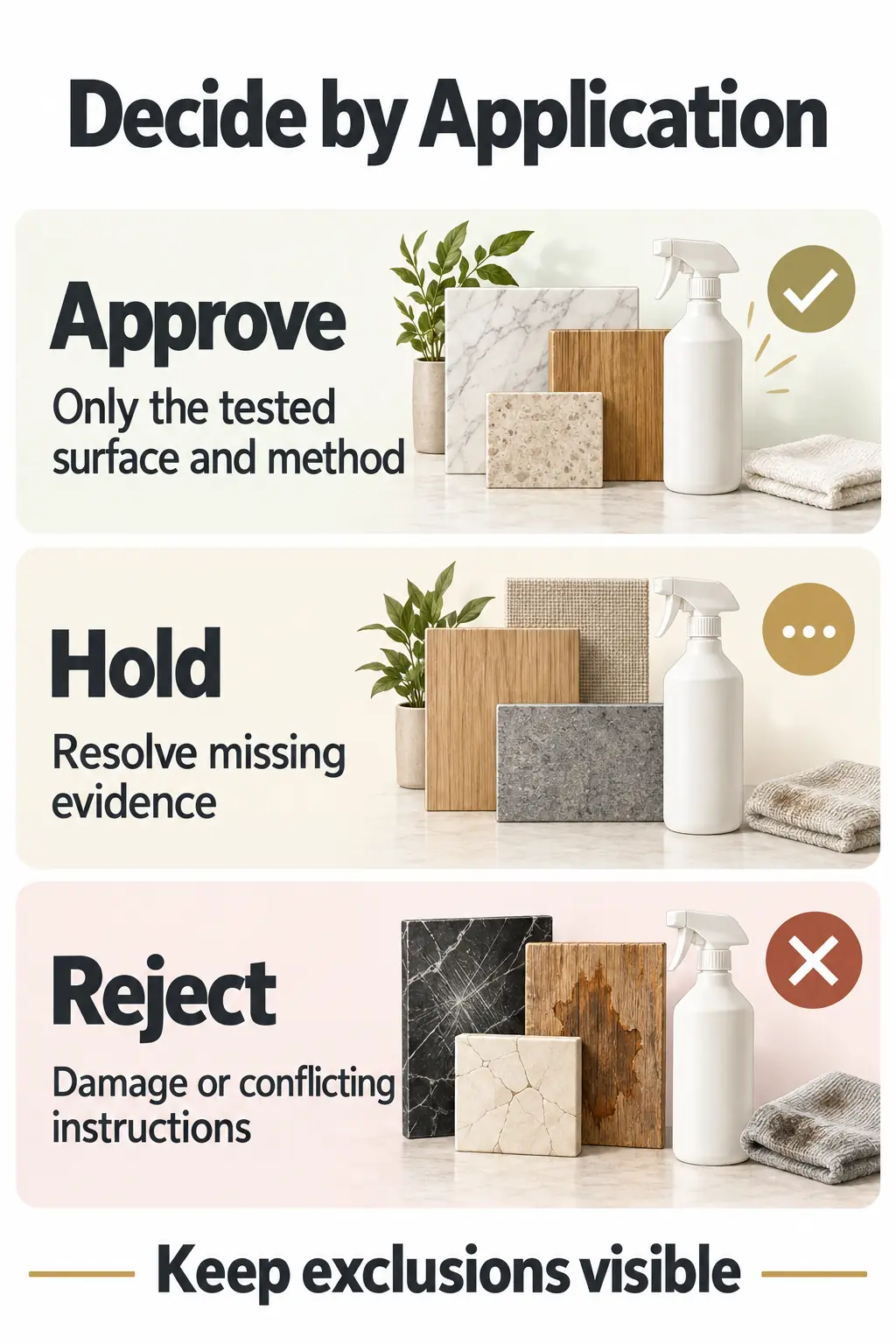
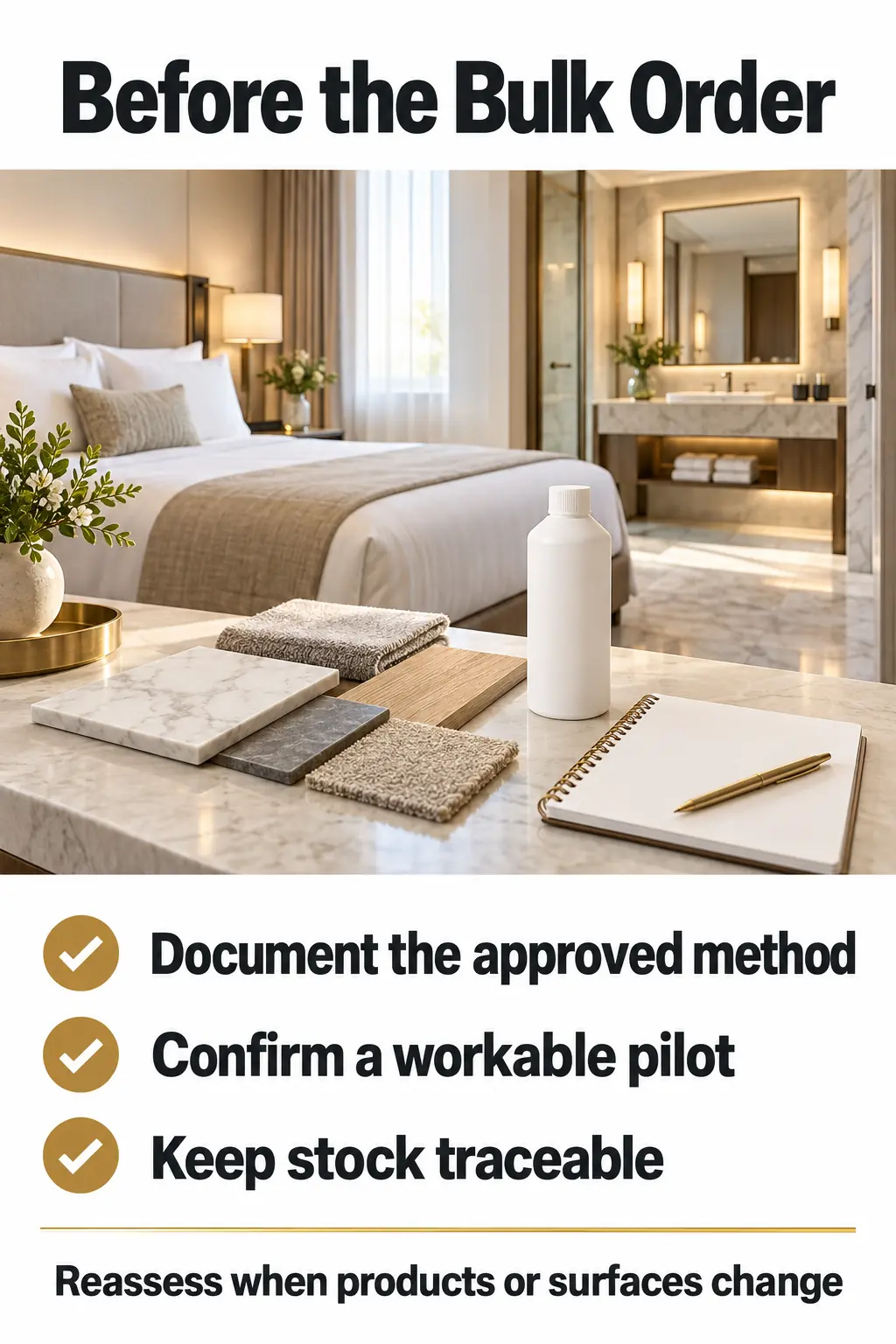
The outcome should identify where the substitute may be used, how it must be applied, and where it remains excluded. A product can succeed on one tested surface and fail on another without making the whole evaluation useless. Convert that difference into a clear operational decision. Before bulk purchasing, run a limited pilot with the staff, tools, water, and room conditions that the hotel expects in normal service. Keep exceptions visible and assign an owner for follow-up. If the team cannot reliably maintain two different methods, a restricted approval may be commercially unattractive even when its technical basis is sound.
Distinguish a pass from an unresolved result
Use the following decision matrix as a review framework. It summarizes purchasing outcomes; it does not replace the product label, a manufacturer’s prohibition, or a specialist assessment.
| Observation or evidence gap | Decision for that application | Evidence needed before wider use |
| Instructions align and the controlled trial meets the agreed criteria | Move to a limited pilot | Reproducible results with normal staff and equipment |
| No immediate damage, but repeated exposure or material identity is unresolved | Hold bulk approval | Material identification or additional assessment appropriate to the uncertainty |
| Candidate succeeds on one finish but fails on another | Consider a restricted approval | Clear exclusions, separate instructions, and a workable stock plan |
| New etching, discoloration, coating damage, or swelling appears | Reject the tested combination | Manufacturer review before considering a different method or candidate |
| Haze, residue, or drying difficulty appears without an identified cause | Hold approval; investigate and repeat the controlled comparison | A permitted, practical method that resolves the cause |
| Label directions and surface care requirements cannot both be met | Reject that use | An alternative product or manufacturer clarification establishing a method permitted by both sets of instructions |
For floors, an acceptable appearance does not demonstrate acceptable slip resistance. Keep the area controlled and obtain an appropriate assessment if the process changes residues or surface behavior. For disinfectants, surface compatibility does not demonstrate microbial efficacy. These are separate decisions with separate evidence requirements.
Make the pilot representative
Choose a limited group of relevant room types and material conditions rather than only the newest, easiest room. Include the staff members who will use the product, because an elaborate demonstration by a supplier may not represent the normal work process. Record deviations rather than quietly correcting them after the fact.
Compare time per completed task, measured product use, extra wiping or rinsing, drying delay, and the need to repeat work. Apply the same definition of a completed task to both methods. A cheaper concentrate may cost more per acceptable room if its required process adds labor. Conversely, an effective candidate may justify a higher unit price if the complete process is simpler and meets the same requirements. Use observed local results, not promised percentage savings.
Keep enough of the existing approved process available for an orderly rollback where it remains suitable and permitted. Separate and identify stock and equipment during the transition. Expired, unidentified, or unsuitable products should not be retained merely as a backup.
Write approval so the next order preserves it
The approval record should connect the exact cleaner to the permitted surface and finish, the cleaning task, the preparation and application method, the supporting documents, and the dated trial record. Identify excluded applications and the people responsible for housekeeping, engineering, and purchasing sign-off. State the limits plainly: a visual pilot with no observed change is not an unconditional lifetime guarantee.
Ask the supplier to notify the hotel of formulation, SKU, label, packaging, or dispensing changes that could affect the approved method. Reassess after a material or sealer change, a meaningful revision to product directions, a different dispensing arrangement, or an unexplained surface complaint. A familiar product name alone is not enough to carry the original decision forward.
Keep the chemical decision connected to the housekeeping tools and supplies used with it. Changing the cloth, pad, or application method can change the result even when the chemical stays the same. Give staff one accessible instruction for each approved application, including exclusions and the route for reporting a problem.
Conclusion
A bulk cleaner substitution is ready to proceed when the exact product, surface, and operating method have a documented basis for approval and the pilot shows that staff can reproduce the result. Screen prohibited uses first, compare representative surfaces under controlled conditions, and evaluate the complete cleaning process before committing to stock. Keep unresolved materials and failed applications outside the approval. This approach makes a partial success useful without turning it into an unsupported promise for the whole property. It also gives purchasing a defensible specification for repeat orders and a clear reason to reopen the review when products or surfaces change.
When preparing a sourcing request, include the proposed use, installed materials and finishes, current method, required documents, trial quantity, and delivery location. Request a cleaning chemical sourcing quote with those details and ask for proposed substitutions to be identified before order approval. Keep the hotel’s compatibility decision separate from the commercial quotation.
Frequently Asked Questions
Can a supplier’s compatibility letter replace a hotel trial?
It can strengthen the evidence, but its scope matters. A letter covering the exact material, finish, concentration, and exposure is more useful than a general statement that a product is safe on most surfaces. Review exclusions and warranty terms. A local pilot still checks the hotel’s water, tools, staff method, existing wear, and operational requirements; it does not expand the letter’s scope.
What if there is no spare material or safe concealed test area?
Do not use a prominent guest-facing surface as an unapproved experiment. Ask the surface manufacturer or installer for a representative sample, confirm the construction from project records, or arrange a supervised assessment. Keep that material on its existing approved method until enough evidence is available. Uncertainty about an expensive finish is a reason to limit the substitution, not to assume equivalence.
Does matching the active ingredient make two disinfectants interchangeable?
No. Concentration, other formulation components, application method, authorized claims, and contact time can differ. Review each exact product’s label and its compatibility with the intended surface. A product can be suitable for a particular disinfection task while still being unsuitable for a finish, or preserve a finish without meeting the required disinfection claim.
Can the hotel dilute a product more to prevent damage?
Only if that dilution is permitted for the intended task and remains consistent with the surface care instructions. Increasing dilution outside the applicable directions can undermine cleaning or disinfectant performance. If the required use conditions damage the surface, select another suitable product or method instead of treating an altered recipe as an approved substitution.
Does a passed test preserve the surface warranty?
Not automatically. Warranty coverage depends on the relevant manufacturer’s terms, the installed product, and whether the permitted care method was followed. Keep written clarifications with the approval record. Do not describe an internal trial as manufacturer approval or advertise warranty protection that has not been confirmed.
References
Health Canada — Guidance on labelling requirements for biocides: Inner and outer labels
Canadian Centre for Occupational Health and Safety — WHMIS – Safety Data Sheet (SDS)
Natural Stone Institute — Care & Cleaning of Natural Stone
Caesarstone — Care and Maintain for our Fusion, Mineral & Quartz Surfaces
Wilsonart — Wilsonart Laminate Care & Maintenance
Canadian Centre for Occupational Health and Safety — Cleaning Products – Working Safely