
Opening quantities for hotel bedding and bed linens should be calculated by item and bed configuration. Start with the pieces required to dress every bed being released for sale, add the pieces tied up in the laundry cycle, provide clean stock for the next issue window, and hold a separate allowance for disruption and permanent replacement. Apply carton sizes only after these operating requirements are visible. A single multiplier applied to the room count cannot show whether the property has enough queen sheets, king pillowcases, or replacement duvet inserts.
The distinction matters because these products behave differently. Sheets and pillowcases circulate frequently. Duvet inserts, pillows, and mattress protectors may follow different cleaning and replacement schedules. An empty room can still contain a fully dressed bed, while a double-queen room requires two bed setups even when only one guest checks in. Counting occupied rooms alone can therefore understate the installed requirement and obscure the stock needed for a busy departure morning.
This guide develops an item-level method for opening stock, operating circulation, reserve stock, and replenishment. It includes a hypothetical 100-room example, explains how to translate laundry turnaround into inventory, and shows how to separate a temporary return delay from a permanent loss of usable pieces. The accompanying calculator lets an opening team change the assumptions and see the resulting purchase quantity. Its example figures are planning inputs, not universal hotel standards or forecasts of a particular property’s performance.
Use the method with housekeeping, laundry, procurement, and the opening manager. Agree on the bed setup, the rooms included in each opening phase, the service schedule, and the time when clean linen must actually be available. Those decisions determine what the hotel needs; the supplier’s pack size determines how that requirement becomes an order.

Build the Opening Baseline by Bed Type and Item
Calculate one complete placement quantity for each stock-keeping unit before choosing a par level. Here, one placement means enough of that exact item to dress all relevant beds once. Separate king and queen sizes, standard and king pillowcases, fitted and flat sheets, and any distinct fabric or finish that cannot be substituted. The baseline should cover beds in rooms scheduled to be ready for sale, including rooms that are initially unoccupied. This creates a stable denominator for comparing circulation stock and reserve quantities without allowing an occupancy forecast to erase the physical room setup.

Convert the room schedule into a bed schedule
For each room type, multiply rooms by beds per room, then by pieces per bed. Add sofa beds, rollaways, or other sleeping positions only under a documented setup and deployment policy. Do not automatically treat a sofa as a permanently dressed bed. Conversely, do not omit it if the property promises every sofa bed as a guaranteed sleeping position during a group arrival.
| Opening room type | Rooms | Beds per room | Beds to dress |
| King | 60 | 1 | 60 king beds |
| Double queen | 40 | 2 | 80 queen beds |
| Total | 100 | — | 140 beds |
In this illustrative setup, each bed receives one fitted sheet, one duvet cover, and four pillowcases. One placement therefore requires 60 king fitted sheets, 80 queen fitted sheets, 60 king duvet covers, 80 queen duvet covers, and 560 pillowcases. The pillowcase total can be pooled only if all beds use the same compatible case specification. If king beds use a different case size, split the 240 and 320 pieces into separate purchasing lines.
Keep durable bedding separate from frequently washed linen
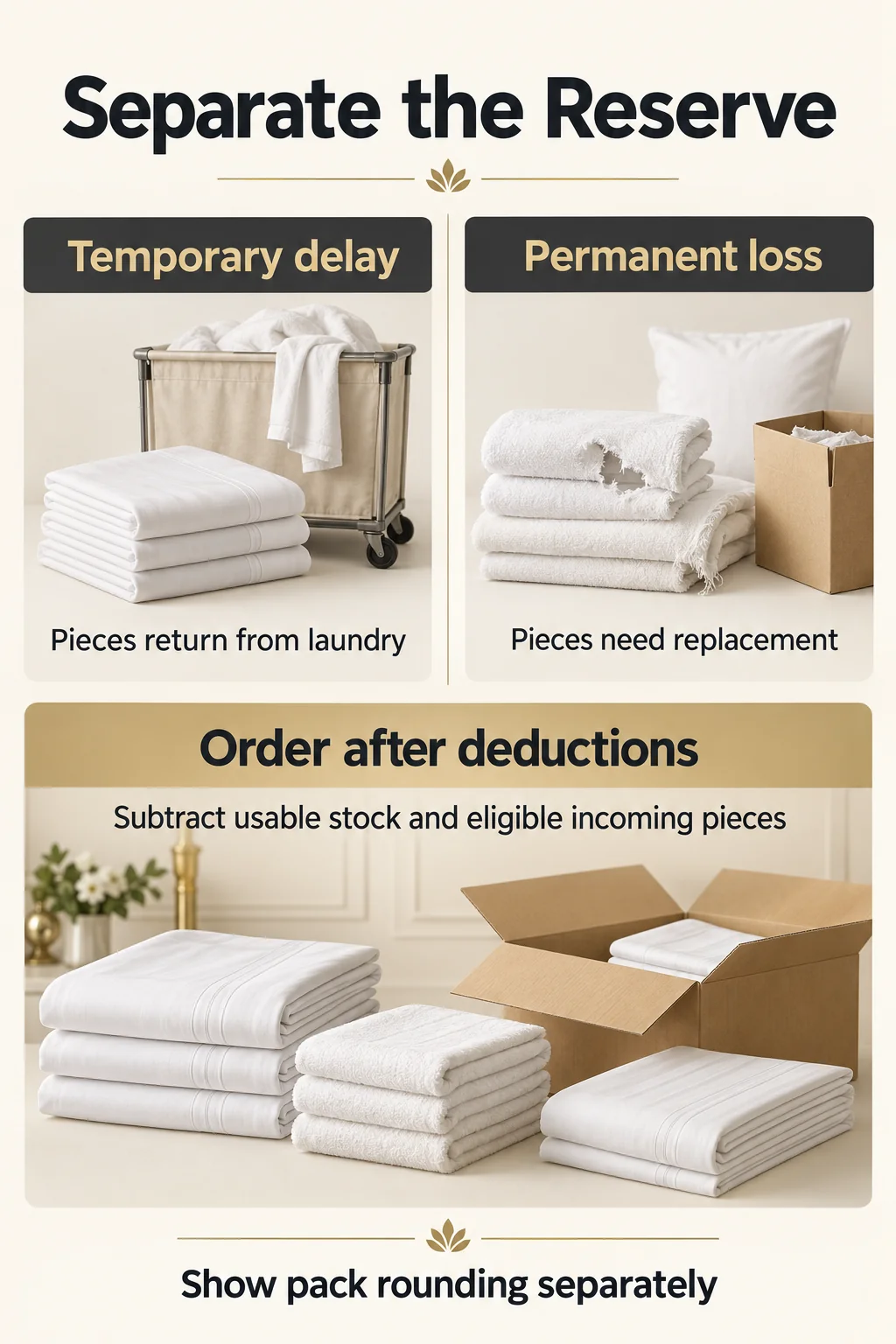
Count pillows, duvet inserts, and mattress protectors from the approved bed standard, then model their own cleaning downtime and replacement needs. Four pillows per bed would require 560 installed pillows in this example. That does not establish a requirement for three or four complete placements of pillows. An insert awaiting cleaning and drying requires temporary substitution; a damaged insert requires permanent replacement. Each needs a defensible allowance, but the same unit must not appear in both allowances simultaneously.
Confirm fitted-sheet pocket depth, finished dimensions, shrinkage tolerance, and actual fit on the approved mattress before quantity approval. A physically present but incompatible sheet is not usable stock. For the underlying evaluation method, review what supplier samples reveal about guest room supplies quality. Record the accepted specification beside the quantity so that a later substitution cannot silently change the usable inventory.
For phased openings, distinguish total project demand from the quantity required before each release date. A closed floor may have no immediate laundry demand but may still consume an installed placement if beds are already dressed. Allocate those pieces to the floor explicitly. Use the broader guest room supplies capacity framework to keep the linen schedule consistent with the rest of the opening plan.

Translate Laundry Turnaround into Circulating Stock
Circulating linen must cover every simultaneous stage between guest use and clean reissue. A practical planning model adds the installed placement, the normal processing pipeline, clean stock for the next issue window, and a separately defined disruption allowance. Laundry turnaround should run from removal from a bed until the accepted, finished item reaches an issue location. Washing time alone omits collection, sorting, transport, finishing, inspection, and distribution. A par level is useful as a comparison after these quantities are calculated, but it should not replace the underlying explanation of where the pieces will be.

Estimate daily changes before estimating daily pieces
Forecast changes by bed type using departure cleans, scheduled stayover changes, guest requests, and other documented service events. Avoid counting a departure change again as a scheduled stayover change. For multiple-bed rooms, use the property’s actual stripping and remake policy. Occupancy multiplied by a daily-change percentage can be a useful approximation, but it should be tested against the expected arrival and departure pattern, especially when group business creates synchronized turnover.
Daily pieces entering circulation = changed beds per day × pieces of that SKU per changed bed. Use separate daily issue quantities for items whose service rules differ. Pillowcases, duvet covers, and protectors need not enter laundry on identical schedules. At opening, use stated assumptions; replace them with observed issues and returns once operating records are available.
Use a transparent stock equation
Let B be the installed placement, D the planned daily pieces changed, T the normal return delay in days, W the clean issue window in days, and E the additional delay scenario in days. A conservative steady-flow screening model is: circulating target = B + ceiling(D × T) + ceiling(D × W) + ceiling(D × E). Each term represents a different stock position. Round each position upward to whole pieces before combining them.
T covers the normal unavailable pipeline. W covers clean pieces staged for future issuance beyond that pipeline. E covers a named interruption beyond normal T, such as a missed return run. Do not include the same missed run in both T and E. Floor pantries and carts belong within clean issue stock when they hold those same pieces; they are not automatically extra placements.
This is an initial sizing model, not a service guarantee. Daily averages can conceal a shortage at 9 a.m. even when clean deliveries make the end-of-day balance positive. Run the planned collection and return schedule against a peak turnover day, recording clean stock before each issuance and after each accepted return. Where demand is uneven, calculate the largest cumulative issue-minus-return gap over the relevant interval and use it to refine the clean buffer and disruption allowance.
Stress-test the bottleneck
Test a busy departure day, a delayed delivery, and a rewash batch. Confirm that washers, dryers, finishing equipment, staffing, transport, and floor distribution can process the planned throughput. Additional stock buys time during a delay; it cannot permanently compensate for a laundry operation that returns fewer usable pieces than housekeeping removes. Change the service or processing plan if the deficit persists.

Calculate Opening Orders and Replacement Reserve
Opening stock needs a reserve for pieces permanently lost from usable circulation as well as stock that will return from laundry. Keep those two exposures separate. A replacement reserve can cover expected condemnation and loss over the next procurement protection period, plus an explicit uncertainty allowance. The opening order then combines the circulating target and replacement reserve, subtracts usable stock already allocated to this opening and eligible incoming stock, and rounds the remaining need to a purchasable quantity. This sequence makes the operational requirement, existing coverage, and packaging excess independently reviewable by the buyer.
Set a replacement protection period
Let r be expected permanent losses in pieces per day, L the end-to-end procurement lead time, V the interval between stock reviews, and U an uncertainty allowance in pieces. For a periodic review policy, replacement reserve target = ceiling[r × (L + V)] + U. Include approval, production, inspection, freight, customs where applicable, receiving, and release in L. A quoted manufacturing duration is only one component of the replenishment period.
At opening, historical loss rates may not exist. Use a clearly identified estimate, document its basis, and test a higher-loss scenario. A loss rate per occupied bed-night is different from a percentage of the total inventory. If a supplier or operator provides a percentage, establish the denominator and period before converting it into pieces. Do not treat all stock temporarily awaiting rewash as permanently lost.
Worked example: queen fitted sheets
Continue the hypothetical 100-room example with 80 queen beds. Assume 48 queen fitted sheets change daily, normal return delay is two days, the clean issue window is one day, and the disruption scenario adds one day. Assume permanent losses average 0.4 pieces per day, replenishment lead time is 45 days, inventory is reviewed every seven days, and the replacement uncertainty allowance is ten pieces. These are illustrative operating choices that must be replaced with property-specific inputs.
| Stock component | Calculation | Pieces |
| Installed placement | 80 beds × 1 sheet | 80 |
| Normal processing pipeline | 48 × 2 days | 96 |
| Clean issue stock | 48 × 1 day | 48 |
| Disruption allowance | 48 × 1 extra day | 48 |
| Circulating target | 80 + 96 + 48 + 48 | 272 |
| Replacement reserve | ceiling(0.4 × 52) + 10 | 31 |
| Opening target | 272 + 31 | 303 |
| Order in packs of 12, no existing stock | ceiling(303 / 12) × 12 | 312 |
| Packaging excess | 312 − 303 | 9 |
The circulating target equals 3.40 placements of this SKU, while the total opening target equals 3.7875 placements before carton rounding. The resulting order is 26 cartons. Those ratios describe this example; they are not a recommendation to apply the same multiplier to every linen item. One additional disruption day would add 48 pieces, increasing the target to 351 and the rounded order to 360. That visible sensitivity gives operations a concrete basis for deciding whether the additional coverage is worth the storage and cash commitment.
Subtract stock and apply commercial constraints
Net opening need = maximum of zero and [opening target − accepted usable stock allocated to this opening − eligible incoming stock]. Count incoming stock only if the correct SKU is expected to arrive, pass inspection, and be released before the required date. Do not subtract it again after it becomes on-hand stock. Rejects, incompatible pieces, stock allocated to another phase, and uncertain deliveries cannot cover the opening requirement.
When an order is needed, round up to the pack multiple after comparing net need with the supplier’s minimum order quantity. If net need is zero, a minimum order quantity alone does not create a reason to buy. Confirm whether the minimum applies per SKU, color, size, or combined purchase. Show any resulting excess separately and obtain an operational decision on storage or phased delivery.
Use the downloadable calculator to reproduce the queen-sheet example and adapt it to another SKU. The workbook keeps baseline placement, circulation, replacement protection, existing stock, pack size, and minimum order quantity editable. It uses the simplified steady-flow model and does not simulate intraday laundry returns.

Control Stock After Delivery and During Opening
A purchase quantity becomes operational protection only when the hotel can identify, release, store, and replenish the pieces. Reconcile receipts by SKU and stock state, then compare the available quantity with the opening schedule. Use one ledger for clean stock, installed items, laundry work in progress, quarantine, and permanent removals, with clear ownership of transfers. A reserve that is casually absorbed into daily floor stock will disappear from the plan unless its release is recorded. Early operating reviews should therefore explain movements and shortages, rather than simply count what remains on storeroom shelves.

Release usable stock before rooms depend on it
Schedule arrival early enough for counting, specification checks, sample-based fit verification, any required initial laundering, drying, finishing, and distribution. Include those tasks in the readiness date. Record received pieces and accepted pieces separately. If cartons contain a shortage or failed specification, revise the usable balance immediately instead of waiting for the claim to be resolved. Pre-opening samples consumed or condemned during testing should not remain in the opening stock deduction.
Measure folded volume and storage capacity from representative finished pieces. Shelving, trolley capacity, floor distribution, and clean storage conditions can constrain an otherwise affordable order. Keep clean stock protected from soiled linen and construction activity, and preserve access for counting and stock rotation. A supplier-held delivery phase may solve a space constraint only when its release timing and delivery risk are compatible with the hotel’s opening schedule.
Replenish permanent losses using the correct inventory position
For continuous review of the replacement reserve, a simple reorder point is ceiling(r × L) + U. In the example, this is ceiling(0.4 × 45) + 10 = 28 pieces. Compare that threshold with usable replacement reserve plus eligible replenishment on order, minus committed replacement issues not yet deducted. This reserve ledger is separate from the 272-piece circulating target. Do not compare a 28-piece replacement threshold with total pieces spread across rooms and laundry.
For weekly review, assess the reserve against the 31-piece protection target that already includes seven days between reviews. Order the shortfall after accounting for incoming coverage, then apply pack and minimum constraints. The continuous reorder point and periodic review target describe different policies; do not add them together. If the operating circulation target has increased, fund that increase separately instead of disguising it as replacement loss.
Reconcile the first operating weeks
Track daily issues, usable returns, rewash quantities, permanent removals, delays, and the lowest clean balance by SKU. Reconcile total usable inventory as opening usable pieces plus accepted purchases minus permanent losses and transfers out, plus transfers in. Moving a sheet from a bed to laundry changes location, not the total. A physical count should use a defined cutoff so carts or laundry deliveries are not counted twice.
Review assumptions frequently during ramp-up, especially after a group stay or a missed delivery. Increase stock only when the evidence identifies a persistent gap or an approved service exposure. Otherwise correct the root cause: a late return, an unrecorded transfer, incompatible sizes, or a service rule that differs from the forecast. Revisit the model whenever room mix, bed setup, change frequency, laundry provider, or procurement lead time changes.
For a sourcing discussion, prepare the room and bed matrix, accepted item specifications, quantities by SKU, pack assumptions, phased delivery dates, and destination. Contact KW Hospitality with that schedule so the quotation can distinguish operating need from packaging and delivery constraints. Request confirmation of per-SKU minimums and the timing of usable delivery before authorizing the purchase.

Conclusion
Calculate opening quantities from the approved bed setup, then make every additional piece explainable. Normal laundry circulation, the next clean issue window, temporary disruption coverage, and permanent replacement reserve serve different purposes. Keeping them separate lets the hotel test a changed turnaround time or opening phase without rebuilding the entire order. The result should be a quantity by compatible SKU, a documented operating target, and a purchase quantity that shows pack rounding and existing coverage. Revisit those assumptions once real issue, return, and loss records become available, because the opening estimate is the beginning of inventory control.

Before releasing an order, the opening manager, housekeeping lead, laundry operator, and buyer should agree on the same baseline and timing assumptions. Use the worked example and calculator as a starting method, then validate the busiest issue window and the actual replenishment period. That combination protects room readiness while making excess stock visible.
Frequently Asked Questions
Can a hotel open with three par of every linen item?
Three placements may be enough for some items and inadequate for others. Calculate each SKU’s installed quantity, issue rate, processing delay, clean issue window, and disruption exposure. Durable bedding may require a different model entirely. A shared par multiplier is acceptable only after the underlying operating schedule supports it.
Should opening stock be reduced because first-month occupancy is low?
Low occupancy can reduce forecast daily laundry issues, but it does not reduce linen already installed in dressed rooms. Reduce the placement baseline only when a defined opening phase leaves beds undressed and unavailable for sale. Confirm when later phases need their own placement and circulation stock.
Can rental linen be counted in the same way as owned linen?
The physical circulation requirement still matters, but purchasing responsibility changes. Confirm the rental provider’s available stock, exchange schedule, peak capacity, shortage response, and responsibility for loss or damage. Do not purchase an owned replacement reserve for supplier-owned linen without reviewing the agreement and contingency plan.
Does a higher reserve solve repeated laundry shortages?
A reserve can bridge temporary delays. It cannot sustain an operation whose usable returns remain below issues. Measure throughput and timing, distinguish delayed stock from permanent losses, and correct the processing or service constraint before repeatedly increasing the order.
Should shrinkage be added as a percentage to every opening quantity?
Shrinkage is primarily a fit and specification issue. Validate finished dimensions and acceptable laundering performance on samples. Only a justified rejection or replacement estimate belongs in quantity planning; a blanket shrinkage percentage can hide a product that becomes unusable after washing.
What should happen when the supplier’s minimum order exceeds the calculated need?
Show the additional pieces separately, calculate storage and cash implications, and ask whether sizes can be combined or deliveries phased under the supplier’s actual terms. Compare alternatives using compatible specifications. Do not relabel a commercial minimum as an operational requirement.