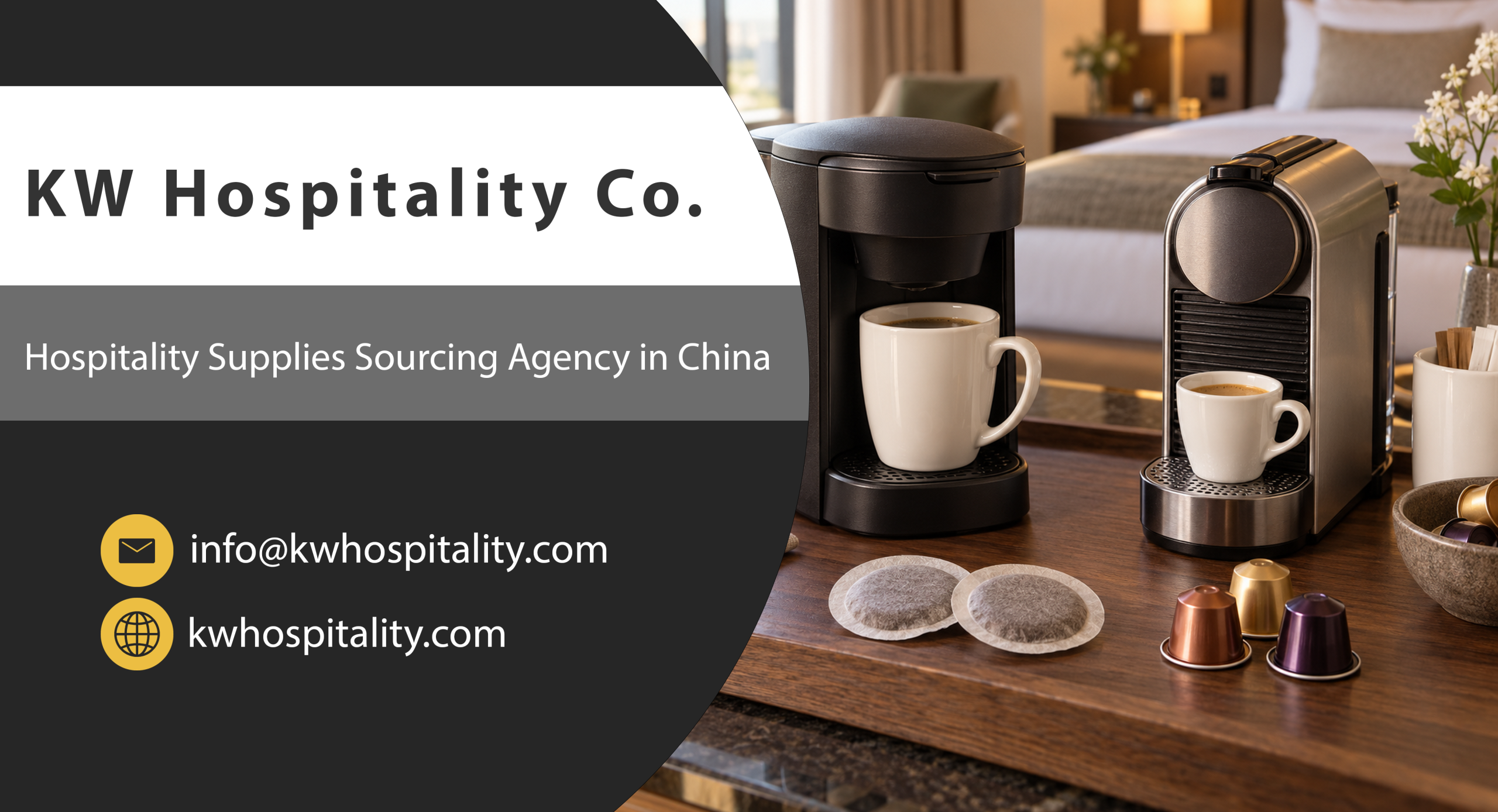
Hotel single-serve coffee makers should be purchased as a complete coffee program: the brewer, compatible portions, housekeeping routine, replenishment route, and exit terms. Soft pods can offer purchasing flexibility when several approved sources actually supply the required format. Capsules can support a familiar guest experience and a defined beverage range, but compatibility and commercial commitments vary by system. Neither format is automatically cheaper, easier to maintain, or free from supply lock-in.
For a hotel buyer, the practical question is not simply whether coffee arrives in paper or a rigid container. It is whether the property can keep serving an acceptable drink if its preferred coffee becomes unavailable, the supplier increases prices, or the equipment program changes. A low equipment price can conceal a substantial recurring commitment. Conversely, paying more for a brewer does not create meaningful independence if its only approved coffee is difficult to source locally.
Start with the guest promise. A limited-service property providing a straightforward morning mug has different requirements from a suite offering espresso. Define the intended drink size, regular and decaffeinated options, cup clearance, room presentation, and expected use before comparing machines. A small espresso and a full mug are different services; comparing only the price of one portion can make an unsuitable system appear economical.
This guide focuses on guestroom equipment and recurring supply decisions, rather than lobby beverage stations or a ranking of particular brands. It explains how to verify compatibility, calculate cost per occupied room, and evaluate operating and contract constraints together. The worked example uses hypothetical US-dollar inputs, not supplier quotations or market averages. Replace those inputs with your hotel’s occupancy, actual stock depletion, staff time, and written offers. The goal is a repeatable purchasing decision that remains workable after the initial equipment order.
Match the Coffee Format to the Exact Brewer
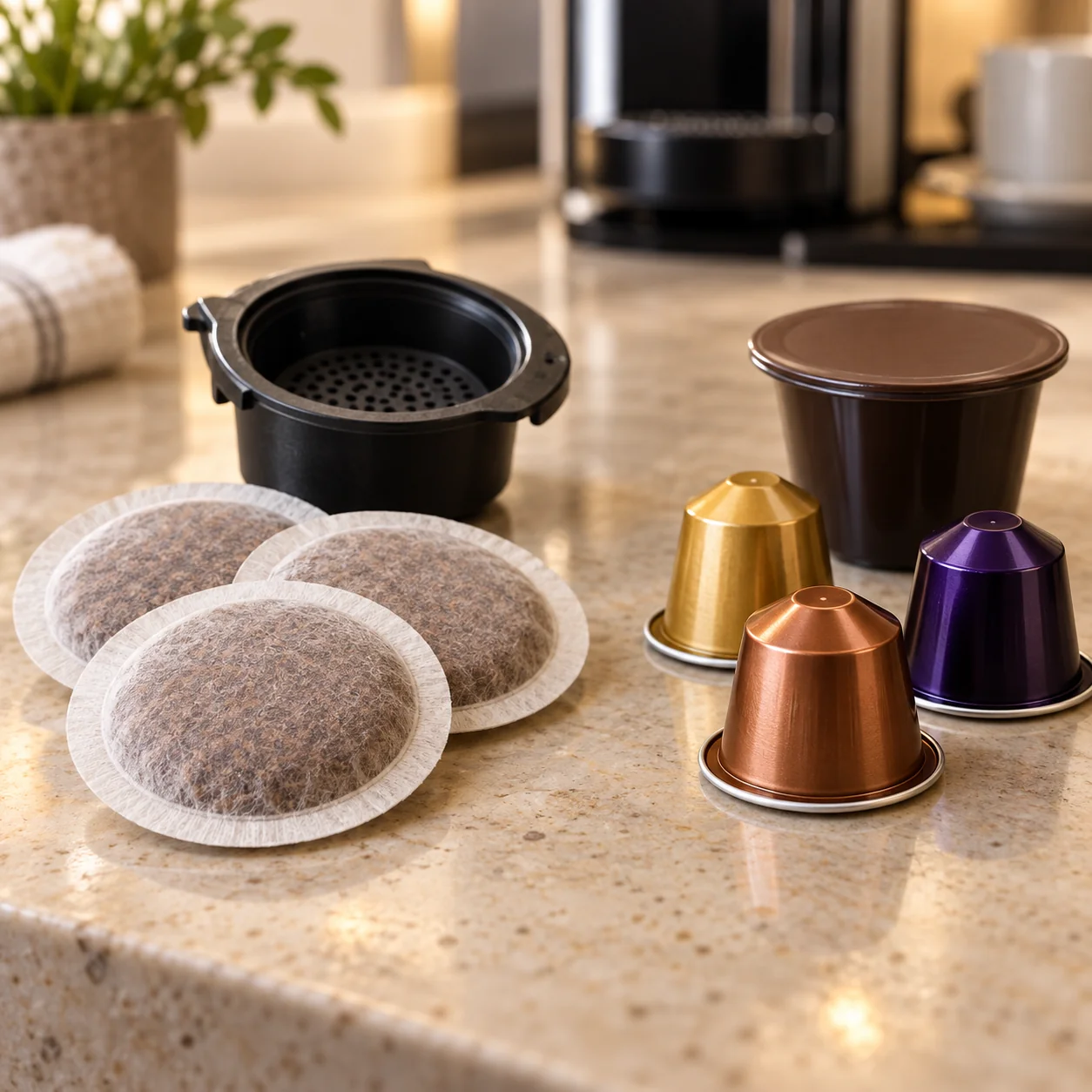
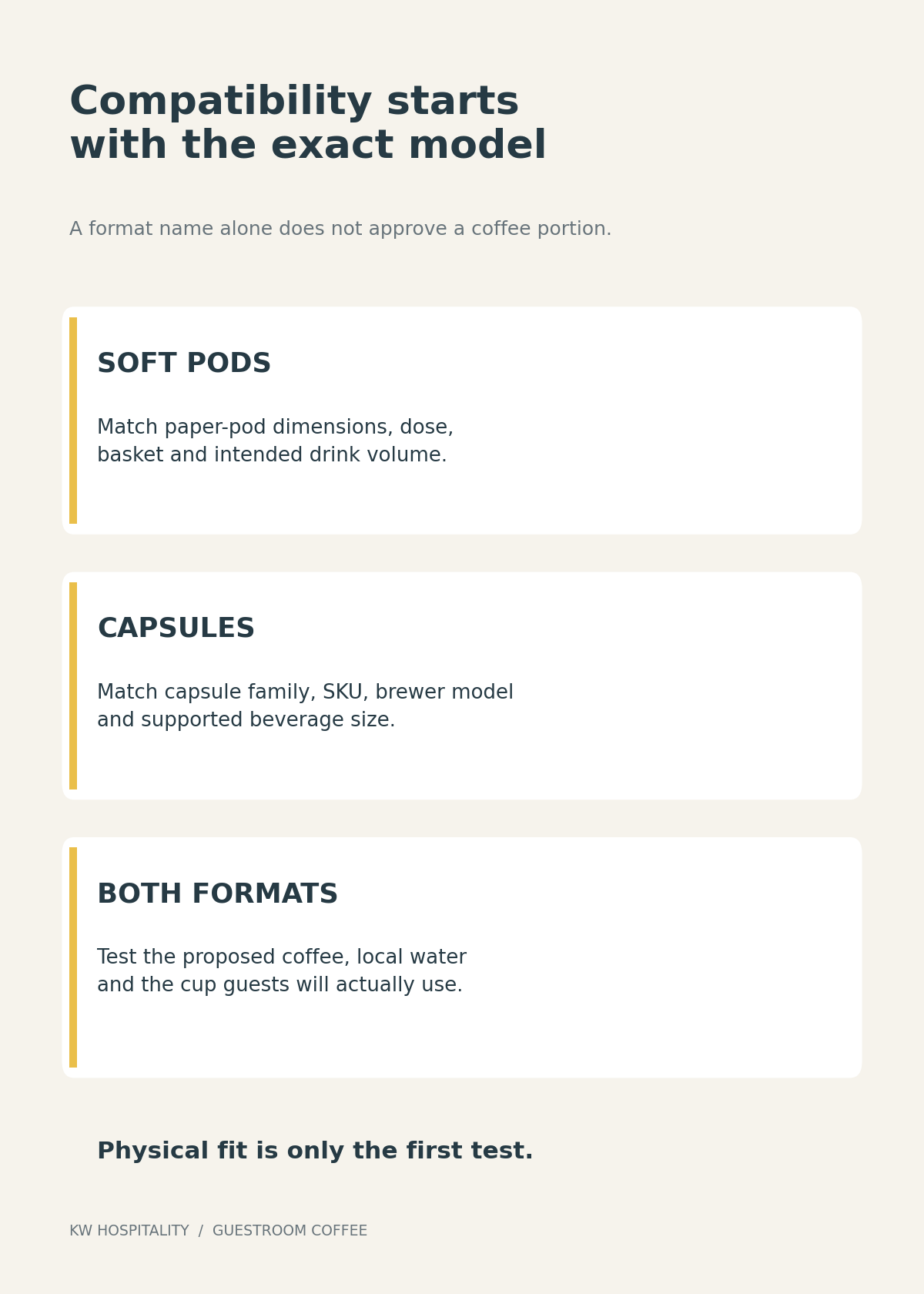
Compatibility starts with the specific brewer model and the exact coffee portion, not the word “pod” on a quotation. A soft pod generally holds ground coffee inside filter paper; a capsule encloses it in a formed container. Retail descriptions sometimes call both products pods, so the purchase specification must remove that ambiguity. Ask suppliers to identify the accepted format, dimensions, coffee dose, intended beverage volume, and any model restrictions. Physical fit is only the first test. The selected coffee must also brew properly, release or eject reliably, and produce the drink the hotel intends to offer.
Soft pods are not a universal standard
A paper pod that fits one basket may have the wrong diameter, thickness, dose, or brewing behavior for another machine. A hotel filter-coffee pod and an espresso paper pod should not be treated as substitutes simply because both look like round paper sachets. Likewise, do not assume a brewer accepts loose grounds, rigid capsules, or alternative pod holders unless its documentation explicitly allows them.
For each proposed soft pod, obtain the manufacturer’s compatibility statement and retain a sample of the approved SKU. Test regular and decaffeinated versions independently. Changing the coffee dose, filter material, or packing density can change the result even when the outside dimensions appear similar. A successful demonstration with one blend does not approve an entire supplier catalog.
Capsules require a system and model match
Capsule systems differ in shape, sealing, opening, recognition, and brewing method. For example, Nespresso Original and Vertuo are separate systems with noninterchangeable capsules. Even within a named family, some beverage sizes can have model restrictions. “Compatible with capsule machines” is therefore an incomplete procurement description.
Third-party availability must be evaluated for the exact system, model, and market. A capsule sold by several distributors may still come from one manufacturer. A similarly shaped alternative may also have different extraction or ejection behavior. Ask for written compatibility and warranty conditions; do not assume either that every third-party portion is acceptable or that any third-party use automatically cancels all coverage.
| Decision factor | Soft pods | Capsules |
| Compatibility evidence | Approved paper-pod specification and basket match | Exact capsule family, SKU, and brewer model |
| Potential purchasing flexibility | Several qualified pod sources, if available | Alternative approved coffees or channels within that system |
| Guest beverage | Defined by brewer, dose, and water volume | Defined by system, capsule, and supported drink size |
| Reset work | Remove wet pod; clean accessible basket and contact surfaces | Remove or empty used capsules; clean tray and accessible parts |
| Packaging review | Include the individual wrapper as well as the paper pod | Include capsule materials and the actual collection route |
| Common purchasing error | Treating all paper pods as interchangeable | Treating all capsules, or all models in a family, as interchangeable |
Approve the drink before approving the format
Use the intended hotel cup, local water, and proposed coffee in the trial. Record fill level, taste at the offered volume, brew time, splashing, leakage, noise, and ease of completing a second drink. If the program promises a mug of coffee, assess that mug; do not evaluate a short sample and then add extra water to meet the guestroom serving size without testing the result.
Compare candidates against the same service promise. A capsule espresso program may be appropriate for suites even if it has a higher cost per portion. A soft-pod program may be appropriate for a straightforward mug service if it meets the taste and usability requirements. Neither format name establishes beverage quality. The accepted combination of brewer, coffee, water, and serving size does.
Compare the Cost per Occupied Room
The useful cost comparison includes coffee consumed or lost, equipment, maintenance, and the labor required to restore the station for the next guest. Coffee price alone misses important differences, while purchase price alone overlooks years of replenishment. Use occupied room-nights as the denominator when evaluating the guestroom amenity budget. Also track cost per acceptable drink if the alternatives deliver different serving sizes or have different failure rates. Keep both measures visible: a program can look inexpensive per room simply because guests rarely use it, which may indicate weak amenity value rather than purchasing success.
Start with depletion rather than the tray allowance
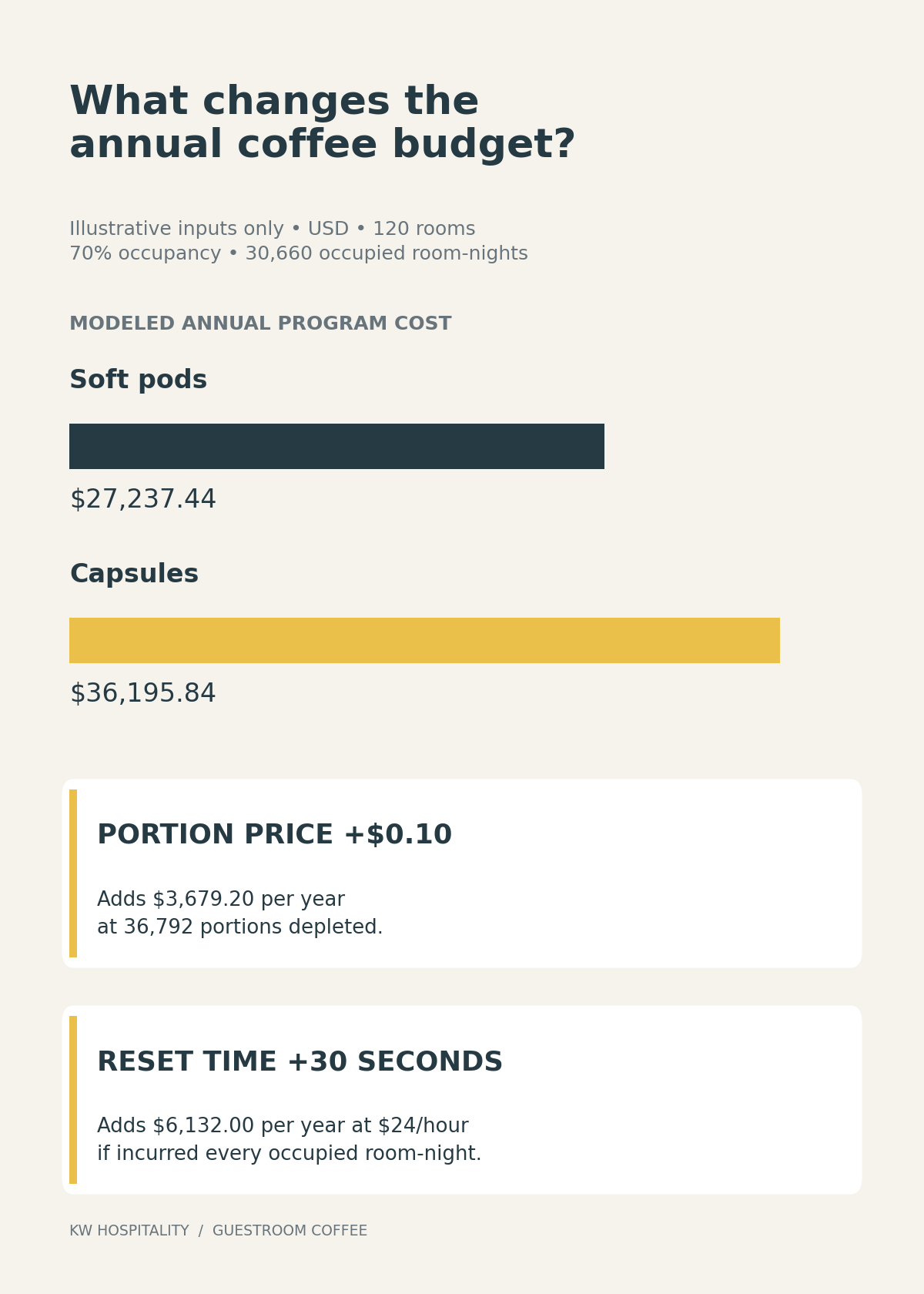
Two portions placed in every room do not necessarily mean two portions consumed for every occupied night. Unopened portions may remain through several services. Conversely, extra requests, damaged wrappers, expired stock, or unexplained losses can increase replenishment requirements. During a trial, reconcile opening stock, receipts, closing stock, and known transfers to estimate actual depletion. Separate regular and decaf because their usage and shelf-life exposure may differ.
Use these relationships for a planning model:
Occupied room-nights = rooms in service × days × occupancy rate.
Annual portions depleted = occupied room-nights × portions depleted per occupied room-night.
Annual program cost = coffee depletion cost + annualized equipment cost + service and supplies + housekeeping labor + other program costs.
Cost per occupied room-night = annual program cost ÷ occupied room-nights.
Use landed coffee cost consistently, including the freight and charges borne by the hotel. Add rent if applicable; do not also annualize a purchase price for the same rented equipment. For purchased brewers, annualization is a planning allocation, not a cash-flow forecast or a statement about accounting depreciation. Choose a realistic service life and account for replacements without double-counting them in both equipment and service budgets.
Worked example for a 120-room property
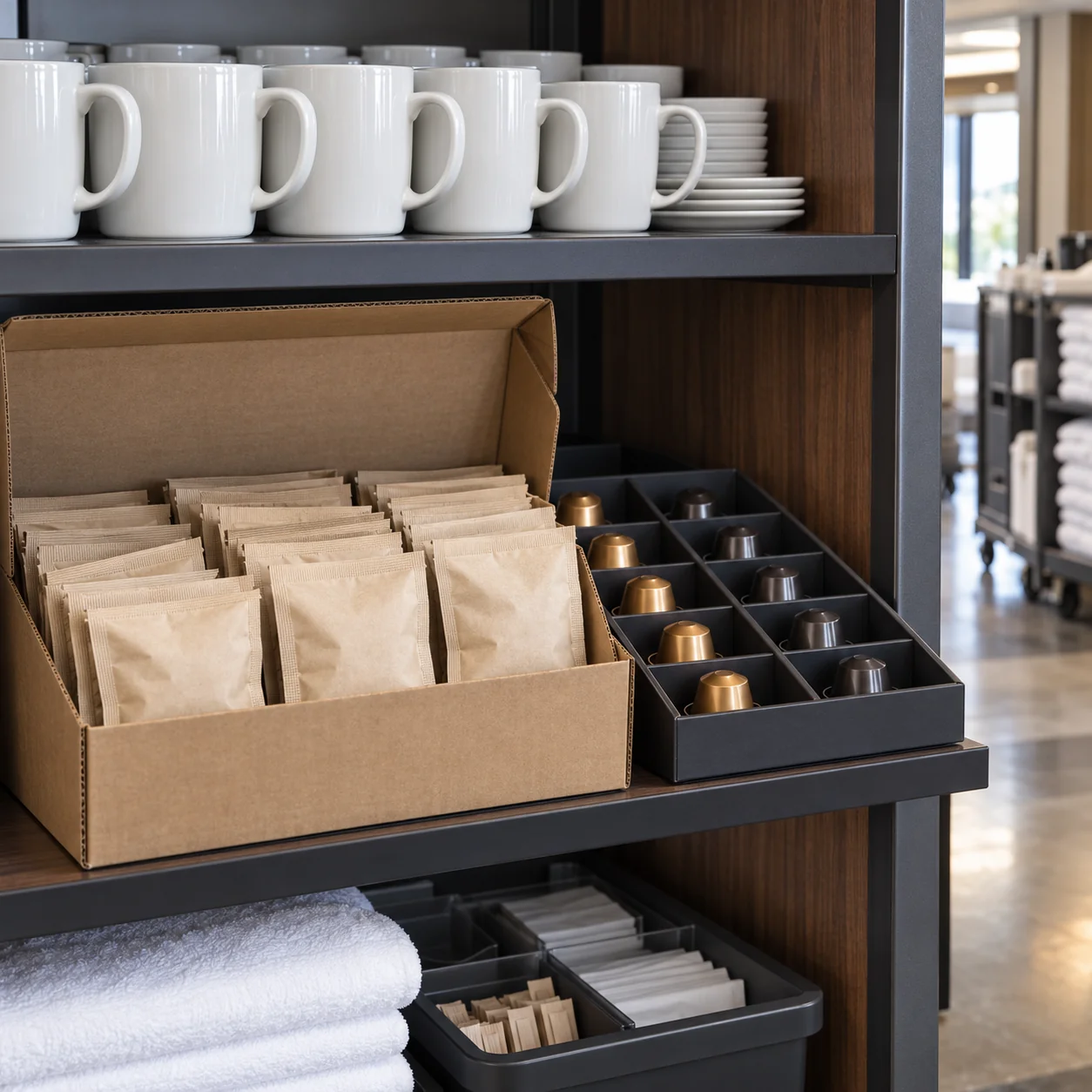
Assume 120 rooms in service, 365 days, and 70% occupancy: 30,660 occupied room-nights annually. Both candidate programs are assumed to meet the same guest beverage requirement and deplete 1.2 portions per occupied room-night, including ordinary losses: 36,792 portions annually. These assumptions are illustrative; neither consumption nor service life is an industry benchmark.
| Hypothetical annual cost input | Soft-pod program | Capsule program |
| Landed cost per portion | $0.32 | $0.52 |
| Coffee: 36,792 portions | $11,773.44 | $19,131.84 |
| 120 brewers, allocated over 3 years | $2,000.00 | $3,600.00 |
| Service and cleaning supplies allowance | $1,200.00 | $1,200.00 |
| Reset labor: 1 minute per occupied room-night at $24/hour | $12,264.00 | $12,264.00 |
| Annual modeled program cost | $27,237.44 | $36,195.84 |
| Cost per occupied room-night | $0.89 | $1.18 |
The equipment row assumes purchase prices of $50 and $90 per room respectively, with no residual value. The example excludes taxes, financing, utilities, cups, condiments, and exceptional downtime. These are not necessarily zero; add them where they differ or where a complete operating budget is required. Equal labor and service allowances isolate the effect of the assumed coffee and equipment prices. They are not evidence that the two formats require equal work.
The modeled annual difference is $8,958.40, or approximately $0.29 per occupied room-night. It supports a decision only if both programs satisfy the agreed guest experience. A property might accept a premium for a different beverage offer, but should state that choice explicitly instead of presenting unlike drinks as equivalent.
Test what could reverse the result
At the example’s volume, a $0.10 change in landed portion cost changes the annual budget by $3,679.20. At a loaded wage of $24 per hour, an extra 30 seconds of work for every occupied room-night adds $6,132.00. Small time differences can therefore matter materially. Use the actual number of coffee-station service events if housekeeping is not performed for every occupied night.
Test lower occupancy, higher coffee uptake, a delayed delivery, and early brewer replacement. For a discounted or loaned equipment offer, compare its recurring cost with an outright-purchase alternative over the same period. Include any minimum purchases and exit charges. A low initial payment is valuable only in the context of the obligations that follow it.
Evaluate Supply Lock-In and the Operating Routine Together
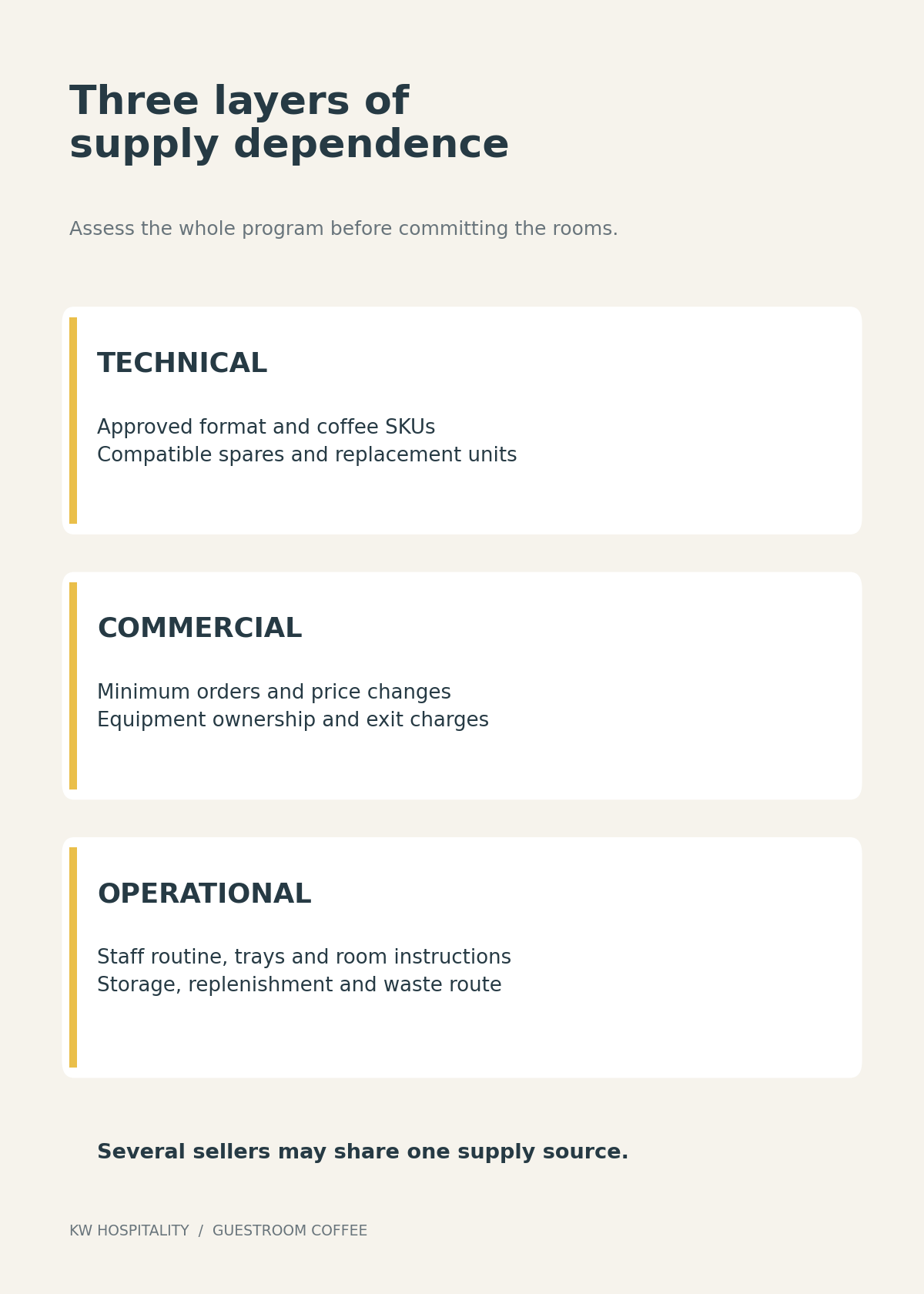
Supply lock-in has technical, commercial, and operational layers. Technical dependence comes from the accepted coffee format and available replacements. Commercial dependence comes from the terms attached to equipment, coffee, and service. Operational dependence develops when staff training, spare parts, room trays, and guest instructions all assume one system. A hotel can accept some dependence in return for reliable service or a valued beverage experience, but it should know what a change would require. Evaluate a realistic shortage or supplier change before rollout, while samples are still inexpensive and the property has negotiating options.
Distinguish alternate sellers from alternate supply
Two distributors carrying the same coffee may provide useful delivery alternatives, but they do not eliminate dependence on the same factory or brand owner. Ask where the approved portions are stocked, who manufactures them, and whether the backup route relies on the same upstream inventory. Check regular and decaf separately. An alternate source that cannot supply the required decaf, case size, or delivery destination is only a partial backup.
For each coffee SKU, establish delivery lead time, minimum order quantity, case quantity, and minimum remaining shelf life at receipt. Compare the order quantity with expected depletion. A low unit price can be poor value if the hotel must buy more than it can use while the coffee remains within its approved shelf life. Agree how substitutions are proposed and approved; a supplier should not silently replace a qualified coffee with a superficially similar portion.
Set a reorder point using expected demand during replenishment lead time plus safety stock sized for observed variability. In the worked example, average depletion is about 101 portions a day. A 14-day replenishment period therefore represents about 1,411 portions before any safety allowance. This is an illustration, not a universal stock target. Reorder calculations should account for usable stock on hand, confirmed incoming orders, seasonal demand, and the space available for storage.
Read the equipment offer as a recurring commitment
Discounted equipment can be conditional on future coffee orders. Read the actual offer rather than inferring the commitment from words such as “free,” “included,” or “partner program.” Request the equipment ownership position, contract period, eligible coffee SKUs, minimum purchase schedule, price-change mechanism, and consequences of under-purchasing or leaving early.
Minimums should be tested against a conservative demand case. Determine whether the obligation is based on portions, boxes, spend, or delivery frequency; whether purchases can be pooled across properties; and whether surplus purchases in one period count toward another. A program that works at peak occupancy may become expensive during a renovation or seasonal closure.
Ask what happens if the preferred coffee or brewer is discontinued. Define the proposed substitute approval process, parts support, service response, replacement-unit arrangements, and treatment of unused coffee. Obtain warranty conditions for commercial guestroom use in writing. Contract language should match the supplier’s actual offer; a requested safeguard is not a benefit until accepted.
Measure housekeeping work with the machine in the room
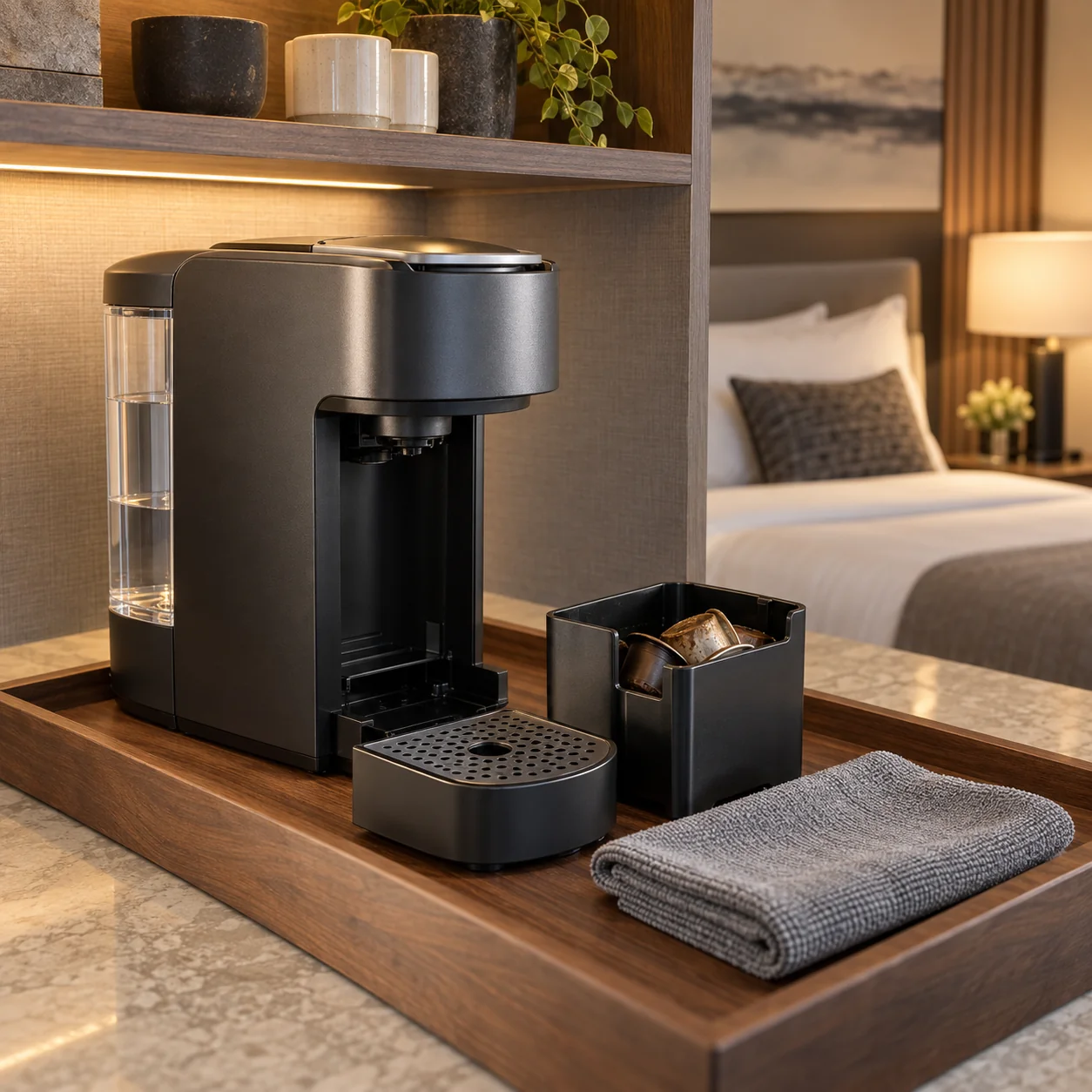
Observe a complete reset, including moving the brewer if needed, accessing the water area, removing used coffee, cleaning permitted components, wiping the station, and replenishing supplies. Soft pods may leave wet paper in a basket; capsule systems may retain used portions in a container. The significance depends on the model and routine, not the format alone. A front-access design may work better under a shelf than a unit that requires substantial clearance above it.
Review the manufacturer’s cleaning and descaling instructions before approval. Confirm which components can be removed, how they are cleaned, and what maintenance requires taking a unit out of service. Do not treat a rinse cycle as proof that the brewer has been cleaned. The operating procedure should follow the selected model’s instructions and the hotel’s hygiene requirements, with clear responsibility for periodic maintenance.
Check electrical suitability, commercial-use documentation, stable placement, cord routing, cup fit, and access for staff and guests. A compact machine is not a good fit if staff must drag it across a crowded tray to refill it. When coordinating the station with other room items, review the hotel’s broader hospitality supplies requirements so cups, trays, condiments, and storage are specified together.
Run a small operational trial and preserve the results
As a practical starting point, trial candidates in several representative rooms across both departure and stayover services. Include more than one housekeeping shift and the people who replenish stock. This is an operational pilot, not a statistically conclusive study. Extend it if usage is too low to expose the intended workflow, and do not infer long-term reliability from a few successful brews.
Record the exact machine and coffee SKU, drink volume, brew completion, leaks, ejection or basket problems, reset time, extra guest requests, and staff comments. Test the proposed backup coffee before calling it an approved substitute. Set acceptance criteria before comparing the results, including unacceptable leakage, compatibility failures, and the minimum beverage quality the hotel will accept.
Include the real waste route in the decision
Paper appearance does not establish that a complete soft-pod package belongs in the hotel’s organics stream, and an aluminum or plastic capsule is not automatically recyclable through its current collection service. Consider wrappers, mixed materials, sorting work, collection containers, and any return program. Confirm the accepted items and handling requirements with the actual service provider. Compare demonstrated disposal routes; do not assign an environmental winner solely from the format name.
Once the service requirement is defined, request a hotel coffee-maker and replenishment quotation with the room count, destination, intended drink size, proposed coffee formats, expected annual depletion, and required delivery date. Ask for separate equipment and coffee pricing, sample availability, compatibility documentation, and supply terms. This makes competing offers easier to compare without assuming that a low brewer price represents the lowest ongoing cost.
Conclusion
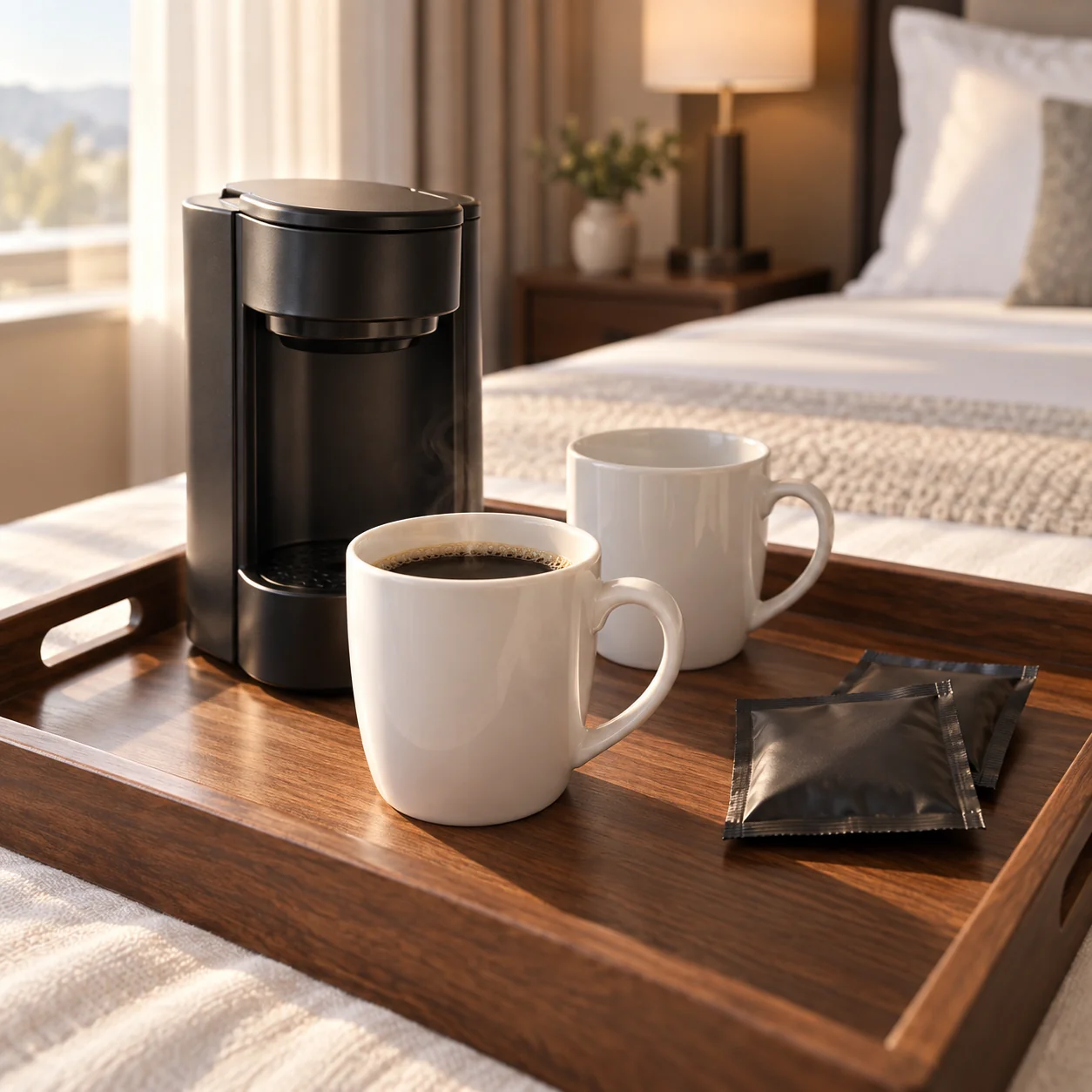
Choose soft pods when the approved brewer and coffee meet the guest requirement and qualified supply alternatives make the program practical. Choose capsules when the specific system provides the intended beverage experience and its recurring cost and supply conditions are acceptable. In either case, base approval on the complete operating arrangement: exact compatibility, measured housekeeping work, realistic consumption, dependable replenishment, and an understood exit path. The strongest purchase decision is the one the hotel can continue to operate when occupancy changes, a preferred SKU disappears, or the original equipment offer comes up for renewal.
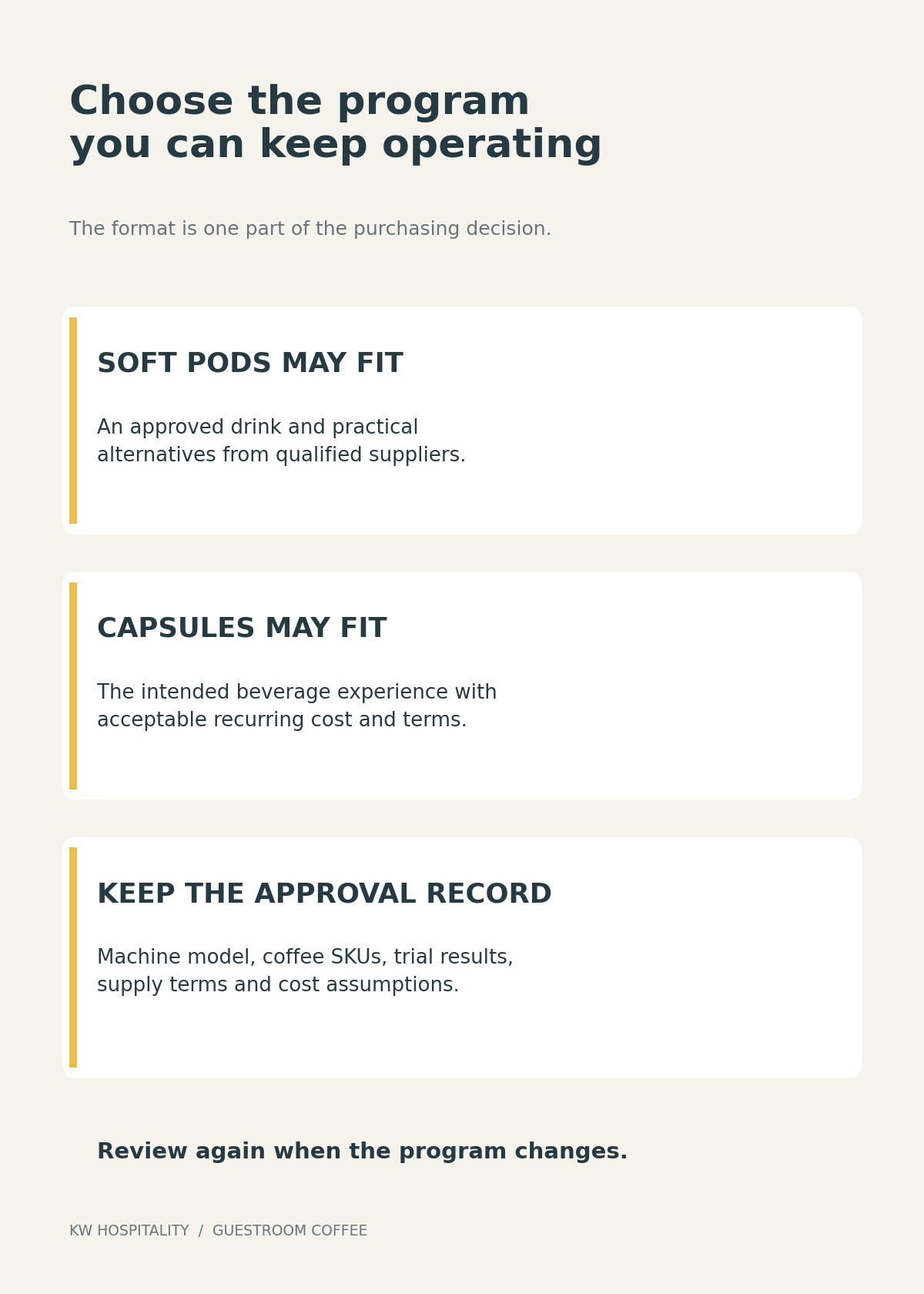
Retain the approved machine model, coffee SKUs, trial results, written supply terms, and cost assumptions as the program’s purchasing reference. Revisit that reference when prices, products, service routines, or suppliers change. This prevents a later “equivalent” reorder from quietly changing the guest experience or the hotel’s ongoing obligations.
Frequently Asked Questions
Can a hotel use one coffee portion for two cups?
Do not budget on reusing a single-serve portion. Specify the approved dose and beverage volume for each serving. A second extraction is not equivalent to a fresh drink, and it can undermine the taste standard used to approve the program. If two guests are expected to make coffee, plan enough approved portions and cups for that service.
Are household coffee makers suitable for guestrooms?
Suitability depends on the exact product, intended use, documentation, warranty, and hotel requirements. A familiar retail brand or compact size is not enough. Confirm commercial guestroom use and local electrical suitability before ordering, along with access to service and replacement parts. Evaluate how guests will actually fill, operate, and leave the unit.
Does a capsule system with many coffee brands avoid lock-in?
Not necessarily. More blends or brands can broaden choice while leaving the hotel dependent on one capsule format or manufacturing network. Check which alternatives are approved for the selected machine, where they are stocked, and whether their supply routes are independent. Distinguish variety of flavor from resilience of supply.
Can reusable capsules eliminate recurring coffee costs?
Reusable holders still require coffee and add filling, cleaning, handling, and quality-control work. Their compatibility and use must be approved for the specific brewer. They may also change the guest experience and housekeeping routine. Compare the complete operating cost before treating them as a purchasing solution.
Should the hotel offer the same system in every room?
A single system can simplify training, stockholding, and spares. Different room categories may justify different beverage offers, but that creates additional SKUs and opportunities for replenishment mistakes. If suites use a separate system, distinguish its stock and service procedure clearly and include the extra complexity in the cost comparison.
What if the preferred coffee is out of stock?
Use a previously approved substitute that is compatible with the exact brewer and meets the agreed drink standard. If none is available, activate the hotel’s planned alternative guest service rather than placing an untested portion in the room. Record the substitution, monitor its performance, and reapprove any permanent change.