
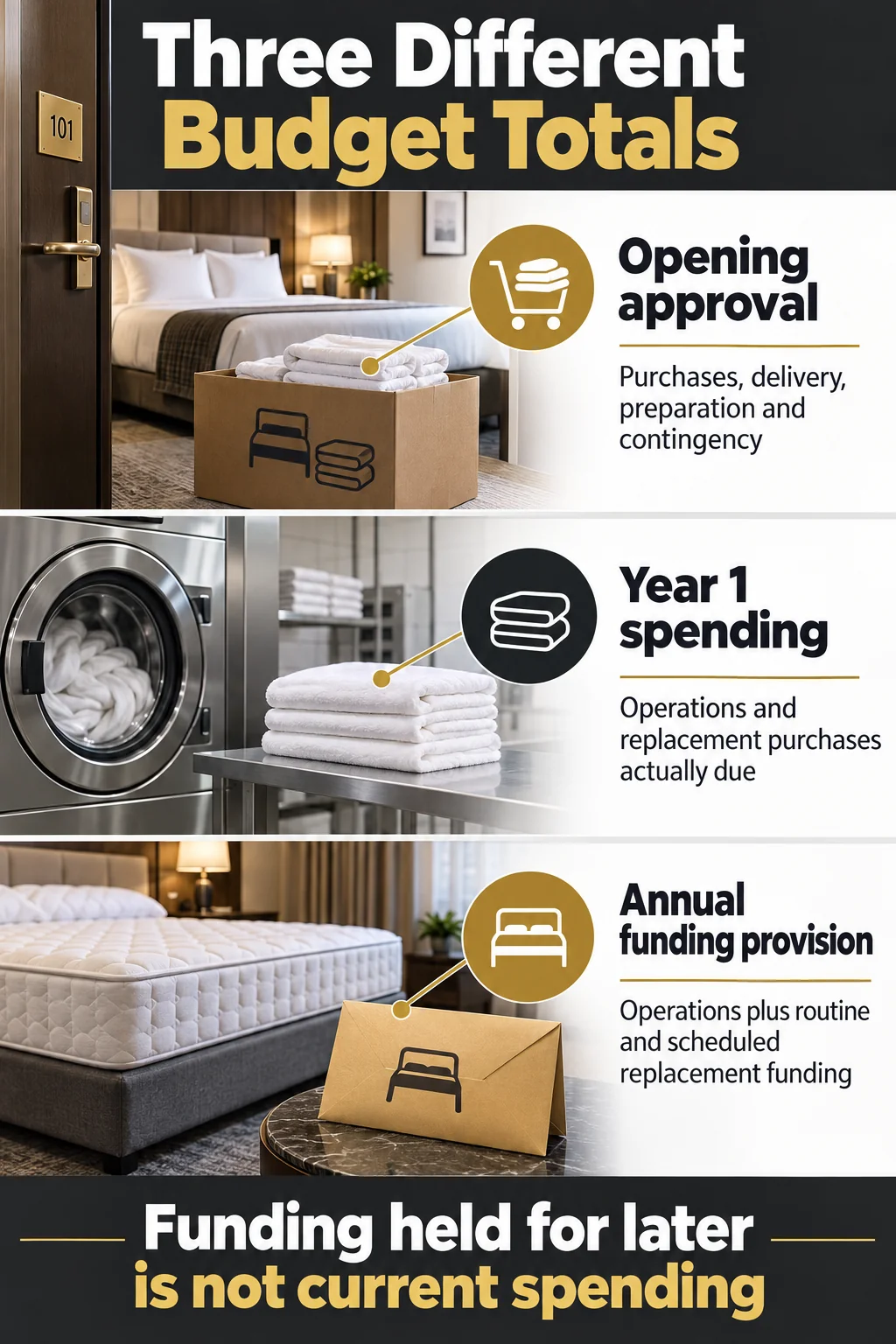
A hotel bedding budget needs three connected schedules: the cash required to open the rooms, the cost of keeping bedding in service, and the funding needed to replace items as they wear out. Combining these schedules into one allowance hides different decisions. Opening inventory determines whether rooms can operate. Laundry and handling determine recurring expenditure. Replacement planning determines whether the property can maintain its guest standard without an unexpected cash request.
Begin with beds and individual products, then translate the result into the financial measures management uses. A 100-room hotel does not necessarily have 100 beds, and an occupied room does not necessarily generate one full linen change every night. Room mix, beds actually used, length of stay, the linen-change policy, laundry turnaround, and the approved bed presentation all affect the quantities and costs. Sheets, pillowcases, pillows, protectors, duvet inserts, mattresses, and bases should retain their own units and replacement assumptions even when they appear in the same purchasing package.
The practical objective is a budget that purchasing, housekeeping, and finance can reconcile. Purchasing needs a complete landed specification. Housekeeping needs enough usable stock and a workable cleaning process. Finance needs the timing of supplier payments, operating expenditure, and future replacement commitments. A lower opening price is helpful only when the product still meets the required comfort, fit, appearance, and service conditions.
This guide develops that budget through an illustrative 100-room property and a downloadable calculator. All prices, operating rates, loss rates, and service-life assumptions in the example are invented for demonstration; they are not current quotations or industry benchmarks. The model uses USD, a full 365-day operating year, and no financing costs. It separates spending from internal reserve contributions so the same replacement is never counted twice. Use the method with your room schedule, supplier offers, laundry records, and replacement condition assessments before setting an approval amount.

Build First Cost From the Approved Bed Schedule
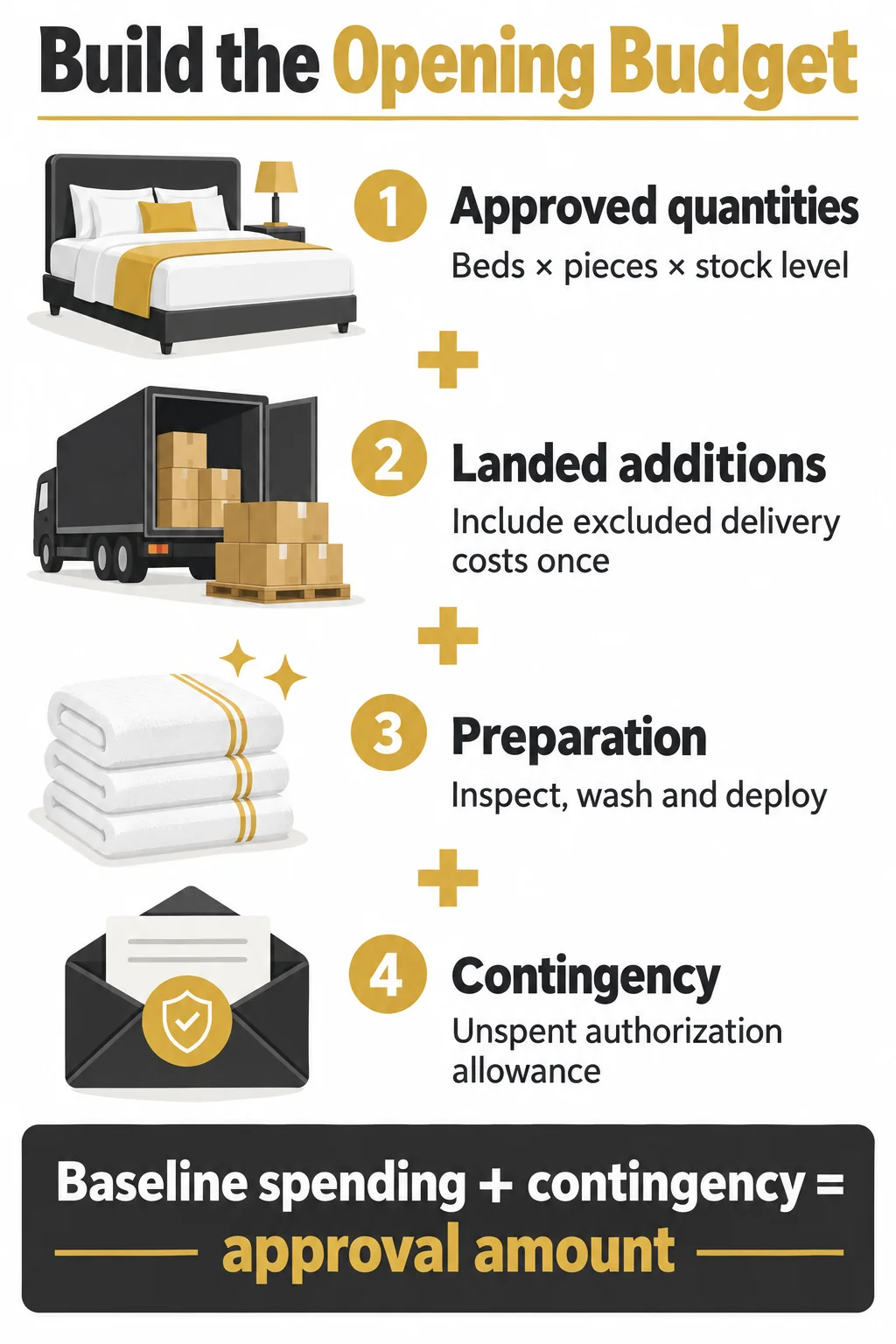
First cost is the amount needed to purchase, deliver, inspect, and prepare the approved bedding package for service. Calculate it from a room-by-room bed schedule and an itemized specification, then add costs that the supplier price excludes. Keep the procurement baseline separate from the authorization contingency: an unused allowance is available funding, not a purchase already made. This distinction lets a hotel approve sufficient cash while still measuring actual spending against an identifiable scope. It also exposes whether an apparently inexpensive quote excludes stock, delivery tasks, or preparation that another supplier has included.
Convert rooms into purchasing units
For each room type, record beds per room, mattress dimensions and depth, the presentation on each bed, and the number of matching pieces. A sheet set must have a defined bill of materials. In this example, one set means one fitted sheet, one flat sheet, and four pillowcases. Duvet inserts and their covers are separate products; if your presentation uses covers, add them explicitly. Never compare a two-piece sheet offer with a six-piece set under the same label.
One par is one complete requirement for every bed in the selected inventory scope. A three-par linen pool therefore contains three full changes per bed, distributed among beds, laundry, and clean storage. Three par is an example input, not a universal standard. Set the actual pool from peak demand, laundry return time, rejection experience, and storage capacity. Keep unopened emergency stock separate if it is additional to the approved operating pool.
| Cost layer | Calculation basis | Budget treatment |
| Opening products | Approved quantity × unit price | Separate every product and size |
| Landed additions | Costs excluded from quoted prices | Include once at the agreed destination |
| Preparation | Initial wash, inspection, receiving and setup | Include only costs outside other rates |
| Contingency | Defined percentage of eligible baseline | Show as an unspent authorization allowance |
Reconcile the delivery boundary
Obtain the shipment basis, destination, carton quantities, order minimums, lead times, and responsibility for unloading. Freight, insurance, import charges, brokerage, final delivery, and receiving labor must have an explicit owner. If a delivered price already contains a charge, remove it from the additional-cost schedule. Apply actual tax treatment with finance: recoverable taxes may still affect payment timing even when they do not belong in net product cost.
Separate deposits, production balances, shipping payments, and final acceptance payments by month. The purchase total alone does not describe the cash peak. For phased openings, quantities and payment dates should follow the rooms that become available, while keeping enough stock to absorb delayed laundry returns.
Use the guest room supplies bid comparison framework to align scope and delivery terms before comparing the bedding totals.
Keep quality assumptions visible
Record fabric construction, finished dimensions, shrinkage acceptance, seam quality, shade consistency, care requirements, mattress support compatibility, and the approved sample reference. Do not infer usable life from thread count alone. A lower-cost product that shrinks outside the bed specification can create an early replacement obligation even when the fabric remains intact.
A controlled wash trial extends the approach used to evaluate supplier samples. Measure fit, appearance, handling time, and rejection causes under the property’s actual process before assigning a budget advantage.
Forecast Operating Cost From Actual Linen Activity
Operating cost follows service activity rather than the number of items originally purchased. Estimate how many beds will be used, how often their linens will be changed, how much textile weight will be processed, and how much staff time the selected presentation requires. Then separate costs that vary with this activity from costs that remain even when occupancy falls. This gives management a useful explanation for budget changes: additional occupied rooms, a different change policy, heavier textiles, more rewashing, or a higher processing rate can each increase expenditure through a different mechanism.
Choose a demand driver that matches the service
Annual occupied room-nights equal available rooms multiplied by operating days and occupancy. Convert this to used bed-nights using the average number of beds actually used per occupied room. For a mixed hotel, calculate each room type separately when its occupancy or bed use differs. The average is a simplification, and it must not imply more used beds than the room inventory can supply.
Annual full-change equivalents equal used bed-nights multiplied by changes per used bed-night. Derive the change rate from checkout activity, stayover policy, guest requests, and recorded exceptions. A fractional result is acceptable in an annual forecast because it is an expected activity total; operational rosters still use whole service events. Partial changes can be converted to an equivalent bundle only if their weight and labor are reasonably comparable.
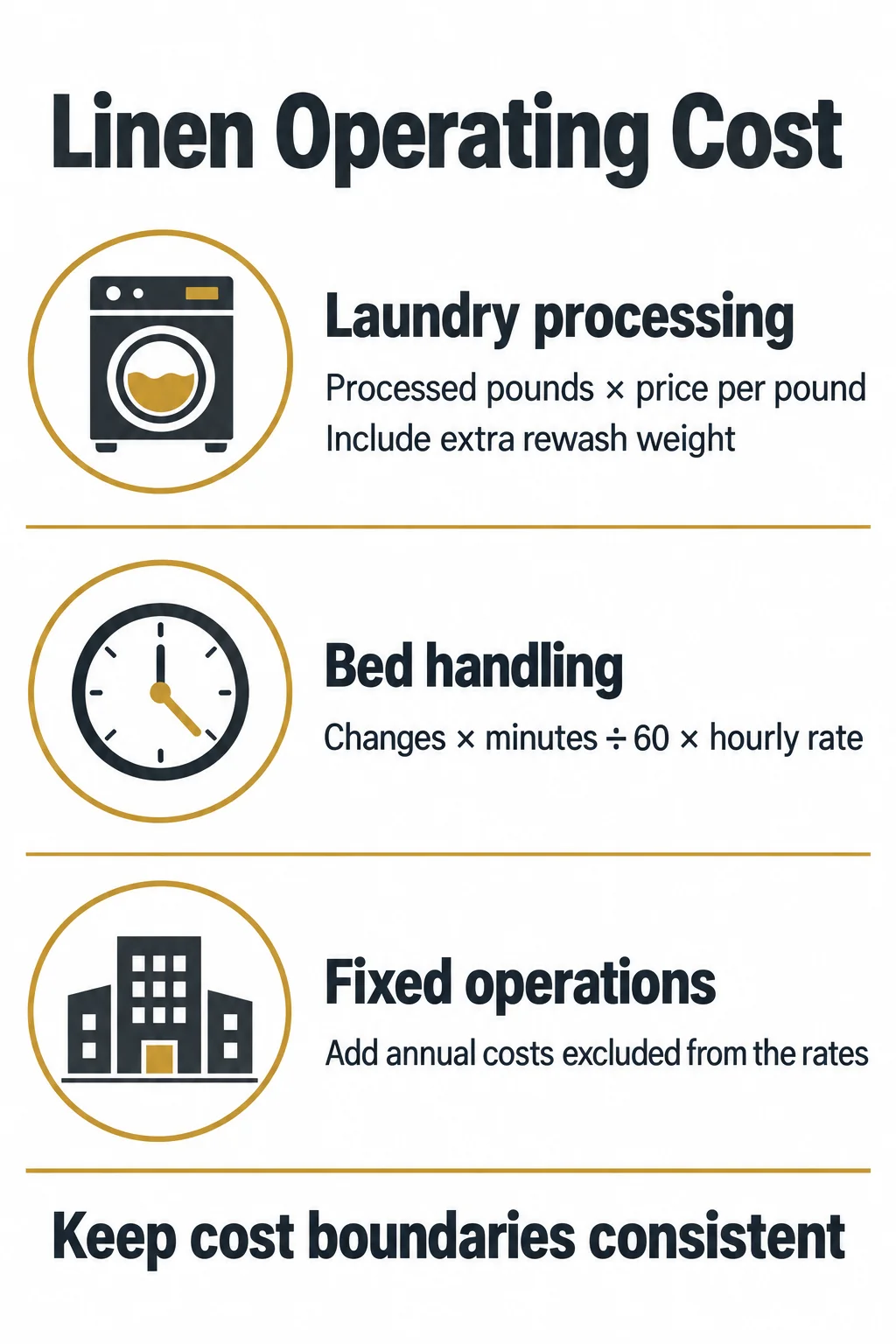
| Operating component | Transparent calculation |
| First-pass laundry weight | Full-change equivalents × dry pounds per bundle |
| Total processed weight | First-pass weight × (1 + extra-pass rewash factor) |
| Variable processing cost | Total processed weight × cost per processed pound |
| Bed handling labor | Changes × minutes per change ÷ 60 × loaded hourly rate |
| Fixed operating cost | Annual costs that do not vary within the modeled range |
Compare laundry options on the same boundary
For on-property laundry, build a processing rate from the included labor, water, sewer, energy, chemicals, and other variable consumables. Keep fixed supervision, maintenance commitments, and equipment costs visible elsewhere when they are outside that rate. For outsourced laundry, confirm whether the price uses dry weight, billed weight, individual pieces, or rental bundles. Add collection, delivery, minimum charges, and surcharges only when excluded from the quoted charge.
A rental-linen agreement may include the textile pool and normal replacement in its service fee. Remove covered opening purchases and normal replacement allowances before comparing it with owned stock. Keep excluded loss charges and extraordinary damage separate. Comparing a rental fee with washing-only expenditure makes the owned option look artificially inexpensive.
In the calculator, the processing price includes washroom variable labor and utilities. Bed handling is a separate incremental task, and fixed operating cost contains only items excluded from both. The rewash input means extra full-pass weight as a fraction of first-pass weight. It is not the same as a probability that an item repeatedly fails every wash.
Measure the cost of an upgrade
Test two acceptable products under the same wash program and bed presentation. Measure dry weight per complete bundle, extra processing passes, elapsed bed-making time, and condition after repeated use. A heavier textile does not automatically cost more per piece under every contract, but it changes weight-based expenditure and may affect machine capacity. A quality upgrade must earn its cost advantage through measured differences, not through an assumed premium-product lifespan.
For a whole-property budget, include the full relevant process cost. For an incremental supplier comparison, use only the differences between options when common costs cancel. Keep these two views labeled so the savings case cannot be mistaken for the total departmental budget.
Size the Replacement Reserve Without Double Counting
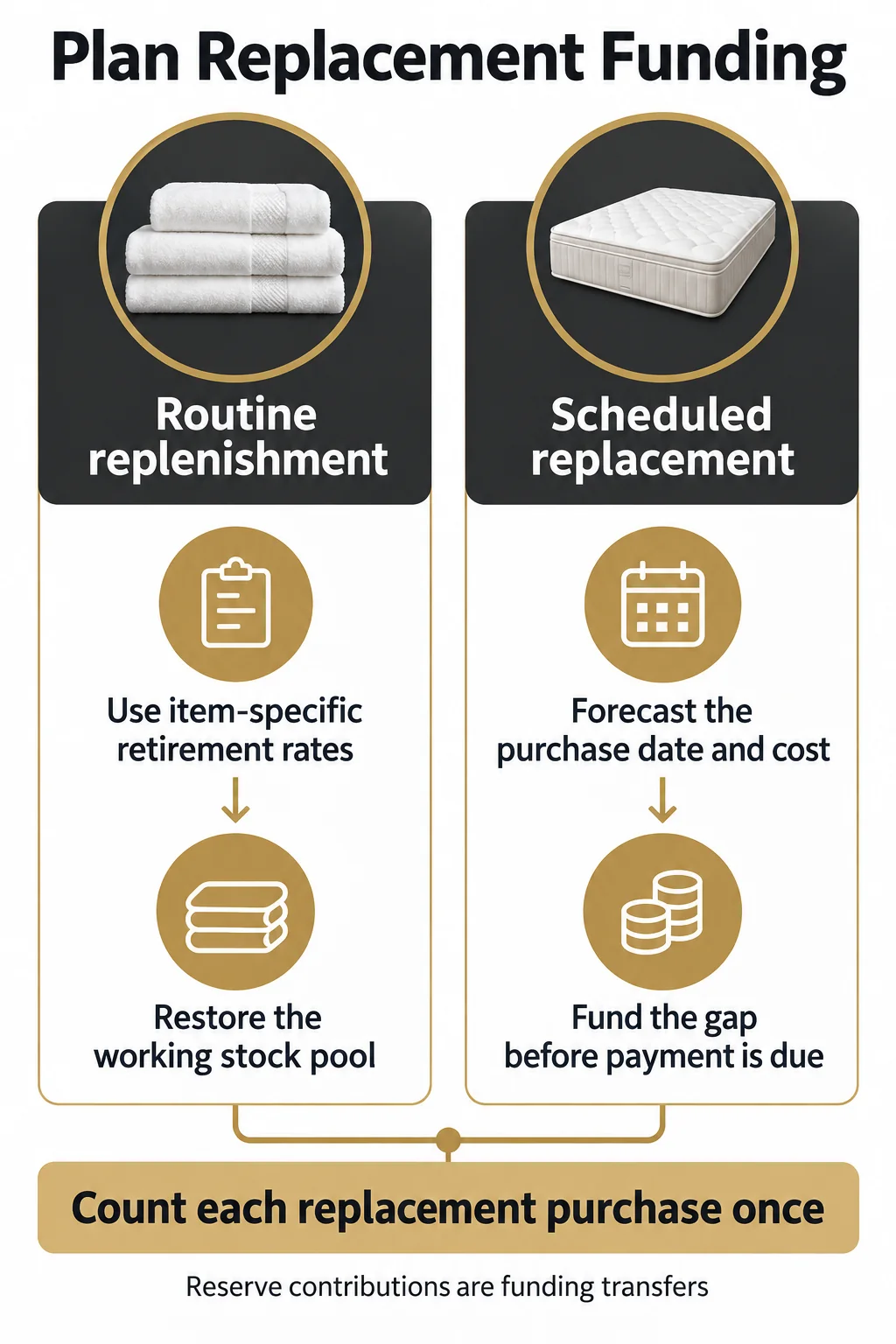
A replacement reserve is a funding plan for future purchases. It does not create additional physical stock, and setting money aside does not itself consume a sheet or replace a mattress. Separate routine textile replenishment from larger scheduled replacements because their timing and estimation methods differ. Routine losses usually require repeated orders, while a mattress or base program may require a substantial payment in one future year. Keep the funding schedule connected to those purchases, then show actual replacement expenditure once in the ownership-cost or cash-spending view. This preserves both budget discipline and a clear explanation of available funds.
Use item-specific replenishment rates
For each textile or bedding item, choose one explicit measurement base. An annual retirement rate measured against the average circulating pool should be multiplied by that pool. A loss rate per thousand occupied room-nights should instead be multiplied by room-night activity. These rates cannot be exchanged without conversion. Record whether the numerator includes wear, permanent stains, shrinkage rejection, damage, and missing items.
Annual routine replacement funding equals the expected replacement quantity multiplied by the replacement landed unit cost, plus order costs not already included. Separate retirement causes when that helps management act, but avoid adding an independent loss allowance if the observed all-cause retirement rate already includes missing items. Opening stock is a separate purchase; subsequent replenishment restores the working pool after actual losses.
The example applies annual all-cause rates to the opening pool as a simple proxy for average stock. That is appropriate only if the hotel maintains a broadly stable pool. With phased openings, major occupancy changes, or a planned specification conversion, build the pool month by month. More par can lengthen the calendar interval between an individual item’s washes without increasing its total usable wash life.
Fund larger replacements by their due date
For a scheduled replacement, start with a current like-for-like quote, the expected replacement date, available dedicated funds, and any credible disposal costs or recovery value. If future prices are modeled with escalation, apply it through the expected purchase date. With zero investment return, the annual contribution is the positive difference between the future cash requirement and the dedicated opening balance, divided by the years remaining.
A seven-year planning horizon is not a promise that a mattress will last seven years. Use inspections, guest-service requirements, warranty terms, and the condition of each cohort to set replacement dates. Mattresses and bases can have different cycles. Combine them only when there is a real plan to replace them together, as the simplified example assumes. A warranty period should not be substituted for an operating-life forecast.
| View | What appears | What is excluded |
| Spending budget | Purchases and operating payments when due | Internal transfers between hotel accounts |
| Reserve funding schedule | Contributions, dedicated balance and withdrawals | A second charge for purchases already counted |
| Ownership cost | Acquisition, operation and actual replacement costs | Unused reserve balances as if consumed |
| Financial statements | Classification under the property’s accounting policy | Automatic classification from a purchasing label |
Connect money and reorder timing
Track reserve balances separately from the stock ledger. A funded account cannot cover tonight’s bed change if replacement goods have not arrived. Monitor usable stock, open purchase orders, supplier lead time, and order minimums alongside approved funds. For scheduled programs, map the deposit and balance payments to the reserve schedule; a year-end funding total can hide a shortfall before a midyear deposit.
For each period, ending dedicated funds equal opening funds plus contributions minus eligible replacement payments. If that balance becomes negative before an order is due, increase earlier funding, revise the timing, or approve another funding source. Do not wait until the forecast year ends to discover the gap. Budget labels such as capital reserve, operating replenishment, and depreciation need to be aligned with finance’s policy, but they should never alter the physical demand calculation.
Apply the Budget to a 100-Room Hotel
The following example combines opening purchases, annual operations, and replacement funding for a 100-room property with 60 king rooms and 40 rooms containing two queen beds. That produces 140 beds. The illustration uses an identical average unit price across sizes to keep the arithmetic readable; an actual order should split king and queen products. All quantities and rates are assumptions, and the package is deliberately limited to the listed items. Use the accompanying calculator to change those assumptions, add excluded scope to the relevant allowance, and see which budget component changes before requesting supplier prices.
Establish the opening authorization
| Opening item | Quantity | Illustrative unit cost | Extended cost |
| Defined sheet sets, three par | 420 | $45 | $18,900 |
| Pillows, four per bed | 560 | $12 | $6,720 |
| Protectors, one per bed | 140 | $18 | $2,520 |
| Duvet inserts, one per bed | 140 | $55 | $7,700 |
| Mattresses, one per bed | 140 | $350 | $49,000 |
| Bases, one per bed | 140 | $120 | $16,800 |
| Product subtotal | $101,640 | ||
| Additional landed costs | $8,000 | ||
| Pre-opening preparation | $2,400 | ||
| Expected opening baseline | $112,040 | ||
| Authorization contingency, 5% | $5,602 | ||
| Opening approval amount | $117,642 |
This presentation uses a defined sheet package. It excludes duvet covers, decorative layers, additional pillow and protector spares, rollaway beds, and laundry equipment purchase. Add any required items before treating the total as a complete hotel opening budget. The $8,000 allowance contains costs outside the listed unit prices; the $2,400 covers preparation outside ordinary post-opening operations. Do not count the $5,602 contingency as expected supplier spending unless a specific additional requirement consumes it.
Calculate the annual service workload
At 70% occupancy over 365 days, the property generates 25,550 occupied room-nights. Assume 1.4 beds used per occupied room and 0.65 full changes per used bed-night. Expected annual full-change activity is 23,250.5 bundles. At four dry pounds per bundle and a 3% extra-pass rewash factor, processed weight is 95,792.06 pounds.
Using $0.55 per processed pound gives $52,685.63 in variable laundry cost. Add $12,000 of fixed operating costs and bed-handling labor at 1.5 minutes per change and $24 per loaded hour, or $13,950.30. Expected annual operating cost is therefore $78,635.93. The calculator retains unrounded values during calculation and rounds only their display.
Add replenishment and scheduled funding
Assume annual all-cause retirement of 25% of the 420 sheet sets, 20% of the 560 pillows, 30% of the 140 protectors, and 15% of the 140 inserts. At the same illustrative unit prices, routine replenishment funding is $7,980 per year. These quantities are forecasting equivalents; real purchase orders must respect whole items, pack sizes, and separately forecast replenishment freight.
The mattresses and bases have a combined current replacement value of $65,800. Assume they will be replaced together in seven years, prices rise 3% annually, the dedicated opening balance is zero, and funds earn no return. The future purchase requirement is approximately $80,925.70, requiring about $11,560.81 in annual scheduled contributions. Actual replacement timing must come from condition and service requirements.
| Annual view | Illustrative amount | Meaning |
| Operating expenditure | $78,635.93 | Processing, fixed costs and bed handling |
| Routine replenishment funding | $7,980.00 | Expected annual replacement purchases |
| Scheduled replacement contribution | $11,560.81 | Funding for the year-seven program |
| Total annual funding provision | $98,176.75 | Operations plus both funding components |
| Average monthly funding provision | $8,181.40 | Annual total divided by 12, not a payment calendar |
If routine replacement purchases match the $7,980 forecast and no mattress or base program is executed during Year 1, annual spending after opening is $86,615.93. The remaining $11,560.81 is retained scheduled-replacement funding. Adding both that contribution and the eventual mattress purchase to ownership cost would count the same obligation twice. The average funded provision is about $3.84 per occupied room-night; expected Year 1 operating and routine replacement spending is about $3.39 per occupied room-night.
Test the assumptions that could change approval
Raise occupancy from 70% to 80% while holding bed use and change frequency constant. The variable laundry and bed-handling portion increases by one seventh, while the $12,000 fixed allowance remains unchanged in this simplified model. Annual operating cost rises to about $88,155.35. In practice, higher activity may also change staffing steps and routine retirement, so update those assumptions separately.
Then test a higher processed-pound price, more frequent linen changes, a higher rejection rate, and an earlier mattress program. Test a combined adverse case as well as each individual input. Keep service requirements fixed when judging whether an alternative is cheaper. Reducing the promised presentation or allowing damaged stock to remain in service changes the product being purchased.
For a longer investment comparison, extend the timed spending schedule using the five-year guest room supplies ownership-cost model. Keep the reserve ledger outside the discounted spending total.
Before seeking a bedding quotation, send the room and bed schedule, dimensions, defined set contents, size-specific quantities, trial requirements, delivery destination, opening date, and replenishment expectations. Ask for separate opening and repeat-order terms so the reserve uses a credible replenishment basis.
Use KW Hospitality’s contact form to discuss the itemized bedding requirement and request comparable sourcing options. Include the delivery scope and sample requirements with the inquiry so the opening and replacement assumptions can be priced consistently.

Conclusion
A workable bedding budget connects the approved bed schedule to three different questions: what must be paid before opening, what recurring service will cost, and what funds must be available when items need replacement. Keep the quantities, measurement units, and timing visible throughout the calculation. The 100-room example shows why opening authorization, annual spending, and annual funding provision produce different totals even when they describe the same property. Once those distinctions are clear, management can compare acceptable specifications, challenge uncertain assumptions, and protect the guest standard without hiding future obligations inside a generic percentage allowance.
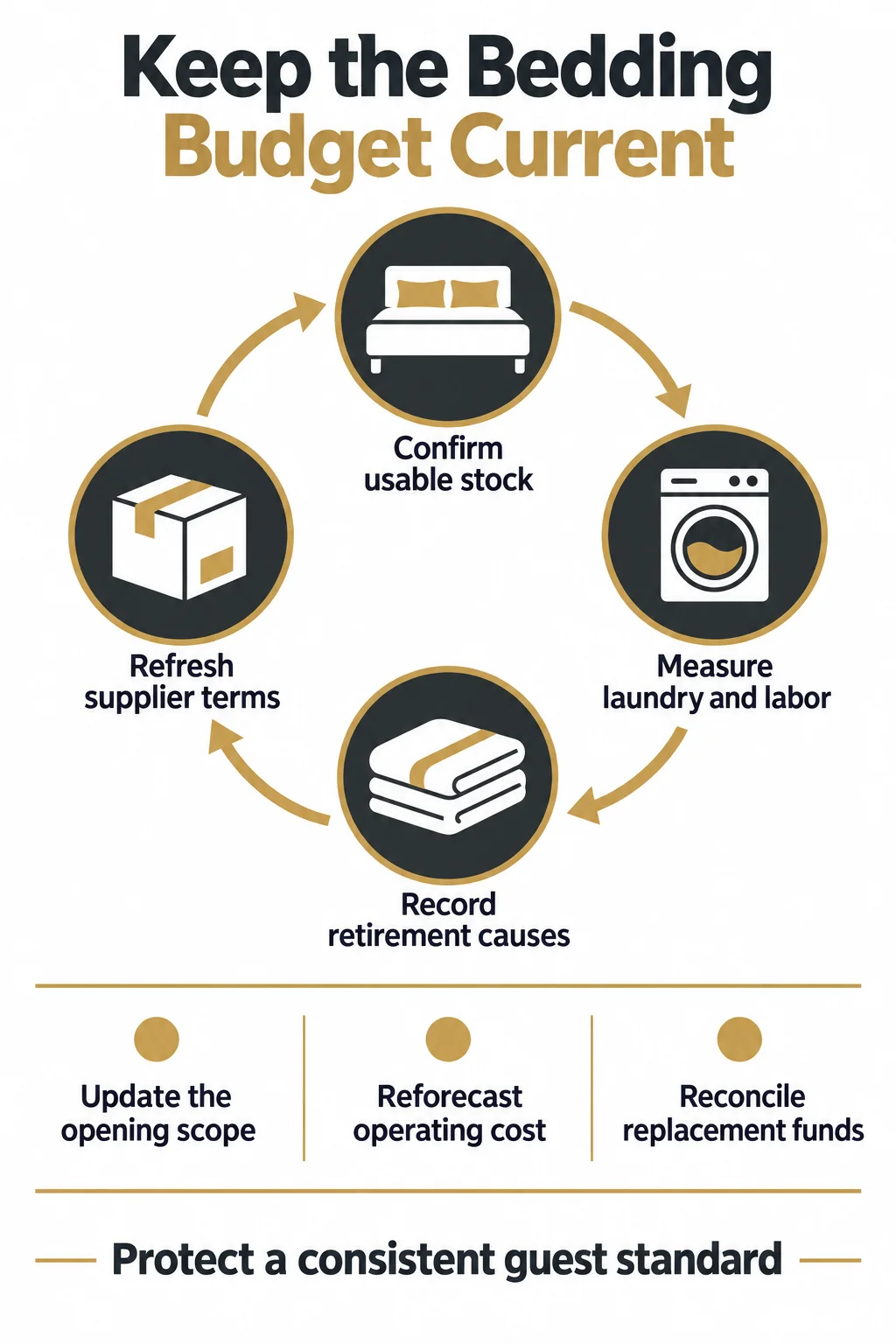
Review the budget after the first operating quarter, then at a cadence matched to purchasing and occupancy changes. Replace initial assumptions with processed laundry weight, labor observations, usable-stock counts, recorded retirement causes, and refreshed supplier terms. Bring finance, housekeeping, and purchasing into the same review whenever the service policy, room mix, or replacement date changes. The result should be a revised cost and funding schedule that each team can reconcile to its own records.
Frequently Asked Questions
Should all bedding receive the same annual replacement percentage?
No. Sheets, pillows, protectors, inserts, mattresses, and bases have different wear mechanisms and service requirements. Assign each group its own measurement base and replacement logic. A single percentage of the original purchase budget can be retained as a management cross-check, but it should not replace the item-level forecast.
Is three par always enough for hotel bed linens?
No. Three par is only the illustrative input used here. Laundry turnaround, peak changes, rejected pieces, emergency coverage, and available storage determine the actual operating pool. If the hotel needs extra stock outside that pool, include it explicitly in opening purchases.
How should a partial opening affect the model?
Use the monthly number of available rooms and their actual room mix. Schedule deliveries, deposits, and preparation before each phase becomes operational. The full-year example assumes all 100 rooms are available for 365 days, so applying its annual activity unchanged to a phased opening would overstate demand.
Does a replacement reserve reduce the property’s actual cost?
No. It changes how money is set aside for future obligations. Cost reductions come from acceptable products or processes that use fewer resources, incur fewer losses, or require less expensive replacement. Keep contributions out of an ownership-cost total that already includes the corresponding purchases.
What if the hotel already has usable linen inventory?
Count usable pieces by size and specification, exclude rejected stock, and deduct only compatible available inventory from the opening need. Keep expected retirement of older stock in the replenishment forecast. A mixed-age pool may need more near-term funding than a newly purchased pool with the same total quantity.
Can a more expensive sheet set lower the total budget?
Yes, if measured benefits in processing, handling, usable life, or rejection outweigh its purchase premium while meeting the same guest standard. Calculate the break-even benefit and validate it in the property’s process. Price, thread count, or a supplier’s general durability claim alone does not establish the result.
Why is the monthly funding figure different from the monthly cash requirement?
The example divides an annual provision by 12 to show an average. Supplier deposits, seasonal occupancy, order minimums, and scheduled replacement dates produce uneven actual payments. A monthly cash schedule must place those payments when due and confirm that the available reserve never falls below the required amount.