
Heavier hotel towels slow room turnover when the laundry cannot return enough clean, dry towels before housekeeping needs them and available clean stock cannot cover the gap. That can happen even when the dryer cycle itself takes no longer: a heavier towel means fewer pieces in each approved load. If the new towel also requires a longer drying cycle, the reduction in towels available per hour becomes larger. The buying decision is therefore about finished towels delivered on time, not GSM alone.
A plush sample can feel like an obvious upgrade during a purchasing meeting. The operational consequences appear later, when laundry teams process the full replacement quantity, attendants wait for replenishment, or a busy departure day consumes the clean reserve. A small daily average can hide a serious shortage during the few hours between checkout and check-in. Conversely, a hotel with sufficient reserve stock and spare processing capacity may introduce heavier towels without delaying any rooms.
The useful comparison connects three things: the dry weight of each towel, the laundry’s demonstrated output, and the number of towels required at each delivery deadline. It also distinguishes a dryer bottleneck from a shortage caused by late collection, slow folding, or an undersized circulating inventory. Buying lighter towels will not necessarily solve those other problems.
This guide shows how to estimate towel weight, translate a dryer load into pieces per hour, and test a proposed specification before a bulk order. Its numerical examples are illustrative planning scenarios, not KW Hospitality operating results or manufacturer performance guarantees. Replace the assumed weights and cycle times with measurements from your property. The objective is a towel specification that meets the guest standard while leaving enough operating capacity to handle the hotel’s actual turnover pattern.

Calculate Towel Weight Before Comparing Dryer Loads
Start with the weight of one finished towel, because that is what converts a purchasing specification into a laundry workload. GSM describes mass per unit area; it does not describe the weight of an entire towel unless its dimensions are also known. A larger towel can weigh more than a smaller towel with a higher GSM. Use the supplier’s figures for preliminary screening, then weigh representative samples under consistent conditions. Keep dry textile weight separate from the wet weight after extraction, and compare towels after the same laundering and conditioning procedure so that packaging, moisture, and sample preparation do not distort the result.

Convert dimensions and GSM into an estimated dry weight
GSM means grams per square meter. For a rectangular towel with an approximately representative whole-towel GSM:
Estimated towel weight (kg) = length (m) × width (m) × GSM ÷ 1,000.
If dimensions are supplied in inches, multiply each dimension by 0.0254 before using the formula. For pounds, multiply the result in kilograms by approximately 2.20462. A supplier’s pounds-per-dozen figure can be divided by 12 to obtain pounds per towel; confirm that the quoted quantity and moisture basis are the same.
| Illustrative specification | 500 GSM towel | 650 GSM towel |
| Dimensions | 70 × 140 cm | 70 × 140 cm |
| Area | 0.98 m² | 0.98 m² |
| Estimated dry weight per towel | 0.490 kg | 0.637 kg |
| Estimated weight per dozen | 5.880 kg | 7.644 kg |
| Dry weight of 40 towels | 19.600 kg | 25.480 kg |
At the same dimensions, moving from 500 to 650 GSM increases estimated towel mass by 30%. If a property’s approved working load is 20 kg, continuing to load 40 of the heavier towels would exceed that limit. The correct response is to establish a suitable piece count and verify the load, rather than assume the old basket or cart quantity still applies.
Treat the formula as an estimate. Borders, hems, construction, manufacturing tolerances, and the supplier’s GSM measurement method can affect the relationship between nominal fabric weight and the actual finished article. Washing may also change dimensions and mass. For final scheduling, use the measured average dry weight of the actual towel and retain an agreed weighing method in the purchase specification.
Separate extra textile mass from extra retained water
Residual moisture after extraction is commonly expressed on a dry-weight basis: retained water divided by dry textile mass. With consistent reference weights, an operational estimate is:
Retained moisture (%) = (post-extraction weight − reference dry weight) ÷ reference dry weight × 100.
For an illustrative 20 kg dry load, 60% retained moisture means approximately 12 kg of water remains; 40% means approximately 8 kg. The difference is 4 kg of water entering the dryer. These values are assumptions, not targets for every towel or washer. An operational dry reference is also not necessarily equivalent to a laboratory oven-dry determination, so do not compare percentages reported using different methods.
The distinction matters. At a fixed towel count, heavier towels increase dry mass and, at the same retained-moisture percentage, the water load. At a fixed dry load mass, that water increase does not automatically occur; there are simply fewer towels. Construction, extraction performance, and airflow then determine whether drying time changes. A 30% increase in GSM does not prove a 30% increase in cycle time.
Define guest quality beyond weight
Compare absorbency, feel after repeated laundering, finished coverage, edge stability, linting, and appearance alongside mass. A lower-weight product is not automatically suitable, and a higher-weight product is not automatically more durable. When reviewing hotel bath linens, separate room towels, bath sheets, hand towels, and pool towels into their own specifications. Combining them under one average GSM hides differences in both guest use and processing demand.

Translate Dryer Capacity into Towels Ready Before Check-In
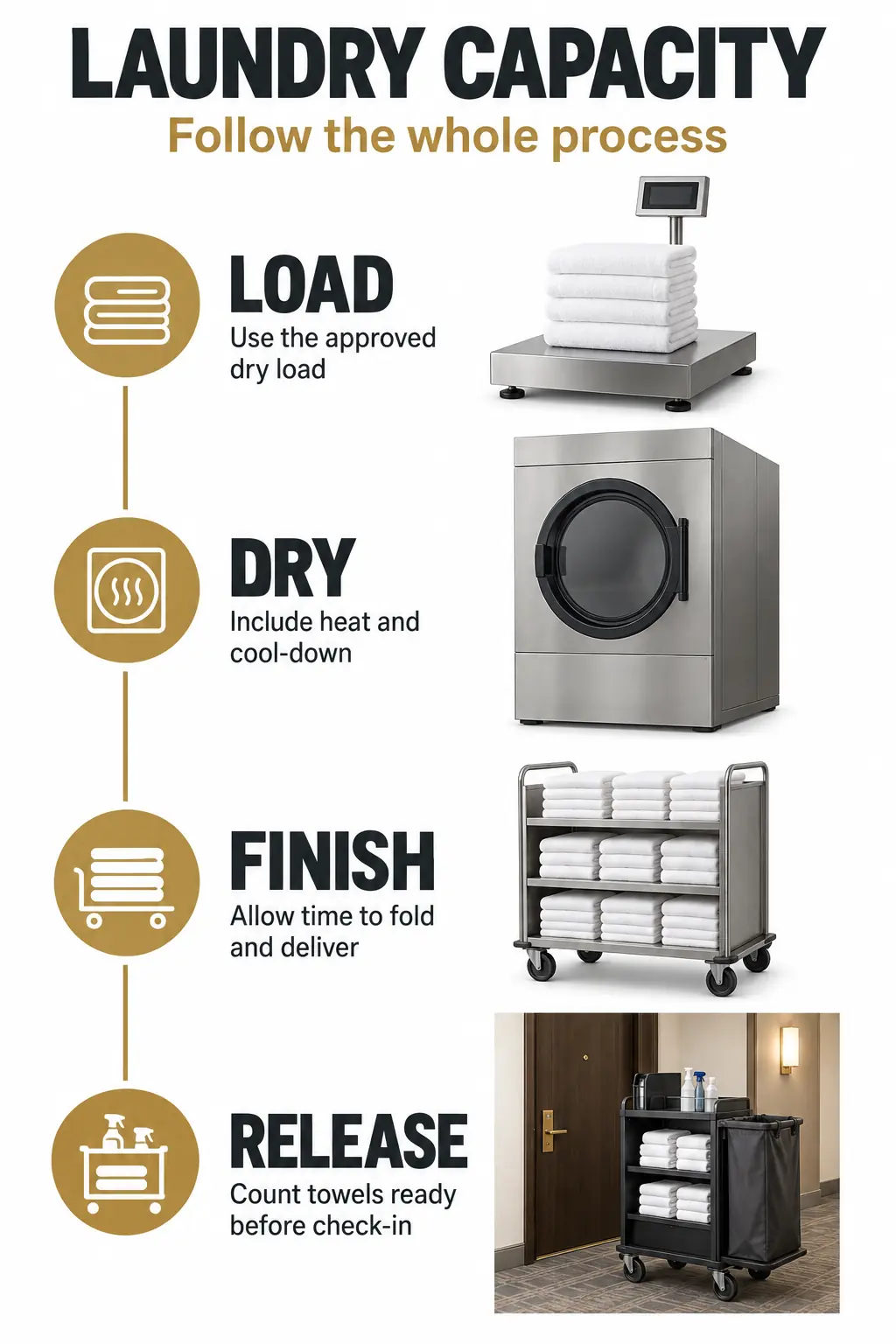
A capacity label describes a loading condition, not a promise about pieces delivered per hour. To estimate usable output, combine the approved working load, measured towel weight, and elapsed time between repeat loads. Then check whether finished towels reach housekeeping before the relevant deadline. Include competing laundry work and the time needed to finish and distribute the towels. This approach explains why a property can have apparently sufficient daily dryer capacity yet still experience shortages during a concentrated checkout period. It also prevents a continuous hourly average from being mistaken for the number of complete batches available within a short window.
Confirm what the machine’s capacity actually means
Check the exact model, program, textile type, and loading instructions. The Electrolux Professional TD6-20 specifications illustrate why the headline number is insufficient: the same 360-liter drum is listed at 16 kg for a 1:22 filling factor and 20 kg for 1:18. That is a model-specific example, not a loading recommendation for another dryer. Ask the equipment supplier which approved working load applies to the towel and program being tested.
Dry textile mass and space for movement are separate constraints. Do not force a bulky load into the drum merely because its estimated mass appears acceptable. The operating limit for a program may also differ from another program on the same machine. Record the permitted load and the load that actually delivers acceptable results during the trial.
Calculate pieces per batch and output per hour
For a single towel type:
Towels per batch = round down (approved dry load kg ÷ measured dry kg per towel).
Sustained towels per hour = towels per batch × 60 ÷ elapsed minutes per load.
Elapsed minutes should include the relevant machine-occupying time: loading, heating, required cool-down, unloading, and routine turnover between loads. Avoid adding cool-down twice if the recorded program time already includes it. Waiting for an operator, a washer load, or another textile allocation must be included in the actual schedule or deducted from the available production window.
The following calculation assumes one dryer, a verified 20 kg working load, one towel type, continuous availability of washed towels, no re-drying, and no competing work. The 40- and 50-minute times are hypothetical complete load intervals.
| Planning measure | 500 GSM, 40 min | 650 GSM, 40 min | 650 GSM, 50 min |
| Estimated dry kg per towel | 0.490 | 0.637 | 0.637 |
| Whole towels per batch | 40 | 31 | 31 |
| Sustained towels per hour | 60.0 | 46.5 | 37.2 |
| Complete batches in 240 minutes | 6 | 6 | 4 |
| Towels from those complete batches | 240 | 186 | 124 |
With the same 40-minute interval, the heavier towel reduces calculated piece throughput by 22.5%. If testing instead establishes a 50-minute interval, the sustained rate is 38% below the original scenario. Those are calculated consequences of the stated assumptions, not general drying-performance claims.
The final column demonstrates an important scheduling trap. Multiplying 37.2 towels per hour by four hours gives 148.8, but a fifth 50-minute batch finishes after 250 minutes. With no batch already in progress, only four complete batches finish within 240 minutes, providing 124 towels. For a deadline calculation, count completed batches or model each batch’s actual completion time.
Convert output into an actual room-readiness risk
Suppose 90 departure rooms each need two bath towels, creating a requirement of 180. Assume the hotel has 20 clean bath towels available for that allocation and the four-hour production window has already been shortened to reserve sufficient time for folding and delivery. In the heavier, 50-minute scenario, 124 new towels plus the 20 in stock gives 144. That covers at most 72 two-towel room allocations, leaving 18 uncovered at the deadline. This is a bath-towel constraint only; it does not claim those rooms would otherwise be ready.
Use the same logic for each towel size and each delivery wave. A hotel with enough clean stock may avoid a same-day delay even with slower production, but repeated output deficits will consume the reserve. Conversely, if towels are already dry and waiting at the folding table, extra dryer capacity will not remove the immediate bottleneck.
For mixed loads, calculate total dry mass as the sum of each item’s count multiplied by its unit weight. Do not divide the machine capacity by bath-towel weight while ignoring hand towels or bath mats in the same load. Multiple dryers require separate working loads, availability windows, and schedules unless they genuinely operate identically.
Use the accompanying calculator to change the assumptions for one towel type and a group of identical dryers. It estimates whole batches, available towels, and the shortage against a room allocation; it does not predict a drying time from GSM.

Trial the Towel Before Approving the Bulk Specification
Approve the proposed towel only after a controlled comparison connects guest quality with processing performance. Begin with the current product as a baseline and test the candidate under documented wash, extraction, loading, and drying conditions. Compare both the efficiency of equal dry-mass loads and the time required to supply an equal number of rooms. These answer different questions: the first helps isolate processing behavior, while the second reveals the operational cost of a heavier specification. Repeat the comparison across representative loads and busy shifts, and judge the candidate against limits agreed by purchasing, housekeeping, and laundry before the results are known.

Establish a fair comparison
Condition both products through the same agreed initial wash procedure. Record product identity, finished dimensions, average unit weight, wash program, extraction setting, dry load mass, and post-extraction mass. Keep the dryer, program, and dryness acceptance method consistent for the first comparison. Record full load intervals and accepted towel counts rather than heat time alone. Repeat enough runs to see whether the difference is consistent; a single unusually fast load is weak evidence for a hotel-wide change.
After the controlled comparison, test any candidate-specific program adjustments that the equipment and textile suppliers approve. Evaluate appearance and feel again after repeated wash-and-dry cycles. Record rejects and re-drying separately: a load is not fully productive if some towels cannot be released. For real shift performance, divide the final accepted towel count by the total elapsed production time, including the capacity consumed by rework.
Do not gain speed by ending the process with damp towels or bypassing required cool-down. Check the thick borders and folded areas as well as the main towel body using a consistent acceptance procedure. The TD6-20 operating manual requires filter cleaning after each drying cycle and identifies overloading and obstructed airflow among relevant operating problems. Apply the instructions for your own equipment and have qualified personnel investigate persistent faults.
Diagnose the constraint before replacing the towel
| Observed pattern | What the pattern suggests | Useful comparison |
| Fewer pieces per load, similar elapsed time | Increased unit weight is reducing piece output | Compare measured mass and accepted pieces per batch |
| Loads leave the washer noticeably wetter | Extraction or wash-loading differences may be contributing | Compare post-extraction mass at the same dry mass |
| Both old and new towels begin drying slowly | A machine or installation issue may be involved | Compare against the historical baseline after approved maintenance |
| Dry towels accumulate before delivery | Folding, sorting, staffing, or transport may be limiting output | Time dryer discharge to arrival at the linen closet |
| Shortages occur only during one departure wave | Scheduling or clean stock may be inadequate | Compare timed demand with batch completions and available stock |
These patterns narrow the investigation; they are not fault diagnoses. For example, an airflow problem and a heavier towel can occur at the same time. Keep the baseline product in the comparison so that a deterioration in equipment performance is not wrongly attributed to the candidate towel.
Decide what to change and what to specify
If the candidate meets the guest standard but fails the peak production requirement, compare a smaller finished size, a different construction, a lower unit-weight alternative, additional clean stock, a revised schedule, or genuinely additional processing capacity. Each option has a different cost. More stock can absorb a timing mismatch, but cannot indefinitely compensate for a sustained daily deficit. A second towel specification reserved for suites may be workable if its processing quantity remains manageable and staff can reliably separate it.
Compare operating cost per accepted use rather than purchase price alone. A practical model combines allocated purchase and replacement cost, washing and drying utilities, labor, rework, and any incremental storage or handling cost, divided by accepted uses over the same period. Measure energy or use an appropriate verified estimate; a machine’s rated power multiplied by program duration is not automatically its actual consumption, particularly when heating cycles on and off. Treat lost room revenue as a separately investigated business consequence, not an assumed saving.
Turn the successful trial into a repeatable specification: finished dimensions and tolerances, fiber composition, construction, nominal GSM, average unit mass and its tolerance, approved care instructions, and agreed post-laundering acceptance criteria. Reference the accepted production sample and require approval for substitutions. A later batch with the same marketed GSM but a different size or construction may not reproduce the trial result.
For a sourcing comparison, send KW Hospitality your towel requirements, including the present specification, target dimensions, expected quantities, delivery destination, and the measured operating limits from your trial. Ask which sample options are available before committing to a full replacement order.

Conclusion
Heavier towels become a room-turnover problem when their piece throughput and the available clean reserve cannot cover housekeeping’s deadlines. The useful purchasing test combines measured towel weight, approved working loads, complete batch timing, and delivery to the floor. Preserve the guest standard, but verify that the chosen product can be replenished during the hotel’s busiest realistic period. A heavier towel may be entirely suitable when capacity and inventory support it; a lighter towel may be the stronger choice when it meets the same guest requirement with less processing demand. Approve the full operating specification and repeatable sample performance, rather than an isolated GSM number.

Ready to compare towel specifications for your property? Request a towel sourcing quote with your sizes, quantities, quality requirements, sample needs, and destination. Include your measured laundry constraints so the sourcing discussion starts with the product your operation can support.
Frequently Asked Questions
Can a 650 GSM towel dry faster than a 500 GSM towel?
Yes, in a particular comparison, because dimensions, construction, retained moisture, loading, and drying settings also matter. A smaller 650 GSM towel can even contain less textile mass than a larger 500 GSM towel. Compare the same intended guest use and document the actual conditions; GSM alone does not establish the order of drying times.
Does buying more towel stock solve a dryer bottleneck?
It can cover a short mismatch between production and housekeeping demand, provided production later replenishes the stock. It will not solve a persistent daily output deficit. Plan stock by towel size and availability: a towel in a guest bathroom, in transit, or awaiting rewash is not part of the clean reserve available for the next room release.
What changes if the hotel uses an outside laundry?
The same unit-weight question remains relevant, but the critical constraint becomes the processor’s accepted specification, pricing basis, turnaround commitment, and delivery schedule. Ask how a heavier towel changes charges and available processing capacity. Model the clean inventory required across the collection-and-return interval, including a realistic disruption allowance agreed with the provider.
Should purchasing use new-sample weight or used-towel weight?
Use a defined and repeatable basis for each decision. Incoming-product acceptance may rely on a conditioned production sample, while operating forecasts should reflect representative towels in actual circulation. Compare products after equivalent preparation and track changes after laundering; mixing an unwashed candidate with a well-used baseline can obscure the reason for a weight or feel difference.
Can a moisture-sensing dryer remove the need for a trial?
No. Moisture control can help stop drying at the selected endpoint, but it does not determine how many towels housekeeping needs or remove downstream delays. Electrolux describes this endpoint control for its Line 6000 tumble dryers. Confirm that the chosen program consistently releases the whole towel, including thick areas, at your agreed quality standard.
Is there one best hotel towel GSM for every property?
No. A useful specification depends on finished size, guest expectations, construction, laundry performance, stock, and replacement economics. Two properties with the same room count may have very different checkout patterns and processing windows. Specify the product that passes the hotel’s quality and operating requirements rather than copying another property’s GSM.
References
Official manufacturer references used for equipment-specific statements; the worked calculations and hypothetical scenarios are developed in this article.
Electrolux Professional: TD6-20 specifications and filling factors.
Electrolux Professional: TD6-20 operating manual, loading, operation, and maintenance.
Electrolux Professional: Line 6000 tumble dryers and moisture management.