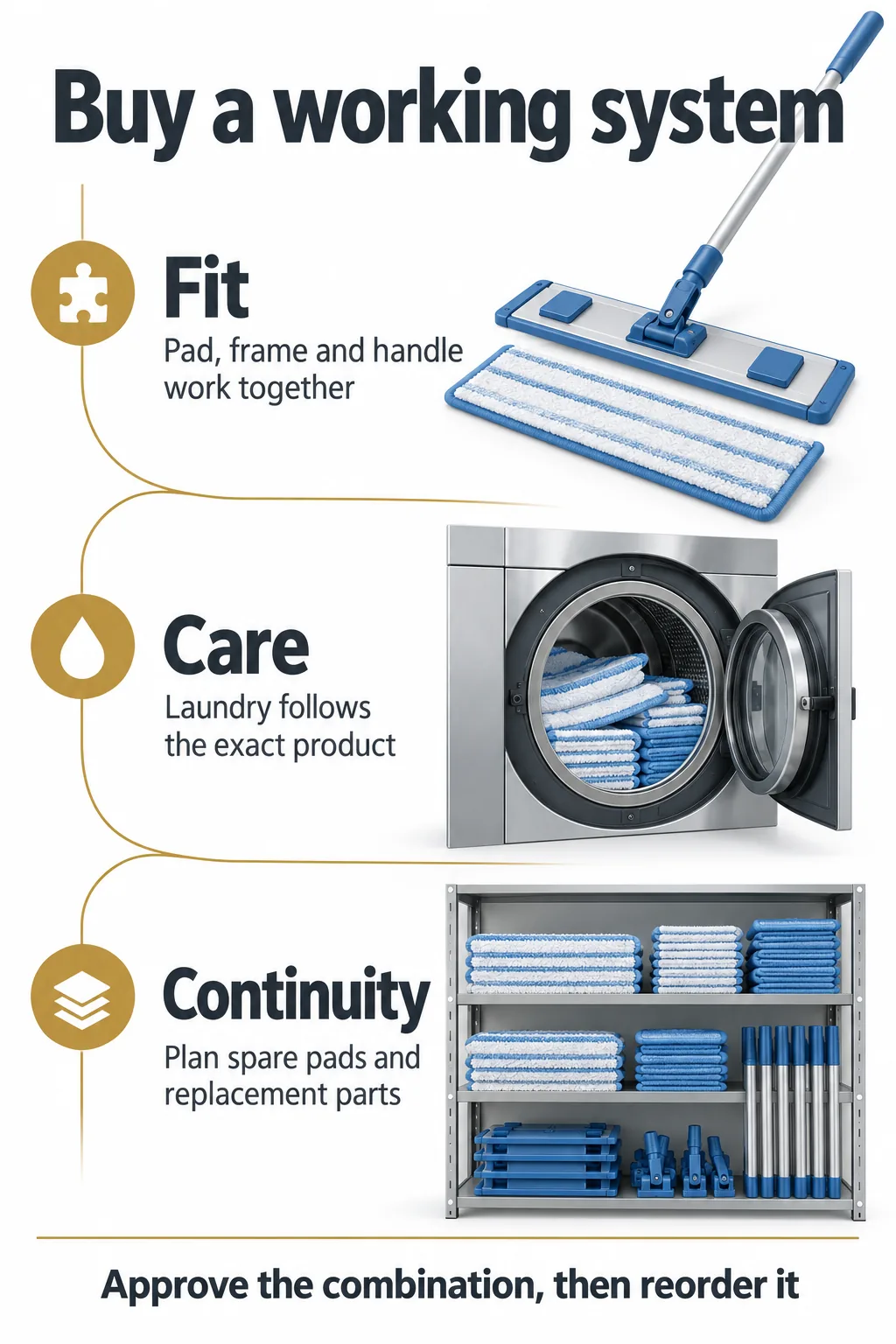
Hotel microfiber mops should be purchased as a matched system: the pad must attach securely to the frame, the frame and handle must suit the cleaning route, and the pad must tolerate the hotel’s approved laundry process. A shared size description does not establish compatibility. Neither does the word microfiber establish a washing temperature, drying setting, or permission to use bleach. Confirm the exact product combination, then evaluate it after laundering before committing to replacement stock.
This matters because a mop can look right when it arrives and perform differently once it enters daily service. A pad that shrinks may expose a frame corner. A backing that does not engage properly can shift during turns. A laundry recipe that works for one construction may damage another. These problems connect purchasing, housekeeping, and laundry: each team controls part of the same operating result, and none can approve the system fully in isolation.
For a hotel replacing an established system, start with the equipment already on the property. Record the frame and handle models, photograph the attachment surfaces, and retain a used pad that still performs satisfactorily. For a new opening, define the floor finishes, room layouts, cleaning method, and laundry arrangements first. The broader selection of housekeeping and janitorial supplies can then be organized around that operating plan, including storage and handling equipment.
The following guide explains how to compare attachment types, turn product care instructions into a workable laundry specification, and assess samples under actual hotel conditions. It also provides a troubleshooting matrix and a transparent cost example. The goal is a repeatable purchase decision: a pad that stays in place, cleans the intended surface, returns from laundry in usable condition, and can be reordered without changing the approved combination.
Match the Pad, Frame, and Handle as One System
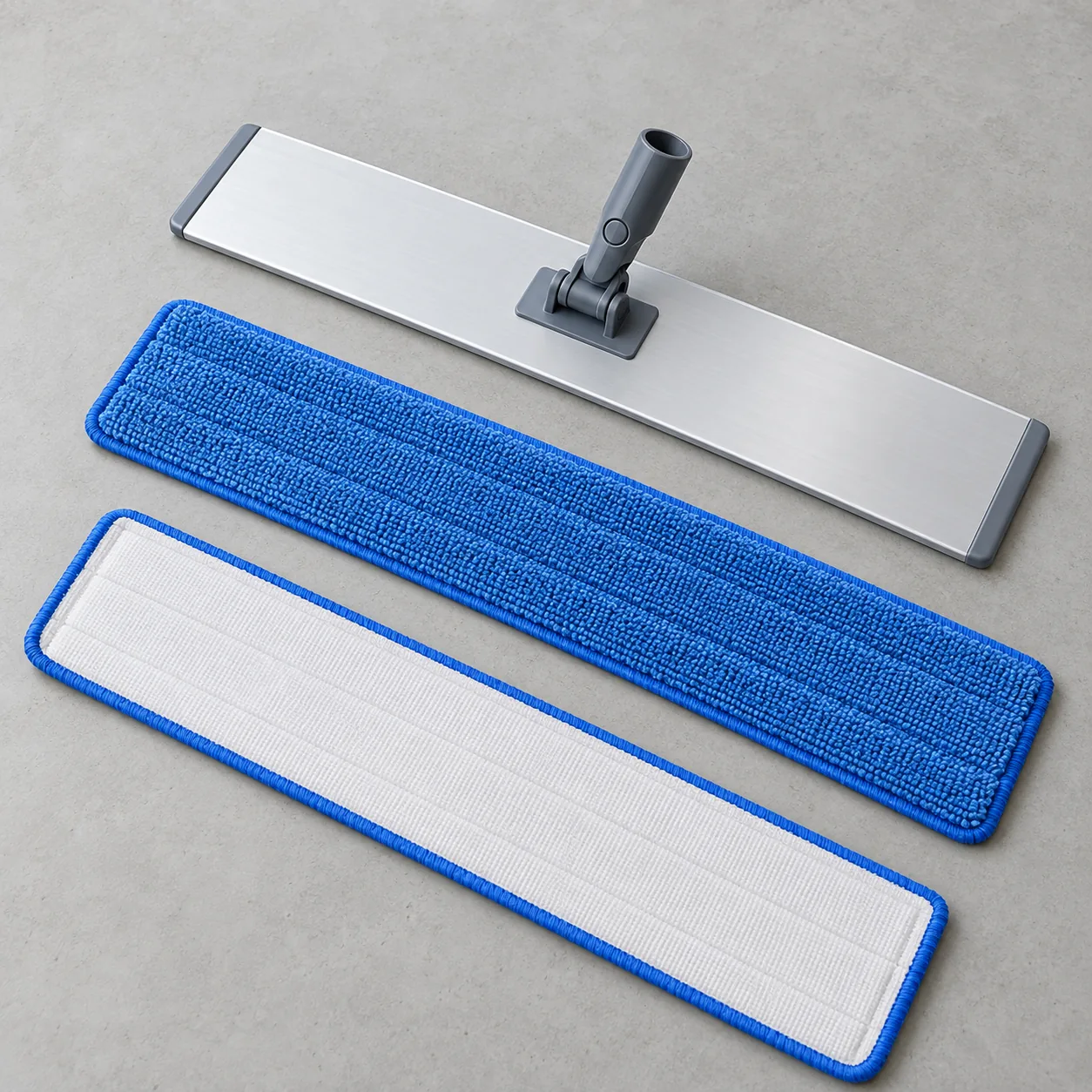
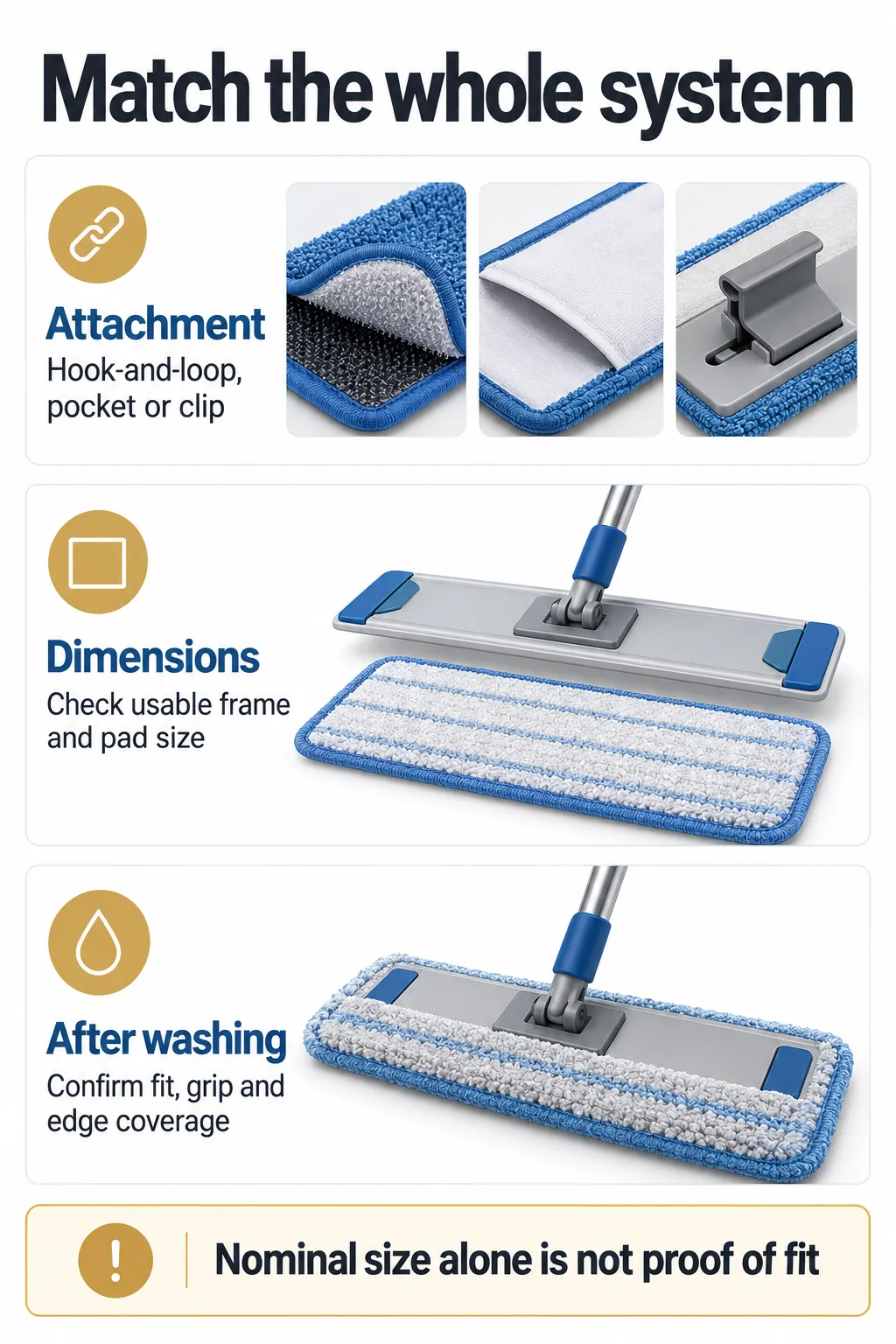
Begin with the attachment interface and the frame’s usable dimensions, then check the pad’s size and construction before and after washing. Hook-and-loop, pocket, and clip arrangements are different connections; an approximately similar rectangle is not evidence of interchangeability. A practical match must remain flat, cover the frame’s working edges, and stay attached during normal turns and changes in direction. It must also fit the hotel’s cleaning method, whether that uses prepared pads, a spray handle, or a compatible bucket and press. Treat the handle connection and replacement fastening components as part of the specification, because a good pad cannot correct loose hardware.
Compare the connection before comparing the advertised size
Ask the supplier to identify the pad and frame by model or part number. For cross-brand replacements, obtain written confirmation of the exact frame being supported and verify it with a physical sample. Descriptions such as universal, standard, or commercial do not replace that evidence. The same nominal length can describe a frame, the pad’s outside dimensions, or a product family. For a manufacturer-specific example, Vileda Professional’s Express Pro System identifies its hook-and-loop frame design and associated mop range; those specifications should not be treated as evidence that unrelated pads will fit.
| Attachment | What must match | What the trial should reveal |
| Hook-and-loop | Frame hook strips and the pad’s loop backing; their position and contact area | Pad stays attached through turns; backing lies flat without corner lift |
| Pocket spacing and depth, frame shape, and folding or locking action | Frame inserts and locks without stretching seams; pad remains secure after washing | |
| Clip or tab | Tab dimensions, clip position, and any proprietary fastening geometry | Tabs seat fully; clips close reliably and release as intended |
| Handle connection | Socket, thread, pin, or quick-connect design; adjustment and pivot mechanism | Connection remains secure and adjustment stays locked during ordinary use |
Measure the frame itself and a pad laid flat without tension. For pocket systems, include the usable pocket opening and the distance between pockets. For hook-and-loop systems, photograph the underside of the frame and pad backing. Include both inches and millimeters when suppliers use different units, but identify which dimension is the controlling specification. Do not invent a universal pad overhang: the correct edge coverage depends on the actual design.
Match the cleaning face to the hotel’s floors
A dusting pad, a damp-cleaning pad, and a pad containing more abrasive scrubbing fibers serve different jobs. Select the cleaning face with the floor finish and soil in mind. A pad that glides easily on smooth resilient flooring may behave differently on textured tile. Test on a discreet area with the intended cleaning product, and follow the floor manufacturer’s limits for moisture, chemistry, and abrasion.
Compare the complete tool in a furnished guestroom and a public-area route. A wide frame can cover open space efficiently but may be awkward around toilets, furniture legs, and narrow doors. Check whether the pivot allows the intended reach without forcing the handle, and whether a spray handle can deliver the approved product as intended. If a press is involved, confirm that it is designed for that pad and frame configuration.
Recheck fit after laundering
Retain an unwashed reference pad and record its relaxed dimensions. Wash trial pads using the proposed hotel process, allow them to reach their normal dry condition, and repeat the measurement and fit assessment. Check seams, backing, pockets, edge coverage, and attachment strength. Agree on acceptable changes before ordering; do not assume that every visible change means failure, or that a pad is acceptable merely because it still attaches.
Turn Product Care Instructions into a Laundry Specification
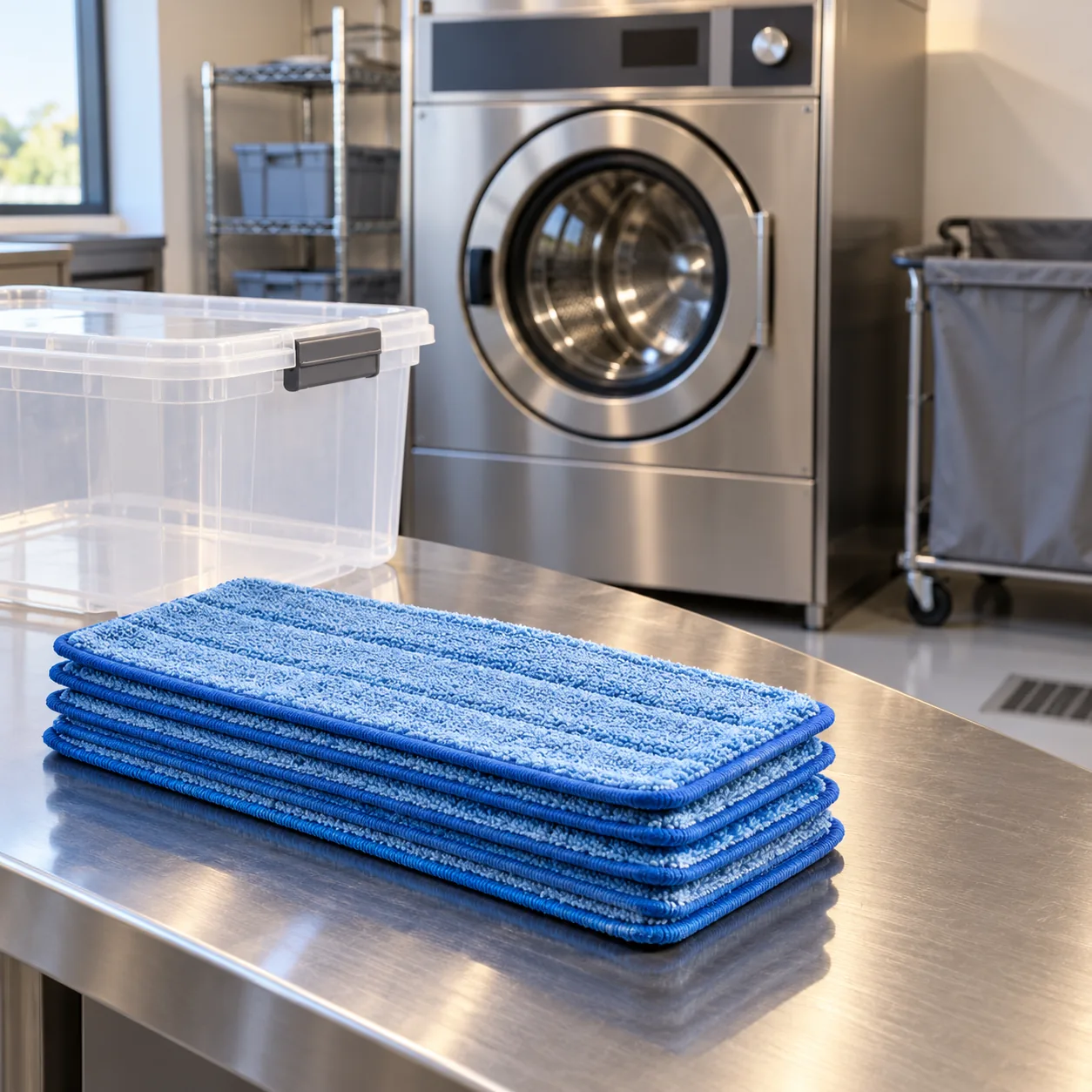
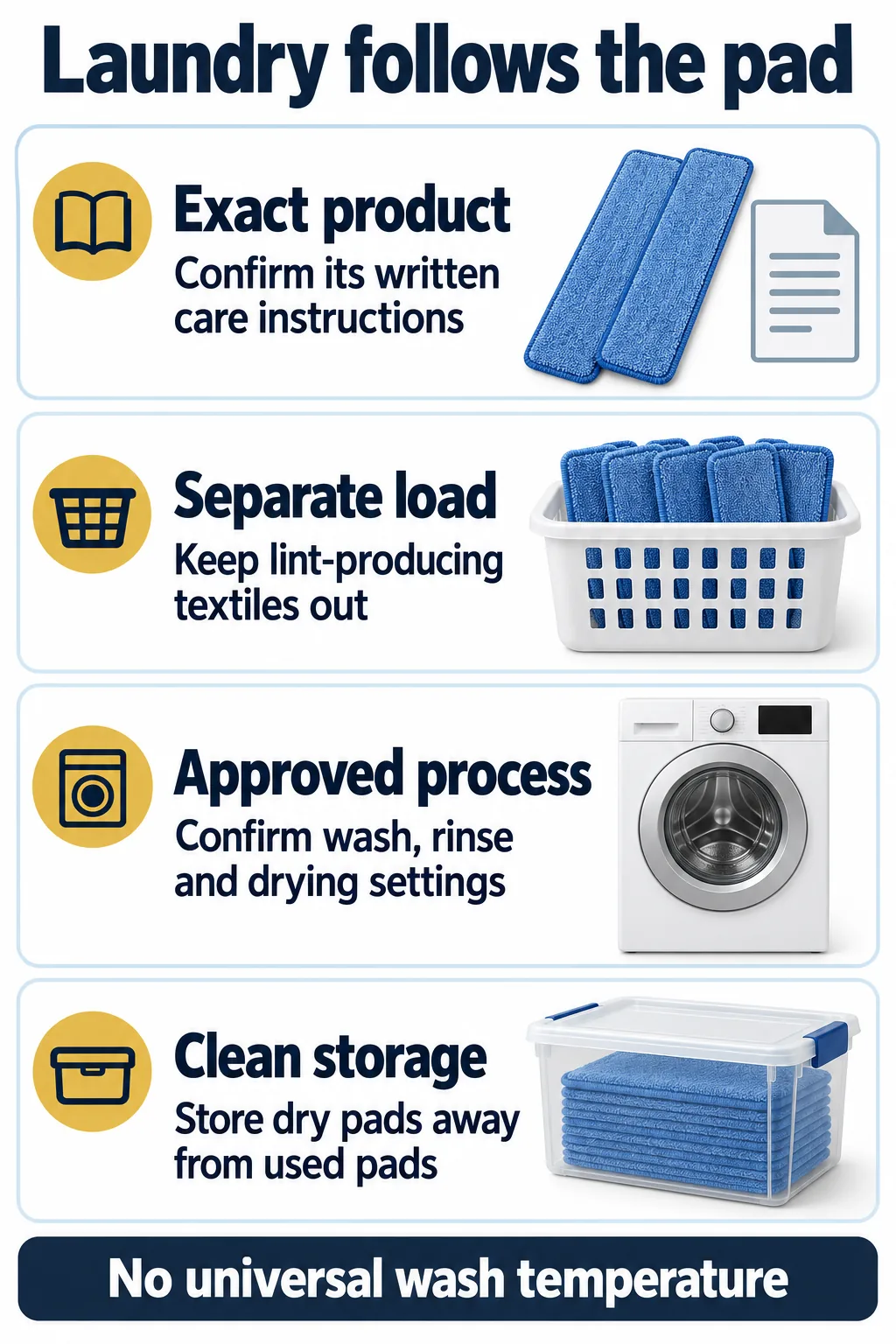
The correct laundry instructions belong to the exact pad, including its backing, seams, and attachment components. Obtain the current written care information before the sample trial and have the laundry operator confirm that the proposed process can follow it. A maximum permitted temperature describes a material limit; it is not automatically the recommended cycle or a validated hygiene process. Likewise, bleach tolerance must be confirmed for the specific product and conditions. The purchase decision should resolve these requirements before pads reach the laundry room, especially where an outside service uses a standard program for many customers’ textiles.
Specify the complete recipe rather than a temperature alone
The operating instruction should identify the pad model, laundry program, detergent and dose, any permitted bleach chemistry, rinse process, extraction, drying method, and storage arrangement. Where the product instructions give limits rather than a complete recipe, resolve the missing settings with the supplier and laundry operator. Record units explicitly: a setting written only as 60 is incomplete without identifying Celsius or Fahrenheit.
Commercial microfiber products do not all share the same temperature or bleach limits. Some constructions are designed for demanding institutional laundering; others require more restricted treatment. Do not transfer a care label from a similar-looking pad or substitute a domestic microfiber instruction for a commercial product specification. A supplier’s wash-cycle claim also needs its test conditions, including drying and chemical exposure, before it can inform a durability comparison. Compare Rubbermaid Commercial Products’ HYGEN laundry guide, which provides commercial wash methods for that product range, with Unger’s microfiber care guidance, which recommends gentler treatment and stresses checking the manufacturer’s care label. Use the instructions applicable to the pad being purchased.
Control lint, chemical carryover, and drying
Keep microfiber pads out of loads containing lint-producing cotton towels or other shedding textiles. Avoid fabric softeners and dryer sheets that can leave deposits on the fibers. Use the specified detergent dose and rinse process rather than adding extra product to compensate for poor results. Residue, soil, and equipment condition should be investigated separately when a pad begins leaving streaks.
Dry within the product’s limits and separate pads requiring different treatment. Do not increase heat simply to shorten turnaround. Return pads to clean storage only when they are dry; damp storage is not an acceptable substitute for an approved drying process. If a hotel intentionally pre-moistens clean pads for use, manage that as a separate preparation procedure with defined solution, quantities, holding conditions, and time limits.
Keep cleaning performance and hygiene claims separate
Removing visible soil and achieving a specified disinfection result are different objectives. A microfiber label alone does not establish disinfection performance. When disinfection is required in a US hotel, select an EPA-registered product labeled for the intended use. Follow the label’s dilution and application directions and keep the surface visibly wet throughout its specified contact time, as explained in EPA’s disinfectant directions-for-use guidance. Confirm compatibility with both the floor and the mop. For specialized contamination, follow the property’s relevant response procedure instead of extending a routine room-cleaning method.
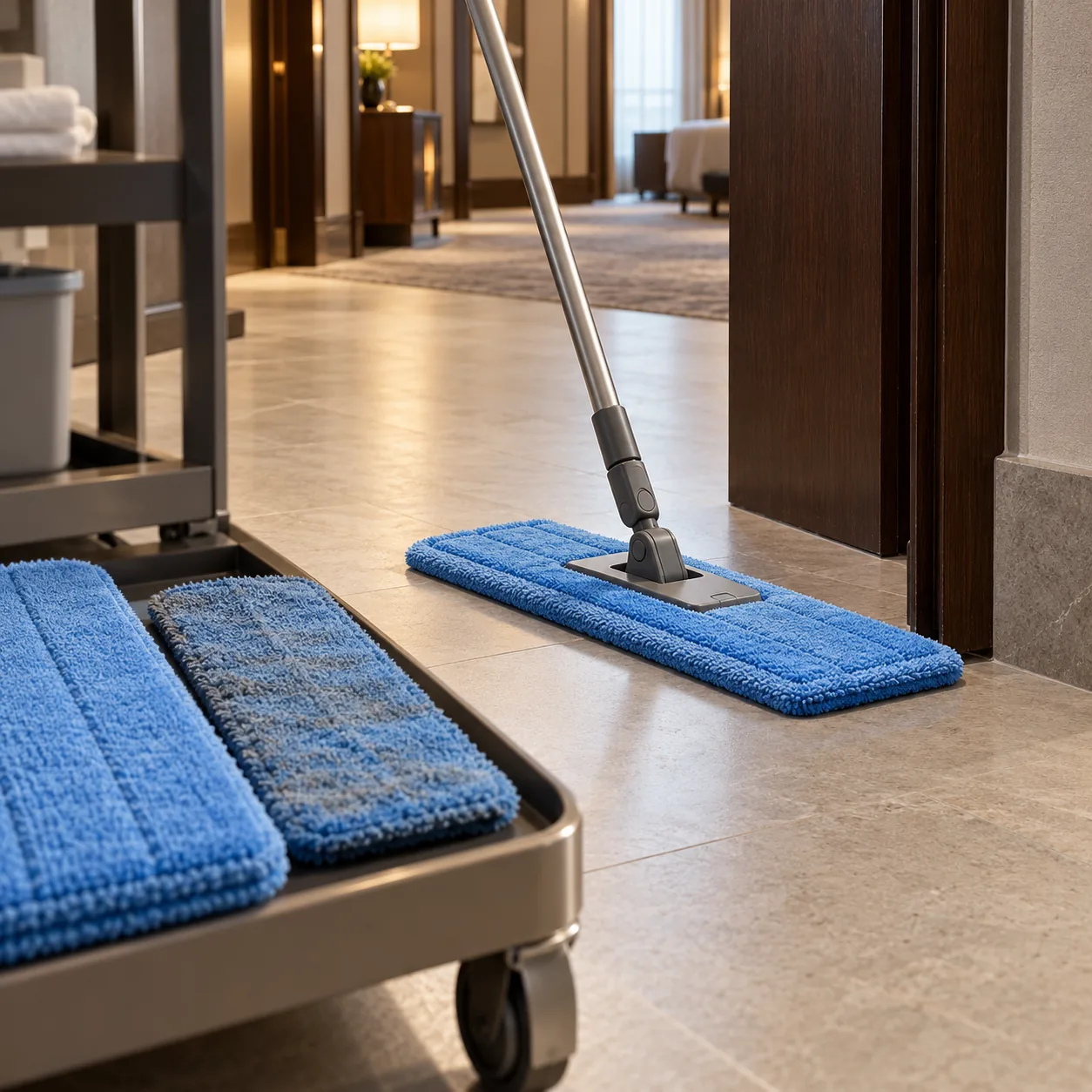
Color coding supports separation only when staff share the same written zone assignments. Do not assume that one color has a universal meaning across hotels or suppliers. Define pad changes between tasks and areas, keep used pads separate from clean stock, and train staff on collection and handling. Cleaning staff also need a way to remove damaged or suspect pads from circulation without returning them to the clean shelf.
Diagnose the symptom before replacing the whole system
| Observed symptom | Possible explanation | Useful comparison |
| Pad detaches during turns | Incompatible backing, worn hook strips, debris, or pad distortion | Try a known-good pad on that frame and the suspect pad on a known-good frame |
| New streaking after laundry | Residual detergent, retained soil, excess solution, or changed floor chemistry | Compare properly processed reference pads using the same floor and solution |
| Corners curl or pockets tighten | Dimensional change or unsuitable wash/dry treatment | Compare relaxed dimensions and actual program records with the approved sample |
| Poor pickup or heavy drag | Wrong cleaning face, clogged fibers, incorrect moisture, or unsuitable surface | Run the accepted pad and candidate side by side under equal conditions |
| Odor after storage | Incomplete cleaning, insufficient drying, or contaminated storage | Remove affected pads; investigate laundering, drying, and storage before reuse |
These comparisons narrow the cause; they do not certify hygiene or prove service life. If a fault follows one frame, inspect its fastening components. If it appears across multiple pad batches after a laundry change, investigate the process before rejecting every pad. Keep the defective sample and the associated batch and wash records so the supplier can evaluate the actual problem.
Evaluate Samples, Stock Levels, and Cost Before Bulk Ordering
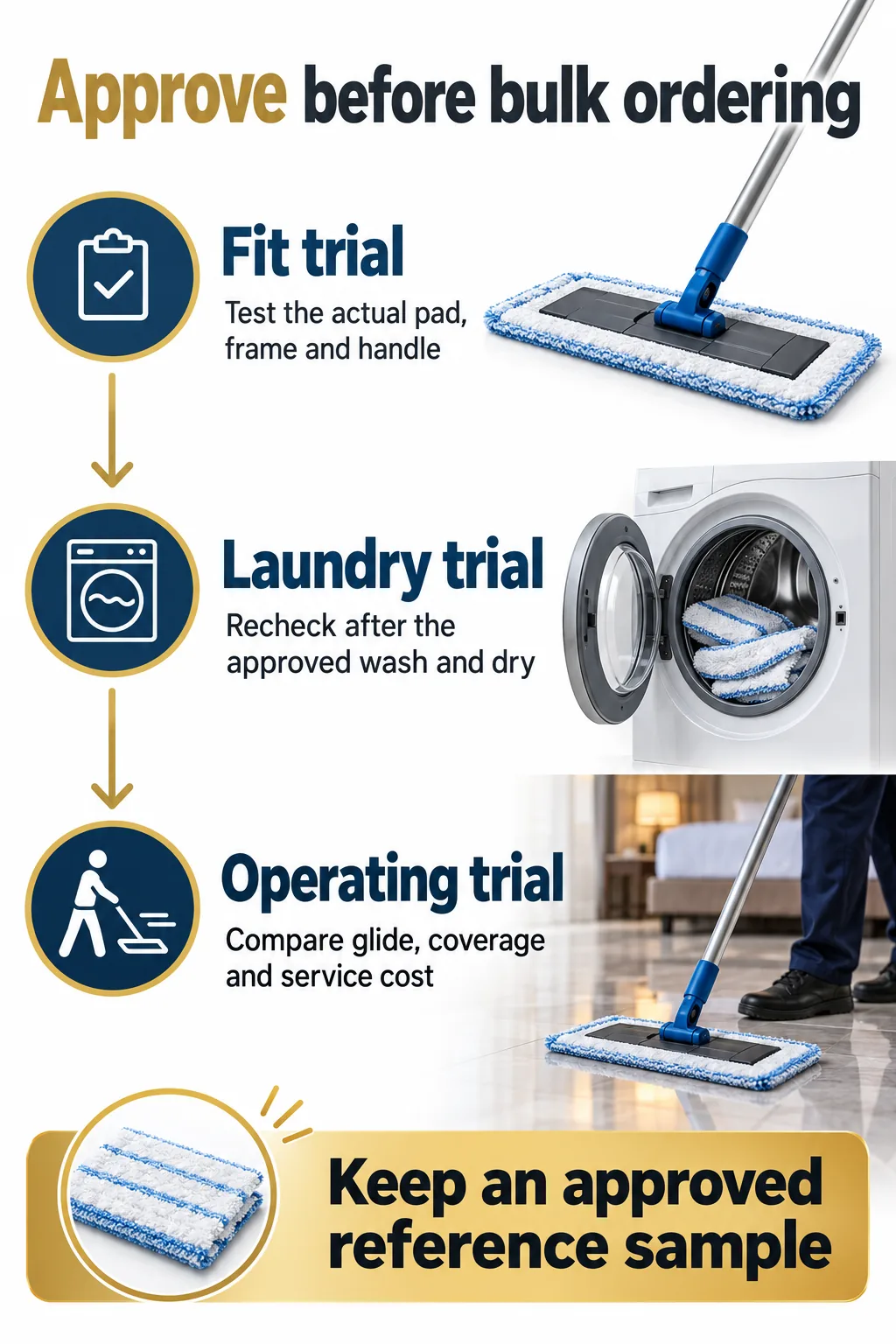
Approve the combination that housekeeping will actually use, then connect that approval to a replenishment plan. A useful pilot includes the intended pads, frames, handles, floor finishes, cleaning solution, and laundry process. Compare candidates under similar conditions and record failures as well as favorable observations. A short trial can reveal poor fit, awkward handling, and early laundry damage, but it cannot prove a long service-life claim. The commercial comparison should therefore distinguish observed trial results from supplier test claims and planning assumptions. This makes it easier to buy sufficient stock without treating the cheapest pad or the highest advertised wash count as the automatic winner.
Set acceptance criteria before the trial
Define what would make a candidate unacceptable: repeated detachment, exposed frame edges, seam failure, floor marking, unreliable handle locking, or loss of usable fit after the approved wash and dry. For handling, ask the people who clean the actual rooms to compare glide, corner access, pad changes, and reach. Keep the test route and cleaning method consistent enough that a change in operator technique does not become a product claim.
Use more than one pad from each candidate batch so one unusually good sample does not decide the order. Record the number of completed cleaning and laundry cycles, the process used, and the reason for any removal from service. Retain an accepted physical reference and photographs. An approval should identify both the exact construction and the laundry process; a change in backing, yarn, fastening, or care instructions requires review.
Size the pad pool around the laundry return time
Count expected pad changes by task and zone instead of assuming that every room uses one pad. Then estimate how long each used pad remains unavailable, including collection, transport, washing, drying, inspection, and redistribution. As a planning model, required pads equal the daily pad-use rate multiplied by the unavailable time in days, plus ready-to-issue stock and a reserve for rejected, lost, or delayed items. Count each group once.
For example, assume a property uses 120 pads per day and each used pad is unavailable for two days. The circulating unavailable quantity is 240 pads. If management also wants 120 clean pads ready to issue and a separately chosen reserve of 36 pads, the planning total is 396. These are illustrative inputs, not a hotel standard. Recalculate for occupancy peaks, weekend laundry schedules, and the property’s actual pad-change policy.
Compare cost per completed use
Use the same definition of a successful cleaning task when comparing pads. A useful partial measure is pad purchase cost divided by expected successful uses, plus the allocated laundry cost per use. A fuller comparison also includes handling labor, replacement hardware, losses, and any repeat cleaning needed. Do not spread the purchase price over an advertised wash count if pads leave your operation earlier.
| Illustrative input | Candidate A | Candidate B |
| Pad purchase price | $8.00 | $11.00 |
| Assumed successful uses | 160 | 220 |
| Purchase cost per use | $0.05 | $0.05 |
| Assumed laundry cost per use | $0.22 | $0.18 |
| Partial cost per use | $0.27 | $0.23 |
All amounts above use one hypothetical currency and are not supplier quotes or market prices. Both pads have the same purchase cost per assumed use; the modeled difference comes from laundry. The example excludes labor, freight, taxes, hardware, losses, and rework. Replace the assumptions with comparable supplier terms and measured hotel results, and retain uncertainty where the pilot has not established the product’s lifespan.
Make the approved specification reorderable
A quotation request should connect the pad part number to the approved frame, handle, attachment, dimensions, floor application, and care instructions. State the sample quantity separately from the opening order and expected replenishment. Ask for replacement fastening strips or other serviceable parts where applicable, pack quantities, lead times, and notice before a construction or product code changes.
Include the delivery destination and the required date, and confirm which costs are included. If the purchase is part of a new opening, coordinate it with the wider hotel opening supplies plan so storage, laundry capacity, and staff training are ready when stock arrives. A well-documented repeat order protects the accepted operating method as much as it protects the product dimensions.
Conclusion
A reliable hotel microfiber mop purchase brings fit, floor performance, and laundry compatibility into one approval. Start with the exact attachment and hardware, confirm that the pad remains usable after the intended care process, and let housekeeping assess it on representative routes. Use trial observations to guide the decision while keeping unproven service-life assumptions visible. Then plan the stock pool around actual pad changes and laundry return time. This approach gives purchasing a specification that can be repeated, gives laundry a defined process to follow, and gives staff a practical way to identify equipment that should leave service.
To discuss sourcing with KW Hospitality, request a quote for your microfiber mop system. Include frame photographs and model details, pad dimensions and attachment type, the proposed laundry process, quantities, destination, and required delivery date. Ask for sample availability and terms so the complete combination can be evaluated before the bulk order is approved.
Frequently Asked Questions
Can a pad labeled 18 inches fit any 18-inch mop frame?
No. The label may refer to the pad, the frame, or a nominal product size. The attachment layout, frame width and shape, and pad dimensions after washing can differ. Use the exact frame model and a sample fit trial; do not authorize a cross-brand substitution from the length description alone.
What if a supplier only provides a maximum wash temperature?
Ask for the missing process information before approval. A material temperature limit does not establish detergent compatibility, permitted bleach, drying conditions, or a complete hygiene procedure. The laundry operator and supplier need to resolve those details for the exact pad. If that cannot be done, choose a product with adequate care documentation.
Can an outside laundry wash mop pads with hotel towels?
Microfiber should be kept out of lint-producing towel loads. Also confirm how the service separates used cleaning textiles, identifies your pad model, follows its care instructions, and returns clean dry stock. A generic assurance that all hotel linen uses one program is not enough to establish pad compatibility.
Do disposable microfiber mop pads use the same approval process?
They still need a fit and performance trial with the intended frame, floor, and cleaning product. However, reusable-pad laundering instructions do not apply to a product designated for single use. Follow its disposal and use instructions, and compare the complete operating cost rather than assuming that washable and disposable pads are interchangeable.
When should a reusable microfiber pad be retired?
Remove it when it fails the property’s acceptance criteria, such as insecure attachment, torn seams, persistent distortion, or inadequate cleaning after correct processing. Investigate contamination or odor before any return to service. Track why pads are retired so expected replacement quantities reflect actual operations, rather than relying only on a calendar interval or advertised wash count.
References
Vileda Professional — Express Pro System
Rubbermaid Commercial Products — Laundry Guide (HYGEN Microfiber Cloths and Mops)
Unger Enterprises — The Do’s & Don’ts on How to Wash Microfiber Cloths & Mop Heads
United States Environmental Protection Agency — Selected EPA-Registered Disinfectants