
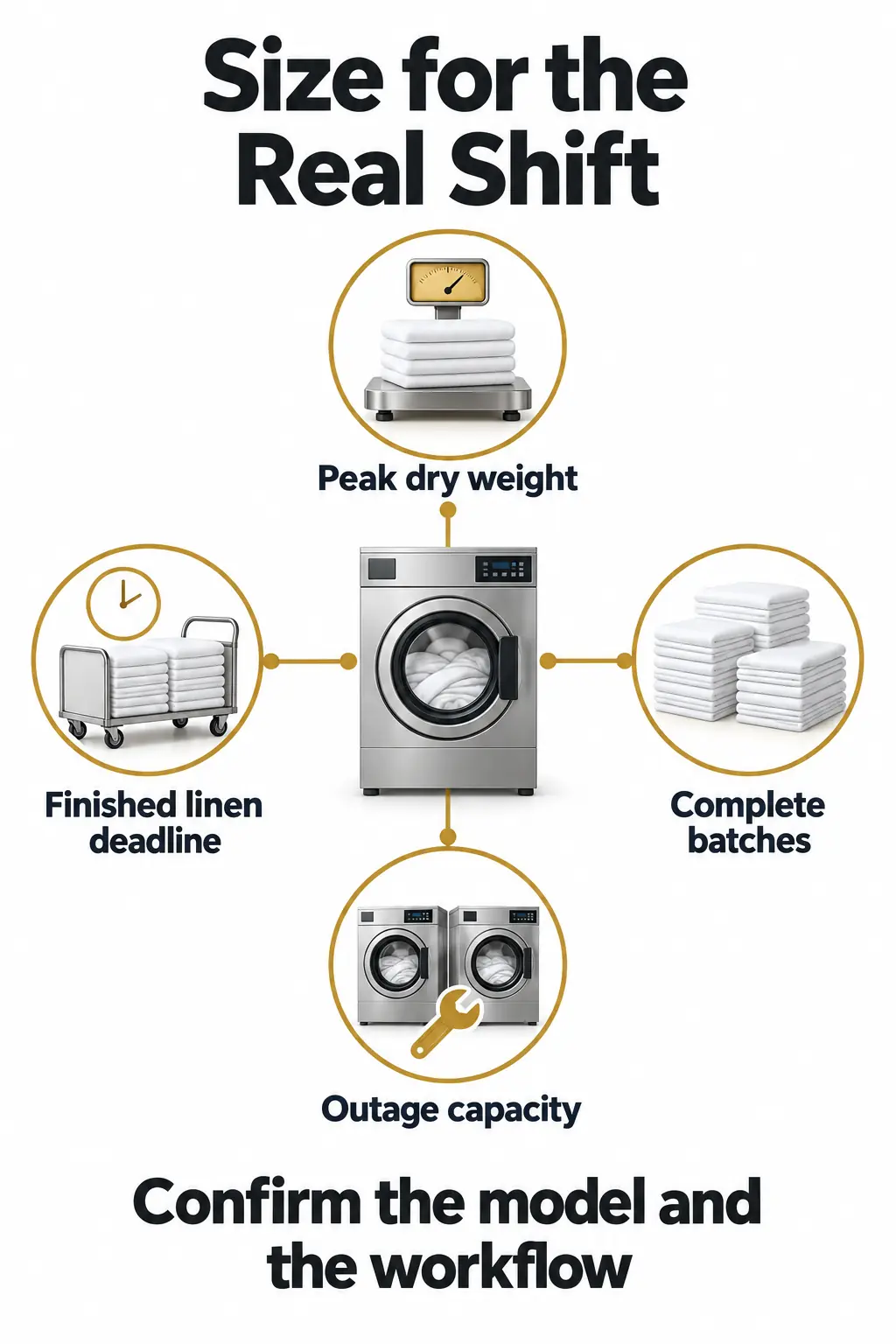
Commercial hotel washers should be sized from the dry weight of linen that must be processed on a peak operating day, the time available to complete each batch, and the deadline for returning finished linen. A machine’s rated kilograms or pounds describe a load, not its daily output. The purchase decision becomes more reliable when the hotel turns its linen demand into a batch schedule and then checks whether staff, utilities, dryers, and finishing equipment can support that schedule.
This matters most when occupancy, departures, and event business peak together. A property may have enough nominal washer capacity for an average day yet run short after a large checkout, a banquet, or a delayed delivery of soiled linen. Conversely, buying the largest available machine can create awkward small loads, concentrate breakdown risk, and require building services that the property cannot readily provide. Room count is a useful starting input, but it cannot capture these differences by itself.
The method below is intended for hotel owners, laundry managers, executive housekeepers, engineering teams, and procurement staff planning an on-premises laundry or replacing commercial washer-extractors. It explains how to establish the dry-weight requirement, translate shift hours into completed batches, compare machine configurations, and test the proposed operation before accepting a supplier’s capacity claim. The numerical example is hypothetical: its linen weights, cycle times, and rewash rate are teaching inputs, not hotel-industry benchmarks or specifications for a particular machine.
Use one mass unit throughout the calculation. This guide uses kilograms; multiply kilograms by 2.20462 for pounds, or pounds by 0.45359237 for kilograms. Confirm the unit on every proposal. A 60-pound washer and a 60-kilogram washer have very different capacities. The downloadable calculator repeats the example and lets you replace its assumptions, while the full method remains explained here.
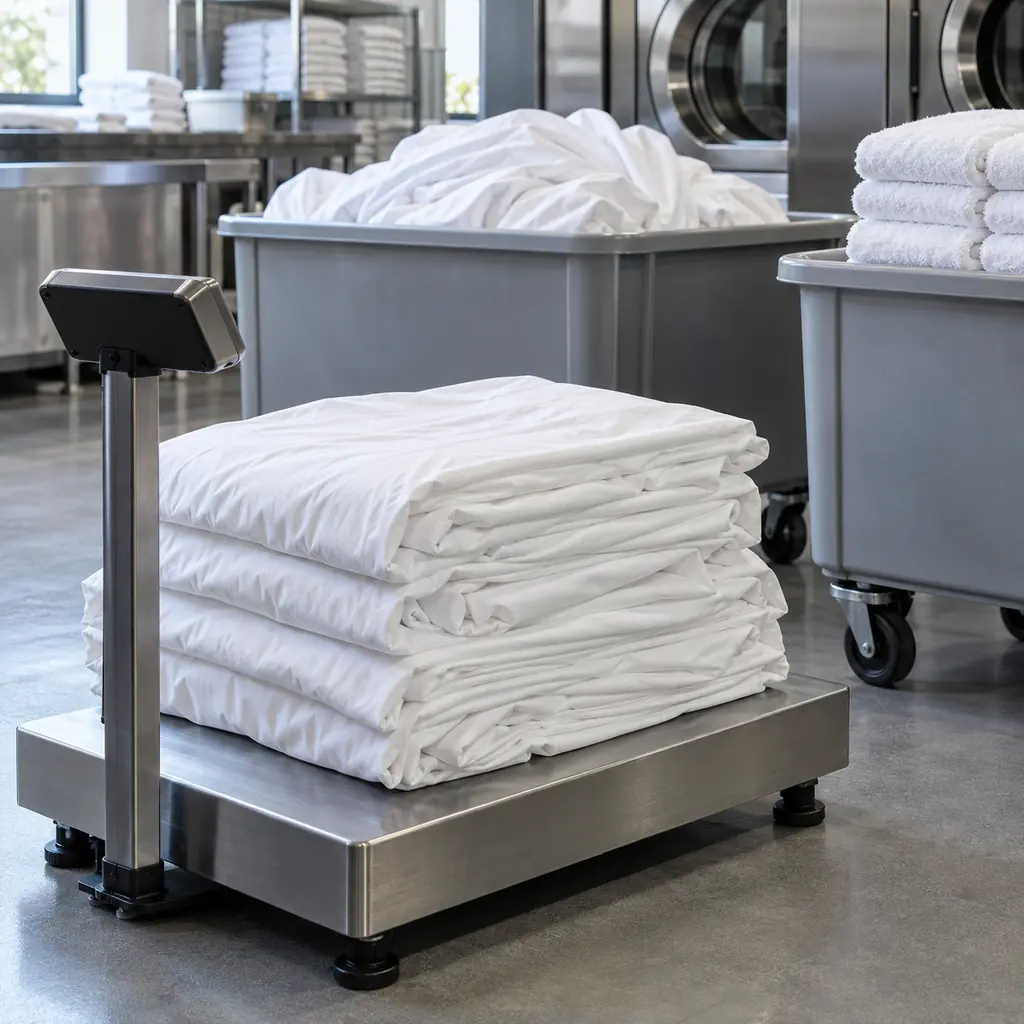
Measure Peak Dry Linen Demand
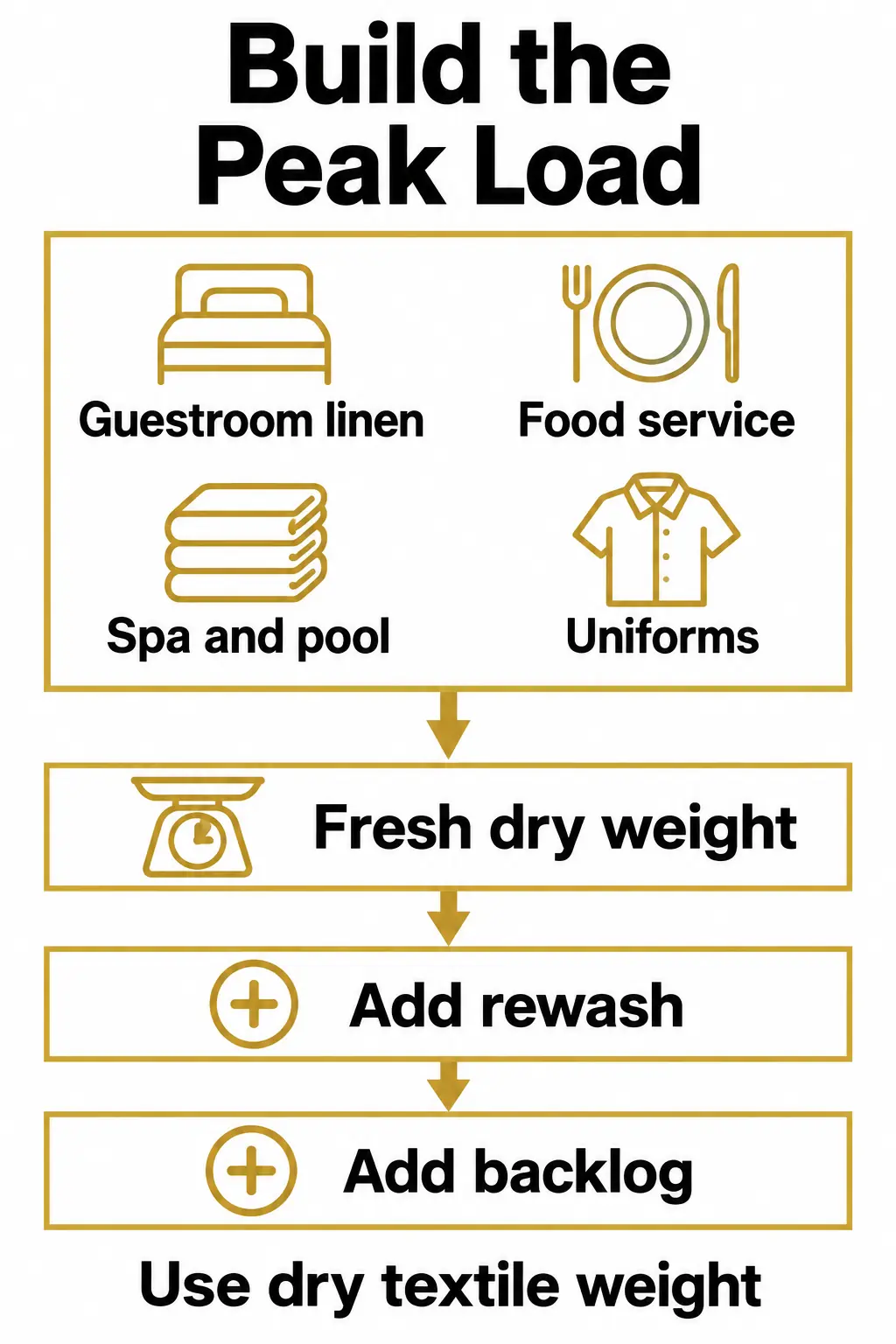
Start with the busiest credible operating day and build its workload from identifiable linen streams. Count what will actually enter the laundry, including guestroom changes, restaurant linen, pool and spa towels, uniforms, planned bulky items, and any backlog due that day. Keep fresh arrivals separate from repeat washing so that the same linen is not counted twice without a reason. The result should be a dry-textile mass for a defined service deadline. If the property has records, compare several busy periods and explain which operating conditions the selected peak represents. For a new hotel, use planned service quantities and weighed textile samples, then revise the estimate after opening.
Establish a dry-weight basis
Check the capacity definition in the exact machine documentation. For example, Alliance Laundry Systems’ Pocket Hardmount Washer-Extractor programming manual identifies its example UW060/UWN060 rating as 60 pounds of dry laundry. This supports a dry-weight comparison; it does not make that model or capacity appropriate for every hotel.
Wet towels, retained water, laundry bags, and carts can distort a weighbridge total. Establish representative clean, dry piece weights for the hotel’s actual textiles and multiply those weights by the pieces expected to be laundered. Tare containers whenever weighing a batch. If a measured soiled weight includes variable moisture, record that limitation instead of treating it as dry weight. Use practical, repeatable weighing conditions and the same scale procedure across the survey.
For towels, GSM alone is insufficient: piece dimensions, construction, and the number used matter too. A sample-based weight is more useful than assuming every bath towel weighs the same. Review the planned bath linen specifications alongside the laundry calculation when changing towel size, robe weight, or room sets.
Separate departures, stayovers, and non-room demand
Departure rooms and occupied stayover rooms often generate different quantities because the change policy differs. A room with no linen change contributes no scheduled change load for those items that day. Do not multiply every occupied room by a full departure set unless the hotel’s actual service policy requires it. Include scheduled periodic changes separately, and account for restaurant events or pool use even when they do not move in proportion to room occupancy.
The following is an illustrative daily demand build for a 250-room property. The weights and service quantities are assumptions to replace with property data.
| Fresh linen stream | Assumed activity | Dry-weight assumption | Daily dry weight |
| Departure-room linen | 150 rooms | 5.0 kg per departure | 750 kg |
| Stayover-room linen | 100 rooms | 2.0 kg per serviced stayover | 200 kg |
| Restaurant linen | 100 covers | 0.4 kg per cover | 40 kg |
| Pool and spa towels | Measured daily quantity | Aggregate dry weight | 100 kg |
| Uniforms | Measured daily quantity | Aggregate dry weight | 50 kg |
| Total fresh linen | 1,140 kg |
Here, the combined guestroom allowance includes the bedding and bathroom items counted for each room. Do not add those same items again as a separate towel total. The pool and spa row covers additional linen only.
Add repeat processing and backlog explicitly
Define rewash as extra dry mass processed again divided by first-pass dry mass. With a hypothetical 5% rewash allowance, extra washing is 1,140 × 0.05 = 57 kg. A further 60 kg of existing backlog gives:
Required daily processing = 1,140 + 57 + 60 = 1,257 kg.
The 5% is an example, not a recommended target. If the hotel’s reporting defines rewash as a share of all processing instead, use extra processing = first-pass dry mass × r ÷ (1 − r), where r is the rewash fraction of total processing for that same stream. For example, 5% on that different denominator gives 1,140 × 0.05 ÷ 0.95 = 60 kg, rather than 57 kg. Use only the formula matching the recorded definition, and keep separately allocated backlog outside it. Count every additional pass that consumes machine time. When backlog is due immediately, include it in that day’s requirement; when it can be recovered over several days, specify each day’s recovery allocation. Model future growth as a separate scenario so that today’s measured peak and tomorrow’s expansion remain visible.
Turn Shift Hours Into Completed Batches
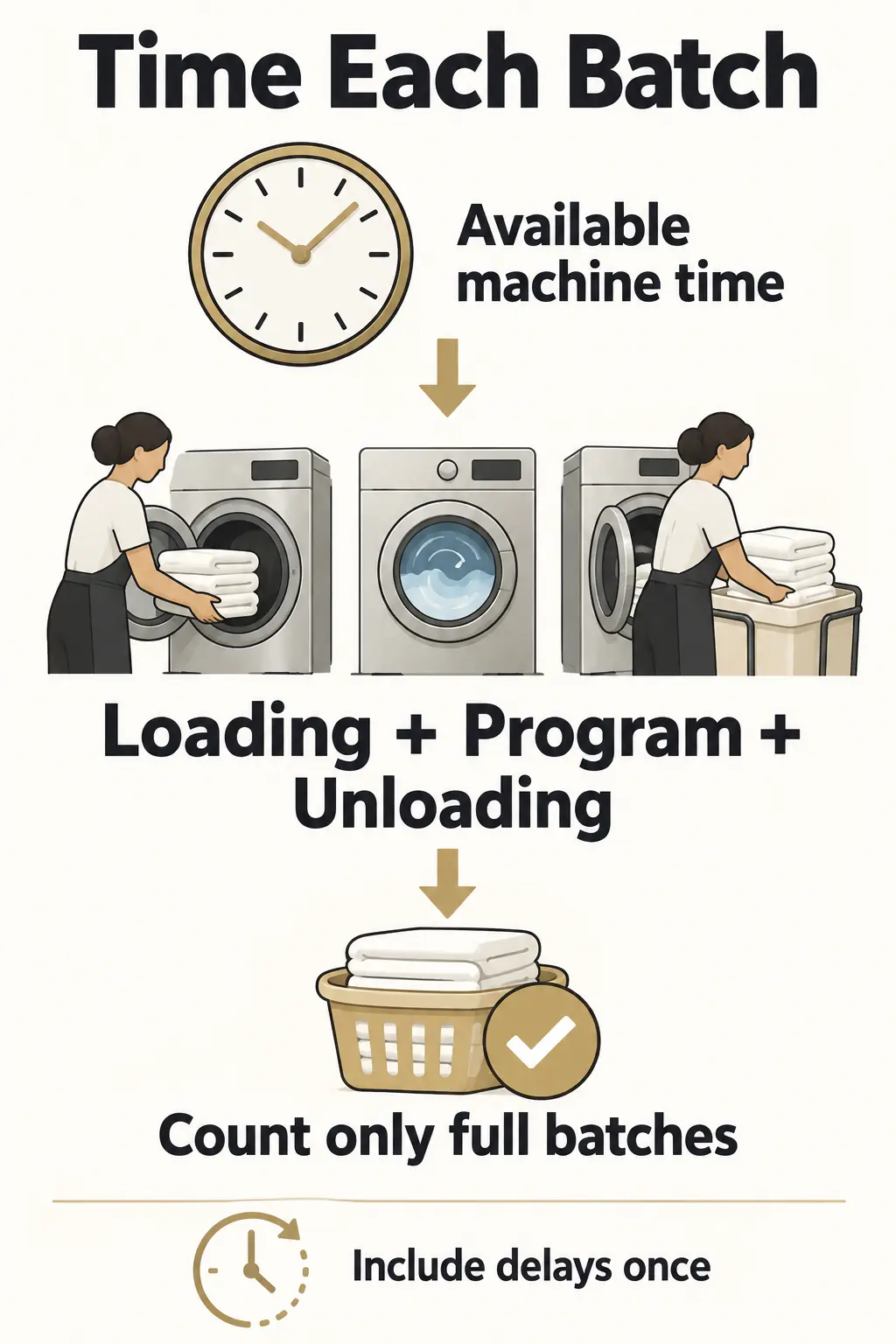
Translate the staff shift into minutes during which each washer can complete useful work. A paid eight-hour shift does not automatically provide eight hours of washing capacity: linen may arrive late, startup tasks may delay loading, or the last wash must finish early enough for drying and return. Record only the losses that actually stop or constrain the machine. Staff breaks do not necessarily stop a running program if the operating arrangements permit it. Then measure complete batch turnaround, including loading, the elapsed program, unloading, and the transition to the next load. Deduct each loss once so the capacity model stays understandable and reproducible.
Define the deadline before counting cycles
Work backward from the time clean linen must reach its destination. Allow for the downstream route appropriate to that linen: drying or moisture conditioning, ironing where required, folding, inspection, packing, and movement to the linen room or floors. The resulting latest washer-unload time may be earlier than the end of the staff shift.
If housekeeping needs towels at noon, finishing all washing at the end of the afternoon does not meet the requirement. Divide the day into delivery windows when necessary and identify when each soiled stream becomes available. A daily total can conceal a morning shortage or a late-arriving load that cannot make the last cycle.
Use elapsed batch turnaround
Time loading from the start of machine occupation, then the complete program, then unloading until the machine is ready for the next batch. Confirm whether the controller’s displayed time includes filling, heating waits, distribution and balancing, extraction, or other delays. Use measured elapsed time for the intended program and load instead of combining a brochure cycle with unrelated handling assumptions.
Electrolux Professional’s EUD-618CV specification sheet lists rated load, a particular program’s time, and consumption conditions separately. That distinction is useful when reviewing proposals: one published test program does not establish turnaround for the hotel’s different linen mix and installed conditions.
Use these screening equations for machines running comparable batches:
Available minutes per machine = scheduled window in hours × 60 − documented unavailable minutes.
Batch turnaround in minutes = loading + elapsed wash program + unloading and transition.
Complete batches per machine = available minutes ÷ batch turnaround, rounded down.
Daily washer capacity = complete batches × permitted dry batch weight × number of machines.
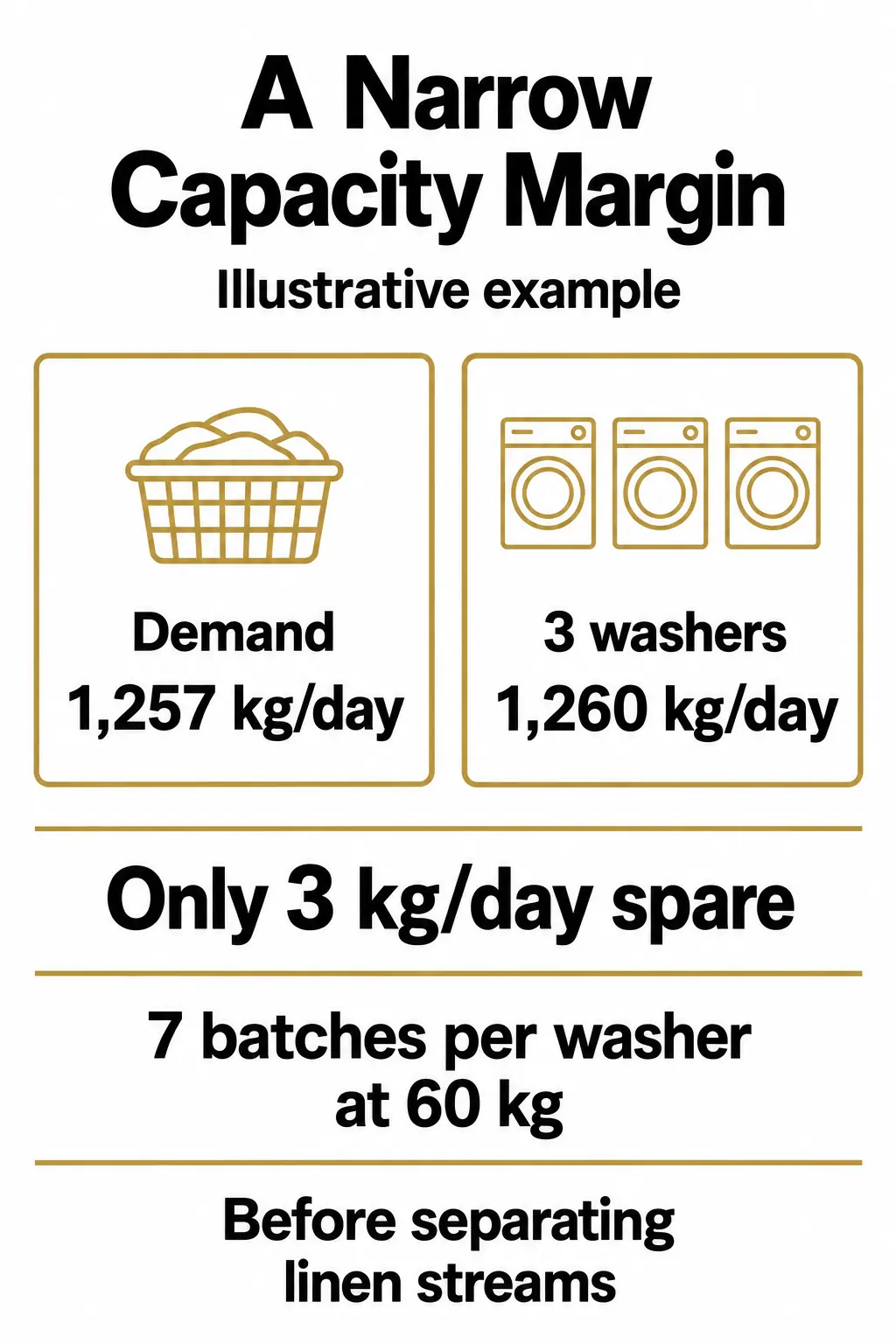
For the example, assume an eight-hour window with 60 minutes excluded for documented nonproduction time and the finishing cutoff. Available time is 8 × 60 − 60 = 420 minutes. A hypothetical 50-minute elapsed program plus 10 minutes of combined handling gives 60 minutes per batch, so one washer completes seven batches.
The seven-batch result assumes the remaining time is genuinely usable and staff can service the machines as planned. Fragmented interruptions can make a simple subtraction optimistic. If the final batch cannot fit between a linen arrival and the cutoff, its unused minutes cannot be reassigned automatically to another part of the day. Verify the sequence with start and finish times.

Compare Capacity and Outage Scenarios
Compare configurations first with an aggregate calculation, then with the actual number of segregated loads and the daily timetable. The example requires 1,257 kg of processing and allows seven 60-minute batches per washer. If each batch may contain 60 kg of the intended dry linen, three washers provide 1,260 kg of aggregate capacity. That leaves only 3 kg, or about 0.24% of demand, before accounting for partial loads, differing programs, or an unavailable machine. Such a narrow mathematical surplus is a signal to investigate the operating plan. It is not sufficient evidence that three washers will meet the hotel’s peak-day requirement.
Make the comparison on the same assumptions
The table uses the same 420-minute window and full 60 kg permitted batch weight throughout. The stress case increases total batch turnaround from 60 to 65 minutes, leaving only six complete batches per available washer.
| Configuration and condition | Complete batches per available washer | Aggregate daily capacity | Capacity minus 1,257 kg demand |
| Three washers, 60-minute turnaround | 7 | 1,260 kg | +3 kg |
| Four washers, 60-minute turnaround | 7 | 1,680 kg | +423 kg |
| Three washers, one unavailable | 7 | 840 kg | −417 kg |
| Four washers, one unavailable | 7 | 1,260 kg | +3 kg |
| Three washers, 65-minute turnaround | 6 | 1,080 kg | −177 kg |
| Four washers, 65-minute turnaround | 6 | 1,440 kg | +183 kg |
| Four washers, 65-minute turnaround and one unavailable | 6 | 1,080 kg | −177 kg |
These are calculated scenarios, not predictions of machine performance. Notice the step change: five extra minutes lose one whole daily batch per washer. Continuous kilograms-per-hour arithmetic can miss this effect. A partial final cycle does not produce a completed load by the cutoff.
Count separate loads before accepting the result
Divide linen by compatible textile, color, soil, care instructions, and approved program. For each group, divide its dry mass by the permitted dry batch weight and round the load count up. Then assign each load its actual turnaround time and an available machine. Do not combine incompatible goods to make the arithmetic fit.
Even a simplified allocation changes the example. Treating the 950 kg of guestroom linen as one compatible group requires 16 loads at a maximum 60 kg each. Restaurant linen needs one, pool and spa towels two, uniforms one, rewash one, and backlog one: 22 loads in total, compared with the 21 loads available from three washers. This is only a preliminary grouping; guestroom sheets and towels, or the rewash and backlog, may need further separation. Small-load suitability also requires confirmation for the chosen machine and program.
Four washers can provide 28 batch slots under the 60-minute assumptions. With one washer unavailable, they fall to 21 slots and still cannot accommodate that simplified 22-load allocation. Thus the apparent outage surplus of 3 kg in the aggregate table does not establish full outage coverage. The model must pass both the weight test and the scheduled-load test.
Choose a useful machine mix
A larger machine can suit consistently large compatible loads. A smaller machine may handle isolated uniform, specialty, or urgent loads more practically. Compare permitted loading for bulky articles as well as mass: a light duvet can occupy substantial drum volume. Obtain the supplier’s textile-specific loading guidance and verify representative batches; do not invent a universal fill percentage or exceed the rating to recover lost output.
For unequal machines, calculate each unit separately and add its completed output. Repeat the plan with the largest or operationally most critical unit unavailable. If full peak-day coverage is uneconomic, specify a credible alternative such as a confirmed external laundry arrangement, an additional staffed window, or a defined recovery plan supported by clean-linen stock. Extra linen inventory buys time but does not create washing capacity.
The calculator provides the aggregate weight and time screen, including fill and outage assumptions. It does not automatically schedule separate linen streams, staff movements, or return deadlines; complete that operational check before selecting equipment.

Match Washers to Drying, Finishing, and Utilities
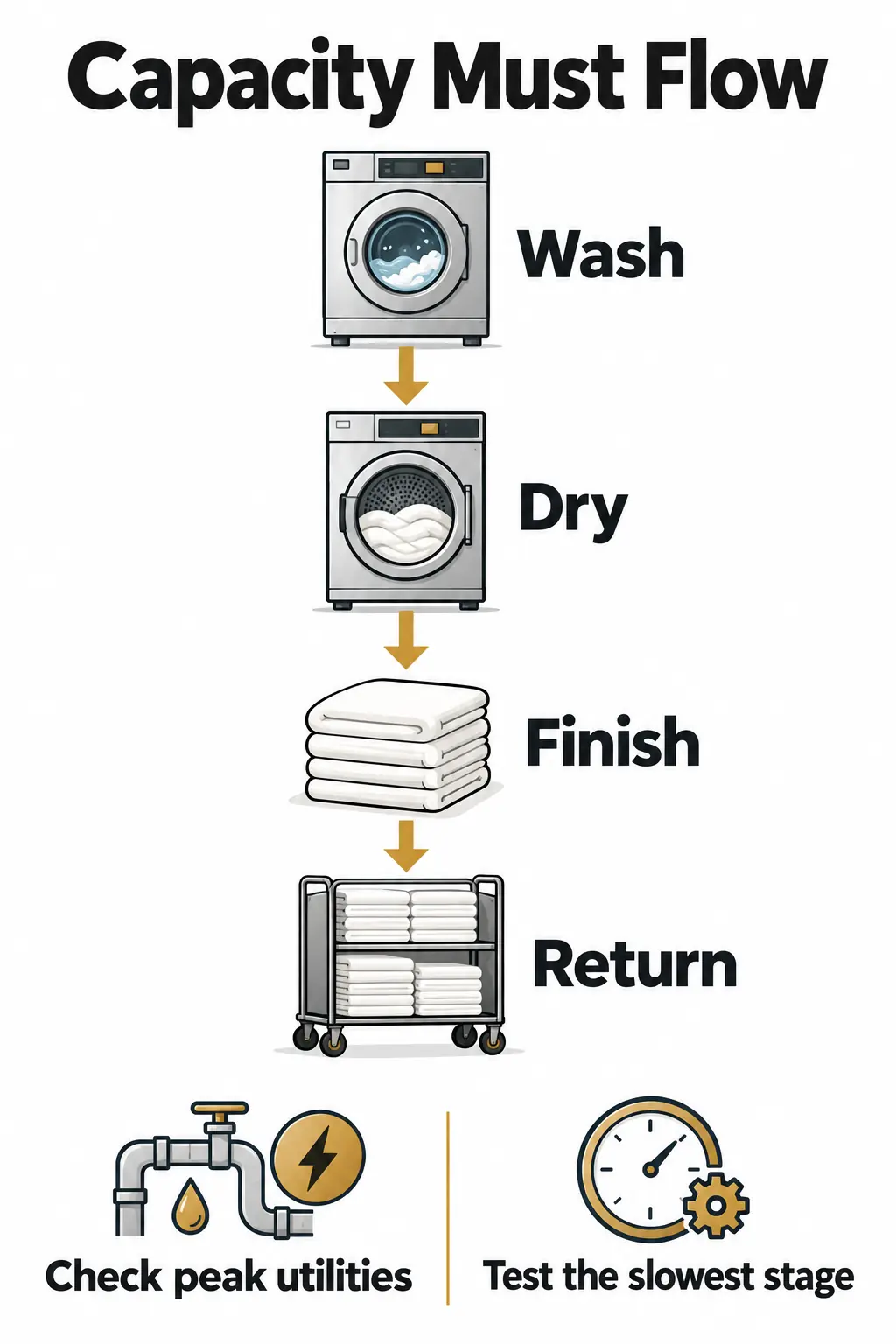
Check the route from soiled linen to usable stock before increasing washer capacity. Washing, drying, ironing where applicable, folding, inspection, and internal delivery must each support the relevant linen stream and return window. Compare output on a consistent dry-textile basis and include the staff needed to move and handle it. The smallest effective capacity can constrain the operation, while uneven load releases can create queues even when daily totals appear adequate. A washer expansion should therefore include a review of downstream equipment and building services. The goal is finished linen available when needed, with the required quality, rather than a larger pile of washed goods awaiting the next stage.
Test the downstream workload by linen type
Towels and robes may create a substantial tumble-drying workload. Flatwork may follow a different conditioning and ironing route. Map those routes individually instead of assuming every kilogram uses the same dryer program. For each stage, record useful dry kilograms completed per batch or per hour under the intended conditions, and the staffing and transfer time required.
As a separate illustrative calculation, a towel route delivering 900 kg over its usable production window cannot clear 1,100 kg due through that same route, even if the washers can process 1,400 kg. Identify the constrained stage before purchasing more washing capacity. Include the last load, because it has the least time remaining for drying and finishing.
Extraction performance matters to this comparison. UniMac’s guide to extraction and moisture removal explains that reducing retained moisture can reduce dryer work, with results depending on the linen and process. Request evidence for the proposed textile and extraction settings rather than treating a higher G-factor as a guaranteed percentage reduction in drying time. G-factor expresses centrifugal acceleration relative to gravity; it is not itself a daily output rating.
Verify peak service demand and installation conditions
Have the equipment supplier and the property’s qualified design or installation team assess the exact model’s electrical configuration, heating arrangement, inlet pressure and flow, hot-water recovery, drain discharge, foundation requirements, and service clearances. Review the machines as a group. Several washers filling or draining together can impose a different demand from one machine running alone.
UniMac’s Washer-Extractors installation manual, for the models it covers, calls for water and drain connections to scale with additional machines. It also explains that restrictive drain routing can increase drain time. Use the current installation documents for the quoted model and market; the cited manual is evidence of the issue, not a substitute design for a different machine.
A supplier must also verify delivery access, door openings, equipment footprint, loading clearance, maintenance access, and structural suitability. If staggered starts are proposed to manage utilities or labor, include the resulting start offsets in the batch schedule. The last machine may lose a final batch when the plan has no time margin.

Specify the Equipment and Prove the Shift Plan
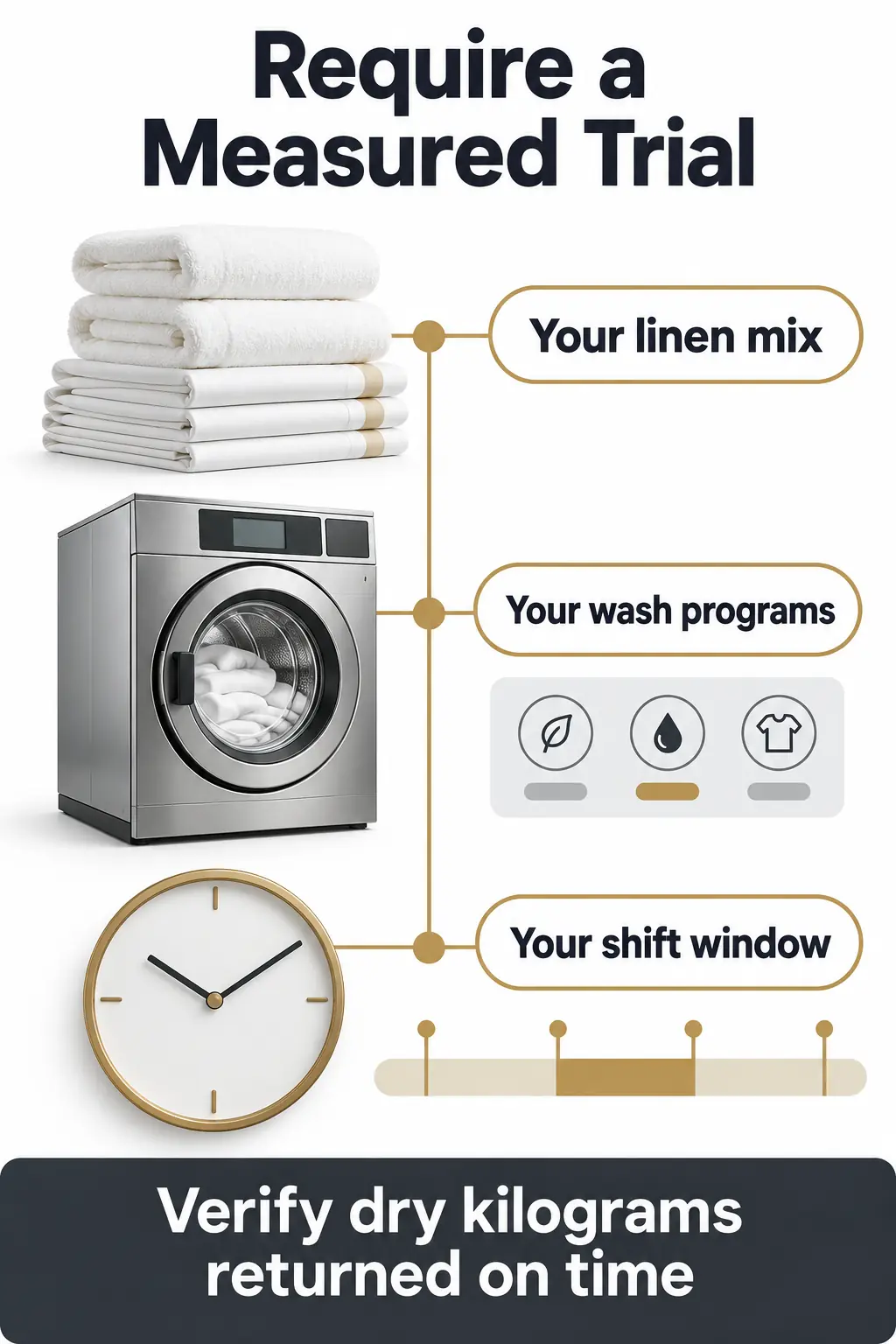
A useful washer quotation should connect the exact equipment configuration to the hotel’s measured workload and available production window. Provide the supplier with the linen groups, dry weights, delivery deadlines, proposed wash programs, and known site constraints, then request a batch plan showing how that configuration will meet them. Keep the cleaning result and textile-care requirements fixed while comparing capacity. A proposal that achieves a faster cycle only by changing an essential process requirement needs a separate technical review. Before acceptance, demonstrate the agreed workload under representative site conditions and record both completed output and unresolved constraints, including those outside the washer itself.
Request a model-specific capacity proposal
Ask the supplier to state the model, quantity, market version, heating option, capacity unit, drum volume, and permitted loading for the planned textile groups. The proposal should identify the program used for each capacity claim, elapsed batch time, handling allowance, utility assumptions, and the number of complete loads achievable before the cutoff.
Include the staffing pattern, soiled-linen arrival profile, cart routes, and downstream equipment. Attach measured peak-day data and explain which values remain estimates. Request the installation documents, service coverage, parts availability, warranty conditions, commissioning responsibilities, and exclusions from the delivered scope. KW Hospitality’s guide to preparing an accurate hotel supply quotation request can help organize the broader procurement brief.
When comparing costs, include equipment, installation and service upgrades, staffing, utilities, maintenance, and the planned response to lost capacity. Keep electricity, water, chemical consumption, and labor assumptions tied to the same linen output and program. Do not compare one supplier’s full-load test with another supplier’s partly loaded operating estimate as though the conditions were equal.
Agree the trial and acceptance evidence
Use the hotel’s actual textiles or a representative agreed sample. Weigh the dry batches, run the approved programs, and record loading start, program start and finish, unloading finish, final linen availability, and any waiting or interruption. Observe peak concurrent operation where practicable, including the building’s other demands. A single favorable cycle does not demonstrate the shift plan.
Judge the trial against agreed output, return deadlines, cleaning quality, textile condition, and repeat-processing results. UniMac’s laundry performance indicator guidance supports tracking usable output alongside quality, downtime, rewash, and delivery performance. Select the measures relevant to the hotel’s plan, and retain enough batch detail to explain a missed target.
If output falls short, identify whether the cause is loading, the approved program, utility delays, staff availability, small segregated batches, or downstream queues. Recalculate the plan after correcting the actual constraint. Recheck capacity when room sets, towel weights, linen-change policies, event business, staffing, or equipment change.
For a sourcing review, send the measured dry-weight demand, shift window, batch assumptions, site-service information, and required commissioning evidence through the KW Hospitality RFQ form. State which items need supplier confirmation so that the resulting proposal can be evaluated on a common basis.
Conclusion
Size commercial hotel washers around a defined peak-day dry-linen requirement and a workable schedule of complete batches. Confirm the permitted load for each textile group, measure full turnaround time, and leave enough time for downstream processing and return. In the illustrative example, three 60 kg washers provide 1,260 kg of aggregate daily capacity against 1,257 kg of demand, yet a simple separation of linen groups already requires more batch slots than those machines provide. That is why machine count, drum rating, and hourly averages need to be tested together. An equipment decision is stronger when normal operation, slower cycles, and a machine outage each have a documented response.
Prepare the workload and site information before requesting equipment options. Use the calculator to compare assumptions, then require a supplier-supported batch schedule and a representative operating trial. Submit that brief through the KW Hospitality sourcing request to start a model-specific discussion.
Frequently Asked Questions
Should I add a fixed 20% capacity allowance?
There is no universal percentage established by this calculation. Test the specific sources of variation: peak activity, rewash, partial batches, slower turnaround, growth, and outages. State the allowance’s purpose and avoid adding it again through a second utilization deduction. A supplier’s standard allowance still needs to be explained against the hotel’s operating plan.
Can a second shift replace an additional washer?
It can increase available machine time if staffing, linen arrival, downstream capacity, services, and return deadlines support it. Recalculate whole batches in the added window and compare the ongoing operating cost with equipment and installation costs. An extra late shift will not solve a shortage that must be resolved before an earlier housekeeping deadline.
How should partly outsourced laundry be included?
Include only the streams normally processed on site in the base washer demand. Model contracted external processing and its collection and return times separately. If the on-site laundry is expected to take over outsourced goods during a disruption, create a distinct contingency scenario with that extra dry weight. Do not assume either party has spare emergency capacity without confirmation.
What changes when several peak days occur consecutively?
Carry unresolved work forward explicitly. For each day, closing backlog equals opening backlog plus new processing demand minus work actually completed, with a minimum of zero. Use completed work rather than nominal spare capacity when linen arrives too late to use it. If backlog grows across the sequence, add a realistic recovery window or external processing; one average-day calculation cannot demonstrate recovery.
Should a one-time linen replacement campaign determine permanent capacity?
Separate the additional washing of new textiles from routine operating demand. Schedule that work over a defined preparation period if the textile instructions, storage, and opening or replacement date permit it. A temporary campaign may justify extra staffed hours or agreed external processing instead of permanent equipment, but its deadline still needs a complete batch and finishing plan.
What if soiled linen arrives after the last feasible wash start?
That linen cannot be credited as completed in the current window. Either change collection timing, establish a later staffed processing window that still meets the return deadline, or move it into the next day’s workload with enough clean stock to cover the gap. Increasing nominal washer capacity alone may not fix an arrival-time constraint.
References
1. Alliance Laundry Systems — Programming: Washer-Extractor, Pocket Hardmount, UniLinc Control, F8138801R3
2. Electrolux Professional — Washer extractor EUD-618CV, 438900685EN-US/2024.02.16
3. UniMac — G-Force Extraction in Washer-Extractors: Moisture Removal and Value
4. Alliance Laundry Systems — Installation/Operation/Maintenance: Washer-Extractors, Pocket Hardmount, Design 5, F8620601ENR4
5. UniMac — Industrial Laundry Key Performance Indicators for Tracking Productivity, Efficiency and Quality