
Better washer extraction reduces dryer demand when it removes more water from the same dry textile load and the dryer reaches the same acceptable finish with less energy or less occupied time. A higher advertised spin speed alone does not establish either benefit. For a hotel, the useful result is a repeatable improvement in clean linen delivered on time, with acceptable textile condition and a justified balance of operating cost, capacity, and reliability.
The connection begins at the washer door. Water left in towels, bathrobes, and other tumble-dried linen must subsequently be removed. Mechanical extraction can reduce that water burden before drying starts, but the outcome depends on the actual load, the achieved spin, drainage, and the dryer program. If a machine repeatedly reduces its spin because the load is unbalanced, its maximum rated extraction figure may say little about normal production.
This guide is for hotel laundry managers, chief engineers, executive housekeepers, and procurement teams evaluating an extraction adjustment, a maintenance intervention, or replacement equipment. It separates three questions that are often combined: how much water enters the dryer, how much energy the complete process consumes, and how quickly the laundry releases usable linen. Electrical peak demand is a fourth, separate billing question; a shorter drying cycle does not automatically reduce it.
The method below connects weighing, a controlled operating trial, and a transparent calculation. It includes a worked water balance, a way to compare bottlenecks, and a spreadsheet for your own measurements. All numerical scenarios are illustrative, not KW Hospitality test results, manufacturer guarantees, or universal operating targets. The proposed trial is a practical site comparison, not a certification procedure.
Start with one important textile family, such as guestroom bath towels. Keep sheets sent to an ironer, delicate items, and mixed guest laundry outside that first comparison. Their finishing requirements can be different enough to hide the extraction effect you are trying to measure.
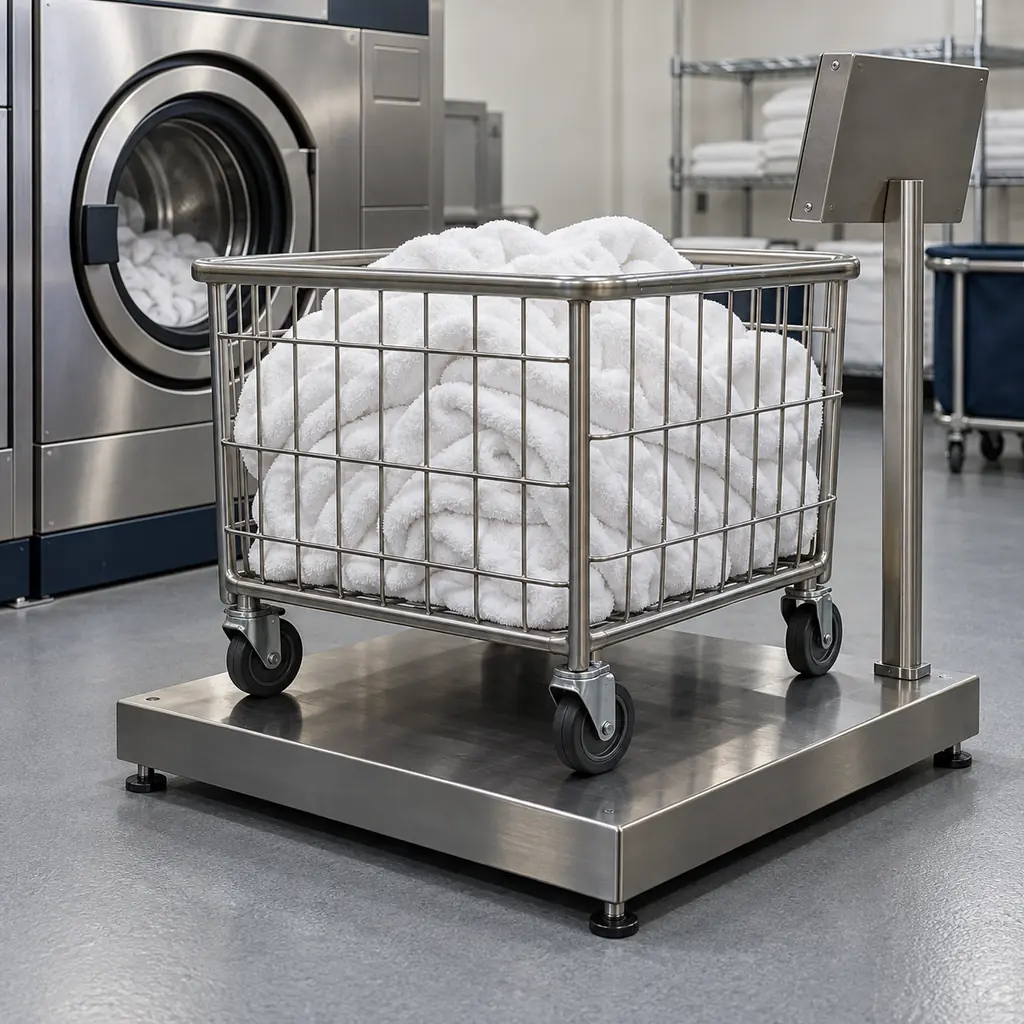
Measure Extraction by Residual Moisture
Evaluate extraction by the water remaining in a known textile load after the final spin. Residual moisture content, or RMC, expresses that retained water relative to a stated dry reference mass. A consistent weighing method makes the result more useful than comparing dampness by touch or comparing nameplate revolutions per minute. Record both the average result and the loads that leave unusually wet. A lower typical RMC can help the dryer, while occasional very wet batches can still disrupt the morning schedule. The dry reference, the textile mix, and the time between unloading and weighing must remain consistent for the comparison to mean anything.
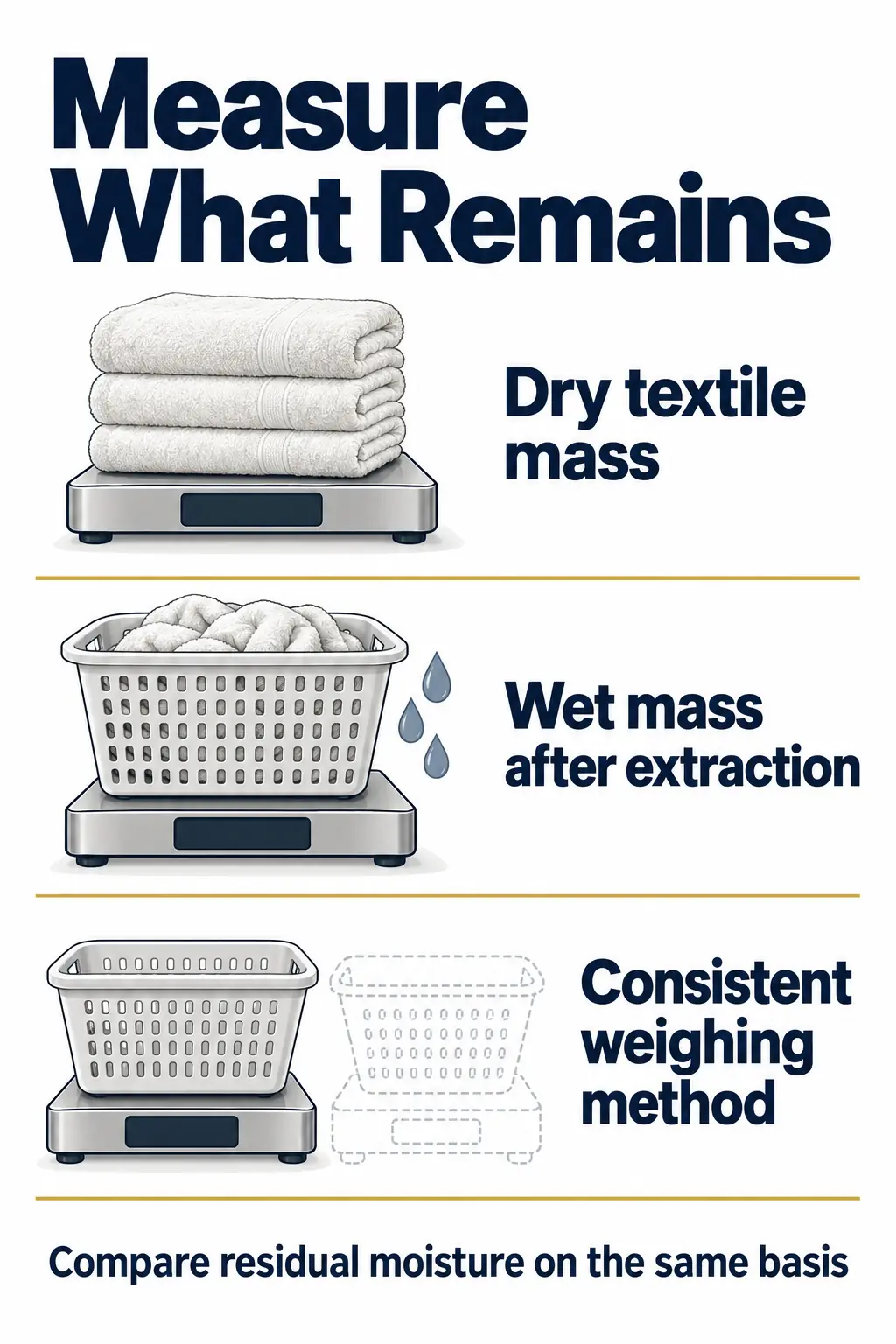
Use one moisture basis throughout
For a dry-basis calculation:
RMC (%) = (wet textile mass after extraction − dry reference textile mass) ÷ dry reference textile mass × 100.
Exclude the cart, basket, sling, and any other container from both weights. If the dry reference is 50 kg and the extracted textiles weigh 85 kg, retained water is 35 kg and RMC is 70%. That is a ratio to dry textile mass; it does not mean water is 70% of the wet load. On a wet-mass basis, the same water represents 35 ÷ 85, or about 41.2%.
The U.S. Department of Energy test procedure in Appendix J2, section 3.8 uses a bone-dry test-load reference for RMC. A hotel’s consistently conditioned, operationally dry reference is useful for internal comparisons, but it is not automatically equivalent to that laboratory basis. State your preparation and weighing method next to every reported percentage. Do not use a test standard’s laboratory drying conditions as instructions for hotel textiles.
For a practical site trial, use a representative, identified clean linen batch with a repeatable dry reference established under agreed conditions. Do not substitute incoming soiled-linen weight or the washer’s rated capacity for the known dry mass of that batch. Keep the pieces together and account for any removed or added items. Weigh promptly after extraction at a fixed point in the transfer process. Allowing one batch to drain in a cart for much longer than another changes the comparison. If you only establish moisture at the dryer inlet, label it dryer-inlet moisture rather than attributing all of the result to the washer.
Compare achieved extraction rather than maximum RPM
RPM measures drum speed. G-force describes the acceleration at the drum wall relative to gravity and also depends on drum radius. The physical relationship is G = angular speed squared × radius ÷ gravitational acceleration, using angular speed in radians per second, radius in meters, and gravitational acceleration of approximately 9.81 meters per second squared. Consequently, two drums at the same RPM can have different G-factors; at a fixed radius, increasing RPM increases G in proportion to RPM squared.
Even a valid G-factor does not predict RMC by itself. Time at extraction speed, load distribution, textile construction, and drainage also matter. The controlled test-cloth method in Appendix J3 varies extraction force and duration under defined conditions, illustrating why a single spin number cannot replace a defined test method. It is not a performance benchmark for a hotel towel load.
Record the selected program and, where the controls provide it, the achieved final speed and time at that speed. Note redistribution attempts, reduced-spin events, and aborts. As one equipment-specific example, Electrolux Professional’s Line 6000 description explains that its imbalance monitoring adjusts G-factor during extraction; this does not establish the performance of another model. An approved longer extraction may improve water removal, but any gain must be weighed against added washer occupancy and operating cost. There is no universally best G-factor or extraction duration for all hotel linen.
Keep textile differences visible
Compare towels with towels of the same construction and condition. Cotton terry, blends, bath mats, and robes can behave differently, and an average from mixed goods may not describe any one category well. Maintain approved loading limits and enough space for the equipment’s intended action; a fixed cart volume is not a reliable substitute for weighing.
If procurement is also changing towel dimensions or weight, treat that as a separate variable. The guide to hotel towel weight and dryer capacity explains the pieces-per-load issue. This extraction trial should first compare the same dry mass and textile specification, so the effect of retained water remains identifiable.
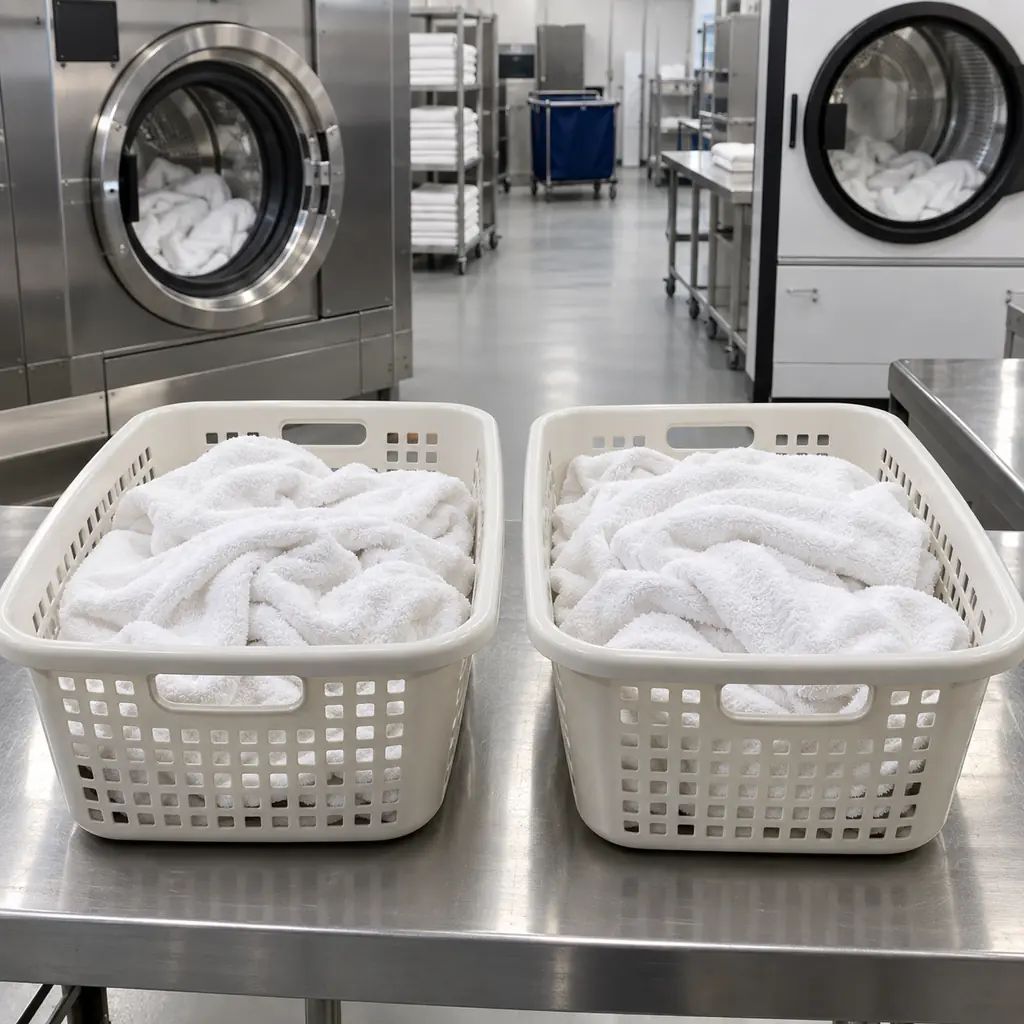
Run a Controlled Washer-to-Dryer Trial
Use a paired baseline-and-trial comparison that follows each load through washing, extraction, transfer, drying, and release. Change one manufacturer-approved setting or one documented maintenance condition at a time. Keep the linen specification, dry mass, wash formula, final drying endpoint, and measurement boundaries fixed. Alternating baseline and trial runs helps reduce the influence of a warming laundry room or a changing shift. Repetition matters because a single well-balanced spin can look excellent while routine production remains inconsistent. Judge the result from the paired differences and their spread, together with the actual number of acceptable batches completed before housekeeping needs them.
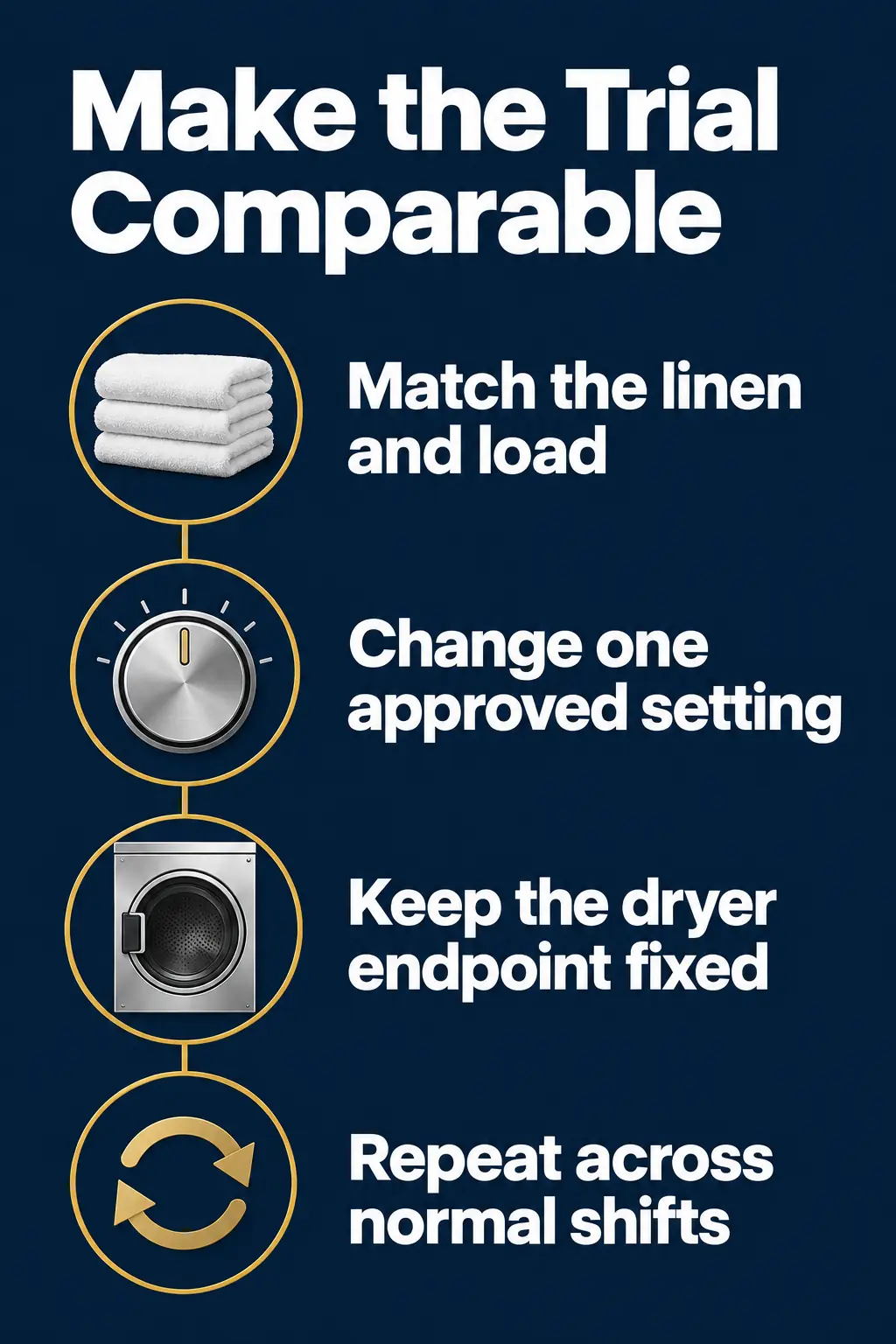
Define success before the first load
Choose the operational question. Are you trying to reduce dryer energy per kilogram, release a dryer sooner, eliminate wet batches, or meet a particular linen delivery deadline? Record the current result and the improvement that would justify the change. Also define acceptable finish, permitted textile wear or damage, maximum washer occupancy, and how much uncertainty is acceptable for the purchase decision.
Use the same approved dryer program and endpoint in both conditions. Do not shorten a timed program simply to manufacture a better result. If the test includes a separate dryer-control adjustment, record it as a second intervention. An automatic moisture program should still be checked against actual finish; a control display does not by itself prove that two loads left at the same moisture condition. Agree a repeatable release check, including representative hems, folds, and thick areas for damp patches. If final RMC is part of acceptance, weigh the complete identified batch after the same approved cooldown and handling interval, using the same dry reference. Record appearance, feel, and any repeat drying as well.
The trial must preserve the property’s required laundering and hygiene process. Changing extraction is not evidence that cleaning or disinfection has improved, and a lower-temperature or shorter wash is not part of this comparison. Keep adjustments within the exact equipment and textile suppliers’ limits, with qualified service support where needed.
Capture the same observations for each pair
The following record structure ties each result to the conditions that produced it. It is a measurement log, not a set of universal acceptance values.
| Measurement group | Record for baseline and trial | Why it matters |
| Load identity | Textile family, batch identifier, piece count, dry reference mass | Detects changes in the goods being compared |
| Washer operation | Model, program, approved setting, total cycle time, achieved spin information | Separates rated capability from actual production |
| Extraction outcome | Net wet mass, calculated RMC, weighing delay, reduced or aborted spins | Quantifies water and the variation behind it |
| Transfer | Unload time, dryer-load time, draining delay, splitting or combining | Preserves traceability between machines |
| Dryer operation | Model, dry-equivalent load, heat/program setting, endpoint, heating and cooldown time | Establishes a comparable finished result |
| Occupancy and output | Loading/unloading time, complete batches released, release time, queue length | Connects machine performance to the deadline |
| Energy and quality | Meter start/end values, electricity and fuel separately, finish, rework, damage | Prevents a time saving from being mistaken for a verified cost saving |
Use a scale suitable for the full load and a repeatable tare. Check its zero and repeatability before the trial. If a basket is weighed twice without changing the load and the difference is large relative to the expected water saving, fix the measurement problem first. Record meter identifiers and units, and ensure readings cover the same process boundary each time.
Repeat, retain failures, and inspect the spread
As an initial screening plan, consider six to ten matched pairs across normal shifts for one textile family. This is an editorial recommendation for organizing a pilot, not a statistical minimum or an industry standard. A noisy process, small expected benefit, or costly replacement decision may require substantially more observations.
Calculate each pair’s change in RMC, energy, and occupancy. Review the median difference and the range, and retain the individual readings. Do not report only the best cycle. Keep unbalanced, reduced-spin, and aborted loads in the operating record; if a procedural mistake justifies excluding a pair from the comparison, document the reason and report it separately. Otherwise, the trial can hide exactly the production failures a hotel needs to understand.
A small average improvement with several worse batches is a reason to investigate further. Repeat the trial after correcting obvious measurement or operating inconsistencies. Approve the change when the benefit is repeatable across representative conditions and the finished linen, rework rate, and deadline performance remain acceptable.
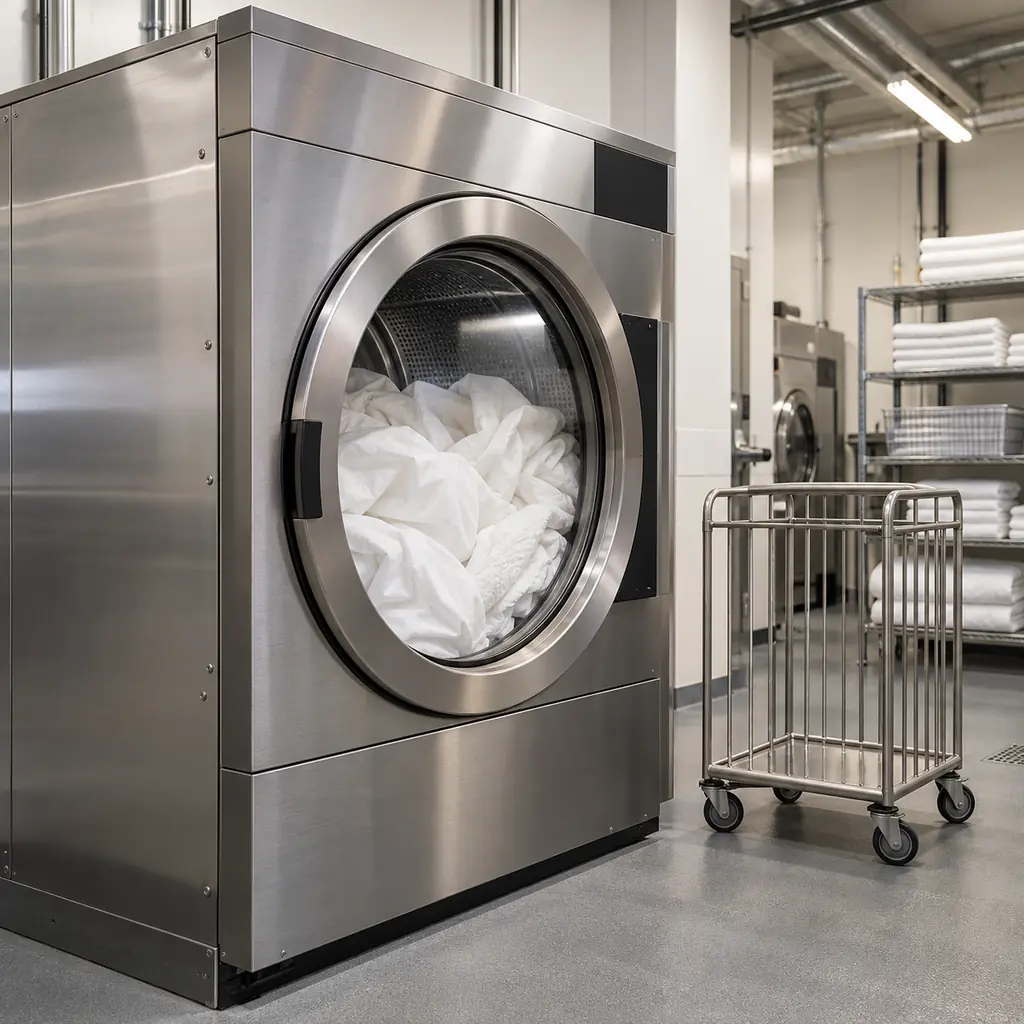
Calculate Dryer Energy and Capacity Effects
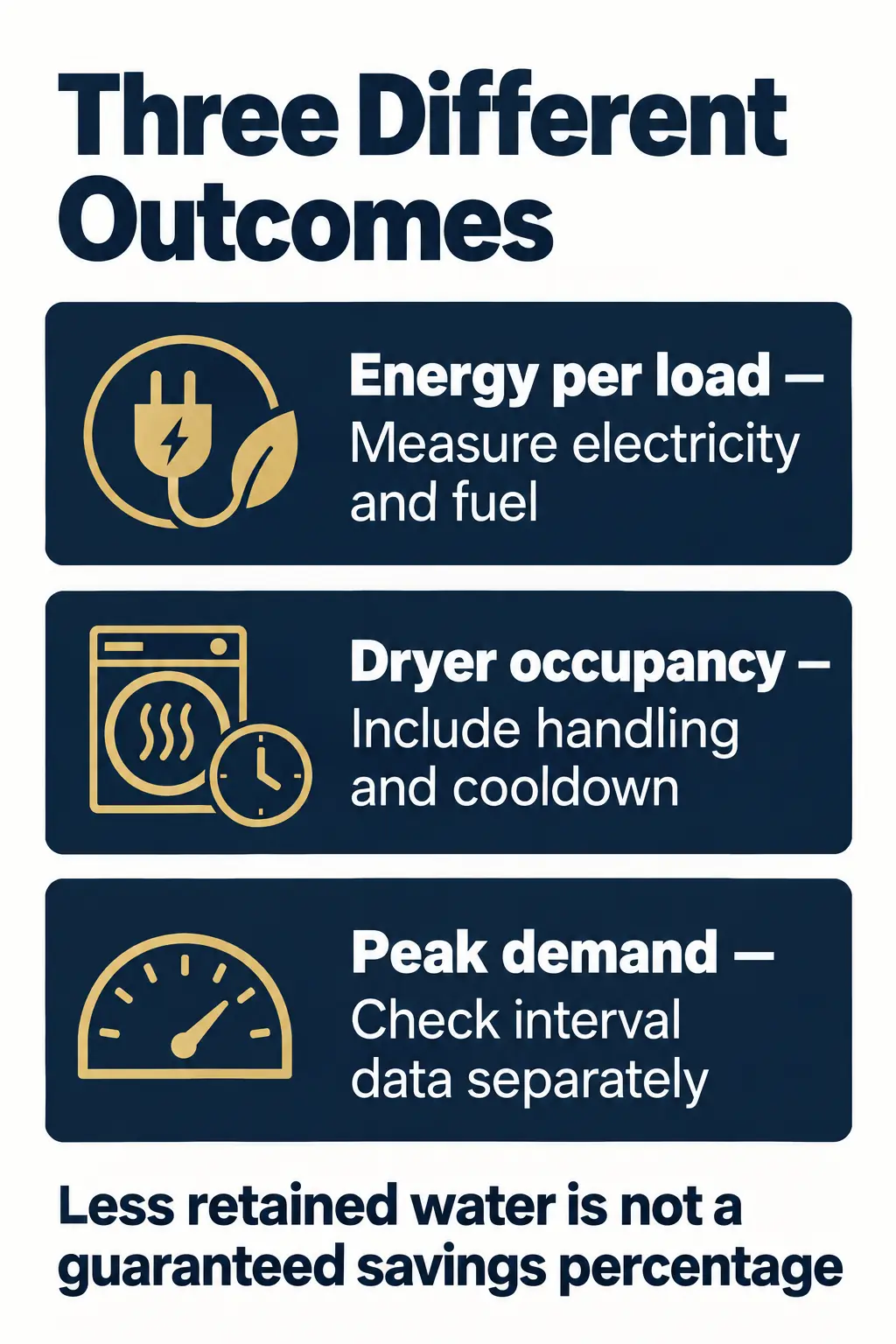
Translate the measured moisture difference into kilograms of water before translating anything into money. Water mass is a direct balance when dry textile mass and the moisture basis are consistent; drying time and energy require additional measurements. Separate the physical evaporation burden from the dryer’s occupied time and from the utility’s billing calculation. This prevents an attractive percentage reduction in retained water from becoming an unsupported energy-saving claim. Use the same finish endpoint in both conditions, measure electricity and fuel independently, and include any added washer time or energy. The worked example below shows the calculation without implying a guaranteed result for your equipment.
Work through a transparent water balance
Assume a 50 kg dry textile load, baseline RMC of 70%, trial RMC of 50%, and a final drying target of 5%, all on the same dry basis. These are illustrative inputs only. Assume no missing textiles, material loss, water addition, or meaningful moisture change during transfer; otherwise use the measured dryer-inlet mass. The 5% endpoint is not a recommended storage condition, hygiene criterion, or universal towel target; use the agreed finish for the actual textile and process.
Water to remove in drying (kg) = dry textile mass × (inlet RMC − final RMC) ÷ 100.
| Quantity | Baseline | Trial |
| Dry reference textile mass | 50 kg | 50 kg |
| RMC after extraction | 70% | 50% |
| Retained water after extraction | 35 kg | 25 kg |
| Wet textile mass entering drying | 85 kg | 75 kg |
| Water remaining at the illustrative 5% endpoint | 2.5 kg | 2.5 kg |
| Water to remove to reach that endpoint | 32.5 kg | 22.5 kg |
The trial sends 10 kg less water per batch to the dryer. That is a 20-percentage-point RMC decrease, a 28.6% reduction in the water initially retained, and a 30.8% reduction in the water that must be removed to reach the assumed endpoint. These percentages answer different questions. None establishes a 30.8% reduction in dryer energy or elapsed time.
At 20 comparable batches per day for 300 operating days, the assumed difference would be 60,000 kg of water per year removed before drying. This is a workload calculation, not a claim that the hotel saves 60,000 liters of fresh wash water. The water has been redirected to drainage earlier in the process; fresh-water consumption must be measured separately.
Measure net process energy and cost
Record dryer electricity in kWh per completed load and the appropriate fuel quantity separately. A gas dryer still uses electricity for motors and controls. For steam equipment, use measured steam or a documented allocated thermal cost with a clearly stated system boundary. A boiler’s total fuel use includes other demands and cannot be assigned to one dryer without an allocation method.
For each energy stream, subtract trial consumption from baseline consumption and multiply by the applicable unit cost. Add dryer and washer electricity within the same electrical boundary; subtract any extra extraction electricity from the dryer saving. Include measured changes in rework, maintenance, and paid labor only when they are supported. Minutes released on a machine are not automatically payroll savings.
As a separate arithmetic example for an electrically heated dryer, suppose hypothetical meter readings showed a 6.0 kWh dryer reduction per batch and a 0.2 kWh increase at the washer. Net electricity reduction would be 5.8 kWh per batch. At an assumed US$0.15/kWh, that is US$0.87 per batch, or US$5,220 over 6,000 comparable batches. Those inputs are hypothetical and are not derived from the water-balance percentages. They do not apply directly to a gas-heated dryer.
For a preliminary simple payback, divide incremental installed cost by positive annual net savings. Include installation, commissioning, training, and any required service changes in that cost. Do not include a demand-charge saving without evidence, or count the same capacity gain as both avoided equipment and extra revenue without checking the scenario. Where net savings are zero or negative, there is no positive simple payback from those inputs.
Calculate occupied time and identify the bottleneck
Dryer occupancy runs from the beginning of loading until the machine is ready for the next load. Include heating, any required cooldown, unloading, and handling that actually blocks the machine. Preserve manufacturer-required cooldown and safety procedures. A timer labeled “drying time” may cover only part of this interval.
For a continuously supplied dryer, potential throughput is dry textile mass per batch × 60 ÷ occupied minutes per batch. If a 50 kg batch occupies a dryer for 50 minutes at baseline and 42 minutes in the trial, the corresponding continuous rates are 60 and about 71.4 kg per hour. These are illustrative machine rates, not promises about completed loads in a short shift.
Now consider a washer feeding that dryer. At 50 kg every 45 minutes, the washer’s continuous rate is about 66.7 kg per hour. If longer extraction makes its cycle 49 minutes, that falls to about 61.2 kg per hour. The nominal dryer gain could therefore yield only a small system gain: the slower stage has moved upstream. With multiple washers, dryers, shared staff, and batch splitting, use a timed schedule of actual arrivals and releases rather than comparing two isolated rates.
Count complete batches released before the hotel’s real deadline, including initial queues, breaks, transfers, and downstream folding. Spare dryer capacity is useful only if the laundry can supply it and housekeeping can use the released linen.
Keep electrical peak demand separate
Energy in kWh and demand in kW are different billing quantities. DOE FEMP’s explanation of electricity bills distinguishes consumption from demand charges and their applicable tariffs. Shorter dryer operation may reduce kWh while leaving the site’s billing peak unchanged if the same equipment still runs together during the peak interval.
Review the actual tariff and interval data before assigning demand savings. A gas input rating is not electrical kW, and a dryer’s nameplate electrical rating is not proof of its contribution to the hotel’s peak. Report energy savings and any verified peak-demand effect separately.
The accompanying workbook calculates the water balance and provides fields for measured energy, cost, occupancy, and paired trial observations. Energy inputs are left unfilled so the example cannot be mistaken for observed savings. Use consistent units and the same measurement boundary in both conditions.
Diagnose Limits and Compare Equipment
If an extraction adjustment or a higher-rated machine does not deliver the expected result, locate the limiting step before changing the purchase specification. Excess water can originate in poor extraction, but slow drying can also reflect load size, restricted airflow, insufficient heat, or an unsuitable endpoint. A faster dryer may still leave housekeeping waiting if transfers or finishing are slow. The useful comparison combines achieved residual moisture, normal cycle reliability, equipment compatibility, and delivered output. Use the exact model’s operating and installation documents, and involve a qualified technician when checks require access to moving parts, electrical systems, burners, or other protected components.
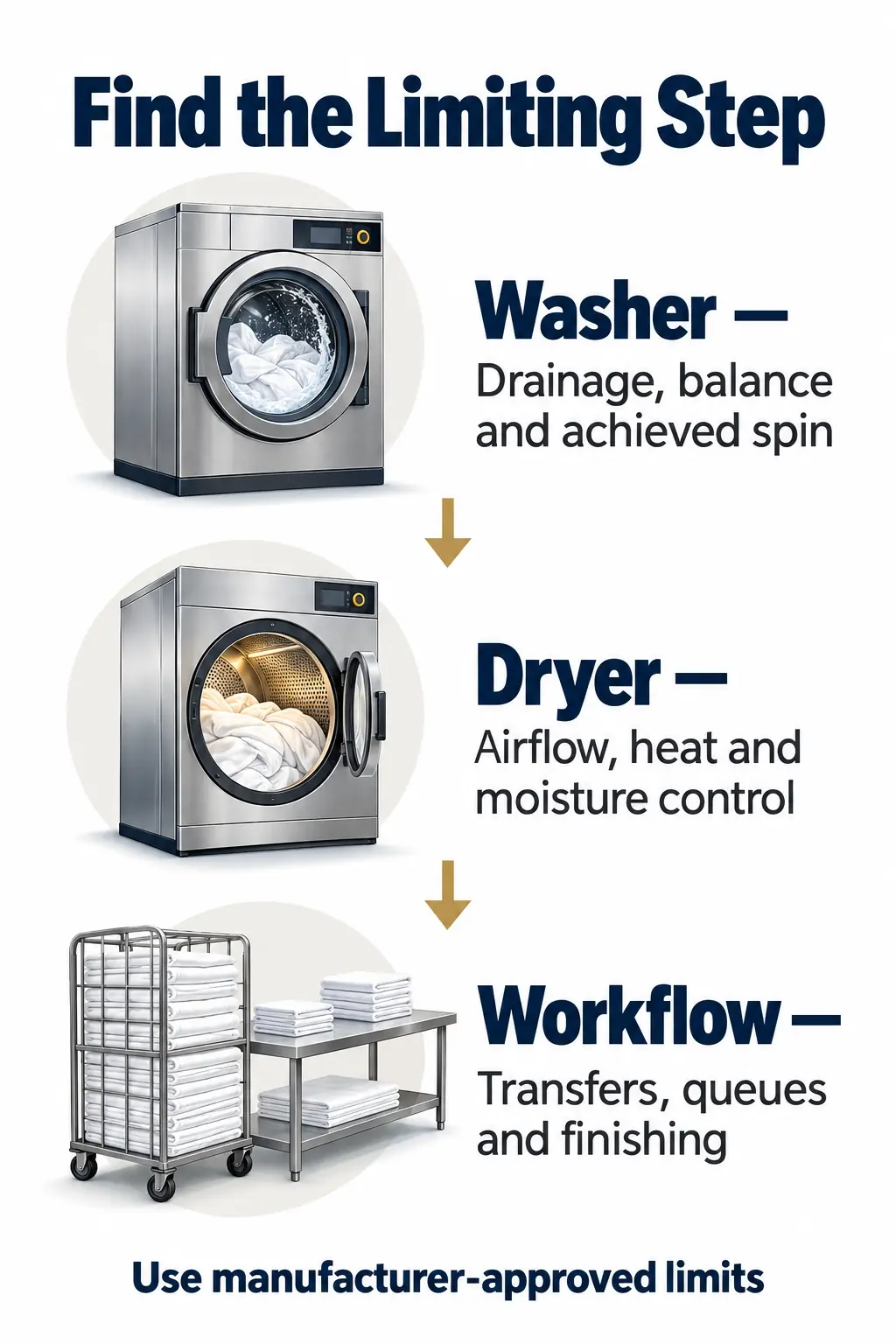
Read symptoms as hypotheses
Alliance Laundry Systems’ tumble-dryer troubleshooting manual identifies retained water, overloading, exhaust restrictions, and makeup-air problems among causes of long drying. It supports checking the whole process; it does not establish that a particular fault exists at your property. The following table organizes observations into questions to investigate under the applicable equipment instructions.
| Observed result | Plausible explanation | Useful next comparison |
| RMC varies widely between similar loads | Load distribution, interrupted extraction, inconsistent weighing, or drainage problems | Compare spin-event records and weighing delays with each load’s RMC |
| RMC improves but heating time does not | Timed program unchanged, endpoint inconsistency, or a different dryer constraint | Compare actual final condition, control behavior, airflow, and heat delivery |
| Dryer time improves but linen delivery does not | Washer, transfer, folding, staffing, or stock availability is limiting | Follow batch release times through the complete production window |
| Higher extraction adds time with little RMC change | Limited additional water removal for that textile and condition | Compare incremental water removal against added washer occupancy and energy |
| Apparent savings accompany damp patches or more rework | Endpoint or load handling changed | Restore comparable finish criteria and include all repeat drying |
Do not use this table to bypass interlocks, defeat unbalance protection, increase speed beyond the approved program, or alter required ventilation. A maintenance repair and a new extraction program are separate changes; measure them separately if you want to know which one created the improvement.
Ask suppliers for comparable evidence
Request a test description alongside every RMC or drying-time claim: textile type and condition, dry reference method, dry load mass, program, achieved extraction speed or G, duration, final rinse conditions, number of runs, and range of results. Ask whether the quoted outcome includes reduced-spin or failed cycles. Compare both machines under the same conditions where practical, preferably with representative hotel linen.
Require model-specific installation information, including foundation and anchoring requirements, dynamic loads, utilities, drainage, access, service clearance, and the applicable operating limits. A machine’s advertised extraction capability is not permission to install it on an unsuitable floor. Confirm who is responsible for local installation requirements, commissioning, operator training, parts availability, and service response.
Consider lifecycle effects beyond utility cost. Monitor visible damage, linting, guest-facing finish, rewash, and replacement patterns during a longer acceptance period. A short pilot can demonstrate immediate moisture and timing effects; it cannot prove a textile’s full service life. Do not assume every product can tolerate the same extraction setting.
When linen specifications are part of the project, use the bath linen product categories to separate towels, bath mats, and robes in the sourcing brief. Keep their trial results separate too. This gives procurement a clearer requirement than one average moisture target covering every item in the laundry.
Conclusion
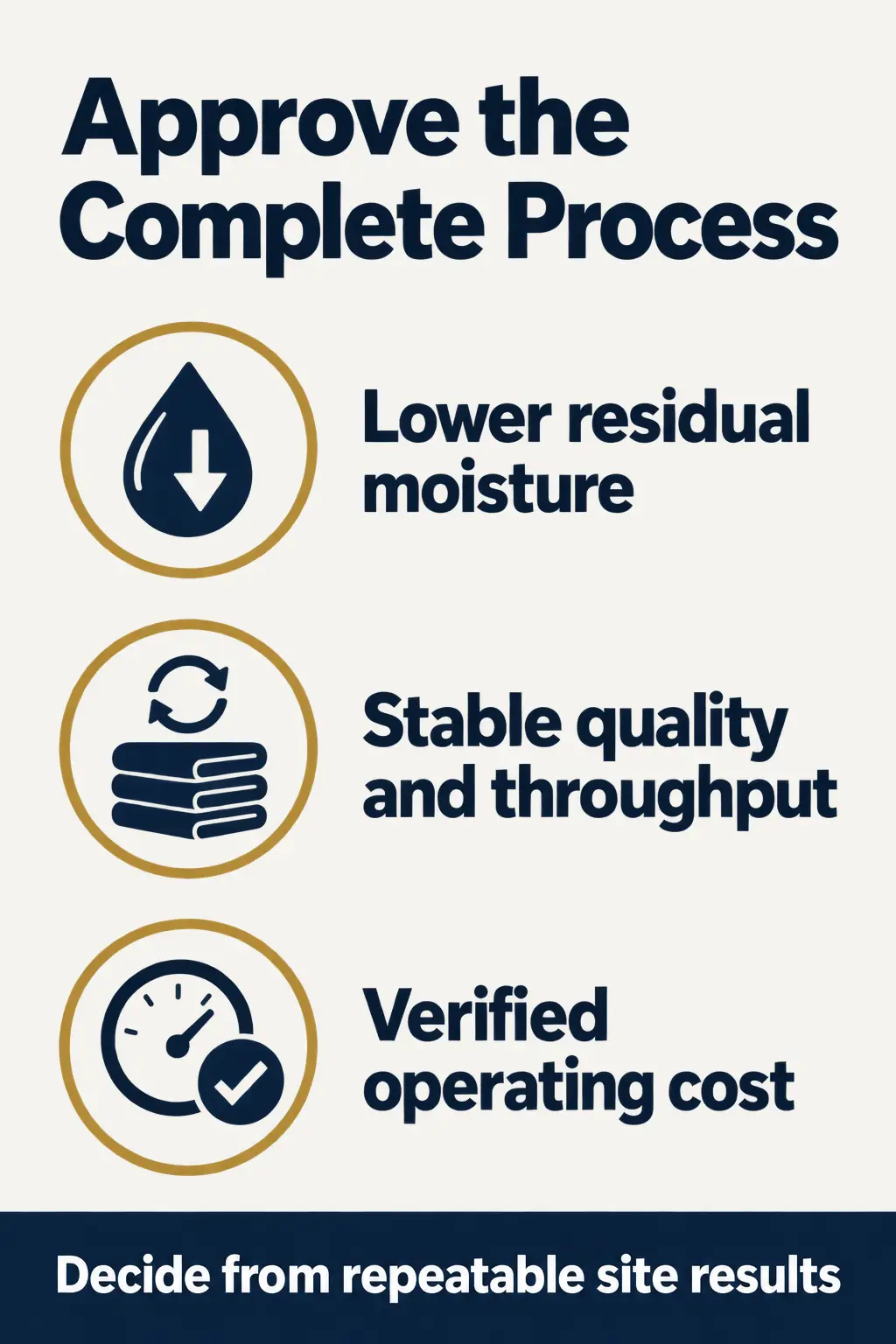
Approve washer extraction performance through a repeatable process result: less retained water in comparable loads, an acceptable finished textile, and a measurable benefit in energy, capacity, reliability, or deadline performance. Keep those benefits separate in the business case and include any extra washer time or operating cost. The best setting is the one that improves the whole laundry within approved equipment and textile limits. A lower RMC is useful evidence, but the final decision should also reflect variation, rework, service support, and the batches that actually reach housekeeping when required. A controlled site trial provides a more defensible purchasing basis than a maximum-spin specification alone.
For an equipment or linen sourcing project, request a quote from KW Hospitality with your textile mix, dry load sizes, current equipment, measured trial results, utility requirements, delivery location, and target schedule. Ask suppliers to state their test conditions and acceptance commitments in writing so the quotation can be evaluated against the same operational requirement.
Frequently Asked Questions
What is a good residual moisture percentage for hotel towels?
There is no single percentage that is suitable for every towel, machine, and test method. Compare the actual towel construction under its approved program using one dry-reference basis. Set an acceptance range from representative trials and a documented supplier commitment, then check whether it supports the required finish and production schedule. A laboratory figure using different test cloths or conditioning should not become your operating target without verification.
Can a gas dryer benefit if its electrical demand barely changes?
Yes. Less water to remove may reduce fuel consumption or occupied time even when motor electricity changes little. Measure gas and electricity separately and compare the same finished load. Those operating benefits do not establish a reduction in the hotel’s billed electrical peak demand.
Should every load receive the longest available final spin?
No. Additional approved extraction time may remove little extra water for a particular load while delaying the washer’s next batch. Compare the incremental RMC change, washer occupancy, and downstream benefit. The longest available setting may also be inappropriate for particular textiles or programs. Use the equipment and textile suppliers’ limits as constraints on the trial.
What if the dryer splits one washer load into two batches?
Track both dryer batches back to the same washer load. Record each batch’s dry-equivalent mass, energy, occupied time, and finish, then combine their energy for the washer-load comparison. Do not sum parallel dryer times and describe the result as elapsed completion time; the schedule determines when the full load becomes available.
Can these calculations be used for sheets sent to an ironer?
The water balance can still describe moisture, provided the reference basis is consistent. The finishing target and equipment sequence are different, however. Some goods enter an ironer with deliberate moisture remaining. Assess the complete extraction, conditioning, ironing, and finishing route instead of applying a towel-dryer endpoint to flatwork.
Is a pilot enough to justify removing a dryer?
Usually it is only an input to that decision. Test peak occupancy days, realistic textile mixes, staff availability, maintenance downtime, and the reserve capacity needed when another machine is unavailable. A continuous-rate improvement during a short trial does not prove that the hotel can remove redundancy and still meet every linen deadline.
References
1. U.S. Department of Energy — Uniform Test Method for Measuring the Energy Consumption of Automatic and Semi-automatic Clothes Washers (Appendix J2)
2. U.S. Department of Energy — Test Cloth Specifications and Procedures for Pre-Conditioning and Determining Correction Coefficients of New Test Cloth Lots (Appendix J3)
3. Electrolux Professional — Line 6000 Solutions
4. U.S. Department of Energy, Federal Energy Management Program — Evaluating Your Utility Rate Options
5. Alliance Laundry Systems — Tumble Dryers Troubleshooting, Part No. 70410501R1