Boiler-based steam cookers deserve a place on a hotel kitchen shortlist when repeated, time-critical batches justify their steam supply and installed infrastructure. A connectionless steamer deserves consideration when its tested output meets the menu and avoiding a permanent water connection has practical value. Neither design wins on its name alone. The useful comparison is acceptable food delivered during the busiest service window, together with the full cost of producing it.
The terminology needs care. Boiler-based describes how steam is generated and delivered. Boilerless means steam is produced in a reservoir within the cooking compartment. Connectionless commonly describes a manually filled boilerless unit, while other boilerless units have automatic water and drain connections. Treat steam generation, water supply, drainage, and energy source as separate specification fields. Otherwise, a purchase can satisfy the requested label yet require unexpected plumbing or operating work.
For a hotel, the decision crosses departments. The executive chef needs consistent texture and timely replenishment. Engineering needs compatible services and maintainable equipment. Stewarding needs a workable cleaning routine. Procurement needs comparable quotations, and finance needs assumptions that survive scrutiny. A lower equipment price or water figure answers only part of those needs, particularly when a steamer serves breakfast, banquets, staff meals, and restaurant orders on the same day.
This guide focuses on commercial compartment steamers for North American hotel kitchens. Pressure steamers and combination ovens require separate comparisons. It explains the equipment distinctions, maps the utility and labor costs, and shows how to test production without treating pan capacity as hourly output. A worked example and editable comparison workbook make the method usable before requesting final quotations. All example operating figures and prices are hypothetical; they are not manufacturer ratings, measured hotel results, or promises of savings.
Understand the Three Steam Supply Arrangements
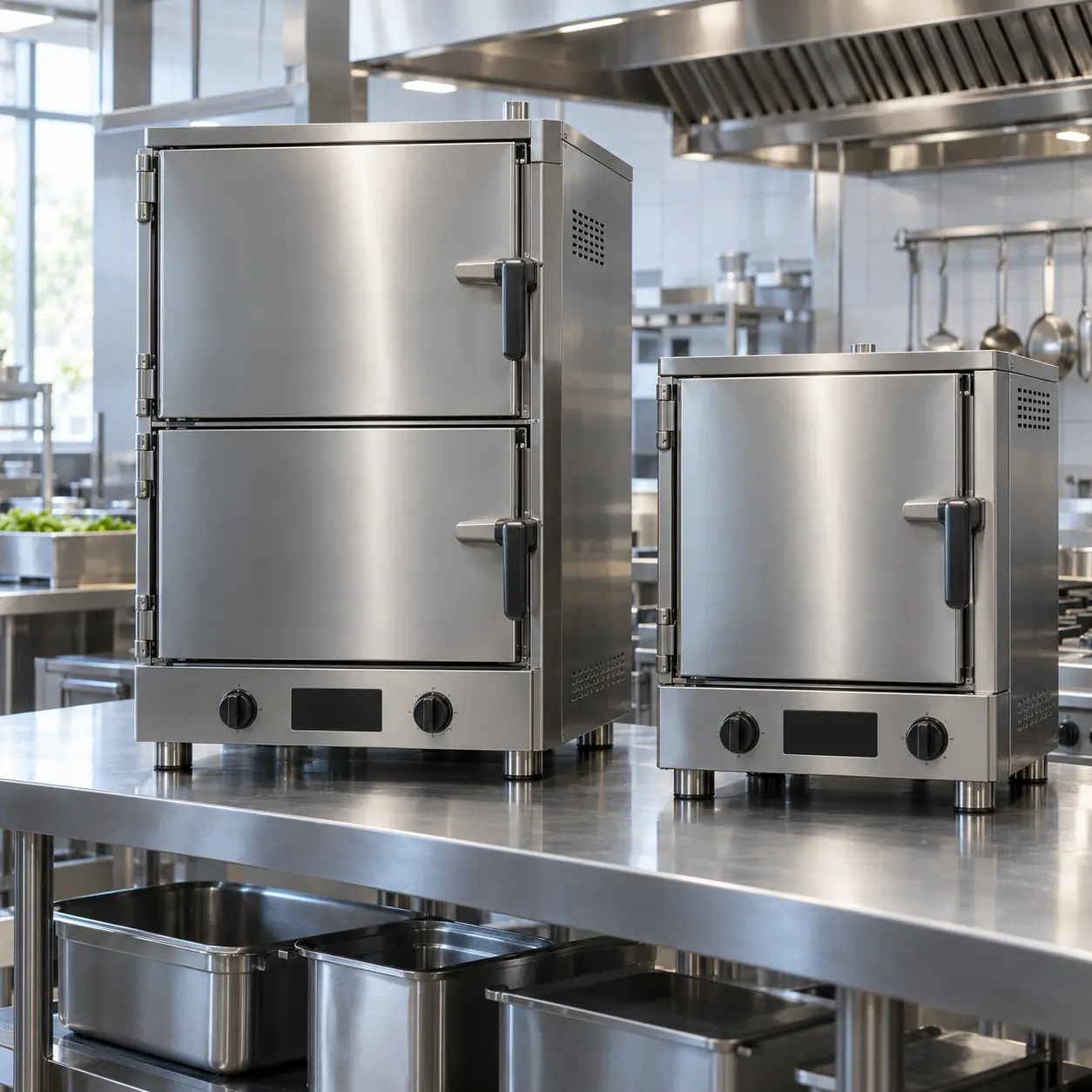
Start by describing the equipment physically, then attach the supplier’s category name. Identify where water becomes steam, how fresh water enters, where wastewater goes, and which energy source runs the unit. That description makes competing quotations easier to reconcile and helps engineering identify missing work. The EPA’s commercial steam cooker guidance distinguishes boiler-based equipment from boilerless equipment, including manually filled connectionless versions. For procurement, retain the actual model number and configuration beside that description. A family name or photograph is insufficient evidence of the connections supplied with a particular model.
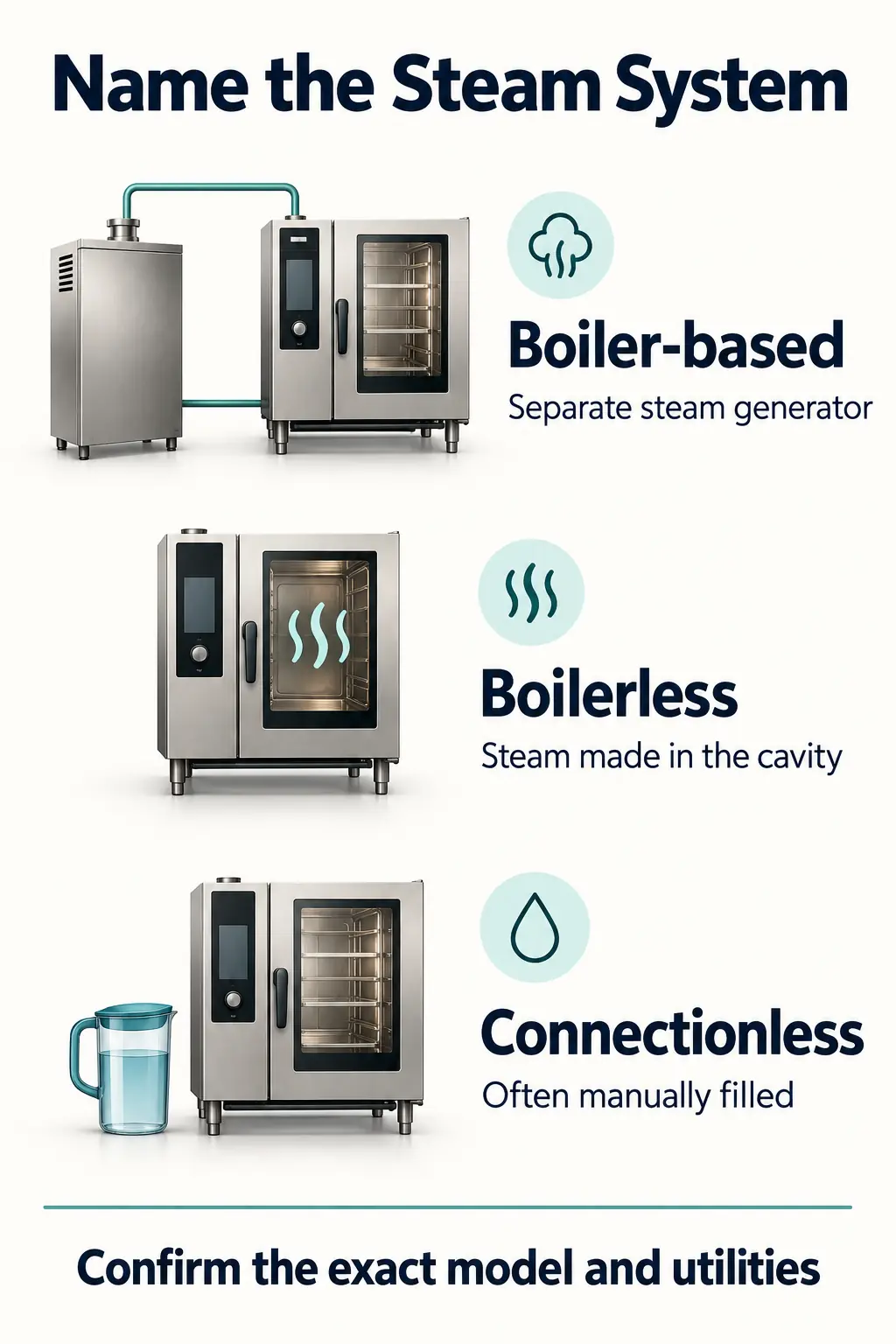
Boiler based equipment
A boiler-based steamer receives steam from a generator outside the food cavity. The generator may be built into the appliance or supplied by a central system. A directly connected central source must provide steam suitable for food contact; the existence of a building boiler does not establish that suitability. Specify the steam conditions and connection requirements with the equipment supplier and project engineer.
For the buyer, the important distinction is the complete system being purchased. A self-contained electric generator, a gas-fired generator, and a direct-steam appliance can place costs in different parts of the property. A direct-steam unit’s small local electricity reading does not account for boiler fuel, distribution losses, or associated water treatment. Include those costs in the comparison boundary.
Connected boilerless equipment
Boilerless does not mean plumbing-free. For example, Cleveland’s 22CET6.1 SteamChef product documentation describes automatic water filling and draining, a drain connection, and a cold-water condenser. That is a useful counterexample to the assumption that every reservoir steamer eliminates drain or cooling-water requirements. Verify the particular design rather than applying a generic boilerless description to the whole category.
A connected boilerless model is a legitimate third candidate when manual refilling would interfere with service. Its operating cost and recovery still need testing. Automatic filling is a feature to evaluate, not proof of either high or low total water consumption.
Manually filled connectionless equipment
Connectionless generally concerns the water installation, not the absence of electricity, cleaning, or wastewater. Cleveland’s 22CCT6 SteamChef documentation describes manual filling and draining without a required water or drain connection, using a drain pan. It also specifies electrical service. Even where a permanent drain connection is unnecessary, staff need an approved method and location for emptying and cleaning the unit.
| Arrangement | What to establish | Main question for the hotel |
| Boiler based | Generator location, fuel or power, steam and drain services | Can the full system support the required service economically? |
| Connected boilerless | Automatic fill, drain, and any condenser connections | Does automation reduce operating interruptions enough to justify the installation? |
| Manually filled connectionless | Power, reservoir operation, refill and emptying method | Can the team sustain peak service within the manual operating routine? |
Keep the comparison within the same cooking task. A six-pan label refers to a stated pan arrangement, not six identical batches per hour. Changing pan depth, food loading, or the appliance’s cooking modes changes the comparison. When coordinating other commercial cooking equipment, evaluate the steamer’s actual place in the line rather than selecting it as an isolated appliance.
Compare the Full Utility and Labor Burden
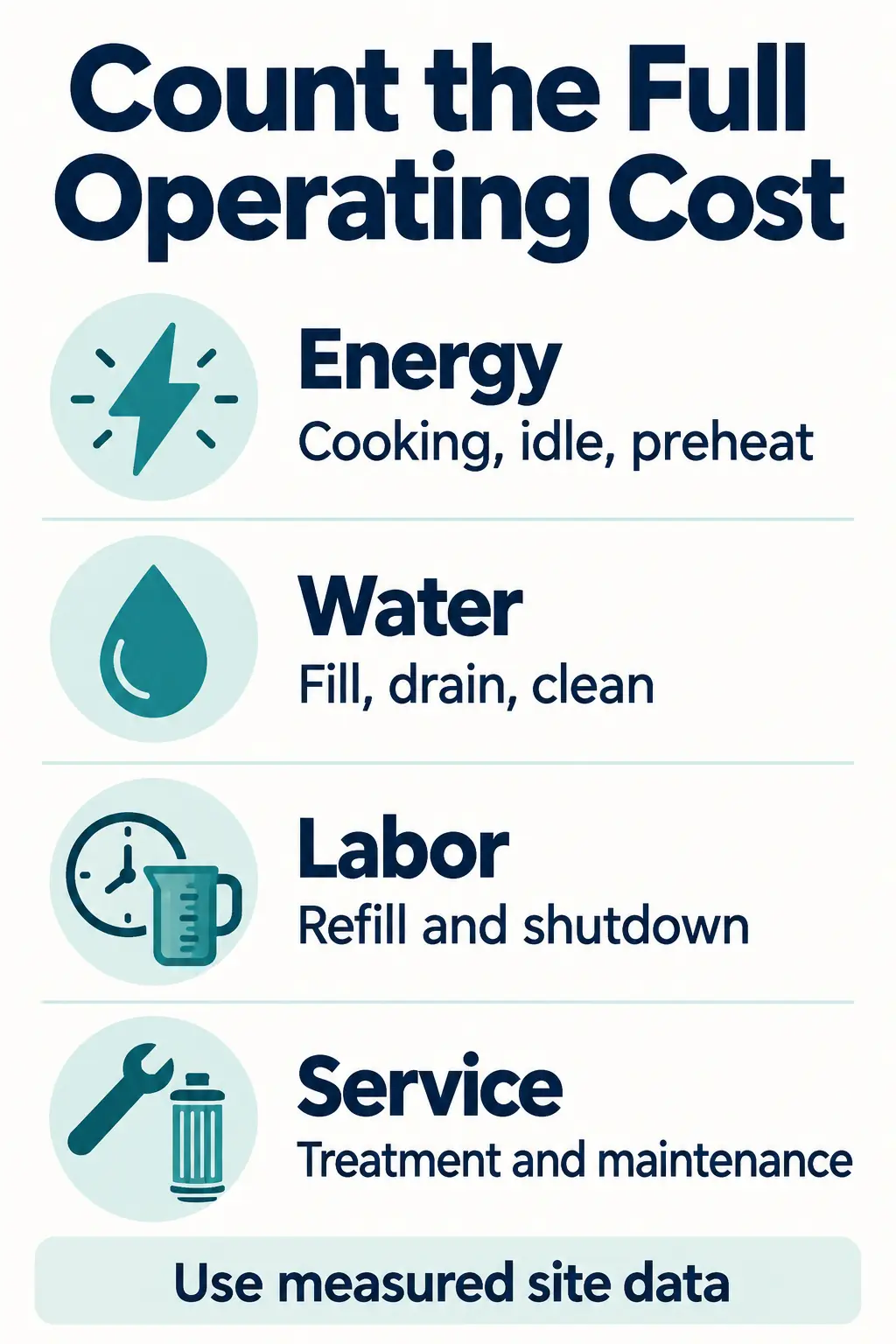
Build the cost comparison around a representative operating day with the same menu, accepted output, and service schedule for each candidate. Include startup before breakfast, waiting between services, production, refilling, shutdown, and cleaning. A meter reading during one cooking cycle cannot describe that whole day. Keep energy, water, labor, and maintenance visible as separate cost lines so the team can see why a result changes. Use the hotel’s current tariffs and wage assumptions in one currency. Where a trial is unavailable, label supplier estimates clearly and test a range rather than reporting a precise annual saving as established fact.
Installation changes the initial comparison
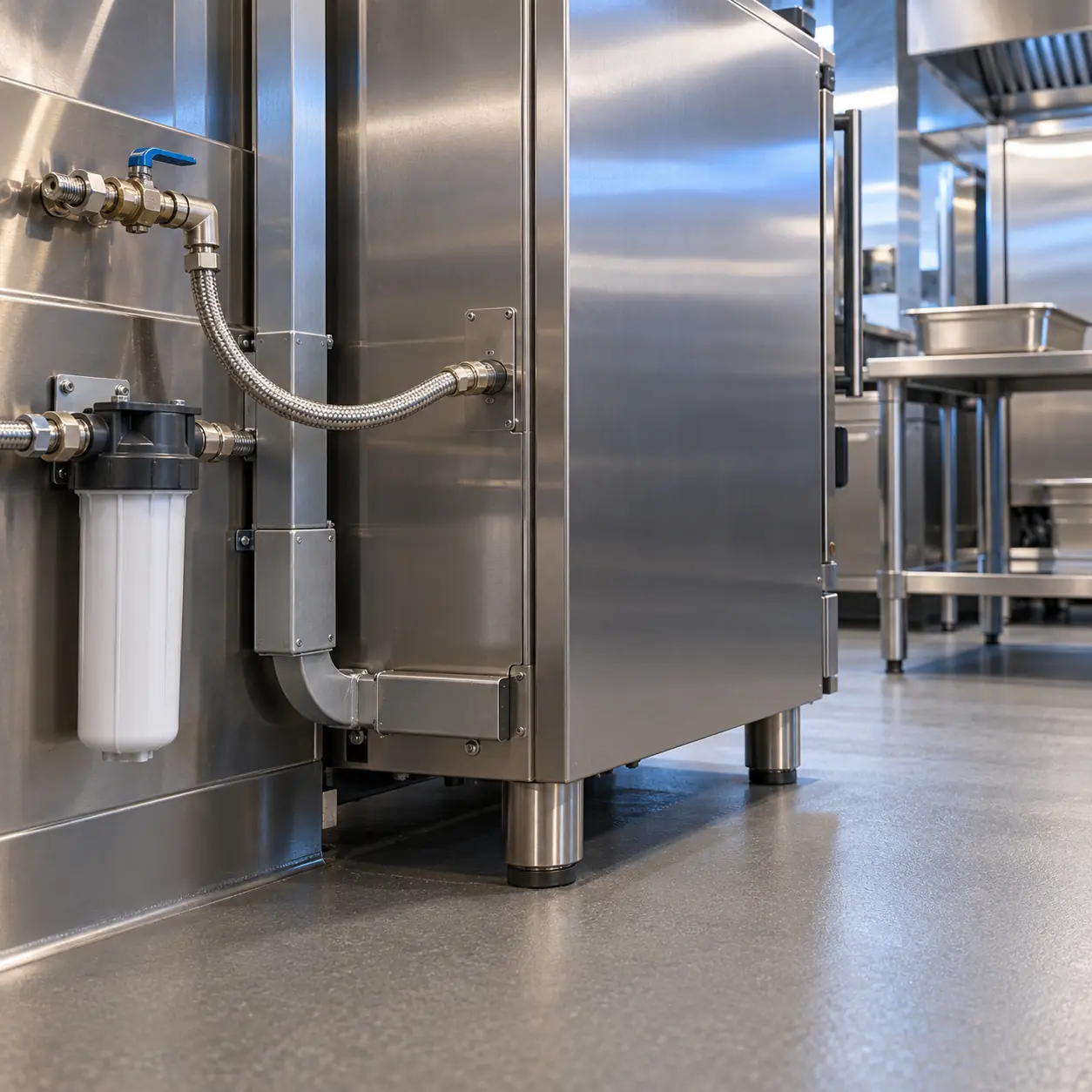
Request a written site assessment covering voltage, phase, circuit capacity, gas where relevant, equipment clearances, ventilation, drainage, and access for service. A connectionless model may avoid a permanent water line while still requiring an electrical upgrade. A boiler-based replacement may reuse some infrastructure but require changes for a different model. Price the specific work after the site is reviewed.
Do not infer a hood exemption from the word connectionless. Review the exact appliance listing, manufacturer’s installation instructions, proposed cooking use, and requirements accepted by the local authority. Gas supply and combustion arrangements also depend on the model. For example, the Vulcan C24EO Series Installation & Operation Manual notes that local codes may require an exhaust hood and specifies a vented drain arrangement. These instructions apply to the covered models. The final installation scope should identify responsibility for each connection and approval; compare commissioning and equipment prices on the same basis.
Account for every water stream
Record initial fills, replenishment, boiler blowdown where applicable, condensate cooling, shutdown rinses, manual emptying, and cleaning. Add attributable treatment-system water if it is material. Avoid counting a measured whole-day total and then adding its component streams again. If only hourly rates are available, distinguish cooking hours from standby hours and establish whether the quoted rate includes ancillary uses.
Water quality deserves a separate line of inquiry. Obtain the site’s water analysis and the exact model’s allowable limits, then have the treatment supplier propose a compatible approach. “Filtered water” does not specify which constituents are removed. Budget cartridges, treatment maintenance, and descaling alongside consumption. The Vulcan C24EA Series manual, for example, distinguishes treated generator water from a separate untreated supply and explains that particle filtration does not remove minerals. Map each connection before costing treatment. Use the manufacturer’s schedule and site conditions; a generic calendar cannot establish the right cleaning interval for every installation.
Compare energy under the same conditions
The ENERGY STAR Version 1.2 steam cooker criteria distinguish heavy-load cooking efficiency from idle energy. They specify minimum cooking efficiency of 50% for electric units and 38% for gas units, with idle limits varying by pan capacity. These are qualification criteria, not a prediction of the hotel’s annual energy bill. The specification does not establish a universal gallons-per-hour water limit.
For the exact candidate, request the applicable certification record and test results, then evaluate the expected operating schedule. The U.S. Department of Energy’s purchasing guidance includes preheat, active cooking, and idle energy in its modeled annual use. Apply that same whole-day logic using local inputs. Nameplate kilowatts describe rated input; multiplying them by every open hour assumes continuous full-power operation and can misrepresent consumption.
For gas equipment, record gas in the billed unit and include ancillary electricity. For direct-steam equipment, allocate generation and distribution costs consistently with the alternative. Add demand charges only where the purchase changes the property’s billed demand, using engineering and tariff analysis. Do not compare a boiler’s fuel input with another steamer’s local electricity while excluding the first unit’s upstream losses.
A hypothetical cost comparison
Consider two electric candidates that both pass the same production trial. Assume 300 operating days per year, electricity at $0.15/kWh, combined water and sewer at $12 per 1,000 US gallons, and loaded operator labor at $25/hour. All dollar amounts in this example are USD. The inputs below are invented to demonstrate the calculation; they do not represent typical consumption or a named product. Daily labor includes attributable filling, emptying, and routine cleaning, counted consistently for both candidates.
| Input or calculated cost | Boiler based candidate | Connectionless candidate |
| Measured or assumed electricity per operating day | 60 kWh | 45 kWh |
| Total water per operating day | 120 US gal | 30 US gal |
| Routine operator labor per day | 10 minutes | 25 minutes |
| Maintenance allowance per year | $600 | $400 |
| Annual electricity cost | $2,700 | $2,025 |
| Annual water and sewer cost | $432 | $108 |
| Annual routine labor cost | $1,250 | $3,125 |
| Annual operating cost including maintenance | $4,982 | $5,658 |
Annual operating cost equals operating days multiplied by the sum of daily energy, daily water and sewer, and daily routine labor costs, plus annual maintenance. For example, boiler-based water cost is 120 × 300 × $12 ÷ 1,000 = $432. Its labor cost is 10 ÷ 60 × $25 × 300 = $1,250. The same unit conversions apply to the other candidate.
In this example, the connectionless candidate saves $999 per year in utilities and $200 in maintenance, but its additional routine labor costs $1,875. Its resulting annual total is $676 higher. At these assumptions, the additional labor could be about 9.6 minutes per day before it consumes the $1,199 utility-and-maintenance advantage. The assumed extra 15 minutes exceeds that break-even point. This result illustrates sensitivity to the work routine; it does not establish that connectionless steamers always require more labor.
Suppose installed prices are $12,000 and $10,000 respectively. The boiler-based candidate’s $2,000 premium has a simple payback of approximately 3.0 years from the assumed $676 annual operating saving. If output is unequal, the saving is uncertain, or annual savings are zero or negative, that payback comparison is not valid. Simple payback also omits financing, discounting, tax, residual value, downtime, and tariff changes.
The workbook reproduces this example, allows separate gas and electricity inputs, and keeps peak output distinct from annual cost. Replace its illustrative values with comparable quotations and site measurements. Its life-of-use total is an undiscounted planning estimate, not a full financial valuation.
Test Production Against the Hotel’s Peak Service
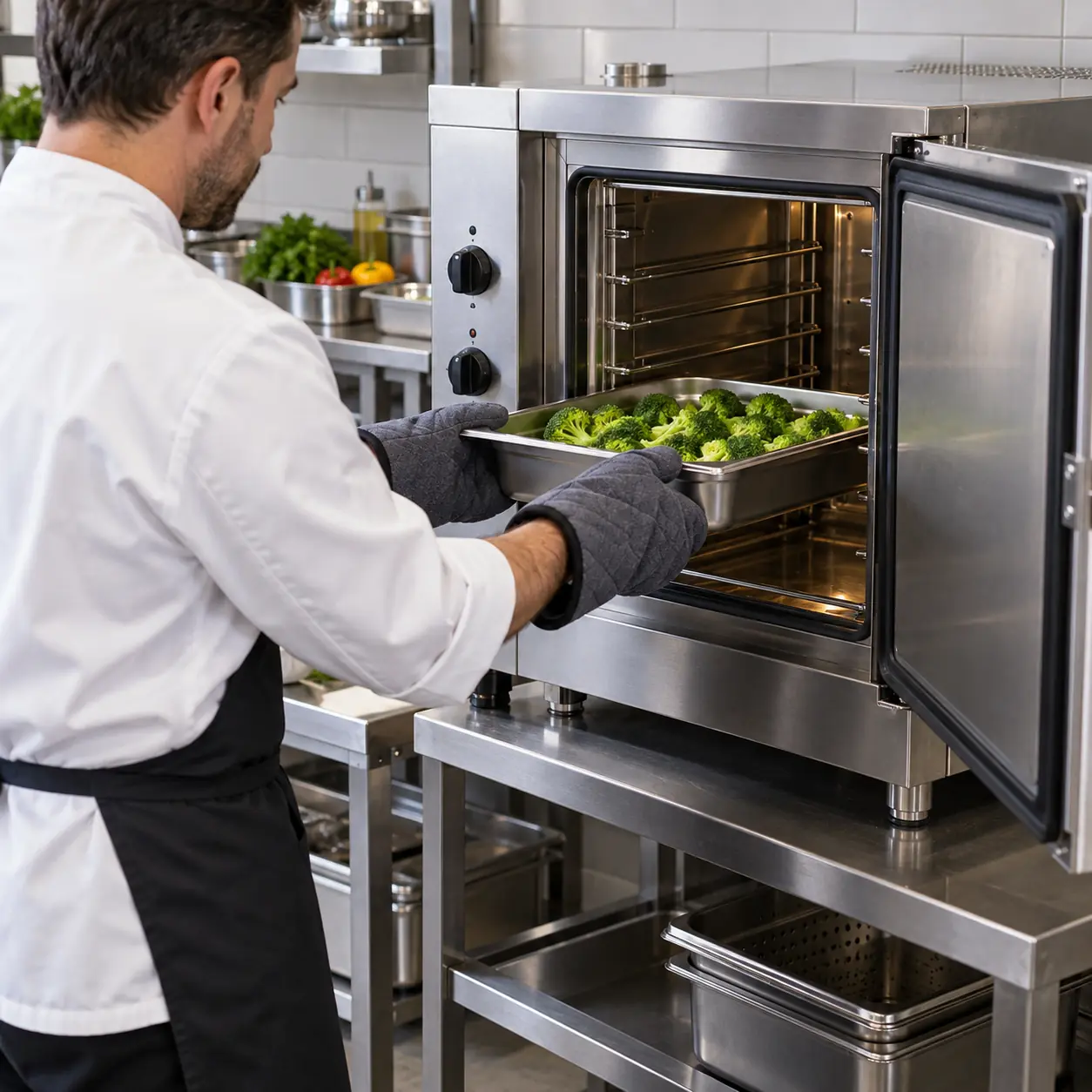
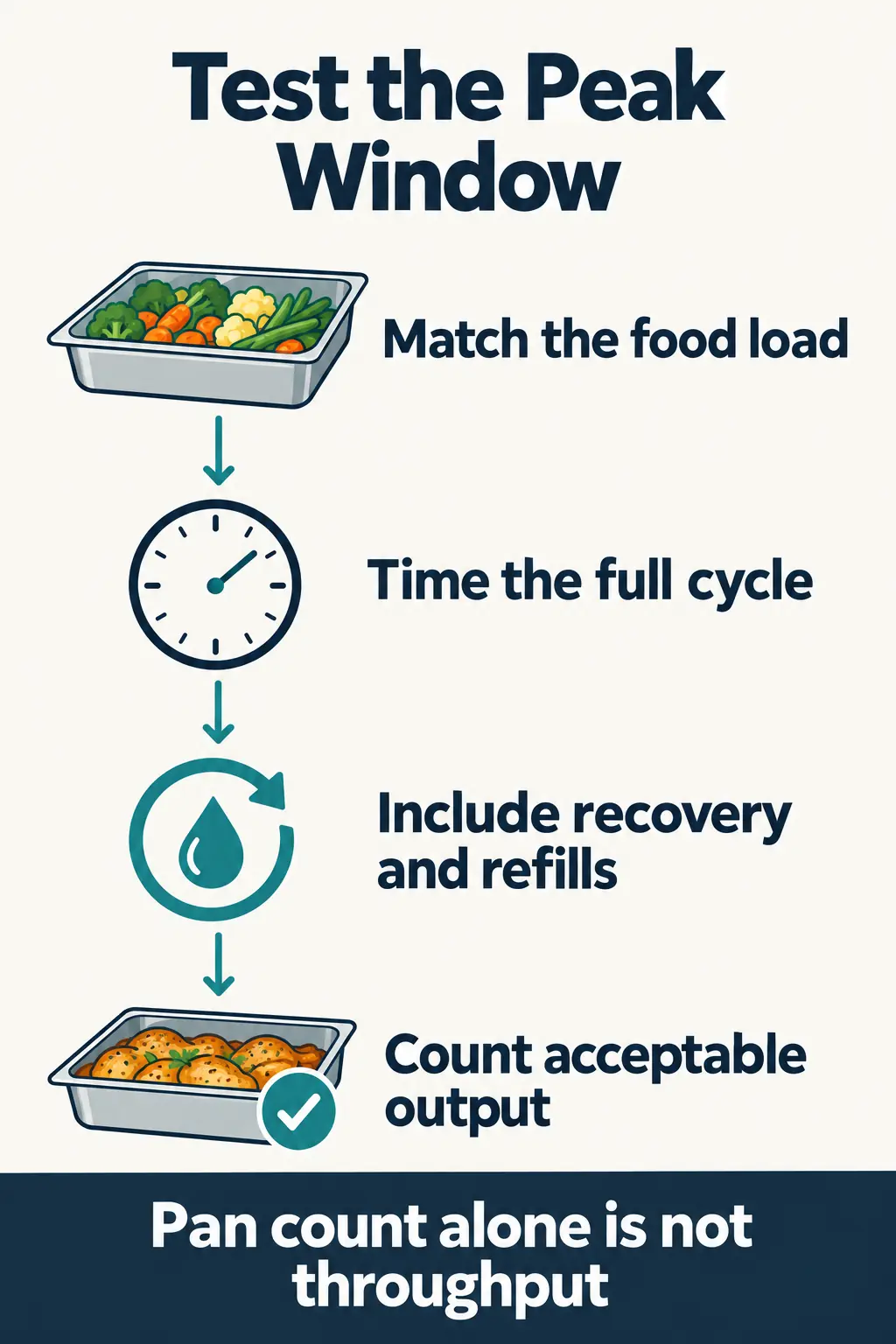
Size the steamer around the busiest realistic production window, then confirm that it can also operate sensibly during quieter periods. For a hotel, simultaneous banquet preparation and restaurant replenishment may create a tighter constraint than total daily portions. Convert the menu into a defined food load, identify when acceptable batches must be ready, and include the time needed to move them into service. The trial should reproduce normal staffing and pan loading. Record late, undercooked, overcooked, or otherwise unusable output separately so a high gross production figure cannot conceal a failure to meet the kitchen’s actual requirement.
Define the load before timing the appliance
Record the food, starting condition, portion weight, batch weight, pan type and depth, fill depth, and required quality endpoint. Frozen vegetables, chilled prepared food, rice, and potatoes do not establish interchangeable production ratings. Use the recipe and applicable food-safety procedure for the item; a supplier’s potato test is not a validated cooking schedule for another food.
A useful demand calculation begins with portions due in a stated interval. If a banquet requires 360 portions of an item at 0.25 lb per portion, it needs 90 lb of acceptable finished product. If that output must be ready within 45 minutes, the equivalent average requirement is 120 lb/hour. Keep raw and finished weights separate and account for actual yield where needed. Do not silently compare a raw-load appliance rating with a cooked-weight service requirement.
Measure the complete batch cycle
Ask suppliers for the test method and revision behind published performance figures. The public scope of ASTM F1484-18(2023) covers measures including preheat, idle energy, production capacity, water use, and cooking uniformity. A hotel menu trial supplements standardized evidence; it is not an ASTM certification test. ENERGY STAR Version 1.2 specifically references F1484-99, so keep the method named in each report intact rather than treating all revisions as interchangeable.
Include loading, cooking to the agreed endpoint, unloading, and the recovery or refill time needed before the next comparable batch. Record startup separately if the trial begins with an already hot unit. If operations overlap, use an actual timeline so the same minute is not counted twice. The timing record should also show door openings, interruption causes, and whether another worker was needed.
For planning, accepted throughput equals acceptable output weight divided by elapsed hours within the defined trial window. A stable batch estimate can use acceptable pounds per batch × 60 ÷ minutes per complete batch. Use that estimate to screen candidates, then confirm it with a sustained trial. A single fast batch can miss a reservoir refill or a recovery limitation that appears later.
Consider a hypothetical 30 lb acceptable batch requiring 12 minutes of cooking, 3 minutes for loading and unloading, and 3 minutes of additional recovery. The 18-minute complete cycle implies 100 lb/hour over repeated full cycles. With the steamer ready at the start and no prepared output, food from successive batches is available at 15, 33, and 51 minutes. The final batch does not need another recovery period before its food can be served. Only two batches, or 60 lb, are available by minute 45. The appliance therefore fails the 90 lb deadline in that setup, even though its hourly estimate may look substantial.
If earlier preparation is proposed, test the food’s approved holding method and quality at the actual service time. Moving production earlier is a change to the operating plan, not proof that the original deadline can be met. Two units may help, but shared electrical capacity, staff, trolley space, and unloading access can prevent simple doubling of usable output.
Test repeated service and partial loads
Run enough consecutive batches to encounter the refill, recovery, or shutdown behaviors that matter to the planned service. For a manually filled unit, establish when staff must check water, how replenishment is performed, and whether it interrupts the peak window. Follow the manufacturer’s operating instructions; do not defeat low-water protection to extend the trial.
Also test the frequent smaller order. A hotel that needs one pan at a time between banquets may value separately controlled compartments or multiple smaller appliances. Compare the usable output and measured idle consumption of that arrangement with a larger single unit. Redundancy has value only if remaining equipment can cover a useful portion of the essential menu when one unit is unavailable.
The purchase record should state the tested menu, starting conditions, accepted output, elapsed time, staffing, and operating interruptions. This makes later commissioning reproducible and helps distinguish a machine problem from changes in recipes, portioning, or workload. It also gives procurement a defensible basis for accepting a proposed substitute.
Build a Purchase Decision From Model-Specific Evidence
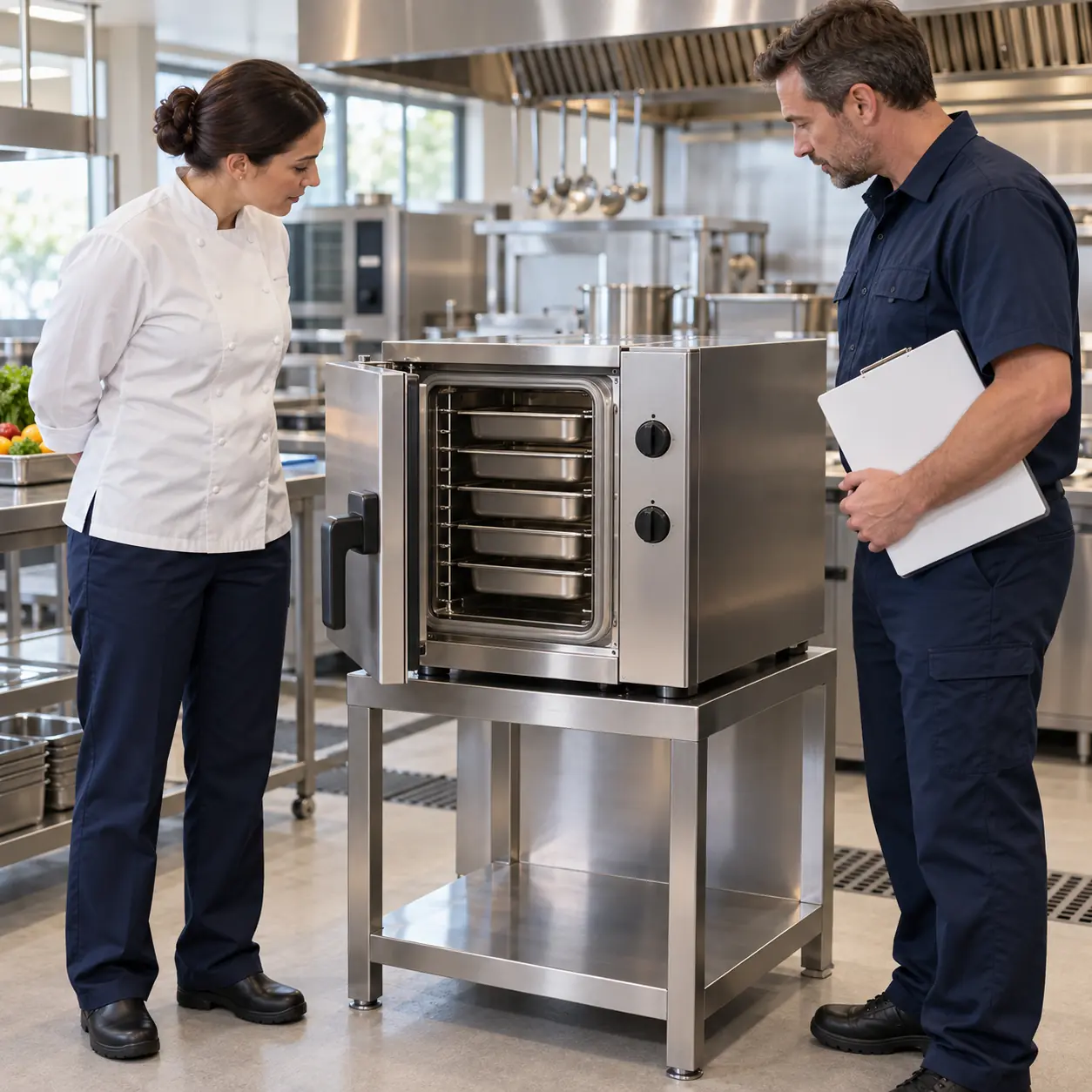
Choose from candidates that meet the physical installation and production requirements, then compare their costs and support arrangements. This sequence prevents an attractive annual estimate from concealing a unit that cannot serve the hotel’s busiest meal. It also makes the decision explainable across departments: engineering confirms site compatibility, the chef confirms acceptable food and timing, and procurement reconciles the commercial scope. Keep the selected model, options, and underlying assumptions together. If a bidder changes the generator, controls, electrical configuration, or filling arrangement, reopen the affected comparison instead of treating the substitution as a minor naming change.
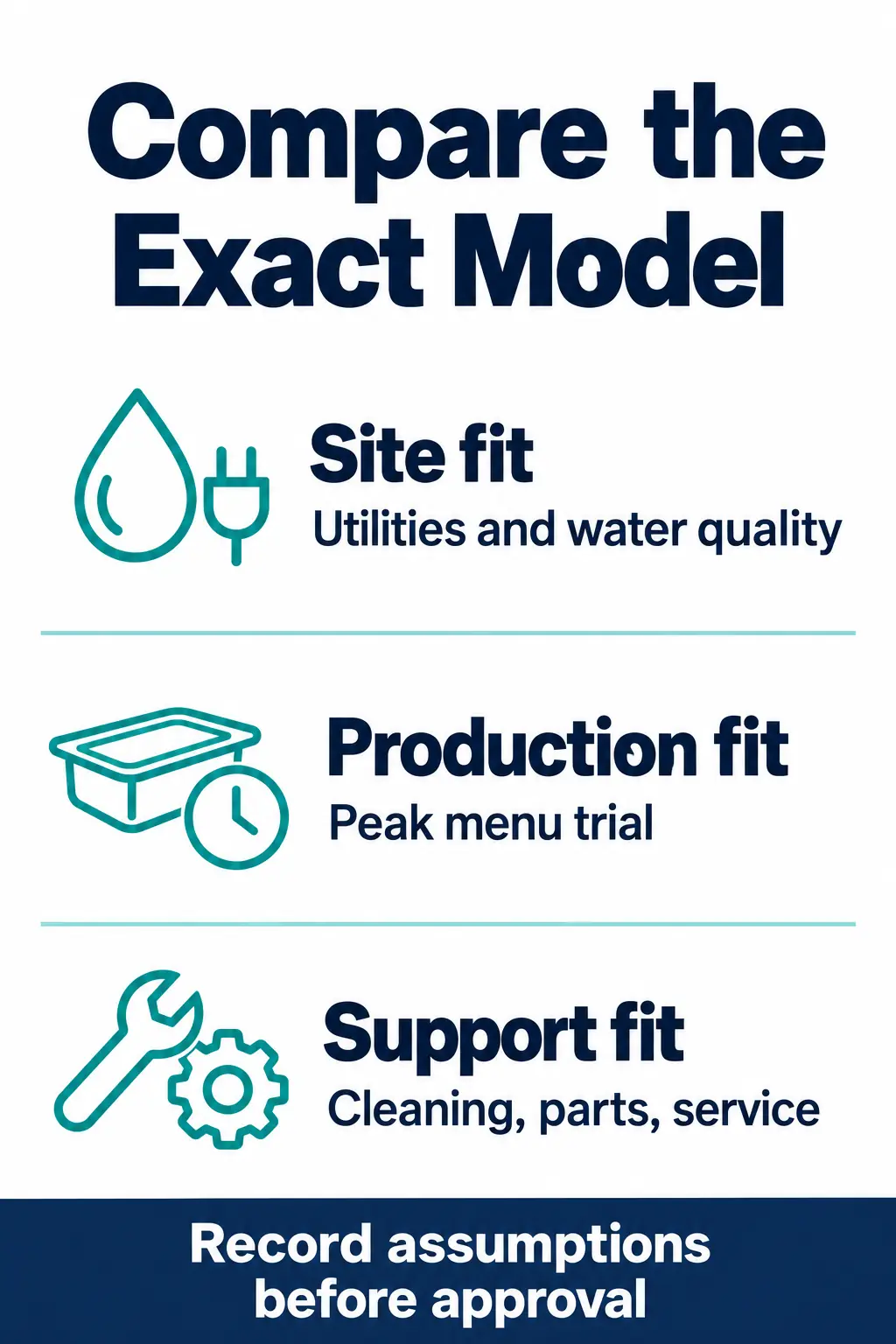
Match the operating pattern to the candidate
| Hotel operating pattern | Candidate worth testing first | Evidence that can change the choice |
| Repeated banquet batches with tight turnaround | Boiler based or connected boilerless | Sustained acceptable output, recovery, and complete utility cost |
| Modest scheduled batches and difficult water-line access | Connectionless | Actual refill burden, safe emptying, power capacity, and peak trial |
| Frequent small orders between larger services | Independently controlled compartments or smaller units | Part-load results, idle consumption, labor, and available space |
| Existing central steam infrastructure | Direct-steam candidate alongside self-contained alternatives | Food-contact suitability, available steam conditions, upstream costs, and reliability |
These are starting points for investigation, not model recommendations. A well-matched connectionless unit may handle a substantial load, and a boiler-based unit may be inefficiently sized or poorly maintained. The test evidence should override a broad assumption about the category.
Make quotations comparable
Ask bidders to identify the exact model and options, then separate equipment, stand, treatment, freight, installation, commissioning, and operator training. Record which party supplies each connection and whether removal of the old unit is included. Normalize taxes and currency before comparing totals. Keep allowances visible where site work has not yet been priced.
Request the current specification sheet and installation, operation, and maintenance manuals for that configuration. Support the operating estimate with test conditions rather than an unqualified percentage saving. Where certification is claimed, match the exact model or covered model family to the certification record. A logo on a generic brochure does not resolve which unit is being offered.
For the commercial format, the hotel supplies RFQ guide can help organize the item schedule and responsibilities. The steamer-specific evidence still belongs in the request itself: required menu output, peak window, available services, water analysis, allowed installation envelope, and the basis for accepting a substitution.
Plan maintenance and commissioning together
A connectionless reservoir remains an operating responsibility even without an external boiler. Use the model’s instructions for draining, cleaning, descaling, and safe handling of hot surfaces and wastewater. The C24EO manual calls for daily cavity and accessory cleaning and scale removal when needed; the C24EA manual includes daily generator draining. These examples show why the routine must come from the purchased model. Assign responsibility by shift and include the actual work in labor measurements. A low purchase price does not compensate for a daily procedure that the available team cannot perform reliably.
Before purchase, obtain local service coverage, warranty conditions, likely parts availability, and the maintenance scope included in the quote. Distinguish routine cleaning labor from contracted maintenance so it is not charged twice in the model. Discuss expected downtime and the hotel’s temporary menu or backup arrangement without inventing a universal failure rate or service life.
At commissioning, confirm the installed configuration against the approved documents and repeat the agreed menu trial. Establish baseline whole-day water and energy readings where metering is practical. If consumption later increases, review operating hours, load mix, water treatment, door seals, leaks, and control settings before concluding that the original design choice was wrong.
When the operating requirements are ready, submit a hotel kitchen equipment RFQ with the candidate specifications, quantities, delivery location, required date, and available utility information. Include the peak-service requirement and the cost assumptions so the quotation can be reviewed against the same decision basis.
Conclusion
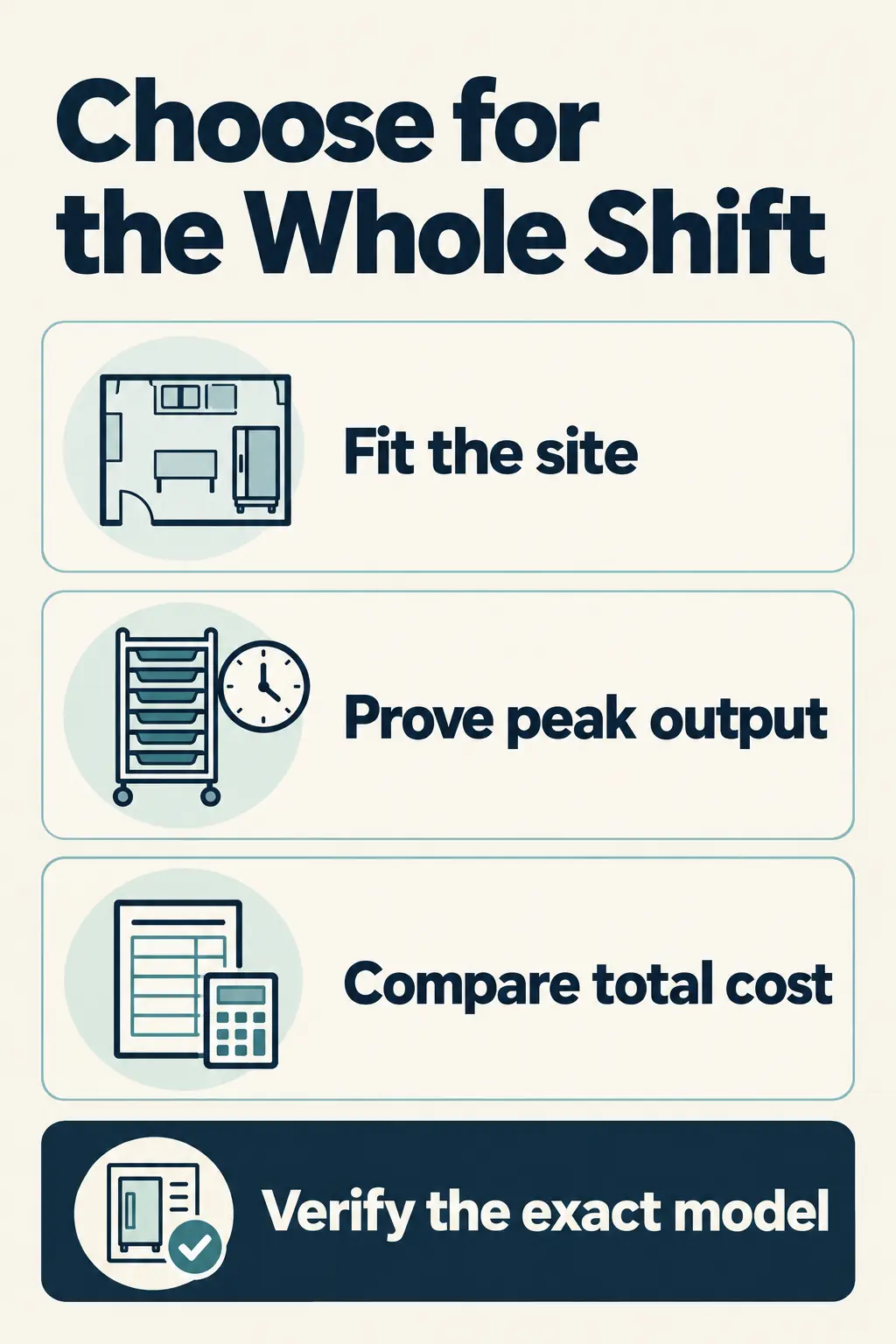
Select the steam cooker that fits the site, demonstrates the required output, and has a credible operating plan. Boiler-based equipment can be a useful candidate for demanding repeat production; manually filled connectionless equipment can be attractive when its output and routine match the kitchen. Connected boilerless models deserve consideration when automatic replenishment is valuable. None of those starting points replaces model-specific evidence. Compare the same food, time window, staffing, and cost boundary, then retain the trial results and assumptions with the purchase record. That approach turns a broad equipment comparison into a decision the hotel can verify after installation.
Frequently Asked Questions
Is a boilerless steamer the same as a connectionless steamer?
No. Boilerless describes steam generation in a reservoir within the cooking compartment. Some models fill and drain automatically through permanent connections. Connectionless usually describes a manually filled version. Check the exact configuration because category wording is not a complete installation specification.
Does a connectionless steamer need a drain or hood?
Some models do not require a permanent drain connection, but they still need an approved emptying and cleaning arrangement. Hood requirements depend on the appliance, its listing, use, installation instructions, and local review. Confirm both issues before ordering; neither is settled by the connectionless label.
Are connectionless steamers always cheaper to run?
No. Water and energy savings can be offset by operating labor, maintenance, or an unsuitable production pattern. In this article’s invented example, lower utility and maintenance costs were outweighed by additional labor. Use the same accepted output and whole-day measurement boundary when comparing actual candidates.
Can pan capacity be converted directly into meals per hour?
No. Pan dimensions, food weight and condition, loading depth, cooking endpoint, handling time, recovery, and refills all affect output. Convert the hotel’s portions into a required food load, then time a representative sequence. Count completed, acceptable output within the actual service deadline.
Does ENERGY STAR certification guarantee a particular water rate?
The Version 1.2 steam cooker qualification criteria use cooking energy efficiency and idle energy limits. They do not set a universal numeric water-use threshold. Obtain water data for the candidate and establish whether the figure includes filling, cooling, draining, and cleaning under the planned operating schedule.
Should an existing hotel boiler determine the choice?
It is one input, not the decision. A direct-steam candidate requires suitable steam and compatible installation conditions. Include attributable generation, distribution, water, and maintenance costs, then compare production and reliability with self-contained options. Existing infrastructure does not make its operating cost zero.
When should the comparison be revisited?
Revisit it when the model or configuration changes, utilities are repriced, the menu or peak volume changes materially, or trial measurements differ from the estimate. Keep original assumptions so the team can explain the change. Confirm current manuals, certification, and installation requirements again at purchase.
References
1. U.S. Environmental Protection Agency — WaterSense at Work Section 4.4 Commercial Steam Cookers
2. Cleveland Range — 22CET6.1: SteamChef 6 Electric Boilerless Convection Steamer
3. Cleveland Range — 22CCT6 SteamChef
4. Vulcan — Installation & Operation Manual: C24EO Series Steamer, Form F-37496 Rev. A
5. Vulcan — Installation & Operation Manual: C24EA Series Electric Counter Convection Steamers, Form F37523 Rev. C
6. ENERGY STAR — Program Requirements: Product Specification for Commercial Steam Cookers, Eligibility Criteria, Version 1.2
7. U.S. Department of Energy — Purchasing Energy-Efficient Commercial Steam Cookers
8. ASTM International — ASTM F1484-18(2023): Standard Test Methods for Performance of Steam Cookers