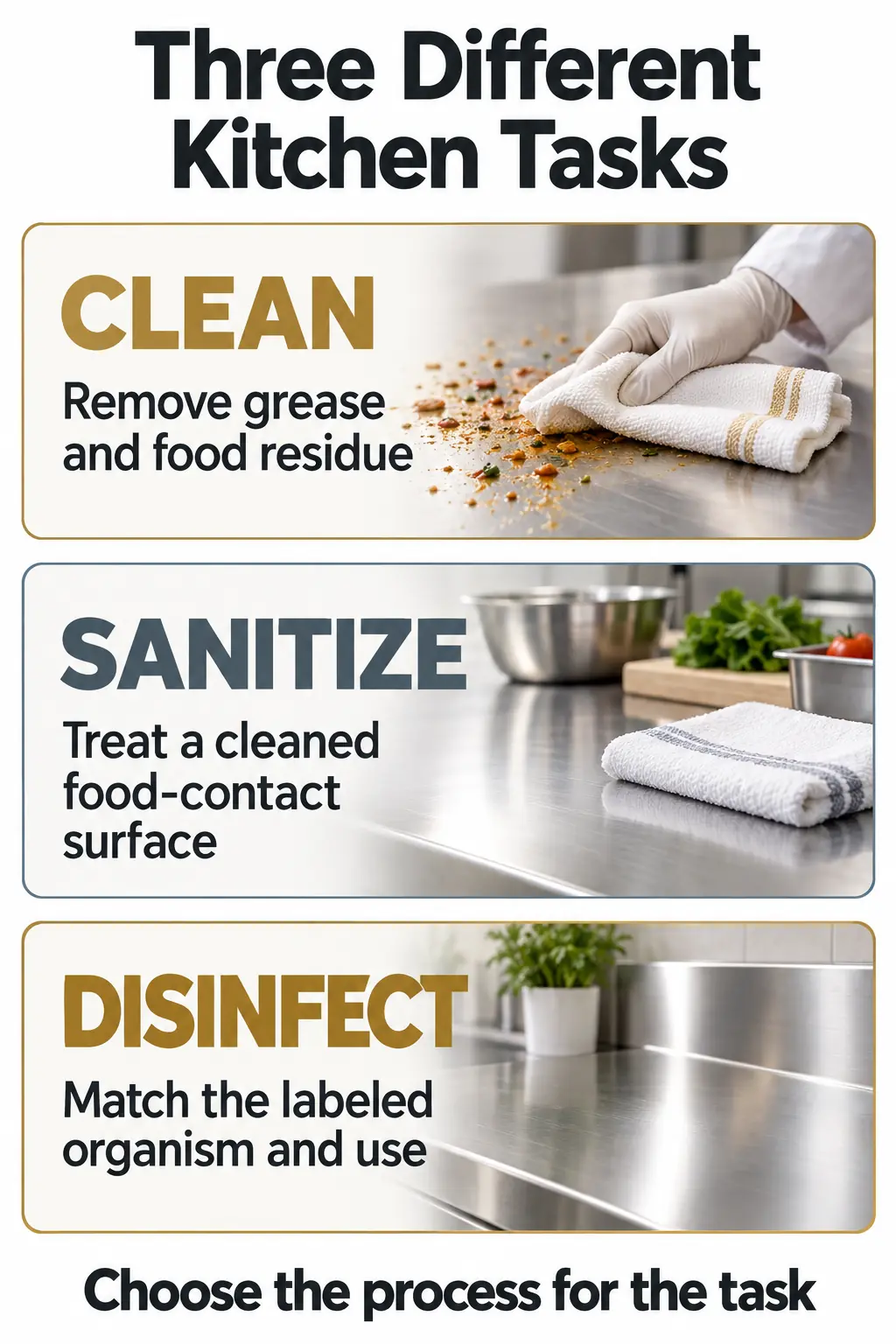
Cleaning removes food residue, grease, and other soil. Sanitizing reduces microorganisms on an already cleaned food-contact surface to the level required for its intended use. Disinfecting targets the organisms and applications stated on a disinfectant label. In a hotel kitchen, these are different jobs with different purchasing requirements. A chemical specification should identify the surface, the task, the permitted use, the working concentration, the contact time, and the steps required before food service resumes.
The distinction matters when one purchasing team supports breakfast service, banquet production, room service, stewarding, and housekeeping. A product that works on a guest bathroom fixture may not be suitable for a cutting board. A sanitizer used in a sink may have different directions from a disinfecting application of the same product. Even a familiar brand can have several formulations and labels. Buying by color, scent, or an active ingredient alone leaves important decisions to the employee holding the bottle.
A useful specification connects the purchase order to a task that the kitchen team can repeat. It makes the supplier identify the exact product and directions, gives the supervisor an acceptance standard, and defines which changes require a new review. It also makes quotations more comparable: the lowest price per container may come with an unsuitable application, an impractical wet contact time, or extra labor that was missing from the original estimate.
Use this guide to build separate requirements for routine cleaning, food-contact sanitizing, and any necessary disinfection. The examples are purchasing language, not mixing instructions for an unidentified chemical. Final operating directions must match the product supplied, the equipment manufacturer’s restrictions, and the food-safety rules applicable to the property. For hotels operating in both Canada and the United States, approve the product and label for each destination rather than assuming one country’s acceptance covers both.
Choose the Process for the Surface and the Task
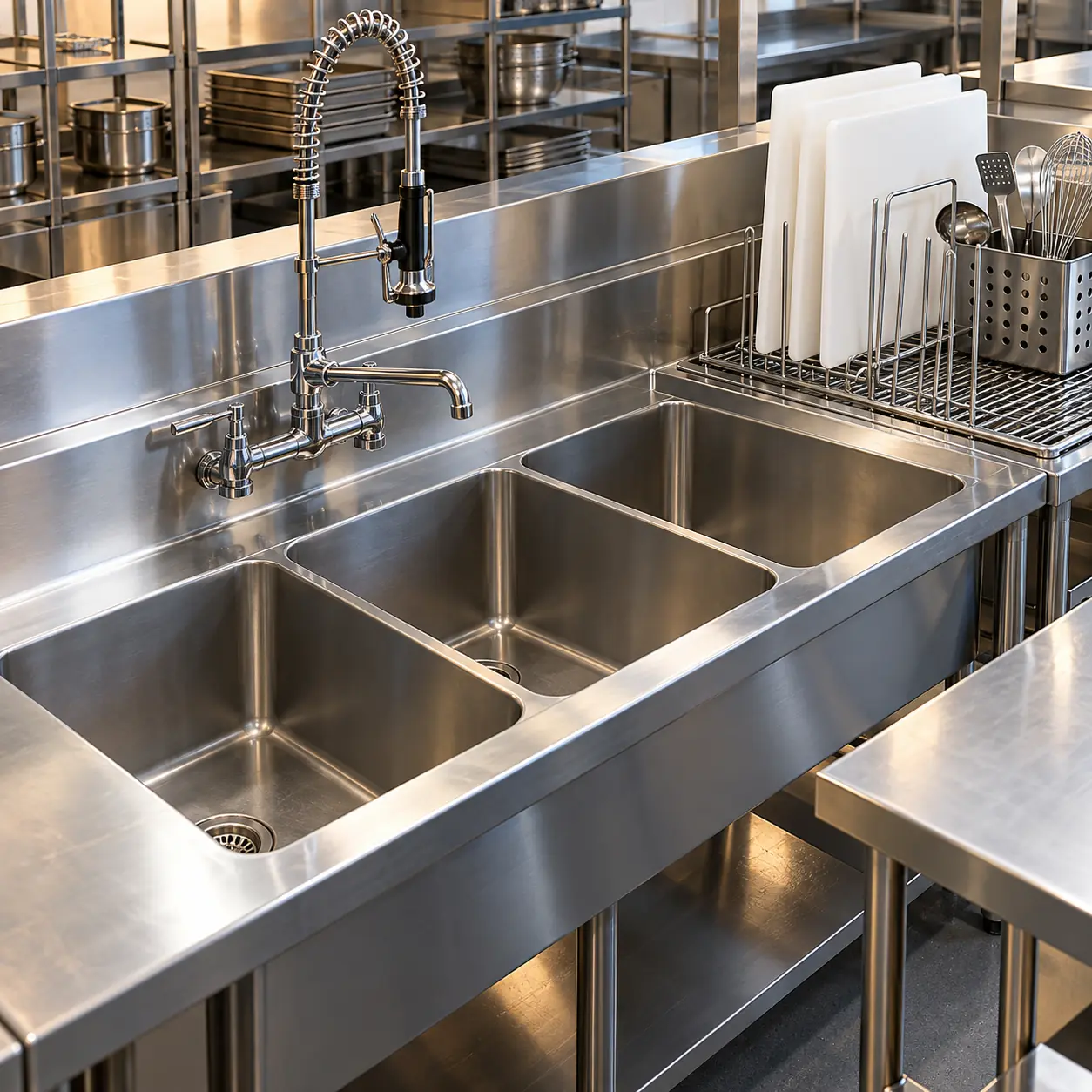
Start with what the surface touches and what must be removed or controlled. Routine food-contact work generally needs a cleaning step followed by an appropriate sanitizing step; a disinfection procedure addresses a different, specified need. These categories do not form a simple ladder in which the strongest claim is automatically the best purchase. A hotel needs a process that achieves the required result while leaving the surface suitable for its next use. Map the work before choosing the bottle, and keep the routine food-preparation procedure separate from the response to an illness incident or other exceptional contamination.
What each term means for purchasing
A cleaner is selected for soil removal: for example, grease on a compatible work surface or baked-on residue on equipment. Detergent action, physical effort, temperature, and the permitted cleaning method all matter. A surface can look polished without having completed a sanitizing or disinfecting process. The EPA’s comparison of cleaning, sanitizing, and disinfecting explains why these are separate product claims.
A food-contact sanitizer is selected for its labeled use on the specified surface after the required preparation. Sanitizing can also be achieved by an approved heat process, but heat sanitization is an equipment specification rather than a reason to buy a stronger chemical. Do not assume a surface sanitizer has a particular virus claim.
A disinfectant must have the appropriate labeled organism claim, surface use, and application method. It is not necessarily a sterilant, and its stronger-sounding name does not establish food-contact suitability. A product may have both sanitizing and disinfecting directions; each application still needs its own operating instructions.
| Kitchen task | Specification focus | Mistake to prevent |
| Food preparation table or cutting board | Compatible cleaner, food-contact sanitizer, and return-to-use steps | Approving a general surface disinfectant without food-contact directions |
| Greasy range exterior or hood surface | Cleaner suited to the soil, material, and equipment instructions | Applying a sanitizer over grease |
| Refrigerator handle or control surface | Routine cleaning plus any disinfection required by the site’s procedure | Using a food-preparation recipe on every touchpoint |
| Reusable utensils and pans | Manual or machine-specific washing and sanitizing process | Substituting a spray product for the warewashing program |
| Vomit, fecal, or other relevant body-fluid contamination | Incident procedure and disinfectant with the required claim | Treating an incident as an ordinary wipe-down |
Keep the food-contact sequence explicit
For a conventional manual process, remove loose soil, wash with the compatible cleaner, rinse away the cleaner and loosened residue, apply the approved food-contact sanitizing process, and allow the required contact and drying or draining steps. Allow sanitized equipment and utensils to air-dry or drain adequately before food contact; do not cloth-dry them or stack them while wet. A combination product does not automatically eliminate preparation or separate applications; its directions must explicitly support the proposed procedure. See the FDA Food Code 2026, Sections 4-6, 4-7, and 4-901.11. The Food Code is a model for adoption; confirm the rules adopted by the property’s jurisdiction.
Disinfection of a food-contact surface may require a potable-water rinse after the specified contact time. A no-rinse claim applies only to the labeled conditions for that use. Write the complete return-to-service procedure, including any subsequent sanitizing step required by the applicable rules and site procedure. Never borrow a no-rinse statement from the sanitizing directions and apply it to a different disinfecting dilution.
Separate routine service from incident response
If an illness event contaminates a food area, the immediate issue is control of the area and affected food, not simply choosing a spray. Follow the property’s incident procedure and applicable public-health instructions. Keep the response kit, assigned responsibilities, disposal method, and release decision distinct from routine kitchen cleaning. When a particular pathogen matters, confirm the exact claim and use directions rather than relying on a broad claim such as killing germs.
Write a Separate Specification for Each Chemical Use
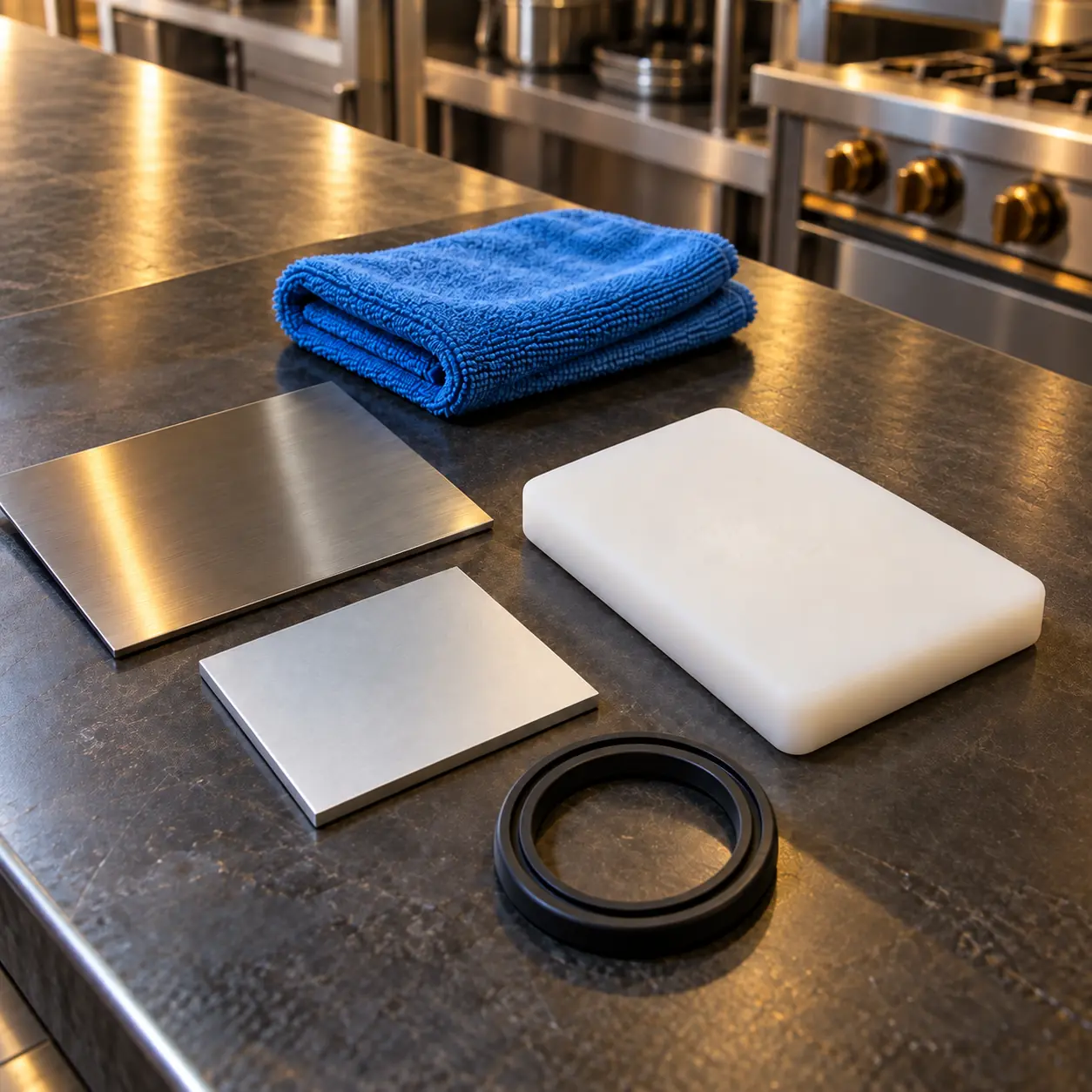
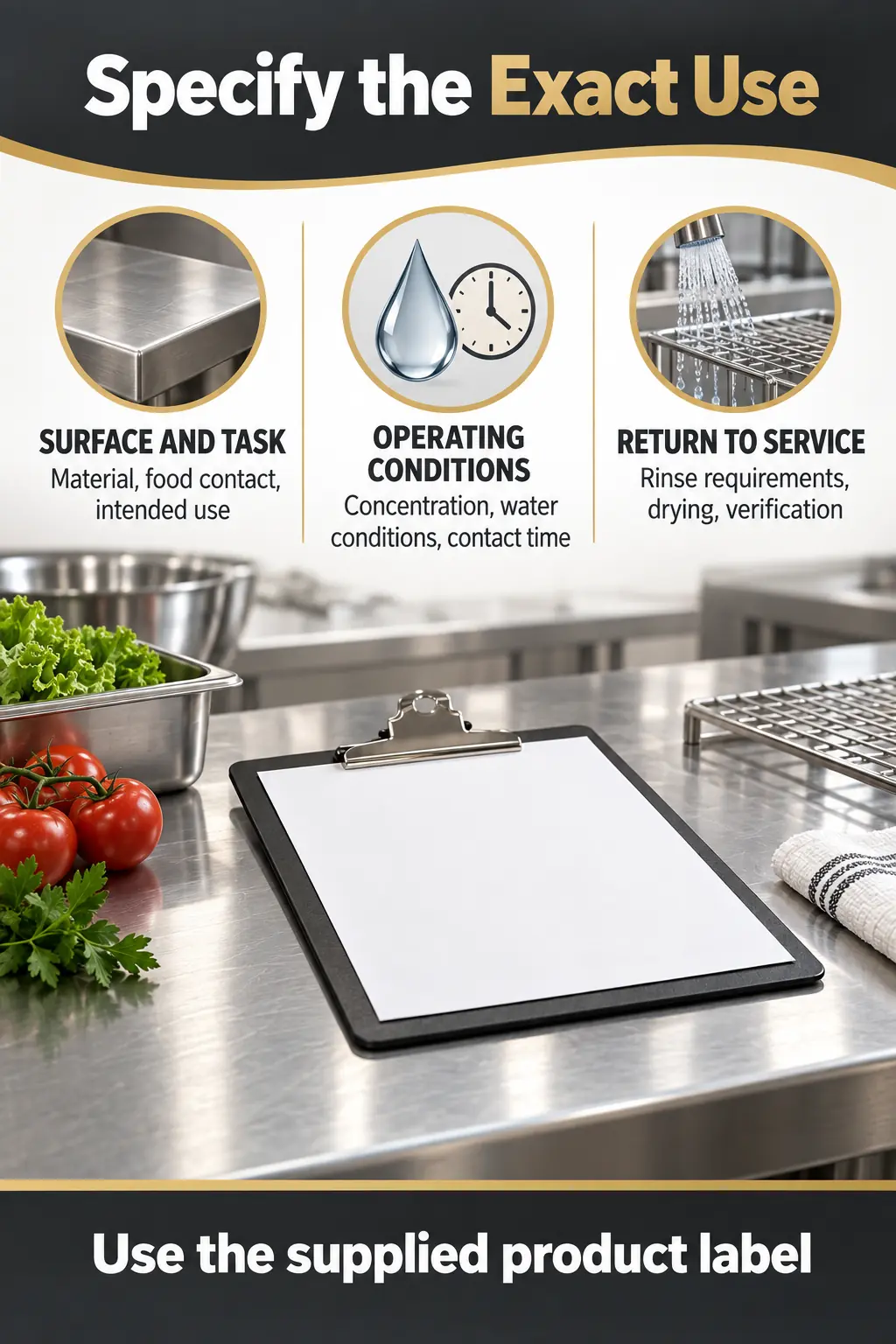
The most useful specification identifies an approved use, not just a product family. Write separate entries for detergent cleaning, routine food-contact sanitizing, and incident disinfection, even when a supplier proposes one product for more than one entry. Each entry should connect the exact formulation and label to the surface, application method, measurable operating conditions, and required final steps. Ask the supplier to fill gaps before approval. A quotation with an unresolved concentration, contact time, or rinse requirement is incomplete because the hotel cannot yet translate it into a reliable work instruction or a fair operating-cost comparison.
Identify the product and its permitted use
Record the trade name, product code, formulation or variant, concentrate versus ready-to-use format, container size, supplier, label version, and safety data sheet revision. For antimicrobial products, verify the applicable registration or authorization and that the supplied label covers the proposed use. A safety data sheet describes hazards and protective measures; it does not replace the antimicrobial use directions or demonstrate food-contact suitability. Use EPA’s registered-disinfectant guidance to check the registration number and locate the approved label, then match the claim to the intended application.
For a US property, verify the product’s pesticide registration and any applicable state requirements. For a Canadian property, obtain evidence of the product’s lawful status for the intended use under the Biocides Regulations or an applicable transition provision, as explained in Health Canada’s biocides transition guidance. Canadian transition arrangements vary by product category. Do not assume a US registration, a foreign-language label, or a supplier’s statement that a product is food grade establishes acceptance at the destination.
Require a complete operating envelope
| Field | What the supplier must specify |
| Surface and task | Food-contact status, material, soil or organism of concern, and exclusions |
| Preparation | Soil removal, precleaning, and rinsing required before application |
| Application | Permitted wiping, immersion, spraying, or machine method; equipment limits |
| Working solution | Exact dilution and concentration range with units; ready-to-use restrictions |
| Water conditions | Temperature, pH, and hardness limits where applicable |
| Contact time | Time for this exact use and how the surface remains wet when required |
| Final steps | Rinse or no-rinse conditions, drying or draining, and release for service |
| Verification | Compatible test method, usable measurement range, and instructions |
| Worker protection | Required gloves, eye protection, ventilation, handling, and spill directions |
| Supply continuity | Shelf life, storage, replacement parts, training, and substitution control |
Parts per million, or ppm, expresses a concentration. It is not an interchangeable dose across chlorine, quaternary ammonium compounds, iodine, or other chemistries. Specify the active ingredient being measured and the appropriate test method. Do not choose a generic ppm value first and ask a supplier to fit a product around it. Both an under-strength and an over-strength solution can fail the approved process. The FDA Food Code provisions on chemical sanitization address concentration, temperature, pH, and water hardness in Section 4-501.114, with solution testing in Section 4-501.116.
Ask how the formulation behaves with the hotel’s water and tools. Obtain the relevant material-compatibility guidance for stainless steel, aluminum, plastics, seals, coatings, and equipment components. If cloths, wipes, or dispensing equipment are part of the system, have the supplier confirm their compatibility. Color coding can help staff distinguish tasks, but it is a local identification system and never replaces a readable container label.
Sample wording for a food-contact sanitizer request
The following is a specification model to complete with the selected supplier. It deliberately leaves product-dependent values unresolved instead of inventing a universal recipe.
Supply a legally marketed product labeled for sanitizing the hotel’s identified hard, nonporous food-contact surfaces. Identify the exact supplied formulation and approved method. State the required precleaning and rinsing, working concentration and units, dilution equipment, water-condition limits, contact time, final rinse status, and drying or draining instructions. Provide the current product label, safety data sheet, suitable concentration-testing supplies, and written compatibility guidance for the listed surfaces and application tools.
Demonstrate the proposed process using the property’s water supply and normal operating equipment. Document the operating settings and corrective action for an out-of-range result. Provide training suitable for the staff using the system and identify who services the dispenser. Do not substitute the product, formulation, package connection, test method, or approved instructions without the hotel’s written technical review.
Create a separate disinfection entry that names the required organism claim and incident application, and documents food-contact restrictions and post-treatment steps. The routine sanitizer entry cannot serve as that approval merely because the supplier offers the same brand.
When the kitchen is also changing equipment, align the chemical schedule with the materials and operating uses in its food and beverage supplies schedule. Send the surface list, destination, application methods, and estimated consumption with the RFQ so suppliers quote against the same defined requirement.
Test the Workflow Before Approving the Purchase
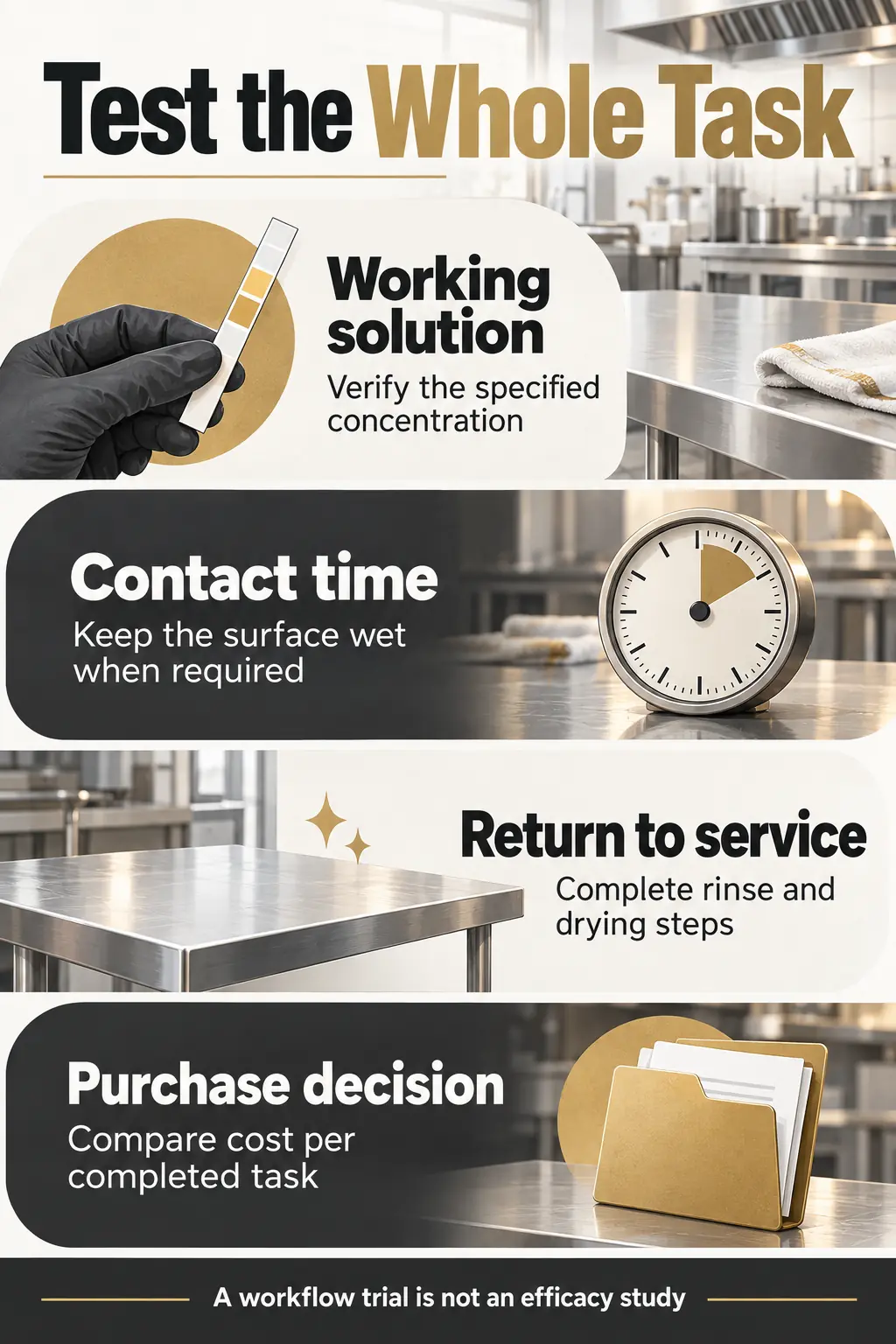
A product can satisfy the paperwork review and still be difficult to use correctly during service. Before a bulk order, run an operational trial under the approved directions using the actual dispenser, water, tools, and work surfaces. The purpose is to check whether employees can repeat the specified process and whether the quoted system includes everything needed. This is not a substitute for the product’s efficacy testing or a microbiological validation study. Agree on acceptance criteria in advance, record any failure and corrective action, and withhold approval when the proposed routine depends on shortcuts to fit the shift.
Observe the complete task
Select representative work, such as a preparation table after a normal production period and a utensil process at the warewashing station. Have the usual operator follow the proposed instructions while a supervisor observes. Record preparation, solution setup, application, contact time, rinse requirements, drying or draining, and the point at which the item becomes available again. Keep employees and food clear of the trial as required by the procedure.
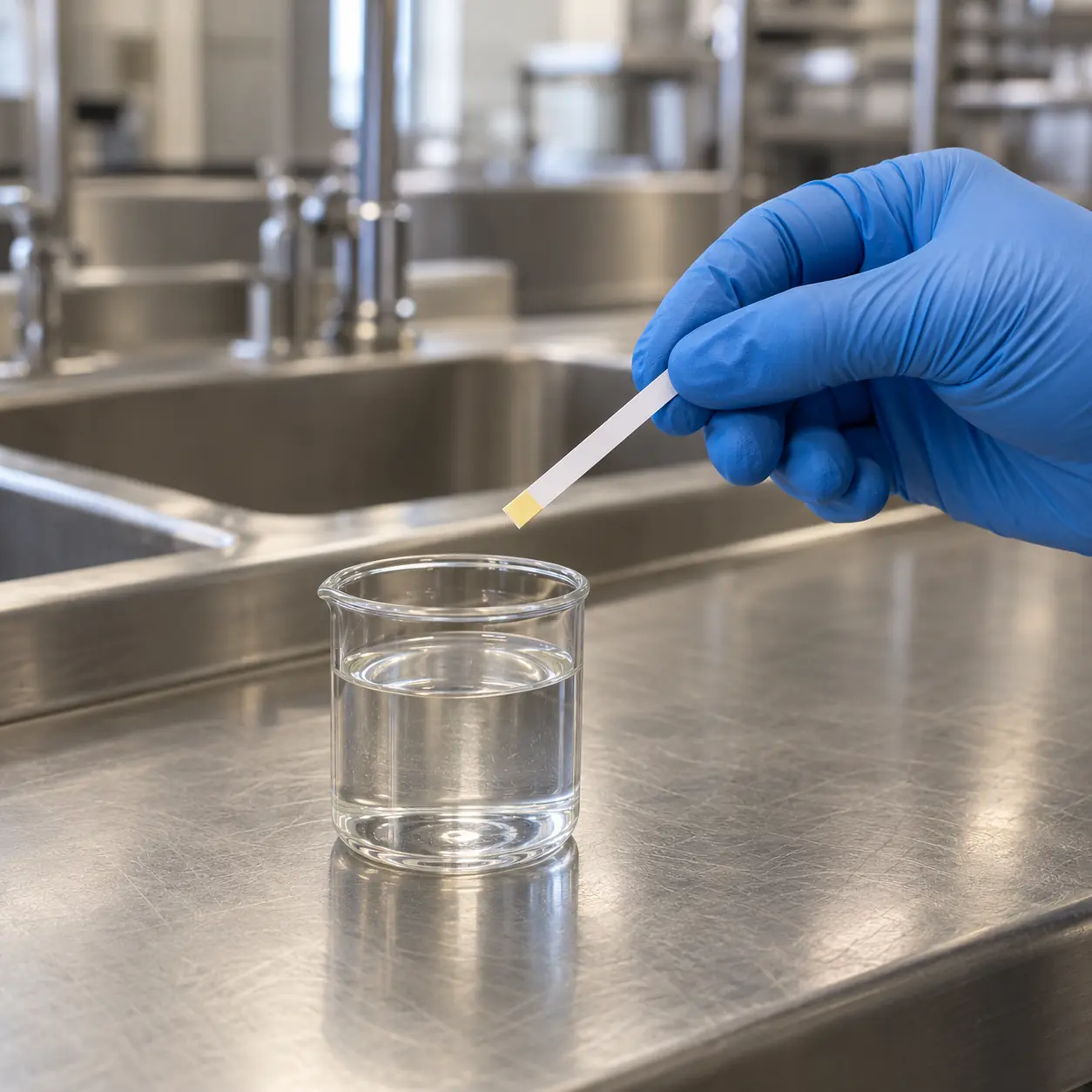
Check the working solution with the specified test kit or device, following its instructions and using supplies within their expiry and storage limits. A dispenser setting alone is not proof of the delivered concentration. Where a label requires the surface to remain wet, observe the entire contact period. If the surface dries too early, investigate the permitted application method and environmental conditions; never shorten the time or improvise a stronger mixture.
Assess soil removal and material condition separately from antimicrobial compliance. A shiny surface does not prove the process achieved its microbial objective. Similarly, a correct concentration result does not prove that the surface was cleaned, fully covered, or treated for long enough. Record these as separate observations so a pass in one category cannot hide a failure in another.
Use failures to improve the specification
| Observation | Question to resolve before approval |
| Concentration is outside the specified range | Are the concentrate, connection, dispenser setup, and test method correct? |
| Surface dries before contact time ends | Can the permitted application keep it wet under actual kitchen conditions? |
| Film or residue remains | Were dilution, cleaning, rinsing, and final steps followed; is the surface compatible? |
| Staff skip a step during changeover | Does staffing, tool availability, or the service schedule need to change? |
| Replacement stock has a different code or label | Does the change require a new technical approval and updated instructions? |
| Required test supplies are unavailable | Can the supplier provide a dependable replenishment route before rollout? |
Set acceptance criteria such as compliance with every required label step, concentration within the specified range, completion of the required contact period, no unacceptable material change during the trial, and a feasible staffing plan. A short trial cannot establish long-term compatibility by itself; retain the manufacturer’s guidance and monitor surfaces after rollout. Record the decision by product and application rather than approving an entire supplier catalog.
Compare cost per completed task
Compare the same task, area, and service conditions for each acceptable option. A useful purchasing model is: chemical consumed plus labor time plus consumables plus the allocated cost of dispensing, testing, maintenance, and training. Track interruption to kitchen capacity separately unless the hotel has a defensible way to assign a dollar value to it. Do not treat a shorter cleaning-only process as equivalent to a complete sanitizing process.
For illustration only, suppose each correctly completed task consumes $0.18 in chemical, four minutes of labor at an assumed loaded rate of $24 per hour, $0.12 in consumables, and $0.10 in allocated support costs. The modeled cost is $2.00 per task: $0.18 + $1.60 + $0.12 + $0.10. These are hypothetical inputs, not market prices or observed hotel performance. Use measured consumption and the property’s actual labor cost in the purchasing comparison.
Keep the approved process stable after delivery
Store chemicals so leaks, drips, or handling cannot contaminate food, utensils, equipment, or clean supplies. Keep required labels on working containers and make safety data sheets accessible to staff. Train employees in the protective equipment and handling precautions for the exact product. Never mix cleaning chemicals; in particular, bleach can react dangerously with ammonia or acids. Provide a defined route for reporting a spill, exposure, damaged label, or uncertain solution. The joint OSHA/NIOSH guidance on protecting workers who use cleaning chemicals covers training, chemical labels, safety data sheets, ventilation, and protective equipment.
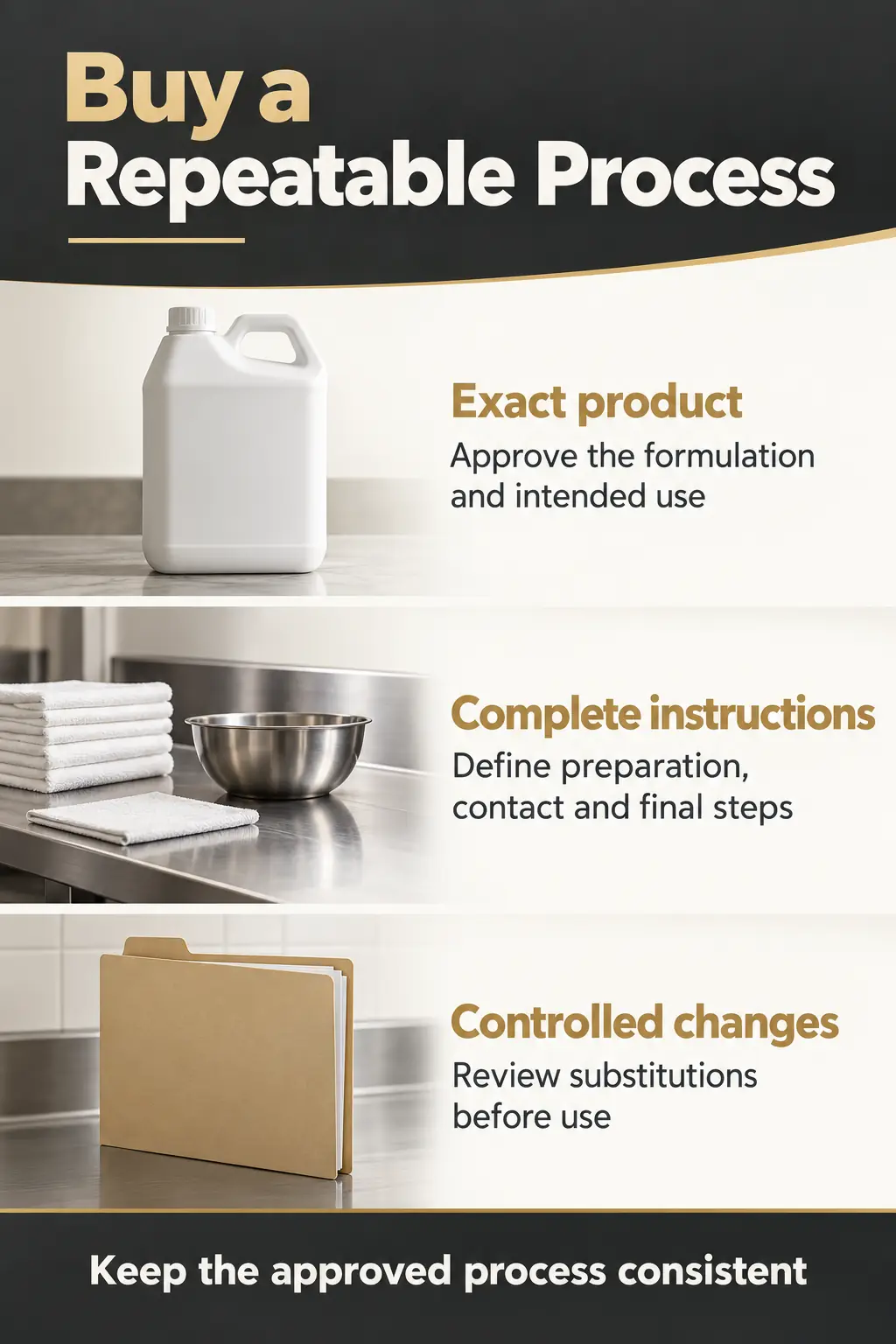
Maintain a controlled instruction for each approved use. Include the product code, preparation steps, operating conditions, test method, replacement criteria for the working solution, and responsible supervisor. Review it when the label, formulation, equipment, water conditions, or intended use changes. Procurement should flag substitutions before delivery, while the kitchen supervisor decides whether the revised system can be released for use.
Conclusion
The right hotel kitchen chemical specification starts with a defined job and ends with a repeatable operating procedure. Separate soil removal, routine food-contact sanitizing, and necessary disinfection; then attach the exact product directions, surface restrictions, operating conditions, verification method, and return-to-service steps to each use. Compare suppliers only after those requirements are satisfied. A measured workflow trial can reveal missing tools, impractical timing, and costs hidden by the container price. Keep the approved product identity and change-control requirements on the purchase order so the process accepted during the trial is the process the kitchen can maintain.
Preparing a hotel kitchen procurement package? Contact KW Hospitality with the destination, equipment and surface schedule, quantities, and required delivery date to discuss sourcing requirements. Include your chemical specification and supporting-tool requirements, and confirm product availability and destination-specific suitability before ordering.
Frequently Asked Questions
Can a kitchen use the same product for sanitizing and disinfecting?
Potentially, if the exact product label supports both applications. Treat them as separate procedures because concentration, contact time, preparation, rinse requirements, and permitted surfaces may differ. Give each procedure a clear task name and verify that staff can distinguish the directions. One bottle does not necessarily mean one instruction.
Does no-rinse mean a surface can be used immediately?
No. No-rinse describes the absence of a required post-application water rinse under the stated conditions. It does not remove the required contact time, concentration limits, or drying and draining instructions. A no-rinse sanitizer still needs the complete labeled process before the surface returns to food contact.
Should every kitchen disinfectant have the strongest available pathogen claim?
Select the claims required by the hotel’s actual use and incident plan. A broader claim has little purchasing value if the product lacks the necessary surface permission or cannot be applied correctly in the kitchen. Keep pathogen requirements specific, and review exceptional contamination with the responsible food-safety personnel rather than substituting a marketing ranking for a use assessment.
Can a ready-to-use product be diluted to reduce cost?
Only if its supplied directions explicitly allow that preparation for the intended application. A ready-to-use designation ordinarily means the product is used as supplied. Diluting it without supporting directions changes the treatment conditions. Compare acceptable products by the cost of a correctly completed task instead of altering one to match a budget.
Does the same active ingredient make two products interchangeable?
No. Formulation, concentration, permitted uses, contact times, compatibility, packaging connections, and test requirements can differ. Review the replacement product’s own label and support documents, then update the approved instructions and training where needed. Procurement should not approve equivalence from the active ingredient name alone.
Who should approve a chemical substitution?
Assign technical approval to the people responsible for kitchen food safety and worker protection, with equipment or engineering input where compatibility is involved. Procurement should confirm supply and commercial terms after that review. The hotel’s own responsibility structure may vary, but there should be one recorded decision tied to the exact product and intended use.
References
1. U.S. Environmental Protection Agency — What’s the difference between products that disinfect, sanitize, and clean surfaces?
2. U.S. Food and Drug Administration — FDA Food Code 2026
3. U.S. Environmental Protection Agency — EPA Releases Finalized Test Methods for Measuring Disinfectant Residue Levels on Hard Surfaces
4. U.S. Environmental Protection Agency — Selected EPA-Registered Disinfectants
5. Health Canada — Guidance on the transition of disinfectants and surface sanitizers to the Biocides Regulations: Overview
6. Occupational Safety and Health Administration and National Institute for Occupational Safety and Health — Protecting Workers Who Use Cleaning Chemicals