Hotel combi oven cleaning programs should be budgeted by the actual mix of cleaning cycles, with water, approved chemicals, energy, hands-on labor, and maintenance priced separately. Record the entire period when the oven is unavailable, then assign a disruption cost only when that period creates an identifiable operating expense or constrains service. A cycle’s advertised duration is only one input.
That distinction matters in a hotel kitchen. The same oven may prepare breakfast, regenerate banquet food, roast proteins, and support late room-service orders. These duties leave different soil loads and different opportunities for cleaning. A short rinse after light use cannot automatically replace the approved end-of-day cleaning procedure, while selecting the strongest program after every task may create avoidable consumption if the manufacturer permits a lighter effective option.
The purchasing decision also extends beyond the oven price. Detergent tablets, liquid cleaner, care products, dosing arrangements, water treatment, training, and local service support affect the operating budget. An inexpensive chemical pack is not necessarily inexpensive per completed clean. An automatic wash may require little active labor yet still occupy the only oven available for breakfast preparation.
This guide gives hotel chefs, stewards, engineering teams, and purchasing managers a common method for measuring those costs and comparing proposals. It covers the cleaning scope, a reproducible annual example, the full return-to-service window, and supplier questions that change the decision. The example uses hypothetical Canadian-dollar inputs; the method also works in US dollars or another currency when every rate uses the same basis.
Start with the exact oven’s current instructions and an observed operating pattern. The objective is a cleaning program that achieves the required result, fits the kitchen schedule, and has a traceable cost. Savings that depend on skipping required cleaning, using unapproved chemicals, or ignoring recovery time are not a sound budget.
Define the Cleaning Program and Capture a Baseline
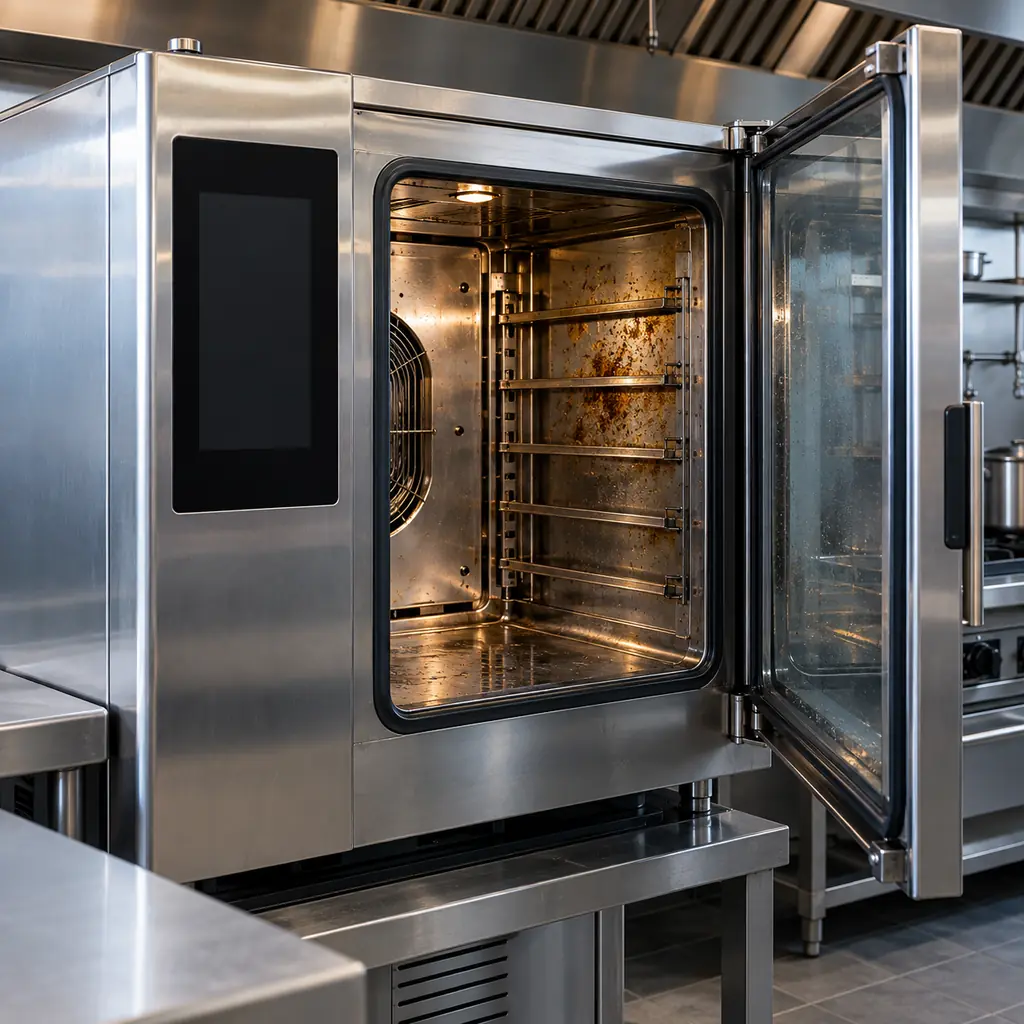
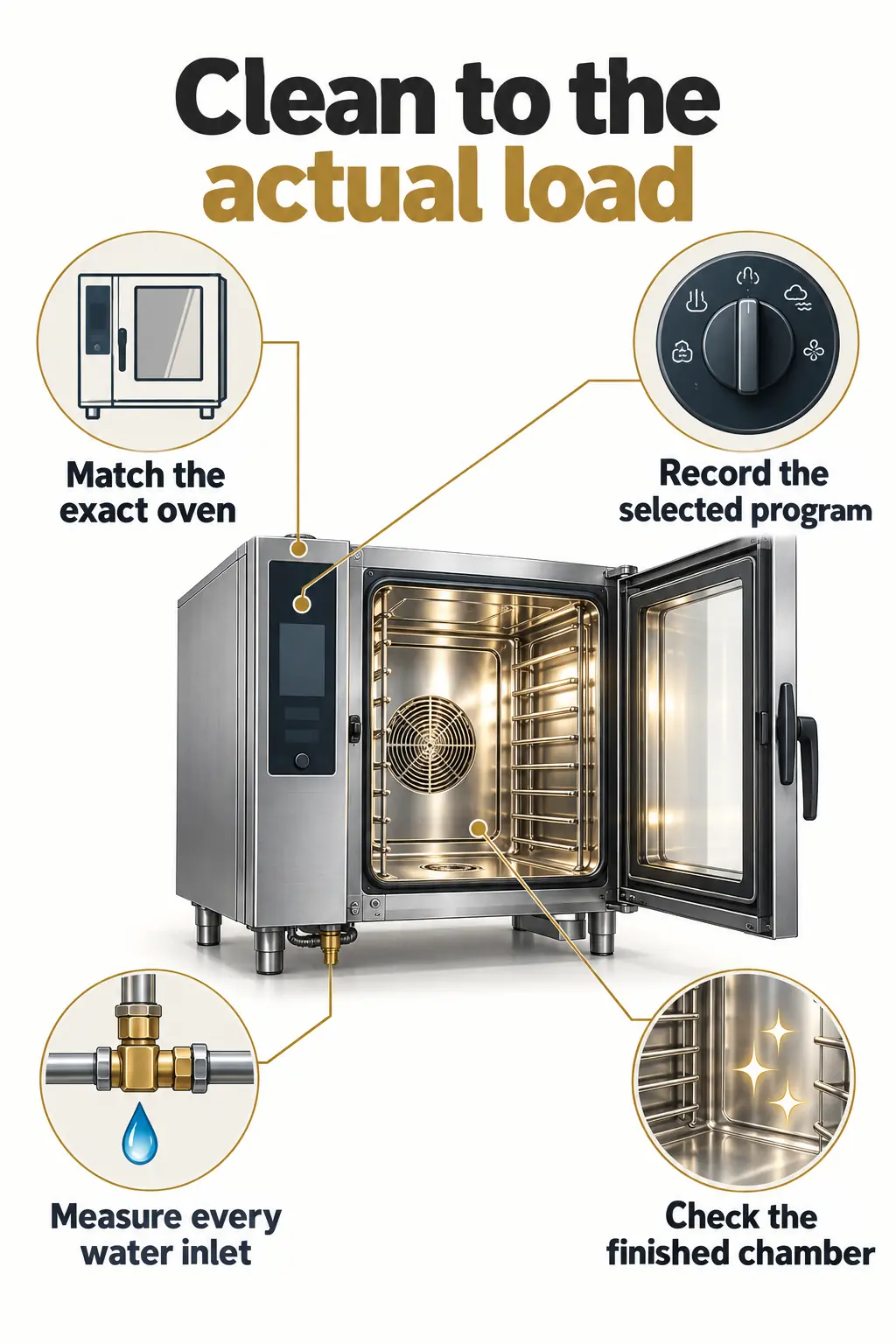
A useful baseline identifies what the oven cleans, how it cleans, and what remains for staff to do. Record the model, cavity size, installed dosing option, relevant software version, water connections, and approved chemical products before comparing consumption. Then log the program actually selected after representative services, together with its cleaning result. Start with a practical observation period, such as one or two operating weeks, and extend it if banquet peaks or seasonal menus are missing. This is a budgeting method, not a manufacturer-prescribed test duration. The resulting program mix should reflect the kitchen’s workload rather than a single demonstration wash.
Separate chamber washing, rinsing, and equipment care
Automatic chamber cleaning removes cooking residues through a manufacturer-defined sequence. A rinse may have a narrower purpose; steam-system care, descaling, and water-filter maintenance address other requirements. Their names, consumables, and relationship to the automatic wash vary by model. Confirm whether they are included in a quoted cycle or require separate time and expenditure.
For example, RATIONAL’s iCombi appliance-care instructions call for daily automatic cleaning even when the appliance is used mainly for steaming. They also describe separate care for components such as glass, gaskets, and drainage areas. This is a requirement for the identified product family, not a universal schedule for every combi oven. It shows why an automatic cycle allowance alone can miss routine labor and water.
Have the chef and steward agree what counts as an acceptable completed clean under the applicable instructions: the program finishes correctly, required inspection is completed, and the oven meets its return-to-use conditions. Record repeat washes or unresolved residue as exceptions. A cheap cycle that routinely needs another cycle is not the lower-cost outcome.
Measure cleaning water separately from cooking water
Do not substitute a cooking-efficiency figure for a wash-cycle figure. The ENERGY STAR commercial oven specification, Version 3.0 defines combination-oven water metrics for idle and heavy-load cooking periods. Those values do not establish how much water a detergent-cleaning program uses.
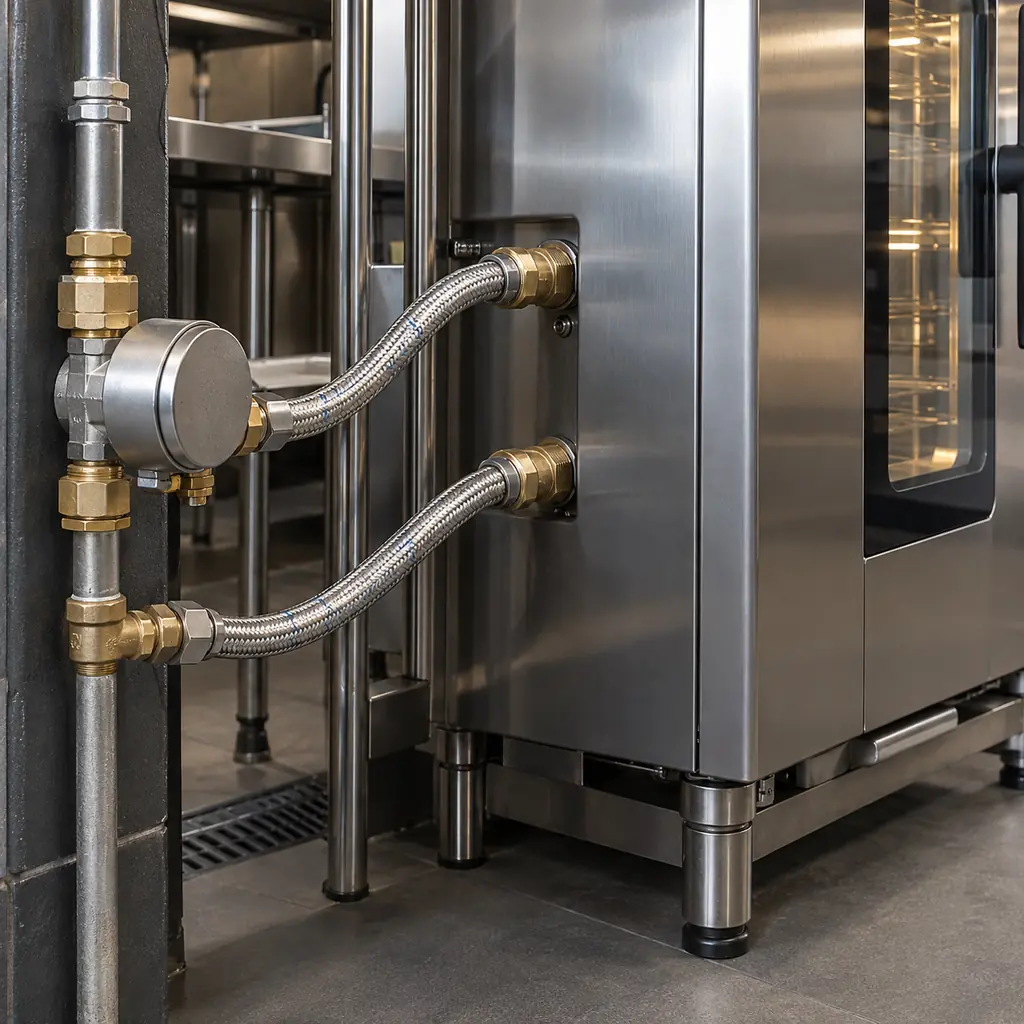
Ask engineering to identify every inlet serving the oven and arrange suitable metering where needed. Read the meters at consistent boundaries and record any simultaneous water use. A shared kitchen meter cannot isolate the oven while other equipment is drawing water. Check whether the measurement covers cool-down, hand-shower use, final rinsing, and separate care; add omitted consumption once, without duplicating water already included.
Some ovens provide useful cycle records. The UNOX CHEFTOP-X and BAKERTOP-X user manual, Version 2.6 describes a completed-wash summary showing duration and resource consumption. Use available records, but confirm their measurement boundary before treating a screen total as the property’s complete water bill.
Keep a record that explains the variation
For each observation, capture the service and menu type, program name and intensity, chemical dose, water volume, energy where available, active labor, start and return-to-service times, and result. Note changes in starting temperature, water pressure, treatment condition, or operator procedure. These explain why two apparently identical washes may differ.
Report both typical consumption and the observed high end for each program. Forecast frequency from the actual cleaning requirement; do not reduce it merely to make the annual total attractive. Include interim washes in addition to required full cleans, and distinguish an extra cycle from a replacement for another scheduled cycle.
Build a Water and Chemical Budget
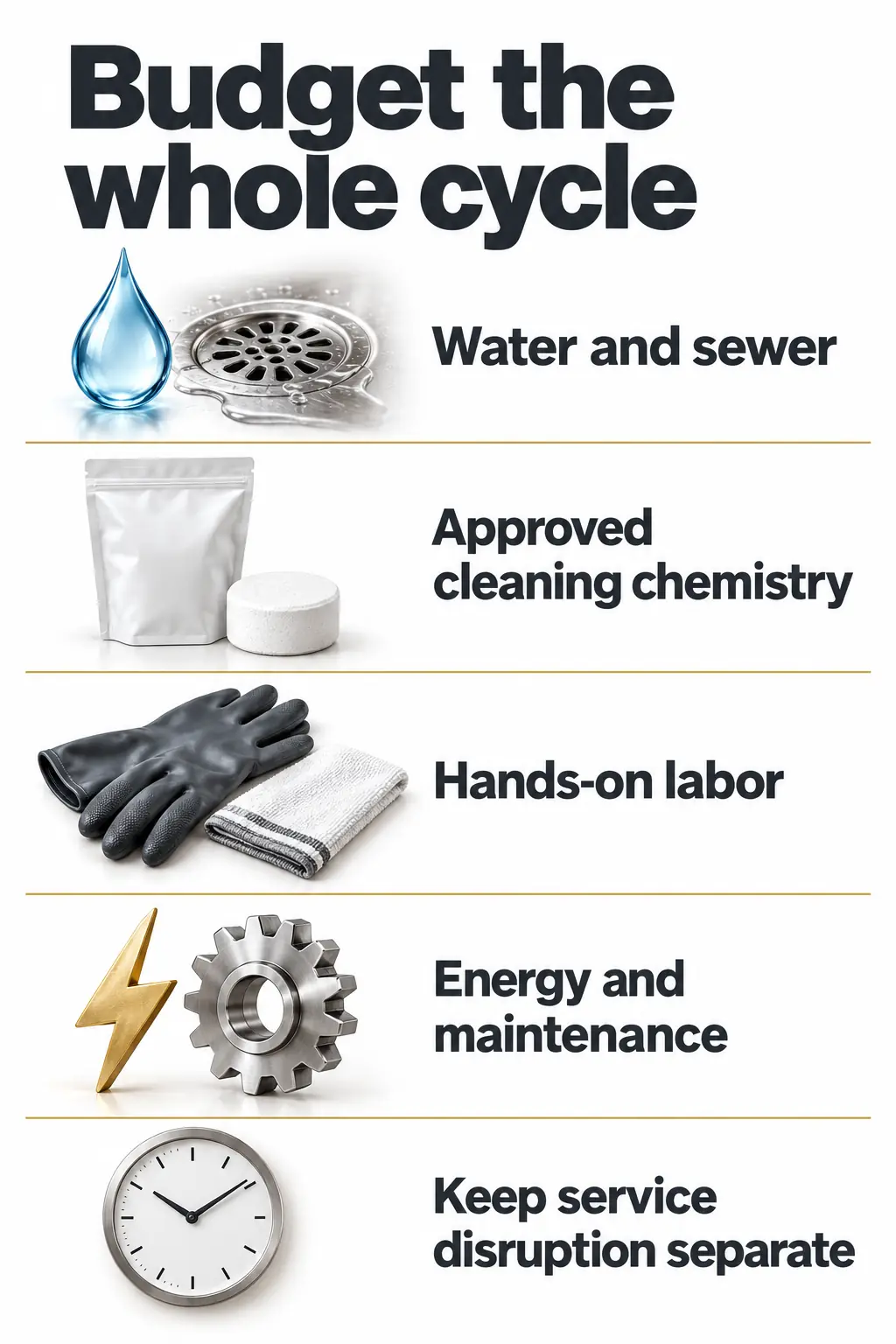
Calculate each program’s direct cost first, then multiply it by the number of times it will actually run. Use delivered chemical prices, the applicable variable water and sewer charges, measured or documented energy, and loaded labor rates. Keep recurring maintenance allowances separate so their basis remains visible. This approach makes a proposal comparable even when one oven uses tablets and another uses liquid dosing. It also exposes omissions: a low detergent cost means little if a separate care product, manual cleaning task, or repeat cycle has disappeared from the estimate. Maintain one currency and one unit system throughout the calculation.
Convert purchasing units into consumption units
Chemical cost per cycle = the sum of each approved product’s dose multiplied by its delivered cost per dose. If a pack contains 100 usable tablets and costs CAD 120 delivered, the example cost is CAD 1.20 per tablet. Two tablets cost CAD 2.40; a separate care dose must be added. These are illustrative prices, not market quotations.
For liquid products, express the dose and price in matching units, such as milliliters and CAD per milliliter. For cartridges, use documented usable yield or observed depletion. Account for residual product, expiry, or waste if it materially changes usable yield. Do not assume that one package equals one clean, or that different brands’ tablets have equivalent doses.
Water cost per cycle = liters used ÷ 1,000 × the applicable CAD per cubic meter. Where the bill uses US gallons, convert consistently: one US gallon is approximately 3.785 liters. Keep US and Imperial gallons distinct. Apply sewer charges according to the actual tariff rather than assuming the same structure everywhere. Fixed bill charges may remain even when consumption falls.
Energy cost follows the same logic: measured kilowatt-hours multiplied by the electricity rate, plus gas or other separately consumed energy where applicable. Do not use the oven’s nameplate power multiplied by cycle length as though the heater runs continuously. For labor, multiply active minutes by the loaded hourly rate divided by 60. Include preparation and finishing tasks; do not price every unattended minute as active work.
Worked example for one oven
The following figures are hypothetical planning inputs, unrelated to any cited manufacturer. Assume 52 weeks, five standard cleans and two heavy cleans per week: 364 scheduled cleaning events. “Standard” and “heavy” are labels for this example only. Per-event water, energy, and labor are assumed to include the routine preparation and finishing assigned to that event; additional site requirements must be added if they are outside this boundary.
| Input per cleaning event | Standard | Heavy |
| Events per week | 5 | 2 |
| Water | 35 L | 60 L |
| Detergent doses | 2 | 3 |
| Separate care doses | 1 | 2 |
| Electricity | 2.0 kWh | 3.0 kWh |
| Hands-on labor | 10 min | 12 min |
| Automatic program | 50 min | 100 min |
| Complete unavailable window | 90 min | 140 min |
Assumed delivered prices are CAD 1.20 per detergent dose and CAD 0.80 per care dose. Other assumptions are CAD 5.00 per cubic meter for combined variable water and sewer charges, CAD 0.15 per kWh, CAD 28.00 per labor hour, and a separate CAD 250.00 annual cleaning-related maintenance allowance. Taxes, financing, equipment purchase, unmeasured treatment costs, extra events, and service disruption are excluded from this base example.
| Annual budget component | Calculation basis | Annual cost CAD |
| Water and sewer | 15.34 m³ × 5.00 | 76.70 |
| Approved chemicals | 260 × 3.20 + 104 × 5.20 | 1,372.80 |
| Electricity | 832 kWh × 0.15 | 124.80 |
| Hands-on labor | 64.1333 hours × 28.00 | 1,795.73 |
| Maintenance allowance | Separate annual assumption | 250.00 |
| Total base budget | Calculated before rounding | 3,620.03 |
Water volume is (5 × 35 + 2 × 60) × 52 = 15,340 liters. Labor is (5 × 10 + 2 × 12) × 52 ÷ 60 = 64.1333 hours. The base budget averages CAD 9.95 per scheduled clean, including the annual allowance. It is an example result, not a cost benchmark or a forecast for a particular hotel.
The same schedule reserves approximately 632.7 oven-hours annually, but that number is not 632.7 payroll hours and does not establish a financial loss. Its operational meaning depends on when those hours occur.
Test the assumptions that change the answer
Changing the illustrative mix to three standard and four heavy cleans per week, while holding other inputs constant, raises the annual total to CAD 3,953.70. That is about CAD 333.67 more, despite the same number of scheduled events. Menu and soil intensity therefore belong in the forecast.
Record extra or repeated events explicitly instead of burying them in an unexplained percentage. For a repeat with different resource use, enter its actual incremental cost separately. If a proposed process reduces active minutes, report the resulting capacity benefit; a payroll saving occurs only when staffing, overtime, or another real expense changes.
The accompanying workbook reproduces the base example and lets you replace its program frequencies, resource inputs, and prices. It also separates additional events and service-disruption allowances. Validate those inputs for the installed oven before using the result for purchasing approval.
Schedule Downtime Around Hotel Service
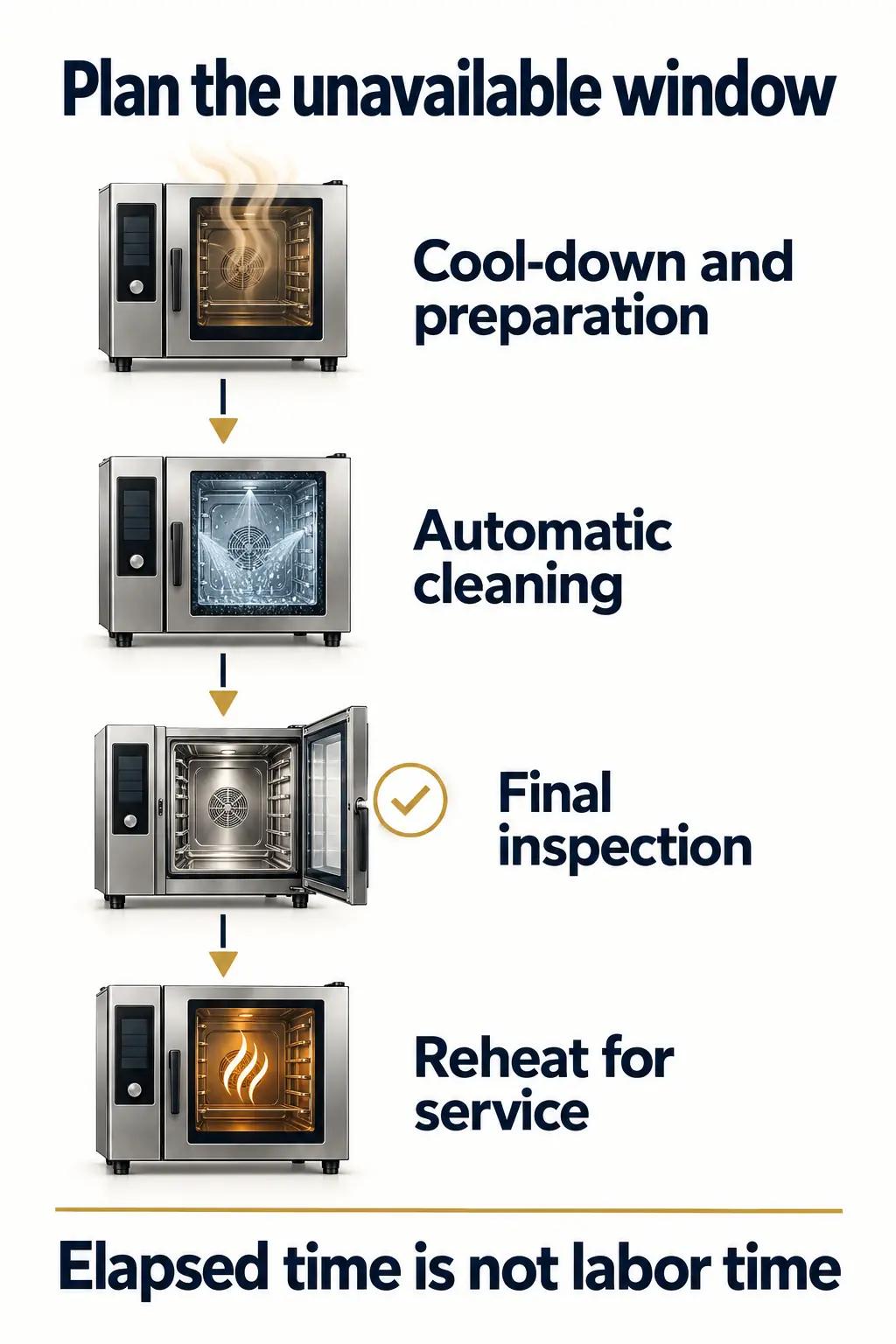
The relevant downtime measure starts when the oven stops being available for production and ends when it is ready for its next required cooking task. That window can include permitted cool-down, preparation, automatic cleaning, required finishing checks, and reheating. Measure the sequence rather than adding durations that overlap. A kitchen may absorb a longer cycle comfortably overnight yet struggle with a shorter cycle between a banquet and breakfast preparation. Keep the cleaning budget connected to the production schedule so that resource savings do not depend on time the kitchen cannot actually spare.
Use elapsed time and active labor for different decisions
In the hypothetical standard event above, allow 20 minutes for cool-down and preparation, 50 minutes for the automatic program, five minutes for checks, and 15 minutes for reheating. Assuming these are sequential, the unavailable window is 90 minutes. The worker’s total active contribution is only 10 minutes, distributed within that window. The heavy event substitutes a 100-minute program, producing a 140-minute window and 12 active minutes.
If production releases the oven at 10:00 p.m., those examples return it at 11:30 p.m. and 12:20 a.m. A midnight production requirement would therefore conflict with the heavy event by 20 minutes. Use this example to expose the scheduling issue; it does not establish safe temperatures, actual appliance durations, or permission for unattended operation.
With two ovens, stagger cleaning when necessary to preserve usable capacity. Confirm that the remaining oven can perform the required menu and volume, and that simultaneous cleaning is compatible with the installed water and drainage capacity. Two cabinets do not automatically provide interchangeable production capacity.
A longer program may suit the lower-cost window
The Convotherm maxx pro brochure distinguishes an Eco mode intended to conserve cleaning fluid, energy, and water from an Express mode that prioritizes speed. This supports comparing resource use and time together. It does not establish identical results or savings for every model and soil condition.
Use the approved program that achieves the required clean within the available window. An overnight resource-saving option may suit one property, while a faster option may be valuable before a tightly timed service. Compare equivalent cleaning outcomes and count the complete return-to-service period, not only the advertised wash timer.
Scheduled starts also need an operational owner. The UNOX manual cited earlier identifies conditions, including an active process or an open door, that can prevent a scheduled wash from starting. Confirm initiation and completion using the functions available on the exact oven. A scheduled icon is not proof of a completed clean.
Price disruption only when it has an identifiable consequence
If the oven is not needed during cleaning and staff perform other work, unavailable time may have no additional service cost. If cleaning requires overtime, a rented backup, outsourced preparation, or a lost production slot, record the relevant incremental amount and its evidence.
For a lost sale, use a defensible contribution calculation after avoided costs, rather than automatically charging full revenue. Do not add a lost-sales estimate and the full cost of backup production for the same orders. Keep ordinary hands-on cleaning labor in its existing budget line. Separating these items makes the financial case reviewable without treating every minute as a loss.
Compare Suppliers and Control Cleaning Costs
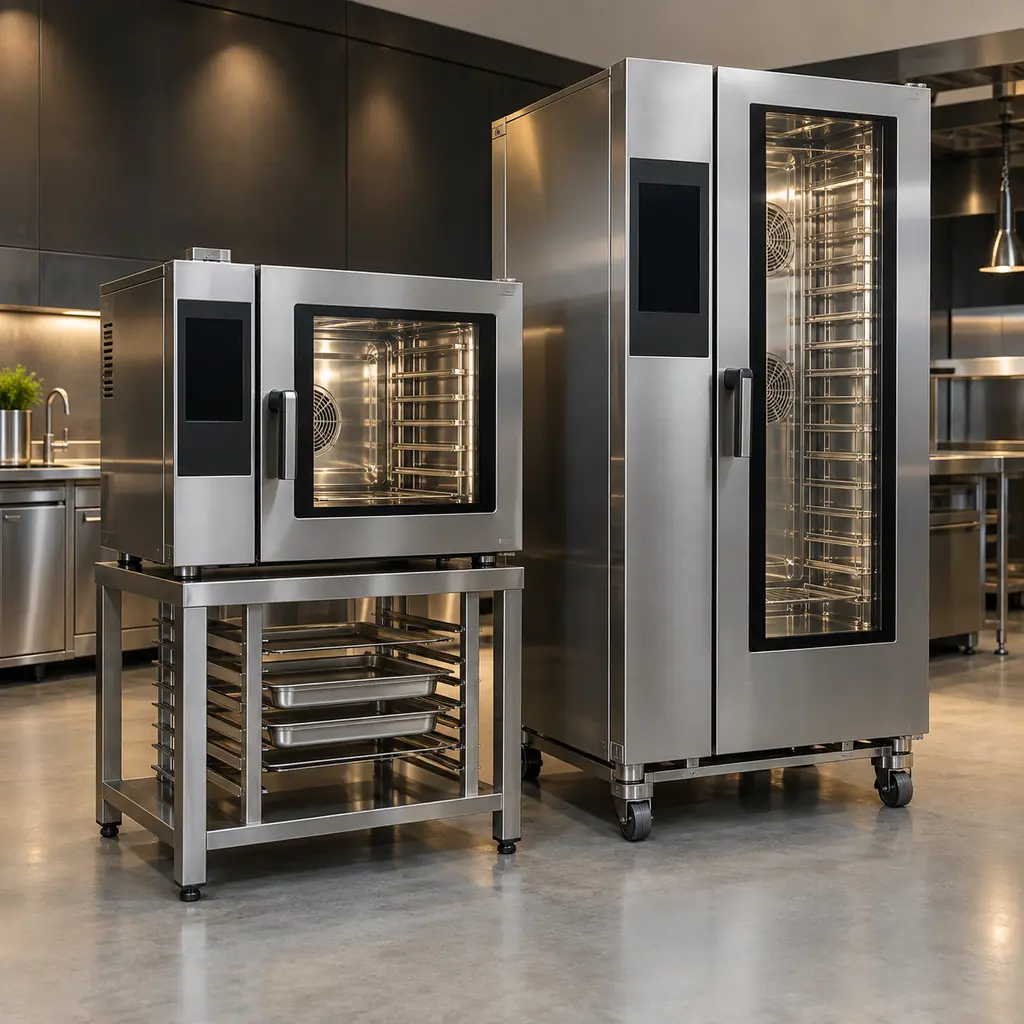
Compare suppliers against the same production duty and cleaning result before comparing their annual totals. The useful proposal connects a specific oven configuration with its required programs, approved consumables, utility assumptions, and local support. A generic statement such as “self-cleaning included” does not establish recurring cost or explain who completes the remaining tasks. Ask for documented inputs and a demonstration using representative soiling, then rebuild the estimate with the hotel’s prices and schedule. Use that same baseline after installation to identify changes in dose, cycle selection, completion rate, and unavailable time.
Request an equivalent operating-cost proposal
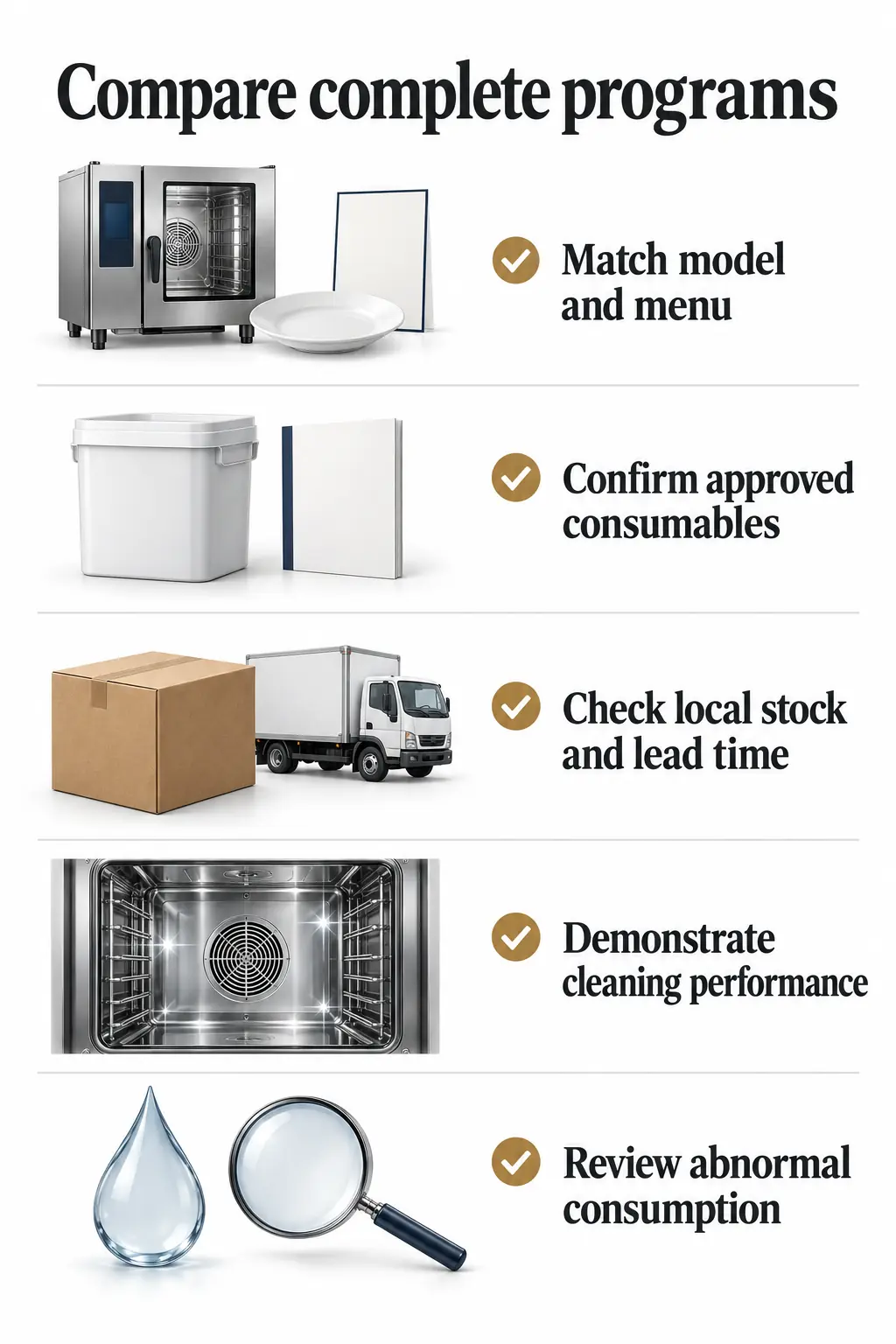
Require the exact model and capacity, available cleaning intensities, installed tablet or liquid-dosing arrangement, approved product names or part numbers, dose basis, and quoted pack yields. The proposal should distinguish documented cycle consumption from estimates, identify the conditions behind quoted duration, and explain any separate care or descaling requirements. Ask for local consumable availability, replenishment lead times, training, warranty conditions, and service support in the hotel’s market.
Place these requirements alongside the hotel’s commercial cooking equipment specifications, including production capacity, utilities, drainage, and access. When preparing a wider tender, use a consistent scope to request comparable hotel equipment quotations. A lower equipment price is not enough if the cleaning assumptions differ.
During a demonstration, document the representative cooking load, initial condition, selected program, approved dose, resource readings, elapsed time, active labor, and final result. Compare several relevant observations where practical. If one unit needs a second wash, keep that event in the comparison. If a supplier provides only an estimate, retain that status until the installed configuration is verified.
Keep chemical compatibility and water treatment in scope
Budget only for chemicals authorized for the exact oven and dosing system. Follow its instructions and each product’s safety data sheet for handling, storage, protective equipment, and disposal. A low-priced general oven cleaner is not evidence of compatibility. RATIONAL’s cited care sheet expressly requires its original products for the specified automatic-cleaning process.
The UNOX manual also requires the specified wash preparation and warns against opening the door during washing. These are examples of why a cost model cannot replace operating instructions. After interruption or cancellation, use the exact model’s recovery procedure and confirm its return-to-use conditions; do not assume that restarting cooking removes cleaning residues.
Water treatment deserves its own scope. EPA’s WaterSense guidance for combination ovens recommends monitoring water quality and preventing scale buildup. Ask which treatment the manufacturer requires for the measured site water. Allocate replacement media, applicable reject or regeneration water, and service costs consistently; identify shared treatment costs separately instead of charging the whole kitchen system to one oven without a basis.
Turn the approved budget into a control process
Review program frequency, water per completed event, chemical usage, repeat events, active minutes, and availability at the next production deadline. Compare like conditions: heavier banquet production may justify a different cycle mix, while an unexplained increase with unchanged use deserves investigation. Have authorized service personnel assess persistent abnormal behavior rather than changing hidden settings or bypassing required steps.
Set chemical replenishment against observed consumption and supplier lead time. Keep required identification and storage conditions intact. Revisit the budget when the menu, occupancy pattern, software, cleaning products, utility rates, or equipment changes. Count cleaner inventory depletion as a useful cross-check, while recognizing that spills, manual use, and stock adjustments can differ from programmed dosing.
For a replacement or expansion project, request a combi oven equipment quote with the oven quantity, kitchen location, required service windows, available utility details, and model documentation. Include the cleaning-program requirements so proposals can be evaluated on the same operating basis.
Conclusion
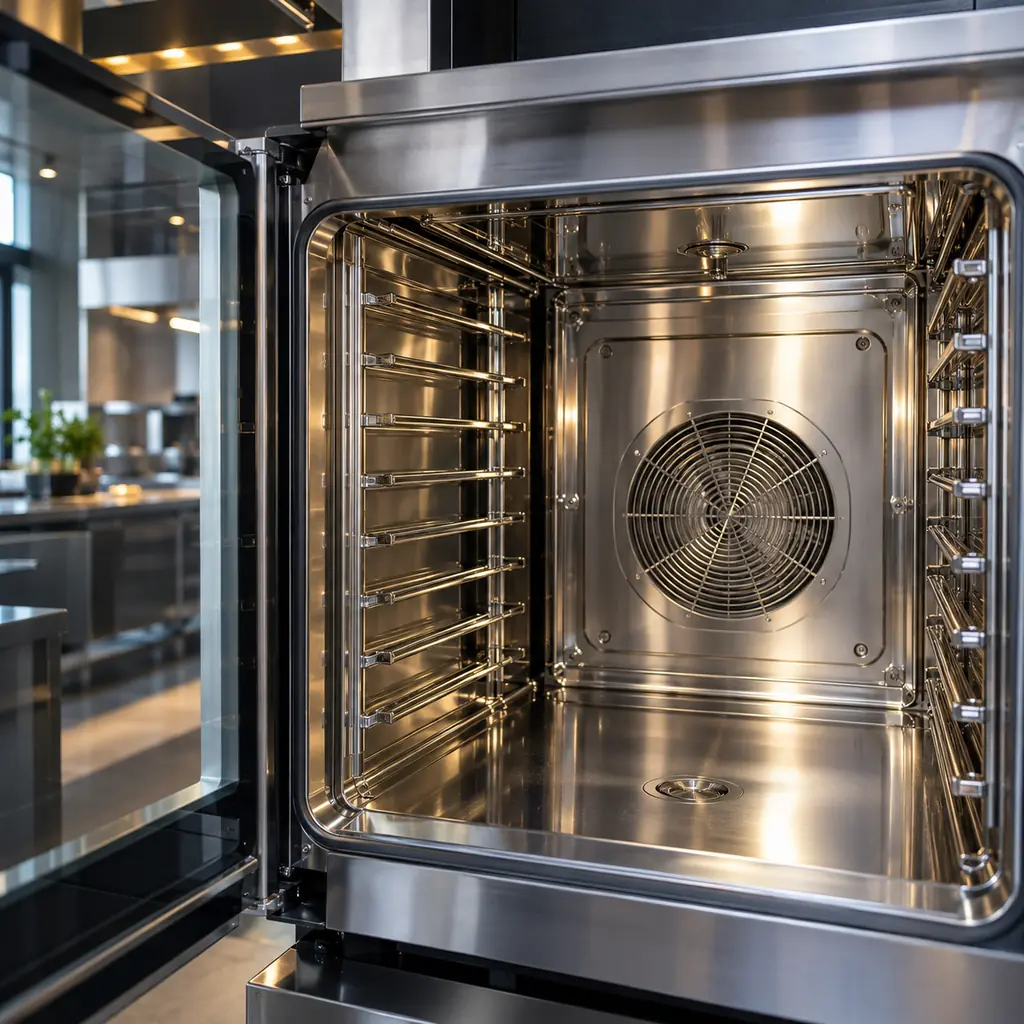
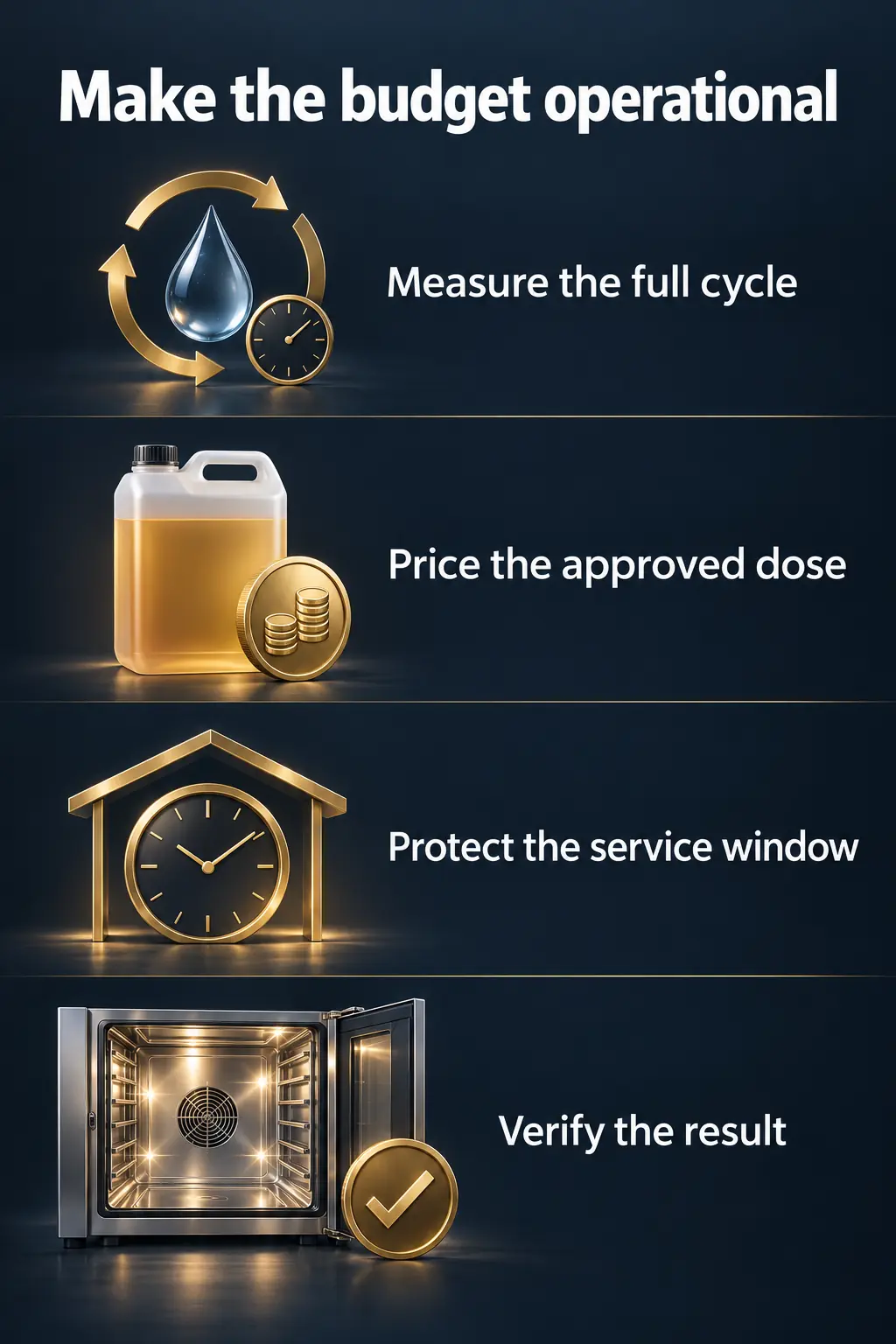
A defensible hotel combi oven cleaning budget begins with a defined cleaning result and the exact appliance configuration. Measure the program mix, price every required consumable, and distinguish active labor from the full period when the oven cannot cook. Use representative site data to replace assumptions, then test how a heavier menu or a tighter service window changes the decision. The most useful comparison is the cost of completing the required cleaning while protecting production. Keep the approved program, purchase terms, and recorded operating results connected so the budget remains useful after the oven enters service.
Frequently Asked Questions
Does a steam-only day eliminate the need for automatic cleaning?
Do not assume so. Follow the exact model’s cleaning requirements. RATIONAL’s cited iCombi care sheet specifically calls for daily automatic cleaning even with mostly steaming use. A light soil load may affect permitted program selection, but it does not automatically cancel a required cleaning schedule.
Should an automatic cleaning cycle be budgeted as labor for its entire duration?
No. Budget active preparation, chemical handling, required checks, and finishing work as labor. Record the complete unavailable window separately. Add paid attendance time if the procedure actually requires it, and add disruption costs only where a real incremental consequence exists.
Can a quick rinse replace a full cleaning program?
Only if the manufacturer explicitly permits that process for the required task and condition. A rinse, an interim clean, and a full cleaning program can have different purposes. Select by the documented cleaning requirement and verified result, not by the shortest displayed duration.
What if cleaning consumption is missing from the supplier specification?
Request the exact program documentation or a measured demonstration with defined boundaries. Use a labeled provisional allowance until verified data are available. Do not substitute cooking water ratings or present the article’s hypothetical inputs as manufacturer performance.
How should multiple ovens be combined in the annual budget?
Calculate each oven’s program mix and costs, then sum the results. Allocate shared treatment or service charges once. Add oven-hours to describe total equipment occupation, but use the actual overlapping schedule to assess whether the kitchen loses usable capacity.
What happens if an overnight cleaning program does not finish?
Keep the oven out of food production until the applicable recovery and return-to-use requirements are satisfied. Record the failed event, additional resources, staff time, and any service impact. Investigate the cause using the model’s instructions and authorized support; there is no universal safe shortcut.
References
RATIONAL — Appliance care. iCombi Pro, iCombi Classic.
U.S. Environmental Protection Agency, ENERGY STAR — ENERGY STAR Version 3.0 Commercial Ovens Final Specification
UNOX — CHEFTOP-X / BAKERTOP-X User manual, Version 2.6
Convotherm — Convotherm maxx pro
U.S. Environmental Protection Agency — WaterSense at Work, Section 4.3: Combination Ovens