
An accurate hotel supply quote begins with an accurate request. A supplier can only price what the buyer has defined, so vague phrases such as “good quality,” “standard size,” “delivery included,” or “same as the photo” force the quotation team to make assumptions. Those assumptions may affect the product grade, dimensions, pack size, minimum order quantity, customization, freight, taxes, installation, lead time, and warranty. Two suppliers may therefore return very different prices even though both appear to be quoting the same item.
The practical solution is to create one controlled request package before asking for prices. That package should explain the property and project, identify every item with a unique code, define measurable specifications, state quantities and units of measure, describe customization and quality requirements, and fix the delivery and commercial basis. It should also tell the supplier how to present alternatives, exclusions, tooling, samples, logistics, and quote validity. The objective is not to make the request unnecessarily long. It is to remove the decisions that should not be left to the supplier.
This guide focuses on the information a hotel owner, operator, designer, developer, or purchasing team should send when requesting a quotation from a hotel supply company. It applies to new openings, renovations, brand conversions, replacement programs, and recurring orders across OS&E and selected FF&E categories. The method works whether the request covers one product or hundreds of line items. For broader category planning, the hospitality supplies sourcing overview can help teams map their requirements before they begin pricing.
Use the quote as a commercial snapshot, not as a substitute for technical approval, sample approval, or a purchase order. A precise request improves accuracy, but the buyer still needs to confirm what the supplier has included, excluded, substituted, and assumed before treating the total as final.

Define the Property, Project, and Scope
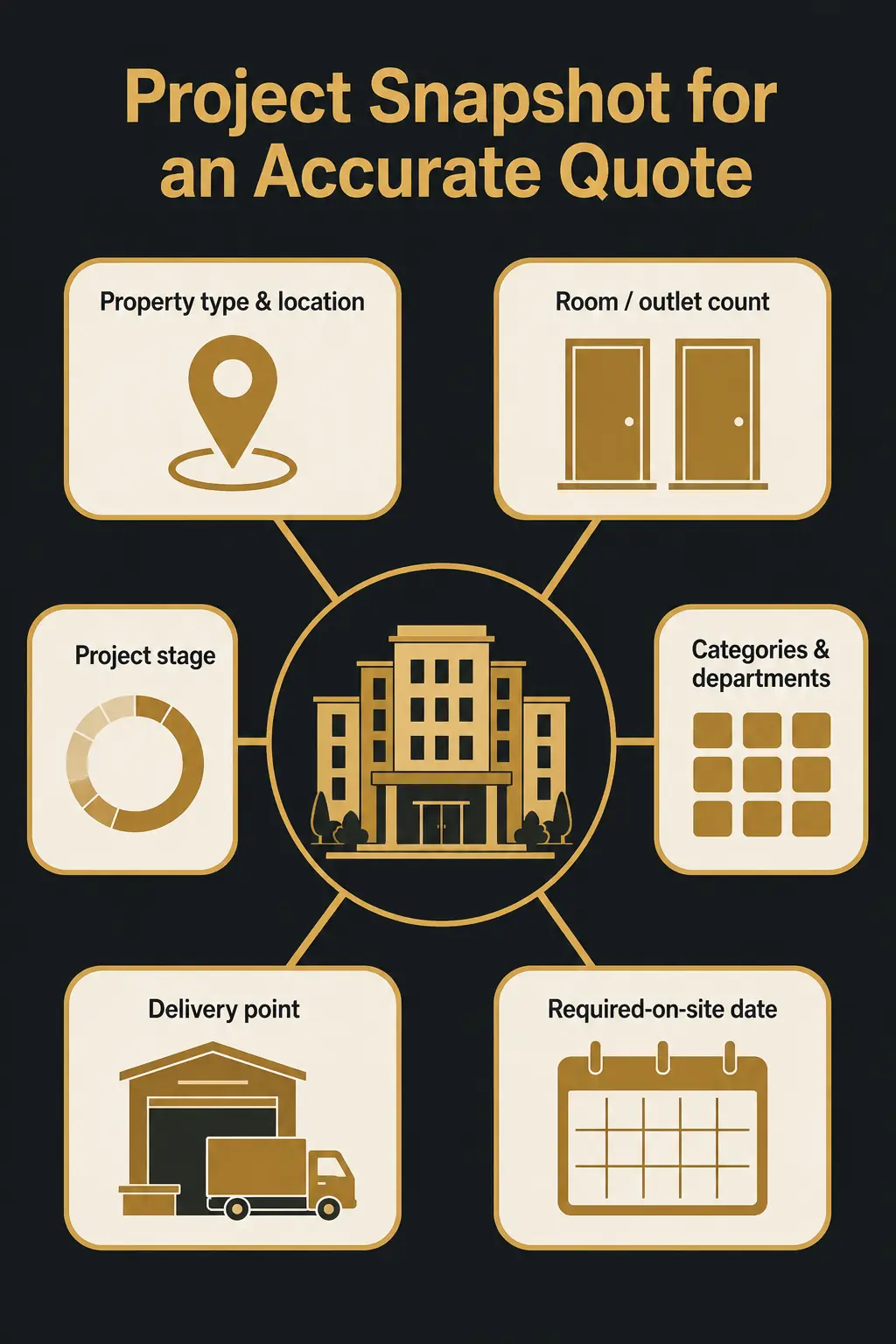
Start with a concise project snapshot so the supplier understands the operating context behind the request. State the property type, location, opening or renovation status, room count, outlet count, service level, target completion date, and the departments or areas covered. Identify whether the request is for an initial opening quantity, a phased installation, a recurring replenishment program, or a one-time replacement. This context helps the supplier judge product suitability, production capacity, delivery sequencing, and category coordination. It also prevents a quote for a generic product that meets the description but not the operating demands of the property.
Separate the project brief from the item schedule
The project brief explains the overall job. The item schedule defines what must be priced. Keep both in the same request package, but do not mix property-level information into every product row.
The project brief should normally identify:
Buyer organization, property or project name, and primary contact
Property type, market, location, and operating model
New opening, renovation, conversion, replacement, or replenishment status
Number of rooms, outlets, workstations, floors, buildings, or relevant operating units
Departments and product categories included in the request
Target sample-approval, production, shipment, and required-on-site dates
Delivery points, access restrictions, storage limits, and phased-delivery needs
Whether the quotation is for budgeting, supplier selection, or an imminent purchase
If the order supports a hotel opening, distinguish the public opening date from the date supplies must be received. Goods may need to arrive earlier for inspection, installation, room setup, staff training, snagging, and replacement of rejected units. A supplier that only sees the opening date may propose a schedule that is technically on time but operationally unusable.
State what is outside the supplier’s scope
Accuracy also depends on exclusions. Clarify whether the hotel, contractor, designer, freight forwarder, installer, or another vendor will handle site measurement, artwork, electrical connection, unloading, assembly, installation, commissioning, staff training, waste removal, customs clearance, or final-mile delivery. If responsibility is not assigned, one party may price the service while another assumes the buyer will provide it.

Build a Line-Item Specification Schedule
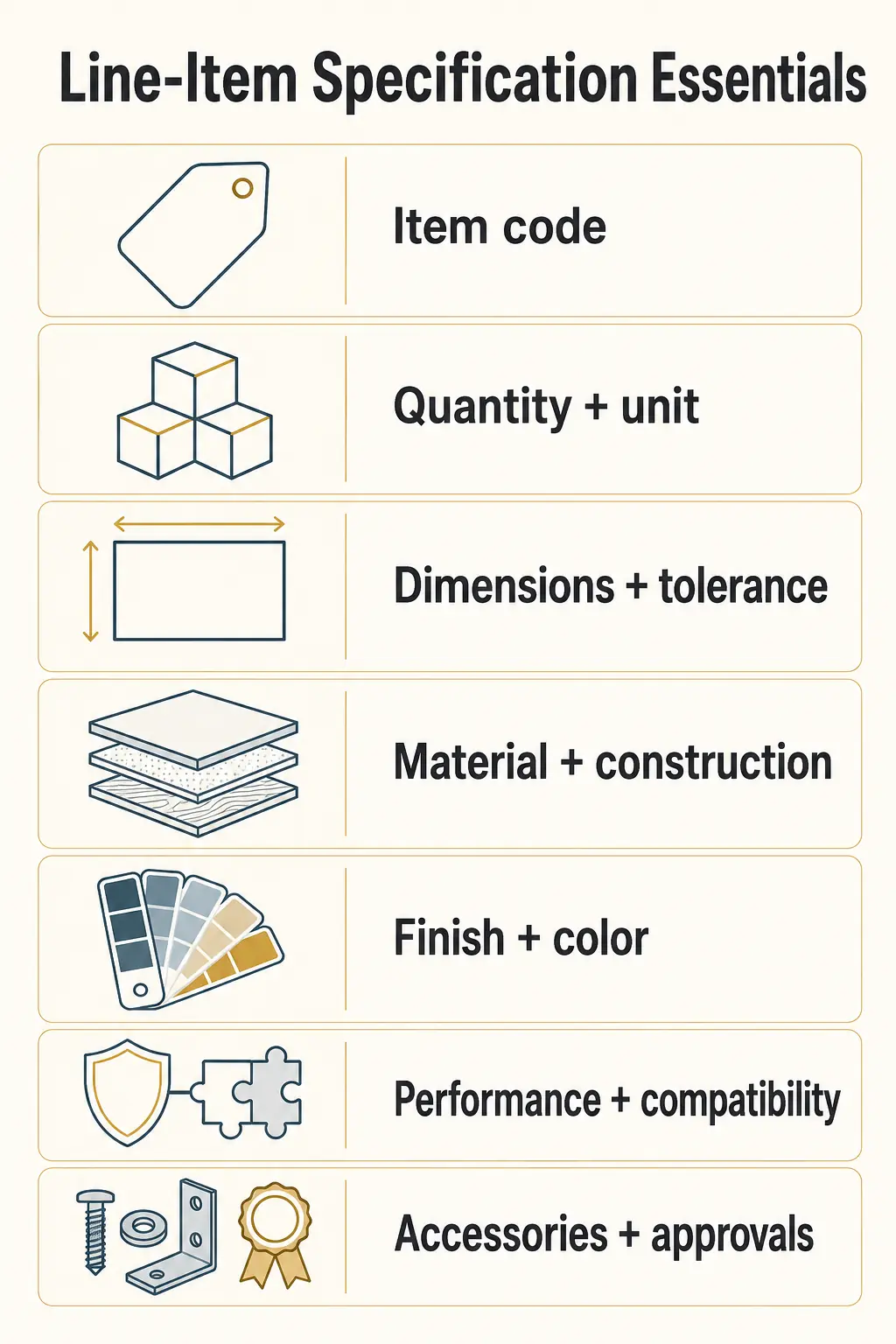
Every product should have one row, one item code, one quantity, and one measurable description. The description must let a qualified supplier identify the product without relying on an informal conversation or an unlabeled reference image. For simple consumables, a short specification may be enough. For furniture, equipment, linens, tableware, guest amenities, carts, or branded products, the row may need dimensions, material, construction, finish, capacity, performance, compatibility, cleaning, compliance, and accessories. The required detail should reflect the risk of receiving an unsuitable substitute, not the price of the item alone.
Give each line item a complete identity
A useful specification schedule includes the following fields where relevant:
| Field | What to provide | Why it affects the quote |
| Item code | A unique buyer reference | Prevents confusion across revisions and similar products |
| Product name | A precise functional name | Establishes the category and intended use |
| Quantity and unit | Units, sets, pairs, cases, rolls, meters, or another defined measure | Prevents pack-size and conversion errors |
| Dimensions | Required dimensions and tolerances in a stated unit | Changes material use, tooling, packaging, and freight volume |
| Material and construction | Grade, thickness, weave, composition, frame, coating, or build method | Determines performance and cost |
| Finish and color | Code, swatch, reference, gloss level, or approved range | Controls visual consistency and customization |
| Performance | Capacity, safe working load, abrasion, absorbency, power, output, or duty cycle | Separates commercial suitability from appearance |
| Compatibility | Utilities, voltage, plug, mounting, software, equipment, or existing dimensions | Prevents products that cannot be installed or used |
| Accessories | Included components, consumables, cables, covers, spare parts, or tools | Exposes incomplete unit prices |
| Approval reference | Drawing, sample, model, photograph, or brand standard | Links the quote to the correct controlled reference |
Replace subjective language with acceptance criteria
Terms such as “premium,” “luxury,” “heavy duty,” “hotel grade,” and “high quality” are not measurable specifications. If the quality level matters, define the properties that create it. A luggage cart might require a stated safe working load, wheel diameter, turning clearance, bumper construction, finish, carpet color, and elevator compatibility. A towel might require dimensions, fiber content, construction, weight range, color standard, shrinkage tolerance, and wash-performance expectations.
When an exact model is not required, describe the minimum performance that an approved equivalent must meet. Ask the supplier to identify every proposed deviation rather than silently substituting a lower grade, different dimension, or alternative finish.
Control reference images and revisions
Reference images help explain form and appearance, but they do not replace specifications. Label each image or drawing with the item code and revision date. State whether it shows a mandatory design, an approximate style, or only a functional reference. If several files conflict, identify which document controls. During clarification, issue a revised schedule rather than relying on scattered email changes that leave different suppliers pricing different versions.
For a formal multi-supplier process, use the site’s detailed guide on how to write an RFQ for hotel supplies to organize submission rules, evaluation criteria, and award conditions around the same specification schedule.

State Quantities, Packaging, Customization, and Quality Controls
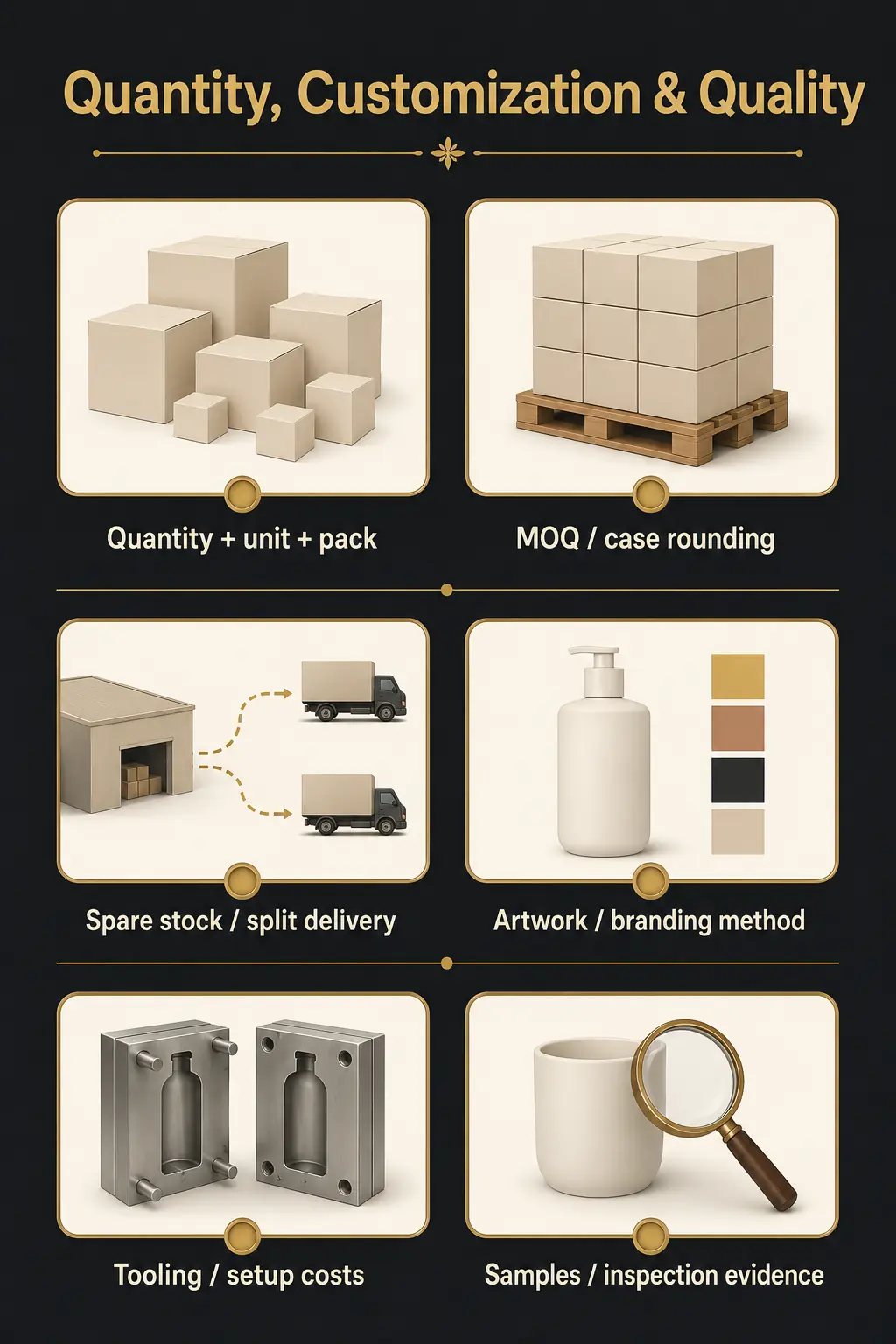
Quantity is more than a number. The supplier needs the quantity per line, the unit of measure, pack configuration, permitted order tolerance, required spare stock, and whether deliveries will be split. Custom products also require clarity about artwork, logo method, colors, tooling, sample stages, and acceptable production variance. Quality requirements should define what must be inspected and what evidence must accompany the quote. Without these details, a low unit price may exclude setup costs, mandatory case quantities, protective packaging, sample fees, testing, or the extra units needed to cover damage and opening-day replacements.
Define the quantity basis
For each item, specify:
Exact requested quantity and unit of measure
Units per pack, case, set, or pallet if the configuration matters
Whether the supplier may round to a case pack or minimum order quantity
Opening quantity, operating par, and spare or replacement reserve where relevant
Delivery quantity by property, phase, building, floor, department, or outlet
Whether partial shipments are allowed
Any acceptable manufacturing overrun or underrun for custom goods
Ask the supplier to show both the quoted order quantity and any mandatory adjusted quantity. If the hotel requests 950 pieces but the factory requires cases of 100, the quote should display the 1,000-piece order basis rather than hiding the adjustment in the total.
Make customization separately priceable
State the exact customization method: printing, embroidery, engraving, embossing, color matching, custom dimensions, private labeling, bespoke packaging, or another process. Attach final or draft artwork in an appropriate file format and define the number of colors, print positions, logo dimensions, color standard, and approval method.
Require separate prices for tooling, molds, screens, plates, dies, setup, artwork adjustment, pre-production samples, and repeat-order setup. Ask who owns reusable tooling and how long it will be retained. These charges should not be buried in an unexplained unit price because they may not recur on future orders.
Define the sample and quality path
Tell the supplier whether the project needs a stock sample, finish chip, fabric swatch, digital proof, prototype, counter-sample, or pre-production sample. Identify the approver, the criteria for approval, the required date, who pays for the sample and freight, and whether the production lead time begins before or after approval.
For technically or visually sensitive products, request the relevant drawings, material data, test reports, certificates, inspection plan, warranty terms, and quality-control records. Do not ask for every possible document by default. Request the evidence needed to confirm the specific product and market requirements, then verify that it applies to the quoted model and production source.

Fix Delivery, Timing, and Commercial Terms
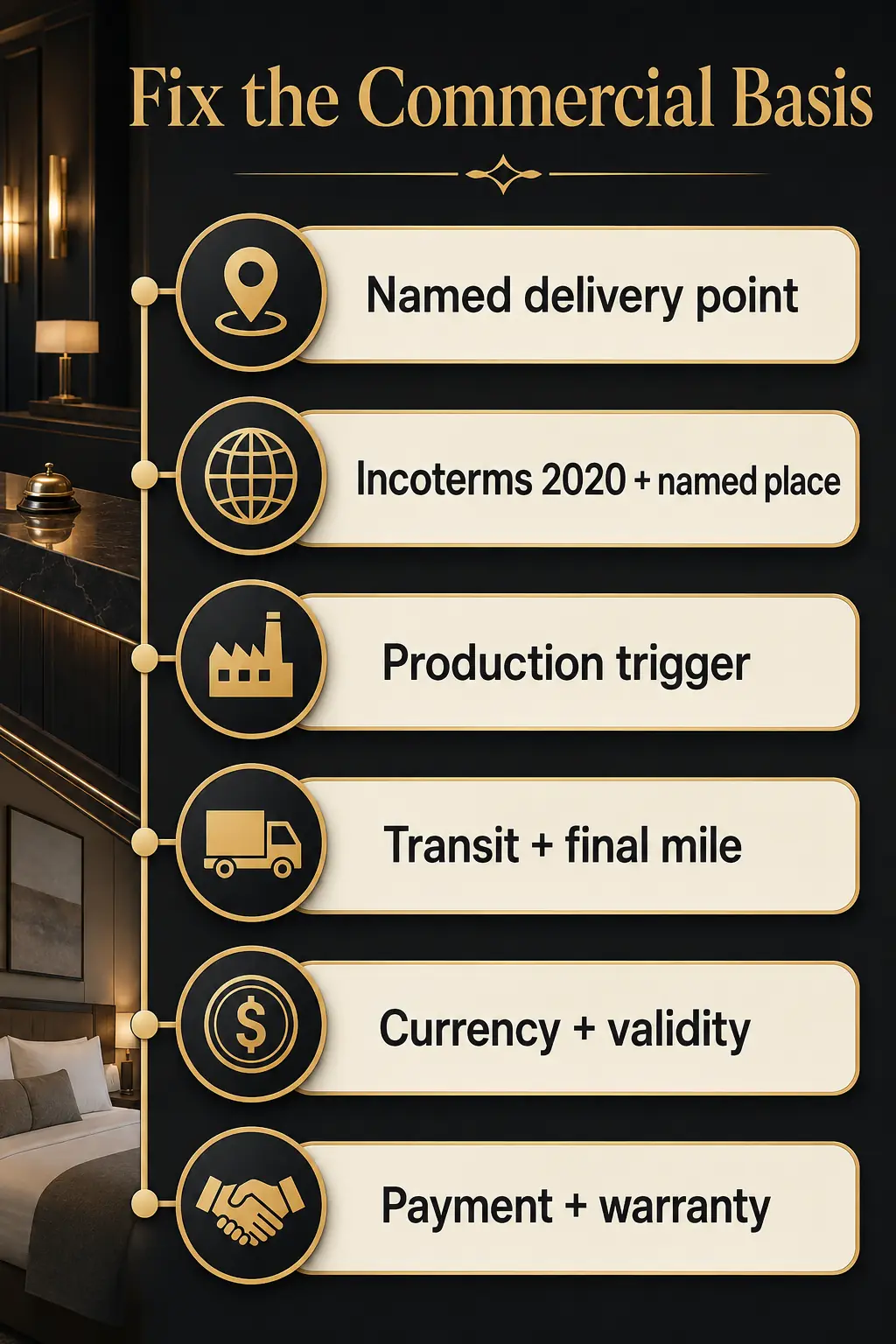
A quotation cannot be accurate if the delivery basis is unclear. Give the complete destination and state whether pricing should cover factory collection, export delivery, port delivery, door delivery, unloading, installation, or another defined point. For international purchases, identify the agreed Incoterms® rule, named place or port, and version rather than writing only “FOB,” “CIF,” or “DDP.” The request should also distinguish production time from transit time and identify the date the goods must be available on site. Commercial terms such as payment schedule, quote validity, taxes, duties, warranty, and currency must use the same basis across all bidders.
Name the exact delivery point and responsibility boundary
“Delivered to hotel” is incomplete if the supplier does not know whether the price includes customs clearance, duty, local tax, appointment booking, lift-gate service, unloading, floor distribution, assembly, installation, packaging removal, or site access permits. Provide the full destination, receiving hours, vehicle restrictions, dock or curb conditions, elevator limits, storage constraints, and contact process.
For international shipments, a trade term allocates specific tasks, costs, and risks between buyer and seller, but it does not replace a complete transport plan or sales contract. Use the full term with its named place and rule version, then ask the supplier to itemize freight, insurance, export handling, documentation, and any charges outside that basis.
Break the schedule into components
Ask for separate durations for:
- Technical clarification and final specification confirmation
- Artwork, drawing, or sample production
- Buyer review and approval
- Production after approval and deposit
- Quality inspection and corrective work
- Export preparation and booking
- Main transport and customs clearance
- Final-mile delivery, installation, or commissioning
Lead time should also state what starts the clock. A promise of “45 days” is ambiguous unless the supplier confirms whether it begins at quotation acceptance, purchase order, deposit receipt, final artwork, sample approval, or material availability. Ask which dates are estimates and which are firm commitments.
Standardize the commercial basis
Require the quotation to state currency, payment schedule, bank charges, taxes, duties, quote-validity period, price-adjustment conditions, warranty coverage, claim procedure, and cancellation terms. If the hotel needs an option price, expedited schedule, alternative material, or split delivery, request it as a separate line or scenario. This keeps the base quote comparable.

Require a Complete, Assumption-Visible Quote
Tell the supplier how the quotation must be structured. A single total on company letterhead is not enough for a multi-item hospitality project. The response should identify the quoted model or specification, quantity, unit, unit price, extended price, tooling, samples, testing, packaging, freight, services, taxes, lead time, validity, payment terms, warranty, exclusions, assumptions, and proposed alternatives. Every blank should be resolved as included, excluded, not applicable, separately priced, or pending clarification. This response format makes omissions visible before the hotel compares totals or requests internal approval.

Ask for a line-by-line compliance response
Require the supplier to respond against the same item codes and document revisions used in the request. For each item, the supplier should mark one of three positions:
Compliant with the requested specification
Compliant with a clearly described exception
Alternative offered for buyer review
An alternative should include a revised description, model or drawing, performance difference, price effect, lead-time effect, and reason for the proposal. “Similar” or “equivalent” without evidence is not sufficient.
Separate included costs from exclusions
Request an explicit cost summary that distinguishes product value from tooling, customization, samples, testing, inspection, packaging, freight, insurance, duties, taxes, installation, commissioning, training, and spare parts. The supplier should also list buyer-supplied items and services. This is especially important when one company offers a factory price and another offers a delivered or installed price.
Require the supplier’s assumptions
Ask the quotation preparer to list assumptions about specification, color, quantity, pack size, delivery, approval dates, utilities, installation conditions, and buyer responsibilities. An assumption is not automatically a problem; an undisclosed assumption is. If a requirement is missing or contradictory, the supplier should raise a clarification question instead of selecting the cheapest interpretation.
Set a clarification channel and revision control
Use one contact and one written clarification log for material questions. When an answer changes the scope, issue it to every invited supplier and update the controlled request documents. Require revised quotes to carry a version number and date, and identify which previous quotation they replace. This prevents a buyer from comparing an updated offer from one supplier with an obsolete offer from another.

Normalize and Validate the Quote Before Approval
When quotations arrive, first confirm compliance and completeness; do not begin by sorting unit prices. Normalize every response to the same specification, quantity, unit of measure, packaging, customization, service scope, delivery basis, currency, and tax treatment. Mark unresolved blanks and exceptions rather than filling them with favorable assumptions. Then validate the supplier’s evidence, sample path, production schedule, and commercial terms. The objective is a quote that can be defended internally and converted into a purchase order without reopening fundamental questions about what the hotel is buying or who is responsible for delivery.
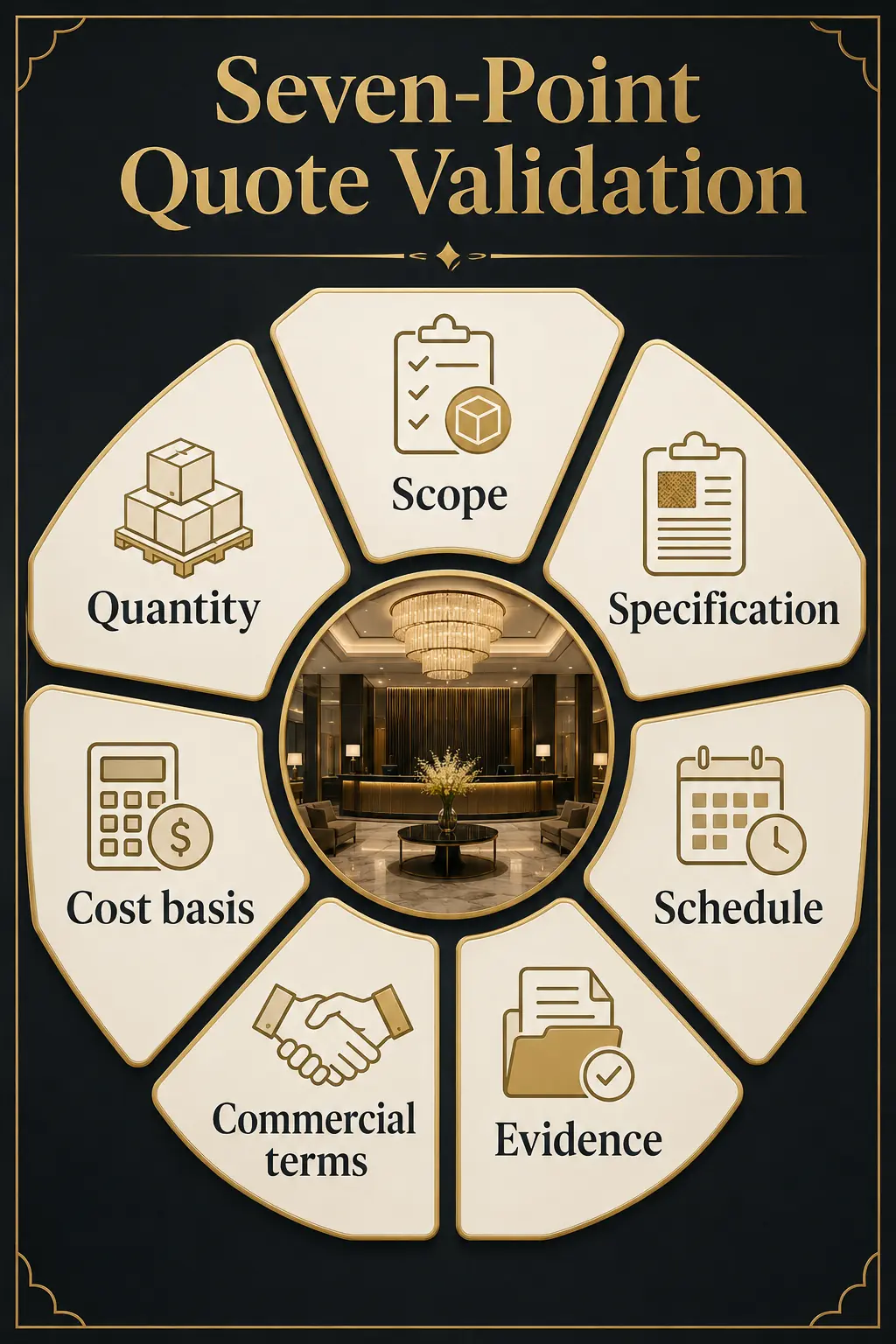
Run a seven-point validation
Before treating a quotation as approval-ready, confirm:
- Scope: Every requested item and service is present, with the correct revision and no unexplained substitution.
- Quantity: Order quantities, units, case packs, minimums, overruns, spare stock, and split deliveries are visible.
- Specification: Materials, dimensions, performance, finish, accessories, compatibility, and approval references match the request.
- Cost basis: Unit and extended prices reconcile, and tooling, samples, packaging, freight, services, taxes, and exclusions are explicit.
- Schedule: Sample, approval, production, inspection, shipment, and delivery durations use a defined start point.
- Commercial terms: Currency, validity, payment, warranty, claims, cancellation, and price-adjustment conditions are acceptable.
- Evidence: Samples, drawings, certificates, reports, and supplier commitments apply to the quoted product and source.
Compare normalized cost, not the headline total
If two quotes use different bases, rebuild the comparison on a common basis. Add excluded but required costs, remove optional items that are not being evaluated, align quantities, and separate one-time tooling from repeat-order cost. Record each adjustment and ask the supplier to confirm material clarifications in writing.
The next stage is supplier selection, which requires more than quote accuracy. The guide to comparing hotel supply companies beyond the quoted price explains how to assess lifecycle value, delivery capacity, service, risk response, and evidence after every offer has been normalized.
Convert the accepted basis into purchasing controls
Once the preferred quote is clarified, transfer the controlled specification, accepted exceptions, approved samples, quantities, prices, delivery basis, milestones, payment terms, warranty, and acceptance criteria into the purchase order or contract. Attach or reference the correct quote version. A purchase order that says only “as quoted” can reopen ambiguity if several revisions exist.
If the project scope is ready, submit the property details, item schedule, specifications, quantities, destination, and target date through the KW Hospitality request-for-quote form. The form also accepts common spreadsheet, document, and image formats, allowing the sourcing team to review the controlled request package rather than reconstruct it from separate messages.

Conclusion
An accurate hotel supply quotation is the result of controlled information, not a better wording of “please send your best price.” The buyer must define the property context, item specifications, quantities, units, packaging, customization, quality evidence, delivery boundary, schedule, and commercial terms. The supplier must then respond line by line, expose assumptions and exclusions, identify alternatives, and separate every material cost. When both sides use one controlled set of documents, fewer key decisions are left hidden inside the total price.
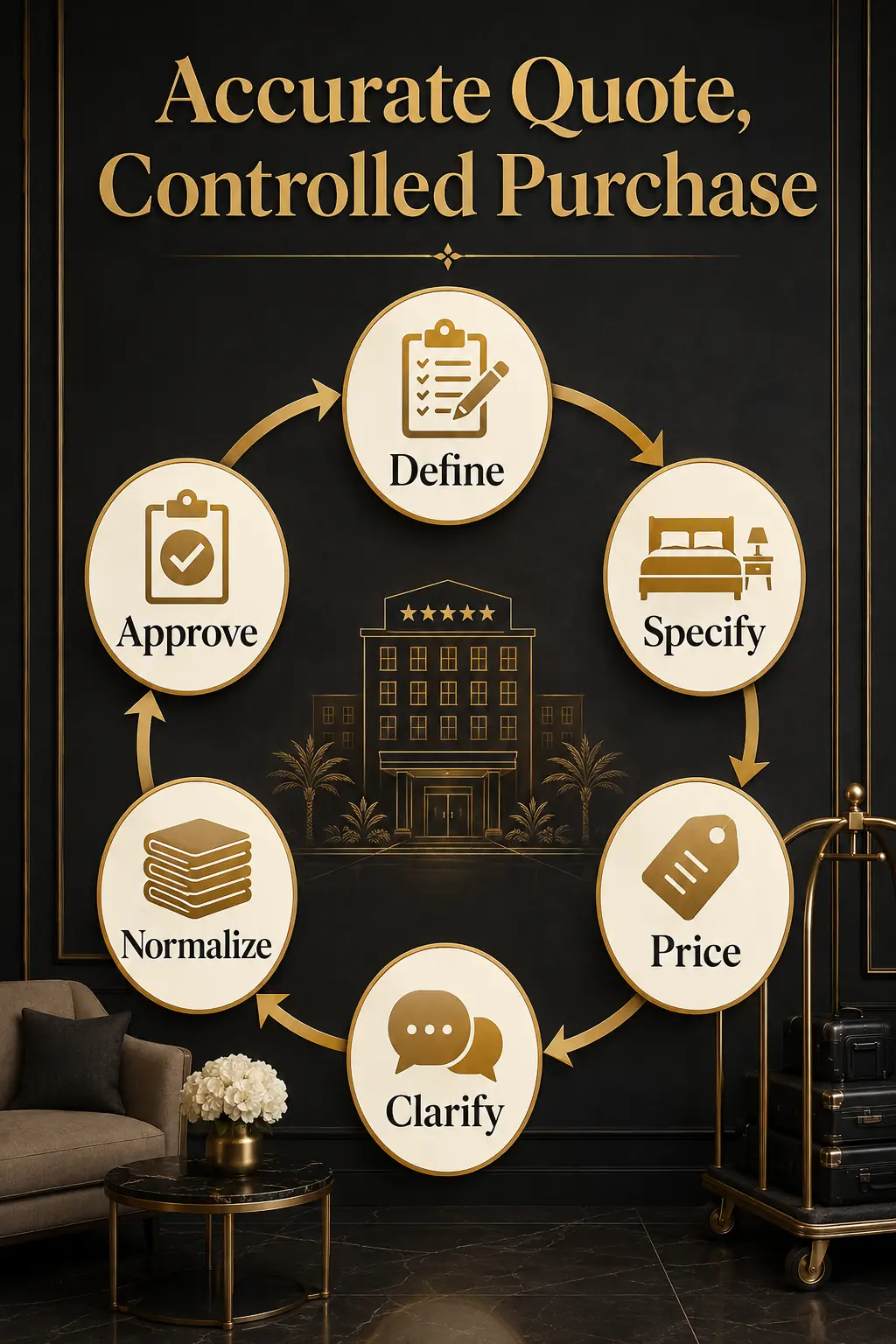
The most effective request is detailed where ambiguity creates cost or material operational risk and concise where the requirement is standard. It does not demand unnecessary paperwork, nor does it treat a quotation as final acceptance. It creates a reliable basis for clarification, comparison, approval, and conversion into a purchase order.
Before sending the request, perform one final consistency check: every item has a code, every quantity has a unit, every reference has a revision, every service has an owner, every deadline has a defined start point, and every price is requested on the same delivery and commercial basis. That discipline shortens clarification cycles and makes the eventual supplier decision easier to explain.
Frequently Asked Questions
What is the minimum information needed for a hotel supply quote?
At minimum, provide the product name, measurable specification, quantity and unit of measure, delivery destination, required date, and contact information. Add dimensions, materials, finishes, customization, packaging, compliance, samples, installation, and commercial terms whenever they can change product suitability or cost.
Can reference photos be used instead of technical specifications?
Reference photos can explain appearance or function, but they should not replace measurable specifications. Label every image with the item code and state whether it is mandatory, approximate, or for inspiration only. Add dimensions, material, performance, finish, and acceptance criteria so the supplier does not have to infer them from the image.
Why do two suppliers quote different prices for what seems to be the same product?
The suppliers may be using different materials, dimensions, pack sizes, minimum quantities, accessories, quality controls, freight terms, warranties, or service scopes. Normalize both offers to the same technical and commercial basis before deciding that one is more expensive.
Should a hotel disclose its budget when requesting a quote?
A budget range can help a supplier avoid proposing options that are clearly unsuitable, especially when several performance or finish levels are acceptable. However, the buyer should still define minimum requirements and request a transparent breakdown. A budget should guide appropriate options, not replace specifications or cost visibility.
Is the lowest quote usually the best quote?
No. The lowest total may exclude required freight, accessories, installation, testing, packaging, warranty support, or a compliant product specification. Compare normalized landed cost, quality, lifecycle value, delivery capability, service, and risk—not the headline total alone.
When should the buyer request samples?
Request samples when appearance, finish, feel, fit, compatibility, cleanability, branding, or performance cannot be approved confidently from documents alone. Define the sample type, cost, freight responsibility, approver, criteria, deadline, and effect on production lead time.
How long should a supplier’s quotation remain valid?
There is no universal validity period. It should reflect the volatility of materials, currency, freight, and production capacity. Ask the supplier to state the validity date and the conditions that may change the price afterward, then confirm the quotation again if approval occurs outside that period.