
Extending the service life of hotel bedding starts with controlling what happens between guest use and the next room release. Match each item to its approved laundry process, inspect it at routine handling points, rotate usable stock, and remove pieces when cleanliness, fit, comfort, or protective function falls below the property’s standard. A longer replacement interval is useful only when the bedding remains suitable for guests.
For housekeeping leaders and hospitality buyers, the challenge is coordinating several products with different failure modes. Sheets and pillowcases can lose fabric strength or become visibly worn. Duvet covers can develop broken closures or distorted seams. Pillows and filled bedding can lose their intended shape. A mattress protector may look acceptable on top while its backing or attachment system has failed. Treating all these items as one laundry category makes the underlying problems harder to see.
This guide covers removable bed textiles, including sheets, pillowcases, duvet covers, blankets, pillows, filled inserts, and mattress protectors. It does not prescribe a mattress replacement cycle or a universal disinfection formula. Product care instructions, the property’s hygiene requirements, and the laundry provider’s validated processes govern the actual washing and drying conditions. The inspection intervals below are proposed operating starting points, to be adjusted using local failure records and supplier guidance.
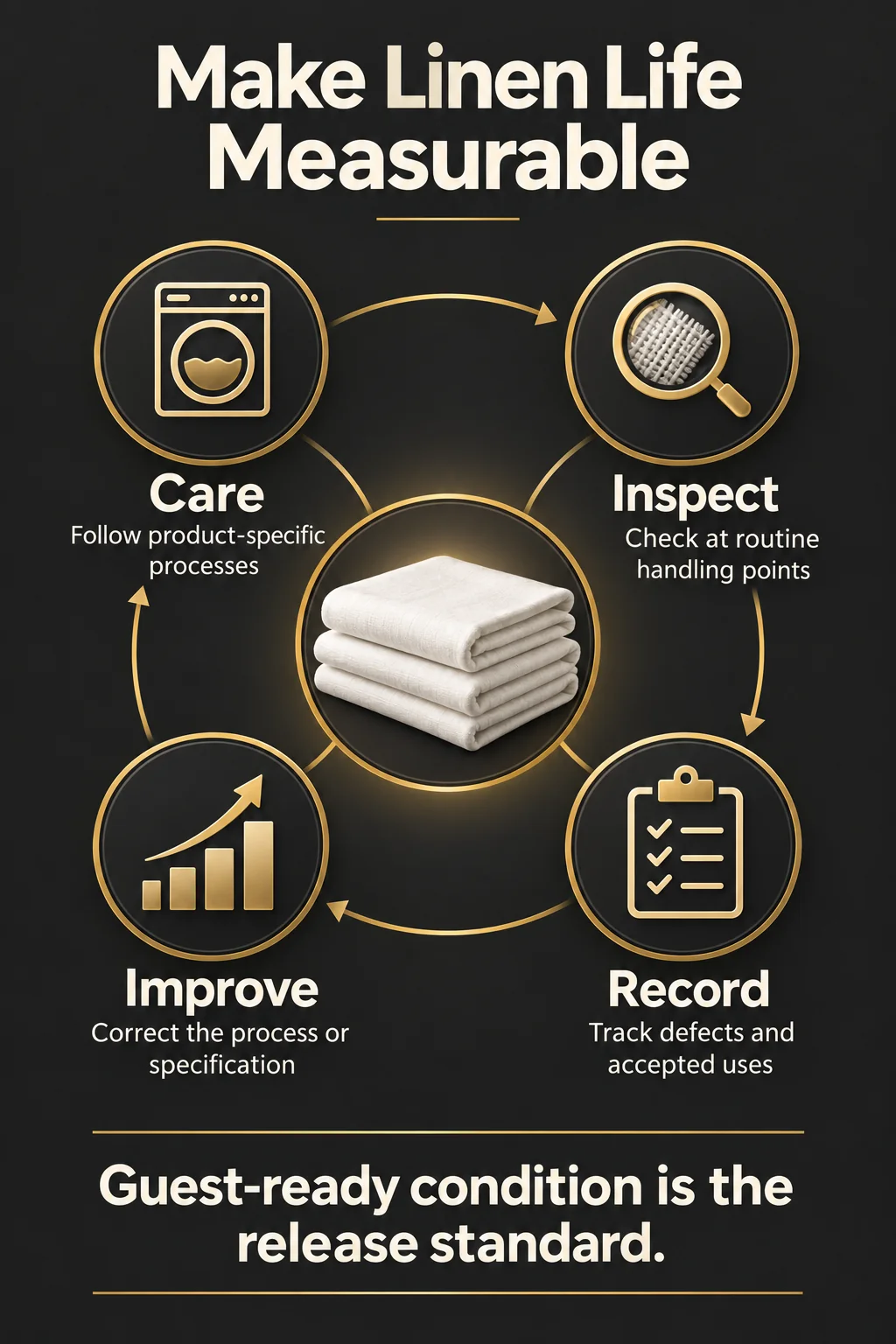
The practical objective is to increase accepted uses while reducing avoidable damage and rework. That requires more than asking staff to handle linen carefully. Specify who checks each item, what evidence they record, and who can release a repaired or reprocessed piece. Separate normal retirement from unexplained loss, and connect recurring defects to purchasing decisions. A well-run program should reveal whether the property needs a different product, a corrected process, more circulation stock, or a clearer rejection standard before another bulk order repeats the same problem.
Control Damage Throughout the Linen Care Cycle
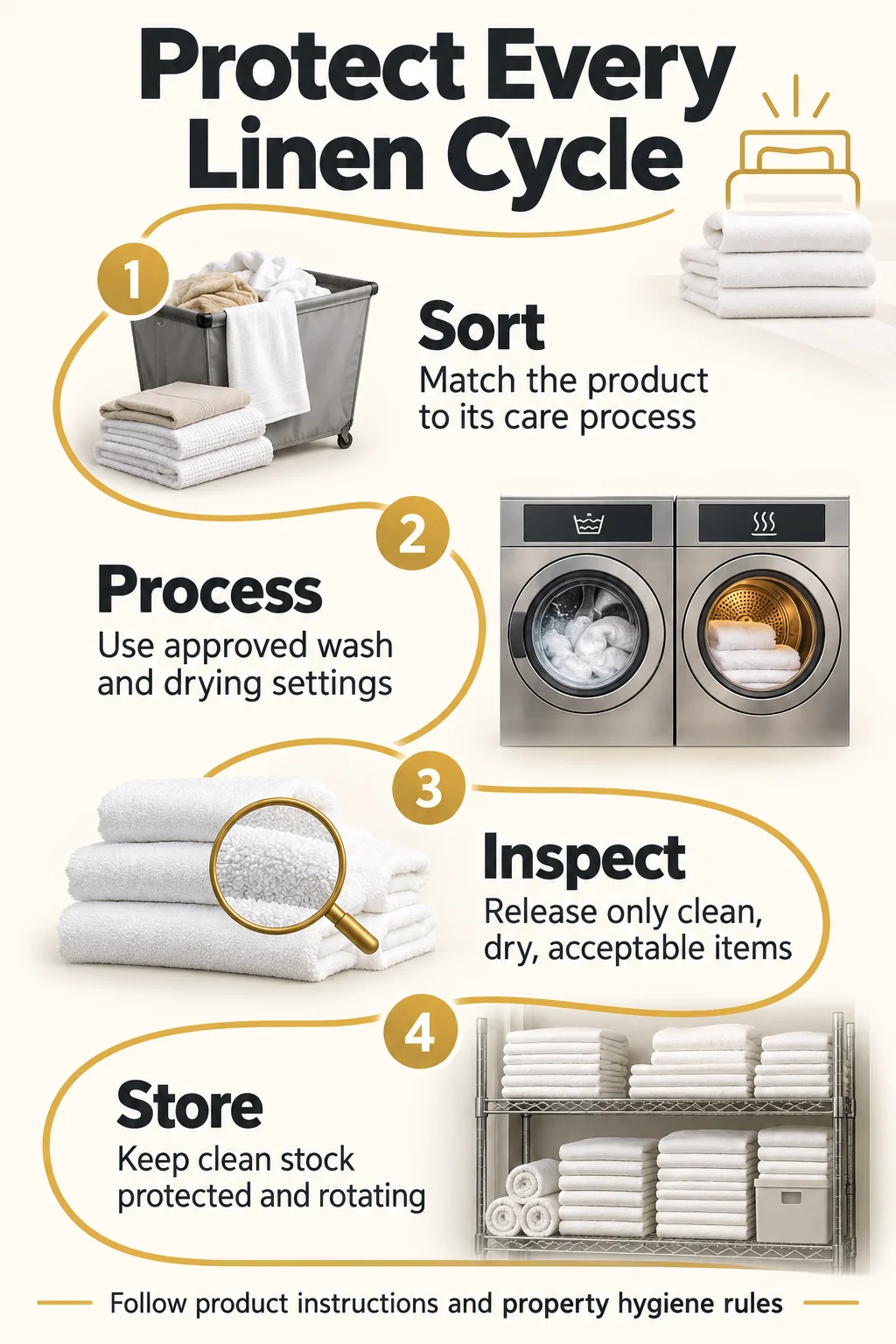
The strongest service-life program starts with product-specific care rules and clear handling boundaries. Cotton sheeting, blended sheeting, filled bedding, and waterproof protectors should not automatically share the same wash, chemical, or drying settings. Confirm the instructions for the actual item and translate them into a process the laundry team can identify reliably. Then examine collection, sorting, loading, finishing, and storage for avoidable stress. The aim is to deliver clean, dry, comfortable bedding without unnecessary reprocessing or handling damage. When an existing process cannot satisfy both the product instructions and the property’s hygiene requirements, resolve that incompatibility before returning the item to routine circulation.
Establish a reference before the first guest use
Keep the supplier’s care instructions, product code, fiber composition, finished dimensions, and relevant construction details with the receiving record. Record the batch or delivery date so a later defect can be traced to a purchasing cohort. Retain a representative approved sample where practical, and distinguish an unused reference from a sample processed through the approved laundry cycle.
For a new sheet or duvet cover, check fit after the specified initial processing rather than relying solely on its dimensions straight from the package. Compare the result with the actual mattress depth, insert size, and bed-making method. If housekeeping must force the corners, pull hard on a seam, or stretch a closure to finish the bed, investigate sizing and shrinkage before issuing the full batch. Repeated strain is a process problem even if no piece has torn yet.
Prevent damage during collection and sorting
Keep used textiles separate from clean stock and use the property’s procedure for contaminated items. Do not use guest linen to wipe equipment, clean floors, or contain sharp objects. Lift sheets free of bed-frame edges and remove them without pulling against trapped corners. Inspect carts, shelf edges, and handling surfaces when repeated snags appear in the same place.
Sort by compatible product and processing requirements, not simply by color. Identify unusual stains for the laundry team before routine processing, while following the site’s handling rules. This avoids sending an item repeatedly through a general wash when it needs a specific, approved treatment. Record the stain category and result so the property can distinguish guest-related staining from marks introduced during transport or processing.
Control washing, drying, and finishing as one process
Use the product-approved formula with the laundry provider’s specified loading, chemical dosing, rinsing, and finishing conditions. A care-label temperature is not a complete commercial wash formula. Do not independently raise bleach concentration, extend exposure, or increase heat to compensate for poor results. Ask the responsible laundry specialist to investigate the cause and verify the corrected process.
Avoid unnecessary overdrying. Check whether the actual load reaches a consistent dry condition without continuing to tumble long after that point. Mixed products can finish at different rates, while tangled bulky items may remain damp inside. Follow equipment and product instructions for load composition, cool-down, and any staged drying. Bedding intended for storage or immediate use must be fully dry; items intentionally transferred damp to approved finishing equipment require completion of that process before release.
Filled pillows and inserts need their own drying verification. A dry outer cover does not establish that the filling is dry. Waterproof protectors also require their own handling rules because their backing may have different heat and chemical limits from the face fabric. Do not apply the sheeting program merely because the protector is white.
Protect clean stock and maintain circulation
Store accepted bedding in a clean, dry area protected from handling contamination. Investigate recurring dampness or odor in a storage location rather than reissuing the same stock after airing it. Keep accepted pieces physically distinct from items awaiting stain treatment, repair, or disposal, and rotate stock so the most accessible stack is not always the only one used.
Set circulation stock from actual consumption and turnaround. One par means the quantity needed to outfit the defined beds once; the total required also depends on laundry transit, processing, delivery variability, and reserve needs. A nominal par number is not a universal guarantee. Count clean, usable pieces by size and product, because a full shelf of the wrong pillowcase or sheet does not prevent shortages in the room type that needs it.
Set Inspection Intervals Around Use and Process Changes
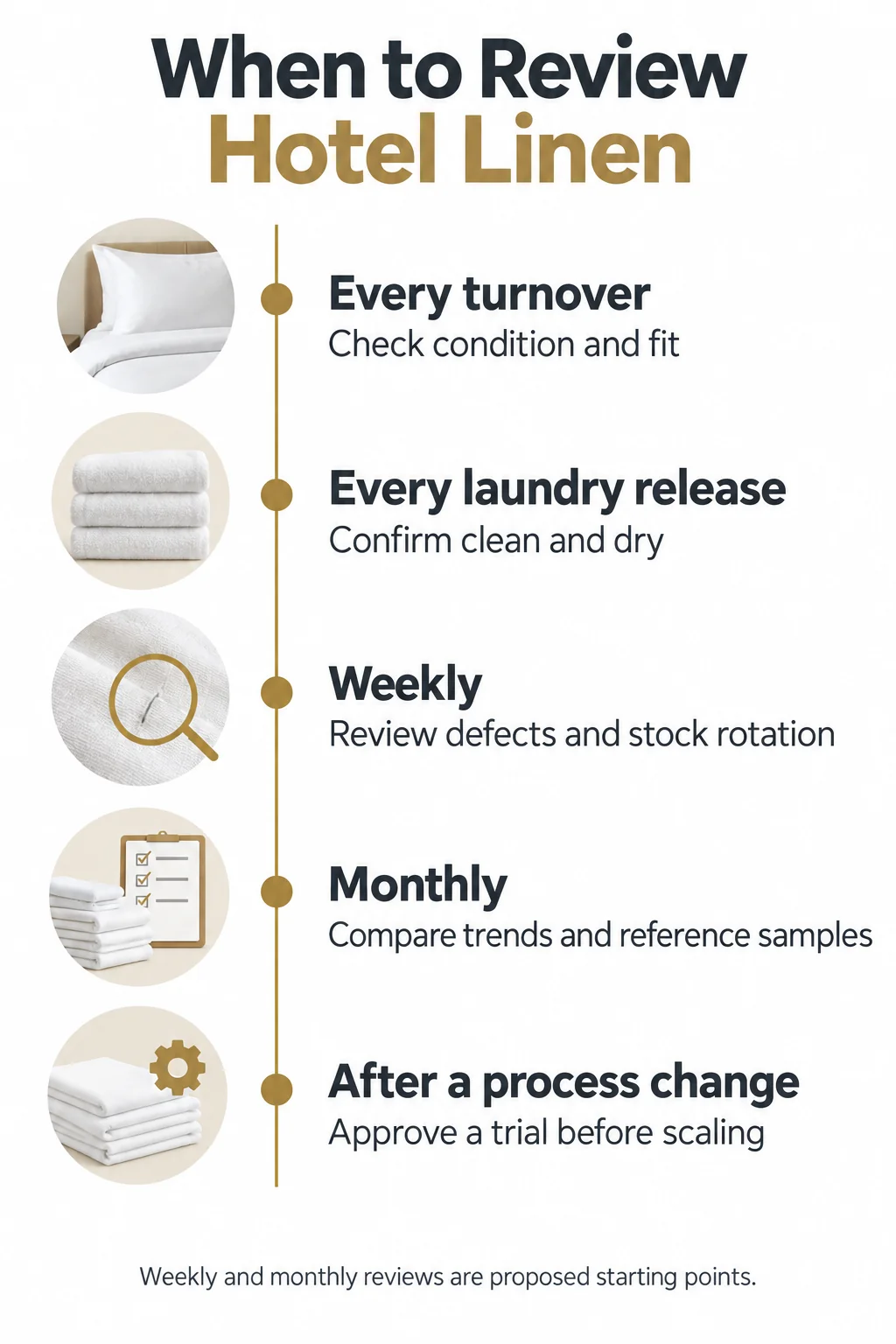
Use frequent handling points for quick condition checks and scheduled reviews for trends that are difficult to detect one piece at a time. Every room turnover and every laundry release creates an opportunity to reject an unsuitable item before it reaches a guest. Weekly and monthly reviews serve a different purpose: they reveal recurring failures, uneven circulation, and changes in the laundry process. The schedule below is a proposed management framework, not a universal care specification or a substitute for cleaning requirements. Tighten the interval when a defect increases, a process changes, or a supplier identifies a product-specific need.
Use a schedule with named owners and clear escalation
| Review point | Proposed owner | Task and evidence | Escalation trigger |
| Every room turnover or linen change | Room attendant | Inspect exposed bedding for stains, odor, tears, fit, closure damage, and loss of shape; identify the affected item | Withhold any item that does not meet the room standard |
| Every processed load, during finishing and release | Laundry team | Confirm correct program identification; check dryness, visible cleanliness, and obvious damage as items are handled | Hold affected items and investigate a repeated or load-wide defect |
| Each operating day | Linen-room lead | Reconcile available clean stock, pending rework, and shortages by product and size | Escalate recurring emergency reuse or stockouts |
| Weekly, as a starting point | Housekeeping and laundry supervisors | Review reject reasons, recurring stain patterns, handling surfaces, and uneven stock use | Inspect the implicated product batch, route, or process |
| Monthly, as a starting point | Executive housekeeper and purchasing | Review retirement and rewash trends; compare a documented sample with approved fit, appearance, and comfort references | Open a corrective action when performance moves outside the property’s accepted baseline |
| After a product, chemical, machine-program, or laundry-provider change | Responsible operations lead | Approve a trial batch and compare post-process condition and bed fit before wider release | Do not scale a change with unresolved failures |
| At the supplier’s specified interval | Assigned maintenance or laundry lead | Complete product- and equipment-specific service tasks and keep the required record | Follow the supplier’s stated stop or service condition |
A condition inspection does not replace the laundering required by the property’s guest-change, stayover, contamination, and hygiene policies. Likewise, a monthly sample does not authorize staff to ignore a defect found today. Immediate failures override the calendar. Define the release authority for exceptions so a shortage cannot quietly turn rejected bedding back into accepted stock.
Make sampling useful rather than convenient
For the deeper review, include different room types, sizes, delivery batches, laundry routes, and circulation ages. Do not examine only the top of one clean stack. Use the same assessment method each time: comparable lighting for discoloration, the same mattress and insert for fit, and a consistent reference for fabric feel or pillow shape.
Record the number examined and the number failing each criterion. A sample can reveal a pattern but does not certify every unexamined piece. If several items share a defect, expand the inspection to the implicated batch or process route. Keep the sample design stable enough to compare periods, and record any change in sampling so an apparent improvement is not caused by inspecting a different population.
Track accepted uses and rejection reasons
A purchase date alone is a weak measure of linen life. Where individual cycle tracking is available, record accepted use-and-laundry cycles alongside retirement reasons. Where it is not, use cohort-level records and label the resulting life estimates as estimates. Do not treat total laundry throughput divided by stock count as an exact history for every item.
Useful operational measures include the percentage of inspected pieces rejected, the percentage of pieces requiring an additional wash, and the number retired by reason. Define each denominator before comparing results. For example, if 18 of 600 inspected pillowcases fail the same appearance standard, that inspection’s rejection rate is 3%. It does not mean 3% of all property linen failed, and it does not establish the cause. Review the rejected pieces by batch and route before blaming the supplier or the laundry team.
Keep missing stock separate from physically worn-out stock. Combining both as “linen loss” can hide a circulation-control problem behind what appears to be poor product durability. Equally, record items waiting for repair separately from those already returned to service, so reported stock availability reflects what housekeeping can actually use.
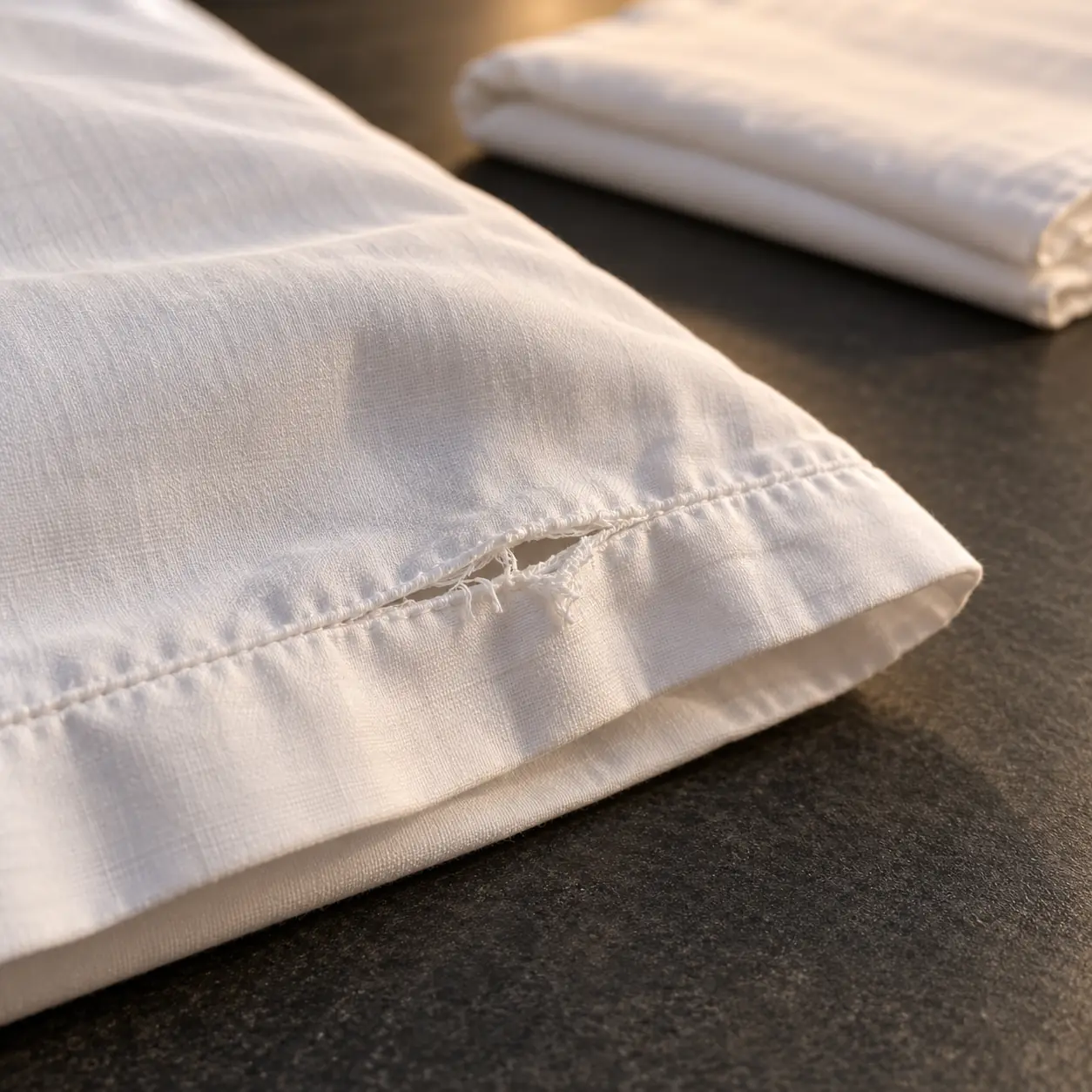
Use Warning Signs to Decide Whether to Reprocess, Repair, or Replace
Warning signs should lead to a defined disposition, not an automatic extra wash or an arbitrary age-based replacement. First withhold the item from guest use, then determine whether an approved treatment can restore cleanliness, whether a localized repair can restore function, or whether the material has reached the end of its useful life. Distinguish an isolated defect from a pattern affecting the batch or process. A repaired item must still pass fit, appearance, comfort, and any relevant protective-function checks. When the cause is uncertain, keep the item out of accepted stock until the responsible supervisor resolves the question.
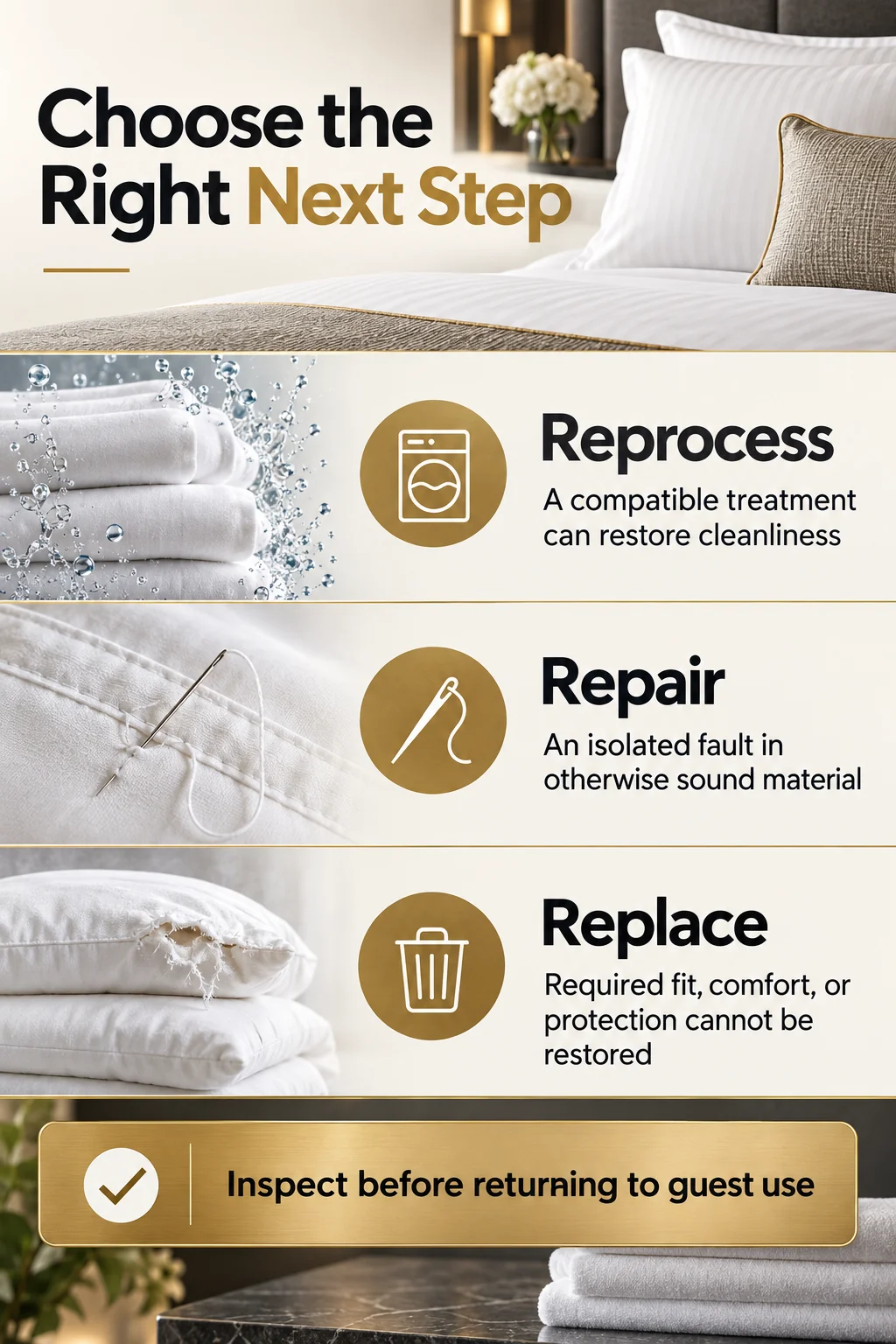
Match the visible symptom to the next decision
| Warning sign | What to investigate | Return-to-service condition or retirement rule |
| Frayed hems, pinholes, thinning, or tears | Is the fault localized, or is surrounding fabric also weak? Are snags recurring at one handling point? | Repair only sound fabric with an acceptable result; retire broadly weakened or repeatedly tearing items |
| Stains or discoloration that survive normal processing | Stain category, batch pattern, chemical compatibility, water or equipment issues | Use approved targeted reprocessing; retire if the accepted appearance cannot be restored |
| Persistent odor or dampness | Incomplete drying, storage conditions, contamination, or a processing failure | Hold for investigation and approved treatment; do not mask odor or release while damp |
| Shrinkage, skewed seams, or poor bed fit | Post-process dimensions, original size, and actual bed or insert dimensions | Release only if fit meets the standard without forced stretching; replace incompatible items |
| Roughness or pilling | Fabric wear versus a potentially correctable processing or residue issue | Compare with the accepted guest-contact standard after correction; retire persistent unacceptable surfaces |
| Failed elastic, zipper, button, or closure seam | Whether the surrounding material is sound and an appropriate repair is available | Repair only if fit, secure closure, and comfort are restored; inspect before release |
| Pillow or insert clumping, flat spots, or fill leakage | Whether approved care restores shape and whether the shell and internal construction remain sound | Replace if the intended support, distribution, or containment cannot be restored |
| Cracked, peeling, or compromised protector backing | Product instructions, process compatibility, and supplier-approved assessment | Remove from protective service; do not assume a household patch restores the barrier |
These are investigation routes, not diagnoses based on appearance alone. A yellowed sheet may need a process correction, but a correction cannot rebuild fabric that is already weak. A damaged protector may retain an attractive surface while no longer providing its intended protection. Keep these distinctions in the rejection instructions so staff do not use whiteness as the only acceptance test.
Set a stop rule for repeat treatment and repair
Allow a further stain treatment only when the laundry lead identifies a compatible method and a realistic prospect of meeting the acceptance standard. Define the permitted reprocessing pathway locally and record its outcome. Repeating the same unsuccessful treatment without review consumes time and exposes the textile to more processing without proving that it can return to service.
Repair can make sense for an isolated opening in a sound seam or a replaceable closure when the product permits it. The repair must not create a hard, scratchy, bulky, or visibly unacceptable guest-contact area. Record the intervention and check the item again after the appropriate cleaning process. Do not stitch or patch a protective membrane and assume its original performance has been restored without the manufacturer’s approved method and acceptance criteria.
For the broader asset decision, apply the same evidence discipline described in lifecycle rules for guest room supplies, while using textile-specific release checks. Keep repairable pieces out of the available-stock count until the work and inspection are finished.
Compare the cost of the next accepted uses
Use forward cost when deciding whether a repair is worthwhile. A practical comparison is the repair cost, required reprocessing, inspection, and handling divided by the realistically expected additional accepted uses. Compare that with the delivered replacement cost divided by expected accepted uses of the replacement. Include normal processing costs on both sides when they differ materially.
For illustration only, a $4 intervention expected to provide 20 additional accepted uses costs $0.20 per added use before ordinary processing. A $12 replacement expected to provide 100 accepted uses costs $0.12 per use on the same basis. Those assumed service lives are not industry benchmarks. Change the inputs to the property’s evidence, and never let the calculation override a failed hygiene, comfort, fit, or protective-function requirement.
Turn recurring failures into better purchase specifications
When several items fail similarly, preserve photographs, product codes, batch details, process records, and the relevant care instructions before disposal. Separate a potential manufacturing defect from wear associated with use or an incompatible process. Warranty eligibility depends on the actual terms and evidence; a short service period alone does not establish a valid claim.
For the next request for quotation, specify the bed and insert dimensions, material and construction, approved processing conditions, desired post-process fit, closure details, trial requirements, and acceptable replacement consistency. Ask how replacement batches will match the approved sample and what evidence supports claimed durability. A small trial can identify incompatibility; it cannot by itself prove a multi-year life expectancy.

Conclusion
Extend bedding service life by making acceptance repeatable throughout collection, laundry, storage, and room preparation. Use product-specific care instructions, quick checks at every handling cycle, and periodic reviews that connect defects to batches and processes. Keep proposed weekly and monthly review intervals flexible, while treating failed cleanliness, comfort, fit, and protective function as immediate reasons to withhold an item. Track the uses gained after intervention and the reasons pieces leave service. This gives housekeeping and purchasing a shared basis for correcting a process, authorizing a repair, or replacing a product before recurring failures become routine operating costs.
When replacement is justified, contact KW Hospitality about bedding sourcing with your product list, quantities, delivery destination, required date, bed dimensions, and laundry conditions. Include the failure patterns you want the new specification to address, and request suitable samples and written care details before approving a bulk purchase.
Frequently Asked Questions
Is a higher thread count a guarantee of longer hotel linen life?
No. Thread count does not establish how an item will perform in the property’s actual process. Compare the complete specification, construction, finished fit, care requirements, and results of a controlled trial. A thread-count claim should not replace evidence that the product remains acceptable after representative processing and guest use.
Can the hotel reduce washing frequency to make bedding last longer?
Service-life targets should not override required cleaning or guest-service policies. Follow the property’s rules for turnover, stayover service, guest requests, and soiling. Seek improvements in handling, compatible processing, drying control, and stock circulation within those requirements. A conservation program also needs a clear rule for immediate replacement of soiled or otherwise unacceptable linen.
What if the laundry is outsourced and the hotel cannot see machine settings?
Ask the provider to document product compatibility, program identification, rejection reporting, and the procedure for process changes. Reconcile dispatch and return quantities by product, and retain representative evidence of recurring defects. Establish who investigates a complaint and who approves release. Outsourcing processing does not remove the hotel’s responsibility to inspect what goes back into guestrooms.
Should every item from an old batch be replaced at once?
Not solely because the batch is old. Inspect its actual condition and consider whether acceptable pieces still match the property’s room standard. A batch-wide defect may justify broader withdrawal, while isolated wear may support selective replacement. Plan the transition so color, fit, and feel remain consistent within each made bed and room category.
Is there a fixed number of washes after which sheets must be retired?
There is no single wash-count rule that can be applied reliably to every hospitality sheet. Construction, processing, use, and acceptance standards differ. Use any supplier-stated limit that applies to the product, then combine documented cycle or cohort history with condition checks. Do not present an estimated average as a guarantee for an individual piece.
Can retired bed linen be reused for another purpose?
Only after its condition and intended new use have been assessed. Clean textiles that no longer meet guest appearance standards may have suitable non-guest uses, subject to the property’s policies. Keep them clearly separated from accepted bedding. Items with unresolved contamination, loose components, or unsuitable material should not be reassigned merely to avoid recording a retirement.