Direct-steam kettles are worth considering when a hotel already has a reliable, appropriately sized steam supply close to the kitchen. Self-contained electric or gas kettles are worth considering when that supply is absent, seasonal, costly to extend, or scheduled for retirement. Neither arrangement is automatically cheaper, faster, or more water efficient. The useful comparison is the cost of delivering the hotel’s required batches, within its service window, using equipment the building can support.
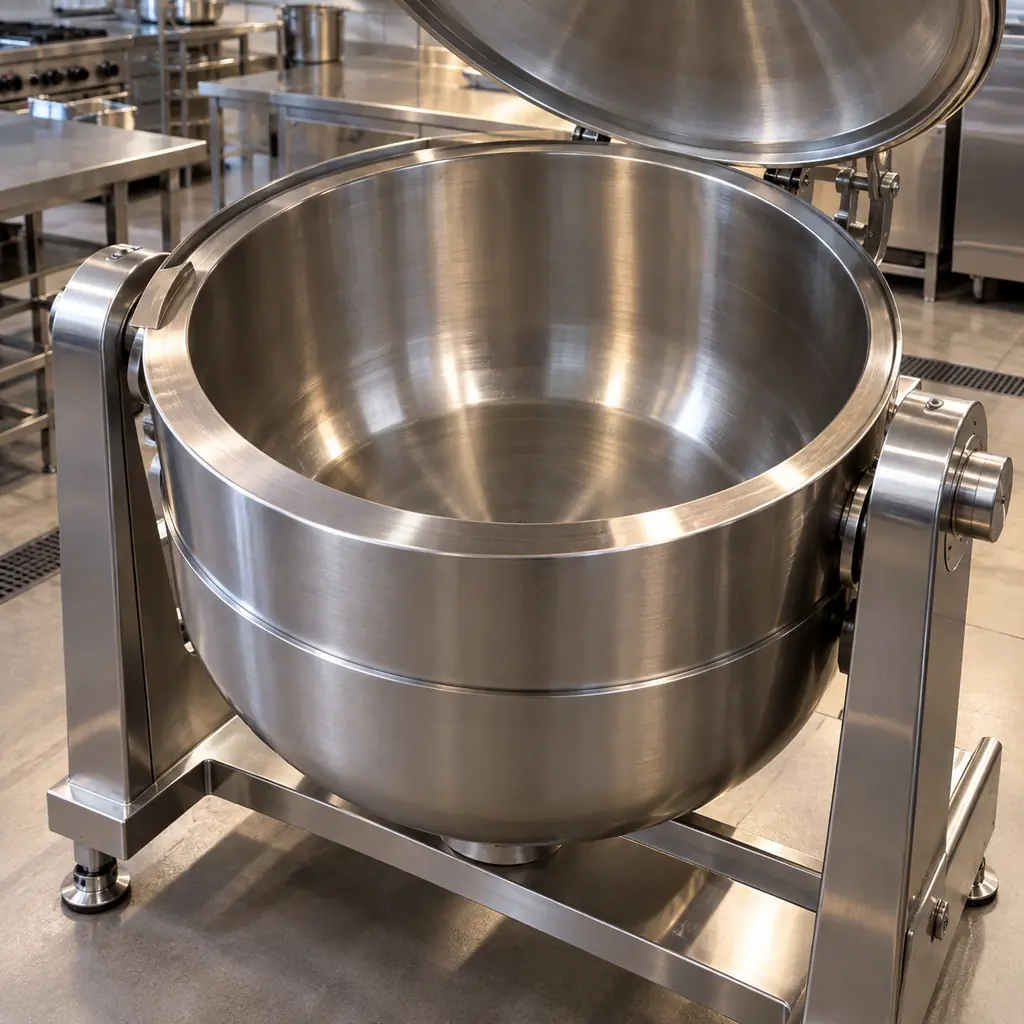
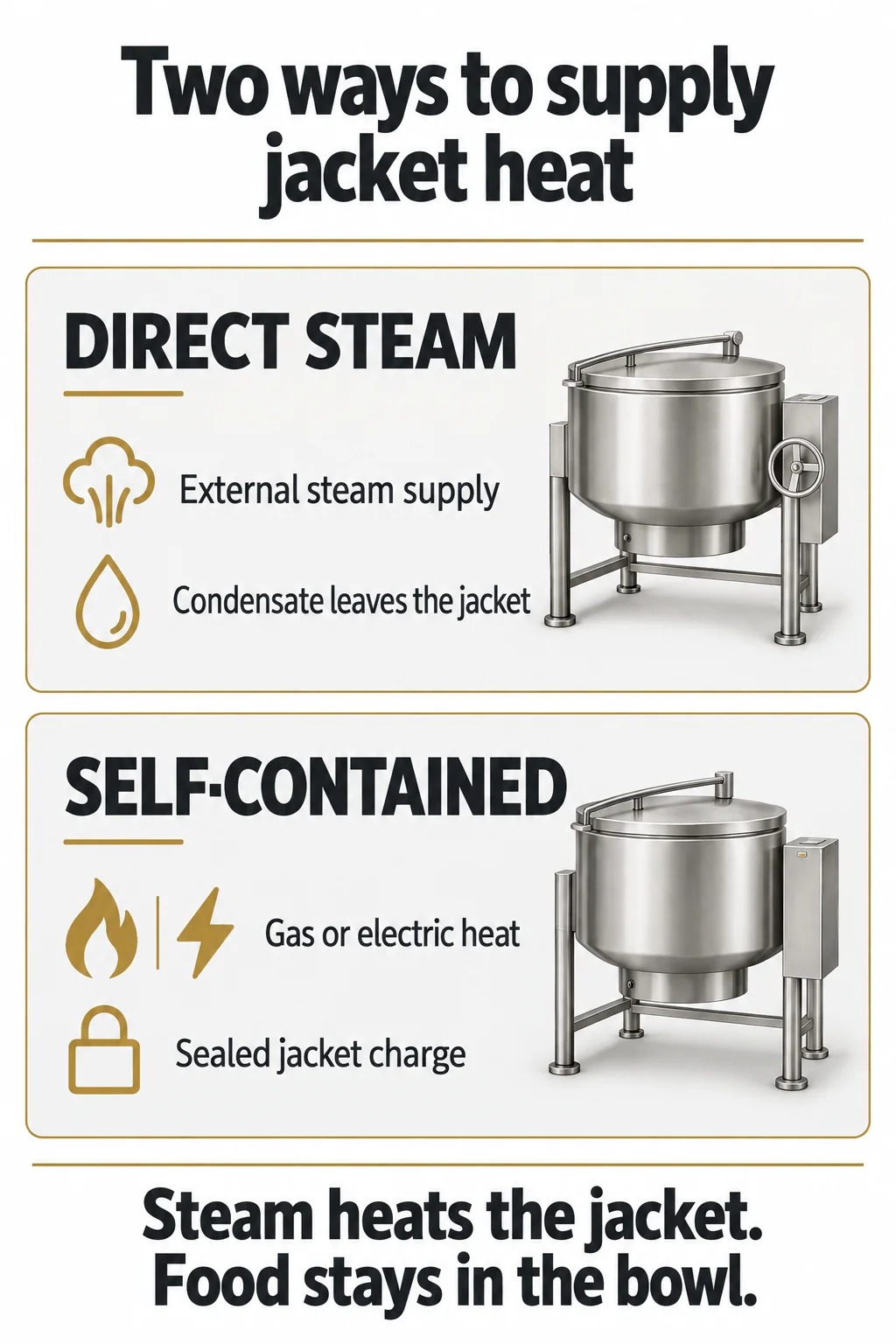
Both types use a steam jacket around the cooking bowl. The distinction is where that steam comes from. A direct-steam kettle receives it from an external boiler or steam generator. A self-contained kettle produces it locally using an enclosed jacket charge heated by electricity or gas. In either case, the food remains in the bowl; “direct steam” does not mean that building steam is deliberately injected into the recipe.
For an executive chef, the purchasing question starts with soup, sauce, stock, and other batch requirements. For engineering, it starts with available utilities and maintainable connections. Procurement must bring those two views together. A low equipment price can lose its advantage when a project needs new piping, a larger electrical service, ventilation work, difficult rigging, or a shutdown during banquet season.
This guide compares ordinary commercial steam-jacketed kettles for hotel kitchens in the United States and Canada. It separates direct steam, self-contained electric, and self-contained gas options; explains how to compare usable output; and provides a worked cost example. The example is hypothetical, not a manufacturer performance claim or a quotation. Model-specific requirements always come from the submitted equipment documents. Evaluate the kettle within the hotel’s wider commercial cooking equipment plan, especially where several appliances compete for the same utilities, floor space, or production staff.
How Direct Steam and Self-Contained Kettles Work
The heat source changes the kettle’s connection requirements and the boundary of its operating costs. Direct steam puts steam generation outside the appliance, so the kitchen depends on a functioning supply and condensate arrangement. A self-contained kettle brings steam generation into the unit, but still depends on suitable electricity or gas, controls, and service access. Treat these as three practical purchasing alternatives: direct steam, self-contained electric, and self-contained gas. Comparing only two labels hides meaningful differences between the latter two. The following distinctions explain what the hotel actually buys and what its engineering team must support after installation.
Direct steam: an appliance connected to a larger system
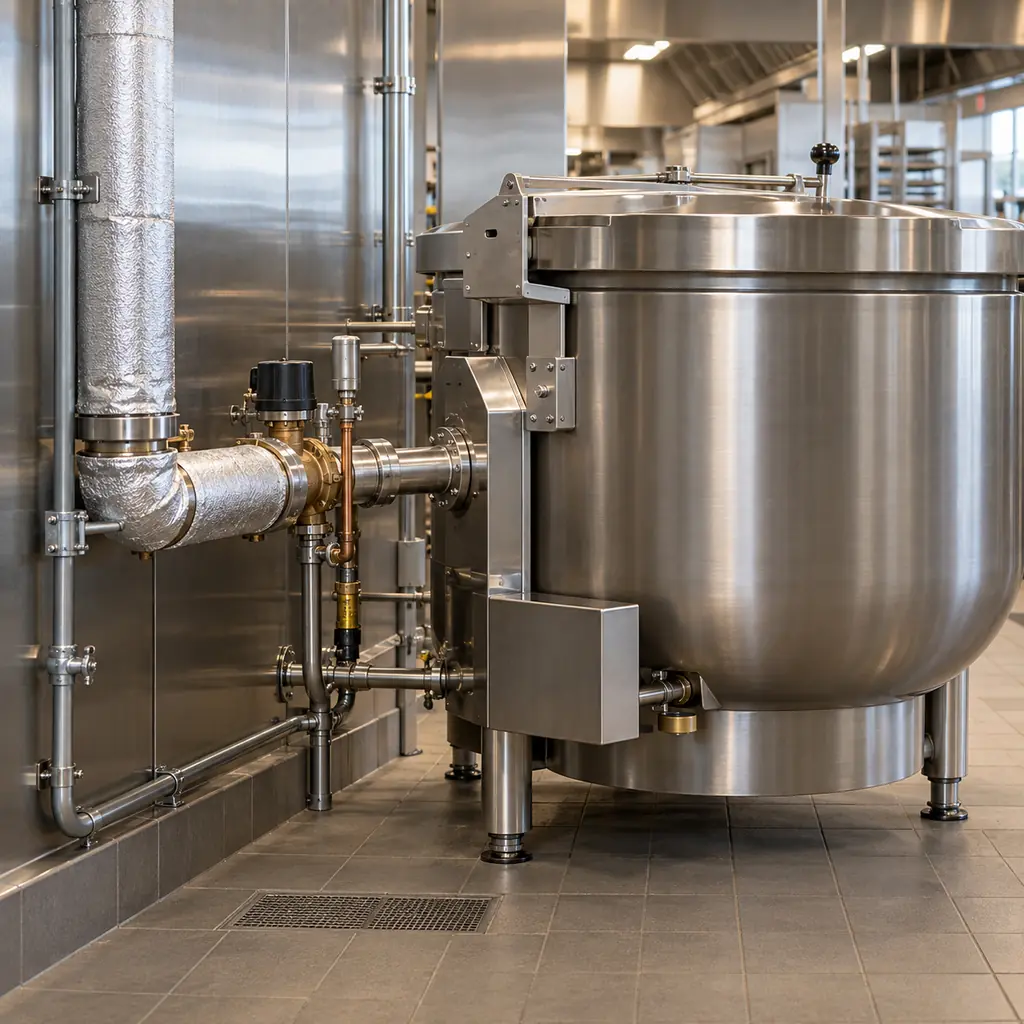
External steam enters the jacket, transfers heat through the bowl wall, and condenses. The resulting condensate leaves through the specified outlet arrangement. Cleveland’s direct-steam floor kettle manual illustrates why steam supply and condensate handling belong in the installation scope, rather than being treated as incidental accessories.
A hotel with a boiler is not necessarily a hotel with suitable kitchen steam. The plant may serve a different pressure range, lack capacity during simultaneous demand, operate seasonally, or be too far from the proposed location. Ask engineering to establish what can be delivered at the kettle connection under the intended operating conditions. A boiler-room pressure reading alone does not answer that question.
Self-contained electric and gas: local steam generation
A self-contained electric kettle heats the jacket charge with electrical elements. For example, Cleveland describes the KEL100 as having a permanently filled, treated-water jacket. This removes the need for a plant-steam heating connection; it does not remove the need to fill recipes, clean the food-contact bowl, or manage wastewater.
A self-contained gas kettle uses a burner and heat exchanger to heat its jacket charge. Gas equipment can also need auxiliary electricity: Cleveland’s KGL40 includes powered ignition and controls. Consequently, “gas available” is not a complete utility specification. The quotation must identify the exact gas and electrical requirements of the proposed configuration.
| Purchasing distinction | Direct steam | Self-contained electric | Self-contained gas |
| Source of jacket heat | External steam plant or generator | Electrical heating within the unit | Burner heating within the unit |
| First feasibility question | Can suitable steam reach the kettle during peak demand? | Can the building supply the specified voltage, phase, and load? | Can the site support the specified gas, auxiliary power, and ventilation? |
| Operating-cost boundary | Delivered steam, including the relevant plant and distribution costs | Metered electricity and applicable demand charges | Metered gas plus auxiliary electricity |
| Important continuity dependency | External steam availability | Electrical supply and local appliance components | Gas, auxiliary power, and local appliance components |
The table is a procurement framework, not a prediction of performance. An ordinary kettle with a pressurized jacket is also not automatically a pressure cooker: the food-side vessel and lid must be specifically designed for any pressurized cooking process. Likewise, compartment steamers are a different equipment category. DOE’s commercial steam-cooker purchasing guidance explicitly excludes kettle steamers, so its efficiency requirements and savings examples should not be reused as kettle benchmarks.
Size the Kettle Around the Production Schedule
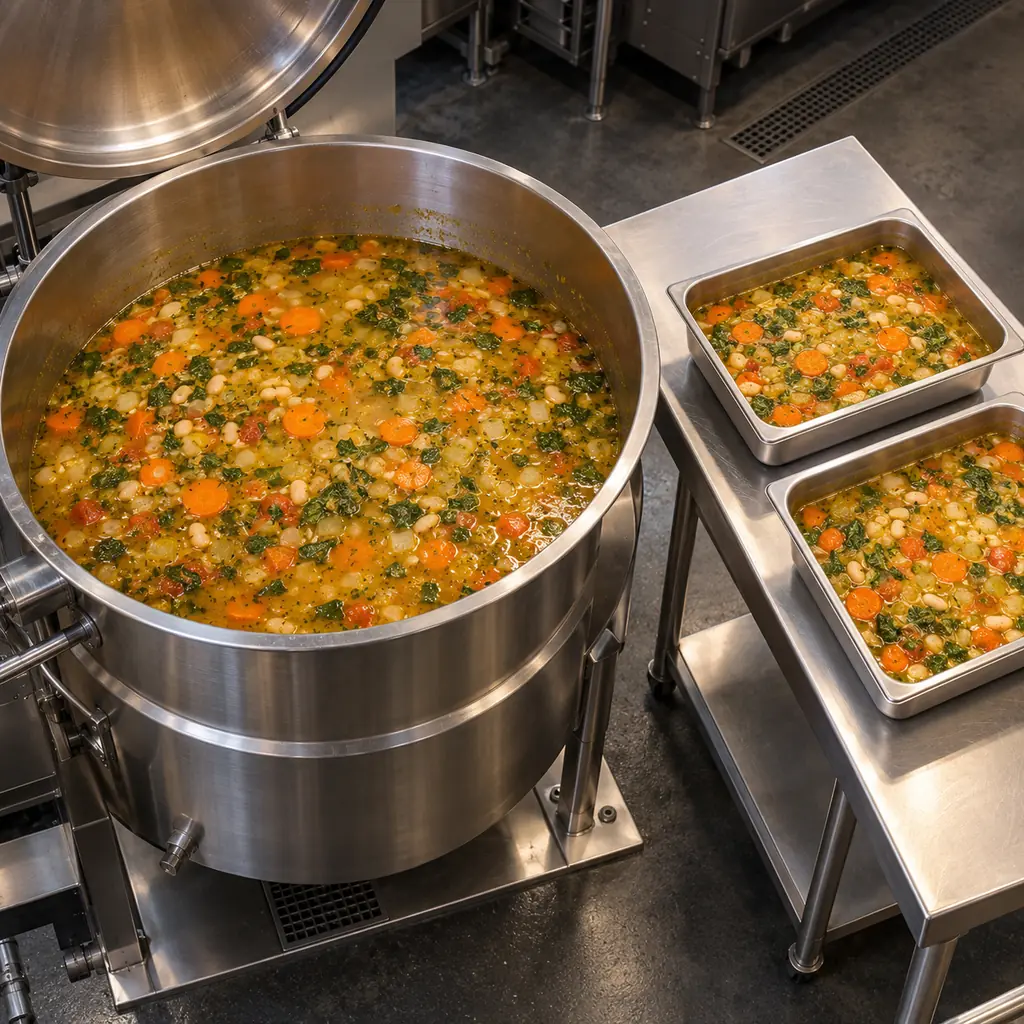
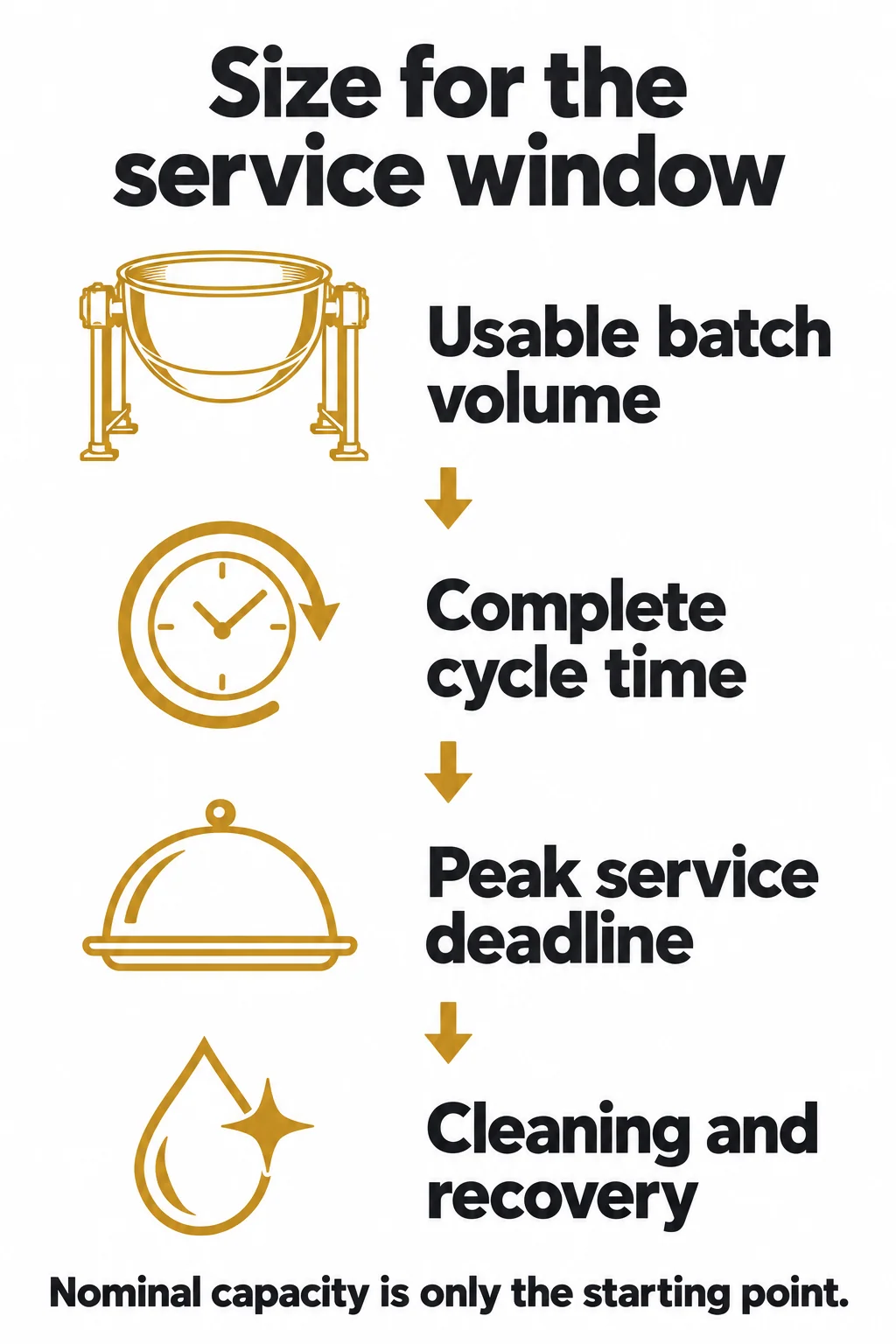
A kettle is large enough only if it delivers the required usable food before service and can be emptied, cleaned, and prepared for the next task. Nominal gallons describe the vessel, not the hotel’s guaranteed output. Begin with the actual menu and the busiest credible service period, then test working volume and complete cycle time together. Include small batches as well as peak batches, because an oversized vessel may be inconvenient for a modest sauce run even if it handles a banquet comfortably. This production-based approach also makes the steam-source comparison fair: each candidate must meet the same kitchen requirement.
Establish usable volume before counting portions
Working volume must leave the required room for stirring, foaming, and safe handling. Groen’s steam-jacketed kettle brochure distinguishes nominal capacity from working capacity and uses an approximately 80% working-volume allowance in its selection guidance. That is manufacturer guidance, not a universal fill rule. Obtain the proposed model’s permitted working volume for the actual recipe.
For a hypothetical hotel service, assume the kitchen needs 360 portions at 8 US fluid ounces each. The required finished volume is 2,880 fluid ounces, or 22.5 US gallons, because one US gallon contains 128 US fluid ounces. If a trial establishes 25 gallons of accepted finished product per batch, one batch covers that requirement. If accepted yield is only 20 gallons, a second batch is necessary. These figures describe volume; an 8-ounce portion by weight requires a separate calculation using the recipe’s actual yield.
Account for evaporation, product left in the bowl, and transfer losses when determining accepted yield. Do not quietly increase a fill limit to achieve the desired portion count. A capacity expressed in liters should be compared using the same unit basis; US and Imperial gallons are different units.
Time the entire occupied cycle
Record loading, heat-up, cooking to the recipe endpoint, required holding, unloading, cleaning, and readiness for the next load. Note whether ingredients arrive chilled or warm and whether the test starts from a cold appliance. Keep recipe, batch size, lid practice, stirring, and endpoint consistent when comparing equipment.
Effective production rate = accepted finished volume ÷ complete occupied cycle time.
For example, 25 accepted gallons in a 75-minute complete cycle equals 20 gallons per hour. Two full cycles occupy 150 minutes. They fit inside a three-hour production window only if other startup, staffing, and scheduling requirements fit within the remaining 30 minutes. A quoted heat-up time alone cannot establish that result.
This is a planning calculation, not a manufacturer’s rating. A supplier demonstration or site trial should establish the inputs. Where output is best controlled by mass, use accepted pounds or kilograms instead of volume and keep that basis throughout the comparison.
Match the bowl and discharge method to the food
Jacket coverage, agitation, and product consistency matter alongside the source of steam. A water boil test does not settle performance for a thick sauce that needs continuous stirring. Ask for a demonstration with a representative recipe and the proposed controls, rather than assuming that a higher pressure or larger input rating guarantees a better result.
Tilting versus stationary describes how the kettle discharges; direct steam versus self-contained describes its heat supply. Evaluate these as separate specification choices. Compare a tilting bowl with a stationary kettle and draw-off valve using the actual transfer task. Chunky food, receiving-container height, valve access, and washdown effort can change labor and turnaround time. Groen’s brochure also identifies liner-material options for more demanding recipes; specify the food-contact material and cleaning compatibility rather than accepting “stainless steel” as a complete description.
Finally, examine the next operation. Faster cooking has limited value if portioning, hot holding, or the hotel’s approved cooling process cannot accept the batch. Two smaller kettles may support simultaneous recipes and partial production during a breakdown, but they also require additional space, connections, and cleaning. Compare that arrangement as a separate production proposal.
Compare Installed Cost and Measured Utility Use
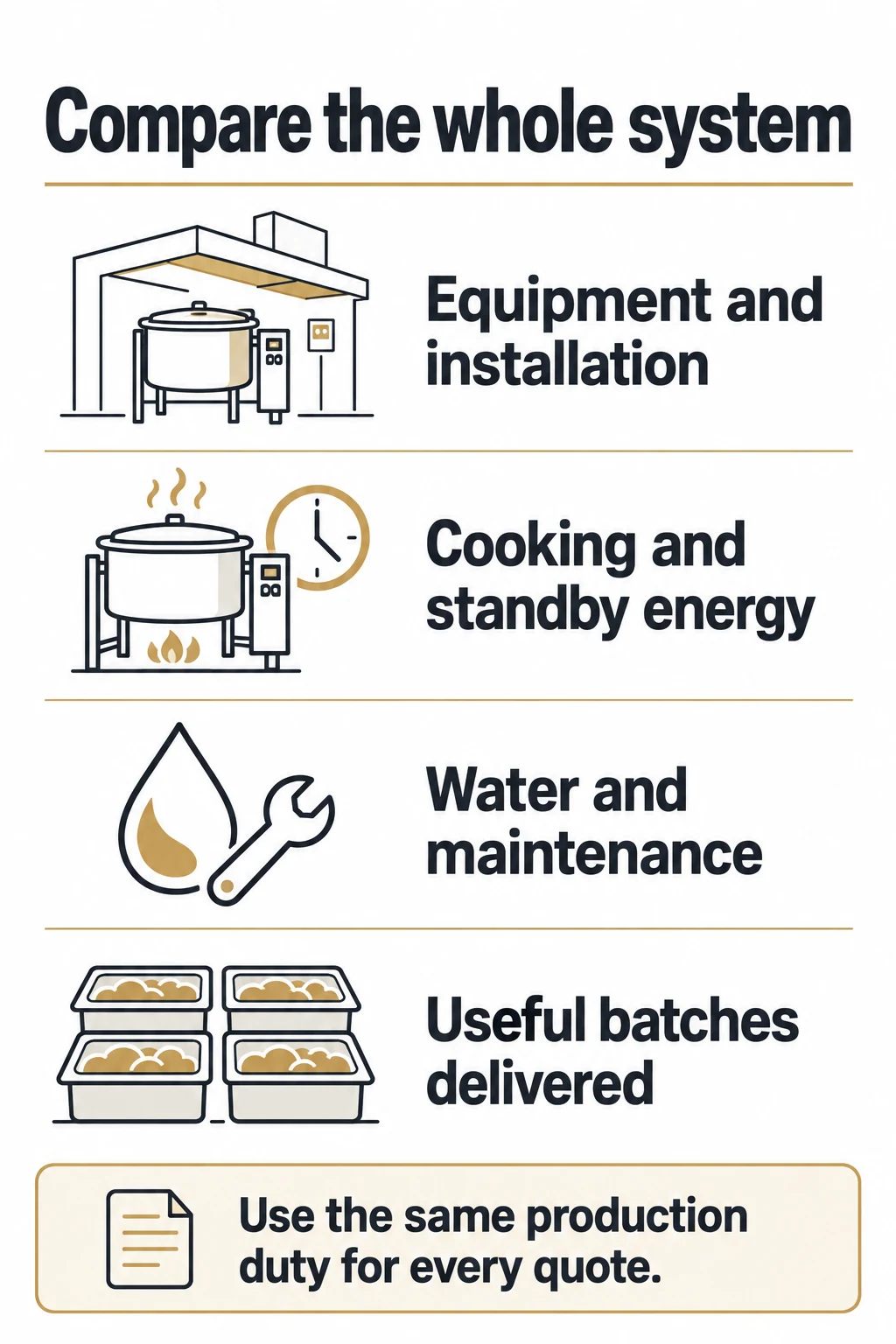
The fairest economic comparison uses the same annual production duty and includes the utilities needed to deliver it. A direct-steam kettle can look inexpensive if the analysis stops at its steam inlet, while an electric unit can look expensive if its maximum input is mistaken for continuous consumption. Neither approach represents measured operating cost. Define the energy boundary, record actual use during representative production and standby periods, and separate costs that will disappear after replacement from costs the hotel will continue paying. Only then should the purchasing team calculate savings or a payback period.
Use matching measurement boundaries
For electric equipment, record kilowatt-hours over complete operating periods, including warm-up and standby. Check whether simultaneous kettle operation changes the property’s billed electrical demand; a higher appliance rating does not by itself establish the additional demand charge. For gas equipment, record the gas consumed and auxiliary electricity, using the units and conversion basis on the actual utility bill.
For direct steam, use a documented delivered-steam rate or an engineering measurement of steam consumption and its supply cost. Do not allocate the entire shared boiler’s fuel reading to one kettle. Equally, do not call steam free because the boiler already exists. DOE’s steam boiler management guidance identifies condensate return, leaks, insulation, blowdown, and treatment as relevant system factors.
Have engineering specify a suitable steam measurement method. A simple condensate collection reading may not capture every vapor or loss pathway. Document which costs are already included in the delivered-steam rate so that water, treatment, and plant maintenance are not counted twice.
Meter recipe and cleaning water separately where practical. A sealed self-contained jacket does not imply zero water consumption, and jacket steam flow is not identical to fresh makeup-water use when condensate returns to the plant.
Build a complete installed-price comparison
Request equipment price and installation scope separately. Relevant items can include delivery and rigging, required utility upgrades, piping and condensate work, valves and controls, ventilation changes, anchoring, permits or inspections where applicable, commissioning, and operator training. Show exclusions clearly so an incomplete quote does not appear to be the economical option.
Keep recurring costs on the same basis:
Annual operating cost = energy at the chosen boundary + incremental demand charges + separately counted water and treatment + maintenance and service costs + operating and cleaning labor where it differs.
Use the hotel’s own service history where available. If future repair or downtime costs are uncertain, show a sensitivity range rather than assigning a precise-looking failure cost without evidence. Distinguish the forecast for the kettle from the cost of maintaining a steam plant that also serves other hotel loads.
Worked example: a conditional result, not a price forecast
The following invented inputs demonstrate the method. Both alternatives are assumed to deliver the same 900 accepted batches per year and meet the required timetable. All amounts are USD. The example excludes financing, tax effects, residual value, and unquantified downtime; it is not a market quotation or a performance benchmark.
| Assumed input or calculated result | Direct steam | Self-contained electric |
| Complete installed price | $26,000 | $32,000 |
| Annual utility quantity, including allocated standby | 150,000 lb of delivered steam | 24,000 kWh |
| Assumed utility rate | $0.036/lb | $0.15/kWh |
| Calculated annual utility cost | $5,400 | $3,600 |
| Additional annual demand charge | $0 in this scenario | $800 |
| Annual kettle service allowance | $1,800 | $1,000 |
| Calculated annual operating cost | $7,200 | $5,400 |
Here the steam rate includes the relevant generation, distribution, makeup-water, treatment, and plant-service costs. For this payback example, all costs credited as savings are assumed to be avoidable after conversion; shared plant costs that would continue are excluded. The separate service allowance covers the kettle and its local components. Recipe and cleaning-water costs are assumed equal and excluded from both columns. Operating and cleaning labor are also assumed equal. Include any verified water or labor difference in a real comparison.
The electric alternative costs $6,000 more to install and saves $1,800 per year under these assumptions. Simple payback is $6,000 ÷ $1,800 = about 3.3 years. If its annual incremental demand charge rises from $800 to $1,800, the saving falls to $800 and simple payback becomes 7.5 years. If verified annual savings are zero or negative, there is no positive simple payback from operating savings.
This sensitivity is why a supplier’s energy-price assumption cannot replace the hotel’s tariff. For a final investment decision, compare discounted cash flows over the expected service period as well as production and reliability. Add a self-contained gas column using its own measured gas, electricity, and installation inputs; do not borrow the electric column’s result.
Separate replacement savings from plant-retirement savings
If a hotel must keep its boiler running for other services, removing one kettle will not eliminate every boiler expense. Count only the costs that actually change. If the kettle is the last reason to maintain summer steam, a broader shutdown opportunity may exist, but engineering must confirm the remaining loads and the practical shutdown plan. Treat that as a separate scenario with explicit assumptions, not an automatic benefit of self-contained equipment.
Match Installation and Maintenance to the Hotel
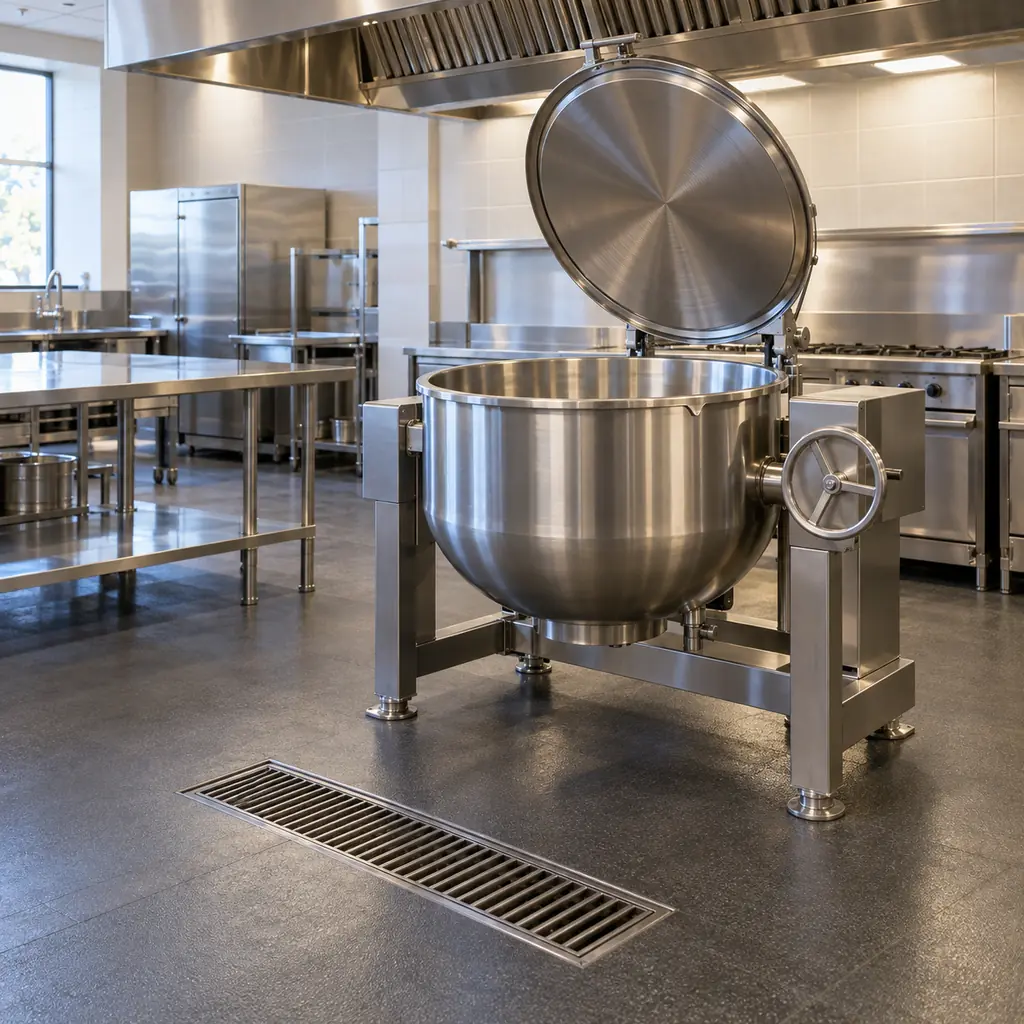
The preferred kettle must remain feasible after the sales quotation becomes an installation project. Engineering should confirm utility capacity and service arrangements, while the chef confirms handling, cleaning, and recipe performance. Procurement can then compare submissions on a shared basis and identify omissions before an order is released. The aim is to avoid selecting a nominally suitable appliance that requires an unexpected building upgrade or cannot be maintained locally. Review the exact model, options, and destination requirements together; a generic product-family description does not establish that the delivered unit will fit the hotel’s infrastructure.
Verify the proposed utility configuration
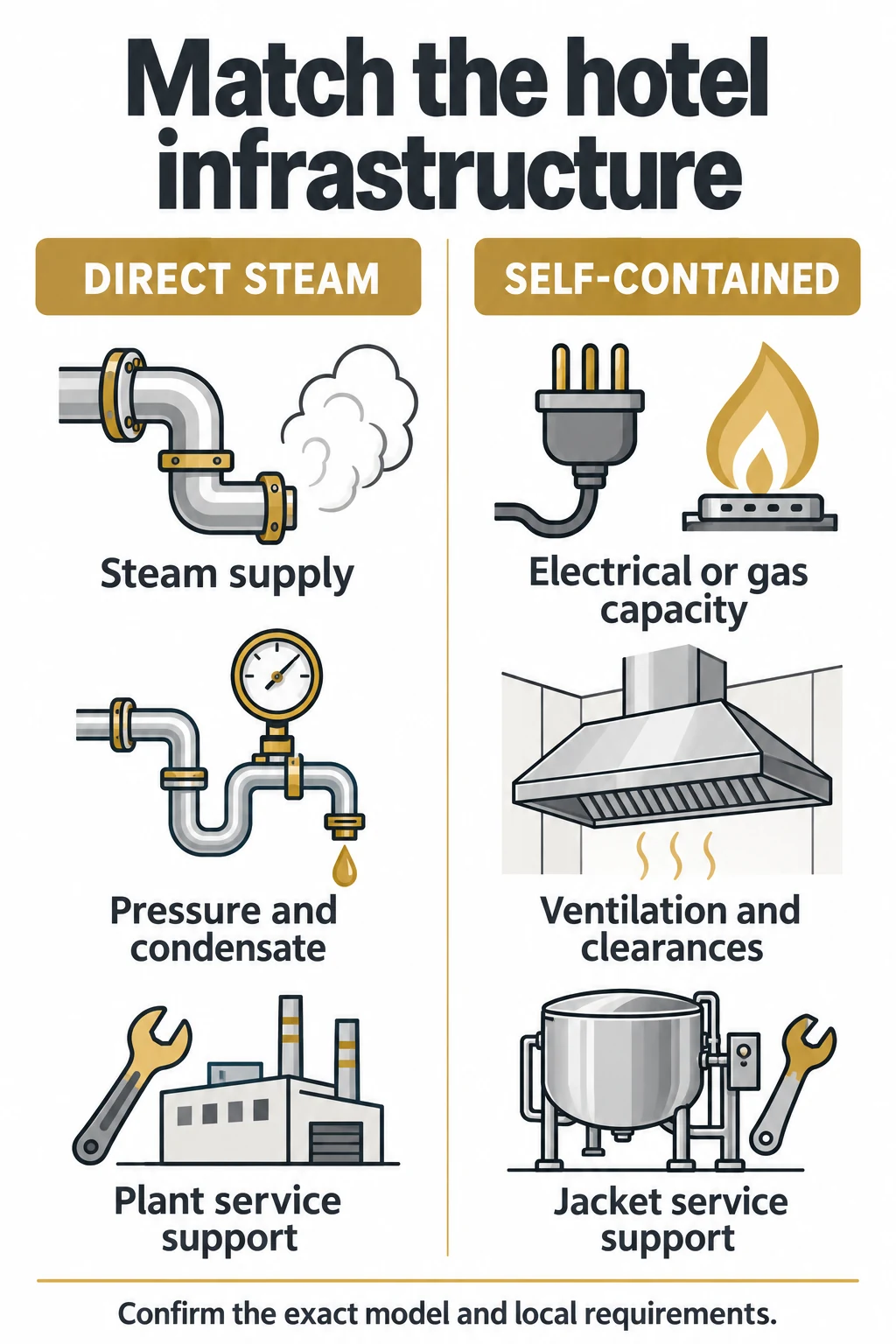
For direct steam, distinguish allowable inlet conditions, available flow, and the jacket’s maximum rated pressure. Confirm the required control and condensate equipment, whether it is included, and who installs it. Cleveland’s direct-steam manual also accounts for simultaneous appliance demand. Have the installer resolve pressure reduction and condensate return conditions; procurement should not prescribe a universal pressure or pipe size.
For electric equipment, match the offered voltage, phase, and heating configuration to the site. Cleveland’s KEL specification sheet illustrates the importance: its standard 40-gallon configuration lists 14.7 kW at 208 V and 19.6 kW at 240 V. Those values are model-specific input ratings, not measured cooking energy. Ensure any demonstrated performance belongs to the configuration being purchased.
For gas equipment, obtain the gas type, supply requirements, and auxiliary electrical load. Cleveland’s KGL/KGL-T operator manual requires ventilation and makeup air for the covered gas models. Confirm the proposed hood and ventilation arrangement with the designer and applicable local authority for every candidate. Choosing electricity does not, by itself, establish that a hood is unnecessary.
Review access from delivery point to final position, the floor and anchoring plan, lid-opening and tilting space, receiving-container clearance, drainage, and maintenance access. Obtain destination-specific acceptance of the submitted equipment documentation. Do not assume a listing or pressure-vessel marking resolves every US state or Canadian provincial installation requirement.
Compare maintainability and shared failure risks
A direct-steam kettle depends on both local components and the external supply. A fault affecting several kettles may therefore originate in the common plant or distribution system. Include local steam and condensate components in the service scope, and investigate utility delivery before replacing a kettle solely because its heating has slowed.
Self-contained equipment avoids dependence on the central steam supply but retains its own heating, controls, and jacket-service needs. Cleveland’s KEL/KEL-T manual includes diagnostics for low-water conditions, leaks, controls, and heating components. “Sealed” is not the same as maintenance-free. Jacket, pressure, gas, and electrical servicing belongs to appropriately qualified personnel using the exact model’s instructions.
Ask who provides authorized service at the hotel location, what parts are locally available, what warranty exclusions apply, and how temporary production would continue during repair. Two electric kettles on one constrained supply are not fully independent simply because each has its own jacket. Consider the common utilities behind any proposed backup arrangement.
Put production and acceptance conditions into the RFQ
Describe the menu, manufacturer-approved working batch, required accepted yield, busiest production window, and minimum batch. Supply utility information verified by engineering, a dimensioned location drawing, the transfer method, and the delivery destination. Require the supplier to identify the exact model and options, current technical documents, installation inclusions, service provisions, and exclusions.
Agree on acceptance before purchase: the demonstration should use the specified recipe and starting conditions, record accepted output and full cycle time, and disclose utility use over the agreed boundary. Observe discharge and cleaning as well as cooking. Commissioning should confirm the installed unit’s connections and operation against its approved documents; a successful demonstration elsewhere does not replace site commissioning.
Once these requirements are defined, submit a kettle sourcing RFQ to KW Hospitality with the production brief and verified site information. Request itemized alternatives so the chef, engineering team, and purchaser can review the same scope.
Conclusion
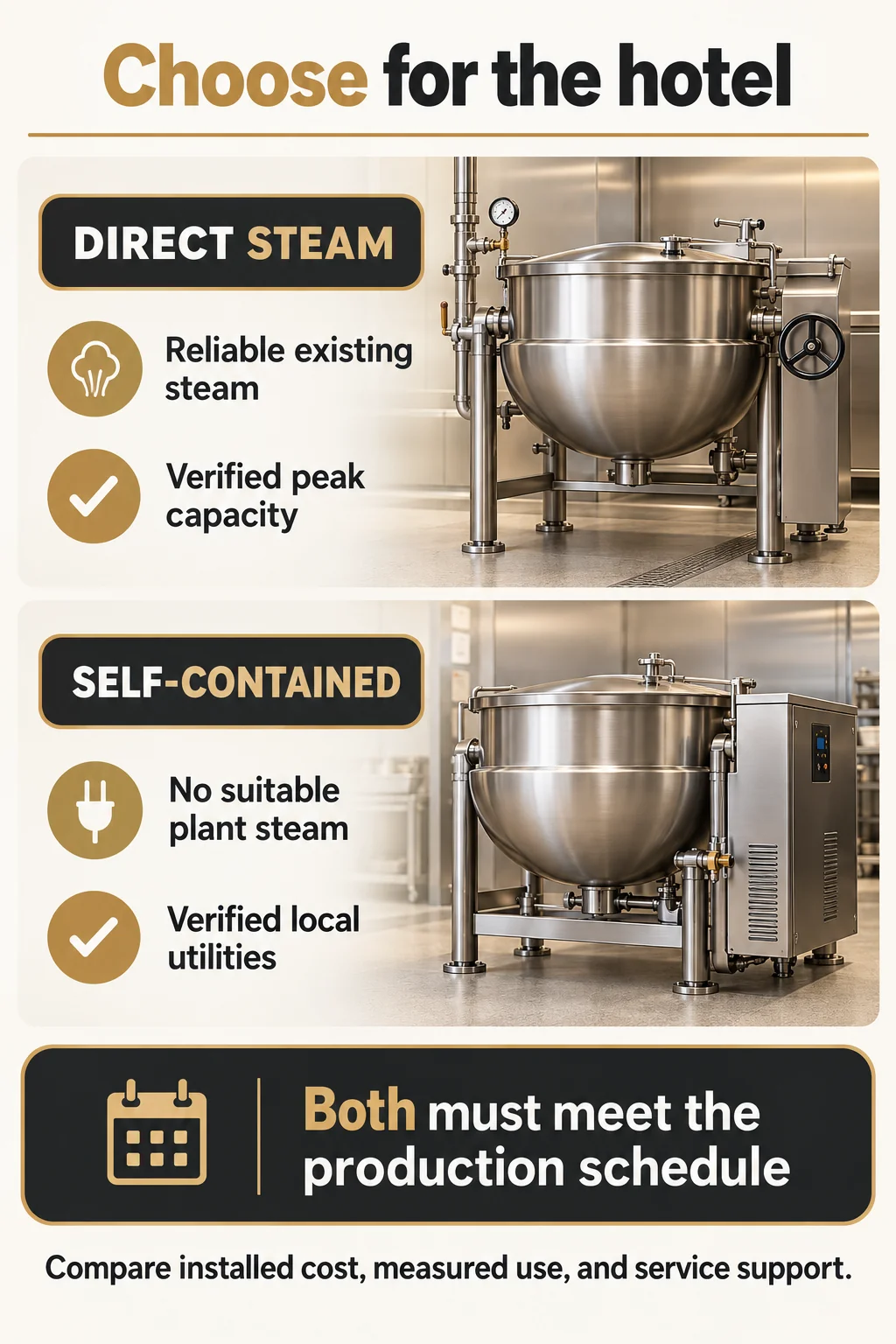
Choose the steam-kettle arrangement that meets the hotel’s production schedule with a supportable installation and a defensible operating-cost model. Existing, reliable steam can make direct steam a strong candidate; absent, seasonal, or retiring steam infrastructure can favor a self-contained proposal. Neither condition settles the purchase without checking working volume, complete cycle time, utilities, and local service. Compare direct steam, electric, and gas on equivalent accepted output, then test the result against demand charges, standby operation, and realistic installation costs. The final approval should name an exact configuration and a measurable production outcome, with responsibilities for installation and commissioning clearly assigned.
Frequently Asked Questions
Can a direct-steam kettle connect to any hotel boiler?
No. First establish that the proposed source delivers steam, rather than only hot water, and that the equipment and installation team accept its conditions. Available pressure, concurrent flow, operating schedule, steam quality requirements, and condensate arrangements all need verification. The existence of a boiler alone does not establish compatibility.
Does self-contained mean that the kettle needs no water connection?
It means that external plant steam is unnecessary for jacket heating. A particular appliance may have a sealed jacket charge, but recipe filling, an optional faucet, cleaning, and drainage remain separate considerations. Obtain the connection schedule for the exact model and selected accessories rather than interpreting self-contained as water-free.
Will a higher steam pressure or electric input always cook faster?
No. Heating performance also depends on the permitted operating conditions, usable batch, starting temperature, recipe consistency, heat transfer, and controls. A rating establishes a limit or input, not a promise of accepted batches per shift. Never exceed the manufacturer’s allowed pressure to compensate for disappointing production.
Should a hotel replace a slow direct-steam kettle immediately?
Not solely because it is slow. Have qualified service personnel investigate the appliance and its steam and condensate supply. Compare its restored, verified performance with replacement proposals where practical. Otherwise, a new kettle connected to the same unresolved utility problem may fail to deliver the expected improvement.
Is one large kettle better than two smaller units?
It depends on recipe overlap, working volumes, available labor, floor space, and utility capacity. Two units can support different recipes or retain some production during a single-appliance failure. One larger unit may suit a concentrated batch requirement. Model the complete schedule and common utility dependencies before deciding.
Can a kettle purchase use steam-cooker efficiency rebates?
Do not assume eligibility from the word steam. DOE’s commercial steam-cooker purchasing category excludes kettle steamers. Check the actual utility or funding program’s current equipment definition and the exact model’s eligibility before including an incentive in the purchase calculation.
References
- Cleveland Range — Direct Steam Floor Model Kettles: Installation, Operation, Maintenance, Parts & Service (KDL, KDL-T and related models)
- Cleveland Range — KEL100: 100 Gallon Stationary Electric Steam Kettle
- Cleveland Range — KGL40: Gas steam kettles, stationary
- U.S. Department of Energy — Purchasing Energy-Efficient Commercial Steam Cookers
- Groen — Steam Jacketed Kettles
- U.S. Department of Energy — Best Management Practice #8: Steam Boiler Systems
- Cleveland Range — Electric Steam Kettles, Stationary: KEL-25, KEL-40, KEL-60, KEL-80, KEL-100
- Cleveland Range — Gas Kettles: Installation, Operation, Maintenance (KGL, KGL-T, 40 and up)
- Cleveland Range — Electric Floor Model Kettles: Installation, Operation, Maintenance, Parts & Service (KEL, KEL-T)