A Well-Stocked Front Desk Is an Operating System, Not Just a Supply Cabinet
A hotel front desk manages far more than arrivals and departures. It processes payments, issues room access, answers questions, stores luggage, receives packages, handles emergencies, resolves complaints, coordinates departments, and supports guests at every hour. If an essential item is missing, even a capable employee may be unable to complete a routine task efficiently.
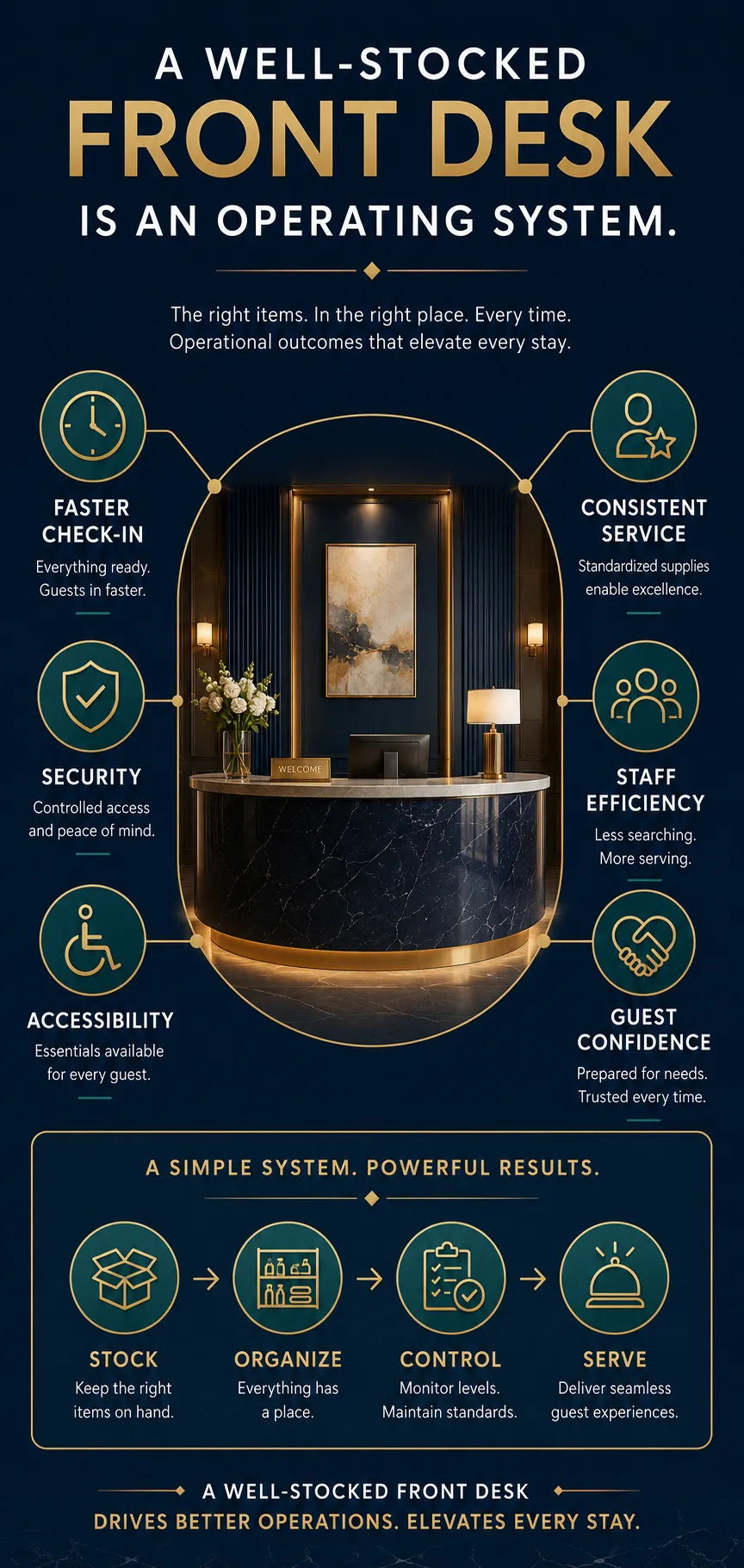
The right front desk supply system therefore affects check-in speed, service consistency, security, accessibility, staff productivity, and guest confidence. A shortage of key cards can stop arrivals. An empty receipt-paper roll can delay checkout. A missing charging cable or sewing kit can turn a minor guest inconvenience into a complaint. Poorly controlled registration documents can create privacy risks.
Every property needs a stocking plan suited to its size, service model, technology, guest profile, and operating hours. A 20-room boutique hotel will not need the same quantities as a 600-room convention property, but both require dependable categories, assigned storage locations, reorder rules, and emergency backups.
This guide covers the front desk equipment, consumables, forms, guest supplies, accessibility tools, safety materials, and inventory controls that hotels should consider when building or reviewing their front office supply program.
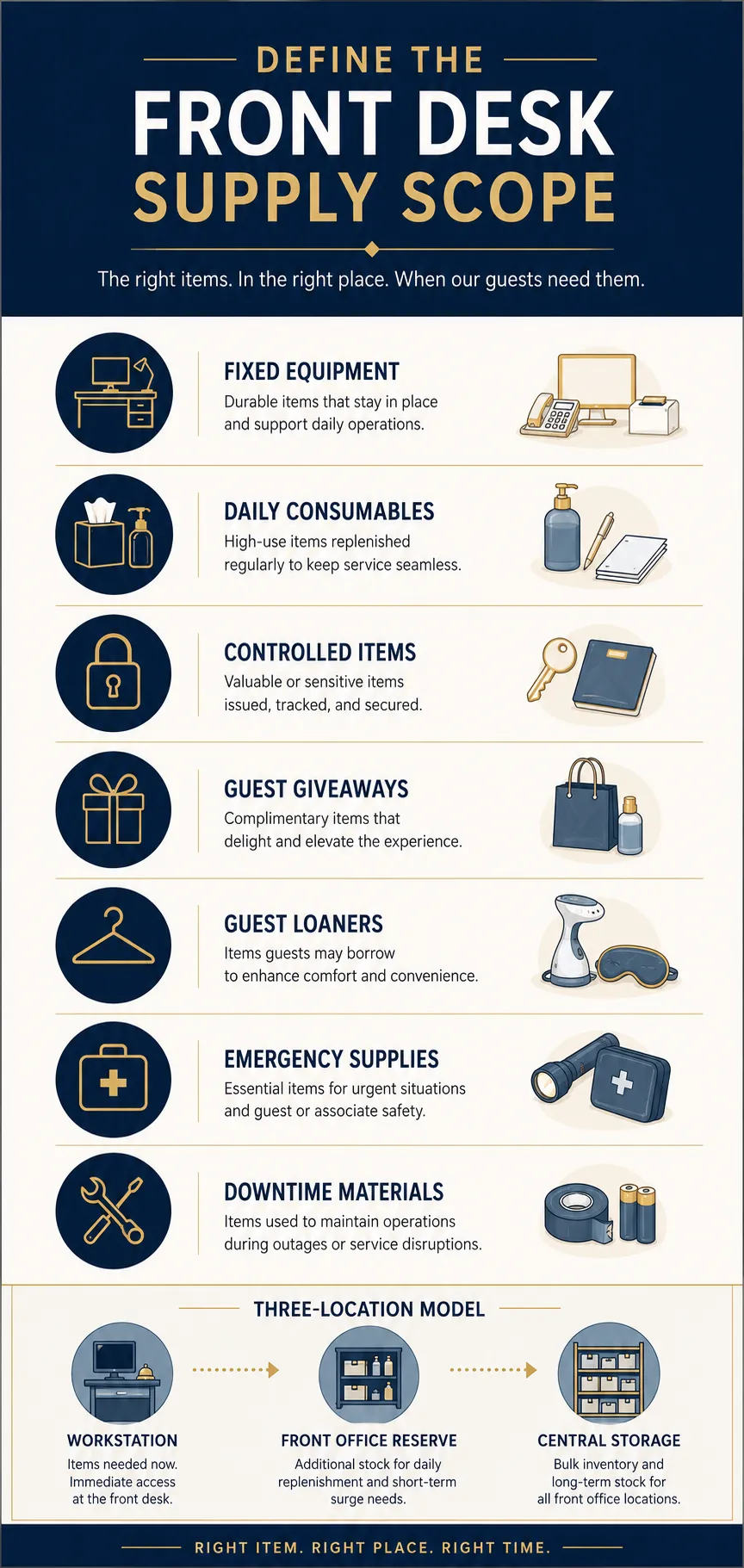
Define the Front Desk Supply Scope Before You Start Buying
Front desk inventories become disorganized when every item is treated as ordinary office stationery. A more practical approach is to divide supplies according to their operational role.
| Supply category | Typical examples | Primary control |
|---|---|---|
| Fixed equipment | Workstations, phones, printers, scanners, key encoders | Asset register and maintenance plan |
| Daily consumables | Paper, pens, key cards, envelopes, receipt rolls | Par levels and reorder points |
| Controlled items | Cash drawer keys, master credentials, blank access media | Restricted storage and issue logs |
| Guest giveaways | Dental kits, razors, combs, slippers, stationery | Usage tracking and cost control |
| Guest loaners | Chargers, adapters, umbrellas, mobility aids | Numbered checkout and return process |
| Emergency supplies | Flashlights, first aid materials, radios, printed procedures | Scheduled inspection and expiration control |
| Downtime materials | Manual registration forms, offline logs, backup keys | Sealed contingency kit and periodic testing |
The inventory boundary should also be clear. Some properties keep luggage tags, valet materials, concierge stationery, and lobby cleaning supplies within the front office budget. Others assign them to guest services, security, housekeeping, or transportation. Either model can work, but ownership must be documented so items are not duplicated, neglected, or charged inconsistently.
Before ordering, map the activities performed at each front desk position. Include arrivals, departures, walk-ins, room moves, payment collection, key replacement, message handling, parcel receipt, lost-property reporting, accessibility requests, and emergency communication. This workflow analysis reveals what must remain within immediate reach, what can stay in a secured back office, and what belongs in central storage.
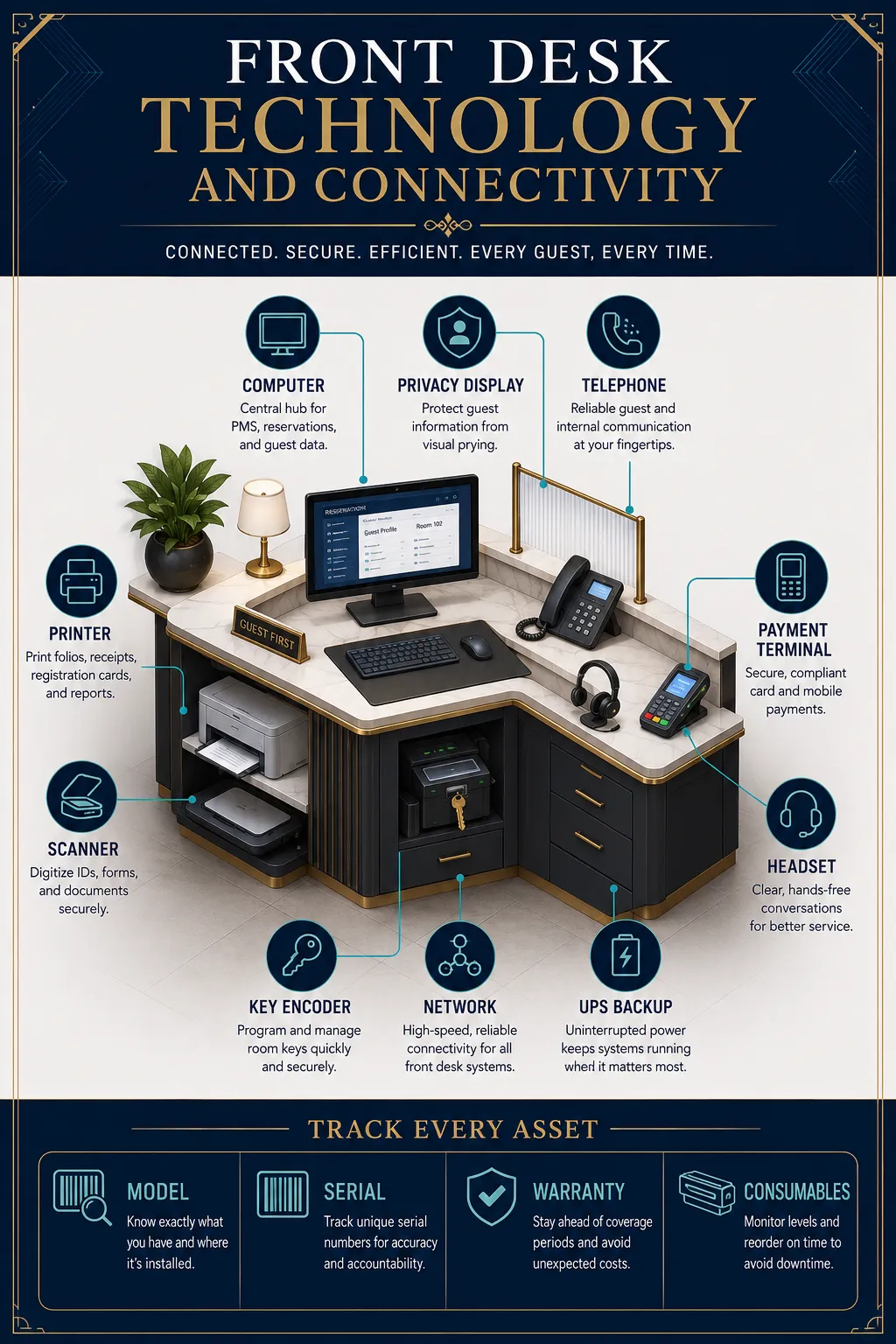
Computers, Phones, Networking, Printers, Scanners, and Backup Power
The workstation is the operational center of the hotel reception area. Each active position normally requires a computer or compatible terminal capable of running the property management system, payment applications, communication tools, and approved integrations. Specifications should reflect actual software requirements rather than general office use.
Select displays that allow employees to view reservations, guest profiles, room status, and payment information without exposing sensitive details to people standing at the counter. Privacy filters, adjustable monitor arms, cable-management accessories, and lockable mounting hardware may be necessary depending on the desk layout.
Front desk telephones should support the property’s internal and external communication structure. Common requirements include multiple lines, transfer functions, hold, voicemail access, emergency dialing, and clear labeling for frequently contacted departments. A backup handset or approved mobile device can protect communications during a system failure.
Typical peripheral equipment includes:
- Document and identification scanners
- Receipt or folio printers
- Standard office printers
- Barcode or label printers
- Signature-capture devices
- Key-card encoders
- Payment terminals
- Headsets for call-intensive positions
- Approved webcams or cameras for remote support
- Charging docks for radios and mobile devices
Hotels should stock compatible paper, labels, toner, ink, receipt rolls, cleaning cards, and approved replacement cables. Purchasing a printer without planning its consumables creates an avoidable single point of failure.
Network switches, secured wireless access, surge protection, and an uninterruptible power supply may also support the front desk. Backup power should provide enough time to complete a transaction safely, preserve data, and follow shutdown procedures. It should not be treated as a substitute for a property-wide emergency power strategy.
Maintain a documented list of device models, serial numbers, compatible consumables, warranty information, support contacts, and replacement priorities. This prevents staff from ordering an incompatible cable, paper size, card stock, or encoder-cleaning product during an urgent shortage.
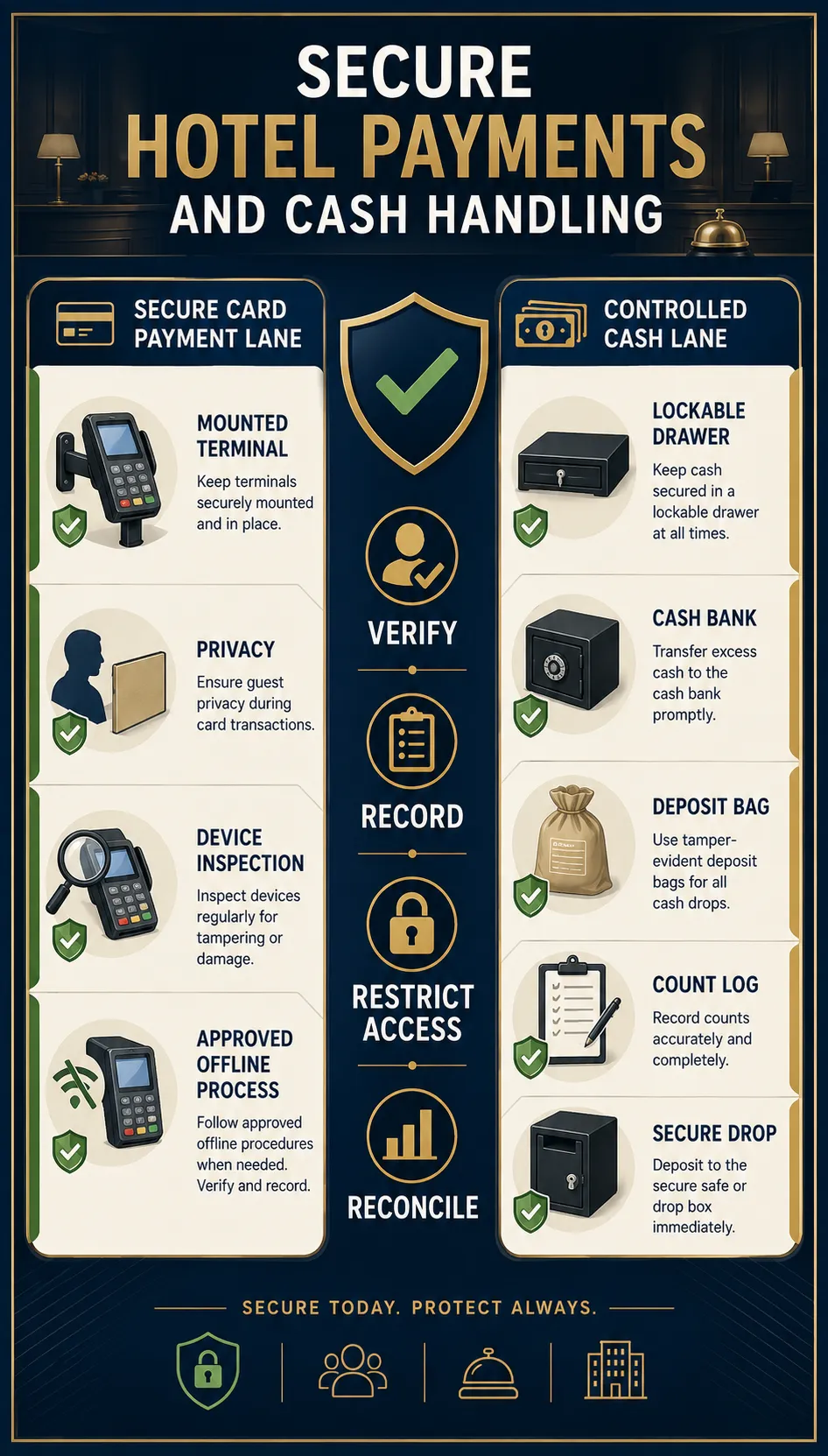
Payment Terminals, Cash-Handling Tools, and Transaction Security
Properties accepting card payments need terminals compatible with their payment processor, property management system, and approved transaction methods. Equipment may include countertop readers, PIN pads, contactless payment devices, signature displays, receipt printers, and secure mounting brackets.
Payment devices should be positioned so guests can use them comfortably while card details and PIN entry remain private. Staff should inspect terminals for damage, unexpected attachments, broken seals, or unauthorized replacement. Device identities and serial numbers should be recorded so substitutions can be detected.
Hotels that accept cash may require:
- Lockable cash drawers or individual cashier banks
- Deposit bags with sequential numbers
- Cash-counting trays
- Calculators
- Coin and bill organizers
- Secure drop facilities
- Change-request forms
- Cash-overage and shortage records
- Counterfeit-detection tools where appropriate
Access to cash, spare drawer keys, deposit materials, and refund documentation must be restricted by role. Shift counts should occur in a controlled location, with clear accountability during bank transfers between employees.
Avoid storing full payment credentials, identification copies, or handwritten card information unless the property has a documented and compliant reason for doing so. When payment systems fail, employees should follow an approved offline procedure rather than improvising with unsecured notes. Any printed material containing personal or financial data should be minimized, protected, and destroyed through an approved confidential-disposal process.
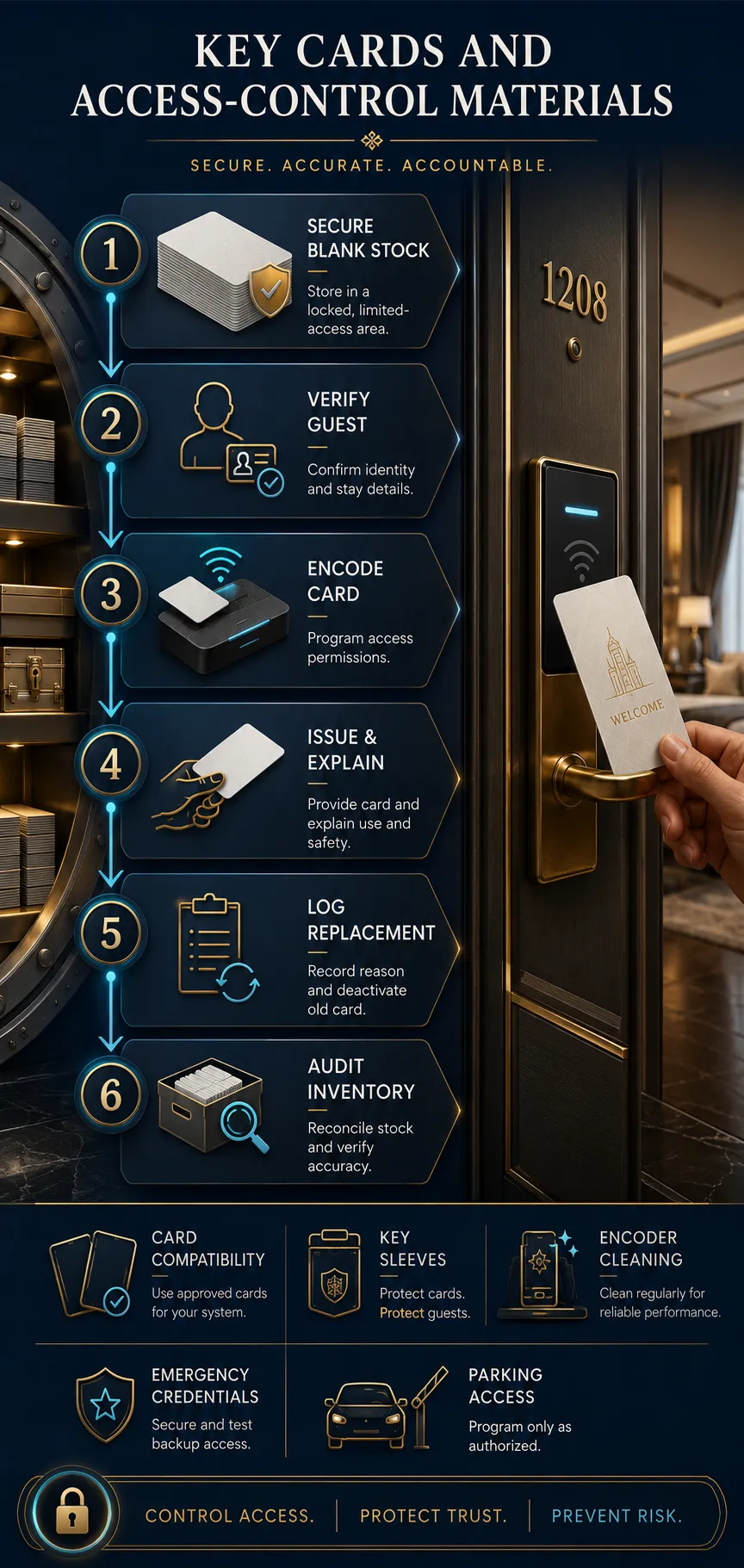
Key Cards, Encoders, Sleeves, and Access-Control Materials
Room-access supplies deserve stricter control than ordinary stationery. A front desk may need magnetic-stripe cards, RFID credentials, mobile-key support, mechanical keys, parking credentials, elevator-access media, or a combination of these systems.
Blank cards must match the installed locks and encoders. Similar-looking cards are not necessarily interchangeable, and an incorrect chip, frequency, coating, or magnetic specification may cause repeated failures. Procurement teams should confirm compatibility with both the lock manufacturer and the hotel’s configuration before ordering large quantities.
Stocking requirements may include:
- Blank guest key cards
- Branded or unbranded key-card sleeves
- Key-card encoders and approved cleaning supplies
- Emergency or backup access credentials
- Parking cards or gate remotes
- Mechanical key tags and secure cabinets
- Key-control logs
- Tamper-evident storage for sensitive credentials
- Batteries or parts approved for relevant devices
Key sleeves should communicate necessary guest information without printing the room number together with the property name in a way that increases risk if the card is lost. Wi-Fi instructions, checkout times, basic directions, and service contacts may be included when appropriate.
Key cards should be issued only after the guest’s identity and authorization have been verified according to property policy. Replacement keys require the same discipline. Master and emergency credentials need especially tight storage, issue logging, return verification, and periodic audit procedures.
Maintain enough blank cards for normal consumption, failed encoding, lost-key replacement, group arrivals, and supplier delays. However, excessive uncontrolled stock increases waste and makes discrepancies harder to identify.
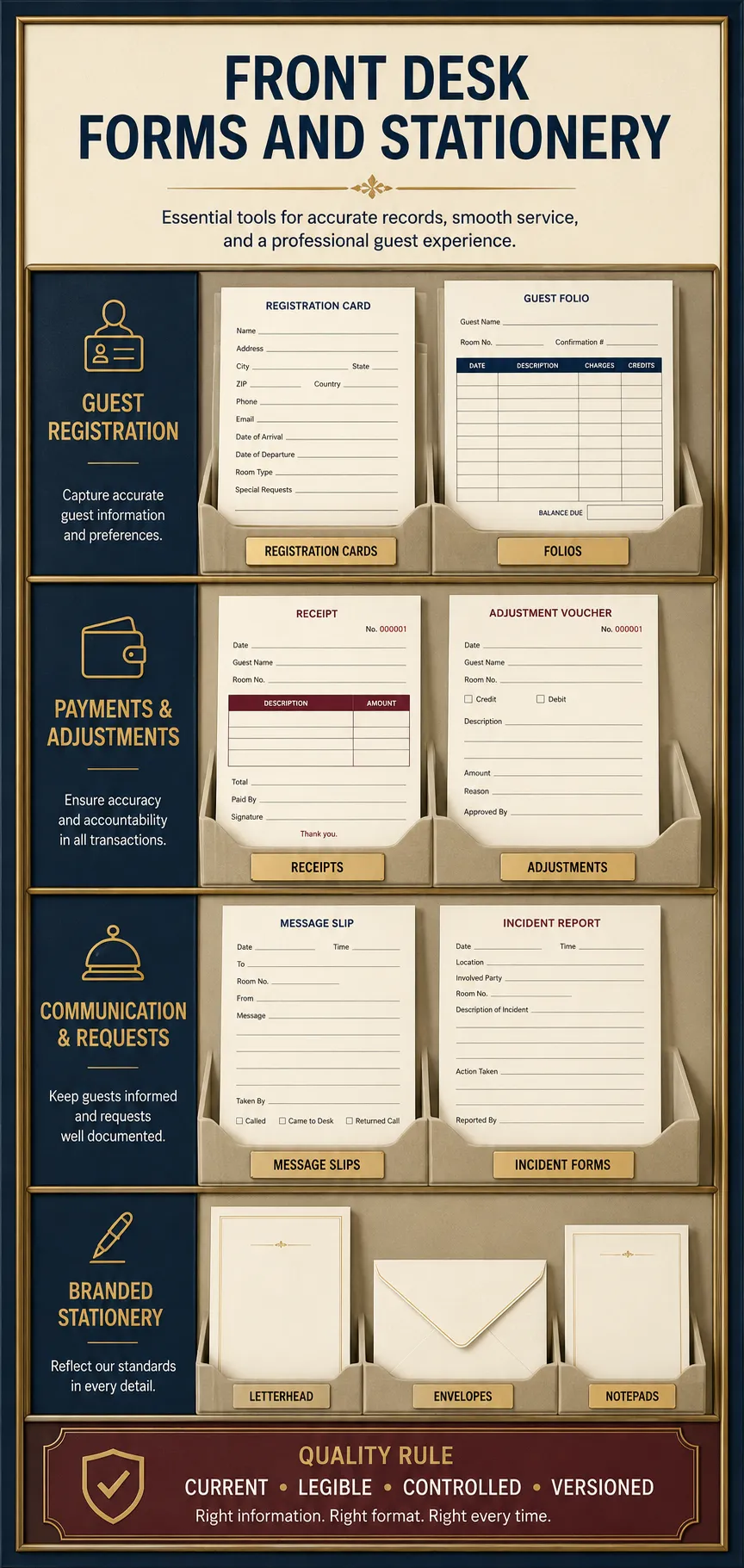
Registration Forms, Folios, Receipts, Envelopes, and Everyday Stationery
Even highly digitized hotels still need selected printed materials. The goal is not to preserve unnecessary paperwork but to ensure that each required document is available, current, legible, and controlled.
Depending on the property, front desk forms may include:
- Registration cards
- Authorization and acknowledgment forms
- Manual room-change records
- Paid-out or adjustment forms
- Cash-deposit records
- Guest folios and receipts
- Message slips
- Wake-up-call logs
- Maintenance request forms
- Incident-report forms
- Accessibility request records
- Luggage and package claim tickets
- Lost-and-found documentation
- Group-arrival materials
- Transportation or valet tickets
Branded stationery may include letterhead, envelopes, note cards, notepads, business cards, welcome letters, and document folders. Before reordering custom materials, confirm that the property name, address, telephone number, website, policies, branding, and legal language are current.
Every form should have a defined purpose and owner. Obsolete forms can create conflicting instructions or collect information the hotel no longer needs. When possible, use version dates or document codes so employees can distinguish the current edition.
Basic supplies still matter: pens, permanent markers, highlighters, pencils, correction materials, staplers, staples, paper clips, binder clips, rubber bands, tape, scissors, rulers, envelopes, folders, printer paper, and notepads. Choose commercial-quality items that withstand continuous shared use instead of repeatedly replacing fragile consumer-grade products.
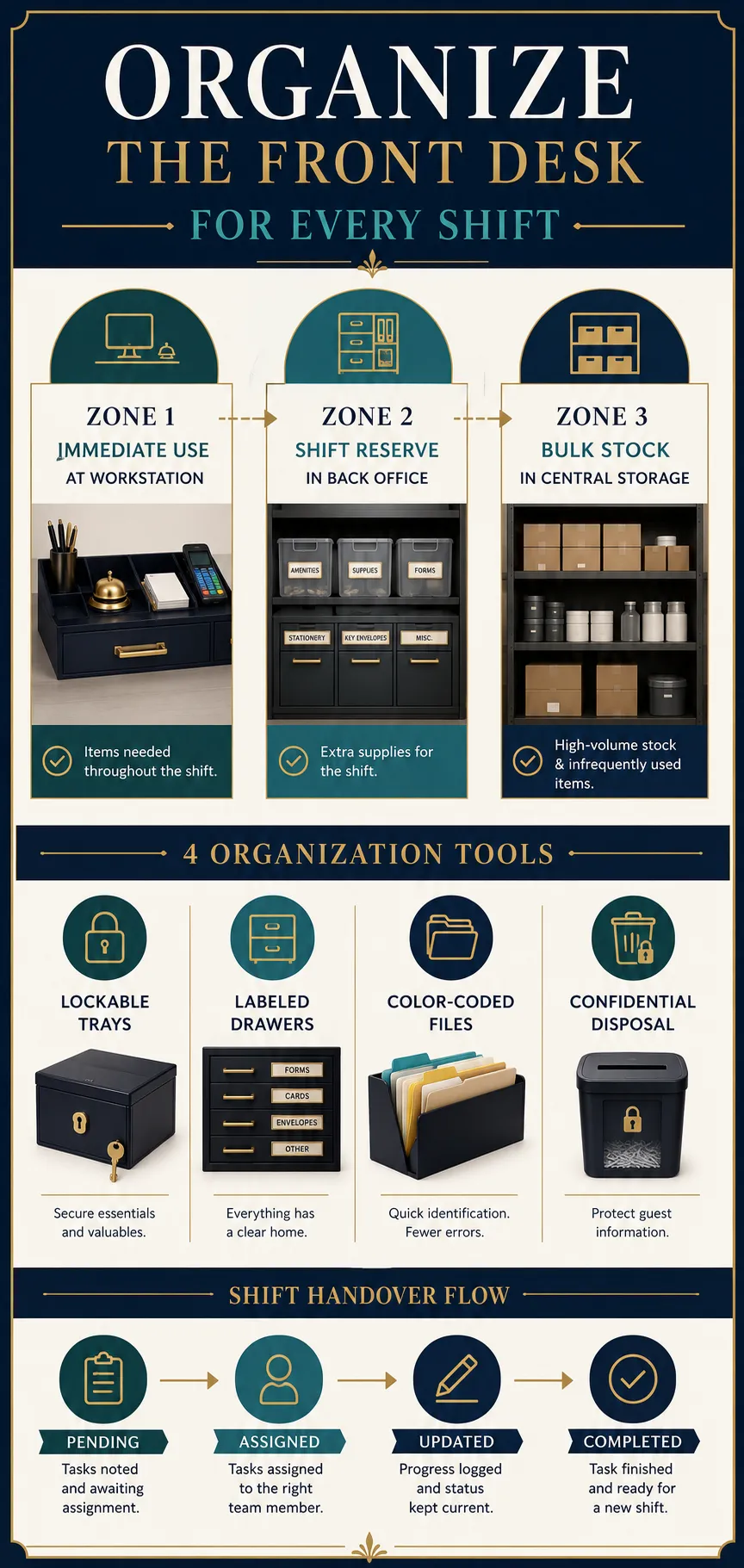
Filing, Labeling, Desk Organization, and Shift-Handover Supplies
A clean counter does not necessarily indicate an organized operation. Front desk employees need a consistent system for separating current work, pending action, confidential records, deliveries, group materials, and items awaiting another department.
Useful organizational products include drawer dividers, vertical file holders, lockable document trays, binders, expanding folders, label makers, color-coded labels, key cabinets, literature holders, and small-parts organizers. Each item should have a permanent location identified by a clear label.
Sensitive documents must never accumulate in open trays visible or accessible to guests. Provide lockable storage for records awaiting processing and secure consoles for confidential disposal. Ordinary wastebaskets are unsuitable for documents containing guest or payment information.
Shift-handover supplies may include a controlled logbook, printed exception reports, task checklists, unresolved-request folders, communication boards, and sealed cash-transfer materials. Digital logs can replace much of this paperwork, but the chosen system should still show ownership, status, time, priority, and completion.
Avoid overcrowding the desk with seldom-used products. Store immediate-use supplies at the workstation, shift-level reserves in the back office, and unopened bulk stock in a designated storeroom. This three-level system improves speed without turning each cashier position into an uncontrolled stock area.
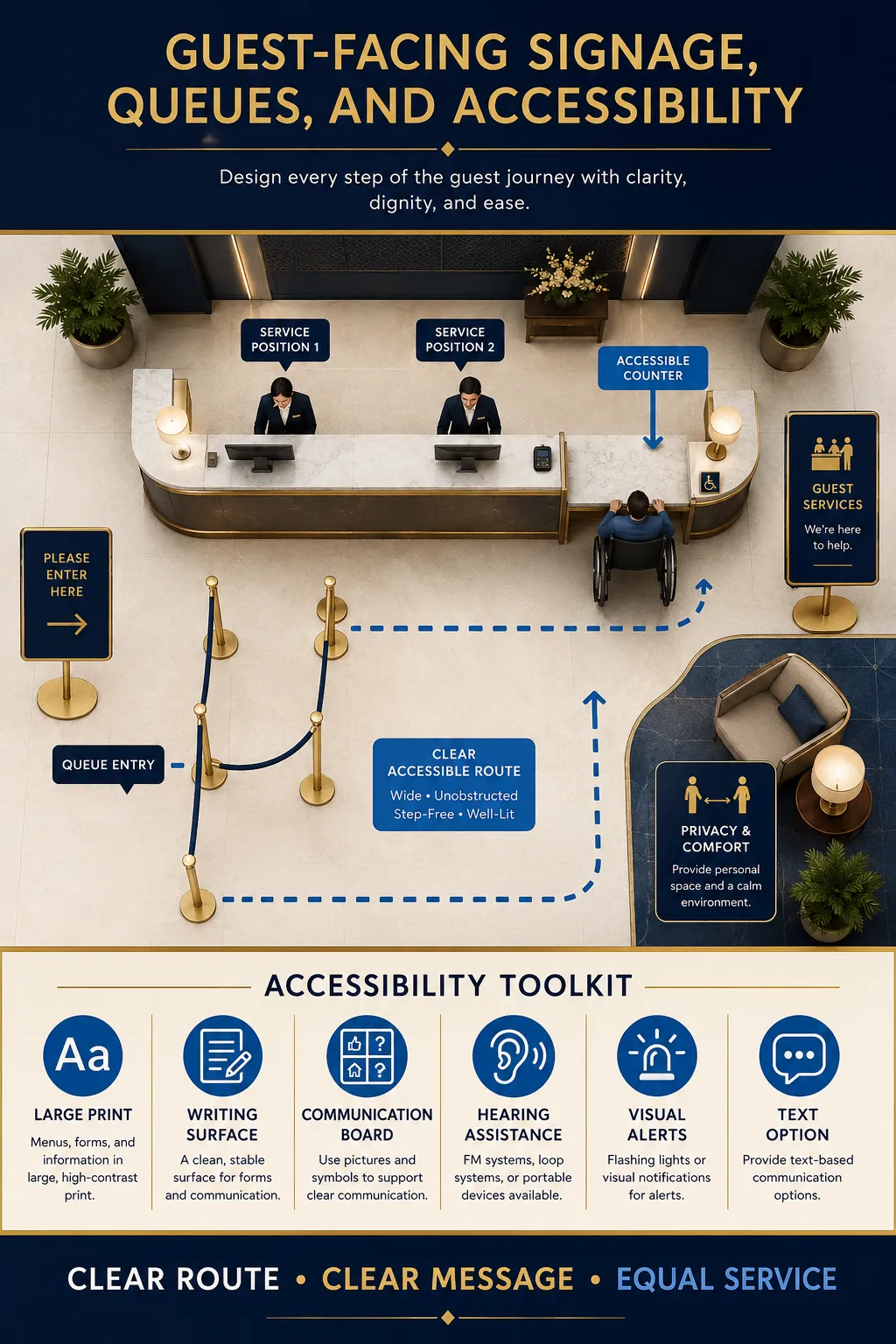
Guest-Facing Signage, Queue Control, and Accessible Communication Equipment
Front desk signs should help guests understand where to go and what to do without making the reception area look cluttered. Depending on the property, useful signs may identify check-in positions, accessible service points, concierge services, queue entrances, checkout options, payment policies, temporary service interruptions, and privacy boundaries.
Use stable, professional sign holders rather than improvised paper notices taped to the counter. Frequently changing information can be placed in reusable frames or approved digital displays. Permanent signs should match the property’s wider wayfinding and visual-identity system.
Queue-control equipment may include retractable-belt stanchions, posts with ropes, floor markers, sign frames, and portable barriers. The layout should maintain a clear accessible route, protect privacy between guests, and allow luggage to move without blocking circulation. Portable queue equipment should have stable bases, replaceable components, and finishes that tolerate contact from carts and bags.
Accessible front desk supplies may include:
- A properly designed accessible counter section
- Clipboards or writing surfaces usable at an appropriate height
- Large-print versions of essential information
- Magnifiers
- Pen grips or easy-to-hold writing tools
- Portable communication boards
- Assistive-listening or counter-loop equipment
- Text-based communication options
- Visual notification devices
- Accessible-room equipment kits managed through the front desk
- Clear signage identifying available assistance
Requirements vary by country, building, and service model, so the property should verify applicable accessibility rules rather than relying on a generic product labeled “compliant.” Equipment must also be charged, tested, stored correctly, and familiar to employees. An assistive device that cannot be located or operated during check-in provides little practical access.
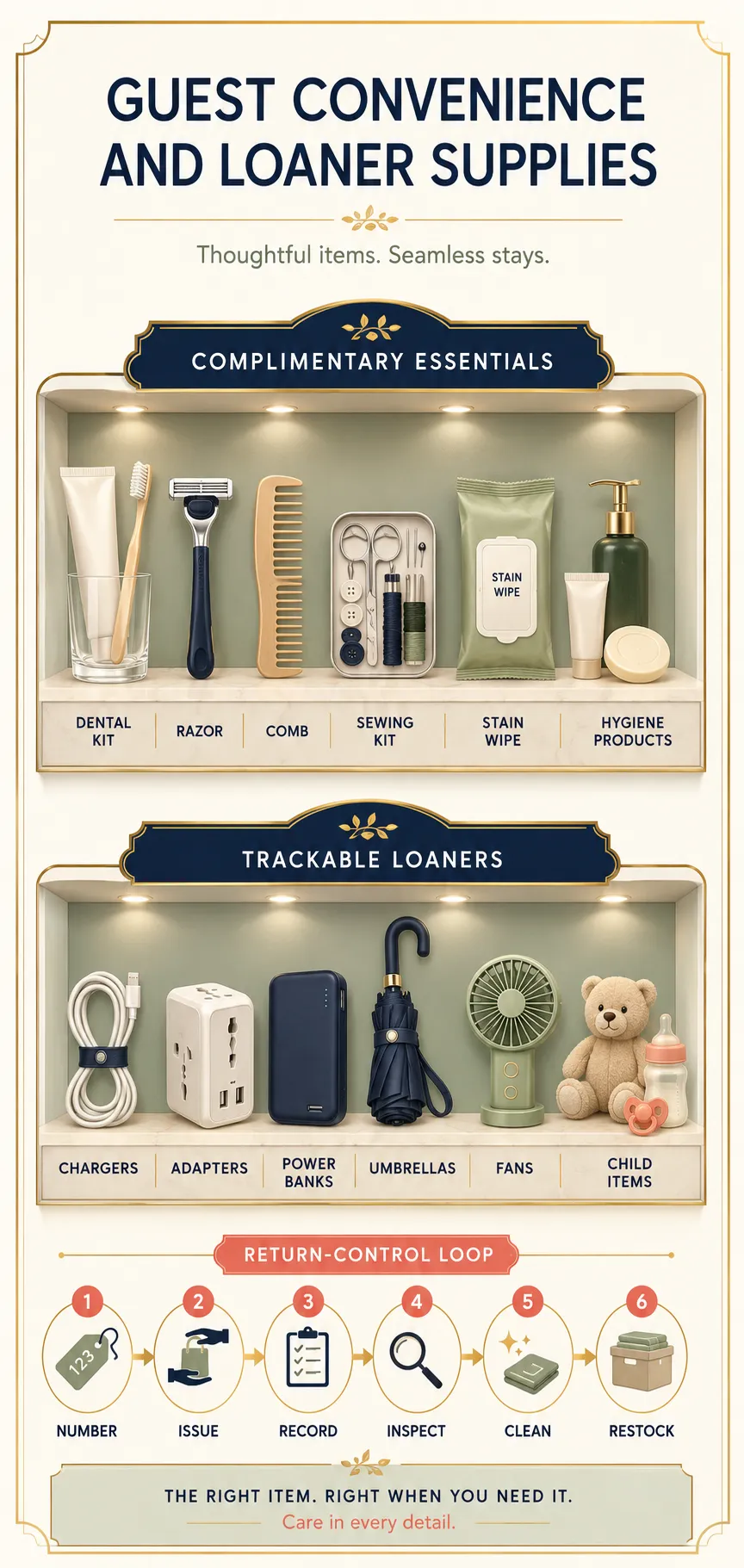
Guest Convenience Items, Forgotten Essentials, and Loaner Supplies
Travelers frequently arrive without a small but important item. A carefully selected front desk reserve can resolve these needs quickly and demonstrate thoughtful service.
Common complimentary or saleable items include toothbrushes, toothpaste, razors, shaving cream, combs, cotton products, feminine hygiene products, shower caps, sewing kits, shoe-care items, stain-removal wipes, laundry-detergent packets, lint rollers, earplugs, bottled water, and basic stationery.
The correct assortment depends on the hotel. Airport properties may receive more requests for adapters and toiletries. Extended-stay hotels may need laundry products and simple kitchen tools. Resorts might stock sunscreen, insect repellent, waterproof pouches, or beach-related items. Business hotels may need chargers, presentation adapters, office supplies, and garment-care products.
Loaner inventories may include:
- Phone-charging cables
- Universal power adapters
- Power banks
- Umbrellas
- Hair dryers or styling tools
- Fans or humidifiers
- Bottle openers and corkscrews
- Board games
- Reading glasses
- Accessibility devices
- Child-related equipment
- Destination-specific recreational items
Every loaner should have a unique identification number and documented issue status. Record the room, issue time, expected return, condition, and responsible employee. Electrical items should be inspected before reissue, and personal-care products must be packaged and handled hygienically.
Avoid promising that every item is free. The property should define which supplies are complimentary, sold, rented, or subject to a deposit, then communicate the policy consistently.
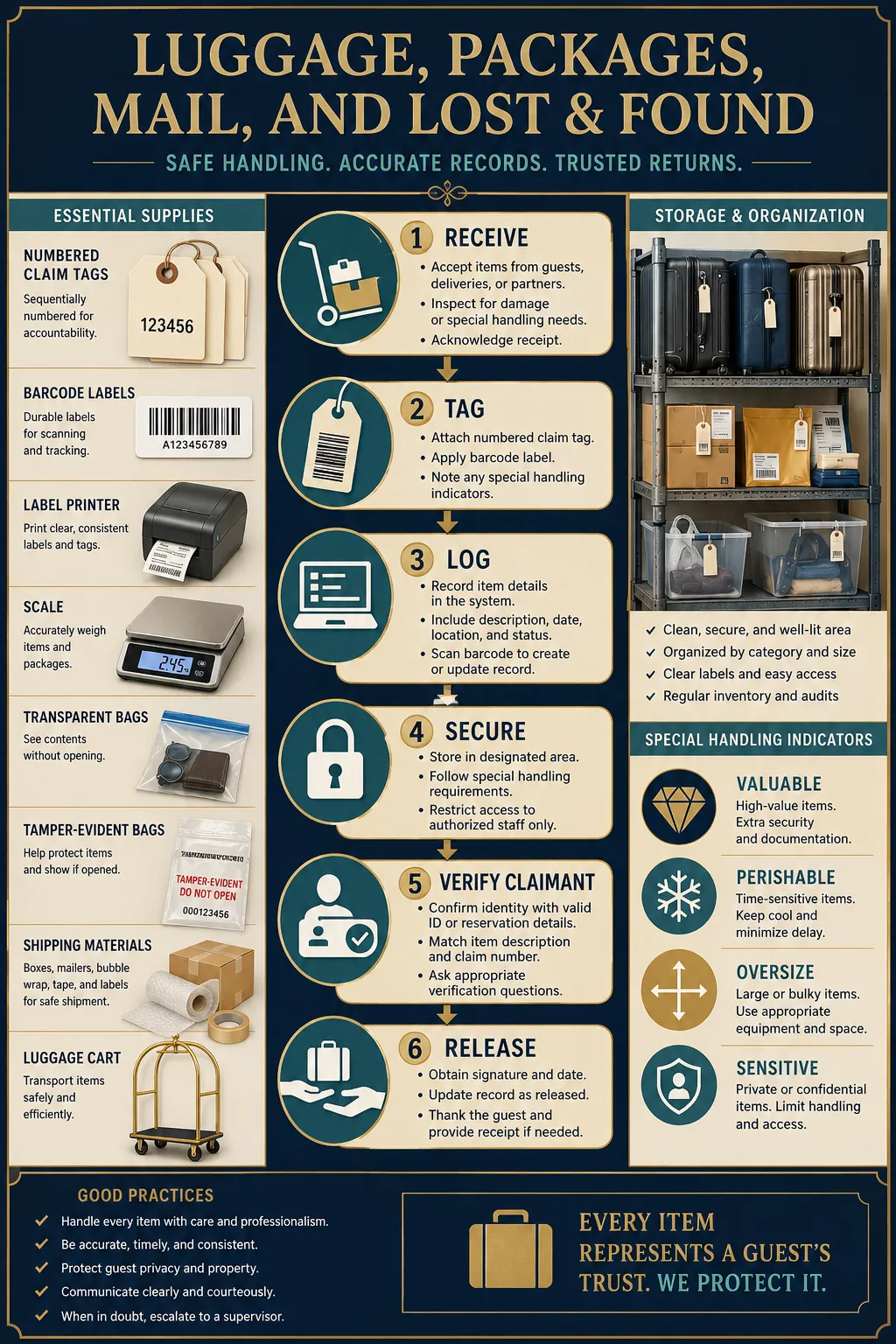
Luggage, Valet, Mail, Package, and Lost-and-Found Supplies
Hotels often manage guest property before check-in, after checkout, and throughout a stay. This responsibility requires more than a luggage cart.
A basic luggage-handling system may need bell carts, hand trucks, numbered claim tickets, durable luggage tags, tamper-evident seals, barcode labels, storage racks, garment hooks, floor protection, and designated oversize-item areas. Carts should match elevator dimensions, doorway clearances, floor surfaces, expected loads, and the property’s appearance.
For mail and packages, consider shelving, sorting bins, label printers, scanners, tape, boxes, protective mailers, scales, secure cages, refrigerated storage where appropriate, and an electronic or manual chain-of-custody log. Package acceptance rules should define eligible recipients, identification requirements, storage periods, handling fees, oversized deliveries, perishables, and unclaimed items.
Lost-and-found supplies typically include transparent bags, tamper-evident bags for valuable items, numbered tags, permanent markers, protective containers, gloves, shelving labels, log forms, and shipping materials. Valuable property, identification documents, medication, electronics, food, and hazardous items may require different handling.
The person releasing luggage, parcels, or lost property should verify the claimant and record the transfer. Claim tickets alone may not provide sufficient verification for high-value belongings. Storage rooms should be access-controlled, orderly, and monitored according to the property’s security plan.
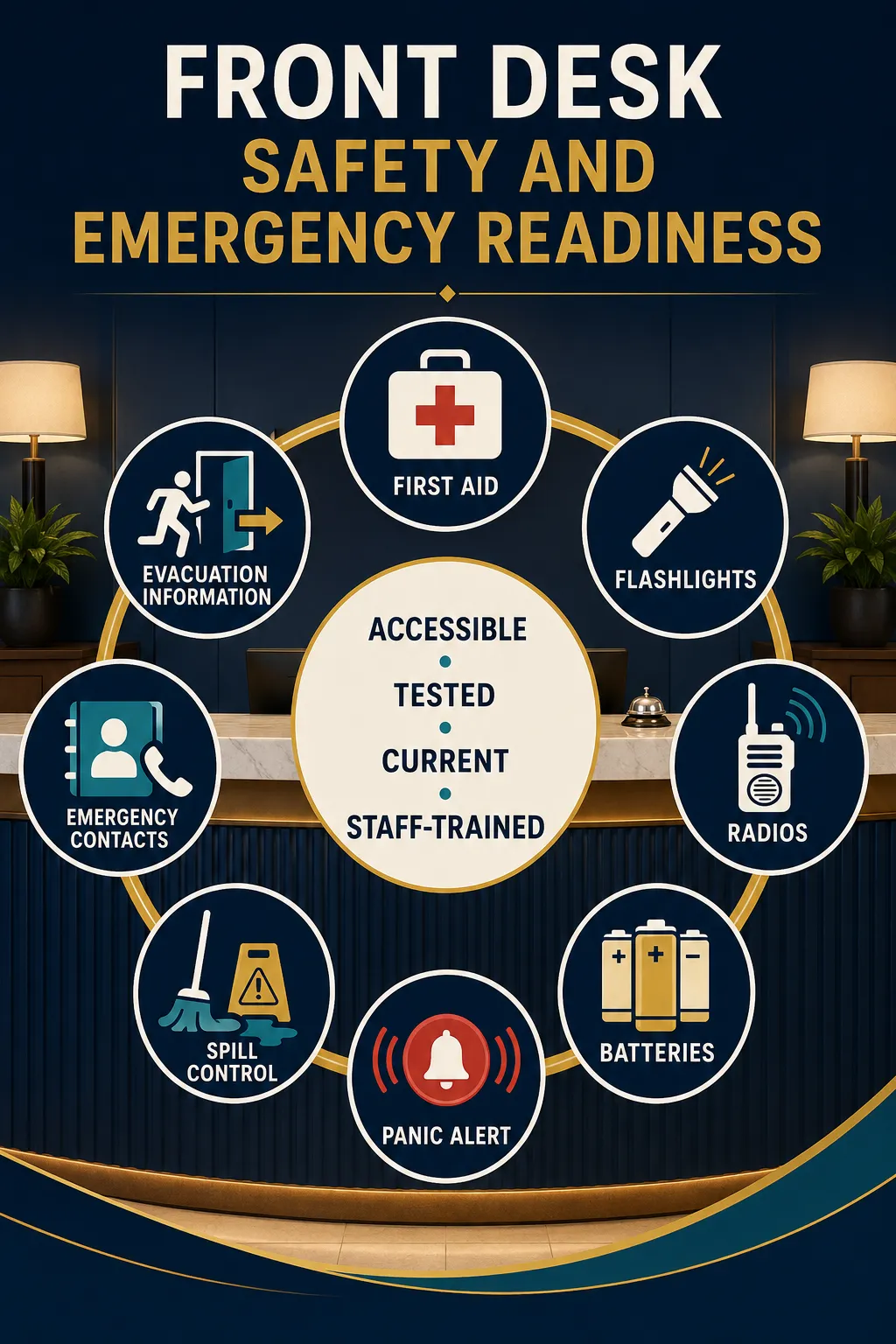
Safety, Security, First Aid, and Emergency-Response Equipment
Because the front desk is continuously staffed at many hotels, it often becomes an emergency communication point. Supplies should support employees until security, management, maintenance, or emergency responders assume control.
Potential front desk or nearby emergency equipment includes:
- A workplace-appropriate first aid kit
- Disposable gloves and protective barriers
- Biohazard disposal materials
- Flashlights and spare batteries
- Emergency radios and charging docks
- Portable phone chargers
- Whistles or signaling devices
- Emergency blankets
- Spill-isolation materials
- Wet-floor signs
- Fire extinguishers in approved locations
- An automated external defibrillator where provided
- Staff alert or panic-button devices
- Updated emergency contact lists
- Evacuation and shelter-in-place materials
The exact first aid and emergency inventory must reflect applicable regulations, employee training, building systems, local hazards, occupancy, and response times. Stocking equipment does not authorize untrained employees to perform tasks beyond their competence.
Security supplies may also include visitor badges, contractor passes, radios, privacy screens, lockable cabinets, evidence bags, incident forms, camera-monitoring equipment, and controlled-access devices. Panic buttons must be tested, reachable, and linked to a defined response—not simply installed and forgotten.
Emergency binders should contain only current, actionable information. Include escalation contacts, utility information, assembly locations, accessible evacuation procedures, emergency-room relocation processes, media restrictions, and system-failure instructions. Review the contents whenever staffing, floor plans, telephone numbers, or emergency procedures change.
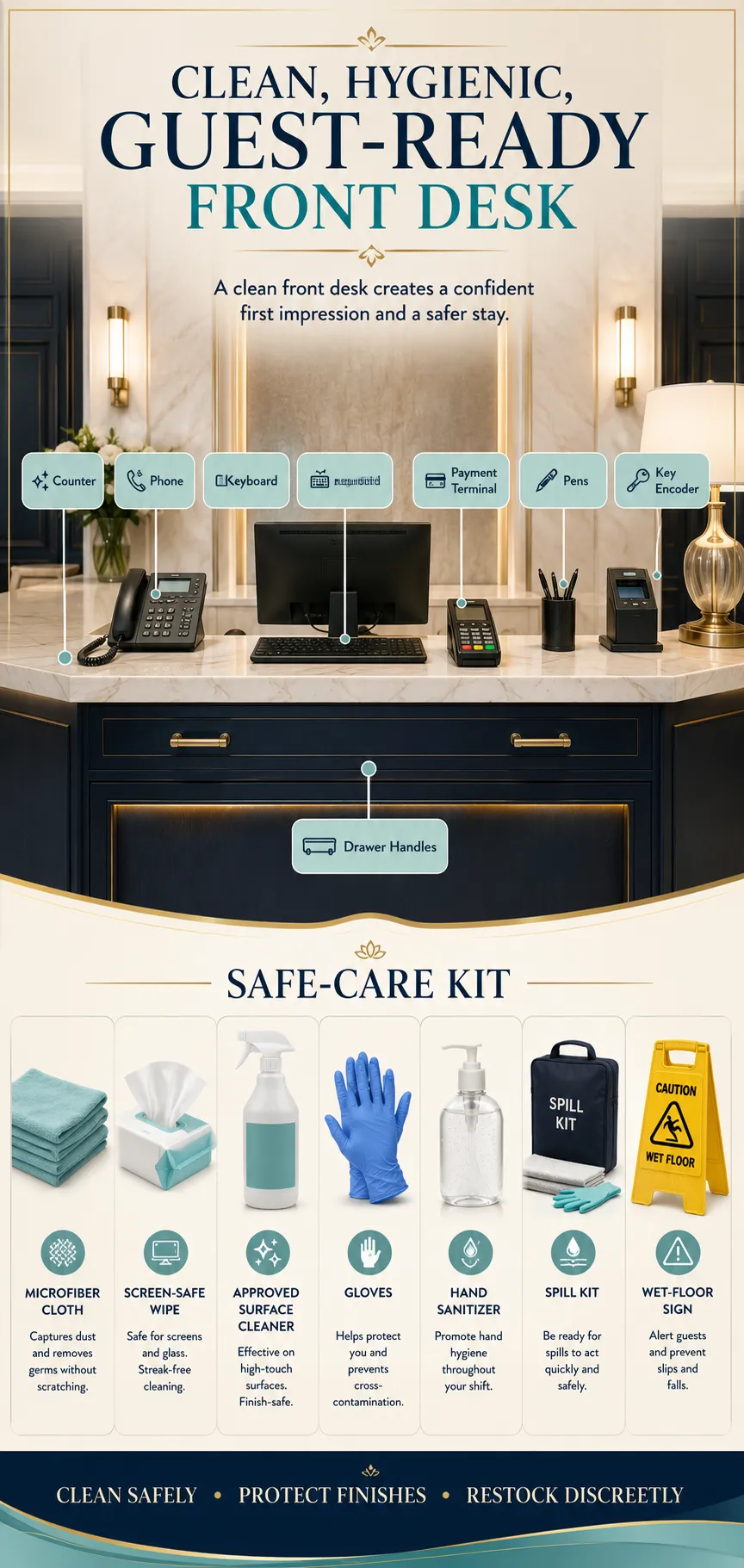
Cleaning, Hygiene, Spill Response, and Front Desk Presentation
The reception counter is a high-contact work surface and a major part of the guest’s first impression. Front desk teams need immediate access to safe, approved cleaning materials without storing an unattractive chemical collection in guest view.
Useful supplies may include microfiber cloths, screen-safe wipes, approved surface cleaner, hand sanitizer, tissues, wastebasket liners, disposable gloves, a small dustpan and brush, and a compact spill-response kit. Wet-floor signs or portable barriers should be accessible when a spill affects the lobby.
Cleaning products must be compatible with stone, wood, metal, acrylic, electronic screens, keyboards, payment terminals, and branded finishes. A harsh chemical can damage an expensive counter or remove markings from equipment.
Assign responsibility for cleaning shared headsets, phones, pens, key encoders, drawer handles, and touchpoints. Decorative items, brochures, and countertop displays should also be inspected and straightened throughout the day. The objective is a front desk that looks calm and intentional, even during peak arrivals.
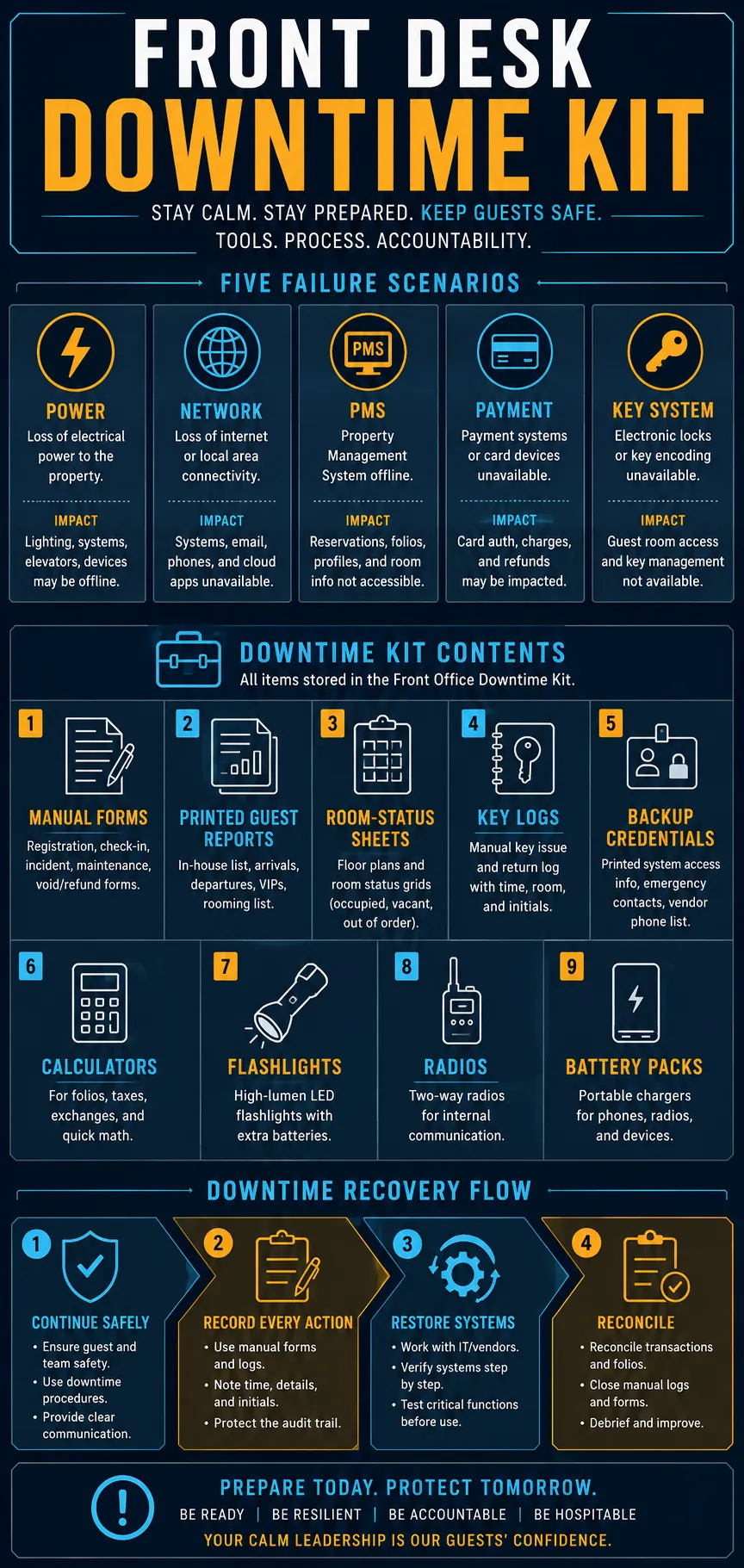
Downtime Kits for Power, Network, PMS, Payment, and Key-System Failures
A downtime kit allows the hotel to continue controlled operations when technology is unavailable. It should be prepared before an outage, stored securely, and tested through realistic drills.
The kit may contain:
- Numbered manual registration forms
- Manual room-assignment and occupancy records
- Printed arrival, departure, and in-house guest reports
- Emergency contact lists
- Current room-status procedures
- Manual key-issue logs
- Approved backup access credentials
- Preprinted folio or receipt forms
- Calculators
- Clipboards, pens, markers, and labels
- Flashlights
- Battery packs
- Radios
- Sealed instructions for system recovery and data entry
Printed guest lists contain sensitive information and should be generated, secured, replaced, and destroyed under a defined policy. Outdated reports can create serious room-assignment and privacy errors.
The downtime plan should distinguish among a local workstation failure, network outage, payment interruption, property management system outage, lock-system failure, telephone failure, and full power loss. Each scenario requires different tools and authority.
After service returns, staff need a reconciliation process for registrations, keys, payments, room changes, postings, and guest requests completed offline. A pile of handwritten notes is not a recovery plan. Numbered forms and controlled logs make delayed data entry traceable.
Calculate Par Levels, Reorder Points, Emergency Stock, and Secure Storage
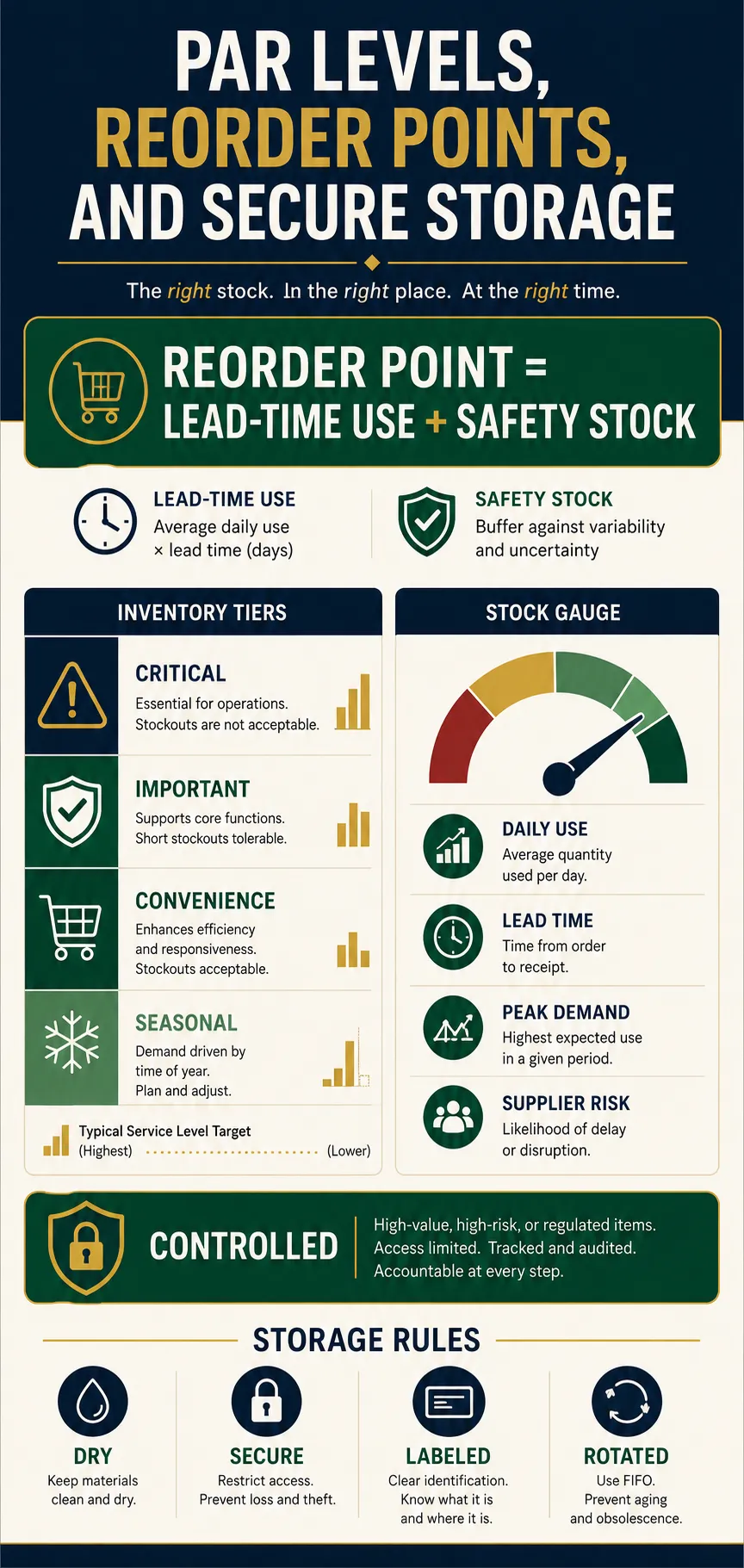
Par levels should be based on consumption and replenishment risk, not intuition. Start by measuring average daily use for key cards, sleeves, receipt paper, printer paper, forms, guest kits, baggage tags, and other repeat items. Then account for peak occupancy, group arrivals, failed units, delivery lead time, and supplier reliability.
A simple reorder model is:
Reorder point = expected use during lead time + safety stock
If a hotel uses 120 key cards per day and replenishment normally takes seven days, expected lead-time demand is 840 cards. Safety stock should then reflect delivery uncertainty, occupancy peaks, encoding failures, and the consequences of running out.
Not every item deserves the same safety margin. Use a risk-based classification:
- Critical items: Operations may stop without them, such as compatible key cards or receipt rolls.
- Important items: Service becomes slower or less consistent, such as standard forms and common guest kits.
- Convenience items: Helpful but temporarily replaceable, such as selected branded stationery.
- Seasonal items: Stock varies with weather, events, or guest mix.
- Controlled items: Quantities matter, but security is more important than open availability.
Set separate par levels for each workstation, the front office reserve, and central storage. This prevents one desk from hiding excessive supplies while another runs out.
Use first-in, first-out rotation for items with expiration dates, changing packaging, batteries, adhesives, or branded information. Count controlled items more frequently than low-value stationery. Loaners require both a physical count and a status check because an item may exist but remain assigned to a guest.
Storage conditions also matter. Keep paper dry, electronics protected from heat and liquids, batteries separated correctly, toiletries hygienic, and access credentials secured. Clearly label open cartons with the date and remaining quantity.
Write Procurement Specifications and Evaluate Front Desk Suppliers
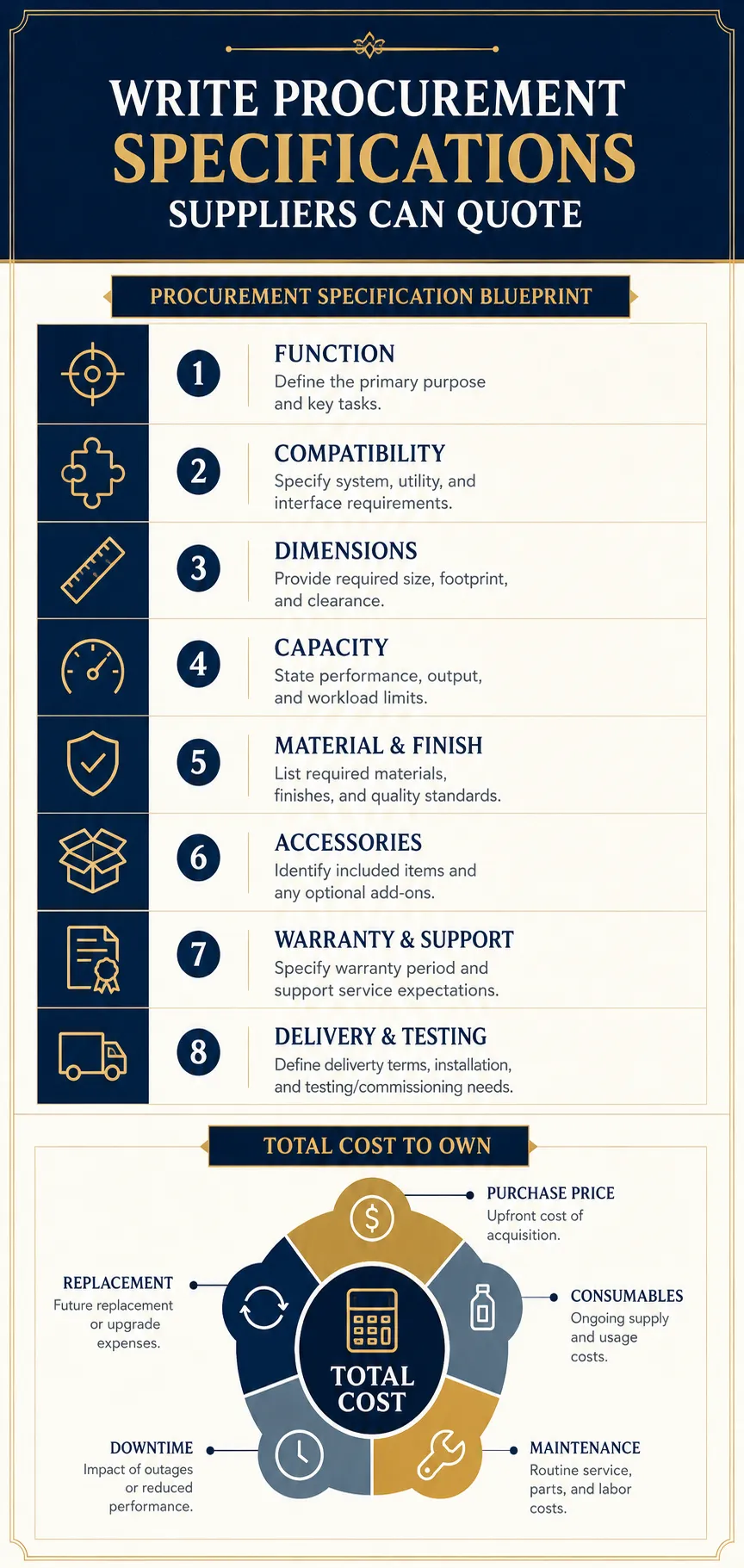
A product name alone is rarely an adequate purchasing specification. Suppliers need enough information to quote an item that fits the hotel’s equipment, workflow, appearance, and regulatory environment.
A key-card specification, for example, may include card technology, chip or magnetic requirements, dimensions, encoding compatibility, finish, printing, artwork, packaging quantity, sample approval, and delivery schedule. A receipt-roll specification should identify width, diameter, core, paper type, printer compatibility, and any storage requirements.
For equipment, document:
- Required functions and capacity
- Dimensions and installation constraints
- Electrical and network requirements
- Software and system compatibility
- Accessibility considerations
- Security features
- Commercial-duty expectations
- Cleaning and maintenance requirements
- Included accessories
- Consumable availability
- Warranty terms
- Support response
- Spare-parts availability
- Training and documentation
- Delivery, installation, testing, and acceptance requirements
Evaluate total cost of ownership rather than unit price alone. A low-cost printer may use expensive proprietary consumables. A cheap luggage cart may damage lobby finishes, create noise, or require frequent wheel replacement. A custom key sleeve may become costly if the minimum order exceeds realistic consumption before the artwork changes.
For critical supplies, qualify a secondary source or maintain additional safety stock. However, do not assume products from two vendors are interchangeable. Samples should be tested under real operating conditions before an alternate supplier is approved.
Supplier performance should be tracked through order accuracy, lead-time consistency, damage rates, compatibility failures, communication quality, replacement speed, and invoice accuracy. This creates a stronger purchasing decision than relying on quoted price or product photographs.
Receiving Inspection, Compatibility Testing, Maintenance, and Lifecycle Control
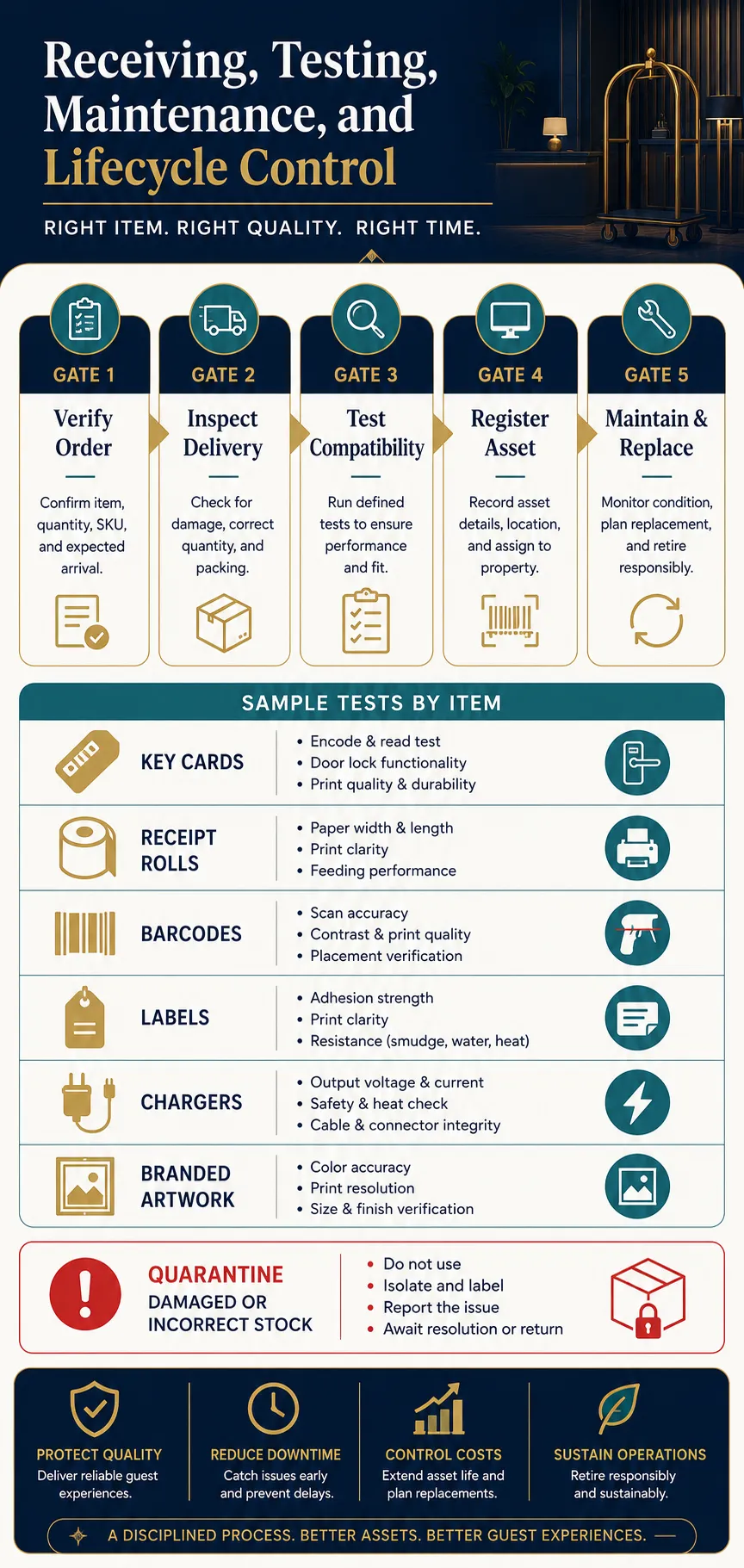
Front desk supplies should be inspected before they are accepted into inventory. Compare delivered quantities, item codes, dimensions, colors, artwork, lot information, and packaging against the purchase order.
Test a representative sample of compatibility-sensitive items. Encode and read sample key cards at different doors. Run receipt rolls through the installed printers. Scan printed barcodes. Confirm that labels adhere to their intended surface and remove without unexpected damage. Check that new charging cables work with approved devices.
Record shortages, defects, substitutions, and transit damage immediately. Do not distribute questionable items across multiple workstations before the issue is understood. Quarantining a defective batch is easier than recovering it from every department.
Fixed equipment should enter an asset register with its serial number, installation date, location, warranty, support details, maintenance requirements, and expected replacement horizon. Preventive care may include encoder cleaning, printer servicing, battery replacement, cart-wheel inspection, cable checks, software updates, and testing of emergency devices.
Change control is equally important. A new lock, payment terminal, brand design, telephone system, or property management platform can make existing supplies obsolete. Before approving a system change, identify all connected consumables, forms, accessories, training materials, spares, and emergency procedures that must also change.
Final Front Desk Stocking Checklist Before Opening or Replenishment
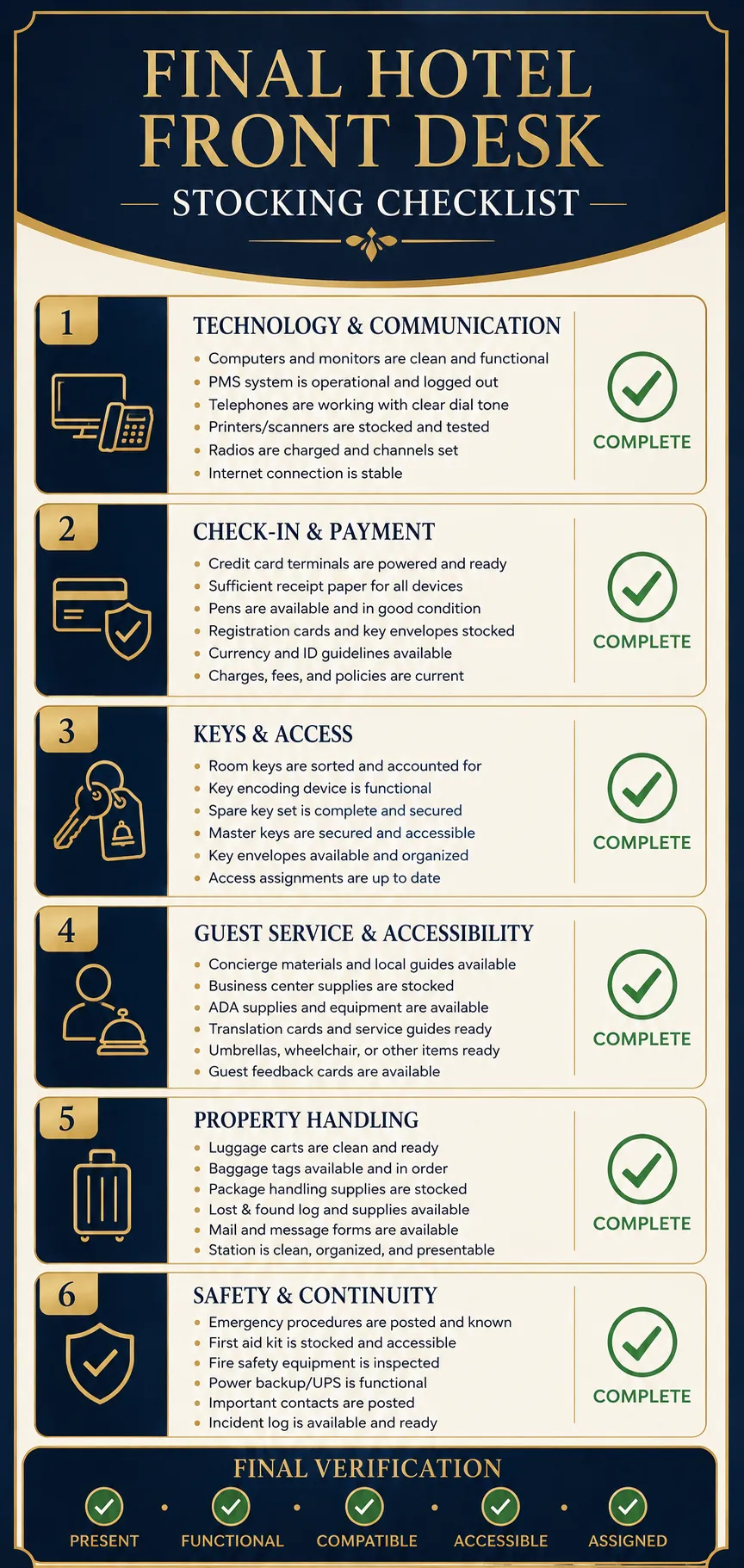
Before a new hotel opens—or before approving a major restocking order—review the front desk as a complete operating environment.
Technology and communications
- Workstations, monitors, privacy filters, phones, headsets, and chargers are installed.
- Printers, scanners, payment devices, and key encoders communicate with the required systems.
- Compatible toner, paper, labels, receipt rolls, cables, and cleaning supplies are stocked.
- Backup power and emergency communication equipment have been tested.
- Device models, serial numbers, warranties, and support contacts are documented.
Check-in, payment, and access
- Registration materials and guest-document workflows are approved.
- Payment terminals are secured and included in the inspection process.
- Cash drawers, deposit bags, and count forms match the property’s procedures.
- Key cards, sleeves, encoders, emergency credentials, and parking access materials are compatible.
- Blank cards and controlled credentials are stored securely.
- Identity verification and replacement-key procedures are available to staff.
Guest service and accessibility
- Essential toiletries and forgotten-item kits reflect the guest profile.
- Loaner chargers, adapters, umbrellas, and other reusable items are numbered.
- Issue, return, cleaning, and damage procedures are established.
- Accessible communication equipment is installed, charged, tested, and labeled.
- Staff know where accessibility kits and alternative-format materials are stored.
- Guest-facing signs and queue equipment preserve clear circulation and privacy.
Property handling
- Luggage carts fit the building and expected operating load.
- Numbered luggage and claim tags are available.
- Package, mail, and lost-property storage areas are secure and organized.
- Logs, labels, bags, shipping materials, and claimant-verification procedures are ready.
- High-value, perishable, hazardous, and sensitive items have defined handling rules.
Safety and business continuity
- First aid and emergency supplies match the approved safety plan.
- Flashlights, radios, batteries, panic devices, and emergency contacts are tested.
- Spill-response materials and portable warning signs are accessible.
- Downtime kits contain current forms, reports, instructions, and controlled backup materials.
- Employees have practiced manual arrival, key, payment, and reconciliation procedures.
Inventory and purchasing
- Every recurring item has an owner, storage location, unit of measure, and item code.
- Critical consumables have documented par levels and reorder points.
- Expiring and controlled items have defined count frequencies.
- Purchase specifications include compatibility and acceptance requirements.
- Secondary supply options have been tested where operationally necessary.
- Receiving staff know which products require sampling or functional testing.
- Obsolete, damaged, or superseded stock has been separated from usable inventory.
A checklist is complete only when each item is physically present, functional, compatible, accessible, and assigned to a documented process.
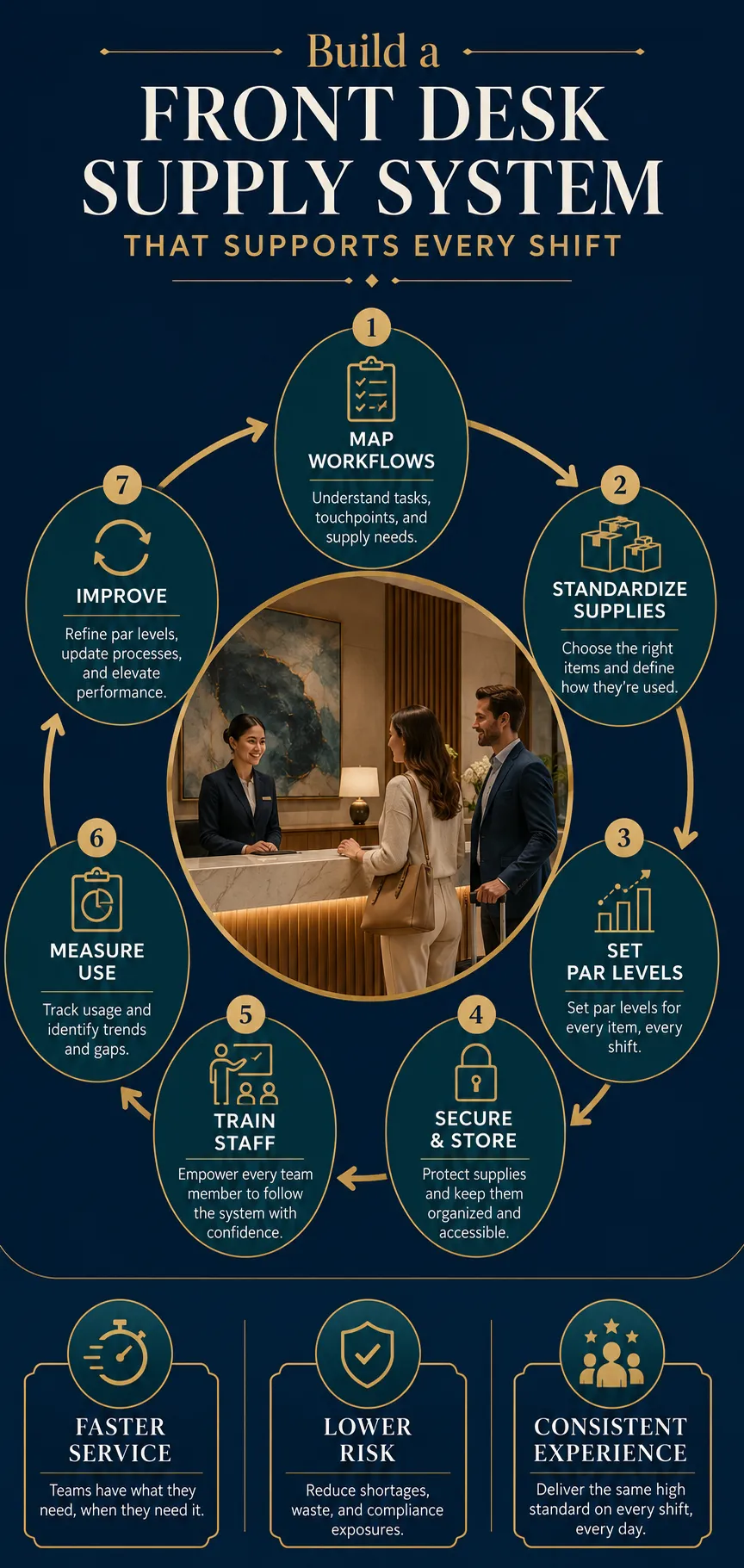
Build a Front Desk Supply System That Supports Every Guest and Every Shift
The most effective hotel front desk inventory is not necessarily the largest. It is the one that places the correct item in the correct location, protects sensitive materials, supports the property’s technology, and remains dependable during peak demand or disruption.
Begin with front desk workflows, then classify supplies by operational importance. Standardize specifications, calculate consumption-based par levels, secure controlled stock, test compatibility, and review usage regularly. Guest convenience items should reflect real requests, while equipment and emergency materials should be maintained rather than merely purchased.
When these elements work together, the front desk becomes faster, calmer, and more consistent. Employees spend less time searching for supplies or creating workarounds, and guests receive confident service from arrival through departure.
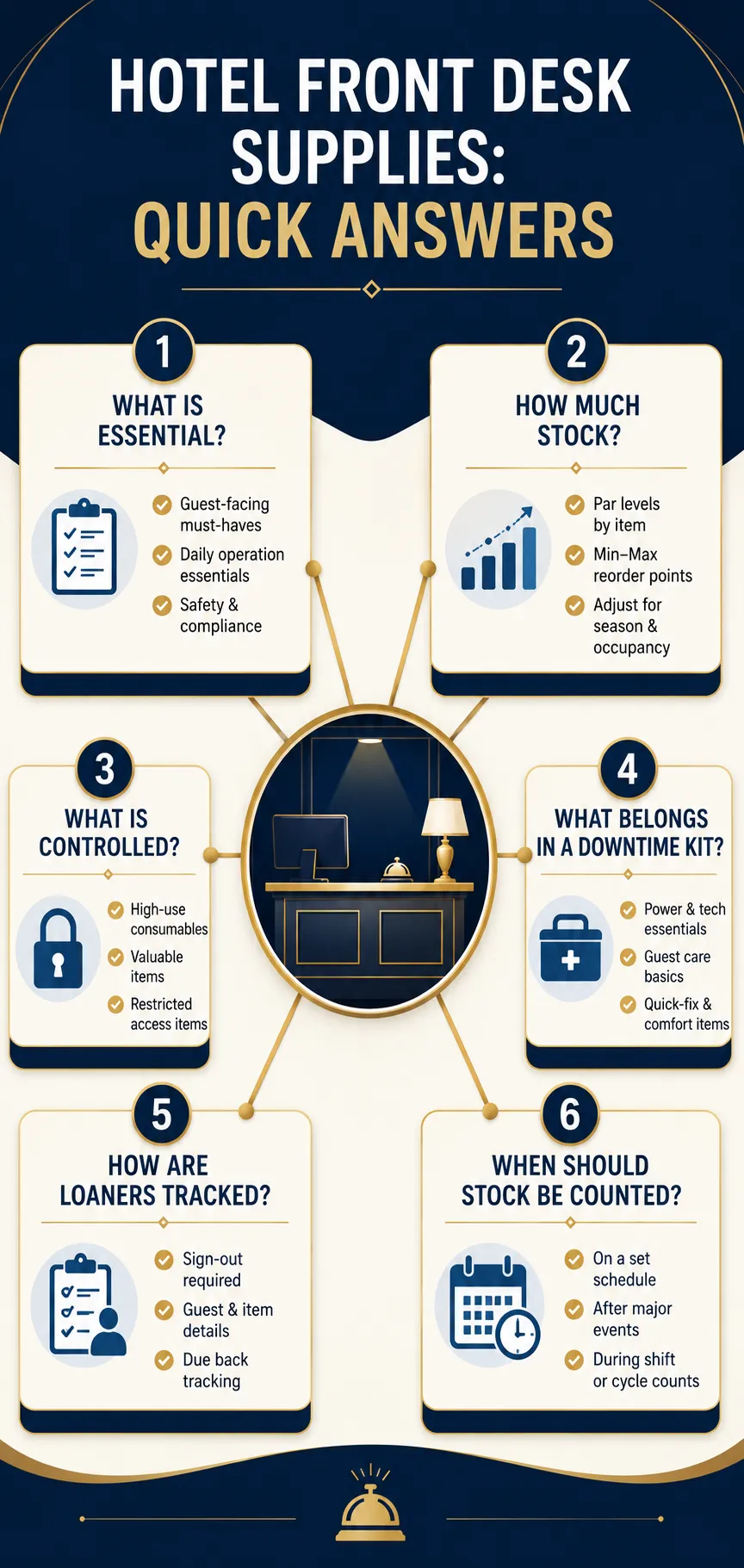
Frequently Asked Questions About Hotel Front Desk Supplies
What are the most essential hotel front desk supplies?
The most essential supplies include compatible key cards and sleeves, registration materials, payment equipment, receipt paper, printers, phones, computers, writing supplies, guest information, luggage tags, emergency communication tools, and a controlled downtime kit. The precise list depends on the hotel’s technology and services.
How much front desk inventory should a hotel keep?
Quantities should reflect average daily consumption, peak occupancy, supplier lead time, ordering frequency, product failure, and the operational impact of a shortage. Critical items generally need more safety stock than products that can be replaced temporarily.
How many key cards should a hotel order?
Estimate daily card consumption using occupancy, average cards issued per occupied room, group business, lost cards, failed encoding, and cards not returned. Multiply expected use by supplier lead time and add safety stock for demand spikes and delivery delays.
Should guest toiletries be stored at the front desk?
A limited shift-level supply can be kept in clean, discreet front desk storage for fast service. Bulk reserves normally belong in a secured storeroom. The front desk should restock from that reserve according to a defined par level.
Which items should be treated as controlled supplies?
Blank access media, mechanical keys, master credentials, cash-handling materials, deposit bags, visitor badges, sensitive forms, emergency keys, and documents containing guest information generally require tighter access and more frequent reconciliation.
What items should be available during a system outage?
Hotels should prepare manual registration forms, room-status information, arrival and in-house reports, key-issue logs, approved backup access credentials, calculators, receipt forms, flashlights, radios, emergency contacts, and instructions for restoring and reconciling transactions.
How should hotels manage guest loaner items?
Number every reusable item and record the room, guest, issue time, expected return, condition, and employee handling the transaction. Inspect, clean, test, and reset returned products before placing them back into available inventory.
What accessibility supplies should a hotel front desk stock?
Needs may include an accessible writing surface, large-print information, communication boards, assistive-listening equipment, visual notification devices, text-based communication options, and accessible-room equipment kits. Exact requirements must be checked against the property’s applicable regulations and facilities.
How often should front desk supplies be counted?
High-use consumables may need daily or weekly review. Controlled items may require reconciliation by shift. General stationery can often be counted monthly. Emergency supplies, batteries, and expiring products should follow a scheduled inspection program.
What is the difference between par stock and safety stock?
Par stock is the target quantity needed to operate through a defined replenishment cycle. Safety stock is the additional reserve held for unexpected demand, supplier delays, defective items, or other uncertainty.
Should every workstation have its own supplies?
Each active station should contain the items needed for routine service, but excessive duplication should be avoided. A useful model is to maintain small workstation pars, a larger front office reserve, and unopened bulk stock in central storage.
How can hotels reduce front desk supply waste?
Track actual consumption, standardize approved items, restrict uncontrolled withdrawals, rotate older stock, reduce unnecessary printing, repair reusable equipment, monitor guest-request patterns, and avoid excessive custom orders that may become obsolete after a brand or policy change.
What should be tested when front desk supplies arrive?
Test key-card compatibility, receipt-paper fit, printer and scanner performance, barcode readability, label adhesion, charging accessories, branded artwork, equipment dimensions, and any item that interfaces with an installed system.
Is the lowest-priced supplier usually the best option?
Not necessarily. Hotels should also evaluate delivery reliability, product compatibility, defect rates, minimum orders, warranty coverage, consumable costs, replacement speed, customer support, and the expected useful life of the product.
Who should manage front desk inventory?
One role should have primary accountability, such as the front office manager, assistant manager, or designated inventory coordinator. Individual category owners may support technology, payments, security, accessibility, guest amenities, and emergency supplies, but responsibility should never be ambiguous.