
Buying wholesale hotel supplies is not simply a larger version of retail shopping. A hotel order may combine dozens of categories, thousands of units, custom finishes, destination-specific requirements, phased deliveries, and replacement needs that continue long after opening. Before a purchase order is released, buyers must make the scope measurable, confirm that quotations are truly comparable, and decide how quality will be approved and protected through production and delivery.
The central risk is not always an obviously unreliable supplier. More often, problems begin with gaps between what the hotel assumes and what the supplier has actually priced. A quotation may exclude accessories, testing, export packing, freight, installation, spare parts, or even a finish shown in a reference image. A sample may look acceptable but remain disconnected from the written specification. A low minimum order may become expensive once mixed cartons, branding setup, inspections, and destination charges are included.
This guide explains the decisions buyers should settle before ordering wholesale hotel supplies. It covers the scope of supply, specification discipline, supplier capability, minimum order quantities, normalized pricing, total landed cost, sample approval, quality control, contracts, logistics, claims, and replenishment. The goal is not to prescribe one sourcing model for every category. It is to give owners, procurement managers, operators, designers, and project teams a repeatable way to identify missing assumptions before those assumptions become cost, delay, or operational disruption. It also separates product-specific verification from broad supplier claims, so decisions can be documented, audited, and handed over clearly to receiving and operating teams.

Wholesale Hotel Supplies Are a System, Not a Single Product List
Wholesale hotel supplies include far more than guest amenities bought by the case. The term can cover operating supplies and equipment, selected furniture and fixtures, commercial kitchen products, housekeeping tools, linens, tableware, front-office equipment, spa and pool items, branded packaging, replacement parts, and project-specific products. Each family has different buying logic. A stocked consumable may be selected around pack size and replenishment, while custom furniture depends on drawings, finishes, prototypes, production control, installation, and future repair. Treating all categories as one purchasing problem hides these differences and makes supplier comparisons unreliable.
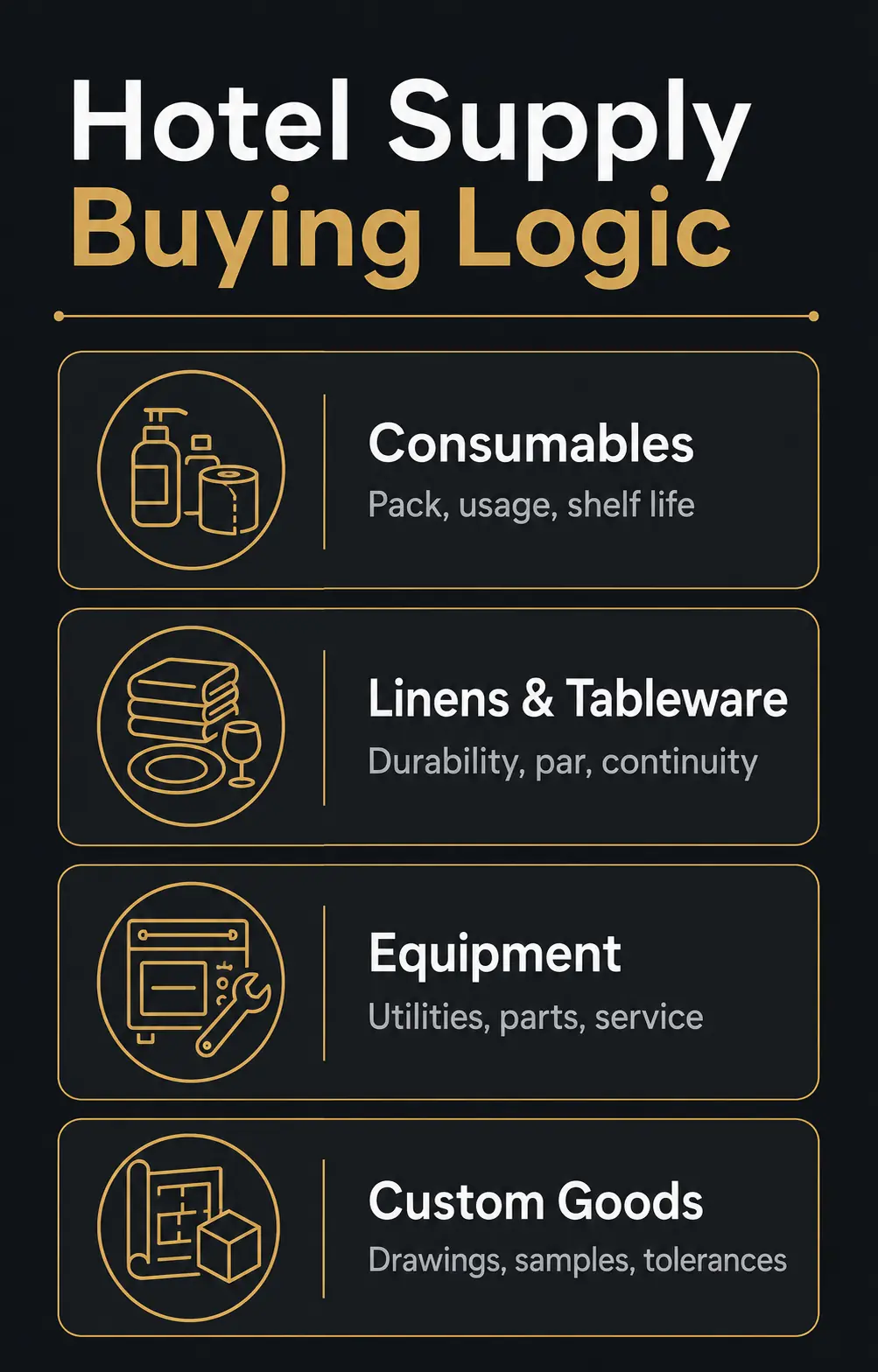
The KW Hospitality supplies directory can be used as a coverage check across departments, while the actual order schedule should remain specific to the property, room types, outlets, operating model, and delivery phases.
| Supply family | Typical buying logic | Main pre-order risk |
| Consumables and amenities | Pack size, consumption, shelf life, branding, replenishment | Overbuying, packaging mismatch, inconsistent repeat orders |
| Linens and tableware | Performance, wash or handling durability, par levels, replacement continuity | Unverified quality claims, unit-of-measure errors, dye-lot or pattern drift |
| Equipment | Capacity, utilities, accessories, commissioning, service and parts | Site incompatibility, missing accessories, unclear warranty support |
| Furniture and custom goods | Drawings, materials, finishes, prototypes, tolerances and installation | Approval ambiguity, production variation, damage in transit |
The distinction between FF&E and OS&E also affects budget ownership, procurement timing, approval routes, installation responsibility, asset tracking, and replacement planning. Buyers who need a deeper classification framework can review the article Hotel FF&E vs. OS&E: What Purchasing Managers Must Know. The key operational point is to assign every line item to a category, owner, delivery phase, and acceptance method before asking suppliers to quote.

Define the Order Before You Compare Suppliers
A wholesale quotation is only as reliable as the requirement behind it. Before contacting suppliers, create a controlled item schedule that identifies what is required, in what quantity, for which location, by what date, and against which acceptance criteria. This does not mean every product must be designed to the last detail. It means suppliers must know which requirements are mandatory, where approved equivalents are permitted, and which assumptions they must disclose. If one supplier prices a complete operating package and another prices only the visible product, the numbers are not competing offers; they are different scopes.
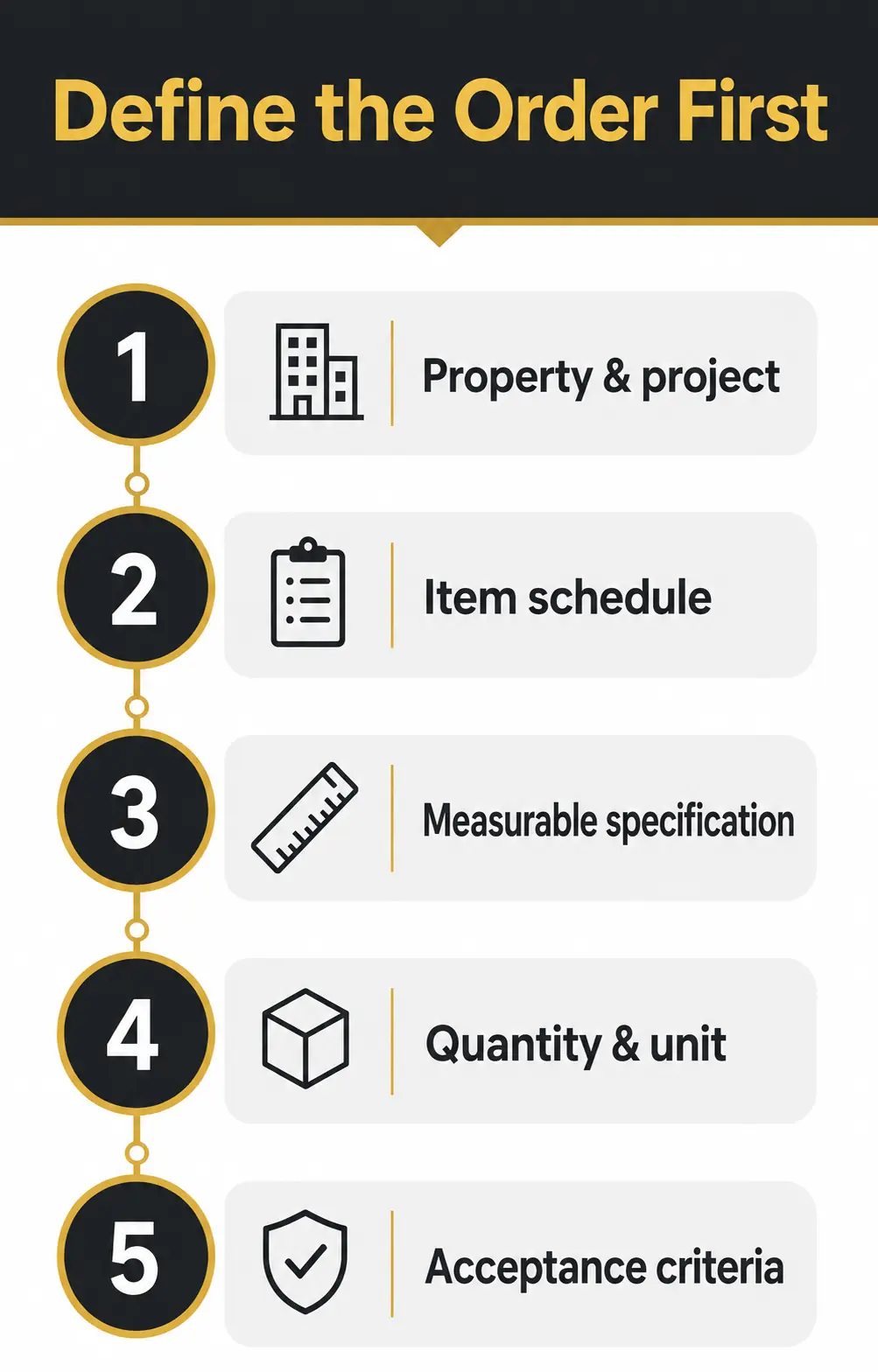
Start with the property and purchasing event
State whether the order supports a new opening, renovation, brand conversion, departmental replacement, emergency replenishment, or multi-property standardization. Include the property location, room count and mix, outlets, operating status, target opening or required-on-site date, storage limits, receiving conditions, and any phased installation plan. These details change quantities, packaging, lead time, shipment strategy, and the type of supplier that can serve the project.
Turn product names into verifiable specifications
Terms such as “commercial grade,” “luxury,” “heavy duty,” and “hotel quality” are not acceptance criteria. A usable specification defines the product’s function, material, construction, dimensions and tolerances, finish, performance, compatibility, accessories, labeling, packaging, required evidence, and reasons for rejection. For branded or custom goods, add artwork control, color references, logo position, proofing stages, tooling ownership, and rules for obsolete packaging.
Resolve quantities and units of measure
Show installed quantity, operating par, opening reserve, replacement stock, and future phases separately. Distinguish pieces, sets, cases, cartons, pallets, and supplier selling units. Ask suppliers to state units per case, order multiples, and MOQ at the SKU, color, size, finish, and total-order level. This prevents a quote for “500 units” from becoming 500 cases or a product mix from failing a per-color minimum after selection.
For a more detailed property-to-product selection process, use the wholesale hotel supplies selection framework as a companion guide. This article continues from that point and focuses on what must be locked before an order becomes binding.

Evaluate Suppliers on Capability, Evidence, and Risk
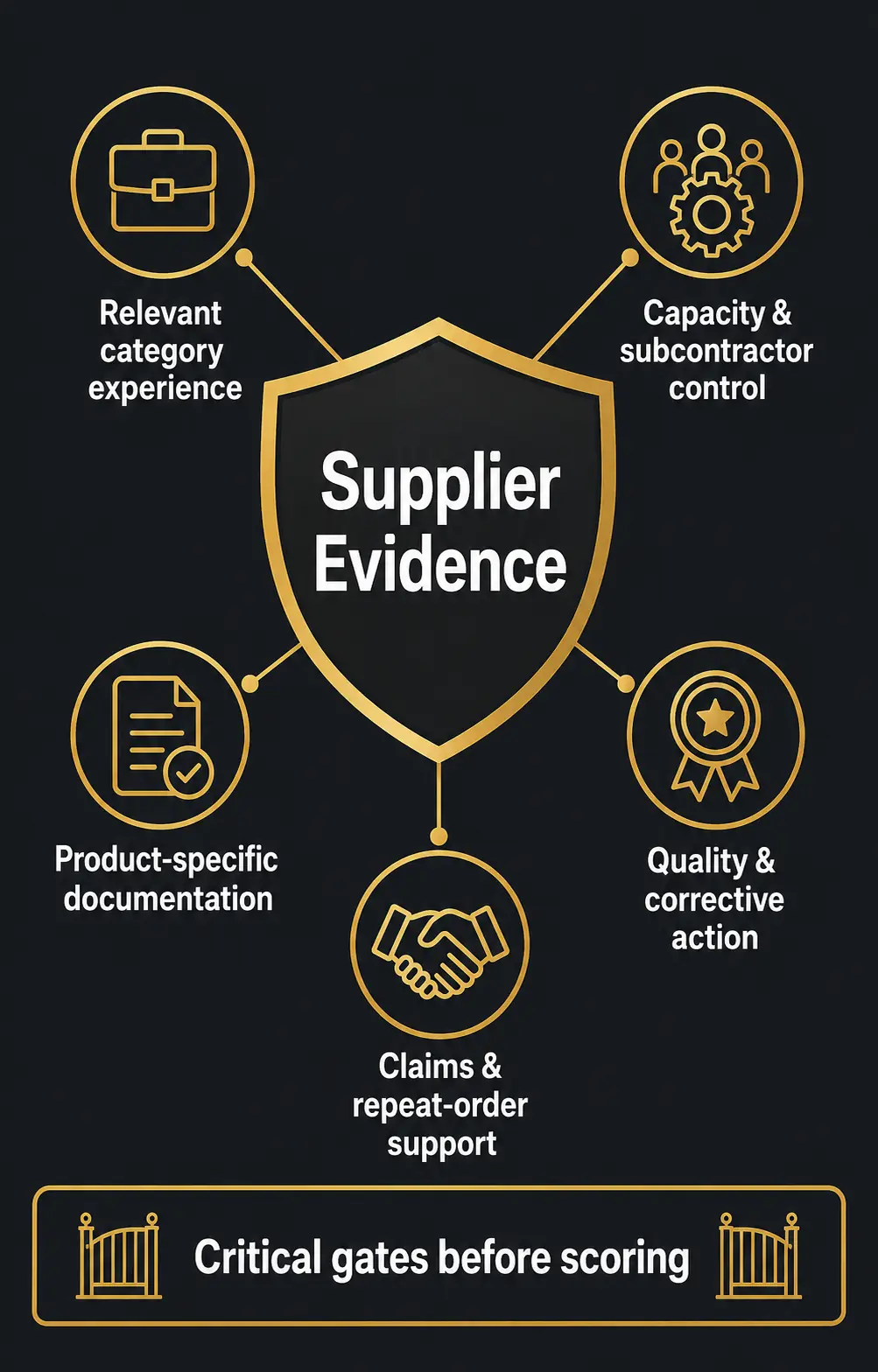
Supplier evaluation should answer a practical question: can this company repeatedly deliver the specified product, quantity, documentation, and timing for this destination? A polished catalog and a low quote do not establish category capability. Buyers should examine where the goods are made, which processes are controlled in-house, what is subcontracted, current production load, export experience, quality systems, communication discipline, and the supplier’s method for corrective action. Evidence should match the actual product and production site, not a related model, another factory, or an expired document.
Match the supplier model to the category
Direct manufacturers can be effective for stable specifications, customization, and scale, but they may require higher MOQs and more buyer-side coordination. Distributors can support mixed ready-stock orders and faster replenishment, but model continuity and substitutions require attention. Sourcing partners can coordinate multiple factories, samples, inspections, and consolidated shipments. Local specialists may be the safest choice when installation, code coordination, rapid service, commissioning, or stocked parts are essential. A hotel project can use more than one model; consolidation is useful only when it does not hide category weakness.
Request evidence that resolves the order’s actual risks
| Evidence area | What to verify |
| Relevant experience | Comparable products and projects with enough detail to establish category relevance |
| Capacity and control | Production location, current load, lead time, peak constraints and subcontractor control |
| Technical evidence | Product-specific data, tests, traceability and destination-market documentation |
| Quality process | Sample development, material and color control, inspection and corrective action |
| Continuity and support | Export packing, claims, warranty, replacement parts and repeat-order capability |
Use critical gates before weighted scoring
A weighted scorecard is useful for comparing qualified suppliers, but it should not allow price to compensate for an unresolved safety, compliance, capacity, sample, or delivery failure. Set non-negotiable gates first. Score only the suppliers that pass them. Record exceptions separately and require written clarification; an unanswered question should remain open rather than receiving an assumed favorable score.

Compare MOQ, Quote Structure, and Total Landed Cost
MOQ is not merely the smallest number shown on a price list. It may apply per SKU, color, size, finish, print design, carton, production run, shipment, or total order value. The commercial effect depends on how the MOQ compares with demand, storage capacity, cash flow, breakage, and replenishment. A lower MOQ can still be expensive if it requires premium production, inefficient freight, or repeated setup charges. A larger order can reduce unit price while increasing inventory risk. Buyers should therefore compare order structures, not isolated minimums or headline unit prices.
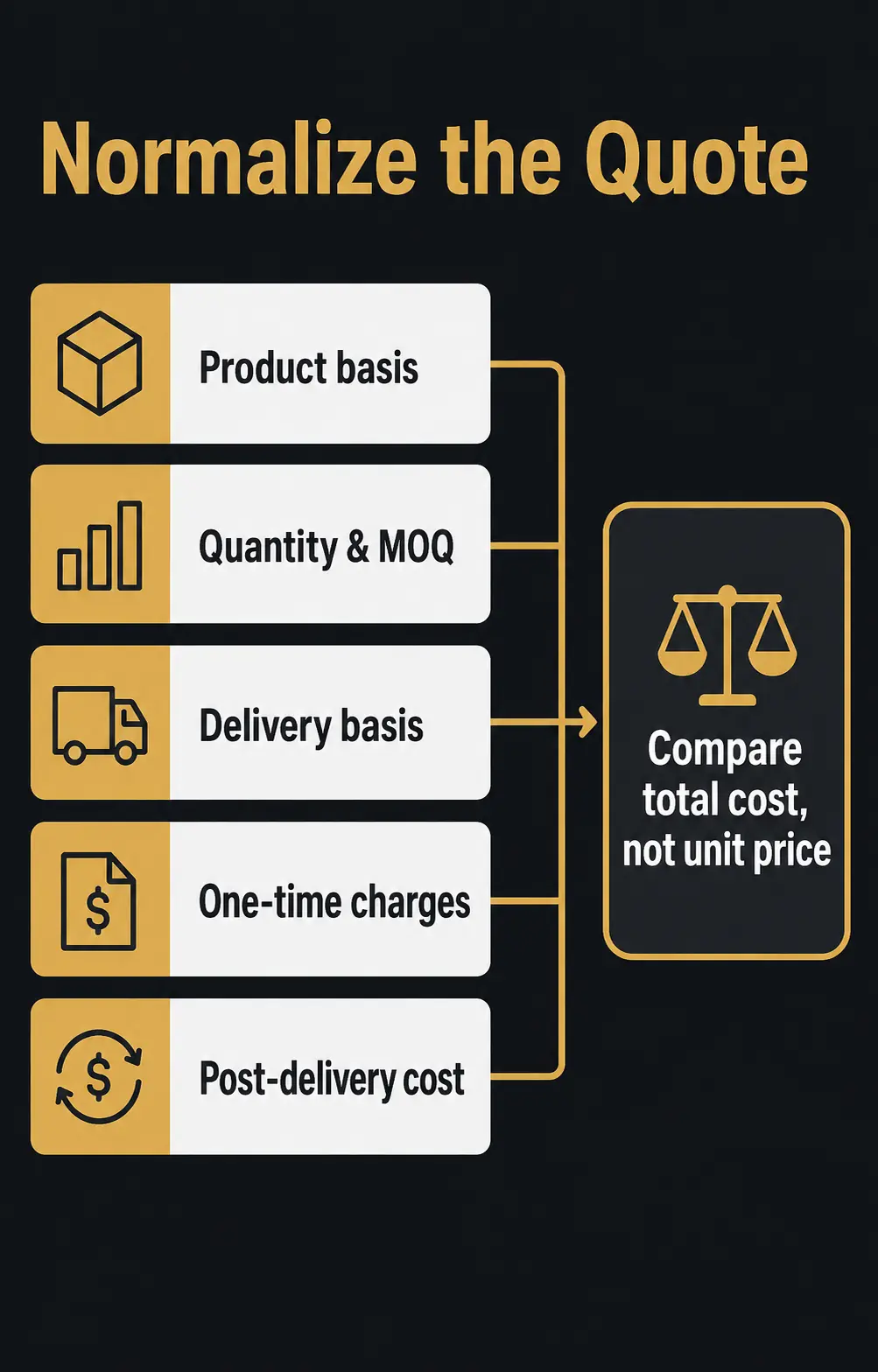
Normalize every quotation
Require the same currency, quantity bands, specification revision, pack configuration, delivery basis, named place, quote validity, and service scope. Separate one-time costs from recurring unit costs. List included and excluded work, including samples, tooling, artwork, testing, inspection, export packing, freight, insurance, duties, taxes, unloading, storage, installation, commissioning, training, and waste removal. When assumptions differ, adjust the comparison or return the quote for clarification before ranking it.
| Quote element | Normalize this | Why it matters |
| Product basis | Model, specification revision, material, finish, accessories | Prevents cheaper substitutions from appearing equivalent |
| Quantity basis | MOQ level, order multiple, pack size, quantity tier | Shows inventory exposure and the real unit basis |
| Delivery basis | Trade term, named place, freight, insurance, final delivery | Clarifies where cost and risk transfer |
| One-time charges | Tooling, molds, artwork, samples, testing, setup | Separates initial investment from repeat-order pricing |
| Post-delivery cost | Handling, installation, utilities, training, parts, maintenance | Reveals costs that begin after arrival |
Model landed cost and downside exposure
Total landed cost normally includes the product, required packaging, inspection, inland transport, export handling, main freight, insurance, import charges, customs processing, and delivery to the agreed point. Depending on the order, the operational decision should also consider storage, installation, consumables, energy or water use, maintenance, breakage, downtime, and early replacement. Avoid false precision: mark each figure as quoted, estimated, excluded, or buyer-supplied, and run a downside case for freight increases, delay, rejection, damage, or shorter service life.
Review payment terms as a control system
The payment schedule should reflect observable progress and retained leverage. Define the deposit, milestone payments, final balance, documents required for release, inspection conditions, currency, bank charges, refund or credit treatment, and what happens when production or delivery is late. Payment terms do not replace due diligence, inspection, or contract remedies. They should support those controls rather than requiring the buyer to pay almost everything before quality and shipping evidence are available.

Lock Quality, Contract, Production, and Delivery Controls
The final pre-order stage turns an acceptable proposal into a controlled commitment. Before the purchase order or contract is accepted, the buyer should be able to identify the governing specification, approved sample, quantity schedule, price basis, production milestones, inspection plan, packing standard, shipping documents, delivery responsibilities, warranty, and claims process. Verbal assurances and chat messages should be incorporated into the controlled order documents when they affect price, quality, timing, or responsibility. If the supplier’s quotation conflicts with the buyer’s specification, the conflict must be resolved explicitly rather than left to whichever document is convenient later.
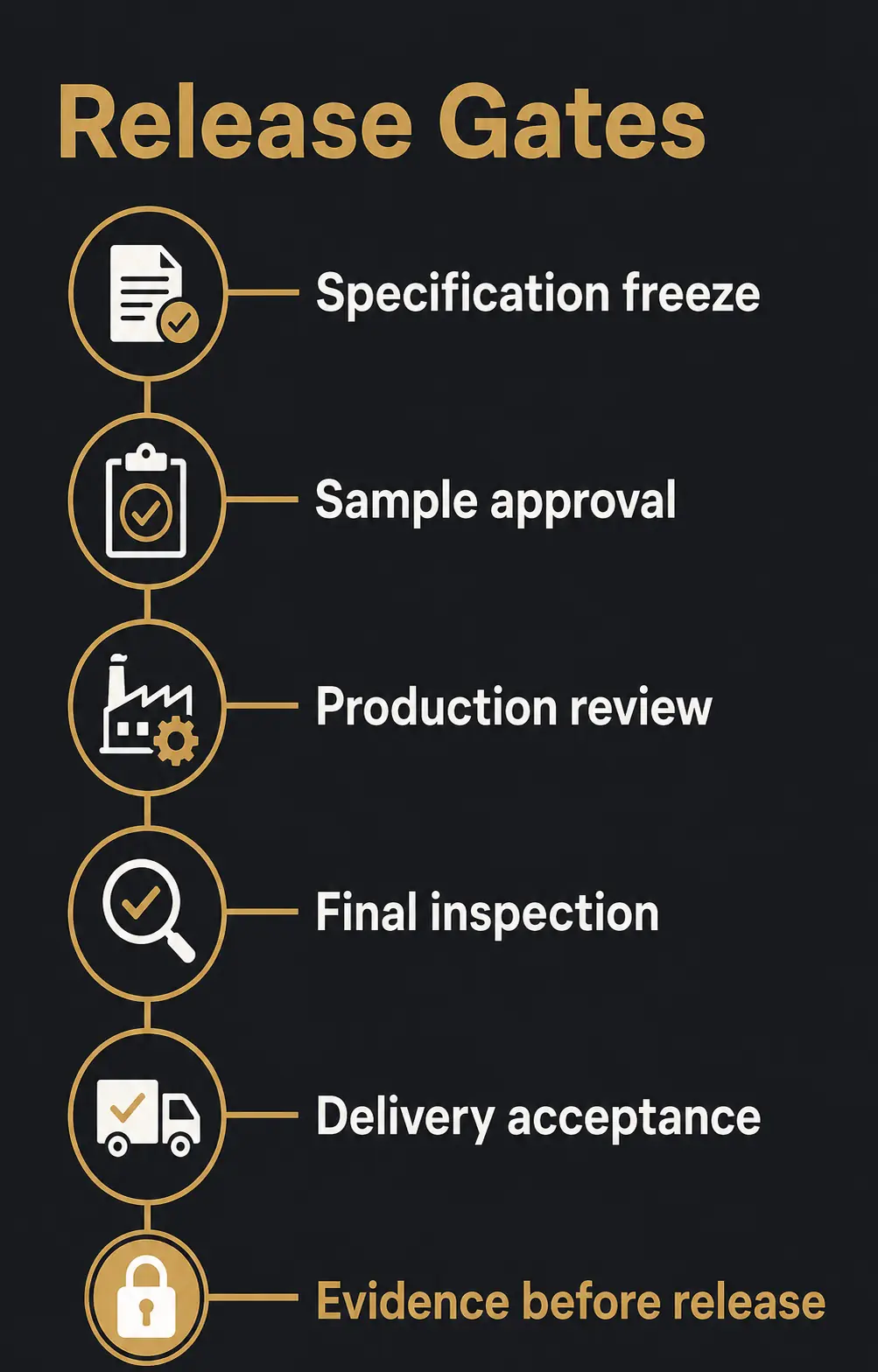
Treat sample approval as a production control
Give each sample a unique identifier and record the product revision, materials, dimensions, finish, measured performance, photographs, deviations, approvers, and conditions of approval. State whether the approved sample becomes the master control sample. Approval should not waive the written specification or permit unapproved material and process changes. For custom products, use staged approvals for drawings or artwork, material and finish references, prototype, corrected prototype, and preproduction sample as needed.
Define inspection and release gates
Choose inspection depth based on product criticality, order value, supplier history, process stability, and the consequence of failure. Preproduction checks can confirm materials and setup. In-process inspection can detect drift while correction remains practical. Final inspection can verify finished quantity, workmanship, function, assortment, labeling, packaging, and shipping marks. Define critical, major, and minor defects in product-specific language, supported by visual examples where useful. State who can authorize rework, reinspection, shipment, replacement, credit, or cancellation.
| Control gate | Evidence to hold | Release decision |
| Specification freeze | Controlled specification, drawings, quantities, exception log | Scope is complete and deviations are accepted in writing |
| Sample approval | Identified sample, measurements, photos, conditions | Production may start only against the approved revision |
| Production review | Material confirmation, schedule, in-process findings | Corrective action is closed before completion |
| Final inspection | Quantity, defects, function, labeling and packing results | Shipment is released, held, reworked or reinspected |
| Delivery acceptance | Packing list, damage record, count, claim notice | Goods are accepted, conditionally accepted or claimed |
Write the claims and after-sales path before shipment
Define inspection at receiving, the time allowed to report concealed damage, required photographs and records, responsibility for return freight, replacement or credit timing, and escalation contacts. For durable equipment, include commissioning, training, warranty start date, service coverage, consumables, spare parts, and discontinued-model handling. For repeat-purchase items, confirm future MOQ, lead time, pattern or color continuity, packaging changes, and how approved alternates will be controlled.
Build the RFQ and final order from one controlled baseline
The hotel supplies RFQ guide explains how to structure specifications, pricing schedules, capability questions, commercial terms, and submission rules. Once a preferred proposal is selected, carry every accepted clarification into the purchase order or contract rather than relying on the quotation alone.
For a new opening, renovation, replacement program, or multi-category order, buyers can submit a project-specific sourcing RFQ to KW Hospitality with the destination, quantities, specifications or reference images, target date, and any branding, sample, testing, packing, or delivery requirements. The RFQ is a request for pricing and supply information, not a final order commitment.

Conclusion
A wholesale hotel supplies order is ready to place when the buyer can explain exactly what is being purchased, how it will be judged, what every quoted cost includes, who carries each responsibility, and what evidence releases the next stage. The strongest protection comes from alignment: one controlled specification, one quantity basis, one commercial comparison, one approval record, and one set of order documents that incorporates accepted clarifications. When those elements agree, supplier selection becomes more defensible and downstream teams can receive, inspect, install, operate, and replenish the products with fewer surprises.
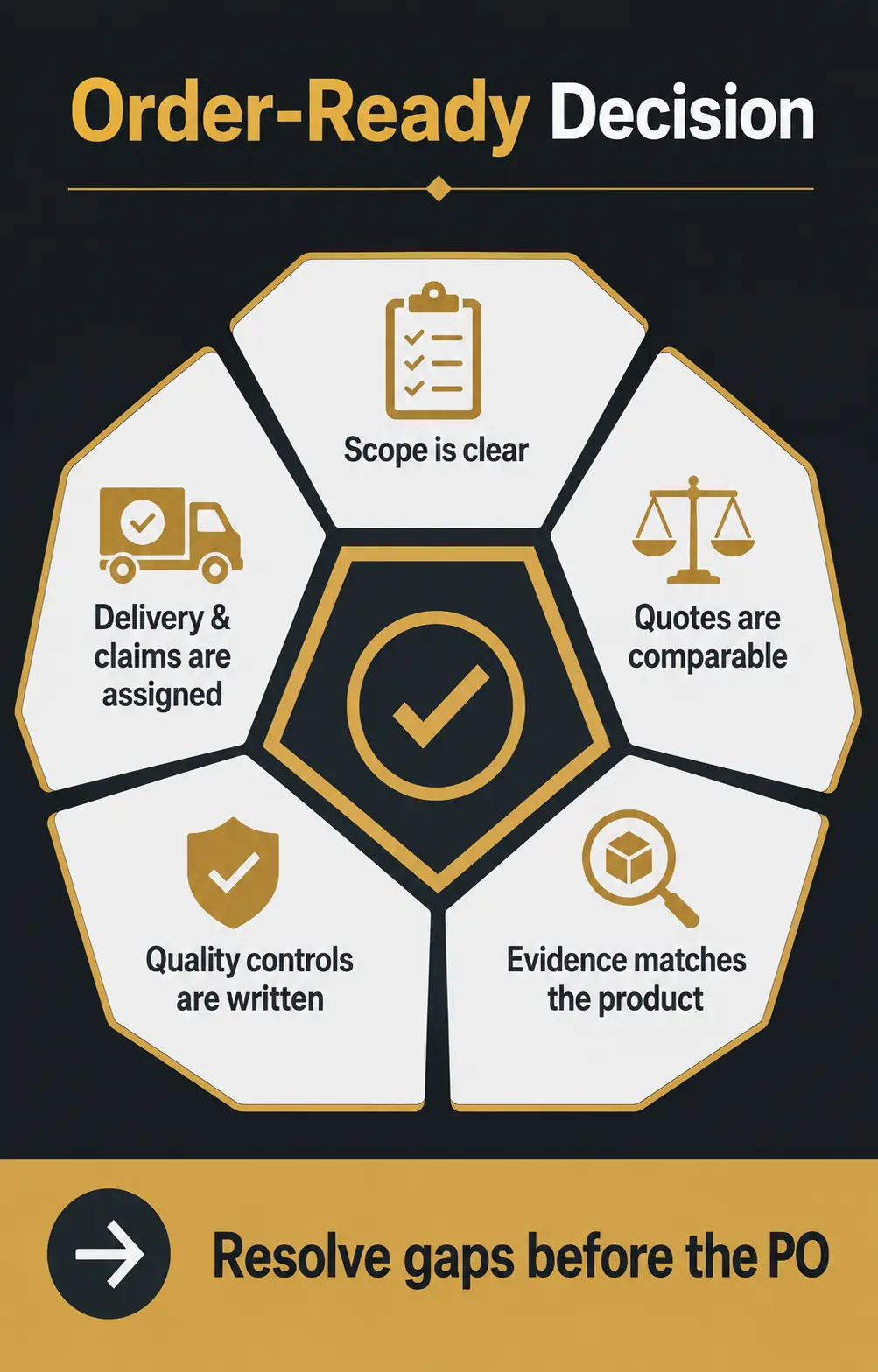
The lowest unit price is rarely enough to support that outcome. Buyers should assess the complete combination of specification fit, supplier capability, MOQ exposure, landed cost, quality controls, schedule realism, contract clarity, claims support, and repeat-order continuity. If a material assumption remains unwritten, a certificate does not match the ordered model, a sample cannot be traced to production, or a quote cannot be normalized, the order is not yet ready. Resolve the gap before commitment; correction is usually cheaper while the purchase order is still a draft.
Frequently Asked Questions
The questions below address common issues that buyers encounter after receiving an attractive wholesale quotation but before converting it into an order.
What is the difference between a wholesaler, a manufacturer, and a sourcing partner?
A wholesaler or distributor typically sells stocked or aggregated products, often supporting mixed orders and lower quantities. A manufacturer produces the goods and may offer deeper customization or production pricing, but may require higher MOQs and more direct buyer coordination. A sourcing partner can coordinate requirements, suppliers, samples, inspections, and shipments across categories. The best model depends on category complexity, order scale, destination, installation needs, and the buyer’s internal capacity.
Should a hotel always negotiate the lowest possible MOQ?
No. A lower MOQ can reduce inventory exposure, but it may increase unit price, setup cost, freight inefficiency, or variation between small production runs. Compare the supplier’s minimum with forecast demand, storage, cash flow, reorder lead time, order multiples, and the cost of a stockout. The objective is a workable order structure, not the smallest number in isolation.
Is an approved sample enough to protect product quality?
Not by itself. The sample should be identified, measured, photographed, linked to the written specification, and retained as a control reference when practical. The order should also define approved materials, tolerances, inspection stages, defect rules, change control, and remedies. A good sample can still be followed by inconsistent production if the control process is missing.
Which costs are commonly missing from wholesale hotel supply quotes?
Common omissions include samples, tooling, artwork, testing, inspection, special packaging, inland transport, freight, insurance, import charges, customs processing, unloading, storage, installation, commissioning, training, consumables, spare parts, and return or replacement freight. The exact list varies by product and destination, so buyers should require suppliers to state inclusions and exclusions explicitly.
When should a buyer refuse to release the purchase order?
Hold the order when a critical specification is ambiguous, the supplier has not disclosed exceptions, the quote cannot be compared on the same basis, required evidence does not match the product, the sample is unapproved, production capacity is unsupported, delivery timing is unrealistic, or quality and claims responsibilities remain unclear. These are not administrative details; they determine whether the delivered goods can be accepted and used.