
Evaluate bedding and bed linens by testing production-representative samples through the property’s actual care process, comparing their finish against an approved reference, and verifying how the same specification will be supplied again. A soft showroom sample, a high thread count, or a low opening-order price cannot establish all three. The purchasing decision should depend on what remains acceptable after use and what can be replenished without changing the guest experience.
For a hotel buyer, these are separate questions. Guest-contact durability means that the surface, seams, fit, and relevant closures remain suitable as guests use the product and staff process it. Finish consistency means that color, texture, sheen, dimensions, and presentation stay within agreed limits across pieces and deliveries. Replacement availability means that the supplier can explain the product identity, minimum reorder quantity, production route, timing, and substitution rules that apply to future purchases.
This guide focuses on sheets, pillowcases, duvet covers, blankets, mattress protectors, and washable bedding components. Filled products need additional checks for fill movement, loft, and drying behavior. Mattresses and foundations require their own structural and safety evaluation; linen test results do not qualify them. The method is intended for hospitality procurement teams working with housekeeping and laundry operations, including properties using an outside laundry service.
The practical objective is an evidence-based approval, not a universal ranking of cotton, blends, weaves, or suppliers. Establish the property’s requirements first, compare candidates under equivalent conditions, and make unresolved risks visible before committing to volume. The sections below explain how to assess durability, control finish differences, and distinguish a credible replenishment plan from an informal promise. They also show how to handle a product that performs well in one area but fails in another.

Evaluate Durability After Realistic Care and Guest Contact
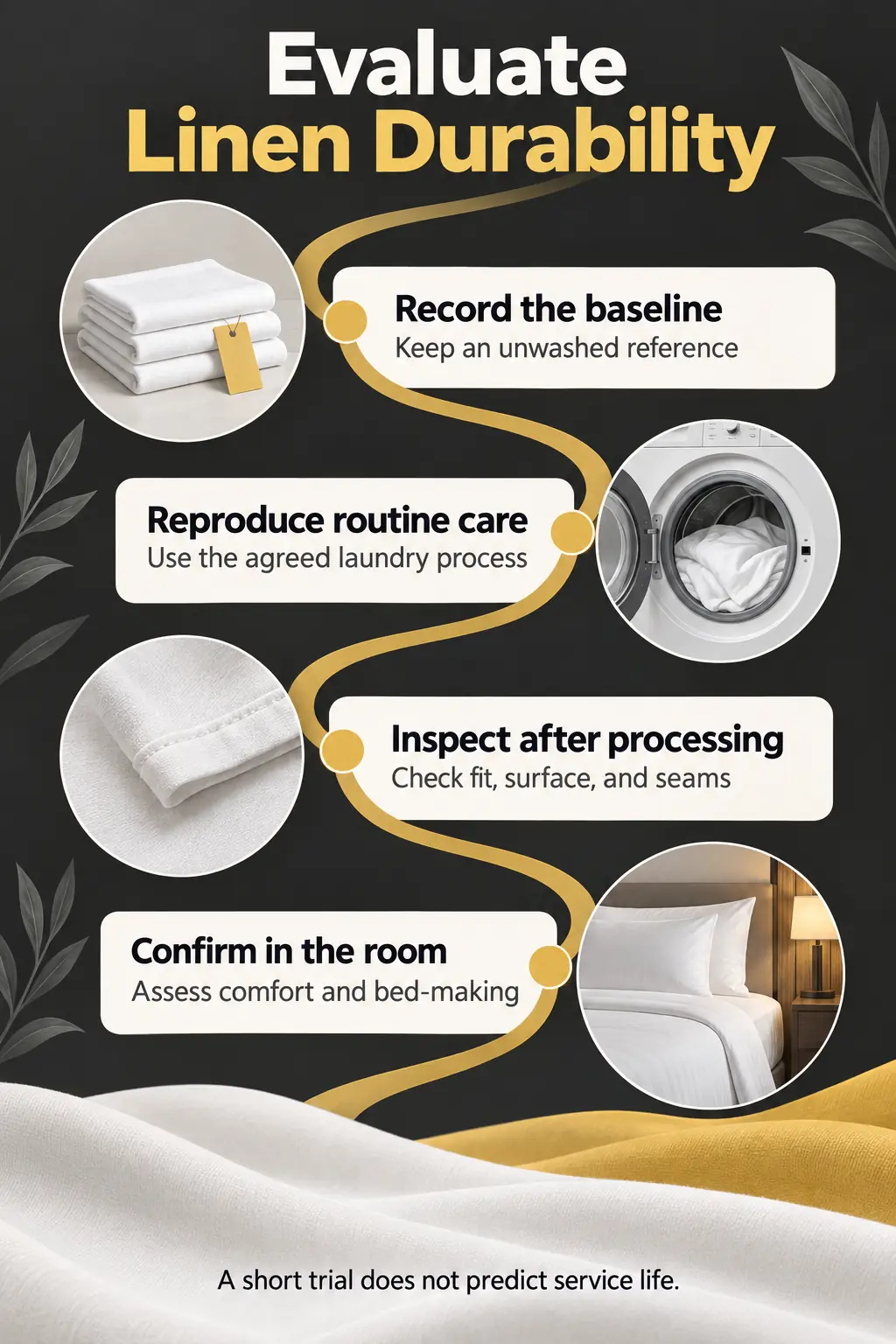
A durable hotel linen must remain comfortable, serviceable, and correctly fitted after the care process it will actually receive. Begin with the intended product and use: a pillowcase has different contact and handling demands from a duvet cover or mattress protector. Then combine a controlled laundry trial with an in-room evaluation and, where the purchase risk justifies it, appropriate laboratory testing. Record the starting condition before processing. Without that baseline, a buyer cannot reliably separate an initially undersized item from one that shrank, or an original seam defect from damage introduced during laundering.
Select samples that represent the order
Ask whether each sample comes from normal production, a development run, or a specially finished sales set. Record its specification revision, manufacturing lot if available, fiber composition, fabric construction, finished dimensions, seam details, and care instructions. Keep an unprocessed reference separate from the trial pieces. Test multiple units and the relevant sizes; one attractive sample does not demonstrate consistency across a shipment.
Set the sample quantity and evaluation effort to reflect order size, product complexity, supplier history, and consequences of failure. A small pilot is useful for finding obvious problems but cannot prove a rare-defect rate. For a large program, have the quality team define a sampling plan and escalation rules before selection. Include both an established in-service product and the proposed alternative when a fair comparison is possible.
Reproduce the care process before judging the result
Have the laundry team document wash chemistry, temperature, load conditions, extraction, drying, and finishing. Use the supplier’s care limits and confirm compatibility with the property’s intended process before testing. An attractive result from a gentler sample wash is not evidence that a product will survive the hotel’s routine. Conversely, damage caused by processing outside agreed limits does not by itself prove a manufacturing defect.
Set review points before starting. An illustrative screening trial might inspect pieces before washing and after 1, 5, and 10 cycles, followed by a longer pilot if the candidate remains promising. These numbers are a proposed workflow, not a universal qualification standard or a prediction of service life. Record the process at every review point and avoid changing chemistry midway through a comparison without treating that change as a separate trial.
Measure fit, surface condition, and construction separately
Measure length and width between repeatable reference points under consistent conditions, without stretching the fabric. For a simple purchasing calculation, dimensional change equals 100 multiplied by the difference between final and original dimension, divided by the original dimension. A negative result indicates contraction. Assess length and width independently; a single average can hide an unacceptable change in one direction.
For example, a sheet measured at 110 inches before processing and 106.7 inches afterward has changed by -3%. That is arithmetic, not an acceptance threshold. Approval depends on whether the processed sheet still provides the required coverage and tuck on the actual mattress, topper, and protector assembly. Evaluate fitted-sheet pocket depth and corner retention on the dressed bed rather than relying only on a nominal mattress size.
Inspect pilling, fuzz, roughness, thinning, snags, seam opening, hem distortion, and closure performance as distinct failure modes. Invite housekeeping to make and strip the bed using normal technique. For duvet covers, assess insertion effort and the security of the intended closure. For filled bedding, examine fill distribution and whether the approved drying process leaves the whole item ready for storage. Assess a protector’s claimed barrier performance separately; a pleasant surface cannot establish that function.
Use laboratory results within their limits
Ask a qualified textile laboratory to select tests appropriate to the material and intended failure mode. Fabric breaking strength, tear behavior, seam performance, abrasion, and pilling answer different questions. A good result on one cannot be treated as proof of all the others. Compare candidates using the same method, specimen preparation, conditioning, and reporting units; results from different procedures may not be interchangeable.
Treat accelerated results as comparative evidence alongside the operational trial. A pilling grade or abrasion count does not directly translate into occupied room nights. Set written acceptance limits before seeing the results, using the property’s demonstrated needs and a suitable reference product. Keep failures outside a weighted score: a sheet that no longer fits cannot become acceptable simply because its color and price scored well.
Control Finish Consistency Across Pieces and Production Lots
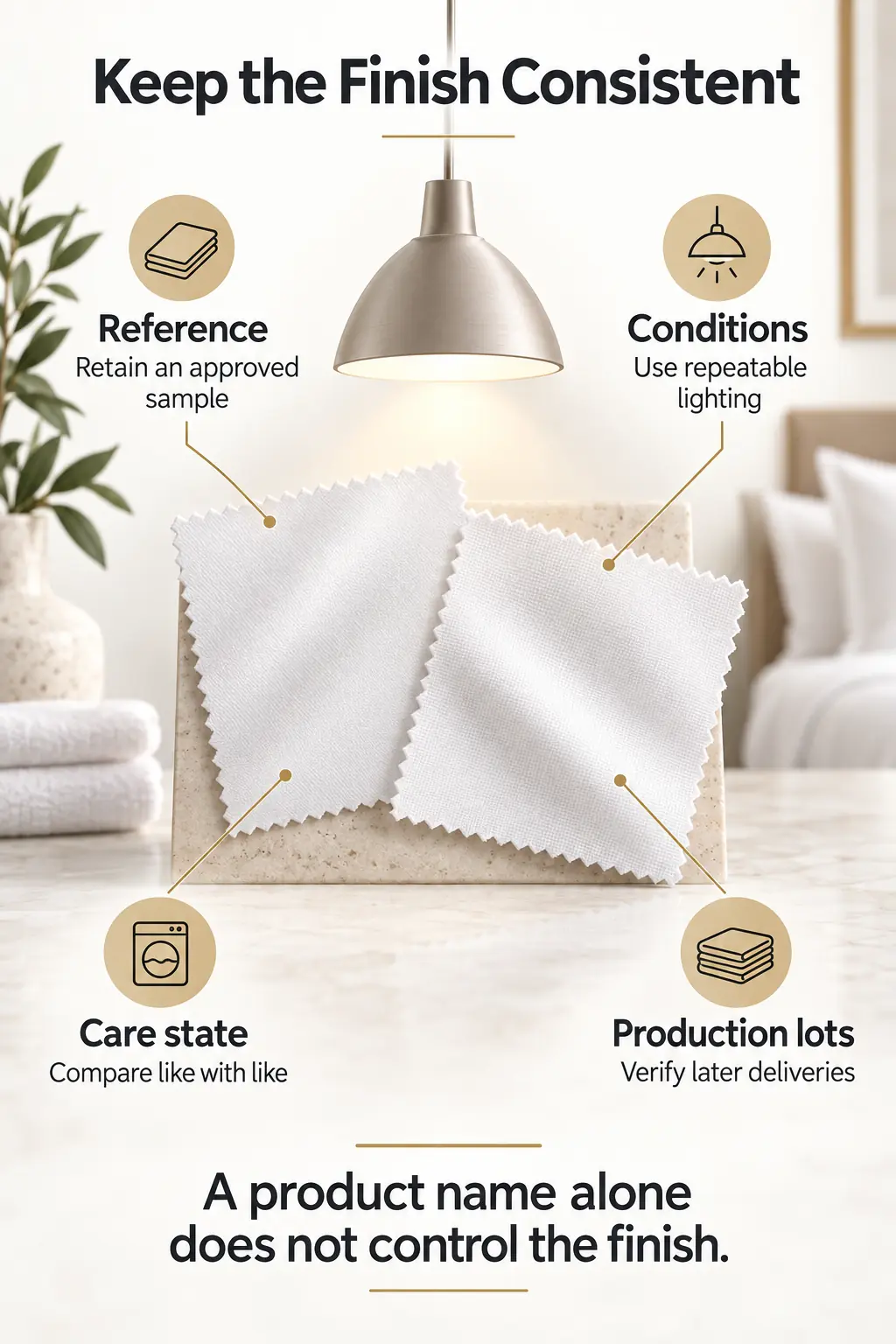
Finish consistency requires an agreed reference and repeatable viewing conditions. The word white is not a complete color specification, and descriptions such as crisp, silky, or hotel quality leave too much room for interpretation. Define which characteristics guests and staff need to remain consistent: shade, sheen, surface feel, weave appearance, seam presentation, dimensions, and fit. Compare new items with the approved new reference, then compare processed items with a reference processed in the same way. Using a new sample to judge a heavily used item mixes production variation with changes caused by service.
Keep a physical reference and a controlled specification
Retain an approved reference sample with its revision and approval date. Describe the construction and finish in writing so the reference does not become the only record. Specify what may vary, the method used to judge variation, and the person authorized to approve exceptions. Store reference pieces so light, handling, and contamination do not silently change the benchmark; replace a deteriorating reference through a documented approval.
For visual comparisons, place the reference and candidate side by side, with the same orientation and number of fabric layers. Use a repeatable evaluation light and also check the actual guest-room lighting. A match under one light may appear different under another. Photographs help document a concern but are not a reliable sole basis for shade approval because exposure, white balance, and displays can alter the apparent result.
If an instrumental color tolerance is necessary, agree with the laboratory and supplier on the measurement method, settings, sample preparation, and pass limit. There is no single color-difference number that should be applied to every bedding program without context. A visible mismatch between pillowcases and a duvet cover may matter more to a property than a small variation between pieces that never appear together.
Distinguish a finish problem from a processing problem
When a candidate changes, compare its pattern of change with the control product and with pieces from other loads. The following diagnostic matrix identifies useful next comparisons. It does not assign a cause without evidence.
| Observation | Plausible explanation | Comparison that helps distinguish it |
| One delivery looks different before washing | Production-lot or finishing variation | Compare several unused pieces from that delivery with the approved new reference |
| Several products change in the same laundry load | Shared processing or water-related effect | Compare control and candidate pieces processed together, then investigate the recorded process |
| A single construction becomes rough after care | Material, finish, or process-compatibility issue | Repeat the agreed process with matching controls and inspect the surface independently |
| Pieces match in the inspection area but differ in rooms | Lighting-dependent appearance | View the same paired specimens under both lighting conditions |
| The cover twists while flat dimensions remain acceptable | Construction or directional distortion | Examine seam alignment and fit on the intended insert after equivalent processing |
Do not respond to every yellowing, graying, or feel change by immediately rejecting the fiber choice. First establish whether the change is product-specific, load-specific, or present in the reference as well. Ask the supplier and laundry operator to investigate the same recorded evidence. Avoid using an unapproved chemical treatment to make a trial sample look better than it will look in routine service.
Confirm consistency beyond the first sample
Request evidence from another production lot when available and inspect the bulk delivery against the same reference. If only one lot has been evaluated, state that limitation in the approval record. Do not describe cross-lot consistency as proven. Check paired components together on a made bed, particularly when sheets, pillowcases, and duvet covers come from different sources.
Translate acceptance into a controlled purchase specification. Identify the approved construction and appearance, the permitted tolerances, the receiving inspection approach, and the required response to a deviation. A later change to the yarn, weave, mill, finishing route, or construction should trigger review of the affected properties. Keeping the same product name is not enough to establish that the supplied article is unchanged.

Verify Replacement Availability Before Awarding the Order
Replacement availability is the ability to obtain an acceptable, compatible product in the quantities and time frames the property will need. Current stock is only one part of that question. A supplier may hold enough pieces for an opening order while offering no workable route for small reorders, or may continue a product name after changing its construction. Before award, connect the approved sample to a stable specification, define the reorder terms, and identify what happens when the original product is delayed, changed, or discontinued. Treat every promised lead time as a commercial commitment that needs clear boundaries.
Separate product identity from stock availability
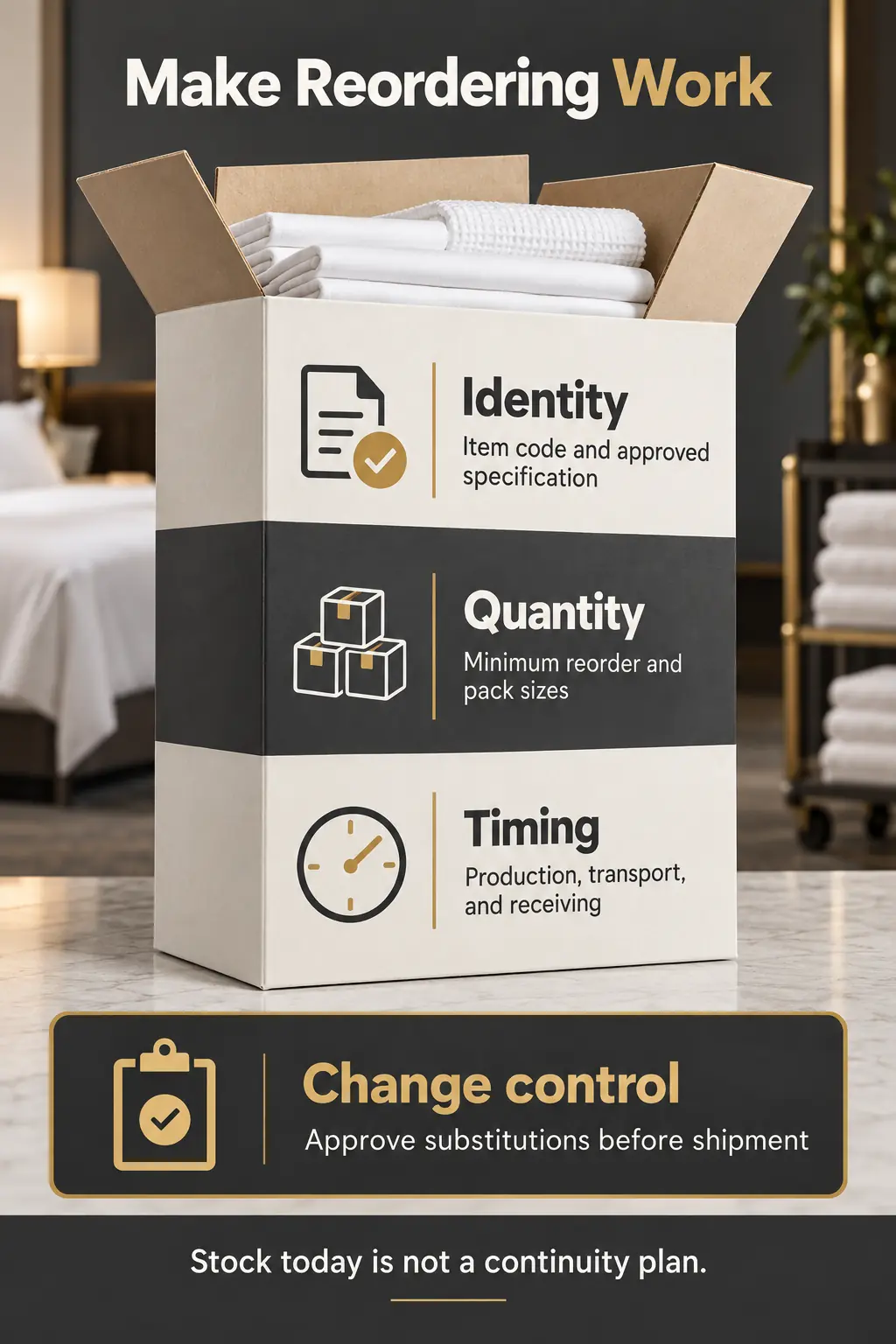
Record the supplier’s item identifier together with the specification revision, size, color or finish reference, and relevant component details. For coordinated bedding, list the identities of the individual pieces instead of assuming that a collection name controls every component. Ask who controls the underlying specification and whether repeat orders use the same production route.
Distinguish stock on hand, stock allocated to the property, replenishable standard production, and a special production commitment. These are different levels of availability. Request the minimum reorder quantity by item and size, pack quantities, reorder pricing basis, order acceptance conditions, and discontinuation notice terms. Confirm whether a low-volume reorder would require a new dye or finish lot and whether an approval sample would be available before shipment.
Define the complete reorder timeline
Break a quoted lead time into the events that affect usable stock: order confirmation, sample or material approval when needed, manufacturing, inspection, transport, import handling where applicable, and receiving. Clarify which stages the supplier’s number includes and what starts the clock. A production lead time should not be presented internally as a guaranteed arrival date.
Use the property’s own consumption and retirement history to assess whether the replenishment route is workable. For illustration, if a particular pillowcase item is being retired at an average of 12 pieces per week and usable replenishment takes eight weeks, expected replacement demand during that interval is 96 pieces before a variability allowance. This example excludes opening quantities, laundry circulation, occupancy growth, and unusual loss events; it is a continuity test, not a complete linen inventory model.
If the minimum reorder is far larger than plausible use, compare the storage and obsolescence implications with alternative sourcing arrangements. If demand varies sharply, the average alone is inadequate. Review busy periods, longer-than-usual deliveries, and correlated losses, such as an entire lot becoming unacceptable together. A replenishment promise is valuable only when the property’s stock policy can bridge the realistic interval.
Approve substitutions before an emergency
Create a defined route for proposed changes: the supplier identifies the differences, provides representative samples and relevant evidence, and waits for written acceptance. Agree on a suitable commercial remedy for an unapproved deviation before ordering. Do not assume that a warranty, a credit, or the ability to buy a different product solves a shortage in operationally usable linen.
A backup item should go through fit, care, and appearance review. If it cannot mix acceptably with the primary product on the same bed, decide whether it can serve a separate room group or whether coordinated components must be changed together. A second supplier using the same underlying production source may not provide the independence the purchasing team expects. Ask about that dependence without assuming that a distributor controls the mill.
For a custom weave, unusual size, or distinctive stripe, assess the continuity trade-off explicitly. A standard item may be easier to reorder, but that is a proposition to verify, not a reason to waive sample evaluation. Keep dated reorder confirmations and review availability when demand, ownership, production arrangements, or discontinuation status changes.
Conclusion
Approve bedding and bed linens only when durability, finish consistency, and replenishment arrangements each meet the property’s requirements. Use samples that represent the proposed order, judge them after realistic care, and carry the approved specification into purchasing and receiving. Document uncertainty when a trial is short or another lot has not been examined. The goal is a repeatable decision that housekeeping, laundry, procurement, and the supplier can interpret the same way. A strong opening presentation matters, but an acceptable product must also remain usable and support the next order without an uncontrolled change in the guest experience.
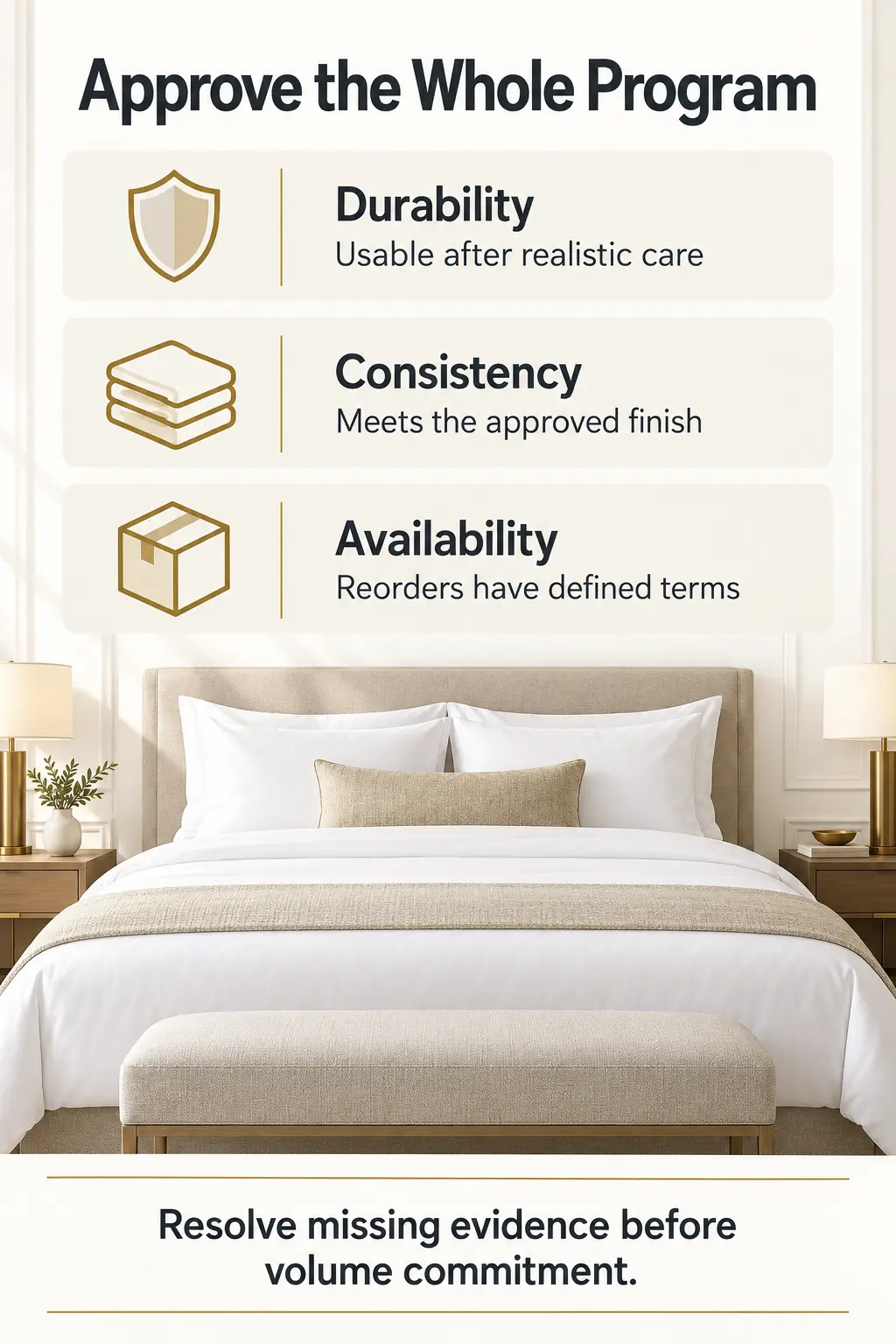
Use this decision matrix to determine the next purchasing action. The states are operational recommendations, not an industry certification or a substitute for the property’s required approvals.
| Evidence state | Appropriate purchasing action |
| Care trial, fit, finish comparison, and reorder terms meet agreed requirements | Approve the defined specification, with receiving verification and change control |
| The sample performs well, but cross-lot evidence or replenishment terms remain unresolved | Limit approval to a defined pilot or resolve the missing evidence before volume commitment |
| A required function fails, or an unapproved substitution is proposed | Hold the affected item and require correction or qualification of an alternative |
For a sourcing discussion with KW Hospitality, prepare the product identities, processed dimensions, sample findings, appearance reference, order quantities, and required delivery window. Ask for confirmation of sample options and repeat-order terms against those requirements. This gives the discussion a concrete basis without treating an initial quotation as proof of durability or future availability.
Frequently Asked Questions
Does a higher thread count mean a sheet will last longer?
No. Thread count describes one part of a fabric’s construction; it does not establish seam performance, dimensional stability, surface feel after care, or resistance to the property’s processing conditions. Compare fully specified products and trial results rather than treating the number as a durability guarantee. A supplier should be able to explain the construction behind the description.
Can a residential wash test qualify linen for a commercial laundry?
It can provide limited comparative information, but it cannot by itself qualify a different commercial process. Detergents, loading, mechanical action, extraction, drying, and finishing may differ. Ask what the test actually used, then evaluate the intended operational process within the product’s approved care limits. Report any remaining gap between laboratory conditions and property use.
What if only one production lot is available before opening?
You can evaluate that lot and make a bounded decision, but cross-lot consistency remains unverified. Record the limit, retain approved samples, and require review of the next lot before treating future deliveries as interchangeable. If opening dates require a commitment, define who accepts that risk and what evidence will be required at receiving.
Should new replacement pieces match heavily used stock exactly?
They should meet the approved new-product requirements and work acceptably in the intended room presentation. Exact visual matching to heavily used stock may be unrealistic. Compare equivalent care states, assess a mixed bed in room lighting, and decide whether coordinated groups need replacement. Do not lower the new-product specification merely to match an aged item.
Can a warranty replace a replenishment agreement?
No. A warranty addresses specified remedies under its terms; replenishment arrangements address access to compatible items when they are needed. A credit may resolve a commercial claim while leaving the property without usable stock. Review both the remedy and the practical replacement route, including quantities, timing, and whether the replacement must match the approved specification.