
A new hotel needs supplies for guestrooms, bathrooms, housekeeping, laundry, food service, reception, maintenance, and the services it will actually offer at opening. The useful starting point is a room and department inventory: identify what must be installed, what will circulate through cleaning, what guests will consume, and what the team needs to keep operating. Then calculate quantities, approve samples, and schedule delivery against the date each area must be ready.
A purchase list becomes reliable when each line answers five questions: what exactly is required, how many usable units are needed, who approves it, when it must reach the property, and how the team will accept it. Without those decisions, a low quotation can hide missing accessories, incompatible replacements, or a delivery that arrives after staff training. A beautiful sample also tells you little about whether the product fits the finished room or survives the intended cleaning process.
This guide is for owners, operators, and purchasing teams planning a new hotel in Canada or the United States. It covers operating supplies and the furniture and equipment interfaces that affect those purchases. The checklist is a starting inventory to adapt to your room types, service model, brand requirements, and location. It is not a construction specification, a complete life-safety schedule, or a substitute for project approvals.
Use it in sequence: define the opening scope, build the department list, calculate stock by the correct demand driver, compare complete offers, and verify readiness before releasing rooms. A small hotel with outsourced laundry and no restaurant will need a different plan from a resort with banquets, pools, and an on-site laundry. The worked examples below use stated assumptions so you can replace them with your own figures. They are planning illustrations, not price benchmarks or reported KW Hospitality project results.

Define the Opening Scope and Purchase Priorities
Start with the rooms and services that will be available on the first operating day. Record the number of each room type, the beds in each room, accessible-room requirements, restaurant and meeting capacity, laundry arrangements, and any phased opening. This converts an ambitious shopping list into a defined purchasing scope. Assign each category to a responsible person and identify the decision that must happen before it can be ordered. A bed linen order, for example, depends on the mattress specification and bed-making standard; a bathroom dispenser order depends on the selected system and the finished mounting surface.

Separate the purchase groups and their owners
Furniture, fixtures, and equipment (FF&E) typically include durable assets such as beds, casegoods, and lighting. Operating supplies and equipment (OS&E) typically include items used to run the property, such as linens, tableware, and housekeeping equipment. The boundary varies by project and accounting policy. What matters for purchasing is that every item has one owner, one budget line, and a clear installation or setup responsibility.
Create one approved schedule rather than separate lists that silently overlap. Record an item identifier, department, room type, specification, unit of measure, required quantity, supplier, approver, and required-on-site date. Add the contractor or operating-team owner where the item touches building work. This prevents a bathroom accessory being ordered twice or a mounting kit being omitted by both teams.
Prioritize by the consequence of delay
Treat an item as opening-critical when its absence prevents a promised service, safe use, or an approved area from opening. A compatible room lock, usable linen stock, and functioning cleaning equipment can be critical even when their purchase values differ greatly. Order priority should also reflect customization, sample approval, installation dependencies, and the difficulty of obtaining replacements.
Place optional enhancements in a separate release phase. Decorative accessories, expanded minibar assortments, or extra banquet capacity may be deferred if they are not part of the opening offer. Do not defer equipment required for accessibility, safety, or a service that has already been promised to guests. For a phased opening, define exactly which rooms and departments each shipment supports.
Test one complete room before multiplying it
Set up a model room with representative products. Open drawers, move the luggage rack, connect appliances through the approved installation, make the bed, service the bathroom, and move a loaded cart through the intended route. Have housekeeping and engineering review the same setup. Record accepted dimensions and finishes, then control later substitutions against that approved room.
Build the Supplies List by Hotel Department
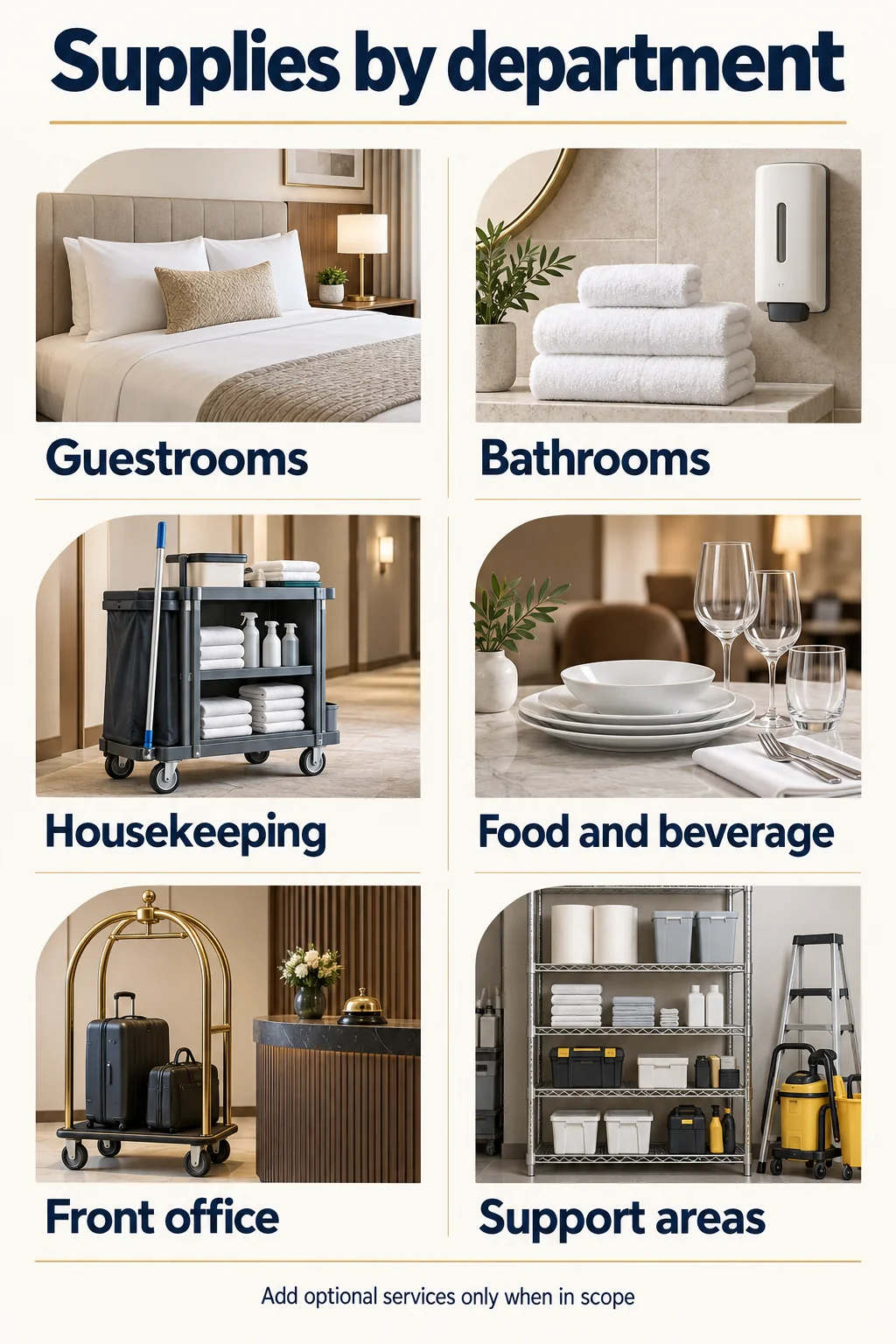
Use the department checklist below to build a property-specific opening inventory. It groups the main supply families while showing the purchasing decision that should accompany each one. Expand every grouped row into individual order lines with a clear unit, specification, quantity, and owner. Include optional departments only when the hotel will operate them, and reconcile construction-related items with the contractor before ordering. No generic list can determine every required product for every property; the purpose of this matrix is to make omissions visible and connect each category to an acceptance check, rather than treat every listed item as mandatory.
| Supply group | Items to specify | Purchase check |
| Guestroom furniture | Beds and bases; headboards; bedside tables; desks; chairs; lighting; window coverings. | Confirm room-type counts, dimensions, finish samples, installation scope, and clearances. |
| Bed linen | Sheets; duvet covers or top sheets; mattress protectors; spare bedding. | Count by bed size and bed setup; confirm post-wash fit and the laundry rotation. |
| Pillows and inserts | Pillows; pillow protectors; pillowcases; duvets or blankets. | Record pieces per bed, fill specification, cleaning method, and replacement supply. |
| Closet and garment care | Hangers; luggage racks; irons or steamers; boards; storage holders; laundry bags. | Test shelf and drawer fit, cooling and storage instructions, and guest handling. |
| Guestroom appliances | Hair dryers; kettles or coffee makers; minibars or refrigerators where specified. | Verify the exact model, electrical approval, supply requirements, accessories, and service support. |
| Guestroom accessories | Waste and recycling bins; tissue holders; trays; glasses or cups; in-room information holders. | Match the room standard; check cleaning access, liner size, and replacement availability. |
| Bath linen | Bath towels; hand towels; washcloths; bath mats; robes where offered. | Set pieces per room type; test laundering, drying, storage volume, and finished feel. |
| Toiletries and dispensers | Soap; shampoo; conditioner; body wash; lotion where offered; dispensers and refill stock. | Confirm applicable packaging rules, compatible refills, mounting, labeling, and service instructions. |
| Bathroom accessories | Toilet brushes and holders; covered bins; tissue stock; hooks and rails within the agreed scope. | Confirm installation responsibility, finish compatibility, dimensions, and cleaning method. |
| Housekeeping equipment | Carts; vacuums; mops; buckets; brushes; microfiber cloths; cleaning caddies. | Test routes, lifts, thresholds, maneuverability, storage, and replaceable parts. |
| Cleaning products | Approved cleaners; disinfectants where needed; dispensers; PPE; waste liners. | Agree surface compatibility, product instructions, staff training, labeling, and safe storage. |
| Laundry equipment and supplies | Washers and dryers if on site; dosing equipment; detergents; finishing tools. | Assign ownership; confirm service capacity, utilities, commissioning, and textile compatibility. |
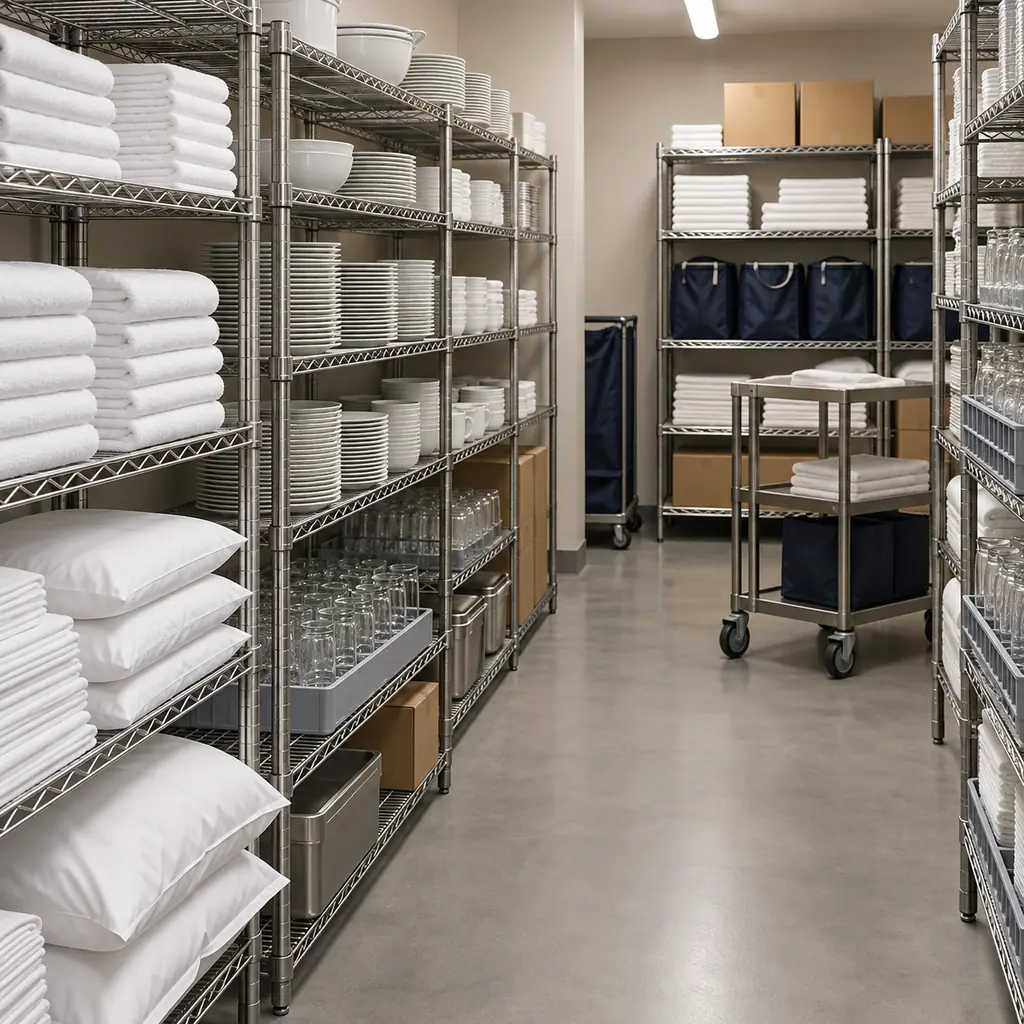
| Linen handling | Clean storage shelves; linen carts; collection bags; sorting bins; receiving stock. | Separate clean and used flows; confirm laundry return times and delivery locations. |
| Dining service | Plates; bowls; flatware; glasses; cups; trays; service utensils; table linen if used. | Count by menu and peak service; test racks, washing, stacking, and replacements. |
| Kitchen operations | Cookware; preparation tools; food containers; thermometers; racks; equipment in the approved plan. | Confirm menu, storage, utilities, food-contact suitability, and equipment approvals. |
| Breakfast and beverage service | Coffee and tea equipment; dispensers; serving dishes; smallwares; compatible consumables. | Match peak demand, cleaning work, replenishment supply, and power or water needs. |
| Meetings and banquets if offered | Tables; chairs; transport carts; table linen; serviceware; presentation accessories. | Use simultaneous event capacity; trial chair stacking, movement, storage, and setup. |
| Reception and administration | Reception accessories; key or access supplies; office stock; approved guest signs. | Confirm compatibility with installed systems and the approved guest communication plan. |
| Bell service and public areas | Luggage carts; entry mats; public-area bins; seating accessories; umbrellas if offered. | Test access routes, wheel behavior, storage locations, and cleaning needs. |
| Staff facilities | Uniforms; lockers; changing-room supplies; break-room and office essentials. | Confirm staffing plan, size distribution, laundering, and replacement arrangements. |
| Engineering and spares | Tools; approved lamps; filters; batteries; replacement pumps and other model-specific parts. | Record exact part numbers, authorized tasks, warranty conditions, and reorder sources. |
| Safety and security interfaces | Approved safety equipment; first-aid supplies; required signs; security-system accessories. | Have the responsible specialist confirm the schedule, locations, installation, and acceptance. |
| Accessible rooms and routes | Specified room equipment; accessible accessories; communication devices where required. | Check the complete installed arrangement with the project team before releasing bulk orders. |
| Pool spa fitness and outdoor areas if offered | Activity-specific towels; storage; furniture; equipment; cleaning and service supplies. | Use each operating plan; confirm wet-area suitability, maintenance, and applicable approvals. |
Use the editable versions to assign responsibility, record status, and take the same inventory into purchasing meetings or receiving checks.
Connect the guest standard to the servicing work
Choose linen dimensions and construction against the actual mattress, wash process, and storage space. A higher thread count or towel weight is not a complete purchase specification. Record measurable requirements and inspect the sample after the intended care cycle. The guide to hotel towel weight and dryer capacity explains how a towel choice can affect available pieces at room-turnover time.
For toiletries, specify the product, dispenser, compatible refill, mounting parts, and servicing method as one system. Confirm whether pumps are replaced with cartridges or reused, and what cleaning work is required. Use the hotel toiletry dispenser workflow comparison when evaluating the ongoing workload. Keep dental kits, shaving kits, and similar extras aligned with the guest offer and any on-request policy.
Buy for the operation behind the display
Restaurant service needs usable pieces through the busiest meal period, including items being washed and replenished. Check that chosen glasses fit the racks, plates fit the washing system, and service pieces can be stored and moved without damage. Banquet purchases should reflect events operating at the same time, not simply the maximum capacity of each room considered separately.
Include consumables and maintenance access when selecting equipment. A coffee maker brings a recurring supply decision as well as a machine purchase; review soft pods, capsules, and hotel coffee supply compatibility. Apply the same discipline to vacuum bags, filters, batteries, dispenser pumps, and replacement parts. An inexpensive device can become difficult to keep in service if its consumables are unavailable.

Calculate Quantities from Beds and Operating Demand
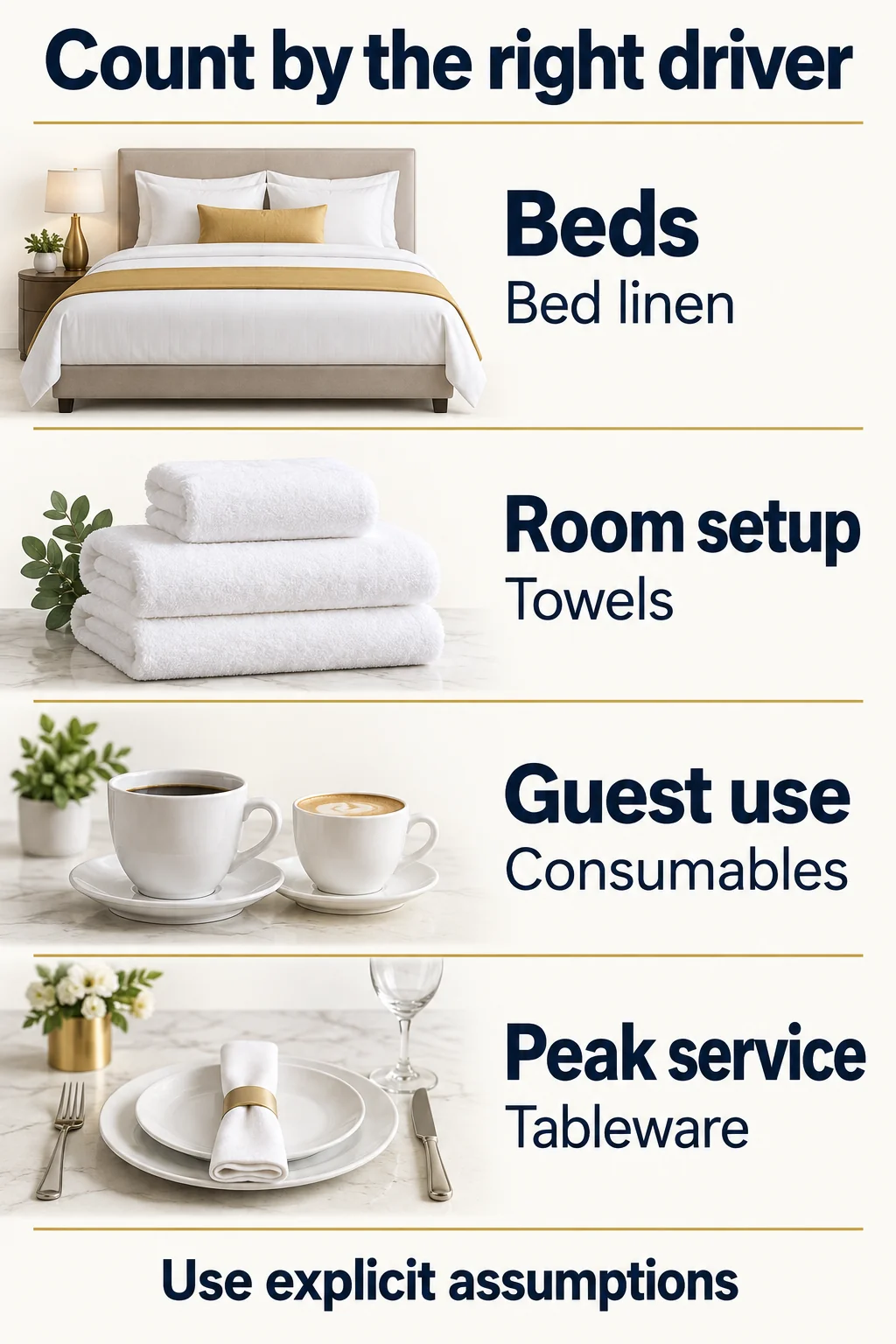
There is no single room-count multiplier that works for every hotel supply. Bed linen follows the bed configuration, towels follow the room setup and laundry cycle, consumables follow expected use, and restaurant pieces follow peak service and washing turnaround. Calculate each item in its own unit and separate opening placement from circulating stock and reserve. Use a clearly defined planning period for consumables and a realistic replenishment lead time. The examples in this section are hypothetical; they demonstrate the calculation method and do not establish a recommended stock level for every property.
Count beds before ordering bed linen
Suppose a 100-room hotel has 60 rooms with one king bed and 40 rooms with two queen beds. The property has 60 king beds and 80 queen beds: 140 beds altogether. If the approved setup uses one fitted sheet per bed, one complete room placement requires 60 king fitted sheets and 80 queen fitted sheets. Flat sheets, duvet covers, pillowcases, and protectors need their own counts because their pieces per bed may differ.
For an illustrative three-par fitted-sheet plan, where one par means enough sheets to equip every relevant bed once, circulating stock would be 60 × 3 = 180 king sheets and 80 × 3 = 240 queen sheets. If the team separately approves 12 king and 16 queen sheets as a replacement reserve, the purchase becomes 192 king and 256 queen sheets before case-pack rounding. Do not add that reserve again if it is already included in the agreed par definition.
Choose the actual par level from collection timing, laundry turnaround, delivery frequency, processing capacity, and the busy-day clean-stock requirement. Outsourced laundry may need different stock from an on-site operation. Check the first service days as well as the steady-state routine: linens waiting for an initial wash are not yet usable opening inventory.
Forecast consumables over a defined coverage period
For items whose use follows occupancy, a simple starting calculation is: expected occupied room-nights × expected units used per occupied room-night. Adjust the driver when use follows guests, arrivals, or meals instead. If 100 rooms are forecast at 70% occupancy for 14 days, that is 980 occupied room-nights. At an assumed 1.5 coffee portions per occupied room-night, forecast use is 1,470 portions. An explicitly chosen 210-portion buffer gives a target of 1,680 portions before deducting usable stock or confirmed receipts.
The coverage period must extend to the next dependable replenishment. Allow for shelf life, secure storage, delivery reliability, and uncertain opening demand when choosing the buffer. After opening, replace assumptions with actual use by item. For routine replenishment, a basic reorder point is expected demand during replenishment lead time plus safety stock. A periodic ordering schedule also needs coverage until the next review.
Round only after defining the unit
If the net requirement is 430 pieces and the supplier sells cartons of 24 pieces, round up to 18 cartons, or 432 pieces. Confirm whether the quotation is per piece, pair, set, dozen, or carton; a towel set and a single towel cannot share the same quantity field. Record pack size and the resulting overage so the receiving team knows what to expect.
For tableware, start with the peak number of diners or concurrent place settings, then account for pieces in use, in clearing and washing, and held ready for the next service. Staff uniforms follow staffing and size distribution. Carts follow working teams, routes, and storage. These separate drivers are more useful than a blanket percentage added to every category.
Approve Samples and Compare Complete Quotes
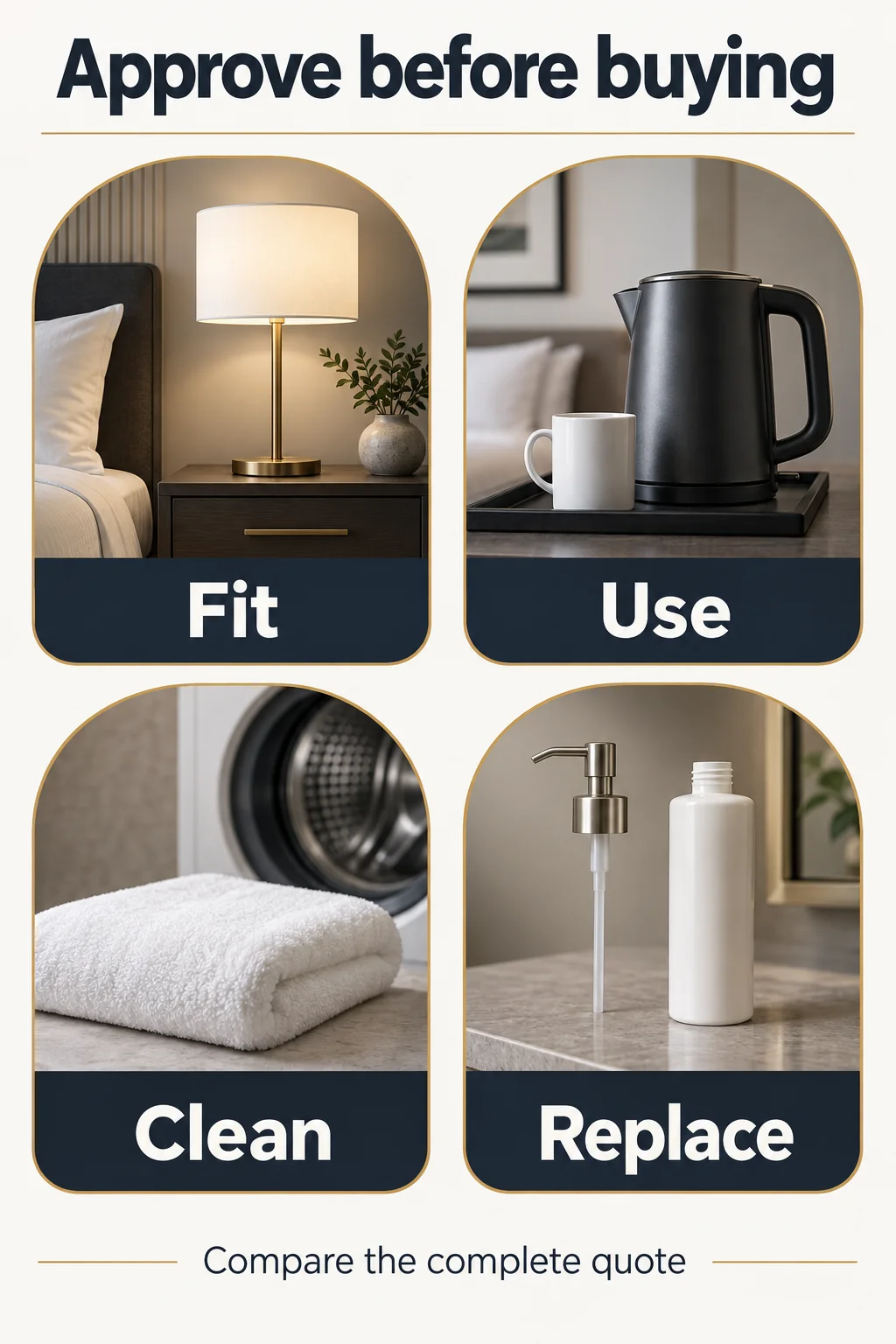
Approve a product against a written specification and a realistic trial before committing to its full quantity. Then compare quotations on the same scope, destination, currency, delivery terms, and service obligations. A unit price alone cannot show the cost of putting an item into use at the hotel. The purchasing decision should combine sample acceptance, documentation, availability, replacement support, and the cost of delivery and setup. For customized goods, lock the approved version and specify how a change will be reviewed. This makes both the order and any later discrepancy easier to evaluate.
Make approval repeatable
Keep the approved sample or a documented reference with its product code, dimensions, material, finish, packaging, and agreed tolerances. Record who approved it and what was tested. Use a representative laundry trial for textiles; assess staining, washing, stacking, and handling for tableware; and test carts on the intended route. A photograph can document appearance, but it does not prove fit, feel, electrical suitability, or cleaning performance.
For appliances, verify the exact model, supply voltage and frequency, plug, power demand, installation conditions, and certification or approval accepted in the destination jurisdiction. Ask the electrical contractor to confirm compatibility before purchase. Do not assume that a familiar-looking plug or a mark used in another market settles the question. Have the project team review accessibility, fire, food-service, and other applicable requirements at the relevant design and procurement stage.
Describe sustainability attributes precisely. Ask what a recycled-content, material, or certification claim actually covers and which product it applies to. A word such as bamboo, biodegradable, or eco-friendly does not establish the performance of every component or the availability of a local disposal route. Durable, repairable products and dependable replacement supply may be more useful purchasing criteria than an unsupported label.
Build a comparable delivered and ready-to-use total
Compare product cost plus agreed customization, samples, inspection, packaging, freight, insurance, brokerage, applicable duties and nonrecoverable taxes, unloading, storage, assembly, and installation. Treat recoverable taxes separately with your accounting team. Identify any excluded service rather than assuming it is included because an offer says delivery. For imported purchases, document the importer of record and the responsibilities associated with the agreed delivery term.
Budget separately for initial consumables, opening labor, spare parts, and contingency. There is no dependable universal per-room supply budget without a defined scope: an estimate covering towels and accessories cannot be compared with one that also includes furniture and equipment. Record both the approved budget and committed orders, and evaluate alternatives against usable service life and operating work as well as first cost.
Schedule backward from the required-on-site date
Ask each supplier for a sequence covering sample approval, production, inspection, correction if needed, dispatch, transport, customs where relevant, and final delivery. Then allow time at the property for unpacking, assembly, initial laundering, testing, and staff practice. Build contingency around the activities that could delay opening. Use the required-on-site date for purchasing control; the guest opening date alone is too late for most operational preparation.
Consolidating products can simplify receiving, but it can also tie an urgent item to a delayed one. Agree which categories can travel together and which need an independent delivery decision. Confirm minimum order quantities, reorder quantities, lead times, warranty handling, and substitute approval. These terms should be recorded for the actual order, not assumed from a general website claim.

Receive Supplies and Release Areas for Opening
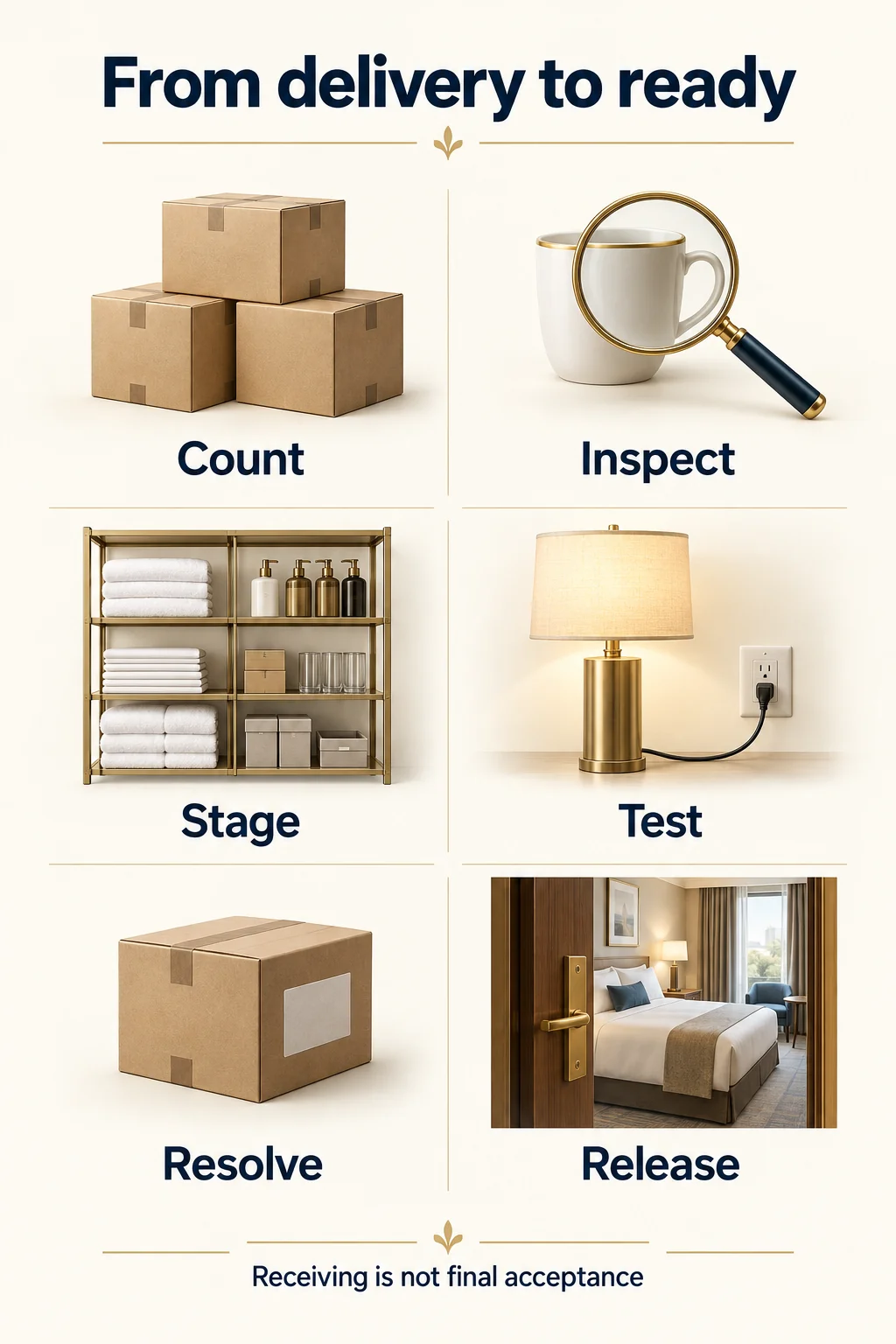
Treat delivery as the start of acceptance, then release each area only after its supplies are counted, checked, placed, and usable. Prepare storage locations and room allocations before the truck arrives so approved goods do not disappear into mixed cartons. Link the packing list to the purchase order and keep discrepancies visible until they are resolved. The team should know who can accept a substitution, who reports damage, and who confirms operational readiness. This distinction prevents a shipment marked as received from creating a false impression that the hotel is ready for guests.
Prepare the receiving conditions
Confirm delivery appointments, vehicle access, dock or tail-lift requirements, unloading labor, elevator dimensions, protective handling, and receiving hours with the carrier and site team. Keep clean, dry storage ready for textiles and separate appropriate storage for chemicals and food-related stock. Coordinate deliveries with construction dust, room completion, and installation access. A confirmed delivery address does not establish that the site can receive the planned vehicle or quantity.
Record discrepancies while they can be identified
Count cartons and verify item codes, pack quantities, and visible condition against the shipment paperwork. Photograph damaged packaging and affected goods, retain identifying details, and report discrepancies within the applicable order and carrier terms. Separate damaged, incorrect, or unapproved items from accepted inventory. Agree the inspection method before delivery; checking a small selection is not the same as proving every unit is defect-free.
Maintain separate figures for ordered, received, accepted, and issued quantities. For example, 100 delivered hair dryers do not mean 100 rooms can be released if some units are damaged or still awaiting the required checks. Close each discrepancy with an approved replacement, credit, correction, or documented decision. Keep final quantities aligned with the room allocations and reserve stock.
Run a practical opening rehearsal
Make up representative rooms, replenish amenities, process a laundry return, move carts along the actual routes, and simulate the busiest planned meal or event setup. Ask the teams to record missing accessories, awkward storage, slow cleaning tasks, and unavailable replacements. Correct those issues before releasing the affected area. Keep product instructions, approved part numbers, warranty information, and reorder contacts accessible to the people who will use them.
After opening, review actual consumption, breakage, laundry turnaround, and stockouts by item. Adjust reorder points and reserves from operating evidence. Keep room standards consistent when replenishing: an apparently equivalent item still needs review if its size, finish, cleaning method, or compatibility differs from the approved version.

Conclusion
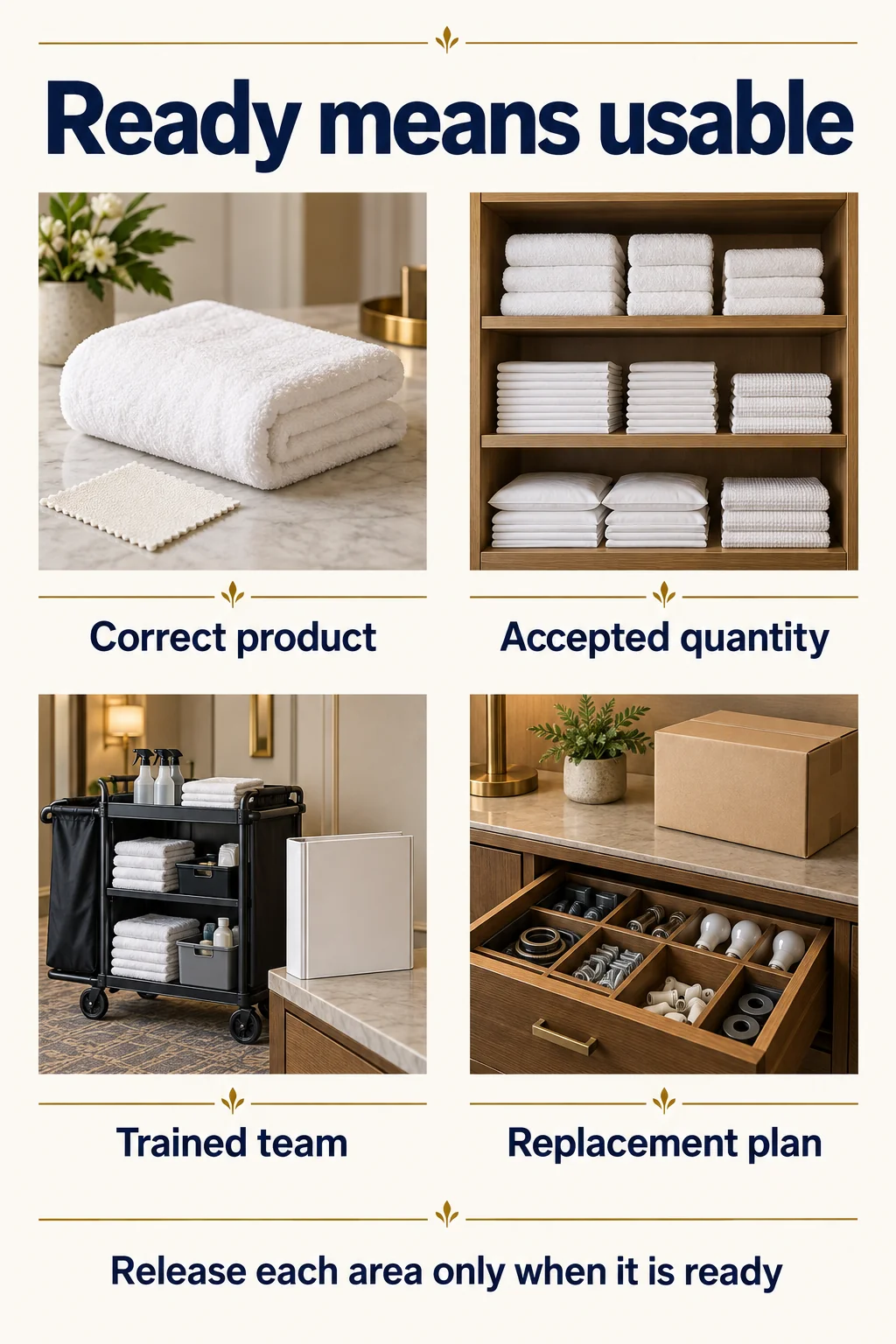
A reliable new hotel supplies plan connects the guest offer to the work required to deliver it. Define the opening scope, use a department inventory, calculate each quantity from its real demand driver, and approve the product in its intended setting. Compare complete quotations and give receiving, setup, and training their own time in the schedule. The final test is whether each area has accepted, usable stock and a workable replacement plan. That approach turns a broad list of hospitality products into a purchasing plan the operating team can verify and maintain.
For help sourcing a defined opening package, request a hotel supplies quote from KW Hospitality. Include the room mix, itemized list, specifications, quantities and units, delivery city and postal or ZIP code, customization requirements, and required-on-site dates. Flag categories that need samples and identify any phased opening. The team can then review product options, sample arrangements, and delivery requirements against the actual project scope.
Frequently Asked Questions
Can a small hotel buy everything from one supplier?
It can use one sourcing coordinator, but it should still evaluate each category separately. A supplier suited to custom furniture may use different factories and service arrangements for linens, appliances, or tableware. Compare sample quality, documentation, replacement availability, and delivery responsibility by category. Keep a backup supply route for items whose interruption would affect daily operations.
Should all supplies be purchased for the full hotel during a phased opening?
Permanent equipment and customized products may need a whole-project order to preserve compatibility and production efficiency. Consumables and some circulating stock can sometimes be released in stages. Make the decision from the confirmed opening phases, minimum quantities, storage conditions, and replenishment timing. Do not reduce critical reserve simply because only part of the property opens initially.
Is an opening reserve the same as safety stock?
The terms can overlap, so define them in the purchase schedule. An opening reserve may cover initial losses, commissioning needs, or future replacements. Safety stock usually protects against uncertainty in demand or replenishment. If the same physical units serve both purposes, count them once and make their availability explicit; stock already allocated to a later phase is not automatically available for current operations.
What should change if the opening date moves?
Review each order stage and the consequences of changing it. Goods already in production may have different options from unapproved samples. Confirm revised delivery appointments, storage costs, insurance responsibility, payment milestones, and consumable shelf life with the relevant parties. Update the required-on-site dates and retain a clear record of agreed changes.
Can imported products be used in Canadian and US hotels?
Yes, provided the exact products and installations meet the applicable requirements and the project team accepts them. Country of manufacture alone does not establish suitability. Verify documentation, electrical approvals where relevant, materials, labeling, installation needs, and support for the destination. Confirm customs responsibilities and delivery terms before the order is released.
Should spare stock be kept for every item?
Use the consequence of failure, replacement lead time, storage cost, and compatibility risk to decide. A low-cost model-specific pump or fitting may deserve spare stock because it can keep a service operating. A large, easily replaced item may need a different arrangement. Record the decision by product and keep spare parts identifiable so the team can find the correct replacement.