
Damaged hotel supplies are not just a receiving problem. A cracked vanity mirror, wet carton of linens, dented luggage cart, chipped dinnerware shipment, or malfunctioning minibar can interrupt an opening schedule, reduce available inventory, create safety risks, and trigger a dispute among the hotel, supplier, carrier, freight forwarder, and insurer. The way the receiving team responds during the first few minutes often determines whether the hotel has usable evidence and a clear path to replacement or ends up absorbing an avoidable loss.
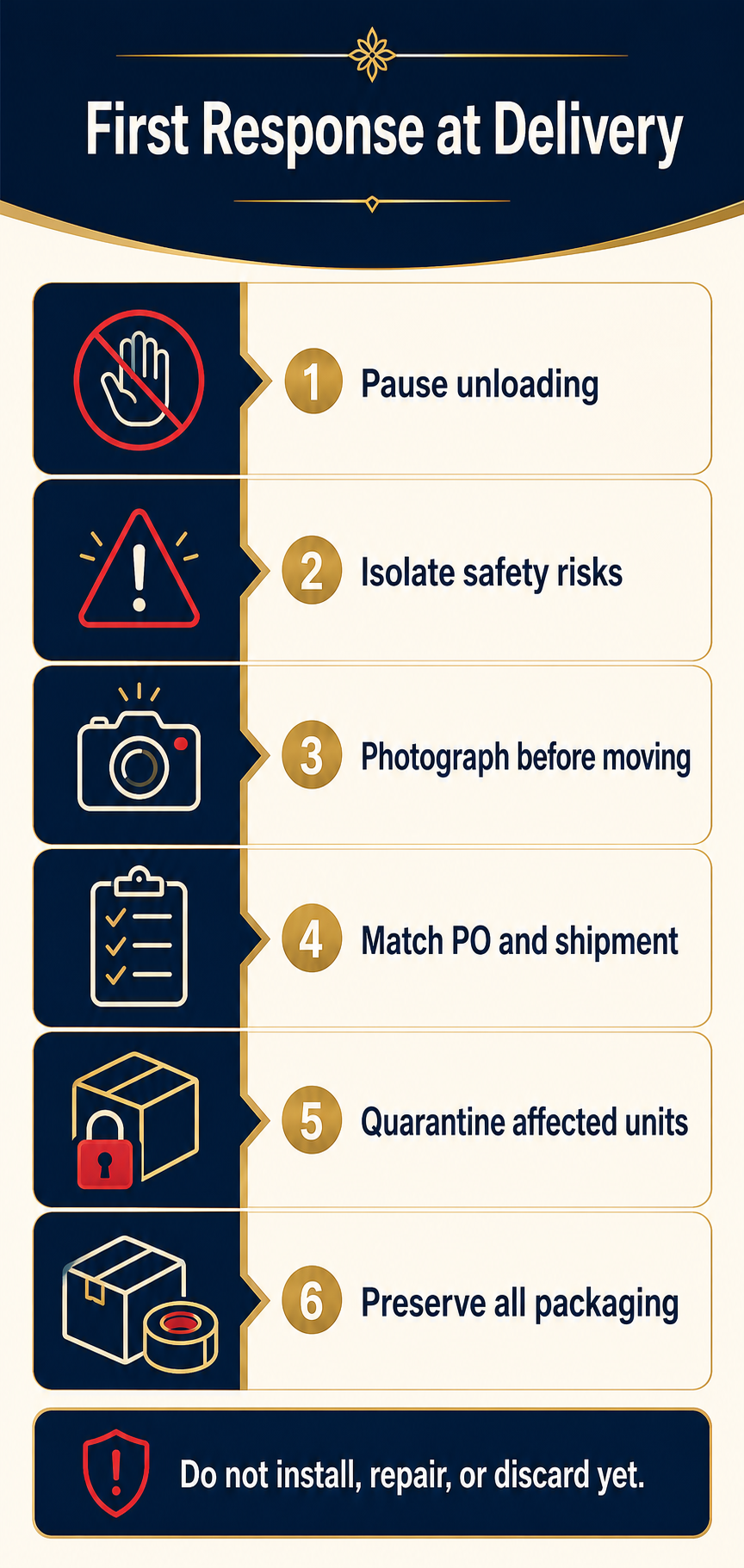
The safest response is to pause the delivery, protect people and unaffected goods, document the condition before anything is moved, and record specific exceptions on the delivery receipt or electronic proof of delivery. The hotel should then compare the shipment with the purchase order and packing list, quarantine damaged units, preserve all packaging, and send written notice to the parties named in the purchase order, shipping documents, and insurance arrangements. A clean signature, discarded carton, or vague message such as “some items damaged” can make the facts much harder to establish later.
There is no universal rule that says every damaged shipment must be refused or every claim must be filed by the hotel. The correct path depends on the extent of damage, whether safe units can be separated, who arranged transportation, the purchase contract, the applicable shipping term, the carrier’s tariff or service conditions, and the supplier’s return and warranty process. This guide gives hotel purchasing managers, receiving teams, finance staff, and department heads a practical workflow for visible damage, shortages, and concealed damage. It is operational guidance rather than jurisdiction-specific legal advice; for a material dispute, review the controlling contract and obtain qualified advice in the relevant jurisdiction.
Stabilize the Delivery Before You Unload or Sign
The first objective is to prevent a damaged delivery from becoming a larger loss. Slow the receiving process, control the unloading area, separate immediate safety concerns from commercial questions, and keep the shipment in a condition that can still be inspected.
Stop unsafe handling
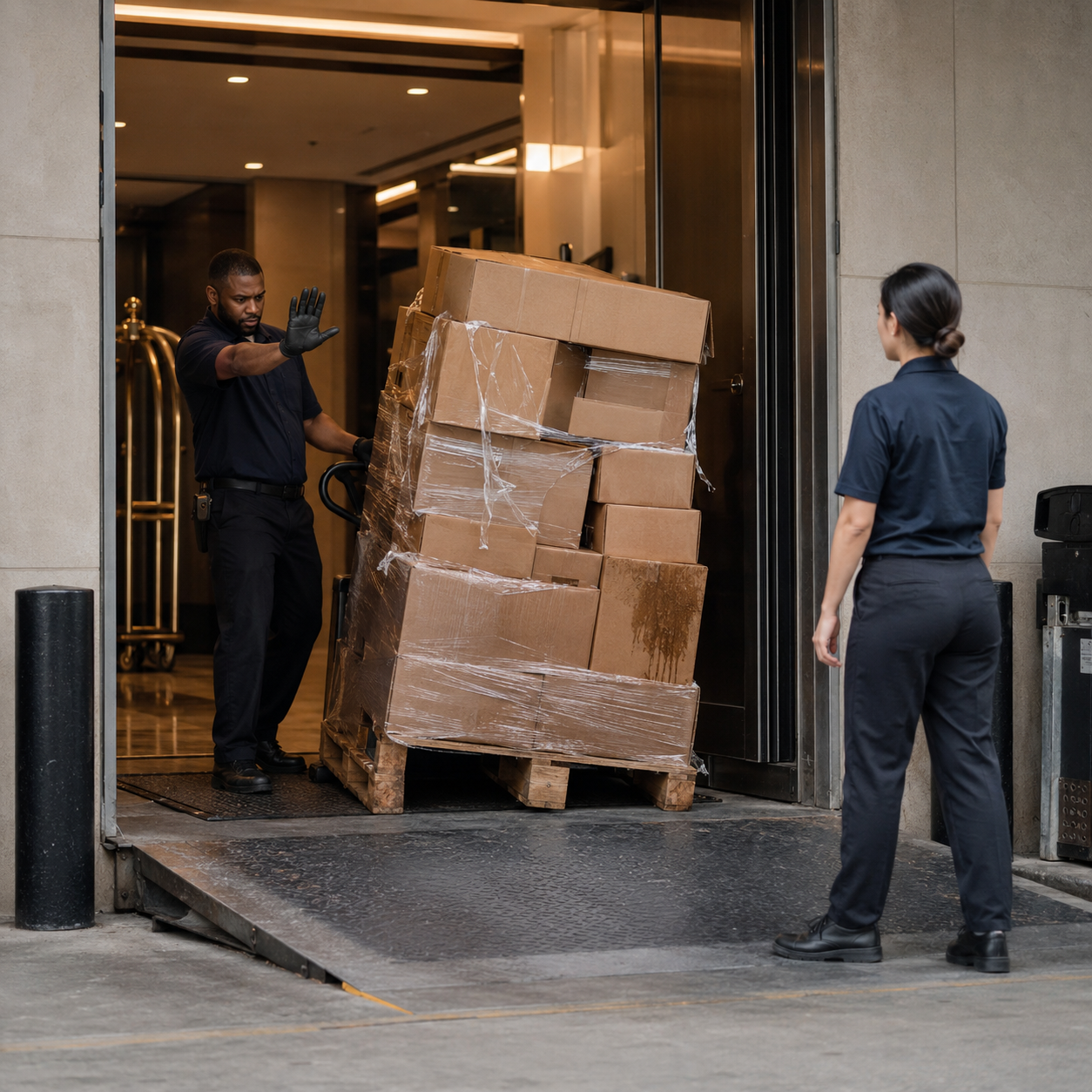
If a pallet is leaning, straps are broken, cartons are soaked, glass is exposed, chemicals or toiletry liquids are leaking, or an electrical item appears crushed, stop unloading until the area is safe. Keep guests and nonessential staff away. Do not energize, install, wash, assemble, or place visibly damaged goods into service. Use appropriate personal protective equipment and follow the property’s safety procedures for broken glass, sharp metal, liquids, unstable loads, batteries, chemicals, and contaminated materials.
Photograph the shipment in its arrival position before the driver removes straps, stretch wrap, corner boards, or pallets. A wide image should show the load and vehicle or delivery area; closer images should show crushed corners, punctures, water marks, broken seals, shifted cartons, or visible product damage. If unloading must continue for safety or access reasons, record the sequence.
Match the delivery to the documents
Identify the purchase order number, supplier, carrier, tracking or PRO number, bill of lading, packing list, carton count, pallet count, and the hotel department that ordered the goods. Verify that the delivery is at the correct property and that the quantities and item codes broadly match the shipment notice.
Do not let schedule pressure turn the driver’s departure into the receiving deadline. A controlled inspection may take time, especially for mixed OS&E pallets, fragile furniture, equipment with concealed panels, or high-value custom items. If the carrier will not wait for a full internal inspection, record what could and could not be inspected and follow the applicable written process immediately.
Quarantine without destroying evidence
Move damaged or questionable units to a designated hold area only after their arrival condition has been documented. Label the area and the individual units with the PO number, delivery date, item code, quantity, and “Do Not Use—Damage Review.” Keep sound units separated so operations can use them only after the count and condition have been confirmed.
Do not discard cartons, foam, dividers, pallets, stretch wrap, labels, seals, or damaged components. Carriers and suppliers may request inspection of the product and original packaging. If storage space is limited, obtain written permission before disposal and retain detailed photographs of every layer.
Inspect the Shipment and Create a Defensible Damage Record
A useful damage record connects each affected unit to the order, packaging, delivery event, and financial value. It should allow someone who was not present—such as a supplier claims analyst or insurer—to understand exactly what arrived and why it does not conform.
Inspect from the outside in
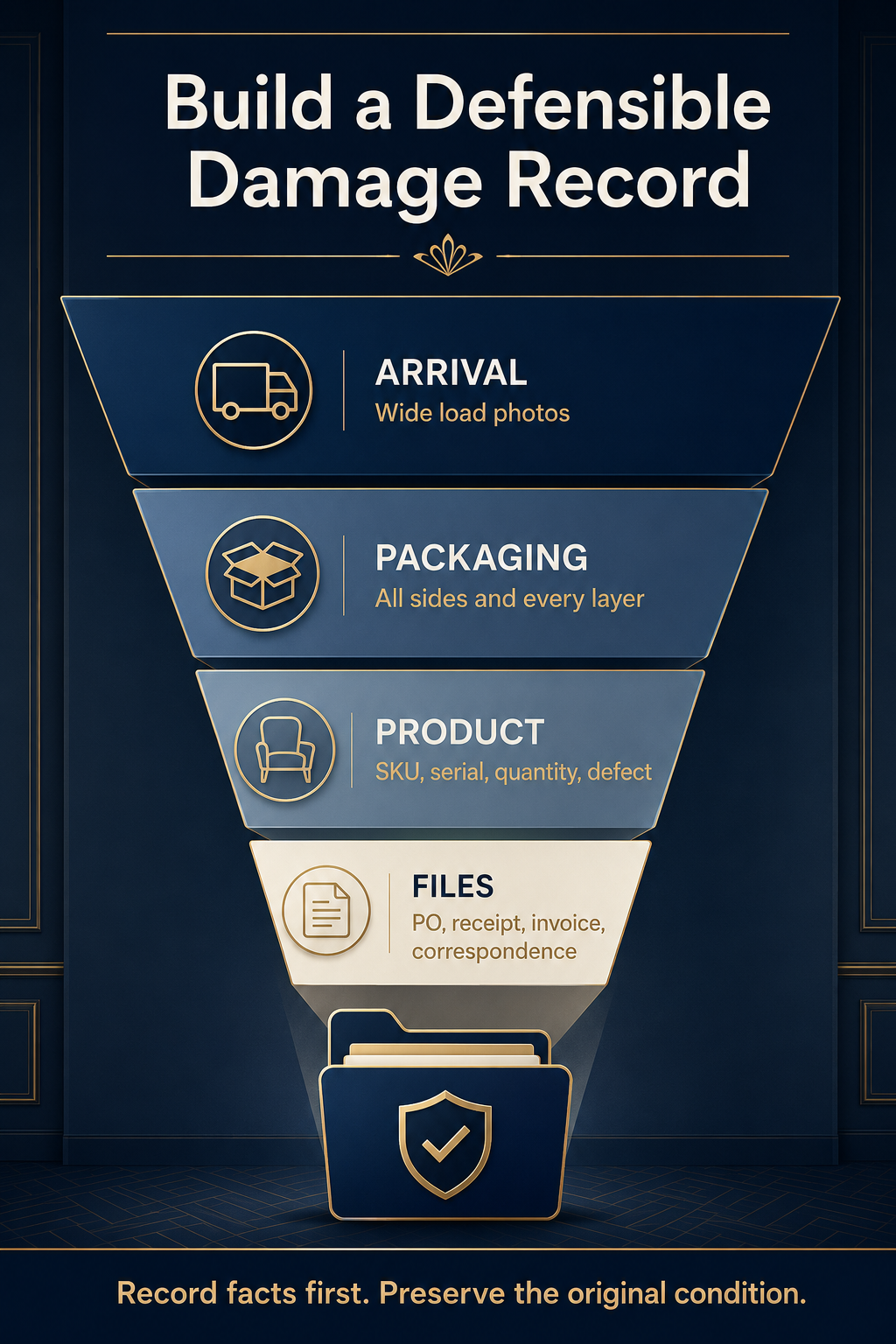
Begin with the vehicle-facing and pallet-level condition, then work inward:
- Record the number and condition of pallets, crates, cartons, and loose pieces.
- Photograph all sides of the pallet or crate before removing wrap or bands.
- Capture shipping labels, handling labels, carton numbers, and seal numbers.
- Photograph external damage with both context and close-up views.
- Open affected packaging carefully and record the internal cushioning and product position.
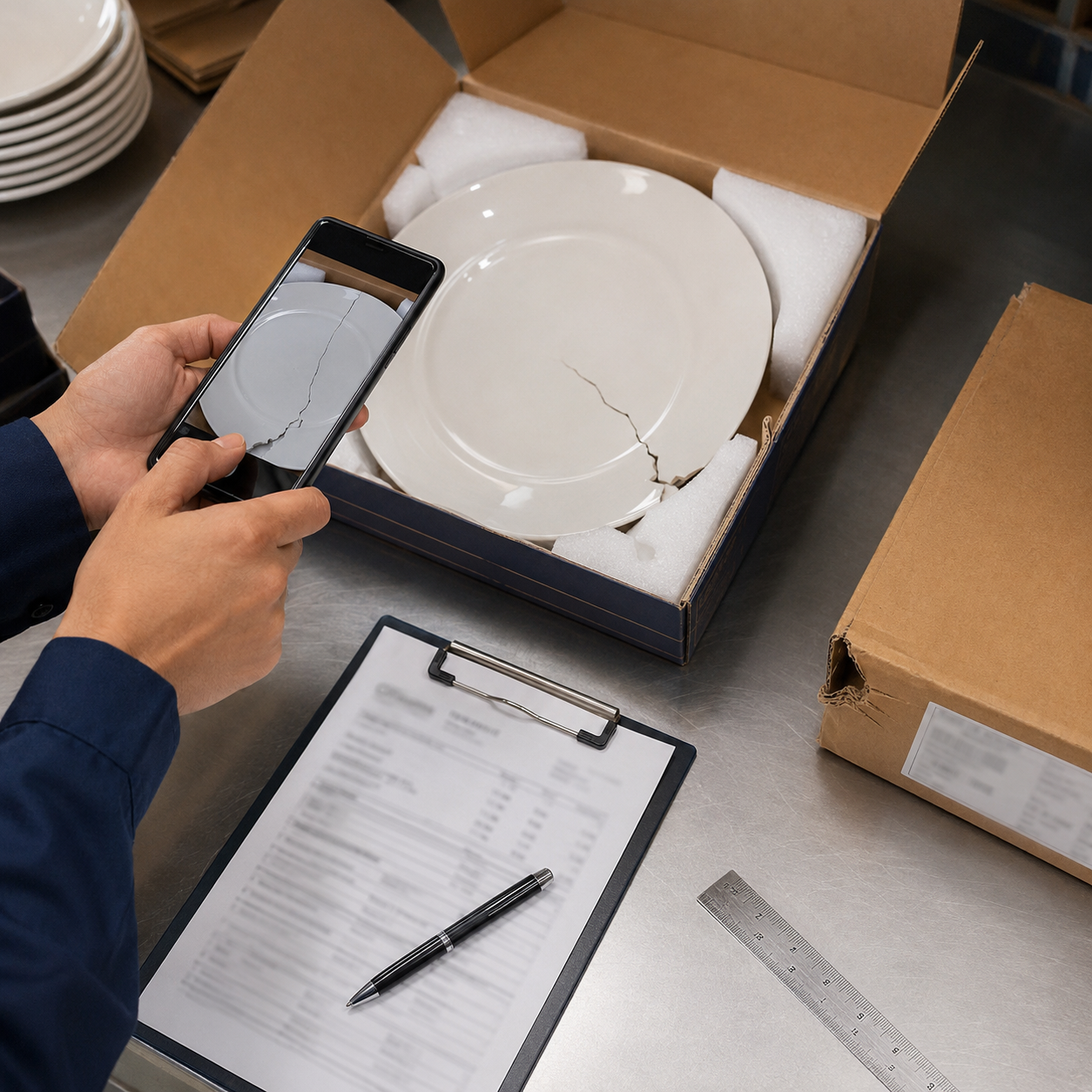
- Photograph each damaged unit, its model or SKU, serial number when present, and the specific defect.
- Count shortages, overages, substitutions, and units that cannot yet be tested.
Use a ruler or scale reference where dent depth, crack length, or puncture size matters. For finish damage, take images under even light and from more than one angle. For wet goods, document the carton, internal moisture, stains, odor, affected layers, and any batch or lot information. Do not clean or repair the item before the initial evidence is complete.
Describe the defect precisely
Replace general language with measurable observations. “Damaged chairs” is weak. “Four of twenty-four dining chairs, item DC-204, have split rear joints; cartons 7 and 8 show compression at the corresponding corners” is useful. Distinguish among:
Transit damage, such as crushing, impact, puncture, water exposure, abrasion, or shifted loads
Packaging failure, such as inadequate cushioning, weak cartons, missing corner protection, or unsecured components
Manufacturing or finish defects, such as poor welds, uneven plating, incorrect dimensions, color variation, or incomplete assembly
Quantity or identity problems, including shortages, overages, wrong items, wrong finishes, or unauthorized substitutions
Functional failures discovered during controlled testing
Avoid assigning blame in the first report unless the cause is established. Record observable facts first. The final responsibility may depend on the contract, risk-transfer term, packaging obligation, carrier handling, inspection findings, and insurance coverage.
Build one evidence folder
Create a claim folder named with the PO and delivery reference. It should contain the purchase order, supplier acknowledgment, approved specification or sample, invoice, packing list, shipping notice, bill of lading, delivery receipt, photographs, videos, serial numbers, inspection notes, staff witness names, correspondence, and the estimated value of affected goods.
Maintain an item-level damage schedule with these fields:
PO line and item description
SKU, model, finish, size, batch, or serial number
Ordered, delivered, damaged, missing, and usable quantities
Damage description and apparent packaging condition
Required resolution: replacement, repair, parts, credit, or technical inspection
Operational deadline and criticality
Unit price, extended value, and documented related cost
Current owner, case number, and status
This schedule becomes the shared record for procurement, finance, operations, the supplier, and the carrier. It also prevents a claim from being delayed because different departments are working from different quantities.
Treat concealed damage as a time-sensitive exception
Concealed damage is found after apparently intact packaging has been opened. It is common with furniture frames, stone or glass components, equipment panels, internal mechanisms, stacked dinnerware, lighting, and goods protected by opaque wrap.
Photograph the unopened package if possible, then record the entire unboxing sequence and report the issue in writing immediately. Do not assume that “concealed” means unlimited time. Carrier rules, sales terms, tariffs, and insurance policies may impose different notice and claim periods by service, country, and shipment type. The hotel should use the shortest applicable deadline in its internal workflow and verify the current written conditions for the specific shipment.

Decide Whether to Accept, Partially Accept, or Refuse the Delivery
Acceptance is not a simple choice between signing and sending the truck away. A hotel may be able to receive sound commercial units, reject unusable units, or accept a shipment with detailed exceptions, but the available options and consequences depend on the contract and applicable law.
When refusal may be appropriate
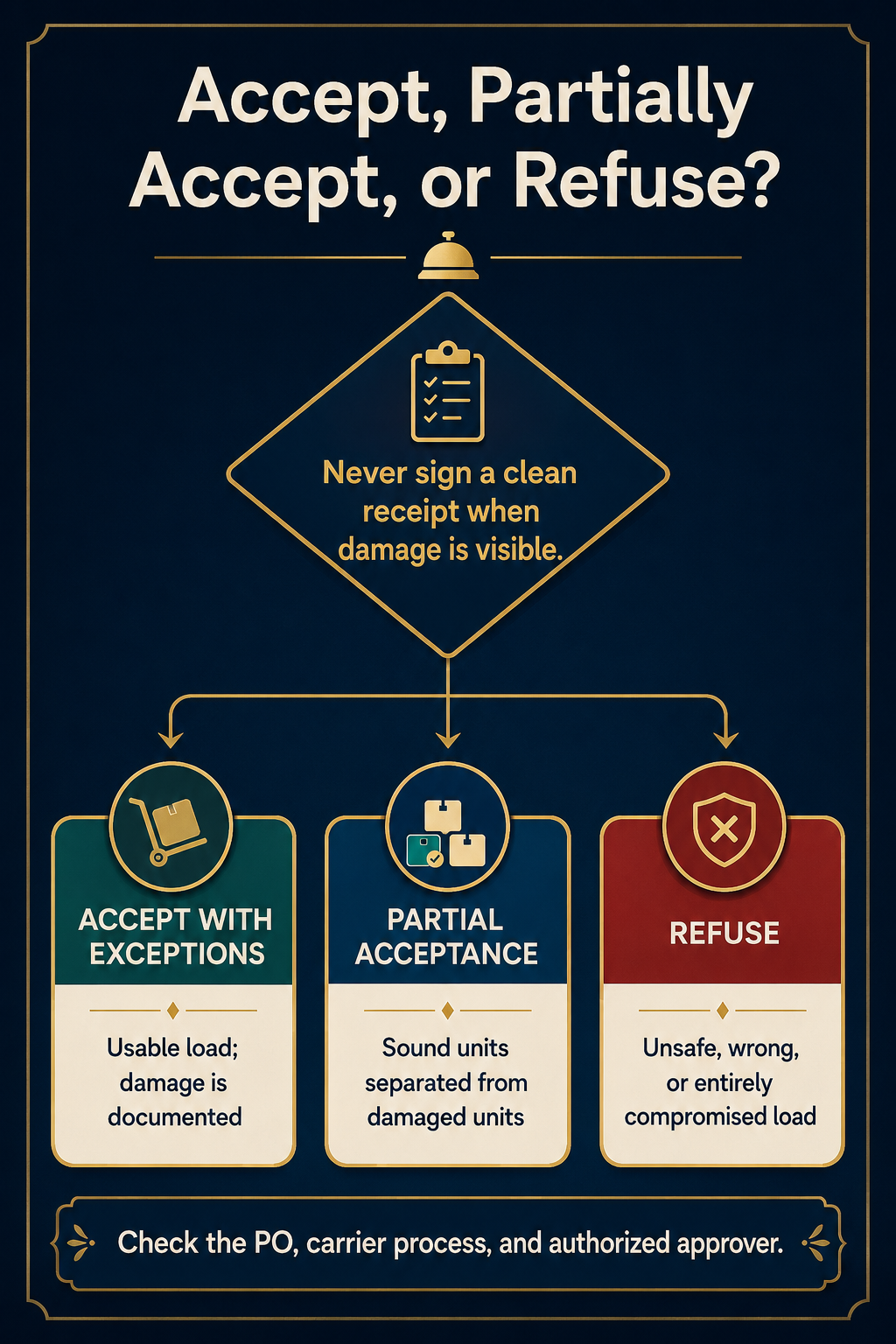
Refusal should be considered when the shipment creates an immediate safety hazard, the entire load is visibly compromised, the goods cannot be safely unloaded or stored, the wrong product has been sent, seals required by the contract are broken, or the supplier or carrier instructs the hotel to refuse.
Before refusing, contact the authorized procurement lead and follow the purchase order and carrier process. Record the reason, quantities, condition, driver or representative details, time, photographs, and the exact wording entered on the delivery record. Obtain a copy of the annotated document or a clear screenshot of the electronic entry.
Do not use refusal as a reflex for minor, separable damage. Sending back an entire shipment may jeopardize usable stock, create redelivery charges, delay the opening schedule, or complicate custody of the evidence. The decision should balance safety, contractual rights, operational need, and the ability to segregate sound units.
When partial acceptance can protect operations
Partial acceptance may be practical when individual cartons or commercial units are damaged but the remainder can be identified and safely used. Count and identify both groups. The delivery record should state the total received, the quantity accepted without visible damage, the quantity refused or held, and the reason.
For example: “Received 10 pallets. Pallet 6 has crushed outer cartons; 12 cartons held for inspection. Two stainless-steel carts, item LC-18, visibly dented and refused. Remaining units received subject to count and concealed-damage inspection.” Adapt the wording to the facts and the contract; do not write a standard phrase that overstates what was inspected.
Never sign a clean receipt when damage is visible
On a paper or electronic proof of delivery, enter specific exceptions before signing. Avoid phrases such as “damaged,” “subject to inspection,” or “one box bad” without quantities and detail. Record torn wrap, crushed cartons, water exposure, missing pieces, broken seals, pallet condition, item identifiers, and any driver acknowledgment.
If the device does not provide enough space, add a note in the available field, ask for an exception report, send a time-stamped written notice while the delivery is still present, and keep a screenshot or copy. Do not allow the driver to summarize the exception inaccurately.
Understand that delivery, ownership, risk, and claim responsibility are different
The party that physically receives the goods is not automatically the party that must file or ultimately bear the loss. Review:
Who contracted with the carrier
Who is listed as shipper, consignee, and bill-to party
The purchase order’s delivery and acceptance clauses
Any Incoterms rule and the precise named place or point
Freight prepaid, collect, third-party, or supplier-arranged terms
Cargo insurance and declared-value arrangements
Supplier warranty, return authorization, and replacement provisions
In international trade, the named destination does not always identify where risk transfers. Some terms move risk to the buyer when goods are handed to the first carrier or loaded at origin, while destination terms transfer risk later. Incoterms rules also do not replace the sales contract’s quality, payment, title, warranty, or dispute clauses.
For U.S. sales of goods, applicable state law may provide inspection and rejection rights, but contracts can shape procedures and remedies, and different rules may apply to installment contracts or accepted goods. Document the defect, notify the seller promptly, and obtain legal advice when the amount or dispute is material.

Notify the Right Parties and File the Claim Without Delay
A damage report becomes actionable only when it reaches the responsible parties through the required channel. The hotel should issue concise written notice immediately, then complete the formal claim or return process with the evidence and valuation each party requires.
Send the first written notice
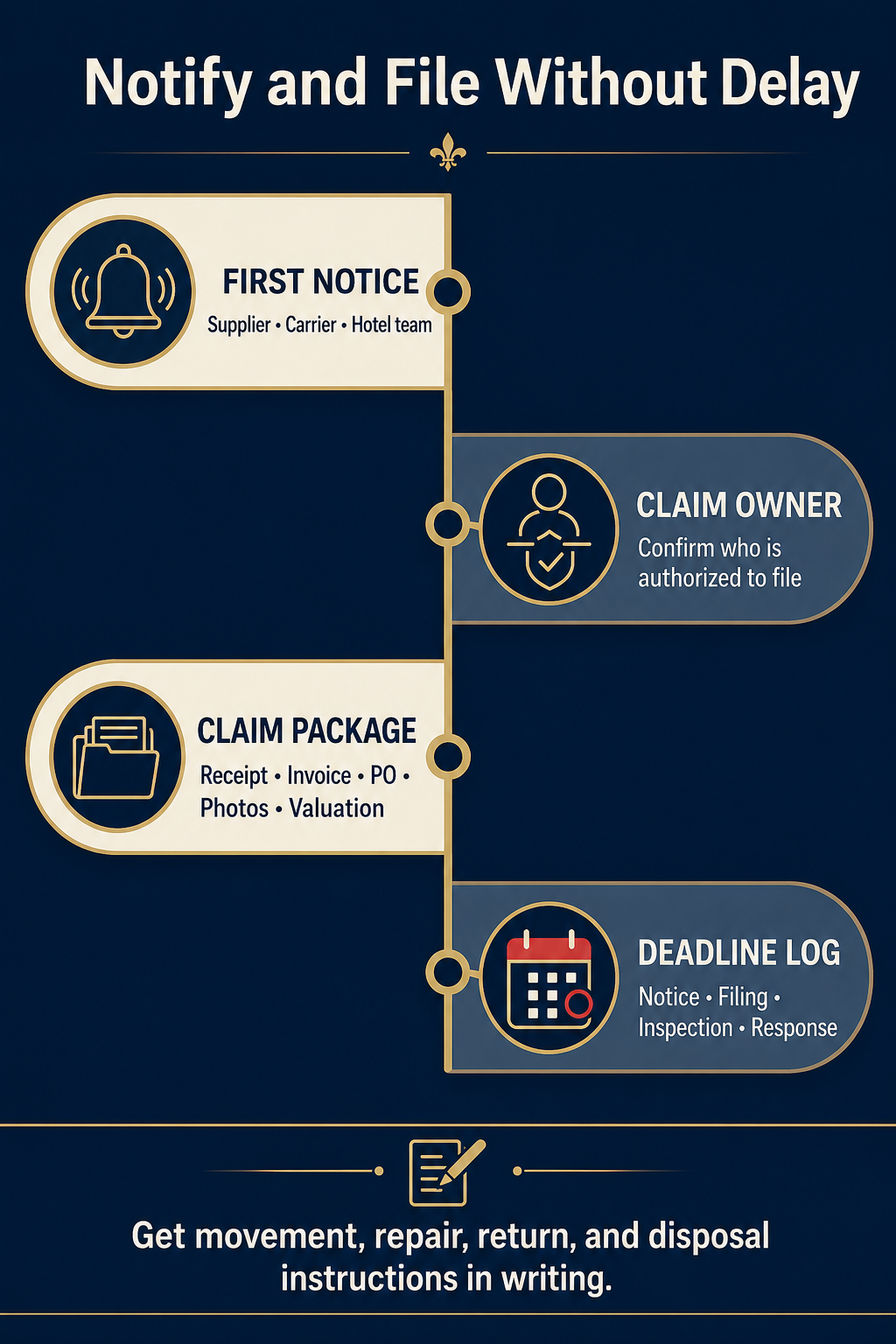
Notify the supplier contact, purchasing agent or sourcing partner, carrier or freight forwarder as applicable, and the hotel’s procurement, finance, receiving, and affected department leads. For high-value losses, also notify risk management and the cargo or property insurer according to policy instructions.
The first notice should include:
Hotel and receiving-location details
PO, invoice, tracking, PRO, container, and bill-of-lading references
Delivery date and time
Item codes and affected quantities
A factual damage or shortage summary
Whether the goods were accepted with exceptions, partially refused, or fully refused
Whether the goods and packaging are being preserved
Immediate operational deadline
A request for the required next step, case number, inspection, and written instructions
Attach representative photographs and the annotated delivery receipt, but do not delay the initial notice while preparing a perfect file. State that a detailed schedule will follow.
Determine who is authorized to file
The hotel, supplier, shipper, consignee, freight forwarder, or insurer may control the claim depending on the account and shipping arrangement. Some carrier accounts restrict claims to the shipper of record; in other cases a recipient or third party can initiate the process. Ask in writing who will file, who will own communication, and where any payment or credit will go.
Do not assume that a supplier’s statement “file with the carrier” resolves the contract issue. The hotel’s commercial claim against the supplier and the transportation claim against the carrier may be related but are not necessarily identical. The supplier may owe replacement or credit under the purchase order while separately pursuing recovery from the carrier or insurer.
Submit a complete claim package
A formal claim commonly requires:
Claim form and case reference
Bill of lading, airway bill, parcel tracking, or freight reference
Delivery receipt with exceptions
Commercial invoice and proof of product value
Packing list and purchase order
Itemized damage and shortage schedule
Photographs of the outside packaging, internal packaging, labels, and goods
Repair estimate, replacement quote, salvage value, or inspection report when relevant
Serial, lot, batch, or model information
Proof of the amount claimed and any contractually recoverable related cost
Use actual documented values. Separate product loss, repair, replacement freight, inspection cost, disposal, storage, installation disruption, and other claimed amounts instead of presenting one unsupported total. Not every consequential cost will be recoverable, so distinguish the hotel’s operational impact from the amount allowed by the contract, carrier terms, policy, or law.
Create a deadline and communication log
Record every notice deadline, formal filing deadline, requested inspection date, response deadline, and promised replacement date. Carrier and insurer time limits vary materially; a parcel deadline, LTL tariff, air waybill, ocean bill, and cargo policy should not be treated as interchangeable.
Log the date, channel, sender, recipient, subject, attachments, case number, and next action for every communication. After a phone call, send a short written recap. Escalate before a deadline expires, not after. If a party asks the hotel to hold, move, repair, return, or dispose of goods, obtain that instruction in writing.

Secure the Right Commercial Resolution and Protect Hotel Operations
The best outcome is not always a carrier check. The hotel needs a resolution that restores safe, specification-compliant inventory by the required date and accounts for the effect on rooms, food and beverage, housekeeping, engineering, events, or the opening schedule.
Choose the remedy item by item
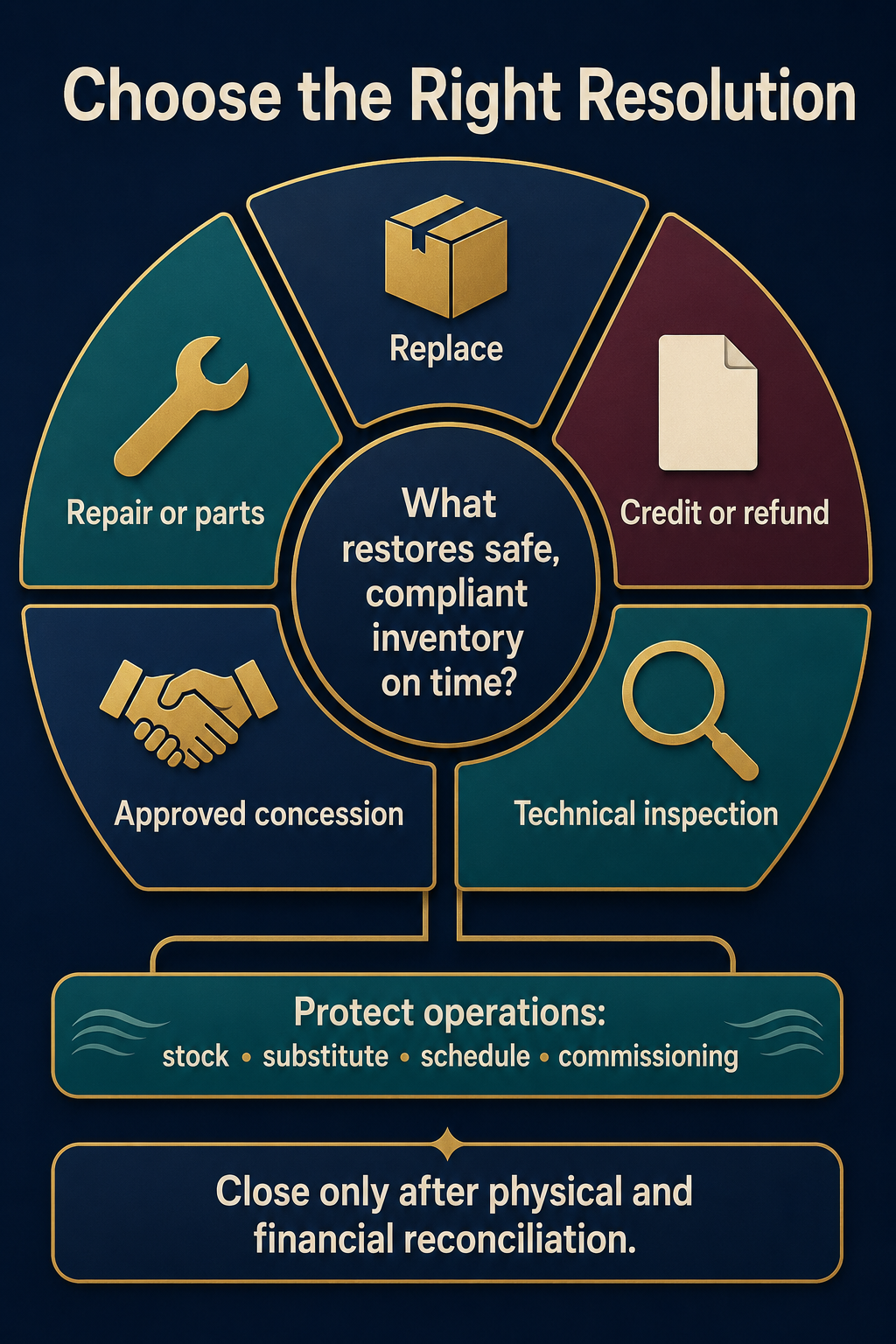
Classify affected units by the practical remedy:
Immediate replacement: critical, unsafe, guest-facing, or nonrepairable goods
Expedited replacement: usable inventory exists temporarily, but par levels or opening requirements will soon be affected
Repair or parts: technically and aesthetically acceptable when completed by an authorized party with warranty preserved
Credit or refund: appropriate when the item will not be replaced or the hotel must source elsewhere
Approved concession: minor deviation accepted only with documented discount, warranty position, and internal approval
Technical inspection: required when hidden structural, electrical, mechanical, hygiene, or performance damage is possible
Do not accept a cosmetic repair on a guest-facing item if finish uniformity is part of the approved specification. Do not let a discount convert a safety, sanitation, accessibility, structural, or warranty concern into “acceptable” stock.
Define replacement details in writing
A replacement commitment should state item code, specification revision, finish, quantity, production status, ship date, delivery date, freight method, cost responsibility, return authorization, disposal instructions, warranty treatment, and the person responsible for updates.
If the hotel has a hard opening or event date, ask for a recovery plan rather than a vague promise to “expedite.” The plan may use approved stock from another distribution point, partial airfreight for critical units, substitute items already approved by design and operations, repair parts, temporary rentals, or a split shipment.
Any substitute should pass the same controls as the original item. Confirm dimensions, utilities, finishes, performance, safety documents, accessibility, cleaning compatibility, branding, and spare-part availability. Record that the substitution is temporary or permanent and update inventory records accordingly.
Protect finance without creating a payment breach
Finance should isolate the disputed value, match credits to the correct PO and invoice lines, and avoid duplicate recovery. However, the hotel should not unilaterally withhold unrelated or undisputed payment without reviewing the contract and obtaining appropriate approval.
Track the supplier credit, carrier payment, insurance recovery, replacement invoice, freight charge, tax adjustment, and disposal or salvage proceeds as separate entries. Close the case only after the physical replacement and financial reconciliation are both complete.
Maintain operational continuity
The department head should translate damaged quantity into operational exposure. Ask:
How many rooms, covers, stations, carts, or shifts can current usable inventory support?
Is the item safety-critical, brand-critical, revenue-critical, or merely convenient?
What is the latest acceptable replacement date?
Can sound units be redistributed among outlets or floors?
Is an approved temporary substitute available?
Will installation, calibration, training, or inspection add time after delivery?
For pre-opening procurement, update the opening risk register and commissioning plan. For operating properties, protect guest service first, but do not put unsafe or visibly substandard products into use merely to preserve par levels.
If a damaged order reveals a larger supplier or specification problem, use a structured hotel-supplies RFQ before reordering. A clear RFQ can define packaging, inspection, acceptance, replacement, and delivery responsibilities before the next quote is awarded.

Prevent Repeat Damage With Better Purchasing and Receiving Controls
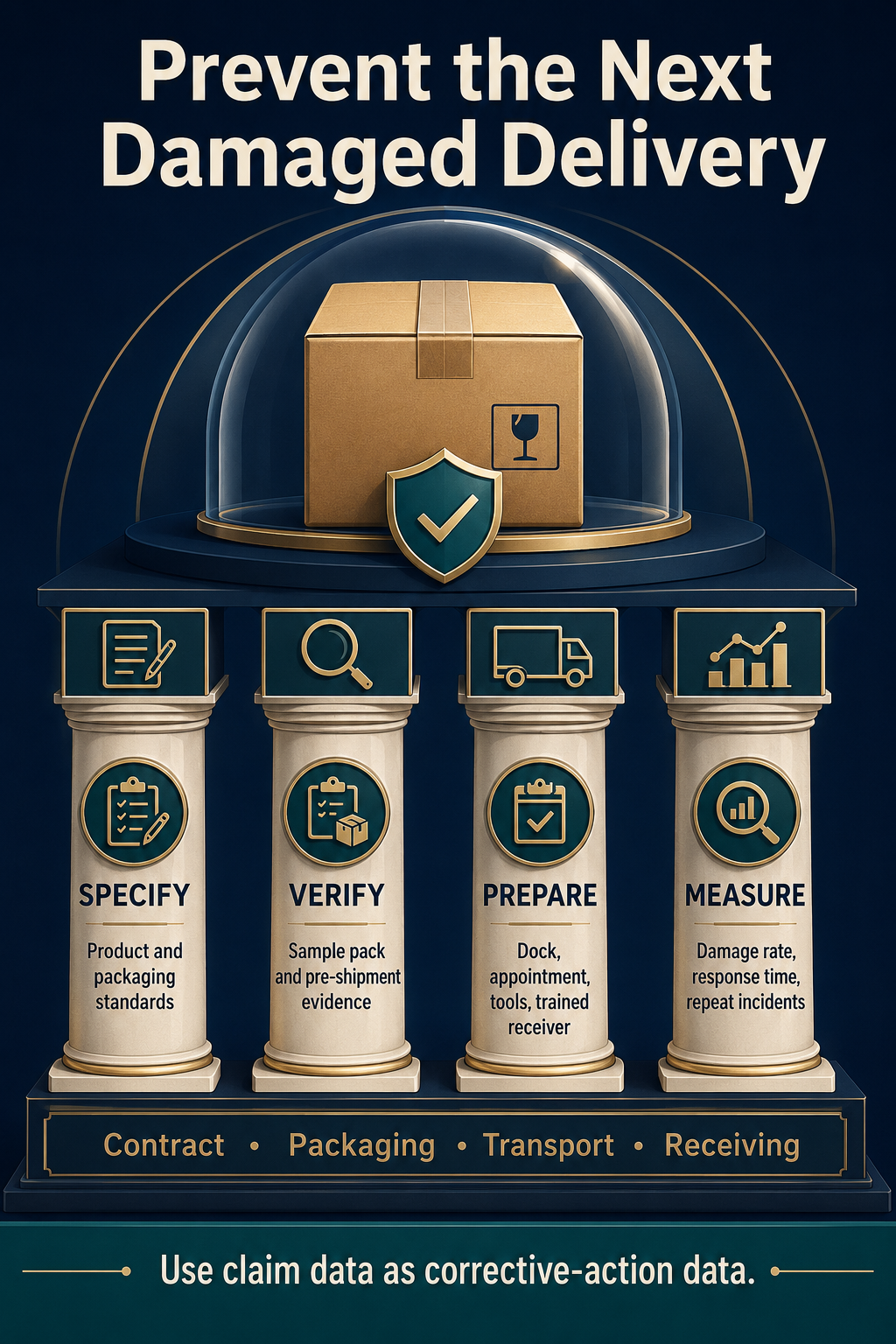
The claim file should become corrective-action data, not an isolated email chain. Hotels can reduce repeat loss by improving specifications, packaging approval, pre-shipment checks, transport terms, delivery appointments, receiving capacity, and supplier performance measurement.
Add damage controls to the purchase order
Specify the receiving and remedy process before shipment. Depending on category and risk, the purchase order or contract should define:
Approved product, finish, sample, and packaging specification
Inner and outer packaging requirements
Pallet, crate, moisture, corner, edge, and shock protection
Carton and pallet labeling, pack count, and serial or batch traceability
Prohibition or approval process for substitutions
Pre-shipment inspection and photo requirements
Delivery appointment, vehicle, liftgate, dock, and site restrictions
Risk-transfer term and precise named place
Required insurance and declared value
Inspection window and concealed-damage process
Response time, replacement timeline, warranty, return, and credit terms
Responsibility for return freight, disposal, rework, and expedited recovery
Avoid ambiguous terms such as “standard export packing” when the product is fragile, custom, high-value, moisture-sensitive, or difficult to replace. Ask for category-specific packaging evidence and a sample-packed unit when the risk warrants it.
Verify packaging before release
For critical orders, inspect packaging during the sample or pre-production stage, not after the first damaged shipment. Review carton strength, cushioning, dividers, component restraint, hardware bags, edge protection, pallet pattern, load height, stretch wrap, bands, moisture barriers, tip indicators, and handling labels.
Pre-shipment photographs should show the finished goods, serial or carton labels, internal protection, sealed cartons, completed pallets or crates, and loading condition. Photographs do not replace inspection, but they help separate production, packing, loading, and transit events.
For a new opening, incorporate these checkpoints into the broader hotel-opening supply plan so arrival inspection, storage, installation, and replacement lead time are included in the schedule.
Build a receiving SOP
Create a property-level standard operating procedure with clear authority. The SOP should identify:
Who can sign, annotate, partially accept, or refuse a delivery
When procurement or management approval is required
Required photographs and document fields
Where damaged goods and packaging are held
How concealed damage is reported after unboxing
Which department tests technical products
Who sends notice and files the claim
Internal escalation thresholds
Record-retention and case-closing rules
Train more than one receiver, including weekend and evening coverage. Keep a mobile receiving kit with a charged device, measuring tape, flashlight, labels, tamper tape, markers, PPE, and a copy of the damage workflow. Make the vendor, carrier, procurement, and management contact list available at the dock.
Measure supplier and carrier performance
Track damage by supplier, carrier, route, product category, packaging type, and cause. Useful measures include:
Damaged units as a percentage of units received
Damaged shipment rate
Concealed-damage rate
Claim submission completeness
Average time to acknowledgment
Replacement lead time
Claim recovery or credit value
Repeat incident rate
Operational downtime or opening-risk days
Review trends quarterly or after any material event. A low unit price can be expensive if it brings high damage, slow replacement, inconsistent packaging, or repeated internal labor. Supplier evaluation should include delivery condition and recovery performance, not only product quality at the factory.

Hotel Supply Damage Response Checklist
This checklist converts the article into a dock-to-resolution workflow. Adapt it to the property’s contracts, carrier accounts, insurance program, safety procedures, and approval limits, then place the final version where every receiving shift can access it.
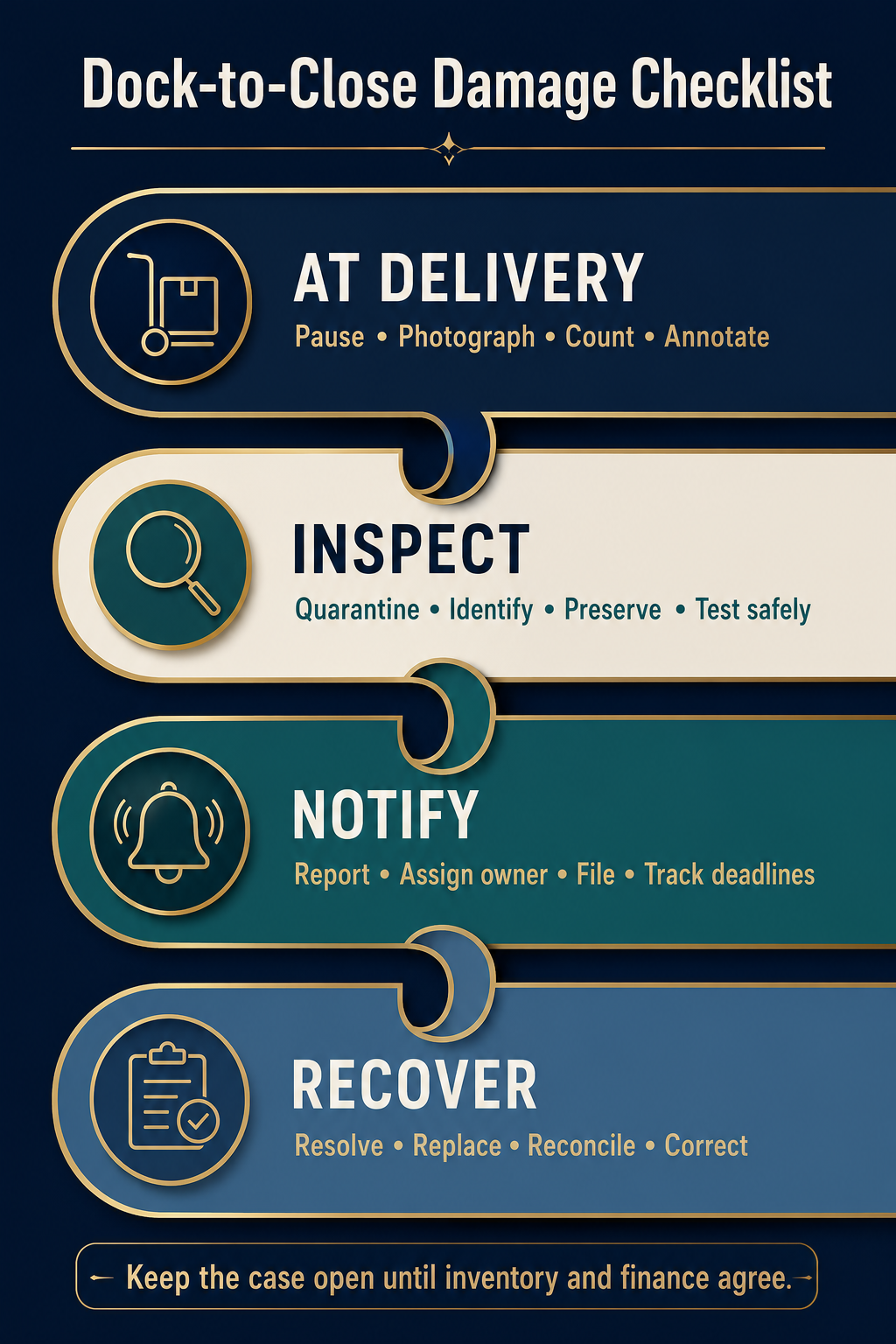
At the delivery point
- Stop unloading if the load or product presents a safety risk.
- Confirm the property, PO, supplier, carrier, tracking or PRO number, and shipment count.
- Photograph the load before straps, wrap, cartons, or pallets are moved.
- Record visible crushing, tears, punctures, water, broken seals, shifted loads, and shortages.
- Count pallets, cartons, crates, and loose pieces.
- Escalate material damage to the authorized procurement lead before signing.
- Enter specific exceptions and quantities on the delivery receipt or electronic proof of delivery.
- Obtain a copy or screenshot of the signed and annotated record.
During inspection
- Quarantine affected units and label them “Do Not Use—Damage Review.”
- Photograph packaging layers, labels, internal cushioning, product position, and each defect.
- Record SKU, model, finish, size, serial or batch number, and affected quantity.
- Compare the goods with the PO, approved specification, packing list, and sample.
- Separate visible transit damage, packaging failure, manufacturing defects, shortages, and functional failures.
- Preserve the goods and all original packaging.
- Test only when safe and authorized; do not install or repair before evidence is captured.
During notification and claim filing
- Send immediate written notice to the supplier and the transport or insurance party required by the documents.
- Inform procurement, finance, receiving, operations, and risk management as appropriate.
- Ask who is authorized to file and obtain a case or return-authorization number.
- Submit the itemized damage schedule, receipt, invoice, PO, shipping documents, photographs, and valuation.
- Record every applicable notice, filing, inspection, and response deadline.
- Obtain written instructions before moving, returning, repairing, salvaging, or disposing of goods.
During recovery and closeout
- Agree on replacement, repair, parts, credit, refund, concession, or technical inspection by item.
- Confirm replacement specification, quantity, freight, ship date, delivery date, and cost responsibility in writing.
- Activate an approved continuity plan for critical operations.
- Reconcile credits, claim payments, replacement invoices, freight, tax, and disposal or salvage.
- Inspect replacements on arrival and link them to the original case.
- Complete root-cause and supplier-performance updates.
- Close the case only when physical inventory and financial records both agree.

Frequently Asked Questions About Damaged Hotel Supplies
These answers address common decisions that are often made too quickly at the receiving dock. The controlling purchase order, carrier terms, insurance policy, shipping documents, and local law should always be checked for the specific shipment.
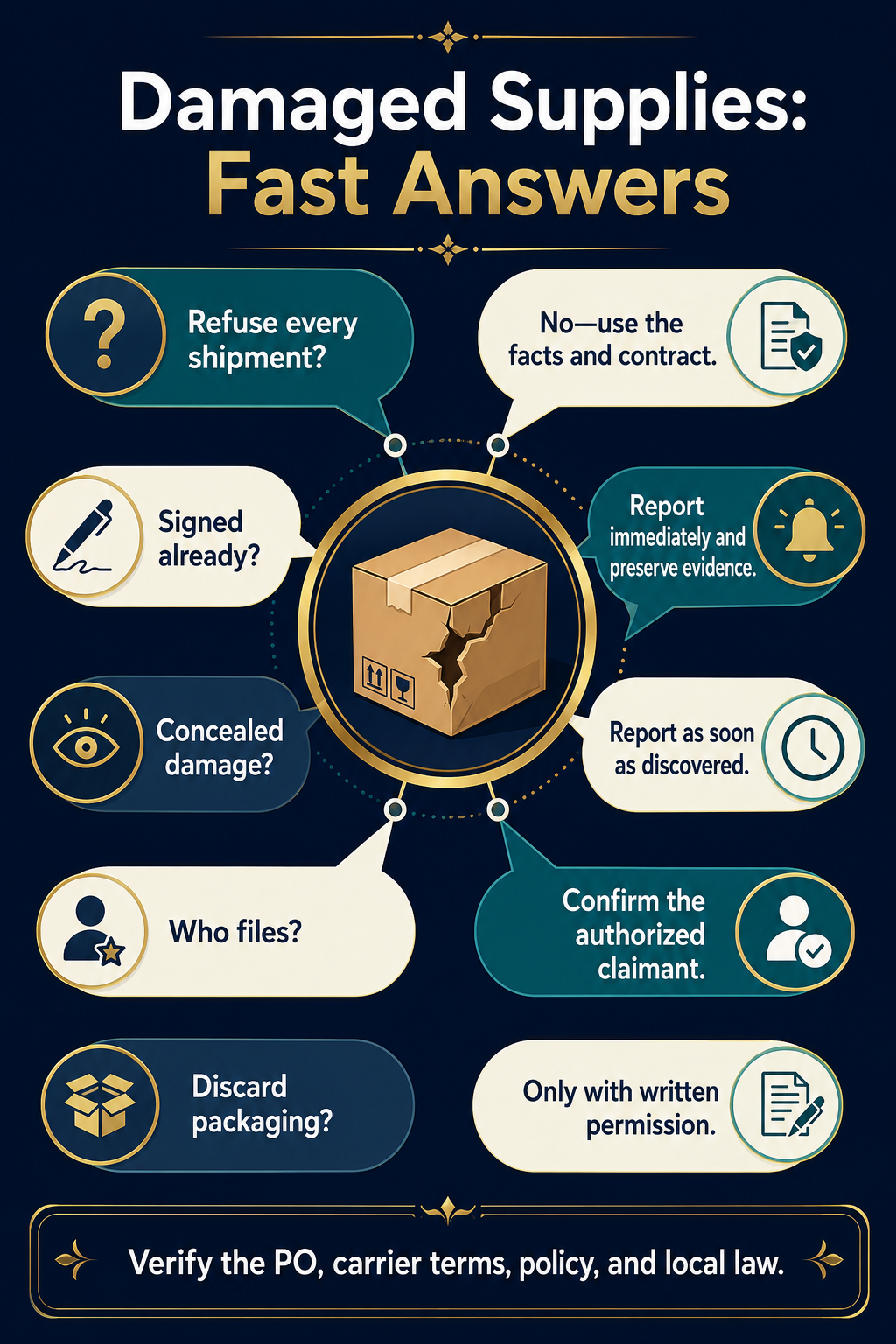
Should a hotel refuse every visibly damaged shipment?
No. Full refusal may be appropriate for an unsafe, entirely compromised, incorrect, or contractually noncompliant delivery, but partial acceptance or acceptance with detailed exceptions may better protect usable inventory. The decision should be authorized, documented, and consistent with the purchase order and carrier process.
What should the receiver write on the delivery receipt?
Write observable details and quantities: crushed or wet cartons, torn wrap, broken seals, missing cartons, damaged item codes, pallet numbers, and units refused or held. Avoid a clean signature when damage is visible and avoid vague wording that does not identify the affected portion.
Can a hotel file a claim after signing for delivery?
Possibly, especially for concealed damage or defects not reasonably discoverable at the dock, but the evidence and available remedy may be affected by the signature, contract, carrier rules, and timing. Report the issue in writing immediately, preserve packaging, document the unboxing, and verify the applicable deadline.
How quickly should concealed damage be reported?
Immediately after discovery. There is no safe universal number of days because the deadline varies by carrier, shipment type, tariff, country, contract, and policy. Hotels should verify the specific written terms and set an internal deadline that is shorter than the shortest applicable external period.
Who files the freight claim—the hotel or the supplier?
It depends on who contracted with the carrier, the account restrictions, shipping documents, risk-transfer term, and insurance arrangement. Confirm the authorized claimant in writing. Separately, preserve the hotel’s commercial notice to the supplier under the purchase order.
Can damaged goods be discarded after photographs are taken?
Not unless the responsible party gives written permission or the item must be handled under an immediate safety requirement. A carrier, supplier, surveyor, or insurer may need to inspect the goods and original packaging. If emergency disposal is necessary, document the reason, condition, method, witnesses, and retained evidence.
Should the hotel repair damaged equipment before the claim is approved?
Only when safety, loss mitigation, or business continuity requires action and the responsible parties have provided written authorization where practicable. Capture the original condition, obtain an estimate, preserve replaced parts, use qualified technicians, and document how the work affects warranty and claim value.
What if only the packaging is damaged?
Inspect the goods carefully before treating the shipment as sound. Packaging damage may indicate impact, compression, moisture, or mishandling that affected hidden components. If the product is undamaged, still record the packaging event when it may affect warranty, future failure analysis, or supplier packaging performance.

Turn a Damaged Delivery Into a Controlled Procurement Process
A damaged shipment is disruptive, but it does not need to become a confused dispute. A disciplined hotel response protects safety, evidence, inventory, cash, and the opening or operating schedule while giving suppliers and carriers the information required to act.
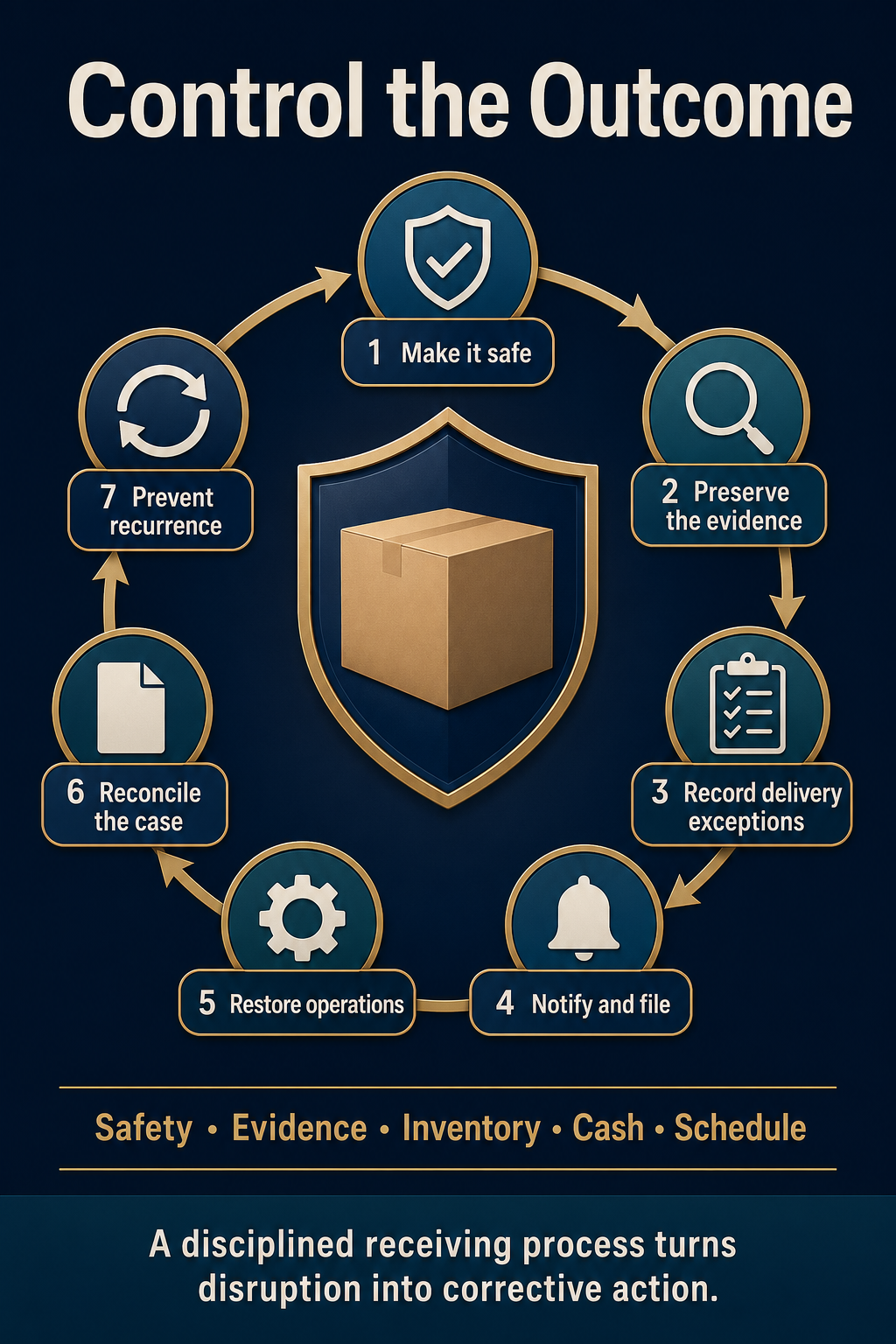
The essential sequence is simple: stop unsafe handling; document the load before it changes; identify every affected unit; annotate the delivery record; quarantine goods and packaging; notify the right parties in writing; verify deadlines and claim ownership; agree on the commercial remedy; and keep the case open until replacement inventory and financial records are reconciled.
The long-term improvement comes after the immediate recovery. Add packaging and acceptance requirements to future RFQs and purchase orders, approve packaging for fragile or high-value categories, define risk-transfer points precisely, prepare the receiving dock, train every shift, and score suppliers on damage and replacement performance. That turns each incident into evidence for a stronger sourcing decision.
If your property needs to replace damaged items or re-source a shipment with clearer specifications, packaging, delivery, and acceptance terms, submit a property-specific RFQ to KW Hospitality.